PORTRAIT OF A PRETTY WOMAN IN CHICAGO, ILLINOIS

riel 2_0001

riel-3

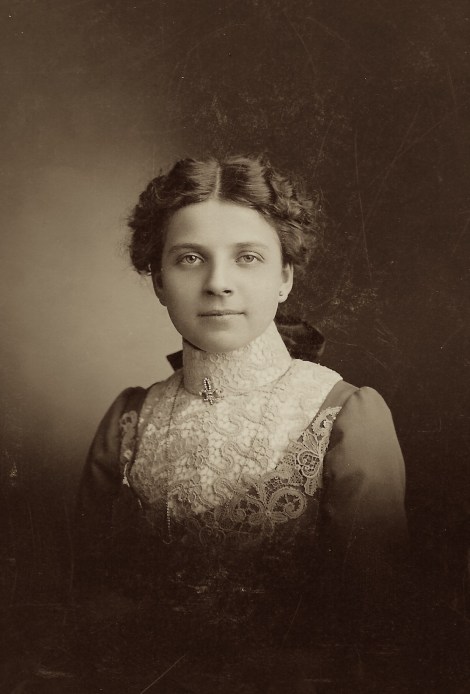
This vintage photograph features a portrait of a pretty young woman wearing a lace collar and lace bib. Note her collar pin and her lovely eyes. This photograph comes from the studio of George F. Riel of Chicago, Illinois. He was a talented photographer. You can make your own judgement about his talent by clicking on the category “Photographer: Riel”. You will be able to view more of his images and learn more about him.

Published in: on January 20, 2017 at 12:00 pm  Leave a Comment  
Tags: ,

PORTRAIT OF A YOUNG WOMAN IN PORTSMOUTH, NEW HAMPSHIRE

lighting-lady

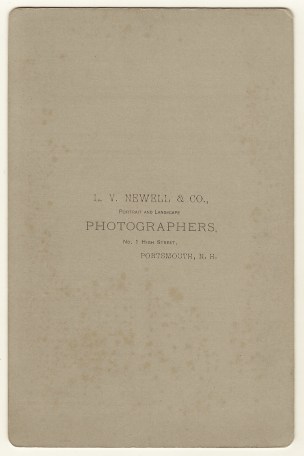
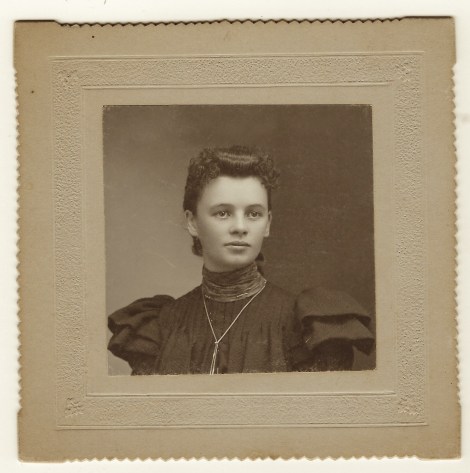
This cabinet card portrait features a lovely young woman with curly hair. She is wearing a ribbon around her neck as well as earrings and a collar clasp. The photographer’s use of lighting makes this image notable. The dark background against the woman’s white clothing makes a contrast which highlights the portrait. The young lady sort of “pops out” of the darkness. The photographer of this photograph is L. V. Newell & Company. The studio was located in Portsmouth, New Hampshire. To learn more about Mr. Newell and to view more of his images, click on the category “Photographer: Newell”. His other work in the Cabinet Card Gallery also demonstrates his mastery of lighting and his ability to create crisp and clear images.

lighting-lady-1

Published in: on January 9, 2017 at 12:00 pm  Leave a Comment  
Tags: ,

PRETTY AND CEREBRAL YOUNG WOMAN IN DES MOINES, IOWA (PHOTOGRAPHER MURDERED AND SENSATIONAL CRIMINAL CASE FOLLOWS)

pearson

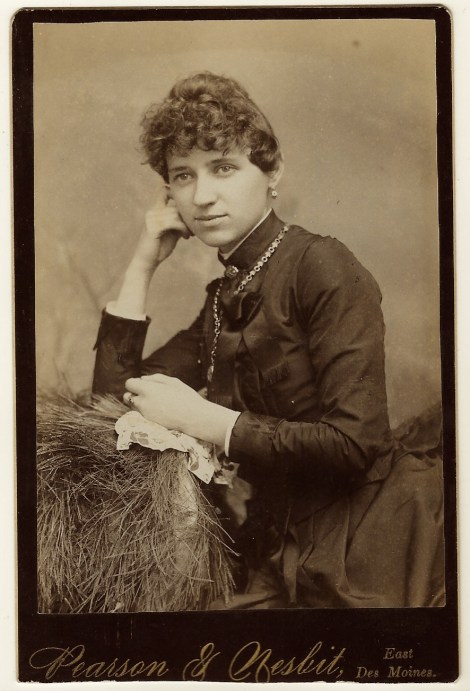
The young woman featured in this cabinet card portrait isn’t just another pretty face. She is also cerebral. Her pose indicates that she’s deep in thought. She is reasonably well dressed and wearing a necklace, ring, and a pair of earrings. Wearing all that jewelry when your standing next to a bale of hay seems a bit incongruent, but at least she is holding a handkerchief to wipe away sweat from any farm yard labor she may encounter. This cabinet card was produced by Pearson & Nesbit who operated a studio in Des Moines, Iowa. Research revealed a tragic story associated with one of these photographer partners, Oliver E. Pearson (1857-1896). The website iowaunsolvedmurders.com features an article providing details of Mr. Pearson’s murder. Nancy Bowers is the author of the article. Pearson was pushed from a height at his studio in Des Moines.  The motive for his murder was related to a business dispute. First, some biographical details about Mr. Pearson. As a boy, Oliver Pearson showed much interest and talent for drawing and photography. After high school he obtained a two year apprenticeship with Des Moines photographer George Washington Stiffler. By 1880, Pearson established his own gallery which he named Pearson’s Portraits. In addition to being a talented photographer, he also drew. Some of his art and photos were entered and won honors in art competitions. His most noted photo was that of a small dog named “Doc”. This dog was the mascot of the 23rd Iowa Infantry regiment during its participation in the civil war. In 1895, Pearson joined brothers Charles F. and Henry W. Wilcox in a business deal. Henry sold ads for a local newspaper while Charles managed the Iowa Historical Illustrative Company. The pair published the “Des Moines Illustrated Souvenir”, an elaborate pictorial volume that celebrated the people and the city of Des Moines. A page in the book was devoted to Pearson. The text begins by praising him and his work but than the writer began to denigrate him. For example, some of his work “bearing his name do not do him credit as they were made by his assistants”. It seems that there was some trouble between Pearson and the Wilcox brothers. Just months after the publication of the volume, the Wilcox brothers climbed the outside steps to enter Pearson’s second floor gallery. Pearson was the only one in the gallery to greet his visitors. The reason for the visit and what exactly happened is unknown. However, witnesses did view the end of the meeting because a pushing and shoving match occurred on the second floor landing outside the photography studio (see photo below). Oliver Pearson was seen falling over the railing down to the concrete below. He fractured his skull in the fall and witnesses carried him home and called for medical assistance. Pearson died from his injuries. Charles and Henry Wilcox were immediately arrested. The businessmen and other associates of Pearson were in an uproar about his violent demise. He was a well liked and well connected citizen. His family received much support from the community. The Des Moines Daily News reported that it was amazing that angry community members didn’t raid the jail and lynch the Wilcox brothers. What caused Pearson’s murder? Some local papers reported that the brothers had gone to visit Pearson because the photographer believed that the pair owed him money and they wanted to settle the matter. The Des Moines Daily News interviewed the brothers who claimed that Pearson started the violence and that he had lost his balance, slid down the rail and fell off the landing. Although the coroner believed that Pearson was murdered, a grand jury did not indict the Wilcox brothers due to lack of evidence. The jury could not rule out that his death may have been accidental. Pearson left behind his wife Susie and three young daughters. His widow sued the Wilcox brothers for twenty-five thousand dollars but lost the case. Research concerning Carroll E. Nesbit (1859-1949), Pearson’s partner in the studio that took this cabinet card photograph, tells a pretty tame story compared to Pearson’s sensational story. Nesbit appears in the 1880 US census as a young photographer working in Des Moines. His name also appears in several Des Moines business directories as late as 1903. By 1910 he had moved to South Hood River, Oregon where he worked as a farmer. The 1940 US Census also finds him farming in Oregon. Upon Nesbit’s death, he was buried in Idlewild Cemetery in Hood River.
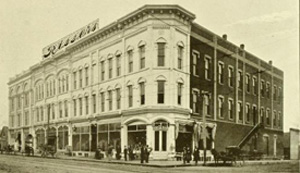
 oliver-pearson-6th-and-walnut1                                                                                                 Second Floor Landing: Site of Pearson’s Murder

PORTRAIT OF A STRIKING WOMAN IN EUGENE, OREGON

striking-woman

The young woman in this post cabinet card era photograph is strikingly attractive. She has wonderful eyes. She appears to be a teenager. The striking young lady is wearing a high collared and ruffled dress as well as a necklace. The photograph was taken at the Winter Photo Company in Eugene, Oregon. The photographer, John A. Winter was born in Ohio sometime around 1831. He was active in the photography business in Eugene between 1864 and 1869, and again between 1873 and 1900. During his career he also operated photography businesses in Albany, Brownsville, and Jefferson; all towns in Oregon.In 1864 he advertised that he intended to “devote his whole time to making pictures”. In 1865 he began his career operating photographic studios. A number of times during his career he was plagued with poor health. At one point he owned a sheep ranch in addition to a photography studio. Winter employed the bartering system in his business. One of his ads promises to trade portrait taking for firewood. From 1888 to 1900, Winter was the photographer of Oregon State University. Winter’s son, Clarence L. Winter was a photographer in Eugene between 1891 and 1906. However, a letter from C. L. Winter appears in the Photographic Times (1887) indicating that he likely began working in Eugene earlier than the aforementioned date. It is not clear whether John A. Winter or Clarence L. Winter is the photographer who produced the picture of this lovely young woman. Perusing the Cabinet Card Gallery’s collection of photographs by Mr Winter, it is clear that he had photographic talent. This photograph measures about 4 1/4″ x 4 1/2″. To view other photographs by Winter, click on the category “Photographer: Winter”.  (SOLD)

striking-woman-1

PORTRAIT OF A PRETTY WOMAN WITH MUSSED HAIR IN JOHNSTOWN, NEW YORK

johnstown

This cabinet card portrait features a pretty young woman wearing a dark dress full of distractions. The buttons on the dress are quite prominent and she is also wearing a collar jewelry and a corsage. Hanging from her chain necklace is a ring. One can hypothesize that the ring belongs to her husband or her beau. The woman’s hair is mussed but I imagine that we are looking at a hairstyle and not laziness or apathy on her part. This photograph was taken at the Kibbe studio in Johnstown, New York. William H. Kibbe (1846-1910) was born in Johnstown. As a school student he exhibited a great deal of talent via his pen and pencil sketching. He then worked briefly as a paint shop decorator but soon found more satisfying work at the studio of renowned engraver Vistus Balch. While working there he assisted in the production of engravings from drawings by Felix Octavius Carr Darley who was famous for his illustrations appearing in Charles Dickens’ novels. During this time Kibbe became acquainted with Napoleon Sarony’s portraits which contributed to his becoming an apprentice with photographer James F. Ryder. From this apprenticeship, Kibbe learned about every aspect of operating a photography studio and in 1871 he opened his own studio at 123 West Main Street in the “Kibbe building”.  His studio was decorated with his own oil and watercolor paintings and he was often joined there by his wife and son (Arthur Fonclair Kibbe) who would assist him. Kibbe was a major contributor to several photographic journals. His obituary appears in Wilson’s Photographic Magazine (1910). A portrait of Mr. Kibbe can be seen below.

datasheet_3091_datasheet_image1

Published in: on November 17, 2016 at 12:00 pm  Comments (3)  
Tags: , , ,

ATTRACTIVE YOUNG AFRICAN AMERICAN WOMAN IN APPLETON, WISCONSIN

ross-lady

This is a wonderful cabinet card portrait of a pretty young woman. The photograph features a great deal of uncertainty. The individual who formerly owned this image claimed that the subject is African American. In my opinion, the claim is debatable. One of the issues relating to some cabinet card images of African Americans is this very question. Some collectors and dealers sincerely believe they possess a portrait of an African American while others dishonestly make the claim in order to increase the value of the photograph. This particular image presents another interesting and debatable subject. The previous owner also claimed that this photograph is a memorial cabinet card. In other words, the photograph was made in honor of this young woman upon her death (not a post-mortem photo). The placement of the woman’s image inside a scroll, or whatever the shape represents, is the alleged tip off that it is a memorial photograph. I have seen experts provide conflicting opinions about such claims. Lets talk about what we do know. This young and attractive woman is making an interesting fashion statement. Her dress has little squares of fabric attached to it in what appears to be a haphazard manner. She is wearing a horseshoe collar pin and a thin necklace. If this photo is a memorial cabinet card, then the horseshoe certainly didn’t provide her with good luck. She is wearing her hair up. The photographer of this cabinet card is William T. Ross (1861-1945) who operated a studio in Appleton, Wisconsin. Ross appears in “Wilson Photographic Magazine” (1898) in an article that reports that he was elected Treasurer of the Convention of Wisconsin Photographers. Ross has a presence in a number of Appleton city directories from 1889 through 1934. He was born in Syracuse, New York and was married to Ella A. Ross. The edges of this cabinet card are scalloped and gold gilded. The reverse of the cabinet card has a ghost image (see below). The image was likely formed by the rear of the cabinet card being pressed against the front of another image while occupying a frame or album.  SOLD

ross-lady-2

Published in: on November 7, 2016 at 3:01 pm  Comments (6)  
Tags: ,

PORTRAIT OF A LOVELY FASHIONISTA (VINTAGE REAL PHOTO POSTCARD)


fashion-lady-3

A highly fashionable and pretty young woman poses for her portrait at an unidentified studio. She is wearing two bracelets, a ring, and a what looks to be, a strand of pearls. She certainly knows how to wear a hat and not hide her beauty. This is a vintage real photo postcard produced by a private studio. The card’s stamp box indicates that the  postcard stock was produced by Crown Studios sometime between 1913 and 1929.

fashion-lady-2

Published in: on September 28, 2016 at 12:00 pm  Leave a Comment  
Tags:

PORTRAIT OF A PRETTY TEENAGER IN WATERFORD, WISCONSIN

grundseth

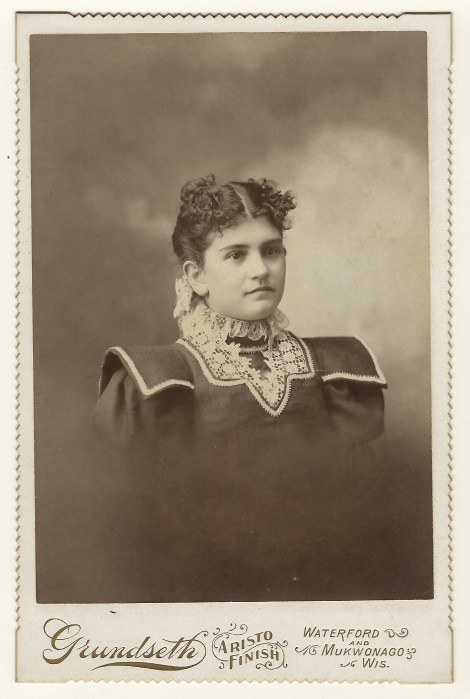
This cabinet card features a pretty young woman, probably a teenager, posing for her portrait at the Grunseth studio in either Waterford or Mukwonago, Wisconsin. The subject is well dressed with a fancy collar and choker. The Wiconsin Photographers Index, published by the Wisconsin Historical Society lists two photographers named Grundseth in the Waterford/Mukwonago area. One of these men is the photographer who took this photograph. Christ. Grundseth operated a studio in Mukwonago and Waukesha beginning 1895. G. Grundseth had a studio in Waterford between 1893 and 1898. Whichever Grundseth produced this photograph, he did an excellent job of capturing this young woman’s beauty and personality.

grundseth 1

Published in: on August 20, 2016 at 8:05 am  Leave a Comment  
Tags: , ,

A FASHIONABLE WOMAN AND HER PARASOL IN ST. CATHARINES, ONTARIO, CANADA

ontario

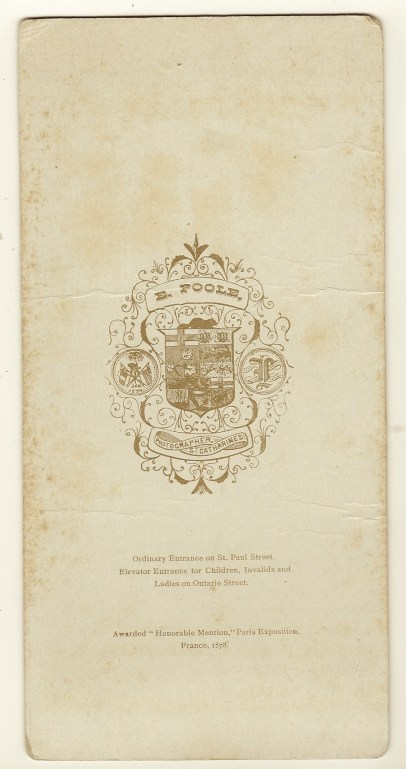
A fashionable woman holding a parasol poses for her photograph at the Poole studio in St. Catharines, Ontario, Canada. She is wearing a lot of jewelry; her earrings, collar pin, ring, and a chain on her jacket are quite evident. She is also wearing half gloves and holding a purse. The woman is exhibiting an “all business” expression. Printing on the reverse of the cabinet card notes that the studio was located on St. Paul Street and the studio had received an “Honorable Mention” award at the Paris exposition in 1878. Edwin Poole was born in Abington, England and educated in London. He emigrated to Canada in 1866 and moved to St. Catharines in 1876. In 1900 he opened a photography studio. His work was published in the Toronto Globe and he won many photographic awards during his career. He retired in 1921 and died in St. Catharines in 1931. I believe the image below is a portrait of Edwin Poole. To view other portraits by this photographer, click on the category “Photographer: Poole”.  (SOLD)

ontario 1

cropped Poole

PRETTY YOUNG WOMAN WEARING ROSES IN DENVER, COLORADO

bellsmith

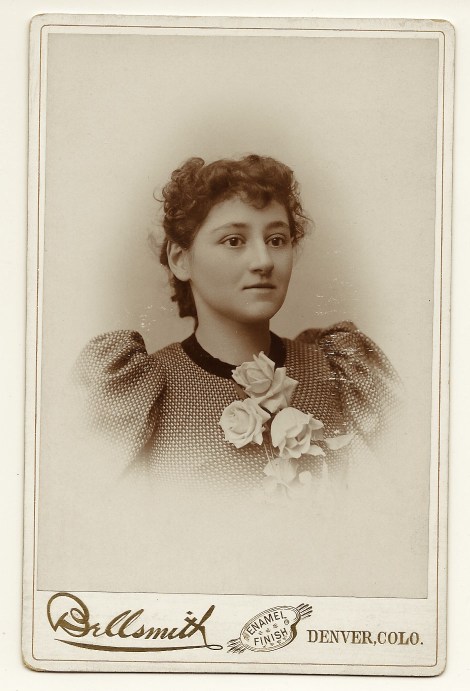
A pretty young woman with smiling eyes poses for her portrait at the Bellsmith Studio in Denver, Colorado. She appears to be in her teenage years. She is wearing a lovely dress and a corsage of roses. The photographer of this image is Harold S. Bellsmith. At one point his business was known as Gold Medal Studio. Bellsmith is listed as a photographer in the Denver business directory from 1890 through 1898. The Photographic Times (1890) announced the opening of his Denver studio. The Photographic Times (1892) reported that Bellsmith experienced a great deal of success as a “high class” photographer. If this cabinet card represents the quality of his work, than he was a talented photographer.          SOLD

bellsmith 1

Published in: on June 21, 2016 at 3:34 pm  Leave a Comment  
Tags: , ,