This vintage real photo postcard features a lovely uniformed Salvation Army couple. Note the man and woman’s “S” pin worn on their collars. The woman’s wire rimmed glasses are similar to the wire rims in style today. The Salvation Army was established in 1865. It began in London, England. Today, the Christian charitable organization has 1.7 million (Salvationists) in 131 nations. The “AZO” stamp box on the reverse of this photo postcard indicates that it was published sometime between 1910 and 1930. The image is a studio photo. This postcard portrait is in excellent condition (see scans).
Buy this Vintage Real Photo Postcard (includes shipping within the US) #3159
To purchase this item, click on the Pay with PayPal button below
$27.50
Buy this Vintage Real Photo Postcard (includes International shipping outside the US) #3159
To purchase this item, click on the Pay with PayPal button below
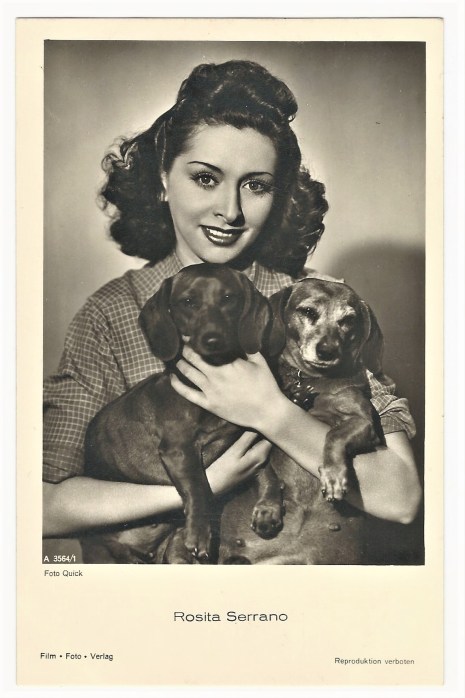
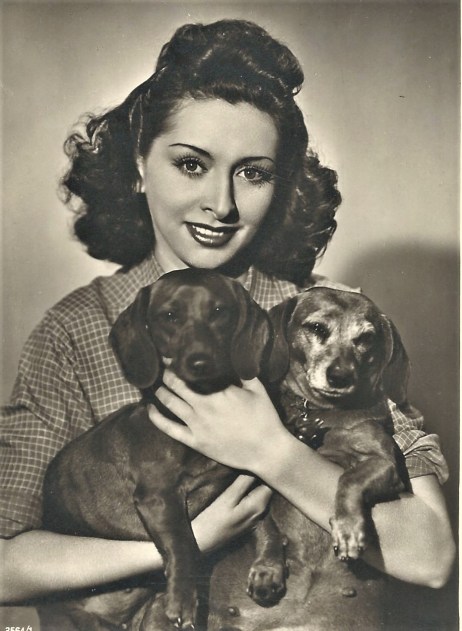
This vintage real photo postcard features pretty actress and singer, Rosita Serrano (1912-1997 . She is casually dressed and is holding two adorable dachshunds. This photo portrait displays Rosita’s lovely smile. Serrano was a Chilean singer who obtained her major success in Nazi Germany between the 1930’s and the early 1940’s. Her singing was known for her bell-like voice and her pitch-perfect whistling. She was known by her nickname as “The Chilean Nightingale”. Rosita was born in Chile. Her father was in the diplomatic corps and her mother was a popular opera singer. The family lived in Portugal and France . By 1936, the family moved to Berlin. Serrano’s initial success was in the Wintergarten and the Metropol Theater where she sang Chilean folk songs. This performance earned her a record contract. From that point, she performed in German. Many of her songs became very popular. In 1938, she began to appear in films. When she was between film roles, she toured with two popular dance orchestras. Minister Joseph Goebbels helped het her appearances on a Wehrmacht (military) radio show. In 1940, Serrano’s song “La Paloma”, became very popular throughout Germany. Serrano’s voice style is described as “coloratura soprano”. Her recordings were in German and Spanish. She sang songs in the folk and pop genre. Her songs included flamenco, rumba, tango and mambo. During a Swedish tour in 1943, she did a benefit concert for Jewish refugees. As a result of this performance, she was accused by Germany of being a spy. Rather than return to Germany and face possible arrest, she fled to Chile. Germany than banned her music. She went on tour to the United States but was not well received. It is conjectured that US citizens could not get enthusiastic about hearing Serrano’s German songs, so close to the end of World War II. She returned to West Germany to appear in films in 1951 and 1952. Besides those two movie roles, her German comeback was unsuccessful. She returned to Chile where she lived out her life. She was not welcomed upon her return to her native country. The public in Chile condemned her for performing in Nazi Germany. She died in poverty. It seems to me that Serrano had the unfortunate pattern of consistently being in the wrong place at the wrong time. Poor timing ruined this talented singer’s career. Serrano’s filmography includes 8 films between 1938 and 1952. This postcard was published by Film Foto Verlag, a subsidiary of UFA Universum Film AG. Note the company’s horse logo on the reverse of the card. The photo was taken by Foto Quick and the postcard is part of a series (no. A3564/1). Check out the video recording of Miss Serrano seen below. This real photo postcard is in very good condition.
This cabinet card portrait features a well-dressed pretty young woman. Her high collared dress includes lots of lace. She is wearing a serious expression. She appears to be in her teenage years or slightly older. This photograph was taken by the Beckford Photo, a studio located in Boston, Massachusetts. David C. Beckford received mention in the book, “Boston: Its Commerce, Finance, and Literature”. His studio is described as a leading photo studio in the country. The business was established in around 1872 as the Chickering Photo Company. The proprietor, Walter E. Chickering (not to be confused with Elmer Chickering, a well respected Boston photographer of the era) was a notorious swindler. He was especially known for his dishonesty and blatant resistance to paying his bills. Walter must have been a tough boss to tolerate. Beckford took over the business in 1888. Beckford’s establishment employed four assistants. Beckford was a native of Jamaica. He came to Boston in about 1872 and worked for Chickering for several years. According to one source, Beckford operated a Hardware business in Jamaica, at least part of the time, while he ran his photo studio in Boston. A Massachusetts directory of photographers asserts that Beckford was active as a photographer until 1909. Beckford is cited in an article appearing in the “Southern Workman” (1909). The title of the article was “Improvement in Housing Negroes in the North”. The writer states that Beckford had recently returned from a business trip to Jamaica where he directed the rebuilding of his properties; and reestablished his hardware business which had been destroyed in an earthquake. The “Southern Workman” article was the first reference that I found that indicated that David C. Beckford was a Black man. Examining the 1900 US census data provided confirmation that Beckford was indeed a Black man. Census data conflicted with other legal documents in regard to where Beckford was born. It appears he was born in either England or Jamaica. He was born in 1856 and immigrated to the United States in 1872. He married Elvira P. Gott in 1881. She was a Black woman born in Massachusetts. She was close in age to Beckford. Photographs by Black photographers are not common, making this image a great find. This cabinet card portrait is in fair condition (see scans). Note the presence of peeling along the left and bottom border of the card mount. The image itself has excellent clarity and is in good condition. (SOLD)
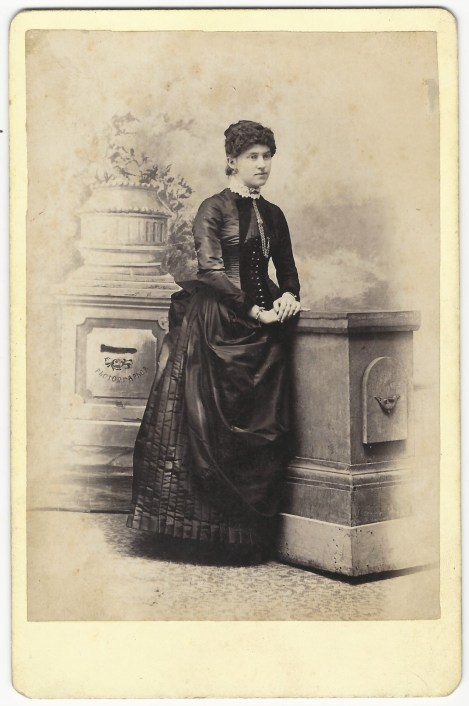
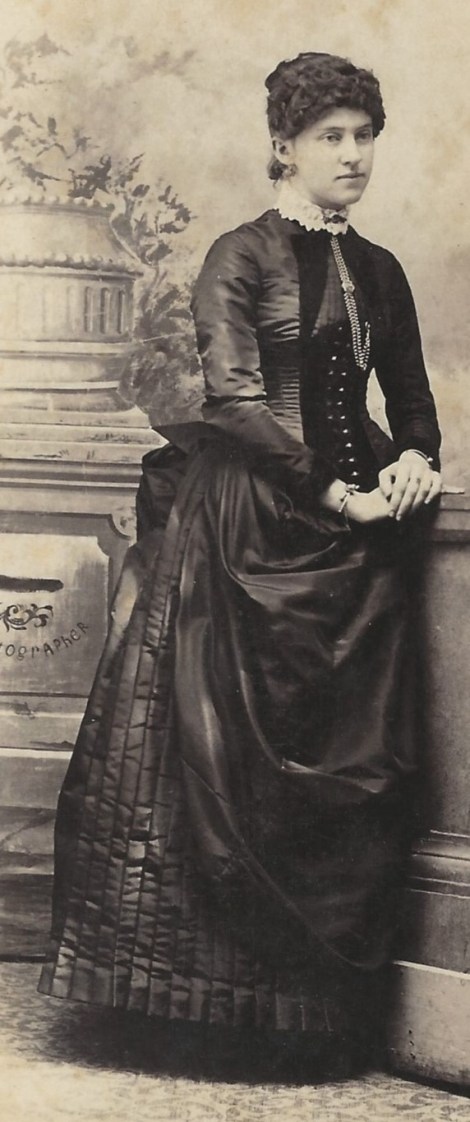
This early cabinet card full portrait features a pretty young woman wearing a long and fancy dress. The photographer’s name who produced this photograph is on the wall behind the subject and the name is crossed out. Why the name is blacked out is a mystery. Perhaps the studio was recently purchased and the old photographer’s name was on the wall. Most cabinet cards advertise the photographer’s name and location on the bottom or the reverse of the card. This is the first time I’ve seen the name of a studio incorporated into the image. It certainly is a creative mode of advertising. (SOLD)
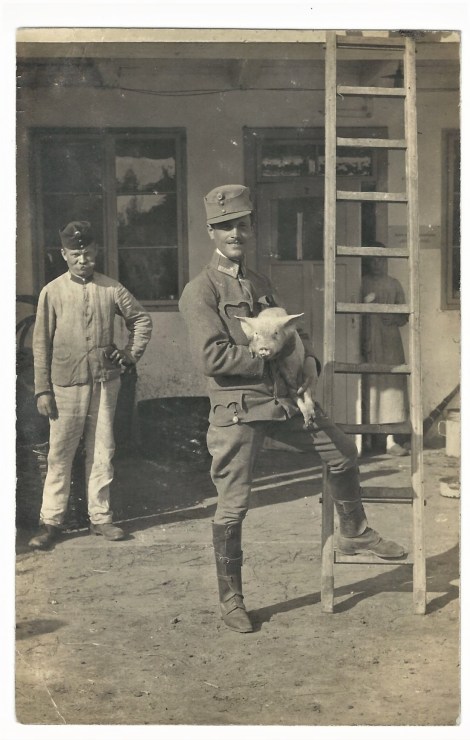
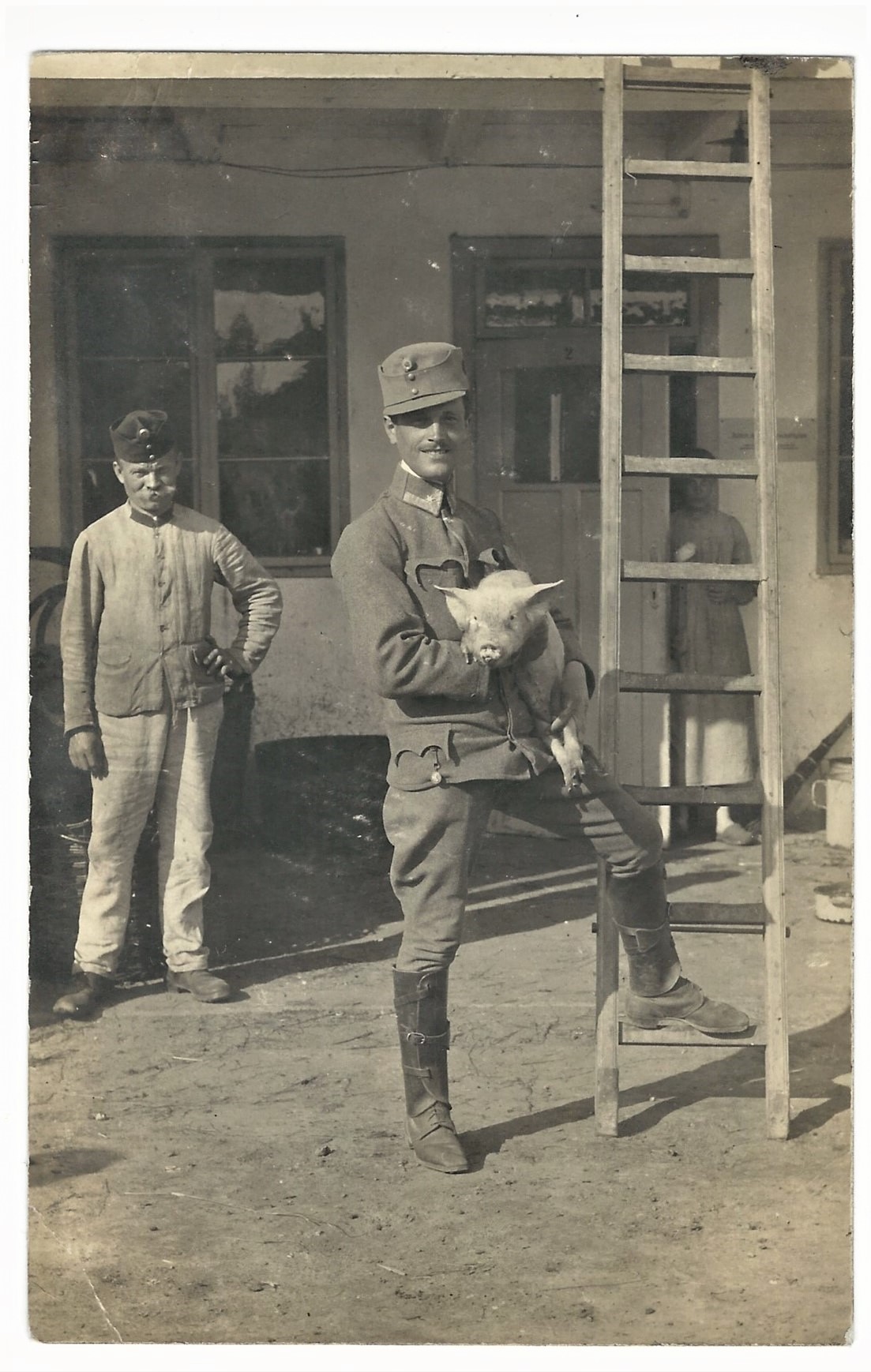
This vintage real photo postcard features a uniformed World War I soldier holding a piglet in his arms. The soldier’s smile makes me nervous. Does he have some culinary plans for this cute pigling? The soldier has two observers. A mustachioed military man stands behind him and a woman is peering through a doorway at the soldier with the pig. The piglet carrier is wearing a pin on his lapel. Is he an officer? What country does he represent? My guess is that he is a member of the Austro-Hungarian military. It is just my best guess based on insufficient research. This postcard is in good condition (see scans).
Buy this Vintage Real Photo Postcard (includes shipping within the US) #3156
To purchase this item, click on the Pay with PayPal button below
$28.50
Buy this Vintage Real Photo Postcard (includes International shipping outside the US) #3156
To purchase this item, click on the Pay with PayPal button below
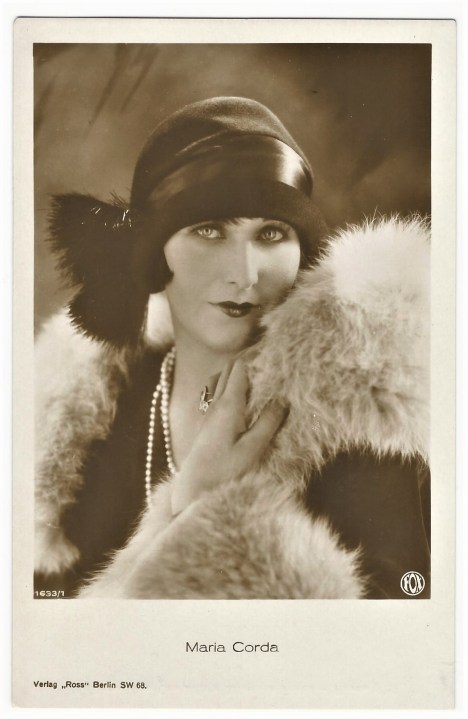
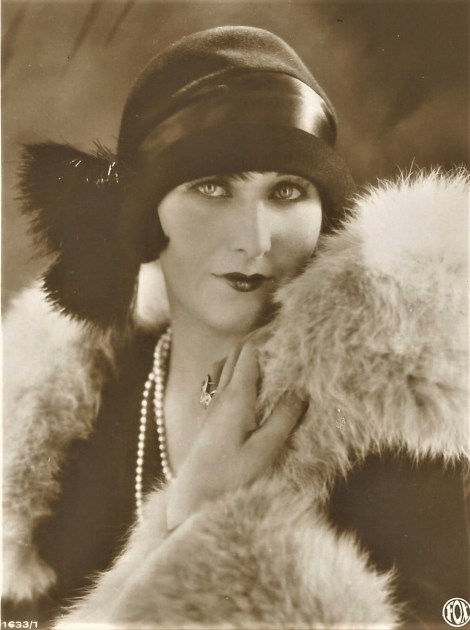
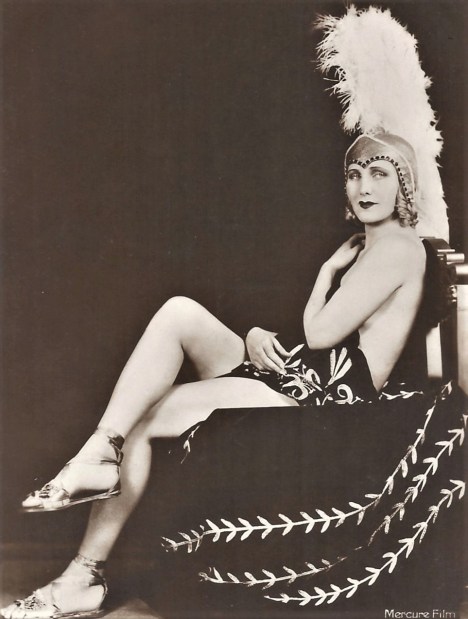
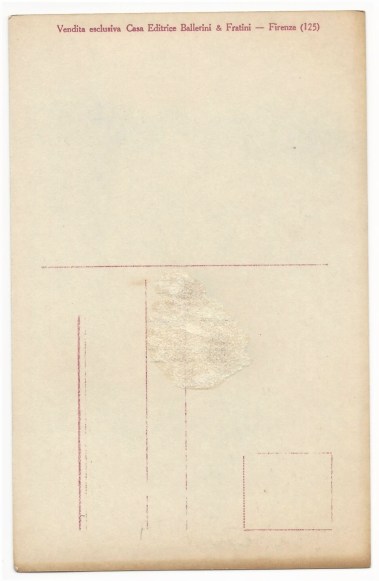
Maria Corda (1898-1976) was a Hungarian actress and a star during the silent film era in German and Austria. She began her career in acting in the theaters of Budapest during the beginning period of World War I. One of her gigs was working as a dancer with the Royal Opera in Budapest. When the Austria-Hungary Empire fell apart, she began working in the film industry. She appeared in her first film in 1919 ;under the direction of Hungarian, Korda Sandor, who later changed his name to Alexander Korda. Korda was the leading movie director in Hungary and he featured her in three of his films in 1919. Maria became the most famous actress in Hungary. Hungary’s leader had Alexander seized by the secret police. Maria and her brother-in-law exerted pressure on the British Military consulate and was able to get her husband freed. The couple fled Hungary and settled in Vienna, Austria. It was in Vienna that the pair changed their names. He became Alexander Korda and she, for some unknown reason, became Maria Corda. In 1920, Alexander began directing films in Austria and Maria became an Austrian silent screen star. Alexander directed Maria in a number of films including “Samson and Delila” (1923). In 1926, the couple moved to Germany the couple teamed up again and were able to continue their film career success. The caught the attention of First National, a Hollywood movie studio. Alexander and Maria were offered a package deal to come to American and make movies. They settled in Beverly Hills. Maria did not encounter the success that she had in Europe. Her Hollywood career aspirations were crushed in 1928 by the advent of sound pictures. She knew little English and had a thick accent. In addition to her movie career, her turbulent marriage also came to an end. They divorced in 1930. Her husband returned to Europe where he had a long successful career in British filmmaking. Maria moved to New York and wrote a number of novels. She spent her later years in Switzerland. In 1942, her husband was knighted and she insisted upon being called “Lady Korda”, even though Alexander was remarried. When Alexander died in 1956, he was onto his third marriage, but that did not stop Maria from trying to claim an inheritance. Maria had an interesting personality. Writers have asserted that she was temperamental and ambitious. She had a tendency to embellish her background. She often described herself as the “Hungarian Garbo”, an opinion reflecting aggrandizement. The IMDb reports that Maria had 28 film credits between 1919 and 1929. —–Postcard 1 was published by Ross Verlag (Berlin), The card was part of a series (no.1633/1). Note the “Fox” logo on the bottom right hand corner of the image. Maria starred in a Korda film for a Berlin based subsidiary of Fox in 1926. Therefore, this postcard is likely from 1926. The film was entitled “Madame Wants No Children”. The postcard was sold exclusively by Ballerini & Fratini of Florence, Italy. SOLD —–Postcard 2 was published by “Europe” which I believe was based in France. It is part of a series (no.315). This photograph of Corda is risque. She is barely covering herself with what appears to be a blanket. Only her strategically placed arm shields her from crossing the risque border. At the time that this photograph was taken, Maria Corda was under contract with Mercure Film. The logo of the company can be seen in the lower right corner of the card. This photo postcard features Corda in costume for her starring role in “The Private Life of Helen of Troy (1927). The film was directed by her husband, Alexander Korda. (SOLD)
This vintage photograph is a portrait of actress, Faye Dunaway (1941-). The photo captures Dunaway in her role as a television executive in the film “Network”. Dunaway came away from the movie with an Academy Award (Best Actress). “Network” (1976) was a satirical drama. It was written by Paddy Chayefsky and directed by Sidney Lumet. Dunaway was born in Florida but because her father was an Army officer, she lived in a number of places in the US and in Europe. During her childhood she took dance, piano and singing lessons. She attended a number of colleges, but graduated from Boston University with a degree in theater. Soon after graduation, she appeared on Broaday in the drama “A Man for All Seasons”. She then appeared in a number of other theater productions. Her film debut was in “The Happening” (1967). She played the role of Bonnie Parker in the film, “Bonnie and Clyde” (1967). She got the role despite the initial objections of co-star Warren Beatty. She was nominated for “Best Actress” by the Academy Awards. The film made her into a star. Her next film “The Thomas Crown Affair” (1968) also was a hit. She received great reviews. Other film roles included “Little Big Man” (1970), “Chinatown” (1974), “The Towering Inferno” (1974). and “Mommie Dearest” (1981). The IMDb reports that Dunaway appeared in 115 television and film roles. The IBDb reveals that Dunaway appeared in five Broadway plays between 1961 and 1982. Dunaway’s personal life was somewhat unstable. Perhaps it was not more stable because of her many changes in residence during her father’s military career? In 1962 she had a year long relationship with comic Lenny Bruce. In 1968 she began a two year relationship with married actor Marcello Mastroianni. In 1974 she married Peter Wolf, the lead singer of “The J. Geils Band”. In 1977 she and Wolf were photographed by photographer Terry O’Neill who was working for People Magazine. O’Neill became her second husband in 1983. After her divorce from O’Neill, she had a number of other significant relationships. Interestingly, both of her marriages were of four years duration. This vintage photo was a press photo. It helped promote the film “Network. The photo is in excellent condition (see scans).
Buy this Vintage Press Photo (includes shipping within the US) #3152
To purchase this item, click on the Pay with PayPal button below
$24.00
Buy this Vintage Press Photo (includes International shipping outside the US) #3152
To purchase this item, click on the Pay with PayPal button below
This vintage real photo postcard features two well dressed young men sitting on what appears to be rails of a fence. The gentleman on the lower rail is wearing a suit that is swimming on him. The suit is so over sized that it likely belonged to the studio, and was borrowed by the young man for the photograph. The Cyko stamp box indicates that this postcard dates to sometime between 1904 and the 1920’s. SOLD
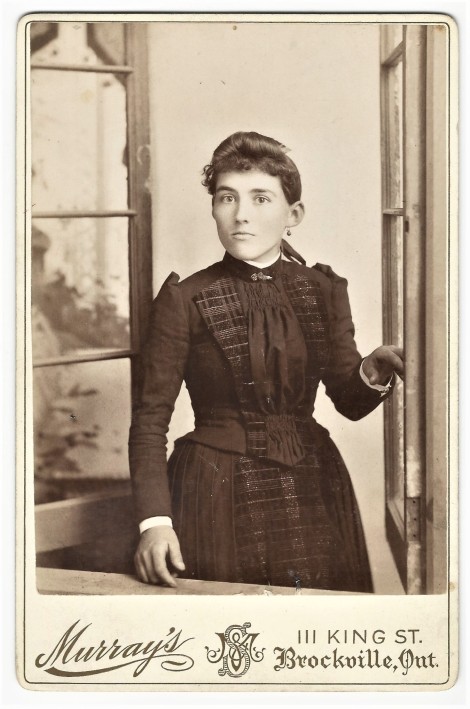
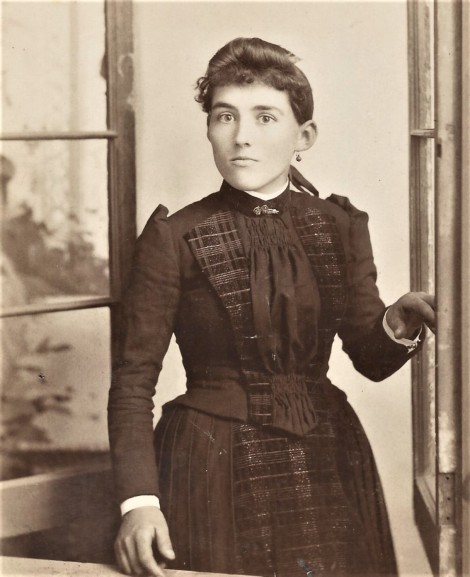
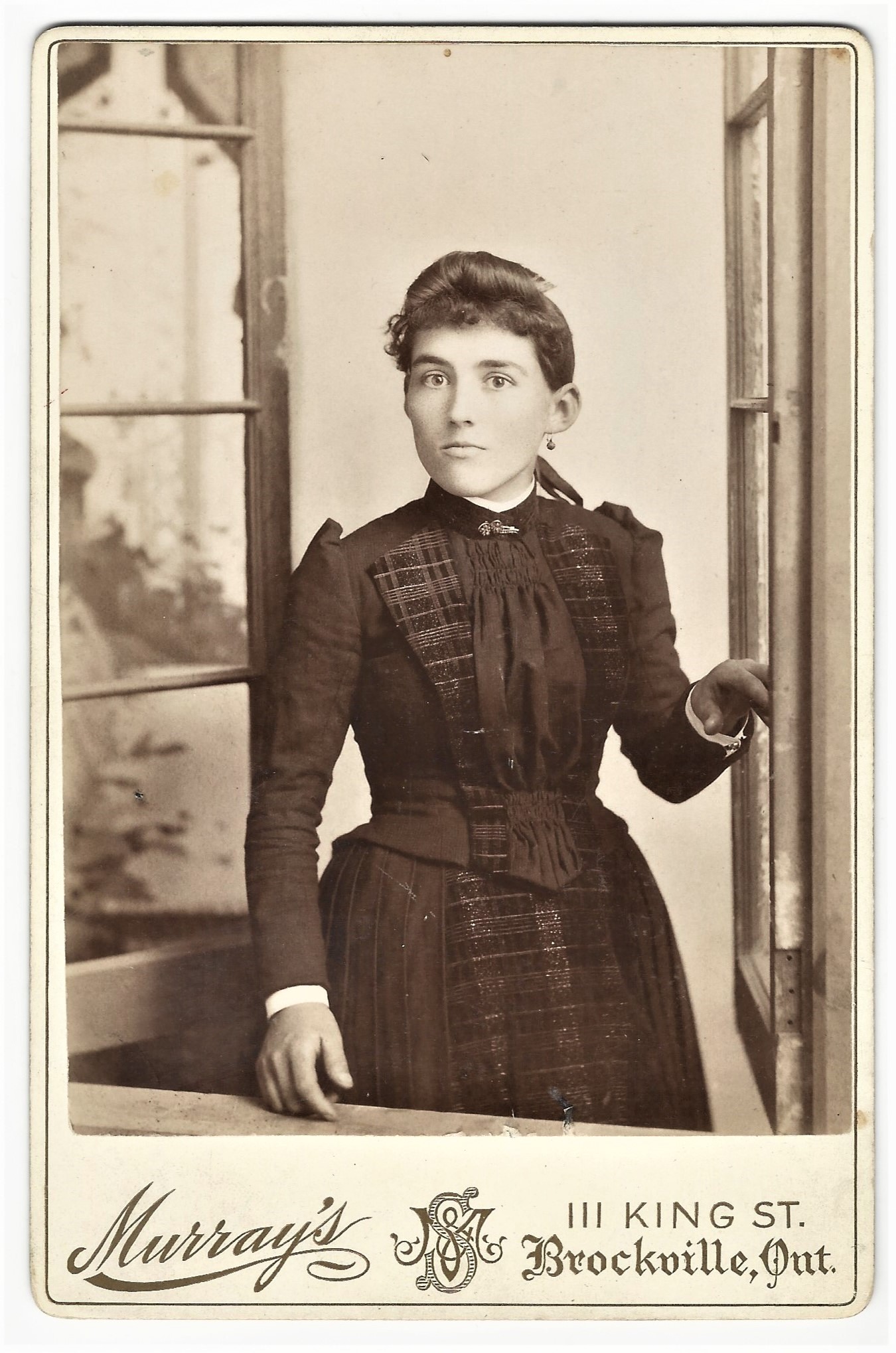
This cabinet card portrait features a girl peering out a large open window. She appears to be in her teenage years. The young lady is well dressed and well coiffed. She is wearing earrings, a collar pin, and a solemn expression. This photograph was taken at Murray’s studio, located in Brockville, Ontario, Canada. I located a blog, “The Brockville History Album” (Curated by Doug Grant) which may shed some light about the photographer. The site exhibits early photographs (circa 1880) of two of Brockville’s churches. The credited photographer was George B. Murray. At one point in time, George was partners with his son, Alex L. Murray. They operated a studio named “Murray & Son”. Alex was also known for being one of the founding members of the Brockville Cycling Club. A studio photo of Alex atop a high-wheel bicycle can be found on the afore mentioned Brockville history site. George Murray purchased the photo studio from A. C. McIntyre in 1869. He and his son were natives of Montreal. Alex, according to a business directory, was one of the most popular young men in Brockville. He was active in a number of athletic organizations. His involvement included participation in the town’s lacrosse, snow shoe, and toboggan clubs. Brockville is a city in Eastern Ontario. It is located in the Thousand Islands region. This cabinet card has excellent clarity and is in excellent condition (see scans).
Buy this Original Cabinet Card photograph (includes shipping within the US) #3148
To purchase this item, click on the Pay with PayPal button below
$25.00
Buy this original Cabinet Card Photograph (includes International shipping outside the US) #3148
To purchase this item, click on the Pay with PayPal button below
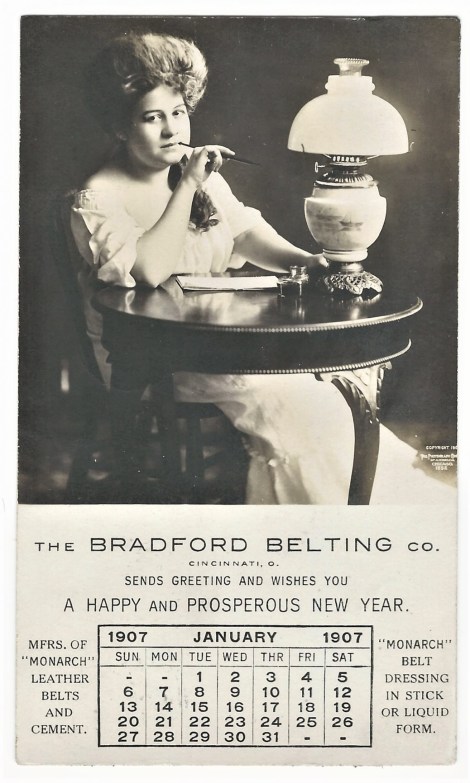
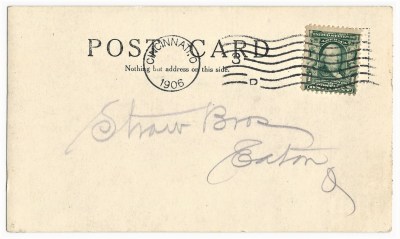
This vintage real photo advertising postcard served as a New Year’s greeting card. The postcard provided a January, 1907 calendar and provided wishes for a happy and prosperous new year. The postcard advertised the Bradford Belting Company as the manufacturer of “Monarch Leather Belts and Cement”. In addition, the postcard hawks “monarch belt dressing” which came in stick or liquid form. The card has a Cincinnati postmark from the year 1906. The addressee on the card, presumably one of Bradford’s customers, is the firm, Straw Brothers which was located in Easton, Ohio. Preliminary research yielded little information about the Bradford company. The Motor Way (1907) reports that Pope Motors built a business car (open delivery wagon) for Bradford. The photograph on this advertising postcard features a pretty woman writing a letter by lamplight. Using female models to sell products in male dominated industries or areas of interest, is a practice that continues today. The card was published by the Photographic Company of America, located in Chicago, Illinois It is numbered 1552. This vintage postcard is in very good condition (see scans).
Buy this Vintage Real Photo Postcard (includes shipping within the US) #3149
To purchase this item, click on the Pay with PayPal button below
$25.50
Buy this Vintage Real Photo Postcard (includes International shipping outside the US) #3149
To purchase this item, click on the Pay with PayPal button below
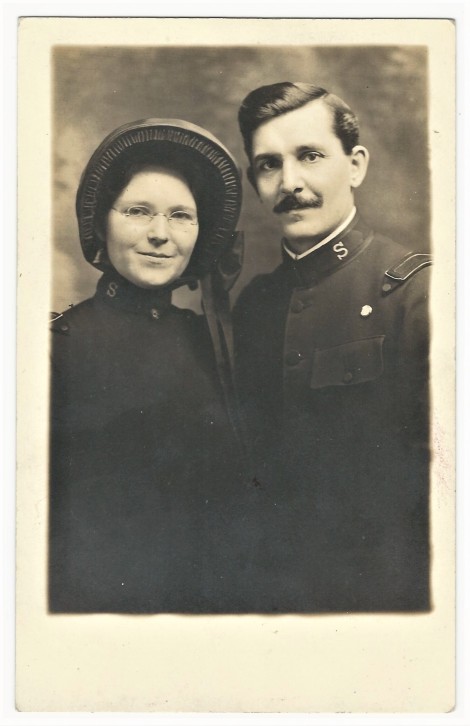
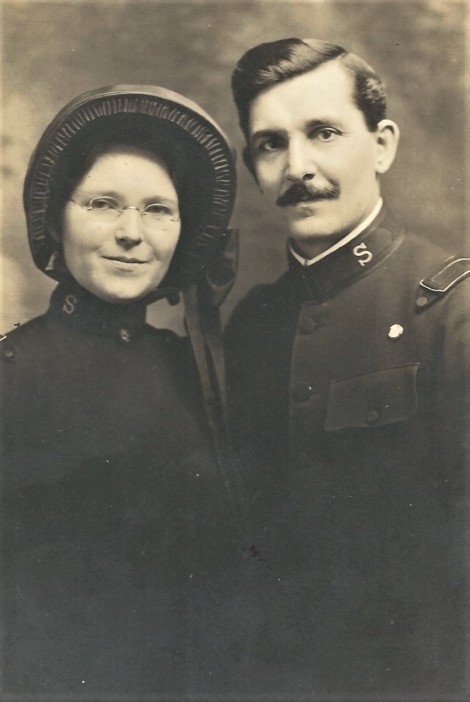 This vintage real photo postcard features a lovely uniformed Salvation Army couple. Note the man and woman’s “S” pin worn on their collars. The woman’s wire rimmed glasses are similar to the wire rims in style today. The Salvation Army was established in 1865. It began in London, England. Today, the Christian charitable organization has 1.7 million (Salvationists) in 131 nations. The “AZO” stamp box on the reverse of this photo postcard indicates that it was published sometime between 1910 and 1930. The image is a studio photo. This postcard portrait is in excellent condition (see scans).


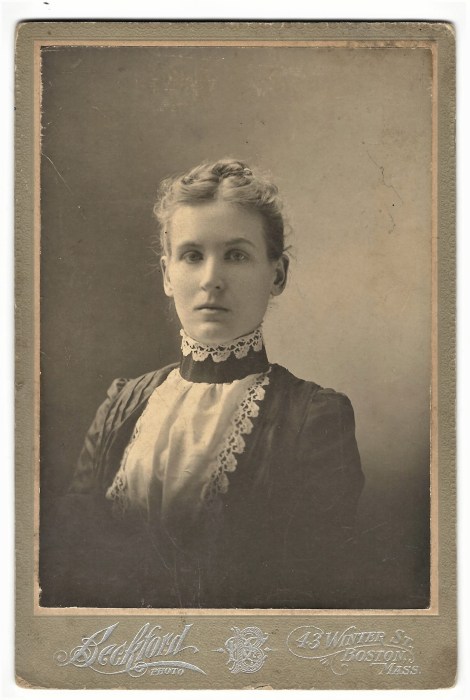
 This cabinet card portrait features a well-dressed pretty young woman. Her high collared dress includes lots of lace. She is wearing a serious expression. She appears to be in her teenage years or slightly older. This photograph was taken by the Beckford Photo, a studio located in Boston, Massachusetts. David C. Beckford received mention in the book, “Boston: Its Commerce, Finance, and Literature”. His studio is described as a leading photo studio in the country. The business was established in around 1872 as the Chickering Photo Company. The proprietor, Walter E. Chickering (not to be confused with Elmer Chickering, a well respected Boston photographer of the era) was a notorious swindler. He was especially known for his dishonesty and blatant resistance to paying his bills. Walter must have been a tough boss to tolerate. Beckford took over the business in 1888. Beckford’s establishment employed four assistants. Beckford was a native of Jamaica. He came to Boston in about 1872 and worked for Chickering for several years. According to one source, Beckford operated a Hardware business in Jamaica, at least part of the time, while he ran his photo studio in Boston. A Massachusetts directory of photographers asserts that Beckford was active as a photographer until 1909. Beckford is cited in an article appearing in the “Southern Workman” (1909). The title of the article was “Improvement in Housing Negroes in the North”. The writer states that Beckford had recently returned from a business trip to Jamaica where he directed the rebuilding of his properties; and reestablished his hardware business which had been destroyed in an earthquake. The “Southern Workman” article was the first reference that I found that indicated that David C. Beckford was a Black man. Examining the 1900 US census data provided confirmation that Beckford was indeed a Black man. Census data conflicted with other legal documents in regard to where Beckford was born. It appears he was born in either England or Jamaica. He was born in 1856 and immigrated to the United States in 1872. He married Elvira P. Gott in 1881. She was a Black woman born in Massachusetts. She was close in age to Beckford. Photographs by Black photographers are not common, making this image a great find. This cabinet card portrait is in fair condition (see scans). Note the presence of peeling along the left and bottom border of the card mount. The image itself has excellent clarity and is in good condition. (SOLD)




 POSTCARD 1 (SOLD)
 POSTCARD 1 (CLOSE-UP) (SOLD)
 POSTCARD 2 (SOLD)
 POSTCARD 2 (CLOSE-UP) (SOLD)
 POSTCARD 1 (REVERSE)
 POSTCARD 2 (REVERSE)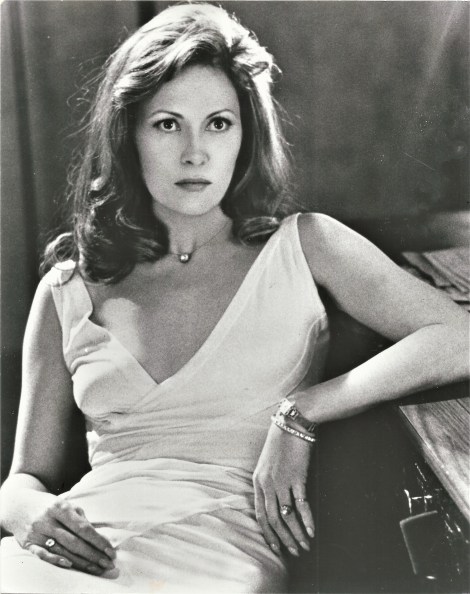


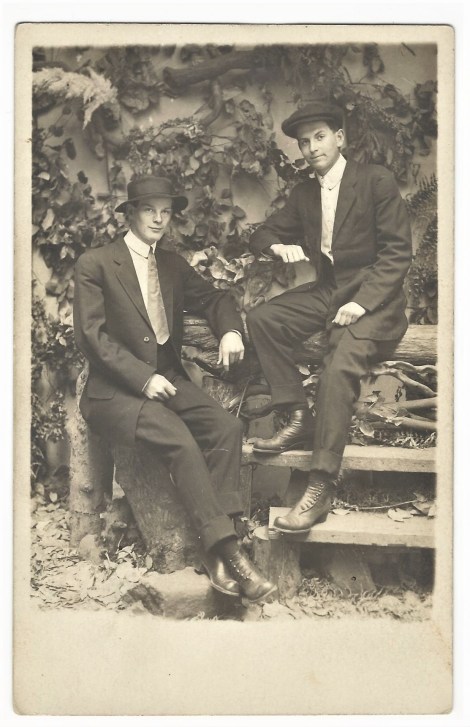
 This vintage real photo postcard features two well dressed young men sitting on what appears to be rails of a fence. The gentleman on the lower rail is wearing a suit that is swimming on him. The suit is so over sized that it likely belonged to the studio, and was borrowed by the young man for the photograph. The Cyko stamp box indicates that this postcard dates to sometime between 1904 and the 1920’s. SOLD




 THE CABINET CARD GALLERY