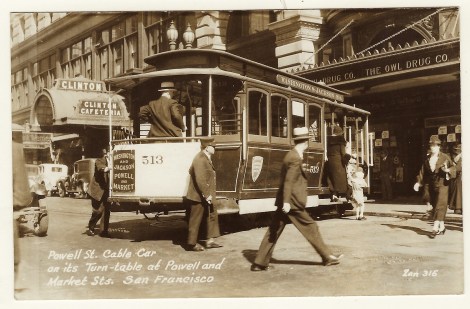
This vintage real photo postcard features the Powell Street Cable Car Trolley on it’s turn-table at Powell and Market Streets in San Francisco, California. This image offers a great look back at early San Francisco history. There is a lot happening in this photograph. Look carefully and you will see two conductors working to turn the trolley around. Actually one seems to be doing all the physical labor while the other checks out the action on the street. In addition to the pedestrians in the image, you can also see a woman and her child boarding the cable car as it turns around. It is also interesting to note the businesses that appear in the photograph. The Clinton Cafeteria and the Owl Drug Company are clearly seen. Preliminary research reveals that the Clinton Cafeteria was located at 18 Powell Street. The book, San Francisco Art Deco (2007) asserts that the restaurants basement dining room had marble floors and potted plants. From six to eight PM the restaurant offered self served diners live dinner music provided by a string orchestra. The second business in the photograph, The Owl Drug Company, was a drugstore chain headquartered in San Francisco. It was established in 1892 and was a subsidiary of Rexall. The photographer of this photograph is Alexander J. “Zan” Stark (1889-1967). He was born in Michigan and moved to California in his early twenties. Zan Stark was a postcard photographer. He worked out of his studio in Mill Valley. He used the professional name of “Zan of Tamalpais” between the 1920’s and the early 1950’s. This postcard is credited to Zan (no. 316). The stamp box on this vintage postcard indicates that it was published on Eastman Kodak paper sometime between 1939 and 1950. (SOLD)


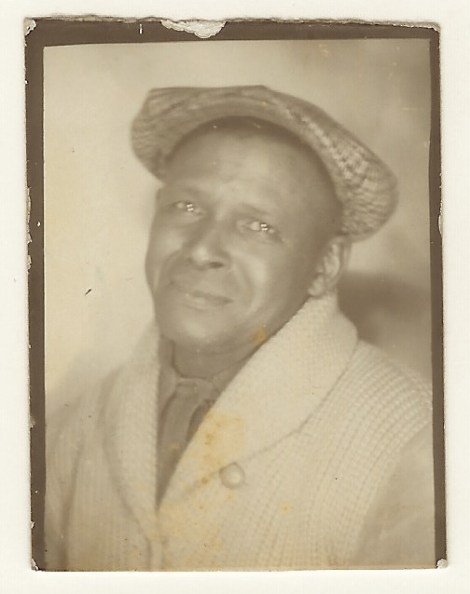

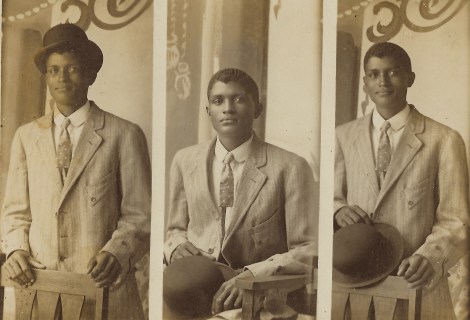
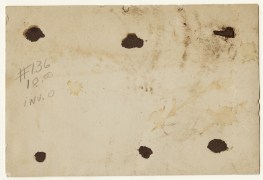

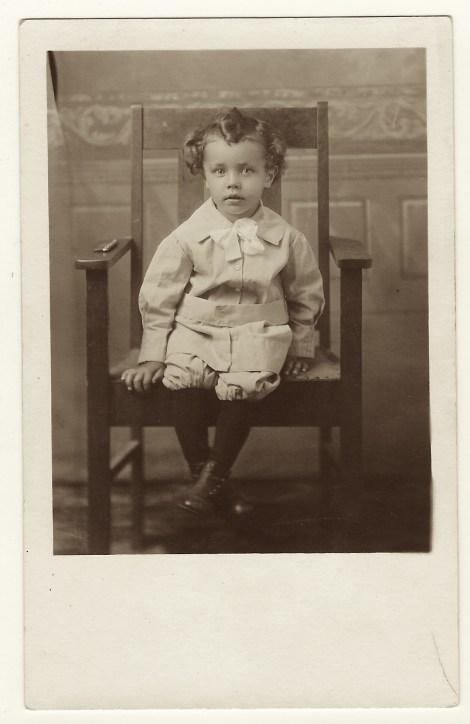

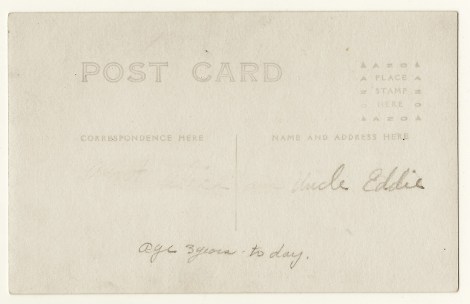
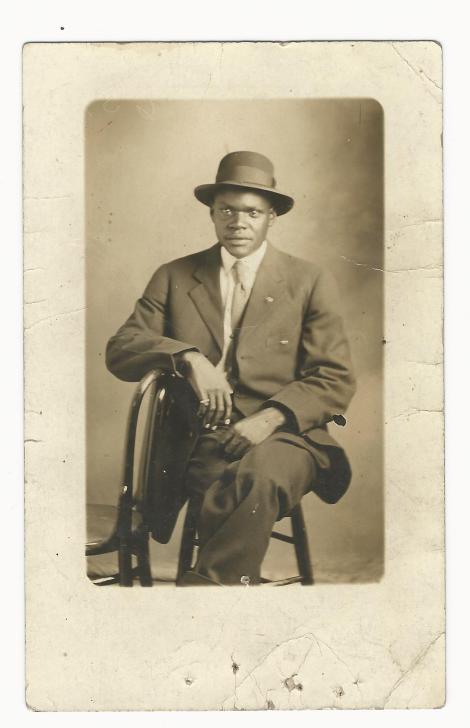 This vintage real photo postcard features a well dressed African American man. He is wearing a ring and a nice hat. He is looking directly at the photographer. The reverse of the postcard has an inscription which includes his name as well as his wife’s name. The gentleman’s name is John Anderson and he inscribed the card to his wife, Inez Anderson. He humorously wrote that she knew that he was the “pretty man” in the photo. The postcard has an AZO stamp box which indicates that it was produced between 1904 and 1918. The lower portion of the postcard has eight tack holes which indicates that the postcard may have traveled a bit and been tacked to a number of walls. There is also residue evidence that the postcard once resided in a photo album. SOLD


 THE CABINET CARD GALLERY