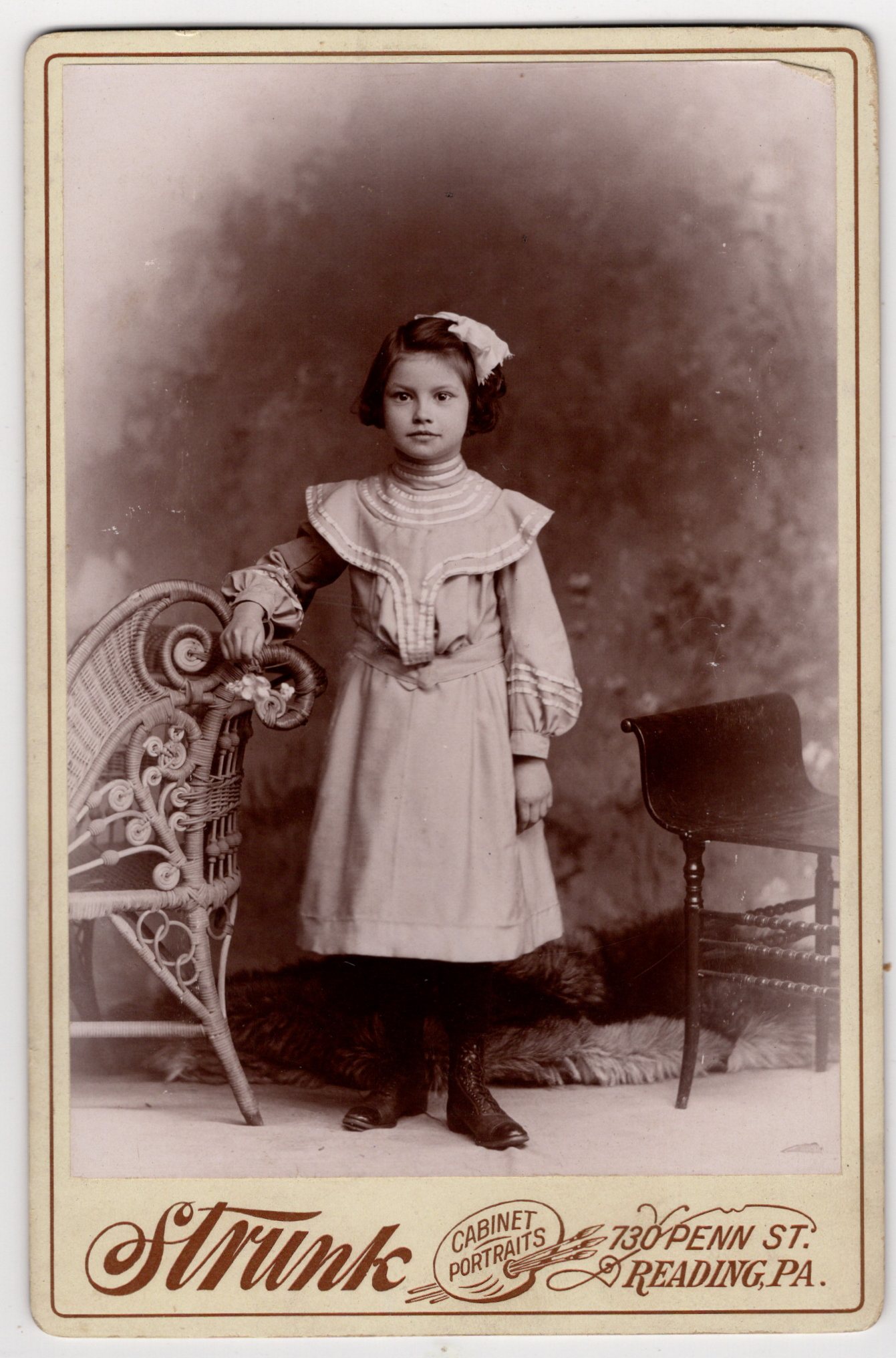
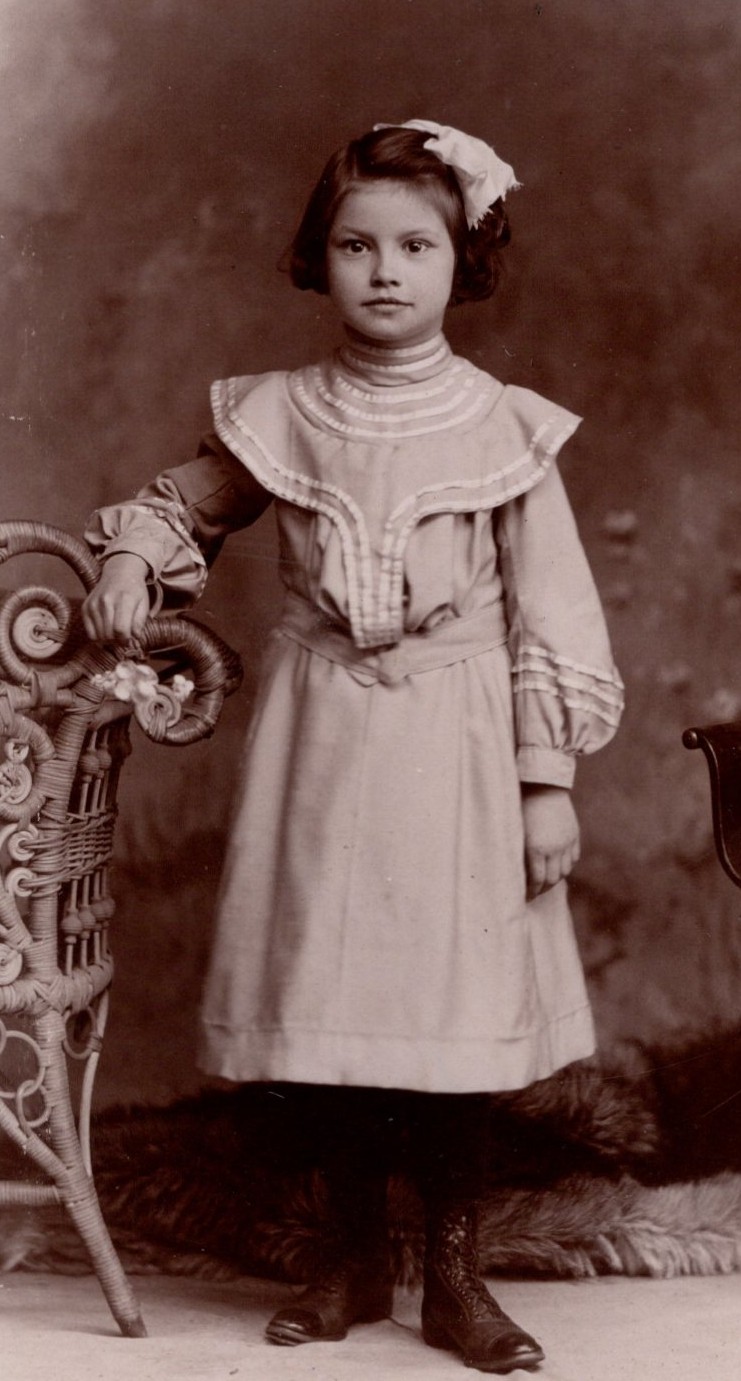
This lovely antique cabinet card photograph features a full-length studio portrait of a young girl, photographed by Strunk of Reading, Pennsylvania, whose studio imprint appears prominently at the bottom of the mount. The girl stands beside an ornate wicker chair, resting one hand on the elaborately curved armrest. A small wooden chair is positioned on the opposite side, and a fur rug is visible beneath her feet, all typical studio props used in late 19th and early 20th century portrait photography. The painted studio backdrop creates a soft, neutral setting that keeps the focus on the subject. She wears a light-colored dress with decorative trim and a wide, ruffled collar, along with dark stockings and lace-up boots. A large bow adorns her hair, which is styled in a short bob with gentle waves. Her expression is serious and composed, as was common in children’s studio portraits of the period, and she stands very still in a formal pose, suggesting the photograph dates to a time when longer exposure times required subjects to remain motionless. John D. Strunk was a well-known Reading, Pennsylvania photographer and a pioneer in photography in the region, operating a studio in Reading for many decades. His cabinet cards are widely collected today, particularly those depicting children and families from the Reading area. I have a collection of Strunk photographs; he was a prolific photographer. Much of his work reflects high craftsmanship. This cabinet card is in very good condition for its age. The photograph retains strong detail throughout, with good contrast and clarity. The image has a tiny crease in it’s top right corner but is generally clean. Overall, it presents extremely well and remains a well-preserved portrait of an adorable little girl. (see scans). Based on the mount style, studio props, and the child’s clothing and hairstyle, this cabinet card likely dates to the late 1890s to early 1900s.
This Cabinet Card is available for purchase at my store, The History Peddler, for $24.00 at auction.
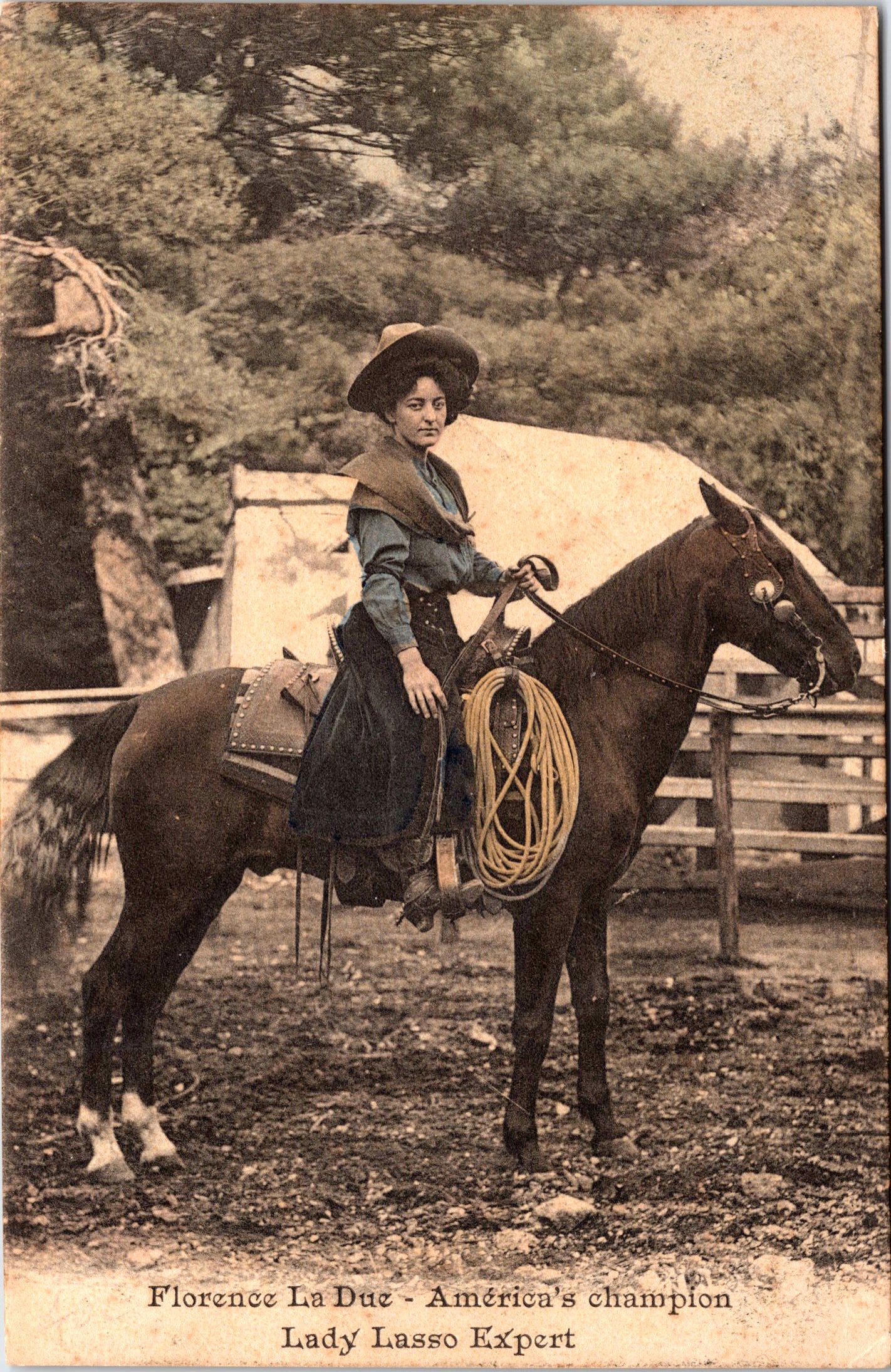
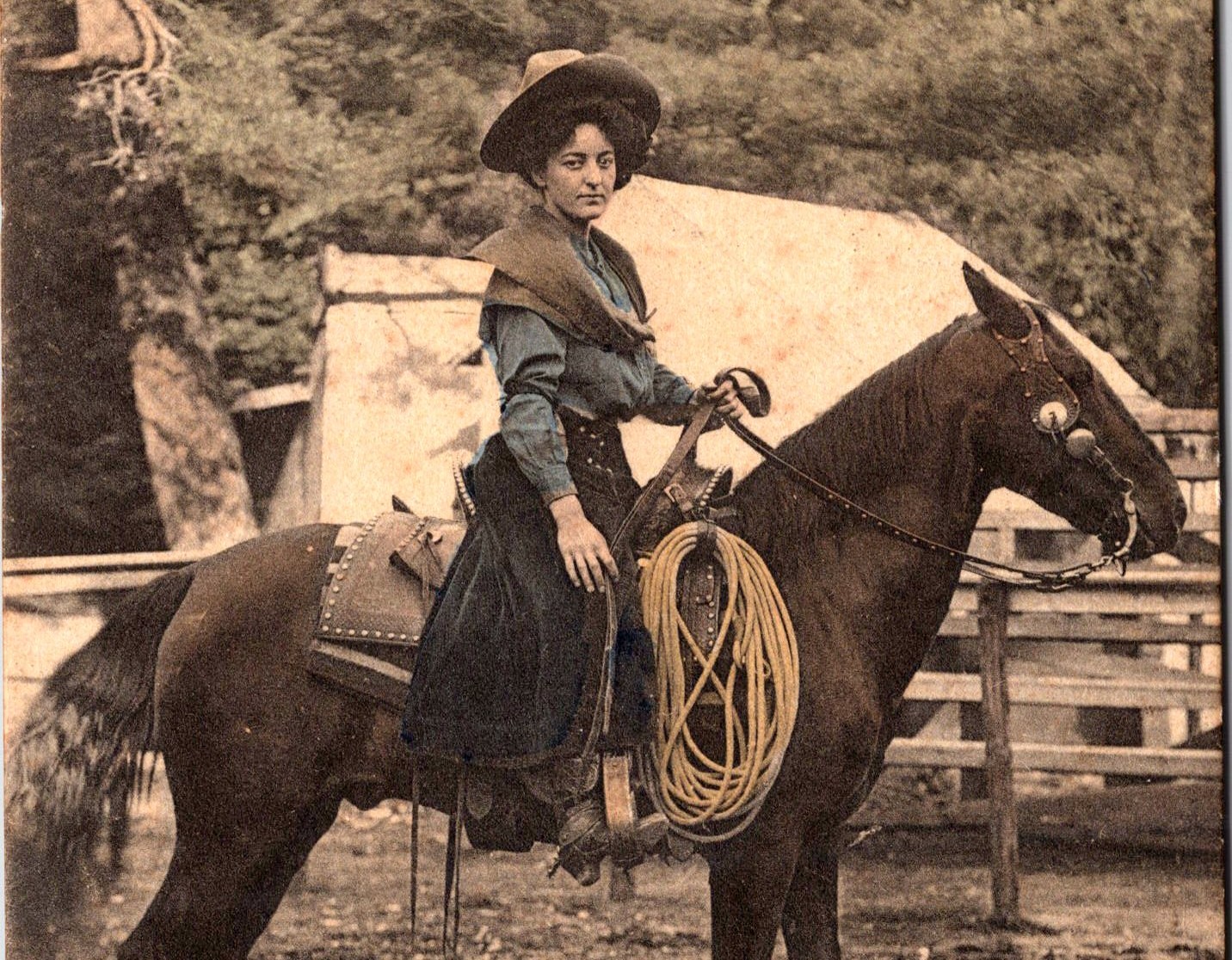
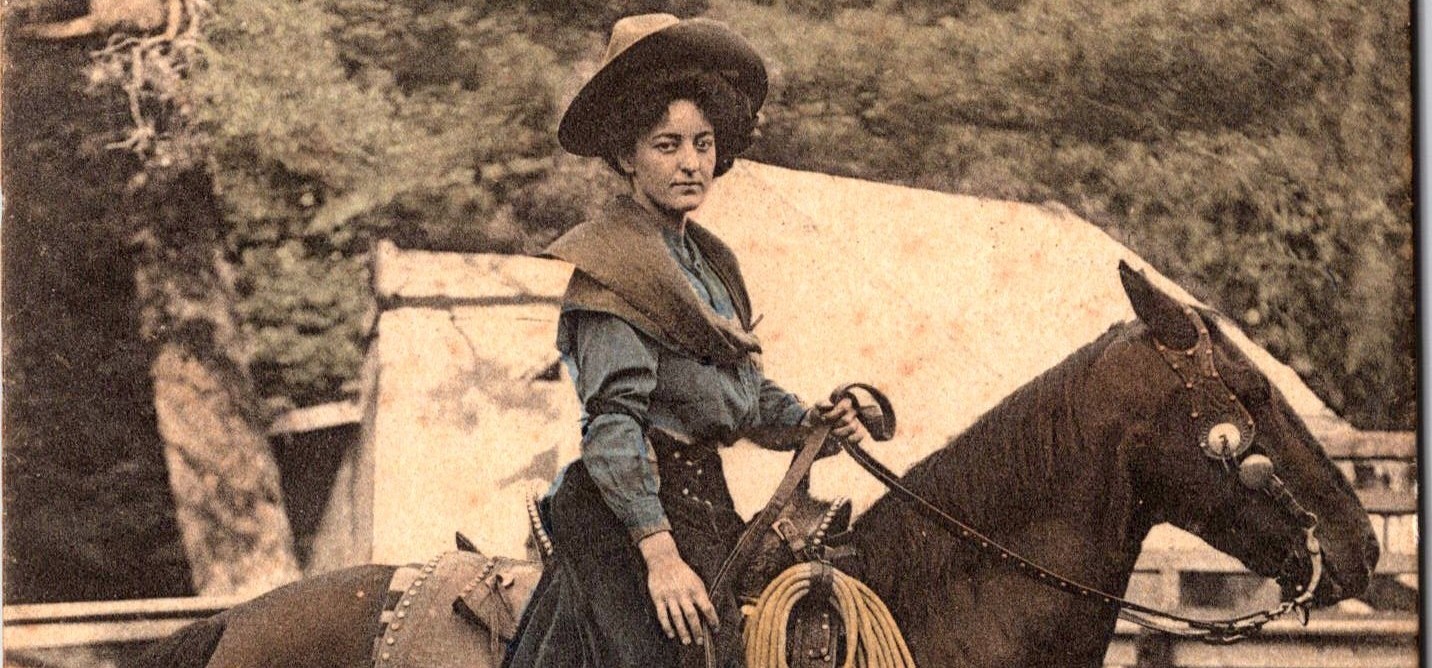
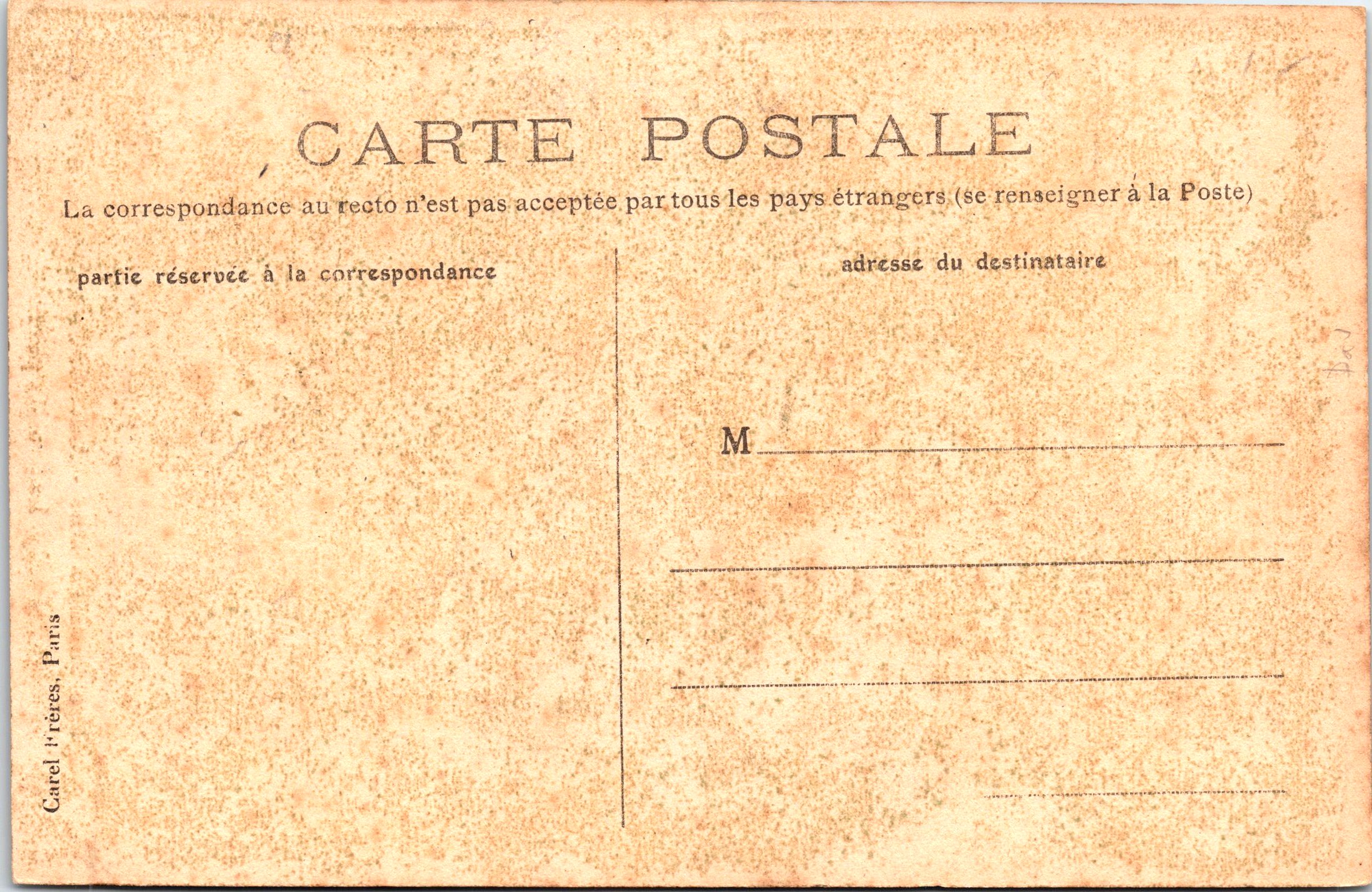
This striking early 20th-century French postcard features Florence Laduz, posed confidently on horseback in full working cowgirl attire—wide-brimmed hat, practical skirt, boots, and coiled lariat at the saddle. The image blends realism and performance: Laduz is presented not as a novelty but as a capable rider, projecting quiet authority and self-possession. Her direct gaze toward the camera reinforces that impression, making this a particularly compelling portrait of a woman in a traditionally male-dominated role. The photograph likely dates to the circa 1900–1910 period, a time when European fascination with the American West—and with female equestrians and performers—was at its height. In France especially, images of women riders were popular in postcards, circus publicity, and illustrated journals, often straddling the line between documentary portrait and performance persona. The postcard was published by Carpel Frères, Paris, a French publisher active in the early postcard era and known for producing high-quality photographic and semi-photographic cards, including portraits of performers, costumed figures, and theatrical or novelty subjects. Florence Laduz, better known on stage as Florence LaDue, was the professional name of Grace Maud Bensel (1883–1951), a celebrated vaudeville performer and internationally recognized champion trick roper. Born in Montevideo, Minnesota, she experienced an unconventional upbringing: her mother died when she was an infant, and she spent much of her childhood on a Sioux reservation, where her grandfather served as a government agent. These early years appear to have shaped both her independence and her remarkable horsemanship. As a young woman, Bensel left home—by some accounts running away to join a Wild West show—and adopted the stage name Florence LaDue. By 1905, she was performing with Cummins’s Wild West Show and Indian Congress, where she met fellow rider and roper Guy Weadick. The two married in 1906 and spent the next several years touring extensively across North America and Europe. LaDue enjoyed a distinguished career in vaudeville and Wild West exhibitions, appearing with major circuits including Keith-Albee, Orpheum, and Pantages, and performing internationally in London, Glasgow, and Paris—making the presence of her image on a French postcard especially fitting. She appeared both solo and with her husband, sometimes billed as Weadick and LaDue, and was equally at home in theatrical settings and competitive roping exhibitions. She also appeared on Broadway in the production Wyoming Days and later with Will Rogers’ Wild West Show. By 1912, LaDue and Weadick settled in Calgary, Alberta, where she played a foundational role in the creation of the Calgary Stampede. LaDue retired after a 31-year career as the undefeated World Champion Lady Fancy Roper, a title that underscored her status as one of the most accomplished female ropers of her era. In recognition of her legacy, Florence LaDue was inducted into the National Cowgirl Museum and Hall of Fame in 2001. Her contributions continue to be honored: in 2024, the Calgary Stampede announced that a major park approach would be named “Flores LaDue Parade,” commemorating her central role in the event’s early history. She died in 1951 in Phoenix, Arizona. (SOLD)
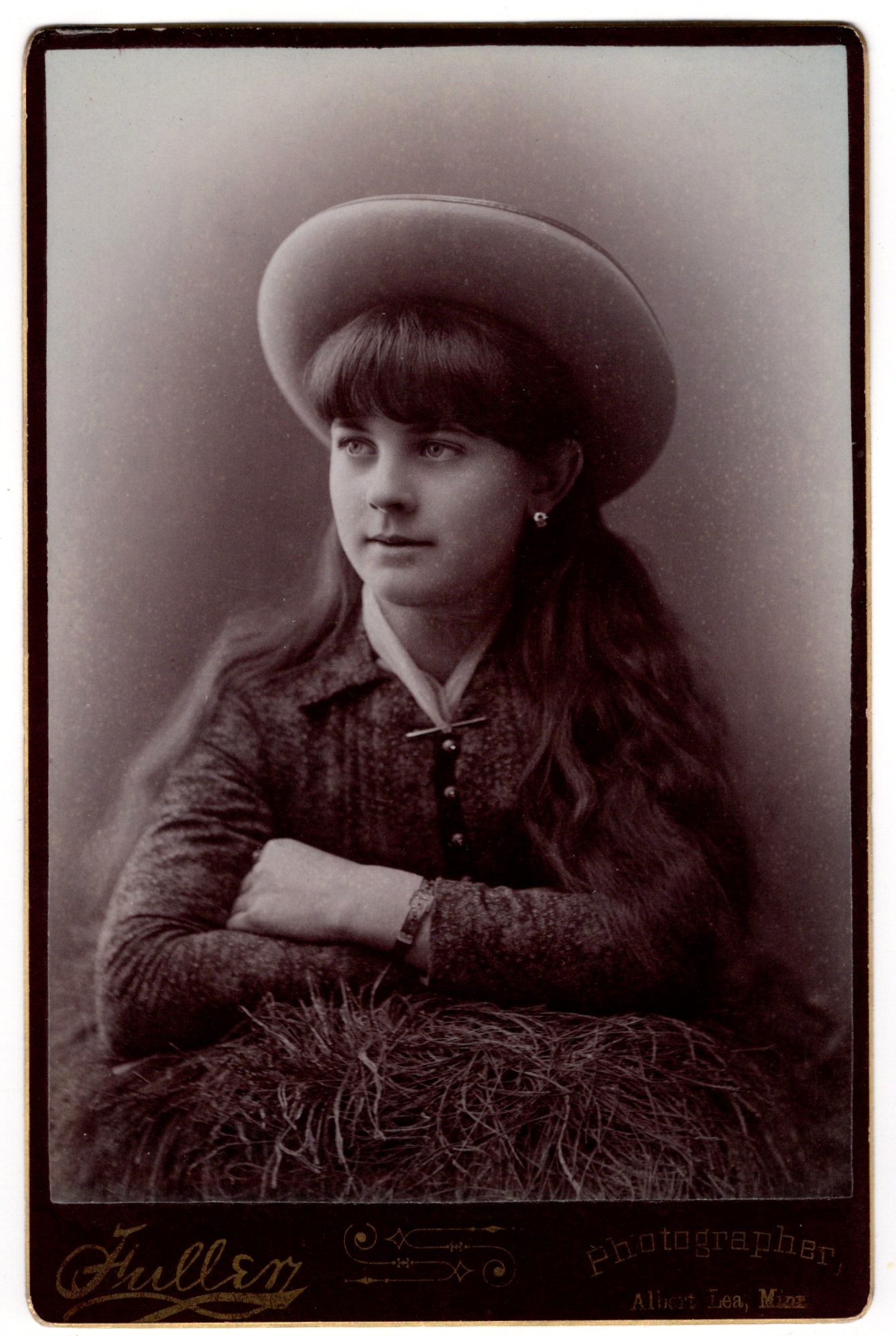
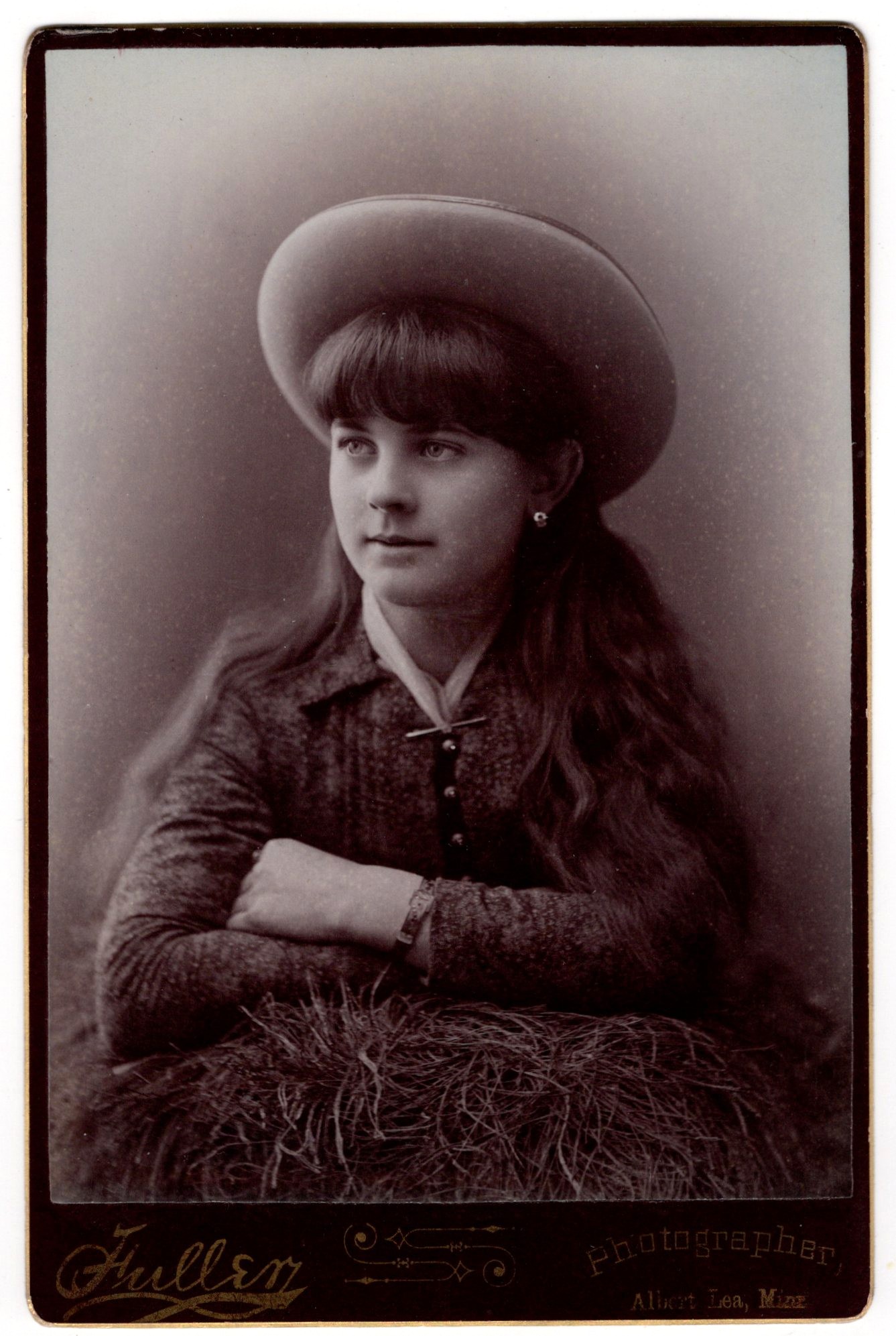
Offered here is a beautiful cabinet card portrait of a very pretty young woman photographed by Fuller of Albert Lea, Minnesota. The sitter is shown in a classic late 19th-century studio pose, seated with arms folded and resting on a rustic studio prop, possibly meant to simulate a natural setting. She wears a wide-brimmed hat, a patterned dress with a decorative collar bar pin, a bracelet, and small earrings. Her long hair falls over her shoulder in a carefully arranged style typical of the period. The portrait has a soft, elegant studio lighting effect and is a particularly appealing example of Victorian portrait photography. The photographer was Joseph A. Fuller (1851–?), an early Minnesota photographer. Fuller was born in Walworth County, Wisconsin, and worked as a photographer in Decorah, Iowa, and Chatfield, Minnesota, before moving to Albert Lea in 1873, where he established his photographic studio. His studio operated for many years and produced cabinet cards, tintypes, and other photographic formats, serving the residents of Albert Lea and the surrounding Freeborn County area. Albert Lea, Minnesota, where this photograph was taken, is located about ninety miles south of Minneapolis and was named after Albert Miller Lea, a topographer with the U.S. Dragoons who surveyed the area in 1835. By the 1870s and 1880s, Albert Lea was a growing Midwestern town, and photographers like Fuller played an important role in documenting its residents and families. Based on the mount style, typography, and photographic presentation, this cabinet card likely dates to the mid to late 1880s (c1885-1890). The cabinet card is in very good antique condition. The photograph itself is clear with good contrast and detail with only minor surface wear. The mount has gold beveled edges. The reverse is blank and shows some light surface wear and minor discoloration near the lower area, typical for a cabinet card of this period. Overall, the cabinet card is very clean and attractive portrait of a very pretty girl in her teen years. See Scans.
This cabinet card is available for purchase at my store, The History Peddler, for $65.00 at auction.
Mary Pickford (1892-1979) was a Canadian-American actress and one of the most influential figures in early Hollywood. She was often referred to as “America’s Sweetheart”. She was a pioneer of silent film and a co-founder of the film industry as we know it today. Pickford’s career began in childhood when she performed in theater productions in Canada and the United States. By the early 1900s, she transitioned to film, working with director D.W. Griffith at Biograph Studios. Her delicate beauty and expressive acting quickly made her a fan favorite, setting her apart in an era when exaggerated stage-style performances dominated silent films. During the 1910s and 1920s, Pickford became one of the highest-paid and most beloved actresses in the world. Starring in films such as Rebecca of Sunnybrook Farm (1917), Daddy-Long-Legs (1919), and Pollyanna (1920), she was known for playing wholesome, spirited young women. Her curly hair and signature on-screen innocence became iconic, but she was also a savvy businesswoman who understood the power of her brand. Pickford was not only a star but also a trailblazer in the film industry. In 1919, she co-founded United Artists alongside Charlie Chaplin, Douglas Fairbanks (her then-husband), and director D.W. Griffith. This revolutionary move allowed filmmakers to control their own productions rather than rely on major studios, changing the industry forever. As the film industry transitioned to “talkies,” Pickford retired from acting in the early 1930s, though she continued to produce films. Her contributions earned her an honorary Academy Award in 1976 for her lasting impact on cinema. Mary Pickford’s influence extends beyond her films. She helped shape the star system, paved the way for women in Hollywood, and co-founded the Motion Picture Relief Fund to support struggling actors. She remains an enduring symbol of early Hollywood glamour and innovation. Mary Pickford was born into a working-class family in Toronto, Canada. Her father, John Charles Smith, was an alcoholic who struggled to provide for the family and died from a workplace accident when Mary was just six years old. Her mother, Charlotte Hennessey Smith, was left to raise Mary and her two younger siblings, Lottie and Jack, on her own. To support the family, Charlotte encouraged her children to enter acting, and Mary began performing in theater at a young age. She soon became the family’s primary breadwinner, and her siblings, Lottie Pickford and Jack Pickford, also pursued film careers. Pickford transitioned from theater to film in the early 1900s, quickly rising to fame with her expressive acting and wholesome on-screen persona. By the 1910s and 1920s, she was one of the most recognizable stars in the world, earning the nickname “Queen of the Movies.” She also helped establish the Academy of Motion Picture Arts and Sciences. Mary Pickford was married three times. Pickford’s first marriage was to silent film actor Owen Moore (1911-1920). Her second and most famous marriage was to fellow silent film actor, Douglas Fairbanks (1920-1936). Her third marriage was to actor Charles “Buddy” Rogers (1937-1979). After retiring from acting in the early 1930s, Pickford focused on producing films and philanthropy. She became more reclusive in her later years, struggling with alcoholism and health issues. Today, she is remembered as a pioneering force in cinema history.
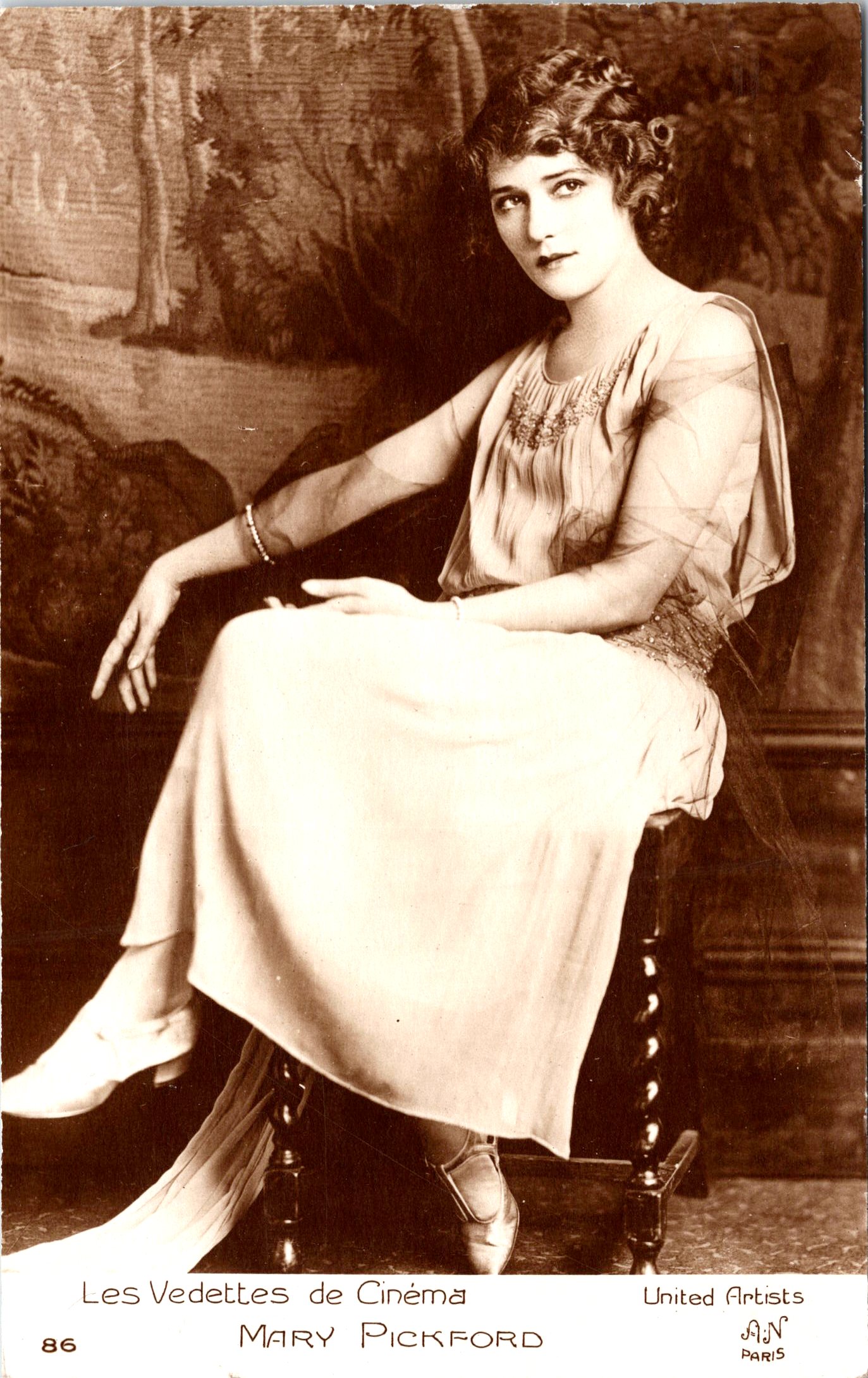
Postcard 1 features Pickford seated gracefully on a carved wooden stool, exuding elegance and poise. She is dressed in a flowing, light-colored gown with delicate embellishments on the bodice and sheer fabric draping over her arms. Her signature curls frame her face, a defining feature of her “America’s Sweetheart” image. She wears a subtle yet confident expression, her eyes gazing slightly to the side with a soft, introspective quality. Her arms are relaxed, with one hand resting gently on her lap and the other elegantly extended. Her accessories include a bracelet on her wrist and a ring on her finger, adding to her refined look. The backdrop behind her is a richly textured tapestry, possibly depicting a pastoral scene. This postcard was likely produced in the 1920s, during the height of Pickford’s career. It is numbered 86 and is part of a larger collectible series showcasing cinema stars of the era. This vintage postcard is part of a series titled Les Vedettes de Cinéma (translated as The Stars of Cinema), and it was published by Alfred Noyer (Paris,France), in collaboration with United Artists, the film distribution company that Pickford co-founded. The back of the postcard identifies the publisher as Cinémagazine – Edition and states that it was Made in France / Fabriqué en France, indicating its European origin.(SOLD)
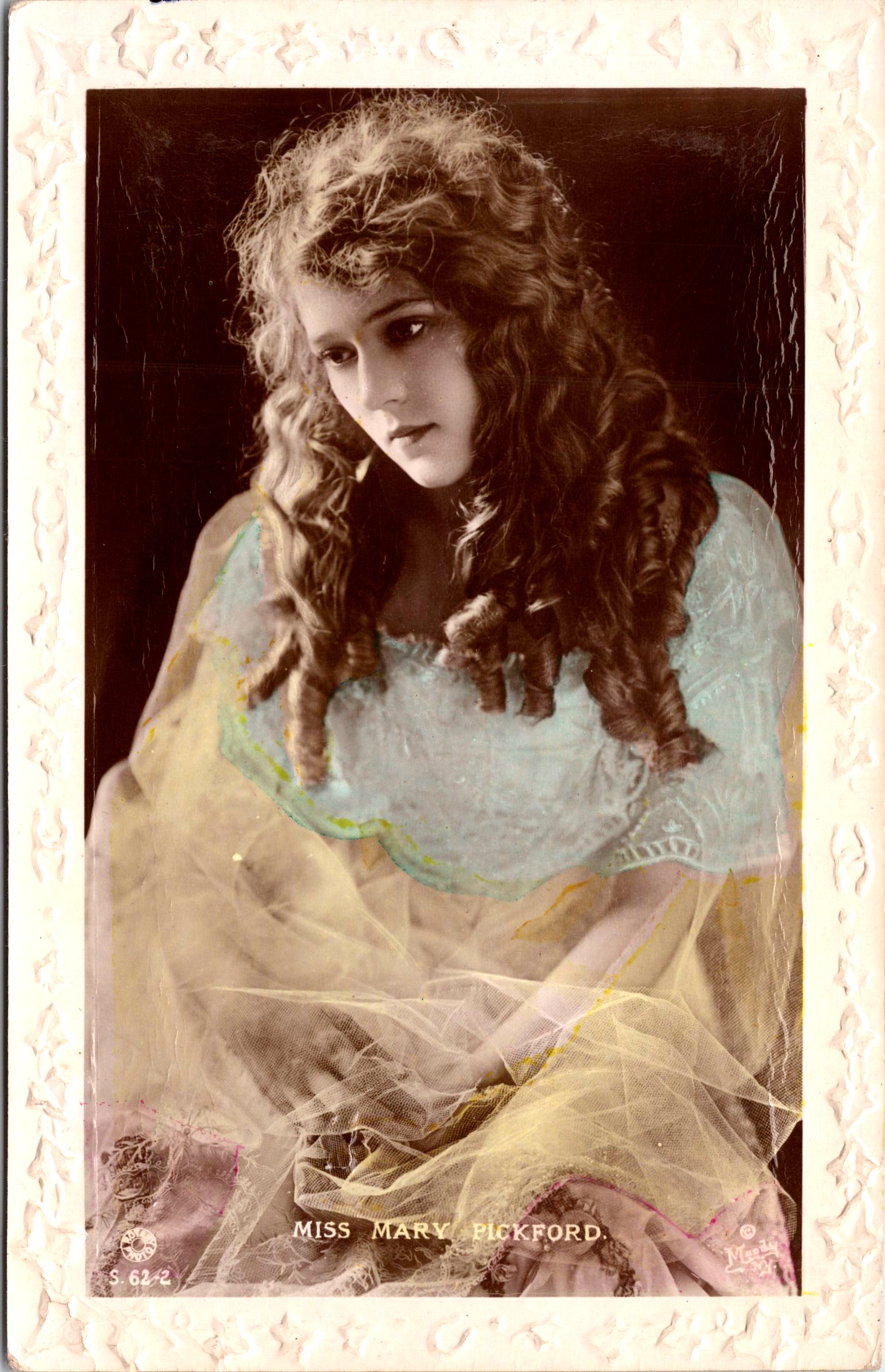
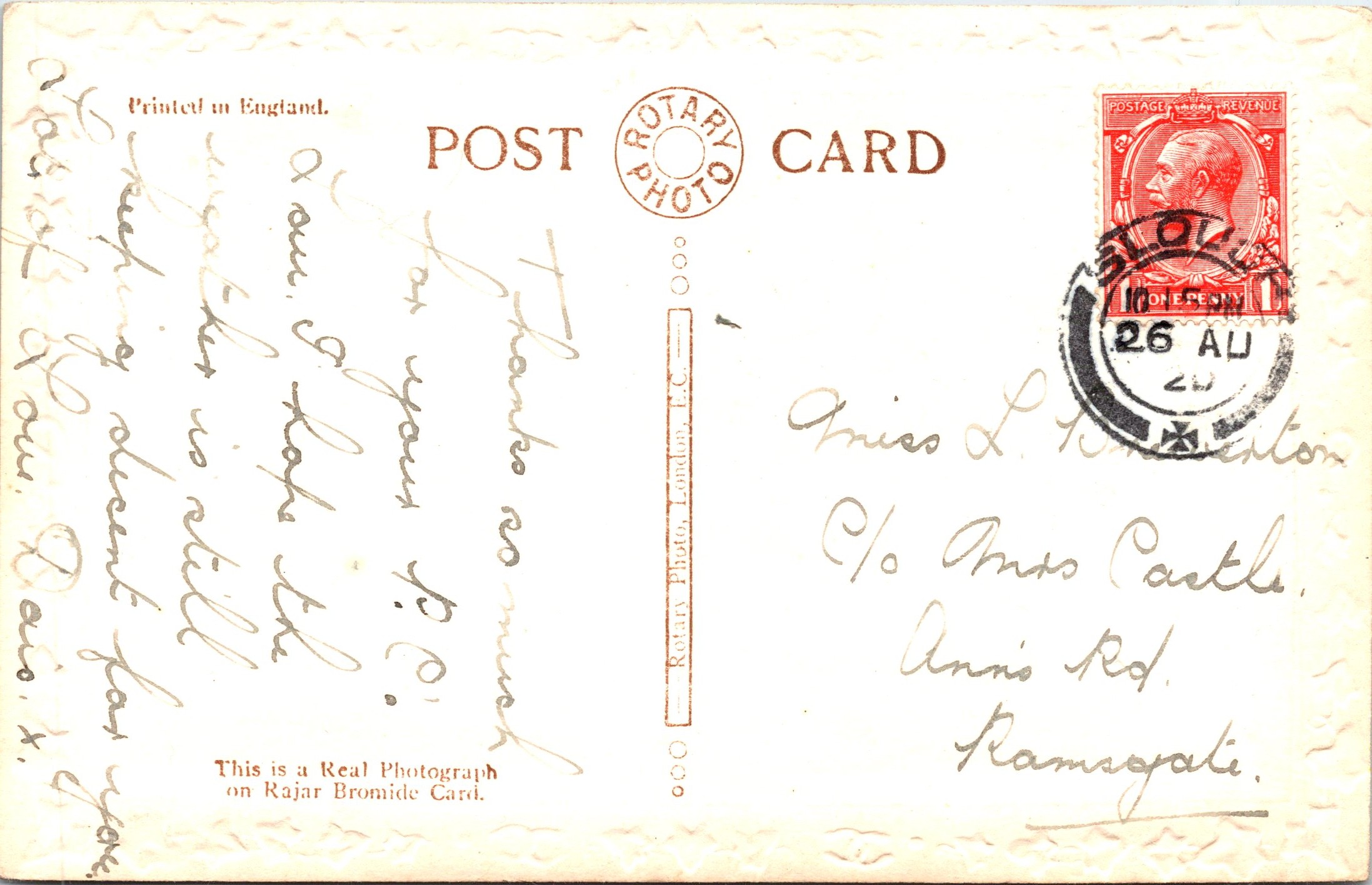
Postcard 2features Mary Pickford in a soft, introspective portrait that perfectly captures the romantic visual style of the early 1910s. Pickford is posed in three-quarter profile, her gaze cast downward, with her signature long curls cascading over her shoulders. She wears a delicate, flowing gown rendered in subtle hand-applied color, with pale blue and warm cream tones carefully brushed over the original photograph, lending the image a dreamy, ethereal quality. The overall effect is gentle and luminous, emphasizing her youthful features and expressive eyes. This postcard was produced by Rotary Photo, one of the most prolific and collectible publishers of celebrity real photo postcards in the early 20th century. The image is identified by the ID No. S.62-2, printed at the lower edge, and the reverse confirms it was printed in England via (Rajer Bromide). (SOLD)
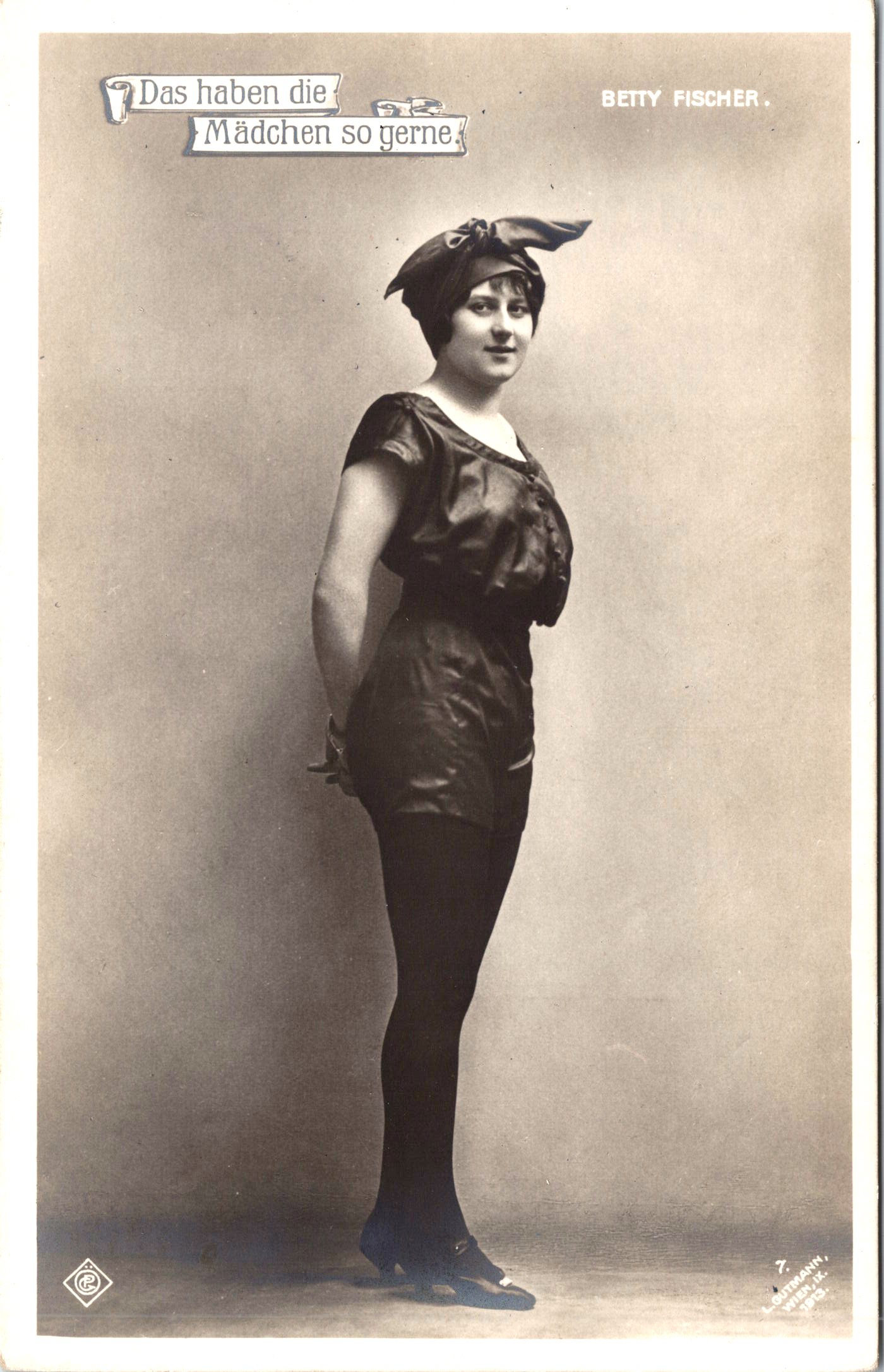
This striking European real photo postcard features stage performer Betty Fischer, photographed in Vienna in 1913 by L. Gutmann, whose imprint appears at the lower right of the image: “L. Gutmann, Wien 1913.” The postcard presents Fischer in a full-length studio pose wearing a theatrical costume consisting of a short satin stage outfit with stockings, heeled shoes, and a large headscarf tied in a dramatic bow. The outfit would have been considered fashionably daring for the period and is typical of costumes worn in cabaret, operetta, and theatrical revue performances in pre–World War I Vienna. The German caption at the top translates roughly to: “That’s what the girls like so much!” suggesting the postcard was likely part of a theatrical or humorous series associated with stage performance culture of the period. Betty Fischer (1887–1969) was an Austrian operetta singer, born in Vienna and she spent most of her career in Vienna’s vibrant operetta and theater world. She began performing at a young age in variety productions and operetta and became an established performer at the Raimundtheater between 1900 and 1903. She then rose to prominence as a prima donna at the Theater an der Wien from 1903 to 1928, one of Vienna’s most important operetta venues. In 1928 she starred at the Johann Strauss Theater, and she also made guest appearances at other theaters in Vienna and in other musical centers. In her later years, she appeared in character roles at the Raimundtheater and also taught at the Vienna Conservatory. Fischer was considered an outstanding operetta singer in her day, known for excelling in both traditional operetta roles and contemporary works. The photographer L. Gutmann of Vienna was active in the early 20th century and is known for producing theatrical and portrait postcards of performers working in Vienna’s entertainment industry. His work is frequently encountered on postcards dating from the 1910s, particularly portraits of stage personalities. At the lower left corner of the front is a publisher’s logo that appears to be the intertwined letters “OPG”, standing for Osterreichische Photographische Gesellschaft (Vienna, Austria), a firm that issued theatrical and actress postcards in the early 20th century. Printing on the front of the postcard indicates that it was published in 1913. The postcard is in very good antique condition with a strong, clear image and pleasing contrast. There is light corner wear consistent with age. Under close inspection, a very faint line is visible in the right background area near the subject’s knee, lightly extending across part of the image; it does not affect the subject and is relatively unobtrusive, mentioned here for accuracy. Overall, this is a clean and highly displayable example an Austrian opera star photo postcard. See scans.
This postcard is available for purchase at my store, The History Peddler, for $22.00 at auction.
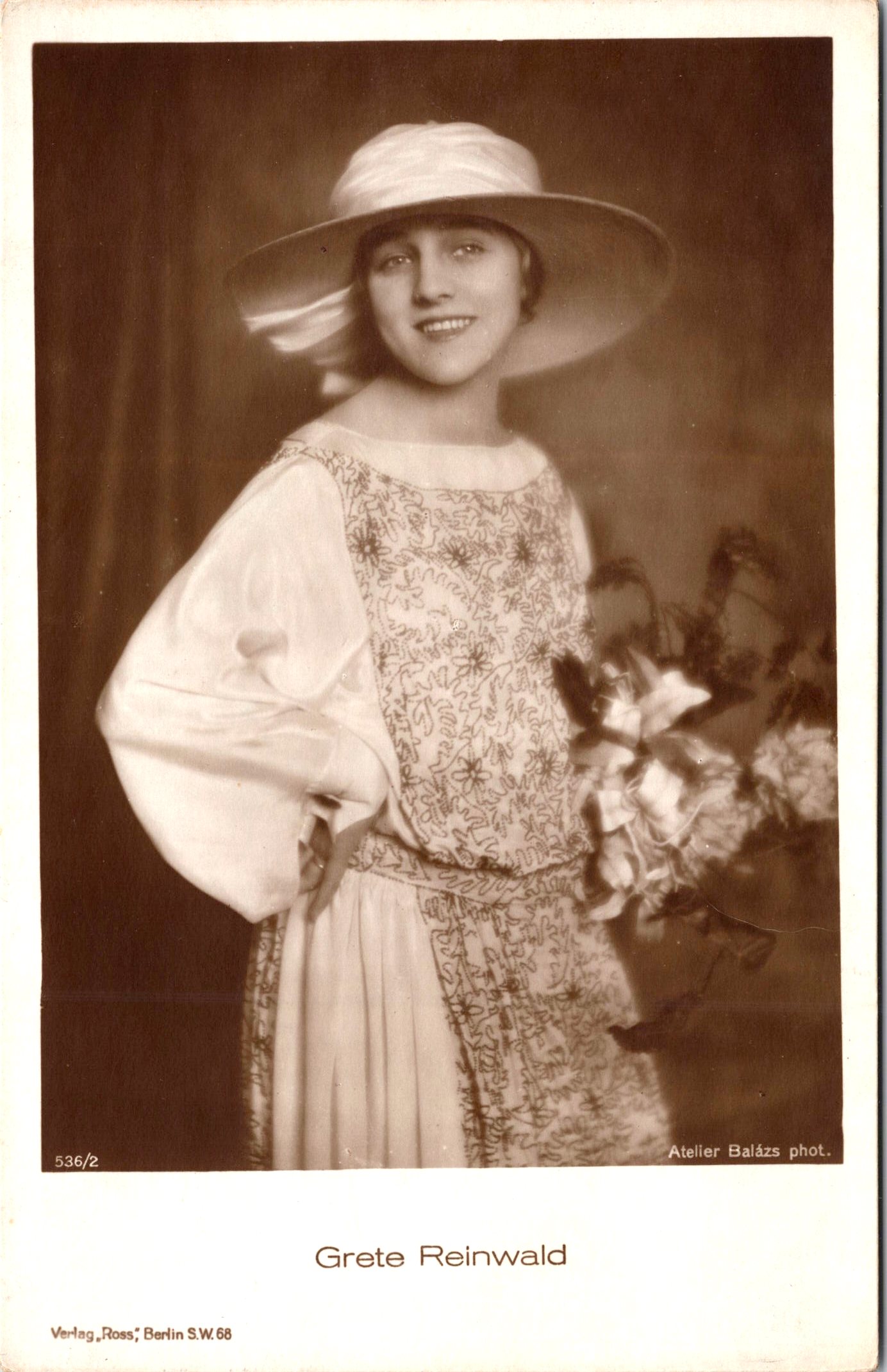
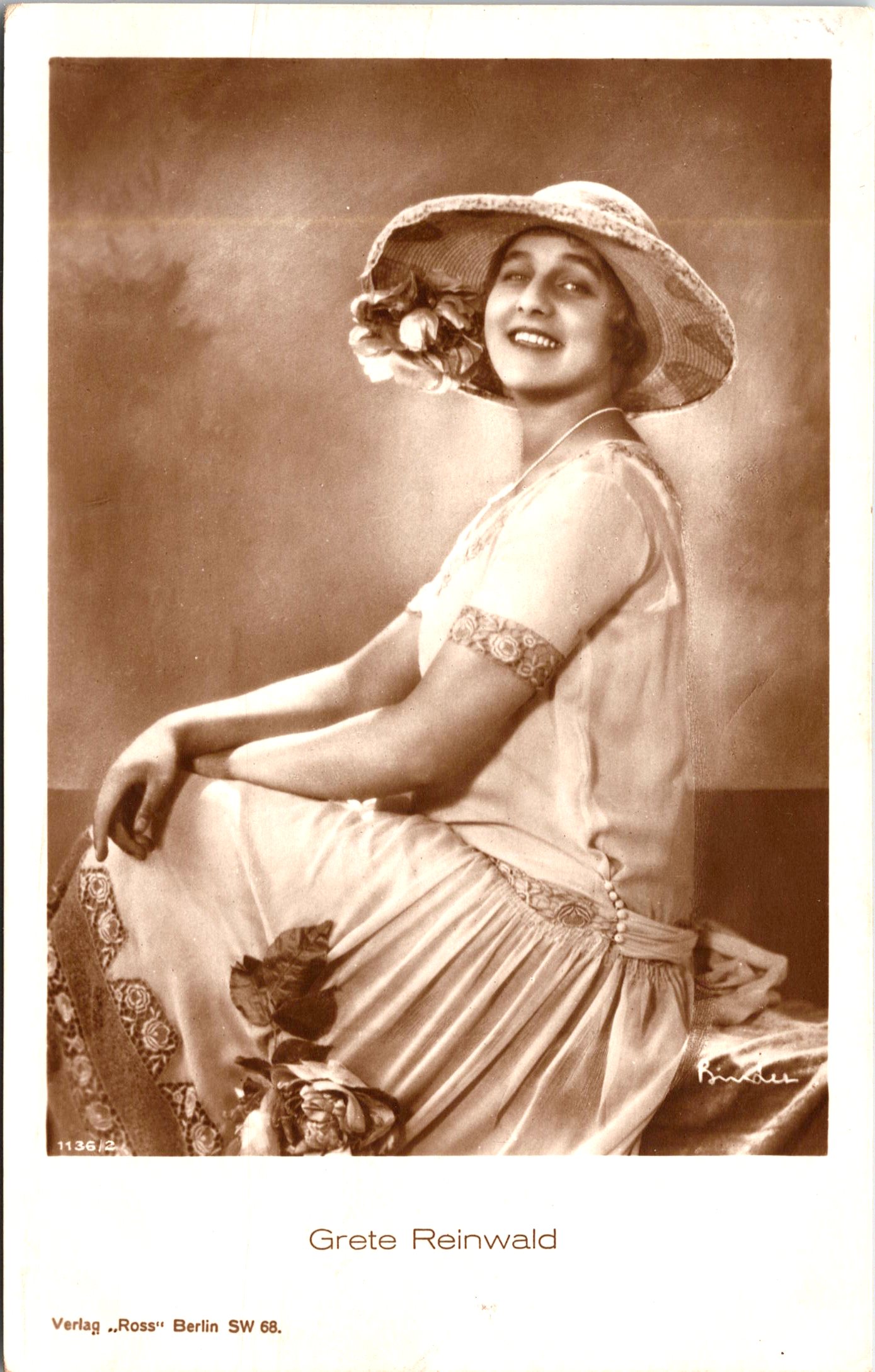
These real photo postcards feature the elegant German actress Grete Reinwald, who began her career as a celebrated child model and went on to achieve recognition on stage and in silent films. Born in 1902 in Stuttgart, Grete Reinwald started modeling as a child and quickly gained popularity in Germany. Alongside her siblings Hanni and Otto, she became a fixture in early German cinema and theater. She transitioned into film during the silent era and continued acting into the 1930s, admired for her expressive face and natural charm. She passed away in 1983, leaving behind a rich legacy in German performing arts.
Postcard 1 captures Reinwald in young adulthood in a graceful, studio portrait taken by Atelier Balázs, a well-known photographic studio. Grete is dressed in a flowing, embroidered dress featuring a detailed swirling floral motif across the bodice and skirt. The dress is belted at the waist and paired with a wide-brimmed hat that adds a sophisticated flair to her ensemble. She holds a bouquet of large flowers—possibly carnations or peonies—adding a touch of natural softness to the scene. Her expression is one of calm confidence, and she gazes slightly to the side with a pleasant, relaxed smile. Her posture, with one hand resting on her hip and the other holding the bouquet, exudes poise and charm. This image perfectly captures her transition from a cherubic child star to a refined young woman, retaining her signature warmth and beauty. The postcard was published by Ross Verlag, a prominent German publisher of celebrity postcards, and is marked 536/2, indicating it is part of their numbered photo series. The clarity of the photo, Grete’s fashion-forward appearance, and the reputable publisher all contribute to its desirability among collectors. (SOLD)
Postcard 2is a studio portrait taken by Alex Binder, a well known celebrity photographer. Grete flashes a beautiful smile beneath a wide brimmed hat. This postcard was published by Ross Verlag. The card is marked 1136/2, indicating it is part of a series. (SOLD)
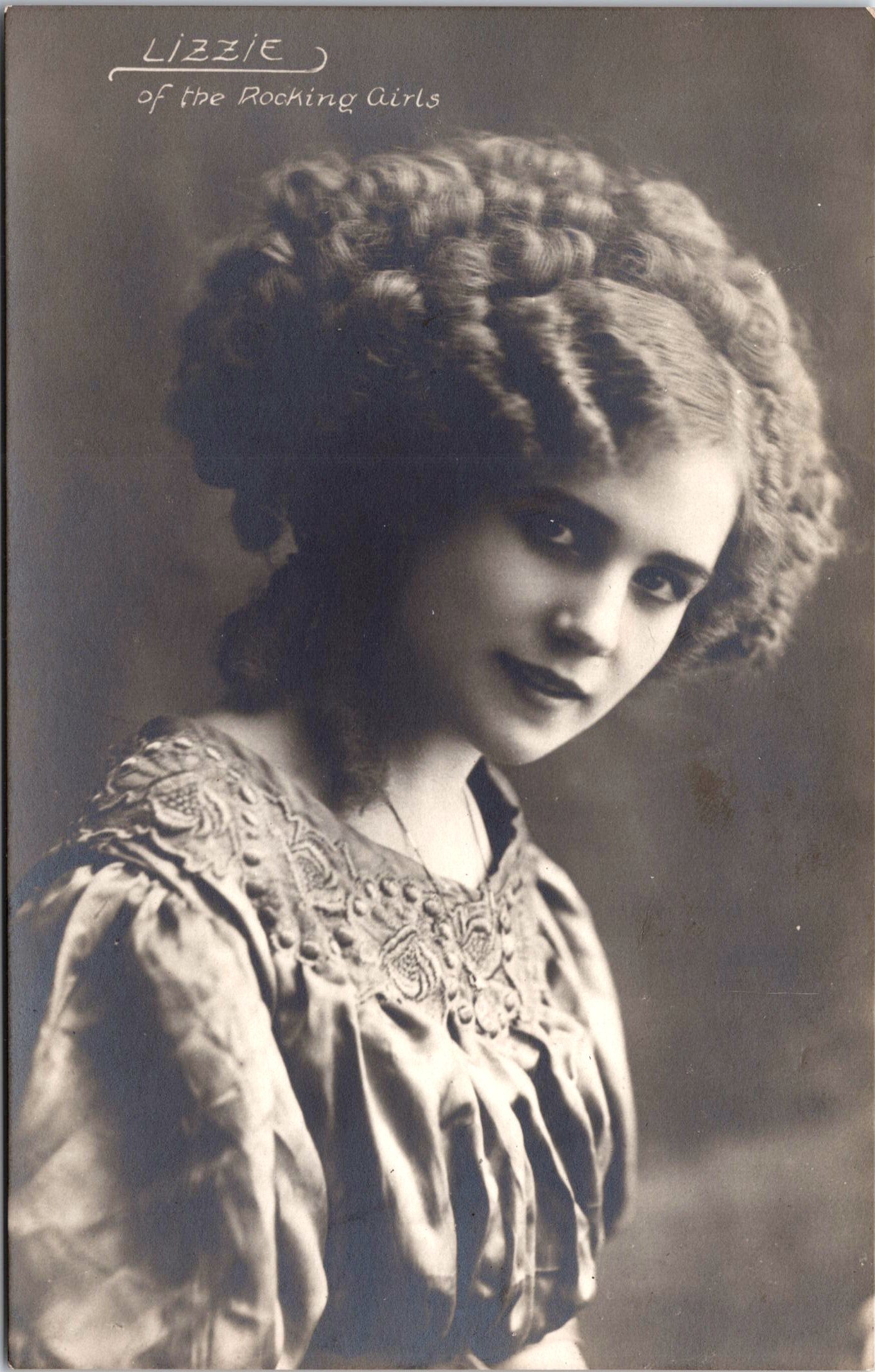
This striking real photo postcard features a studio portrait identified in period handwriting as “Lizzie of the Rocking Girls.” The image shows a young woman posed in a three-quarter view, her elaborate curled hairstyle and theatrical costume suggesting that she was a stage performer rather than a private studio sitter. Her blouse features decorative embroidery typical of stage or costume wear, and the dramatic lighting and soft-focus photographic style are consistent with theatrical portrait photography from the early 20th century. The caption “Lizzie of the Rocking Girls” likely refers to a theatrical troupe, musical comedy chorus line, vaudeville act, or touring stage company. During the circa 1905–1915 period, many small traveling performance groups—often called “girls” troupes (for example, chorus lines, dance revues, or musical comedy ensembles)—produced and sold photographic postcards of individual performers as souvenirs. These postcards were commonly sold after performances or used for promotional purposes, which would explain the professional quality of the portrait and the identification written directly on the image. The term “Rocking Girls” may refer to a song-and-dance troupe, possibly associated with a musical revue or vaudeville circuit. Many such groups had names like “The ___ Girls,” and individual performers were often marketed by first name only, which suggests that “Lizzie” may have been a stage name rather than a full professional name. Preliminary research found no information about the “Rocking Girls” which suggests that this may have been a regional or touring vaudeville company, making the postcard a scarce and interesting piece of theatrical ephemera. The postcard back has a divided back style. This real photo postcard can be dated to approximately circa 1908–1913, based on several visual and production clues. The postcard is in good antique condition overall, with a strong, clear image and pleasing contrast. There is light corner wear consistent with age. A small, faint spot is visible in the right background area a way from the subject’s chin. This postcard is an overall well-preserved and very displayable card. See scans.
This vintage postcard is available for purchase at my store, The History Peddler, for $22.00 or best offer.
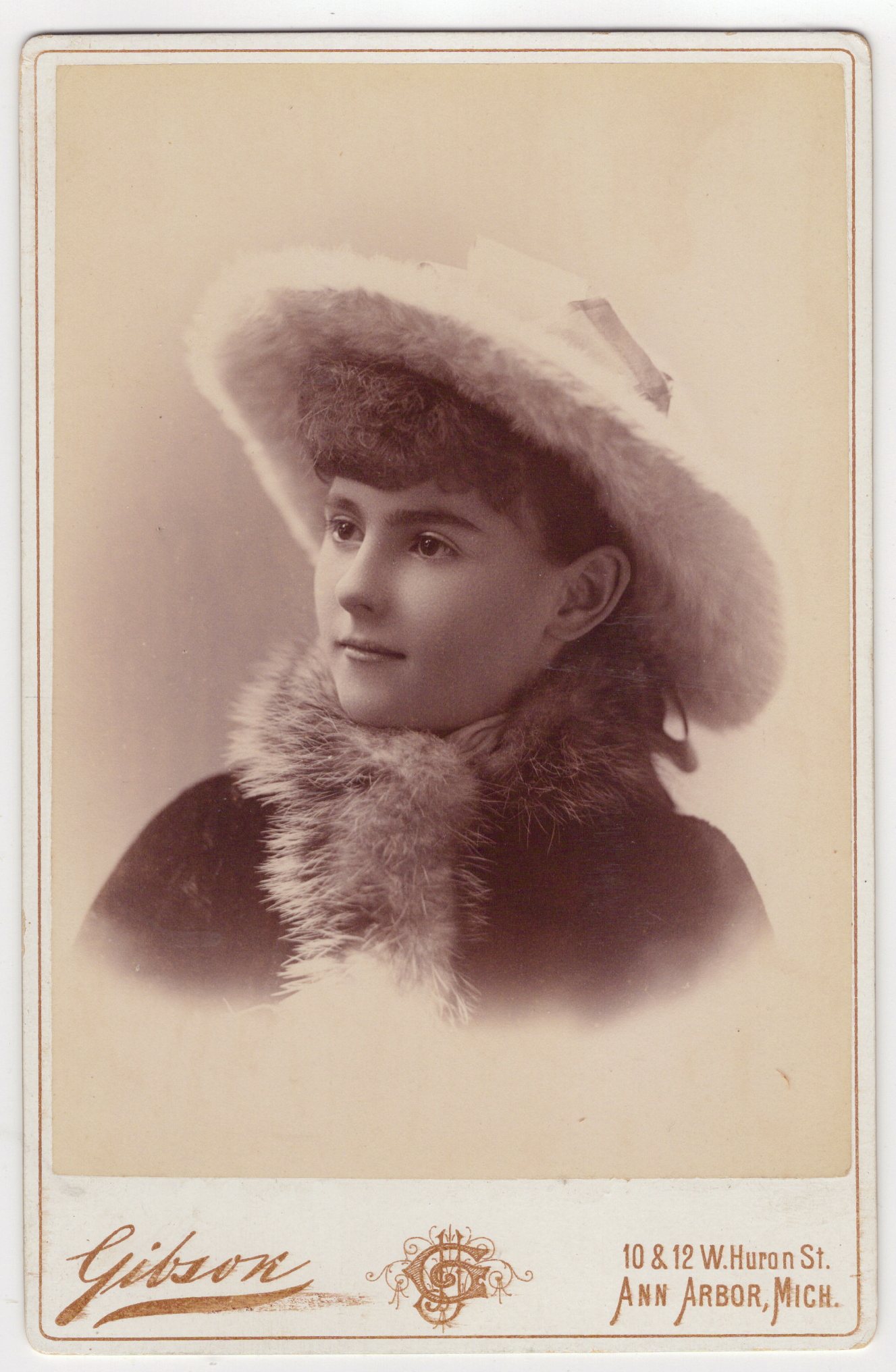
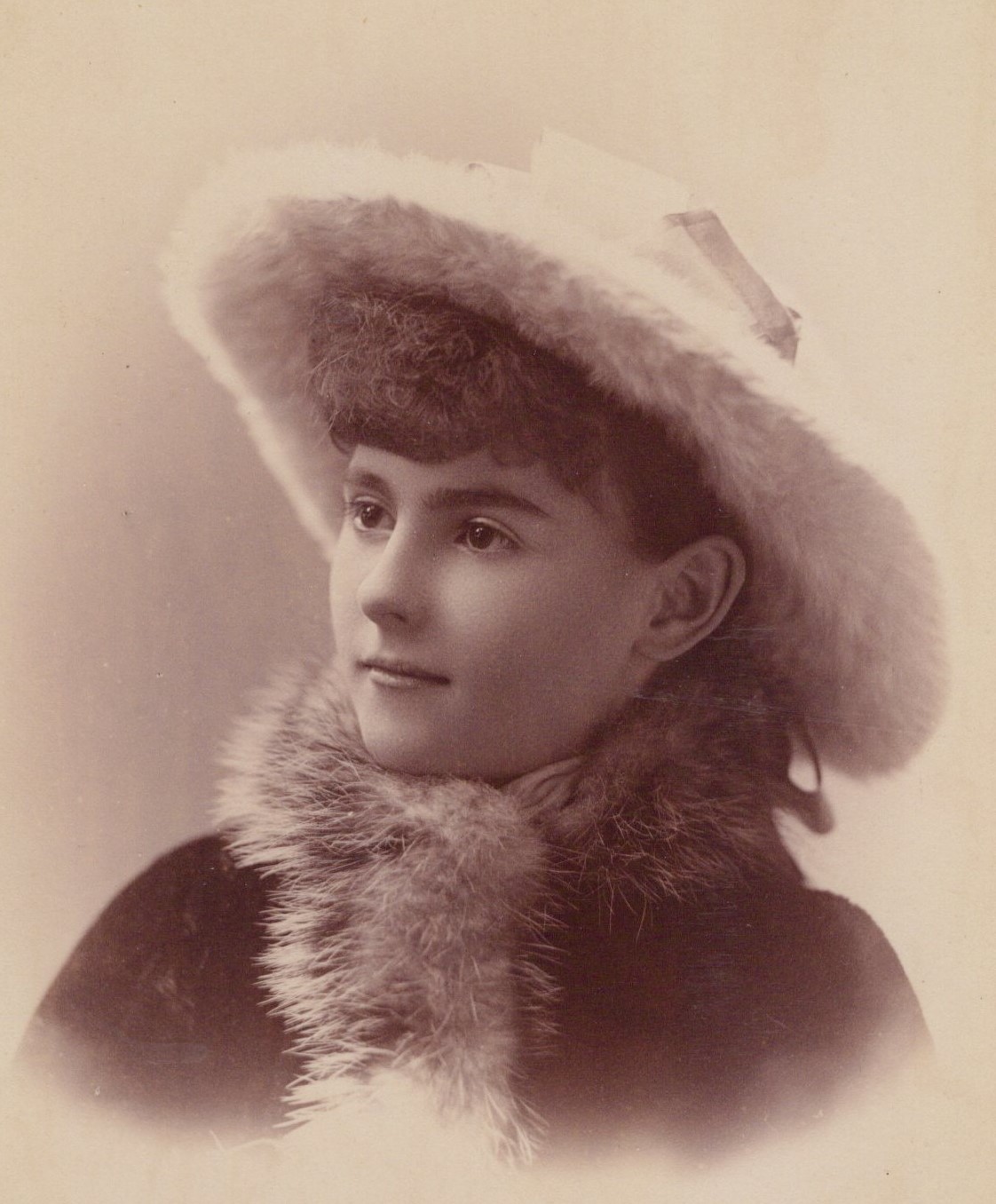
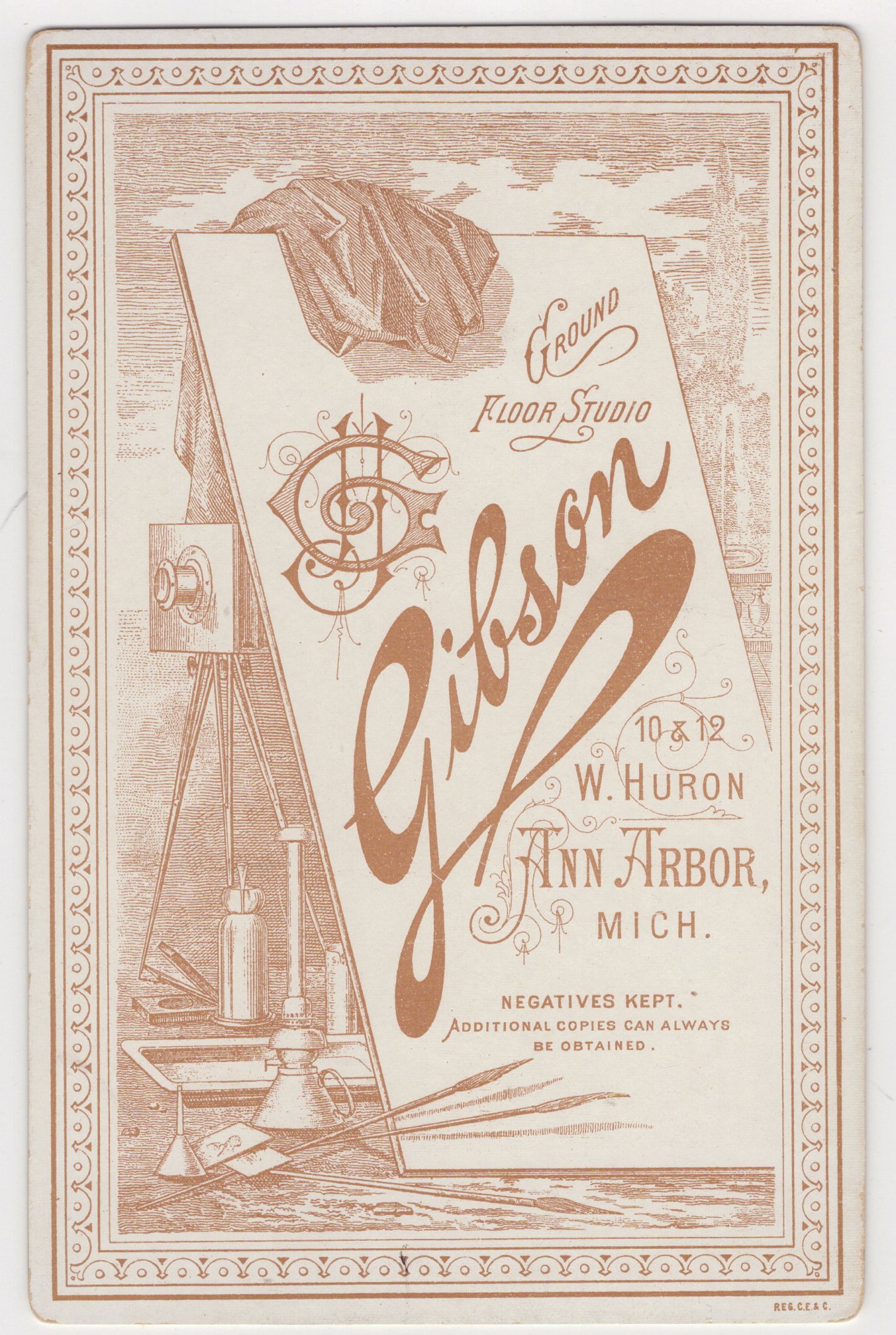
This cabinet card captures the the charm and innocence of a very fashionable young girl. She appears comfortable in front of the camera. She appears to be in her teenage years. The photographer of this pretty girl is Canadian born, John Jefferson Gibson and he took this photo at his Ann Arbor studio. He was a portrait photographer in Michigan in the 1880’s to 1893. Gibson also had studios during his career in Bay City and Detroit, Michigan. He married a Ypsilanti resident, May Clark, in 1889. Gibson was the official portrait photographer at the World’s Columbian Exposition in 1893. The Gibsons stayed in Chicago after fair and they opened a photography studio. Gibson died in 1902 at a young age (between 30 and 40 years-old). His cause of death was tuberculosis. After his death, his wife took over the studio and eventually it became the Montgomery Wards Portrait studio. Jefferson took many series of photos at the University of Michigan and this work has been published in Journals and it is currently held at the Bentley Historical Library at the University of Michigan. (SOLD)
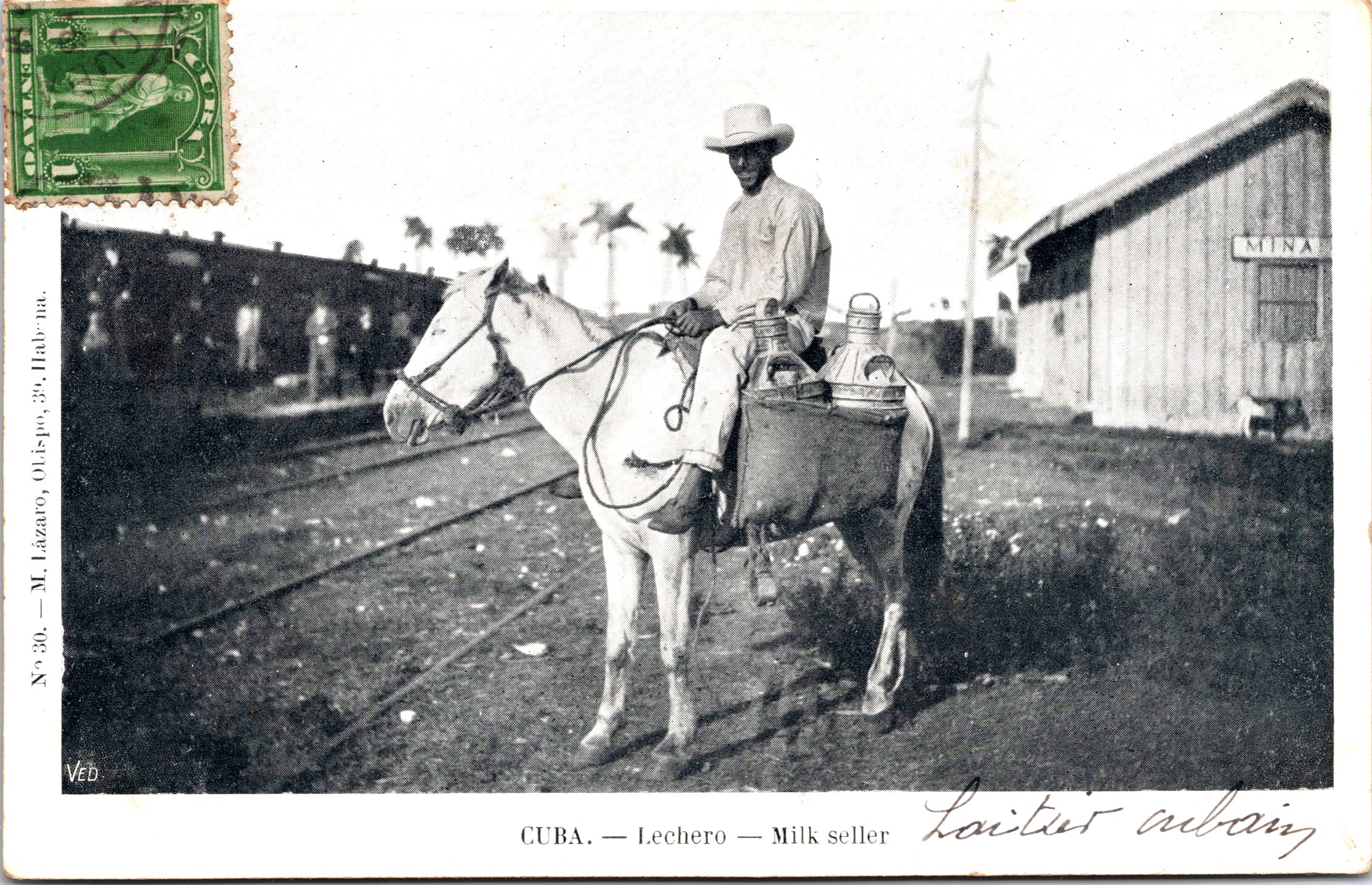
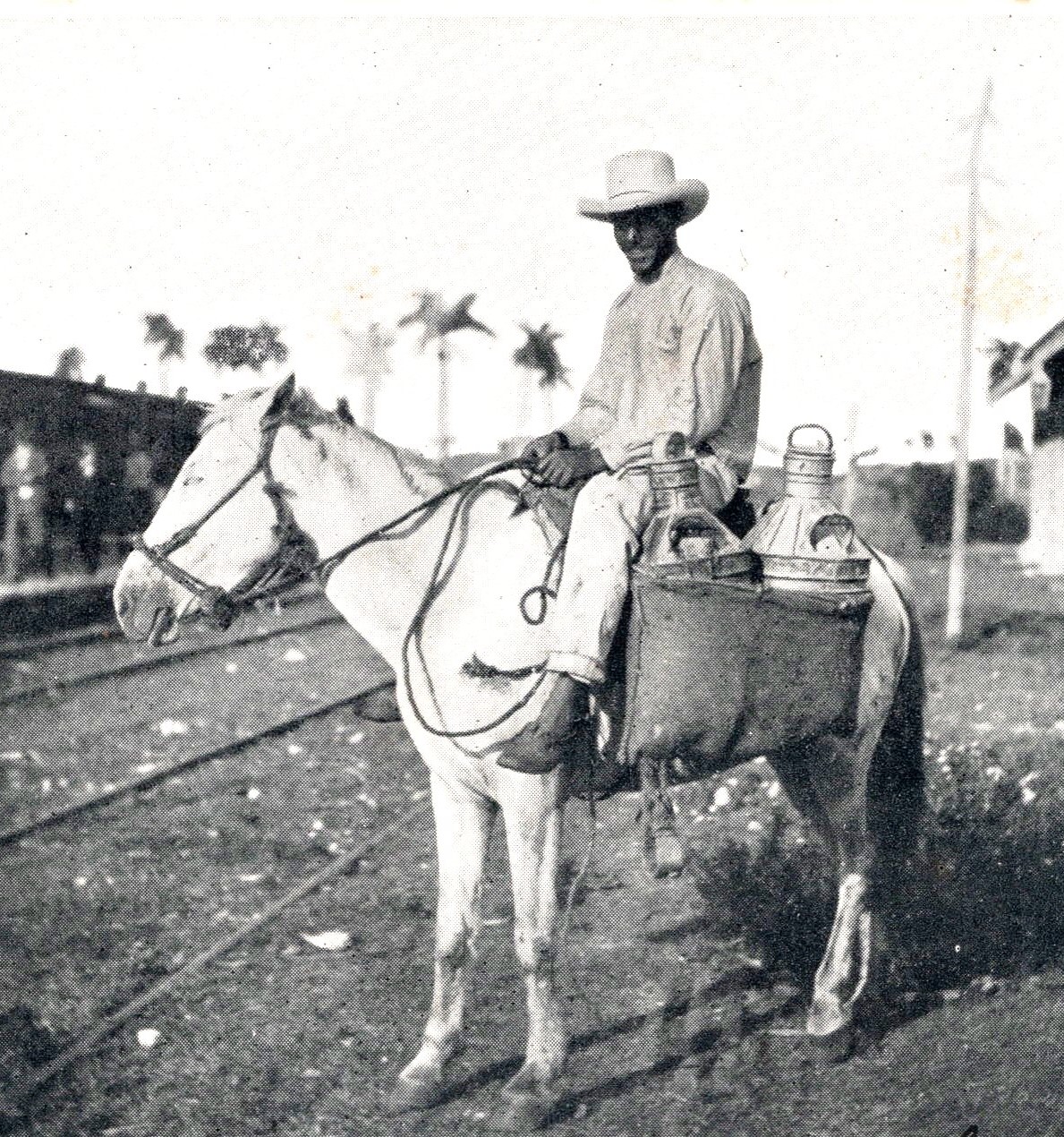
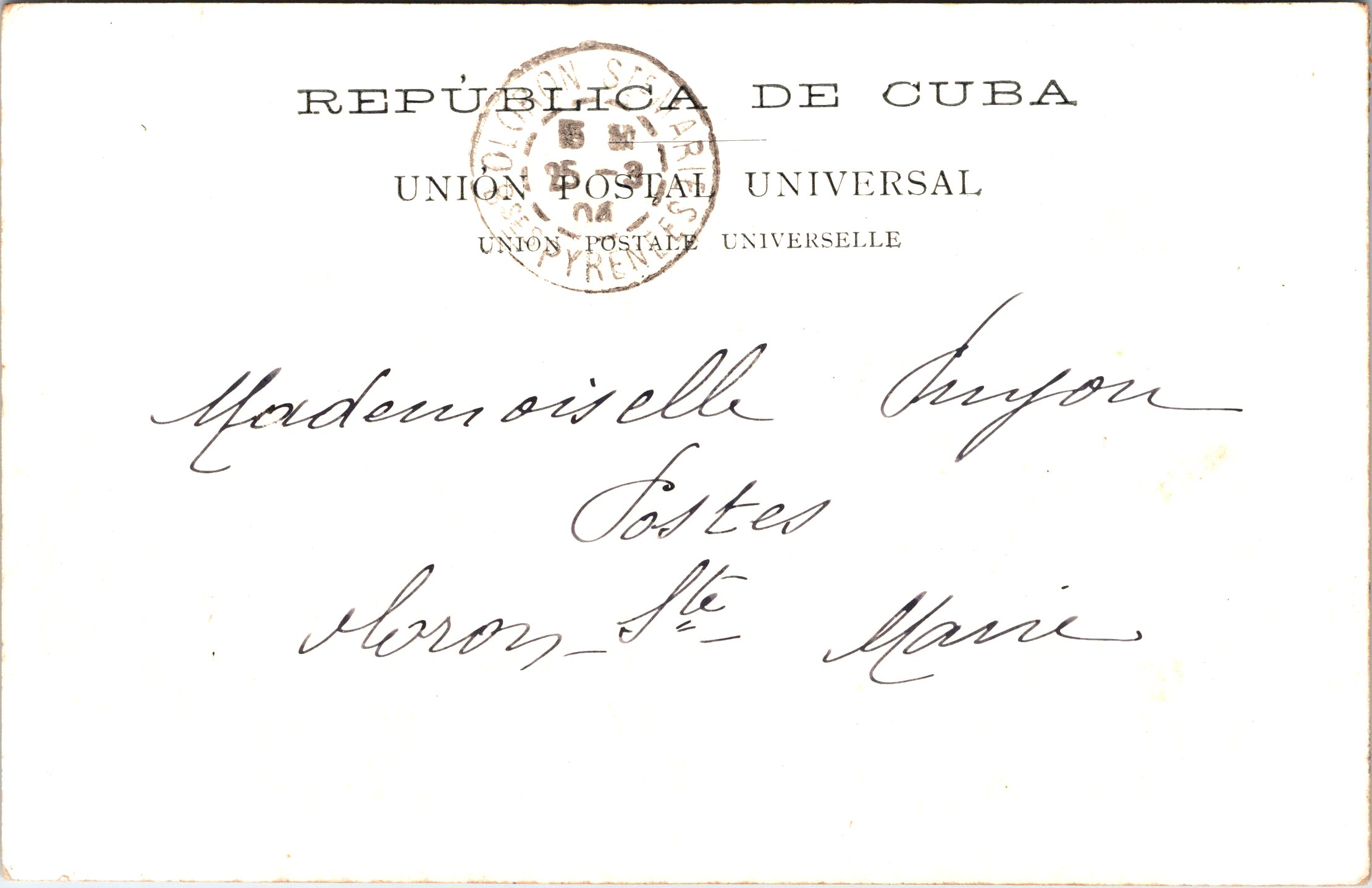
This is an interesting early twentieth-century Cuban postcard depicting a traditional milk vendor, or lechero, delivering milk on horseback. The image shows the rider seated calmly on a light-colored horse beside railway tracks, carrying large metal milk containers in saddle baskets. The scene captures a moment of everyday life in Cuba during a time when milk was commonly delivered door-to-door before refrigeration and modern dairy distribution. The printed caption at the bottom of the card reads: “CUBA — Lechero — Milk seller.” The fact that the caption includes English language, likely reveals that this postcard was meant to be sold to tourists who had a profound interest in occupational postcards. Postcards depicting occupational scenes such as this—milk vendors, street sellers, and other everyday trades—were especially popular with travelers visiting Havana during the early 1900s. The word “lechero” is the Spanish term for a milk vendor who transported fresh milk into towns and neighborhoods, often selling it directly to households. In many cities across Latin America and the Caribbean during the late nineteenth and early twentieth centuries, milk was delivered daily by riders or cart drivers who carried large metal milk cans similar to those visible in this photograph. A particularly interesting detail in this postcard is the pair of large metal milk cans secured in wooden carrying crates attached to the saddle. These containers were early transport milk churns designed to be tightly sealed to prevent contamination or spillage while traveling through town. In warm climates such as Cuba, milk sellers sometimes wrapped the cans with damp cloth or straw coverings to create a simple evaporative cooling effect that helped keep the milk fresh during the day. Milk vendors typically collected fresh milk early in the morning from nearby dairies and transported it into town in these containers. The milk was then measured and poured directly for customers, often using a smaller serving container carried along with the larger storage cans. Because refrigeration and pasteurization were not yet widespread, the milk was meant to be sold and consumed the same day. Note that there is a sign over the window in the building seen in this postcard. “Mina” can be translated as “mine” or a “mining facility”. Likely related to the mine is the railroad tracks running along side the building. The publisher of this lithographic postcard was M. Lazaro. He was located on Obispo Street in Havana. Obispo Street is one of the city’s most historic commercial streets and a well-known center of tourist shops, photographers, and postcard dealers during the early twentieth century. A Cuban one-centavo green stamp appears on the reverse of the card. The postcard is postmarked Bordeaux, France, indicating that the postcard was mailed internationally. The postcard remains in good antique condition overall with strong photographic detail and clear printing. There is general age toning and light handling wear. There is minor corner wear. The stamp remains attached on the front with a visible postal cancellation. The reverse shows the original message and address in ink along with the printed Cuban postal markings. Overall, this is an appealing and historically interesting occupational postcard documenting a traditional milk delivery scene in early twentieth-century Cuba (see scans).
This postcard is available for purchase at my store, The History Peddler, for $18.00
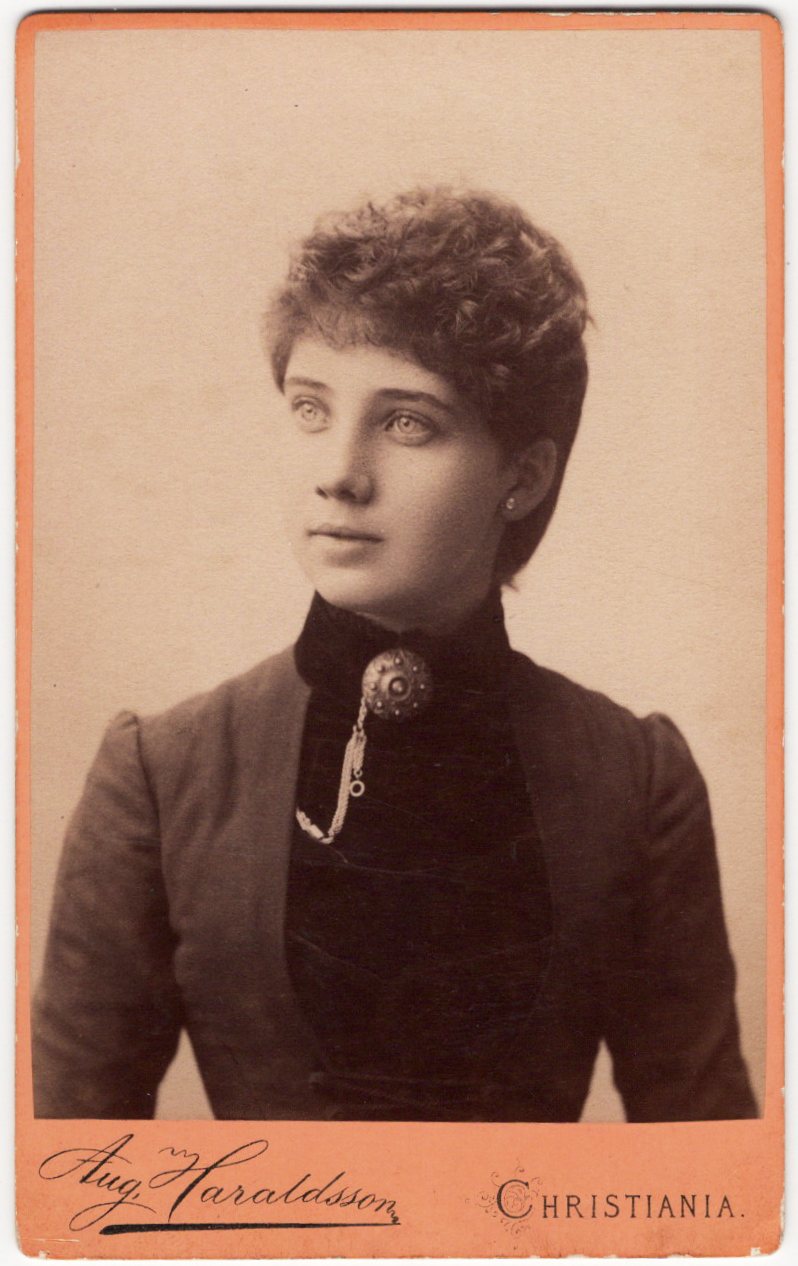
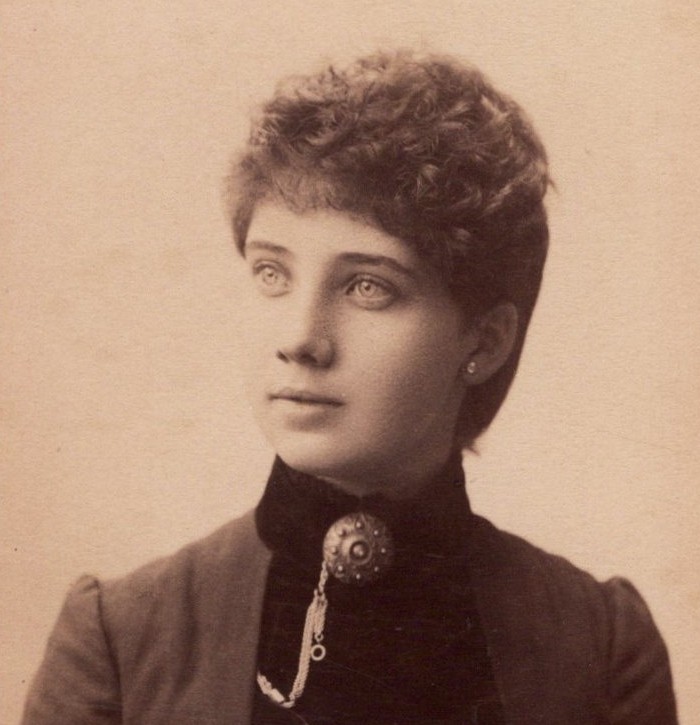
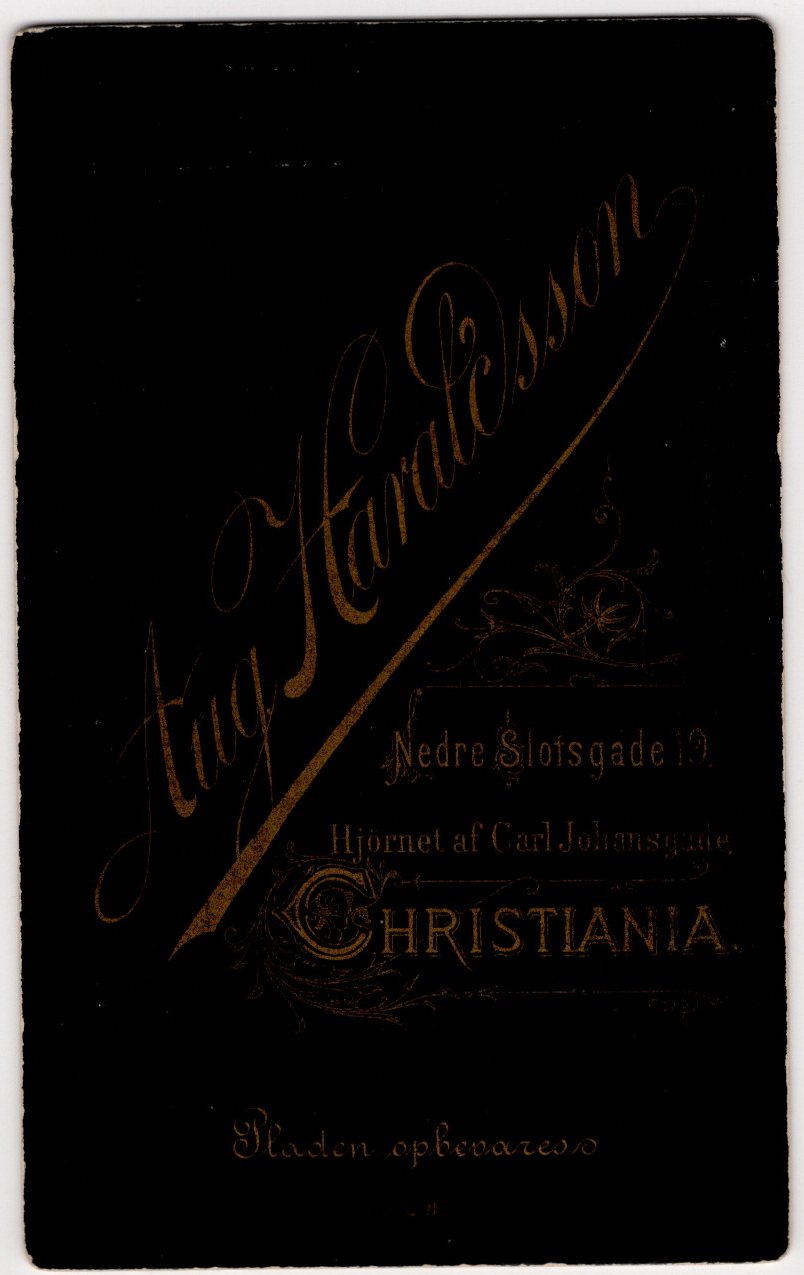
This is a beautiful carte de visite portrait of a young woman taken by photographer Aug(ust) Haraldsson of Christiania, Norway (now Oslo). The sitter is elegantly posed in three-quarter view, looking slightly off to her right with a calm and reflective expression. Her light eyes and delicate features are sharply captured, giving the image a quiet dignity and presence. She wears a high-collared dark dress or jacket with a velvet bodice, secured at the throat with an ornate round brooch featuring a dangling chain. Her hair is fashionably short and softly curled, framing her face in a way that was in vogue during the 1880s–1890s. A small earring is visible in her left ear, adding a subtle touch of refinement. The overall impression is one of youthful poise and gentle elegance. The photographer’s imprint appears on the front mount and in elaborate gold script on the reverse, which reads: “Aug. Haraldsson, Nedre Slotsgade 19, Hjørnet af Carl Johansgade, Christiania.” Haraldsson was an established portrait photographer in Christiania, operating from this address in the late 19th century. (SOLD)