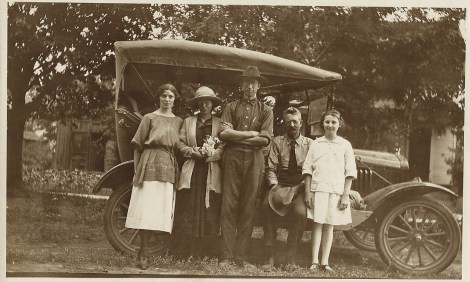
It appears that the two couples riding in this buggy are having a lot of fun judging by the preponderance of smiles in the photograph. Of course this buggy may in fact be standing still. The driver of the carriage is likely holding the reigns of non existent horses because there is a more than reasonable chance that the buggy is a prop located inside a photographers studio. The photographer in question is N. E. McLeod who bills himself as a “Rustic & Wild West Photographer”. His location is advertised on the reverse of this vintage real photo postcard is Happy Hollow, Hot Springs, Arkansas. Take note of the women’s hats in this image. The woman in the back of the carriage has a wide brimmed hat and the woman in the front seat is wearing a plumed hat. Also note the lamp attached to the side of the buggy. The internet’s Encyclopedia of Arkansas History and Culture informs us that Happy Hollow was another name for McLeod’s Amusement Park. This site was one of Hot Spring’s most popular tourist attractions from the late 1800 until the 1940’s. It’s location was at the head of Fountain Street, just off of Central Avenue and north of Hot Springs Mountain. Happy Hollow was owned and operated by photographer Norman McLeod from the time of its founding (1888) through 1908. McLeod was born on a farm in Georgia . At the age of 19 he moved to Live Oak, Florida where he learned the photography business. He then attended college in Athens, Georgia. He started Happy Hollow as a photography studio and gradually developed it into an amusement park complex which included a zoo. In 1908 he sold the property. The park became known for taking humorous photos of it’s guests. Props included an old bathtub, a burro, and painted scenery which included a jailhouse and a gigantic angry bear. McLeod and Happy Hollow were nationally known. This postcard has an AZO stamp box indicating it was produced sometime between 1904 and 1918. SOLD
 Norman McLeod

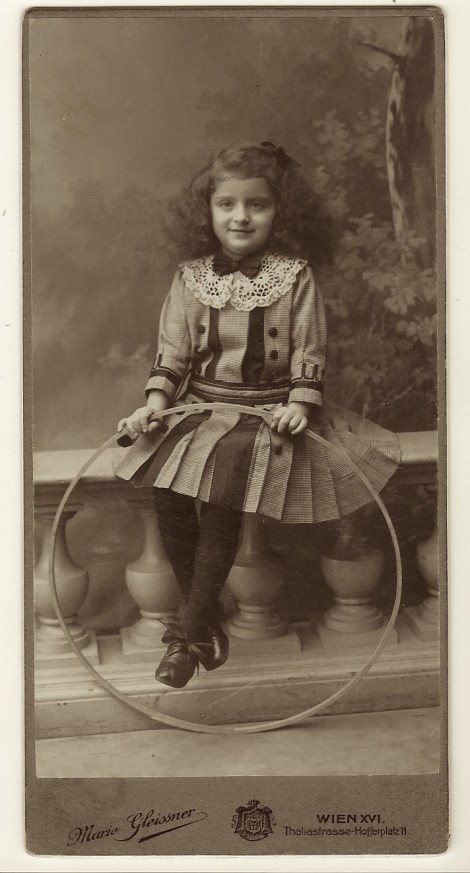
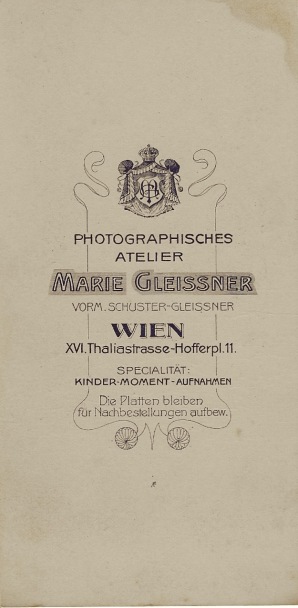
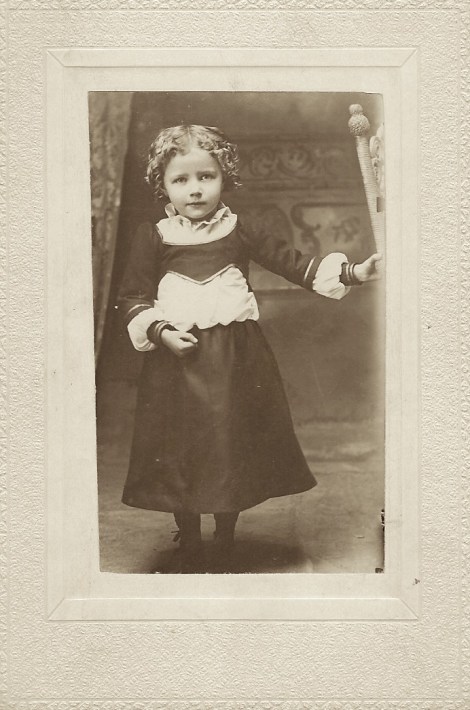 This vintage photograph features a most adorable little girl wearing a cute dress. Printing on the reverse of the photograph reveals that this portrait was taken by Hunt’s Art Studio which was located in Goodland, Indiana. I want to live in a town named Goodland. A place where everyone is “good” and everything that happens in one’s life is “good”. Research reveals that Goodland, which is probably a lovely town, does not fit the bill for being the location of “all encompassing goodness”. In fact, the town, which originated in 1861, is named Goodland because the soil is good. Writing on the verso indicates that the little girls last name may be “Allen”. Investigating the photographer was unproductive. Although there were a number of photographers with the last name of “Hunt” operating in Indiana during the post cabinet card era, I could not find one who worked in Goodland.