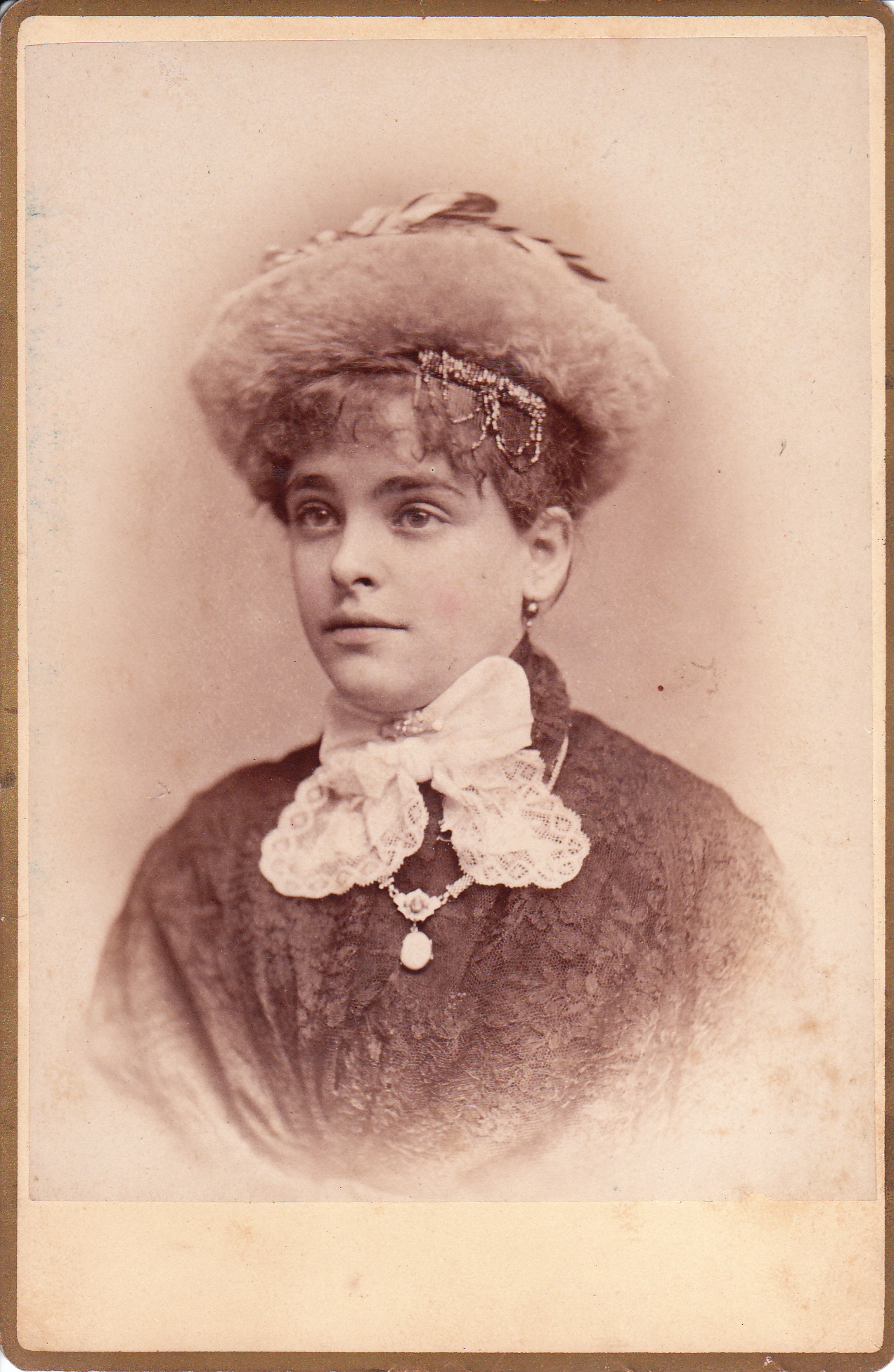
This cabinet card captures the image of a pretty young woman dressed in a fur trimmed winter coat and wearing a fancy hat. She is also wearing a necklace. The photographer who produced this image is Finley & Sons. The studio was located in Canandaigua, New York. This cabinet card likely dates back to the 1870’s. The Finley & Sons studio was established by Marshall Finley as a daguerreotype gallery. His son, Horace M. Finley (1839- ?) joined his father in business in the early 1860’s. The 1870 Ontario County Directory has an advertisement for the gallery. The ad reveals that in addition to “photographic work”, Finley & Sons (172 Main Streeet) was “Canandaigua’s Music Store”. The Finley’s sold pianos (including Steinway and Chickering brands) as well as other instruments and music supplies. In 1888, Horace Finley took on a partner named William N. Freeman. There are many stereoview cards, cdvs, and cabinet cards produced by this studio that can be found today as the Finleys were known to run a prolific studio. To view other photographs by Finley, click on category “Photographer: Finley”.
“WHEN I WORE A YOUNGER MAN’S CLOTHES” IN PHILADELPHIA, PENNSYLVANIA
An older man poses for his portrait at the studio of Adolph W. Rothengatter in Philadelphia, Pennsylvania. While looking at this photograph I thought of a line in the lyrics of Billy Joel’s song “Piano Man”. “When I wore a younger man’s clothes” popped into my head. Something about the image made me think that this elderly man was wearing clothing that he had not worn for many years. At the time of this photograph, I think he looked a bit out of place in his “business clothes”. My thoughts on this matter probably reflect some sort of ageism. However, they are my thoughts and for some reason I wanted to share them. The photographer of this cabinet card operated his own business but during his career he also had partnerships which included “Rothengatter & Dillon” and “Rothengatter & Casselberry”.
ENGLISH STAGE ACTRESS: ELLEN TERRY (THERE AIN’T NOTHIN LIKE A DAME!)
Dame Ellen Terry (1847-1928) was an English stage actress. The top cabinet card is from the studio of Campbell, in Elizabeth, New Jersey. Ellen Terry was the leading Shakespearian actress in Great Britain. She was born into a family that was immersed in the theatre; and future generations continued theatrical pursuits; including grand nephew, John Gielgud (actor, director, producer). Ellen Terry began playing Shakespeare roles as a child and continued to do so. In 1878 she joined Henry Irving’s company. She toured Britain and the United States with great success. In 1903 she took over management of London’s Imperial Theatre and her focus included the plays of George Bernard Shaw and Henrik Ibsen. In 1916 she began acting in films and in 1925 she was made a “Dame Grand Cross of the Order of the British Empire”. Terry’s romantic life, including marriages and love affairs, make interesting reading. Research about the photographer of this cabinet card discovered his obituary in the New York Times (1912). The Times reports that Alfred S. Campbell (1839-1912) was a pioneer in the development of art photography. Among his accomplishments was the publication of an edition of the bible that was illustrated with photographs he took in the Holy Land. He emigrated to the United States on the invitation of famed photographer, Napoleon Sarony in 1866. Among his “intimate friends” were Henry Longfellow, Thomas Nast, and William Cullen Bryant . Visitors to the Cabinet Card Gallery can see photographs by Sarony under the category of “Photographer: Sarony” and can see a portrait of William Cullen Bryant under the category of “Journalist”. To view other photographs by Campbell, click on the category “Photographer: Campbell”.
The second cabinet card features Ellen Terry in the role of “Beatrice” in William Shakespeare’s play, “Much Ado About Nothing”. The Window & Grove studio of London,England, published this photograph. The studio operated in London from the 1870’s to at least 1908.
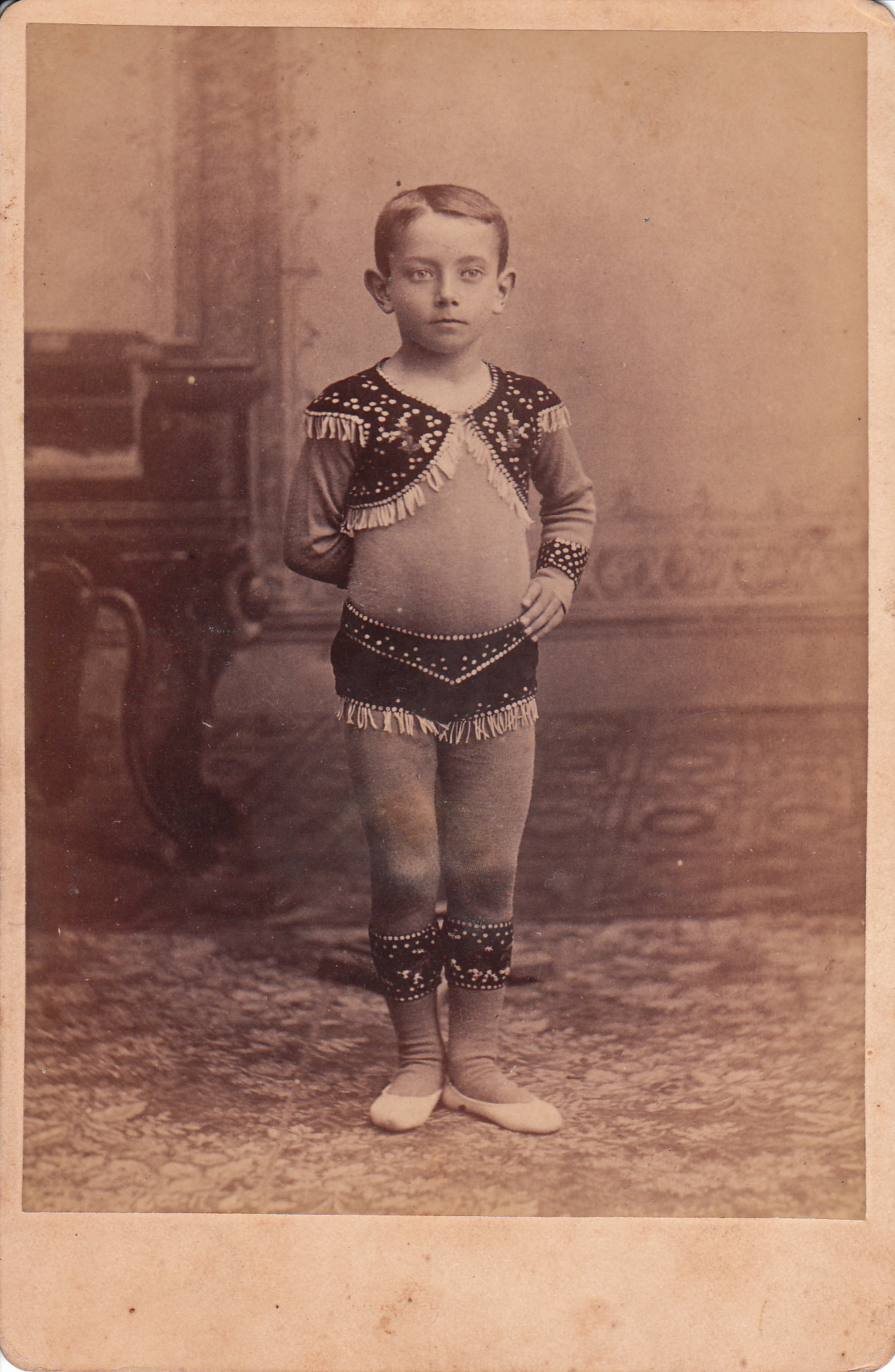
COSTUMED CHILD ACROBAT/CIRCUS PERFORMER
This cabinet card features a young boy who is likely a professional acrobat. The lad’s costume certainly is strongly suggestive that he is a circus performer. The child, as well as the photographer and the location of the studio, are all unidentified.
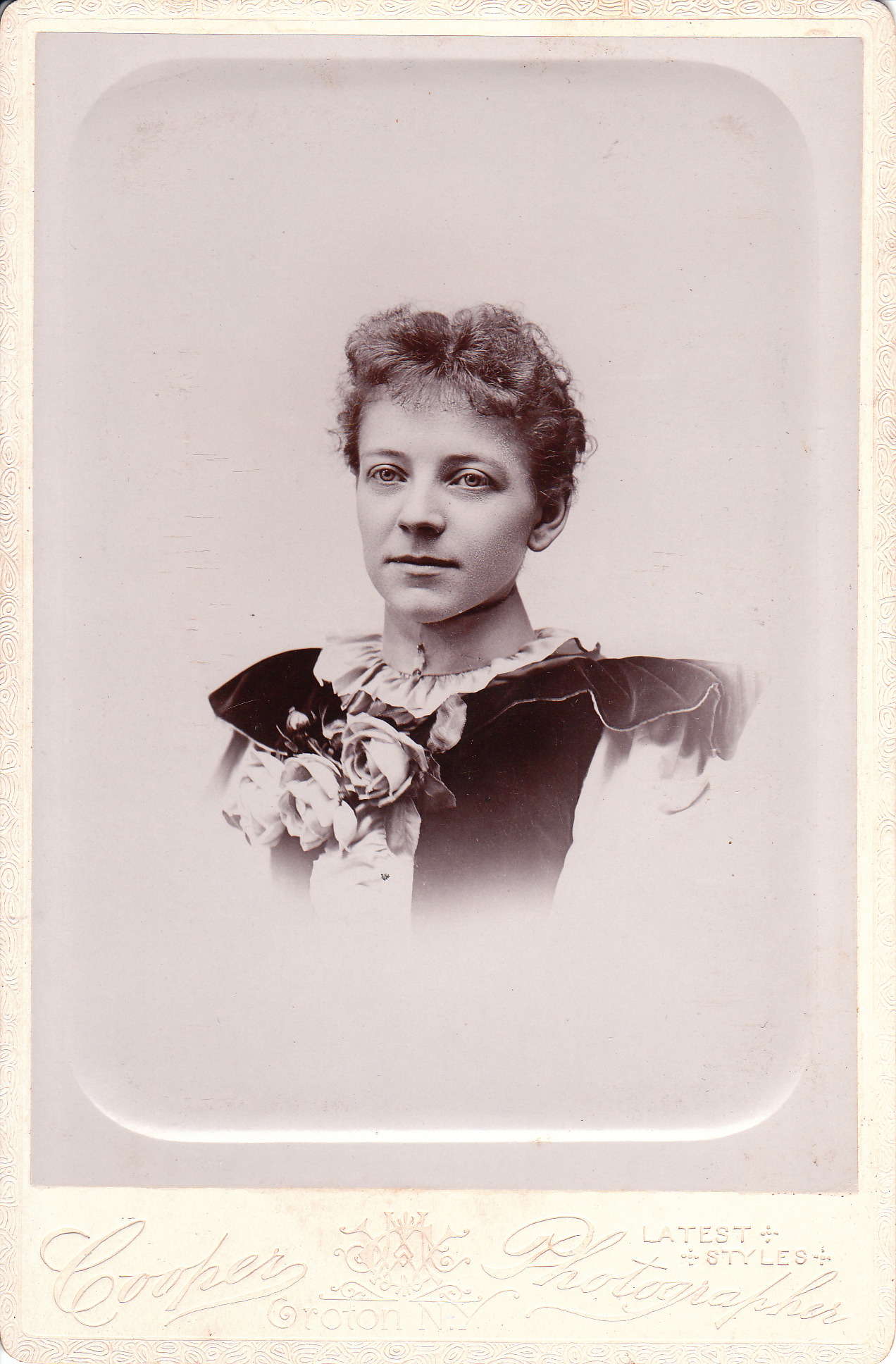
EVERYTHING’S COMING UP ROSES FOR PRETTY WOMAN IN GROTON, NEW YORK
A pretty woman wearing pinned roses on her dress poses for her portrait at a photographic studio in Groton, New York. The photographer’s name is M. W. Cooper. One source reports that he operated as a photographer in Groton in the 1890’s through 1900. Cooper is listed in the Ithaca (NY) city directory of 1890 under the category of Photographers. The directory confirms that his business was located in Groton.
MOTHER AND TWO DAUGHTERS POSE IN KIMONOS IN READING, PENNSYLVANIA
A mother and her two daughters pose in kimonos at the studio of John S. Fritz in Reading, Pennsylvania. There was a time when wearing this Japanese style clothing was quite popular in parts of the United States. This is apparent because it is not uncommon to find cabinet card era photographs with subjects wearing kimonos. A number of historical fashion experts visit the cabinet card gallery and hopefully some of them will weigh in on this subject. To learn more about photographer J. S. Fritz and to view more of his photographs, click on category “Photographer: Fritz JS”.
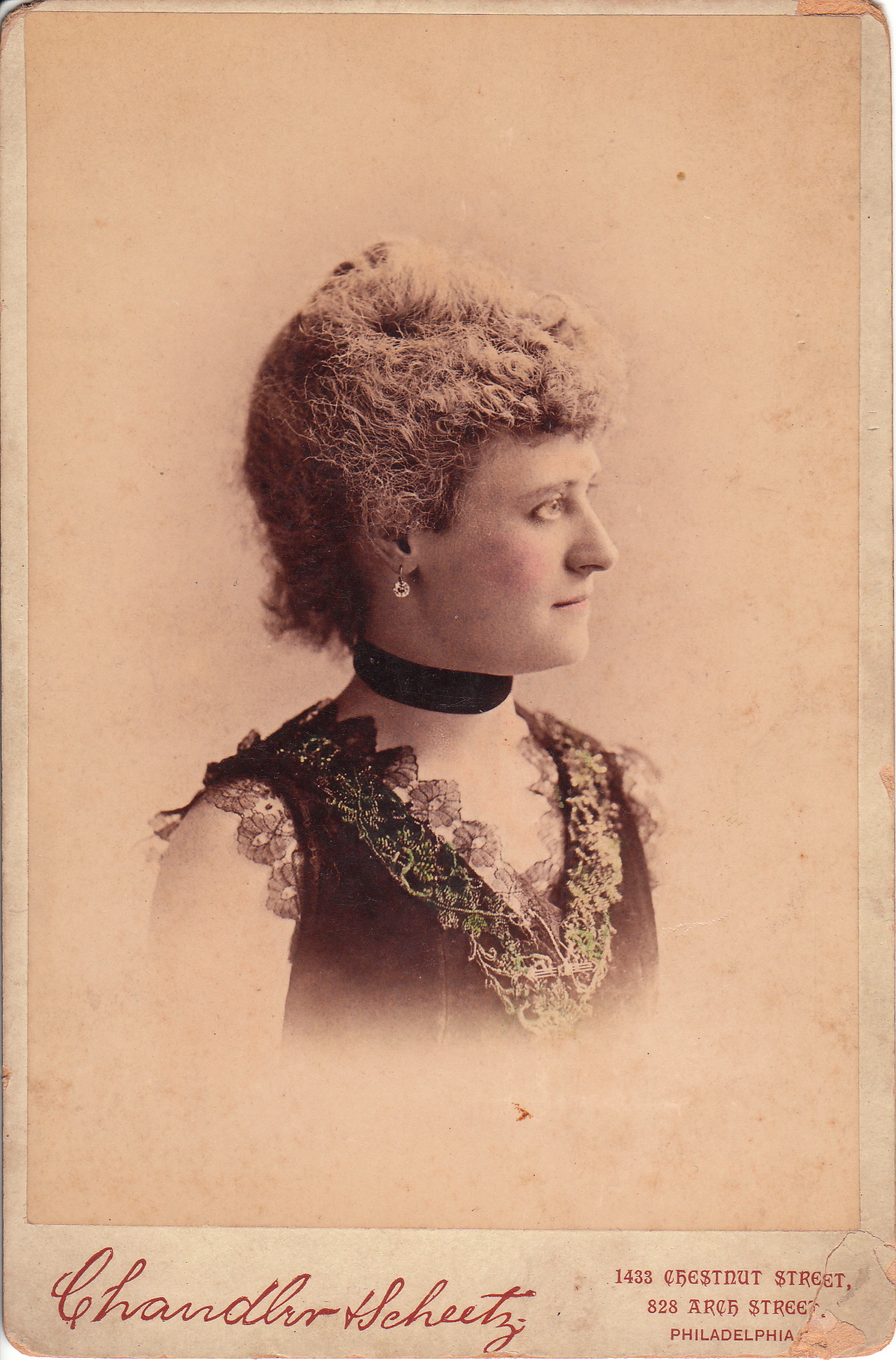
IT’S ALL ABOUT THE DRESS IN PHILADELPHIA: LAURA DEXTER TELLS COUSIN GUSSIE ABOUT HER ADVENTURES IN FASHION
“Dear Gussie,
Here is a Photo of my self in full dress if you would rather have me in my black lace dress I will exchange this for it. Everyone thinks this is the best I have ever had taken. Recd (received) your letter will answer it tomorrow. I tinted this for you.
With love, Your devoted Cousin, Laura Decker.”
The above is the inscription found on the reverse of this cabinet card. Laura Decker was definitely fashion conscious and also very excited about her appearance in this photograph. She was also eager to share her joy with her cousin Gussie. Although this is not a particularly flattering image of Laura, the dress certainly photographed well. Laura’s message to her cousin is interesting though while reading it, I felt almost guilty as if I was reading someone else’s mail. That feeling shouldn’t be too surprising because that’s exactly what I was doing. The photographer of this cabinet card was a studio belonging to George F. Chandler & Samuel Scheetz. They operated their business in Philadelphia, Pennsylvania. One source indicates that the studio was located on Arch Street in Philadelphia between 1880 and 1893. Another source reveals that the two men had a gallery in Atlantic City, New Jersey in 1885. The business was located on the Boardwalk at the corner of South Carolina Avenue. To view additional photographs by Chandler & Scheetz, click on the category “Chandler & Scheetz”. Further information about Laura Decker could not be located because there were a number of women in Philadelphia who shared that name.
SMILING AND BAREFOOT CHILD IN ST. PAUL, MINNESOTA
A barefoot smiling child appears in this portrait by Thomas M. Swem whose studio was located in St. Paul, Minnesota. The wide smiling child, sitting in a fur draped chair, is pictured with a toy and a doll. The reverse of the photo advertises that Swem won a medal from the Minnesota State Agricultural Society in the “Best Photograph” category. He received the award in 1888. Thomas Swem was born in Lima, Ohio in 1848. His wife was named Cassandra and the couple married around 1877. The pair had four children. He operated a studio in St. Paul for eighteen years and then moved to Fargo, North Dakota in 1900. After 1913 he moved to Medford, Oregon where he operated a gallery until1921. Swem died in Medford in about 1931. To view other photographs by Thomas Swem, click on category “Photographer: Swem”.
PRETTY YOUNG WOMAN IN PHILADELPHIA, PENNSYLVANIA
A pretty young woman poses for photographer George W. Bew in his studio. The studio was located at 1725 Germantown Avenue in Philadelphia, Pennsylvania. She is wearing a fashionable hat and an interesting necklace with a locket. She is also wearing earrings. A story about photographer George W. Bew (1835-1913) appears in the “Historical Journal ” (2012) of the Lititz Historical Foundation. Lititz is a town in Lancaster County, Pennsylvania. Apparently, after working as a photographer in Philadelphia (he is listed in the 1881 city directory), Bew moved his business to Lititz. Between 1890 and 1896 his business in Lititiz was known as the “Broad Street Gallery”. Between 1900 and 1913 his gallery was located at 162 Locust Street in Lititz. The Bulletin of Photography (1913) announced Bew’s death. The brief article mentioned that he was still working as a photographer at the time of his death, even though he was 80 years old. Another source listed his death age as seventy-eight.
YOUNG WOMAN UNDER AN UMBRELLA AND EVEN YOUNGER BOY DRESSED IN “LITTLE LORD FAUNTLEROY” STYLE IN LITTLE FALLS, MINNESOTA
A young woman and an even younger boy pose for their portrait at Moe’s Studio in Little Falls, Minnesota. One can only guess about their relationship. Are they mother and son? Could they be brother and sister? The answer to these questions will likely remain unknown. The woman under the umbrella appears pensive. She is wearing a hat and holding gloves. The boy is dressed in the popular “Little Lord Fauntleroy” style that was in fashion at the time of the photograph. No information could be found about Moe or Moe’s Studio. The last name “Moe” appears to have been a popular name in Little Falls around the turn of the century. The name was of Norwegian origin.