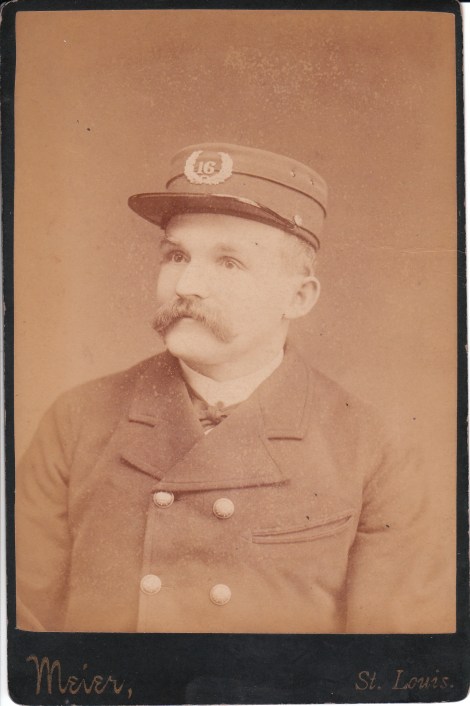
This fireman is posing for his portrait in St. Louis, Missouri. The photographer is Meier.Charles F. Meier was a photographer in St. Louis between 1875 and 1900.
This fireman is posing for his portrait in St. Louis, Missouri. The photographer is Meier.Charles F. Meier was a photographer in St. Louis between 1875 and 1900.


Clinton and Mary Derby are the subjects of this Cabinet card. Brother and sister are dressed adorably. Note the size of the chair the young girl is sitting in, and the fur rug. The photographer is C. E. Lewis of Lebanon, New Hampshire. Lebanon is a city in western New Hampshire. In the mid 1800’s industries began there including furniture manufacturing, machine shops, tanneries, mills (ie woolen textile) and clothing factories. The area attracted many French workers from Quebec.
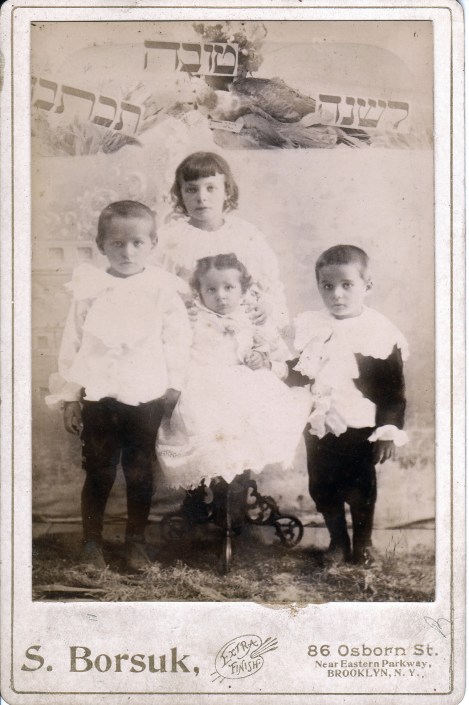
This Cabinet card is a photograph of four Jewish children posing in a studio with a background (perhaps added during the developing process) of Hebrew words. This is a Jewish New Years card (Rosh Hashanah). The photographer of this Cabinet card is S. Borsuk of Brooklyn, New York. It is noted that the studio is near Eastern Parkway. Eastern Parkway has some interesting history. It was the first “parkway” and was conceived by Frederick Olmsted and Calvert Vaux in 1866 (Olmsted designed Central Park). Eastern Parkway was designed as a wide road with several medians with trees, benches, and bike and pedestrian paths. The concept of the parkway was to bring the country to the city.
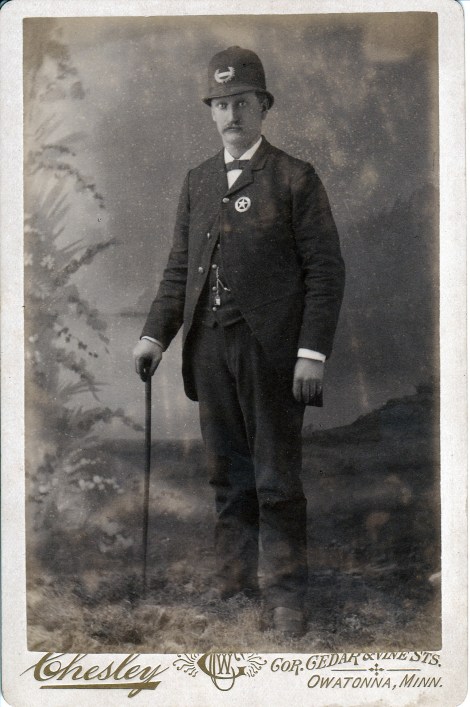
The policeman in the Cabinet card appears to be holding a night stick or baton. He appears quite intense. His uniform appears to show both a British and a frontier western influence. He’s a lawman wearing a sheriff like star. The photographer is Chesley of Owatonna, Minnesota. Owatonna was founded in 1854. It is in southern Minnesota. The origin of its name is interesting. A story was concocted to promote tourism and to sell bottled water. The creative fictional account stated that an Indian chief’s daughter, “Princess Owatonna” was dying but cured from water bubbling up from the ground in the town. It is likely that Chesley, the photographer of this Cabinet card, photographed many of the tourists who came to Owatonna to see and drink the “miracle waters”.

This fantastic Cabinet card captures a Fireman in an old style uniform. He is seated in the photographic studio of Alex. Hesler of Chicago, Illinois. Note the pin on his bib that looks like a hydrant. Also note that his belt has some numbers and some writing. It would be terrific to have someone knowledgeable about fire department history to leave a comment explaining his uniform, pin and belt.
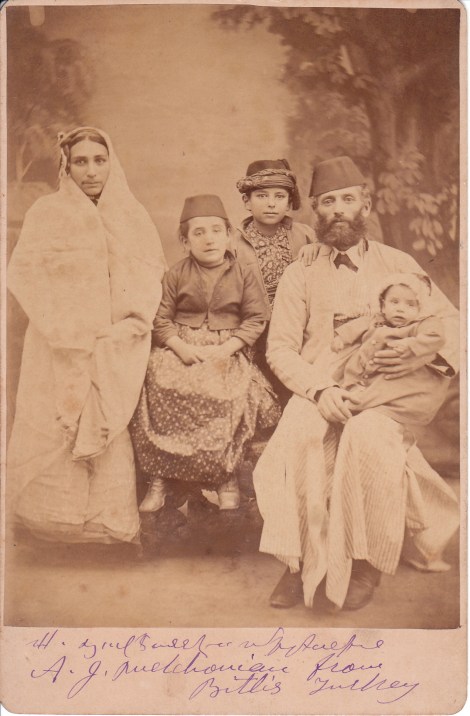
A Turkish family is posing in their traditional garb for photographer L.A. Sawyer in Philadelphia, Pennsylvania. Cabinet cards capture history and this photograph represents the building of America through immigration. How did this family adapt to life in this country? What issues did they face? Lots of questions and no answers. We can only imagine or read about the struggles of other immigrant families. The inscription below the photograph appears to indicate that this family comes from Bitlis, Turkey. Bitlis is located in southeastern Turkey, southwest of Lake Van and 4600 feet above sea level. It is rich in history, having been controlled by Arab dynasties, Byzantines, Persians and Mongolians. By the 14th century it became part of the Kurdish dynasty and was very autonomous until 1847 when it became part of the Ottoman empire. During World War I, the city was occupied by the Russians. The occupation had adverse impact on Bitlis; it reduced its population and damaged their weaving and dyeing industries.

The subject of this Cabinet card is a dapper young black gentleman photographed by Wendover of Albany, New York. Judging by his formal attire, he appears to be well-to-do and is sporting a pocket watch and cuff links. To view other images by this photographer, click on the category “Photographer: Wendover”.

Richard Bartholdt (1855-1932) was born in Schleiz, Germany where he attended college and then immigrated to the United States in 1872. He initially settled in Brooklyn, New York where he learned the printing trade and became a newspaper writer and publisher. He then moved to St. Louis, Missori in 1877 and continued in the newspaper trade. In 1893, while editor in chief of the St. Louis Tribune and member of the St. Louis Board of Education, he was elected as a Republican to the U.S. Congress where he served until 1915. While in Congress he served as chairman of the Committee on Immigration and Naturalization and other committees. In 1911, President Taft appointed him special envoy to the German Emperor to present a statue of Baron Steuben as a gift from Congress and the American people. After serving his time in congress, Bartholdt devoted himself to literary and further political pursuits. He was an esperantist, ind in 1914 he proposed a resolution to have Esperanto taught in American schools. During World War I, he was president of the American Independence Union, which was committed to establishing an embargo on munitions sales by the United States companies to belligerent nations. He died in St. Louis, Mo. This Cabinet card was photographed by C M (Charles) Bell of Washington D.C. The reverse of the card is inscribed by Barholdt. He writes “With the compliments of the season. Yours very truly, Richard Bartholdt M.C.” It is very likely that M.C. signifies “Member of Congress”.
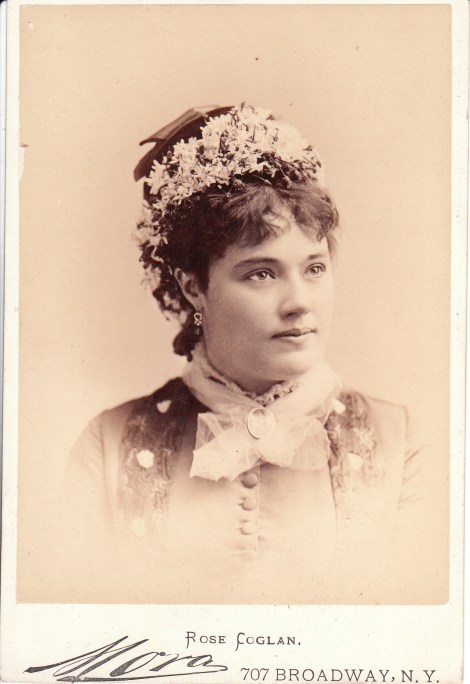
Beautiful stage actress, Rose Coghlan (1851-1932) is the subject of this photographic portrait by celebrity photographer, Jose Mora. Coghlan was an Irish actress who began her theatrical career in both England and the United States in the 1870’s. The IBDB reports that Coghlan appeared in 21 Broadway productions beginning in 1872. These plays included The School for Scandal (1909) and Vanity Fair (1911). She also appeared in Oscar Wilde’s A Woman of No Importance (1893) which was not on Broadway. In 1902 she became a naturalized American citizen. In addition to theater, Coghlan raised livestock on her ranch in Montana. The reverse of this card has a pencilled note indicating that this photograph was taken while Rose Coghlan appeared in “Jealous Wife” (1878).
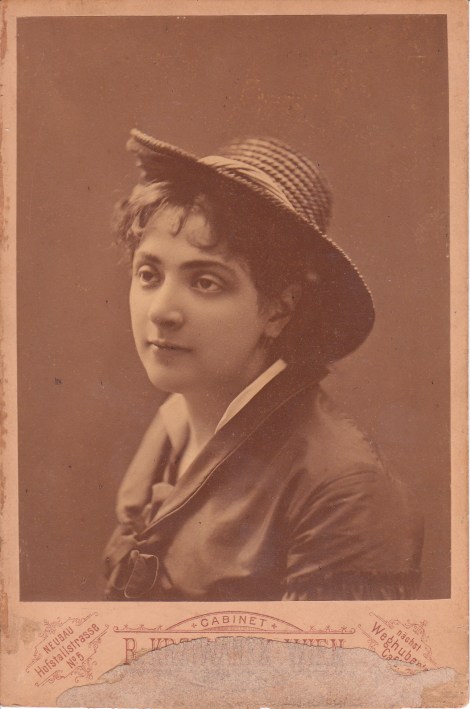
The subject of this cabinet card has a very intriguing appearance. She is young, attractive and mysterious. The reverse of the Cabinet card presents even more to ponder. Glued to the back of this Cabinet card is a vintage photograph of a Black family. Are the photos related or is there another explanation? I believe that this Cabinet card comes from the studio of R Krziwanek of Vienna, Austria. I am not sure of my translation, so any help in identifying the photographer and studio location would be appreciated.


 THE CABINET CARD GALLERY