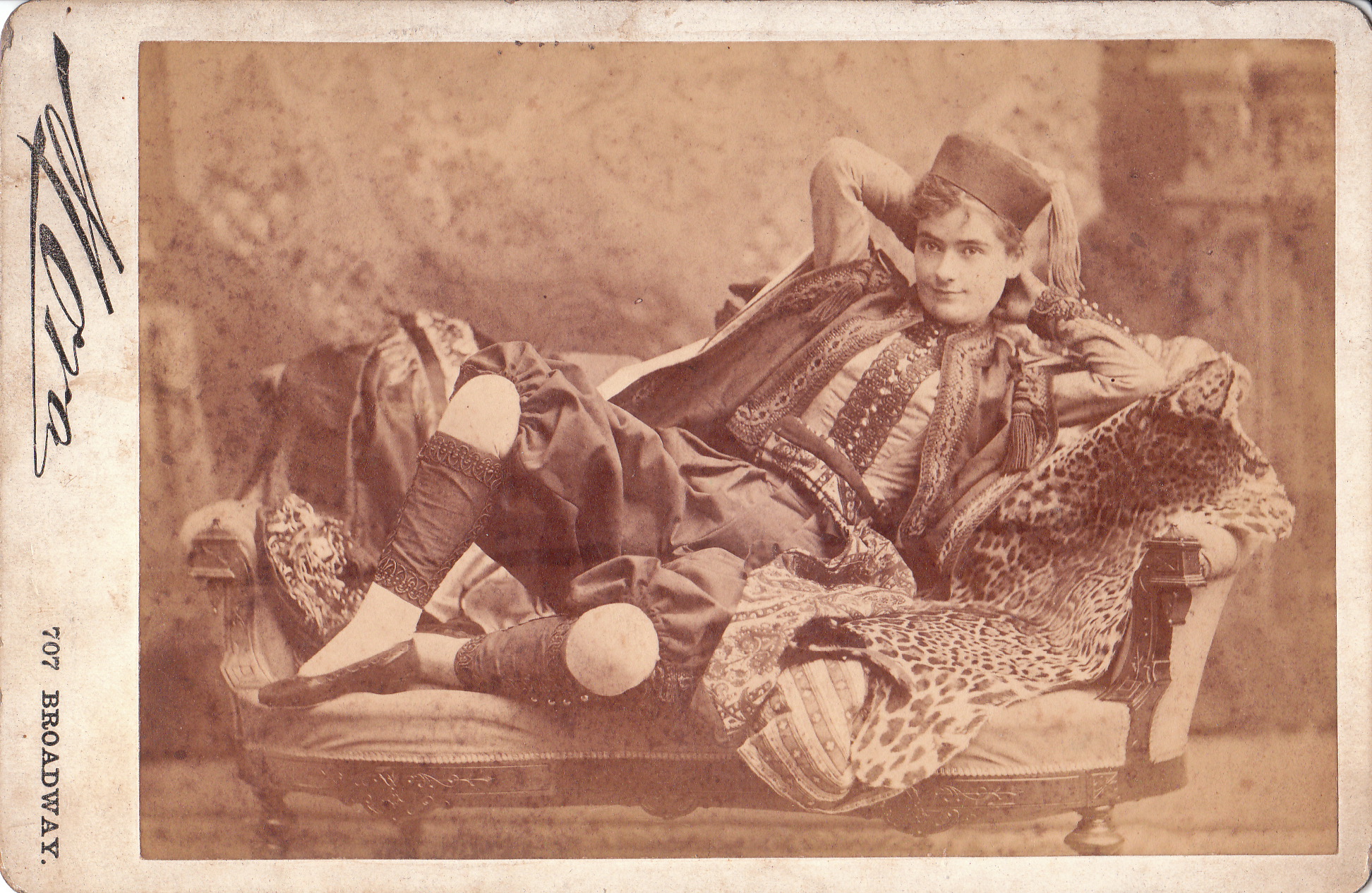
This cabinet card features an alluring woman lying on a divan in a very provocative pose. Note the leopard skin on the divan. This woman is likely an actress. She appears to be dressed like she is part of a harem. Rather than an actress, she may be a member of a circus act. The photographer is the famous celebrity photographer, Jose Mora. This image is risque for the time that it was made. To view other photographs by Mora, click on the category “Photographer: Mora”. ADDENDUM: An informed visitor to the cabinet card gallery has identified the subject of this cabinet card as being actress Jeffreys-Lewis. See the comment below to learn the interesting details.
RISQUE PORTRAIT OF AN ALLURING WOMAN IN NEW YORK CITY, NEW YORK BY JOSE MORA (ACTRESS JEFFREYS-LEWIS?)
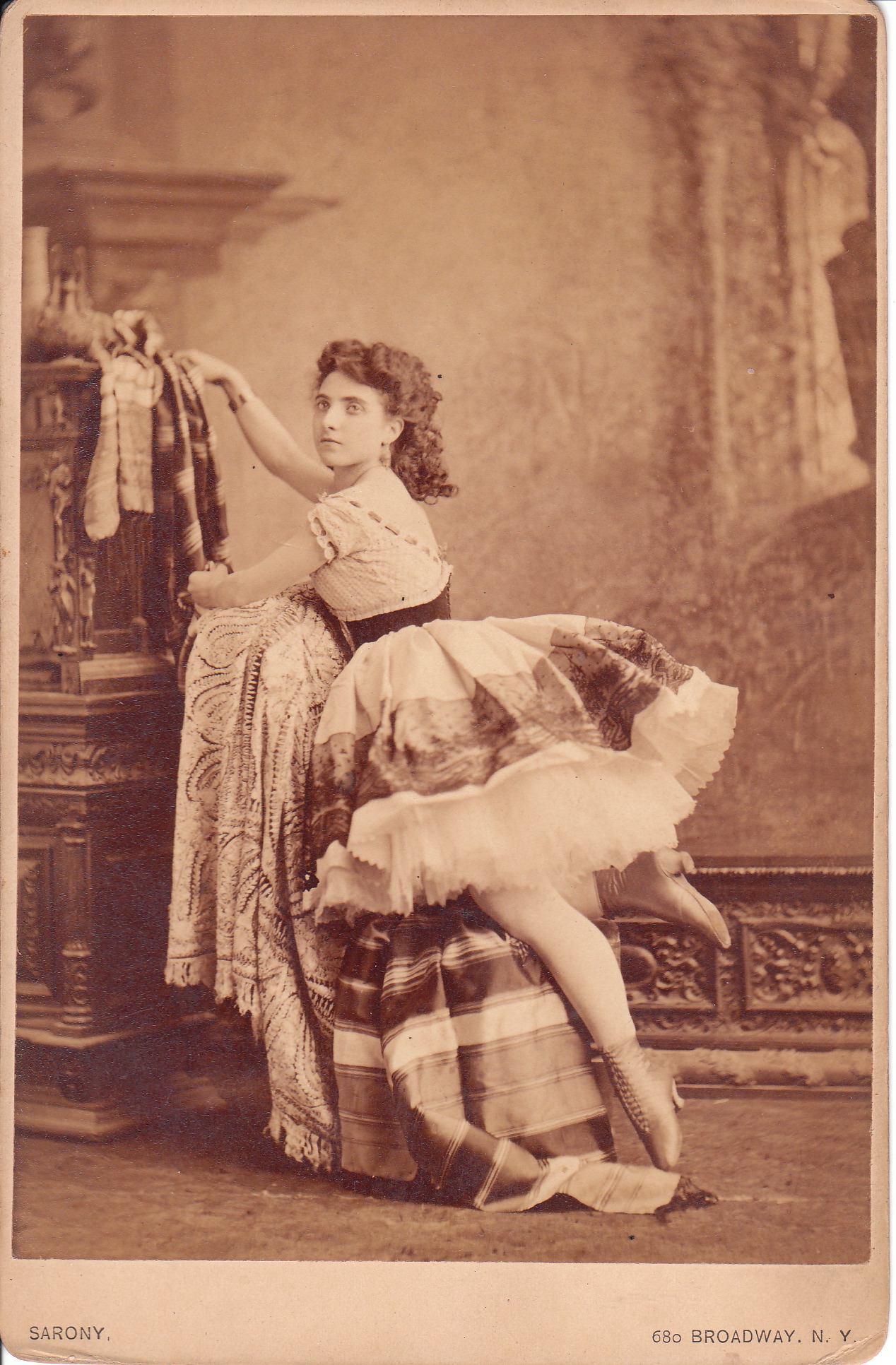
PRETTY DANCER PHOTOGRAPHED BY SARONY IN NEW YORK
This cabinet card is a photograph of a young dancer/actress photographed by the famous celebrity photographer, Sarony of New York. She seems to be in a dancers pose and costume. The reverse of the card has a handwritten identification of the subject. The name listed is Sara Belle; and preliminary research has revealed nothing about her. In fact, the existence of an actress/dancer by that name has not yet been confirmed. Interestingly, Napoleon Sarony’s daughter was named Belle. In regard to the date of this photograph, Sarony opened his Broadway studio in 1866 and moved to 37 Union Square in New York City in 1871. Therefore this photograph was taken between 1866 and 1871. Perhaps a visitor to this site can shed some light on the identity of the woman in this photograph. Additional images by Sarony can be seen by clicking on the Cabinet Card Gallery’s category of “Photographer: Sarony”.
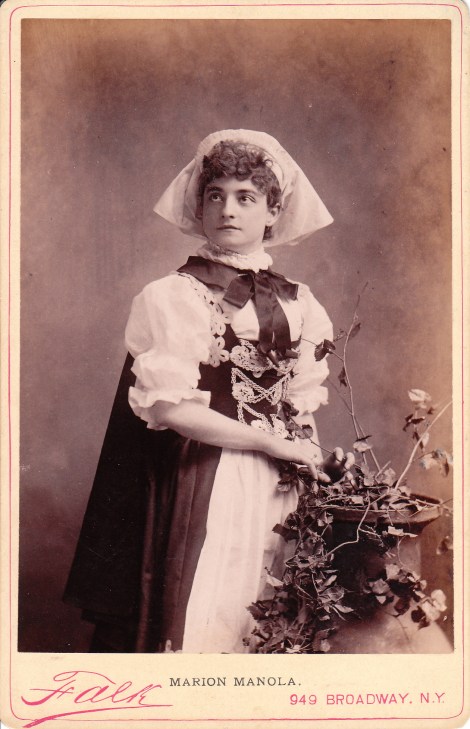
“A BRILLIANT FUTURE SACRIFICED FOR A LIFE OF EXCITEMENT” (1894): STAGE STAR MARION MANOLA
Marion Manola (1865-1914) is the subject of this cabinet card photograph by celebrity photographer, Benjamin Falk. Manola was born in Cleveland, Ohio. She was a popular comic opera star during the late 1880’s and 1890’s. The New York Times (1894) featured a headline stating “A Brilliant Future Sacrificed for a Life of Excitement” referring to Ms. Manola. The newspaper reported that the theatrical community was upset by the actress’s “insanity”. She was described as one of the more popular singer/actresses on American stage. She was known to be a bit eccentric but she was “heartily liked by everybody”. She was described as light hearted, having a joyous nature, and as vivacious. She was discovered by Colonel John A. McCaull, who cast her in a comic opera company. She aggressively pursued her career and had “late suppers”, “early rehearsals”, and worked hard. The stress of her theatrical life caused her to become irritable, fretful and difficult to manage. When her theatre company dissolved, she joined De Wolff Hopper’s company where she became the prima donna. After about a year she lost her job because of difficulty with a manager. She then went to Europe where she played the role of Maid Marion in “Robin Hood”. While in Europe she met her soon to be second husband, John Mason. Mason had his own personal problems including a great deal of debt. They joined a comic opera company in Boston but they quickly lost their jobs due to problems getting along with management. They organized their own company but it went bust. Manola’s mind began to fail and it became known that she had a opium habit. The press had a field day covering Ms. Manola’s psychiatric and substance abuse difficulties, as well as her entry into a rehab facility. Does any of this sound familiar? Think about the press coverage of Lindsay Lohan or a number of other celebrities of today who experience emotional or addiction problems. Manola also made her mark in the courts. In fact, Judge Louis Brandeis, one of America’s great Justices, was involved in an interesting and important case Manola brought to the legal system. The actress brought suit against a theatre manager and a photographer because she was photographed on the stage, without permission, while wearing an outfit (tights) she felt were too immodest to be photographed in. After being photographed, she ran off the stage in distress. The court supported Ms Manola’s suit and forbid the photographs from being distributed. The court took the position of there being a need for morality in the press. Some skeptics felt that the actresses real issue with the photographs had more to do with her not getting financially compensated for the photographs, rather than her claims that her privacy was violated. To view other photographs by Benjamin Falk, click on the category “Photographer: Falk”.
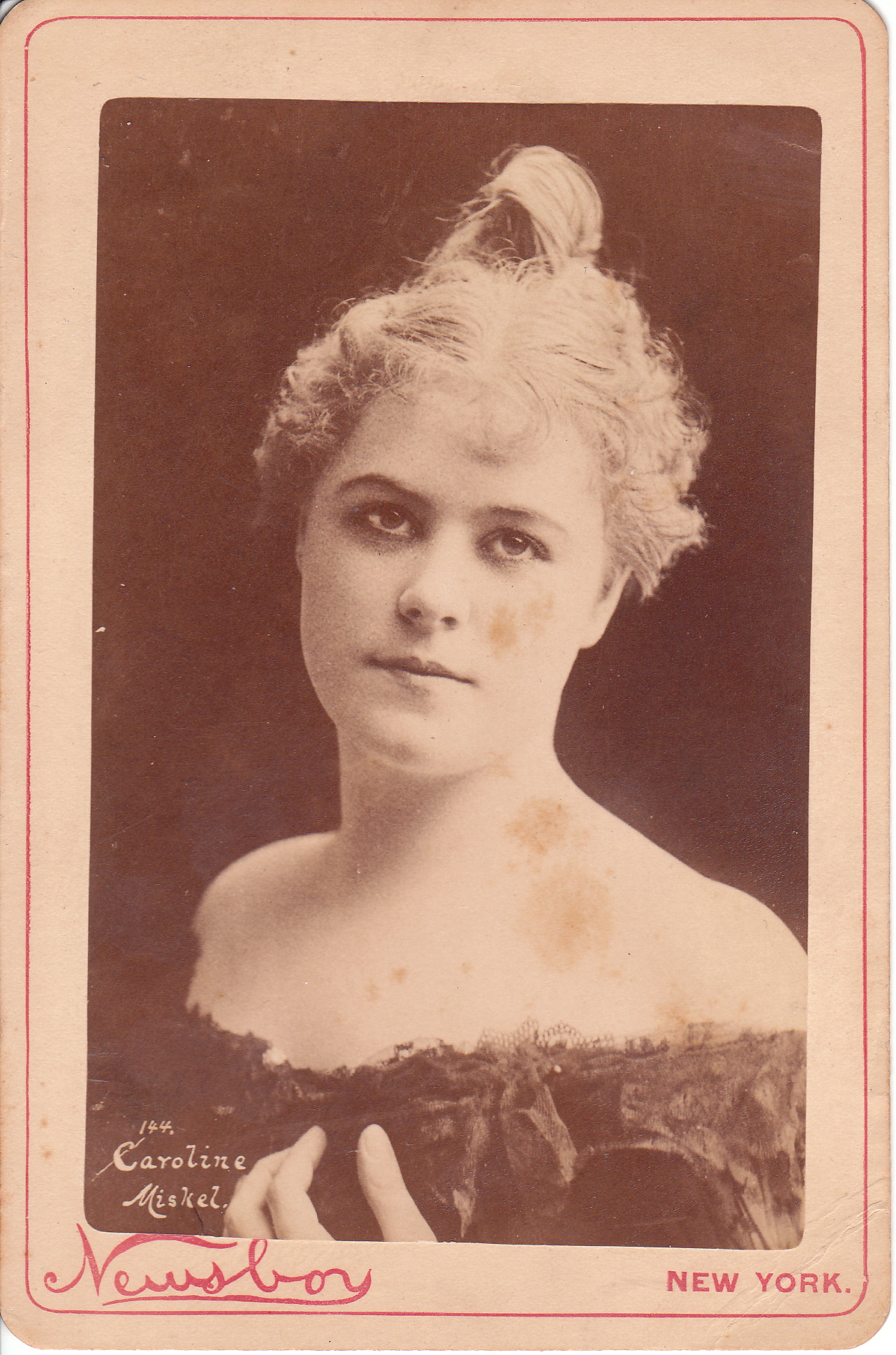
CAROLINE MISKEL: AMERICAN STAGE ACTRESS WITH “NOBLE FORM AND FEATURES”
Caroline Miskel (1873-1898) was born in Kentucky. Her father was a newspaper editor and state legislator. She began her acting debut season with John Augustin Daly’s theatre company. She played in comedies and classic revivals. In 1894 she married Charles Hoyt, a popular playwright of the “gay nineties”. She starred in his production of “A Temperance Town”. In 1895 she was named America’s most popular actress and was awarded with “a nickel plated bicycle with a solid silver searchlight lantern”. Miskel was considered one of the most beautiful of all American stage actresses. One writer described her as a beauty with “light auburn hair, creamy complexion, bright sapphire eyes, and noble form and features”. The writer added that she was “as intellectual as she was beautiful”. Miskel’s life was cut short when she tragically died at age 25 after giving birth to a son. This cabinet card was published by Newsboy as part of a series of premium cards to be given away with the purchase of Newsboy tobacco products.
MARIE BURROUGHS: AMERICAN STAGE ACTRESS
Marie Burroughs (1866-1926) is the subject of this cabinet card portrait by Newsboy. Newsboy used this cabinet card as a premium to boost sales of their tobacco products. Marie Burroughs was born in San Jose, California and after completing her convent education, she was invited to join the Madison Square Theatre Company (c 1883). She appeared in many productions including “Saints and Sinners” (1885,1887) and “Foregone Conclusion” (1886). She was a prominent leading lady but wasn’t considered to have enough star power to carry a production by herself. In 1890 she married actor Louis Massen who had helped train her to become an actress. They separated within two years and she went on to have two other marriages.
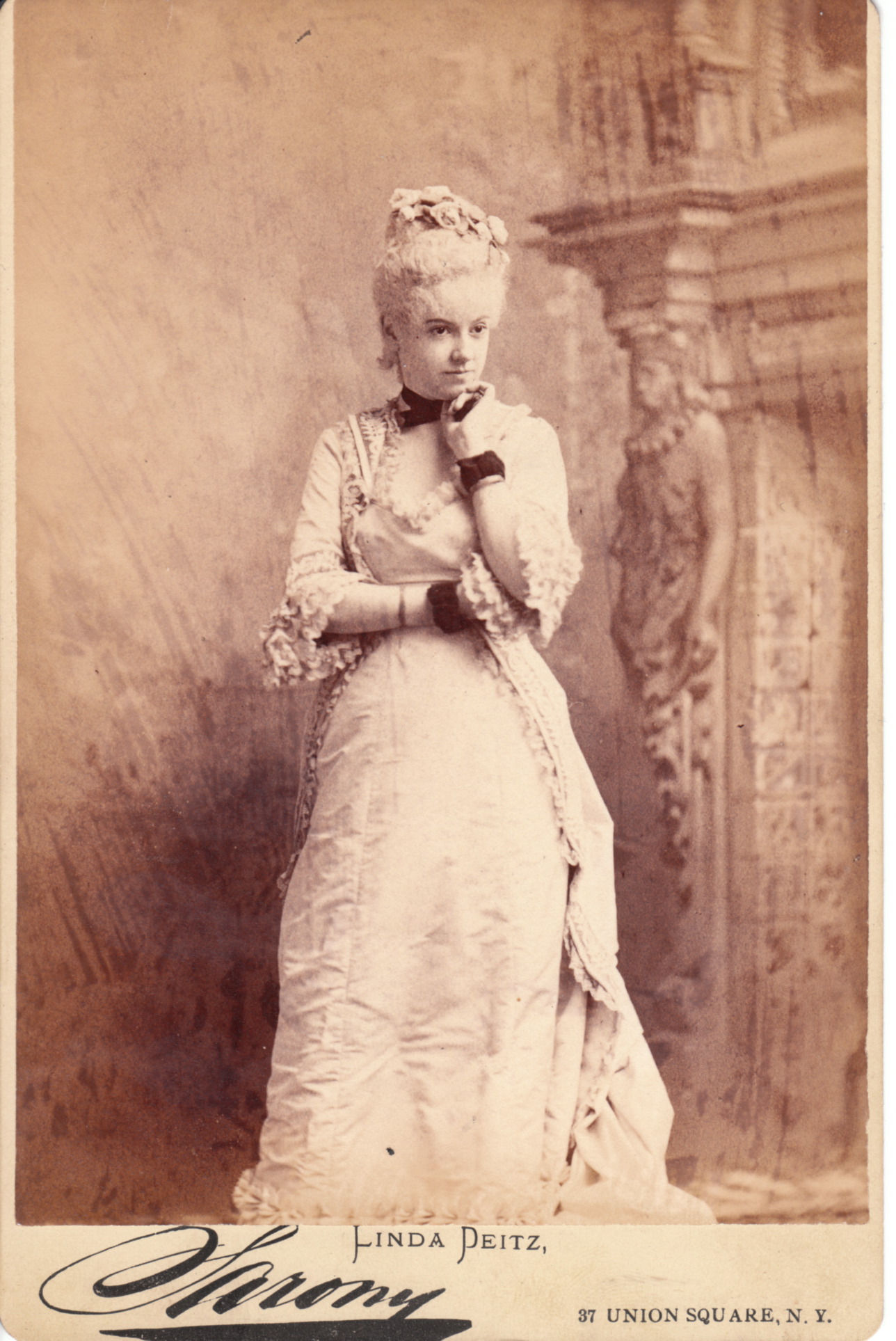
LINDA DEITZ: STAGE ACTRESS INSULTED BY THE NEW YORK TIMES (1879)
Linda Deitz poses for this cabinet card portrait by famed celebrity photographer, Sarony of New York City. Deitz was a well known American actress in the 1870’s and 1880’s. She was photographed a great deal but her theatrical career was of only about ten years duration. She made her stage debut replacing actress Fanny Davenport in a production at Daly’s 5th Avenue Theatre. View Ms Davenport’s cabinet card image under the category of Actresses located on this site. In 1879 a theatre column in the New York Times announced that Deitz was being cast as a leading lady. The critic reported that the decision “does not strike us as very happy”. The article goes on to describe her as a respectful actress within a limited range of parts but “she can scarcely hope to fulfill worth the severe duties of a leading lady”. Later that year, Linda Deitz left New York to join the Hare and Kendal theatre company at St. James Theatre in London. Deitz died in 1920.
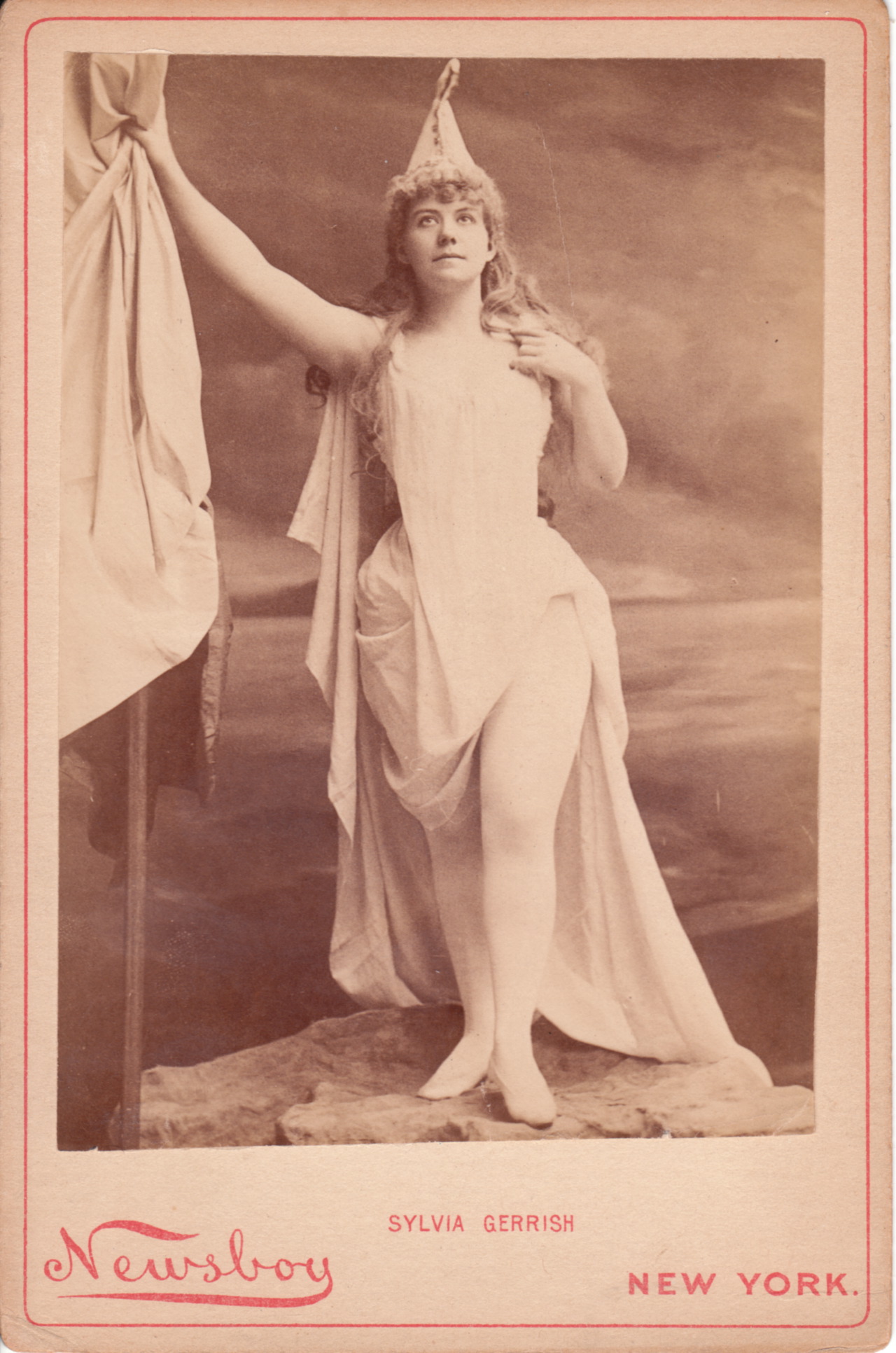
RISQUE THEATRE ACTRESS SYLVIA GERRISH
Sylvia Gerrish (1858-1906) is the subject of this Cabinet Card published by Newsboy. The photograph of the noted comic opera actress and singer was a premium given to users of Newsboy Tobacco products. Sylvia Gerrish was a stage beauty noted in the United States as well as England. She was born in California, sang in her church choir and came to New York and pursued the theatre life. Millionaire Henry Hilton became enamored of her and sacrificed his marriage and fortune to be with her. The story of their relationship was extensively covered by the newspapers of the time. Gerrish ended up dying in poverty.
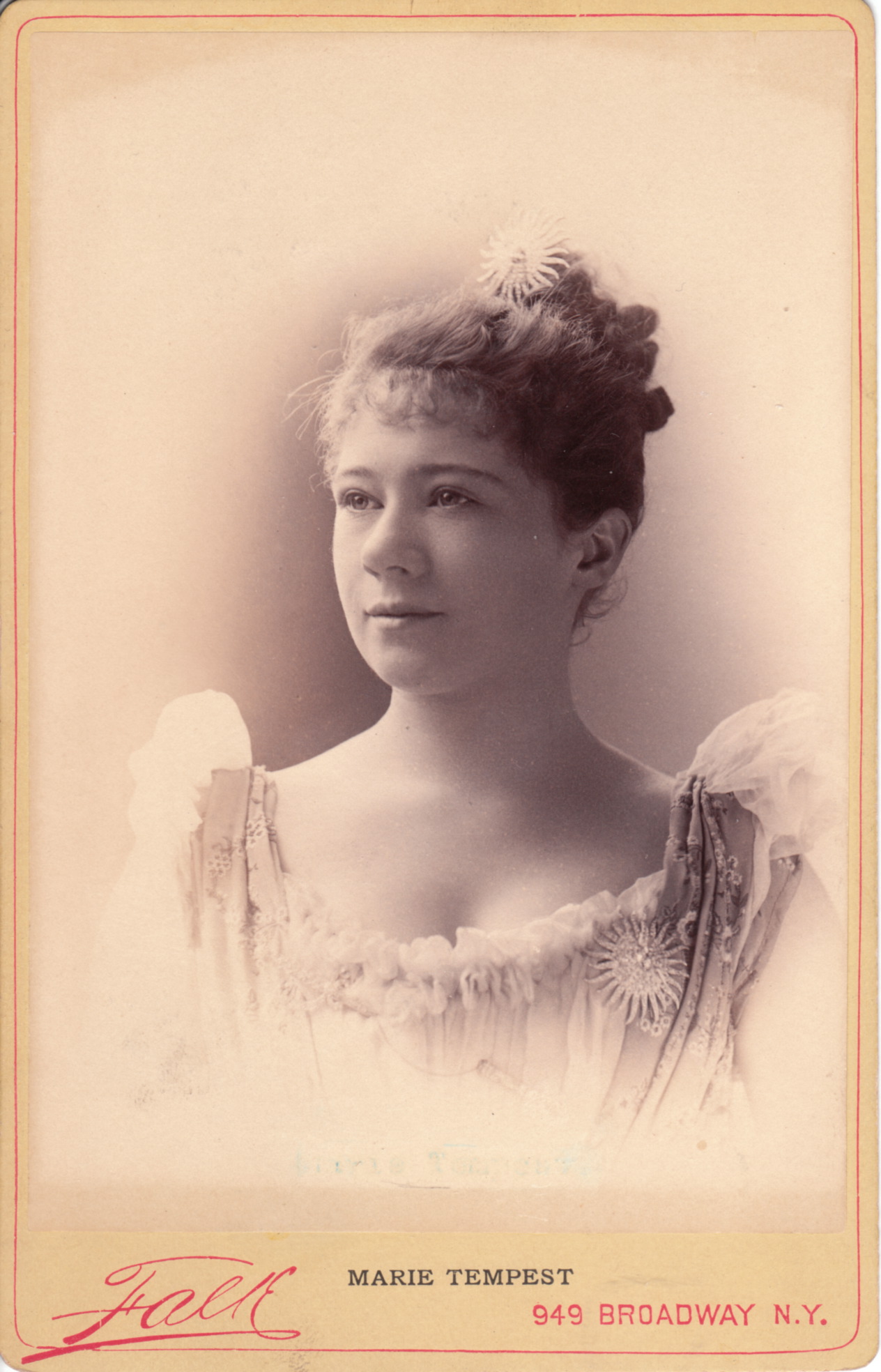
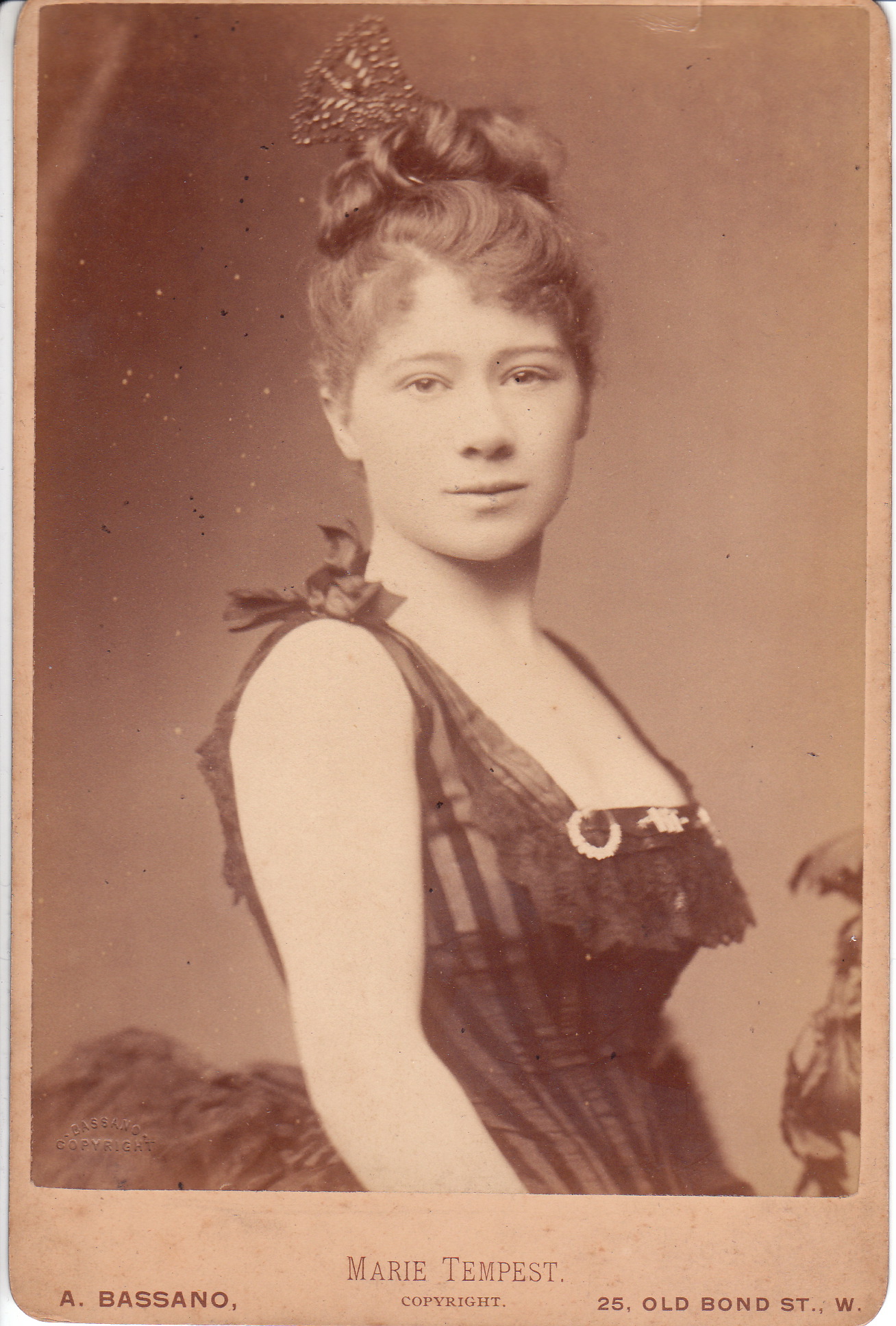
Marie Tempest: English Singer and Actress
Marie Temptest (1864-1942) was a famous soprano in late Victorian light opera and Edwardian musical comedies. She later became a a leading comic actress. She toured in North America and other parts of the world. She was also a significant force behind the founding of the actors union Actors’ Equity in England. She was born in London, England and educated in Belgium. Her later musical education took place in Paris and London. She had her debut in 1885 in the operetta Boccaccio in London. After a few years in other performances, she performed on Broadway over a three year span. She was in numerous productions including The Tyrolean, and The Fencing Master. She was considered on the few rivals to Lillian Russell. Tempest was a difficult star but mellowed in middle age. She was a very active actress and performed in numerous productions over the years. She was created a Dame Commander of the British Empire in 1937. The top Cabinet Cafd was photographed by famous celebrity photographer Falk, of New York City. The bottom Cabinet Card was produced by A. Bassano of London, England.
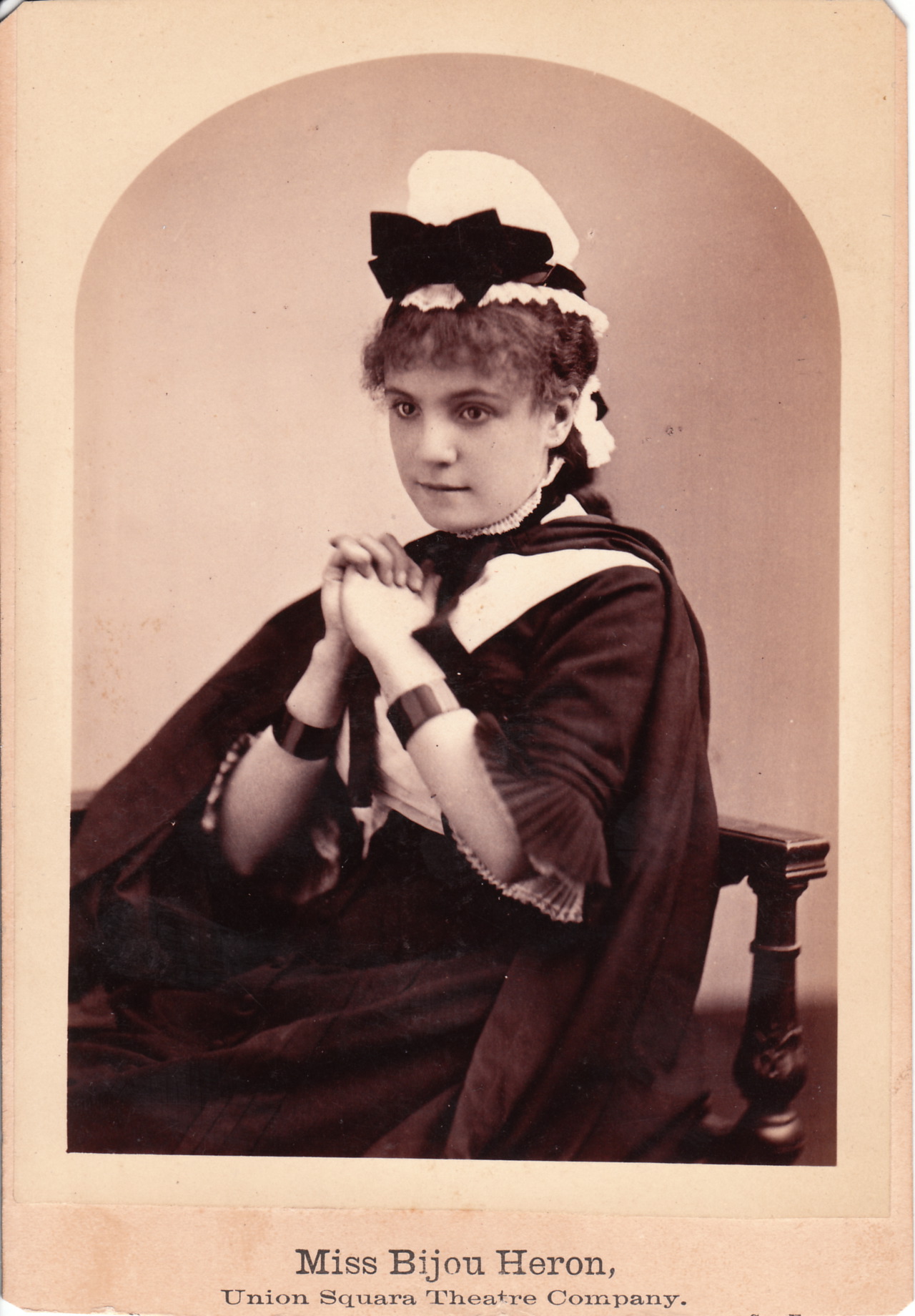
BIJOU HERON: BEAUTIFUL AMERICAN STAGE ACTRESS
This Cabinet Card presents the image of American stage actress Bijou Heron (1863-1937). She was the daughter of composer Robert August Stoepel and actress Matilda Heron. She began her career as a child. She married Broadway producer, writer, actor, and director, Henry Miller (1858-1926). Her son, Gilbert Miller became a very successful Broadway producer. The photograph was published for the Union Square Theatre Company. The photographic studio was Bradley & Rulofson in San Francisco, California. The reverse of the card indicates that the studio has the only “Elevator Photography” in the world. Perhaps a visitor to this site can explain the meaning of “Elevator Photography”. Research reveals that in 1872 the partners installed what they claimed to be the first hydraulic elevator ever to be associated with a photographic studio. The elevator cost them four thousand dollars. Henry William Bradley (1813-1891) and his partner William Rulofson (1826-1876) were partners in a photographic studio that photographed many notable Californians. Bradley was born in Wilmington, North Carolina, and grew up in New Orleans, Louisiana. He opened his San Francisco studio in 1850 and took in his partner in 1860. When he retired in 1878 his studio was considered the best on the west coast and won first prize at the Centennial Exposition at Philadelphia in 1876. Mr Rulofson had quite a controversial and interesting life and associated with many famous people including Ambrose Bierce. Rulofson died in a fall from the roof of his studio and was heard to say during the descent, “I am killed”. You can view a second cabinet card of an actress by these photographers by clicking on the category “Photographer: Bradley & Rulofson”. Ms. Heron is dressed in costume for this portrait. It is likely that she was appearing in San Francisco with a touring company from the Union Square Theatre. The costume that she is wearing is one that she wore in the play “The Two Orphans” in which she appeared with actress Maud Harrison circa 1880. This cabinet card indicates that Bijou Heron was a strikingly beautiful woman.