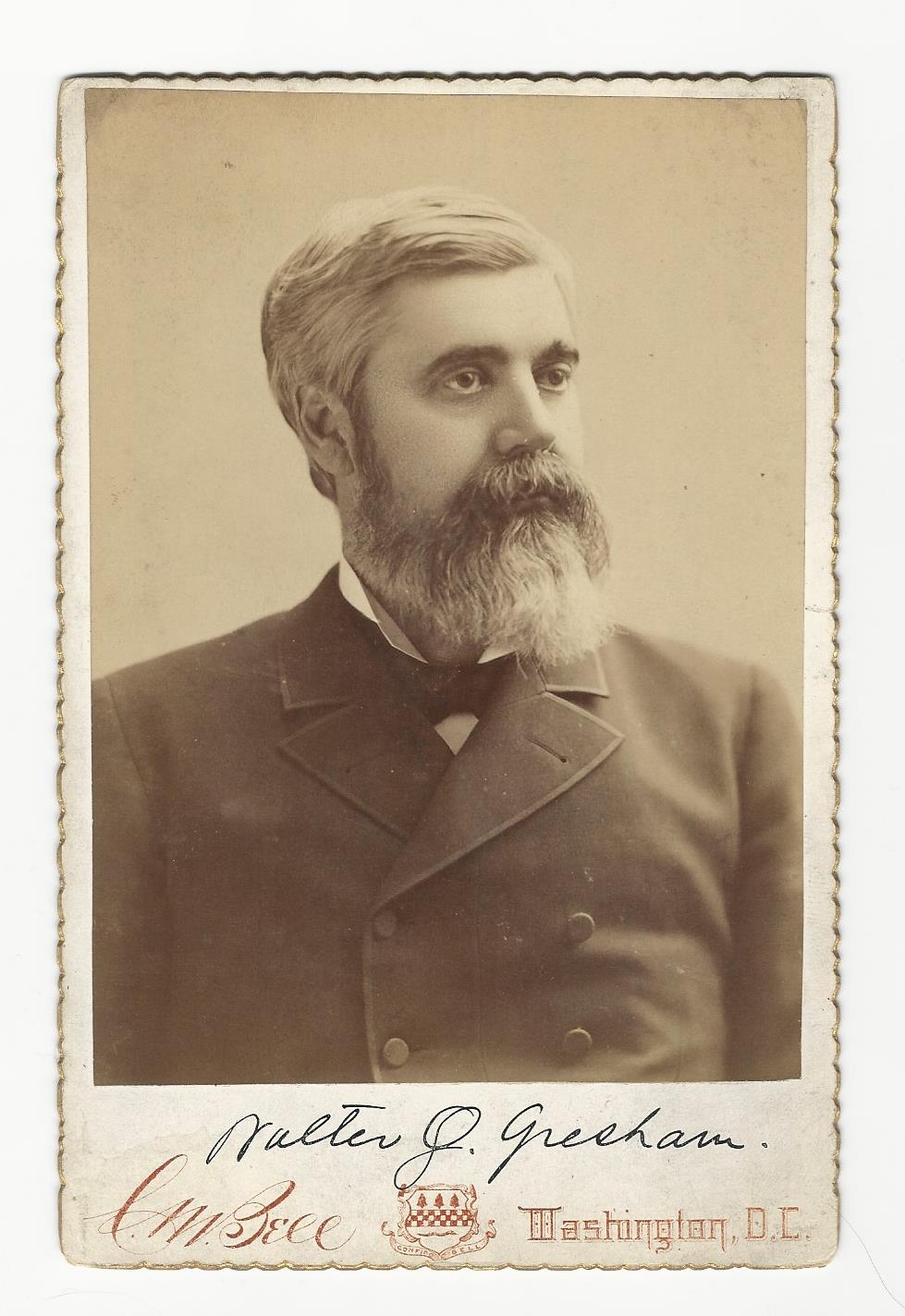
Walter Q. Gresham (1832-1895) was quite an accomplished man in both his military and his political careers. He was an American statesman and jurist. He held offices that included US Postmaster General, Judge on the US Court of Appeals, Secretary of State, and the Secretary of Treasury. He was a two time candidate for the Republican nomination for President (1884 and 1888). He also served as a Union officer in the American Civil War. He entered the army as a Lieutenant Colonel of the the 38th Indiana Volunteer Infantry. He was promoted to full Colonel and led the 53rd Indiana Infantry and took part in the fight for Vicksburg as well as other battles. In 1863 he was appointed Brigadier General and commanded Federal forces in Natchez, Mississippi. In 1864 he became a division commander under General Sherman during the Atlanta campaign. He was forced to leave the army after being shot in his knee; an injury that left him lame for the remainder of his life. He was married to Matilda McGrain in 1858. Gresham is buried in Arlington National Cemetery. The photographer of this historic cabinet card is C. M. Bell. Charles Milton Bell (1848-1893) was also an accomplished man. He was the youngest member of a family of photographers that operated a studio in Washington DC from around 1860 until 1874. He established his own studio on Pennsylvania Avenue in 1873. He quickly became one of the most successful photographers in the city. He was noted for his portraits of Native Americans as well as political figures and celebrities. His subjects included President Chester Arthur, Chief Yellow Bull, and Helen Keller. His photographs can be found in many prestigious institutions including The Library of Congress, Harvard University, Dartmouth University, and the Smithsonian. Bell is also known for his photographs of President Garfield’s assassin, Charles J. Guiteau. He was the only photographer authorized by Guiteau and the Government to take photographs of Guiteau and other people playing roles in his trial. Bell also took medical photographs relating to the assassination and assassin.
PORTRAIT OF A WOMAN AND HER VIOLIN IN MASSACHUSETTS
This cabinet card photograph features a woman and her violin and bow. At least, I think its a violin. Hopefully, an informed visitor to the cabinet card gallery will confirm whether her instrument is a violin and if it isn’t, will correctly identify the stringed instrument. The portrait is a product of a photographer named W. C. Thompson. Mr Thompson operated the Opera House Studio in Amesbury, Massachusetts, as well as the Globe Studio which was located in Newsburyport, Massachusetts. One has to wonder whether the woman in this image was a performer at the Opera House in Amesbury. The Amesbury Opera House has an interesting history. P. Stevens, author of the History of Amesbury (1999) writes that the Opera House was “the most ostentatious building ever to grace the streets of Amesbury”. The citizens of Amesbury experienced a change of scenery when the building burned down in what is considered the worst fire in Amesbury’s history. A contributing factor to the lack of success that the fire department had in putting out the fire was the fact that the man in charge of keeping water pressure high to fight fires was away for the weekend and failed to designate anyone to relieve him during his time away. It seems safe to say that this portrait was photographed before the 1899 fire since the photographic studio likely also was destroyed in the the blaze. According to one source, the photographer of this image, William Cushing Thompson (1839-1917) operated his Amesbury studio between 1869 and 1893. It was located for at least some of this time at Market and Main Street. The Bulletin of Photography (1917) reported that Thompson was in the photography business when the civil war started and he temporarily quit his career to join the Union army. According to the article, he stayed in the war until it ended. Thompson entered the war as a private and mustered out as a sergeant. He served in Company A of the 48th Massachusetts Infantry. Some of Thompson’s photographs are in the collections of the New York Public Library and the Massachusetts Historical Society. Thompson was born and died in Newsburyport. He is buried in the Oak Hill Cemetery in Newsburyport. To view other photographs by this photographer, click on the category “Photographer: Thompson”.
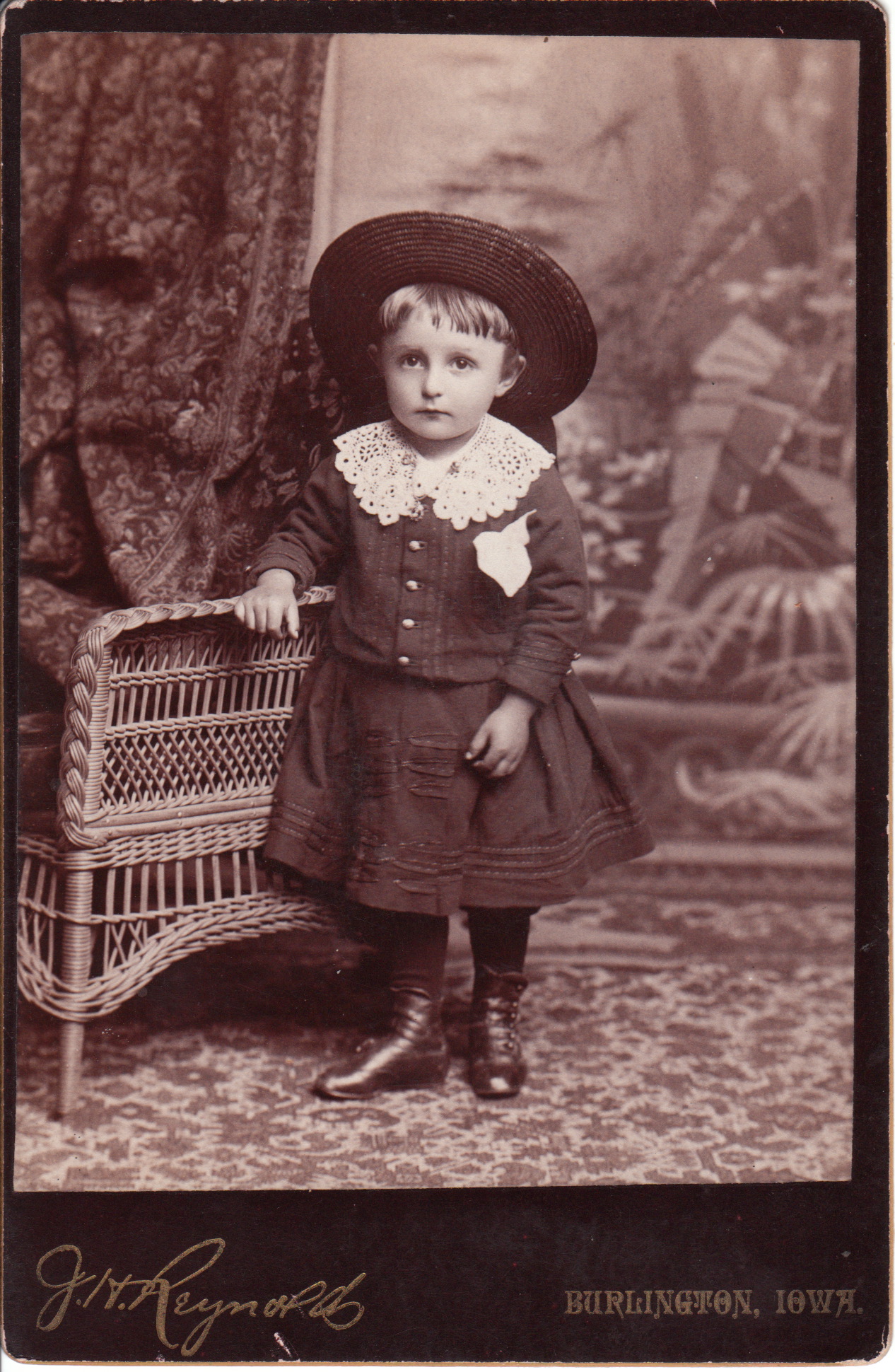
AN ADORABLE CHILD IN BURLINGTON, IOWA
A REAL CUTIE PIE, BOY OR GIRL IS UNCERTAIN BUT I VOTE FOR GIRL NICE HAT AND BUTTON UP BOOTS J H REYNOLDS IS PHOTOGRAPHER JH REYNOLDS PHOTOGRAPHIC STUDIO IS WAY ITS WRITTEN BANGS LACE COLLAR STRAW HAT?
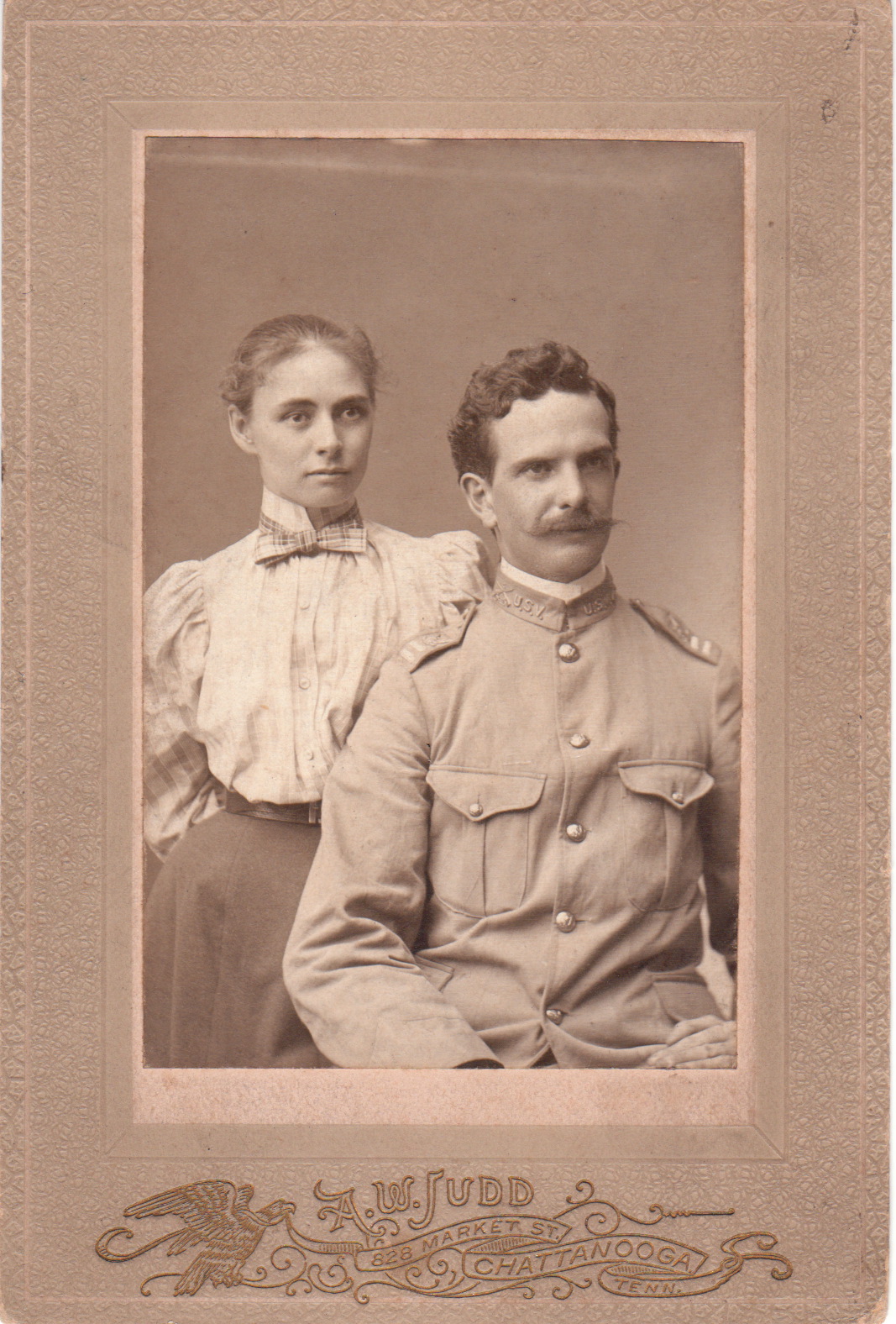
UNITED STATES VOLUNTEER UNIFORMED SOLDIER AND HIS WIFE IN CHATTANOOGA, TENNESSEE
This photograph features a military man with a young woman who is likely his wife. The soldier is wearing collar pins that identify him as a member of the United States Volunteers. Members of the USV were enlisted in the army but were separate from units of the regular US Army. Although volunteer regiments existed during the civil war, the USV was not officially named until the Spanish American War in 1898. The volunteer army was a quick way to supplement the regular army during times of war and was unnecessary during times of peace. This portrait was likely taken during or just after the Spanish American War. The photograph is smaller than a cabinet card. It measures 3.5″ x 5.25″. Note that the woman is standing behind the man making him appear much more prominent. It almsost seems like that she was not even in the original pose and that she was superimposed onto his photographic portrait. The photographer is A. W. Judd of Chattanooga, Tennessee. Judd was born in 1846. The book “Chattanooga” (1996) reports that Amos Wilson Judd was a civil war veteran who began his photography business in 1877. His name and studio appears in Chattanooga’s business directories from 1890 through 1920. He died in 1929. He had two brothers who were photographers. His son succeeded him in running his studio. Judd had two portraits appear in Wilson’s Photographic Magazine (1900). The Photo Beacon (1906) states that Judd was the President of the Kentucky/Tennessee Photographers Association. Wilson’s Photographic Magazine (1908) indicates that he held a patent for a photography invention. A confederate soldier named Amos Judd was a member of the 2nd Battalion Georgia Infantry (State Guard), Company B. He mustered in as a private and left the service with the same rank.
PORTRAIT OF A COUPLE IN CHATSWORTH, ILLINOIS (JOSEPH AND ELLA FRANCIS)
This cabinet card features a couple posing for their portrait at the studio of A. H. Hall in Chatsworth, Illinois. The gentleman has an interesting long and narrow beard, The woman has a dress with many buttons and is wearing a pin on her collar. Note the mans hat is on the floor directly in front of where the couple is sitting. It is not uncommon to see cabinet card portraits that include hats prominently displayed on the floor. Perhaps the hats were viewed as important enough to belong in the picture but it was considered inappropriate to wear hats indoors. The couple in this photograph are identified on the reverse as Joseph and Ella Francis. Investigation reveals that Joseph Francis served in the civil war. In 1864 he enlisted as a private in Company D of the Illinois 45th Infantry Regiment.He mustered out as a private in 1865. The 1880 US census identifies Joseph S. Francis (1846-1930) as a farmer of Irish descent living in Illinois. The 1910 census finds the Ohio born, Francis living in Forrest, Illinois and working as a railroad car inspector. He was 64 years old at the time and living with his wife Ella Svedaker Williamson Francis (1862-1938) and four of their children. The 1930 census that Joseph Francis, at age 84, was still employed. He was working as an assessor for his township. Research found death certificates for both Joseph (1930) and Ella (1938). The photographer of this image was Albert H. Hall. The History of Livingston County (1878) provides a brief biography of Hall. He was born in 1849 and at age 22 went to Chicago to learn the trade of photography. In 1872 he moved to Chartsworth and opened a photography and gem gallery. He married a woman named Dora Knapp.
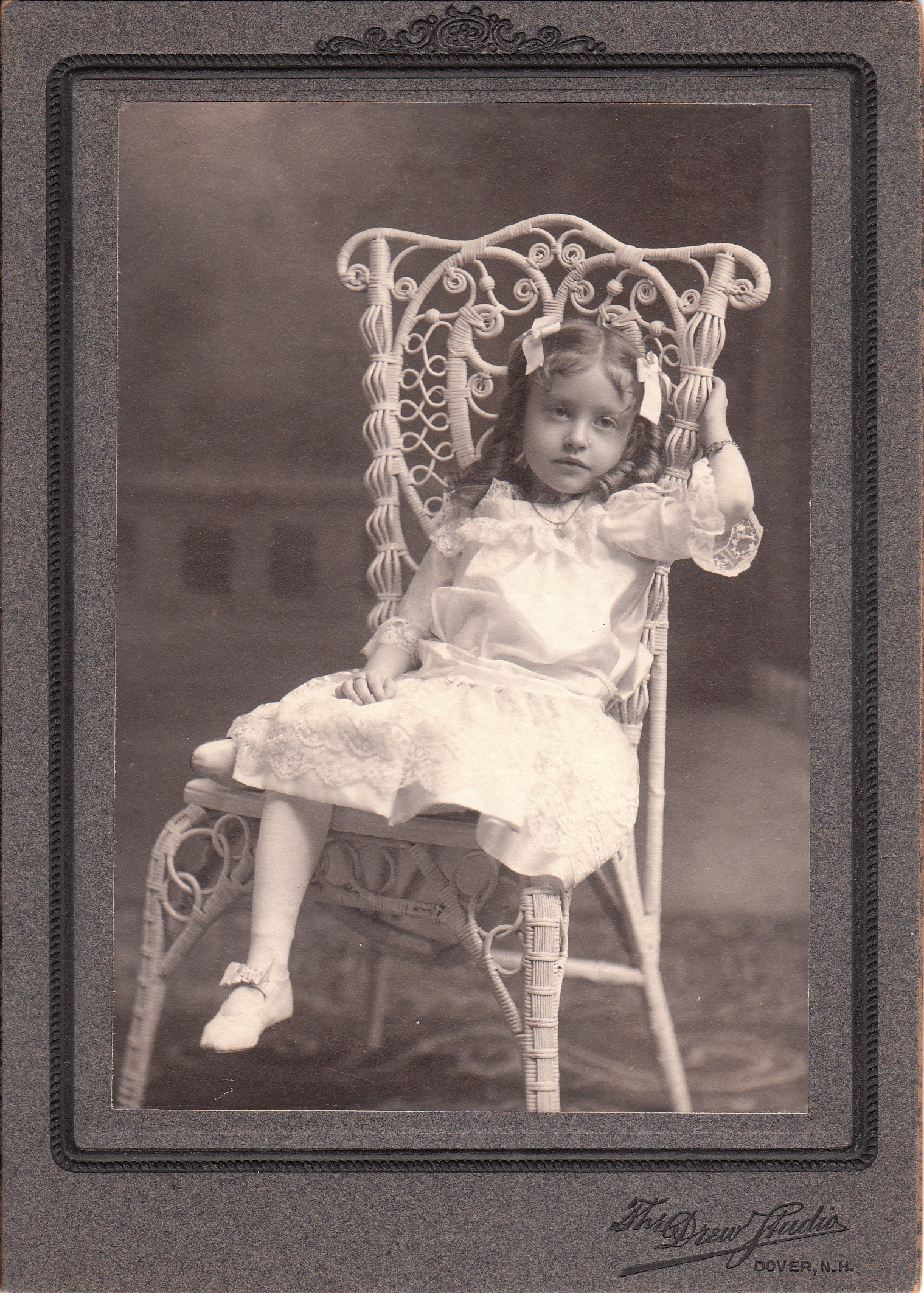
ANGELIC LITTLE GIRL IN ARTISTIC POSE IN DOVER, NEW HAMPSHIRE
An angelic looking young girl dressed in white, poses in an artistic portrait at the Drew Studio in Dover, New Hampshire. The little girl does not appear very happy about the process of being photographed. She has corkscrew curls and is wearing hair ribbons. She is sitting cross legged in a white wicker chair. The photographer of this large format image is A. P. Drew. The Dover Enquirer (1896) has an article which mentions Alfred Palmer Drew. In 1896 a “deluge” and subsequent fire destroyed a business block and three bridges in Dover. The flooding sent the stores on the block down the Cocheco River. The photography studio Drew and Boomer was among the stores washed away. The Bulletin of Photography (1917) contains the obituary of A. P. Drew. He died at the age of 81. He had been born in Dover and had worked as a photographer there for more than 50 years. He retired in about 1914. During the civil war he had been a member of the Strafford Guards. The regiment was originally established in 1822 and a year later became part of the New Hampshire State Militia. In 1864 the Strafford Guards were mustered into service of the Union Army for a period of sixty days. They relieved a New Hampshire artillery unit that had been sent to the front. A. P. Drew served as a corporal.
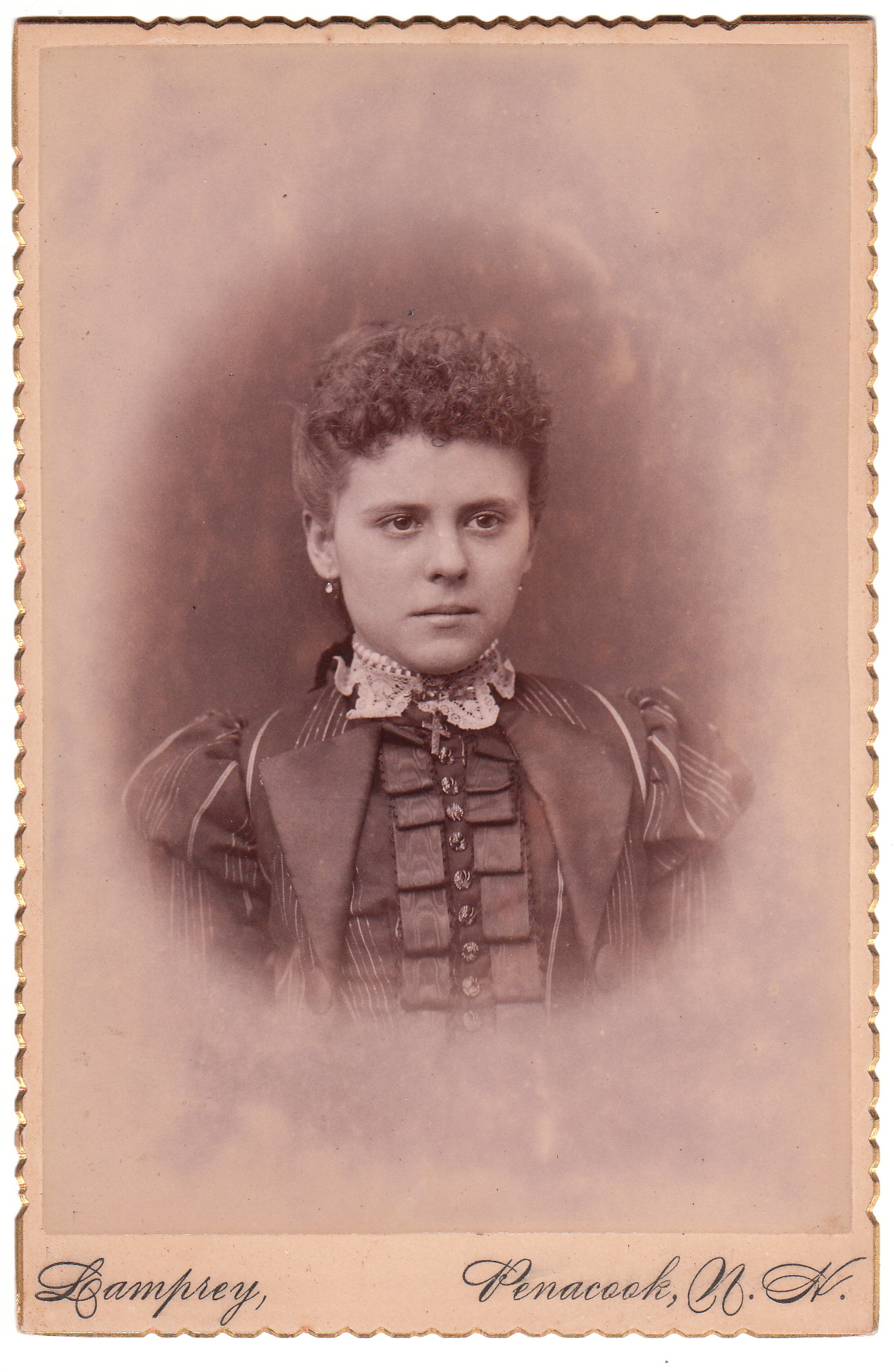
WOMAN MODELS REPTILIAN WEAR IN PENACOOK, NEW HAMPSHIRE
Most people don’t think of Penacook, New Hampshire as the center of turn of the century fashion. However, in 1890, a new fashion trend was born in tiny Penacook. Traditional fashion centers like Paris and New York City were blindsided by the innovative dress designs coming out of Penacook. Reptilian Wear was introduced in 1890 and was overwhelmingly the most well received of all these designs. Penacook area photographers quickly were called upon to sharpen their skills in fashion photography because their services were in high demand by the rapidly growing local clothing industry. This cabinet card was produced by the studio of M. S. Lamprey who began operating in Penacook in 1858. The woman in this image is wearing an excellent example of a Reptilian Wear dress. This particular dress was sold under the Iguana label. The model in this photograph was not identified. She is wearing a necklace from which hangs a cross. If you doubt the veracity of this story; you would be correct to do so. Here is some non fiction commentary about this cabinet card. The photographer is Maurice S. Lamprey (1835-1912). The 1860 census finds Lamprey living with his parents and siblings and working as a varnisher. He enlisted in the 10th New Hampshire Volunteer Infantry in 1862 as a private and was transferred to the Signal Corp which is where he remained throughout the war. The earliest city directory found that lists him as a photographer was from 1872. The 1900 US census reports that Lamprey was 64 years old, living alone, and working as a photographer in Concord. The town of Penacook was named after the Penacook Native American tribe which lived in the area. The town was a village located within the city of Concord. Penacook was involved in the textile industry. The town was located along the Contoocook River. This location attracted the hydro power industry and Penacook became a mill town.
THREE NATIVE AMERICAN SIBLINGS IN EL RENO, OKLAHOMA TERRITORY (PHOTOGRAPHED BY STOTZ)
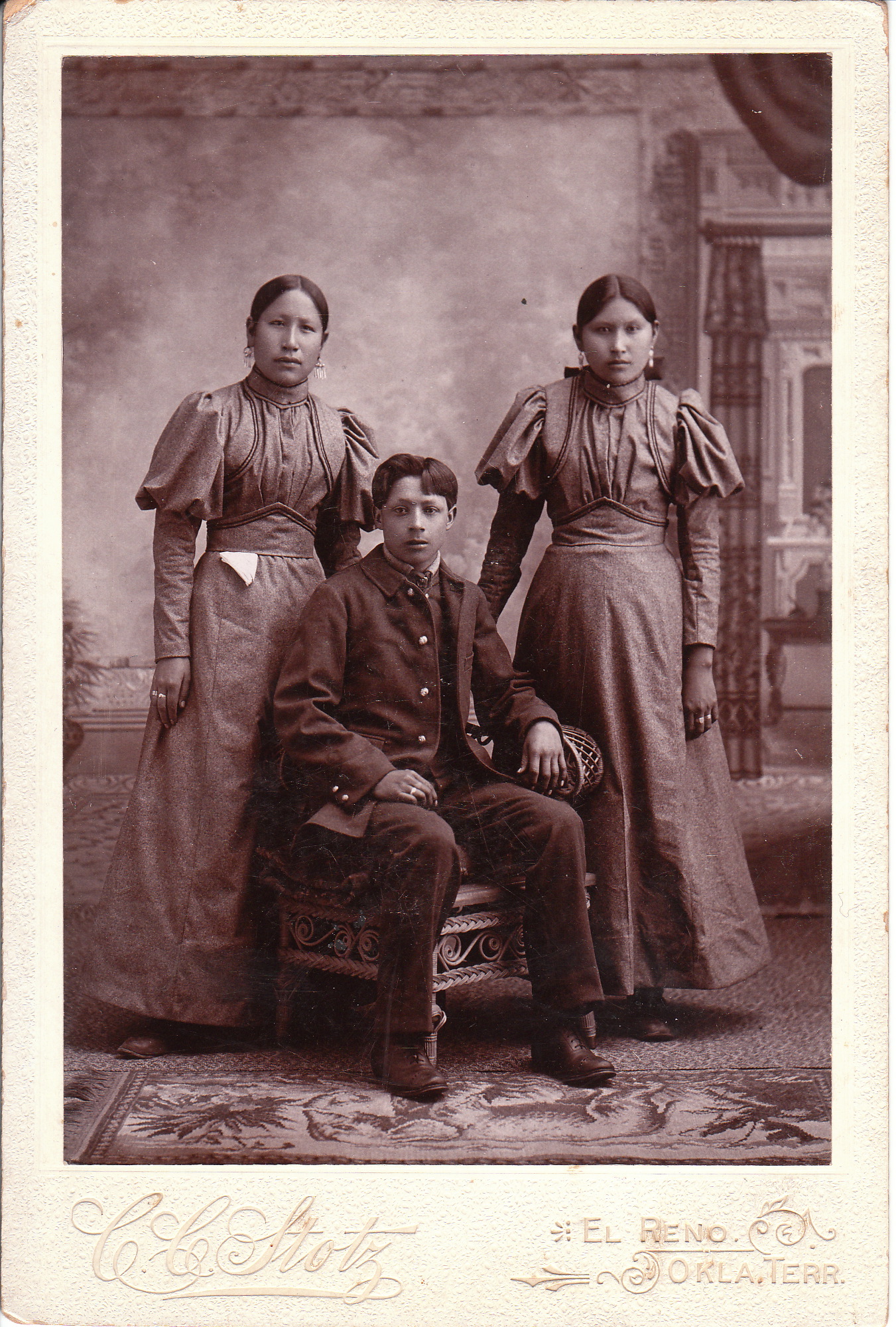
This cabinet card is chock full of history. The photograph features three young Native Americans posing for their portrait at the studio of Christopher Charles Stotz (1851-1932), in El Reno, Oklahoma Territory. The subjects of this image are likely siblings. The young women are wearing identical dresses and are adorned with rings and beautiful earrings. The specific Indian tribe that these three young people represent, is unknown. Oklahoma was the home of many Indian Tribes including Pawnee, Creek, Apache, Arapaho, Choctaw, and others. Many tribes were relocated there from other states. As mentioned earlier, the photographer of this cabinet card is C. C. Stotz and his studio was located in El Reno, Oklahoma Territory. Oklahoma became a state in 1907 which means that this photograph was taken before that year. El Reno is located in central Oklahoma, about 25 miles from Oklahoma City. Fort Reno was built in 1874 and it’s first commander was Civil War hero, General Philip Sheridan. Sheridan named the fort after his friend, General Jesse L. Reno, who was killed in the Civil War. The fort was near the Cheyenne-Arapaho reservation. One of the fort’s missions was to “protect” the “Five Civilized Tribes”. This group was comprised of the Cherokee, Chickasaw, Choctaw, Creek, and Seminole tribes. Employing the term “civilized tribe” was evidence of the special prejudice held against the tribes not among the designated five civilized tribes. Tribes described as civilized were tribes that had adopted many of the customs and values that were held by European-Americans at the time. Who was C. C. Stotz? Stotz was born in Columbia, Pennsylvania. He established a studio in El Reno in 1889; the same year El Reno was founded. Therefore, this photograph was taken between 1889 (El Reno founded) and 1907 (Oklahoma statehood). During the 1880’s and 1890’s, he made field and studio photographs of Southern Plains Indians. Stotz is an acclaimed early photographer of Native American’s and Native American life.
PRETTY WOMAN WITH SNOW SHOE BROOCH IN DANBURY, CONNECTICUT
A pretty young woman poses for her portrait at Folsom’s gallery in Danbury, Connecticut. She is wearing a snow shoe brooch at her collar. Joseph H. Folsom (1841-?) married Sarah Elizabeth Lockwood n 1869. At the time he married, he was a veteran of the American Civil War. He had enlisted in the New York First Regiment in 1861 and had fought in several battles before being taken prisoner at Gaines Mill, in June, 1862. He was a prisoner of war in Libby Prison. After the war, he returned to his photography business in Danbury. A photography journal published in 1883 announced that his estate had sold the business. Interestingly, it seem that his wife, reestablished the photography studio. The Anthony Photographic Bulletin (1888) reported that she had opened her own photographic studio in a new location.
BIG HEADED MAN WITH A LITTLE BEARD IN SULLIVAN, INDIANA
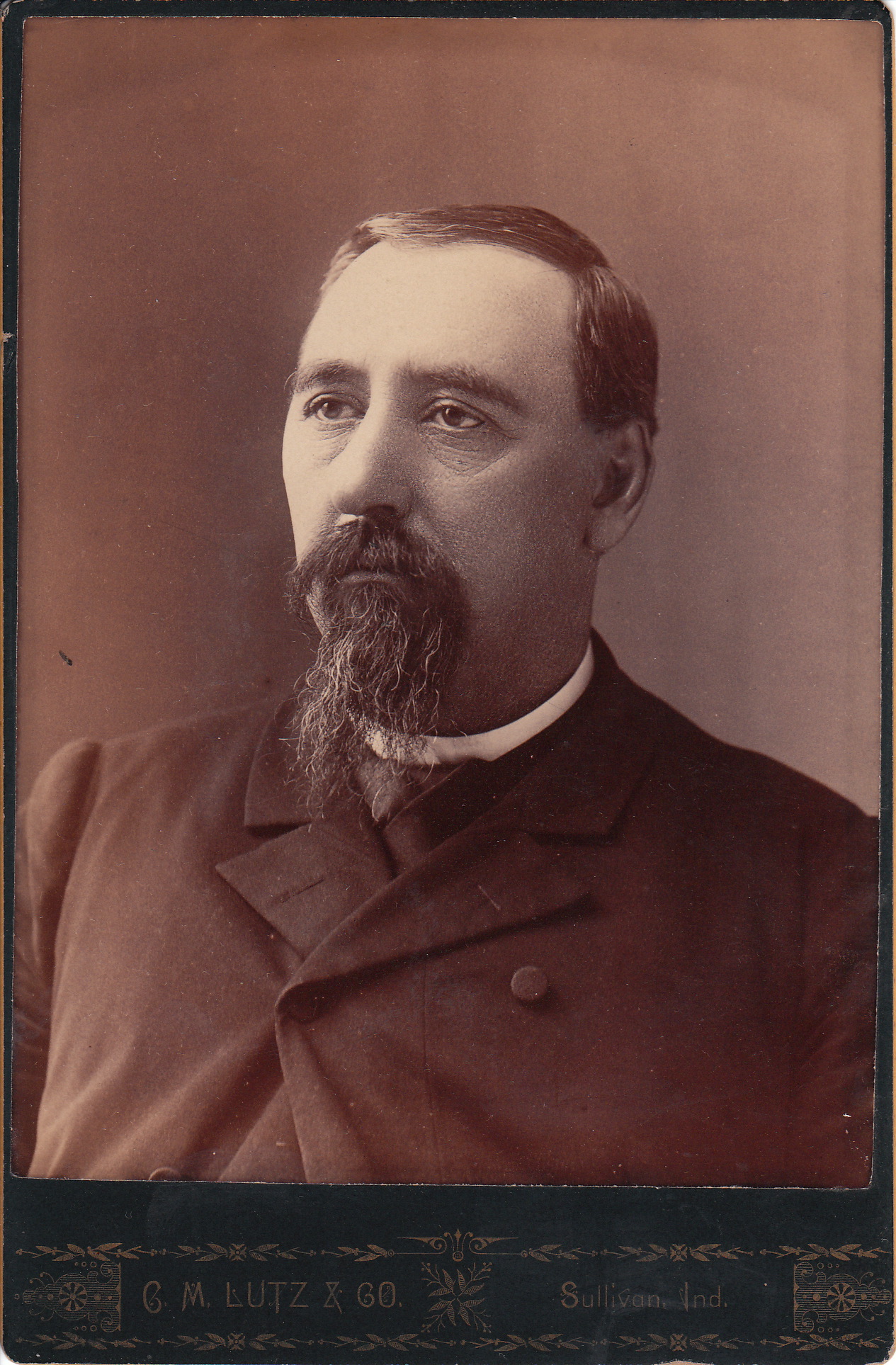
This cabinet card features a man with a big head and a little beard. This gentleman could not commit himself to growing a full beard so he restricted its growth to his chin area. He even lacks sideburns. To view other interesting images of beards, click on the category “Beards (Only the Best). The photographer of this image is Charles M. Lutz & Co. The studio was located in Sullivan, Indiana. A Sullivan County directory (1896) reveals some biographical information about C. M. Lutz. He was born in 1842 in Huntingburg, Indiana. He began working as a photographer in 1861. He served in the 27th Indiana Volunteer Infantry during the civil war. He mustered in the unit as private and mustered out with the same rank. Lutz served in Company B of the 27th. Lutz married Sarah South in 1884 and came to Sullivan County in 1887. In 1891, he entered a partnership with photographer, W. F. Devol.