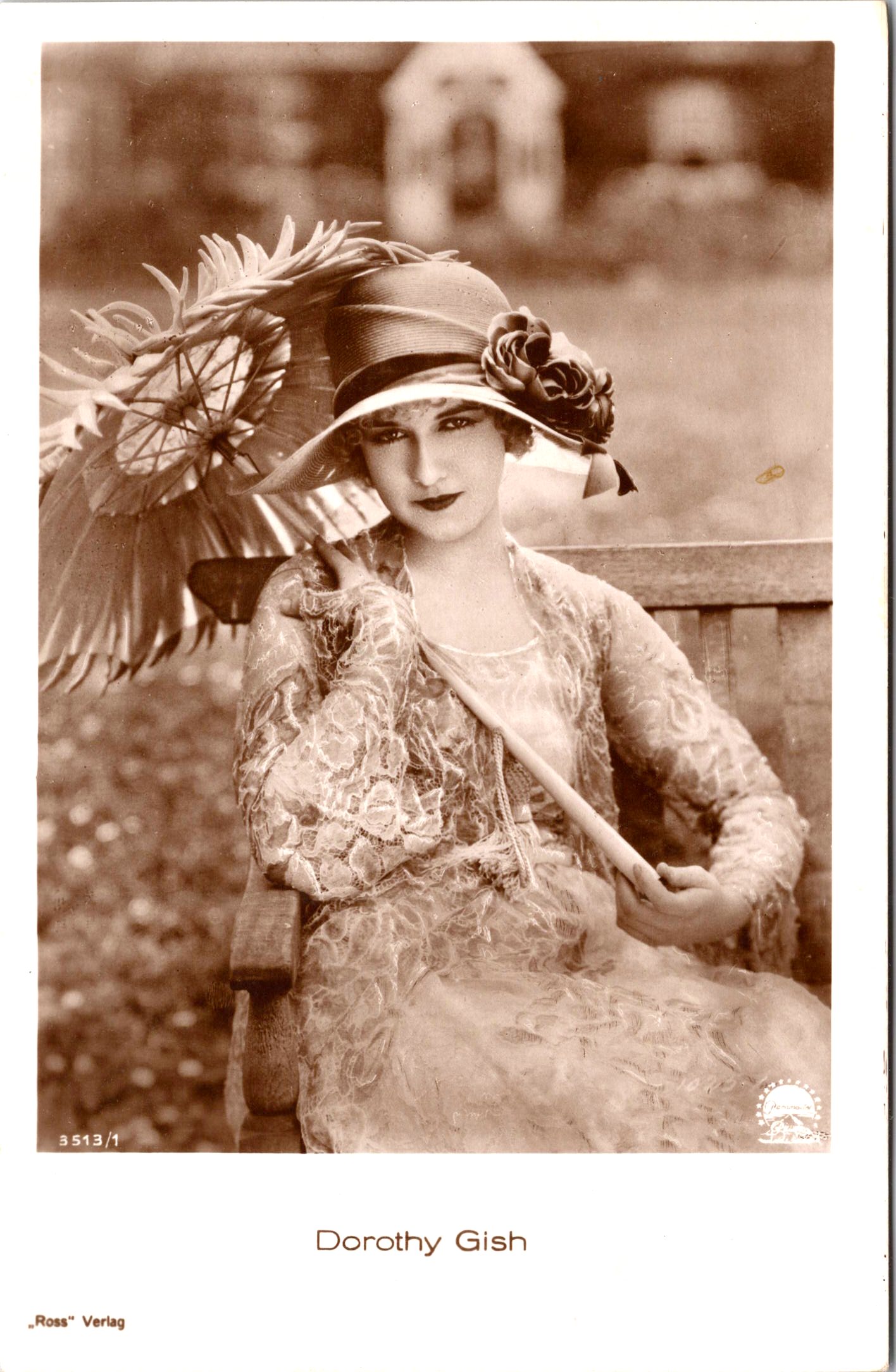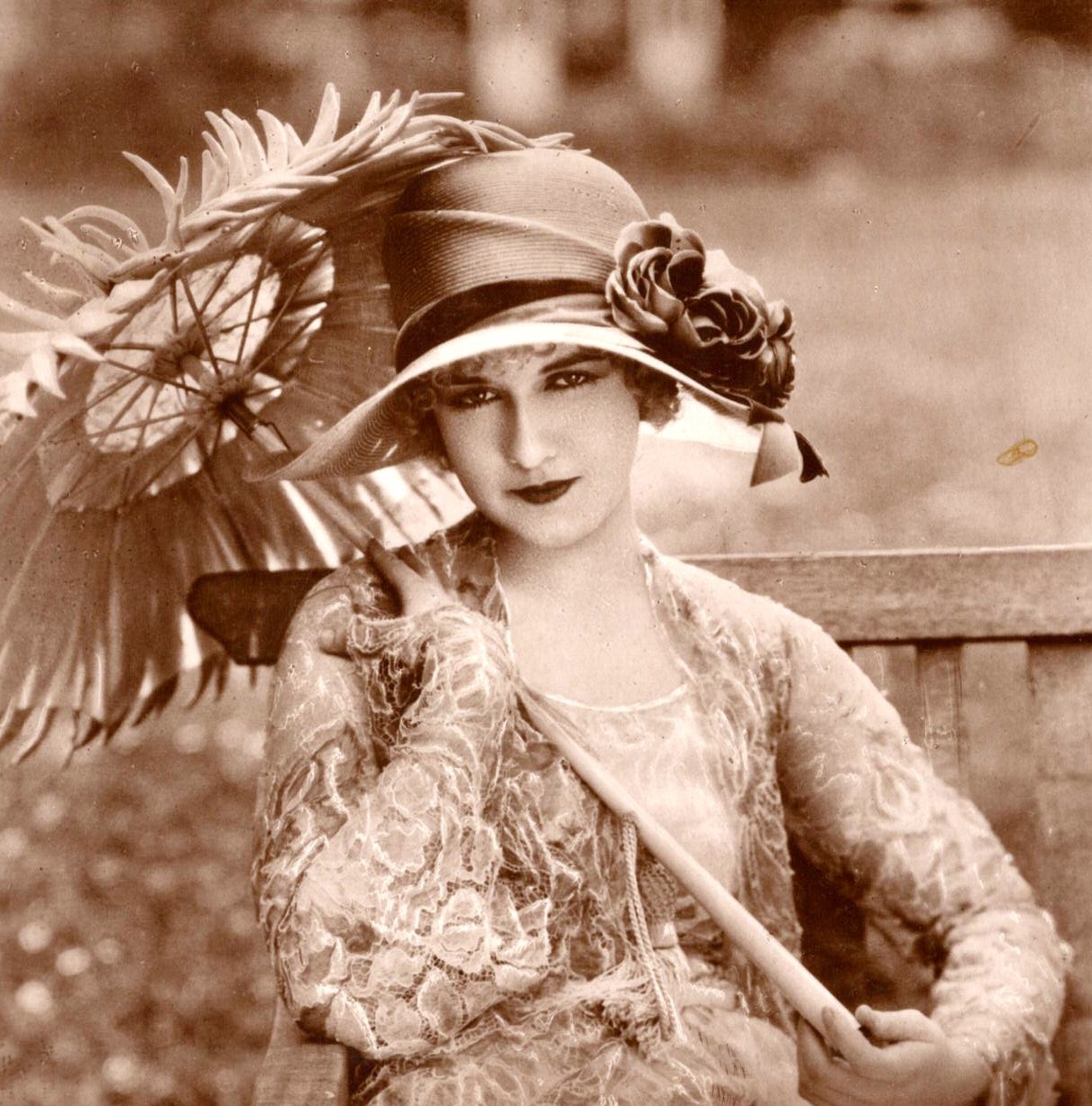
DOROTHY GISH : PRETTY SILENT FILM STAR : FASHIONISTA :PARAMOUNT : RPPC 1928

This vintage real photo postcard features actress, Dorothy Gish (1898–1968). She was a prominent American actress best known for her work in silent films and later in theater. She was also quite pretty which is apparent in this postcard portait. In addition, she was quite fashionable. She was born in Dayton, Ohio, into a family with roots in the performing arts. Dorothy and her older sister, Lillian Gish, are often remembered as significant figures in early American cinema, particularly for their work with director, D.W. Griffith. Dorothy and Lillian’s parents separated when they were young, leaving their mother to support the family. In 1902, the Gish family moved to New York City, where their mother sought work in the theater. Both sisters began acting on stage as children to help support their family. Dorothy made her stage debut at a young age, and by the time she was a teenager, she had already gained experience in theater. In 1912, Dorothy and Lillian were introduced to D.W. Griffith by their friend, actress Mary Pickford. Griffith immediately saw potential in the sisters and cast them in his films, launching their film careers. Dorothy’s early work with Griffith included supporting roles in films like The Musketeers of Pig Alley (1912) and The Birth of a Nation (1915). However, Dorothy’s specialty was comedy, and she developed a distinct, lively style that set her apart from her sister Lillian, who typically played more dramatic roles. Dorothy’s popularity rose as she starred in a series of comedic silent films, including Hearts of the World (1918) and Orphans of the Storm (1921), both of which also featured Lillian. While Lillian’s characters often embodied innocence and vulnerability, Dorothy’s roles allowed her to showcase a playful, often mischievous side, bringing her critical acclaim and a strong fan following. With the advent of sound films in the late 1920s, Dorothy, like many silent film stars, found it challenging to transition to “talkies.” She made a few sound films, but she gradually shifted her focus to theater, where she had always felt at home. Dorothy was well-suited to the stage, bringing her charm and humor to roles in productions such as Young Love (1928), which was a hit on Broadway, and The Chalk Garden (1956). Throughout the 1930s and 1940s, Dorothy toured in various plays and continued to appear in films occasionally. She remained active in theater well into the 1950s, and her stage career extended her professional life even as her work in film slowed. In contrast to her sister, who continued to receive accolades in film well into the sound era, Dorothy’s legacy was tied more to her stage performances and her beloved silent film roles. Dorothy was known for her wit, independence, and close bond with her sister Lillian. The two were inseparable and supported each other throughout their lives, both personally and professionally. In 1920, Dorothy married James Rennie, a Canadian-born actor. However, their marriage ended in divorce in 1935, and she did not remarry. After retiring from the stage, Dorothy lived a quiet life but remained connected to the arts and close to her sister. She passed away in 1968. This postcard was published by Ross Verlag as part of a series (No.3513/1). The card was published in 1928/1929. SOLD

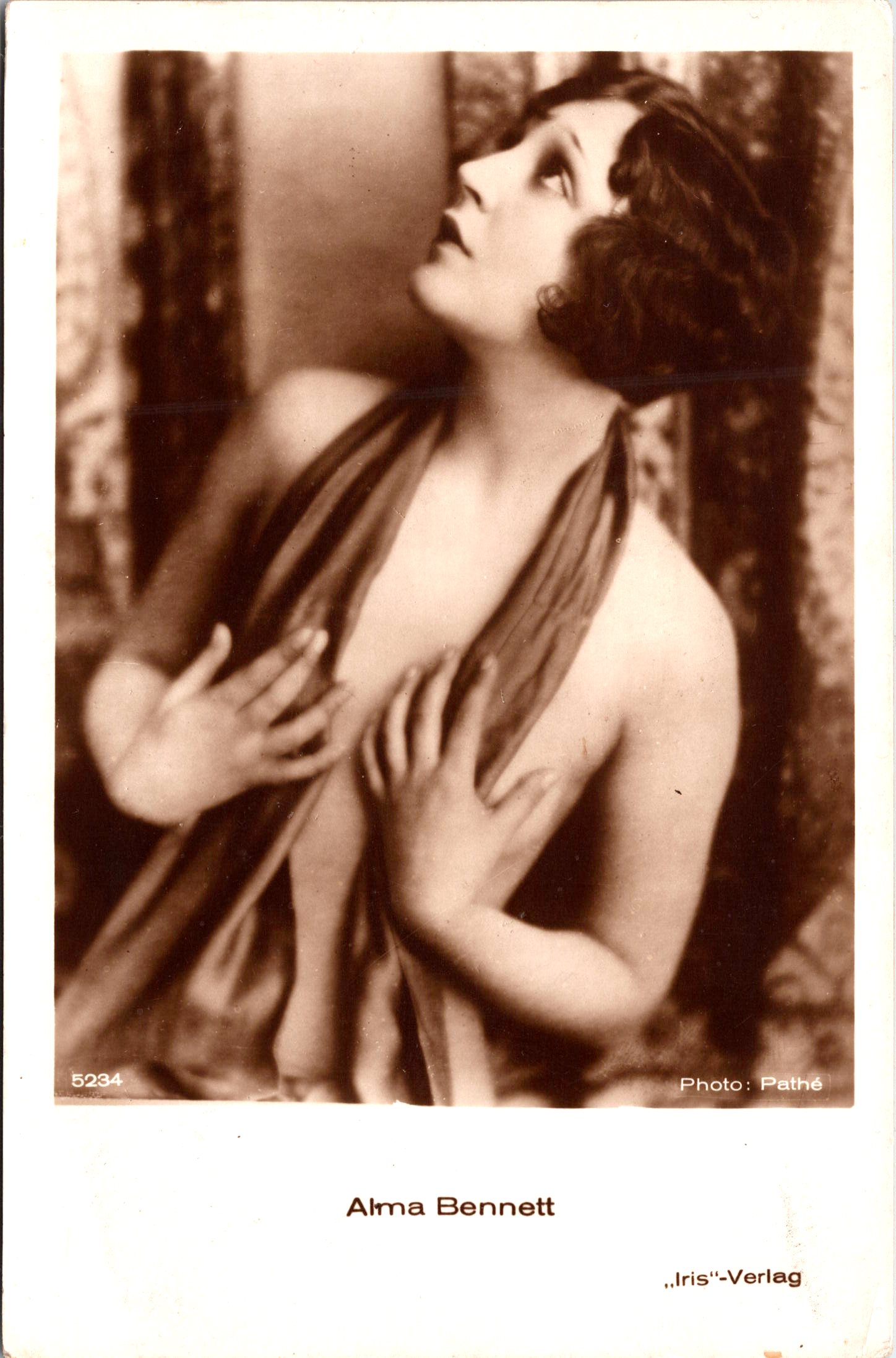
ALMA BENNETT : RISQUÉ 1920s RPPC OF SILENT FILM ACTRESS : PATHE : IRIS VERLAG

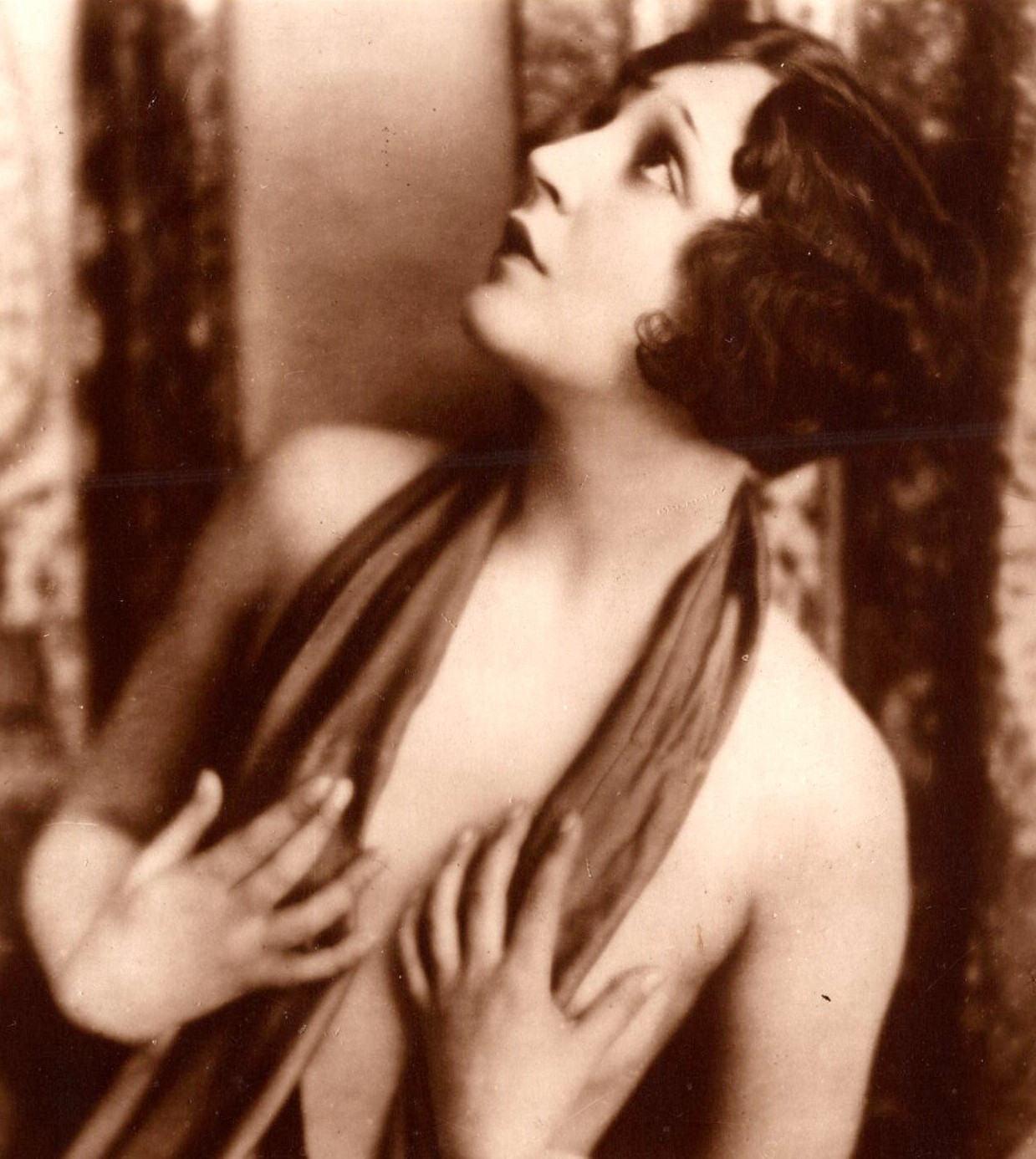
This sepia-toned, real photo postcard features the glamorous silent film actress Alma Bennett (1904-1958) in a striking, risqué pose. Published by Iris Verlag of Austria, this collectible is numbered 5234 and credits the prominent studio Pathé as the photographer—known for its high-quality film stills and star portraits during the silent era. The image captures Bennett draped in a sheer, flowing fabric that barely conceals her chest. With her hands placed carefully to cover herself, the pose is both sensual and elegant—clearly intended to appeal to fans of 1920s starlets and risqué glamour. Her expressive face is tilted upward in a dramatic fashion, with her dark, wavy bob framing large, expressive eyes. Her parted lips and gaze suggest a moment of theatrical longing or awe, characteristic of the silent film aesthetic. This postcard falls squarely into the risqué category due to its suggestive styling and scant coverage, though it retains a refined and artistic tone rather than being overtly provocative. Alma Bennett was an American silent film actress who appeared in over 60 films between 1919 and 1931. Known for her beauty, versatility, and ability to play both dramatic and comedic roles, she became a recognizable face during the peak years of silent cinema. Bennett began her career in Hollywood in the late 1910s, likely transitioning into film from stage or local beauty contests, as was common during the period. Her breakout years came in the 1920s, with notable roles in films such as: “Orphans of the Storm” (1921, uncredited, directed by D.W. Griffith), “The Prairie Pirate” (1925), “A Woman Against the World” (1928), “The Night Flyer” (1928). and “The Arizona Kid” (1930).  Alma’s personal life was somewhat tumultuous, mirroring that of many silent-era actresses whose careers were overshadowed by the transition to sound films. She was married to Fred Bennett, though the marriage reportedly ended in divorce. Little is documented about her life after retiring from film around 1931, and she never returned to the screen during the sound era. (SOLD)

MARY PICKFORD : LES VEDETTES DE CINEMA : CINEMAGAZINE : RPPC (1920’s)

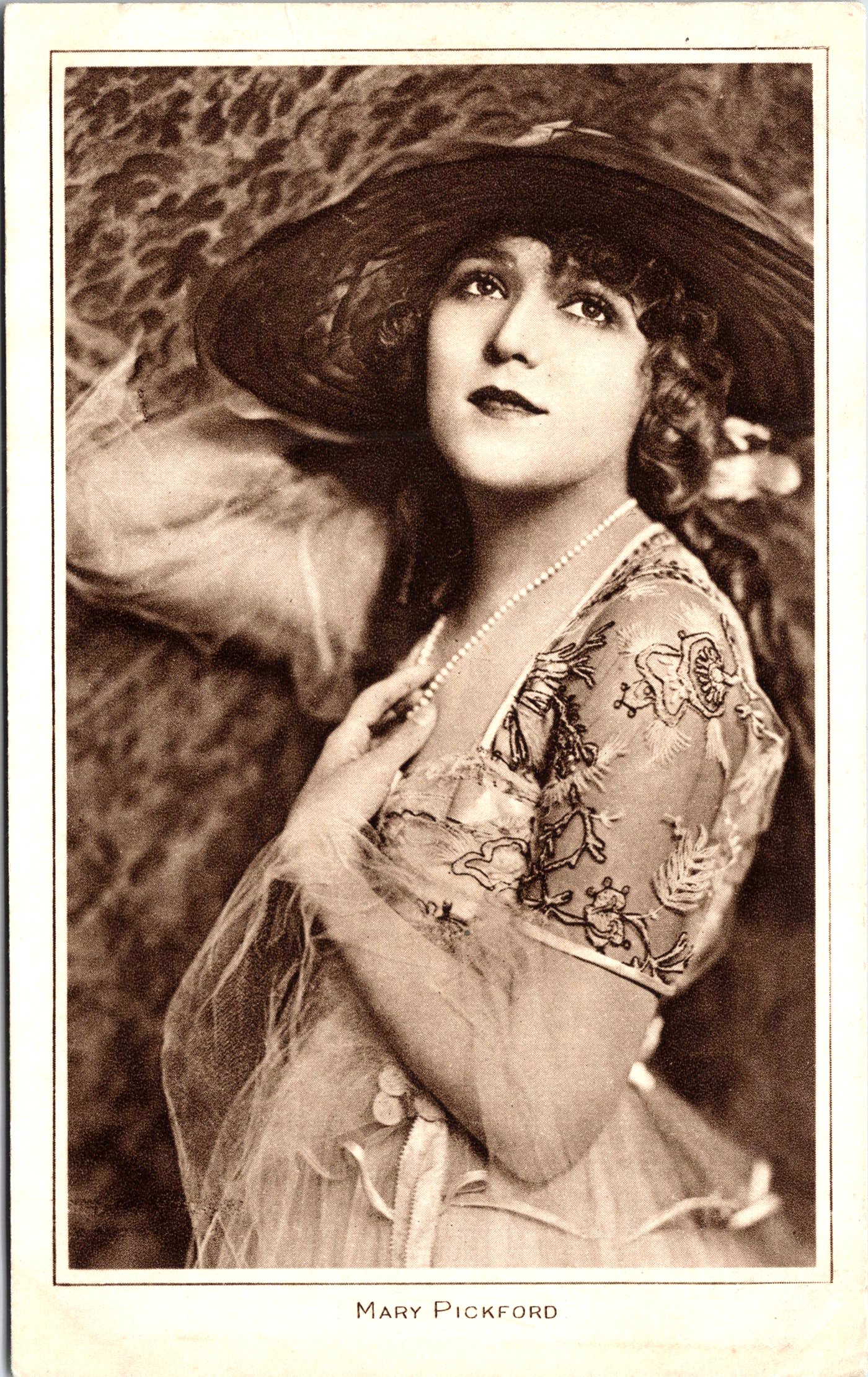
Mary Pickford (1892-1979) was a Canadian-American actress and one of the most influential figures in early Hollywood. She was often referred to as “America’s Sweetheart”. She was a pioneer of silent film and a co-founder of the film industry as we know it today. Pickford’s career began in childhood when she performed in theater productions in Canada and the United States. By the early 1900s, she transitioned to film, working with director D.W. Griffith at Biograph Studios. Her delicate beauty and expressive acting quickly made her a fan favorite, setting her apart in an era when exaggerated stage-style performances dominated silent films. During the 1910s and 1920s, Pickford became one of the highest-paid and most beloved actresses in the world. Starring in films such as Rebecca of Sunnybrook Farm (1917), Daddy-Long-Legs (1919), and Pollyanna (1920), she was known for playing wholesome, spirited young women. Her curly hair and signature on-screen innocence became iconic, but she was also a savvy businesswoman who understood the power of her brand. Pickford was not only a star but also a trailblazer in the film industry. In 1919, she co-founded United Artists alongside Charlie Chaplin, Douglas Fairbanks (her then-husband), and director D.W. Griffith. This revolutionary move allowed filmmakers to control their own productions rather than rely on major studios, changing the industry forever. As the film industry transitioned to “talkies,” Pickford retired from acting in the early 1930s, though she continued to produce films. Her contributions earned her an honorary Academy Award in 1976 for her lasting impact on cinema. Mary Pickford’s influence extends beyond her films. She helped shape the star system, paved the way for women in Hollywood, and co-founded the Motion Picture Relief Fund to support struggling actors. She remains an enduring symbol of early Hollywood glamour and innovation. Mary Pickford was born into a working-class family in Toronto, Canada. Her father, John Charles Smith, was an alcoholic who struggled to provide for the family and died from a workplace accident when Mary was just six years old. Her mother, Charlotte Hennessey Smith, was left to raise Mary and her two younger siblings, Lottie and Jack, on her own. To support the family, Charlotte encouraged her children to enter acting, and Mary began performing in theater at a young age. She soon became the family’s primary breadwinner, and her siblings, Lottie Pickford and Jack Pickford, also pursued film careers. Pickford transitioned from theater to film in the early 1900s, quickly rising to fame with her expressive acting and wholesome on-screen persona. By the 1910s and 1920s, she was one of the most recognizable stars in the world, earning the nickname “Queen of the Movies.” She also helped establish the Academy of Motion Picture Arts and Sciences. Mary Pickford was married three times. Pickford’s first marriage was to silent film actor Owen Moore (1911-1920). Her second and most famous marriage was to fellow silent film actor, Douglas Fairbanks (1920-1936). Her third marriage was to actor Charles “Buddy” Rogers (1937-1979). After retiring from acting in the early 1930s, Pickford focused on producing films and philanthropy. She became more reclusive in her later years, struggling with alcoholism and health issues. Today, she is remembered as a pioneering force in cinema history. Pickford is featured on this postcard. She is seated gracefully on a carved wooden stool, exuding elegance and poise. She is dressed in a flowing, light-colored gown with delicate embellishments on the bodice and sheer fabric draping over her arms. Her signature curls frame her face, a defining feature of her “America’s Sweetheart” image. She wears a subtle yet confident expression, her eyes gazing slightly to the side with a soft, introspective quality. Her arms are relaxed, with one hand resting gently on her lap and the other elegantly extended. Her accessories include a bracelet on her wrist and a ring on her finger, adding to her refined look. The backdrop behind her is a richly textured tapestry, possibly depicting a pastoral scene. This postcard was likely produced in the 1920s, during the height of Pickford’s career. It is numbered 86 and is part of a larger collectible series showcasing cinema stars of the era. This vintage postcard is part of a series titled Les Vedettes de Cinéma (translated as The Stars of Cinema), and it was published by Alfred Noyer (Paris,France), in collaboration with United Artists, the film distribution company that Pickford co-founded. The back of the postcard identifies the publisher as Cinémagazine – Edition and states that it was Made in France / Fabriqué en France, indicating its European origin. (SOLD)

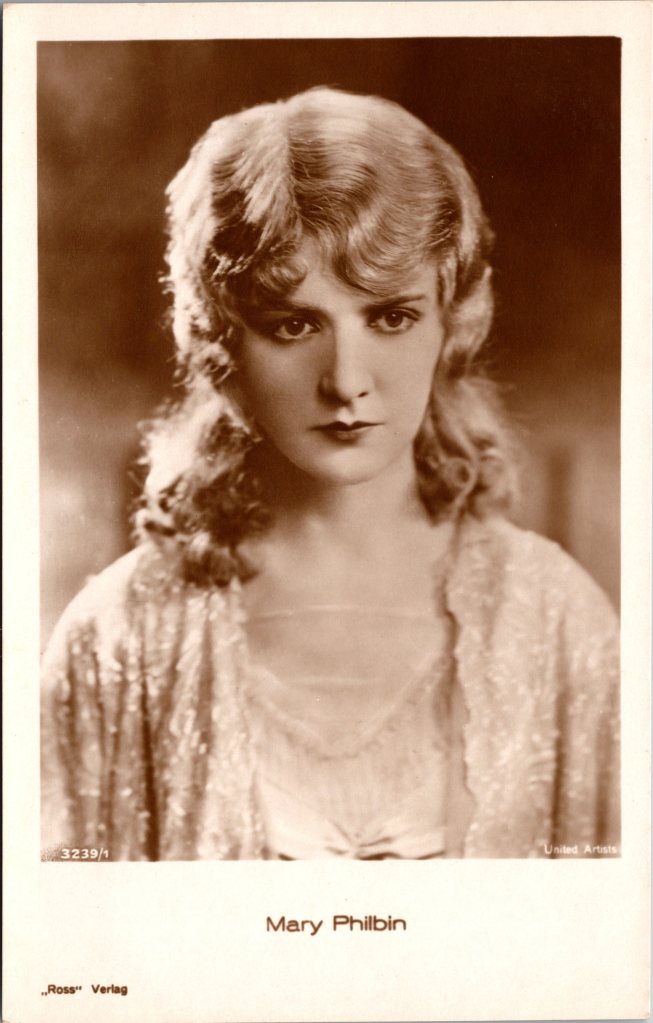
MARY PHILBIN – BEAUTIFUL AMERICAN FILM ACTRESS


mary philbin

POSTCARD 1   (SOLD)


This image has an empty alt attribute; its file name is 5032_0001.jpgPOSTCARD 2   (SOLD)

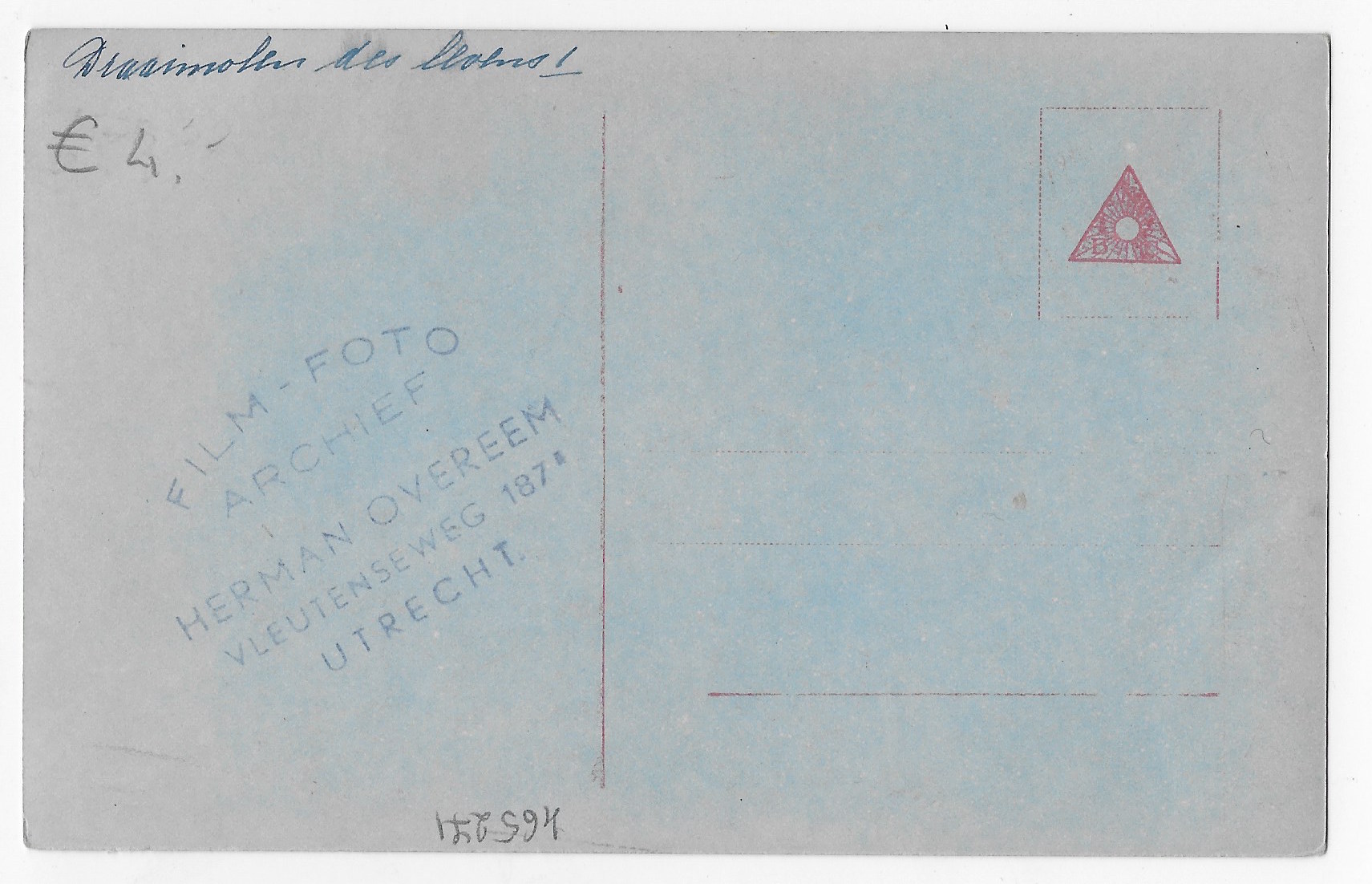
This vintage real photo postcard portrait (Postcard 1) features American actress Mary Philbin (1902-1993). She was active in film between 1918 and 1930. One of her most noted film roles was in “The Phantom of the Opera” (1925). She co-starred with Lon Chaney. A number of her roles involved playing the “beauty” in “Beauty and the Beast” type stories . Mary was born in Chicago, Illinois. Her parents were middle-class and of Irish descent. Her mother was convivial but controlling and domineering. She pushed her strong religious beliefs onto Mary. She adored her father who was “quiet, shy, and reserved”. She was very similar, personality-wise, to her dad. She would accompany him to the theater and there she developed a passion for the stage. She pursued dance and played the pipe organ and piano. She lacked a singing  voice, and surprisingly, never received training in acting. Mary’s acting career was launched after she won a beauty contest sponsored by Universal Pictures. The motion picture company promptly signed her to a contract. Her screen debut was in 1921 and during the following year she was named a WAMPAS Baby Star. This prestigious annual award, given by an association of film advertisers, was awarded to thirteen young women each year. These women were predicted to be on the verge of becoming major movie stars. During the 1920’s, Mary’s film career blossomed and she starred in a number of successful films, including “Drums of Love (1920), directed by D. W. Griffith. When “talkies” arrived, she played in a few films and even dubbed her own voice for the sound version of “Phantom of the Opera”. Unfortunately, her voice was considered too “girlish” to be suitable for talking pictures. She retired from the screen in the early 1930’s in order to become a caretaker for her elderly parents. She lived the rest of her life as a recluse. She never married and seldom made public appearances. An exception occurred when she attended the Los Angeles opening of Andrew Lloyd Webber’s musical version of “Phantom of the Opera”. She died of pneumonia at the age of ninety and is buried in Los Angeles, California. The IMDb reports that Mary appeared in 34 film between 1921 and 1929. She never married.  In 1926 she became engaged to Universal producer, Paul Kohner. When her family learned of the engagement, they were infuriated. They demanded a meeting with Kohner and all went reasonably well until the subject of religion arose. Kohner was Jewish and Mary’s family was Catholic. Mary’s mother was adamant in her belief that Kohner would attempt to convert Mary to Judaism. Paul and Mary informed her parents that no such thing  would happen. An argument developed between Paul and Mary’s parents. She was told by her parents that she would be disowned if she proceeded with her wedding plans. Mary was ambivalent but, in the end, despite still loving Paul, she returned her engagement ring to him. A biographer contends that this traumaticrd experience is the reason Mary never married. This vintage postcard was published by Ross Verlag, of Berlin, Germany. It is part of a series (no. 968/1). The name of the film distribution company (Filmhaus Bruckmann) can be seen on the bottom right corner of the image. A stamp on the reverse of the postcard indicates that it once was part of a collection belonging to Herman Overeem, of Utrecht, the Netherlands.  (SOLD)

Postcard 2 was published by Ross Verlag, of Berlin, Germany. It is part of a series (no. 3239/1). The name of the film company (United Artists) can be seen on the bottom left corner of the image.  (SOLD)


mary philbin 3

POSTCARD 1   (SOLD)
 

POSTCARD 2 (SOLD)