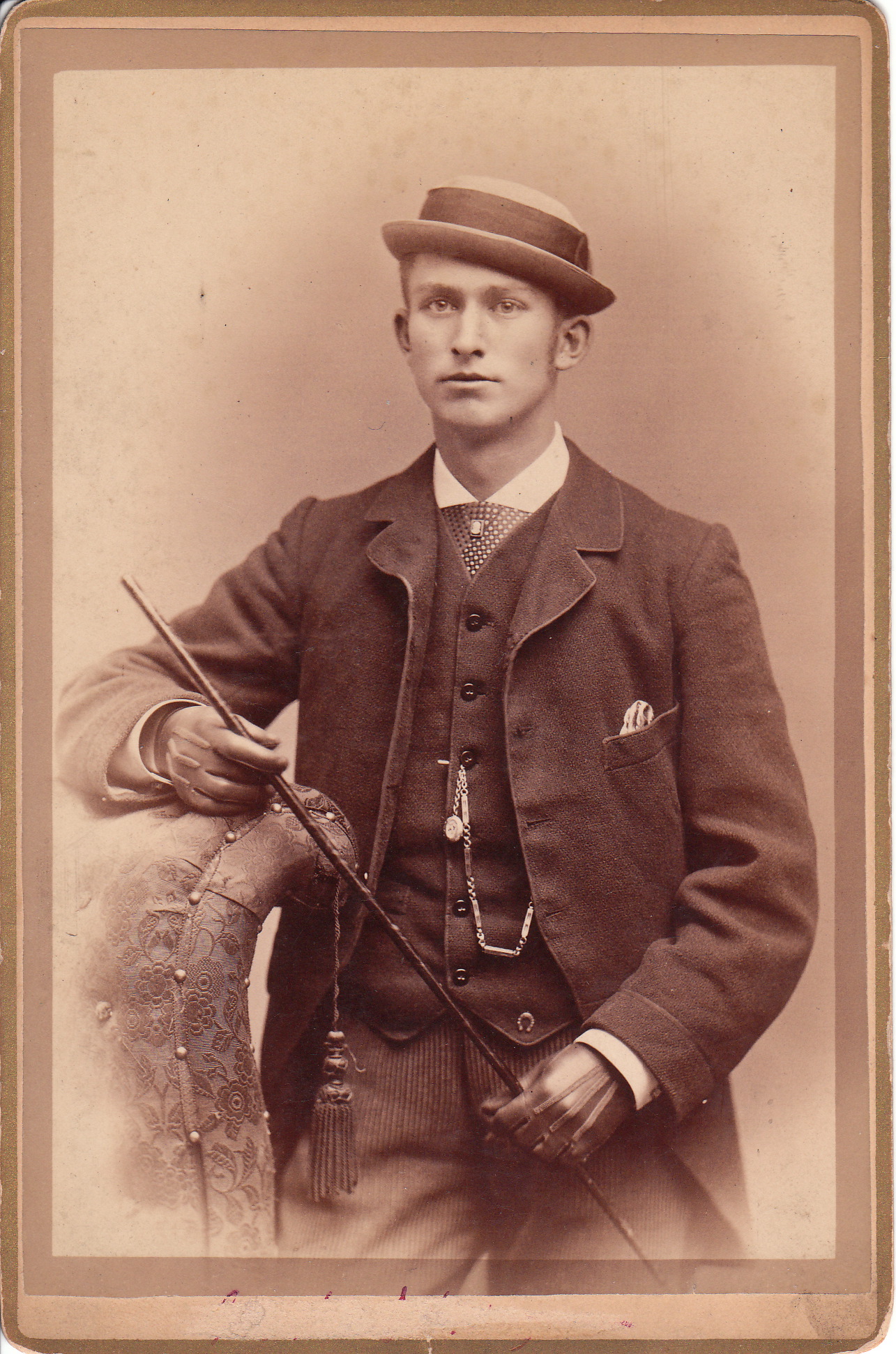
 This cabinet card features a dandy gentleman holding what appears to be a riding crop in his gloved hands. Is he dressed for riding? Is that a horse shoe pin that he is wearing near the bottom of his vest? Note his pocketwatch and chain. The reverse of the photograph is inscribed by the subject. He wrote “Ever your friend, George L. Stringer”. The reverse of the cabinet card also reveals the name of the photographer. A stamp identifies the portraitist as being A. W. Adams whose studio was located on Water Street in Decorah, Iowa. Research revealed some information about George Lincoln Stringer (1862-1932). The 1880 US census indicates that he was born in Iowa but that his parents were Canadian born. In 1880, he was living in Decorah with his parents. His occupation was hard to decipher but it looked a lot like blacksmith. The 1900 census found him still living in Decorah and married (1884) to Mary Alice Kennedy. The couple had a 15 year-old son named Vernon. Once again his occupation was nearly illegible but it seemed to read “traveling salesman”. George Stringer died in 1932 and is buried in Phelps Cemetery in Decorah. The town of Decorah was settled in 1849 and in its early history had a large number of Norwegian settlers. The Norwegian influence remains there today. The Decorah Posten was the largest Norwegian newspaper in the United States until it shut down in 1972. The town was named after Waukon Decorah, a Winnebago tribal leader, who was a US ally in the Black Hawk War of 1832. The photographer of this cabinet card, Asa W. Adams (1842-1915) operated a photo studio in Decorah between 1863 and 1884. Before moving to Decorah, Adams ran a a studio in McGregor, Iowa (1863). Early during his operations in Decorah he had a partnership with S. R. Shear in the Adams & Shear Gallery. In 1866 he married Emma J. Fuller and the couple had four children. Adams sold his studio to O. E. Borlaug. He next conducted his photography business in Waterloo, Iowa (1884-after 1900). Adams died in 1915 and is buried in Decorah.
MISTER EQUESTRIAN IN DECORAH, IOWA

THE OTHER BOOGIE WOOGIE BUGLE BOY OF COMPANY B……… IN ALBERT LEA, MINNESOTA
 This cabinet card features a uniformed bugle boy, posed holding his instrument, and wearing a satchel bag strapped over his shoulder. The boy’s cap has a badge indicating that he was in company B of the “ALC”. “ALC” likely stands for Albert Lea C……”. Perhaps a visitor to the Cabinet Card Gallery can leave a comment identifying the “C” word. The bugle boy, judging by his uniform, was a member of a band. Albert Lea is the name of the Minnesota town where the photographic studio that produced this cabinet card was located. Albert Lea is ninety miles south of Minneapolis, Minnesota; and was named after a topographer with the US Dragoons who surveyed the area in 1835. The photographer of this cabinet card was Joseph A. Fuller (1851-?). Fuller was born in Walworth County, Wisconsin. He worked as a photographer in Decorah, Iowa and Chatfield, Minnesota; before moving to Albert Lea in 1873. At the time of this photograph, Fuller’s studio was on the corner of Williams and Broadway Streets, “over Brown & Cos Bank”. His later studios in Albert Lea included 202 South Broadway (1914-1922) and 204 South Broadway (1924). He worked in Minnesota from the 1870’s through part of the 1920’s.
COOL LONG HAIRED MAN IN FARIBAULT, MINNESOTA (WILLIE NELSON TYPE)
 This Cabinet Card photograph is an image of a very interesting looking man. His long hair and beard makes him look like Willie Nelson. This gentleman is from Faribault, Minnesota; or perhaps he was from elsewhere and just “on the road again”. The photographic studio was Peavey and Peterson of Faribault, Minnesota. Louis Peavey (c1832-1902) was a photographer active in Decorah, McGregor, and Ossion, Iowa (1864-1870). He opened a studio in Faribault, Minnesota in 1870 and partnered with Christian Peterson in about 1878 until near the end of the 1890’s.


 THE CABINET CARD GALLERY