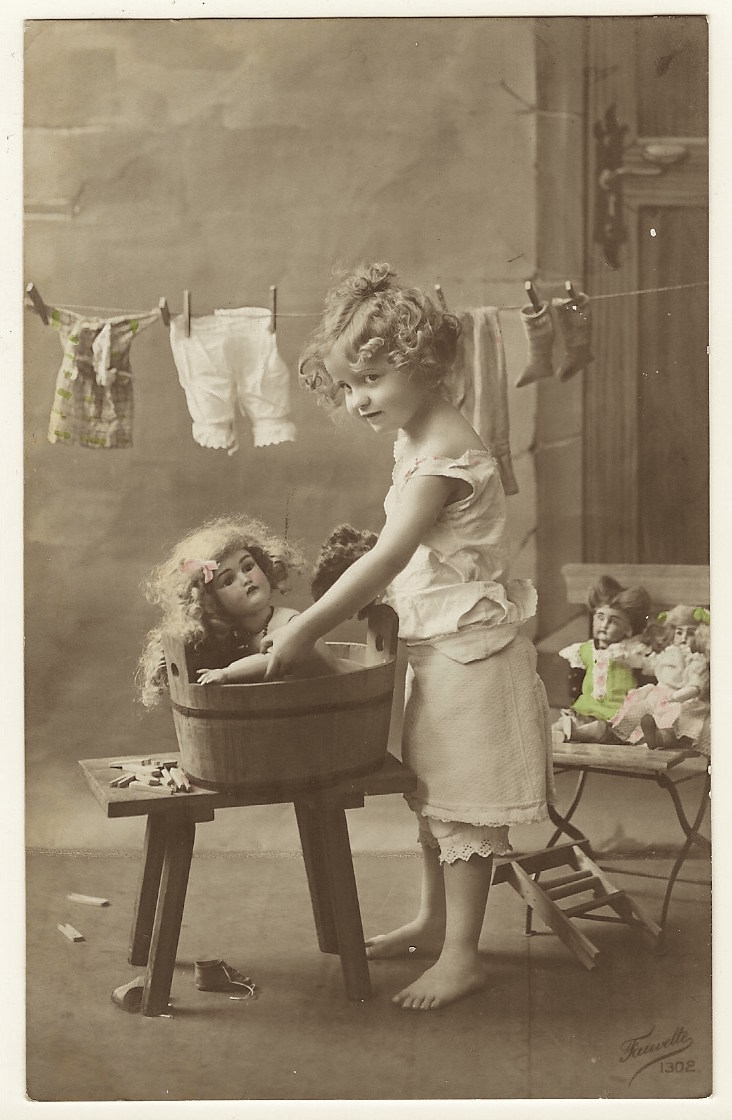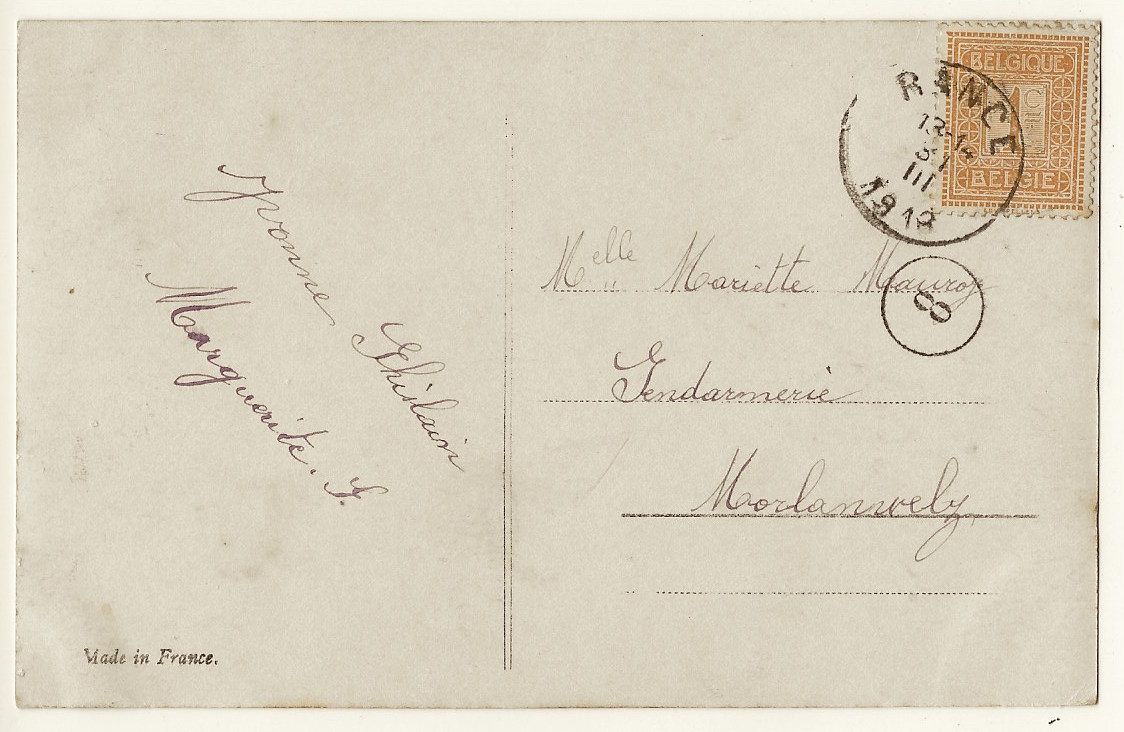
This vintage real photo postcard falls under the category of “incredibly cute”. The photograph shows an adorable curly and golden haired little girl giving her porcelain doll a bath in a wooden barrel tub. Two additional dolls are seated in a chair beside her awaiting their turn in the tub. Behind the little girl is a clothes line from which the doll’s clothes are hanging to dry. Scattered around are some unused clothes line pins and under the small table holding the tub, one can find the doll’s shoes. The scene is terrifically posed. The postcard is of French origin and published by Fauvette (#1302). The postcard is postmarked in 1913. (SOLD)
PORTRAIT OF AN ADORABLE LITTLE GIRL IN ST. DENIS, FRANCE

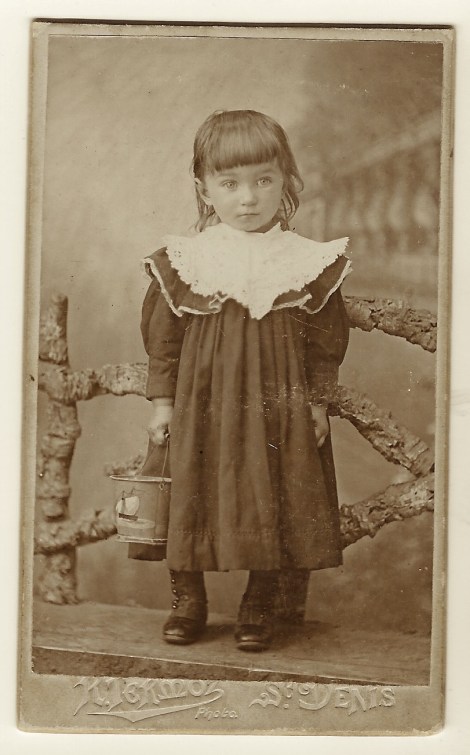
This carte de visite portrait features an adorable little girl holding a beach pail. Note the painting of a sailboat on the pail. She is wearing a dark dress with a white lace bib. She is wearing high top shoes. The little girl seems a bit intimidated by her photographic session. The photographer of this cdv image is R. Termoz and his studio was located in St. Denis, France. Saint-Denis is a town in the northern suburbs of Paris, France. (SOLD)

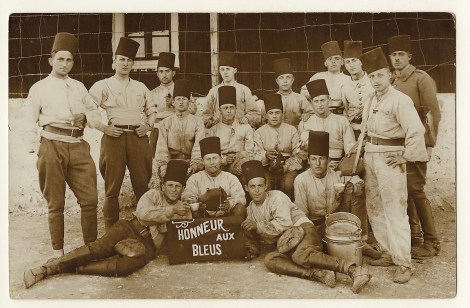
GROUP PHOTO OF FRENCH SOLDIERS IN NORTH AFRICA (WORLD WAR I ERA)

This vintage real photo postcard features a group of uniformed French soldiers in Northern Africa. The sign they are holding,”Honneur Aux Bleus” reveals some interesting information. There is a related French military slogan that states “Honneur aux anciens, courage aux bleus”. This roughly translates to “honor to the old soldiers, courage for the rookies”. In French, “bleu” means “rookie”. In 1793, rookies wore blue uniforms while more veteran soldiers wore white uniforms. Note that three of the men have canteens and one of the soldiers is holding a cup of coffee. This postcard appears to date back to the 1910’s (World War I era).
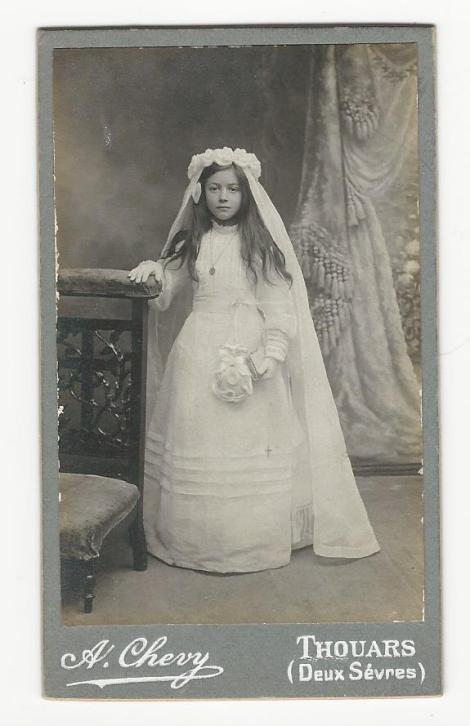
PRETTY LITTLE GIRL ON THE DAY OF HER FIRST COMMUNION IN THOUARS, FRANCE (CARTES DE VISITE)

This cartes de visite features a long haired pretty young girl having her portrait taken on the day of a religious ceremony (first communion). Note the roses on her long veil and her necklace. She is has a cross which can be seen on the forefront of her dress on the right side of the photograph. She also has a purse. The girl is wearing white gloves and is holding a small bible. The photographer of this CDV is A. Chevy. He operated a studio in Thouars, France. (SOLD)
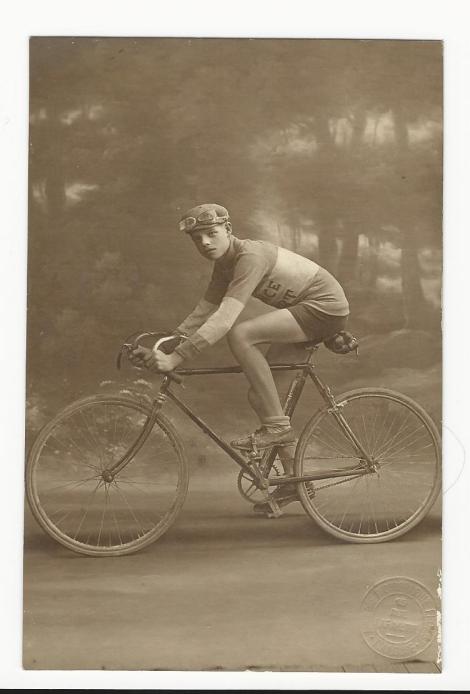
A MAN RIDING A RACING BIKE: NEED FOR SPEED (FRENCH VINTAGE REAL PHOTO POSTCARD)

A MAN RIDING A RACING BIKE: NEED FOR SPEED: This vintage real photo postcard features a bicycle racer sitting on his bike. I believe he has goggles strapped around his head. The lens’s are visible at the front of his cap. Note the photographers embossed stamp on the bottom of the right hand side of the image. This photograph was taken by Antoine Provost who worked as a photographer in Toulouse, France. At one point his studio was located at Rue de la Pomme. The photographer did an excellent job of posing the rider. The image captures the feel of speed and motion. The postcard was published by “K Ltd” sometime between 1918 and 1936. (SOLD)

WOUNDED WORLD WAR I FRENCH SOLDIER TREATED BY FELLOW COMBATANT WITH A BOTTLE OF ABSINTHE

This vintage real photo postcard features a wounded French soldier being treated by his fellow combatant. The soldier doing the nursing helps his buddy by pouring some absinthe into the cup that the wounded man is holding. The injured man seems to be very pleased as he awaits his medicinal drink. What is absinthe? It is a distilled highly alcoholic beverage. Absinthe became a highly popular drink in late 19th and early 20th century France. It is a drink that was later portrayed as dangerous and seen as a hallucinogen. By 1915, it was banned in the US and much of Europe (including France). Although the ban of absinthe and the start outbreak of World War I occurred close together in time, author Doris Lanier, in her book “Absinthe–The Cocaine of the Nineteenth Century……..” (1994), notes that soldiers continued to enjoy absinthe during the war. Back to the photograph. Note the storage holders on the shelf above the injured man’s bed. It appears that they were used to hold the hospitalized patient’s clothing and belongings. My description of this interesting photograph contains some conjecture. Perhaps you have a different interpretation of this image. If so, please share your ideas in the comment section.
PRETTY WOMAN WEARING A BIRD NEST HAT

This vintage real photo postcard features a pretty woman wearing a bird nest hat. At least it looks like a bird nest. This young woman has the beauty to wear this unusual hat and look terrific rather than silly. The postcard is of French origin and was published in Paris. The Publisher’s logo “LL” can be seen on the front of the postcard. The postcard is part of a series (#123). “LL” postcards were produced for France, England, United States, and other nations. For many years postcard collecting experts believed the logo stood for Louis Levy but there was no real supporting evidence and that belief died around 1991. Later research arrived at the conclusion that the initials “LL” stand for (Moyse) Leon and his son-in-law (Isaac) Levy. Leon and Levy began their career as assistants with the Parisian photographic studio Ferrier-Souilier. The pair began their own photographic studio in 1862. Leon and Levy’s studio won a gold medal at the 1867 Universal Exhibition. Leon left the partnership in 1872 and Levy kept the business going and continued to use the “LL” logo. The company was renamed Levy Fils et Cie. Levy died in 1913 and the company was later bought by the printer Emile Crete.
PORTRAIT OF A SERIOUS BEAUTY (VINTAGE REAL PHOTO POSTCARD)

This vintage real photo postcard features a portrait of a very attractive young woman. She is displaying a very serious expression as she looks directly at the camera. She is well adorned with pretty flowers. The postcard is addressed to, and postmarked at Tourcoing, France. Tourcoing is a city in northern France. The postcard has a French stamp.

THE MERCHANT OF THE MASKS (REAL PHOTO FRENCH POSTCARD BY ALBERT BERGERET)

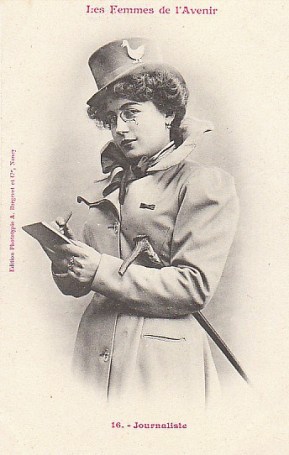
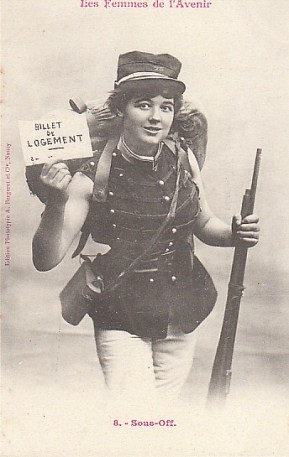
This spectacular vintage real photo postcard features a pretty young woman posed as a seller of theatrical masks. Note the detail of the facial features of each mask. The masks are absolutely beautiful, as is their purveyor. This RPPC was produced by celebrated French artist Albert Bergeret (1859-1932) and published in Nancy, France. Included in Bergeret’s body of work is his series “Women of the Future”. In 1902 he designed a series of postcards depicting women at work in traditionally male professions. Seen below are some examples of these cards. We see a journalist and a soldier. Other cards included a physician, lawyer, and a military general. Bergeret was no feminist. In fact, many of his depictions in the series involved women in skimpy clothing. The pictures were more like pin-ups than a call for equal employment rights for women. Bergeret was a successful businessman. His studio became the leading postcard producer in France. In 1900 he produced 25 million cards and by 1903 he published 75 million postcards. He knew how to grow a business.
WOMEN OF THE FUTURE
WOMEN OF THE FUTURE

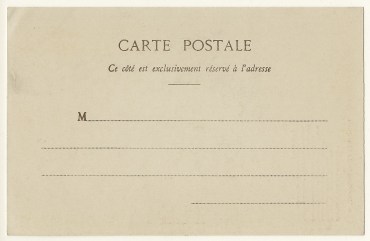
REVERSE OF THE MERCHANT OF THE MASKS POSTCARD
IMAGE AND STORY: YOUNG SOLDIER COMES HOME FROM WORLD WAR I (VINTAGE REAL PHOTO POSTCARD)
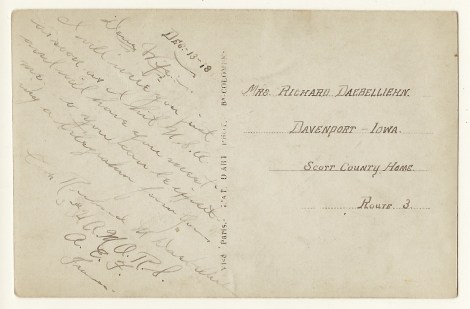
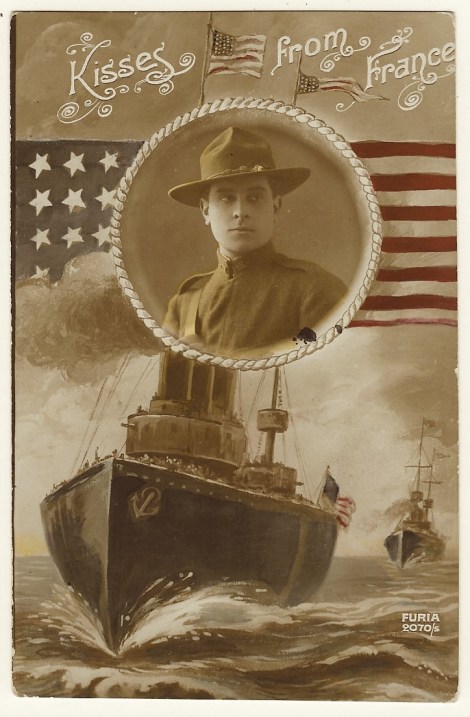
On November 11th, 1918, World War I came to an end. It was a joyous time and soldiers and sailors from all the fighting nations were able to return home to their loved ones. This real photo postcard provides a visual image of that time in history. We see two ships speeding home on a a rough ocean. The postcard shows an American soldier who is portrayed as being on one of these ships. Note the American flag in the background as well as the flags on each ship. This was truly a patriotic time. On the reverse of the postcard is a most interesting message. On 12/13/18, about a month after the war’s end, Richard M. Daebelliehn (1889-1964) wrote a message to his wife. I will decipher it the best that I can as it is not totally legible. “Dear Wife, I will wire you just as soon as I hit USA and will have you meet me. You can be expecting a telegram from me”. He signed his name and followed it with an alphabet soup of letters, “HQ (headquarters) M.O.R.S. (?) A. E. F. (American Expeditionary Force) France. It also appears that the word “Cook” appears before his name. Daebelliehn sent this postcard to his wife who was living in Davenport, Iowa. Research reveals that his wife’s name was Grace Luttsia Anderson. The 1920 US census reports that the couple had two children, Dorothea (age 9), and Robert (age 7). The census, as well as many city directories, indicate that Richard was a butcher (meat cutter) for many years. In fact, he owned his own business. Knowing that Richard was a butcher before the war likely explains why he was a cook in the military. Richard and his family lived in Rock Island, Illinois at the time of the census. I wish I could say that after Richard was reunited with his family that they lived happily together for many years. However, Grace died in September of 1921 in Springfield, Illinois. Richard remarried (Margaret Daebelliehn) sometime before 1930. This postcard was produced by Furia, a French postcard company. The postcard certainly is a relic of history with an image on one side and a story on the other side.