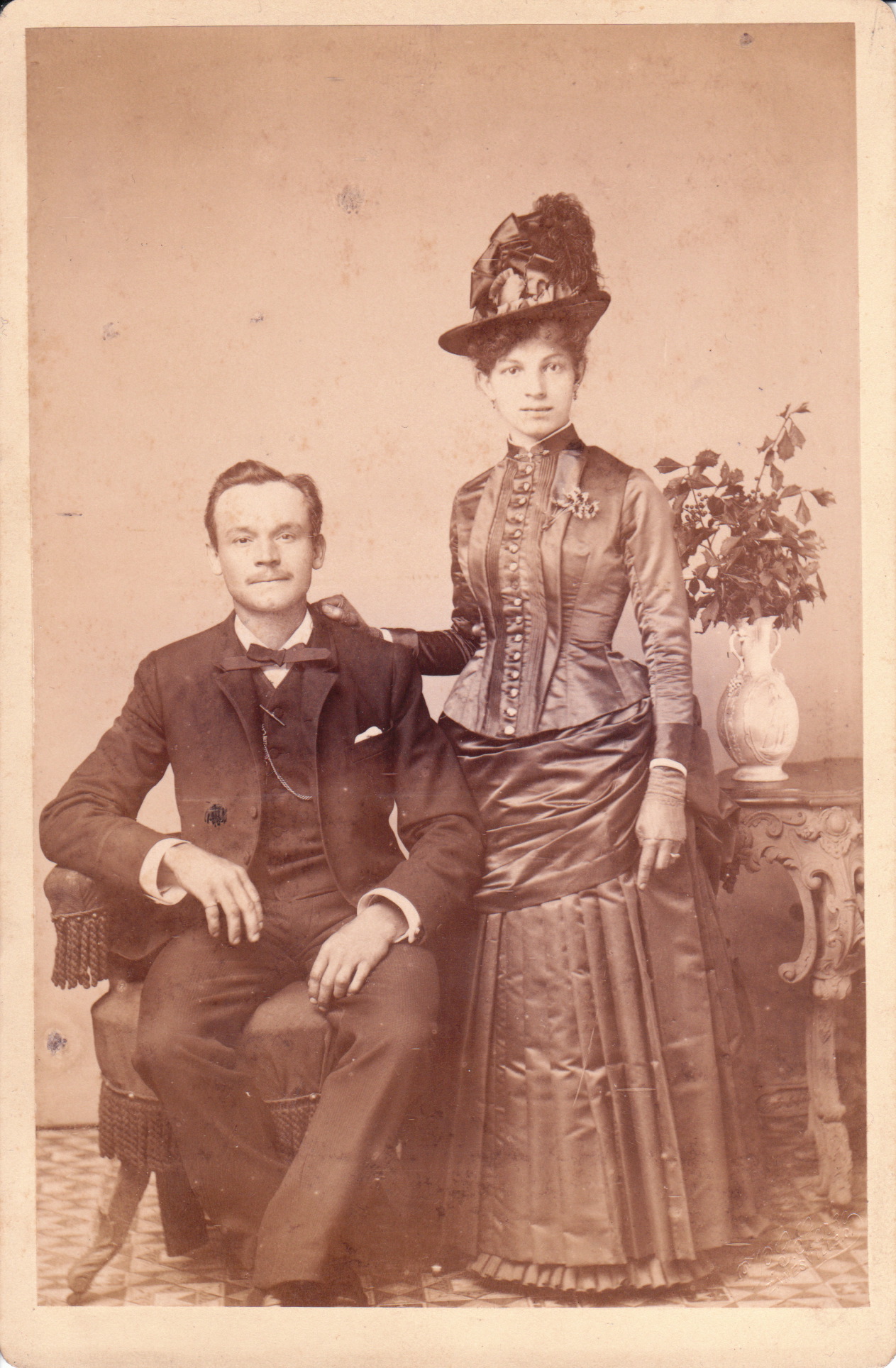
 This cabinet card captures a fashionable handsome couple She is wearing a gorgeous dress and an elaborate hat with a feather. The photographer is William G. Starke and his studio was located on the corner of Main and Fifth Streets in Zanesville, Ohio. Starke operated in Zanesville from at least 1881 through 1897 and at some point, he was joined in the studio by his son, William E. Starke (1856-?).
HANDSOME COUPLE IN ZANESVILLE, OHIO

LOVELY LADY AND A TRAIN WRECK IN ASHTABULA, OHIO
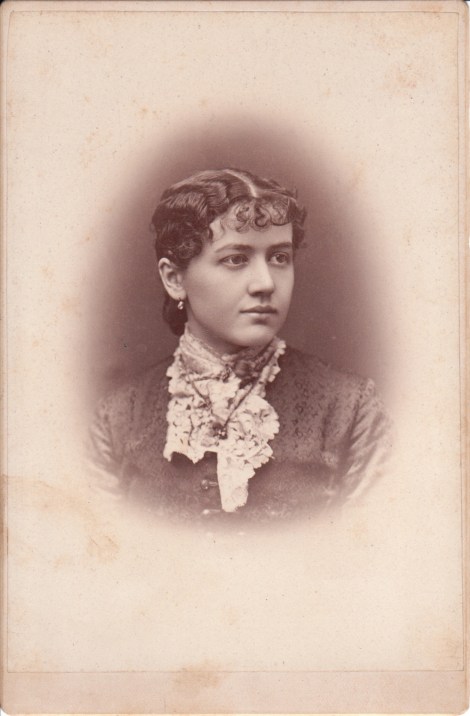 This cabinet card features a portrait of a very lovely lady posing in the studio of Blakeslee & Moore in Ashtabula, Ohio. The town of Ashtabula was the site of a major train wreck in 1876 and one of the firemen who responded to the resulting blaze was Frederick W. Blakeslee. Besides being a firefighter, he was also a photographer and he used his camera to record the aftermath of the disaster. The image he made has become legendary in the history of disasters and the history of Ashtabula. He sold thousands of prints of the scene. Fred W. Blakeslee was in business in Ashtabula from 1870 to 1897. Blakeslee was born in Ohio in 1843. He was a lifelong resident of Ashtabula. At the end of the civil war he opened a photography studio in the town. Beginning the 1870’s he was joined by Frank C Moore (1851-1907). For a time, they operated a branch in Geneva, Ohio. Moore began his photography career as an apprentice in Ashtabula and then ran his own studio in Lima, Ohio between 1870 and 1875. Moore’s partnership with Blakeslee ended in 1894. Blakeslee’s son Frederick K Blakeslee (1880-?) also became a photographer in Ashtabula. The story of the “Ashtabula Train Disaster” is immensely tragic. The accident is thought to have been caused mainly by the collapse of a bridge owned by the Lake Shore and Michigan Railroad. The bridge was a joint creation by Charles Collins (engineer) and Amasa Stone (architect and designer). On a winter night in 1876, a train carrying 159 passengers and crew crossed over the bridge and when the first engine just passed the far side of the bridge, the bridge began to collapse and the rest of the train fell into the ravine. Ninety-two people were killed in the accident and most died from fires that were started from the train car’s oil lamps and stoves. The passengers were trapped in the burning crushed cars. The accident happened after a heavy snow storm and the rescuers were ill prepared and not equipped to help the poor victims of the train wreck. Charles Collins testified about the bridge design to an investigative jury and after finishing his tearful testimony, went home and shot himself in the head. Amasa Stone was held partially responsible for the accident, but he refused to accept blame. He theorized that the train jumped its tracks and destroyed the bridge. However, it is probable that he suffered severely from the incident, and about seven years later, he shot himself in the heart.
YOUNG WELL DRESSED AFRICAN AMERICAN MAN IN COLUMBUS, OHIO
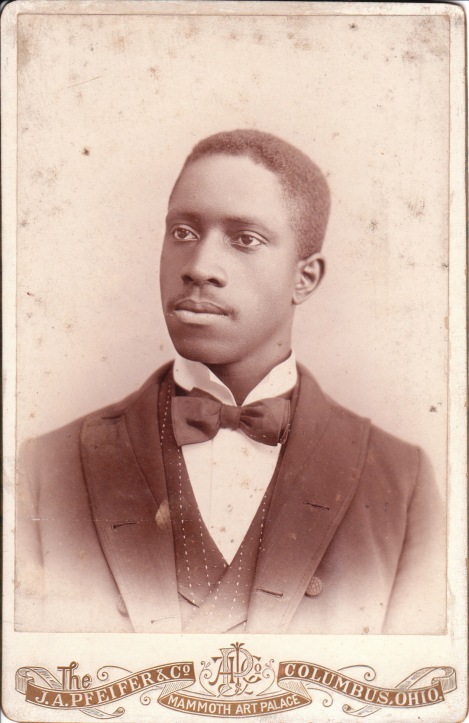
A well dressed African American man poses for his portrait at the J. A. Pfeifer & Company gallery. He is wearing a dress jacket, a pin striped vest, winged collar and bow tie. This handsome young man is unidentified. The reverse of the cabinet card lists Pfeifer’s name but also the names Smith and Mulligan Brothers. Presumably these three names belong to photographers who were employed the the Pfeifer studio. The address of the gallery is also printed on the reverse of the card. The business was located at 262, 264, and 266 South High Street in Columbus, Ohio. According to the book “Artists in Ohio” (2000), the photographer of this image, John A. Pfeifer (1859-1932), was active in the Columbus area from 1882 to at least 1913. During much of that time, he was partners with George C. Urlin of the “Mammoth Art Palace” on High Street. To view images by Urlin, click on the category “Photographer: Urlin”. The Oberlin Review (1888) noted that the Urlin & Pfeifer studio won the contract to be the class of 1888’s photographer. A competitor in the bidding was the Cleveland firm of Urlin & Becker. Urlin’s participation in the bidding under two different studios, caused the students to raise some ethical questions about the bidding process. Pfeifer proved to the students that he had the legal right to use Urlin’s name and the class “was convinced of his honesty and integrity” and retained him as class photographer. In 1891 Pfeifer and George D. Saas (1854-1924) founded Pfeifer & Saas Printers. In 1905 Pfeifer became the sole owner of the firm and renamed it the Pfeifer Show Print Company.
PRETTY YOUNG WOMAN SITTING ON PRETTY UNUSUAL CHAIR IN CANTON, OHIO

A pretty young woman appears to be comfortable enough as she sits on an unusual chair and poses for her portrait at the Manly & Son studio in Canton, Ohio. She is holding a small fan and displays a faint smile as she leans toward the camera. She is wearing a ruffled dress with a striped collar and is also wearing a pin. Note the fringed chair and also notice the floor lamp. At least it appears to be a floor lamp. Could it possibly be an odd looking table? The woman is wearing a hat, but due to her puffy curly hair, the hat appears to be floating on her head. Research provided some information concerning photographer George Watson Manly but the more interesting story concerns his wife Angeline Stewart Manly. George was born in New York in about 1824. George appears to have begun his photography career in Akron, Ohio. He started out as a dagguerreotypist beginning 1859. The 1870 US census confirms that George was working as a photographer in Akron and that he was married to Angeline who was seven years his junior. The couple had three children in the household; Sabray (age 24), William (age 18), and Clifford (age 10).The boys were presumably George and Angeline’s sons. Also in the household was a young relative of Angeline and a young Irish couple. The husband of the Irish couple was listed as a photographer and he was likely an assistant to George. One source asserts that George stayed in Akron until 1873, and during some of his time in Akron he also had a studio in Salem, Ohio. It is not clear when he moved to Canton, but he is listed in Canton business directories by at least 1881. So what is the story concerning George’s wife, Angeline? The story is that Angeline Stewart Manly was a major figure in the temperance crusade in both the city of Akron and in the state of Ohio. She served as Akron’s city representative to the first state convention. The convention organized the Women’s Temperance League of Ohio and Manly was elected President. In 1883, Manly published a novel called “Hit and Miss: A Story of Real Life”. It is not known why George and Angeline moved to Canton from Akron. George died in Canton in 1900 and Angeline died there in 1913.
A SERIOUS COUPLE IN KENTON, OHIO
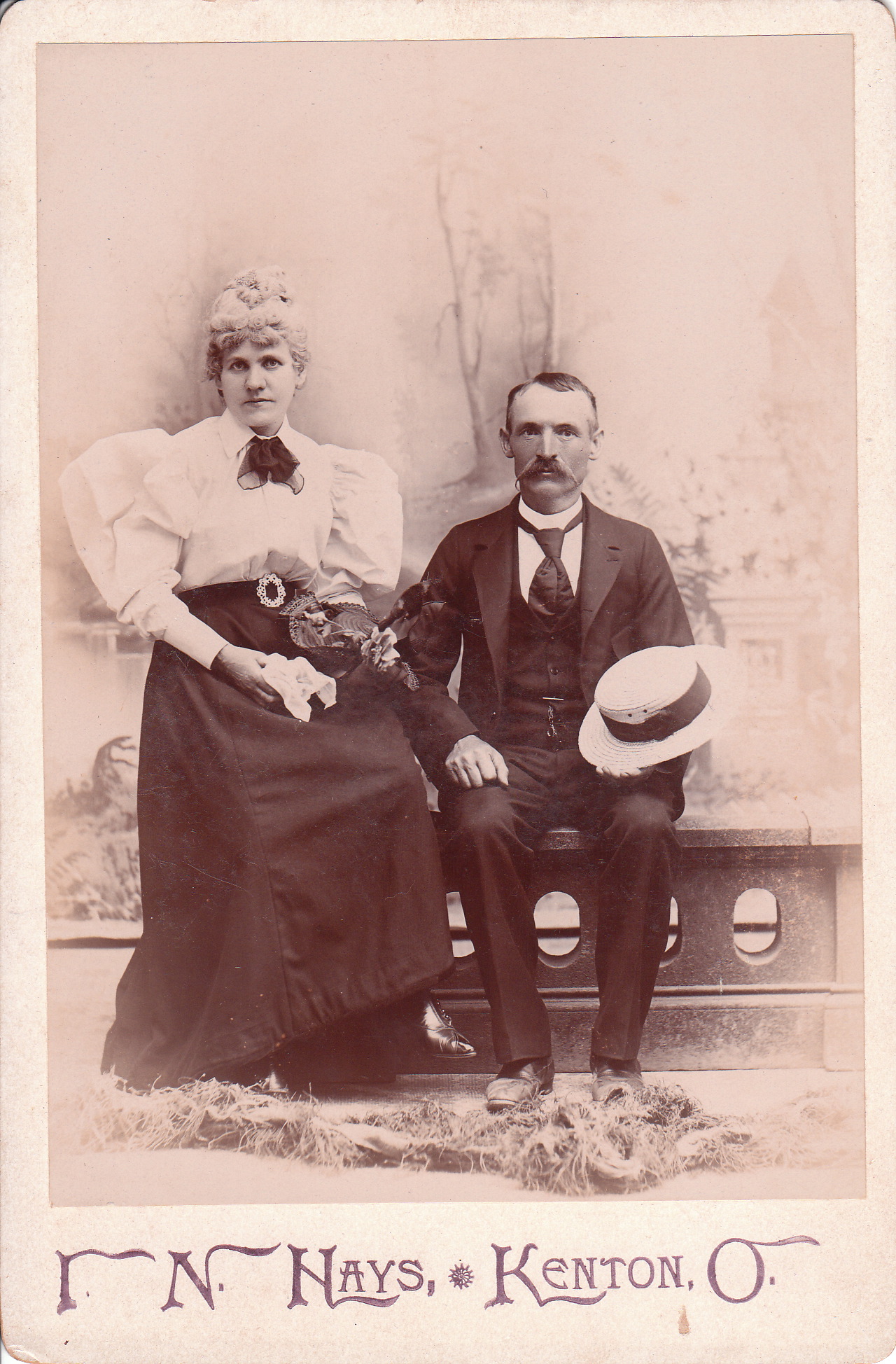 A well dressed and intense looking couple pose for their portrait at the studio of I. N. Hays in Kenton, Ohio. They do not look like they are having fun. The woman his holding flowers, a hat, and a handkerchief. The gentleman is holding his straw hat. Magnify this photograph and you will see the gentleman has a very interesting mustache. The photographer who produced this photograph was Isaac Newton Hays. He was born in Ohio in 1835 and operated studios at various times in various towns in Ohio. He was active in Greenville from about 1865 until 1870. He left there for Kenton between 1875 and 1879. He later returned to Greenville and also did business in Wapakoneta. He returned to Kenton where he ran his studio from 1891 through at least 1898. At one time, his Kenton studio was located at the corner of Detroit and Columbus Streets. Isaac Hays left the photography studio and entered the recording studio to become a celebrated soul singer and song writer. He won two Grammy awards and wrote the “Theme from Shaft”. Just kidding! Obviously Isaac Hays, the photographer, and Isaac Hayes, the musician, are two different people from two different eras.
BROTHERS IN YOUNGSTOWN, OHIO (DAVID AND RICHARD EVANS)
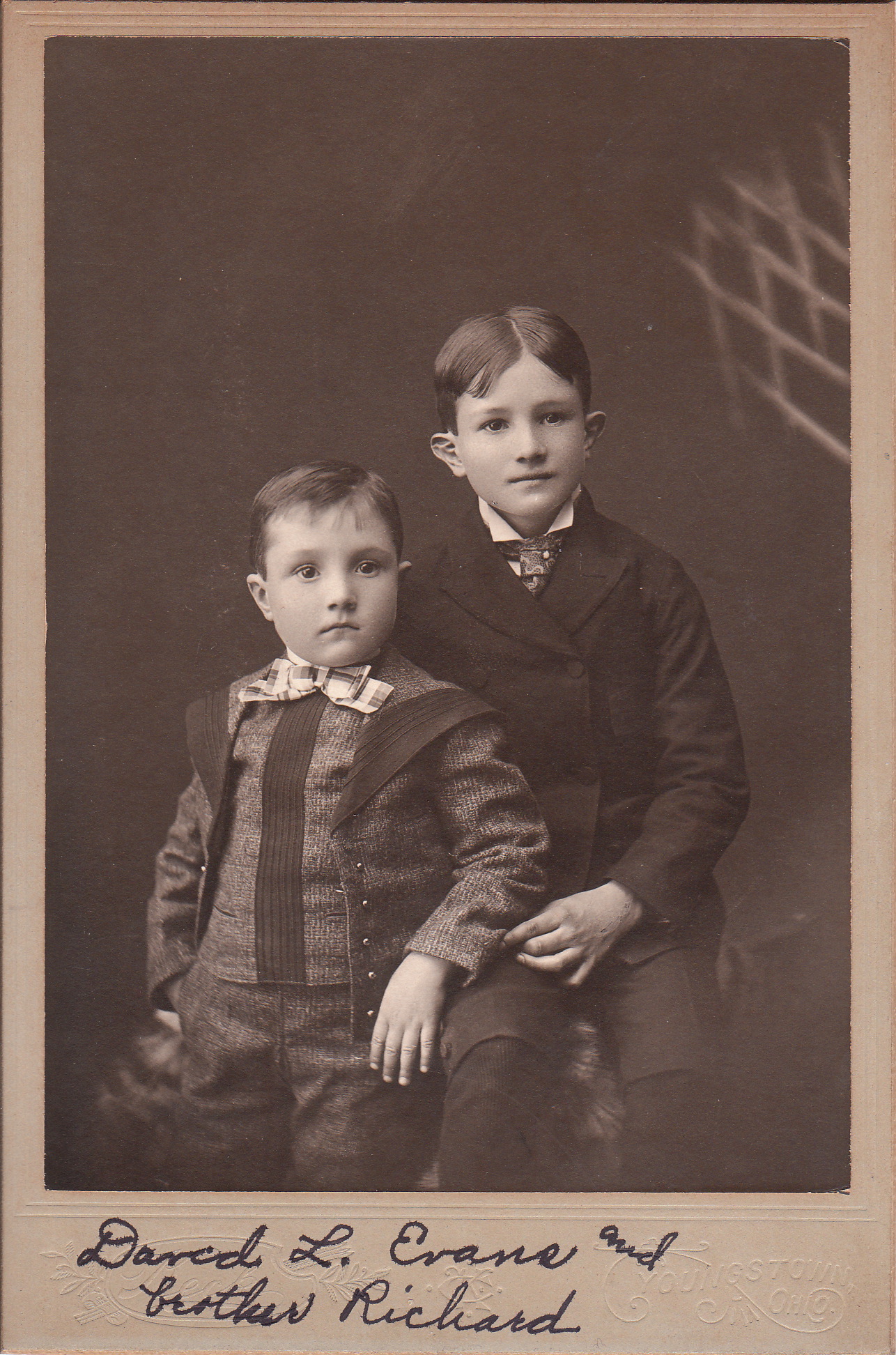
David L Evans and his brother Richard pose for a photographer located in Youngstown Ohio. I can not make out the photographers name. It may be Peck. The brothers are dressed fashionably for this portrait. The older brother seems affectionate and protective toward his sibling. Note the boys ears. The ears are unusually shaped.The 1880 census finds an Evans family in Youngstown with sons named David (age 2) and Richard (age 6 months). It is important to point out that the David in the census and the David in this photograph have different middle initials. However, it is not uncommon for middle initials to be listed incorrectly both in the census and when written on photographs. The census lists the Evan’s parents as being named Thomas and Mahala. Thomas was a furnace worker and he and his wife were born in Wales.
LITTLE GIRL WITH VERY LONG HAIR IN SIDNEY, OHIO
 Let me introduce you to Nellie Ewing. She was five years old when she was photographed at Miller’s Art Studio in Sidney, Ohio. The photograph was taken in 1896. Nellie was a cute child and she had very long hair which the photographer has placed in the forefront of this image. Nellie appears to be a thoughtful little girl. The 1900 US census reveals that Nellie was born in 1881 in Ohio. At the time of the census she was living in Sidney with her grandmother Margaret Brown (age 70) and presumably her mother, Sara Ewing (age 41). All three women were employed. Nellie worked as a saleswomen; her mother was a seamstress and her grandmother was a nurse. A Sidney city directory (1902) shows that Nellie had switched careers and had become a stenographer. Little could be found about Miller’s Art Studio. However, it was discovered that the proprietor was Reinhard Miller who was born in Switzerland around 1865. He was active in Sidney in the late 1880’s and part of the 1890’s. In 1900 he moved to North Baltimore, Ohio; where he continued his profession.
BEAUTIFUL BUSTY WOMAN IN COLUMBUS, OHIO
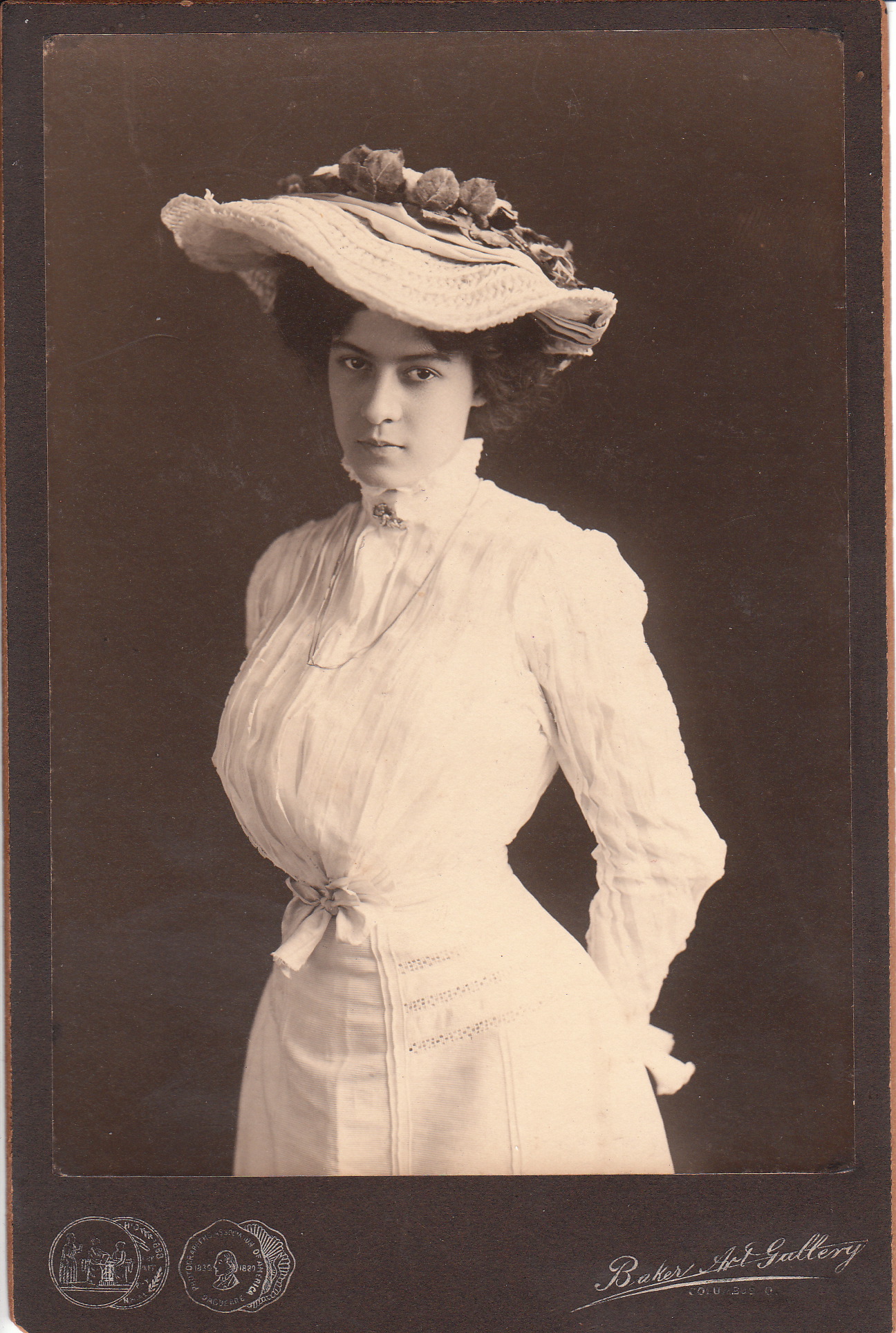
The Baker Art Gallery of Columbus, Ohio, produced this portrait of a pretty and busty young woman. A corset likely assists her wasp waist and lovely figure. Apparently, she is well aware of her beauty and capitalizes on it with a “come hither” expression. Take note of her interesting hat; its truly a work of art. The Cabinet Card Gallery has a number of images from the Baker Art Gallery. To view these images and to learn more about the Baker studio, click on the category “Photographer: Baker Art Gallery”.
PROUD COUPLE AND A DIPLOMA IN VAN WERT, OHIO
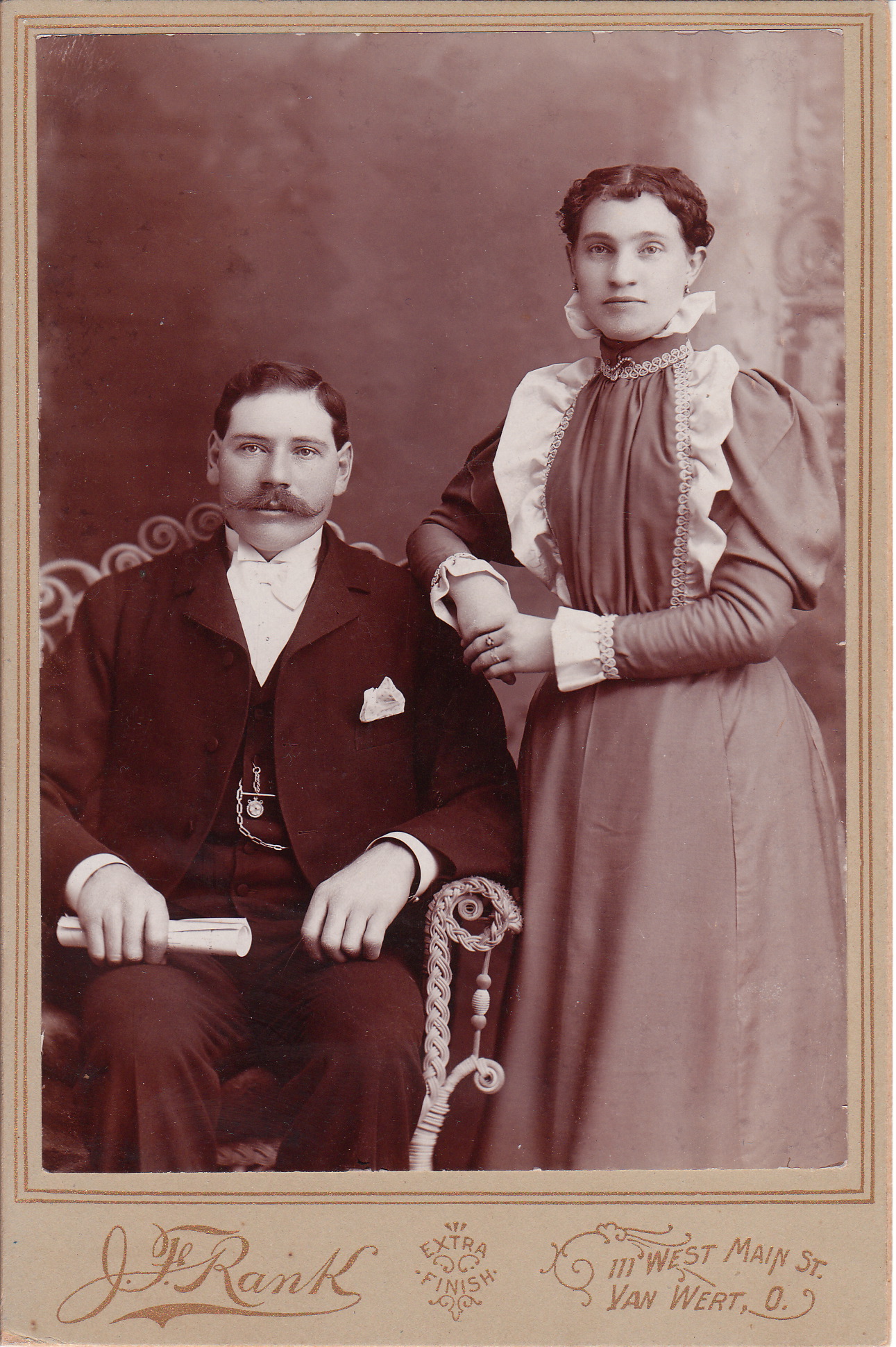
A young couple poses for their portrait in this cabinet card photographed by J. F. Rank of Van Wert, Ohio. The man in the image is holding a rolled document that appears to be a diploma. He is dressed in formal clothing which suggests that the portrait may be a graduation picture. He has a fine handle bar mustache and is wearing a pocket watch. The woman in this picture is nicely dressed and well adorned with jewelry. Jeremiah F. Rank (1847-1913) was born in Shelby, Ohio. He learned the trade of photography from I. S. Hartsock in Van Wert, Ohio, in 1872. After being trained, he quickly bought Hartsock’s studio and operated the business until 1892 when he sold the gallery. After traveling around the United States for two years, he opened galleries in Schuyler and Lincoln, Nebraska. He eventually returned to Van Wert and opened another studio there. In 1874, Rank was married to Mary I. McBride of Oskaloosa, Iowa. To view other photographs by this photographer, click on the category “Photographer: Rank”.
A JOYFUL MOM AND HER BABY IN CLEVELAND, OHIO
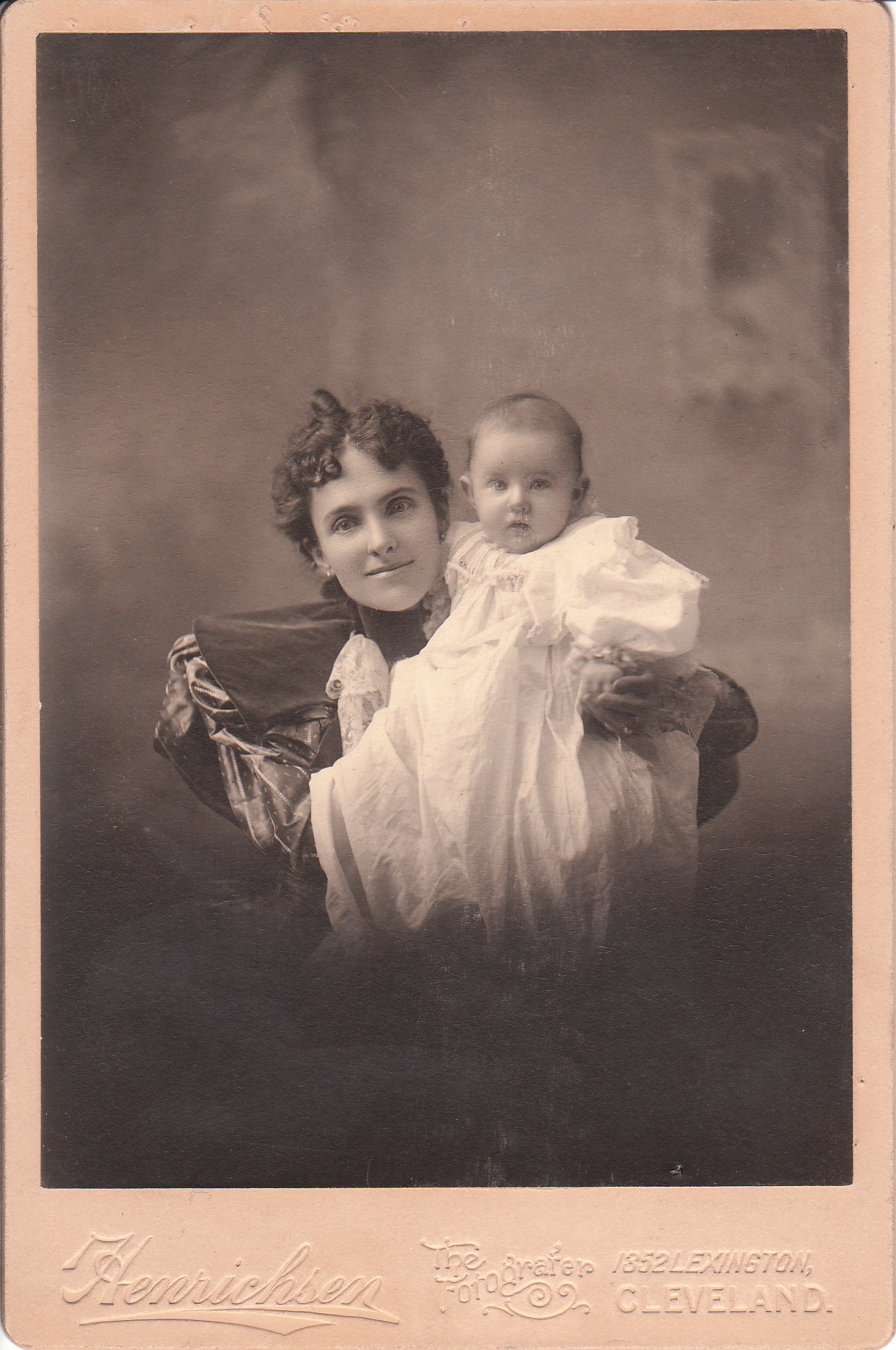
Film reviewers speak of a category of movies called “feel good” movies. It has been my observation that there is a category of cabinet cards that should be called “feel good” cabinet cards. This cabinet card, featuring a mother and her baby, falls into the “feel good” genre. This image exudes joy. Mom is smiling. It is important to note that smiling subjects are a rare occurrence in cabinet card photography. Mom’s eyes are smiling too; she just can’t contain her joy. Mom is beautiful, and of course, all babies are adorable. Does anyone wonder how mom was able to hold her baby in this pose for as long as it took to have the photograph taken? Mom likely had some invisible assistance. The child is likely sitting on a platform of some type that has been blocked out by the photographers “tricks” during the development process. This image was photographed by Henrichsen who’s studio was located at 1352 Lexington, in Cleveland, Ohio. John H. Henrichsen operated his studio in Cleveland between 1891 and 1897 and was located on Lexington from 1893 until 1894. These dates were found in the book, “Ohio Photographers 1839-1900” (1998). Henrichsen was also mentioned in Wilson’s Photographic Magazine (1896), as a competitor for prizes at a major photography exhibit.


 THE CABINET CARD GALLERY