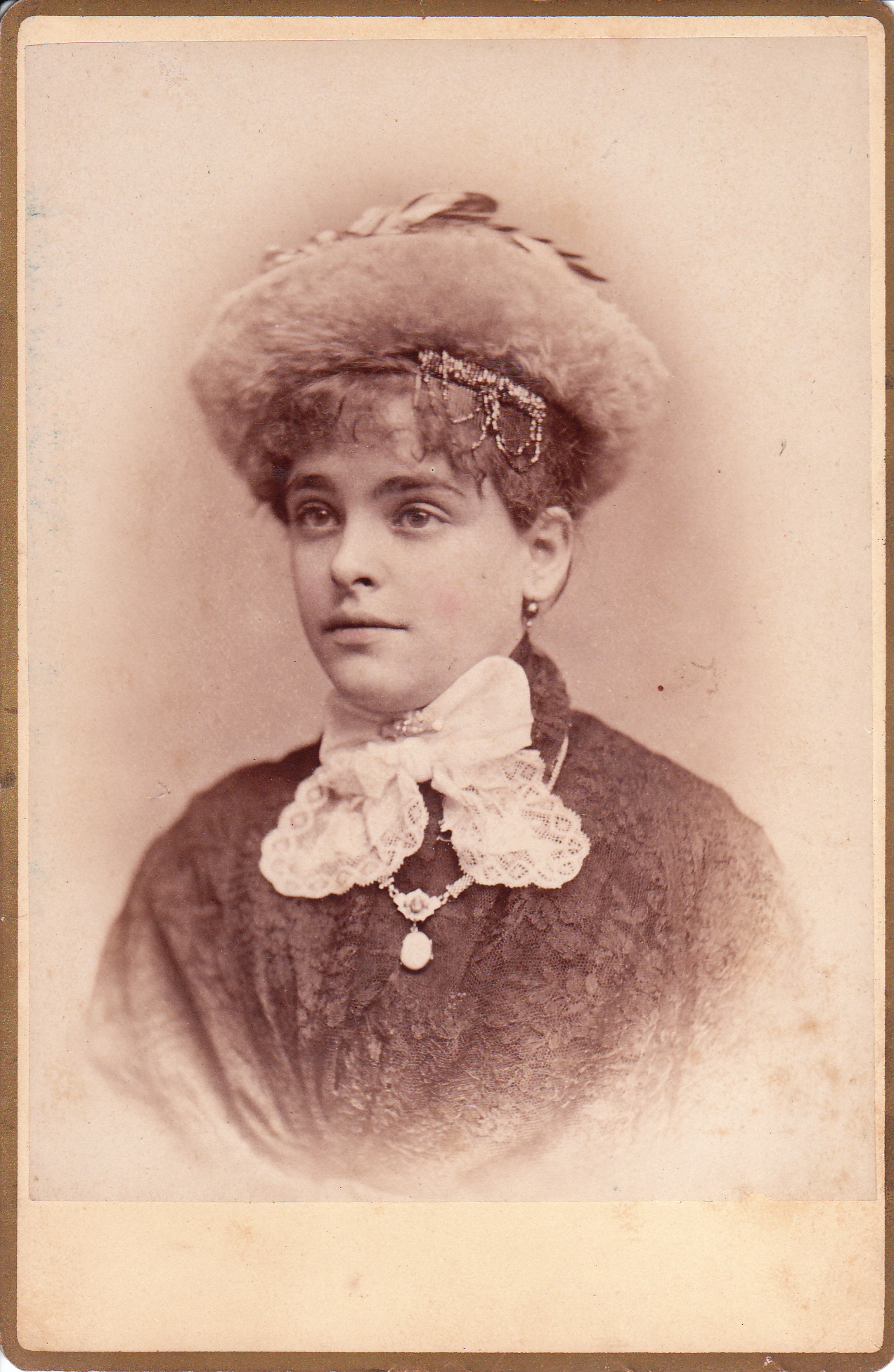
 A pretty young woman poses for photographer George W. Bew in his studio. The studio was located at 1725 Germantown Avenue in Philadelphia, Pennsylvania. She is wearing a fashionable hat and an interesting necklace with a locket. She is also wearing earrings. A story about photographer George W. Bew (1835-1913) appears in the “Historical Journal ” (2012) of the Lititz Historical Foundation. Lititz is a town in Lancaster County, Pennsylvania. Apparently, after working as a photographer in Philadelphia (he is listed in the 1881 city directory), Bew moved his business to Lititz. Between 1890 and 1896 his business in Lititiz was known as the “Broad Street Gallery”. Between 1900 and 1913 his gallery was located at 162 Locust Street in Lititz. The Bulletin of Photography (1913) announced Bew’s death. The brief article mentioned that he was still working as a photographer at the time of his death, even though he was 80 years old. Another source listed his death age as seventy-eight.
PRETTY YOUNG WOMAN IN PHILADELPHIA, PENNSYLVANIA

MOTHER AND TWO DAUGHTERS EXPERIENCE A BAD HAIR DAY IN PHILADELPHIA, PENNSYLVANIA
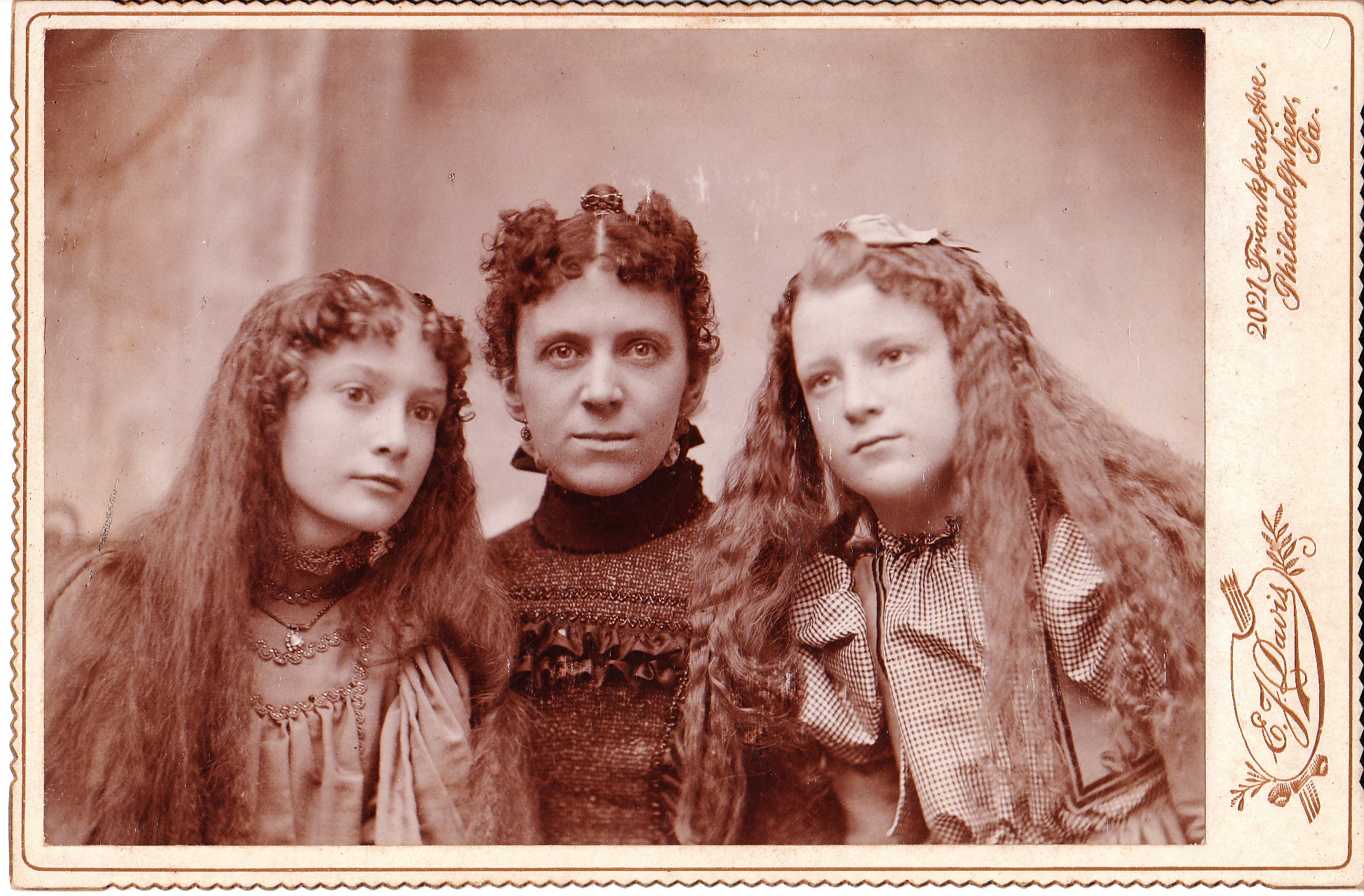
A mother and her two long haired daughters pose for their portrait at the studio of E. J. Davis in Philadelphia, Pennsylvania. The young girls don’t just have long hair, they have long frizzy hair. Are they having a bad hair day? One can only guess what the girls thought about their hair before they sat for this photograph. What do you think about the dynamics between the family members in this portrait? It appears to me that this is one very detached family. The lack of connection between mother, older daughter, and younger daughter is striking. All three individuals appear to be very much in their own world. Little information could be found about photographer E. J. Davis. The only information uncovered concerning Davis, was an ad he placed in a photography journal, Snap Shots (1908). The ad listed some of his photography equipment for sale. The subjects of this photograph are not identified. SOLD
PRETTY ACTRESS TRYING TO GET LUCKY IN PHILADELPHIA, PENNSYLVANIA
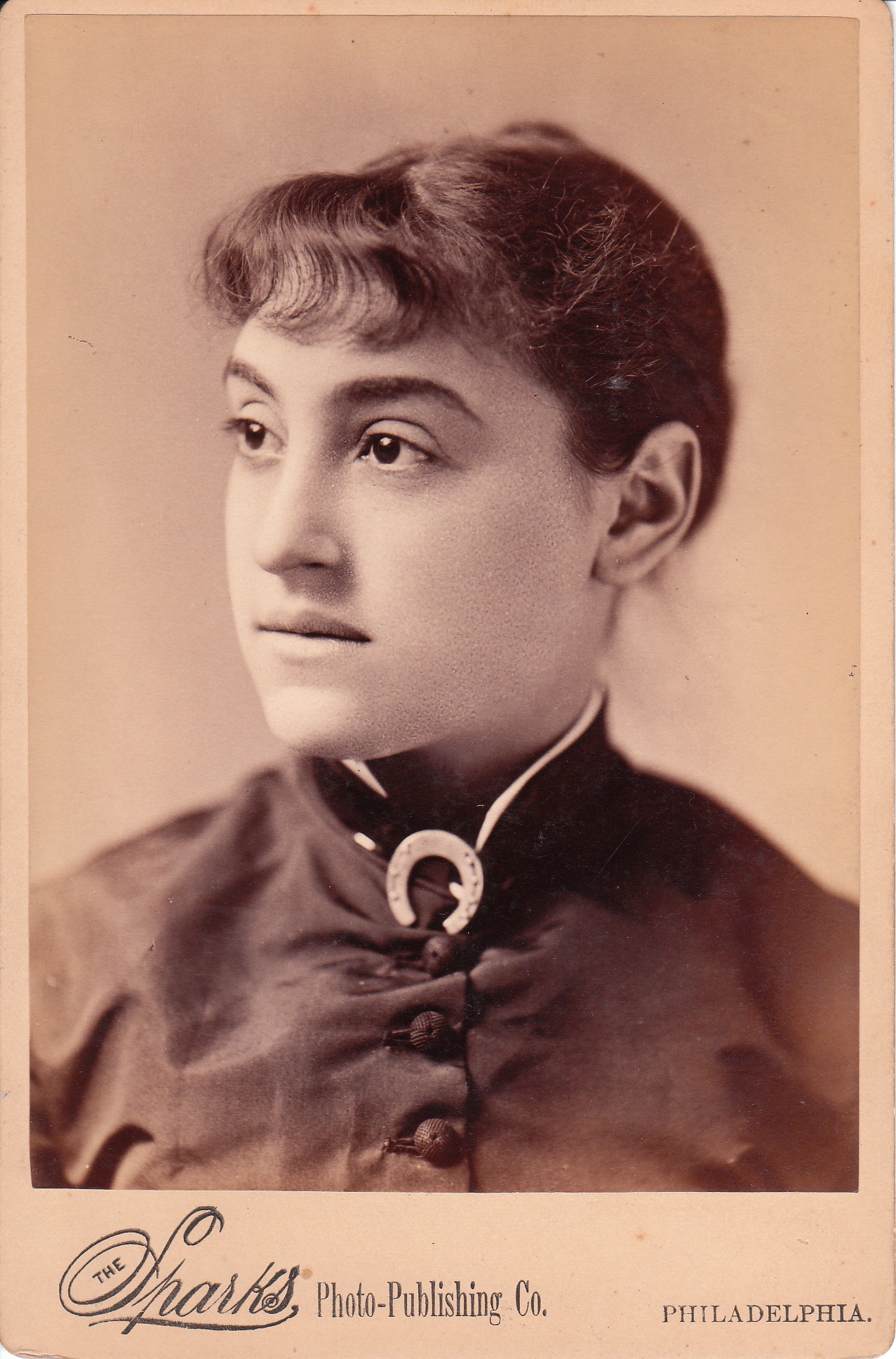
A beautiful young actress poses for her portrait at The Sparks studio in Philadelphia, Pennsylvania. She is wearing a horseshoe broach which probably was supposed to bring her good luck. This actress’s name was Marion Elmore. She was born in 1860 in a tent in Sandhurst, Australia. Her parent were English and they were in Australia because they were hoping to hit it big in the Gold Rush. Elmore began her acting career at age three. She played in Rip Van Winkle with touring American actor, Joseph Jefferson. In the 1870’s she was a member of Lydia Thompson’s famous burlesque troupe. “The Blondes” performed a risque mix of songs, dance and comedy. They also were very well known for showing a great deal of leg in their revealing costumes. She came to the United States in 1878 with the troupe but soon went off on her own as an actress and vaudeville performer. Her first starring role was in Chispa (1883). This play was poorly reviewed. The “Virtual Dime Museum” quotes the journal “Music and Drama” which wrote that the play “was dramatic rubbish, and that it does not fit Marion Elmore any better than her straw hat, which was continually falling off”. The New York Times (1882) also lambasted the play. The critic had mixed feelings about Miss Elmore, but stressed her negatives. He blamed actress Maggie Miller for perpetuating a type of actress that he found abhorrent. These actresses were seen as stock actresses who rose to “money making dignity” by performing in troupes like Lydia Thompson’s Blondes. He described Elmore as a “vivacious exponent of the high art of leg burlesque”. The critic asserts that the craze surrounding Lydia Thompson, and other similar troupes, was one of the worst stupidities of the stage” and that he was pleased that the popularity of this type of entertainment had become “extinct”. On the positive side, the critic enjoyed Elmore’s sense of humor and her “brightness”. One fortuitous outcome of her acting in Chispa was that she fell in love with, and in 1884, married her co star, Frank Losee. Another actress in Chispa was Lina Merville. Her portrait can be found in the Cabinet Card Gallery via the search box. As Elmore’s career continued, she acted in many plays in the New York area. She was active through the 1890’s and the early twentieth century. She died at age ninety in 1950. To view other photographs of actresses by Sparks, click on the category “Photographer: Sparks Photo Publishing Co.”.
HE’S IN THE ARMY NOW…..THE SALVATION ARMY (PHILADELPHIA, PENNSYLVANIA)
 A young man, wearing a salvation army uniform, poses for his portrait at a studio in Philadelphia, Pennsylvania. The man has long hair and a great mustache. The photographer of this image was Frank A. Kroneberger (1847-?). The photographer’s studio was located at 1313 and 1315 Columbia Avenue. Kroneberger was born in Maryland and was of German heritage. He appears in the 1900 census as living in Philadelphia and working as a photographer. He was listed as being married to Henrietta Kroneberger since 1870 and as having three daughters (age 16 to age 21). Kroneberger had longevity in the field of photography. He is listed in various directories (from 1877 to 1918) as being a photographer. He appears to have started his career in Chester, Pennsylvania. To view other images of Salvation Army workers, click on the category “Salvation Army”.
ACTRESS MARY ANDERSON: BEAUTIFUL STAR OF THE AMERICAN AND ENGLISH STAGE
 Cabinet Card 1 (SOLD)


These cabinet cards feature American stage actress, Mary Anderson (1859-1940). Interestingly, Anderson’s father was an Oxford educated New Yorker who after Mary was born, moved his family to Kentucky. He then joined the Confederate army and was killed in action when Mary was just three years old. Mary was not much of a student but loved to read Shakespeare. Her step father sent her to New York at age 14 to take ten professional acting lessons. In 1875, at age 16, Mary Anderson began her stage acting career in a Kentucky production of Romeo and Juliet. She continued acting in Kentucky and then appeared in a number of other cities, including New York. Her critical reviews tended to be mixed but she was well loved by the public. She then worked the New York and touring company stages for twelve years until she spent the next six years on the English stage (appearing in a lot of Shakespeare productions). She then returned to the United States, and at age 30, collapsed on stage with a case of nervous exhaustion. This experience, likely coupled with less than favorable reviews, caused her to retire from acting.
Cabinet Card 1 features Anderson in the role of Galatea. A review of Mary Anderson’s performance in this role appeared in the New York Times in a September 1884 edition. She was appearing opposite British actor William Terriss, in the play “Pygmalion and Galatea”, at the Lyceum Theatre in London. Many notables were in attendance, including Oscar Wilde. The review states ” Miss Anderson surpassed herself and that the performance was throughly artistic and finished”. The cabinet card was photographed by The Vanderweyde Light of London, England (182 Regent Street W.). Henry Van Der Weyde (1838-1924) was an artist and photographer. In 1877, he became the first photographer to install and take photographs by electric light. (SOLD)
The second cabinet card was photographed by celebrity photographer, Sarony. The image reflects Mary Anderson’s great beauty. To view other photographs by Sarony, click on Cabinet Card Gallery’s category “Photographer: Sarony”.
The third cabinet card was photographed by “The Sparks Studio”. The studio was located in Philadelphia, Pennsylvania and the artist/manager was Elliott Houseworth. This cabinet card offers a profile portrait of the attractive Ms. Anderson. The 1880 census lists Elliott A. Houseworth as being born in 1855, residing in San Francisco, California, and working as a photographer. Houseworth also appears in the 1900 census as living in Norwood, Pennsylvania and working as a manager. These demographics fit the photographer of this image, since Houseworth managed Sparks Photography Studio and Norwood is only about eleven miles from Philadelphia. To view other photographs of actresses by Sparks, click on the category “Photographer: Sparks Photo Publishing Co.”.
The fourth cabinet card features a smartly dressed Mary Anderson and was photographed by George Rockwood, of New York City. To learn more about Rockwood and to view more of his photographs, click on the category “Photographer: Rockwood”. A sticker on the reverse of the photograph indicates that the image was once part of the Kean Archives in Philadelphia, Pennsylvania. The Kean Archives was a company that served as a source of illustrations and photographs for various modes of media. They eventually were purchased by Getty Images.
PRETTY WOMAN IN PHILADELPHIA, PENNSYLVANIA (1885)
 A pretty woman poses for her portrait at the Dunshee Studio in Philadelphia, Pennslvania. The studio was located across the street from the U. S. Mint. The subject’s dress has a very lacy collar and she is wearing an elaborate belt. Note the buttons on the side of her skirt. This arrangement of buttons is not commonly seen on dresses in cabinet card photographs. Her figure is improved by the corset that she is wearing. Print on the reverse of the photograph indicates that the image was produced in 1885. To view other photographs by Edward Sidney Dunshee, and learn more about his history, click on the category, “Photographer: Dunshee”.
MARY COLEY, A PICTURE OF FASHION, IN PHILADELPHIA, PENNSYLVANIA
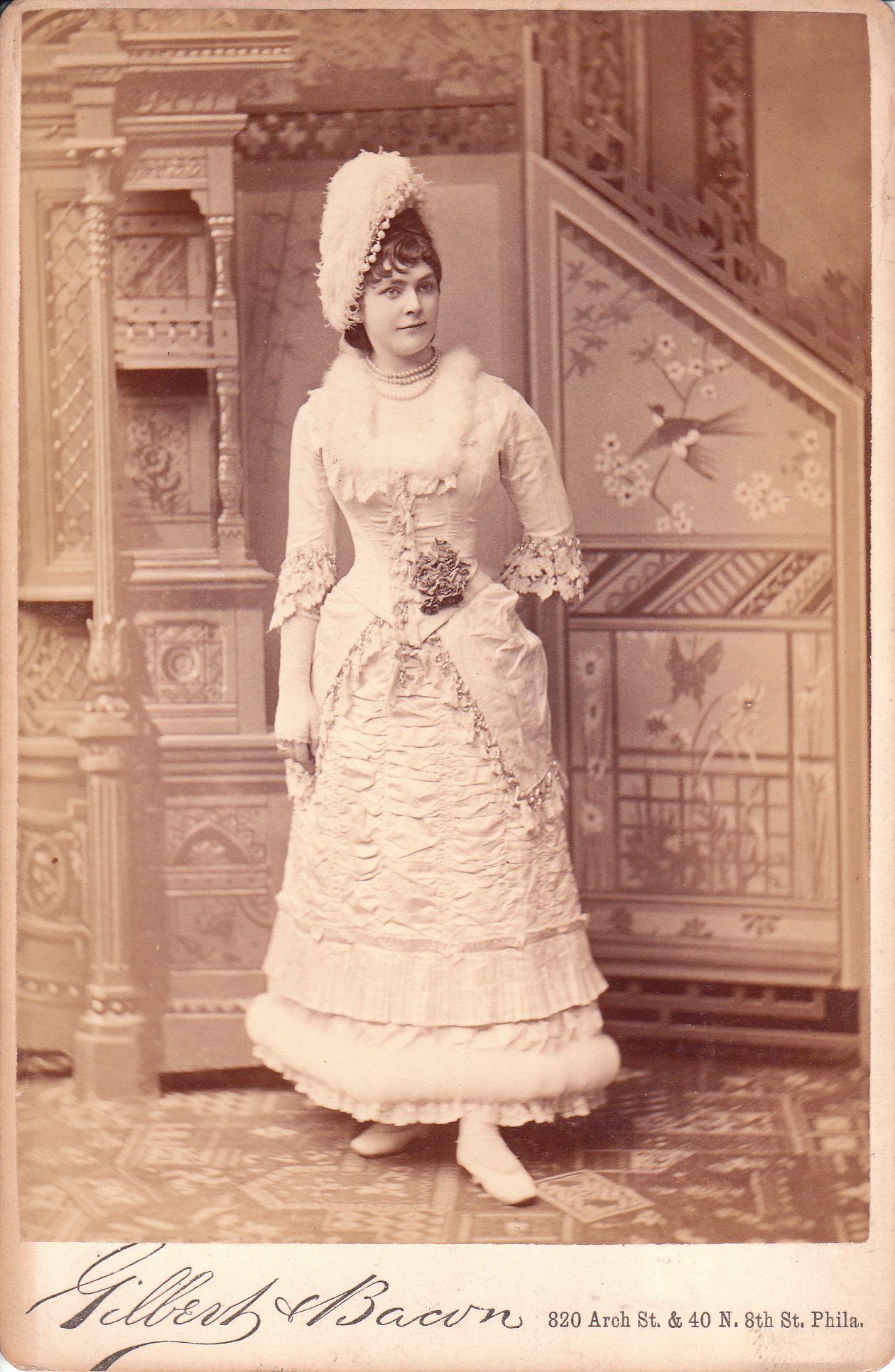 This cabinet card features a very fashionable lady, posing for her portrait at the studio of Gilbert & Bacon, in Philadelphia, Pennsylvania. The woman is identified as Mary Coley (her name is written on the reverse of the photograph). She looks great in her beautiful gown. Note the fur trim at her collar and near the bottom of her dress. She appears to be wearing pearls and she strategically placed her hat at just the right angle, in order to make some sort of fashion statement. This pretty woman may be an actress; Gilbert & Bacon were prominent theatre photographers in Philadelphia. However, research found no record of any actresses named Mary Coley. To learn more about the photographers of this cabinet card, click on the category “Photographer: Gilbert & Bacon”.
DAPPER MAN WEARING A DERBY IN LANCASTER, PENNSYLVANIA
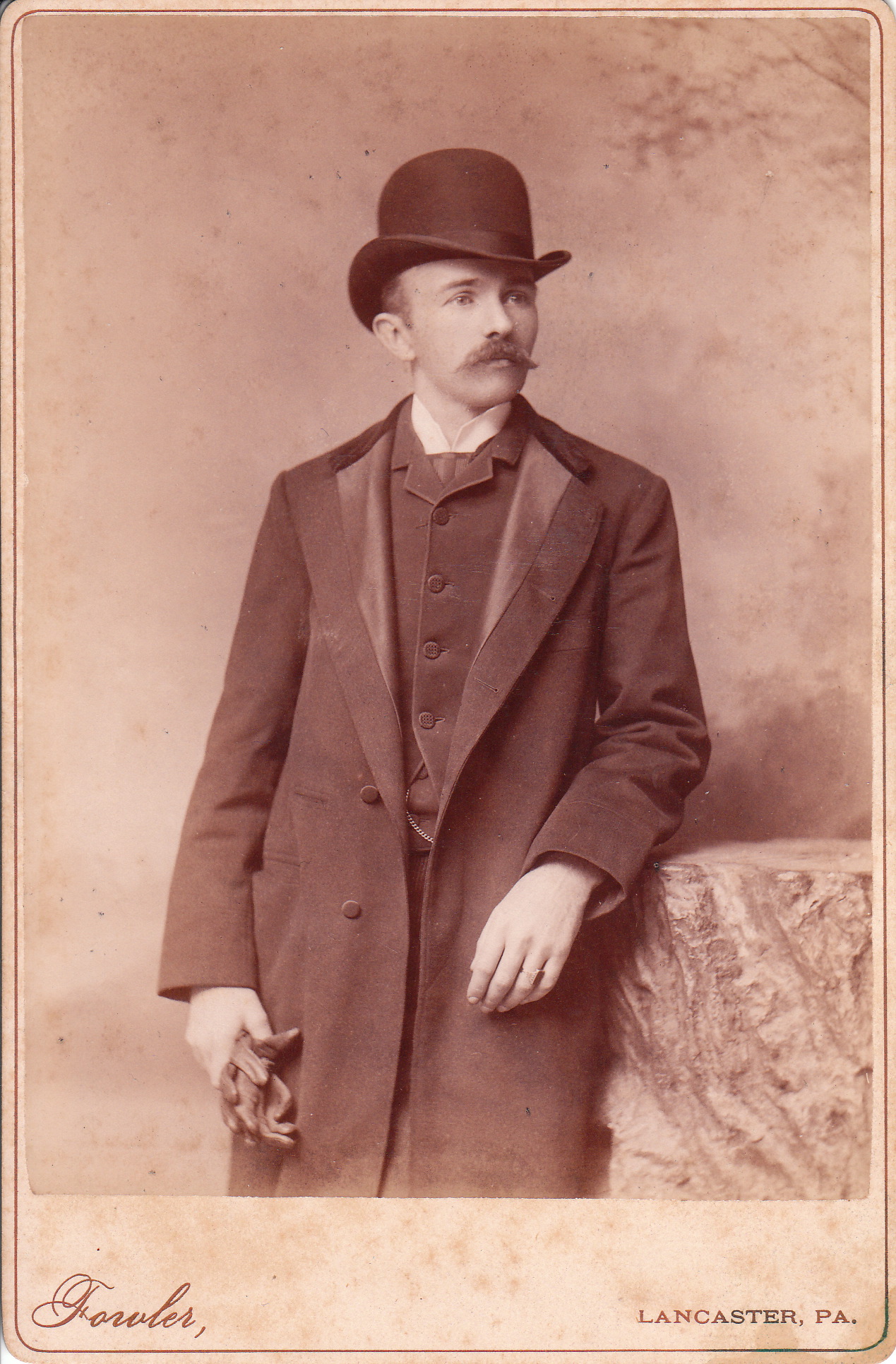 A dapper man poses for his portrait at the studio of Lewis C. Fowler, in Lancaster, Pennsylvania. This gentleman is nicely dressed. He is wearing a long outer coat with what appears to be a velvet collar and satin lapels. He is holding a pair of gloves and has a derby hat on his head. The subject of this photograph’s image possesses an aura of success and importance. Fowler’s photographic studio was located at 12 West King Street, in the town of Lancaster. An advertisement in the Lancaster Board of Trade directory appeared in 1887. A directory of businesses in Philadelphia, indicates that Fowler operated a studio there in 1890. It is unknown whether he conducted businesses in both cities simultaneously. To view other photographs by Fowler, click on the category “Photographer: Fowler (Lewis)”.
YOUNG GIRL AND HER BLACK LAB IN PHILADELPHIA, PENNSYLVANIA
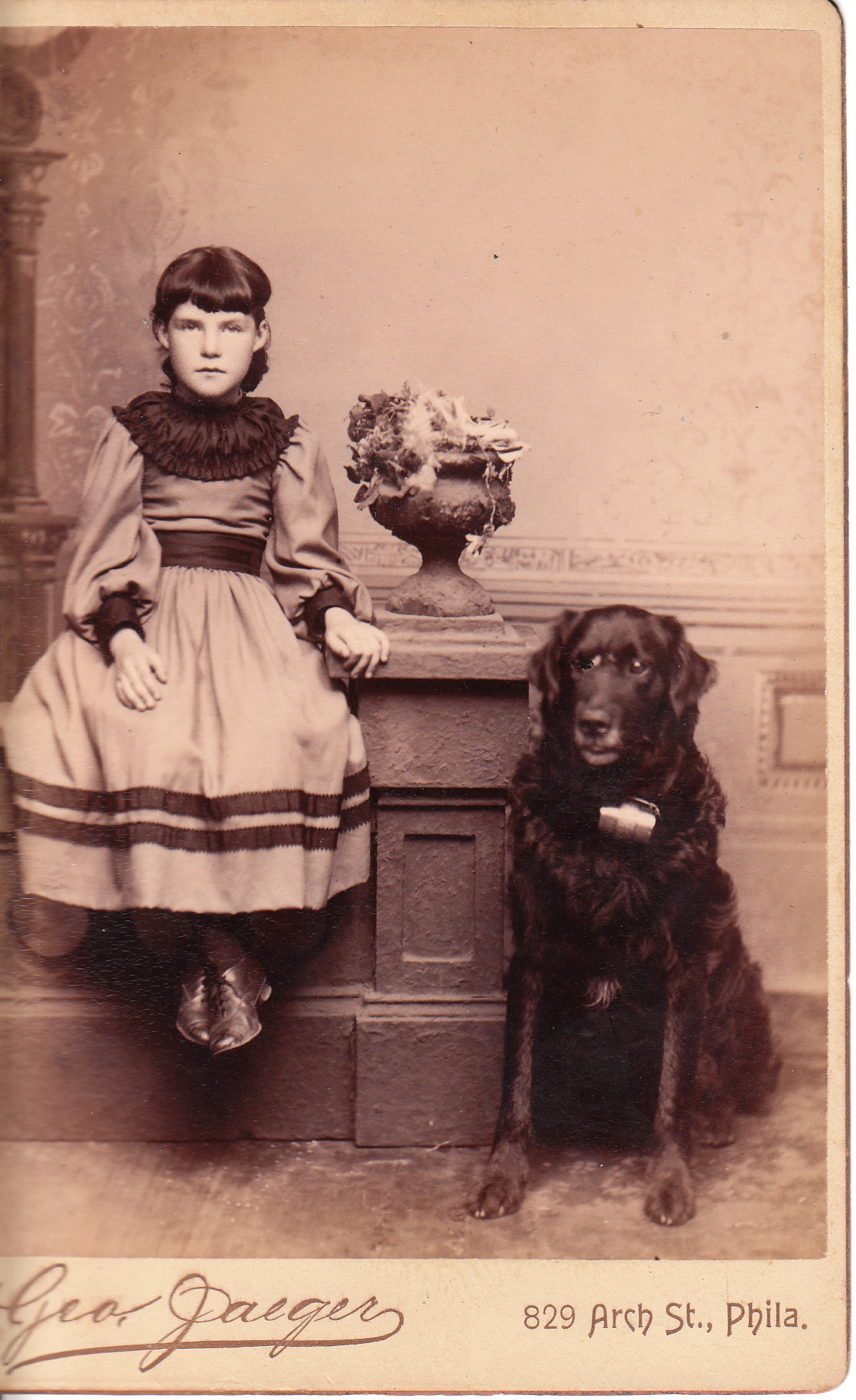 A young girl poses with her black dog (likely a Labrador Retriever) at the studio of George Jaeger, in Philadelphia, Pennsylvania. The child is looking quite serious and one must wonder how the photographer was able to get the dog so nicely posed. The Lab is wearing something on his collar. The object is somewhat shaped like a barrel. Could it be a flask? Hopefully, a visitor to this site will leave a comment that identifies the object on the dog’s collar.
STEAMSHIP STEWARD ON THE S. S. GEORGE W. CLYDE
 This cabinet card photograph is a portrait of a ship’s steward. His cap has a patch that identifies him as a steward, indicates his identification number, and displays an anchor. The reverse of the card has an inscription indicating that he worked as a steward on the S. S. George W. Clyde. The photographer or the location of the photographers studio is unknown. The S. S. George W. Clyde was built in Philadelphia in 1872 by William Cramp & Sons. The ship was scrapped in 1926. The ship carried both merchandise and passengers during its existence. It was an early American steamship and records indicated that among its voyages were many that ended in the Port of New York.


 THE CABINET CARD GALLERY