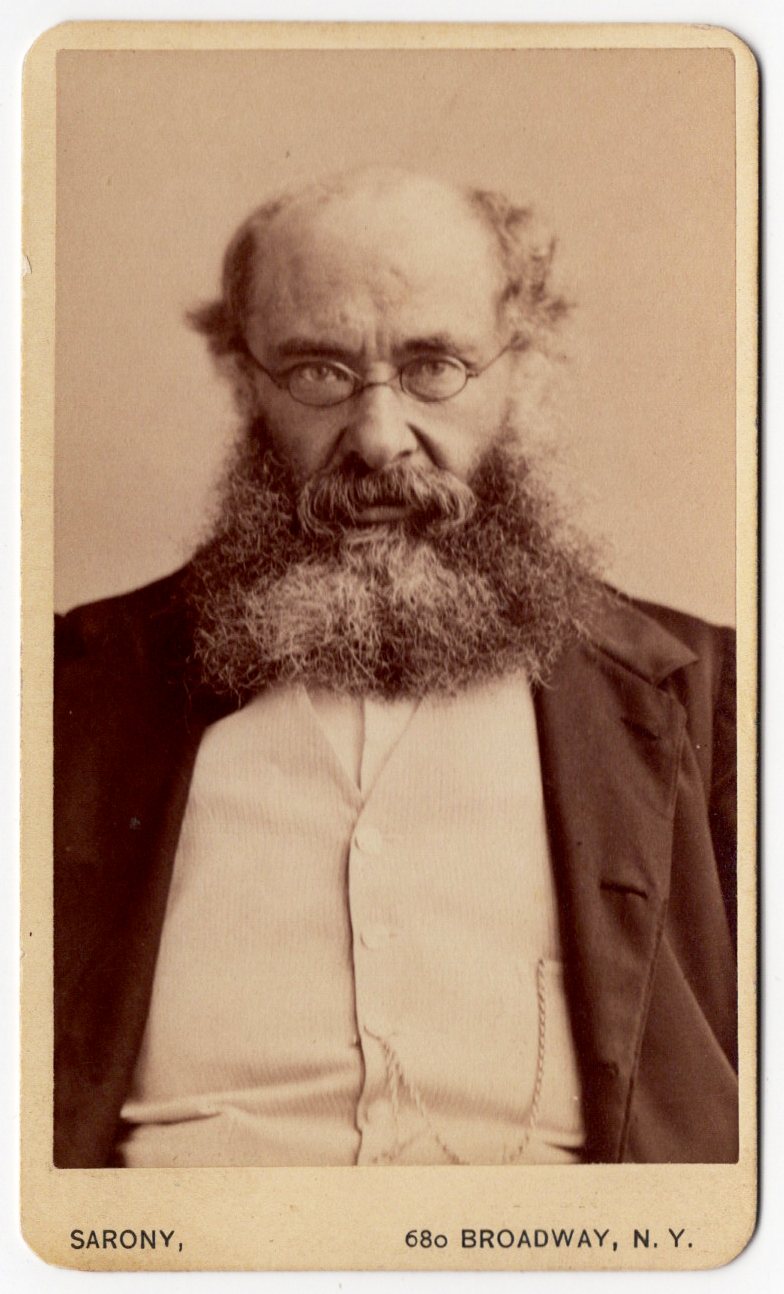


CARTE de VISITE PORTRAIT : ANTHONY TROLLOPE : NOVELIST: PHOTO BY NAPOLEON SARONY

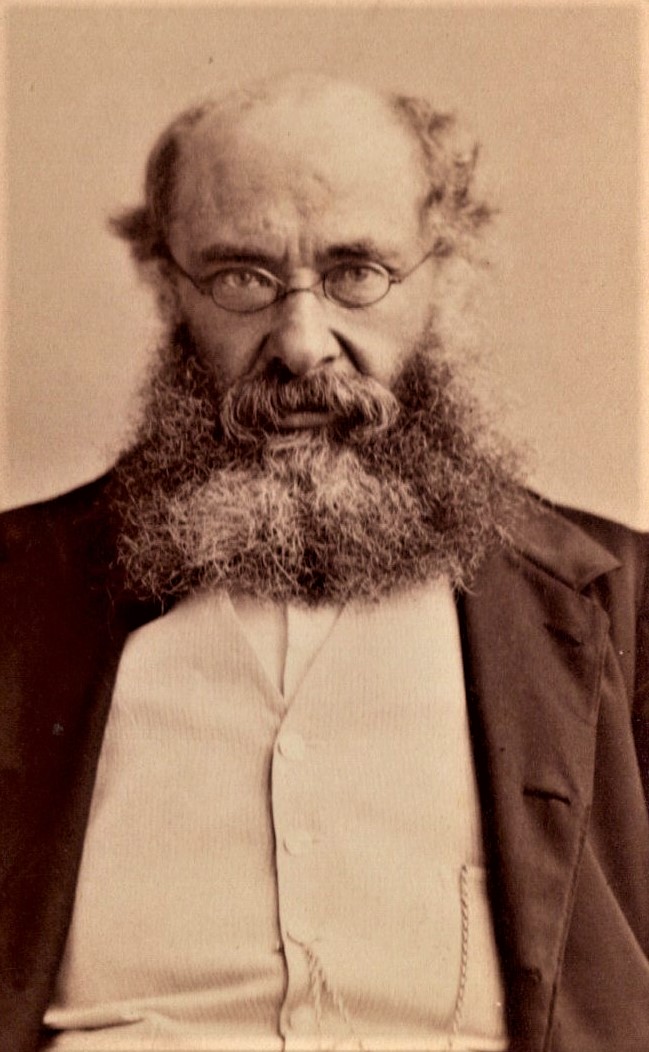
This carte de visite portrait features British author, Anthony Trollope (1815-1882). He has been described as “one of the most successful, prolific and respected novelists of the Victorian era. His best known work was a series of novels known as the “Chronicles of Barsetshire”. He also wrote novels revolving around political, social and gender issues. This cdv’s photograph of Trollope was taken by Napoleon Sarony. Sarony was a celebrated and talented celebrity photographer based in New York City. (SOLD)

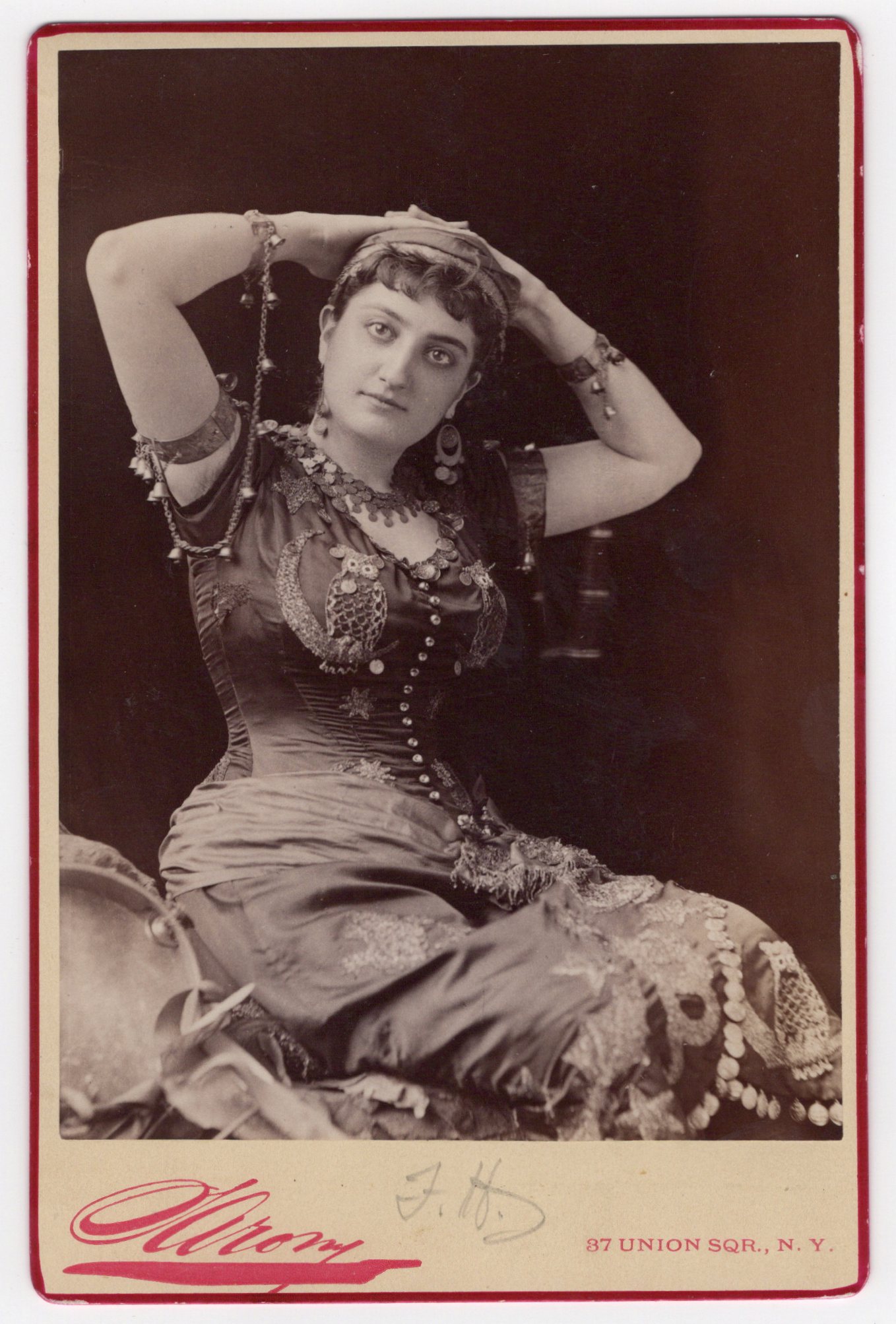
ROSALBA BEECHER : PRETTY OPERA DIVA : OWL ON A CRESCENT MOON : SARONY CABINET CARD

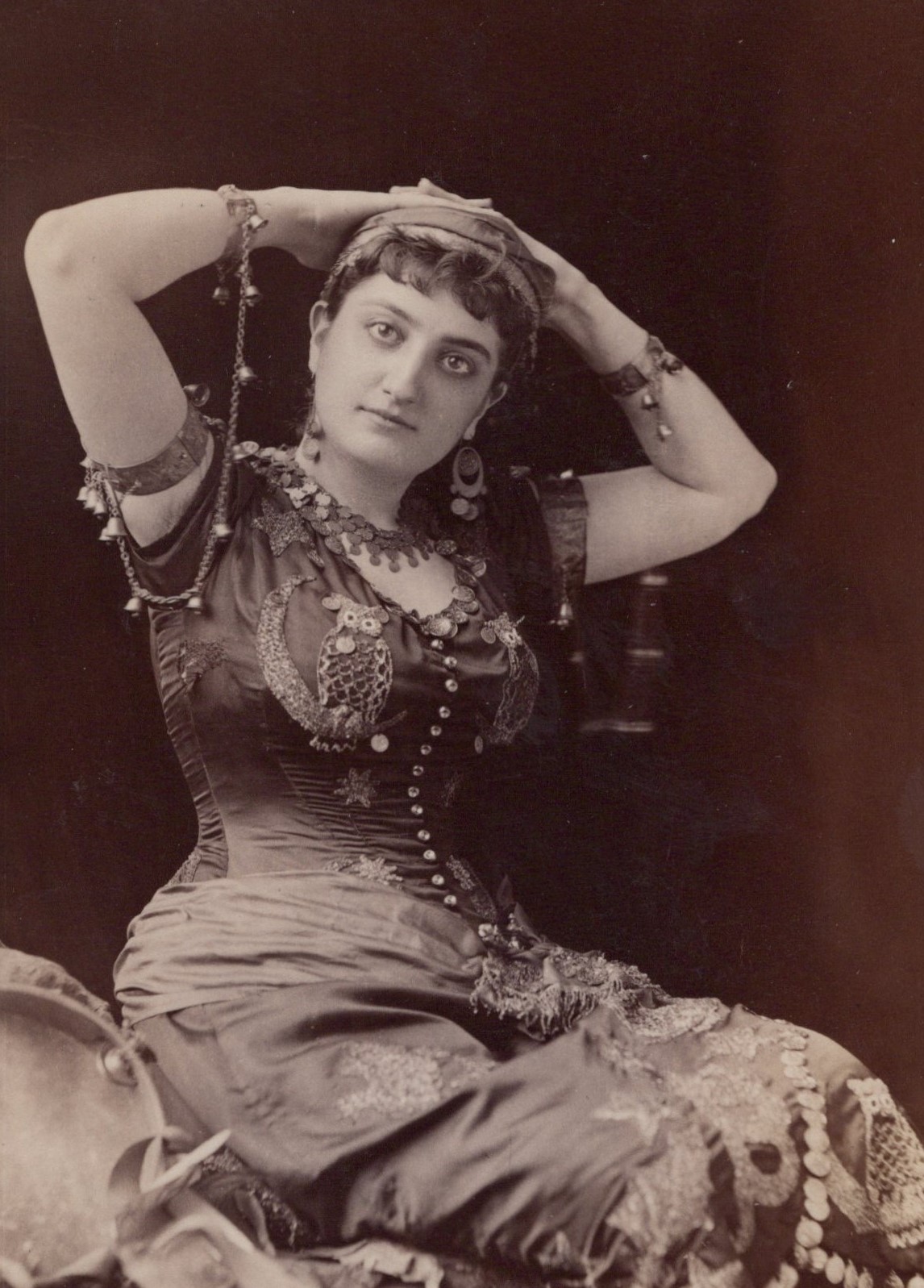
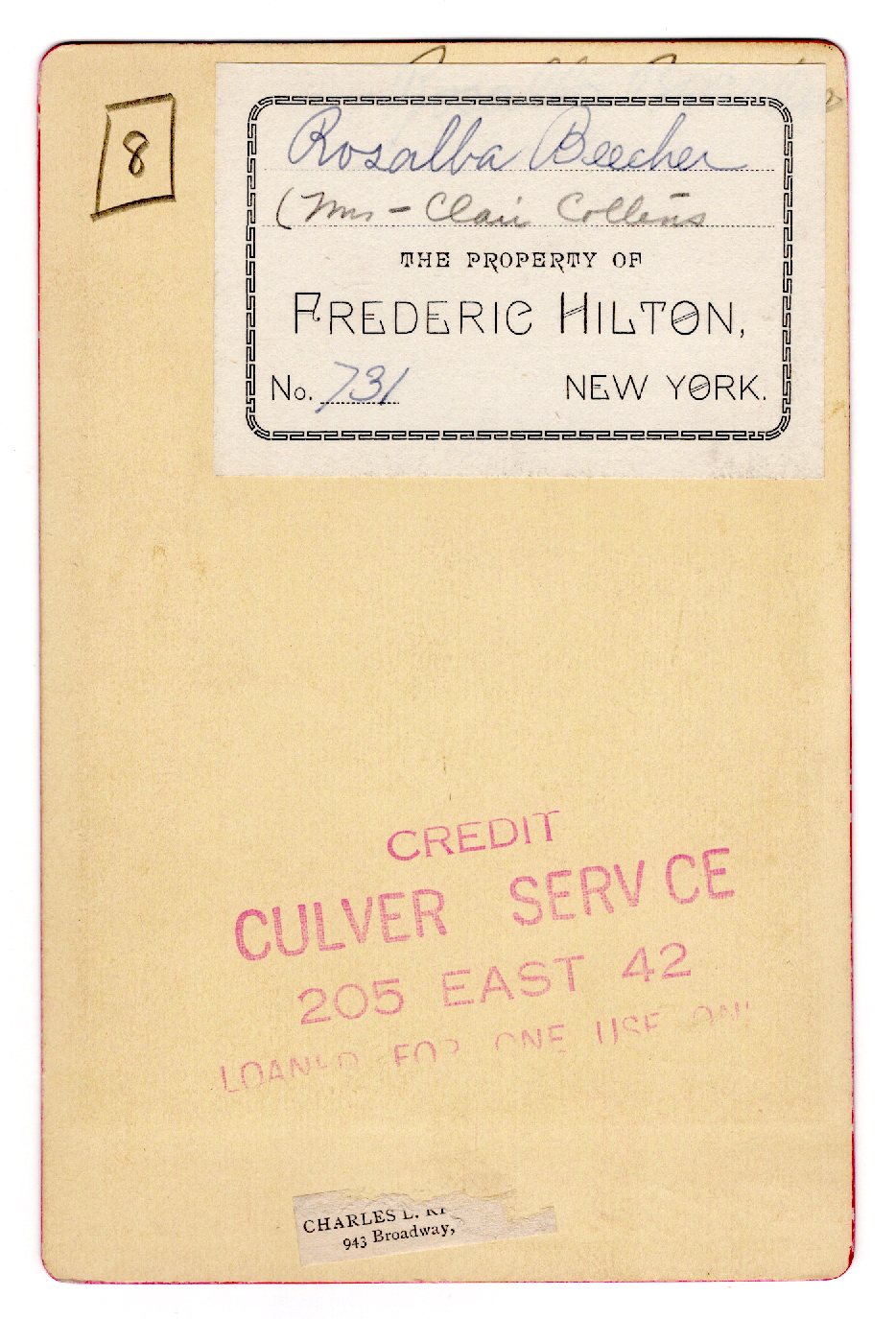
The celebrated Sarony studio of New York City, famed theatrical photographer, published this cabinet card portrait of Rosalba Beecher. Ms Beecher is wearing a very  ornate and dramatic dress. Note the design of an owl sitting on a crescent moon. She is wearing a great deal of jewelry. Her clothing is likely a costume from an opera that she was appearing in. Beecher’s magnificent piercing eyes are evident in this portrait. During her stage career, Beecher appeared in one Broadway play, “Prince Methusalem” (1884). Miss Beecher is mentioned in a New York Times (1900) article concerning her divorce from Clarence Lyman Collins of the dry goods commission firm of  Whitin Collins. Mr. Collins had filed for divorce because he alleged that his wife, whom he married in 1886 (She was 23 and he was 38 years-old), was causing him financial ruin with her excessive extravagant spending. It was alleged that her spending was creating a grave economic problem for Collins and she agreed to return to her pre marital profession of being an opera singer. She moved to Paris to get experience before executing her plan to return to singing on the American stage. She stayed in Europe for several years. While there, she continued her incessant spending and Collins found himself forty thousand dollars in debt. An interesting side note is that Collins’s first wife was a Vanderbilt. This particular cabinet card has been well travelled. The reverse of the cabinet card has “Property Of” stamps from Culver Service (New York), Frederic Hilton (New York), and Charles Ritzman (New York). Culver Pictures was a service that collected photographs that for a fee could be used by the media to accompany the stories appearing in their publications. Culver Service was established in 1926. Research yielded no information concerning the identity of Frederic Hilton. Charles L. Ritzmann was a well known purveyor of photographs of stage actors and actresses. To view other cards formerly owned by Culver or by Ritzmann, type Culver of Ritzmann in the search box.   (SOLD)

ATTRACTIVE YOUNG WOMAN WITH HYPNOTIZING EYES IN DETROIT, MICHIGAN

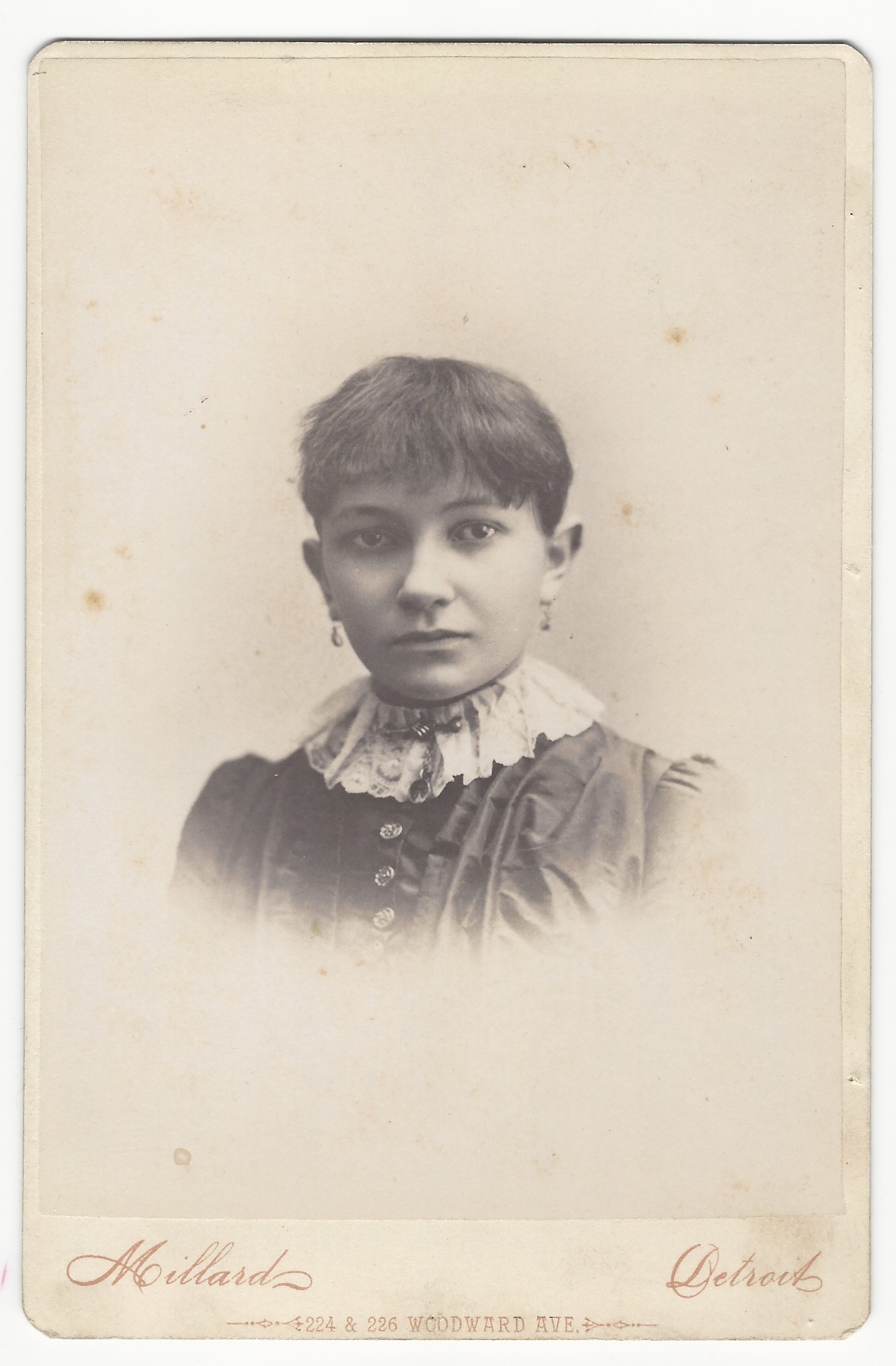
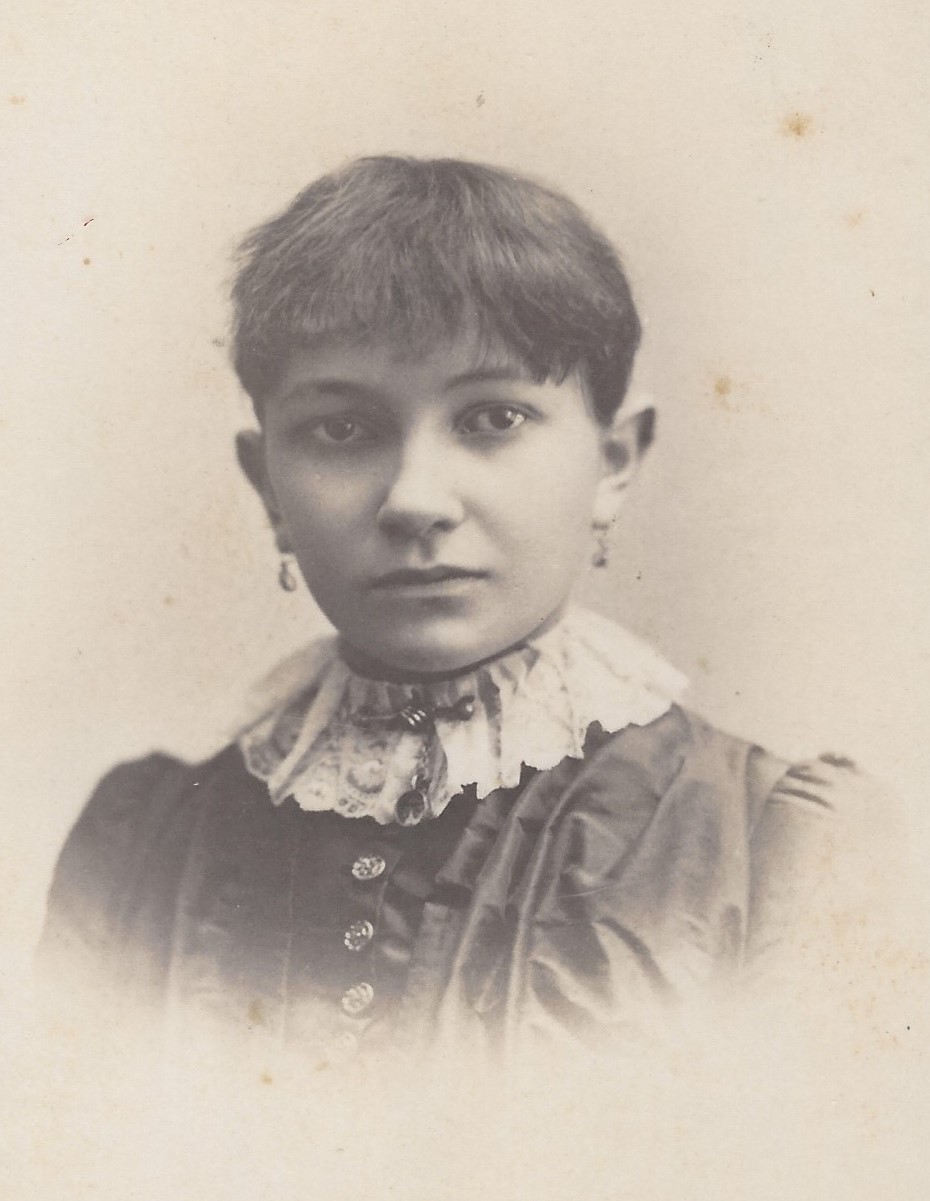
This bust portrait of an attractive short haired young woman is the product of the Millard studio in Detroit, Michigan. The woman is wearing a lace collared dress and earrings. She has magnificent deep hypnotizing eyes.  C. A. Millard is mentioned in The Industries of Detroit (1887) as being the proprietor of the oldest photographic studio in Detroit. It is reported that he bought out a Mr. Powelson in 1879 and at the time of the books publication, Millard employed ten to fifteen artists in his studio. An interesting side note concerns Millard’s death in 1891. Frank Scott Clark (1865-1937), a noted backdrop painter, came to Detroit in 1892 to manage Millard’s studio for Millard’s estate. Among his accomplishments, Clark was an extremely talented photographic background specialist. In fact, during his career, he created, made, and set up backgrounds for both Napoleon Sarony and Jose Maria Mora. Not too shabby a resume for Mr  Clark.  (SOLD)

Published in: on October 12, 2020 at 12:01 pm  Comments (3)  
Tags: , , , , , ,

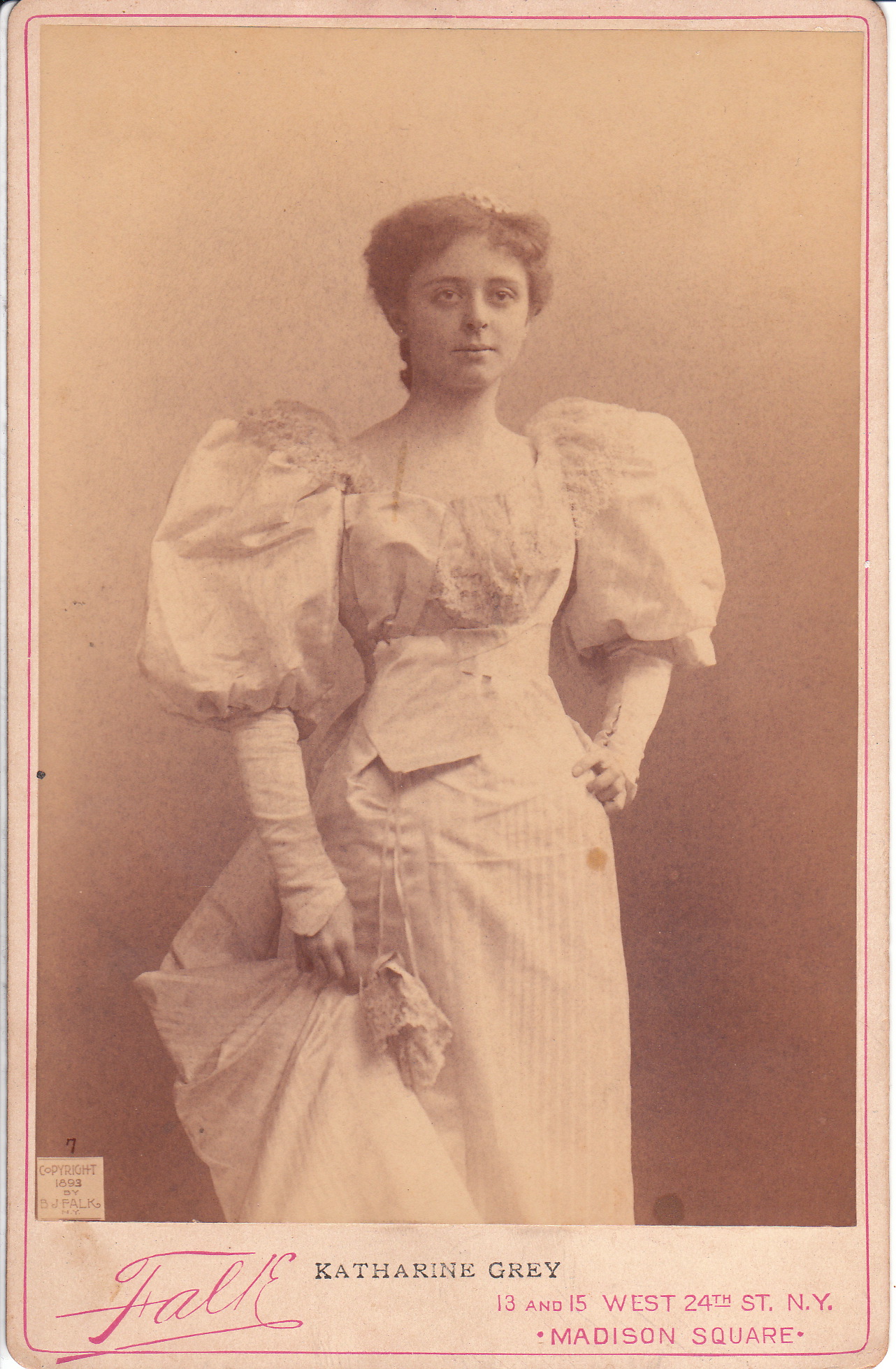
KATHARINE GREY (1873-1950): THEATRE ACTRESS

grayPHOTO 1

PHOTO 2

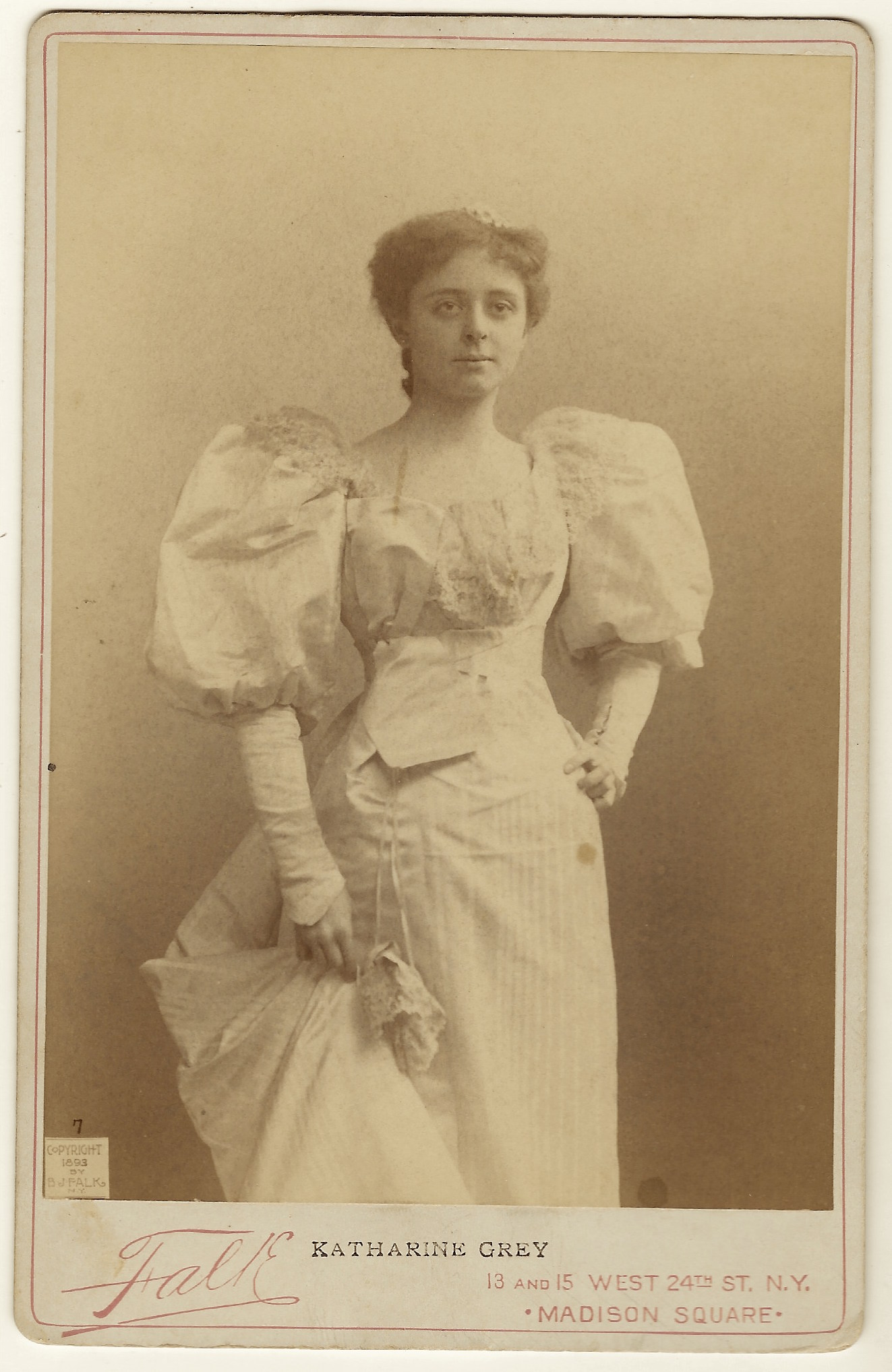
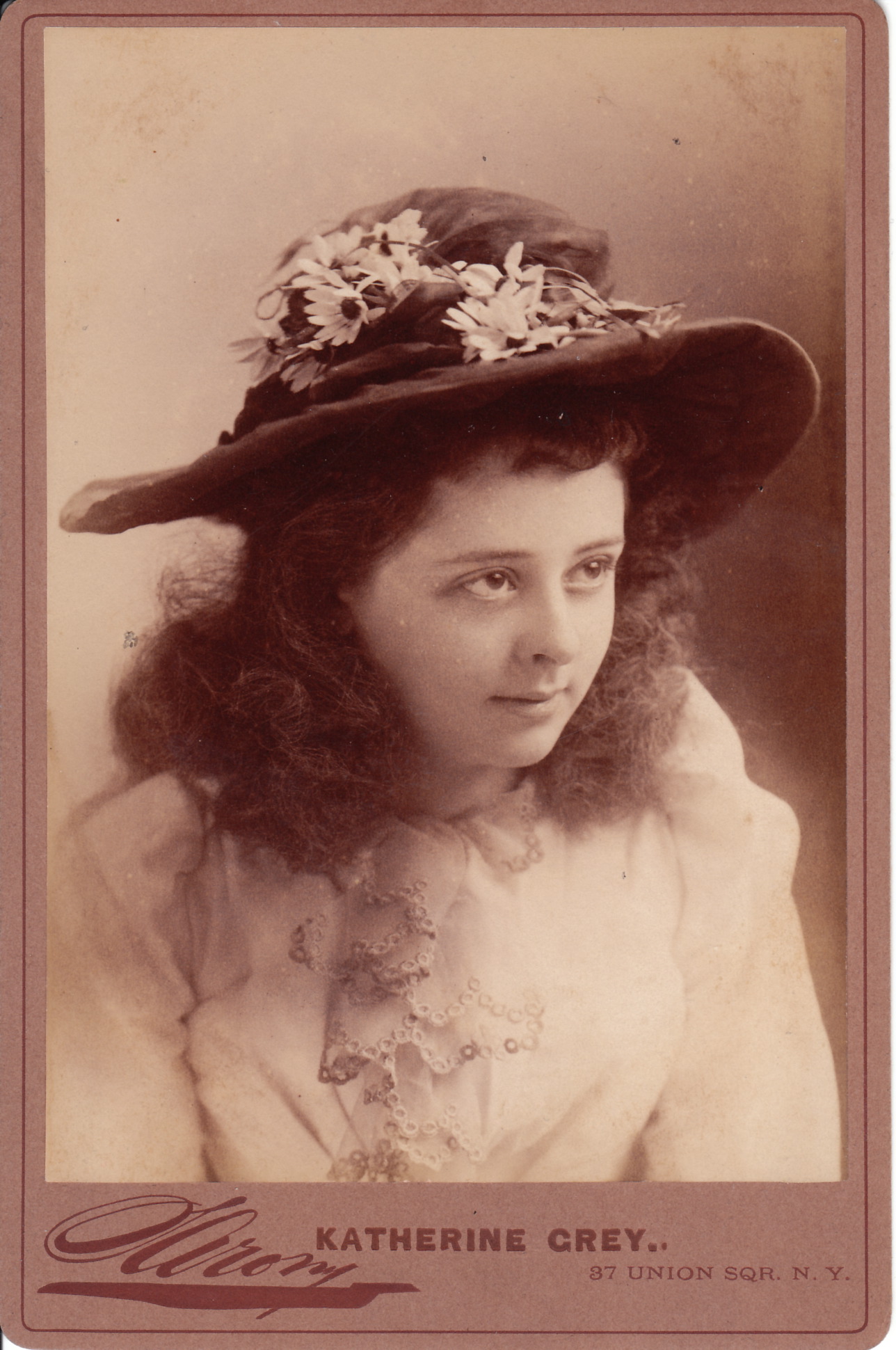
Katherine Grey (1873-1950) was an American theatre actress who appeared in more than 25 Broadway shows between 1895 and 1940. In the top cabinet card, she is photographed by Sarony, of New York City, the famed theatrical portrait photographer. Note the daisies on her hat. In the bottom cabinet card, Grey is photographed by famed celebrity photographer B. J. Falk, also of New York City. In this image she is holding the bottom of her dress in her right hand. The photograph is dated 1893 and in good condition (see scans).

Buy this original Cabinet Card Photograph (includes shipping within the US) #2755

To purchase this item, click on the Pay with PayPal button below

$28.50

Buy this original Cabinet Card Photograph (includes International shipping outside the US) 2755

To purchase this item, click on the Pay with PayPal button below

$36.50

katherine grey 1

MEET THE VOKES FAMILY: JESSIE, VICTORIA, AND ROSINA VOKES WERE TALENTED SISTERS OF THE BRITISH STAGE

Rosina Vokes

Rosina, Jessie, and Victoria Vokes
vokes

Victoria Vokes

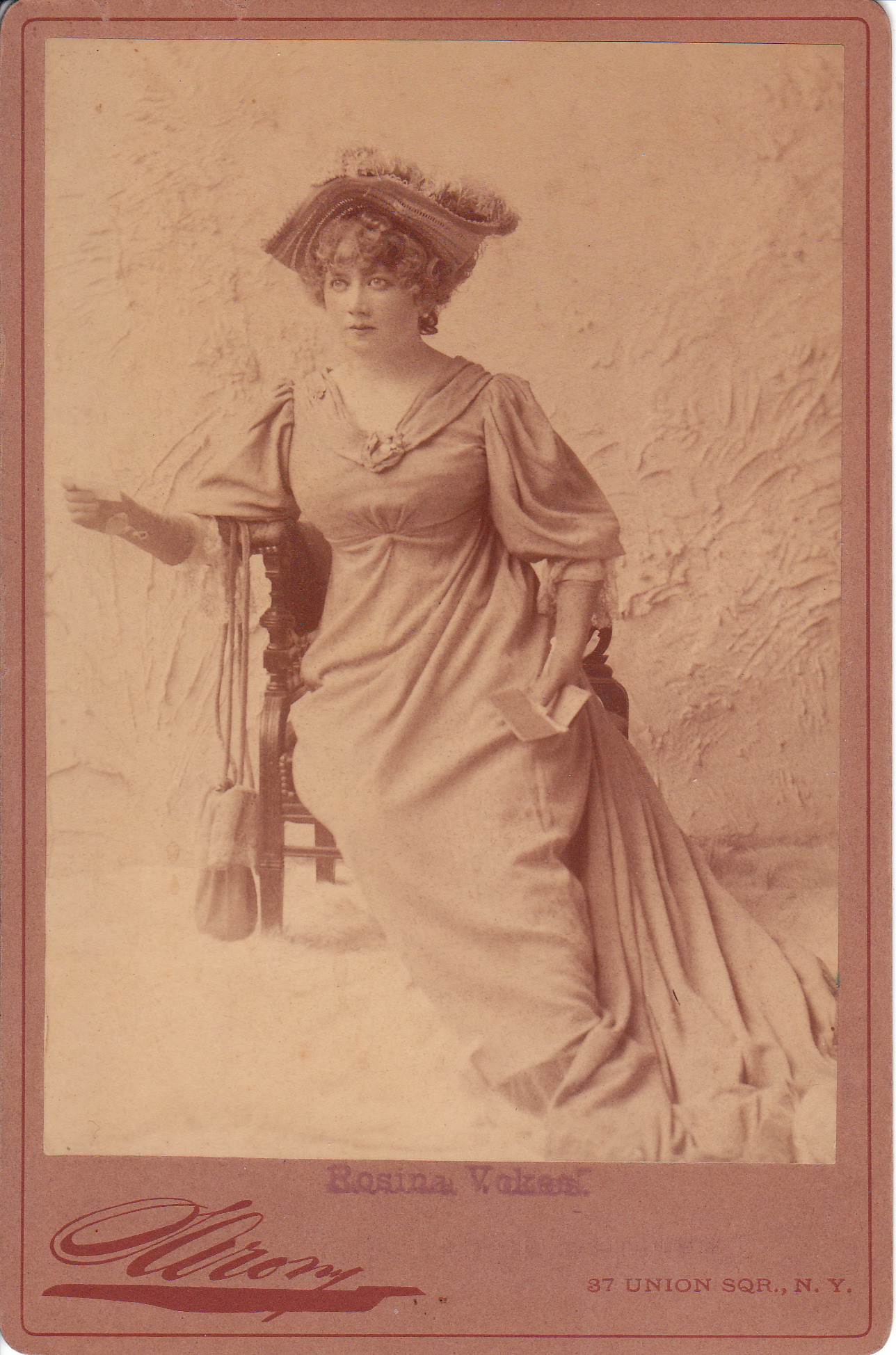
The top photograph in this grouping features stage actress Rosina Vokes (1854-1894). She was the daughter of a London costumer. She came to America with her two older siblings and Fawdon Vokes to make a career in the theatre. Interestingly, Fawdon Vokes was not a member of the Vokes family. His name was actually Walter Fawdon, but the name change was necessary for him to join the family troupe. The group made their New York debut in 1872 in “The Belles of the Kitchen“. They played in a number of shows over time and from the beginning, Rosina was considered “infinitely the cleverest, the most bewitching” of the group. When she reappeared in America in 1885 with her own company, she was warmly welcomed. One paper wrote “she is still young, agile, slender and graceful; the piquant prettiness of her face and the droll charm of her manner still exert a strong influence on the susceptible spectator”. She toured with made-to-order productions, until shortly before her early death, at about, forty years of age. The New York Times (1893) published an article entitled “Rosina Voke’s Serious Illness: It Deprives the Anglo-American Stage of One of its Brightest Ornaments”. The article favorably compares her to her other acting family members and reveals that Vokes had embarked on a voyage from America to England whose purpose was to allow her to die in her home country. The young actress was terminally ill with consumption (pulmonary disease). Judging by the content of the many obituaries that appeared in American newspapers after Rosina Vokes succumbed to her illness, the actress was a well respected and loved performer of the American stage. It is important to note that the Vokes theatrical family included a brother named Fred Vokes (1846-1888). He was an actor and a dancer. This cabinet card comes from the studio of famed celebrity photographer, Napoleon Sarony. To view other photographs by Sarony, click on Cabinet Card Gallery’s category, “Photographer: Sarony”.

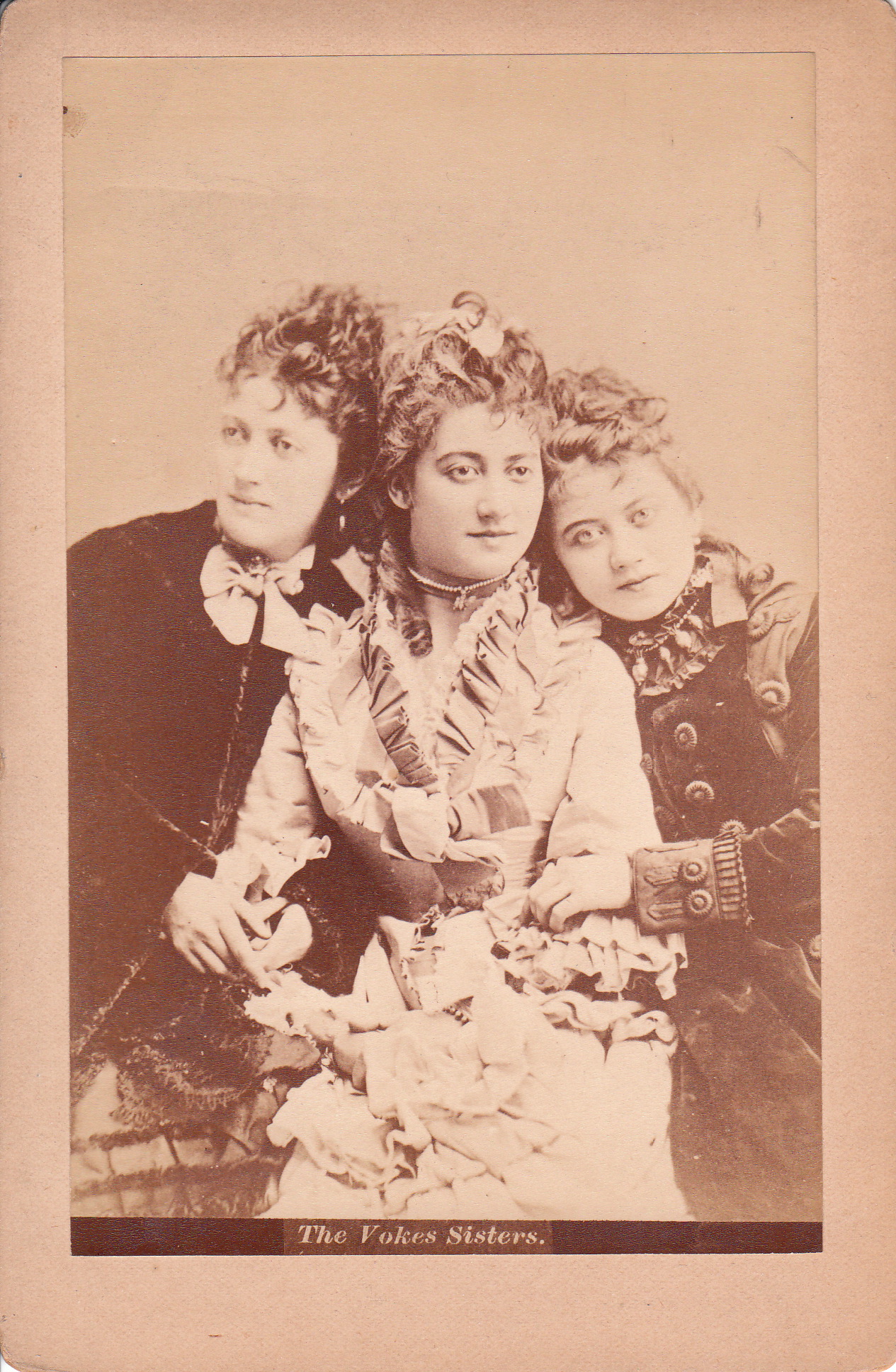
The second photograph captures Rosina and her two sisters posing for an unidentified photographer. The sisters have been identified as Jessie (1851=1884) and Victoria (1853-1894). The reverse of the photograph indicates that the image was formerly part of the “Harold Seton Collection”. Who is Harold Seton? Research reveals that Harold Seton was best known for his work as a journalist, author and collector. He wrote about theatre and society in his column, Theatre Thoughts”, which appeared in Theatre Magazine. He accumulated over ten thousand theatrical photographs of actors and actresses who performed between 1870 and 1900. He donated some of his collection to the New York Historical Society and some are  located at the Wake Forest University library, as well as a number of other institutions. A Harold Seton was a theatre actor who performed in eight plays between 1919 and 1935. Although I doubt that the two Harold Setons’ are the same men; no evidence could be found to determine if they were one and the same man.

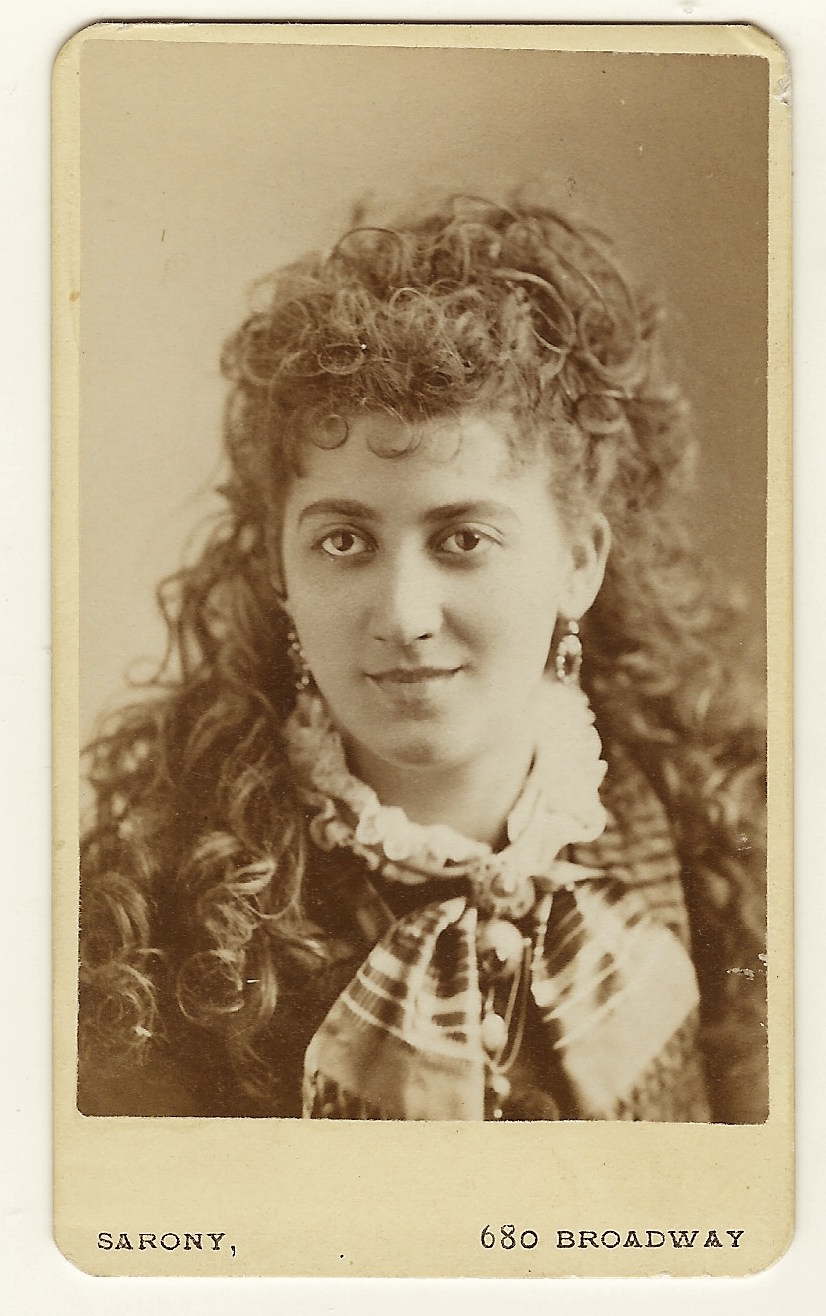
The third image in this group is a carte de visite portrait of Victoria Vokes. The photograph was taken at the Broadway studio of Napoleon Sarony. Victoria was born in London and began her career at the Royal Surrey Theatre at just two years of age. Over time she played a variety of children’s roles in London theatres. In 1861 she appeared with her brothers and sisters at the Operetta House in Edinburgh as one of the “Vokes Children” (later changed to “The Vokes Family”. Victoria earned her early popularity with her voice but soon she was gathering acclaim via her acting. Her performance in “Amy Robsart” (1871) at Drury Lane Theatre is an example of one of her excellent exhibitions on stage. “The Cornell Daily Sun” (1890) wrote about an appearance by Victoria Vokes and her Company. The reviewer asserted that “Few actresses have appeared in Montreal whose genius is so versatile as that of Miss Yokes. She sings with a fine contralto of great power, dances like zephyr and acts in comedy — well, like one of the Yokes”.

MARIE WAINWRIGHT: PORTRAIT OF A THEATRE ACTRESS (PHOTOGRAPHED BY SARONY)

PHOTO 1

wainwright

PHOTO 2   (SOLD)

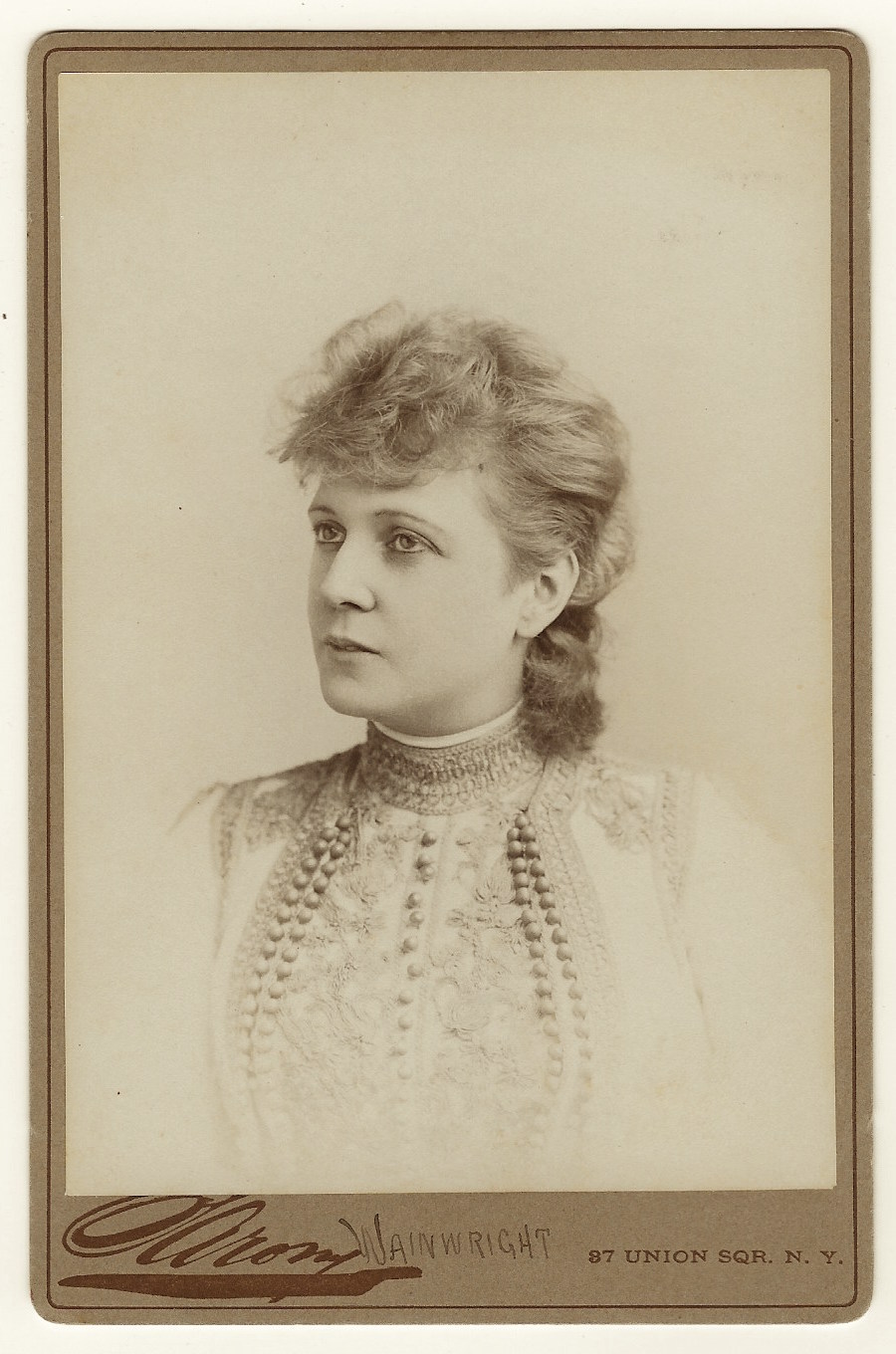
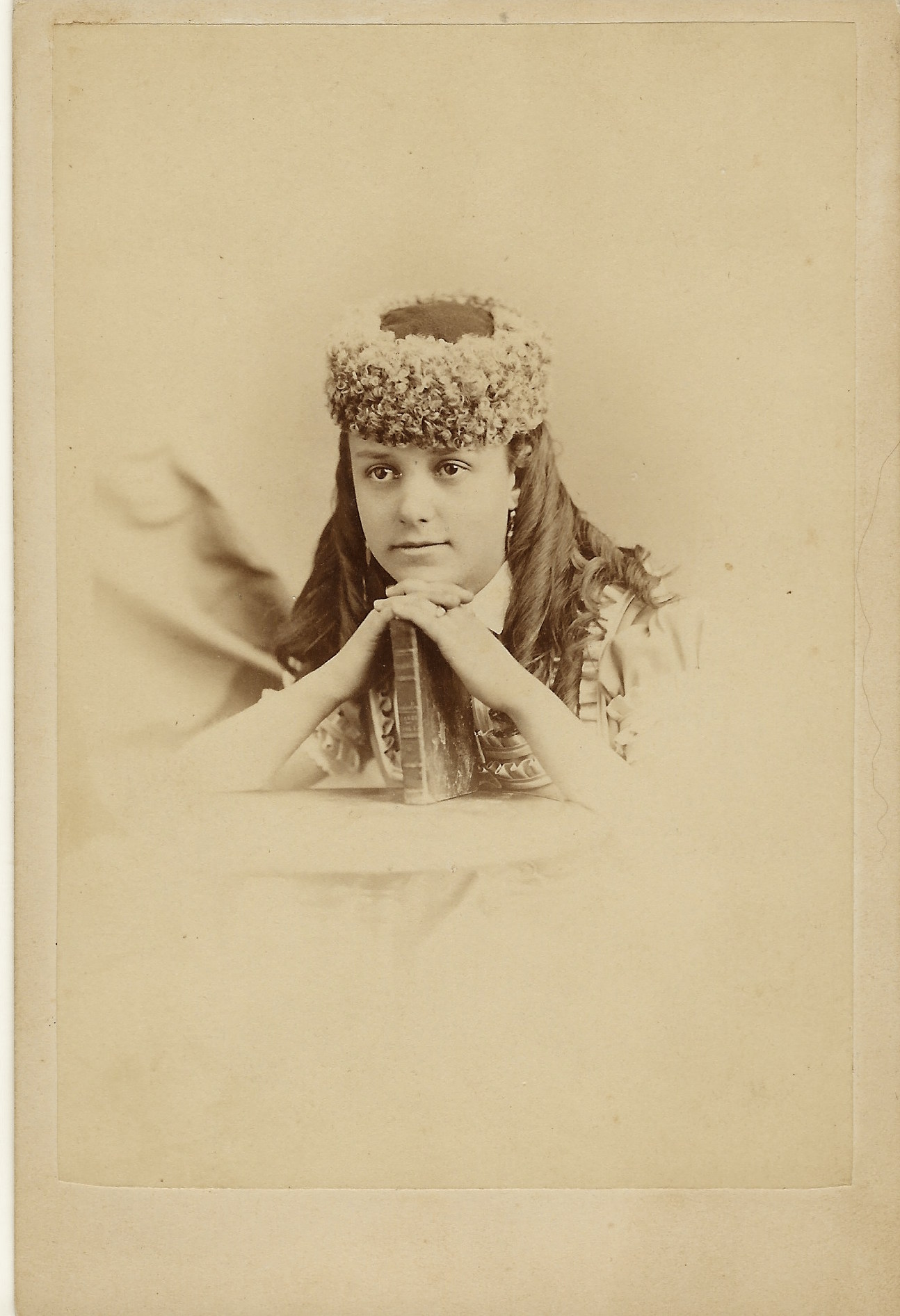
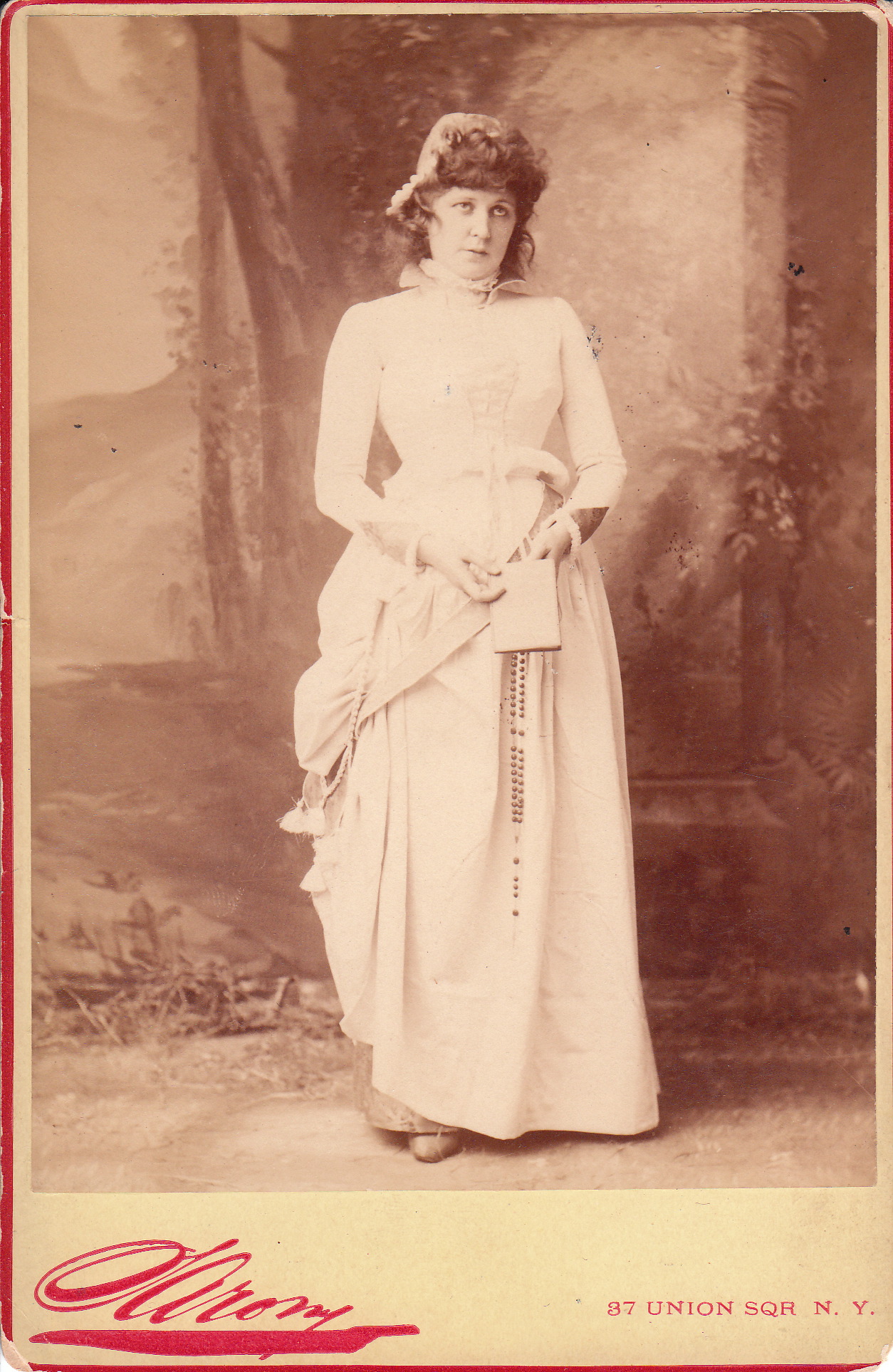
These cabinet cards feature Marie Wainwright (1853-1923), an American stage actress and singer. She also appeared in three silent films between 1918  and 1920. Most of her fame came from the Victorian stage. She was born in Philadelphia and as educated in Paris, France. She received her acting training in Paris. Her first stage appearance was in New York in “Romeo and Juliette (1877)”. Her career flourished afterward. She spent many years in the Boston Museum company and later on, operated her own theatre company. During her career, she was the leading lady for Edwin Booth, Lawrence Barrett, and other well known actors. She appeared primarily in classics and high dramas until the turn of the century. She then appeared in more contemporary productions. Her resume includes roles in “H. M. S. Pinafore” and “Diplomacy”. When asked why she entered the acting profession, in a New York Times interview (1878), she stated that she did it for her children’s sake. Wainwright claimed that she was married before the age of fifteen, and had three kids before she turned twenty-one years of age. She stated that her husband was not supporting her and the children, and she needed to work for financial reasons. It appears that the breakup of Wainwright’s marriage was a hot news item. The marital conflict was quite dramatic and there were some questions about Ms. Wainwright’s character. The top  photographic portrait is by Sarony’s New York City  studio. Sarony was a famous celebrity photographer and other examples of his work can be seen by clicking on the category labelled “Photographer: Sarony”. This image shows Wainwright wearing a white gown and bonnet. She is holding a book and rosary beads.

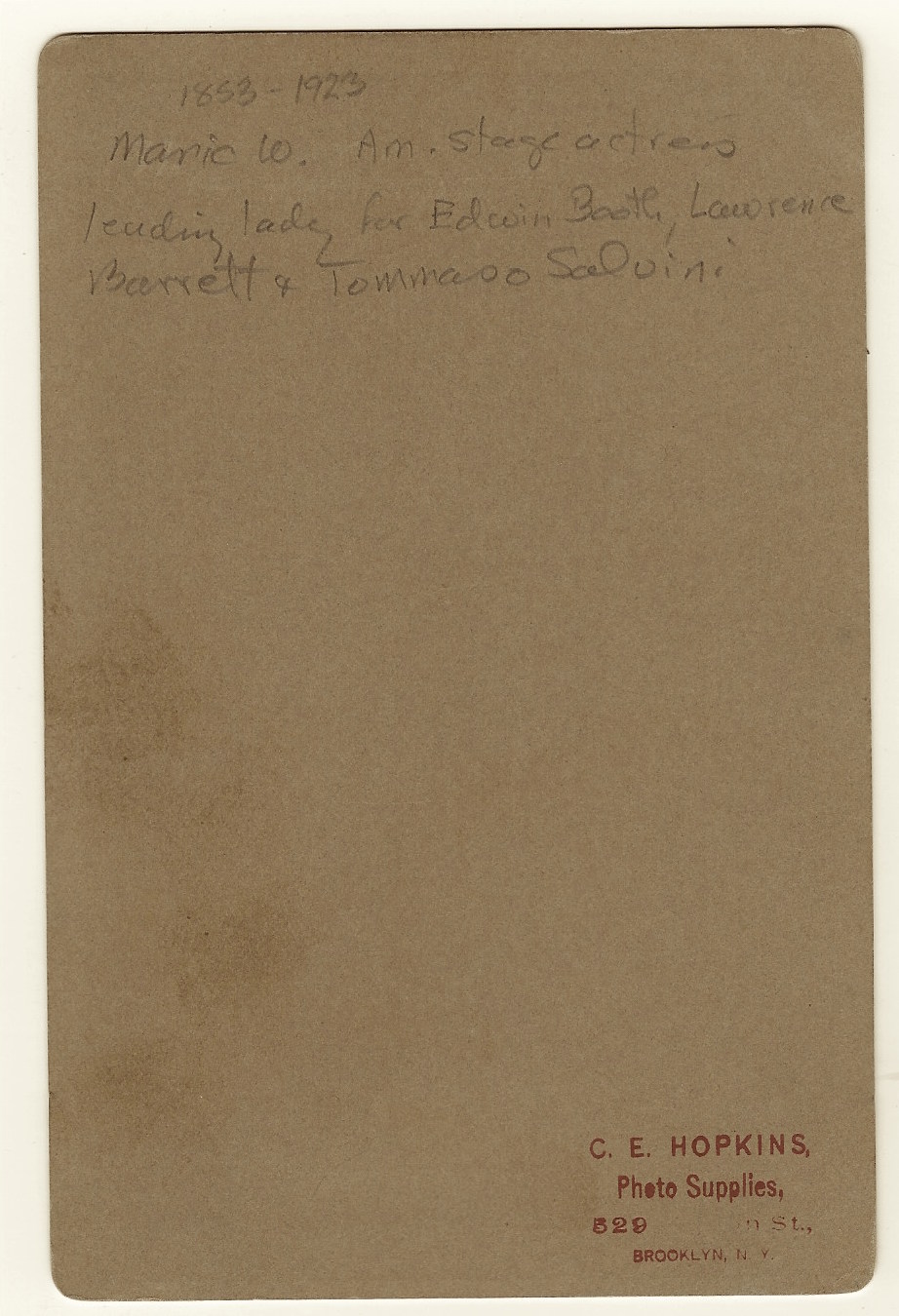
The second cabinet card was also photographed by Sarony. Miss Wainwright certainly was a pretty woman. The reverse of the cabinet card has an inscription describing some aspects of her career. There is also a stamp from a photographic supply dealer on the photo’s reverse. The dealer is C. E. Hopkins whose business was located in Brooklyn, New York. Mr Hopkins was an excellent self promoter as illustrated by mention of his name and business in several photographic journals of his time. For example, “Photographic Times” (1890) recounts that one of Mr Hopkins’s amateur customers produced a series of photographs pertaining to a duel, that Mr Hopkins had shared with the publication. It is likely that this cabinet card portrait of Miss Wainwright once could be found “for sale” in C. E. Hopkins’s shop.

wainwright-1

AMELIA GLOVER: FAMOUS SKIRT DANCER (CABINET CARD PORTRAIT BY SARONY)

glover

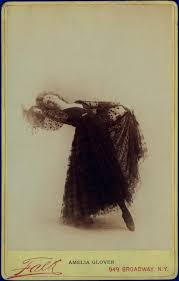
This cabinet card portrait features celebrated skirt dancer Amelia Glover. The photograph was taken by the well known New York theatrical photographer, Napoleon Sarony. The term “skirt dancer” is not a term we read or hear about today so an explanation is likely in order. Skirt dancing earned its name due to the voluminous skirts worn by the dancers. These skirts were often made of sheer and flimsy material. The skirts were utilized as part of the dancers act. Famous skirt dancers include Glover, Loie Fuller, Papinta, and Anna Held. Amelia Glover was not just any skirt dancer. The Illustrated American (1892) published an article called “The Skirt and the Dance”. In the article the author bemoans the trend that resulted in French and English dancer’s skirts getting shorter and shorter. Most dancers prior to the trend wore long skirts (below the knee). Kate Vaughn is credited with the reintroduction of long skirts and the”skirt dance”. Letty Lind and Sylvia Grey are asserted to be responsible for importing the dance from England to the United States. The pair are said to have created a “rage” with the skirt dance. The author complains that the dance “has mostly degenerated into a lot of high kicking and can can impropriety”. He continues with the contention that the original dance has become “vulgarized”at the hands of “ordinary women” of the variety stage.The author goes on to state that there is one American skirt dancer who has “remarkable natural gifts”. He identifies that dancer as Amelia Glover, also known as “Little Fawn”. The cabinet card image below gives a view of  Glover dancing while wearing a long skirt. Besides being an incredible dance talent, Glover has another claim to fame. Theatre Magazine (1922) reports that Miss Glover started the fad of wearing bobbed hair. Her hairstyle was imitated by other women of the stage as well as by women of society.  SOLD

imgres

CUTE LITTLE GIRL IN CINCINATI, OHIO (PHOTOGRAPH BY MARCEAU)

cute girl

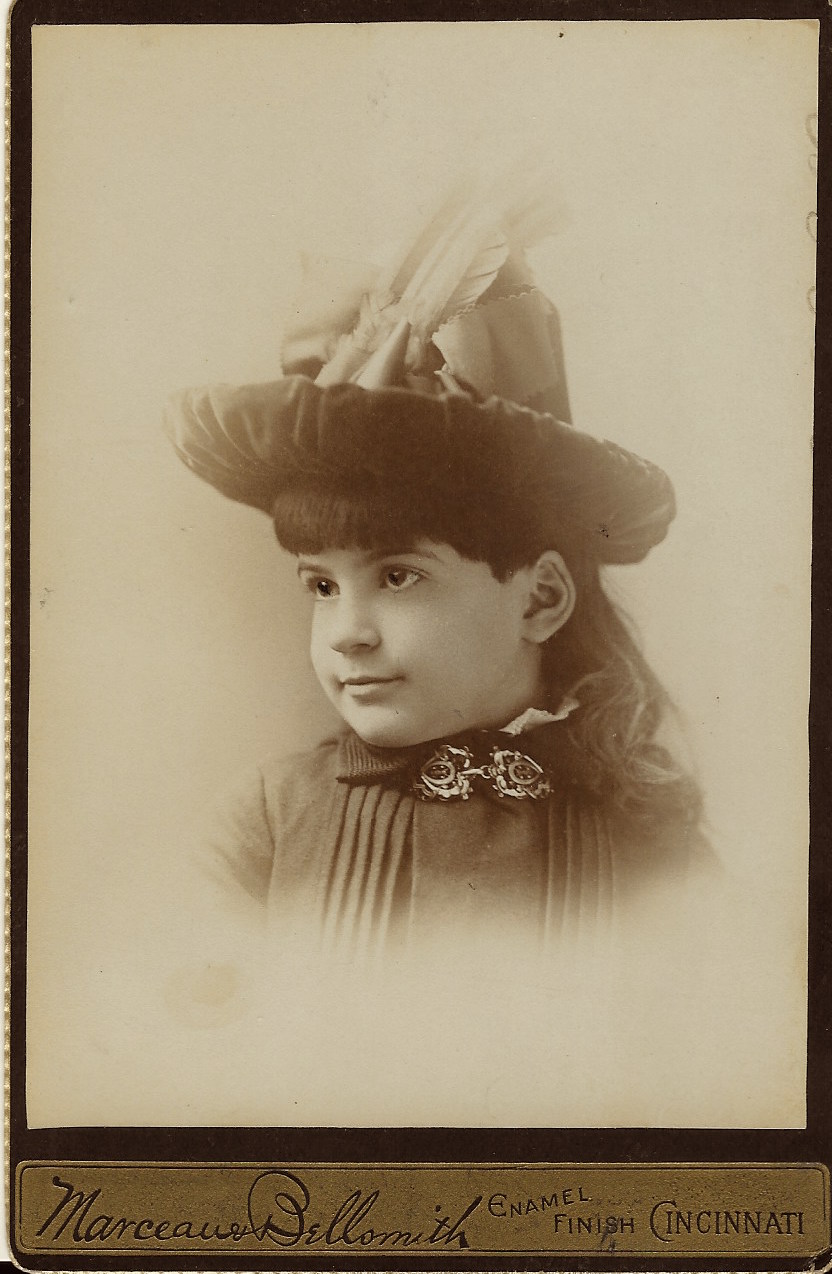
A little girl dressed in big girl clothing looks adorable as she posed in the Marceau & Bellsmith studio in Cincinnati, Ohio. The child is wearing an elaborate hat and a large collar pin. She is also wearing a very cute expression which includes a half smile. Colonel Theodore C. Marceau (1859-1922) operated a studio at 285 Fifth Avenue in New York City. The studio was known for producing many celebrity portraits. Marceau was also known for pioneering the creation of national chains of photographic studios in the 1880’s. He became nationally known at the ripe young age of twenty-two when he served as a US government phot0grapher in Santiago, Chile. He was part of an 1882 expedition that recorded the movement of Venus. Later, he served on the staff of Governor Foraker of Ohio, then Governor Markham of California. After leaving public service he lived in Cincinnati (1885-1886) and executed a business strategy that he repeated several times over the years. He would capitalize and build photographic studios, take on a talented local photographers as a partner, build the business, and then sell it to his partner. His first venture took place in Cincinnati and his partner was Randolph “Ralph” P. Bellsmith. The pair produced the photograph seen above. Marceau eventually had branches in Indianapolis, San Francisco, and Boston. His partner in San Francisco was Frederick Bushnell who later built his own chain of studios on the west coast. In 1891 Marceau married a widow named Amanda Fiske and their marriage had a deleterious effect on Marceau’s finances and emotional well being. The marriage was of short duration and Marceau took on his wife’s debts and was rewarded by her habitual infidelity. Marceau took custody of his son and became embroiled in publicity generating divorce proceedings that lasted four years. In 1900 Marceau made New York City his primary operation. For about ten years he ran the Otto Sarony and the Marceau Studios out of New York. Using the Sarony name caused Marceau to fight Jonathan Burrow (purchaser of the Napoleon Sarony Studio) in court. Marceau was described as a skilled raconteur and he became very active in the photography world in New York. In 1905 he cofounded the Professional Photographers Society of New York with Pirie McDonald. Marceau, MacDonald, and B. J. Falk organized the Copyright League to give photographers stronger rights protection of their work. Marceau was quite successful financially. He employed profits from his studios to buy a large amount of New York City real estate. His name appeared in New York’s “Blue Book”. His estate was worth millions of dollars upon his death. His son, a Yale trained lawyer, took over the operation of his father’s studio after his father died but he sold it in 1922. To view the work of Marceau’s Cincinnati partner and to learn more about him, click on the category “Photographer: Bellsmith”.   SOLD 

KATE SHIPPEN ROOSEVELT: PORTRAIT OF A PRETTY HIGH SOCIETY WOMAN BY CELEBRATED PHOTOGRAPHER NAPOLEON SARONY

shippen

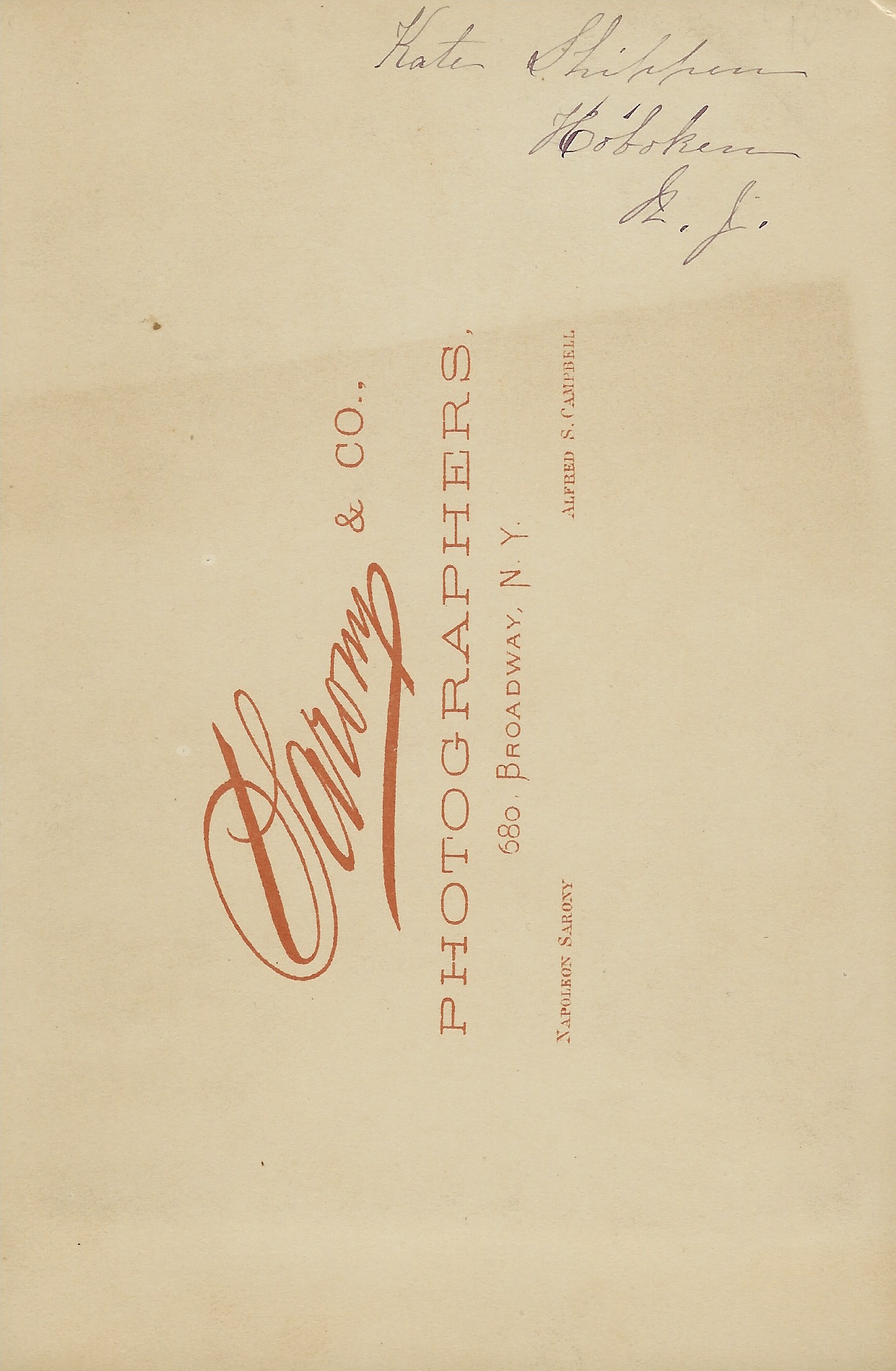
It is not infrequent that a cabinet card presents an interesting mystery. This cabinet card, by celebrity photographer Napoleon Sarony of New York City, conjures  up some fascinating questions. Is the woman in this photograph a member of one of America’s most famous political families? It is likely that the pretty woman with the dreamy gaze seen in this photo is a Roosevelt. Let me tell you a little about Kate Shippen Roosevelt (1855-1925). In 1883, Kate Shippen Roosevelt (1855-1925) was married to Hilborne Roosevelt who was a world famous organ maker. He had factories in New York City, Philadelphia, and Baltimore. His company made some of the finest and largest pipe organs in the world. He designed the first electric organ and he was a first cousin to President Theodore Roosevelt. Kate was the daughter of William W. Shippen who was the president of the Hoboken Land and Improvement Company and Hoboken Ferry Company. It is not a surprise that their wedding was called by the New York Times (1883) the event of the season. An article in Town Topic Journal of  Society (1883) announces that Kate Shippen Roosevelt would be performing a monologue and that she was one of the “best amateurs” engaged in such performances. Kate was also a well known women’s suffrage critic. She called suffragettes “soapbox militants”. Hillborne Roosevelt died in 1886 at age 37. He left his widow and three year-old daughter quite wealthy and they continued to be part of high society in New York City.  I believe that that the woman in this image is Kate Shippen Roosevelt because  1) the inscription on the reverse of the image is supportive (see below), 2) Mrs. Roosevelt was a member of society and Sarony was a society photographer, and 3) My research was unsuccessful to find another celebrity sharing the name “Kate Shippen”.  Unfortunately, I could not find a photo to confirm or disconfirm that the subject of this cabinet card portrait was Mrs. Roosevelt. The bottom image is the gravestone of Kate Shippen Roosevelt which is located at Green-Wood Cemetery in Brooklyn, New York.   SOLD
shippen 2


PORTRAIT OF AN ACTRESS NAMED ROBEL IN AN UNUSUAL DRESS

ROBEL_0008

The pretty subject of this cabinet card was photographed by celebrity photographer Napoleon Sarony at his New York City Studio. She is dressed in an unusual fashion and is likely in costume. The woman is probably an actress. Penciled on the reverse of the photograph is the name “Robel”. Preliminary research proved to be unsuccessful in identifying an actress with that name.  (SOLD)

Published in: on December 12, 2014 at 12:00 pm  Comments (1)  
Tags: ,