ADRIENNE AUGARDE : POPULAR ACTRESS IN BRITAIN & US : RPPC : (1906)

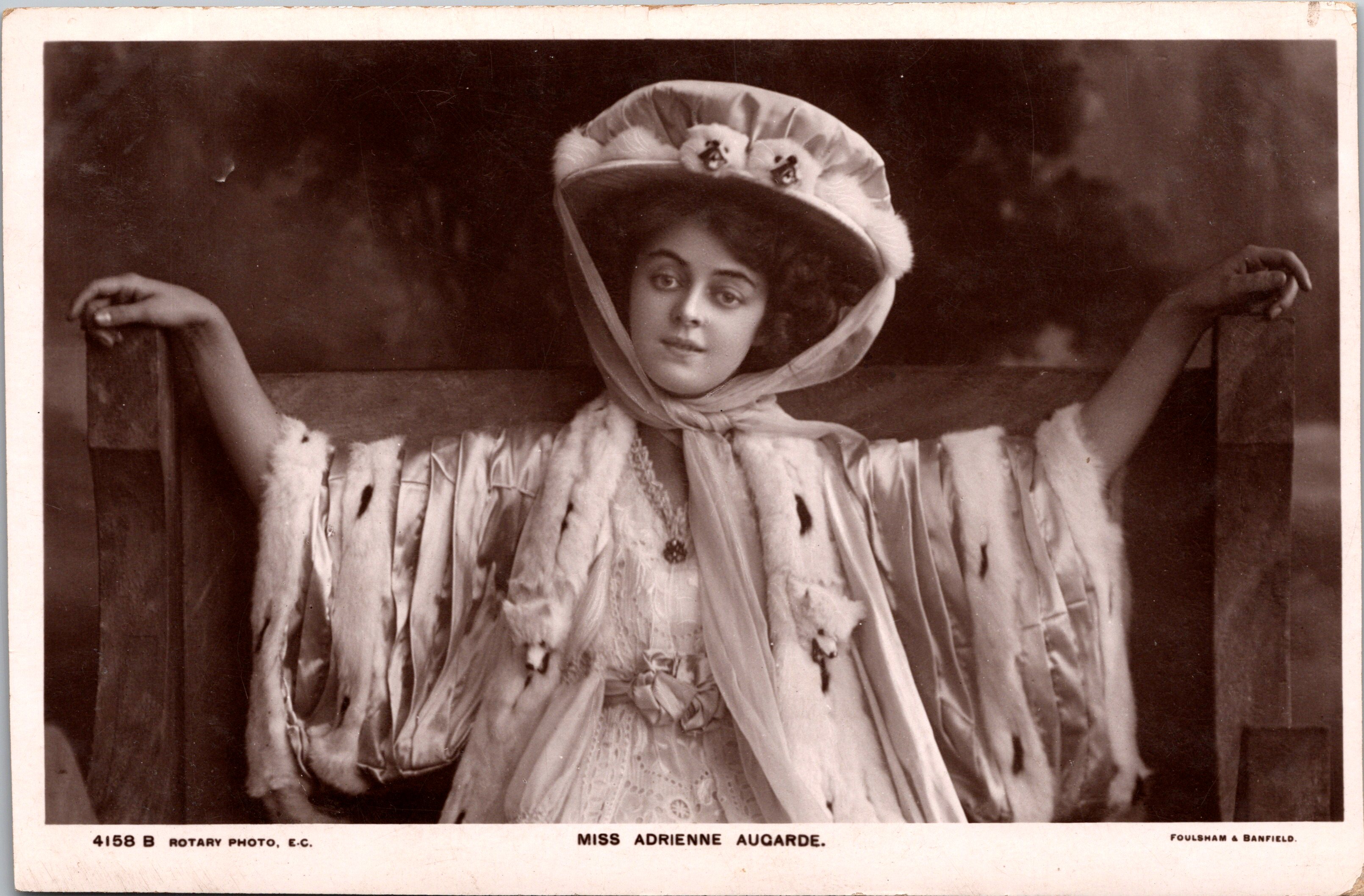
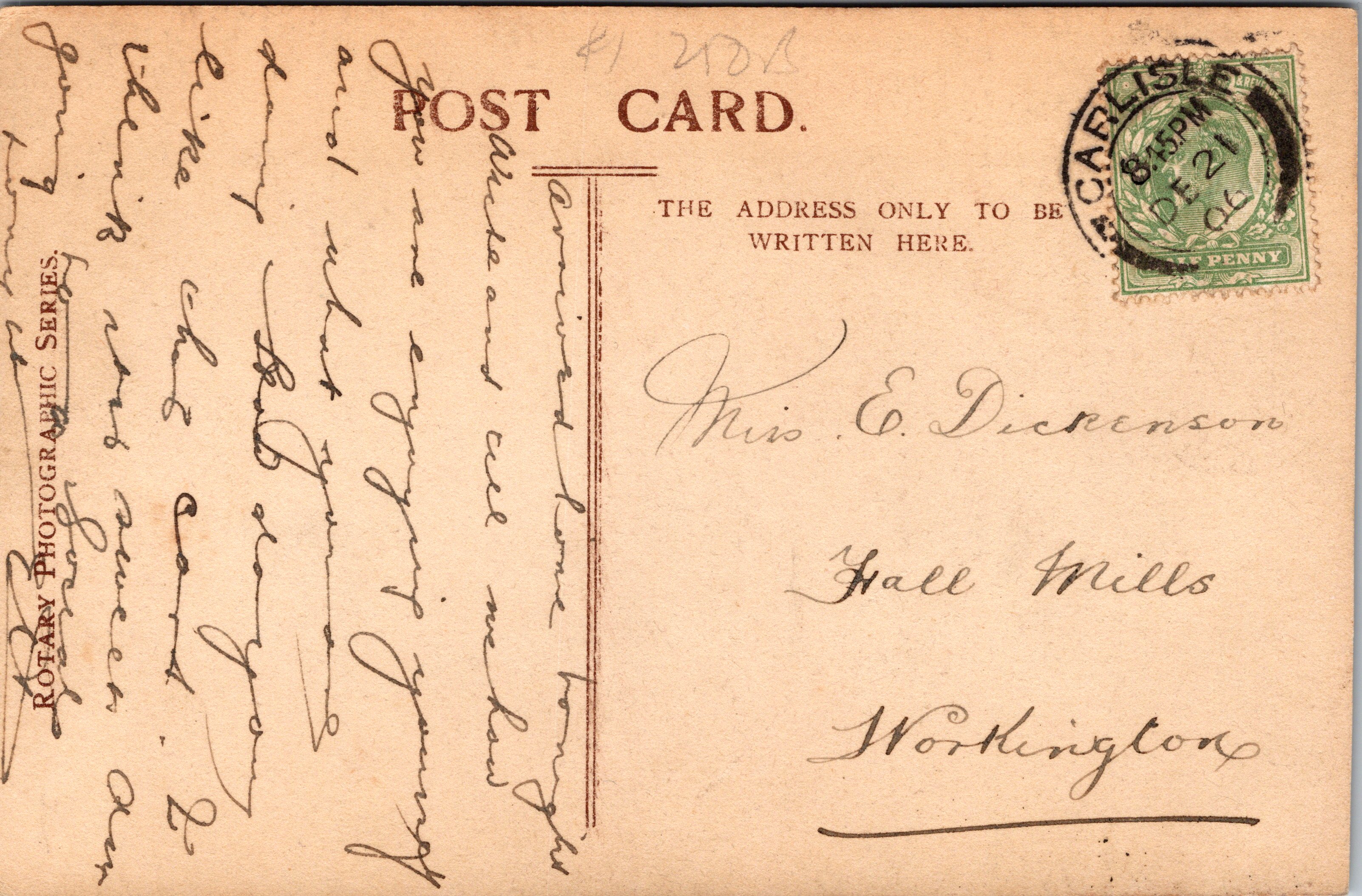
This vintage real photo postcard features English actress and singer, Adrienne Augarde (1882-1913). She was born in London. Her father was a violinist and her mother was a Belgian singer. Augarde had several other members of her extended family who were successful theatrical or music performers. Her popularity transcended beyond Great Britain to include the United States. In fact, she appeared in four Broadway plays between 1905 and 1912. These plays included “The Dollar Princess” (1909) which ran for 250 performances. She was most known for her roles in Edwardian musical comedy.  Augarde started her career at age sixteen. She did pantomine and appeared in small roles in musical comedy and opera. Her popularity began with her playing leading roles in the musicals of George Edwardes. She then starred in a number of long running productions in both London and New York (1903-1912). While on a Vaudeville tour in the US, she became ill and died after an unsuccessful appendectomy. She was thirty years of age at the time of her death. She died in Chicago. Her ashes were put in an urn designed to look like a make-up box. Her cremains were sent to her mother in England. This card was published by Rotary Photo as part of a series (No.4158B). The photograph was taken by the Foulsham & Banfield studio. The postcard has a 1906 postmark. (SOLD)

LEILA HYAMS : PRETTY FILM ACTRESS : FAMOUS MODEL : LISTERINE : “FREAKS” : RPPC

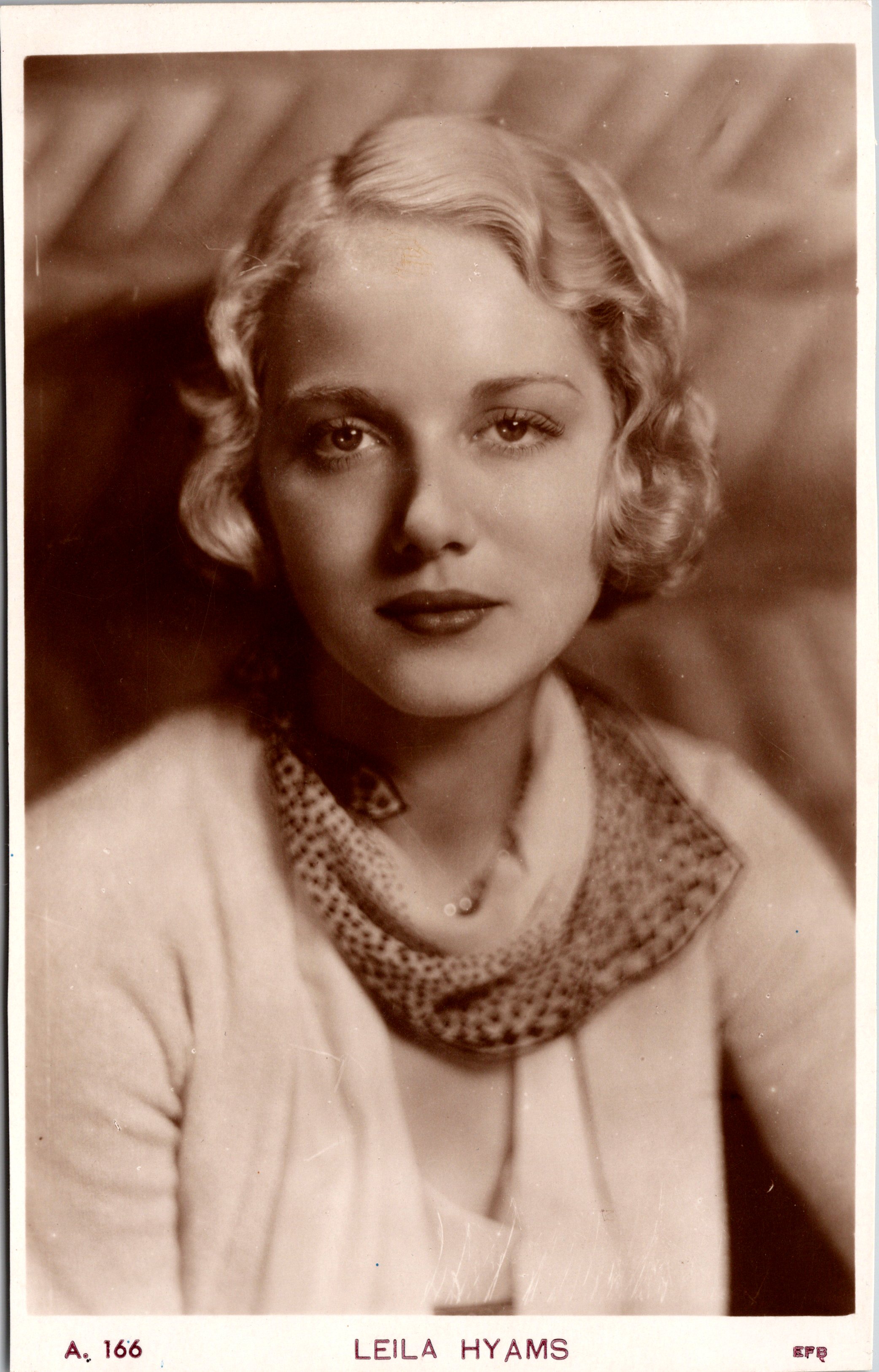
This vintage real photo postcard features American film and stage actress, model and vaudeville player, Lila Hyams (1905-1977). Her parents were vaudeville comedy performers and her mother was also a well thought of actress. Her parents also appeared together in a number of films. Leila began acting on stage as a child. In her teenage years, she worked as a model and became nationally known. She modelled for the first ad for Listerine. Leila’s film career was during the silent film and early talkie era and spanned from 1924 through 1936. Often playing leading lady roles, she appeared in more than fifty films. “Freaks” (1932)  was one of best known movies. Leila married her talent agent in 1927 and they stayed together for 50 years. The New York Times wrote in her obituary that she was “an attractive blonde actress who was eminently successful at playing ingenues.  This vintage postcard portrait is in very good condition (see scans). SOLD

CARRIE PERKINS : RISQUE PHOTO : WORE THE TIGHTEST DRESSES IN VAUDEVILLE

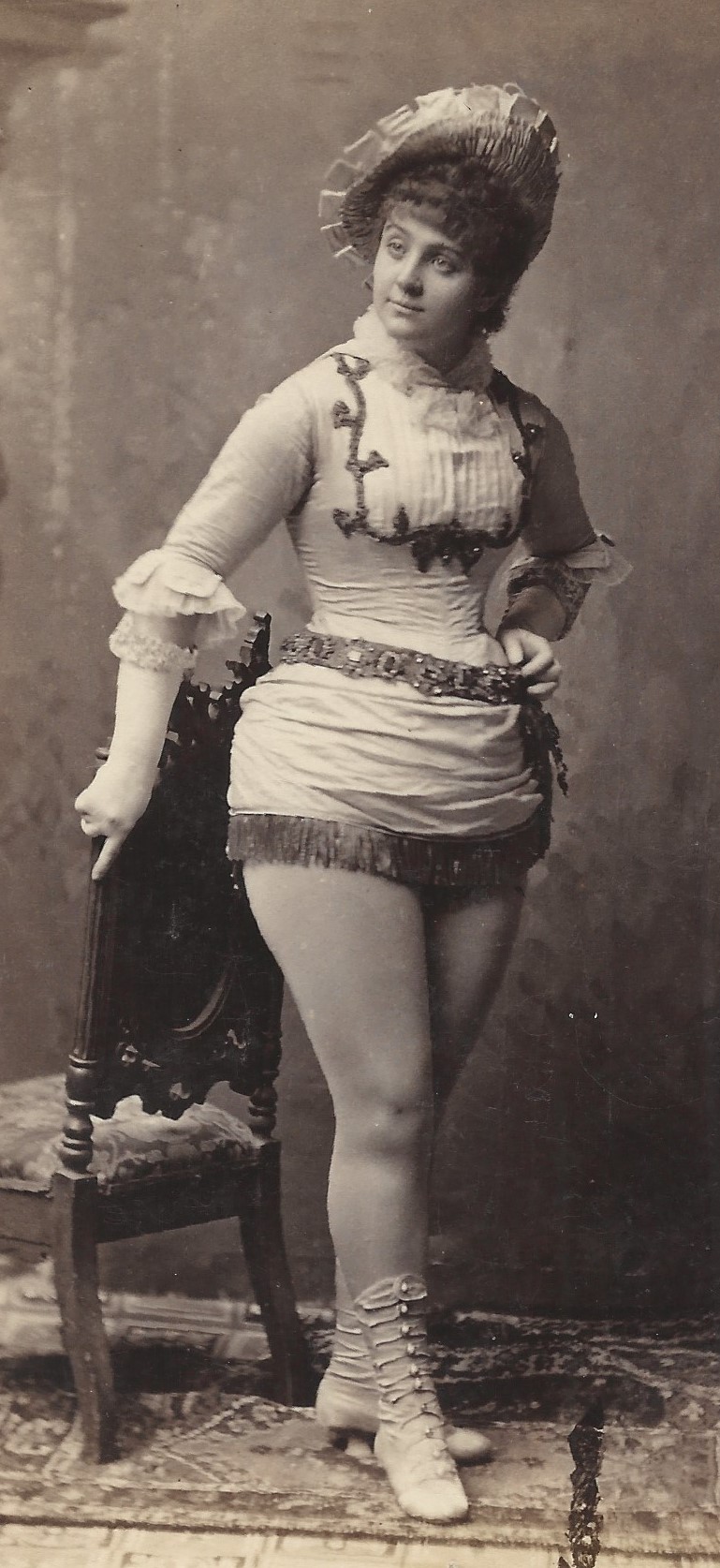
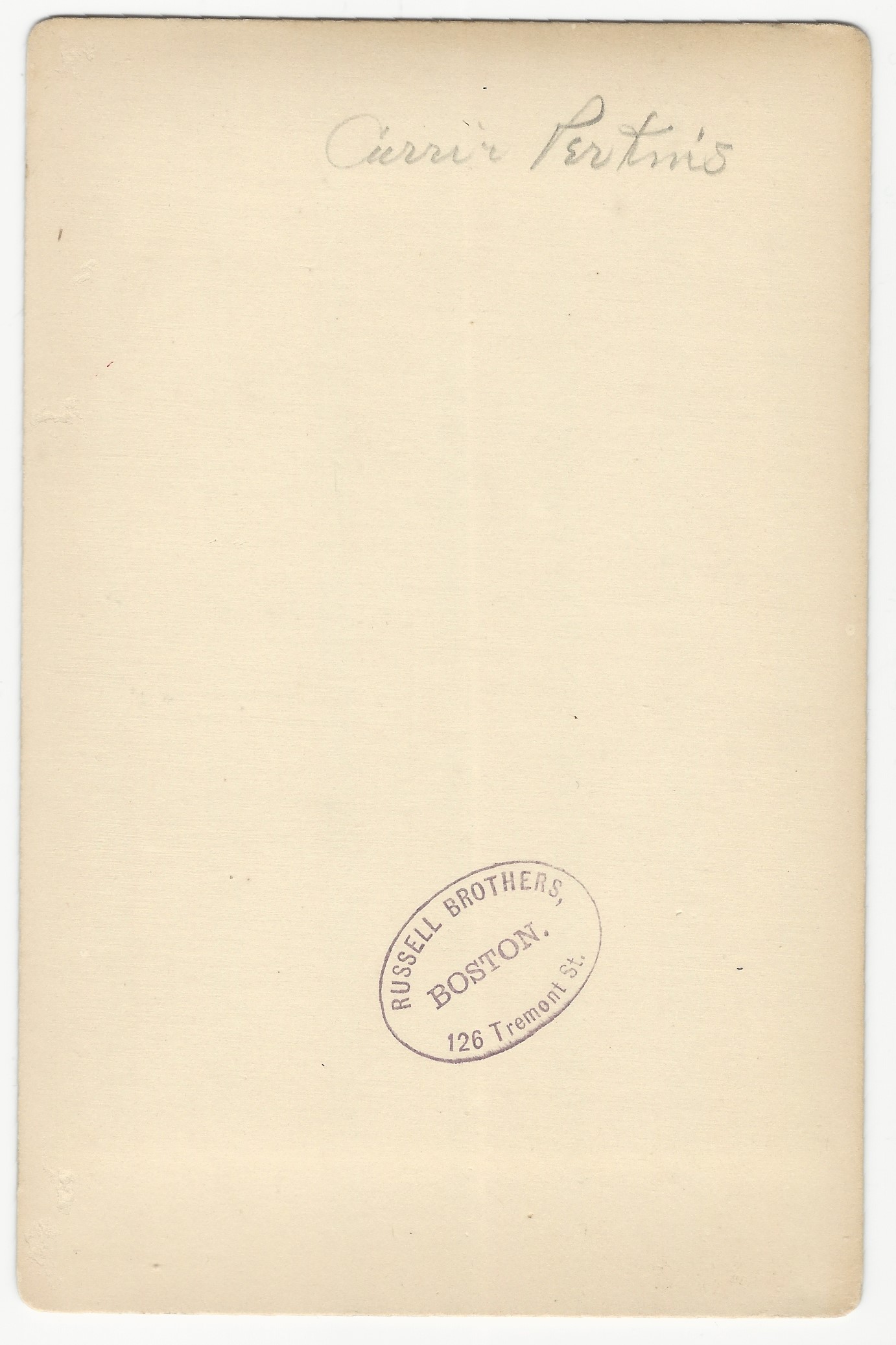
The pretty woman seen in this cabinet card portrait is actress, Carrie Perkins. Her acting included productions on Broadway, as well as, appearances on the Burlesque and Vaudeville stage. One of Perkins’s claims to fame, is that she was considered to be the actress that wore the tightest fitting costumes in all of vaudeville. She appeared in much advertising such as premium cards for cigarette brands. The website, “Broadway Photographs” provides a biography of Miss Perkins. She is described as “a vaudevillian with a trim body and a smart tongue”. The site states that “she plied both the visual and verbal dimensions of entertainment”. Although she was known for her tight gowns, the biographer states that “it was her urban girl wit that won her a ticket to Broadway”. She became known to the theatrical world in Garrick’s burlesque “Thrilby” (1895). She wasn’t considered beautiful enough to play lead roles. Instead she played roles that showcased “feminine audacity”. She appeared in nineteen Broadway productions according to the Internet Broadway Database (IBDB). These appearances occurred between 1888 and 1911. These performances included “Jack and the Beanstalk (1898), “The Casino Girl” (1901), and “The Merry Shop Girl’s” (1905). Her final show was “The Fascinating Widow”. which was a touring production with the popular actor and female impersonator Julian Eltinge. There seems to be agreement that Perkins was long on personality and appearance, but short on talent. Perkins rarely received praise from theatre critics. She found her place on the stage as a supporting actress/dancer/singer. This cabinet card photograph was taken by the Sparks Photo-Publishing Company. The studio was located in Philadelphia, Pennsylvania. The artist/manager of the studio was Elliott Houseworth. The 1880 census lists Elliott A. Houseworth as being born in 1855, residing in San Francisco, California, and working as a photographer. Houseworth also appears in the 1900 census as living in Norwood, Pennsylvania and working as a manager. These demographics fit the photographer of this image, since Houseworth managed Sparks Photography Studio and Norwood is only about eleven miles from Philadelphia. A stamp on the reverse of the image states “Russell Brothers, 126 Tremont Street, Boston”. Perhaps the Russell Brothers were photograph collectors or a photo gallery that sold celebrity photographs. Photographs of Miss Perkins are rare and this image is beautiful remnant of turn of the century Broadway theater. SOLD

BETTY COMPSON : PROLIFIC AND PRETTY AMERICAN FILM ACTRESS : SITS IN SPORTS CAR

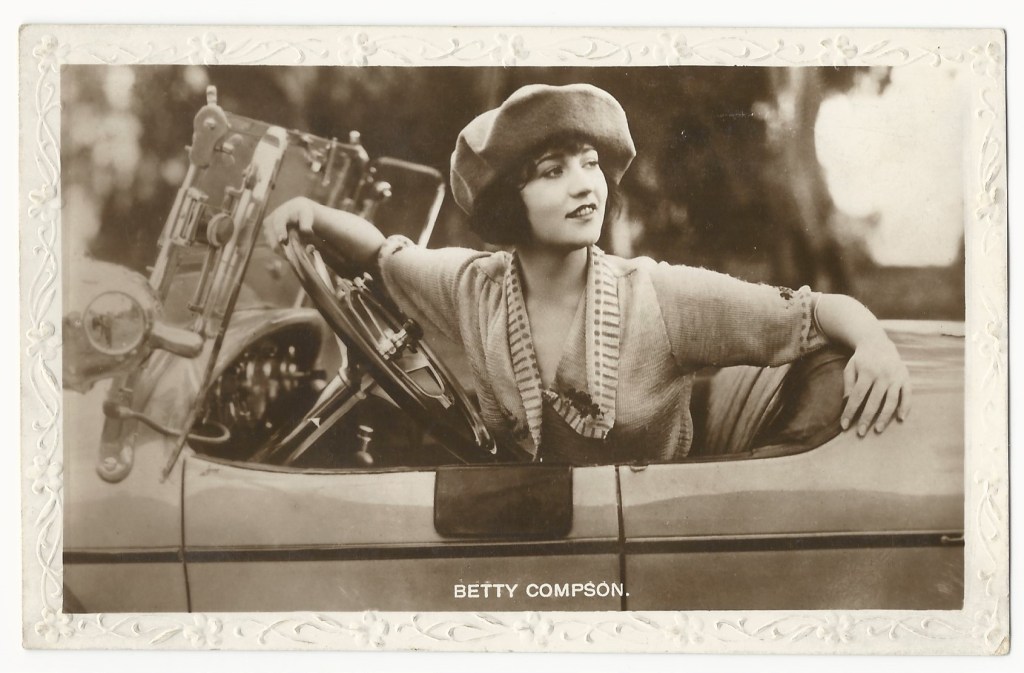
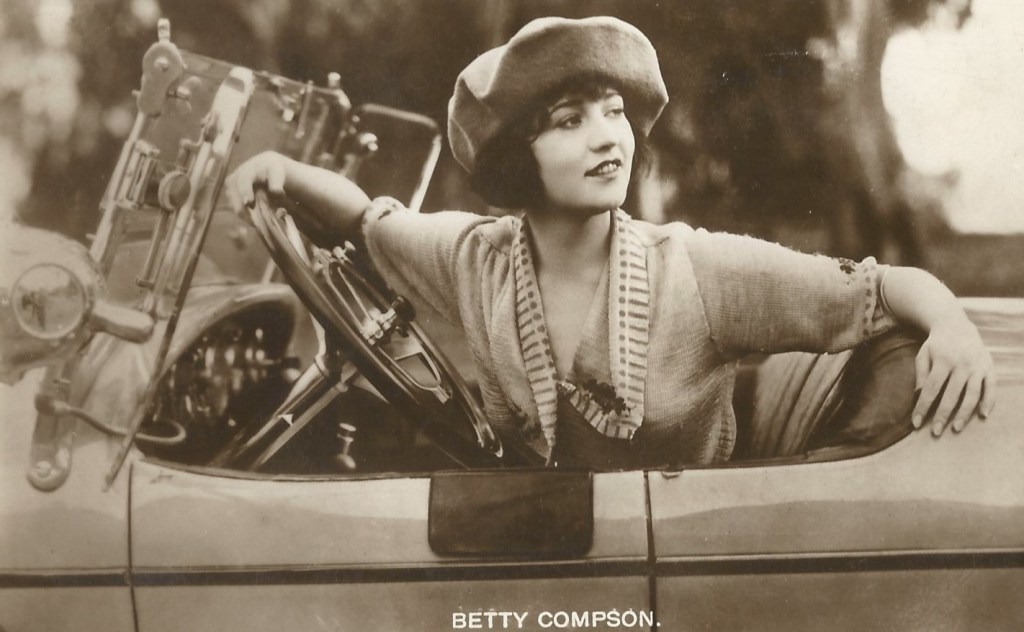
This vintage real photo postcard features American actress and film producer, Betty Compson (1897-1974). She was nicknamed “the prettiest girl in pictures”. Compson was born in a mining camp in Beaver, Utah. Her father was a mining engineer, a gold prospector, and grocery store owner. Her mother was a maid in hotels and private homes. Betty graduated from Salt Lake High School. She was hired as a violinist at age 16 in a theater in Salt Lake City. She then played in vaudeville touring companies and it was during this stint she was discovered by a film producer (Al Christie) who signed her to a contract. She began her career during Hollywoods’s silent film era. Her debut film was “Wanted, a Leading Lady” (1915). After this film, her career rocketed. She appeared in 25 film in 1916. All but one, were shorts. In 1918 she was offered a contract by studio head Mack Sennett. She rejected the offer because the salary was too low. She continued to make numerous short films until the middle of 1918. She was frequently paired with Roscoe “Fatty” Arbuckle. She started making only feature films. She became a rising star after appearing opposite Lon Chaney in “The Miracle Man” (1919). Paramount became interested in her and signed her to a five year contract. In 1921, Compson established her own production company in order to have creative control over screenplays and financing. The first movie she produced was “Prisoners of Love” (1921). After she completed acting in “The Woman With Four Faces” (1923), Paramount refused to give her a raise. She wanted an increase in her $2500 per week salary. Compson was angry enough at Paramount, to leave the company, and sign with a British film company. She made four films in England, two of them were films penned by Alfred Hitchcock. Paramount lured her back to Hollywood from England by offering her a top dollar contract. She then appeared in a movie by director, James Cruze. The pair married in 1924, but divorced four years later. The divorce from Cruze nearly ruined her financially because of debt accrued by Cruze. After Paramount did not offer her a contract renewal, she began freelancing in lower budget films. In 1928 she appeared in a “part talkie” called “The Barker”. She played a manipulative carnival girl. She was nominated for a “Best Actress” for this role by the Academy Awards. In 1929, she gained much recognition for her role in “The Docks of New York”. She played a suicidal prostitute. These two films resulted in her popularity returning to it’s previous high level. She appeared in many “talkie” films. Unlike a lot of silent film stars, Compson made a successful transition into sound films. In fact, she even appeared in a number of early musicals. When she played singing parts, her voice was dubbed. Her career flourished. In 1930, she appeared in 9 films. Her last “hit’ was in “The Spoilers”. Her costar was Gary Cooper. Her popularity waned and she only got roles in low budget, less successful studios. Her last film was in 1948. After retiring from her movie career, she started a cosmetic line and assisted her husband in a business named “Ashtrays Unlimited”. In total Compson was married three times. Her second marriage, to agent/producer Irving Weinberg ended in divorce after four years. Her third marriage was to a professional boxer. The marriage lasted 18 years and ended upon his death in 1962. She had no children. She died in 1974 after suffering a heart attack. She had much impact on the early movie industry. The IMDb reports 209 film credits between 1915 and 1948. This vintage postcard is in excellent condition (see scans). Take a look at the YouTube video below. The video features Betty Compson appearing in the silent film, “The Docks of New York” (1928). The music accompanying this video is obviously modern, but, in my opinion, it is excellent. Compson demonstrates incredible acting ability. Her facial expression and her eyes speak for her. SOLD

Betty Compson in “The Docks of New York” (1928)
Music: “Marry Me” By Dave Pagett and Viv Jones (Sax)

A DUSKY BEAUTY : MISS AIDA OVERTON WALKER

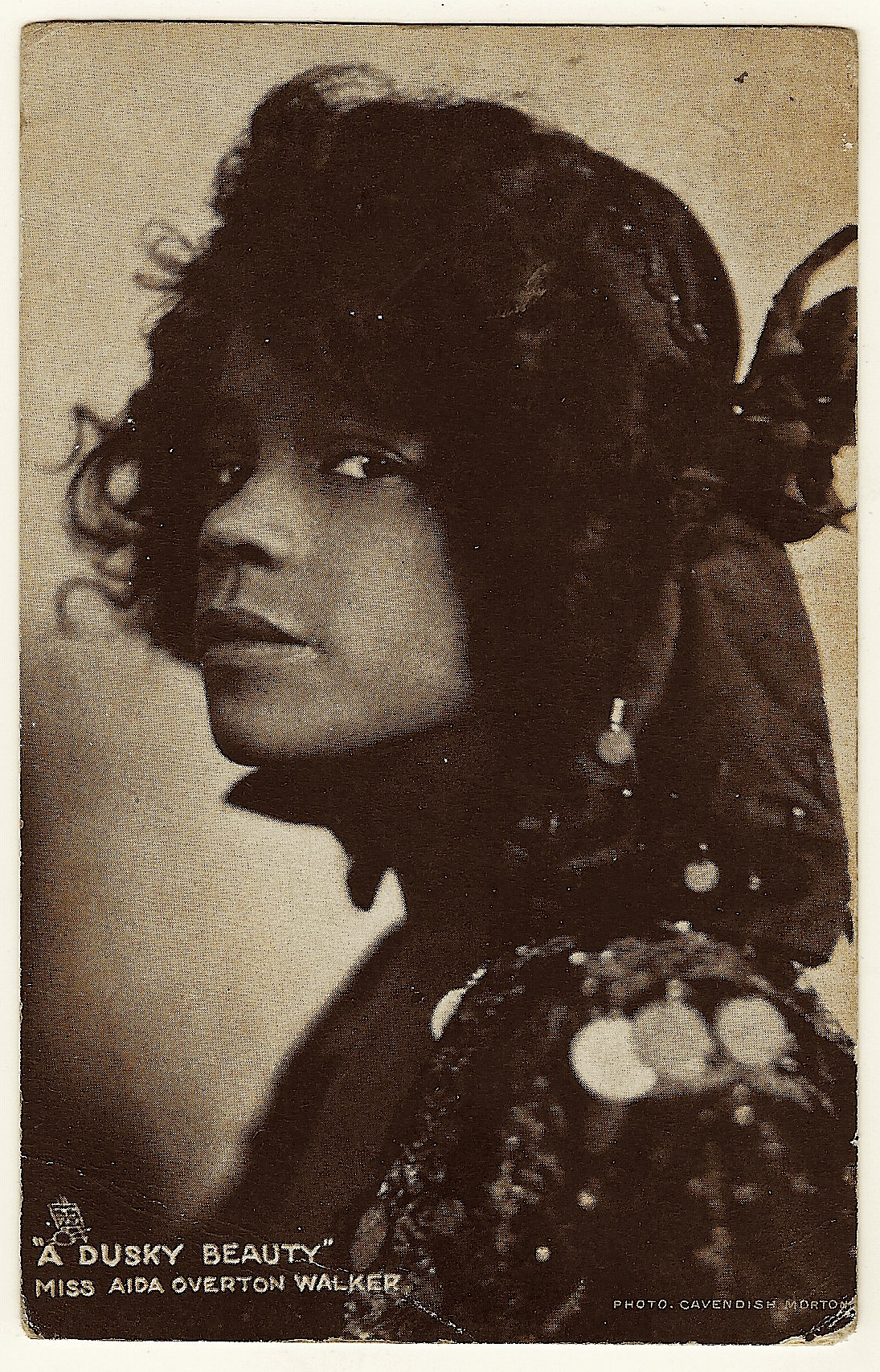
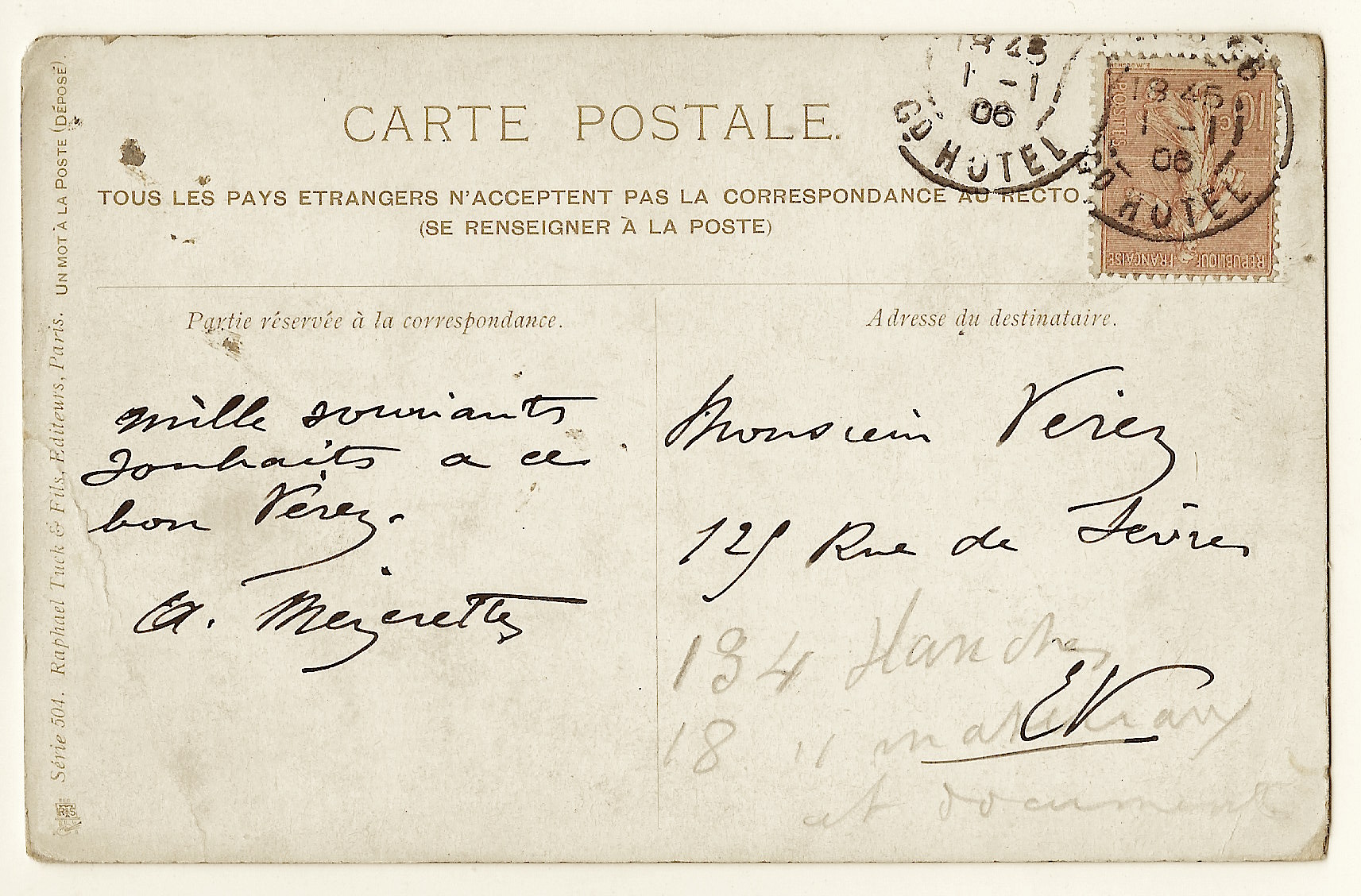
The subject of this vintage real photo postcard is Miss Aida Overton Walker. The caption above her name refers to her as “A Dusky Beauty”. Seems like a racist title to me. I don’t recall ever seeing its equivalent, “A Pasty Beauty”, on a portrait of a white female performer. Aida Overton Walker (1880-1914) was known as “The Queen of the Cakewalk”. She was African-American and an American vaudeville performer, singer, actress, and choreographer. She has been called the most famous African American female performer of the early twentieth century. She was married in 1899 to vaudeville performer, George Walker. Aida and her husband performed with the highly successful Bert Williams. They were the major black vaudeville and musical comedy act of the era. She was also a solo dancer and choreographer for a number of other vaudeville shows. Aida was well known for her 1912 performance of the ”’salome” dance. Aida was born in Richmond, Virginia and moved to New York City when she was young. She was educated there and received a great deal of musical training. When she was fifteen years old she joined the “Octoroons”, a black touring group. In 1900 she gained national notice with her performance of  “Miss Hannah from Savannah” in the play, “Sons of Ham”.  The song became a major hit. Overton Walker had significant theatrical success with her performances in Dahomey (1902), Abyssinia (1906), and Bandana Land (1908). Overall, Aida was praised by critics and fellow performers. She was financially successful. In 1908 she retired to care for her ill husband. In 1910 she returned to the stage as a solo act. In 1911, her husband died. By 1912, she was on tour again. That same year, she performed on Broadway as Salome. In 1914, Walker died suddenly from kidney failure. Two years before her death, she was performing in white variety theaters. She and Bert Williams were the only Black performers “permitted” to do so. At that time, African Americans were expected to confine themselves to “lower” entertainment such as comedy and ragtime. “High” art, like dramatic theater and classical dance were reserved for whites. Aida helped break that racist tradition. During her career, Aida addressed the issue of racial relations. She stated in an article in “The Colored American Magazine (1905), her view that that the performing arts could have a beneficial effect on race relations. Walker asserted “I venture to think and dare to state that our profession does more toward the alleviation of color prejudice than any other profession among colored people.” She also worked to improve working conditions, and to expand roles for black women on the stage. During the period Walker was performing, female actresses, especially black actresses, were seen as “immoral and oversexed”. Aida wrote “a woman does not lose her dignity…when she enters stage life”. Walker also worked to develop the talents of younger black performers within the framework of refinement and elegance. In 1908, she began organizing benefits to assist such causes as the Industrial Home for Colored Working Girls. This vintage postcard was published by Raphael Tuck, of Paris, France. The photographer of Miss Walker was Cavendish Morton (1874-1939). The National Portrait Gallery possesses 104 of Morton’s portraits. Morton had several careers including electrical engineering, architecture, acting, illustrating, and in the 1890’s he took up photography. He is known for his theatrical photo portraits. His son was a well known watercolor artist. This postcard was postmarked in 1908, The postcard is in good condition. See the youtube video below. It is a tribute to Aida Overton Walker.   (SOLD)
 

DOLLY BABCOCK: BEAUTIFUL VAUDEVILLE PERFORMER

DOLLY BABCOCK_0002

dorilda 1

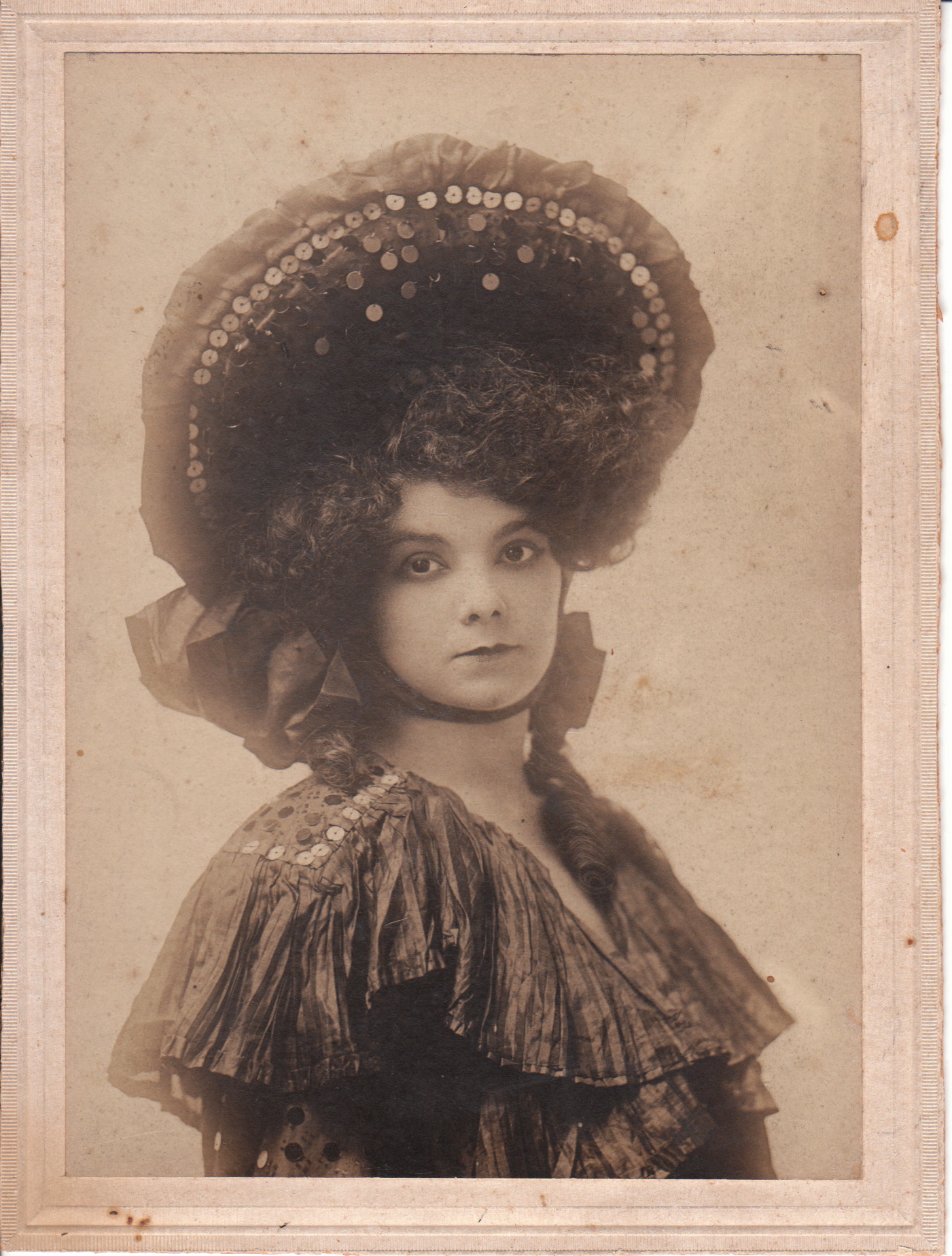
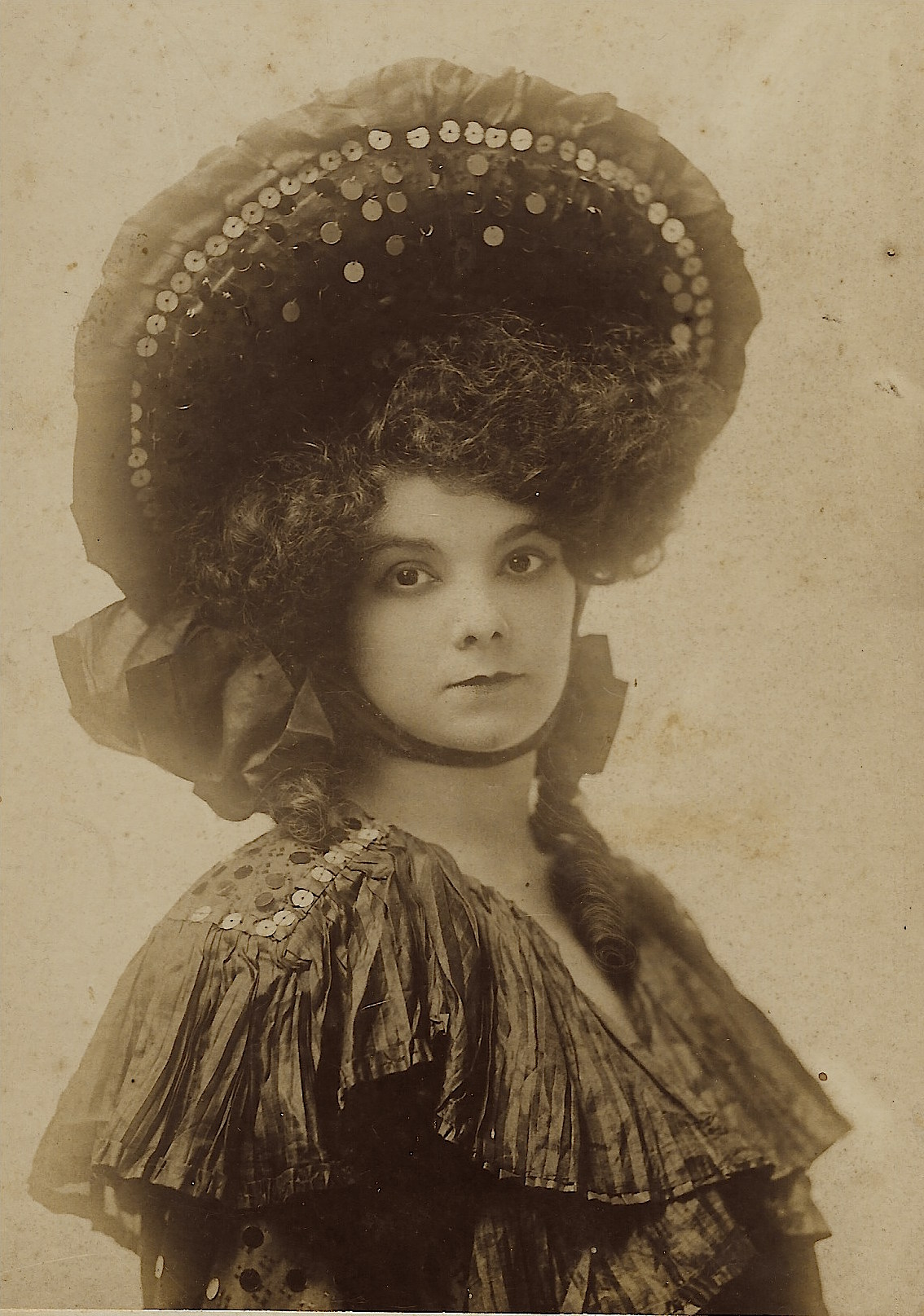
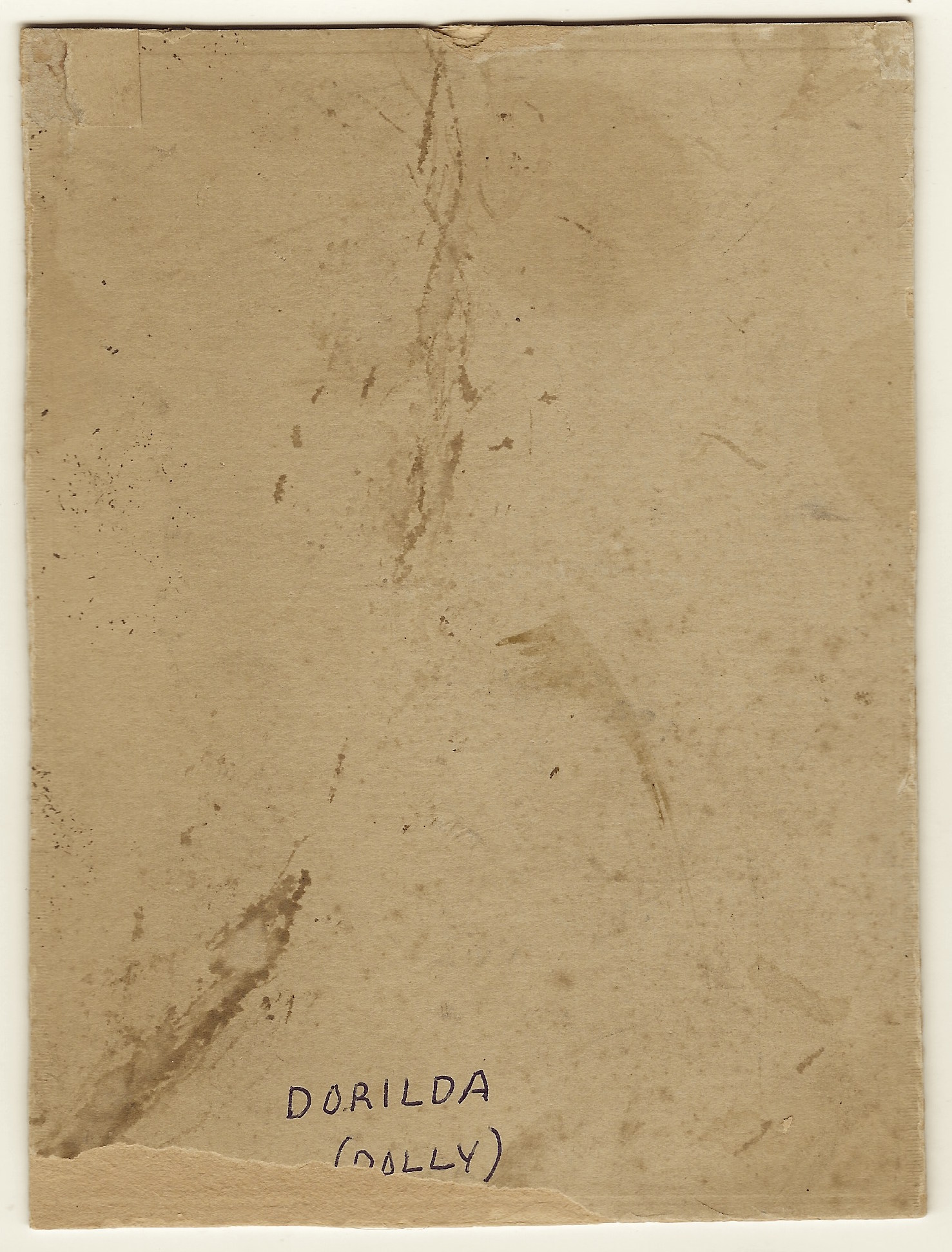
This photograph features a beautiful young woman in a theatrical costume. Written on the reverse of the image is the name “Dorilda (Dolly)”  This pretty woman is Dolly (Tetreault) Babcock. She and her husband performed on the Keith Orpheum Vaudeville Circuit playing all over the United States. They were active from the early 1920’s through the early 1930’s” and performed under the stage name of  “Babcock and Dolly”. She was known for her beauty and fantastic costumes, many of which she made for herself. Arthur died in 1953 and Dolly lived until 1965. This vintage photo measures about 4 1/2″ x 6″.   SOLD

dorilda 2

Published in: on December 8, 2018 at 12:01 am  Comments (2)  
Tags: , ,

BAWDY PORTRAIT OF A SCANTILY CLAD YOUNG WOMAN (VAUDEVILLE ACTRESS?)

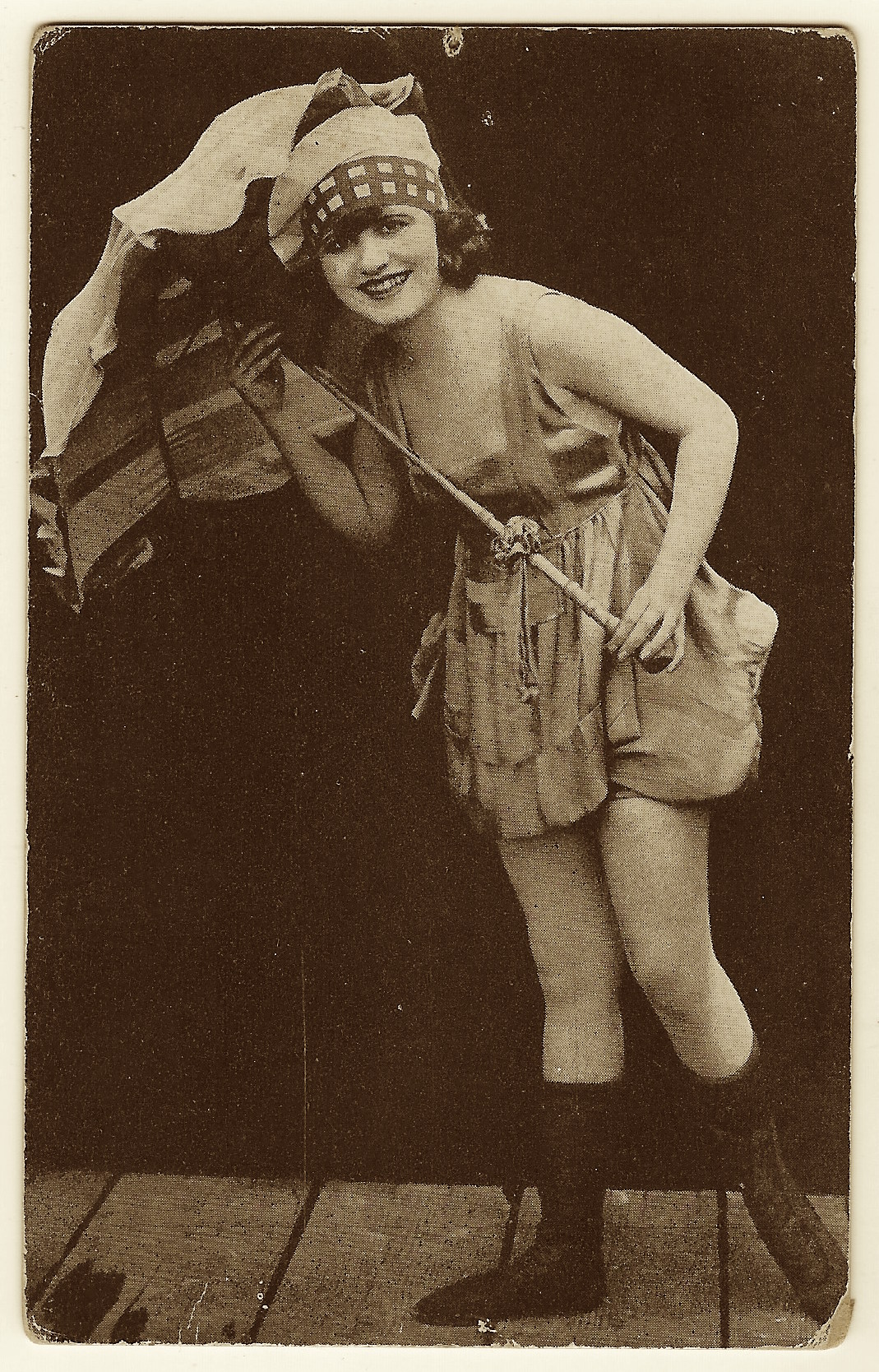
This vintage bawdy photograph features a young woman scantily clothed and flashing a terrific smile. Her expression is very inviting. I wish I knew the story associated with this risque image. My hypothesis is that the woman is an actress and part of a vaudeville show. Her act was likely focused on bringing men into the theater. She may have been a dancer or a singer. Perhaps she was talented in both dance and song. Note her dress. It certainly didn’t require a lot of material to produce. It shows a lot of the performer’s body, but it is tastefully done. The dress covers “the essentials”. Vaudeville acts were very popular in the United States from the early 1880’s through the early 1930’s. Vaudeville was a genre of theater that was composed of a series of separate and unrelated acts that were presented together at one performance. It is difficult to determine when this photograph was taken. It certainly was produced sometime in the early period of vaudeville. This photograph is not a postcard. I do not believe that the image is a trimmed cabinet card, though it has a cabinet card type board.  An examination of the photos edges reveal that they are straight and smooth. The photograph measures about 5 1/4″ x 3 1/4″. There is a small pinhole through the top center of the image. Someone, decades ago, appreciated this wonderful photograph enough, to hang it on their wall.  ADDENDUM : I have been informed that the woman seen in this photograph is part of Mack Sennetts bathing beauty troupe. This has not yet been confirmed but worth noting.

Published in: on January 14, 2018 at 12:00 pm  Comments (4)  
Tags:

MOLLIE FULLER: STAGE ACTRESS AND VAUDEVILLE PERFORMER

molly fuller

This cabinet card is a portrait of Mollie (Molly) Fuller (1868-1933), a Boston born stage and vaudeville performer. She appeared in two Broadway plays but is better known for her vaudeville career. She was the second wife of Frederick Hallen (1859-1920) and the couple were a popular team on the vaudeville stage for nearly twenty-five years. They were known for their short comedic plays. Mollie’s resume includes performances in “Adonis” and in “Evangeline”, both plays by  Edward Rice. He biggest hit was her starring role in “The Twentieth Century Girl” (1895). When producer Edward Albee learned Mollie was near blind an impoverished in Chicago, he arranged to bring her to New York. He commissioned a theater piece to be written for her to perform in. She returned to the stage to perform in the resulting playlet “Twilight”. Mollie was the sister of Loie Fuller (1862-1928). Loie was a pioneer of modern dance and theatrical lighting techniques. Among Loie’s skills was her talent as a “skirt dancer”. She died in Hollywood, California, at the age of 68 in 1933. At the time of her death she was receiving assistance from “Troupers”, a national vaudeville players association. This cabinet card was issued by “Newsboy” which was a tobacco company that used cabinet cards as premiums to encourage sales of their tobacco products. This image is number forty-one of a series.  SOLD

STAGE ACTRESS MATTIE VICKERS COYLY POSES IN NEW YORK CITY

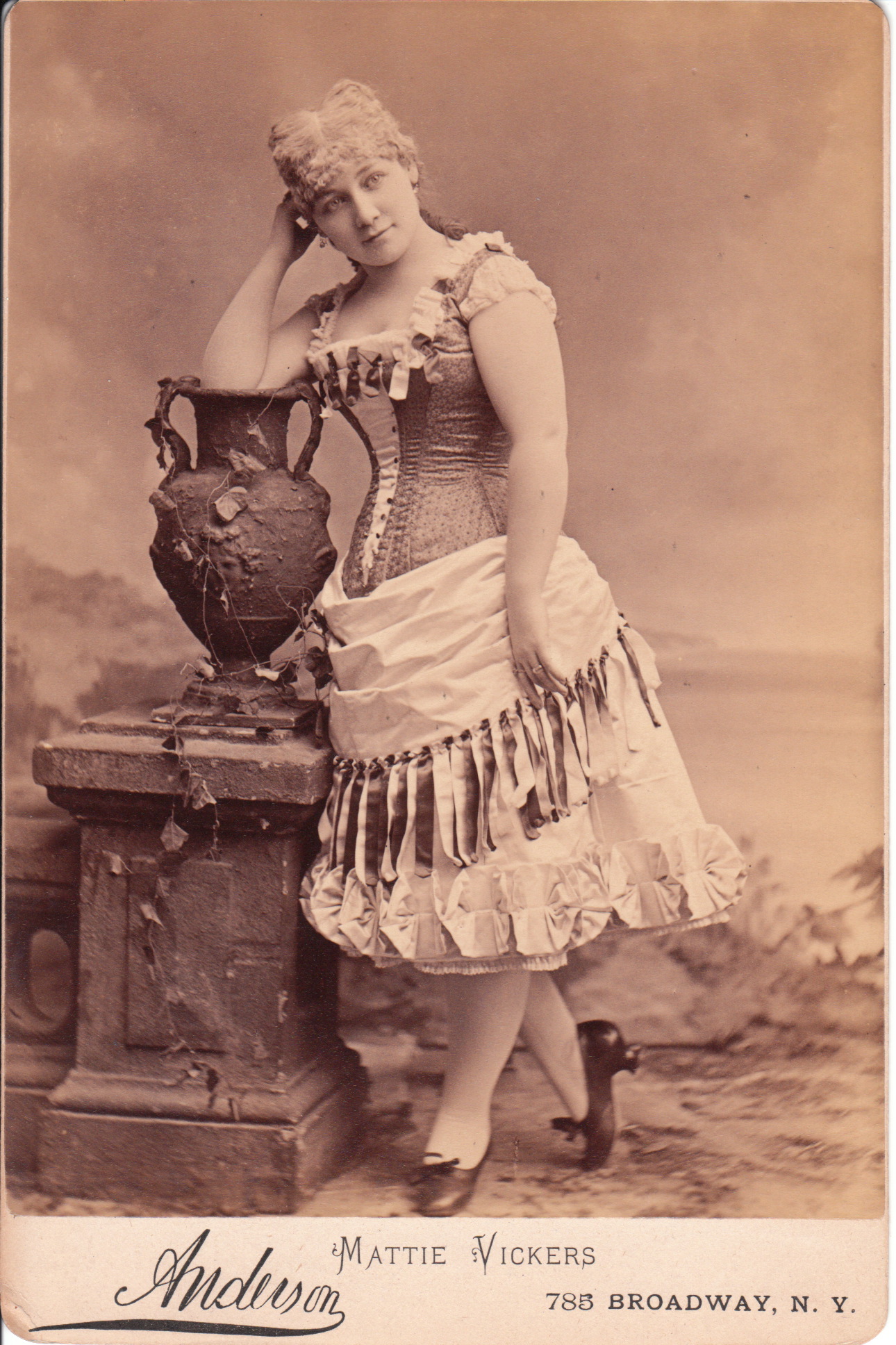
MATTIEVICKERS_0001Stage actress Mattie Vickers poses for this cabinet card image at the Anderson studio in New York City. Anderson photographed many celebrities and more of his photographs can be seen by clicking on category “Photographer:  Anderson (New York)”. During the early 1900’s, Vickers was one of the the sweethearts of American musical comedy. Her father was a retired actor who ran a boarding  house. She made her theatrical debut in vaudeville in the mid 1870’s. In 1877 she married her manager, Charlie Rogers. He died in 1888 after which she toured the country playing starring roles in plays such as “Circus Queen” and  “Edelweiss”. A portrait of Mattie Vickers ran in The National Police Gazette (1886). The accompanying text described her as the “sprightly and vivacious young American soubrette” and “the cleverest rough-and-tumble soubrette on the American stage”. No need to visit a dictionary to discover the definition of the word “soubrette”.  A soubrette is simply someone who plays a minor female role in a comedy. The reverse of the cabinet card has been stamped by George D. Russell of  Tremont Street in Boston, Massachusetts. Research reveals that Mr. Russell was a well known music publisher in Boston. Perhaps he also was involved in the sale of theatrical cabinet cards.

ISABELLE URQUHART: COMIC OPERA AND MUSICAL COMEDY STAR (PHOTOGRAPH BY NEWSBOY)

URQUHART_0001

This cabinet card features actress Isabelle Urquhart (1865-1907). She was an American stage actress and contralto who appeared in mostly comic operas and musical comedies. Urquhart was born in New York City and claimed to have been educated in a convent. She made her first stage appearance in 1881. She performed as a chorus girl at the Standard Theatre in New York City. She than appeared in a number of small roles. From 1882 through 1883 she joined Augustin Daly’s company and acted in productions including “The Passing Regiment” and “The Squire”. In the latter production she was only seventeen years of age but played a ninety-seven year old woman. She returned to light opera because of it’s better compensation although she stated she preferred legitimate drama to comic opera. She had much success in major roles in light operas including in the hit operetta  “Erminine” which ran from 1886 through 1888 at the Casino Theatre. She also had success in other productions by luminaries such as Gilbert and Sullivan. In her leading lady role in “Erminine”, she started a fashion trend by not wearing petticoats in order “to accentuate her gorgeous figure”. Urquhart later appeared in vaudeville. Blue Vaudeville (2004) states that in a sketch at the Union Square Theatre, she “did little more than display her form in a handsome gown to the utmost advantage”. Urquhart also performed in several Broadway plays including “The Diplomat” (1902), “Arms and the Man” (1906), and “How He Lied to Her Husband”. This cabinet card was published by Newsboy and was number one i a series of photographs that were distributed as a premium accompanying tobacco sales.