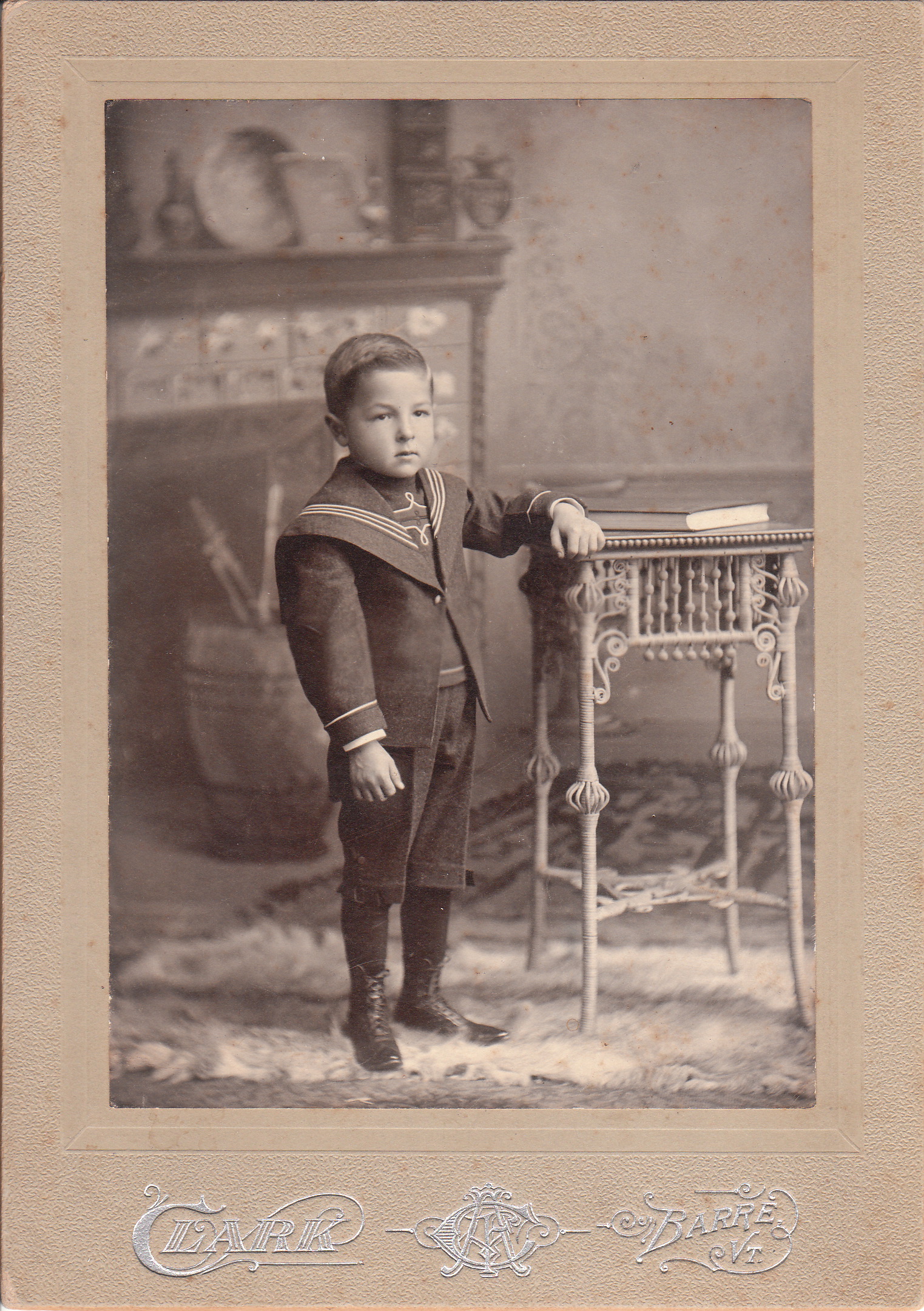
A young boy wearing a sailor suit poses for his portrait at the Clark studio in Barre, Vermont. The boy is well dressed and very clean cut. A. F. Clark is listed as a photographer in a Barre business directory from 1891. He is also listed in the 1900 US census as a single 41 year-old photographer.
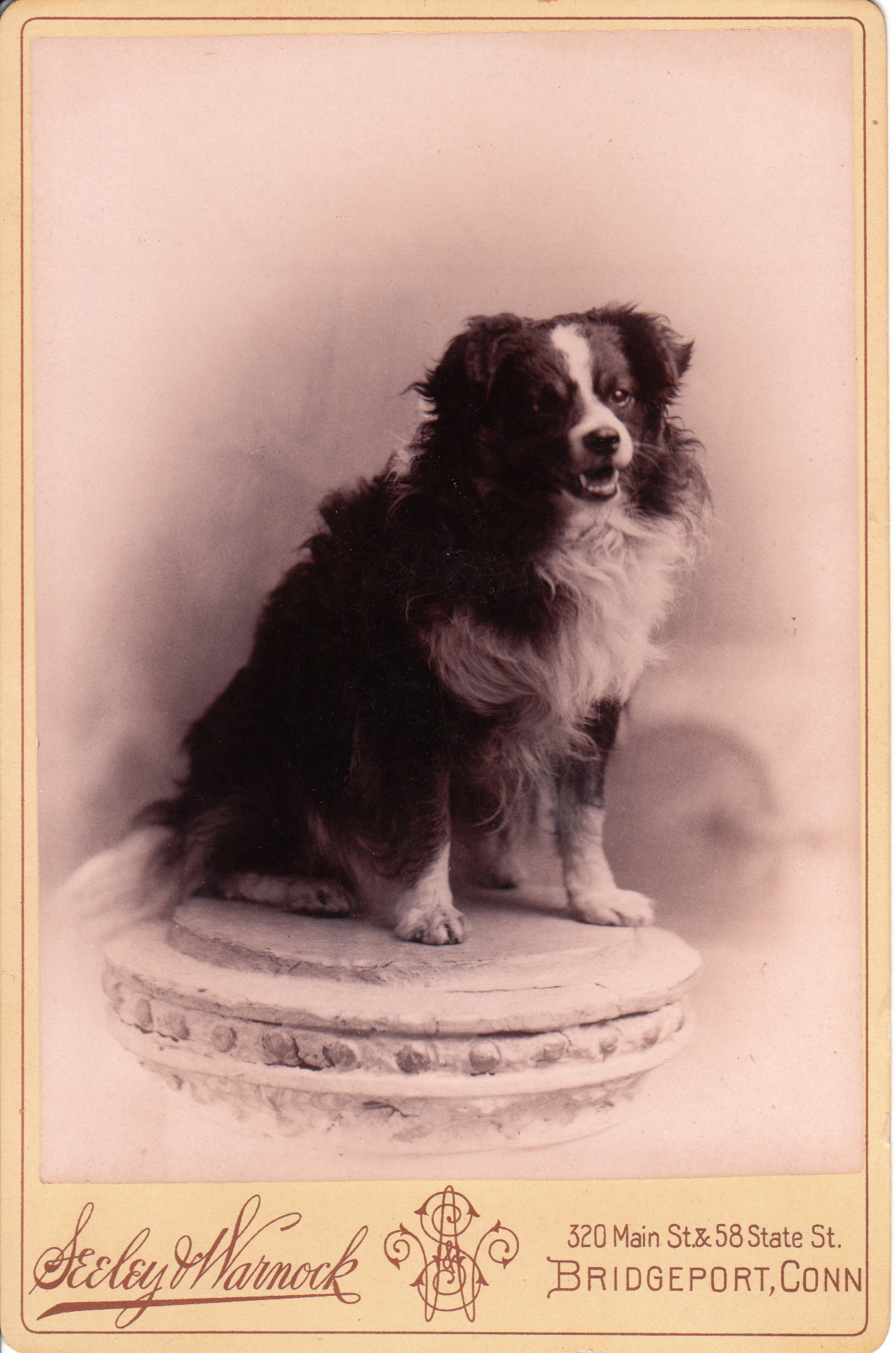
CUTEST DOG IN BRIDGEPORT, CONNECTICUT (1892)
Photographers Seeley & Warnock took this photograph of a cute dog posing in their studio in Bridgeport, Connecticut. What a pose? The photographers have captured this adorable canine exhibiting a smile (with his/her mouth open). The lighting utilized in this photograph could have been better, but lets remember that dogs are tough customers for a photographer. On the reverse of the cabinet card is advertising that states “Instantaneous Portraits of Children A Successful Specialty”. Note that photographing children is not only a “specialty” but it is a “successful specialty”. Additional printing on the reverse of the cabinet card indicates that it was produced in 1892. Preliminary research found no information about Mr. Warnock but there is an abundance of information about Mr. Seeley. Henry James Seeley was well known in Grand Army of the Republic circles. He was a department commander (Connecticut) and served in national offices of the organization. He was born in Jericho, Vermont in 1849. At the age of fifteen he enlisted in the 10th Indiana Battery, Light Artillery. After serving with the unit he was transferred to the gunboat Stone River which was operating on the Tennessee River. His next post was Fort Johnson in Huntsville, Indiana. Seeley entered and left the military as a private. After mustering out of the military in 1865, he taught school in Carbondale, Illinois. He then went to Vermont to further his education and then had teaching stints in Rome (NY), Worcester, Fall River and Bridgewater (MA). In 1872 he moved to Bridgeport where he studied photography and finally settled down. He opened a photography studio there in 1872 at 922 Main Street. He spent the next forty-five years or more working as a photographer.
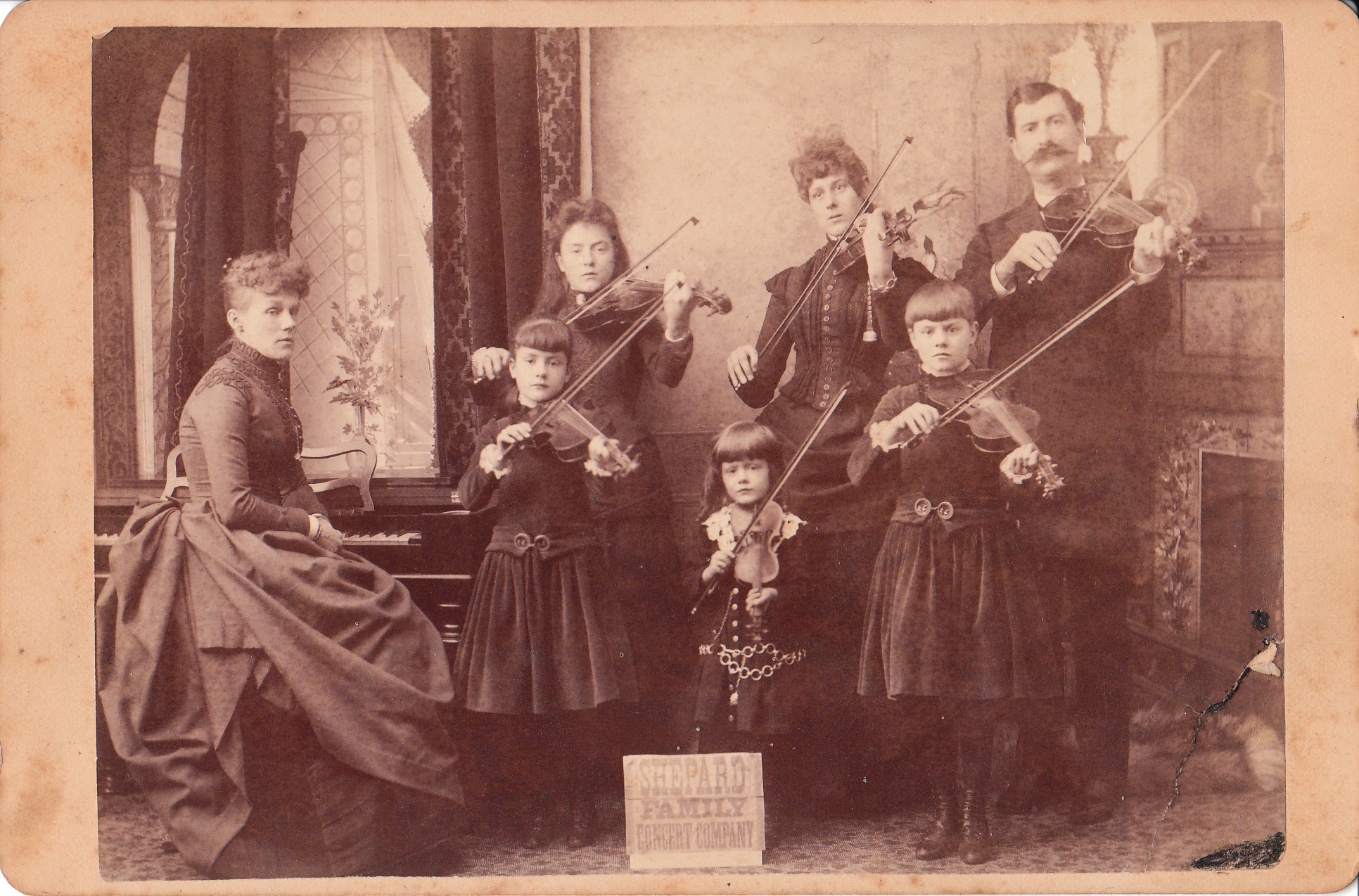
THE SHEPARD FAMILY CONCERT COMPANY
This cabinet card features a portrait of the Shepard Family Concert Company. In this photograph, mother is playing the piano (or organ) and the five children and their father are playing violins. The photographer of this cabinet card is unknown, as is the location of the studio. A photograph of the Shepard family and their instruments appears in The Henry Sheldon Museum of Vermont (located in Middlebury, Vermont). In addition, the museum possesses a “cigar ribbon quilt” serving as a piano cover. The quilt is made from silken advertising ribbons which cigar companies used to tie cigars together for packaging purposes. This particular quilt was made by Mary Emily Shepard (“Minnie”), the matriarch of the Shepard Family. The Shepard Family was Massachusetts based, and mostly toured upper New England. The musical group venues included the Town Hall Theatre, in Middlebury, Vermont. Family Musical Troupes were popular in the 1880’s and 1890’s. Mr. and Mrs. J. M. Shepard and their children, Kittie, Laura, Lessie, Georgie, and Burtin were regionally well known and appreciated in the late nineteenth century. Each family member were multi instrumentalists. The family could perform as a choral group, a brass band, or a violin ensemble with the mother playing the pump reed organ. In addition, sometimes, the children would perform as a banjo quintet.
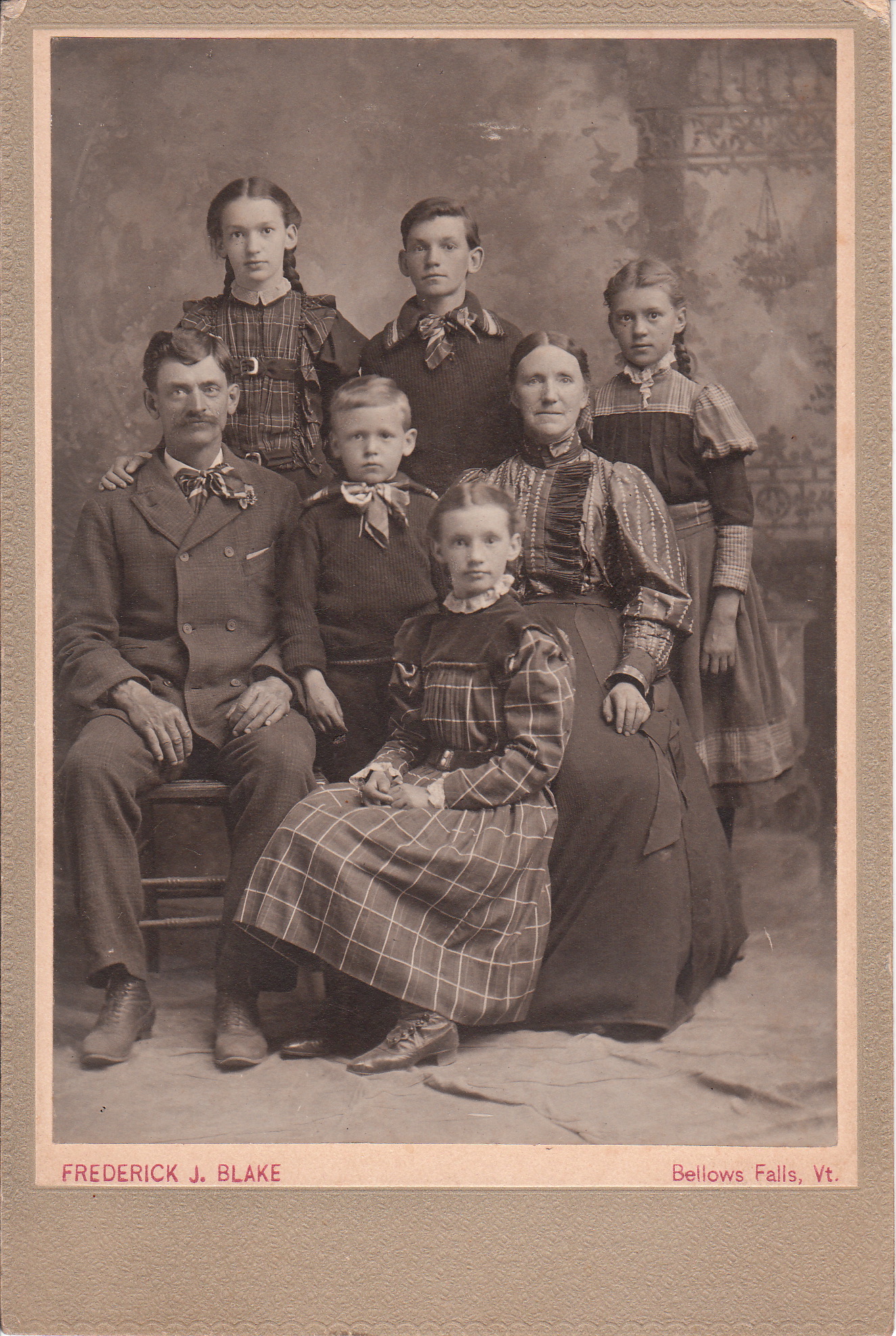
A FAMILY PORTRAIT IN BELLOWS FALLS, VERMONT
This cabinet card features at attractive family posing for their portrait at the studio of Frederick J. Blake, in Bellows Falls, Vermont. Mom and Dad are accompanied by their two sons and three daughters. Blake is listed in the Windham County Business Directory (1884).
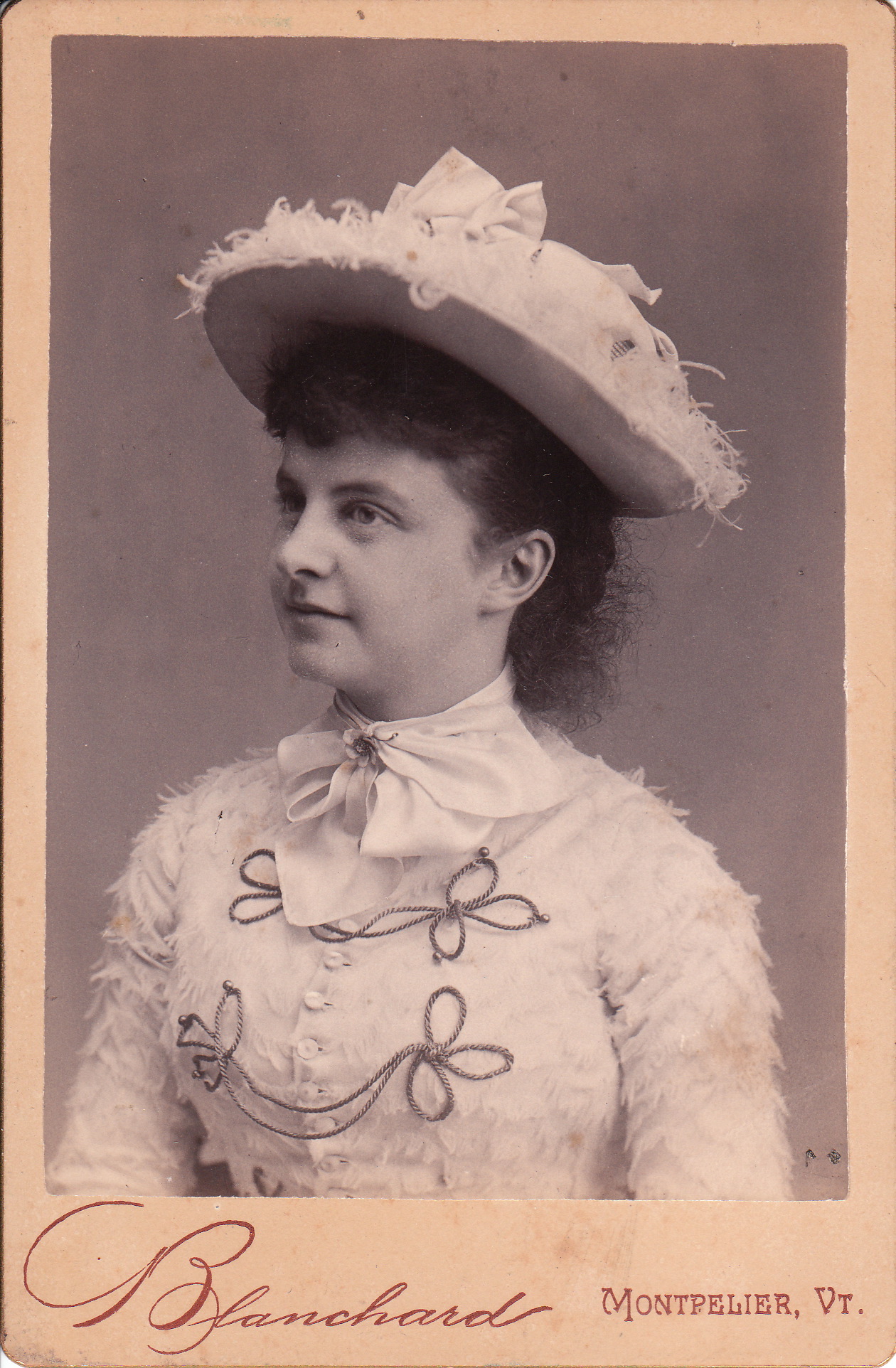
PRETTY WOMAN IN MIDDLEBURY, VERMONT
An attractive young woman is the subject for this cabinet card photograph from the studio of W. M. Jackson of Middlebury, Vermont. The studio was located on the Cobb Block of Middlebury. The Bulletin of Photography (1916) reports that Mrs. William M. Jackson of Middlebury sold her studio to A. N. Gove and Worthy Needham of Bristol, Vermont. The photographer of this image is likely the very same William M. Jackson; and perhaps Mrs. Jackson sold the studio in 1916m upon her husbands death. This photograph has been trimmed to fit into a previous owners album or picture frame.
THE BOYS ARE BACK IN TOWN IN SPRINGVILLE, OR SPANISH FORK, UTAH (NOTED UTAH PHOTOGRAPHER)
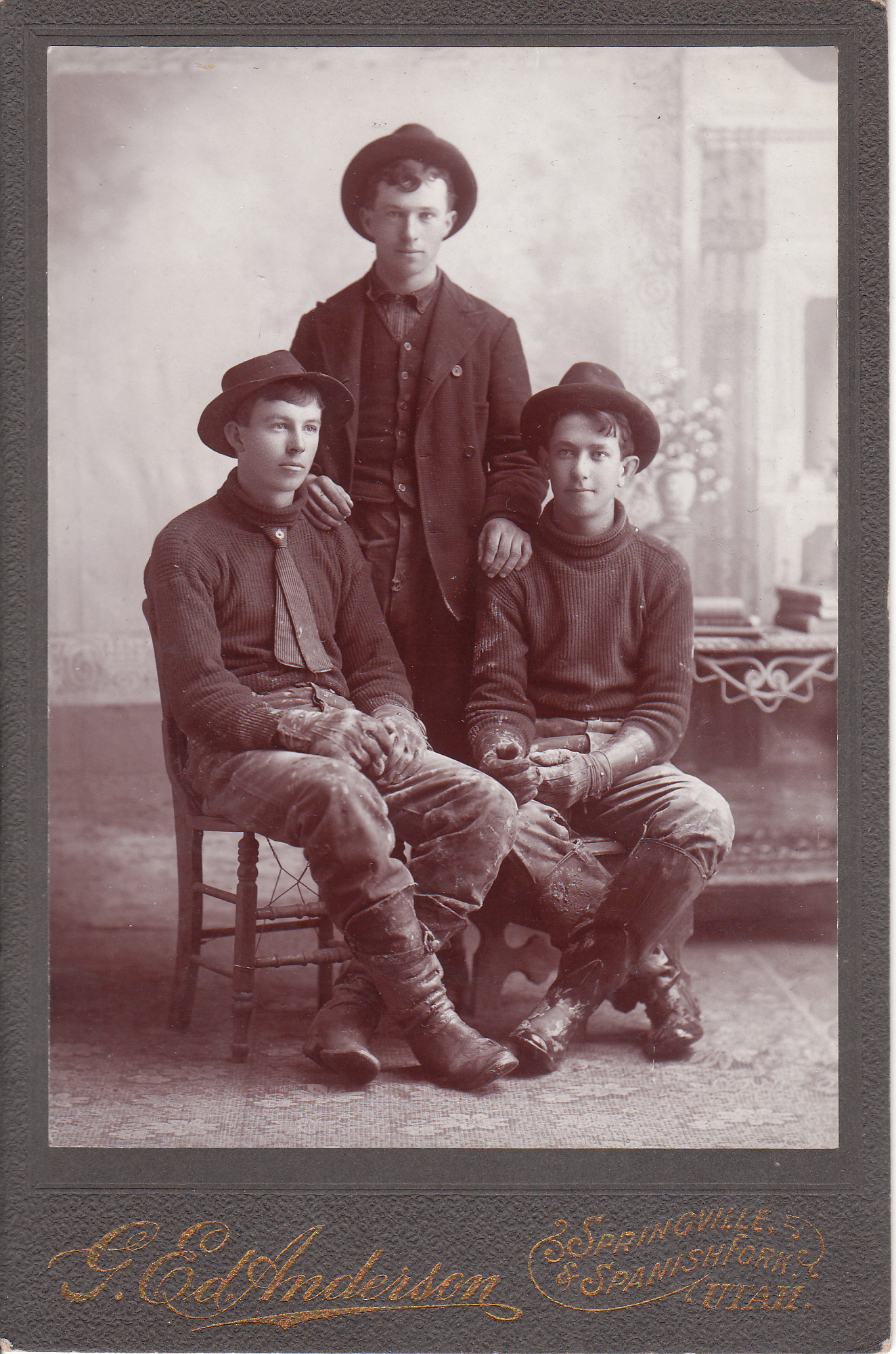
Three young men pose for their portrait at the studio of G. Ed. Anderson, located in either Springville, or Spanish Fork, Utah. The guys may have come to the studio after work. The two seated men are wearing work boots and work gloves. They are also wearing dirty trousers. Interestingly, one of the guys is wearing a turtleneck, a garment not seen often in cabinet card photographs. An inscription on the reverse of the card identifies the men as Saul Clyde, Will Rowland, and John Whiting. It would be interesting to hear some of this sites visitors opinion as to what occupation these men may have occupied. Please leave a hypothesis if you have one. Photographer, George Edward Anderson (1860-1928) was a noted photographer for his portraiture and documentary photographs of early Church of Jesus Christ of Latter-day Saints temples. He was born in Salt Lake City, Utah and was a photographer apprentice to renowned photographer Charles Roscoe Savage. At age seventeen, Anderson established a photography studio in Salt Lake City with two of his brothers. He then established a studio in Manti, Utah and in 1886, he moved his studio to Springville, Utah. Anderson became well known for his traveling tent studio which he set up in small towns throughout central, eastern and southern Utah. During that time he did an excellent job of documenting the lives of residents in the years 1884 to 1907. Although best known for his portraits, Anderson took many documentary photographs of homes, barns, businesses, Temples, mines and railroads. He went to England on his Church of Latter Day Saints mission in 1909 to 1911. After his mission, he set up a photography studio in South Royalton, Vermont, which is near the birthplace of LDS prophet Joseph Smith. In 1913, he returned to his home and family in Springville. He returned to financial and marital problems and tried to revive his traveling tent studio but met little success. The later years of his life were spent documenting families and life in Utah Valley and traveling to photograph newly constructed temples. Anderson received most of his recognition long after his death. A collection of his works is housed at Brigham Young University library.
A WOMAN WITH SERIOUS HAIR IN VERMONT
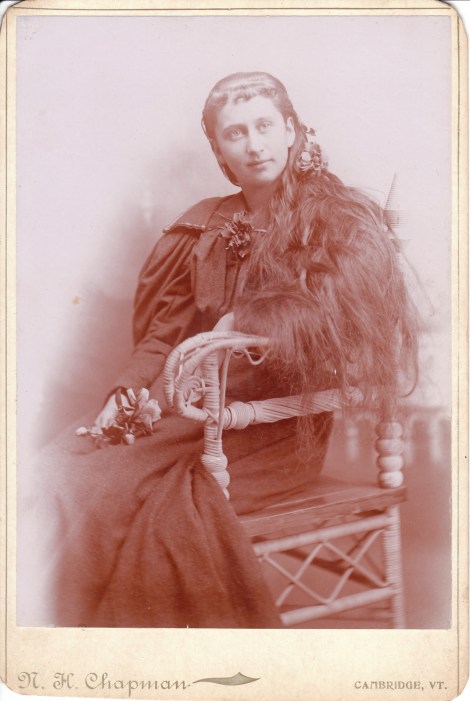
The woman pictured in this Cabinet Card has unusually long hair. Her hairstyle is quite unique and I bet she had to get up very early in the morning to groom herself for the day. The photographer of this image is N. H. Chapman of Cambridge, Vermont.
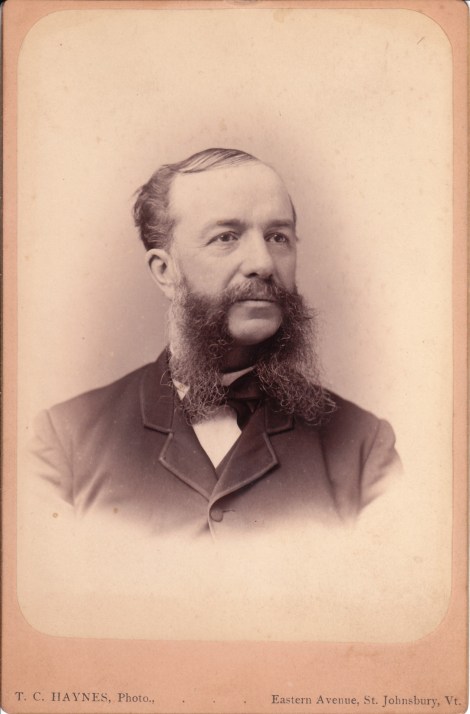
MUSTACHE OF THE MONTH FOUND IN VERMONT
This Cabinet card is a new addition to my Mustaches (Only The Best) Category. The handsome mustache and its owner were photographed by T C Haynes in St. Johnsbury, Vermont.