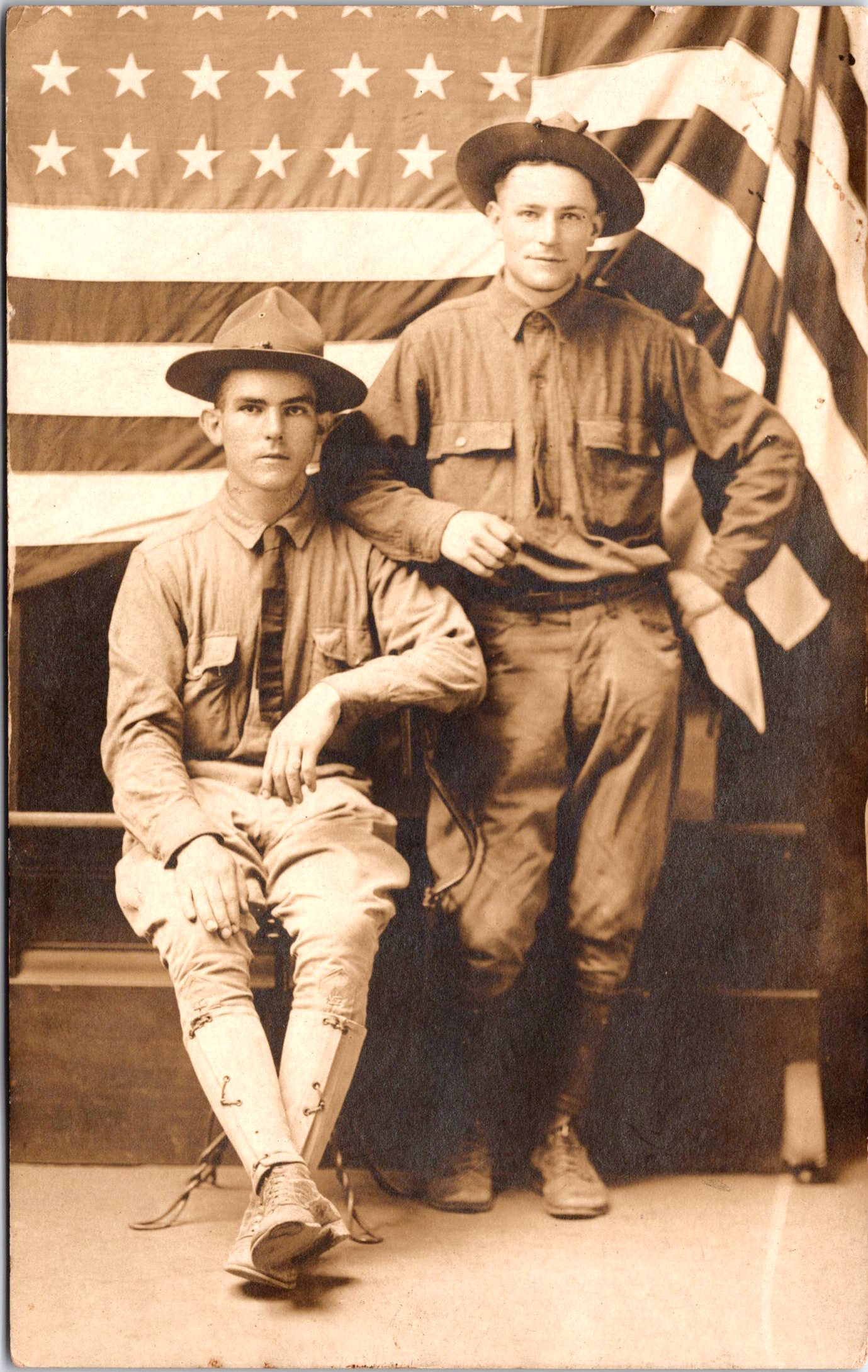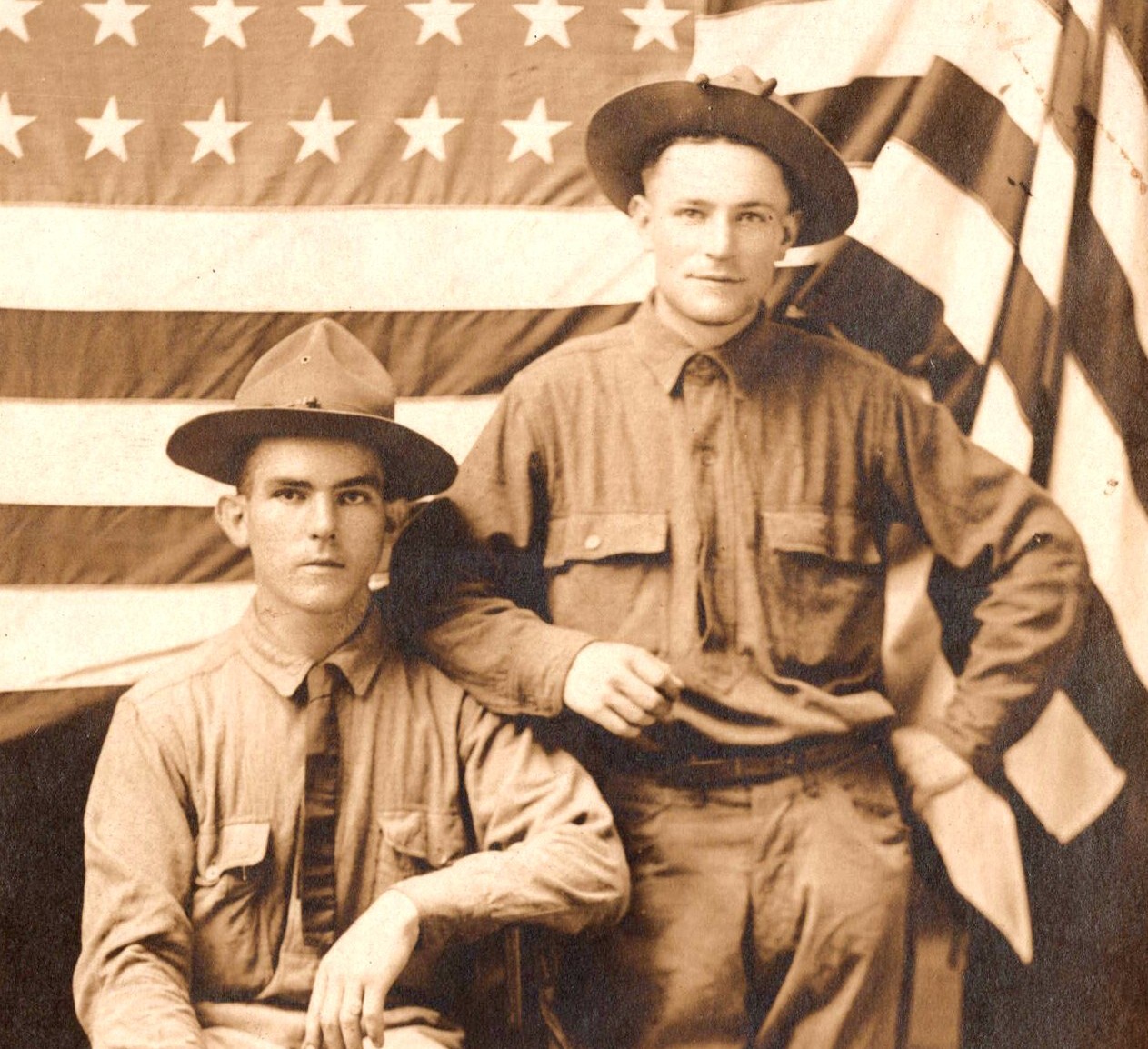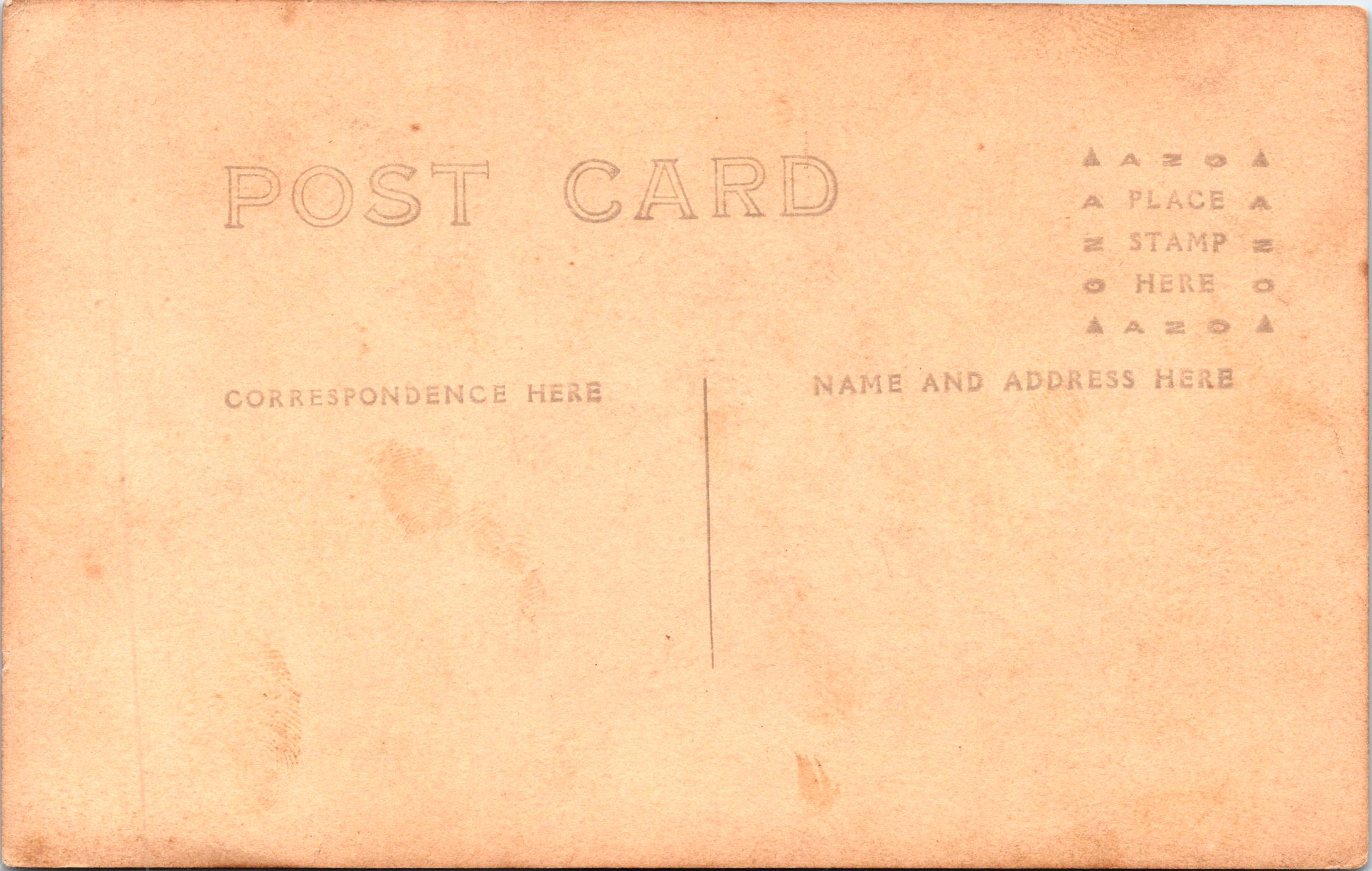
This original real photo postcard captures two World War I-era American soldiers posed proudly in front of a large U.S. flag backdrop. Both men wear their service uniforms complete with campaign hats, buttoned shirts, and breeches tucked into puttees or leggings. The soldier on the left is seated with legs crossed, hands resting naturally, and gazes directly at the camera. The standing soldier rests his hand casually on his comrade’s shoulder, creating a sense of camaraderie. The flag’s stars and stripes fill the background, adding a strong patriotic tone to the image. The reverse of this postcard has an AZO stamp box indicating that it dates back to between 1904 and 1918. The card’s style and subject matter suggest that the postcard likely dates to the World War I period (circa 1917–1919). SOLD
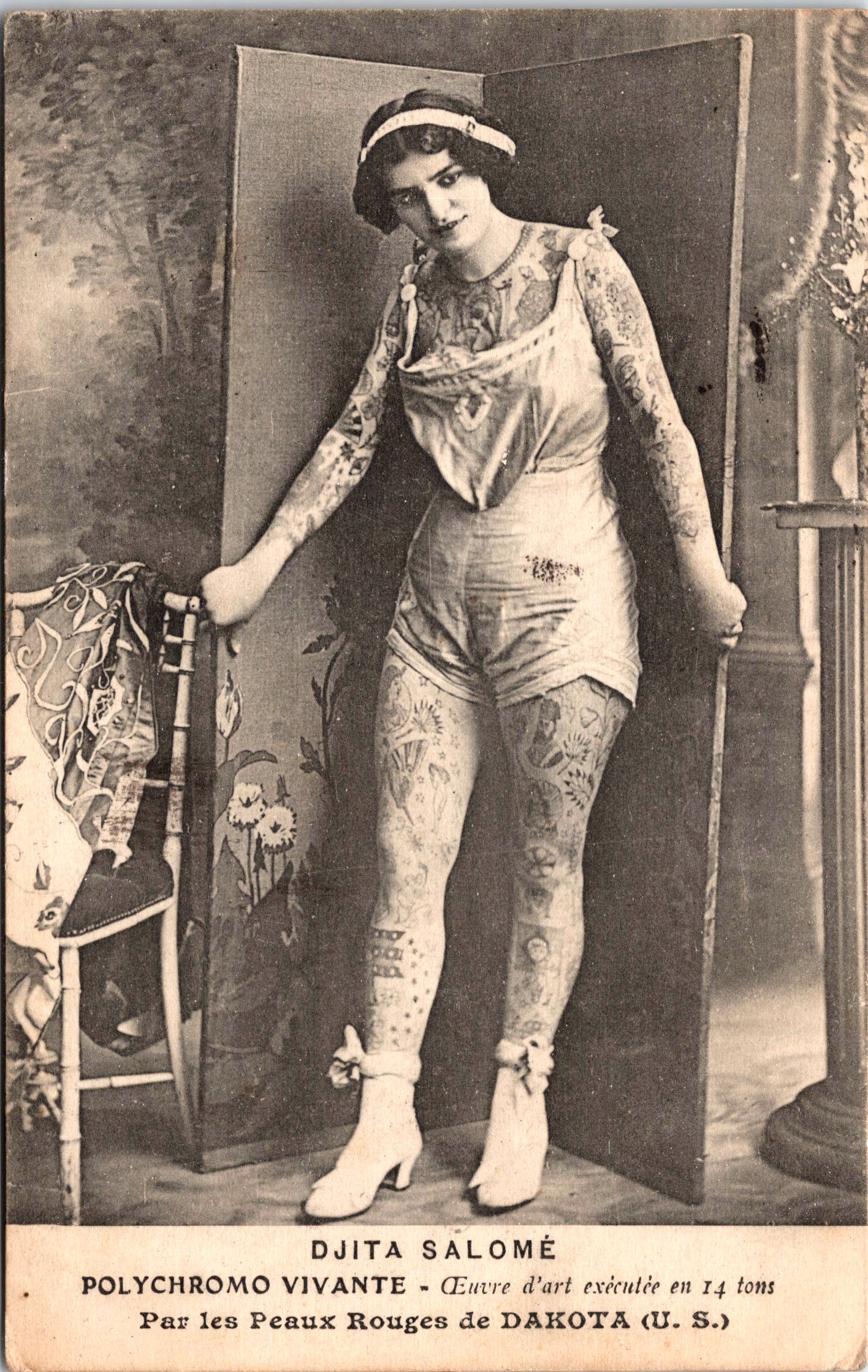
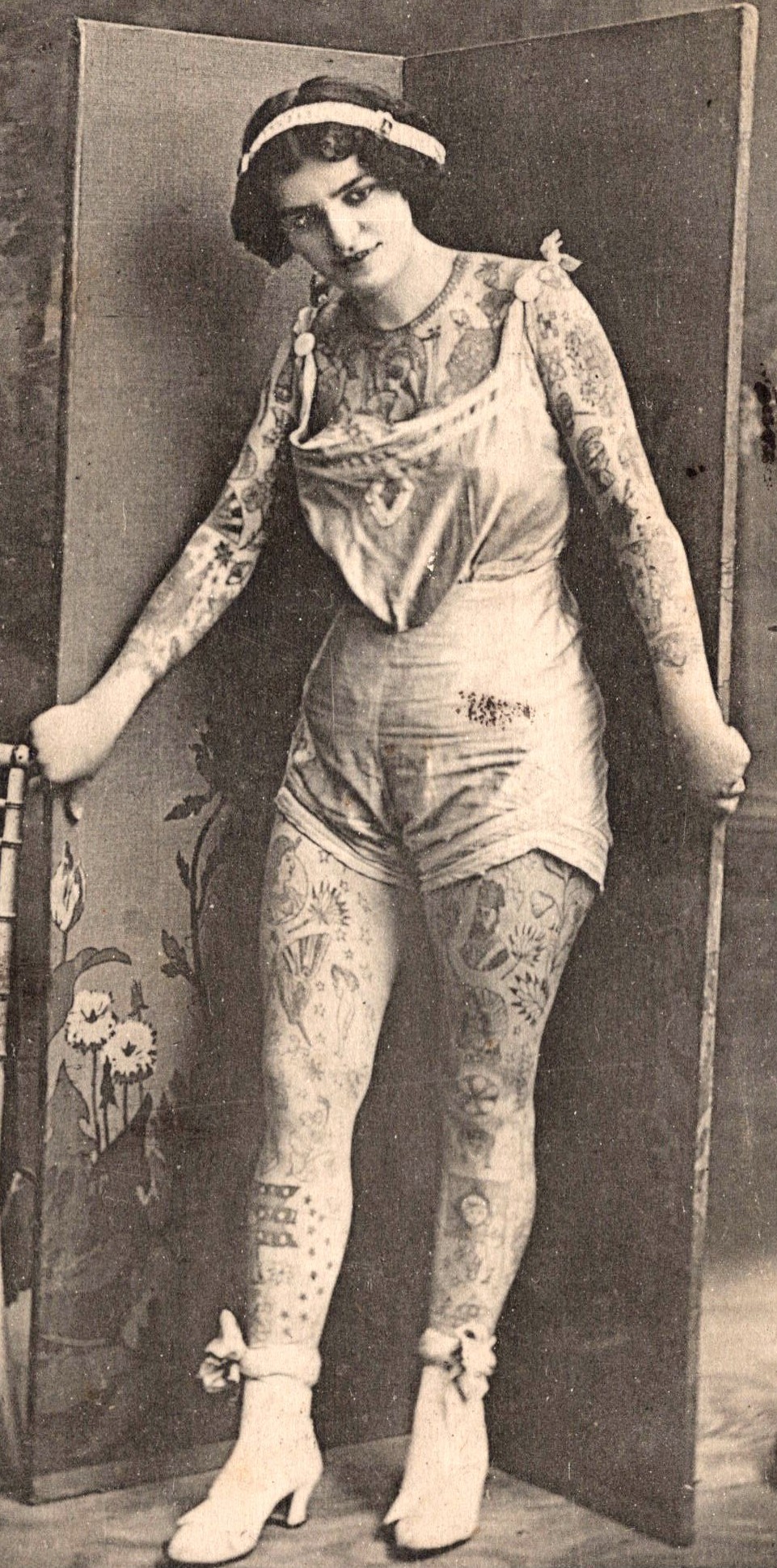
This extraordinary real photo postcard features Djita Salomé, one of Europe’s most celebrated tattooed ladies of the early 20th century. Salomé toured widely on the sideshow and carnival circuit and was promoted as a “living polychrome work of art.” Her entire body was covered in elaborate tattoos, executed in up to 14 different colors, making her a sensation across Europe. She performed at major venues including Edinburgh’s Waverley Market (1911), Toulouse’s Théâtre des Nouveautés (1913), Laval (1914), and Paris’s Bal Tabarin (1914). The postcard’s printed caption (in French) describes her as: “Djita Salomé – Living Polychrome – Work of art executed in 14 tones by the Red Skins of Dakota (U.S.)”. Such phrasing was typical of the bold circus-style marketing used to promote her act. The card carries a handwritten message dated 1916,. The card was sent from Drome, France; and was addressed to Léon Florançon at a local barracks. The following is a rough translation of the message : ” My dear Léon, I received your letter of the 14th with great pleasure. I am happy to know that you are well. Here, everything is going fine, and we are all in good health. Papa is working as usual, and we are managing with the household accounts as best we can. I sent the 25 francs you asked for last week—please let me know if you received it. Write more often when you can; your letters always bring us joy. Mama sends you her warm affection. Courage, my dear boy, and remember that we think of you every day. With tender kisses, Your loving sister, Jeanne.” This message not only adds personal warmth but also situates the postcard directly in the context of World War I France, where families maintained contact with sons and brothers in service. (SOLD)
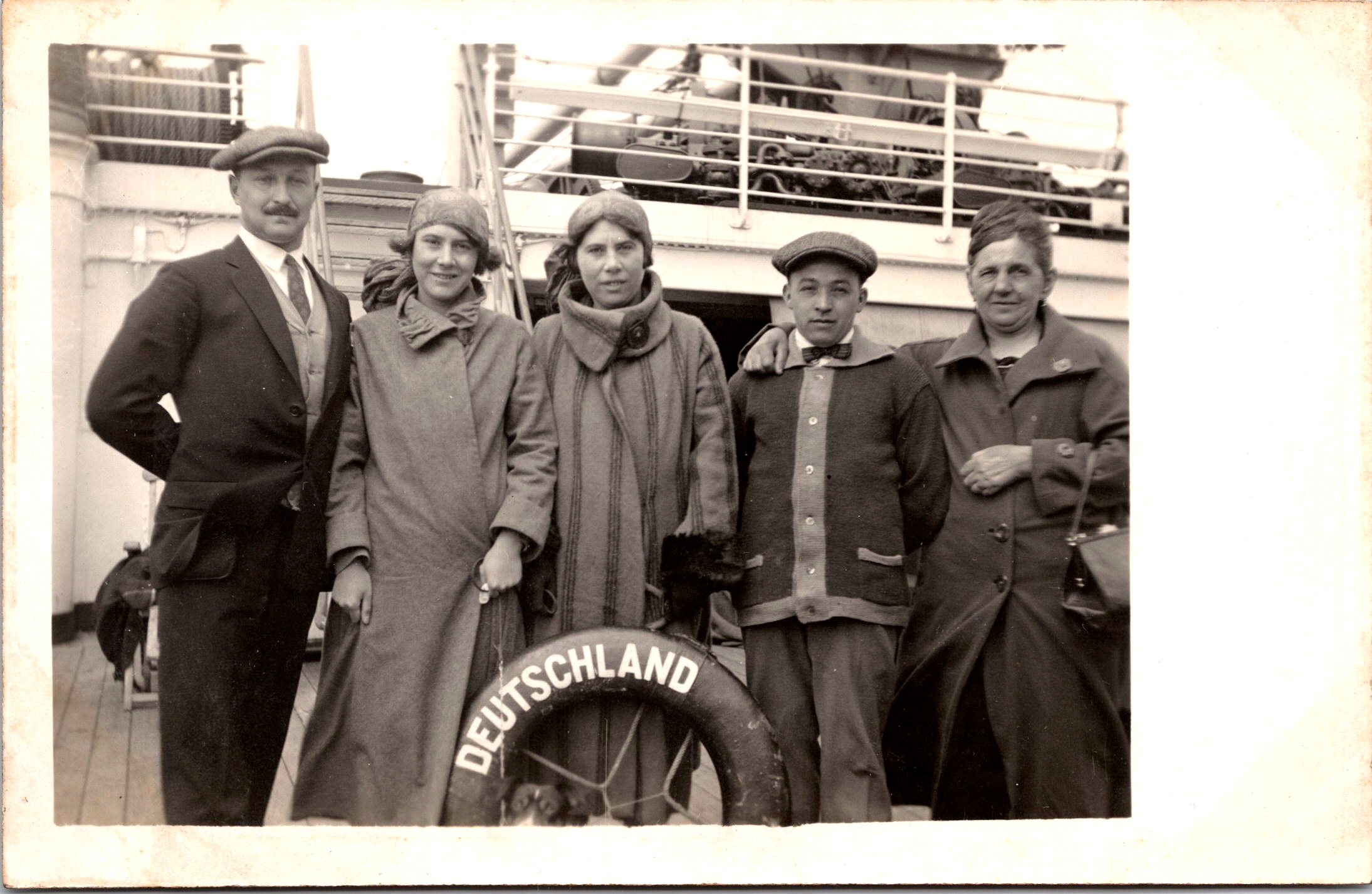
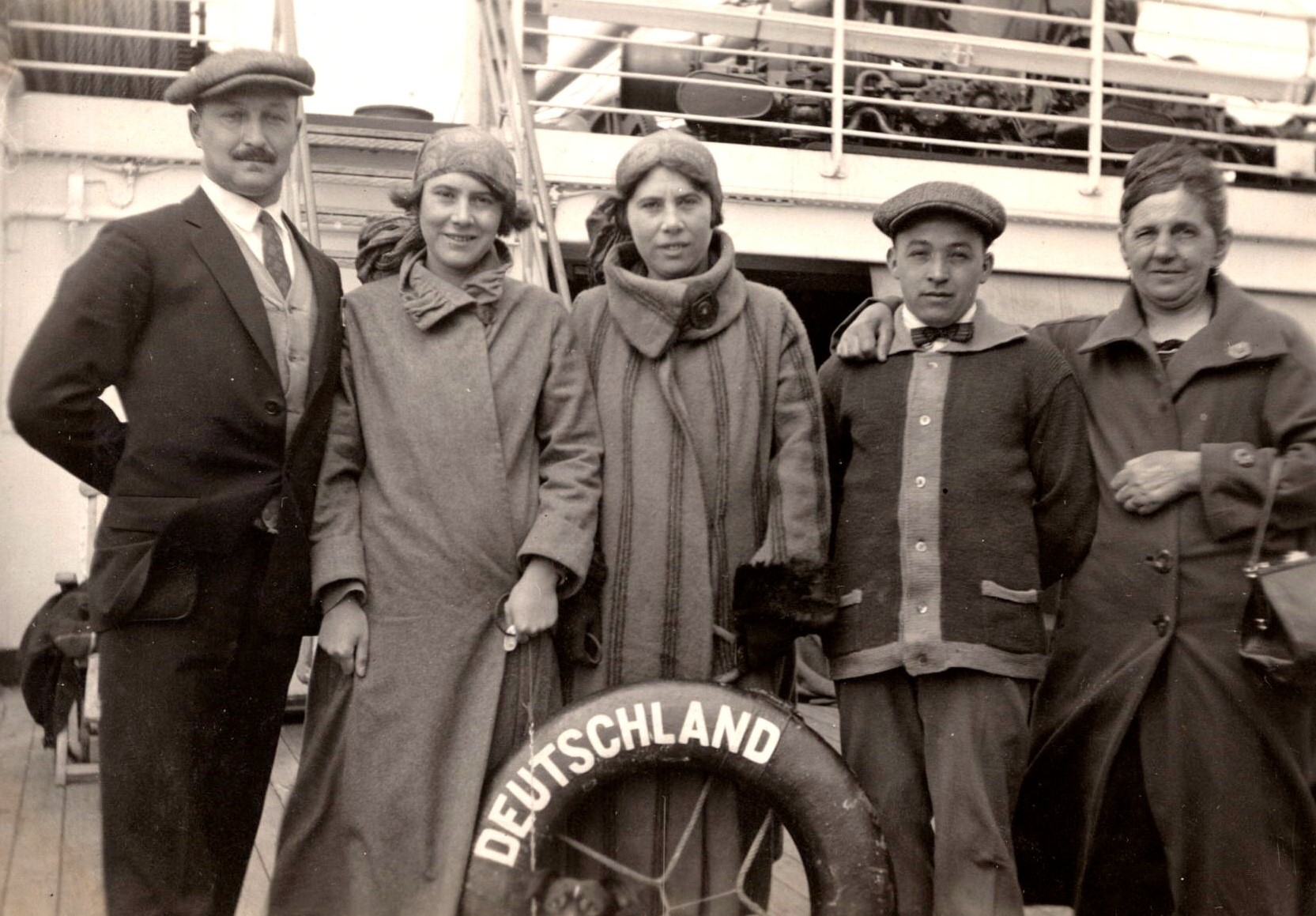
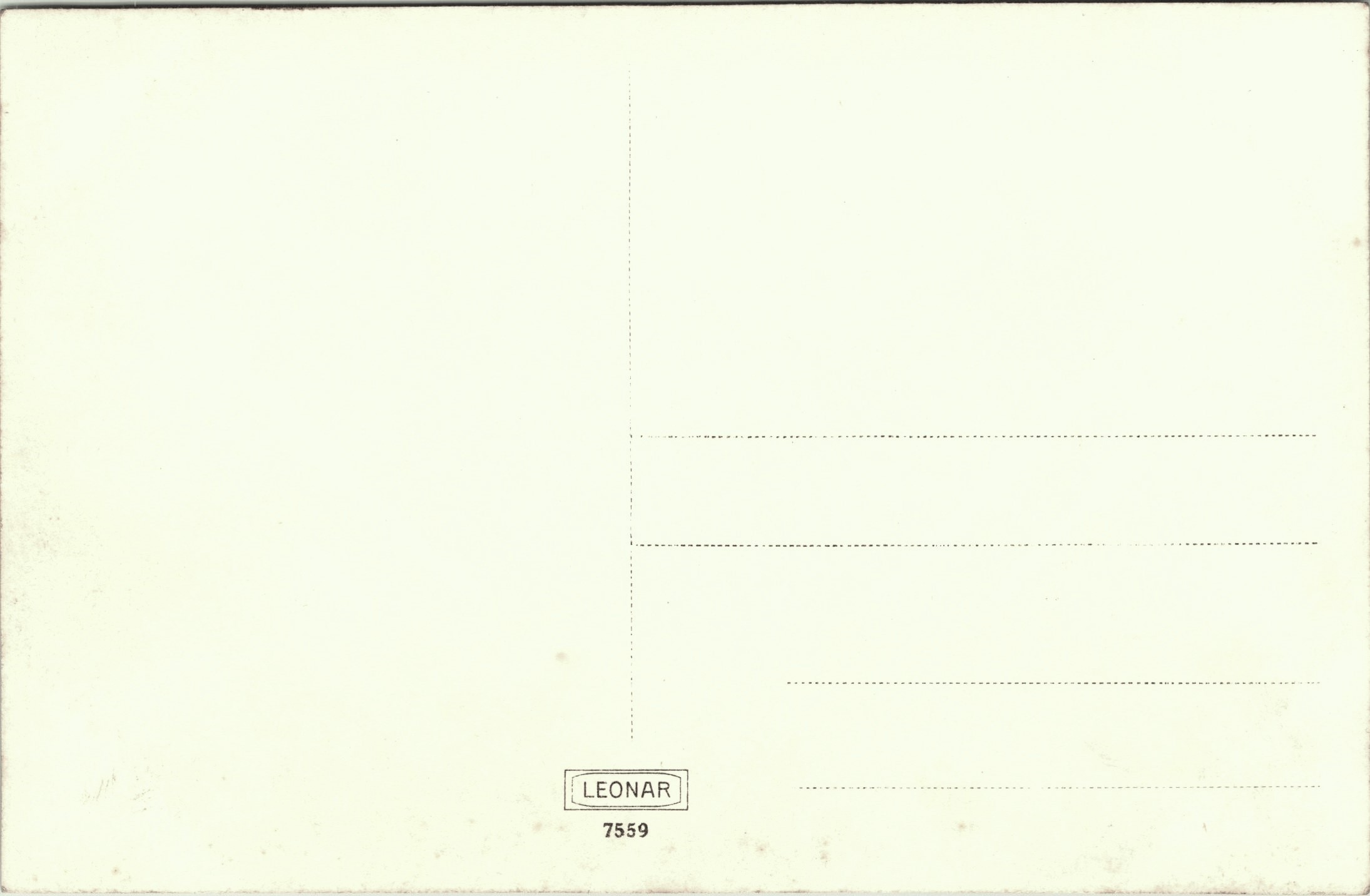
This striking vintage real photo postcard features a family of five posing on board the passenger liner, SS Deutschland. The life buoy in front of the family reveals the name of the ship. The family is likely on a vacation cruise. The father and the daughter standing next to him appear to be genuinely happy about their ocean adventure. The SS Deutschland was launched in 1900 by the Hamburg America Line of Germany. The ship was able to cross the Atlantic Ocean in a little more than five days. Unfortunately, the ship had chronic engine problems and was removed from transatlantic service in 1910. We can safely determine that the photograph on this postcard was taken between 1900 and 1910.The ship later saw service in World War I and then was used as a immigrant ship (Hansa). The ship was scrapped in 1925. Printed on the reverse of the postcard is the name, “Leonar”. Leonar was a firm that produced postcard stock (paper), cameras, and other photographic supplies. SOLD
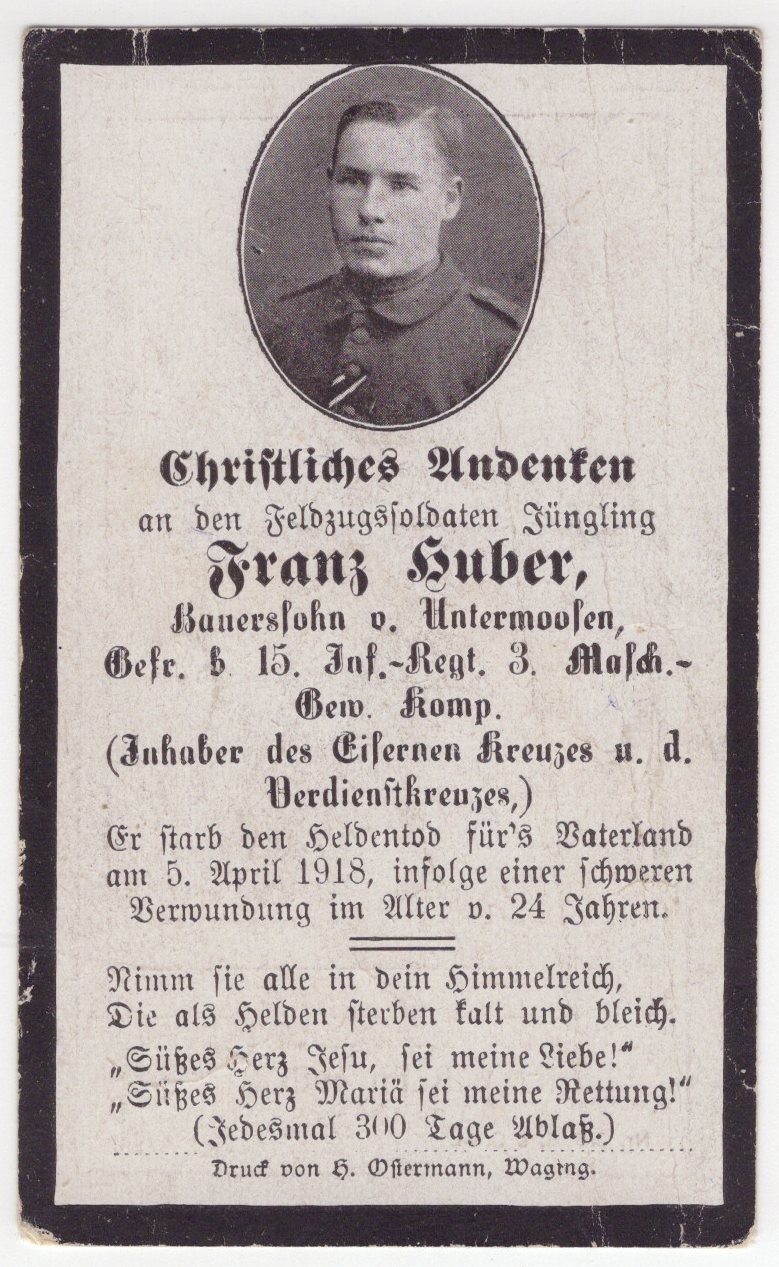
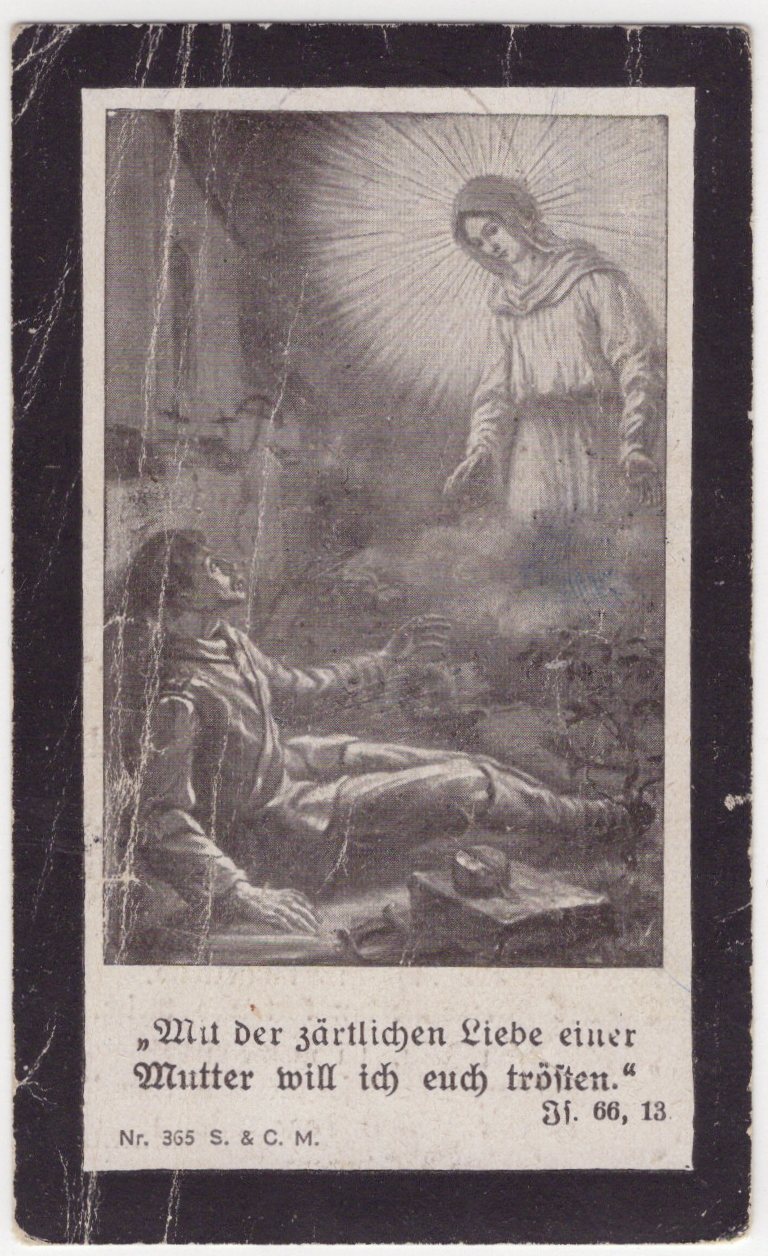
This item is a World War I death card. It was customary to issue a card for fallen soldiers of the German army, navy and air force. The front of the card states that it is a Christian commemoration of the campaign soldier youth, Franz Huber. Information about his regiment and overall unit is provided. It is stated that the soldier was awarded the Cross of Merit. Furthermore, it states that Huber died a heroic death for his country on April 5, 1918. He died as the result of a serious injury at the young age of 24. A prayer is at the bottom of the card and there is a notation that the card was printed by H. Ostermann of Waging, Germany. The reverse of the card has a touching quote. “With the tender love of a mother I want to comfort you. SOLD
This vintage photograph features American stage and film actress, Kathleen Clifford (1887-1962). The IMDb credits her with 14 film credits between 1917 and 1932. She is known for “Richard the Lion-Hearted (1923)”, When the Clouds Roll by (1919)”, and “Who is Number One? (1917)”. She often played leading roles in her films for Paramount. During her film career, she worked alongside Douglas Fairbanks Sr., Betty Compson, and Wallace Beery. She appeared on the Broadway stage six times between 1909 and 1916. Clifford was famous as a Vaudeville comedienne and male impersonator. She was billed as “The Smartest Chap in Town”. At one point in her vaudeville career, she worked as a duo with female impersonator, Bothwell Browne. Like many movie performers, she left acting with the advent of sound films. During the early years of World War I, she served as a Red Cross Nurse with the British Army in France. Upon retirement, she became a business woman and owned “Broadway Florist” in Hollywood. Clifford also wrote a novel about her time in Hollywood. She was married to Miomir Peter Illitch for over 35 years. He was a banker. This original photographic portrait of Kathleen Clifford was taken by a highly talented and esteemed American photographer, Fred Hartsook (1876-1930). He owned a California studio chain that, at that time, was considered to be the largest photographic business in the world. His celebrity clients included President Woodrow Wilson, Henry Ford, Mary Pickford, and Charles Lindbergh. He also owned a resort and two ranches in Southern California where he raised Holstein cattle. He was married to Bess Hesby, queen of the San Francisco Pan-Pacific Exposition of 1915. SOLD
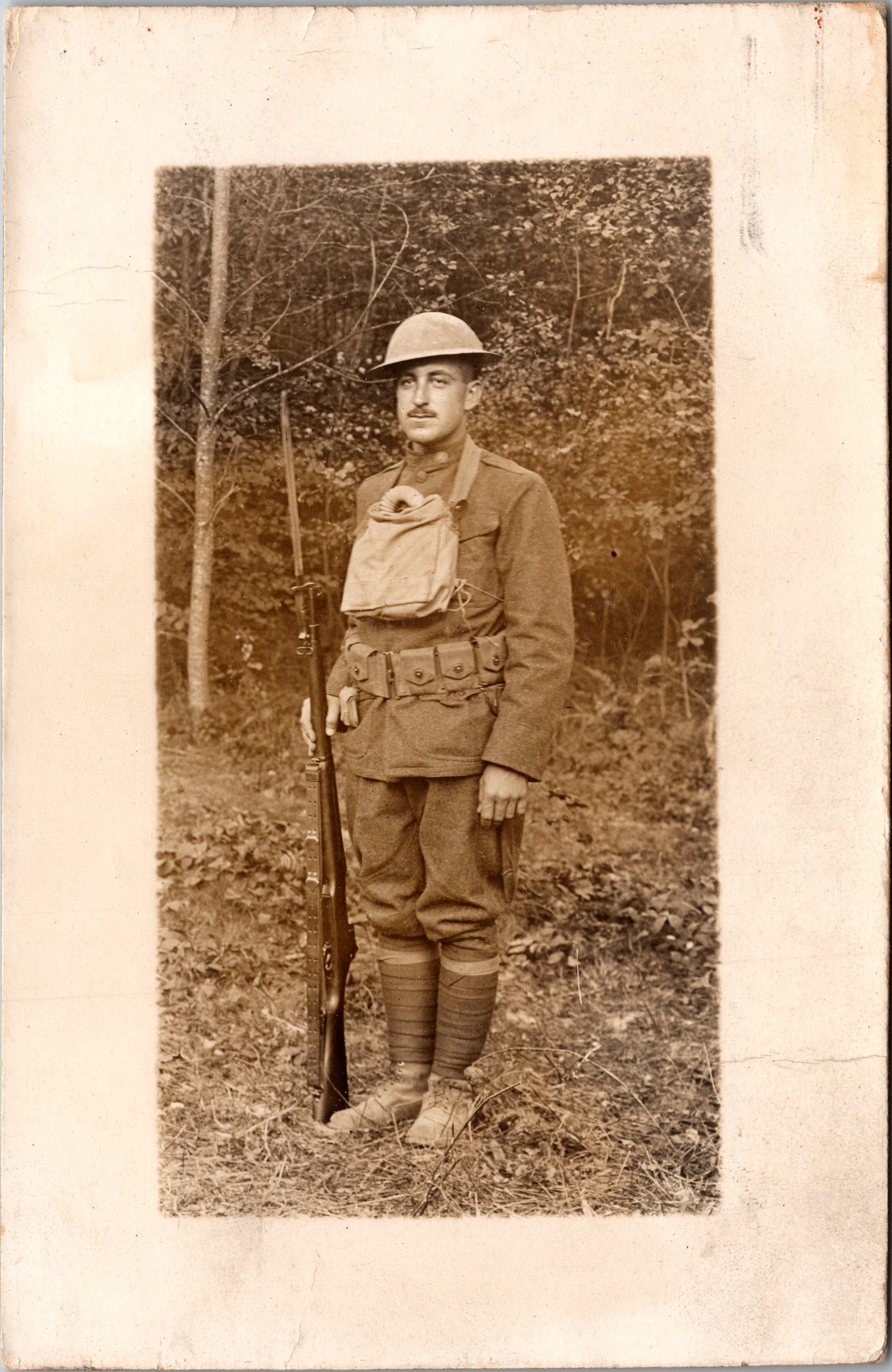
This vintage real photo postcard features a handsome World War I era uniformed soldier posing for an outside portrait He is well equipped with a rifle, haversack, cartridge belt, and high boots. He has been identified as a US dough boy but this has not been confirmed. The message on the card indicates that he is from an English speaking country. The message on the card is light hearted. The soldier asks how he looks in his uniform adorned with his equipment. He is especially interested in the reader’s reaction to his mustache. SOLD
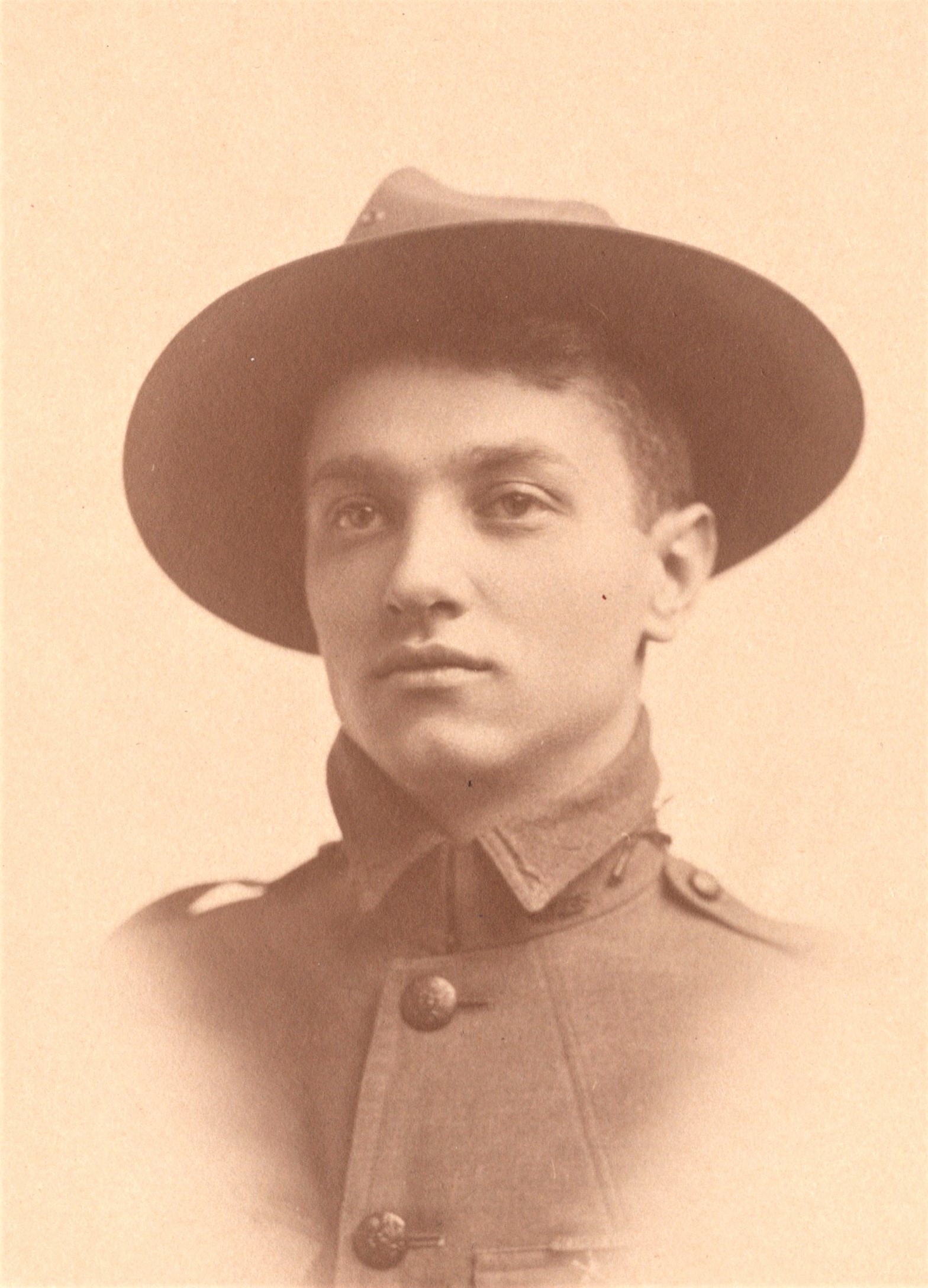
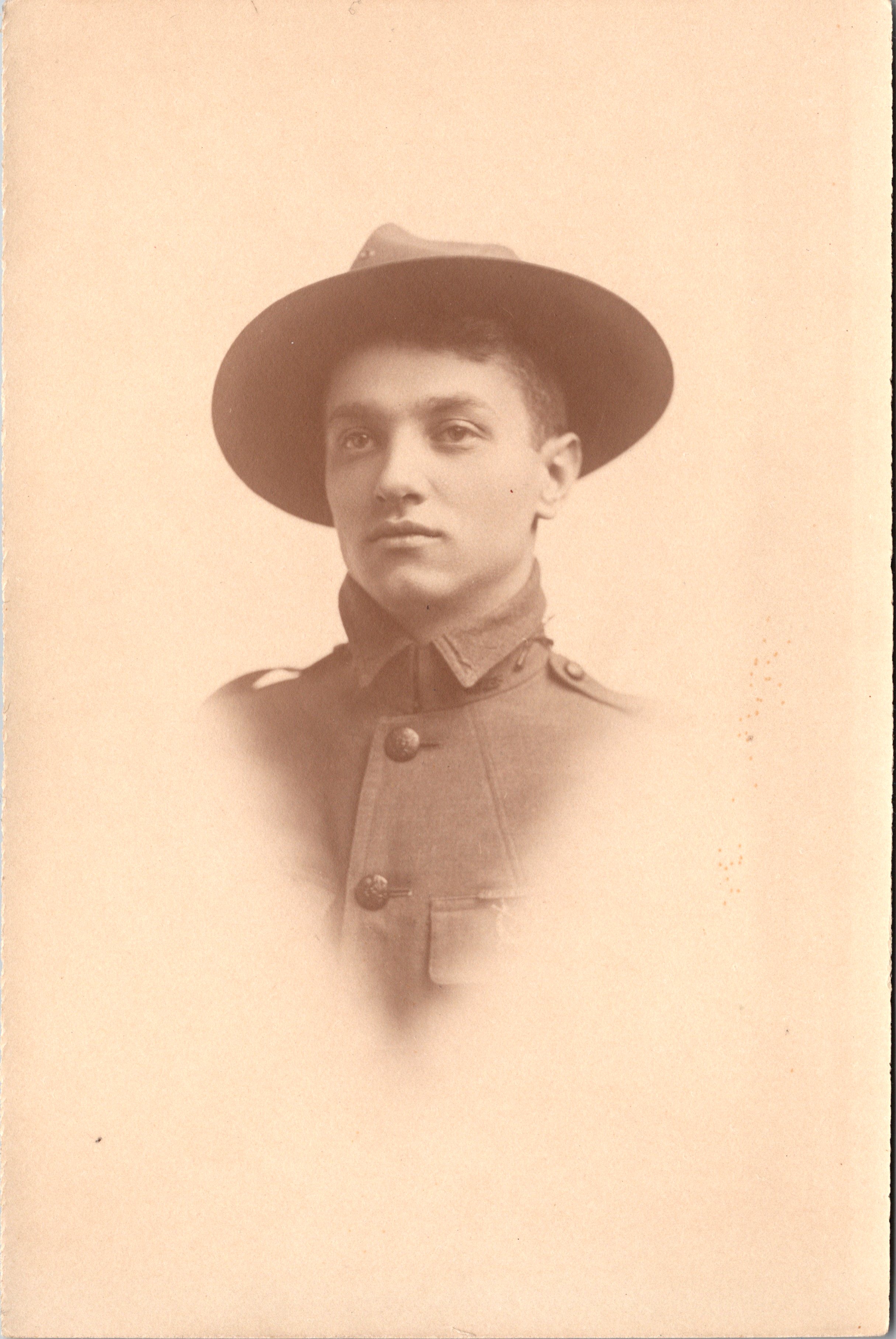
This vintage photograph features a portrait a very young uniformed World War I era soldier. He is handsome and he appears to be trying to look stoic. This photograph measures 4″ x 6″. (SOLD)
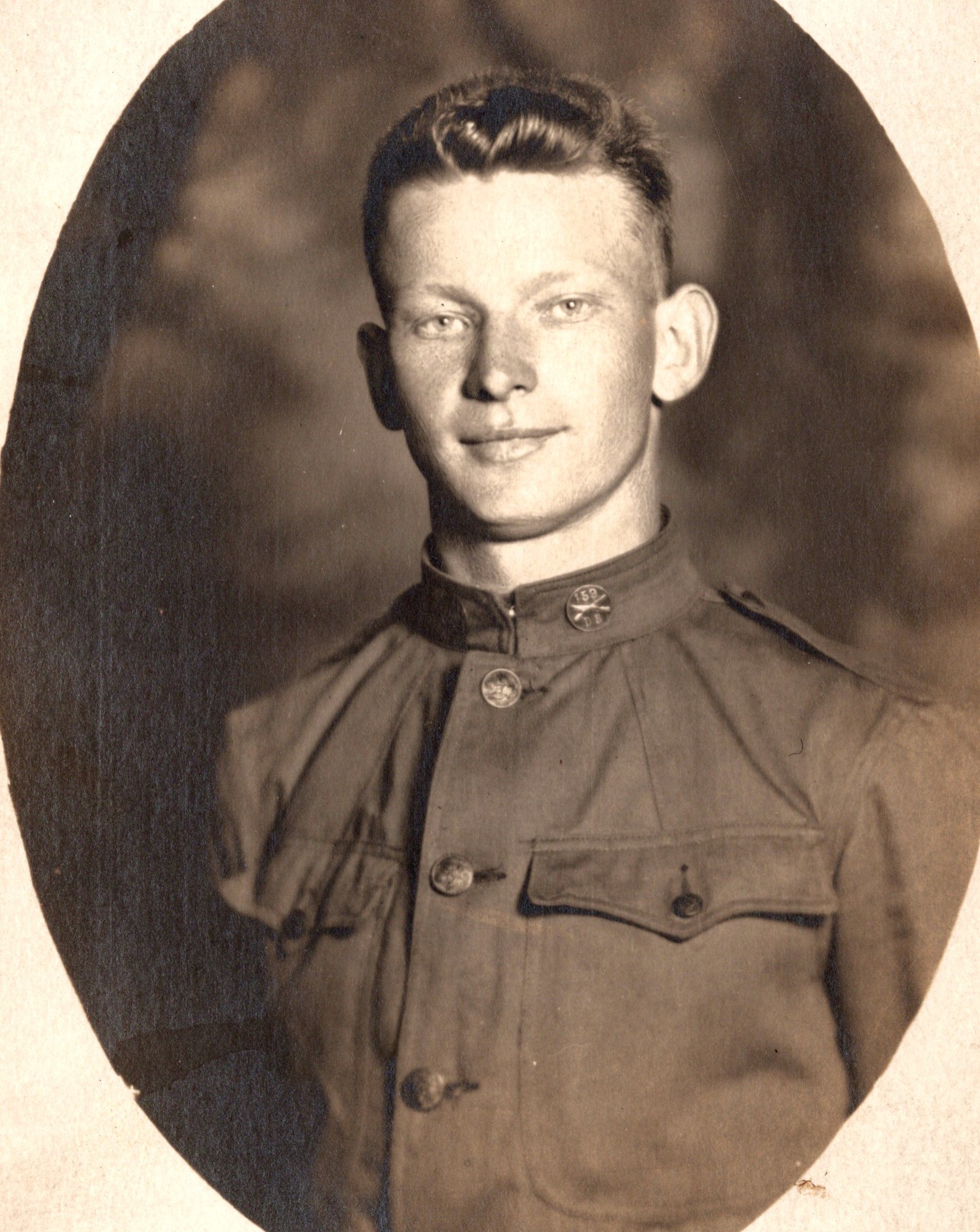
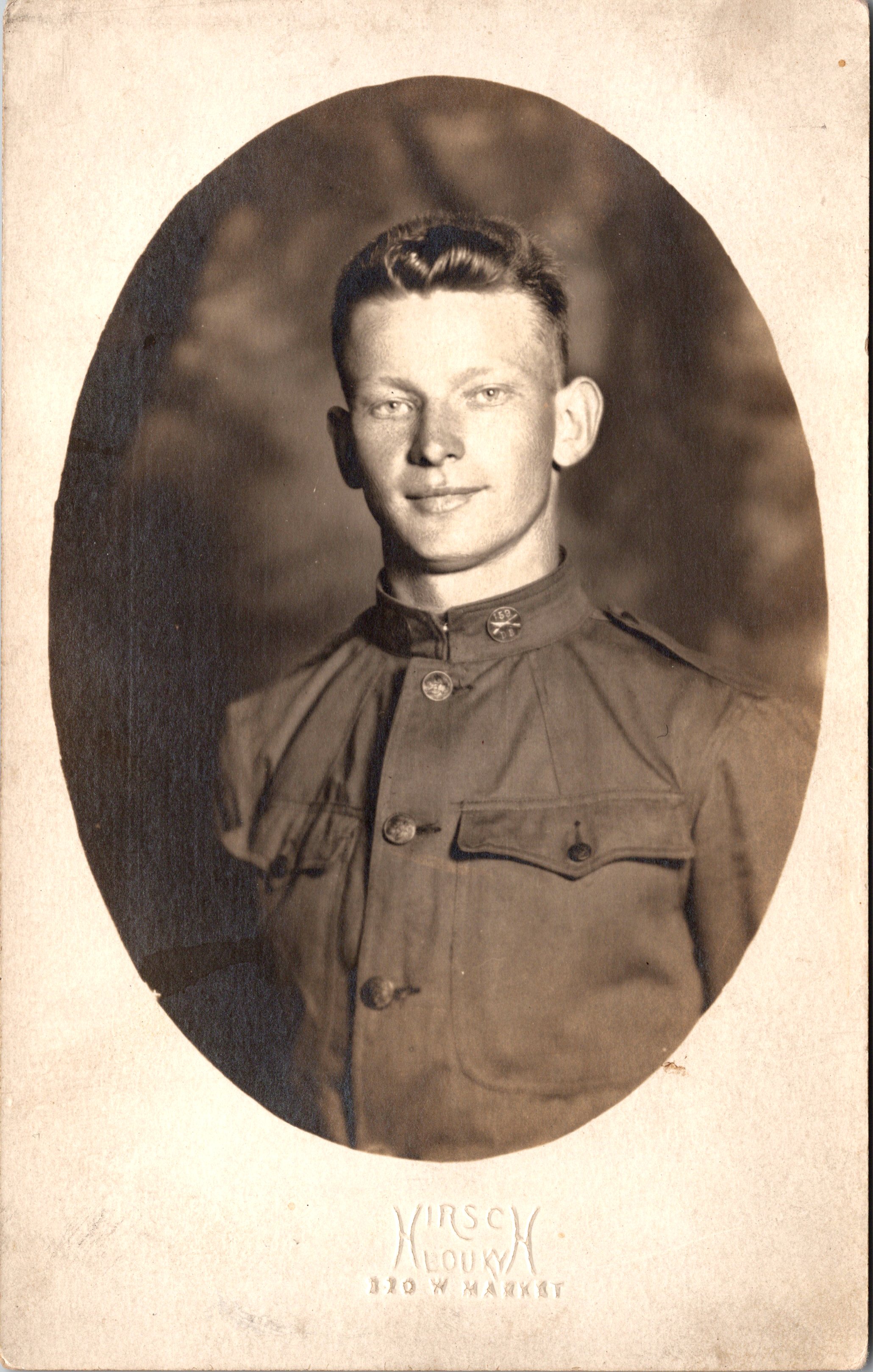
This vintage real photo postcard features a handsome World War I era soldier posing for his portrait at the Kirsch studio in Louisville, Kentucky. The young man is smiling for the camera and likely sent this photo home to his parents or his wife or girlfriend. The AZO stampbox on this postcard indicates that it was published sometime approximately between 1910 and 1930. (SOLD)
This vintage real photo postcard features a pretty young woman wearing the uniform of the United States Army. This postcard was published by Alfred Noyer and is from the World War I era. The postcard is part of a series (No.2923). SOLD