“LITTLE MISS SUNSHINE” IN MUNICH, GERMANY

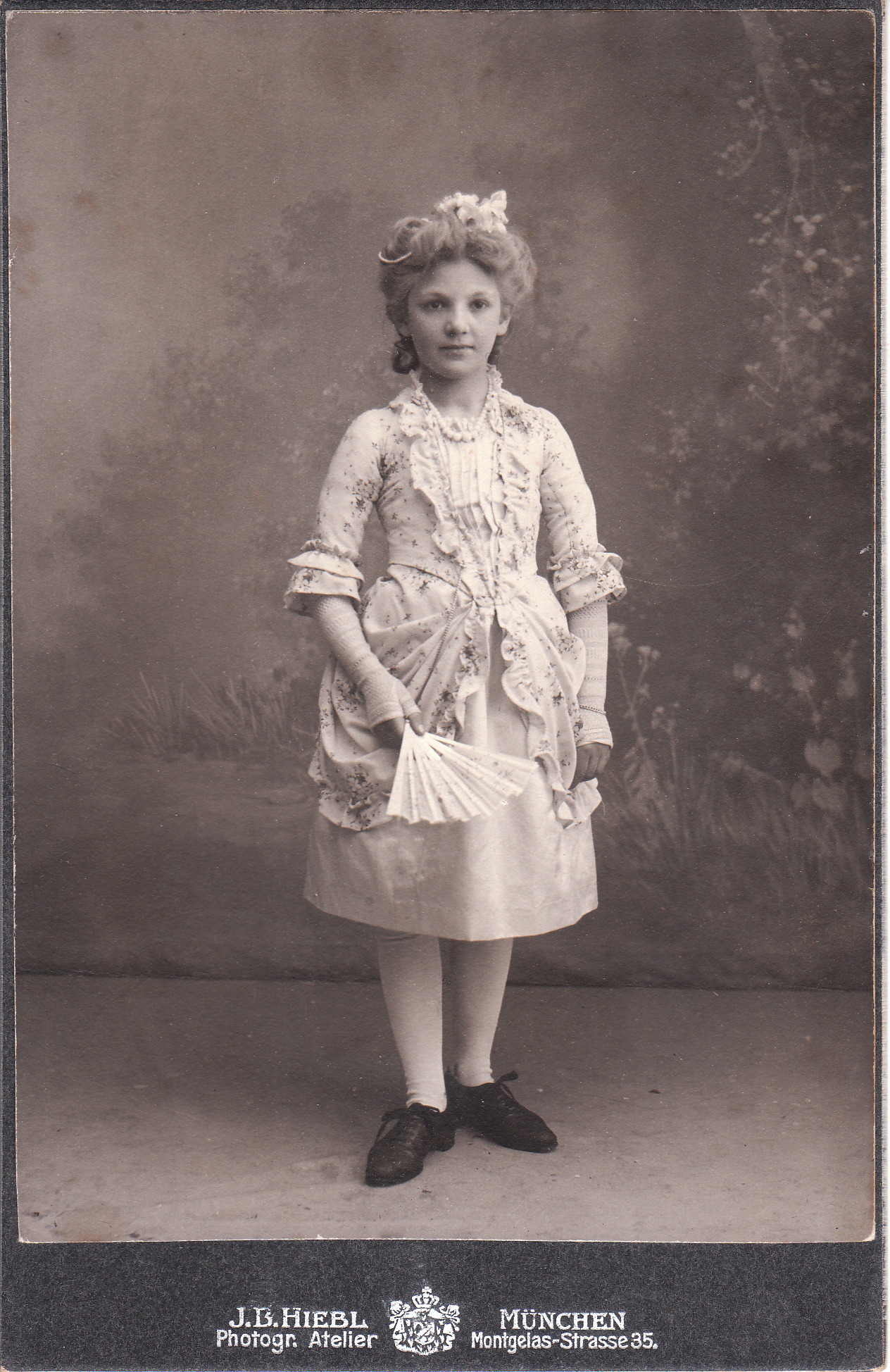
The young girl in this photograph looks like the American little girls who get all “dolled up” for beauty contests and the results of those efforts are that the girls look much older than their years. Writing on the reverse of this image indicates that the girl in the photograph is ten years old and is named Traudi. Fortunately, Traudi isn’t made up (cosmetically) to look inappropriately provocative like many of the contestants in the aforementioned beauty pageants. However, our “Little Miss Sunshine”  looks well beyond her years in this photograph. According to the previous owner of this image, the subject is wearing a fancy “Rokoko” costume. She is also holding a fan. This cabinet card may or may not be an example of  “Rokoko” fashion. I’m in way over my head. Fortunately, a number of visitors to the Cabinet Card Gallery are very knowledgeable about the history of fashion and hopefully they will leave a comment confirming or dispelling the Rokoko theory. By matter of explanation, (thank you Wikipedia), Rokoko refers to the late baroque periods artistic movement and style that had impact on fine arts architecture, decoration, interior design, and fashion. The movement developed in Paris, France, and was “more jocular, florid, and graceful” than the baroque influence. The photographer of this image is J. B. Hiebl and his studio was located in Munich, Germany.

Published in: on July 11, 2012 at 12:01 am  Comments (3)  
Tags: , , , , , , ,

WEDDING COUPLE IN CHICAGO, ILLINOIS

This photograph features a bride and groom on their wedding day. The bride is wearing a beautiful white wedding dress and has a flower bouquet on her lap. The handsome groom is wearing a corsage and has a small pocket watch hanging near the top of his vest. Judging by their fashionable wedding attire, this couple appears to be well-to-do. The wedding portrait photogrrapher was Friesleben of 3932 State Street, in Chicago, Illinois. Louis W. Friesleben is listed by one source as operating his photographic studio from the State Street address between 1887 and 1900. An 1893 portrait taken by Friesleben of Plains Indians, who were part of an exhibit at the Columbian Exposition in Chicago,  is part of the collection of photographs that can be seen in the online National Cowboy and Western Heritage Museum.

SALVATION ARMY WORKERS: GROUP PORTRAIT

This cabinet card features a group portrait of five members of the Salvation Army. Four men and a woman, most of them wearing Salvation Army badges, pose for an unknown photographer at an unknown location. Three of the men are holding their uniform hats while the woman member is holding a tambourine and wearing her hat. The man on the left in the back row has a special hat (perhaps he holds higher rank than the others) and is wearing a sweater that has embroidered letters that say “Salvation Army” and a religious motto, “It is Finished”. The hats display a slogan that appears to say “Prepare to Meet Thy God”.  The Cabinet Card Gallery has a large collection of Salvation Army photographs which can be viewed by clicking on the category “Salvation Army”.

Published in: on July 8, 2012 at 12:01 am  Comments (1)  
Tags: ,

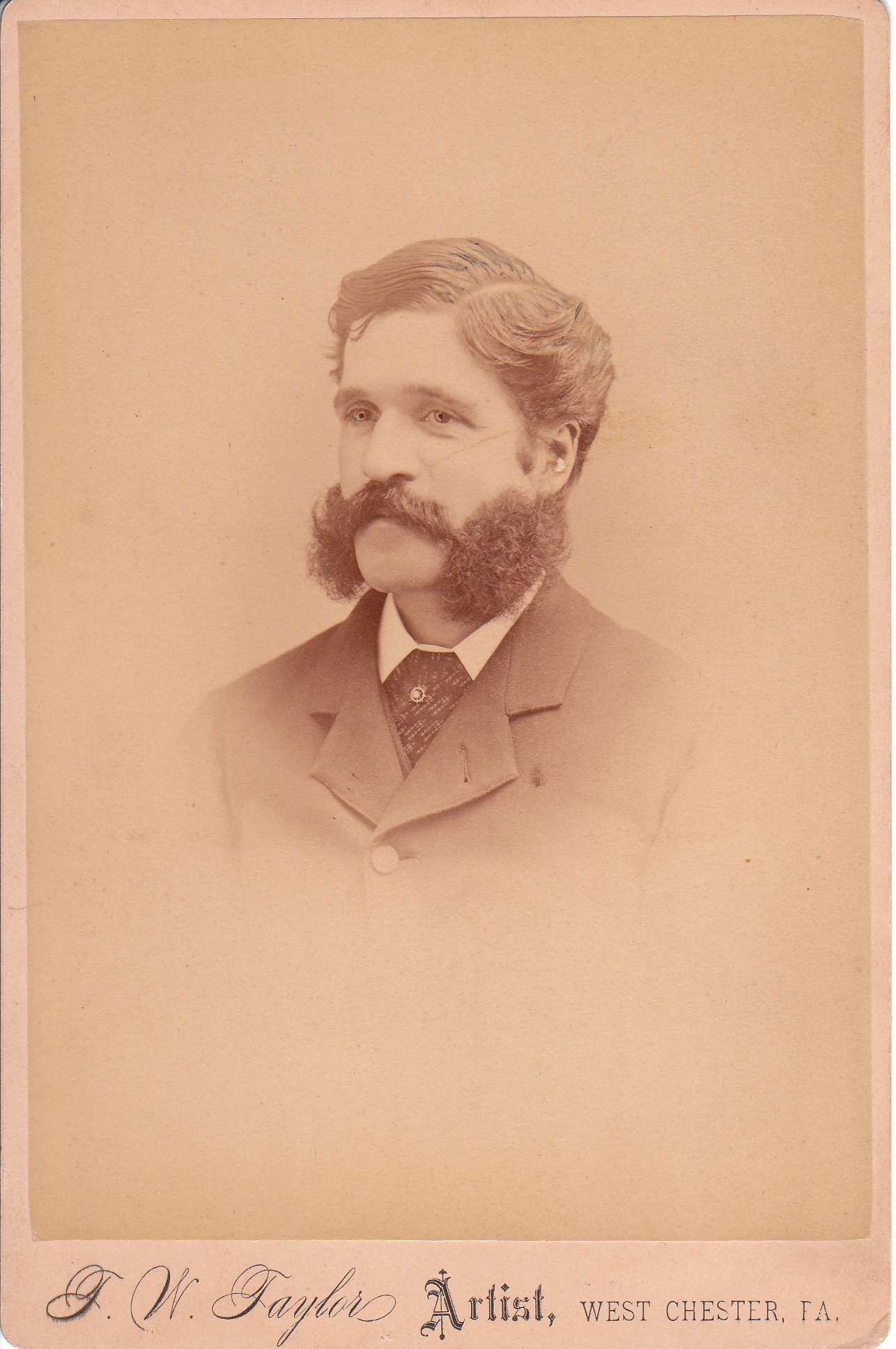
NOVEL MUSTACHE IN WEST CHESTER, PENNSYLVANIA

This cabinet card features a gentleman with an unusual mustache. This style mustache could be labeled an “ear muff mustache”. The mustache looks like the man had been wearing ear muffs and they slid down his face stopping in a position where the furry ear coverings came to rest on his cheek and upper jaw, while the head band settled in a spot above his upper lip and below his nose. To view other interesting and unique mustaches, click on cabinet card gallery’s category “mustaches (Only the Best)”. The photographer of this image is T. W. Taylor. In advertising on the reverse of the photograph he has printed the name of his studio, “First Premium Gallery”. It was located at 10 West Gay Street in West Chester, Pennsylvania. The previous described advertising also indicates that in 1882 the studio won a “prize medal” for its use of Crayons. Thomas W. Taylor (1838-1904) is described by the Chester County Historical Society as operating one of the most prominent studios in West Chester. His photography career was interrupted by the Civil War. Taylor joined Company E of the 124th Regiment of Pennsylvania Volunteers. He fought at Chancellorsville and Antietam. He entered the Union army as a private and mustered out as a corporal. He reopened his studio for business in 1863 and worked into the 1890’s.

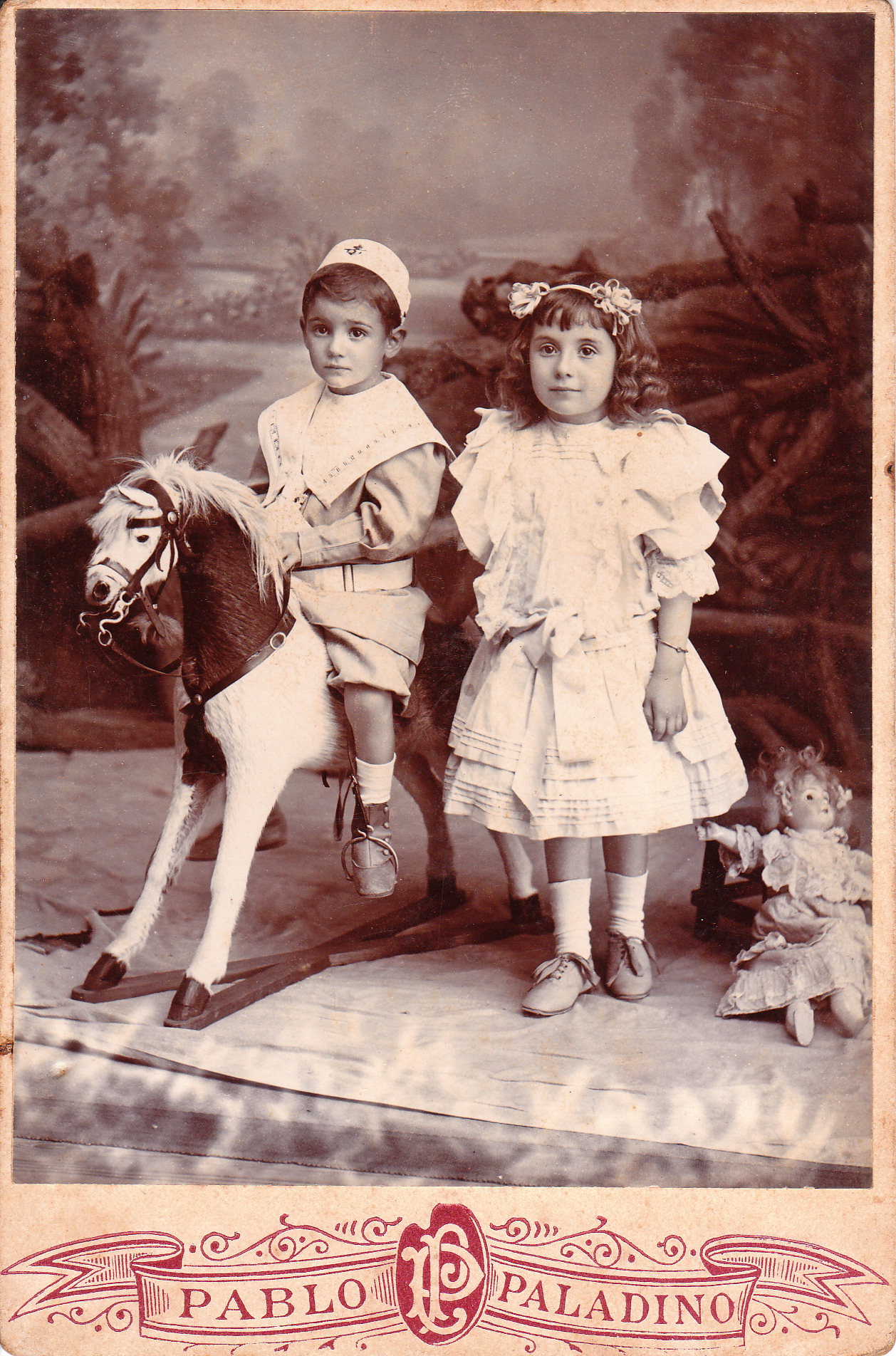
ADORABLE SIBLINGS AND THEIR TOYS IN CANELONES, URUGUAY

The previous owner of this cabinet card asserts that the photographer, Pablo Paladino, operated a photographic studio in Canelones, Uruguay. I have been unable to find confirmation of that claim. The nationality of the cabinet card may be a mystery but it is very clear that this is a wonderful portrait of two young children. They are likely siblings. The boy is siting on a wooden toy horse. The horse is nicely detailed. Note the mane and bridle. The little girl has a doll posed next to her. The girl has a fancy hair band and is wearing a bracelet. The little boy is wearing a cap that has what looks like an anchor design. He, like many little boys of his time, is dressed in the style of a sailor. Hopefully, a visitor to the cabinet card gallery may have some information about photographer Pablo Paladino and will leave a comment with some of his biographical information.

Published in: on July 6, 2012 at 12:01 am  Comments (2)  
Tags: , , ,

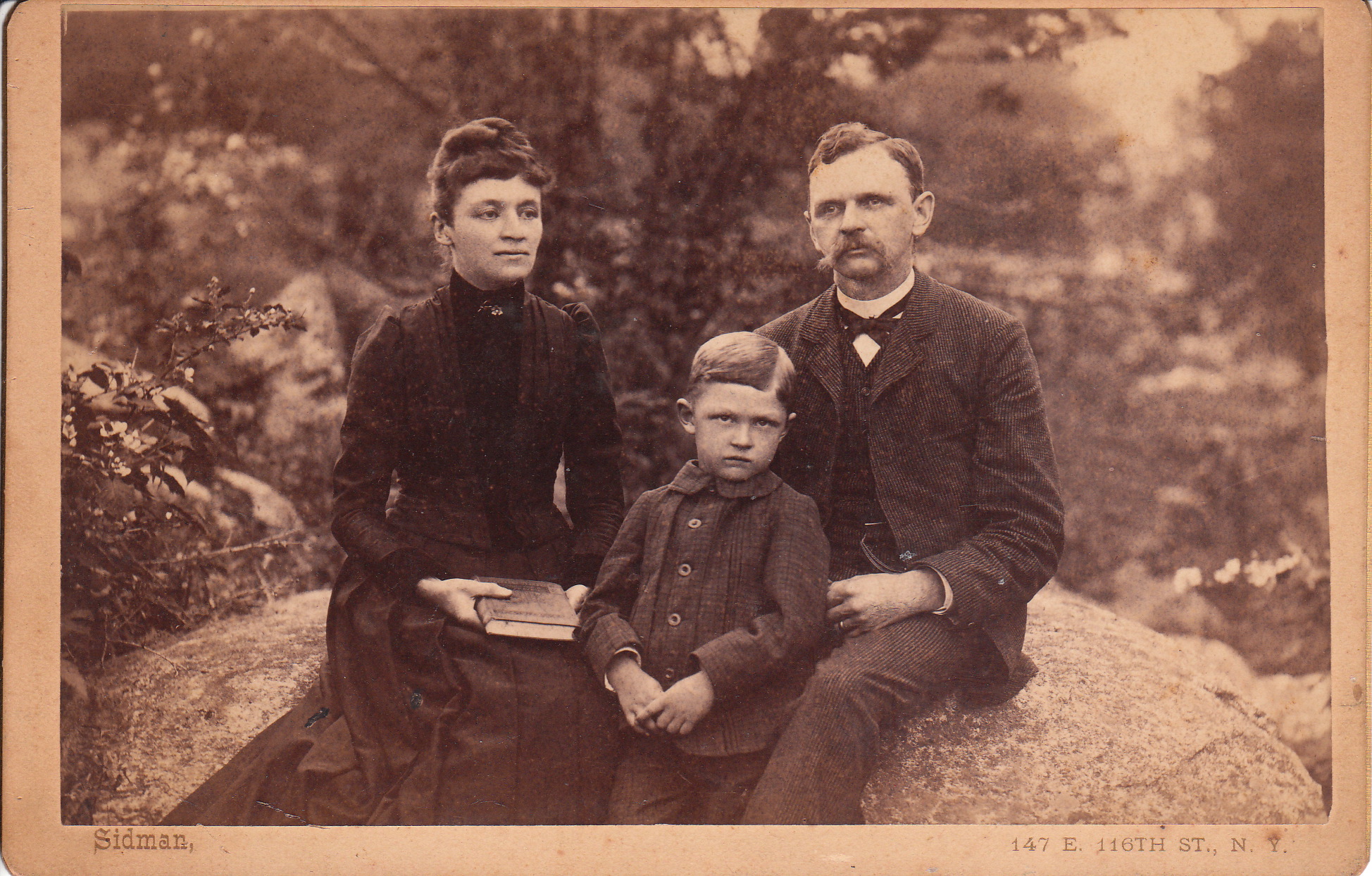
FAMILY OF THREE ON THE ROCKS IN NEW YORK CITY

This cabinet card features a terrific family portrait that may have been taken outside the photographer’s studio. Take a close look at the facial expressions of each of the family members. Dad looks very intense and displeased. Sonny boy is a chip off of the old block. His expression can best be described as sour. Mom looks like she is a lot more fun. She appears to be holding back a smile and has a twinkle in her eyes. The photographer of this image is H. Herbert Sidman. His studio was located at 147 East 116th Street in New York City, New York. Advertising printing on the reverse of the photograph boasts that the studio does “Out-door Work” in addition to the standard “Interiors and Flash-Light Pictures”. If this photograph was indeed taken outside, perhaps it was taken in Central Park. The park was certainly in existence at the time that this photograph was taken.  Central Park is a public park located in the center of Manhattan. It was opened in 1857 on 843 acres and and expansion, designed by Frederick Law Olmsted and Calvert Vaux began in 1858 and was completed in 1873. Research yielded little information about H. H. Sidman. The American Amateur Photographer (1904) carried a story that announced the death of  Sidman and described him as a “well known architectural photographer”. Other references were found confirming Sidman was very involved in the field of architectural photography.

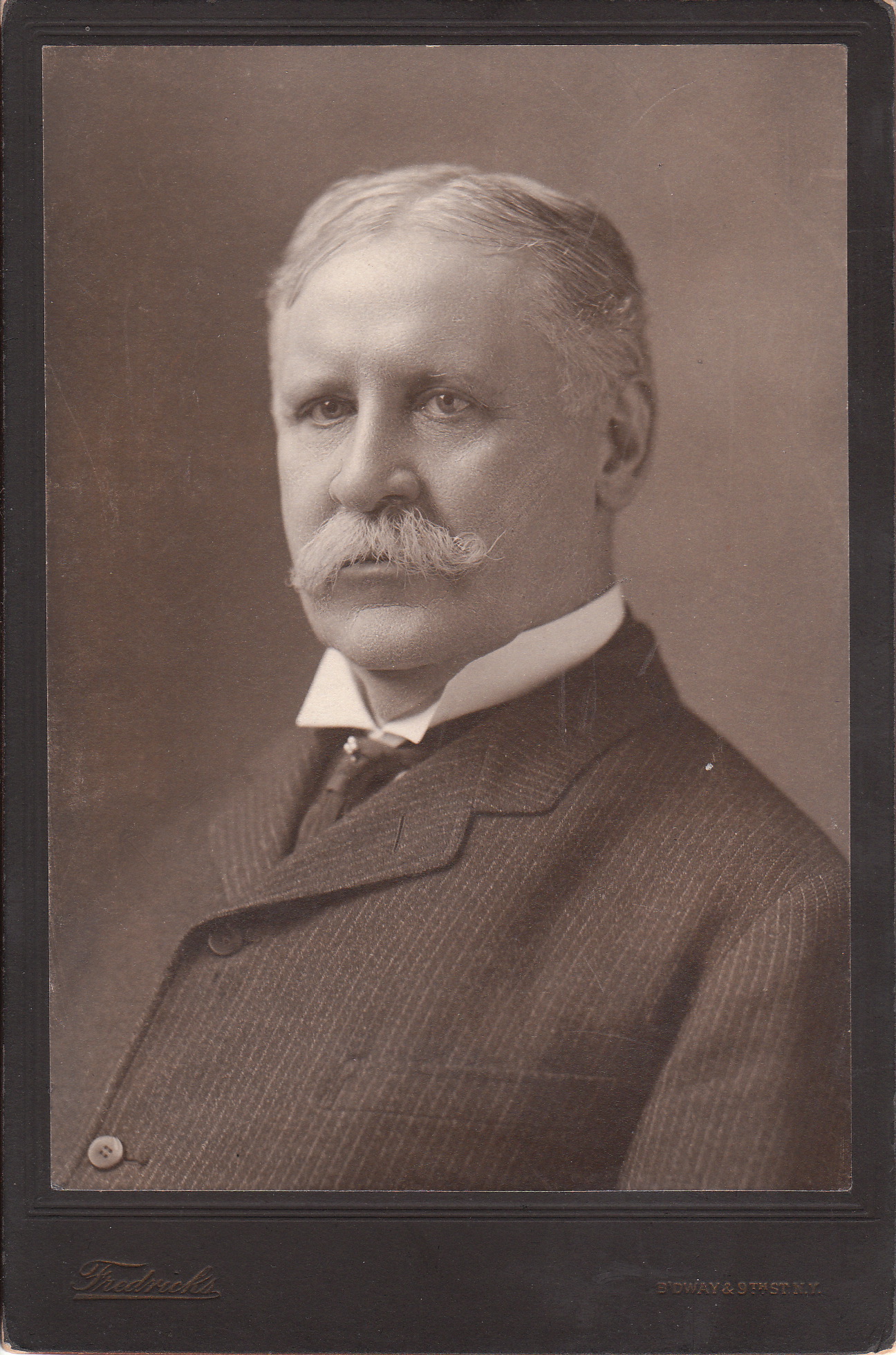
RUFUS B. COWING: NEW YORK CITY JUDGE AND WALL STREET LAWYER

This cabinet card portrait features Rufus Billings Cowing, New York City Judge and Wall Street lawyer. The photograph was published  by Fredricks whose studio was located at Broadway and Ninth Street in New York City, New York. The New York Times (1906) reported Judge Cowing’s retirement from the bench of the Court of General Sessions. He had served for 28 years and had been involved in some sensational criminal and political corruption cases. His career was intertwined with the history of New York City. After leaving the courts, he entered private practice by joining his son’s firm on Wall Street. Cowing was born in Jamestown, New York in 1840. Cowing’s father died when Cowing was just 5 years old. At age 12, he came to New York City where he attended boarding school until he entered the Polytechnic Institute in Brooklyn from which he graduated in 1861. Next, he clerked at a bank for a short while and then decided to enter a law career. He worked for and studied at a New York City law firm for about two years and then entered Harvard University’s Law School, graduating in 1865. He practiced law in New York City and got involved in politics. He had an unsuccessful run for an assembly seat in 1875. He ran as a Republican in a heavily Democratic district and nearly won. Cowing was married twice and had children from both unions. He was married to Hester Tugnot (1866) and Marie Ling (1901). Cowing died in 1920. Charles DeForest Fredricks, the photographer of this image, was a well known New York City photographer who was known to have photographed many celebrities during his career.

ATTRACTIVE SWINGERS IN NAPOLEON, OHIO

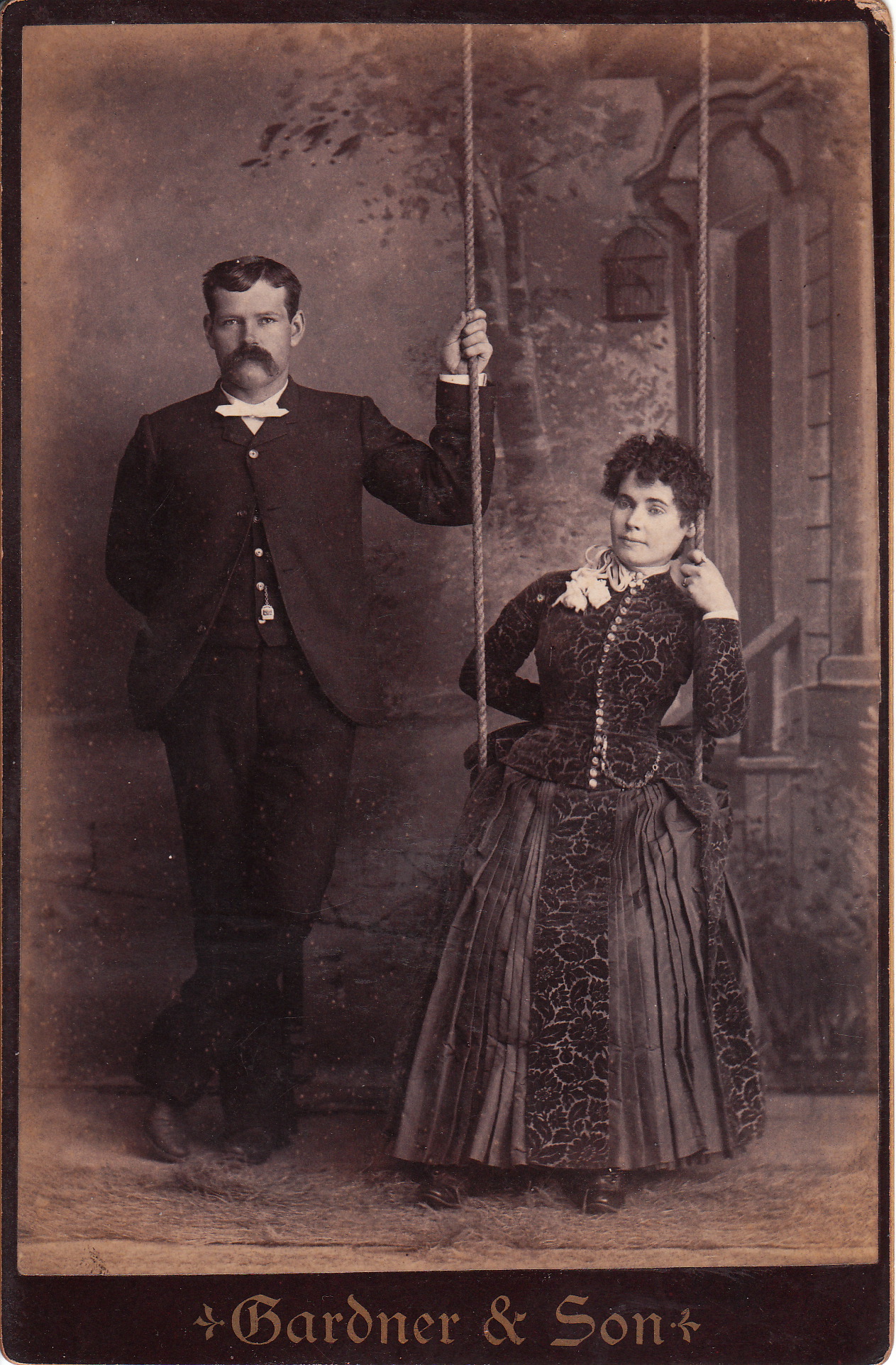
This cabinet card features a handsome couple that likes to swing. The husband is a hunk and the wife is pretty. Both are dressed well. Wait a minute! Where is your mind taking you? I’m not referring to that kind of swinging.  I’m talking about playground type swinging, like kids do.  The photographer of this image is G. W. Gardner & Son: “Photographic And Portrait Artists”. The Gardner studio was located in Napoleon, Ohio. Apparently, many people liked to swing during the cabinet card era and you can see a number of photographs of swingers by clicking on Cabinet Card Gallery’s category “Swing”. George W. Gardner was born about 1829 in Cayuga County, New York. He began as a daguerreotype artist in Seneca County, Ohio in about 1850. He moved to Napoleon in 1865 and operated a studio from about 1870 until about 1900. He was assisted by his son George W. from about 1880 through about 1900. (George W.  following in his fathers footsteps is reminiscent of  another George W. following in his father’s footsteps slightly more than a century later). Later a second son, Cecil L. (1875-1960), followed his father and brother’ career path (are you reading this, Jeb?). George W. Jr also had two children enter the photography business in Napoleon.  Joseph Gardner (1873-?) was a photographer and Mary D. Gardner was a photo retoucher. Both were active in 1900. To view other photographs by the Gardner studio, click on the category “Photographer: Gardner”.

LILLIE PRUSH: BEAUTIFUL ACTRESS OR BEAUTIFUL SCHOOL TEACHER

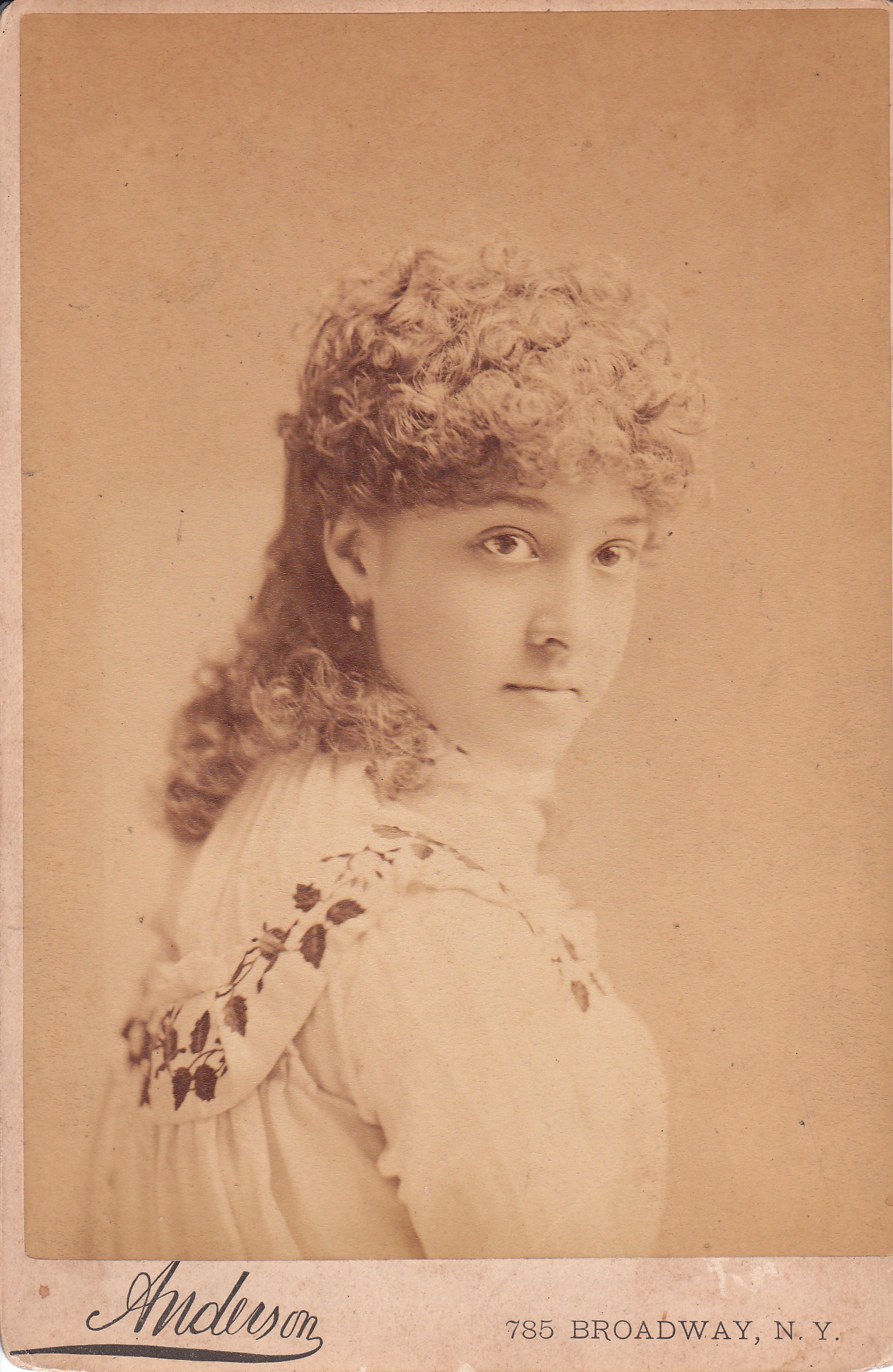
The beautiful woman in this cabinet card portrait is unidentified despite the existence of evidence that should facilitate identification. One possibility is that the subject of this photograph is an actress. Evidence pointing toward the acting profession include her beauty as well as the fact that she was photographed by D. H. Anderson, a renowned New York City theatre photographer. Obviously not all beautiful women are actresses and Anderson didn’t exclusively photograph theatre stars. Further evidence exists that points the search for the subjects identity in another direction. An inscription on the reverse of the photograph reveals the subjects name, “Lillie Prush”. However, life is rarely that easy; there is a complication. Due to legibility issues, the inscription might actually read “Lillie Roush” or “Lillie Raush”. I contend that the name is “Lillie Prush” and the 1880 US Census finds a Lillie Prush living in New York City. Miss Lillie was a school teacher. She was born in 1859 and lived with her parents and brother. Her father, J. E. Prush, owned a furnishing store and her brother was a civil engineer. If this photograph is an image of Miss Lillie, a New York City school teacher, than she must have certainly commanded the attention of the older boys in her classes. There must have been a lot of crushes in her classroom. Here is one final observation. Note the ivy pinned to the shoulder and back of Lillie’s dress. Do you think this small prop adds to or detracts from the photograph? To view other photographs by Anderson, click on category “Photographer: Anderson (New York)”.

Published in: on July 1, 2012 at 12:01 am  Comments (2)  
Tags: ,