

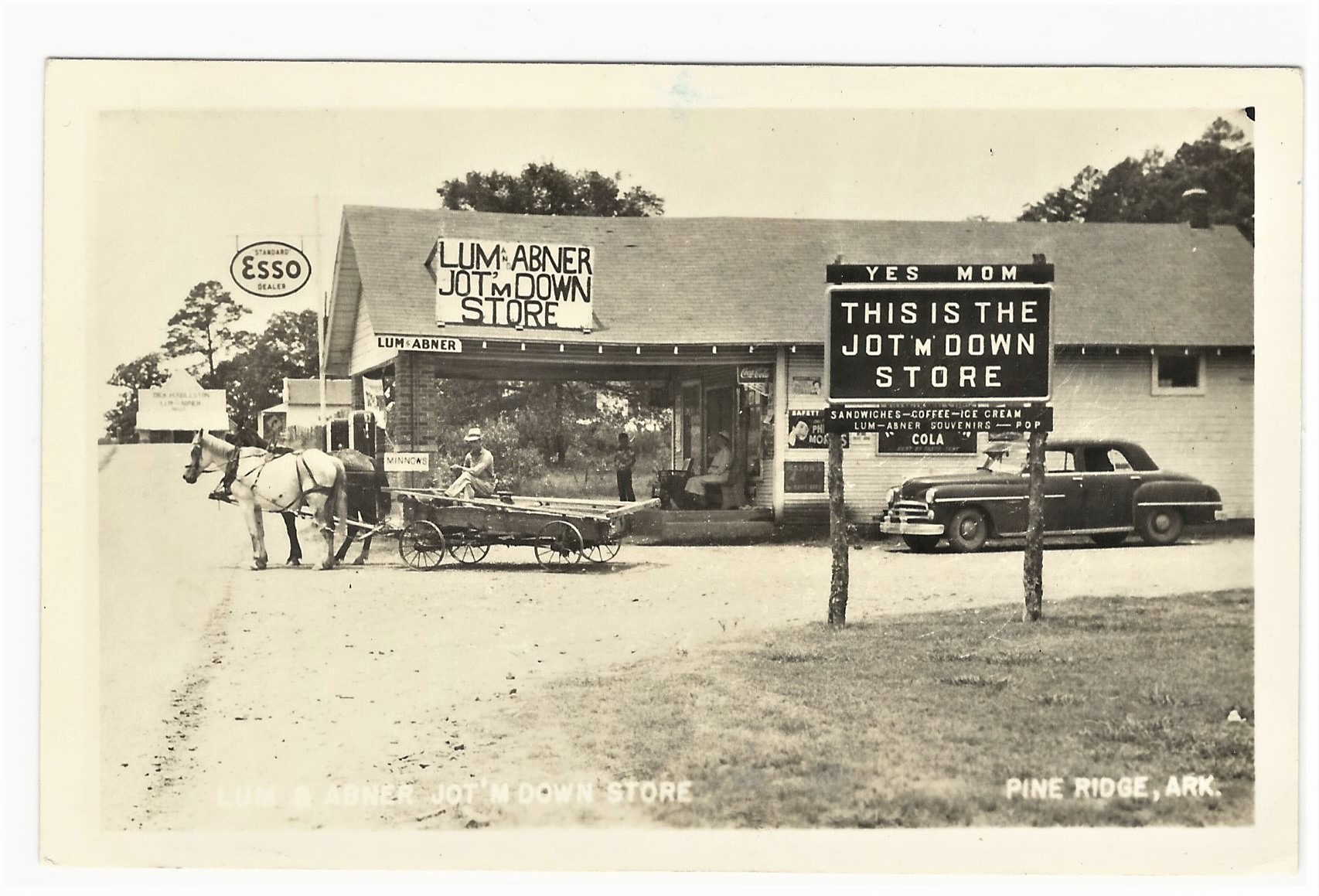
This vintage real photo postcard features the Lum & Abner Jot m Down Store. The business was located in Pine Ridge, Arkansas. Chester “Chet” Lauck (Lum Eddards) (1901-1980) and Norris “Tuffy” Goff (Abner Peabody) (1906-1978) operated the Lum & Abner” comedy radio show. They were the creators, actors, writers, sound effects men, and directors of the program.They received more fan mail than any other radio program of their time. They began as young amateur performers in Mena, Arkansas; the town where they grew up together. The duo entertained at school and civic functions. They were invited to perform at a Hot Springs, Arkansas radio station. They performed their old country storekeepers routine there. They must have shown much talent because they were offered a 13 week contract with NBC and were sponsored by Quaker Oats. The pair’s radio show was founded with an interesting focus. In small towns like Pine Ridge, the general store was the center of activity. The radio show followed fictional residents of the town. Of course, all the characters were played by Lauck and Goff. If you were to travel to Pine Ridge, you would find the Lum “n” Abner Museum and General Store. After entering show business the pair were required to move around and in 1939 they moved to Hollywood to make movies. Between the late 1930’s to the early 1950’s they made seven films. Even during their film careers, Goff and Lauck continued their radio programs. These radio personalities were “big time”. Their sponsors included Quaker Oats, Ford Motors, General Motors, and Alka Seltzer. This postcard has some interesting signage. There is an “Esso” sign and gas pumps. Posted signs advertise Phillip Morris (cigarettes) and Coca Cola. There is also a sign indicating that the store sells fishing bait (minnows). It is interesting to note the contrast of the parked car and the horse drawn wagon. An inscription on the reverse of the postcard indicates that it was purchased in 1955 as a souvenir. This postcard is in very good condition (see scans).
Buy this Vintage Real Photo Postcard (includes shipping within the US) #3137
To purchase this item, click on the Pay with PayPal button below



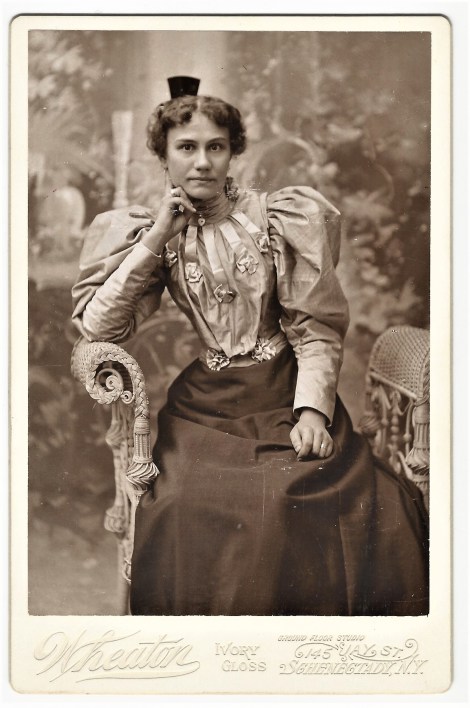
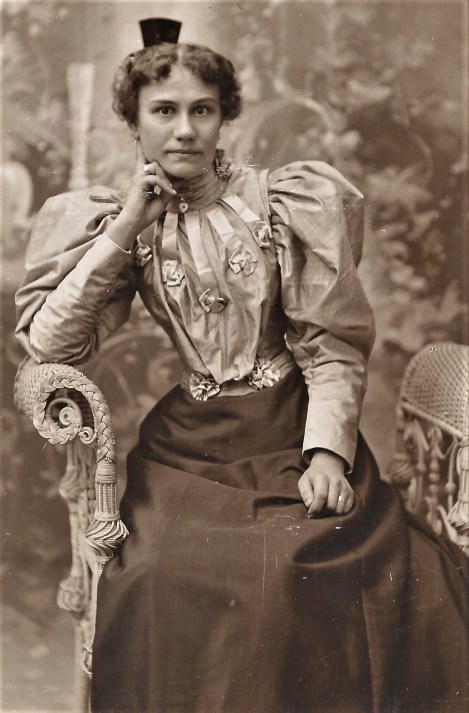 A pretty woman sits in a wicker chair poses for her portrait at the Wheaton studio in Schenectady, New York. She appears pensive as she looks at the photographer. The woman is well dressed. Her blouse has “leg o mutton” sleeves. Such sleeves are voluminous around the biceps and shoulders while fitted at the lower arm and wrist. They became popular between 1825 and 1933. The style reappeared in fashion in the 1890’s and was gone by 1906. It was during the reemergnce of “leg o Mutton” sleeves that this photo was taken. The photographer of this image is Van B. Wheaton (1870-1948). The Anthony Photographic Bulletin (1897) reports Wheaton winning a medal at a photography exhibition. His son, Ivan P. Wheaton was a World War I aviator, race car driver, author, and photographer. SOLD
 PHOTO 1
 PHOTO 1 (CLOSE-UP)
 PHOTO 2
 PHOTO 1
 PHOTO 2
 This carte de visite photograph features an impeccably dressed adolescent boy. He is decked out in a three piece suit and has a pocket watch, walking stick, and long coat. This fashionista fellow looks like he walked off the pages of “Gentleman’s Quarterly”. The photographer of this exceptional CDV is Heinrich E. Herkner. He operated a studio in the city of Gablonz, which is the German name for a city located in present day Czechoslovakia. The city is now named Jablonec. SOLD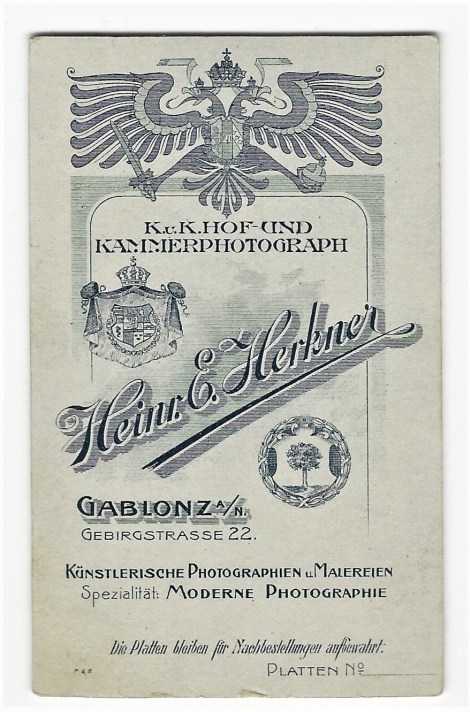
 This vintage real photo postcard offers a street view of Dobson’s Store, in Stoystown, Pennsylvania. Three upstanding citizens of the town can be seen in the photograph. Note that the thoroughfare is a dirt road. There are a number of posts in front of the sidewalk. I wonder it they were used to hitch horses. This postcard was published by G S Dobson; the proprietor of Dobson’s Store. The 1910 US census lists George S. Dobson (1863-1944) as a merchant (department store). He was married to Ellen L Dobson (1867-1947), nee Straub,for 26 years. George and Ellen lived with their son Albert (age 21), daughter (age 4), and Ellen’s sister. Albert worked as a salesman in the family business. The 1920 US census finds the family intact, but both George and his son were unemployed. Here is some information about Stoystown, the home of George’s store. The town is part of the Johnstown, Pennsylvania Metropolitan area. Originally the site of Stoystown was an encampment and a supply depot during the French & Indian War. The town was founded by hunter Daniel Stoy in 1774. Stoy later served in the Revolutionary War. Stoysville is near the site where flight 93 crashed on September 11th, 1001. SOLD
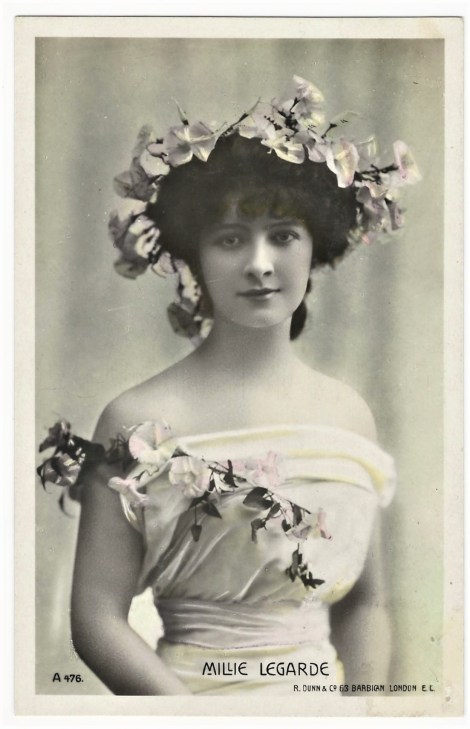 The beautiful woman in this vintage real photo postcard is Millie Legarde. She was an actress and a singer. She was active in her career between 1898 and 1911. She was a sitter for eight portraits in Great Britain’s National Portrait Gallery. She performed in numerous theater productions and in one film (1905). Searching for biographical information about Miss Legarde was like looking for a needle in a haystack. Preliminary research revealed that she appeared in many plays. Newspaper articles of the time, mention her name, but provide little information. It’s as if she was in the “witness protection program” and nearly all information about her has been scrubbed. Millie posed for a number of postcards but this card is certainly the nicest one I’ve seen. This postcard was published by Ralph Dunn & Company which operated out of London, England. The card is part of a series (no.A476). The postcard was manufactured in Berlin, Germany. (SOLD)




 THE CABINET CARD GALLERY
Buy this Vintage Real Photo Postcard (includes International shipping outside the US) #3137
To purchase this item, click on the Pay with PayPal button below
$26.00