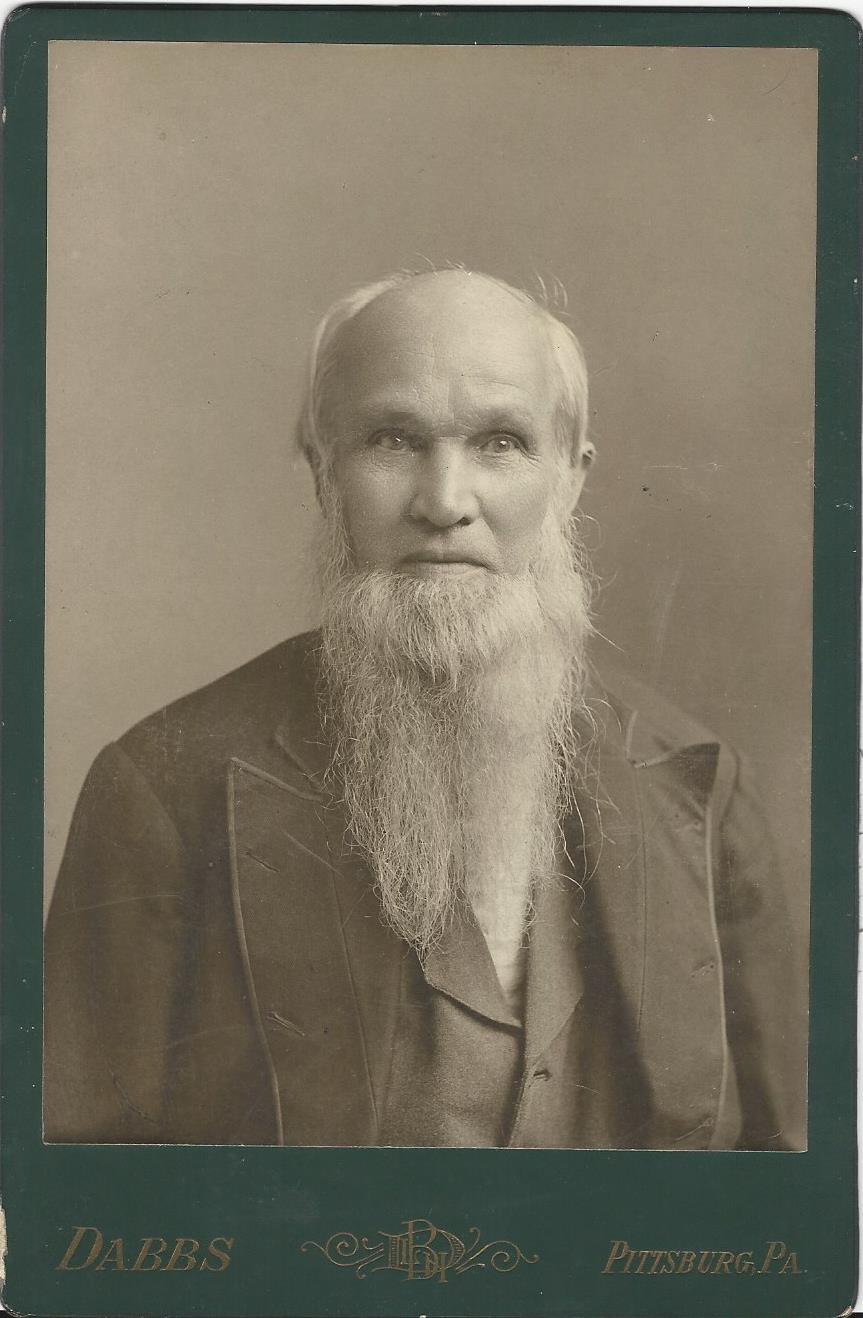
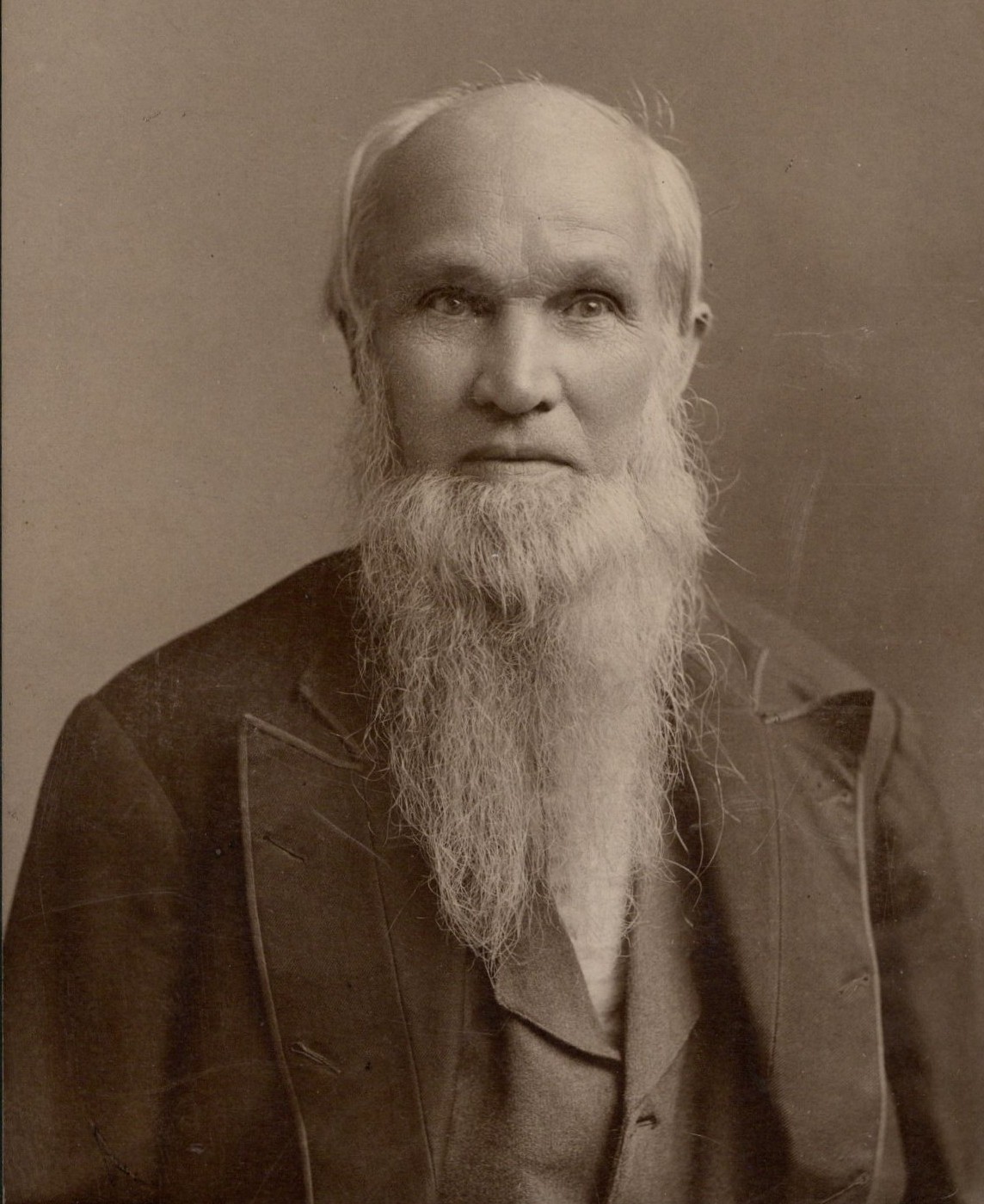
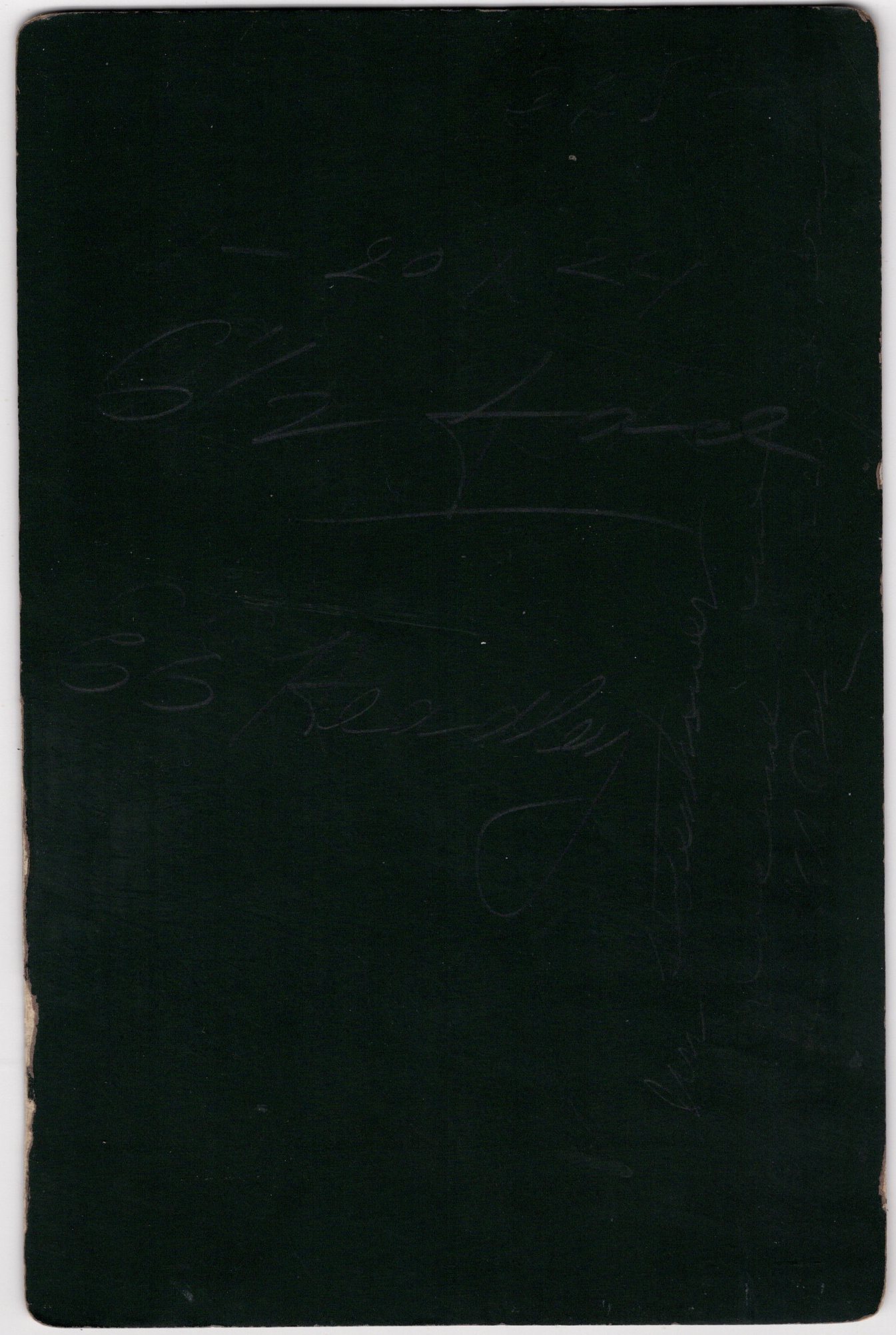
This cabinet card portrait features a well dressed handsome older gentleman with a wonderful long white beard. The man has striking eyes. They are bright and soft and he projects a certain sweetness and friendliness. This photograph was produced by the Dabbs gallery in Pittsburg, Pennsylvania. Benjamin Lomax Horsley Dabbs was born in London in 1839. He immigrated into the United States while still in his childhood. His father was a pioneer in the American photographic supply trade. Dabbs learned the photography field from his father, George Dabbs. Benjamin came to Pittsburgh in 1861 and opened a business selling photography supplies. That same year he also bought a gallery from a Mr. Rorah. He grew the business dramatically and in 1869 he sold his supply business to concentrate on being a photographer. During his tenure as a photographer in Pennsylvania, he was considered by many to be the best photographer in the state. In 1868 Dabbs married Sadie Dickson and the couple ultimately had nine children. Dabbs was a close personal friend of Abraham Lincoln and steel magnate Andrew Carnegie. Dabbs drew some attention for his stance on free resittings for customers who were not satisfied with the portraits taken by his studio. Unlike many other photographers, he refused free resittings because “the public do not value what they can get for nothing”. In his later years, Dabbs was debilitated by rheumatism and other illness. He died at age sixty in 1899. His celebrated portrait of Andrew Carnegie can be viewed today at Pittsburgh’s Carnegie Museum of Art. There is very light writing on the reverse of the cabinet card. The writing includes the name E. E. Headley. This cabinet card has minor edge and corner wear and is in overall good condition (see scans).
This Cabinet Card is available for purchase at my store, The History Peddler, for $36.00
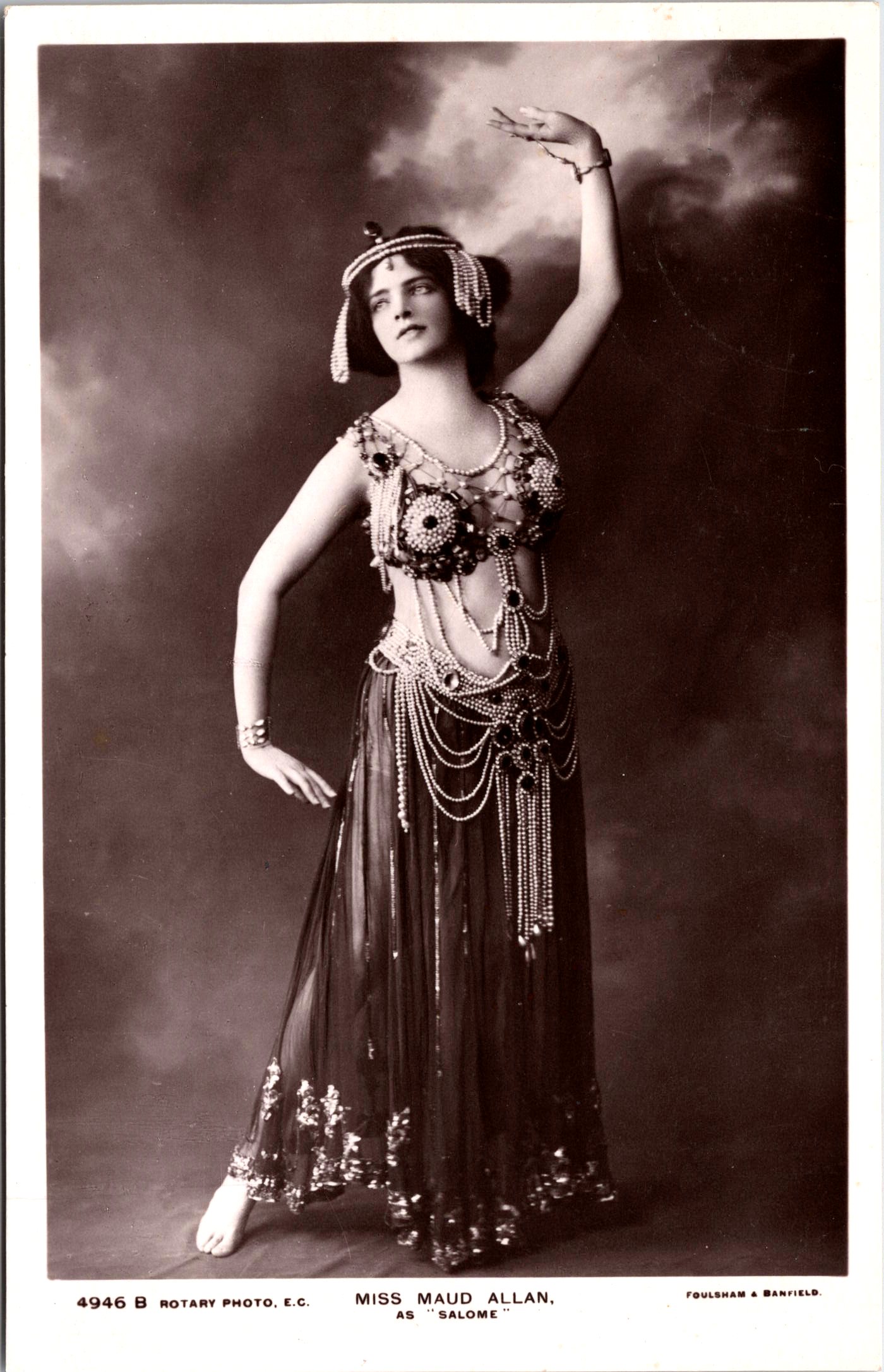
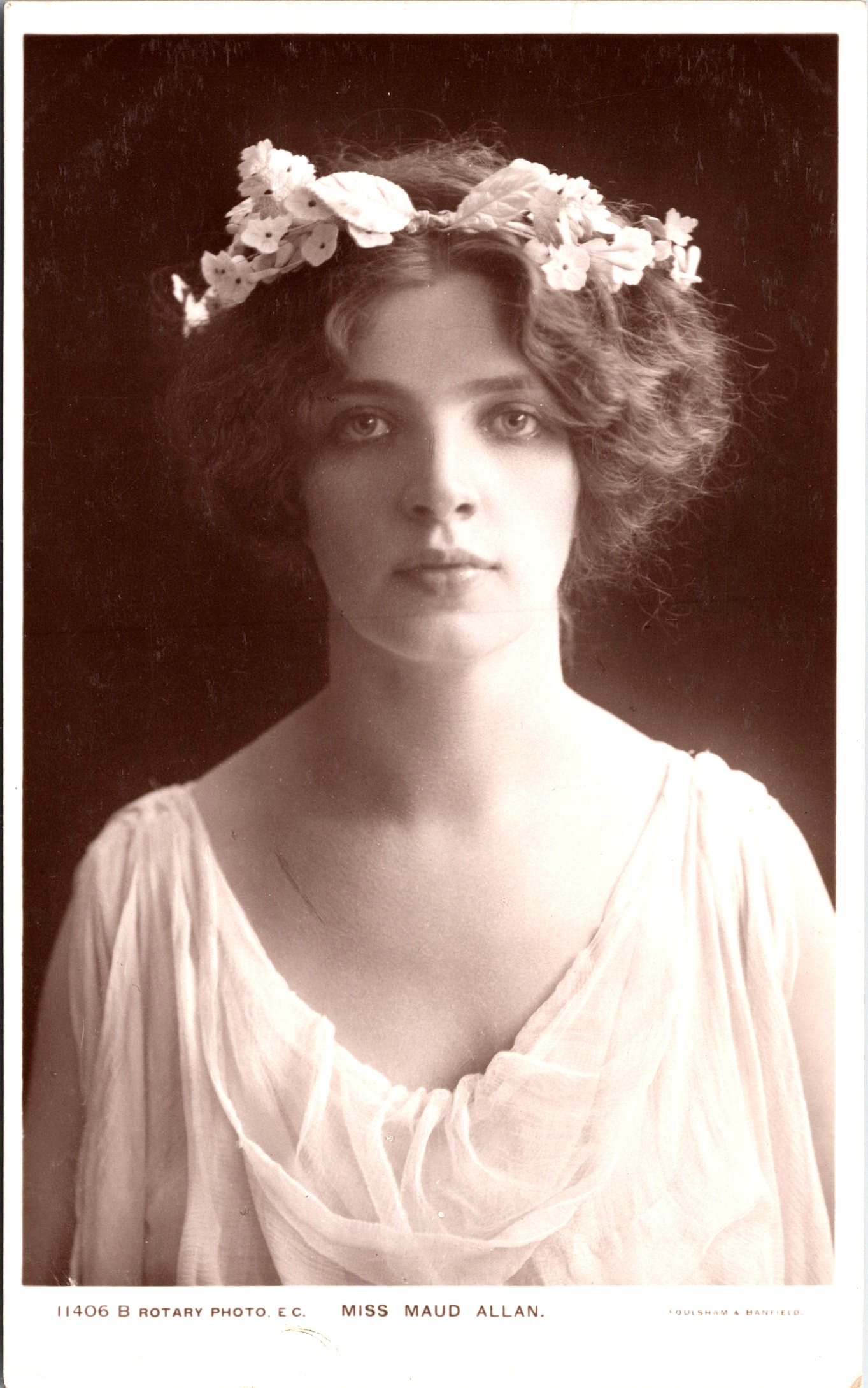
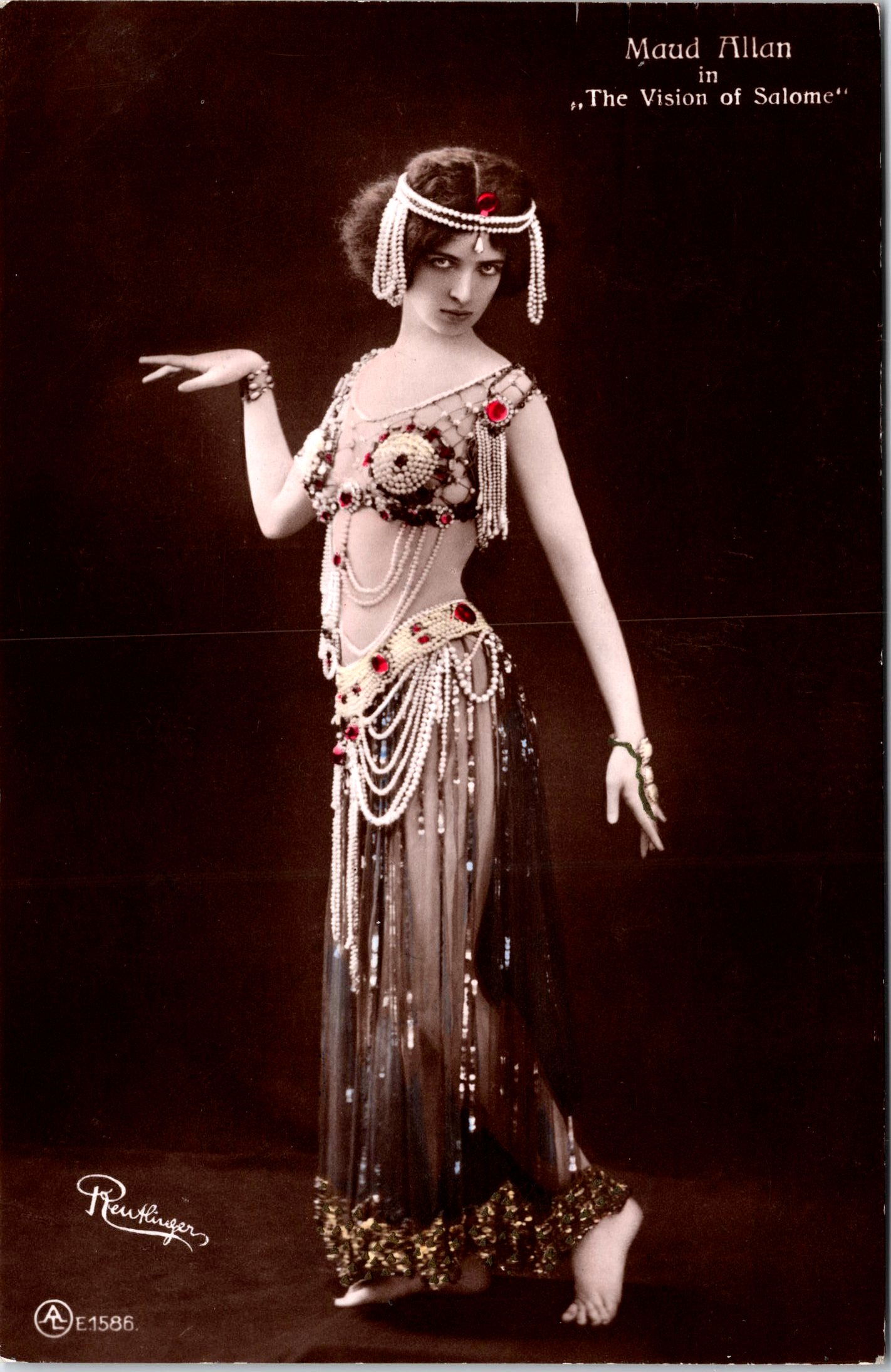
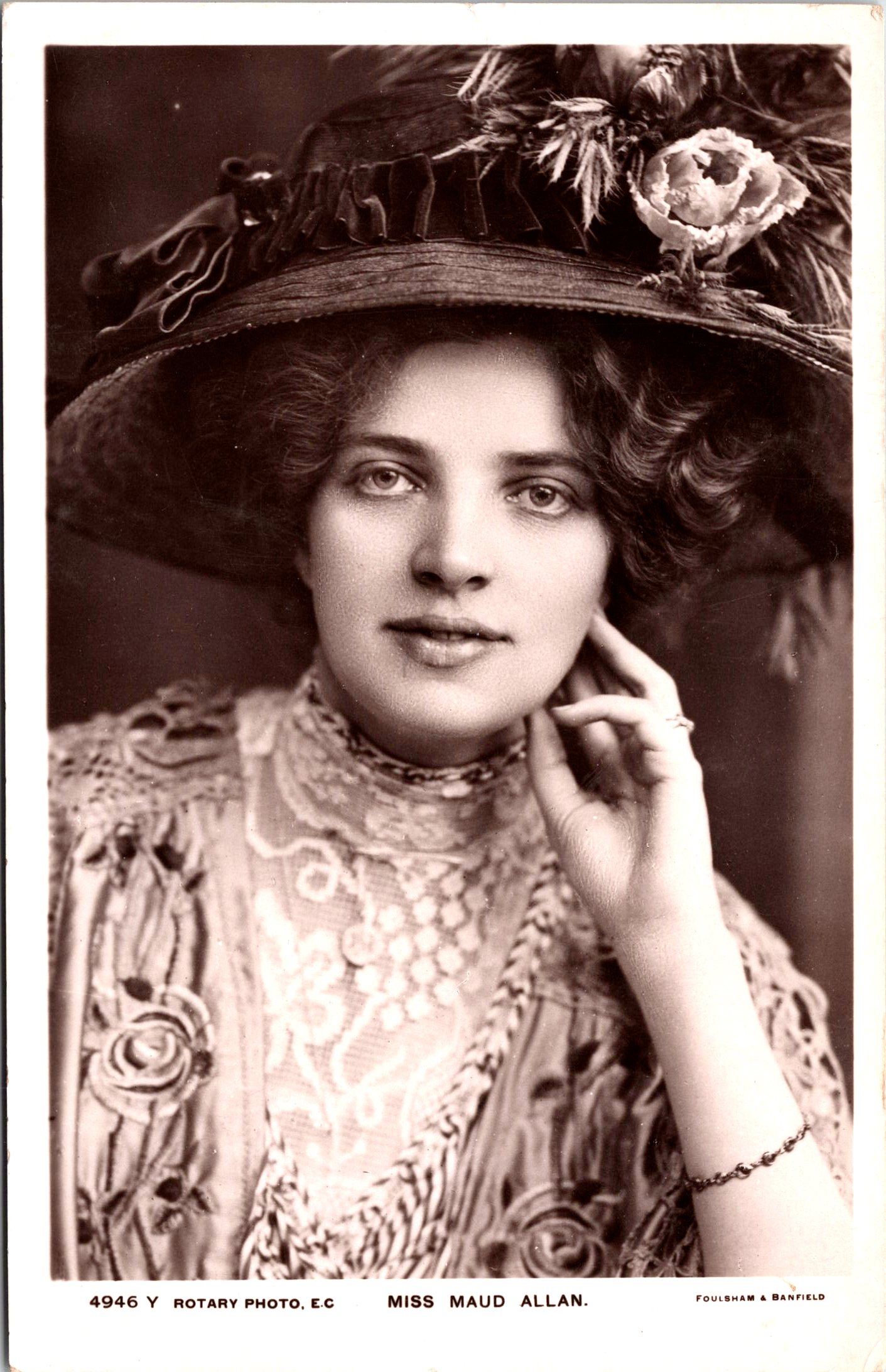
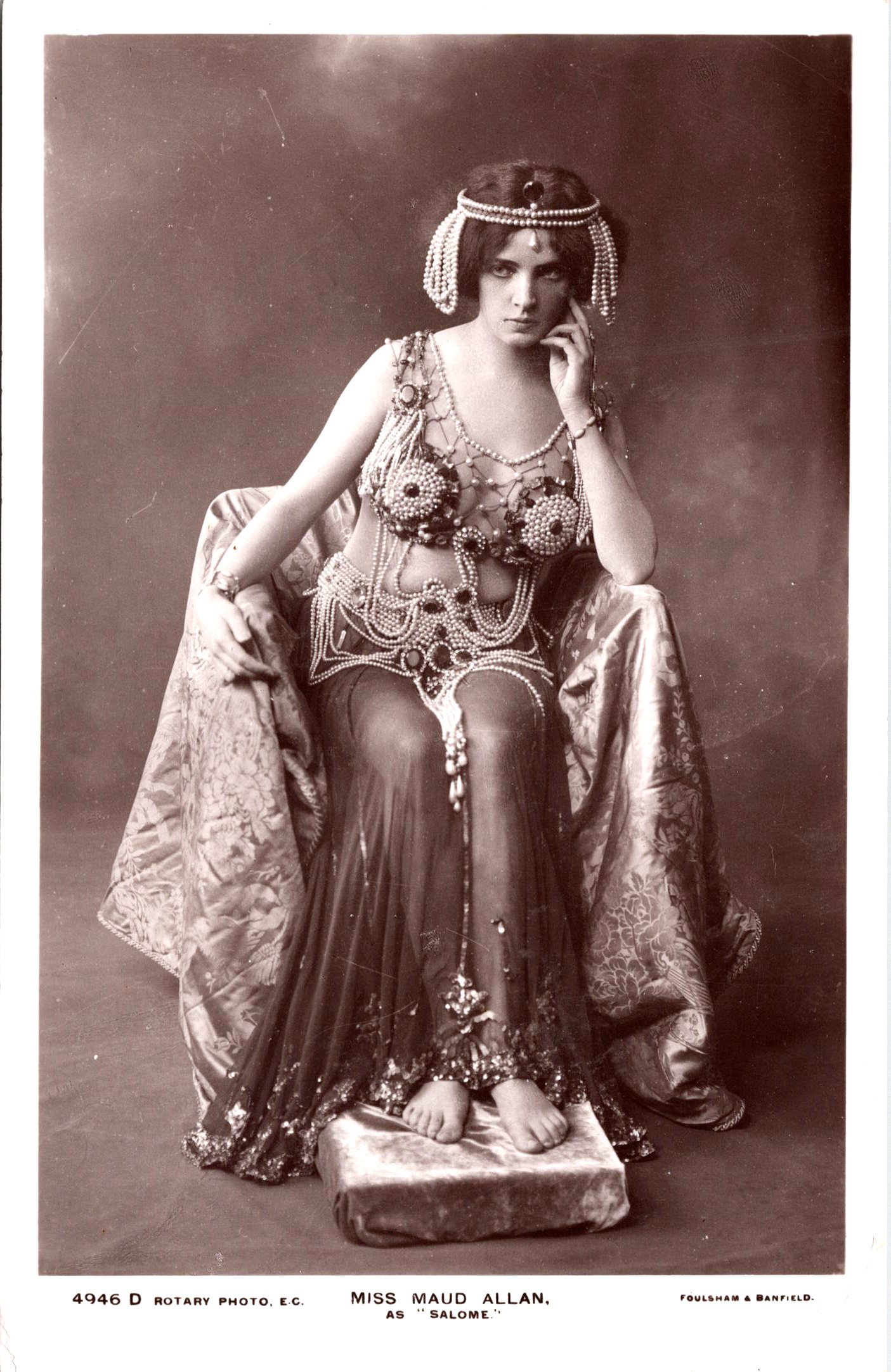
These risque vintage real photo postcards feature Maud Allan (1873-1956). She was a Canadian-born dancer, choreographer, and actress, who performed in the United States and Europe at the turn of the 20th century. She was known for her performances of the “Vision of Salome”, an interpretive dance based on the Oscar Wilde play “Salome”, in which she portrayed the title character. Allan’s performances were controversial and often drew criticism for their erotic content. She also was known for her court case in 1918 against a British newspaper, the Illustrated Times, who published an article accusing her of promoting immorality and lesbianism. She sued for libel and won. In regard to Allan’s sexual orientation, she was a lesbian and was involved with women her entire life. She had a long affair with Margot Asquith, the wife of Herbert Henry Asquith, the Prime Minister of the United Kingdom from 1908 through 1916. Allan also had a long affair with Verna Aldrich, her secretary.
Postcard 1 presents Allan dancing as “Salome”. She is wearing a sexually provocative costume. She is covered with jewelry. This postcard was published by Rotary Photo as part of a series (No.4946B). Miss Allan’s photograph was taken by the Foulsham & Banfield studio. An inscription on the card’s reverse reveals that the card is from 1908. (SOLD)
Postcard 2 This postcard also presents Allan dancing as “Salome”. Once again, she is wearing a sexually provocative costume and is covered with jewelry. This postcard was published by Rotary Photo as part of a series (No.4946Q). Miss Allan’s photograph was taken by the Foulsham & Banfield studio. This card is from circa 1908. (SOLD)
Postcard 3 is rare. The card captures Miss Allan wearing a sexually provocative costume. She is covered with jewelry. This postcard was published by Rotary Photo as part of a series (No.11406B). Miss Allan’s photograph was taken by the Foulsham & Banfield studio. This card is from circa 1908. (SOLD)
Postcard 4 is a risque vintage postcard that was published by Aristophot. Allan’s photograph was taken by Leopold Reutlinger as part of a series (no.E1586). This Salome postcard has a 1908 postmark. (SOLD)
Postcard 5: Most vintage postcards of Miss Allan, capture her in various risque poses during her performance in “Salome”. This uncommon postcard portrait captures her well dressed and elegant looking. This card is uncommon and was published by Rotary Photo as part of a series (No.4946Y). Miss Allan’s photograph was taken by the Foulsham & Banfield studio. This card has a 1906 postmark. (SOLD)
Postcard 6 features Maud Allan in an erotic costume as she plays “Salome”. This postcard was published by Rotary Photo as part of a series (No.4946D). Miss Allan’s photograph was taken by the Foulsham & Banfield studio. (SOLD)
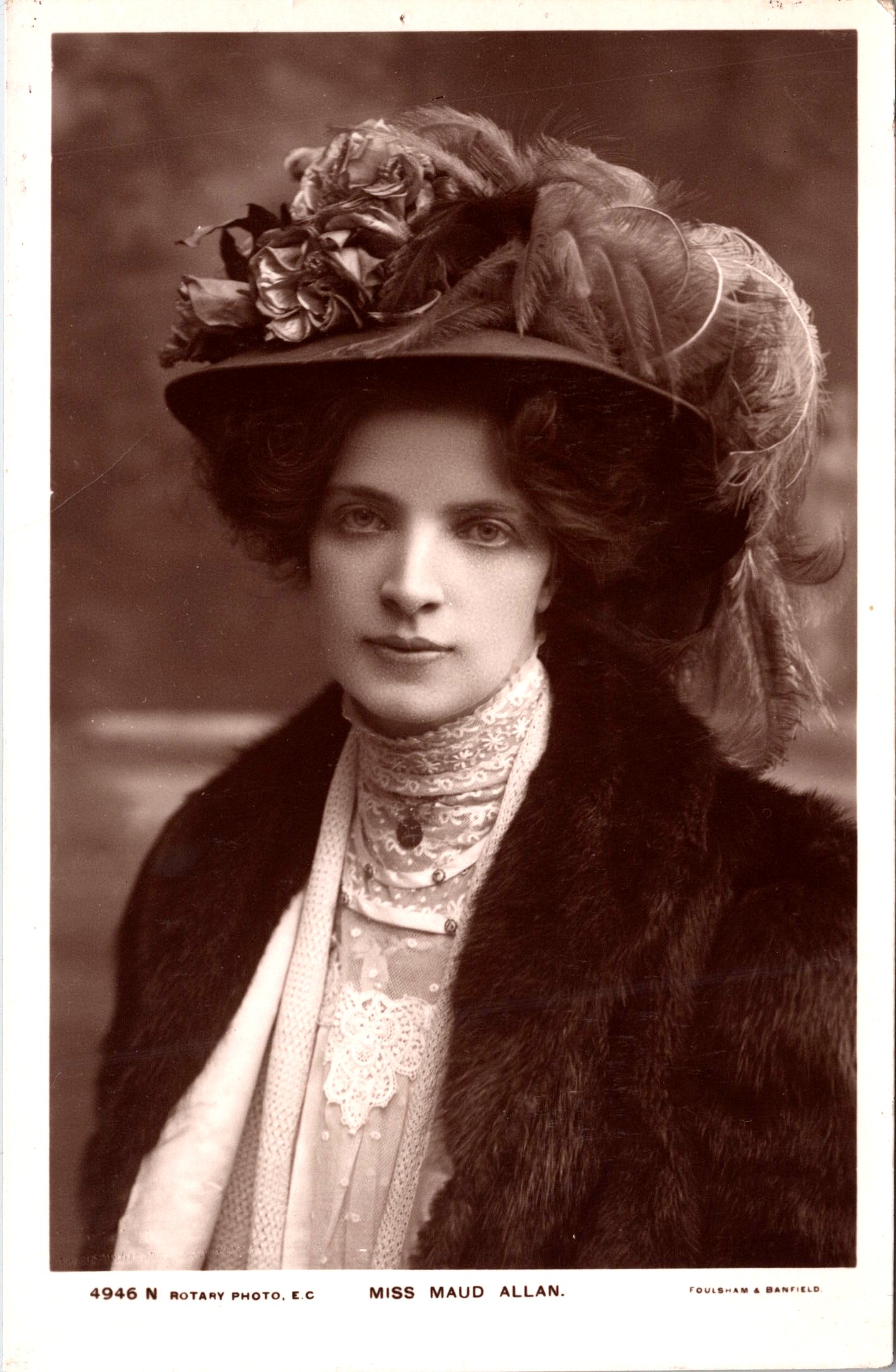
Postcard 7 was published by Rotary Photo as part of a series (No.4946N). Miss Allan’s photograph was taken by the Foulsham & Banfield studio. This postcard features Allan radiating an aura of refined elegance and timeless beauty. Her attire is a masterful display of Edwardian fashion. She wears a high-necked lace blouse adorned with intricate detailing, lending her an air of sophistication and grace. Over this, she dons a luxurious fur coat that adds richness and depth to her ensemble. Around her neck, a delicate pendant peeks out, suggesting a taste for understated yet exquisite jewelry. Her hat is a work of art in itself, lavishly adorned with roses, feathers, and ornate embellishments. The elaborate design frames her face beautifully, complementing her delicate features. Her hair, arranged in soft, voluminous curls beneath the hat, enhances her classic femininity. Maud’s expression is serene yet captivating, her slightly parted lips and soft gaze conveying both intelligence and an enigmatic charm. Her eyes hold a quiet confidence, suggesting a woman of depth, creativity, and individuality. Altogether, Maud Allan’s appearance in this postcard speaks to her remarkable beauty, not only in her physical features but also in the grace and character she exudes. She appears as a woman who is elegant, enigmatic, and effortlessly captivating. (SOLD)
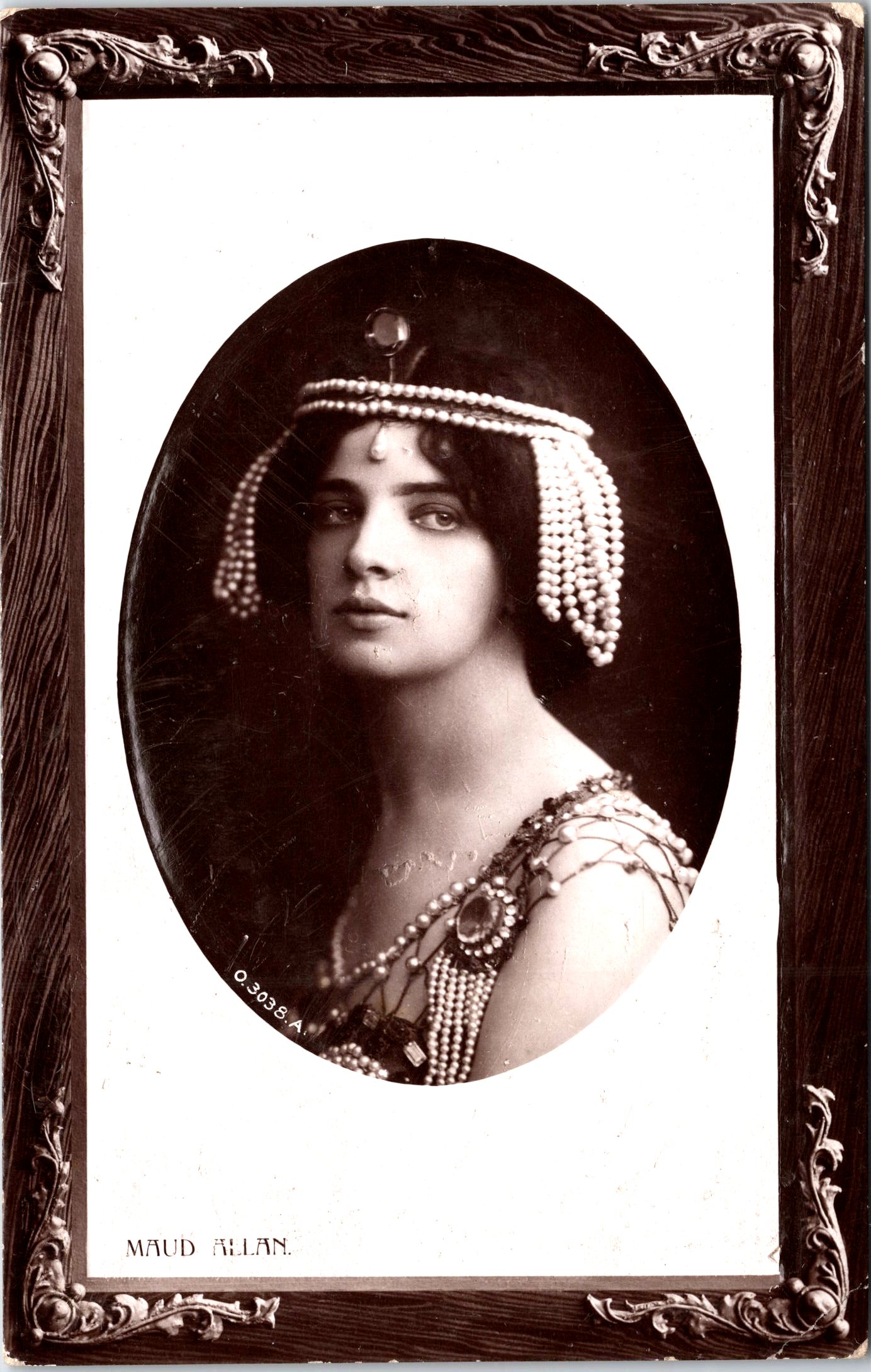
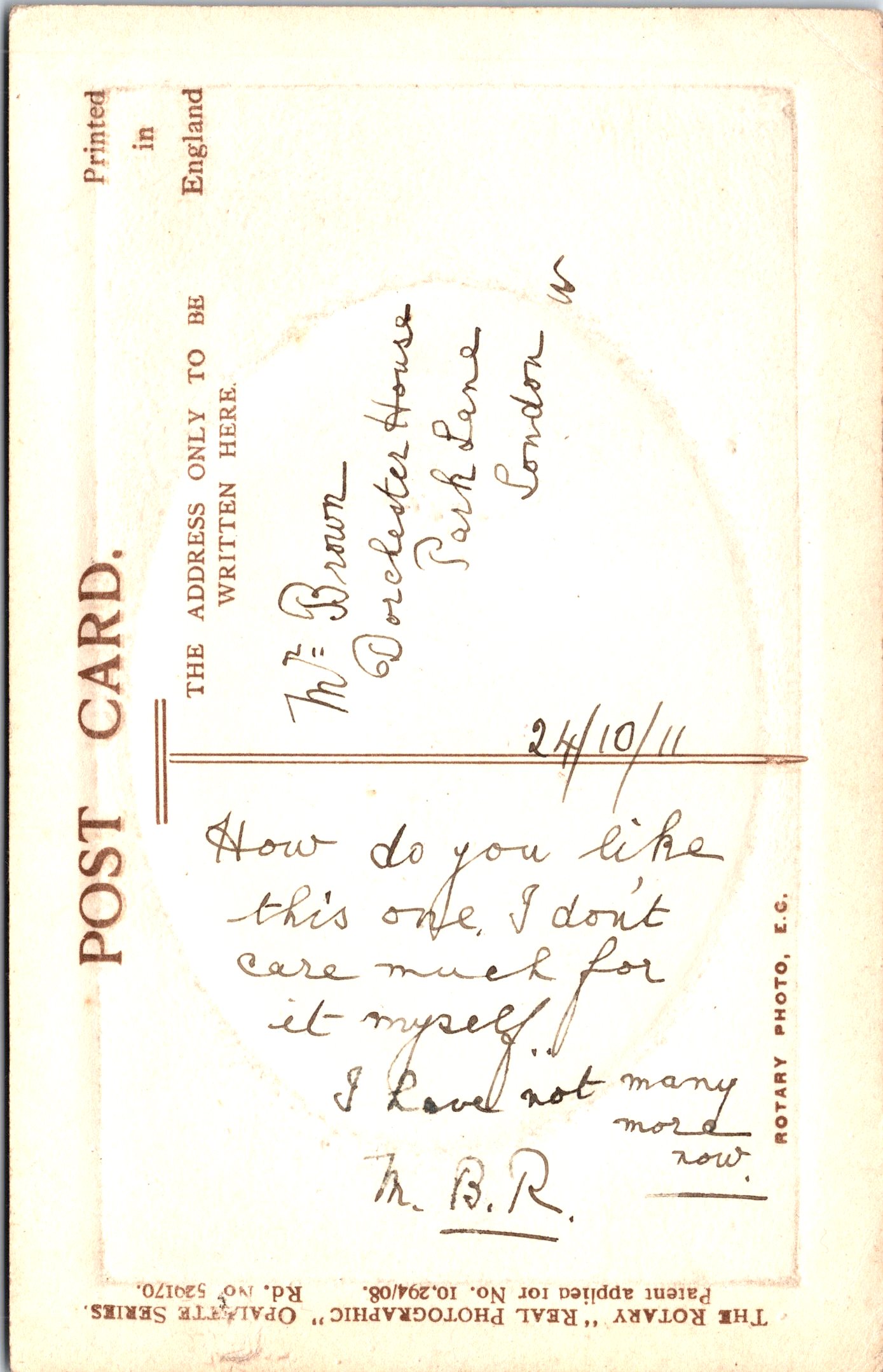
Postcard 8is a portrait of Allan wearing an elaborate costume: strands of pearls draped across her shoulders and chest, a large bejeweled ornament on her bodice, and a pearl headdress with a central jewel resting on her forehead. Her dark hair frames her face, and she gazes with a calm, slightly enigmatic expression. The overall mood of the image is both theatrical and regal, emphasizing her role as a stage performer who often blurred the line between classical dance and sensual spectacle. The postcard was published by Rotary Photo as part of their “Opalette” series. The ornate printed “frame” around the oval portrait adds an additional decorative touch. The postcard has a divided back and there is a handwritten note dated in 1911. The correspondence reads: “How do you like this one, I don’t care much for it myself. I have not many more now. Th. B.R.” It is addressed to a man located in London.(SOLD)
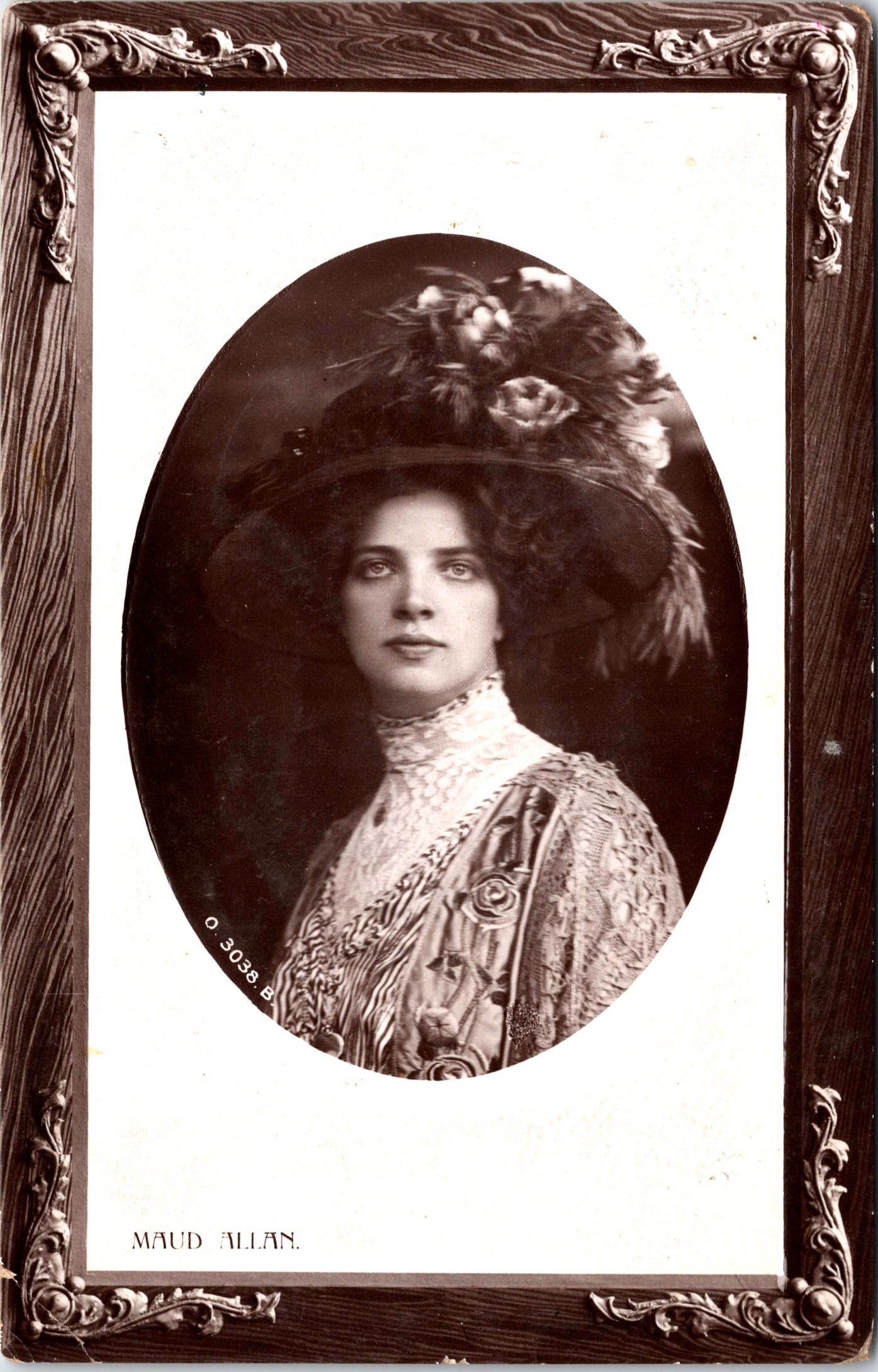
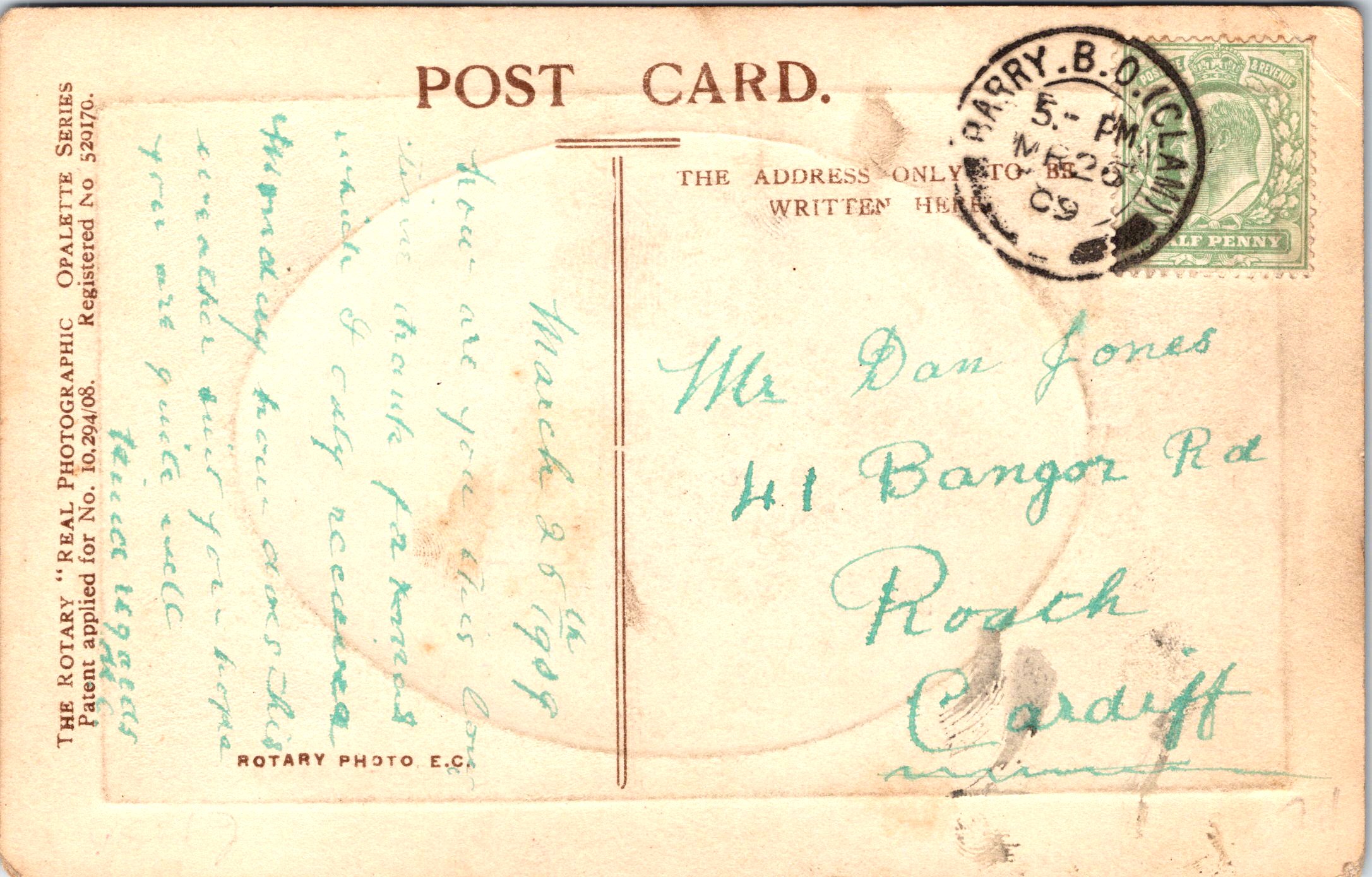
Postcard 9 was published by Rotary Photo and is part of the firm’s Opalette Series. this postcard has a postmark from 1909. (SOLD)
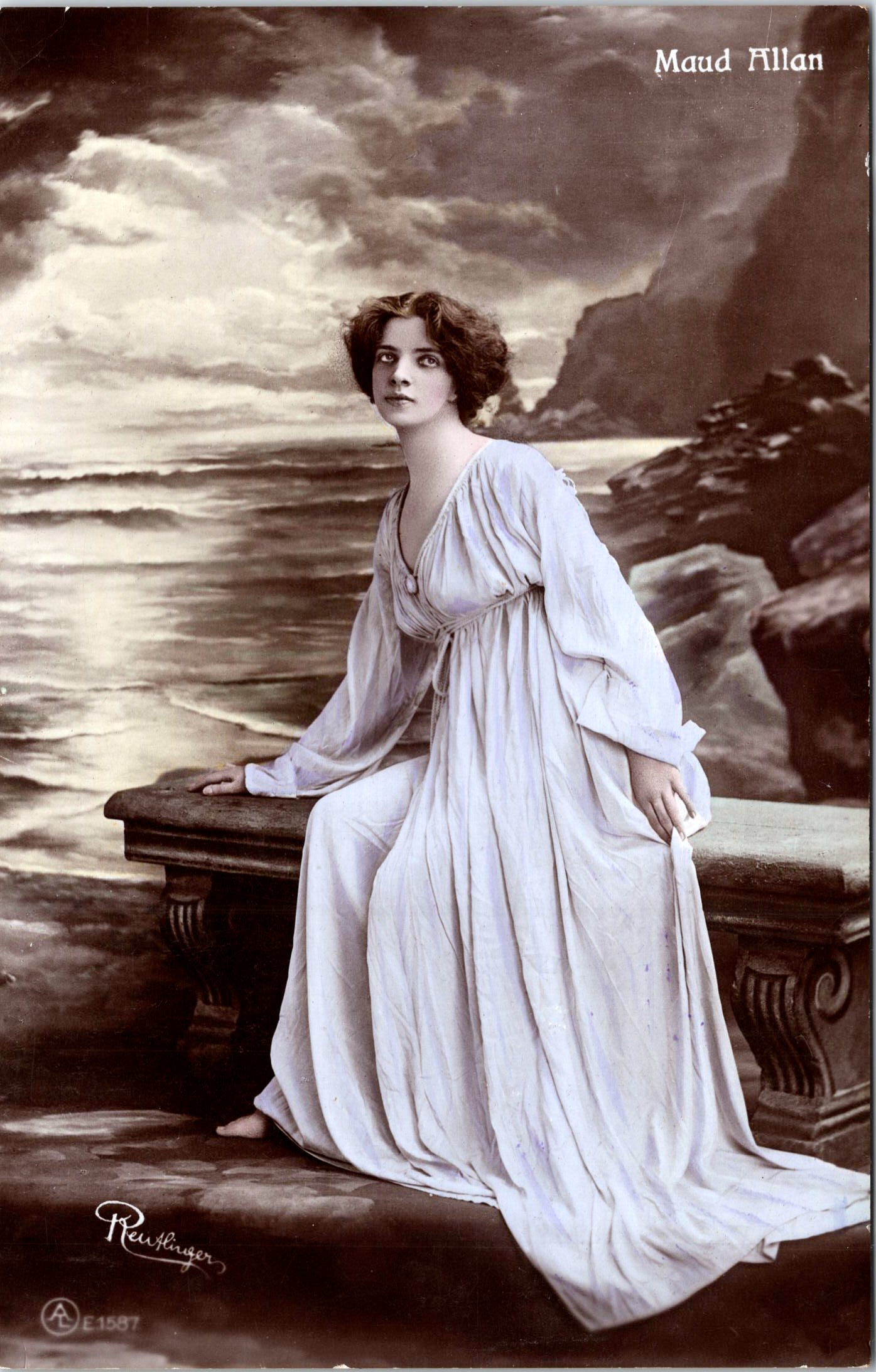
Postcard 10 is a striking Edwardian real photo postcard features Maud Allan, the celebrated dancer and stage performer whose career bridged classical, exotic, and highly sensual performance at the turn of the 20th century. Allan is shown seated in a flowing, classical-style gown, posed against a dramatic seaside backdrop of rocks, surf, and stormy skies. The pose is both poised and emotionally charged, with her gaze turned slightly upward, giving the image a dreamlike, almost mythic quality. She is dressed in a soft, empire-waist gown with loose sleeves and a long, flowing skirt. The styling deliberately evokes antiquity and romantic fantasy, which aligns perfectly with Allan’s reputation for expressive, sensuous dance interpretations rather than traditional ballet technique. Her bare foot and relaxed posture add to the quiet intimacy of the image. The photograph was taken by Leopold Reutlinger, one of the most important and accomplished theatrical photographers of the period. Reutlinger’s portraits of performers are widely collected and appear in museum collections; his work is especially prized for its technical quality and dramatic staging. His signature appears in the image, and the postcard carries the Reutlinger studio mark and serial number E1587, confirming it as part of his commercial theatrical series. This is an Aristophot Real Photo Postcard, as clearly indicated on the reverse. Aristophot Co. Ltd. was a London-based publisher, specializing in high-quality photographic postcards of actors, dancers, and performers. The reverse also notes “Printed in Saxony,” which was common for high-end photographic postcard production during this period. This specific image of Maud Allan is uncommon. The combination of Maud Allan + Reutlinger + Aristophot makes this a particularly desirable postcard. In fact, this photograph of Miss Allan can be found in Britain’s National Portrait Gallery. The postcard in their collection was postmarked in 1909. SOLD
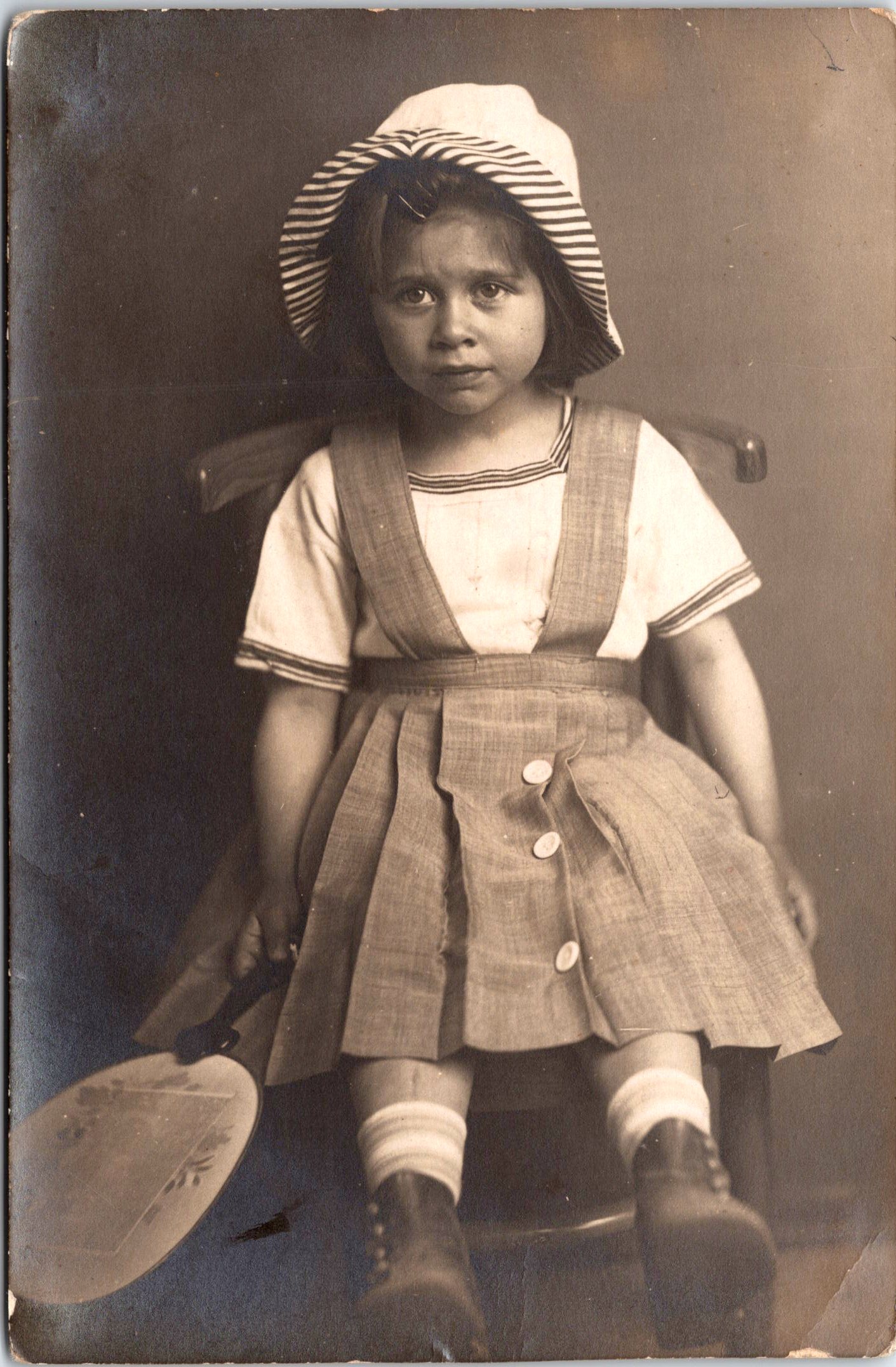
A wonderfully expressive vintage real photo postcard featuring a young girl seated in a studio portrait, captured with remarkable intimacy and character. The child sits upright on a simple wooden chair, gazing directly at the camera with large, searching eyes and a slightly solemn, almost questioning expression that gives the image unusual emotional depth. She is dressed in a charming early 20th-century outfit: a light blouse with striped trim at the collar and sleeves, paired with a pinafore-style dress secured with wide shoulder straps and large decorative buttons down the front. Her clothing has a practical yet stylish look typical of the period. On her head she wears a soft, wide-brimmed hat with bold striped edging, which frames her face beautifully and adds a playful, fashionable touch.In her hand, she appears to be holding a small fan or possibly a toy paddle, with a flat, rounded surface and a short handle. Given its shape and decorative quality, it most closely resembles a child’s hand fan, though it could also be a novelty or toy accessory used by the photographer to help keep the child engaged during the sitting. The photograph measures approximately 3.5 by 5.25 inches, consistent with real photo postcards of the era. Based on the clothing, hairstyle, and photographic style, this image likely dates to around 1910–1920. The postcard is in overall good condition with strong visual appeal. The image retains nice contrast and clarity, though there is moderate age toning. The corners exhibit noticeable rounding and wear. The reverse shows heavier toning, spotting, and adhesive residue from it’s former days residing in a postcard album. Despite this, the photograph remains fully intact and displays well (see scans).
This vintage Postcard is available for purchase at my store, The History Peddler, for $16.00 at auction
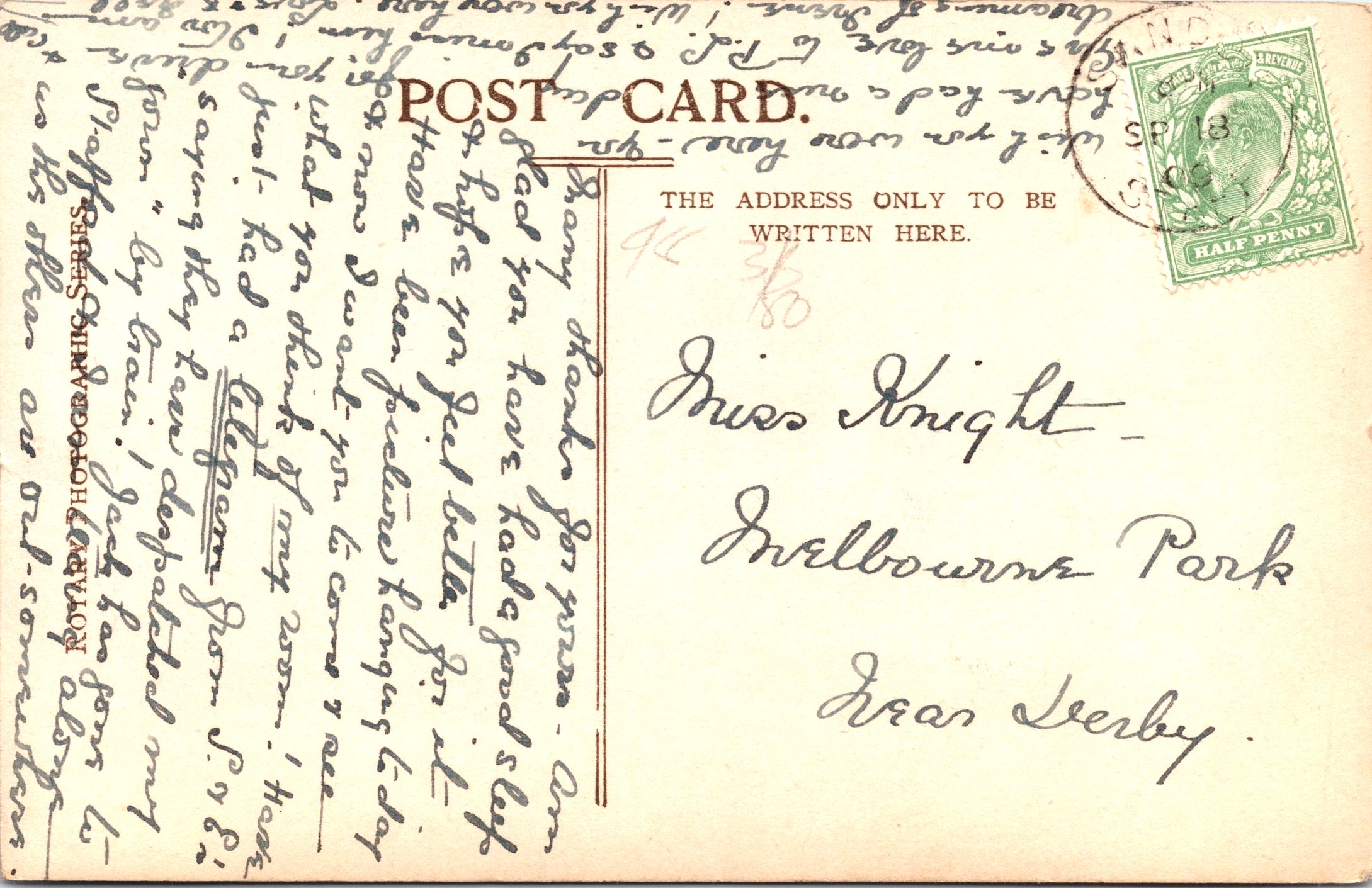
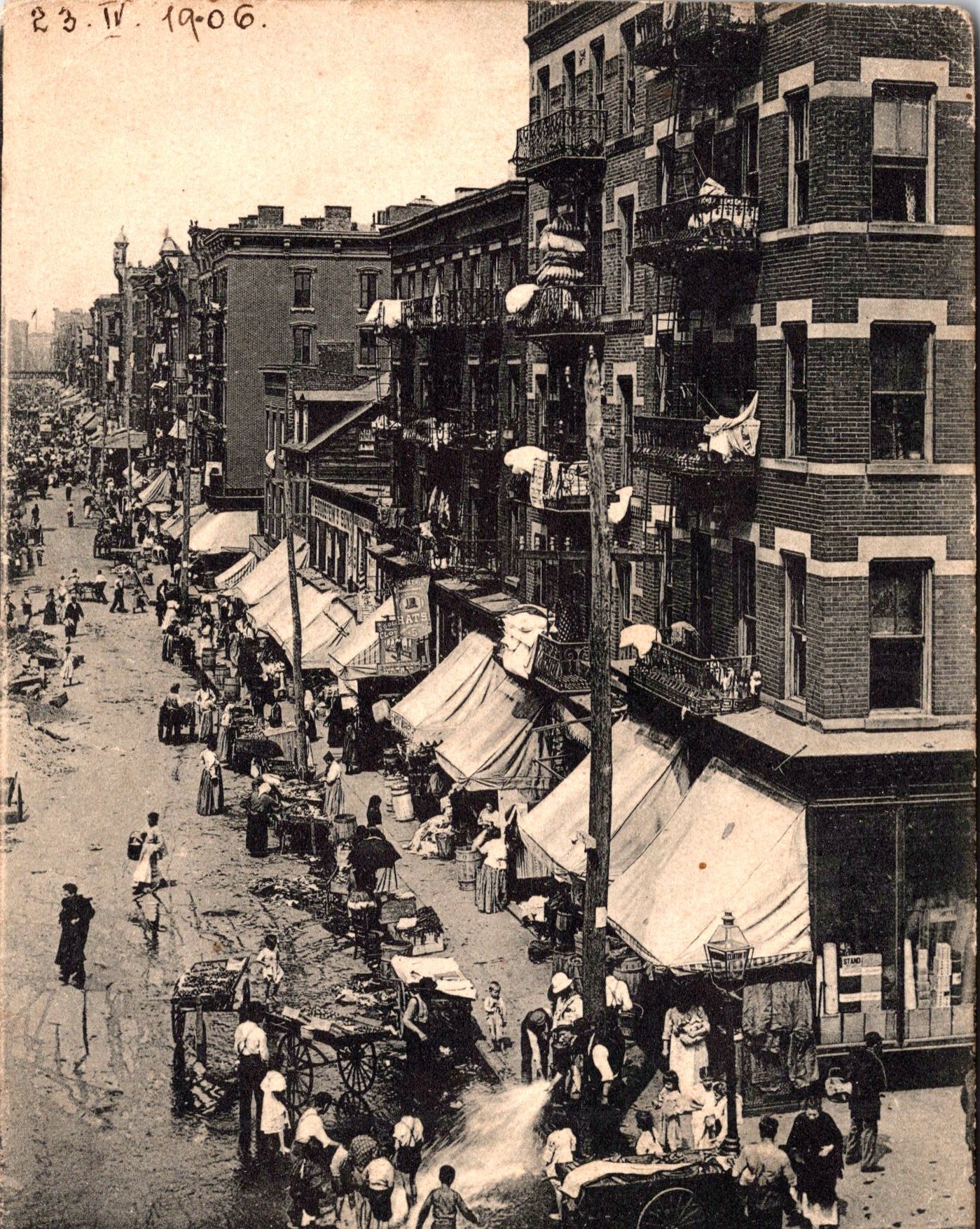
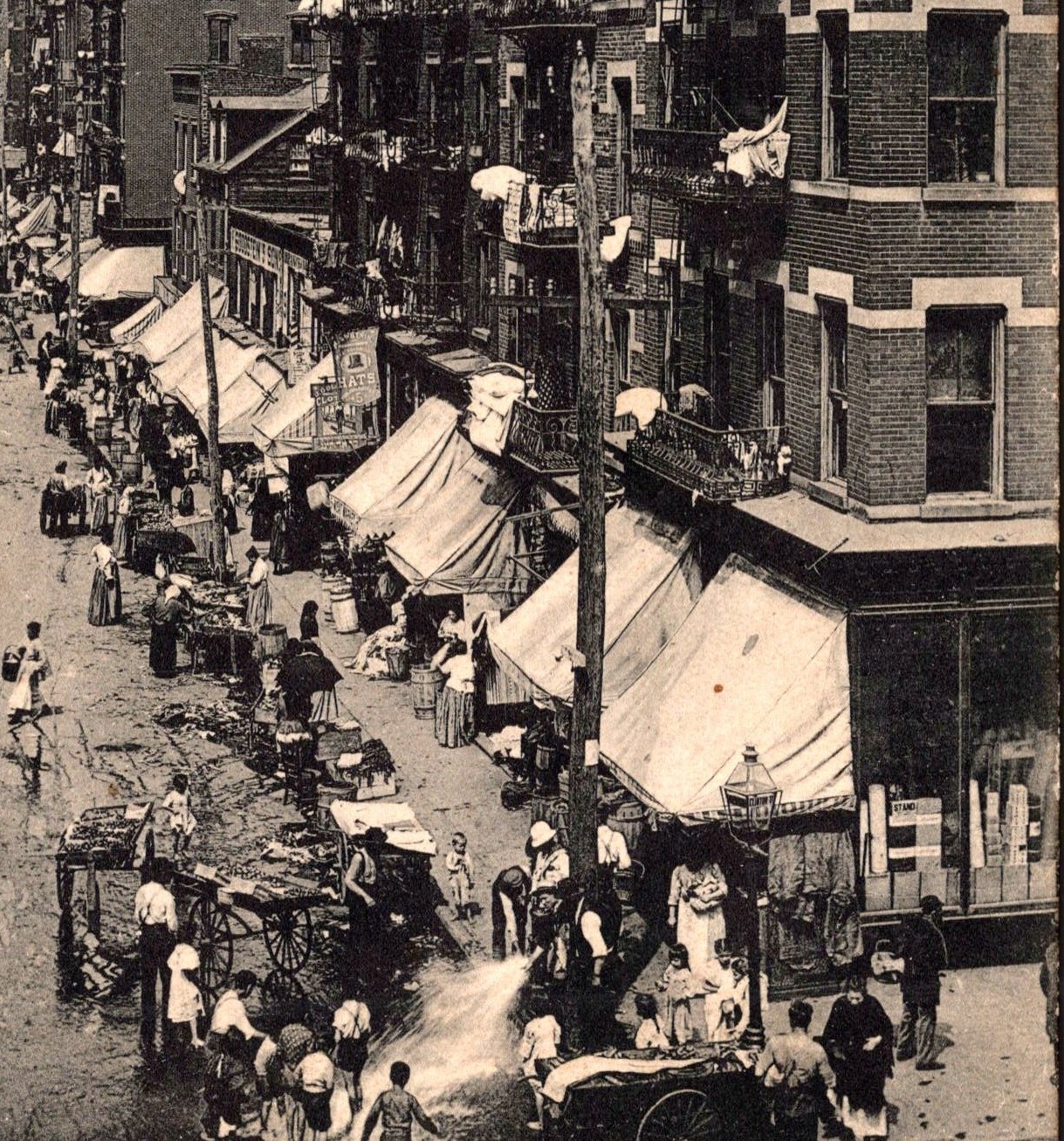
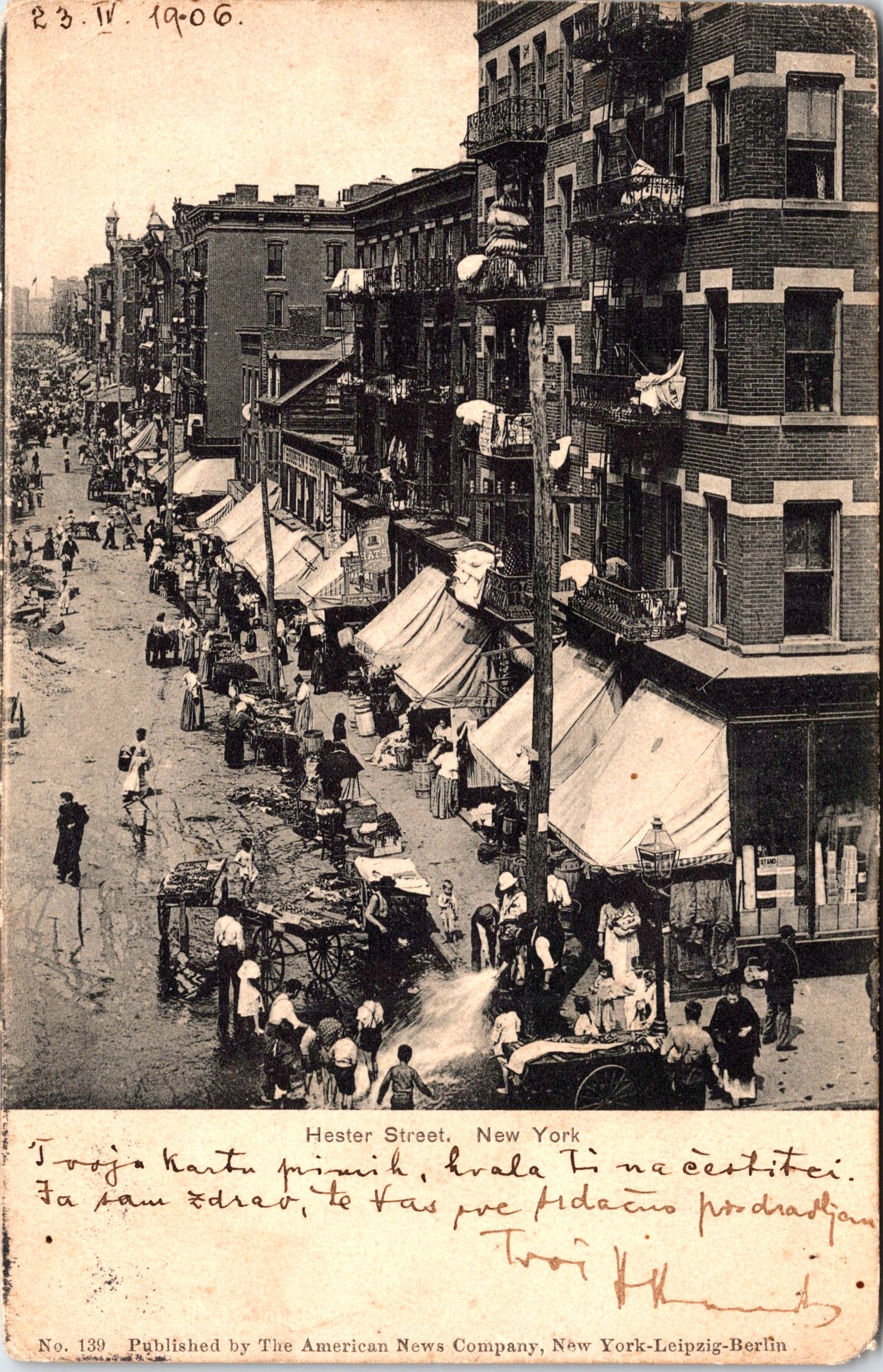
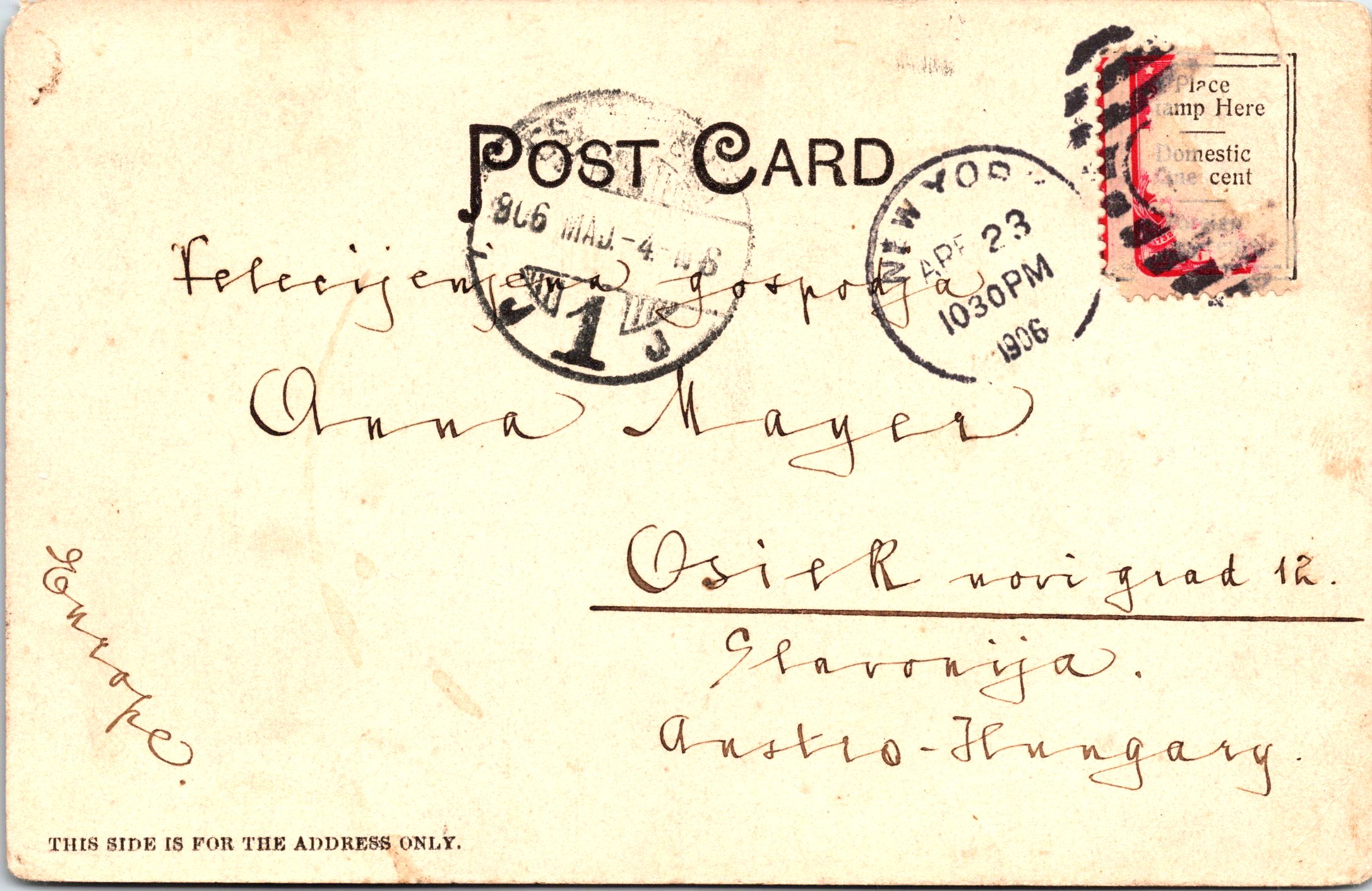
This terrific early New York City postcard captures Hester Street on the Lower East Side during its bustling immigrant-era heyday. Published by The American News Company (No. 139)—one of the major postcard publishers of the early 20th century—this 1906 street scene shows an extraordinarily lively and detailed view of life in one of the most densely populated neighborhoods in America at the time. The image portrays Hester Street crowded with vendors, pushcarts overflowing with produce, women in long skirts shopping along the muddy street, and merchants working under the characteristic canvas awnings hung from the tenement storefronts. Laundry hangs from iron fire escapes, children play in the street, and a man hoses down the roadway in an attempt to control dust and refuse. This postcard is a rich visual record of the Jewish immigrant community that transformed the Lower East Side in the late 19th and early 20th centuries. The urban density, the clothing, the signage, and the architecture all reflect the conditions described in reform literature and immigrant memoirs of the era. The card is postmarked New York, 1906, and was mailed to Osiek, Slavonija, then part of Austro-Hungary. The handwriting on the front and back suggests that the writer was likely a Slavic-speaking immigrant sharing news and thanks with family overseas—a compelling historical link between the immigrant sending the card and the old world receiving it.The message is written in a South Slavic language (likely Croatian or Serbian written in Latin script). Handwriting is challenging, but the meaning is clear. The translated message is “Your card arrived. Thank you for the congratulations. I am healthy and wish you all the best”. SOLD
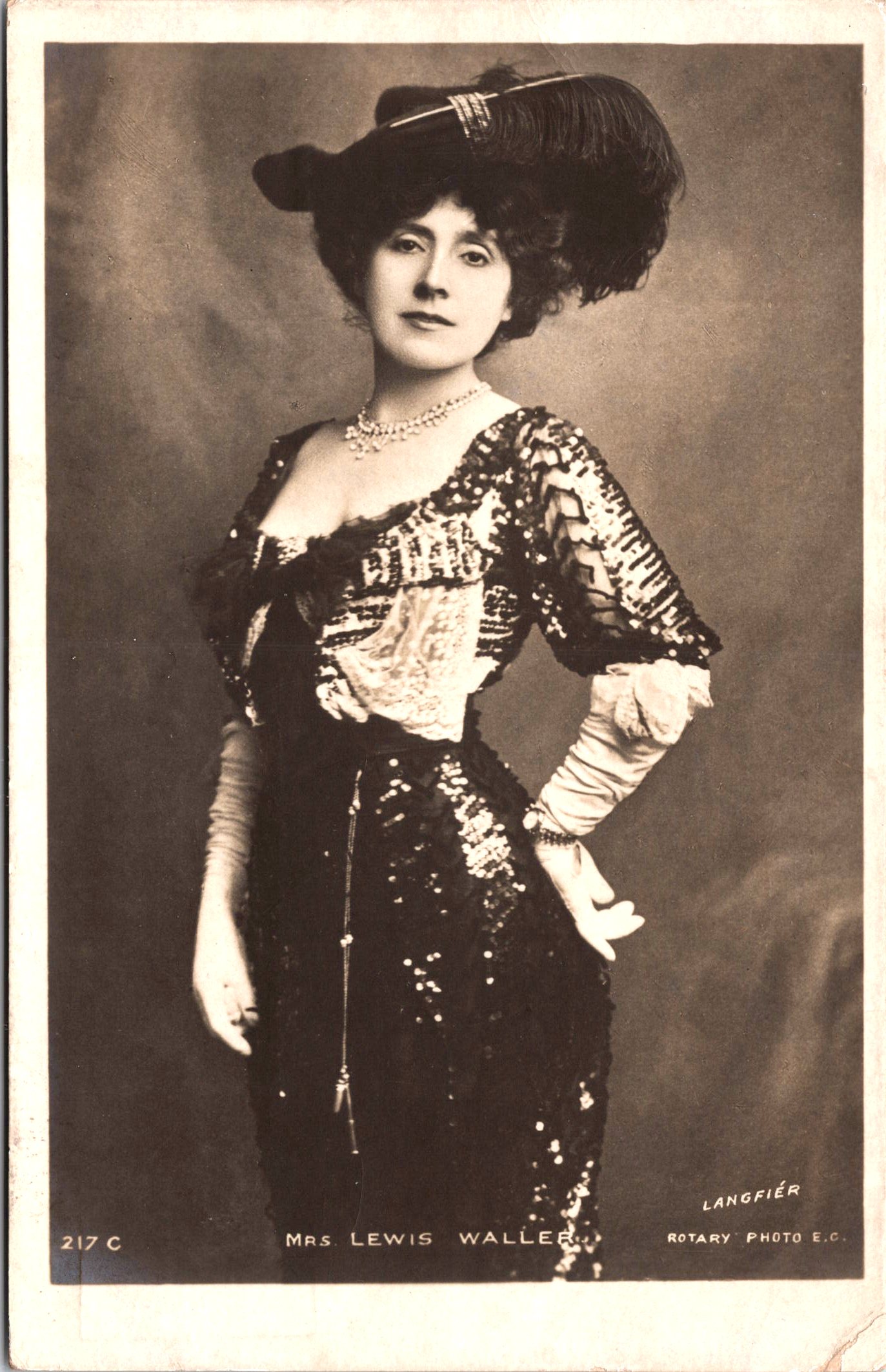
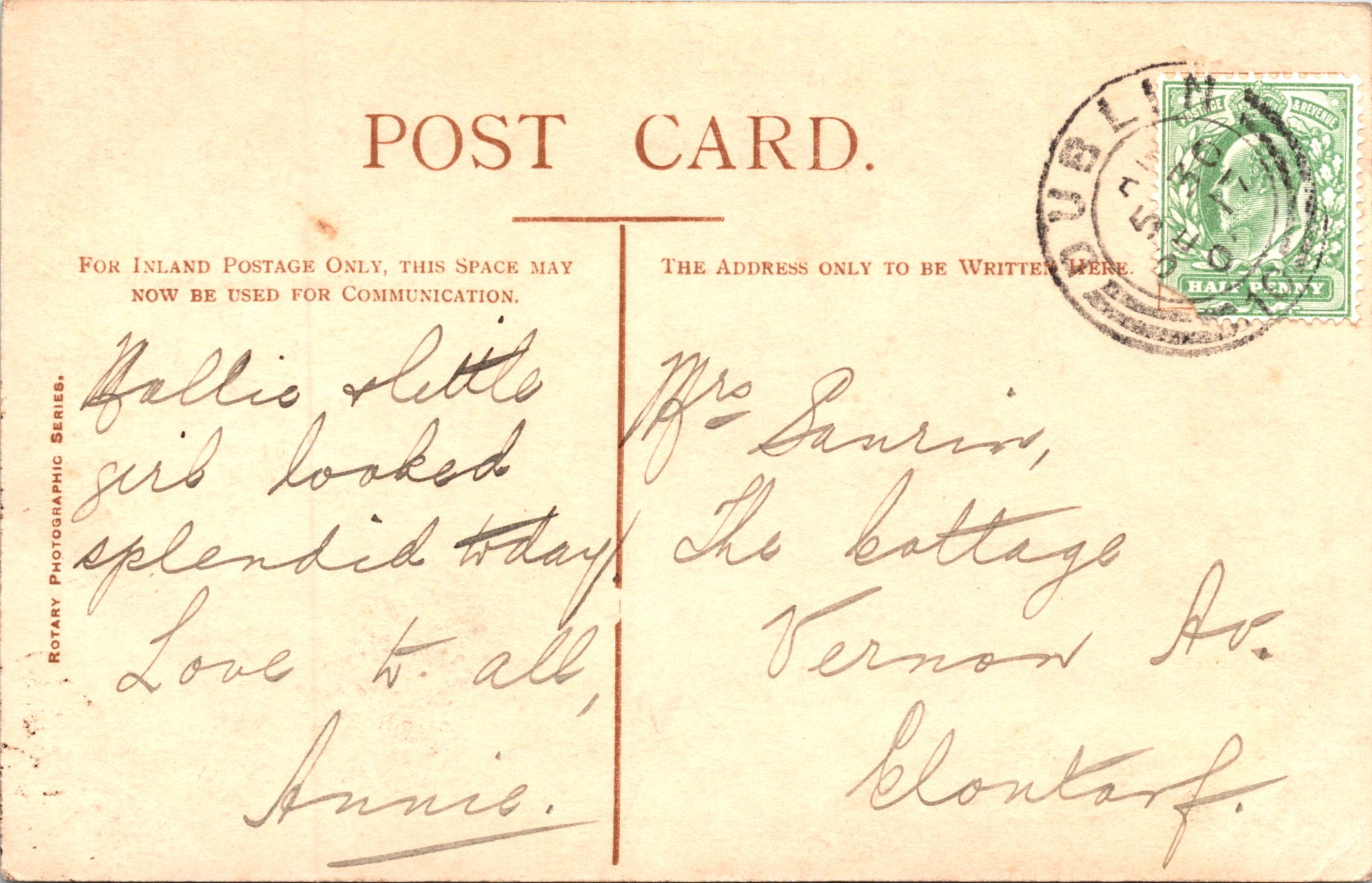
This vintage real photo postcard features Mrs. Lewis Waller, otherwise known as Florence West (1858-1912). She was an English actress known for creating roles in new plays written by Oscar Wilde and Bernard Shaw. She frequently appeared on London’s West End stages with her husband, actor Lewis Waller. She married Waller in 1882 and made her stage debut in 1883. She retired in 1905. Five portraits of Florence West can be found in Great Britain’s National Portrait Gallery. This postcard was published by Rotary Photo as part of a series (no.217C). Miss West’s photograph was taken by the studio of Louis Saul Langfier. He was the husband of actress Pearl Lyndon. This postcard has a slight crease in its bottom right corner and is in overall good condition (see scans).
This vintage Postcard is available for purchase at my store, The History Peddler, for $8.95 .
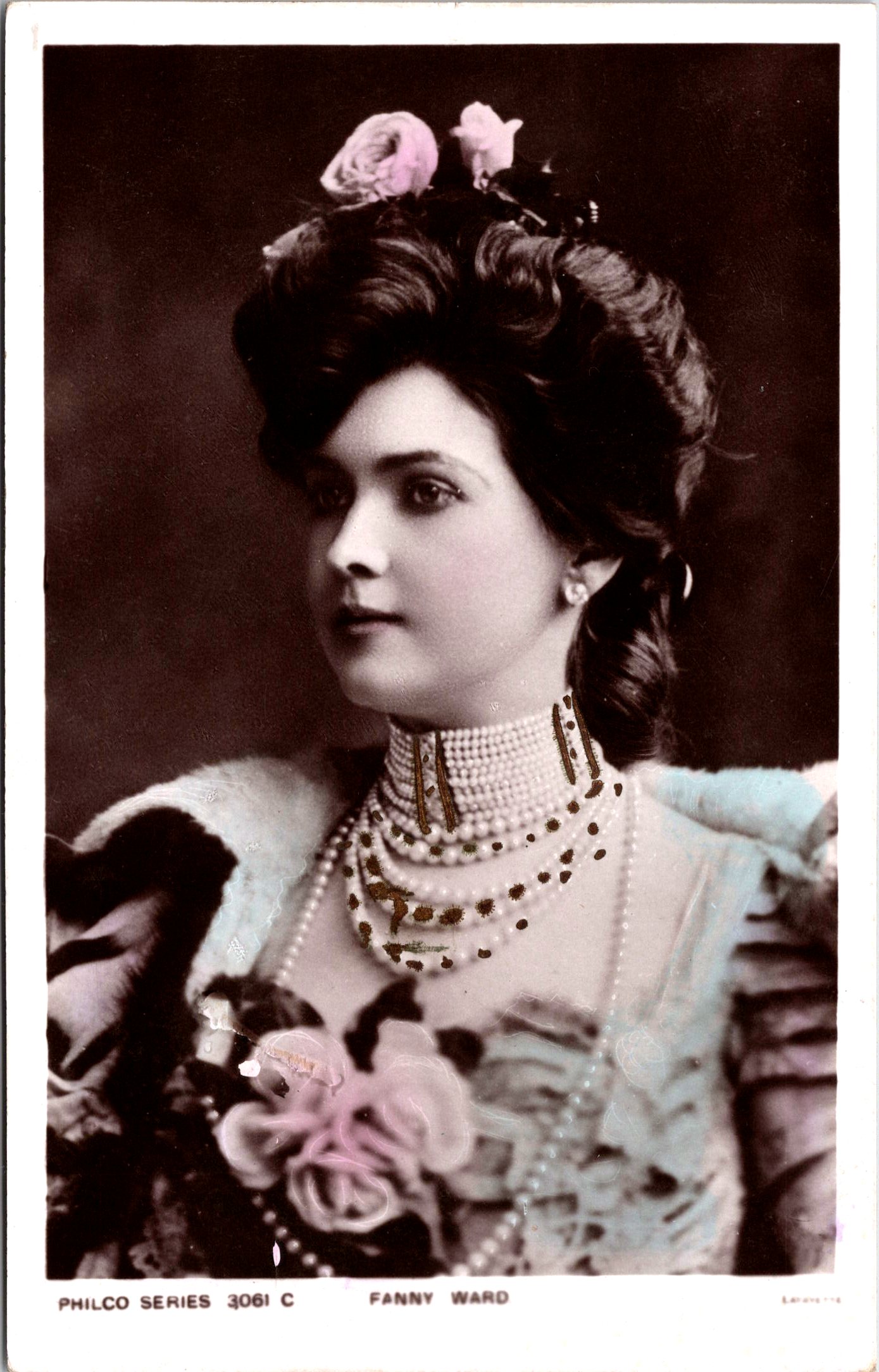
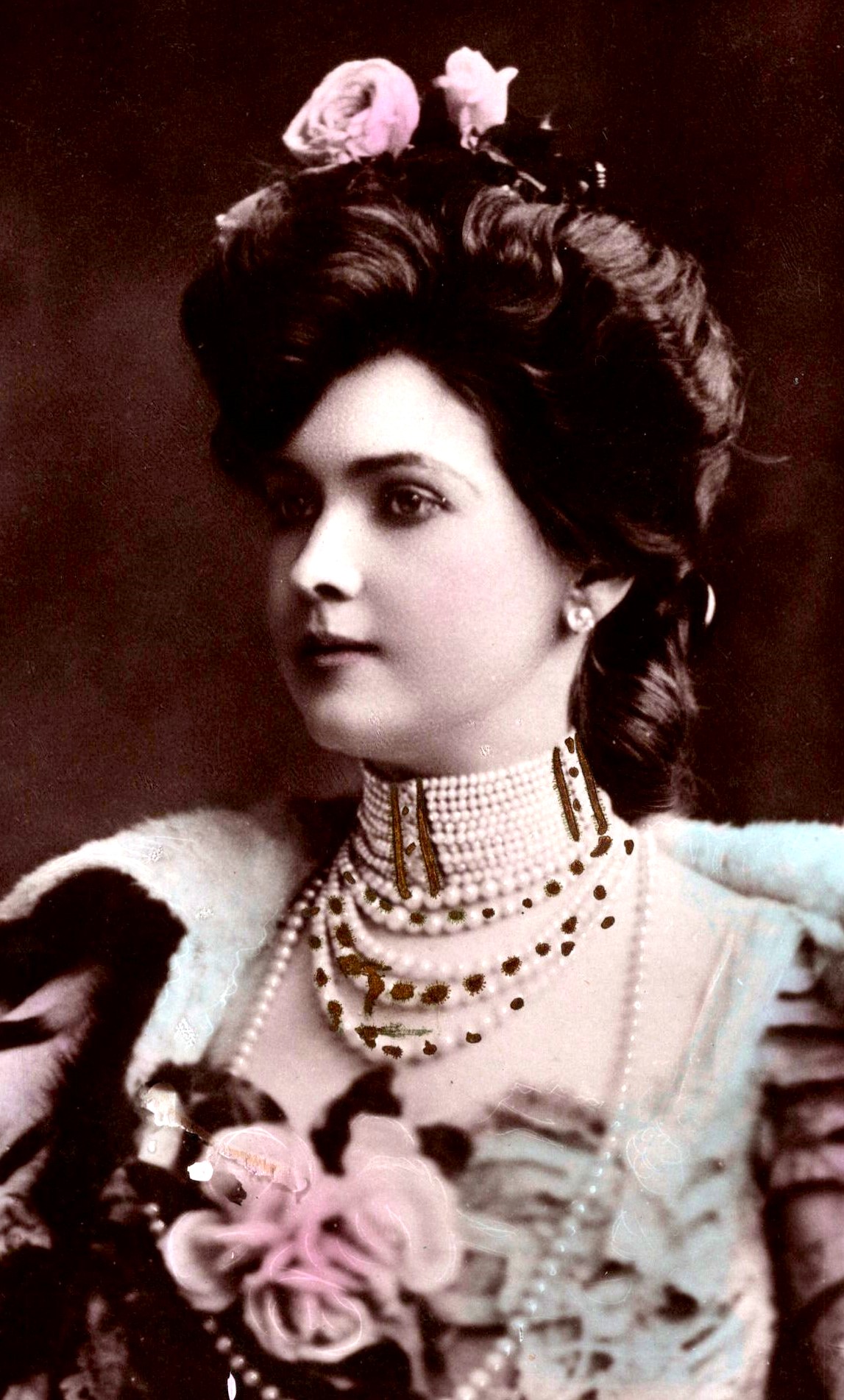
This vintage real photo postcard features pretty American stage and silent film actress and film producer, Fanny Ward (1872-1952). She was also the star of light comedies on Broadway. She began her career in the early 1890s, and appeared in over 100 films between 1895 and 1920. She was known for her roles in silent comedies and melodramas, and was considered one of the most popular actresses of her time. She played starring roles in “Madam President”, “The Shop Girl” and many others. Her screen debut was in Cecil B DeMille’s sexually charged, “The Cheat” (1915). Ward also produced several films, including the 1913 film “The Chink in the Armour,” which was directed by her then-husband, Frank Keenan. She retired from acting in 1920, but continued to work in the film industry as a producer until her death in 1952. In addition, after her retirement from the screen, she opened a beauty salon in Paris called “The Fountain of Youth”. The name of the salon is a bit ironic. Ward was known for her youthful appearance. It was not ununsual for her to play the parts of women one of two decades her junior. Ward held feminist beliefs which she wasn’t shy to talk about. In 1909, she told a reporter that her husband hated her work and then pointed out the hypocrisy of society’s support of men pursuing their interests (ie. art, sports, travel) but not supporting women who did the same. In addition, Ward worked as a film producer, a role not usually populated by women. Philco published this postcard as part of a series (No.3061C). The firm was located in London. Miss Ward was photographed by the Lafayette studio. James Lafayetter was the pseudonym of photographer James Stack Lauder (18853-1923). His Dublin, Ireland studio specialized in photographing members of high society. His photographs are part of the collections of many British museums, including the National Portrait Gallery. SOLD
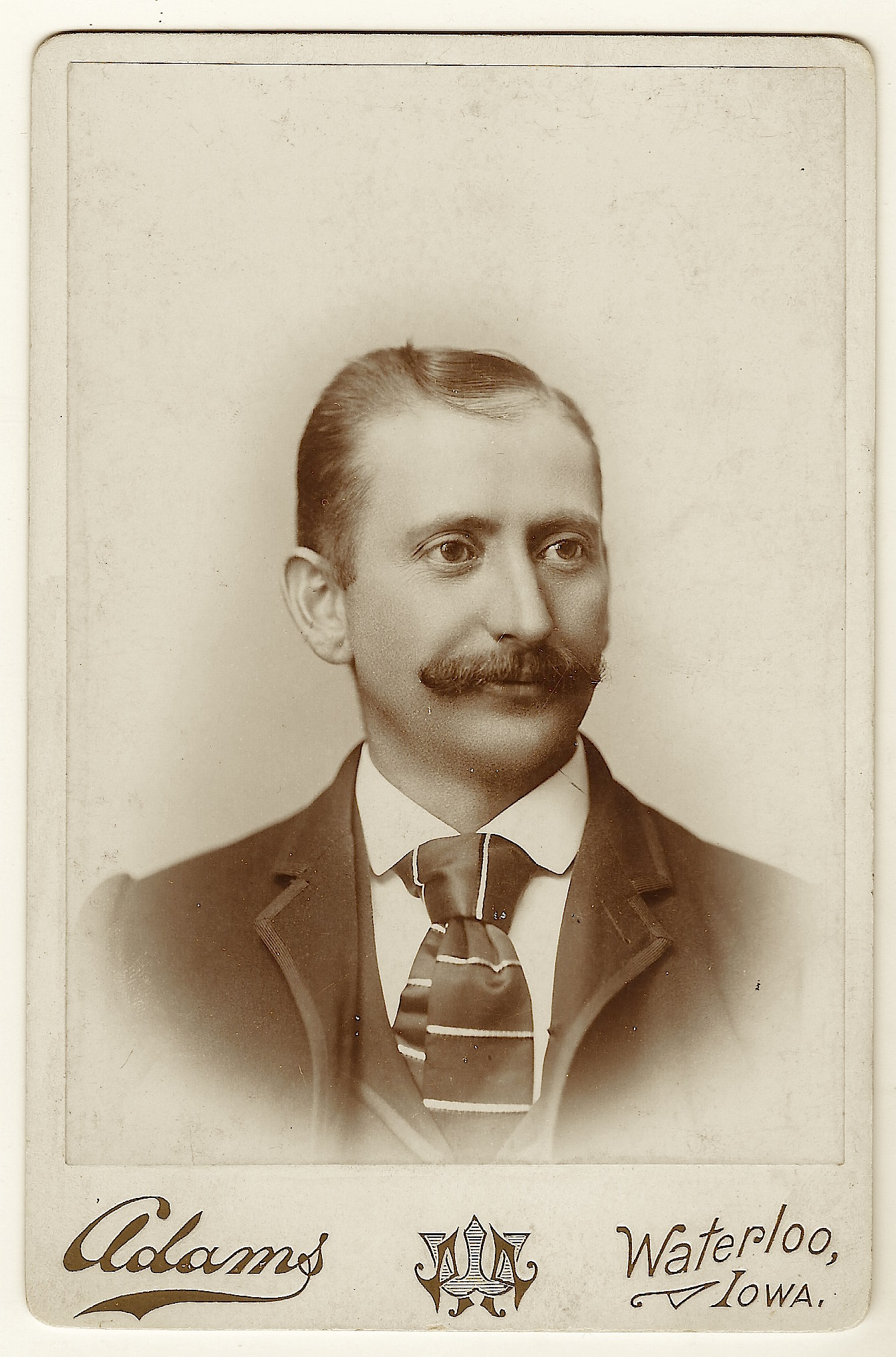
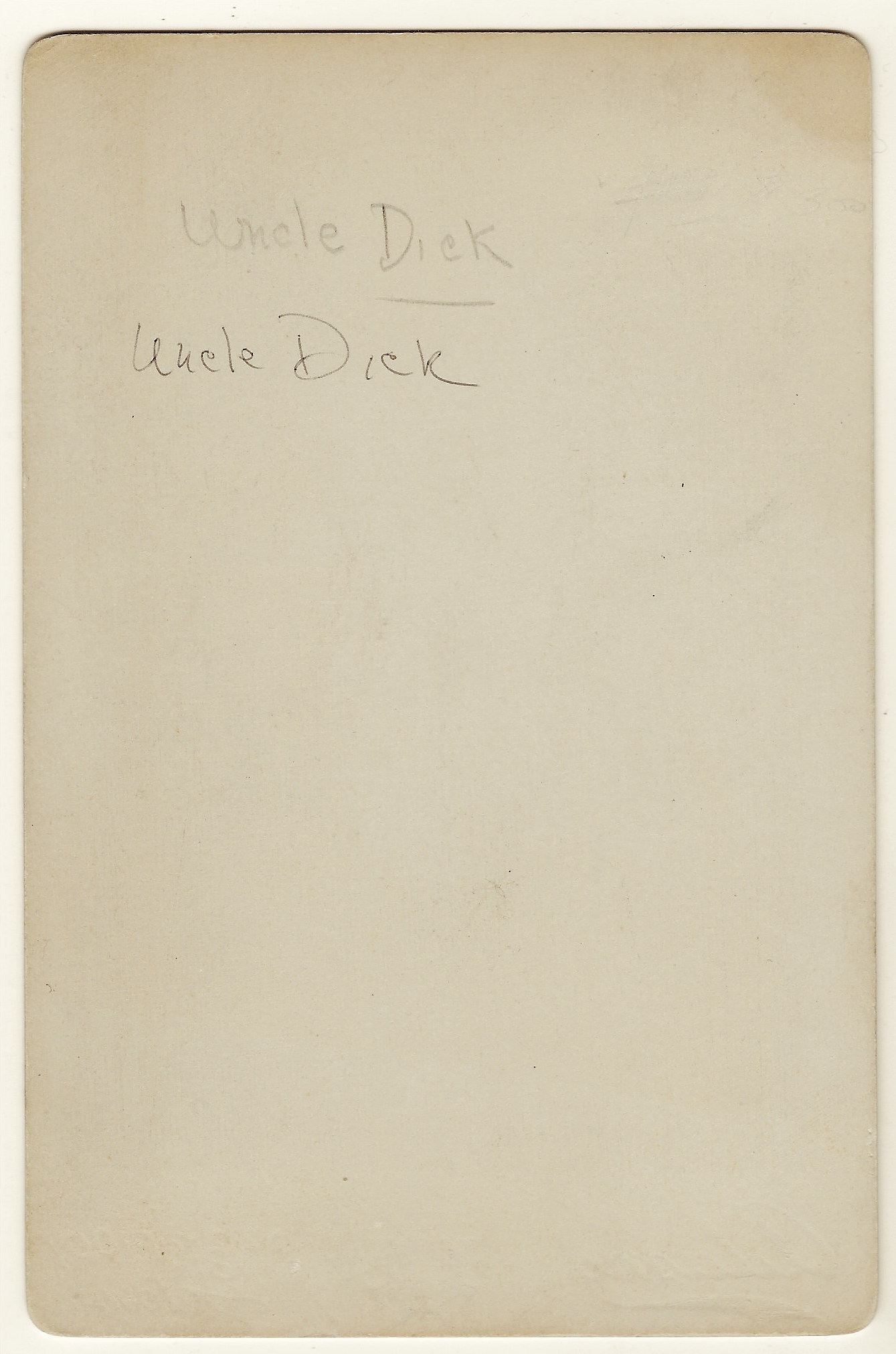
Meet Uncle Dick. His name is inscribed on the reverse of the cabinet card. He appears to be middle aged and possess a sunny disposition. He is well dressed and has a nicely groomed mustache. Note the width of his tie. I find it interesting that the width of neck ties tend to vary as the years go by. This photograph was produced by the Adams studio in Waterloo, Iowa. It is difficult to ascertain the full name of the photographer. W. G. Adams worked in Waterloo in the 1880’s but I could not find any information about him. Asa W. Adams (1842-1915) operated a studio in McGregor, Iowa (1863), Decorah, Iowa (1863-1884). In 1866 he married Emma J. Fuller and the couple had four children. Adams conducted his photography business in Waterloo (1884-after 1900). Adams died in 1915 and is buried in Decorah. This cabinet card is in very good condition (see scans).
This Cabinet Card is available for purchase at my store, The History Peddler, for $25.99
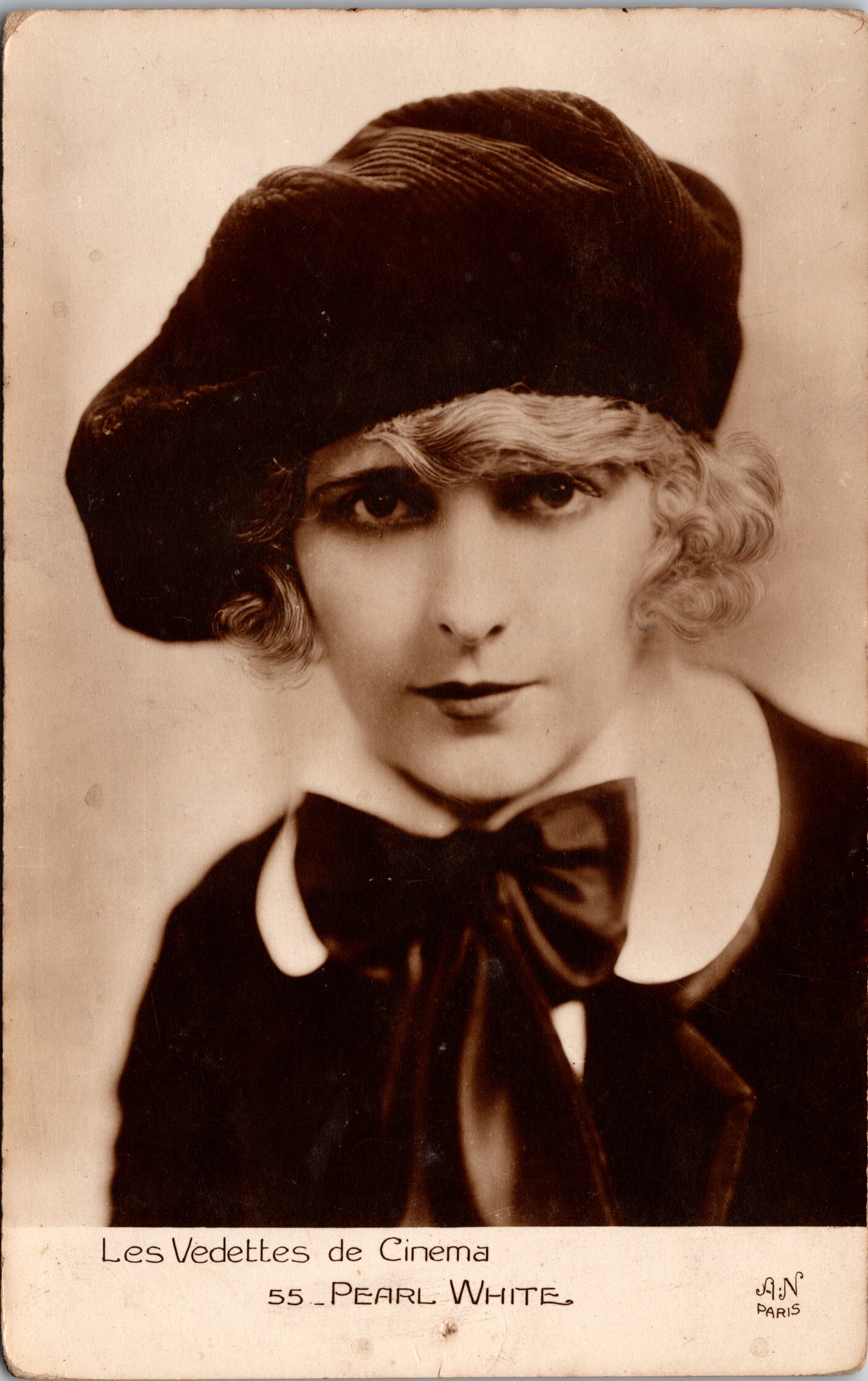
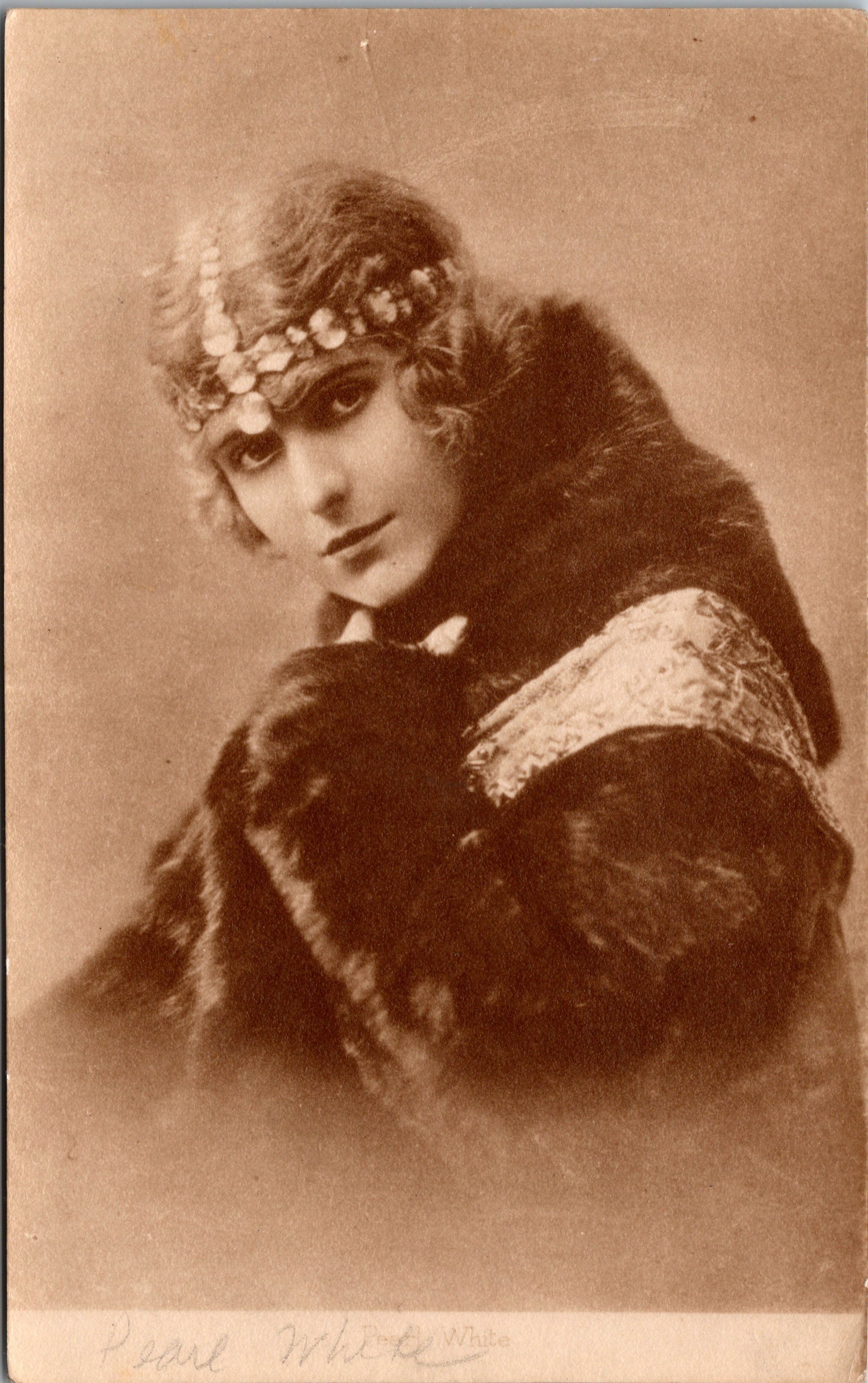
Pearl White (1889-1938) was an American actress of film and stage. She started her career on the stage at just 6 years old in the play, “Uncle Tom’s Cabin”. At thirteen years of age she was a bareback rider for a circus. She dropped out of high school to join a touring stage company. Next she worked as a singer in Cuba and South America. She made her appearances in dance halls and casinos. In 1910, her voice began to fail and she began to appear in silent films, including many popular serials. Her nickname was “Queen of the Serials’. She did the majority of her own stunts in these film serials. She is known well for her role in “The Perils of Pauline”. She was often cast in the role of an athletic heroine, rather than the more typical, innocent young woman. As a result of her appearances in “The Perils of Pauline”, she was soon earning $1,750 per week. She increased her star power as she appeared in other serials. In these films she flew airplanes, raced cars, and did other action hero feats. By 1919 White moved on to more dramatic roles. She appeared in ten drama films for Fox Film Corporation. She finished her career by taking roles in European films, and finally, appearing on the European stage. While performing in London, she earned three thousand dollars a week. At the time of her retirement (1924), White had banked two million dollars. She then began investing. Her investments included a hotel, a night club, and a stable of race horses. White was married twice, each time, for short duration to actors. White died of liver failure, possibly due to her history of heavy drinking. Her drinking may have been attributable to her problems with pain stemming from a spinal injury occurring during her stunt days. The IMDb site credits white with 228 film appearances between 1910 and 1924.
Postcard 1 was published by Cinemagazine (Paris Edition). The card is part of the “Les Vedettes de Cinema” (Stars of the Cinema) series (No.,55). White’s postcard photo portrait was taken by the celebrated photographer, Alfred Noyer. (SOLD)
Postcard 2 features White’s beauty. She is wearing a fur. Note her pretty head band. Although this card is the size of a standard postcard, there is no printing on it’s reverse. (SOLD)
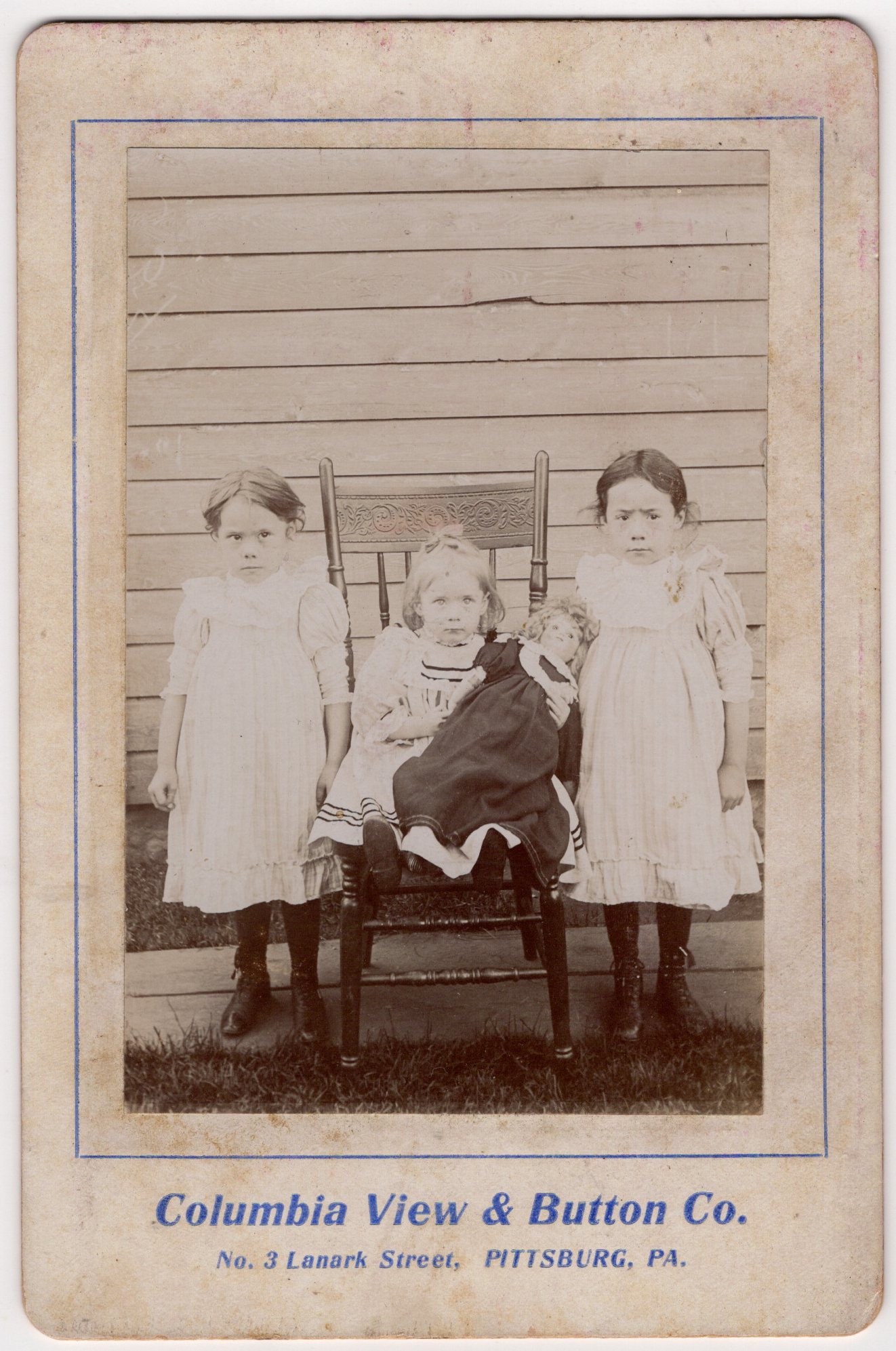
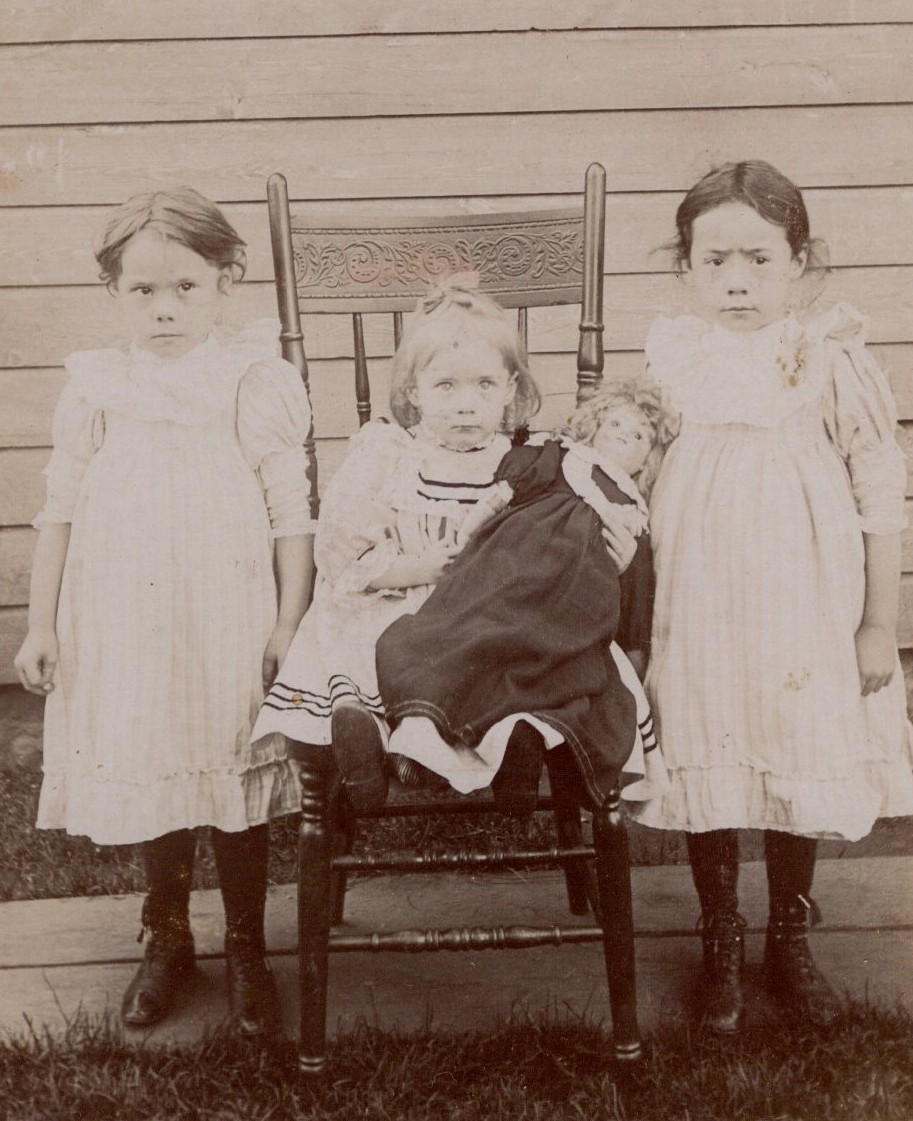
Three young children pose together for a cabinet card portrait by the Columbia View & Button Company of Pittsburgh, Pennsylvania. This photograph precipitates a number of questions. Was this photograph taken outdoors, or is this an in-studio portrait? Finally, why is the photographic studio called a “View & Button Company”? Lets attempt to answer the previous questions. First, it is not clear if this is an indoor, or outdoor photograph. The next question concerns the reason the name of the studio includes the terms “View & Button” . The likely answer is that the studio originally produced stereoviews and photograph buttons. The buttons were generally portraits and varied in size. They could be worn or displayed on a piece of furniture or shelf. Large photographic buttons were most popular between 1900 and 1930. The smaller pinback buttons were popular beginning the 1890’s. One wonders if the three children in this photograph are siblings. Their facial appearance is similar so it is likely the case that they are siblings. This cabinet card has corner wear and is in overall good condition (see scans).
This Cabinet Card is available for purchase at my store, The History Peddler, for $48.00 at auction
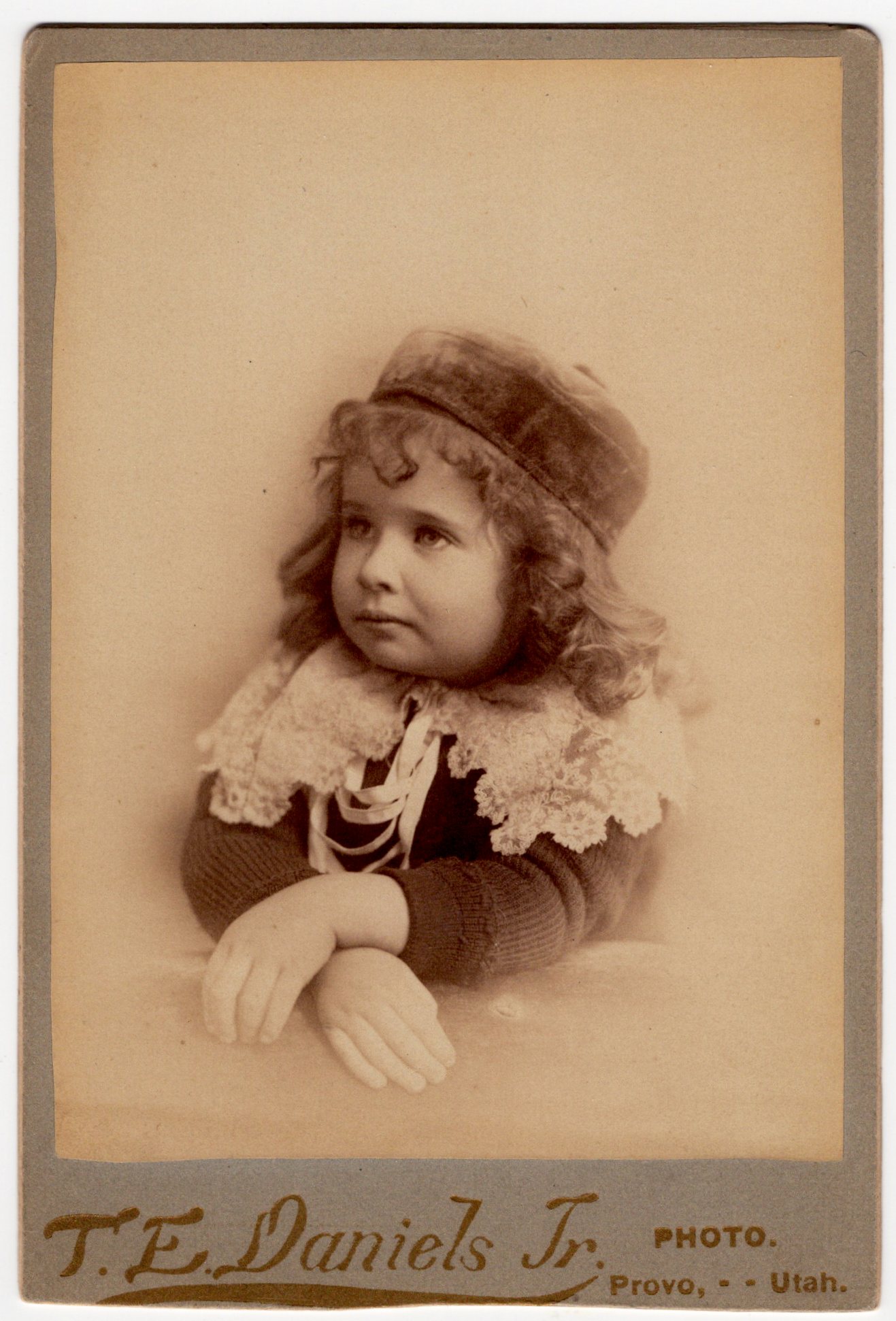
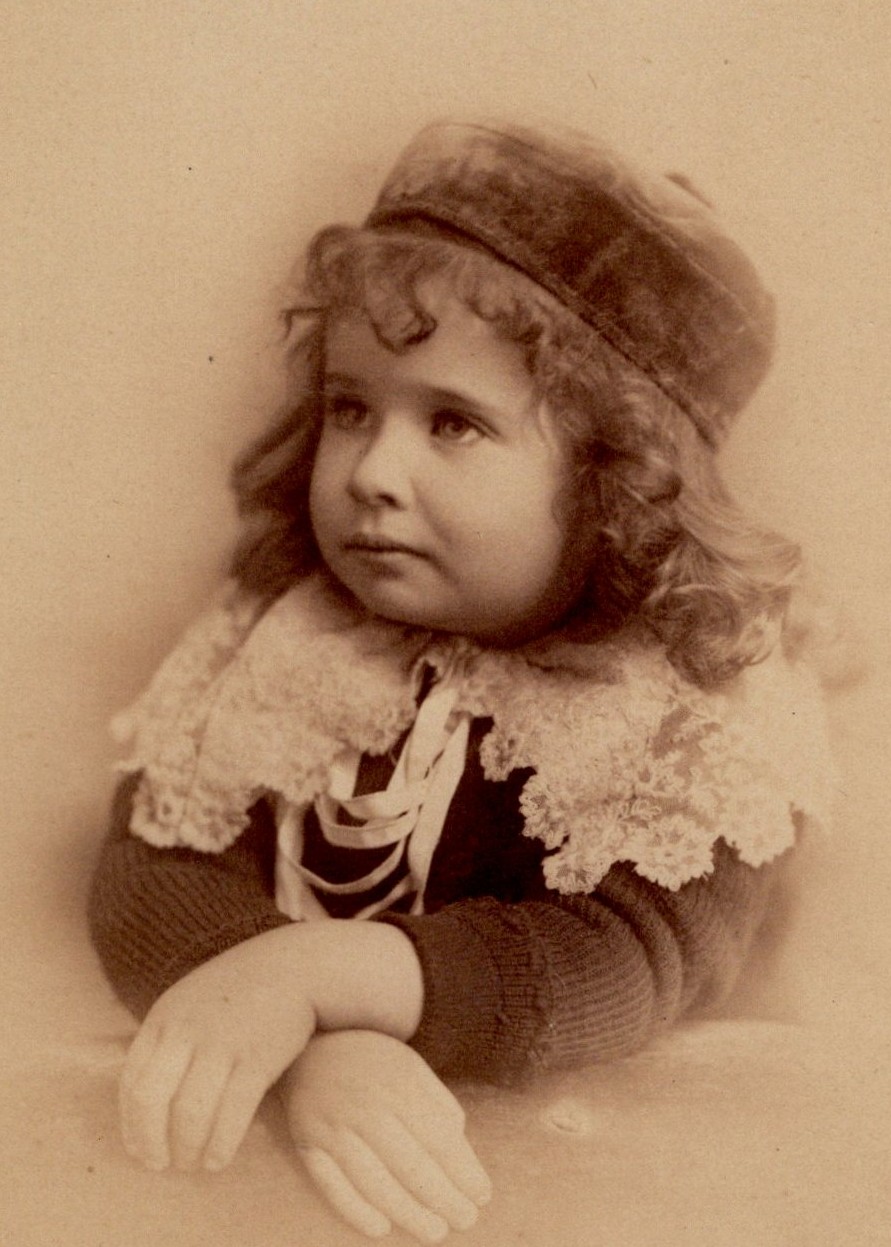
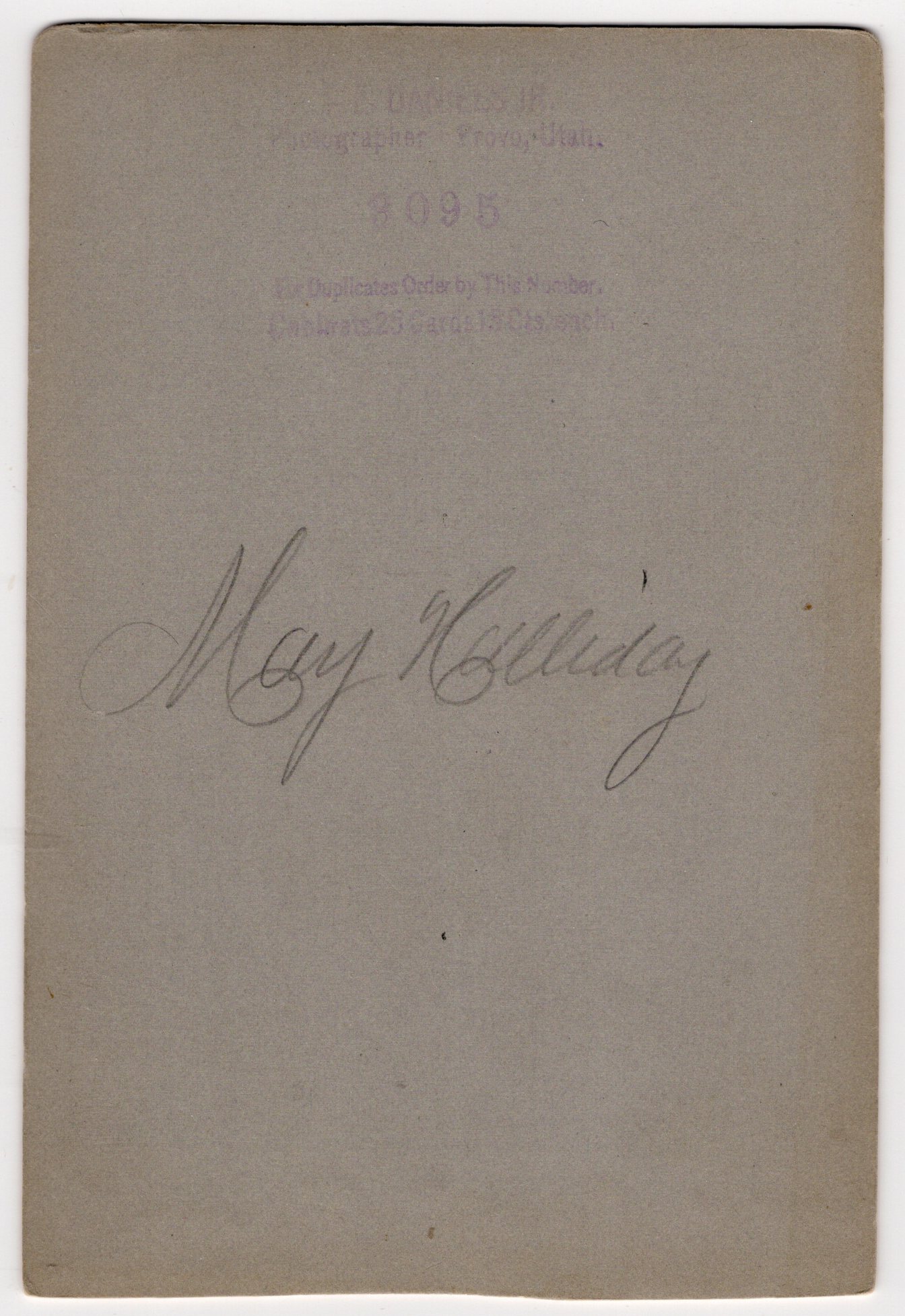
This beautifully preserved cabinet card features a young girl with delicate facial features, gazing thoughtfully off to the side. Her soft, wavy curls frame her face, adding to her angelic and innocent appearance. Her expression is one of quiet contemplation, with wide eyes that suggest curiosity and perhaps a hint of shyness. She is dressed in a stylish Victorian outfit, consisting of a dark, long-sleeved dress adorned with a lace-trimmed collar that cascades over her shoulders. A ribbon is neatly tied at the front, adding a refined touch to her ensemble. On her head, she wears a plush velvet hat, slightly tilted, giving her a fashionable and well-dressed look indicative of the late 19th century. Her hands rest gently atop one another in a relaxed yet poised manner, further enhancing the timeless elegance of this portrait. The lighting and soft focus around the edges draw attention to the girl’s delicate features, making this a striking example of high-quality Victorian-era portrait photography. This cabinet card was produced by T.E. Daniels Jr., a photographer based in Provo, Utah. The back of the cabinet card contains an elegantly written inscription: “May Holliday”—likely the name of the young girl in the portrait. Additionally, there is a faint purple studio stamp from T.E. Daniels Jr., Photographer, Provo, Utah, along with a catalog number 3095. This image has excellent clarity. The contrast and fine details remain crisp, capturing the textures of the girl’s lace, her velvet hat, and even the soft waves of her hair.(SOLD)





 THE CABINET CARD GALLERY