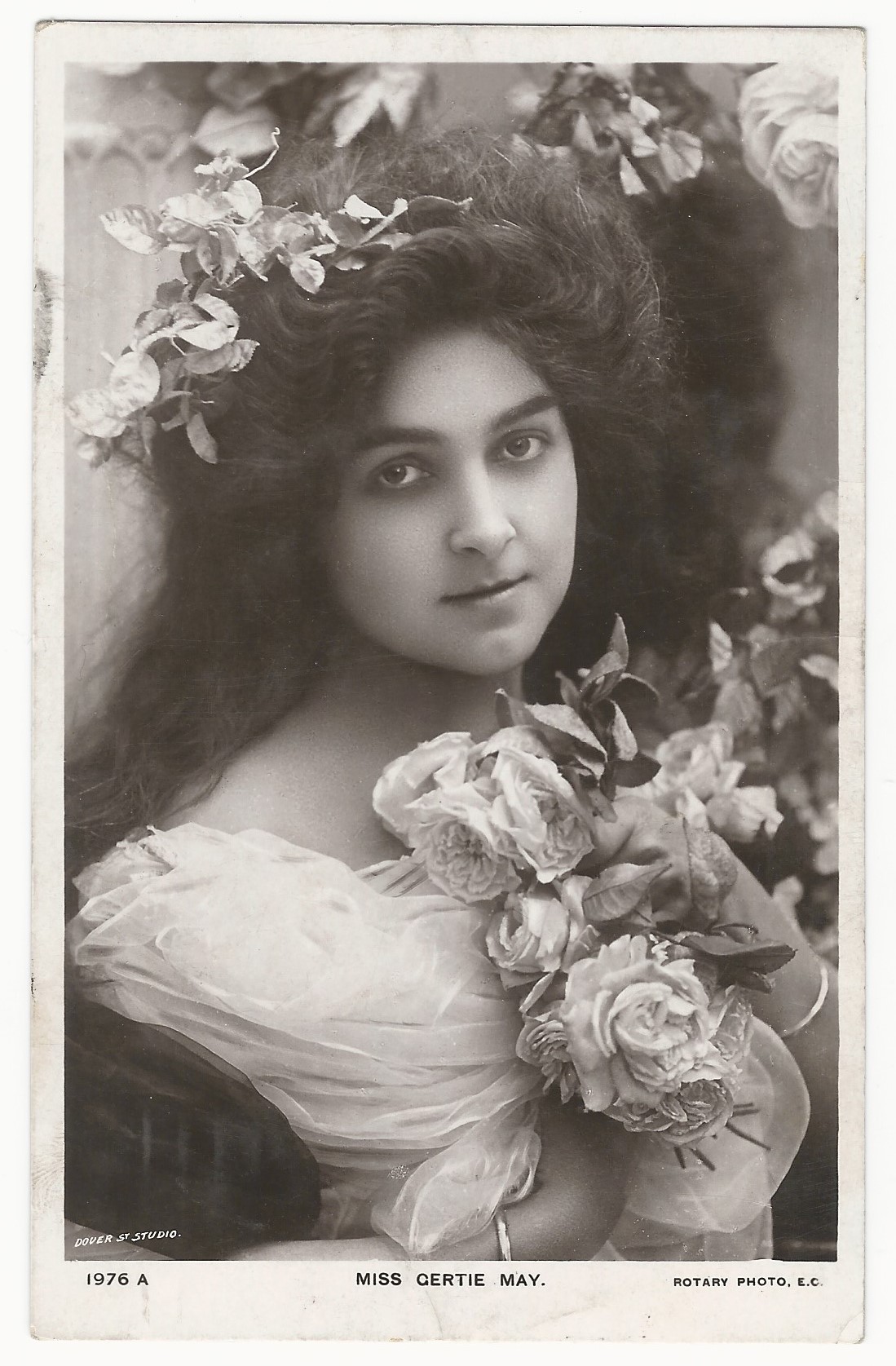
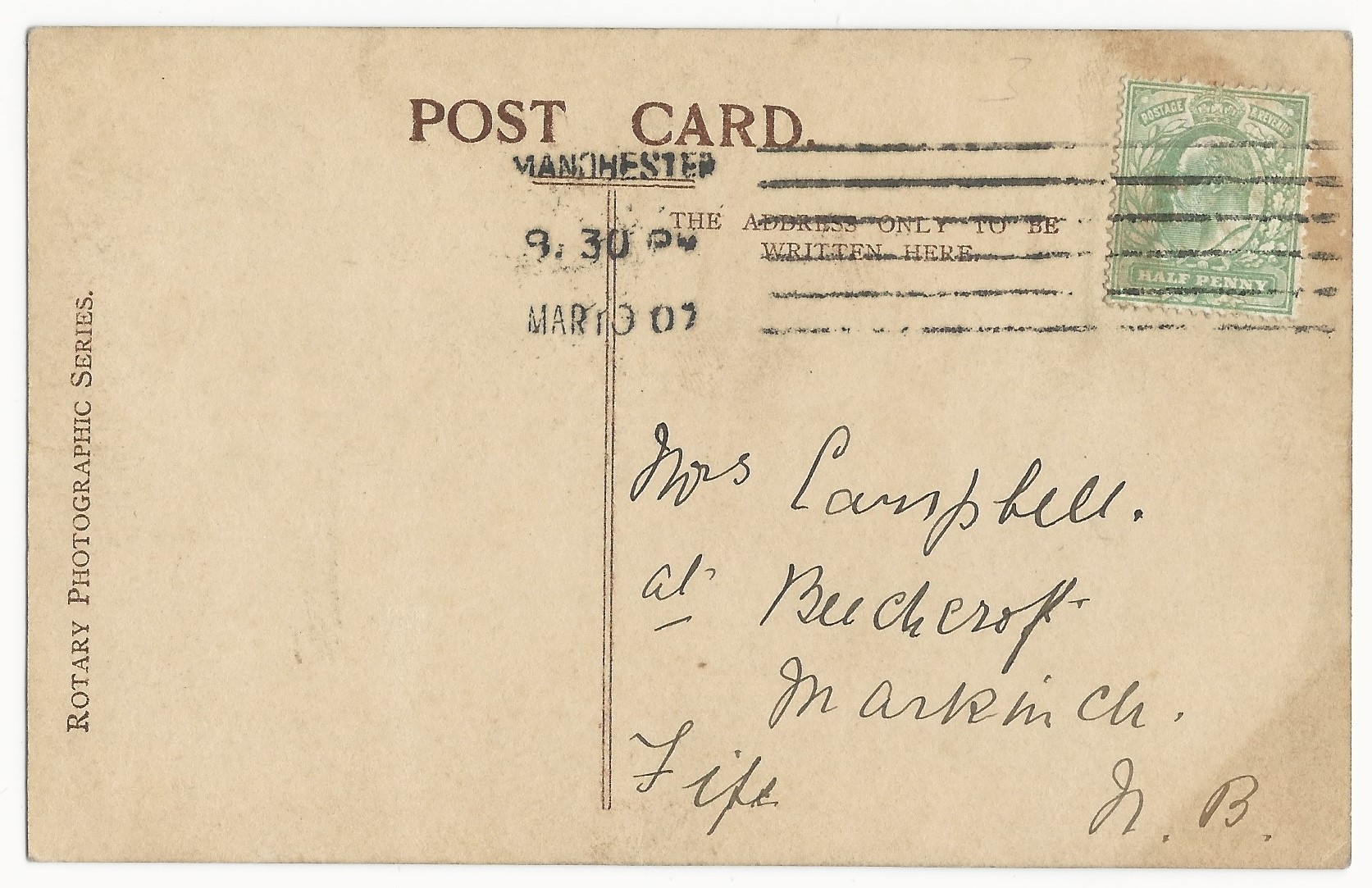
This vintage real photo postcard features a pretty actress named Gertie May. She has beautiful flowing dark hair and is flashing a wonderful half smile. Miss May is nearly surrounded by flowers. Preliminary research uncovered “bubkes”. I would welcome any information about this performer. This postcard was produced by Rotary Photo as part of a series (no.1976 A). The card has a 1907 postmark from Manchester, England. This wonderful portrait of Miss May, was taken by Dover Street Studios. The studio was active between circa 1906 and circa 1912. The gallery specialized in taking theatrical portraits and was located in London, England. They were the successors to the Biograph Studios as well as Adart (a studio that took advertising photos). SOLD
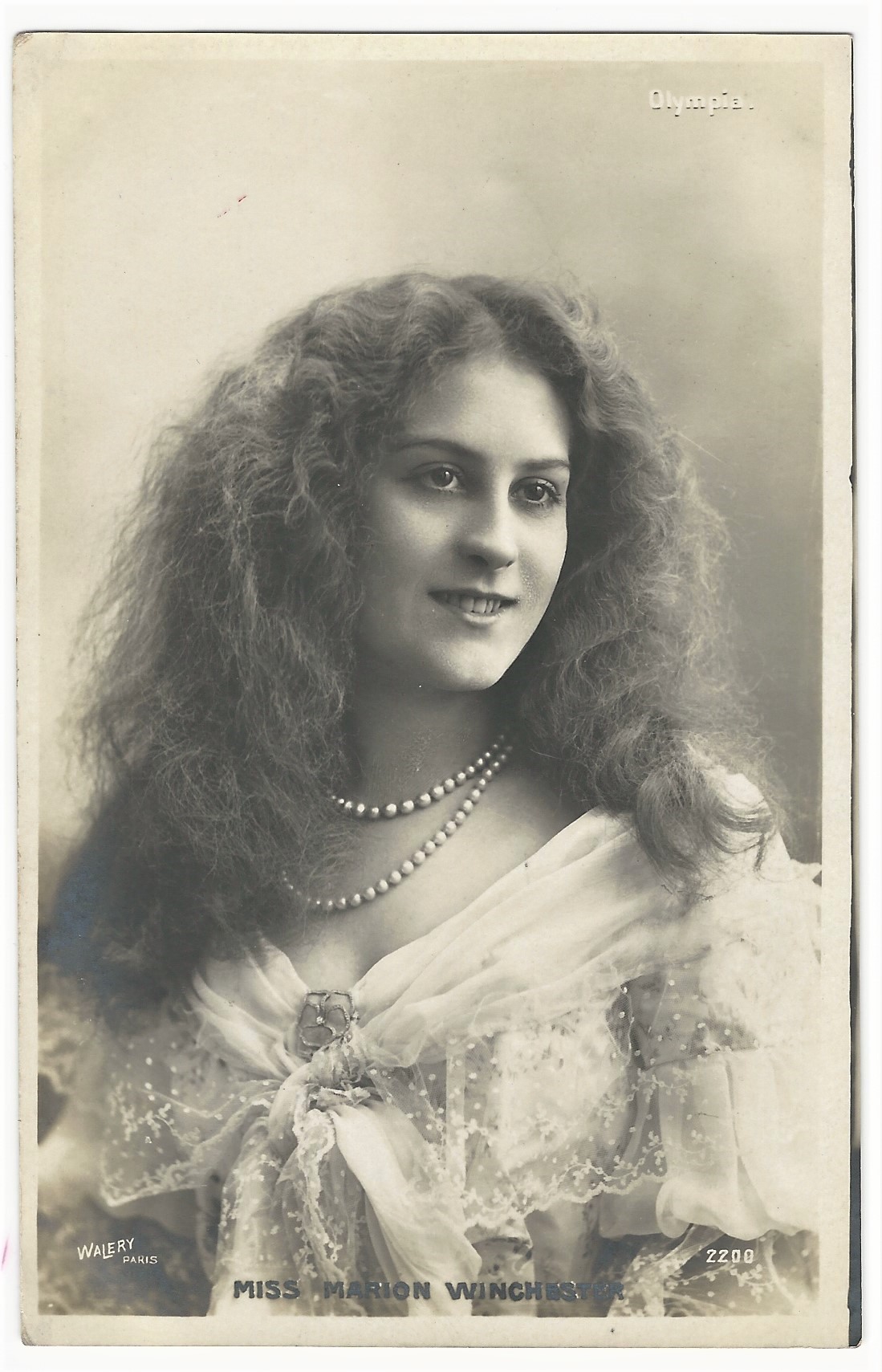
Marion Winchester (1882- ?) is the subject of this real photo postcard portrait. She was born in California. She began her professional career in 1899. She was trained at the Alviene Stage Dancing and Vaudeville School of Acting, at the Grand Opera House in New York. Winchester’s London premiere occurred in 1903 when she performed at the Oxford Music Hall where she was billed as the “World’s Champion Cake Walker”. She left London to appear in Paris where she received accolades for her dancing ability. In 1921, she applied for an emergency passport at the American Embassy in Paris. Her paperwork indicated that she resided in Paris where she studied music. She later married Italian pianist and composer, Count Aldo Solito de Solis (1905-1973). The pair divorced in 1940 and De Solis then married actress Gale Page. A photograph of Miss Winchester can be found in England’s National Portrait Gallery. Marion Winchester has appeared on Broadway four times between 1900 and 1902 and once again in 1934. She was mainly active within her career between 1899 and 1908. She was known for being a specialty dancer. An article in “London Week by Week” (1904) tells an interesting anecdote about Winchester. The article refers to the actress as the “Sugar Queen” and explains the origin of this nickname. It is reported that one day she was in the corridor of a fancy hotel and she was sucking on a piece of candy. She happened on the path of the “Emperor of the Sahara”, Jacques Lebaudy. The eccentric sugar magnate said to her, “Give up sugar-stick, and buy sugar stock”. It is said that she took the tip, and made a great deal of money, keeping her well stocked with furs, beautiful dresses, and diamonds. This portrait postcard was photographed by Lucien Walery. He was a celebrated Paris photographer known for his portraits of artists and cabaret dancers from the city’s music halls. He is very well known for his portraits of Mata Hari and Josephine Baker. Walery did a lot of work in the genre of nude/erotic photography. He photographed the beautiful women of Paris between the early 1900’s and the 1920’s. Walery does an excellent job of capturing Miss Winchester’s loveliness. Note her beautiful long hair. This postcard is part of a series (no. 2200). (SOLD)
This vintage real photo postcard features American silent film actress, Fern Andra (1893-1974). Andra was one of Germany’s most popular actresses in German silent film. She also worked as a film director, script writer, and producer. The pretty smiling Miss Andra poses with a Borzoi dog. She was born in Watseka, Illinois. Her father died when she was five years-old and her mother remarried. Fern’s step-dad was a vaudeville actor, circus performer and tight-rope walker. By age four, Fern was part of a tight-rope act. She later trained in dance and singing. In 1899, at age six, she made her first film, a version of “Uncle Tom’s Cabin”. She continued to perform with the circus and toured the United States, Canado, and Europe. She was a member of a famous troupe of wire artists. In Berlin, she took acting lessons from Max Reinhardt, prominent film and theater director. She appeared in several of his plays and films. In 1913, she acted in her first German film. In 1915, she was in her first Austrian film. Some believe Andra was an Allied spy in World War I. To deal with these rumors, she married a Prussian Baron. At some point, she stated that she actually was spying for the allies. This was her first marriage. He was killed in the war. Her second marriage was to a professional boxer. Her appearance in the film “Genuine” (1920) caused a great stir. In this horror film, she wore a costume that was simply, her painted body. She continued to make films in Europe but by the mid 1920’s, her popularity waned in Germany. In 1922, she was widely reported as being killed in a plane crash. In fact, she, and her companion, director Geog Bluen, survived the crash but according to one article, died the next day. However, the pilot, a former World War I fighter pilot and brother of the “Red Baron”, was killed. By 1928, Andra was working in the United Kingdom and the United States. She also expanded her acting to radio and television. Andra was married four times. She was widowed two times and divorced two times. Her fourth marriage, to a General, lasted about 35 years. She had no children. The IMDb gives Andra 51 acting credits between 1913 and 1930. She is also credited as a writer, producer, and director. An interesting side note is that when she was working as a producer, she interacted with a young German playwright named Josef Goebbels. Interestingly, she did propaganda broadcasts into Germany for the allies during World War II. Fern Andra died at age 80, in South Carolina. The stamp box of this postcard has an interesting story. “NBC” (Neue Bromsilber Convention) was a price cartel established in 1909 that continued until the 1930’s. The purpose of the cartel was to ensure that the minimum price charged for postcards was kept at a sufficiently profitable level. A number of postcard publishing companies joined the cartel in an effort to stave off the effect of competition on the pricing of postcards. This postcard is part of a series (no.131/1). The logo for the motion picture company, “Film Sterne” ,can be seen in the lower left hand corner of the image. SOLD
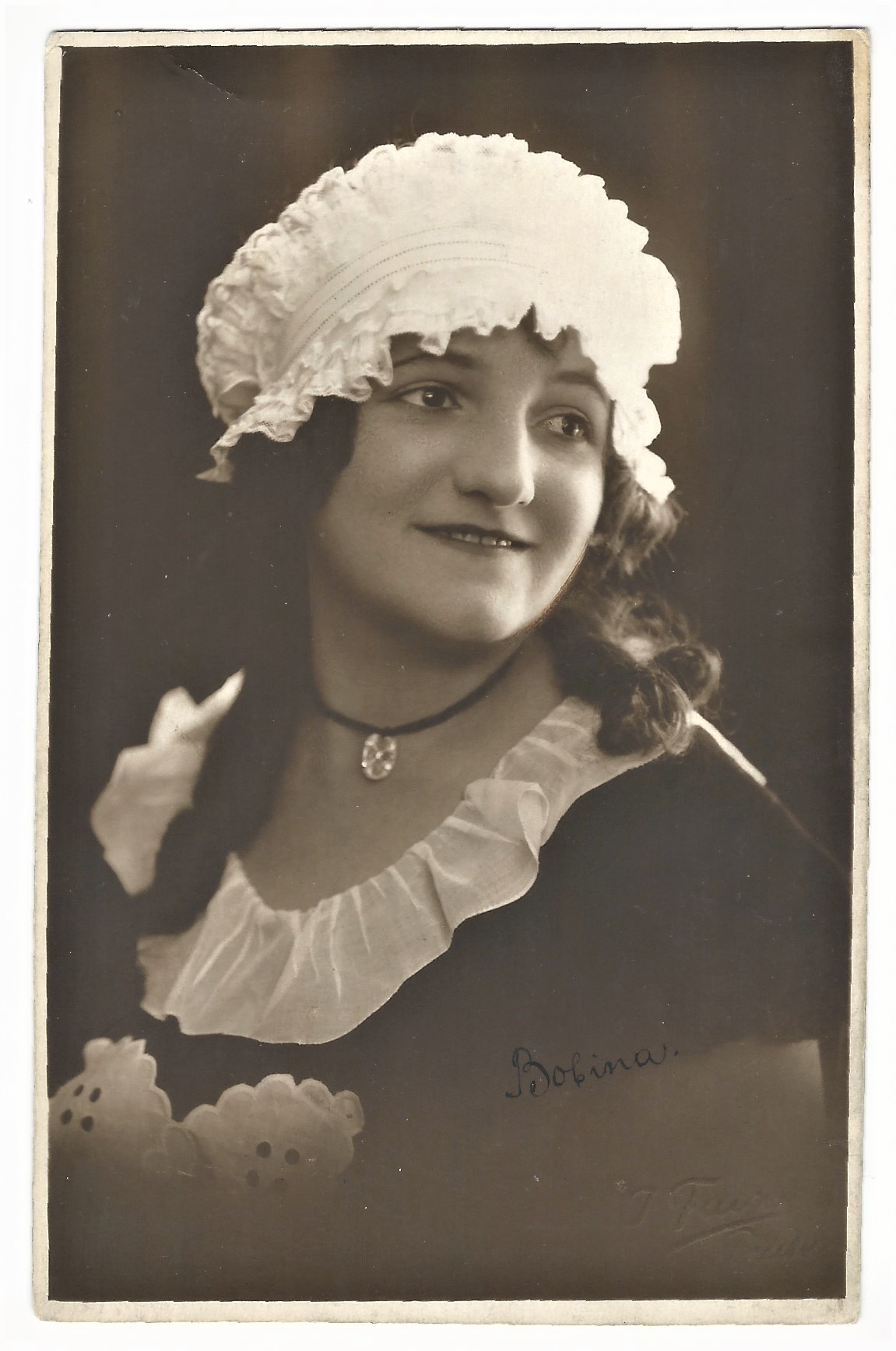
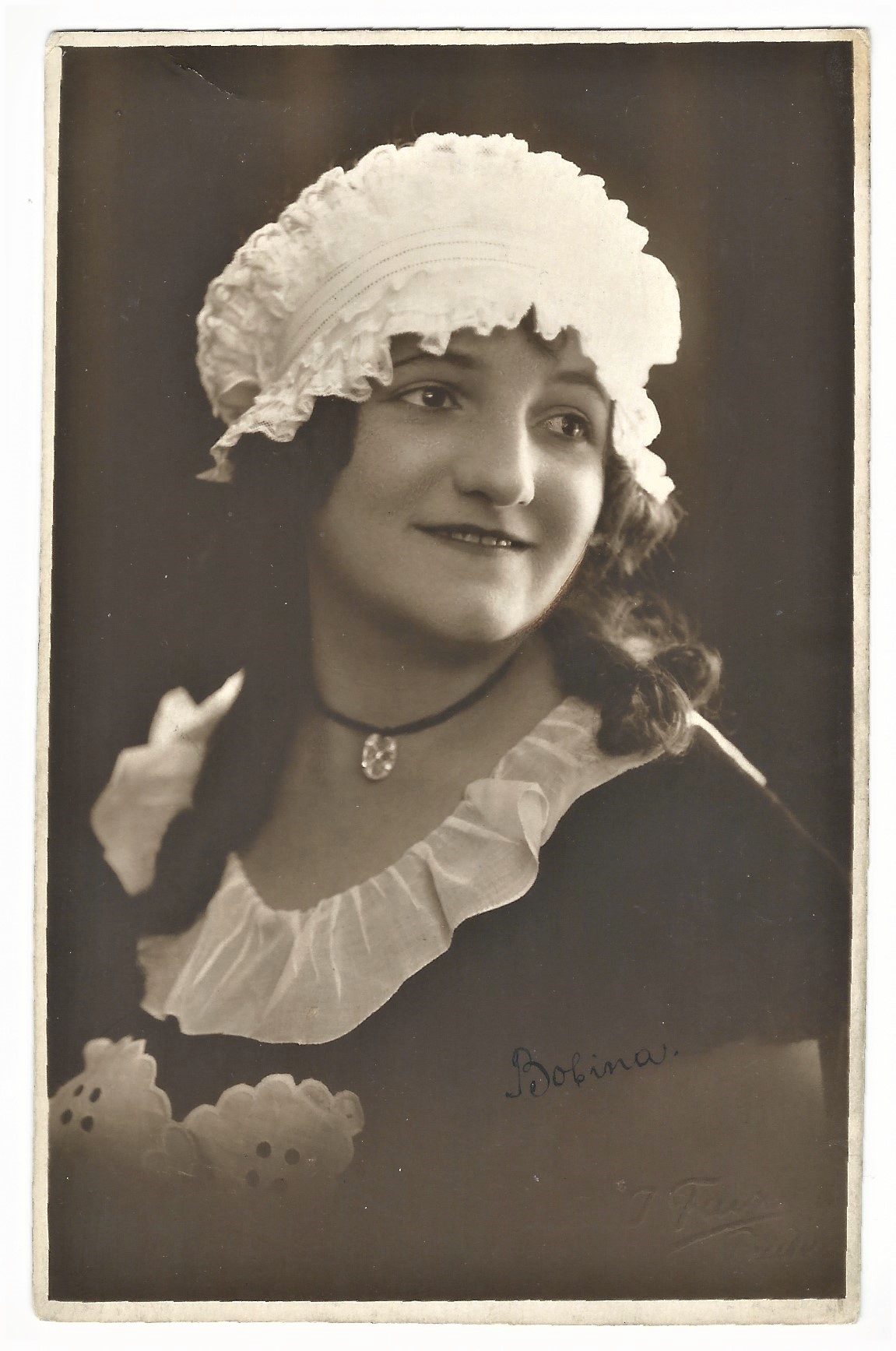
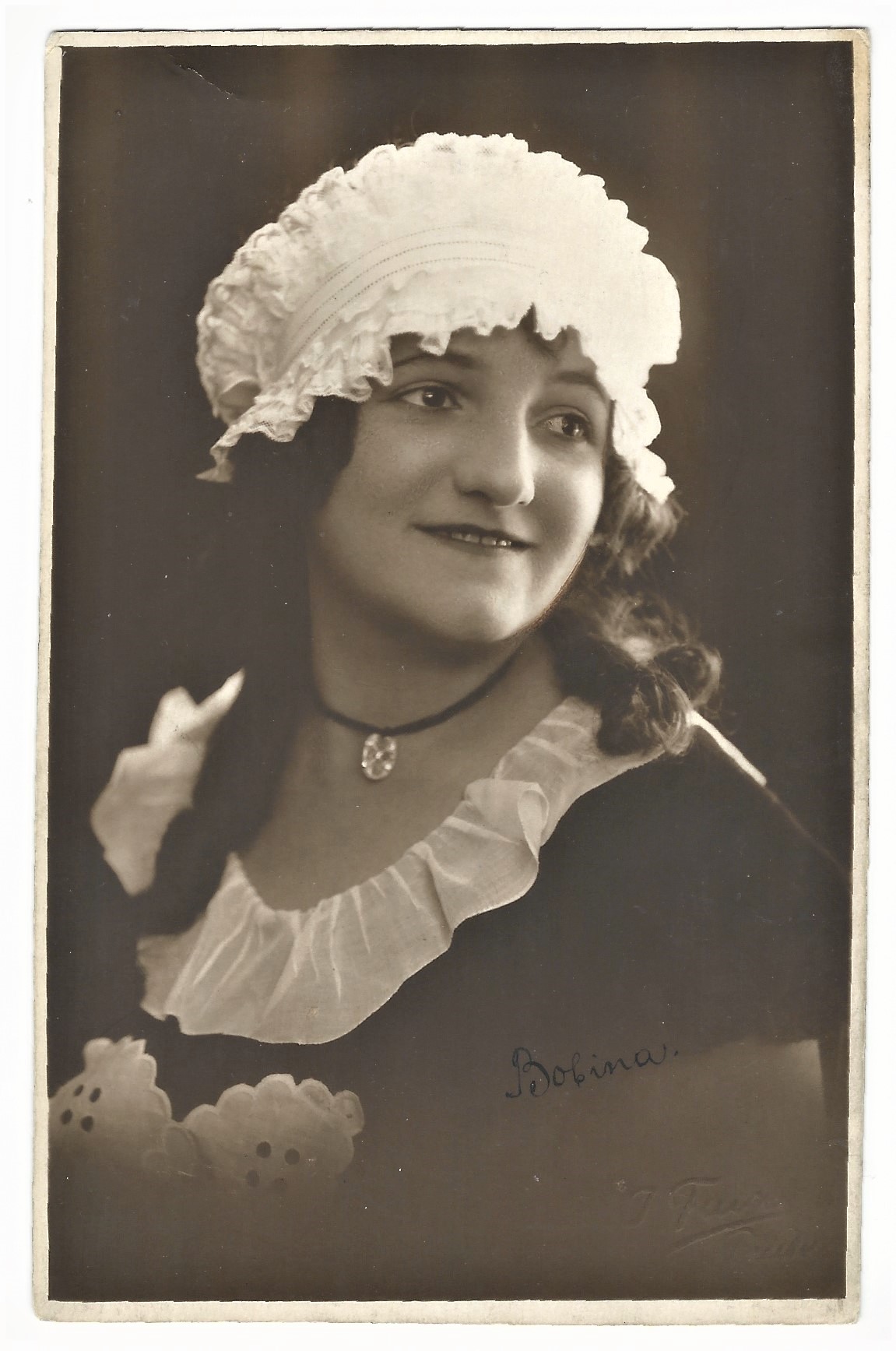
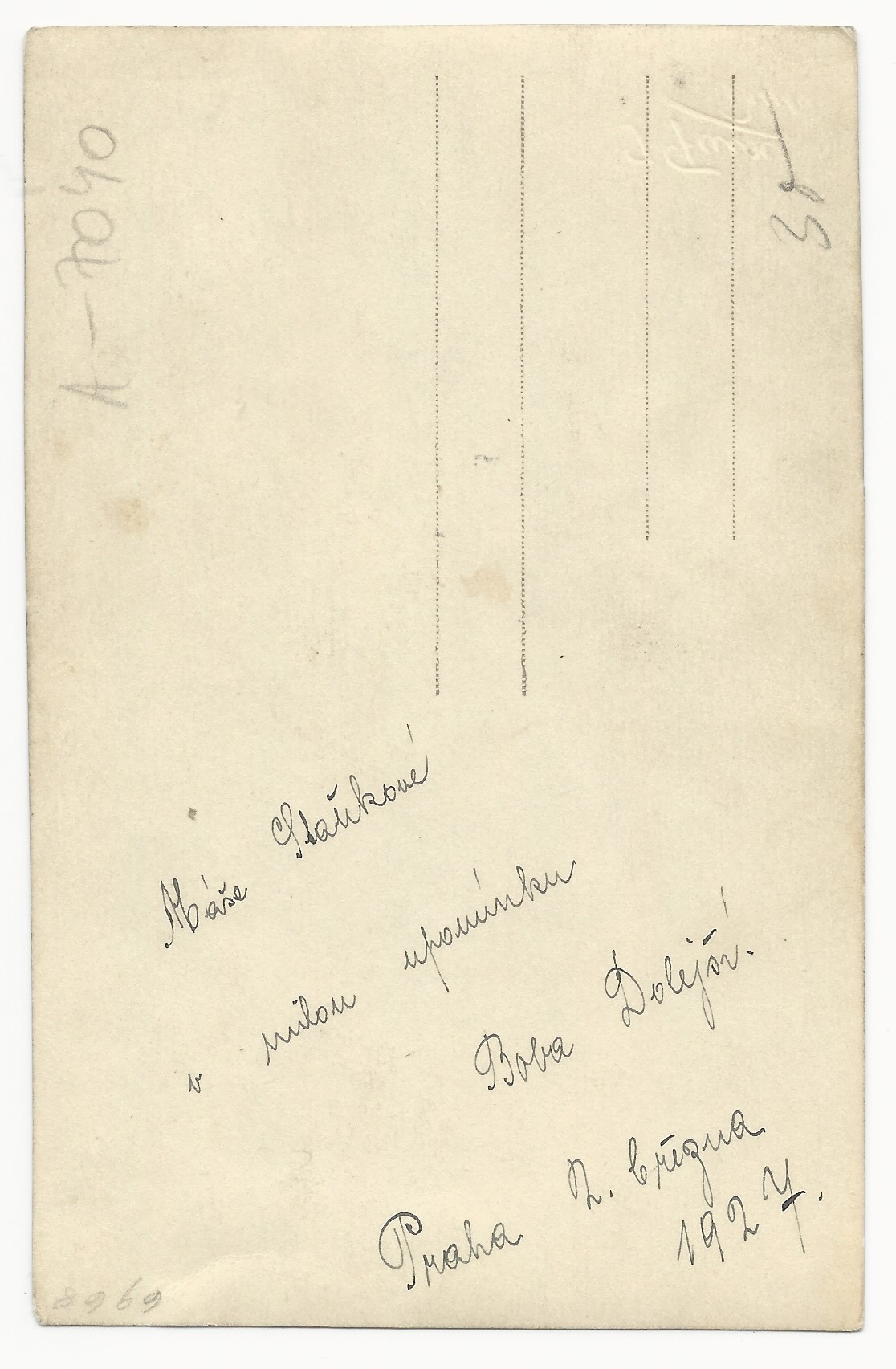
All of my attempts to identify this pretty young woman, have failed miserably. The previous owner of this vintage real photo postcard, identified this lovely lady as actress, Boba Doljesi. I can not find any information concerning anyone with this name. The postcard has an inscription on the reverse that was written in 1927. There is neat script writing on the near bottom right of the image that states “Bobina”. I need all the help that I can get to identify this woman with the sweet and pretty smile. The name of the photographer and the studio’s possible location is embossed on the bottom right hand corner of the image. Unfortunately, I don’t find the stamp legible. My guess, and it is only a guess, is that this card is from Czechoslovakia. This postcard is in very good condition (see scans).
Buy this original Vintage Real Photo Postcard (includes shipping within the US) #3252
To purchase this item, click on the Pay with PayPal button below
23.50 $
Buy this Cabinet Card Photograph (includes International shipping outside the US) 3252
To purchase this item, click on the Pay with PayPal button below
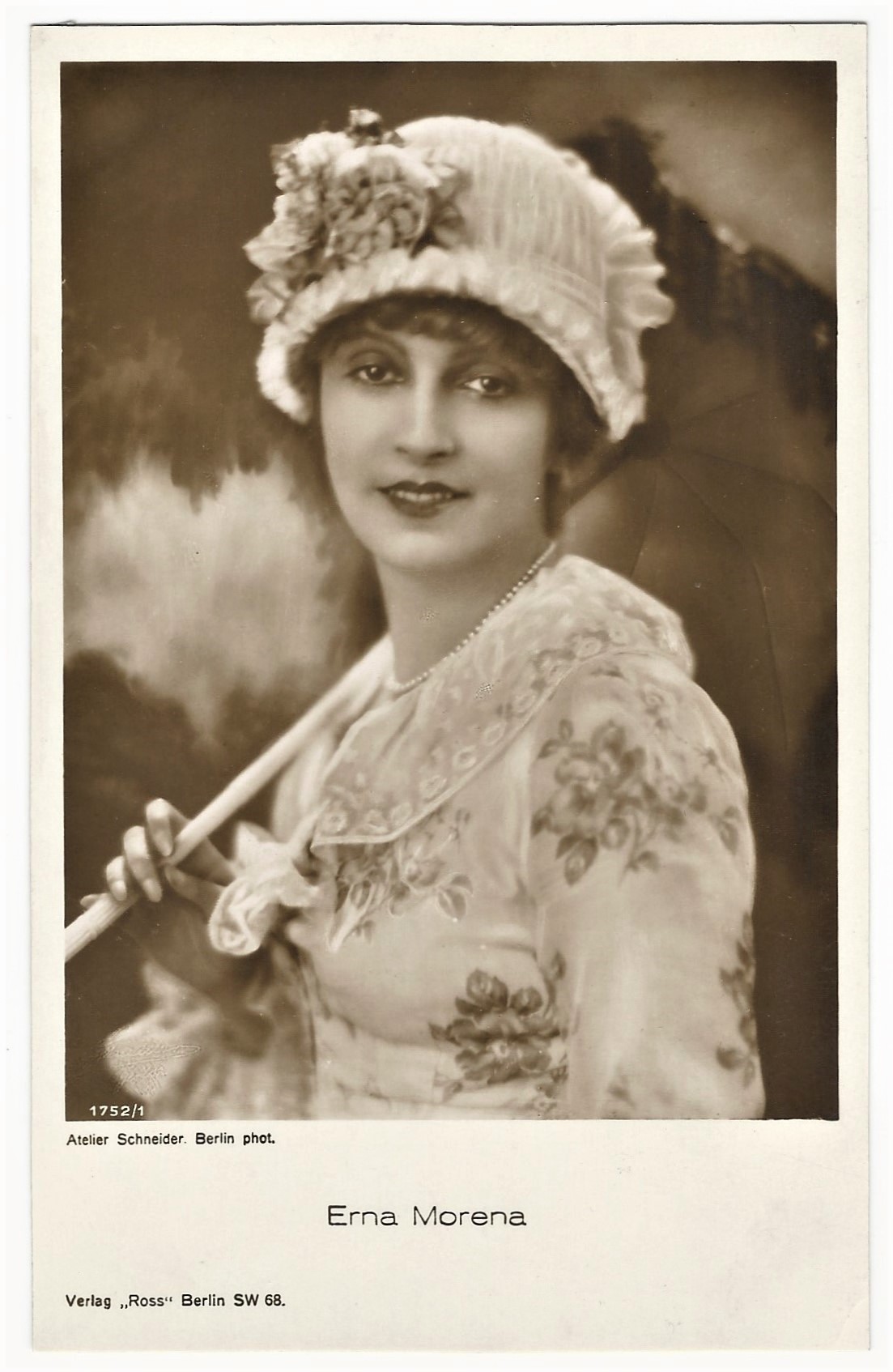
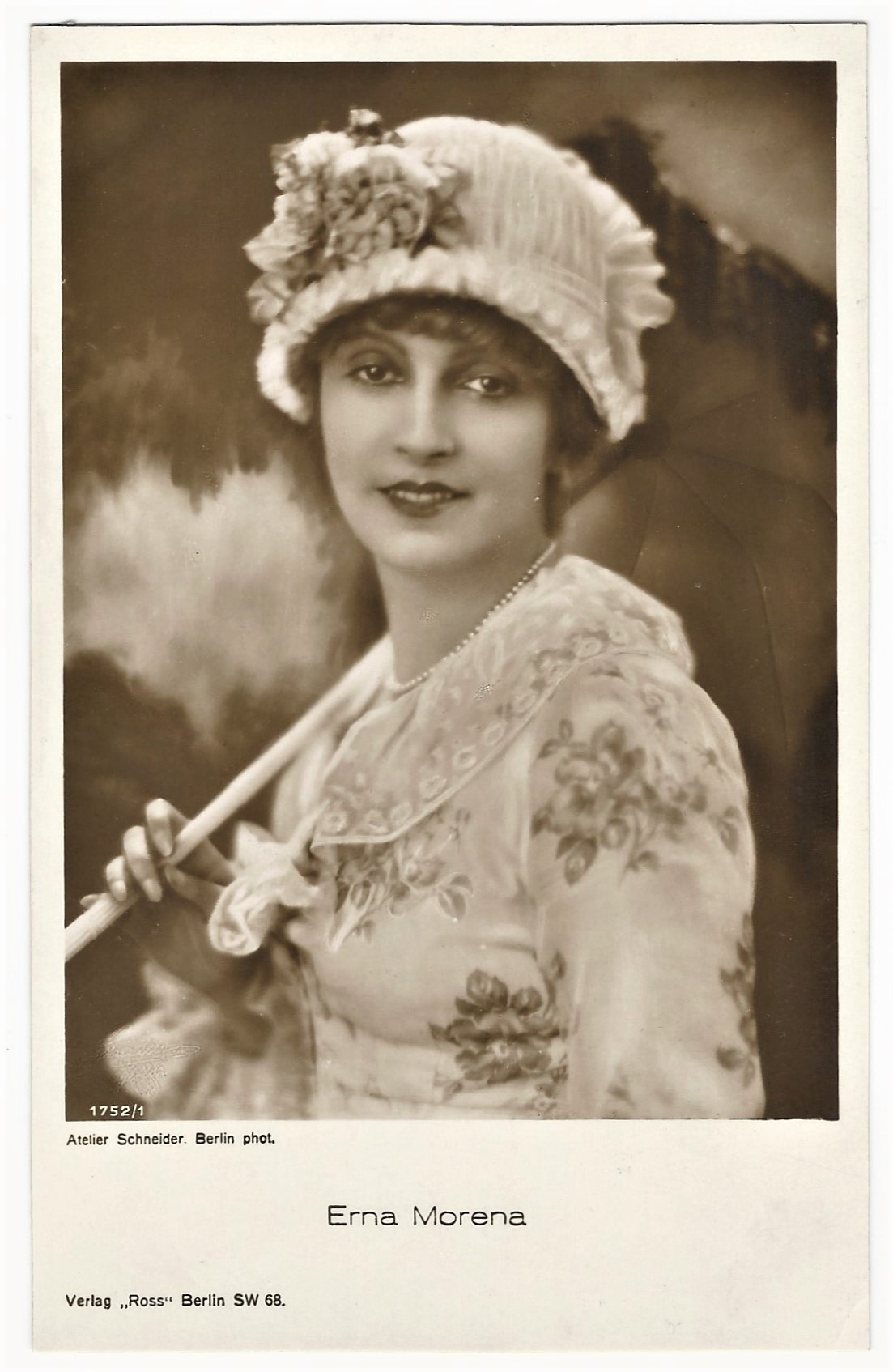
This vintage real photo postcard (Postcard 1) features pretty German film actress, Erna Morena (1885-1962). In addition to being a performer, she was also a film producer and screen writer during the silent era. The IMDb reports that Morena appeared in 122 films between 1913 and 1951. Morena grew up in a middle-class family in Bavaria. At age 17, she attended applied art school in Munich. In 1909, after a short stint in Paris, she moved to Berlin where she worked as a nurse. She became a student at the German Theater’s drama school and in 1910 was hired as an actress by Max Reinhardt, Austrian-born theater and film director. She played a number of small theater roles and in 1913, Morena made her film debut in “The Sphinx”, produced by Leteraria Film. She was a “big time” actress. She worked under many well known directors and with some of the most well known actors in German film. Morena made a bid to become a film producer and formed her own film company which produced films in 1918 and in 1920. By the mid 1920’s, she was considered one of the biggest stars in German films. With the advent of talkies, her career declined. However, she did appear in supporting roles during the 1930’s. Between 1915 and 1921, Morena was married to the German writer, Wilhelm Herzog. He was a historian of literature and culture, a dramatist, the author of an encyclopedia, and a well known pacifist. Their marriage ended in divorce. Morena appeared in the 1940 film “Jud SuB”. The movie was a Nazi Germany historical drama propaganda film. The film was produced on the order of Joseph Goebbels, the Nazi politician and trusted aide to Adolph Hitler. The movie is considered one of the most anti-semitic films of all time. Postcard 1 was published by Ross Verlag and is part of a series (no.1752/1). The company was located in Berlin, Germany. Morena was photographed by the German photographer, Ernst Schneider. Research about Mr Schneider yielded a great deal of information. He was considered to be one of the most celebrated studio photographers in Berlin during three decades (1900’s, 1910’s, 1920’s. He photographed many celebrities from the world of theater, opera, circuses, and film. He was also one of the most prominent fashion photographers in Berlin. In addition, he was well known for his nude photography and he published books showcasing his work in this domain. Sometime around 1908 Schneider began working with postcard publishers “Rotophot” and “Neue Photographische Gesellschaft” (NPG). In 1919 he began working with Ross Verlag. This postcard, a former resident of a postcard album, is in very good condition (see scans below).
Buy this Vintage Real Photo Postcard (includes shipping within the US) #3173
To purchase this item, click on the Pay with PayPal button below
$25.50
Buy this Vintage Real Photo Postcard (includes International shipping outside the US) #3173
To purchase this item, click on the Pay with PayPal button below
$34.00
Postcard 2POSTCARD 2 (CLOSE-UP)
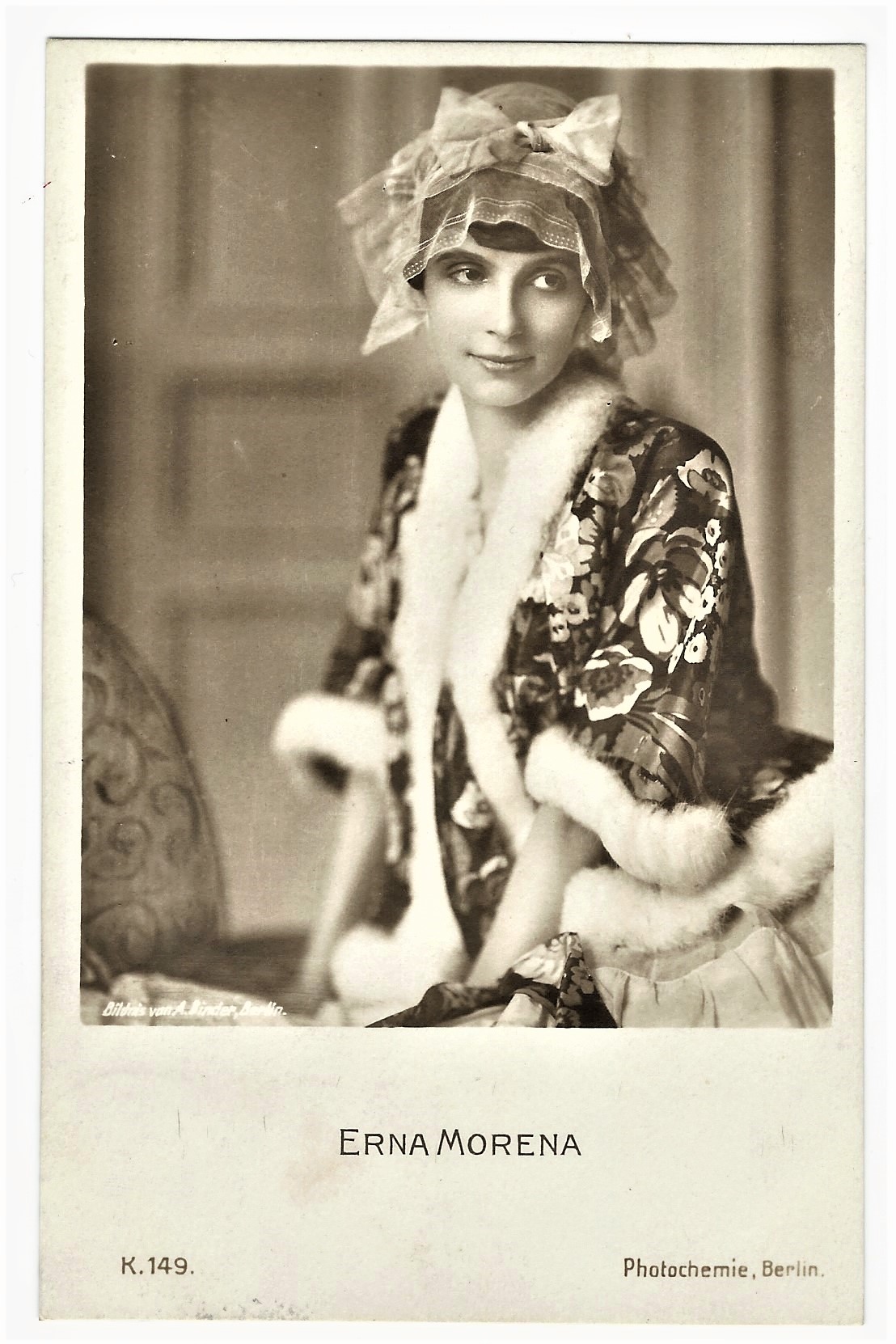
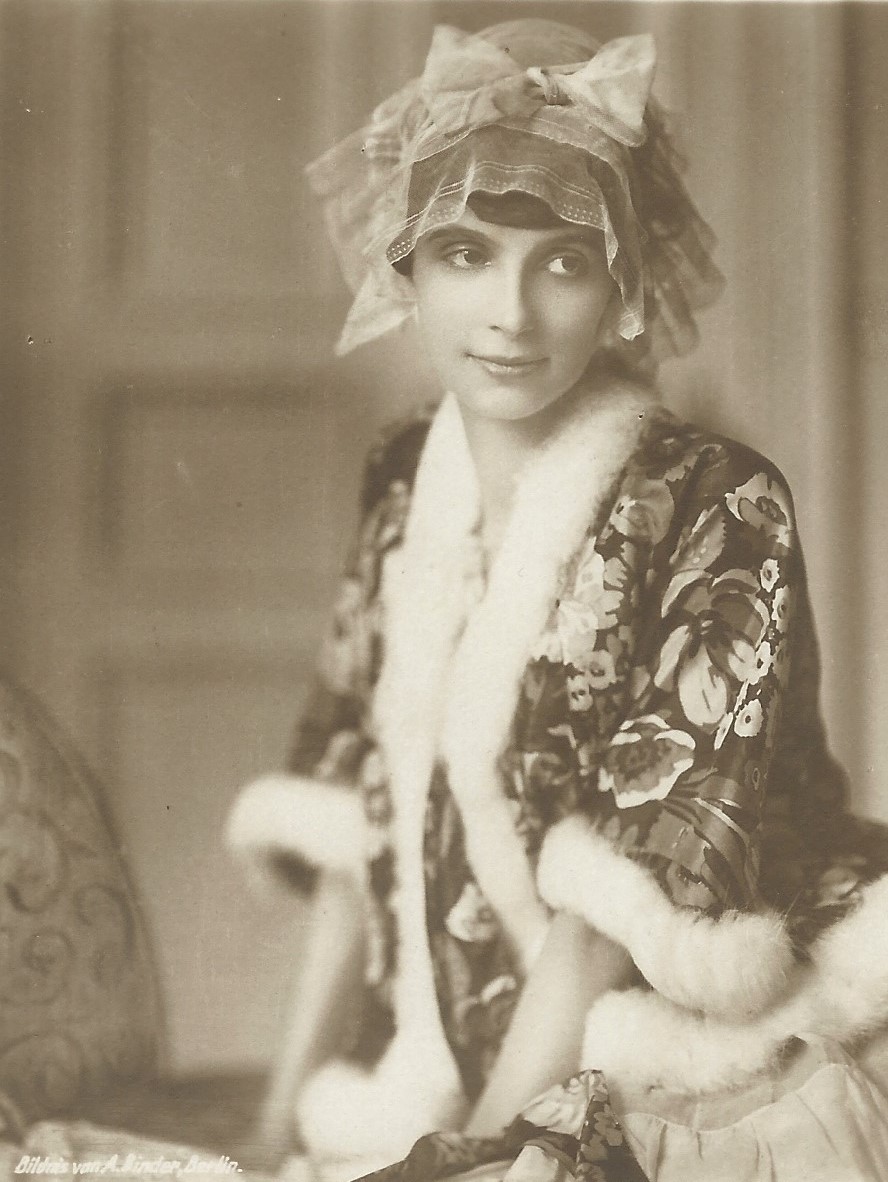
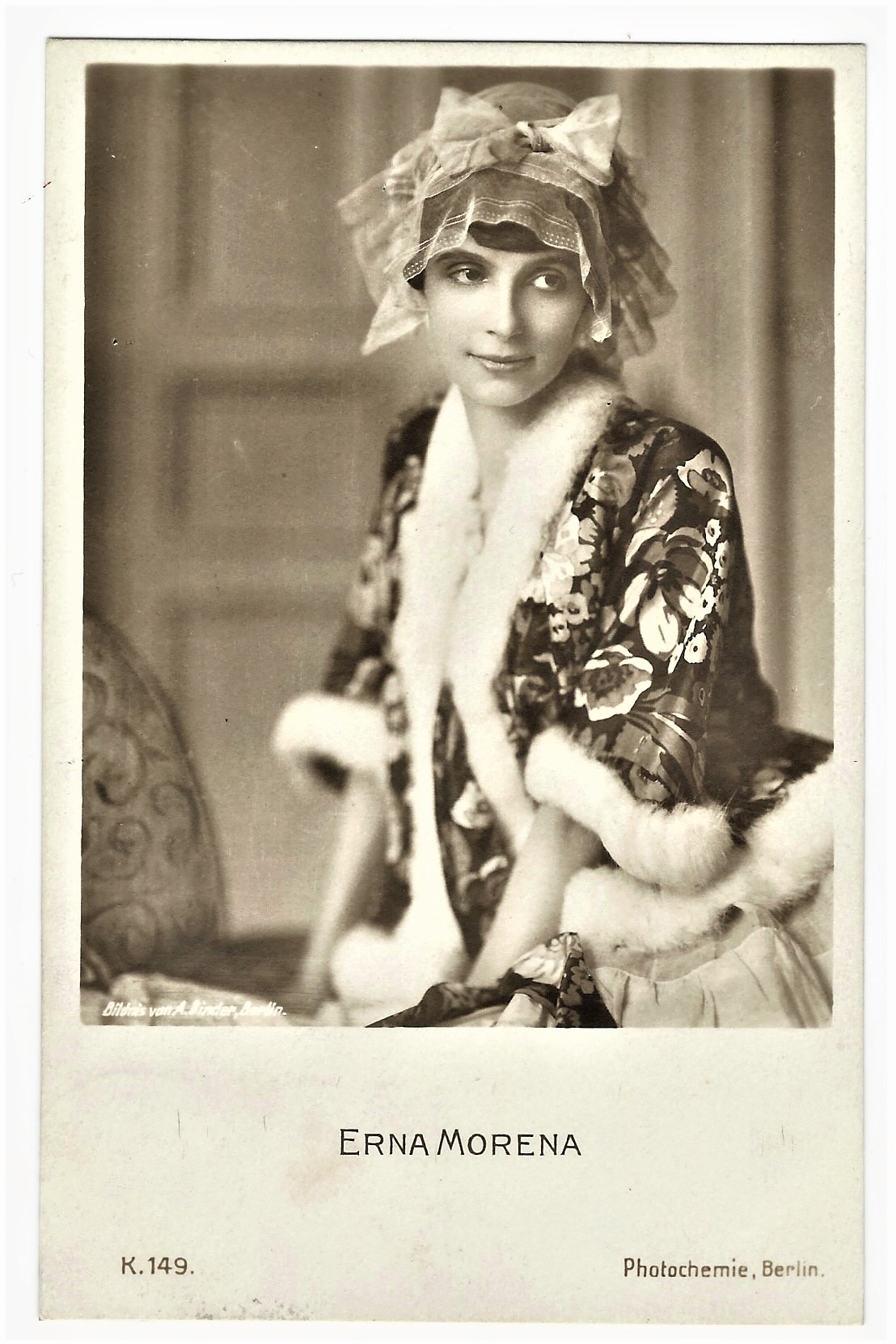
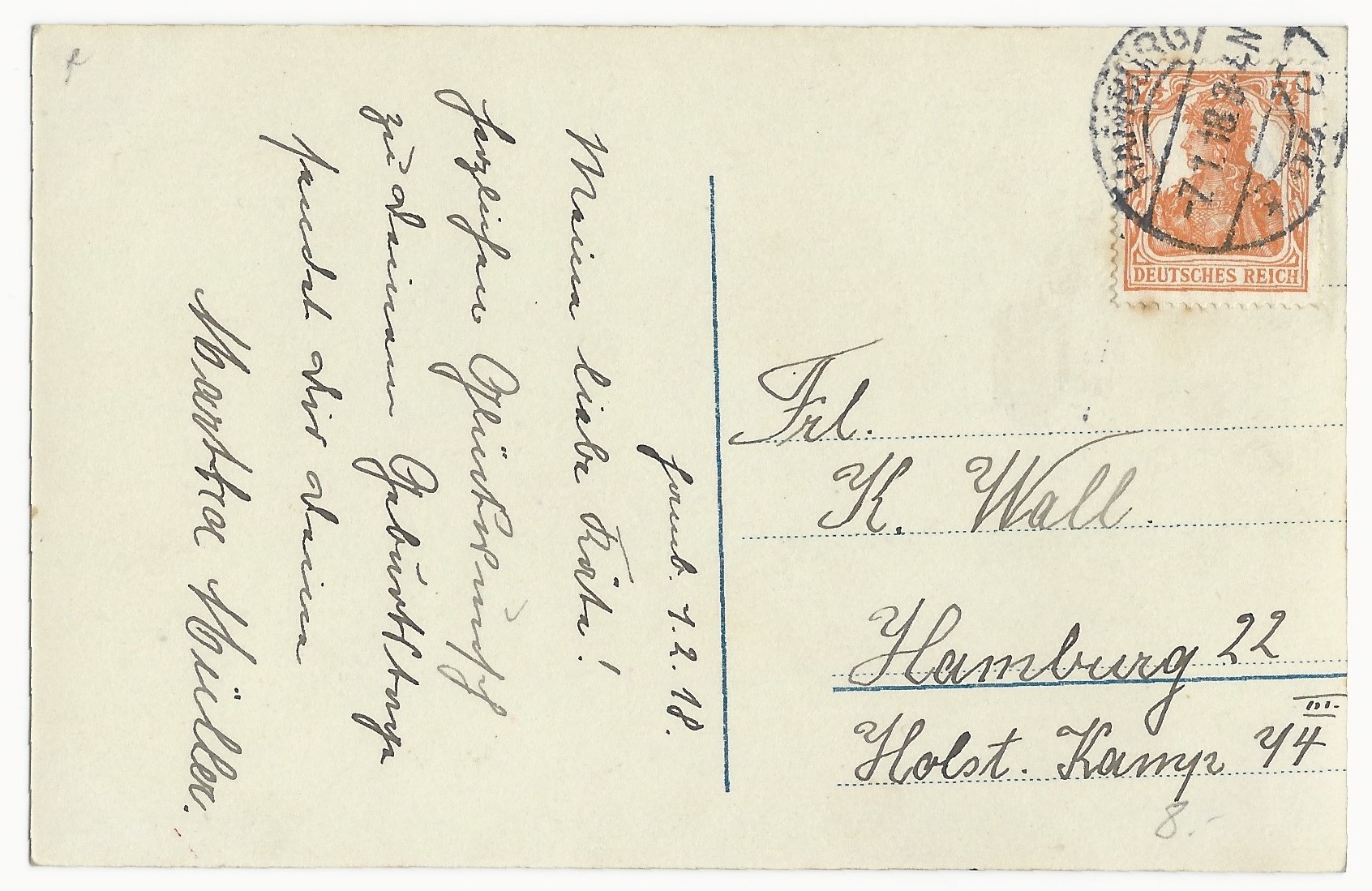
Postcard 2 also features the lovely Miss Morena. This postcard was published by Photochemie, located in Berlin, Germany. The card is part of a series (no.k149). Photochemie published postcards of only German film stars or European performers performing in German films. The postcards were published between 1914 and 1919. The firm also produced postcards of other subjects. The photographer of this terrific image was Alexander Binder (1888-1929). He had the largest photo studio in Europe during the late 1920’s and the 1930’s. Many of his entertainment star portraits appear on Ross Verlag postards. It is thought that Binder was of Swiss origin. He was of the Jewish faith. He studied engineering but did not complete his studies. From 1908 to 1910 he studied photography at a school in Munich, Germany. After the completion of his photography studies, he went to Berlin and in 1913 opened his first photography studio. Before long, he became one of the premier photographers in Berlin. He primarily focussed on fashion and celebrity photography. Since Berlin was the capital of the European film industry, Binder photographed all the stars of the European film industry including, Lilian Harvey, Conrad Veidt, and Lya De Putti. Many of his images were used in popular film portrait postcards. His photographs could be seen in postcards published by Ross Verlag and Photochemie. Binder died in 1929 but new photo cards bearing his signature continued to be published until 1937. It is thought that the real photographer of these new postcards was Hubs Floeter (1910-1974) who was employed at the studio as an operator. The studio continued to be owned by Binder’s widow, Mrs. Binder Alleman and their two daughters. The studio was managed by the Jewish Elisabeth Baroness Vonhedlis Stengel who was later deported to the Theresienstadt concentration camp. In 1938 the Nazi’s closed Binder’s studio and it was later taken over by an Aryan photographer, Karl Ludwig Haenchen . Haenchen continued to produce celebrity portraits for postcards. His publishers included Film-Foto-Verlag. After World War II the studio was taken over by the Hasse und Wiese company. This postcard has a Hamburg, Germany postmark and is dated 1918. The postcard is in very good condition (see scans)
Buy this Vintage Real Photo Postcard (includes shipping within the US) #3253
To purchase this item, click on the Pay with PayPal button below
$19.50
Buy this Vintage Real Photo Postcard (includes International shipping outside the US) #3253
To purchase this item, click on the Pay with PayPal button below
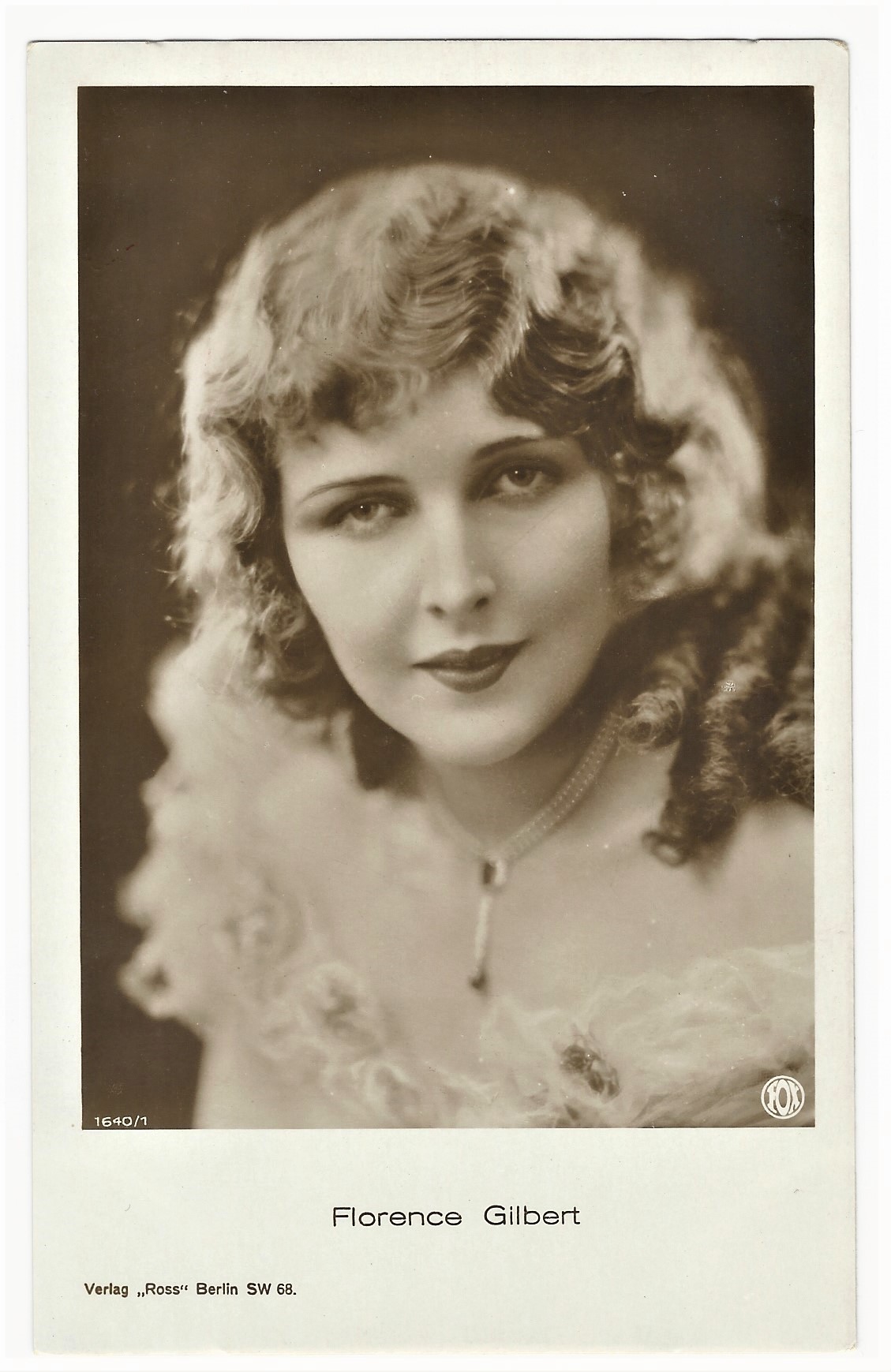
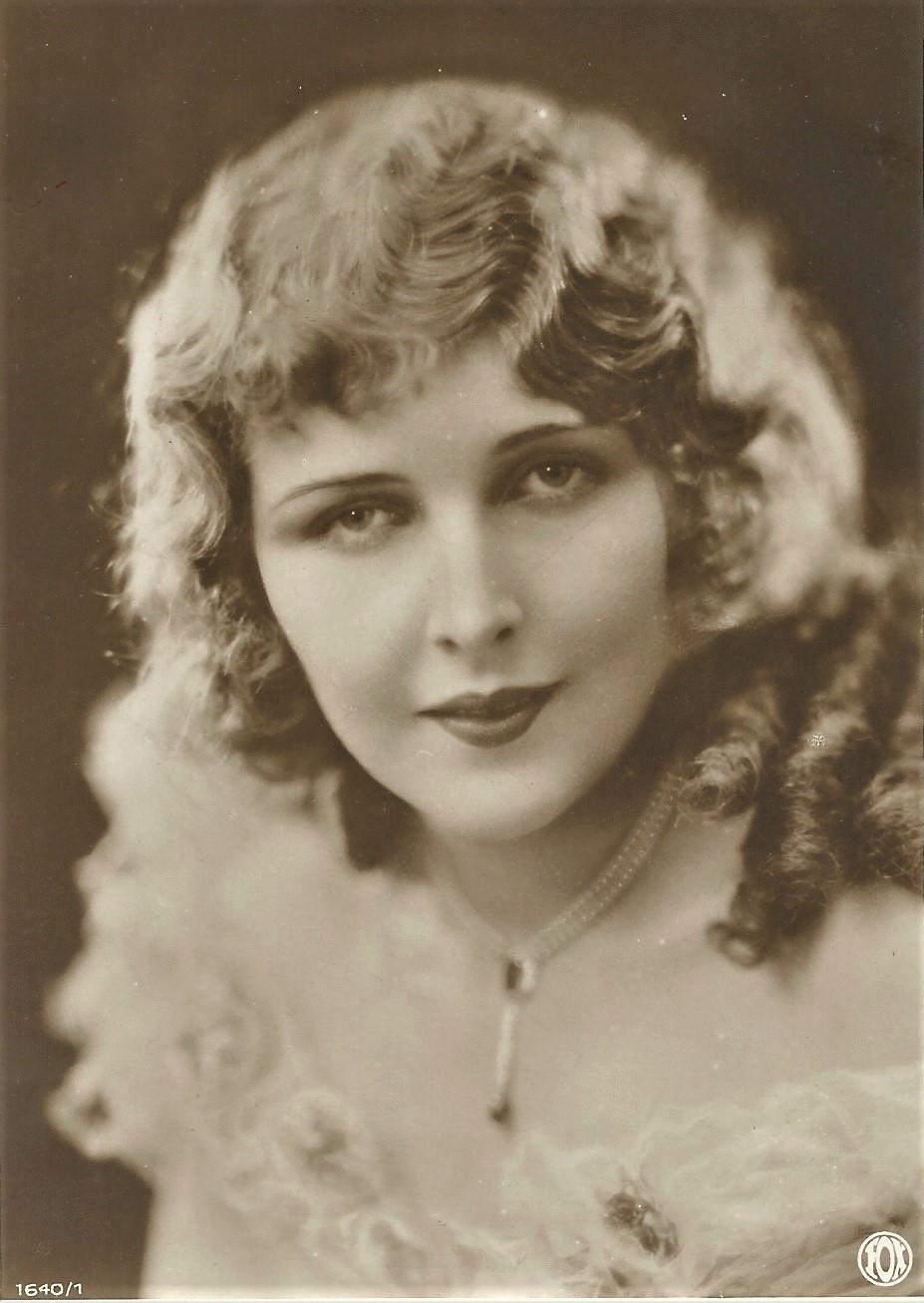
Florence Gilbert (1904-1991) is the subject of this vintage real photo postcard. She was a film actress active between 1920 and 1927. Gilbert’s hometown was Chicago. Florence’s mother wanted her to become the next Mary Pickford. In fact, she resembled Pickford in some ways. Florence’s mother had mailed photos of Florence to Pickford who encouraged her to take Florence to Hollywood. At age 14, she moved with her mother and brother to Los Angeles. She started off as Mary Pickford’s double. She was discovered by Monty Banks, an Italian comedian, film actor, director and producer. Apparently, she looked older than her fourteen years. She played a number of roles in films for Mack Sennett studios. She also worked in Hollywood for Fox Studios. Although she was still a teenager, she became the breadwinner of her family. According to IMDb she made 68 film appearances beginning in 1920. She appeared in the first Laurel and Hardy film, ‘The Lucky Dog” (1921). She was married three times. Her first husband was Ashton Dearholt (1894-1942), an American silent film actor. She permanently left acting after marrying Dearholt. She divorced him when he returned home from filming in Guatemala, accompanied by co-star Ula Holt. He was determined to have Holt live in the house he shared with Gilbert. She divorced Dearholt after he made his outrageous demand. Dearholt later married Holt. Husband number two was Edgar Rice Burroughs (1875-1950), an American fiction writer. He was the creator of Tarzan. The marriage ended in divorce due to his drinking. Her third husband was Dr Albert Stillman Chase. She had two children with Dearholt; both were adopted by Chase. Another source “credited her” with two additional marriages. This vintage postcard was published by Ross Verlag, located in Berlin, Germany. The card was part of a series (no.1640/1). Note the Fox studio’s logo in the bottom right hand corner of the image. This postcard is in excellent condition (see scans). SOLD
This vintage real photo postcard features the Swedish actress Jngeborg Ronnblad (1873-1915). If you can pronounce her first name, please accept my congratulations. If you are Swedish, you are not eligible for this challenge. Miss Ronnblad is quite pretty and fashionable. Her dress and hair (or wig) are covered with roses. Note that she is wearing two large rings. I wonder if she is dressed in a costume from one of her films. Just below her name in the top right corner, are the words “i Lifvets dal”. The translation of these Swedish words is “In the Valley of Life”. Could this be a film title? Ronnblad was born in Sweden. Her parents ran a theater society. Her husband was Swedish actor, Hugo Ronnblad. She worked a an actress, at least between 1888 and 1895. The publisher of this postcard was Paul Heckscher. The card is part of a series (no2011).This publishing house specialized in art reproductions, artist signed cards, black and white views, and hand colored real photos. The company was headquartered in Stockholm, Sweden. The Paul Heckscher publishing company operated between 1900 and 1917. Their postcards were printed in England. This vintage postcard portrait is in very good condition (see scans),
Buy this original Vintage Real Photo Postcard (includes shipping within the US) #3222
To purchase this item, click on the Pay with PayPal button below
25.50 $
Buy this Cabinet Card Photograph (includes International shipping outside the US) 3222
To purchase this item, click on the Pay with PayPal button below
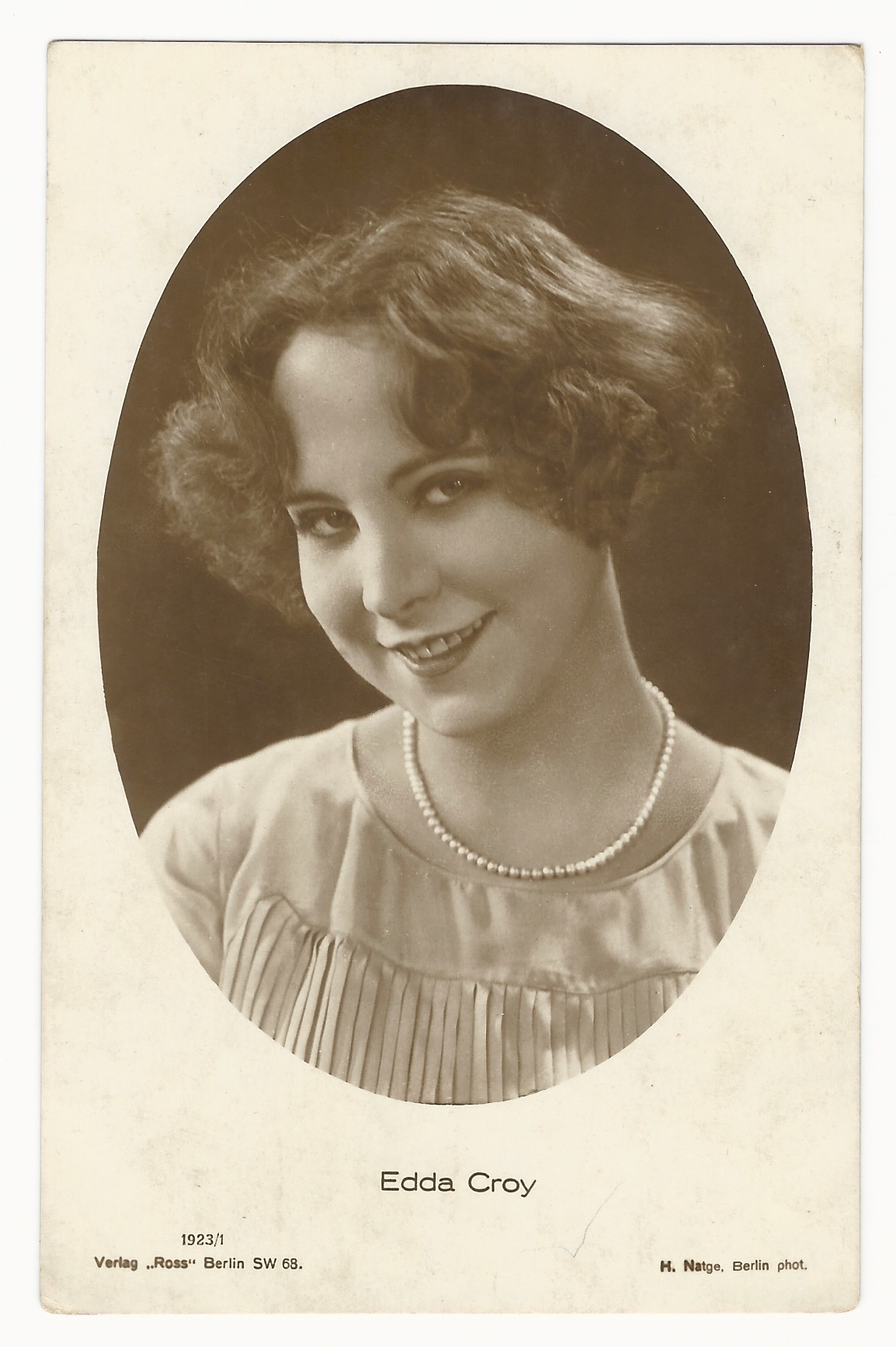
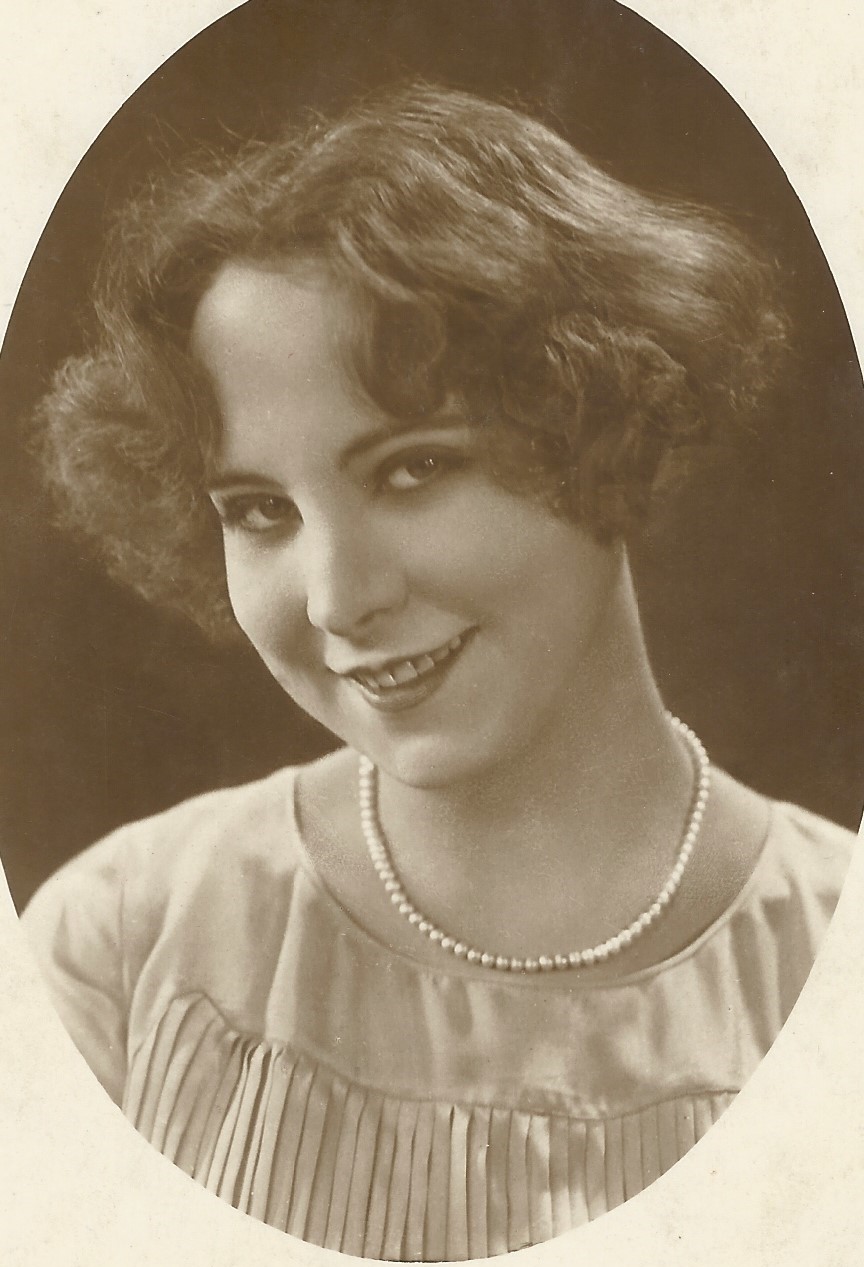
This vintage real photo postcard features silent film actress, Edda Croy. Edda has “the girl next door” look. Preliminary research uncovered little about her. Edda had a very short career. She played in three German silent films, all release in the same year (1927). One of these films was directed by Robert Wiene. He is well known for directing the silent film “The Cabinet of Dr. Caligari” (1920) and other expressionist films. Popular actor, Harry Liedtke, appeared in all three of her films. Actress Erna Morena, who’s photograph can be seen elsewhere in the Cabinet Card Gallery, apppeared in one of Edda’s films. This postcard was published by Ross Verlag (Berlin). It is part of a series (no.1923/1). Miss Croy’s photograph was taken by photographer Hans Natge. Natge was very involved in German film production. He played roles in the realm of cameras, directing and assistant directing. He was born in Berlin in 1893. His filmography on IMDb reports that he has 28 film credits between 1924 and 1949. Nineteen of these credits were for his role as the film’s “still photographer”. It is likely safe to assume that he took this photograph of Miss Croy in 1927. This vintage portrait postcard is rare and in very good condition (see scans).
Buy this original Vintage Real Photo Postcard (includes shipping within the US) #3218
To purchase this item, click on the Pay with PayPal button below
24.00 $
Buy this Vintage Real Photo Postcard (includes International shipping outside the US) 3218
To purchase this item, click on the Pay with PayPal button below
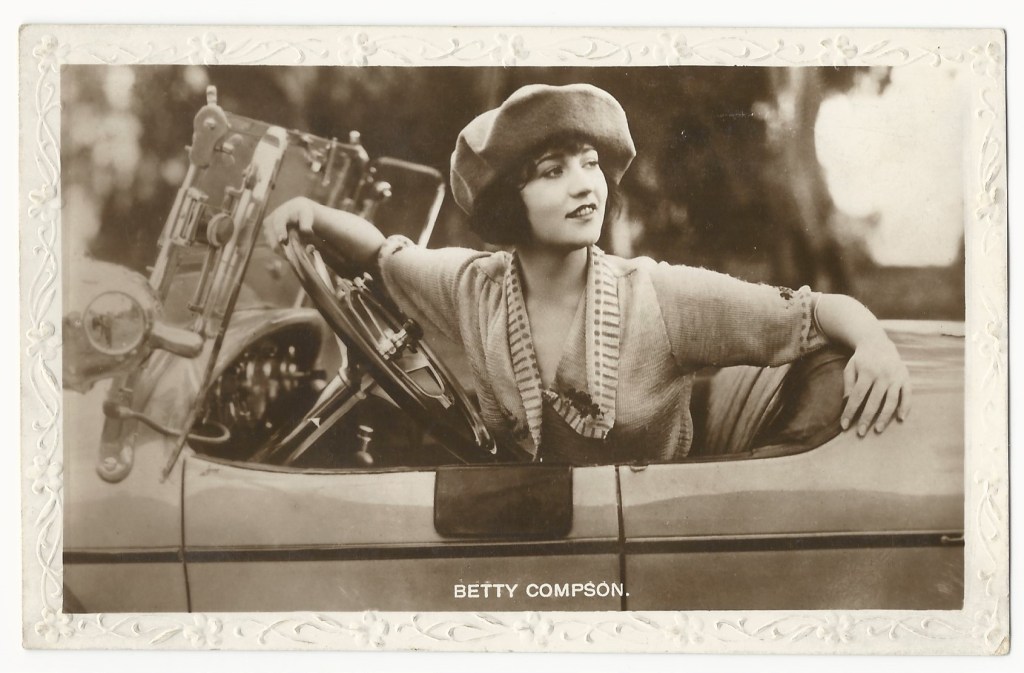
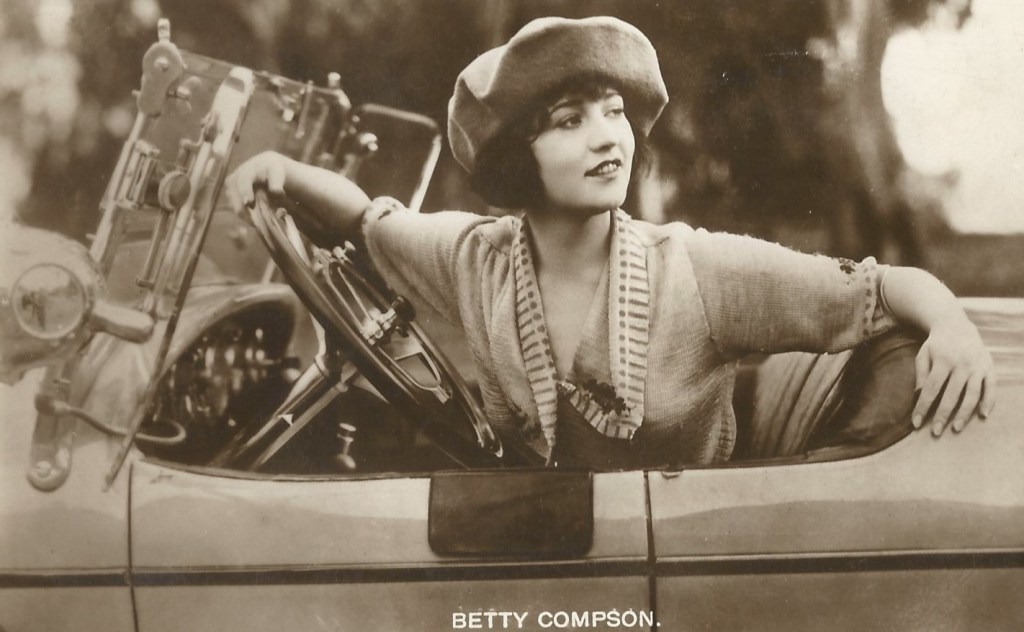
This vintage real photo postcard features American actress and film producer, Betty Compson (1897-1974). She was nicknamed “the prettiest girl in pictures”. Compson was born in a mining camp in Beaver, Utah. Her father was a mining engineer, a gold prospector, and grocery store owner. Her mother was a maid in hotels and private homes. Betty graduated from Salt Lake High School. She was hired as a violinist at age 16 in a theater in Salt Lake City. She then played in vaudeville touring companies and it was during this stint she was discovered by a film producer (Al Christie) who signed her to a contract. She began her career during Hollywoods’s silent film era. Her debut film was “Wanted, a Leading Lady” (1915). After this film, her career rocketed. She appeared in 25 film in 1916. All but one, were shorts. In 1918 she was offered a contract by studio head Mack Sennett. She rejected the offer because the salary was too low. She continued to make numerous short films until the middle of 1918. She was frequently paired with Roscoe “Fatty” Arbuckle. She started making only feature films. She became a rising star after appearing opposite Lon Chaney in “The Miracle Man” (1919). Paramount became interested in her and signed her to a five year contract. In 1921, Compson established her own production company in order to have creative control over screenplays and financing. The first movie she produced was “Prisoners of Love” (1921). After she completed acting in “The Woman With Four Faces” (1923), Paramount refused to give her a raise. She wanted an increase in her $2500 per week salary. Compson was angry enough at Paramount, to leave the company, and sign with a British film company. She made four films in England, two of them were films penned by Alfred Hitchcock. Paramount lured her back to Hollywood from England by offering her a top dollar contract. She then appeared in a movie by director, James Cruze. The pair married in 1924, but divorced four years later. The divorce from Cruze nearly ruined her financially because of debt accrued by Cruze. After Paramount did not offer her a contract renewal, she began freelancing in lower budget films. In 1928 she appeared in a “part talkie” called “The Barker”. She played a manipulative carnival girl. She was nominated for a “Best Actress” for this role by the Academy Awards. In 1929, she gained much recognition for her role in “The Docks of New York”. She played a suicidal prostitute. These two films resulted in her popularity returning to it’s previous high level. She appeared in many “talkie” films. Unlike a lot of silent film stars, Compson made a successful transition into sound films. In fact, she even appeared in a number of early musicals. When she played singing parts, her voice was dubbed. Her career flourished. In 1930, she appeared in 9 films. Her last “hit’ was in “The Spoilers”. Her costar was Gary Cooper. Her popularity waned and she only got roles in low budget, less successful studios. Her last film was in 1948. After retiring from her movie career, she started a cosmetic line and assisted her husband in a business named “Ashtrays Unlimited”. In total Compson was married three times. Her second marriage, to agent/producer Irving Weinberg ended in divorce after four years. Her third marriage was to a professional boxer. The marriage lasted 18 years and ended upon his death in 1962. She had no children. She died in 1974 after suffering a heart attack. She had much impact on the early movie industry. The IMDb reports 209 film credits between 1915 and 1948. This vintage postcard is in excellent condition (see scans). Take a look at the YouTube video below. The video features Betty Compson appearing in the silent film, “The Docks of New York” (1928). The music accompanying this video is obviously modern, but, in my opinion, it is excellent. Compson demonstrates incredible acting ability. Her facial expression and her eyes speak for her. SOLD
Betty Compson in “The Docks of New York” (1928) Music: “Marry Me” By Dave Pagett and Viv Jones (Sax)
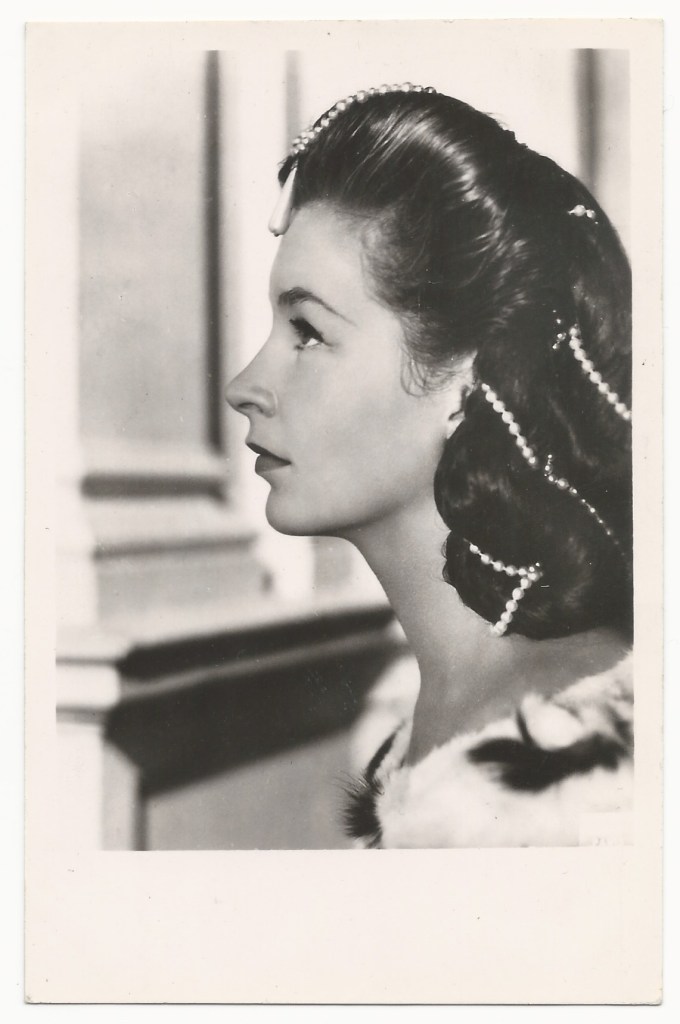
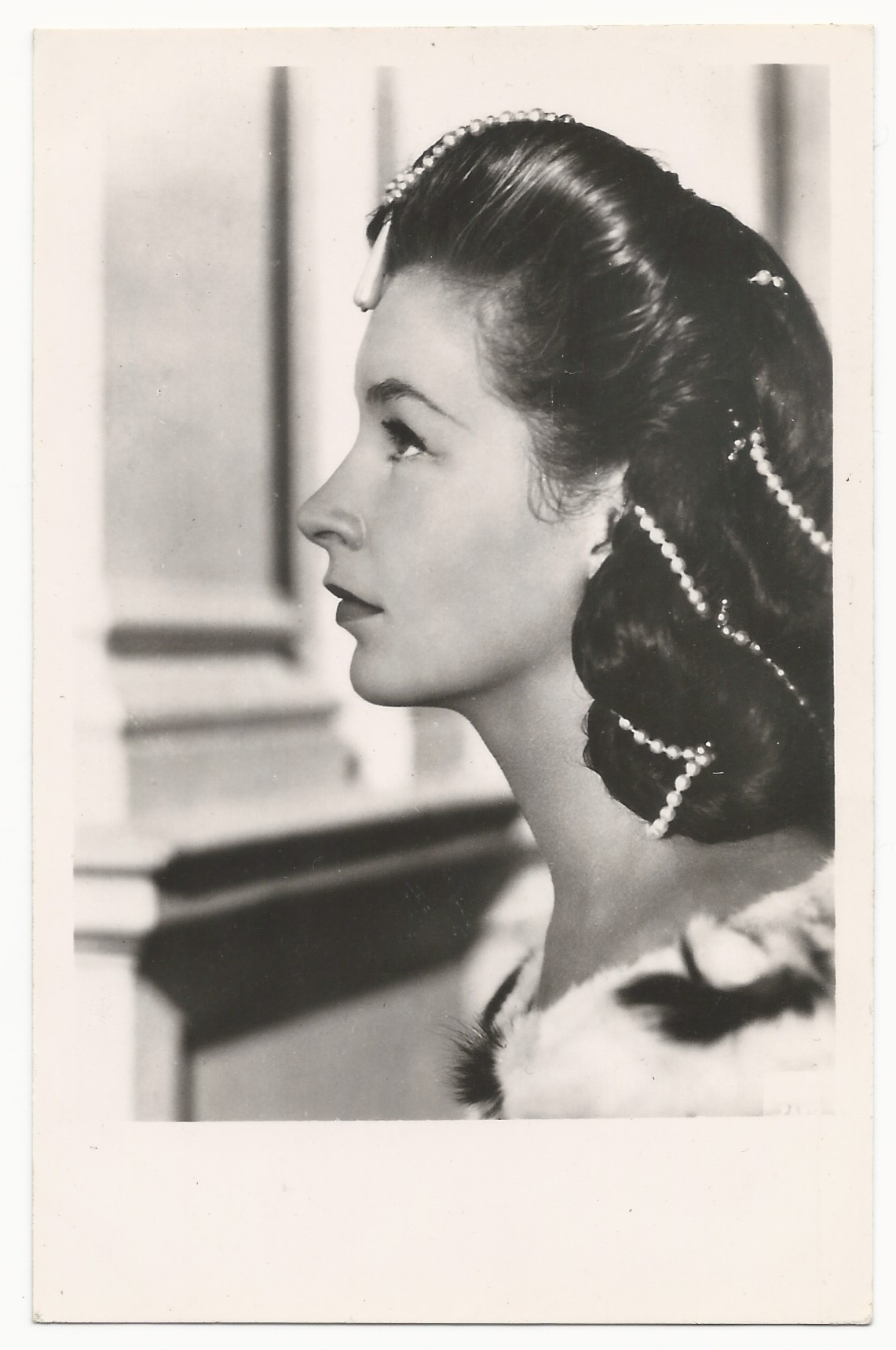
The pretty woman in this photograph is French actress, Odile Versois (1930-1980). She appeared in 50 television and film productions between 1948 and 1980. Her IMDb biography describes her as “docile, delicately beautiful, and light haired”. I wonder why the writer chose the word “docile”. The IMDb article asserts that “she moved audiences most with her portrayals of fragile, often tragic heroines in romantic drama”. She appeared in a number of British films in the 1950’s. She had three sisters who became actresses, including Marina Vlady, known for her sultry roles. Her parents were also performers. Her father was a well known opera singer and her mother was a dancer. Odile began acting as a child and also briefly pursued a ballet career. She was a child ballerina with the Paris Opera Corps de Ballet. Her film career began at the age of 16. For much of her career; she played leads. She married actor Jacques Rene Dacqmine in 1951 but the marriage was of only one year duration. She married a second time in 1953 and had four children before being divorced. Her second husband was a Count and a Corsican politician who became a Russian diplomat. She died of cancer just after she turned 50 years old. This French postcard is part of a series (no1296) and is in excellent condition (see scans).
Buy this original Vintage Real Photo Postcard (includes shipping within the US) #3209
To purchase this item, click on the Pay with PayPal button below
21.50 $
Buy this Vintage Real Photo Postcard (includes International shipping outside the US) 3209
To purchase this item, click on the Pay with PayPal button below



 POSTCARD 1
 POSTCARD 1 (CLOSE-UP)