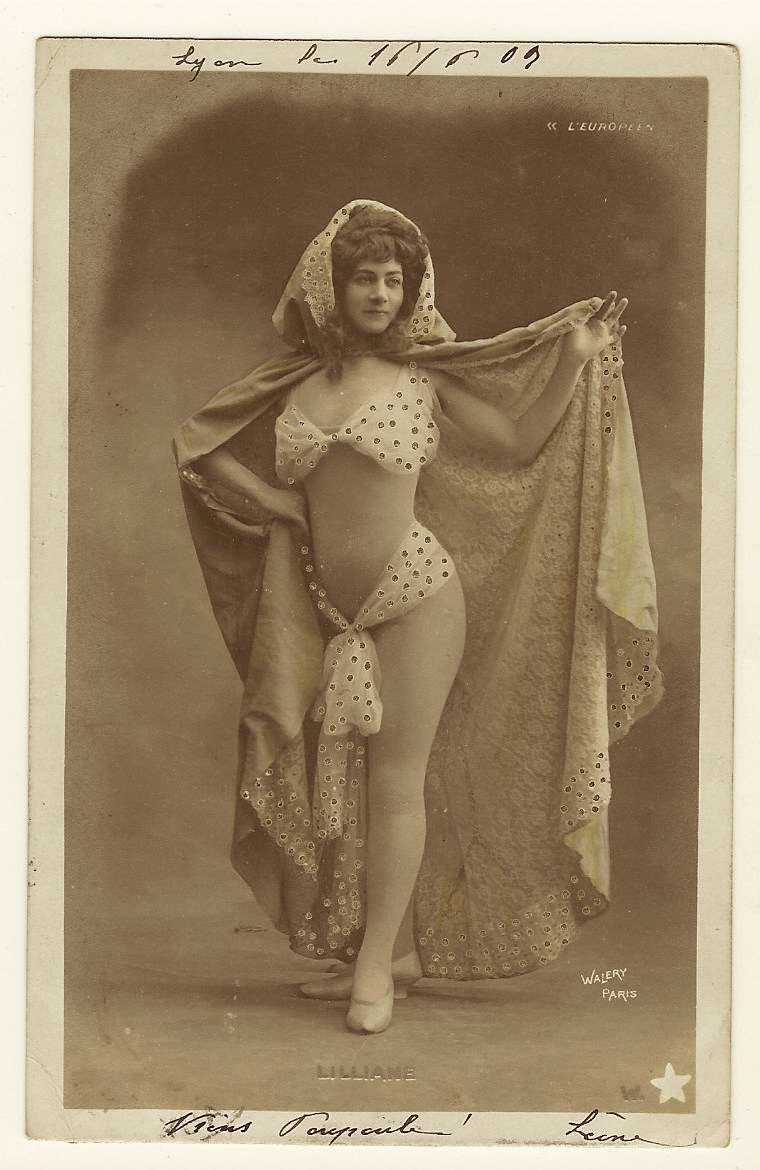
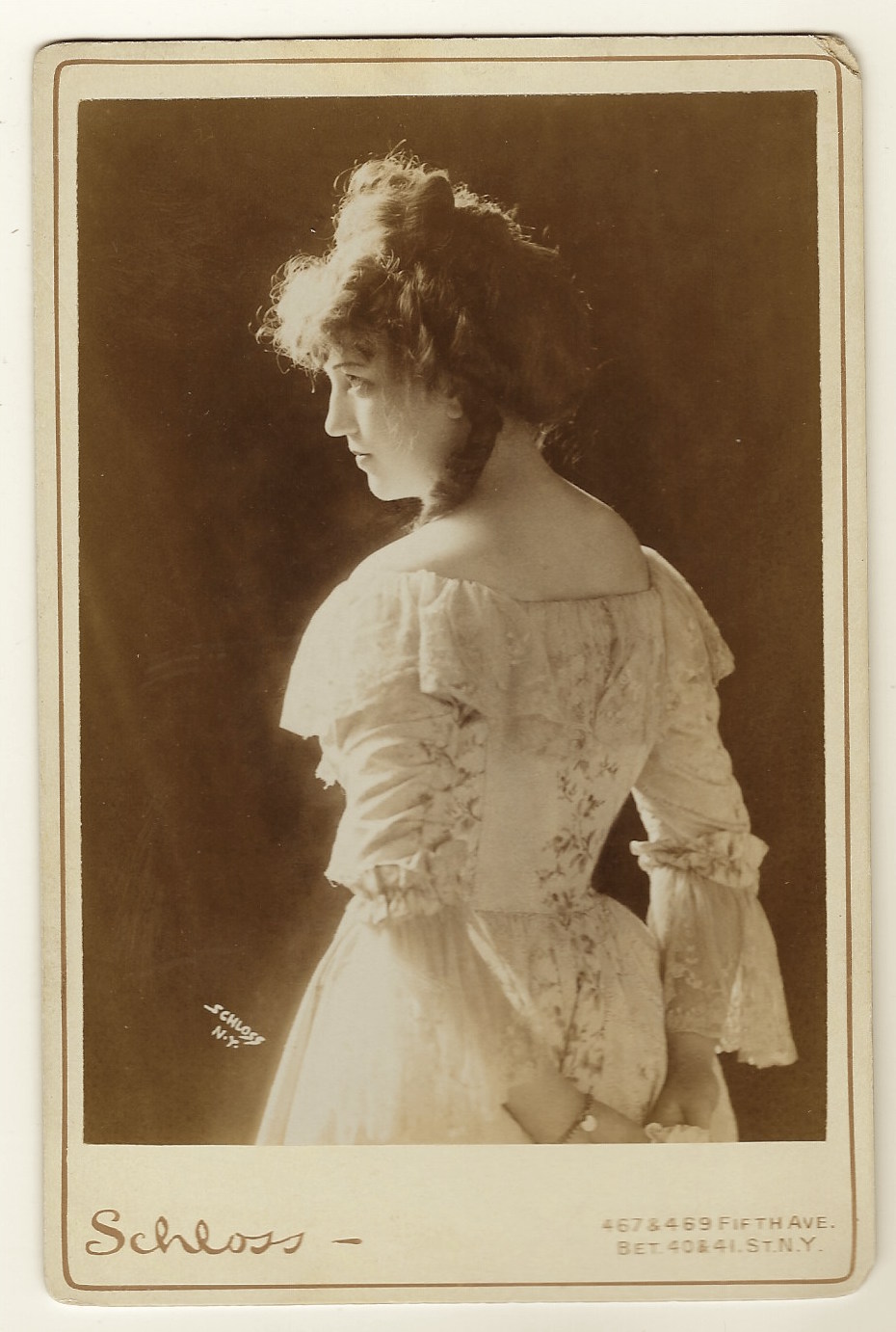
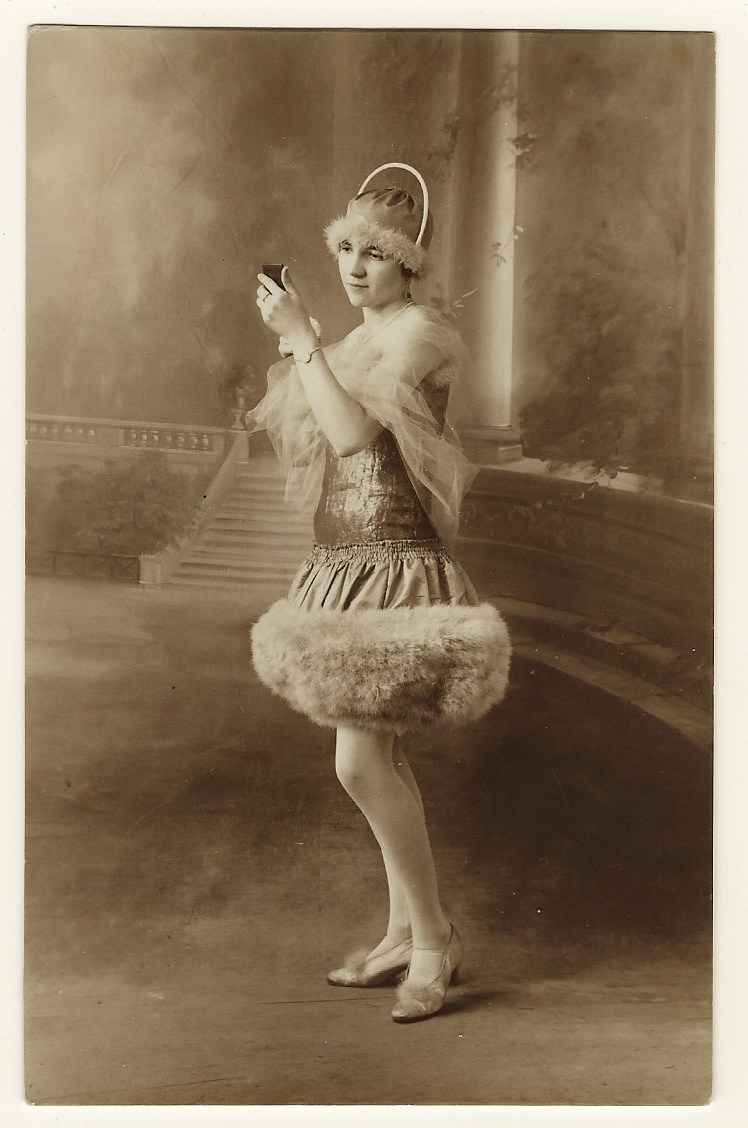
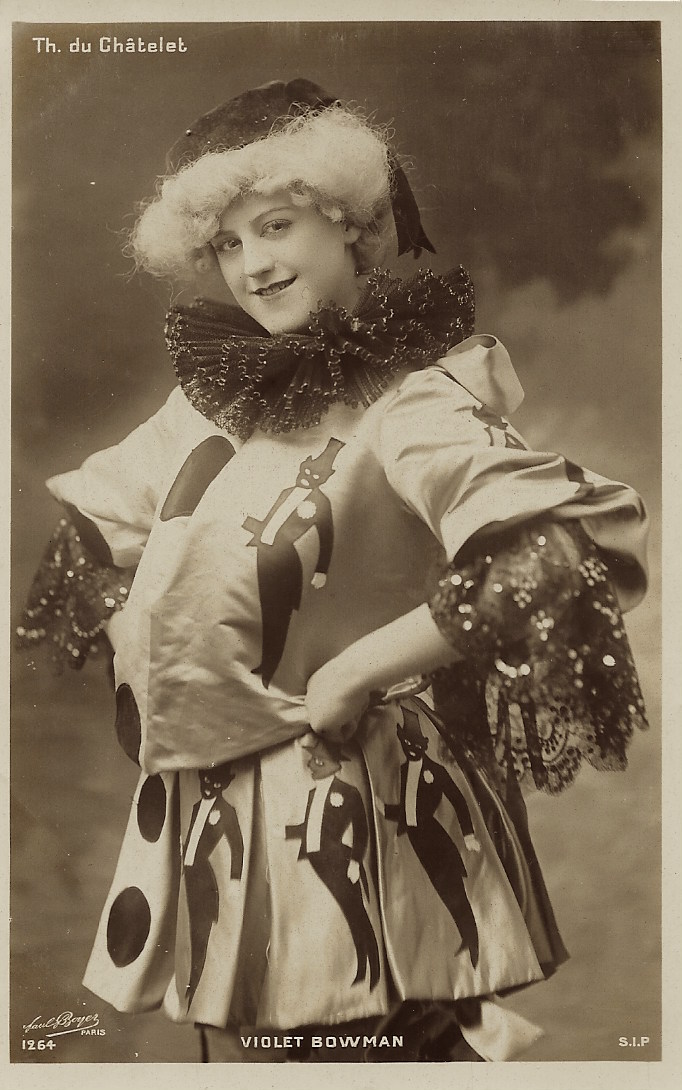
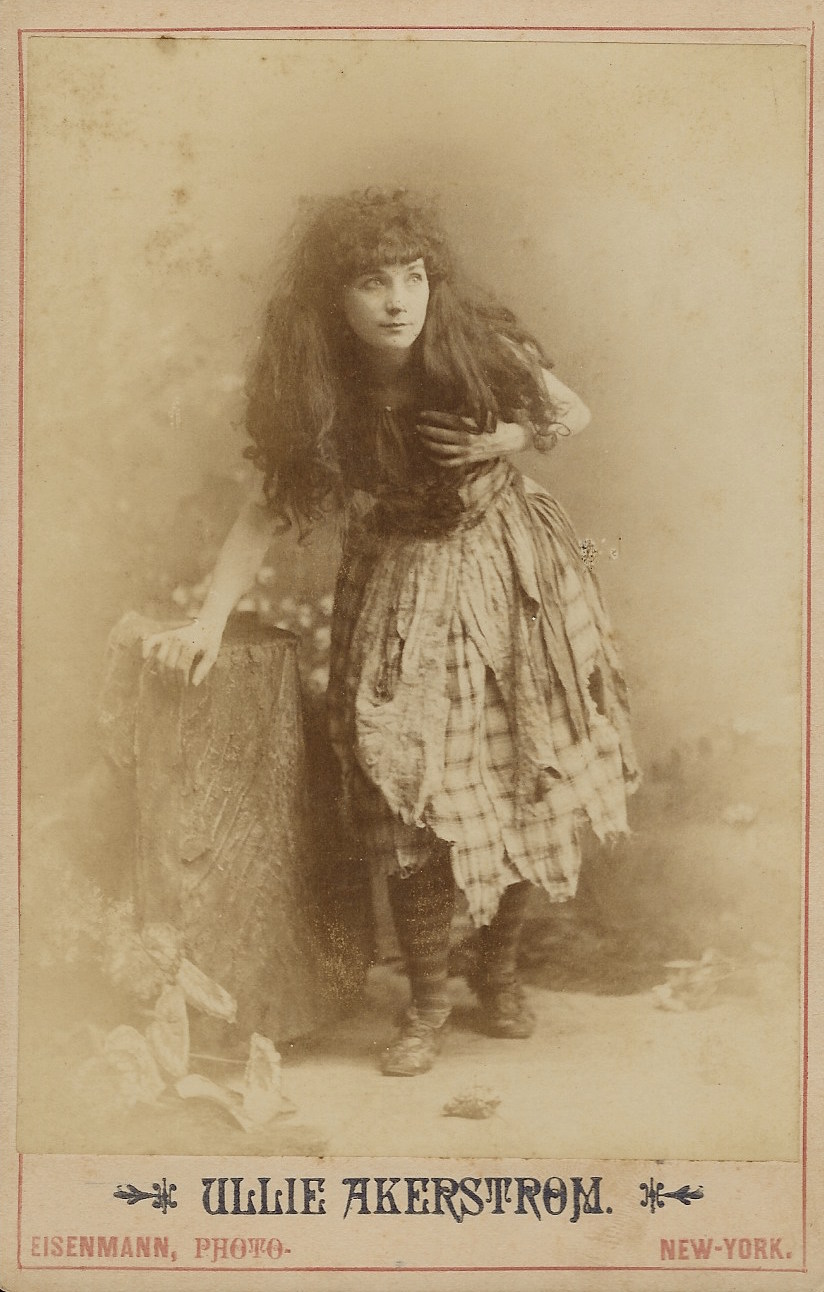
This item is a vintage postcard featuring the very attractive theater actress Sybil Arundale (1879-1965). Her stage roles included a number of Shakespeare plays. Her sister Grace was also an actress. The postcard was produced by Philco Publishing Company in London, England. It is number 3005 in a series. The photographer was Alexander Bassano (1829-1913) who was a leading royal and high society photographer located in London. SOLD
FRENCH STAGE ACTRESS AND DANCER MLLE DERMINY: PRETTY WOMAN WITH ANTENNAS (REAL PHOTO POSTCARD)
This vintage real photo postcard features a portrait of French stage actress and dancer Mlle. Derminy. I am unsure of her first name but she is listed in a number of sources as Marthe Derminy, who was an early film actress. The two performers may, or may not be, the same individual. Take a look at the headpiece that Mlle Derminy is wearing in this photograph. She looks like she has antennas coming out of the top of her head. It is as if she just walked out of a space ship. She is a pretty woman and is posed in relatively risque fashion. Derminy was photographed by many of the most celebrated photographers of her era. I have seen portraits of her by Reutlinger, Walery, and Stebbins. This postcard portrait was published by Societe Industrielle de Photograpie which was located in Rueil, France. SOLD
CAMILLE D’ARVILLE: PRETTY STAGE ACTRESS WITH STRONG OPINIONS ABOUT MARRIAGE AND CAREER
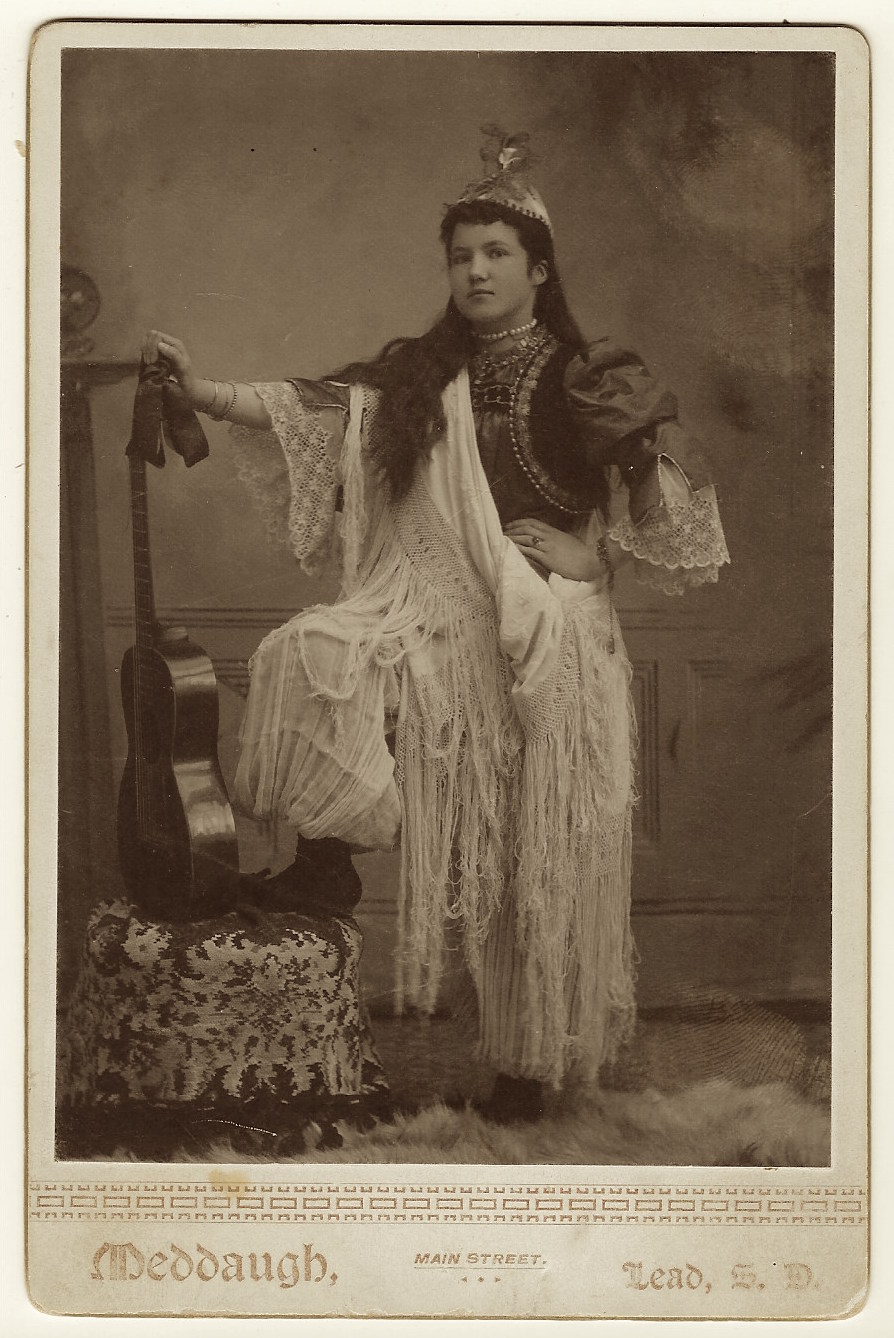
This cabinet card portrait features pretty stage star Camille D’Arville (1863-1932). The photograph was published by Newsboy and was number 38 of a series of images used as tobacco premiums. The actress is dressed like a gypsy in this photograph. She is holding a tambourine. It is interesting to note the mug in the bottom right hand corner of this image. One wonders the purpose of it’s inclusion in the photograph. It is also evident that to make this image a bit more risque, Miss D’Arville’s legs are partially exposed in the photograph. The Illustrated American (1892) wrote that she “is not only a delightful singer but she is also a charming woman”. Miss D’Arville was born in Holland in 1863 of well to do parents. When she was young she was known in her community as “the humming bird of Holland” because of her penchant for singing and her pretty voice. At age eleven she became active in amateur theater. At age fifteen she became devoted to concert singing and entered the Academy of Music in Amsterdam. Her professional career began at age twenty-two when she became a light opera actress in London. She premeired in “Cymbia” at the Strand Theater. She performed in London for six years. In 1888, J. C. Duff organized a strong opera company and engaged her to appear in “The Queens Mate” on Broadway in New York City. She shared the stage with Miss Lillian Russell. Reviewers of the play reported that Miss D’Arville captured the audience. As her career developed, she became “one of the foremost artists on the comic operatic stage”. In an interesting interview that appeared in the San Francisco Call (1900), D’Arville spoke about the issue of balancing career and marriage. She was preparing to marry Capitalist E. W. Crellin and had declared that she was going to retire from the footlights. The newspaper scoffed at the notion of her retiring because so many actresses before her had made the same declaration upon their marriage, yet after turning their backs on the stage, they do a “right about face” again. The paper opined that “they flit back before the honeymoon is over”. Miss D’Arville asserted that she wouldn’t miss her salary (reported to be “something like” a thousand dollars a week). She stated that she would miss the audience “hanging on” to every note she sang. She had a theory about mixing marriage and career. She asserted that when an artist, milliner or stenographer renounces her vocation for “the highest profession-domestic life- the world nods its approval”. However, she contends that female professionals, such as actresses, lawyers, doctors, and journalists, do not receive social approval when leaving their careers for marriage. She declares that in her opinion, attempting to combine stage and home life is about as easy as mixing oil and water. As a result, she believes that “any woman who pursues a profession after her marriage makes a miserable failure of it”. Balancing work and home is seen as so stressful that professional women have to quit at least one, and they usually choose to quit matrimony. She concludes that “marriage does not handicap a woman in her profession, but a profession seriously interferes with married life.” The issue concerning women’s ability to balance career and marriage remains part of the public debate today. Perhaps we should focus more on men’s ability to balance work and family life. It clearly is not just a problem for women. It is really incredible how researching a photograph can take one in so many different directions. Researching a vintage photograph is akin to going on a journey to a mystery destination.
STAGE ACTRESS MISS NINA CADIZ AND HER MANDOLIN (1906 RPPC)
This vintage real photo postcard features stage actress Miss Nina Cadiz and her mandolin. I am actually not sure that her string instrument is a mandolin and hopefully a musically informed visitor to the cabinet card gallery will correctly identify it. This postcard was mailed from England in 1906. The message on the postcard wishes the addressee a “very happy New Year”. The postmark is December 31, 1906 which may indicate the writer was a bit of a procrastinator. The postcard was published by Stewart & Woolf who were located in London. The postcard was part of a series (116) and is numbered #50. A portrait of Miss Cadiz can be found in Britain’s National Portrait Gallery. The image can be seen below. Note that the photography studio that produced the portrait is Elliott & Fry, a name that should be familiar to frequent Cabinet Card Gallery visitors. Click on category Photographer: Elliott & Fry to view more of their photographs.

PORTRAIT OF A BEAUTIFUL AUSTRIAN ACTRESS IN VIENNA
This cabinet card features a beautiful young actress. I am hypothesizing that she is an actress based on her wardrobe and her great poise. The young lady is wearing a necklace and a jeweled hair band. Note her interesting footwear. She is standing by a faux pile of rocks in the Schuster studio which was located in Vienna, Austria. This cabinet card is not standard sized. It measures about 3 3/4 ” x 8 1/4″.
FLORENCE COLLINGBOURNE: STAGE ACTRESS

The beautiful woman pictured in this Cabinet card is stage actress, Florence Collingbourne. Obtaining significant biographical information about her has been difficult and further research will be done and provided in an addition to this blog. However, information from readers about this stage beauty will be appreciated. The Cabinet card was produced by the Rotary Photographic Company which also produced many postcards with images of theatrical stars. This Cabinet card was published in London, England. The second image displayed is a vintage real photo postcard also featuring the beautiful Miss Collingbourne (1880-?). The postcard was published by the Rotary Photo Company. The reverse of the postcard has evidence that it once occupied a photo album.
A SOUBRETTE OF MAJOR PROMISE: STAGE ACTRESS EDITH MURILLO
This cabinet card portrait by New York City celebrity photographer Benjamin Falk, features stage actress Edith Murillo. Judging by the sparsity of easily accessible information pertaining to Miss Murillo, it appears that she was not a major theatrical player. However, The New York Times (1884) “Notes of the Stage” section announces her appearance in a musical comedy. In addition, the Topeka State Journal (1889) describes Miss Murillo as “a soubrette of uncommon promise”. Wikipedia defines a soubrette as “a comedy character who is vain and girlish, mischievous, lighthearted, coquettish and gossipy”. The description adds that soubrettes “often display a flirtatious or even sexually aggressive nature”. This image of Edith Murillo certainly captures the pretty actress in a flirtatious pose.
PORTRAIT OF AN AUSTRIAN ACTRESS: ROSA ALBACH RETTY
This cabinet card portrait features German born Austrian actress Rosa Albach Retty (1874-1980). Retty appeared on the stage and in movies. She was daughter of actor Rudolf Retty. She began her theatrical career in 1890 at the Deutsches Theater and the Lessing Theater. In 1895 she appeared at the Volkstheater in Vienna and in 1903 became a member of the Burgtheater ensemble. She made her film debut in 1930 in Georg Jacoby’s “Money on the Street”. Her last film credit was for a role in “Congress Dances” (1956). She was married to Karl Albach, an Austro-Hungarian Army officer. Albach-Retty’s son, Wolf Albach-Retty was an actor as was her granddaughter (Romy Schneider {1938-1982}). Albach-Retty clearly had the “theatrical gene” as well as the gene for longevity. She died at the age of 105. She is buried in Zentralfriedhof in Vienna. The photographer of this image is Hans Makart and his studio was located in Vienna, Austria. The photographer Hans Makart is not the same individual as Austrian Hans Makart (1840-1884), the celebrated artist. It is an interesting coincidence however, that Makart the artist utilized photography in his work. Another portrait of Albach- Petty as well as an image of her gravestone can be seen below. The third photograph is a portrait of Romy Schneider.


AMELIA GLOVER: FAMOUS SKIRT DANCER (CABINET CARD PORTRAIT BY SARONY)
This cabinet card portrait features celebrated skirt dancer Amelia Glover. The photograph was taken by the well known New York theatrical photographer, Napoleon Sarony. The term “skirt dancer” is not a term we read or hear about today so an explanation is likely in order. Skirt dancing earned its name due to the voluminous skirts worn by the dancers. These skirts were often made of sheer and flimsy material. The skirts were utilized as part of the dancers act. Famous skirt dancers include Glover, Loie Fuller, Papinta, and Anna Held. Amelia Glover was not just any skirt dancer. The Illustrated American (1892) published an article called “The Skirt and the Dance”. In the article the author bemoans the trend that resulted in French and English dancer’s skirts getting shorter and shorter. Most dancers prior to the trend wore long skirts (below the knee). Kate Vaughn is credited with the reintroduction of long skirts and the”skirt dance”. Letty Lind and Sylvia Grey are asserted to be responsible for importing the dance from England to the United States. The pair are said to have created a “rage” with the skirt dance. The author complains that the dance “has mostly degenerated into a lot of high kicking and can can impropriety”. He continues with the contention that the original dance has become “vulgarized”at the hands of “ordinary women” of the variety stage.The author goes on to state that there is one American skirt dancer who has “remarkable natural gifts”. He identifies that dancer as Amelia Glover, also known as “Little Fawn”. The cabinet card image below gives a view of Glover dancing while wearing a long skirt. Besides being an incredible dance talent, Glover has another claim to fame. Theatre Magazine (1922) reports that Miss Glover started the fad of wearing bobbed hair. Her hairstyle was imitated by other women of the stage as well as by women of society. SOLD
PAULINE HALL (1860-1919): BEAUTIFUL MUSICAL THEATRE STAR


CABINET CARD 2 (SOLD)

The top cabinet card features Pauline Hall (1860-1919), one of the most popular turn of the century prima donnas. She began her career as a dancer in Cincinnati, Ohio at age 15. She joined the Alice Oats Opera Company but left to tour in plays with famed actress Mary Anderson. By 1880, she worked for well known producer Edward Everett Rice in musical productions. Early in their association, he gave her a role in “Evangeline”. Her shapely figure allowed her to take male roles as she did in “Ixion” (1885). Her greatest success came in the title role of the first American production of “Erminie” (1886). She played in more than two dozen Broadway operettas. Her final role was in the “Gold Diggers” (1919). This photograph was taken by famed celebrity photographer, Elmer Chickering of Boston, Massachusetts. Other photographs by Chickering can be seen by clicking on Cabinet Card Gallery’s category of “Photographer: Chickering, E.”.
The second cabinet card, photographed by B. J. Falk, of New York City, captures Pauline Hall in stage costume. The photograph is #305 in a series from Newsboy. The tobacco company (Newsboy) gave away cabinet cards as a premium with the purchase of their products. This cabinet card shows a copyright date in the 1890’s. The exact date has become illegible over time. (SOLD)
The third cabinet card portrait was also photographed by Falk. Ms. Hall looks quite beautiful in this image. She is wearing earrings and an interesting hat. The photograph is a bit risque. Much of her neck and shoulders are exposed. In addition, her dress accentuates and reveals significant cleavage. Is the material at the base of her scoop neckline part of her dress; or was it added in order to make the photograph less provocative? Perhaps a visitor to the cabinet card gallery will be able to provide an explanation. SOLD
The fourth cabinet card image, once again photographed by B J Falk, features Miss Hall wearing a dark dress, long gloves, a lovely hat, and a purse. Pauline Hall certainly was a stage beauty as attested by this photograph. SOLD