This risque (lots of cleavage shown for this era) cabinet card is a portrait of Pauline Markham (1847-1919), a singer and burlesque dancer during the civil war period in the United States. She was born in England where she made her stage debut as a child. She came to New York and appeared in “Black Crook” and “Pinafore”. She was a member of the Lydia Thompson troupe (British Blondes). After the civil war, she had relations with Northern Generals and Reconstructionists In the 1870’s she formed her own stage company and in 1879 she took her company on a tour of the West during which they performed Gilbert and Sullivan. A member of that troupe was Josephine Marcus, who later married lawman, Wyatt Earp. She retired from the stage in 1889 after breaking her leg. She must have taken the old show business saying of “break a leg” literally. This cabinet card was photographed by Fredricks, of Brooklyn, New York. It is possible that the photographer is Charles DeForest Fredricks (1823-1894) who was an innovative American photographer. Fredricks learned the art of daguerreotypes from the great photographer , Jeremiah Gurney (see category “Photographer: Gurney”). Fredricks worked in South America through the early 1850’s and then he operated out of Charleston, South Carolina; and Paris, France. He was the first photographer to make life-size portraits, which he then hired artists to color them using pastel. He then returned to New York City and rejoined Gurney. In 1854 he developed a new enlarging process and in 1855 he ended his association with Gurney. In the late 1850’s Fredricks ran his studio in Havana, Cuba, and in the 1860’s he opened a studio on Broadway, in New York City. He retired in 1889. Research has not confirmed that Fredricks ever had a studio in Brooklyn, so it is quite uncertain whether the Fredricks who photographed Markham is actually Charles D. Fredricks.
PAULINE MARKHAM: TURN OF THE CENTURY BURLESQUE ACTRESS
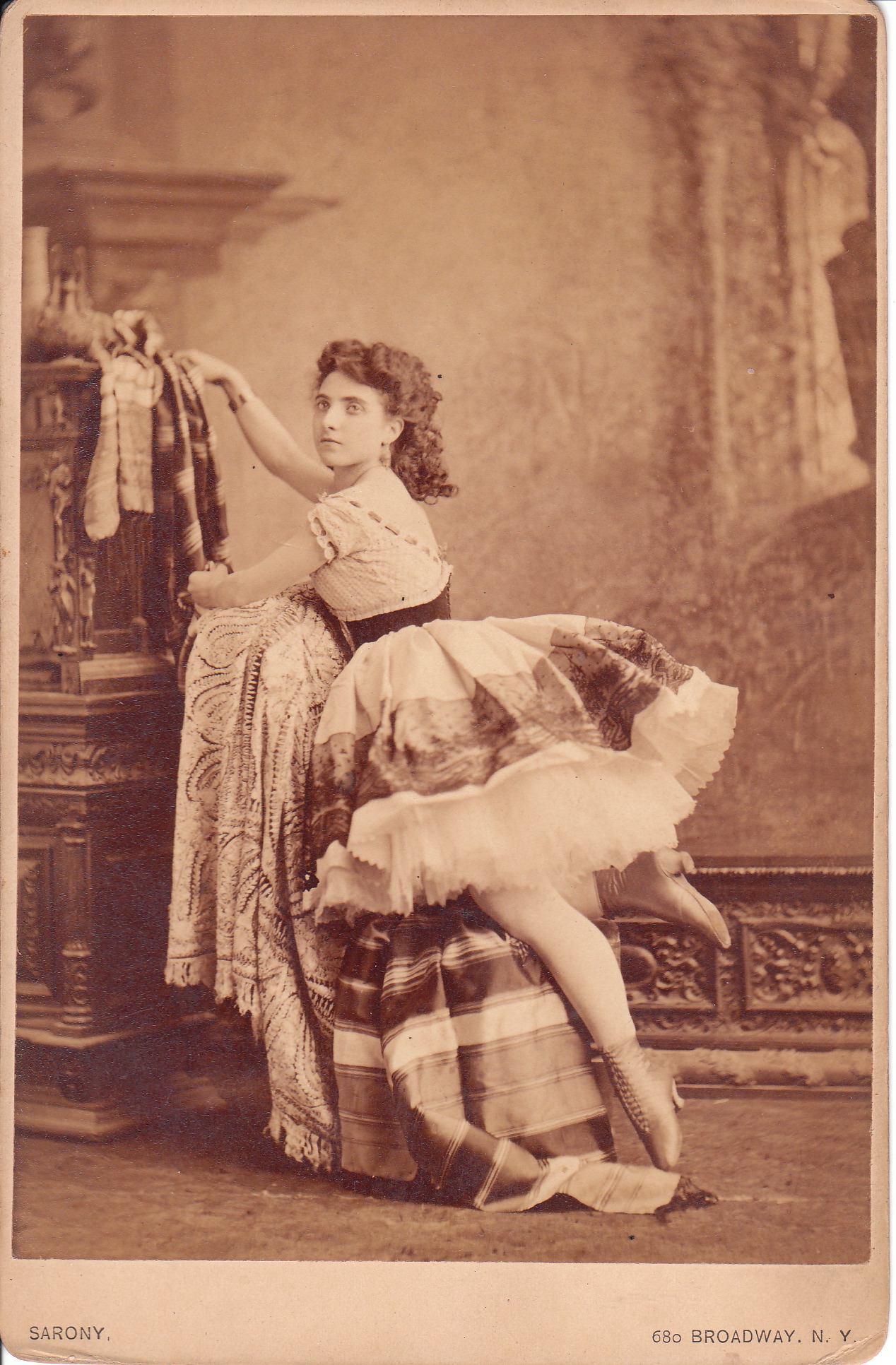
PRETTY DANCER PHOTOGRAPHED BY SARONY IN NEW YORK
This cabinet card is a photograph of a young dancer/actress photographed by the famous celebrity photographer, Sarony of New York. She seems to be in a dancers pose and costume. The reverse of the card has a handwritten identification of the subject. The name listed is Sara Belle; and preliminary research has revealed nothing about her. In fact, the existence of an actress/dancer by that name has not yet been confirmed. Interestingly, Napoleon Sarony’s daughter was named Belle. In regard to the date of this photograph, Sarony opened his Broadway studio in 1866 and moved to 37 Union Square in New York City in 1871. Therefore this photograph was taken between 1866 and 1871. Perhaps a visitor to this site can shed some light on the identity of the woman in this photograph. Additional images by Sarony can be seen by clicking on the Cabinet Card Gallery’s category of “Photographer: Sarony”.
STAGE STAR, DOROTHY DONNELLY IN “SOLDIERS OF FORTUNE” (1902)
Dorothy (Agnes) Donnelly (1880-1928) was an actress, lyricist, and a librettist. She was the daughter of the manager of New York City’s Grand Opera House. She made her acting debut in the stock company of her brother, Henry V. Donnelly at the Murray Hill Theatre in New York City. She became a well known performer in 1903 when she played title roles in Yeat’s “Kathleen ni Houlihan” and Shaw’s “Candida” in their first American performances. Her most celebrated performance was in the title role of “Madame x” (1910). She acted for another decade but after the success of her book and lyrics for Sigmund Romberg’s adaptation of Schubert’s melodies in “Blossom Time” (1921), she gave up performing and concentrated on her writing. Donnelly was married to Sigmund Romberg. The photographer of this cabinet card was celebrity photographer, Schloss. The photograph captures Donnelly in costume for “Soldiers of Fortune” (1902); so the image is a portrait representing the very early part of her theatrical career. The cabinet card comes from the Oral M. Heffner Theatrical Collection and was formerly the property of the Franklin County Historical Society. To learn more about the Heffner collection, click on the Cabinet Card Gallery category of “Oral M. Heffner Theatrical Collection”.
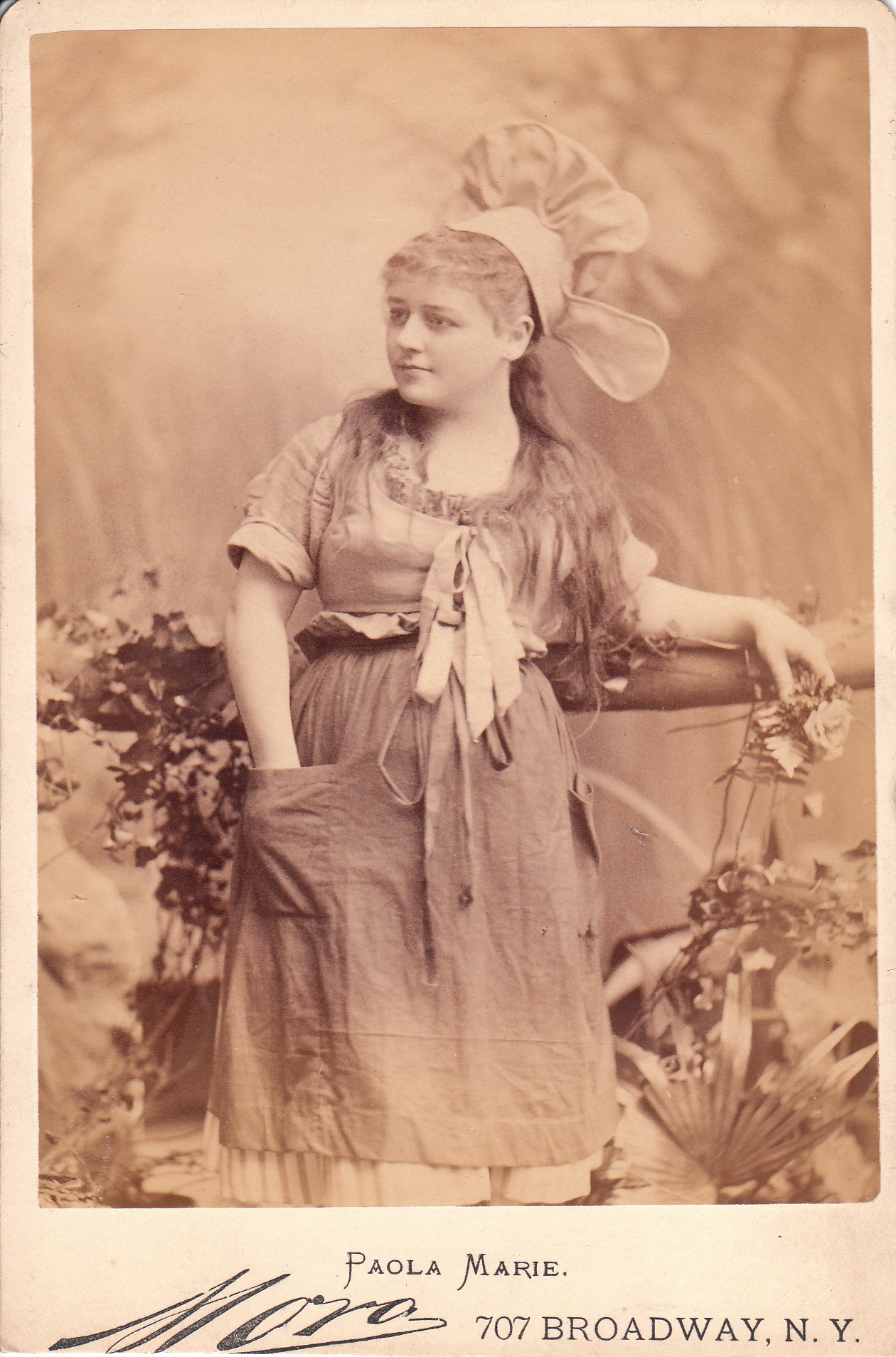
PAOLA MARIE: FRENCH OPERA STAR, NEWS OF HER IMPENDING DEATH PROVES FALSE
Paola Marie was a well known and talented French opera star. She was the sister of opera star Irma Marie. The publication “Every Saturday” (1874) tells an interesting tale about the performer. She was appearing in Bordeaux, France when an oversight or practical joke occurred in the printing of a notice advertising that her engagement was about to come to an end. The sign said that “Mlle Paola Marie was expiring on “friday next”, and there would be only four more performances of “The Perichole”. The notice should have said that the performance of the opera was about to expire. Upon reading about the star’s impending death, her faithful fans came out in mass, carrying many bouquets of flowers, to pay their “last homage” to the popular actress. The photographer of this cabinet card, Mora, was a celebrity photographer located on Broadway, in New York City. To see other photographs by Mora, click on the category, “Photographer: Mora”.
“A BRILLIANT FUTURE SACRIFICED FOR A LIFE OF EXCITEMENT” (1894): STAGE STAR MARION MANOLA
Marion Manola (1865-1914) is the subject of this cabinet card photograph by celebrity photographer, Benjamin Falk. Manola was born in Cleveland, Ohio. She was a popular comic opera star during the late 1880’s and 1890’s. The New York Times (1894) featured a headline stating “A Brilliant Future Sacrificed for a Life of Excitement” referring to Ms. Manola. The newspaper reported that the theatrical community was upset by the actress’s “insanity”. She was described as one of the more popular singer/actresses on American stage. She was known to be a bit eccentric but she was “heartily liked by everybody”. She was described as light hearted, having a joyous nature, and as vivacious. She was discovered by Colonel John A. McCaull, who cast her in a comic opera company. She aggressively pursued her career and had “late suppers”, “early rehearsals”, and worked hard. The stress of her theatrical life caused her to become irritable, fretful and difficult to manage. When her theatre company dissolved, she joined De Wolff Hopper’s company where she became the prima donna. After about a year she lost her job because of difficulty with a manager. She then went to Europe where she played the role of Maid Marion in “Robin Hood”. While in Europe she met her soon to be second husband, John Mason. Mason had his own personal problems including a great deal of debt. They joined a comic opera company in Boston but they quickly lost their jobs due to problems getting along with management. They organized their own company but it went bust. Manola’s mind began to fail and it became known that she had a opium habit. The press had a field day covering Ms. Manola’s psychiatric and substance abuse difficulties, as well as her entry into a rehab facility. Does any of this sound familiar? Think about the press coverage of Lindsay Lohan or a number of other celebrities of today who experience emotional or addiction problems. Manola also made her mark in the courts. In fact, Judge Louis Brandeis, one of America’s great Justices, was involved in an interesting and important case Manola brought to the legal system. The actress brought suit against a theatre manager and a photographer because she was photographed on the stage, without permission, while wearing an outfit (tights) she felt were too immodest to be photographed in. After being photographed, she ran off the stage in distress. The court supported Ms Manola’s suit and forbid the photographs from being distributed. The court took the position of there being a need for morality in the press. Some skeptics felt that the actresses real issue with the photographs had more to do with her not getting financially compensated for the photographs, rather than her claims that her privacy was violated. To view other photographs by Benjamin Falk, click on the category “Photographer: Falk”.
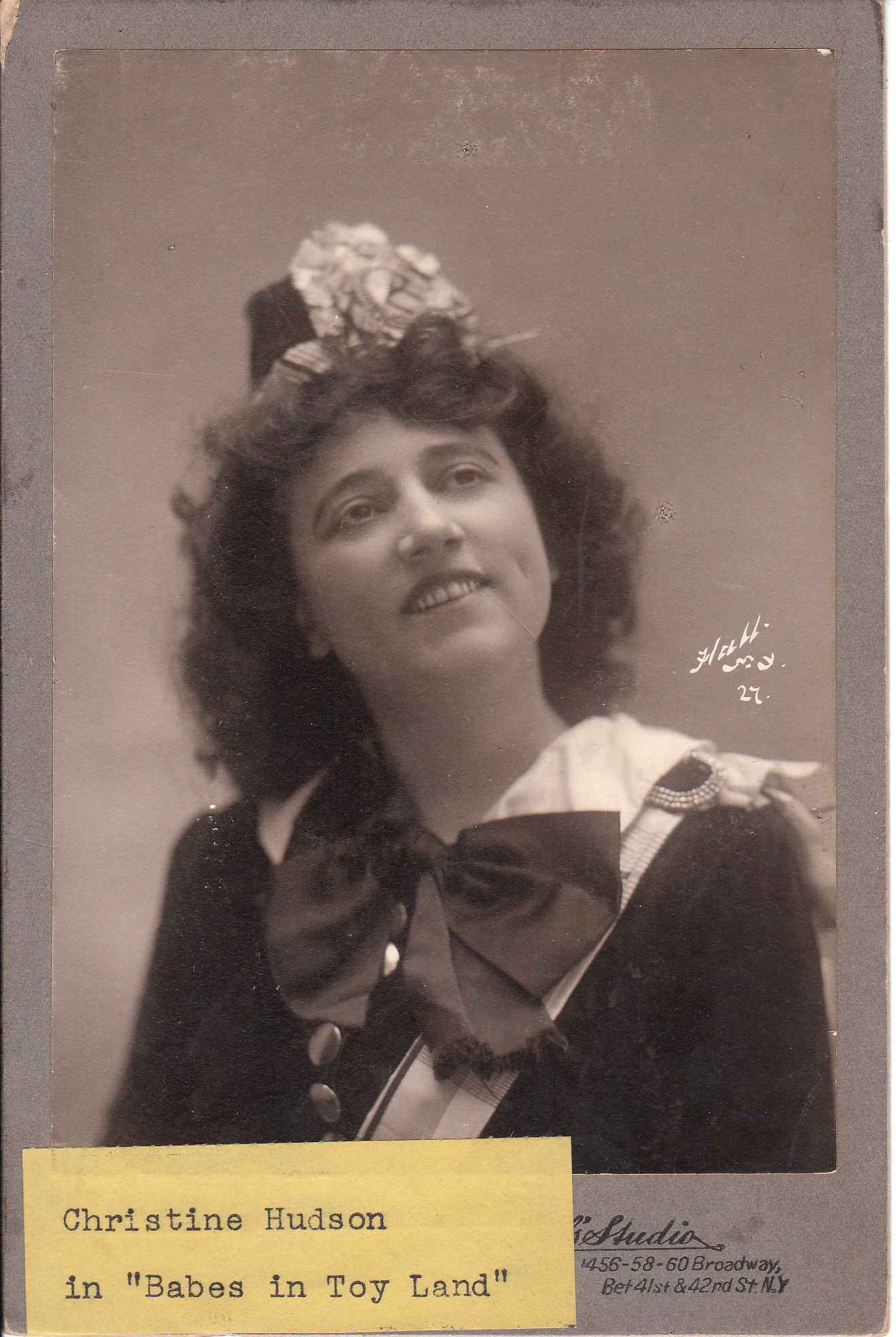
CHRISTINE HUDSON IN BABES IN TOYLAND
This Cabinet Card features stage actress Christine Hudson in costume for her role in “Babes in Toy Land”. The New York Times (9/10/1905) reports that the show was appearing at the West End Theatre and the cast included May De Sousa. An earlier edition of the New York Times (1902) announces her appearance in “Princess Chic”. The reverse of the cabinet card has an affixed label stating that the photograph is number H-16 of the “Oral M. Heffner Theatrical Collection” and the property of the Franklin County Historical Society. Research sheds some light on the Heffner collection. The Ohio State Archeological and Historical Quarterly (1953) writes that the first showing of the Oral M. Heffner Theare Collection was in 1953 and that the collection included over 700 rare photographs of early actors and actresses “who visited Columbus years ago”. The label on the front of this photograph blocks the name of the photographer. The name of the photographer etched on this image appears to be “Hall”. There was a Hall Studio located in New York City at a different Broadway address and it is possible that the studio was once at the Broadway address listed on this cabinet card. However, confirmation is needed and any verification help from a visitor to this site would be appreciated. To see other images by Hall, click on the category “Photographer: Hall”. To see other cabinet cards from the Heffner Collection, click on Cabinet Card Gallery’s category of “Oral M. Heffner Theatrical Collection”.
MISS LESLIE CHESTER: A THEATRICAL ACTRESS WHOSE BEAUTY COMPENSATED FOR HER LACK OF TALENT
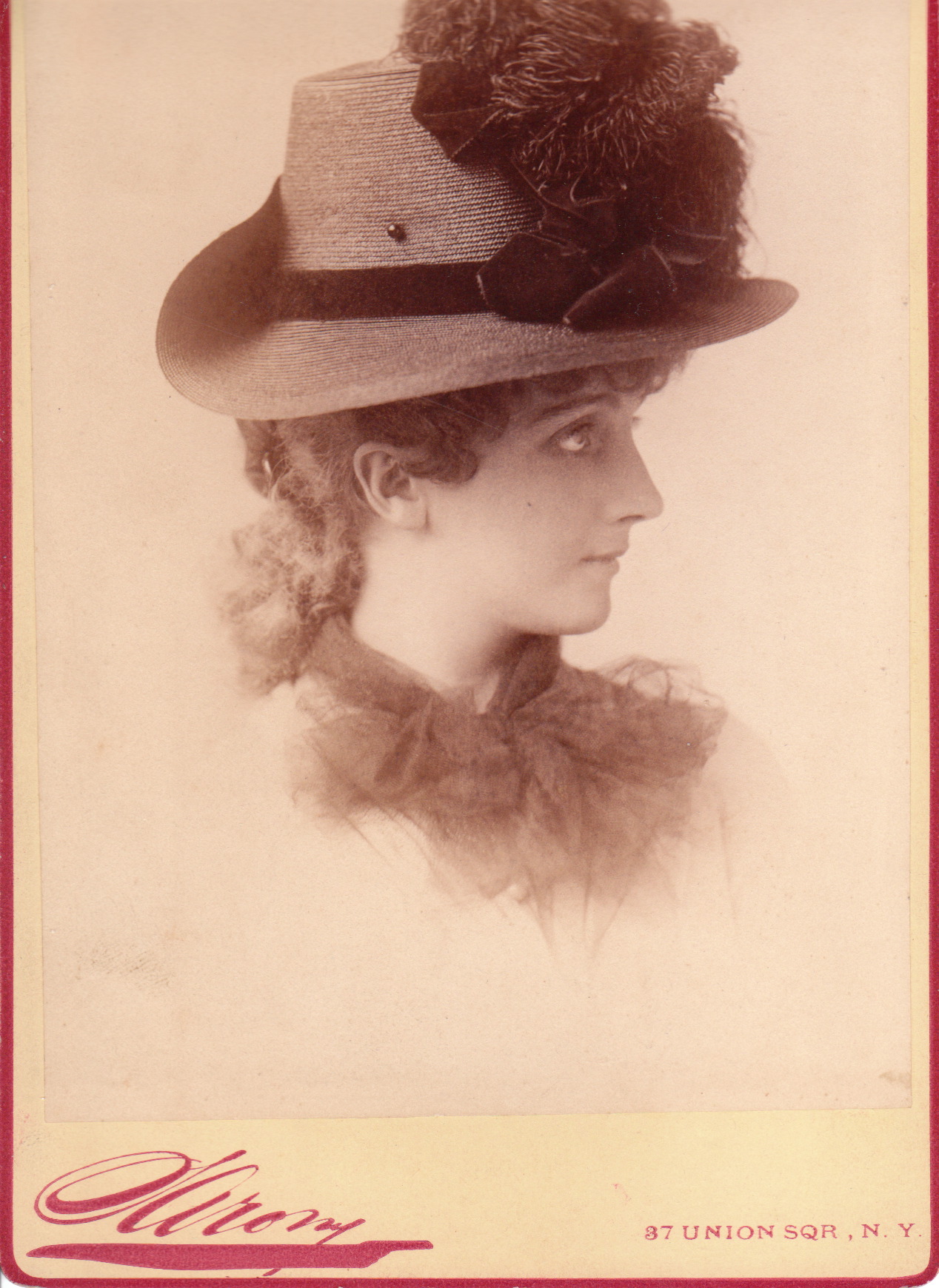
Celebrity photographer, Sarony, of New York City, produced this head and shoulders photograph of actress, Leslie Chester. The actress is wearing an incredible hat. A review of one of Ms Leslie’s performances appeared in Life (1886). The review states that “Miss Leslie Chester is so pretty that her dramatic sins can be magnanimously pardoned”. The review goes on to report that Ms Chester “appears (in a role) as an ambitious amateur, who has no idea of acting and the part is distinctly appropriate.” Hopefully, Ms. Chester was as thick skinned as she was beautiful.
GEORGIE COOPER: CHILD ACTRESS PLAYING “LITTLE LORD FAUNTLEROY”
Georgie Cooper (1882-1968) appears in this cabinet card by Rose & Company of Denver, Colorado. Georgie Cooper was born in Battle Creek, Michigan. Her mother was an actress, Georgie Woodthorpe (1860-1927). Cooper started as a child actress and appeared as “Little Lord Fauntleroy” with her mother at the Burbank Theatre in Los Angeles, California. She later married actor, Landers Stevens and both were active appearing in films. She appeared in 47 films from 1928 through 1944. The photographer of this cabinet card is John K. Rose. He later took on a partner and started a studio named Rose & Hopkins. This partnership was dissolved in 1901. It is interesting to note that “Little Lord Fauntleroy” had much impact in cabinet card photography. In addition to the existence of a number of portraits of child actors portraying the character; many children’s attire and hairstyle in cabinet card images were based on the clothing and appearance of the “Little Lord Fauntleroy” character. “Little Lord Fauntleroy” was the first children’s novel written by English-American author Frances Hodgson Burnett. It was published in 1885. In regard to fashion, the classic Fauntleroy Suit was a velvet cut-away jacket and matching knee pants worn with a fancy blouse with large lace or ruffled collar. It became a major fad in formal fashion for American middle class children. Most commonly, boy between 3 and 8 years of age wore these suits and a minority of these children also wore ringlet curls. ADDENDUM : I have been informed that that this photograph was taken at a performance in Denver that occurred in November, 1889. The source reports that this information comes from an article appearing in the New York Clipper on 12/7/1889. (SOLD)
SOPHIE EYRE: STAGE ACTRESS SUFFERS AN UNFORTUNATE DEBUT
Sophie Eyre (1853?-1892) was a moderately successful stage actress. She was successful enough for the New York Times to publish a detailed obituary upon her death from heart disease while traveling in Naples, Italy. Eyre was born in Tipperary, Ireland. She married an English Army officer and went on the stage after his death. In 1884 she took the place of Rose Coghlan in the company at Wallach’s Theatre. In 1885 she appeared in New York in a “feeble and speedily forgotten” piece called “In His Power”. The debut was unfortunate “for the part was bad and the play was worse“. The debut was further spoiled by the “extraordinary stupidity of her maid” who followed her mistress on the stage bearing the train of her gown wrapped in a sheet”. Other New York appearances included “Valerie”, “Diplomacy” (by David Belasco), “She Loved Him”, “Home”, “Central Park: or the House with Two Doors”, and “The Palace of Truth”. During her stay in the United States, she was the subject of much gossip in the newspapers. This cabinet card was produced by Falk, a well-know celebrity photographer in New York City. Additional Cabinet Card Gallery photographs by Falk can be seen by clicking on the category “Photographer: Falk”. (SOLD)
CAROLINE MISKEL: AMERICAN STAGE ACTRESS WITH “NOBLE FORM AND FEATURES”
Caroline Miskel (1873-1898) was born in Kentucky. Her father was a newspaper editor and state legislator. She began her acting debut season with John Augustin Daly’s theatre company. She played in comedies and classic revivals. In 1894 she married Charles Hoyt, a popular playwright of the “gay nineties”. She starred in his production of “A Temperance Town”. In 1895 she was named America’s most popular actress and was awarded with “a nickel plated bicycle with a solid silver searchlight lantern”. Miskel was considered one of the most beautiful of all American stage actresses. One writer described her as a beauty with “light auburn hair, creamy complexion, bright sapphire eyes, and noble form and features”. The writer added that she was “as intellectual as she was beautiful”. Miskel’s life was cut short when she tragically died at age 25 after giving birth to a son. This cabinet card was published by Newsboy as part of a series of premium cards to be given away with the purchase of Newsboy tobacco products.