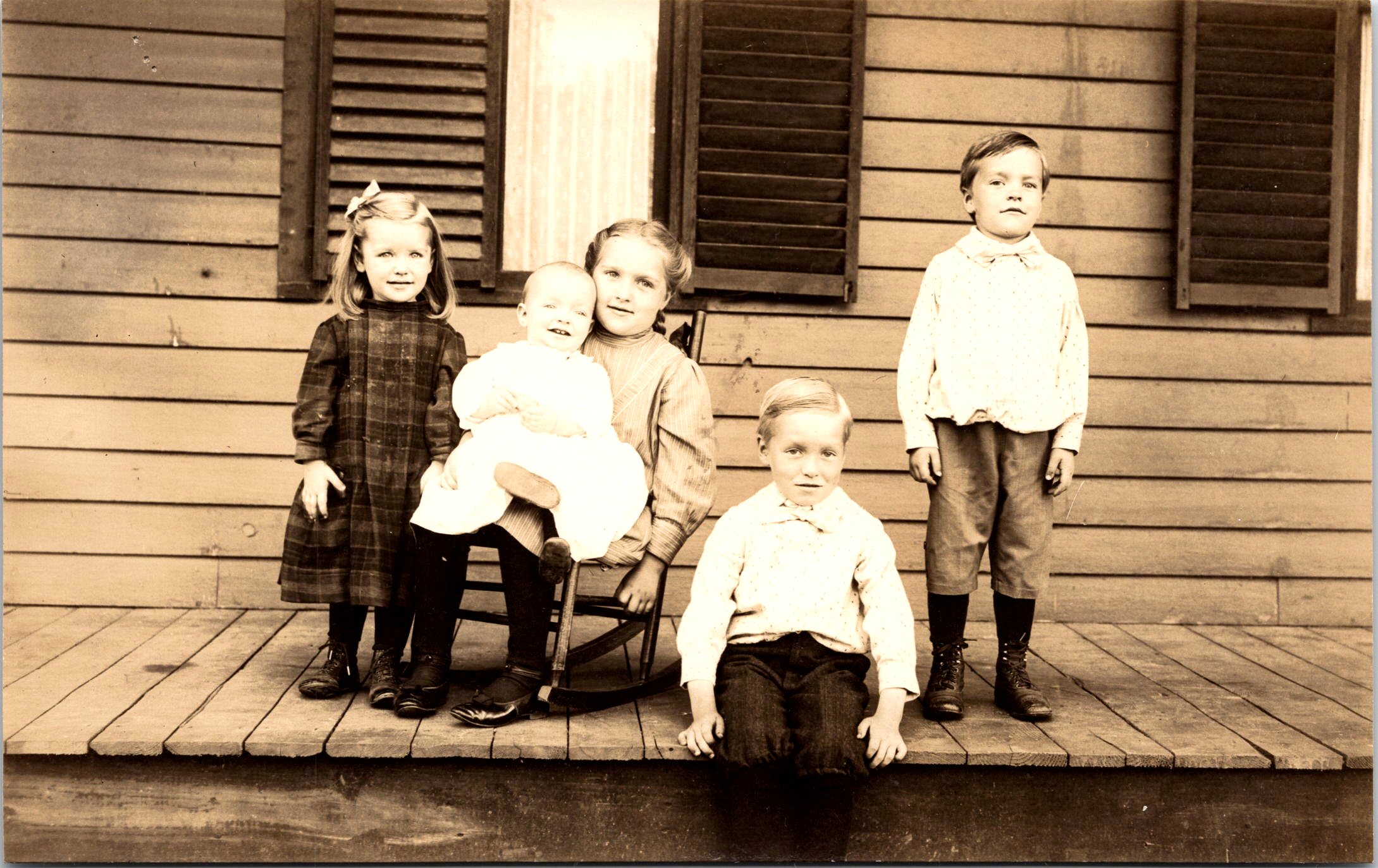
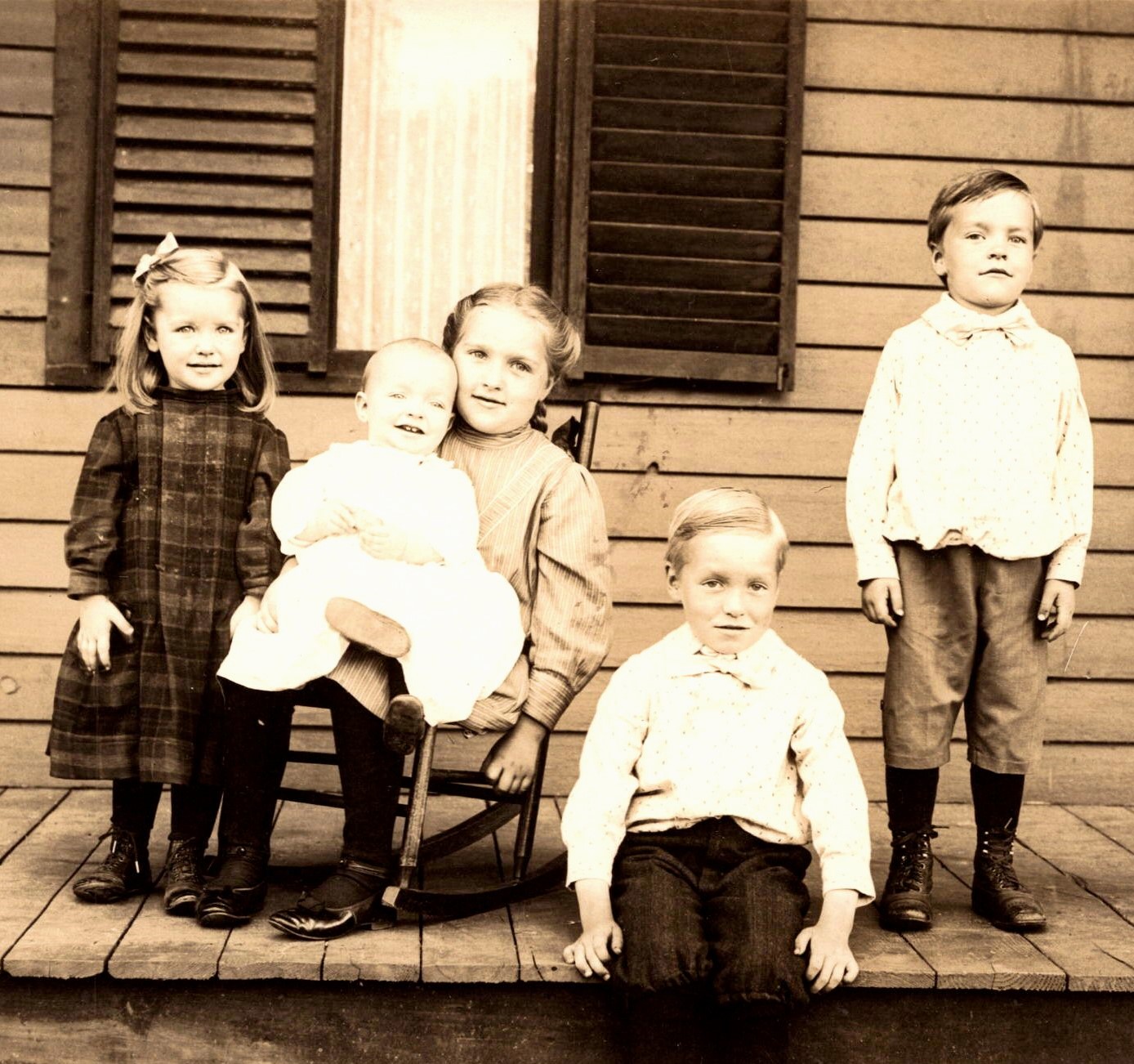
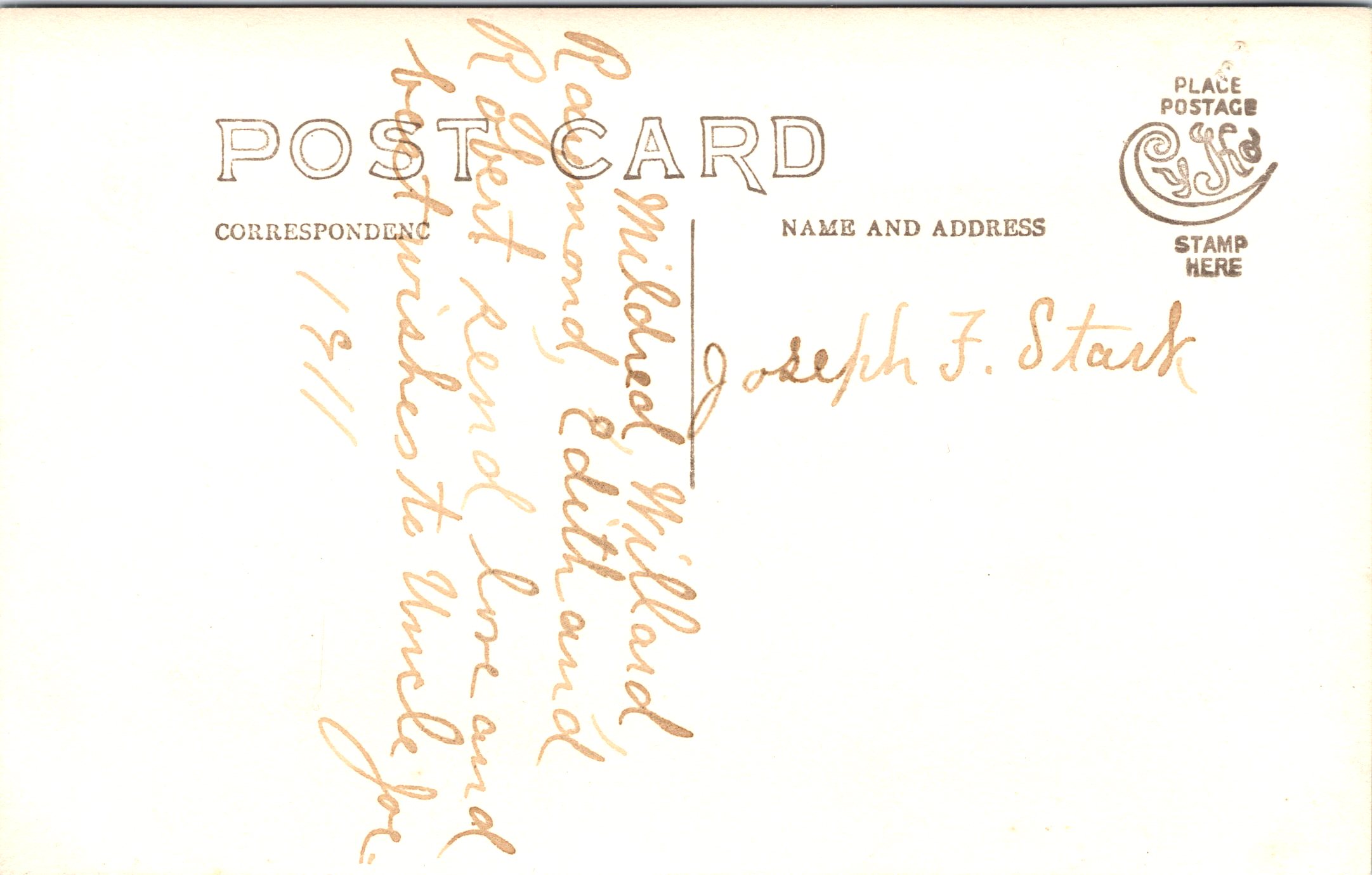
This vintage real photo postcard captures five siblings posed on a front porch. They are likely in front of their own home. The oldest child is sitting on a rocking chair and has the baby of the family on her lap. The writer of this postcard addressed it to “Uncle Joe” and introduces him to each child by their first name. The stamp box indicates that this postcard was produced by Cyko. SOLD
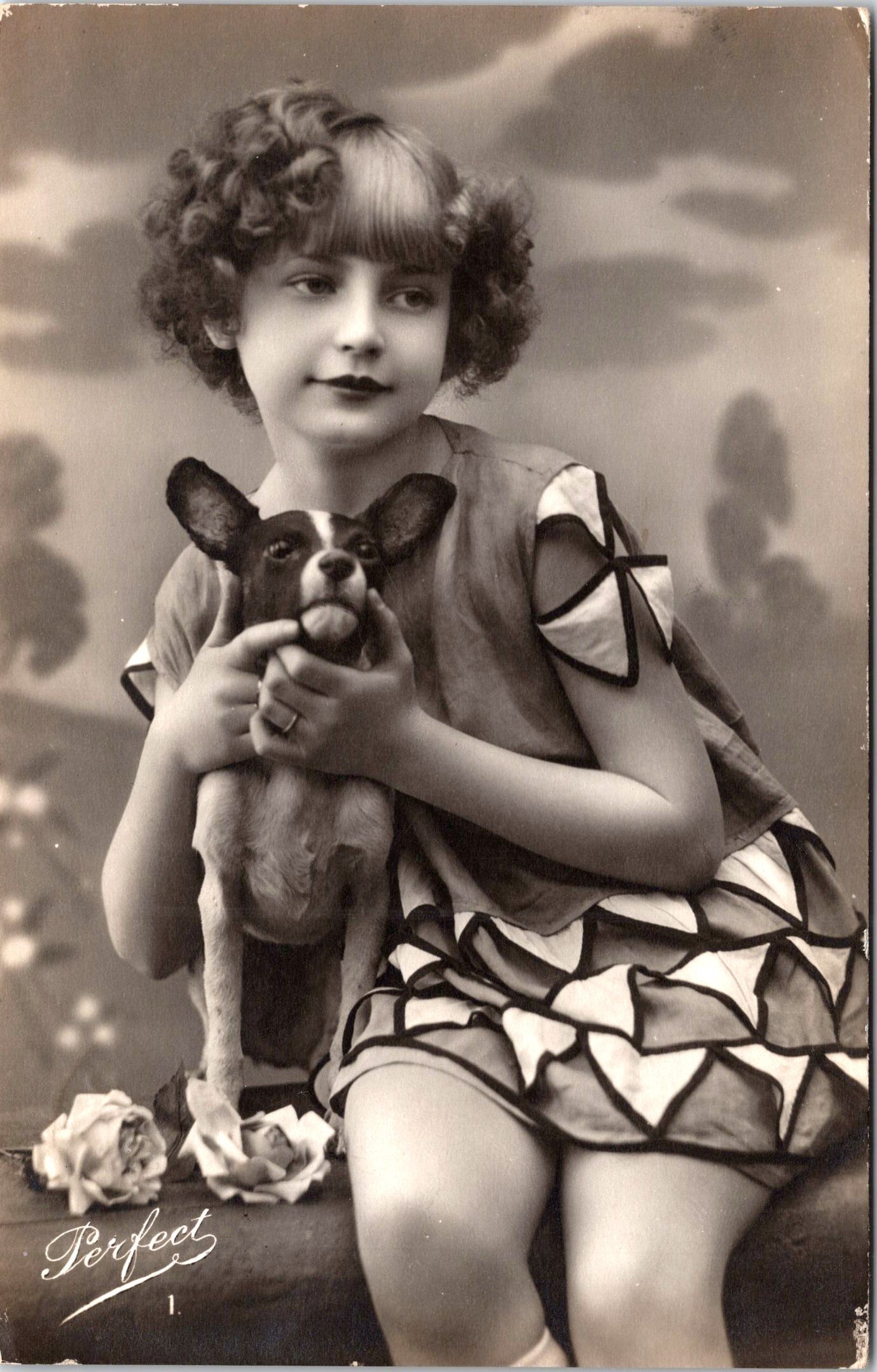
This charming vintage real photo postcard captures a delightful scene of a little girl lovingly holding her dog. She wears a short-sleeved dress with decorative trim—possibly silk or rayon—featuring a playful geometric pattern or layering. Her hair is styled in tight curls—indicative of a child’s fashionable curls in the 1920s. The dog, small and alert, could be a toy or miniature Chihuahua‑type, with pointy ears and a poised stance. I believe it is most likely a Jack Russell Terrier. The pair sit against a painted backdrop with floral imagery, creating a refined and innocent studio portrait. The postcard is from publisher Perfect, with the signature “Perfect” scripted on the lower left of the front. The card is postally used, with handwriting on the reverse, a green 10-centime stamp from Belgium, and a postmark dated 1926, likely from Sottegem, Belgium. The handwritten message on the reverse is in French is addressed to recipient in Belgium. Translated, the missage message reads: “Kindly and affectionately”. (SOLD)
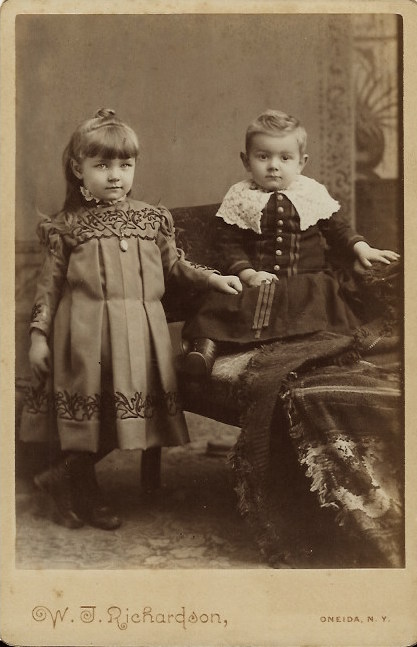
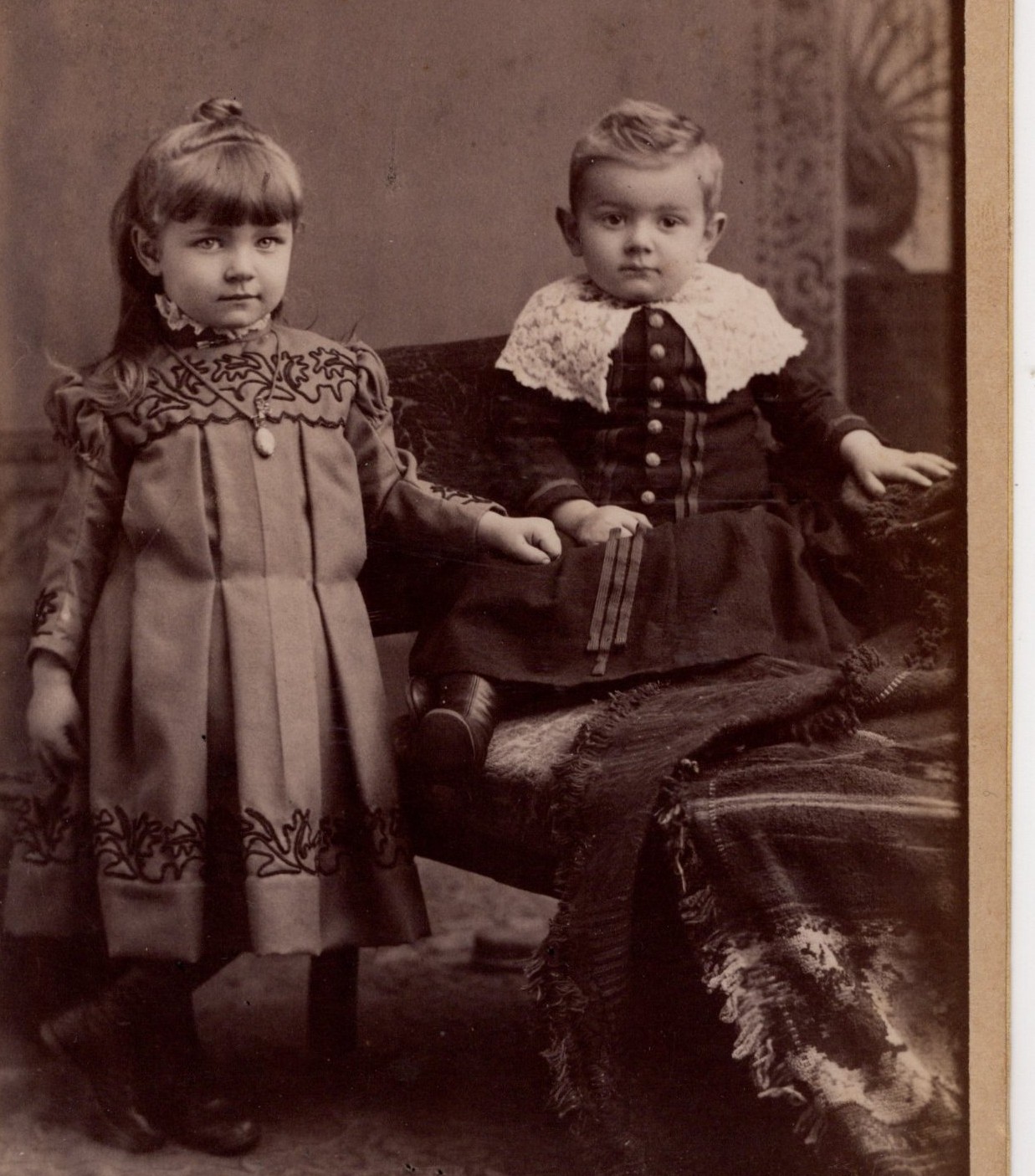
This charming late nineteenth-century cabinet card was photographed by W.J. Richardson of Oneida, New York, and depicts a beautifully dressed young girl standing beside a seated toddler boy in a carefully arranged studio interior. The girl wears her hair in long braids and is adorned with decorative buttons or breast ornaments that add visual interest to her otherwise modest Victorian dress. She stands confidently, her posture poised and composed. She is adorable. Beside her, the younger boy sits with a softer, slightly tentative expression, creating a lovely contrast between sibling composure and childhood vulnerability. The “big sister” seems to be assuming a protective posture in relationship to her sibling. Both children share pleasant smiles. The careful posing, the understated backdrop, and the children’s clothing all reflect the aesthetic sensibilities of the 1880s–1890s, when cabinet cards were at the height of their popularity. The mount style and photographic tone strongly suggest a date in the late 1880s to early 1890s. The image retains strong contrast with tonal depth. There is light, even age toning consistent with photographs of this period. The mount shows gently rounded corners, and the cabinet card remains solid and structurally sound. The cabinet card has gold beveled edges which are in good condition. Overall, the card presents in very good antique condition and displays beautifully (see scans).
This cabinet card is available for purchase at my store, The History Peddler, for $35.00
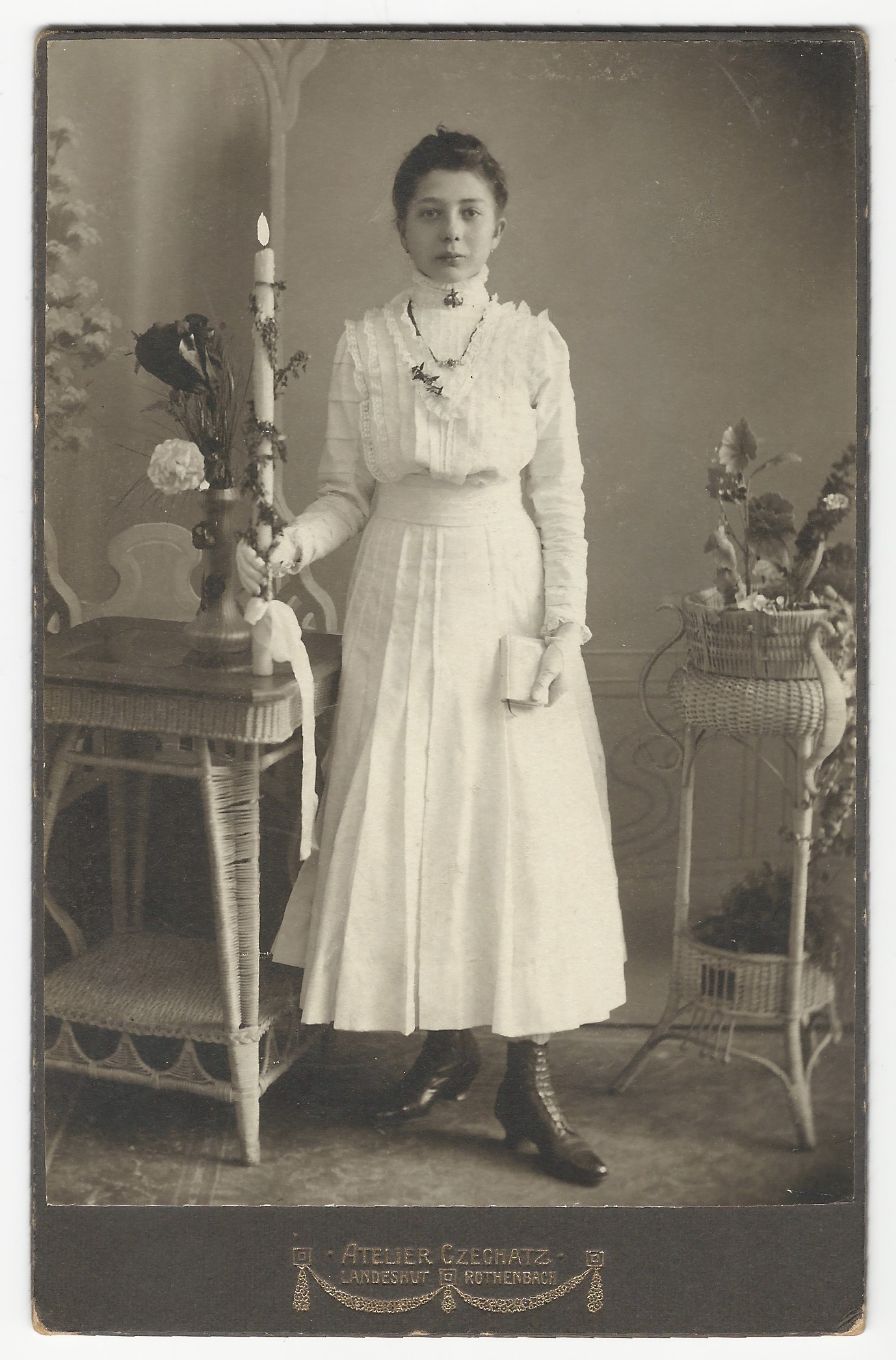
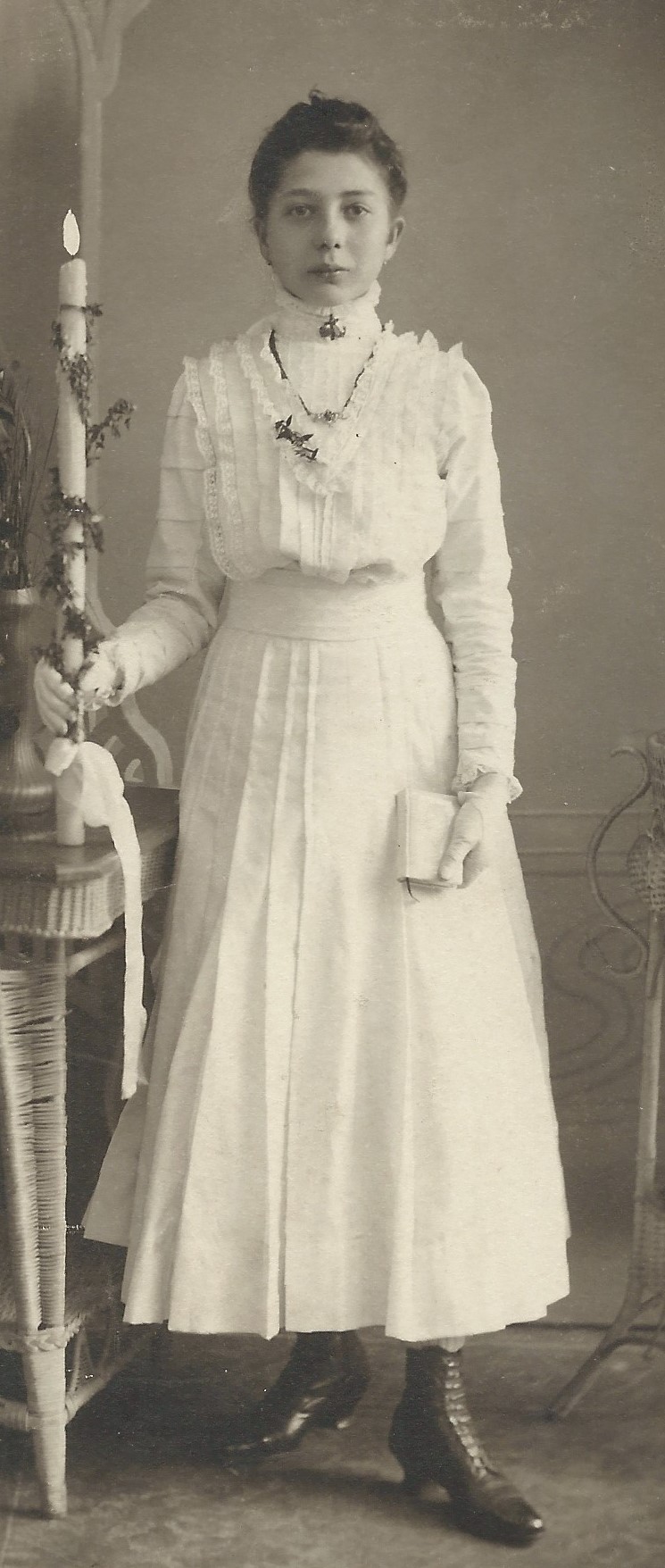
This cabinet card features a young girl posing for her first communion portrait. The photograph was taken at one of the two locations of the Czechatz studio. The sites of these two studios were Landeshut (Poland) and Rothenbach (Germany). Landeshut is also known as Kamienna Gora. This cabinet card is in excellent condition (see scans).
This real photo postcard is available for purchase at my store, The History Peddler, for $19.85 or best offer.
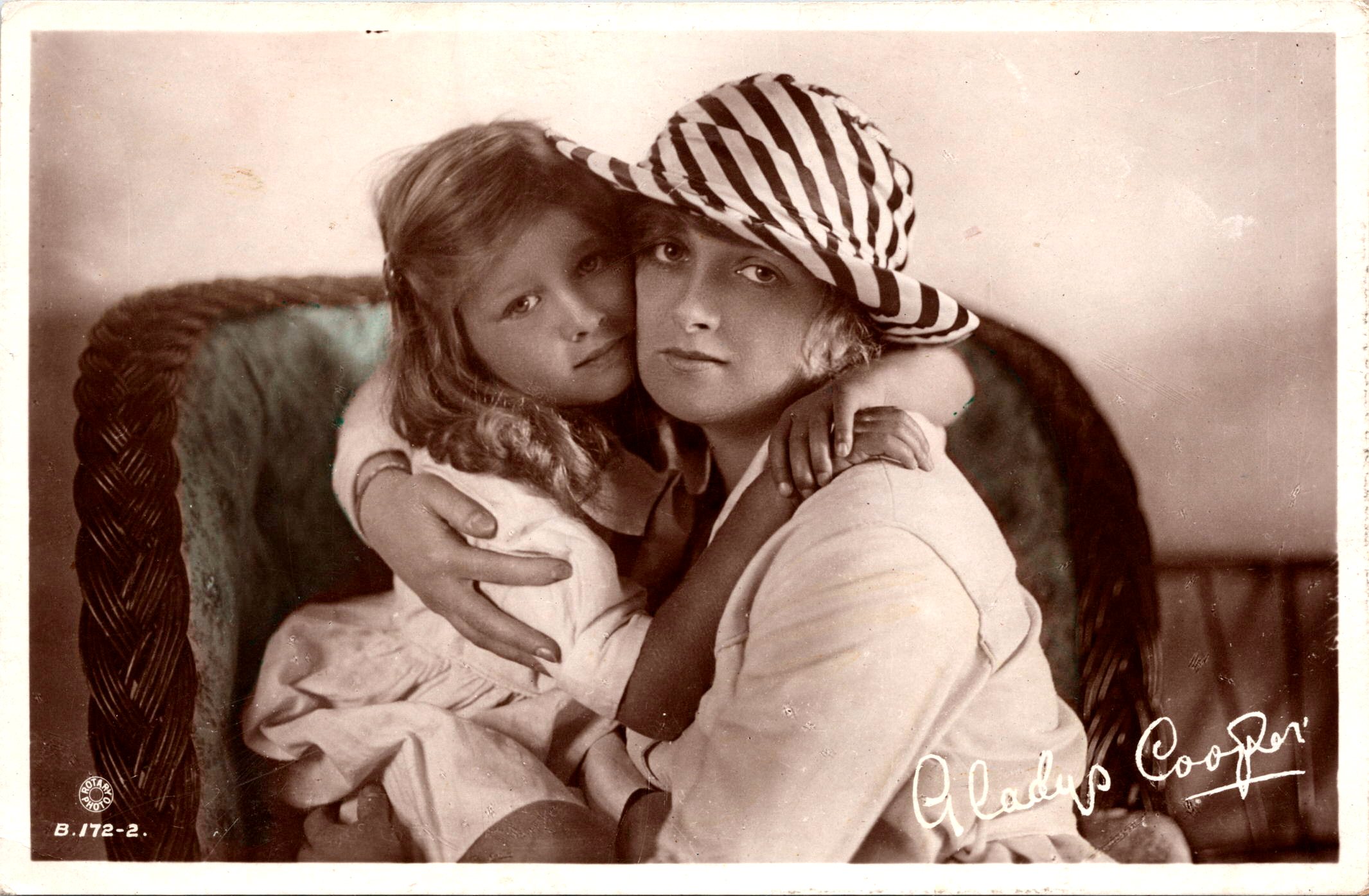
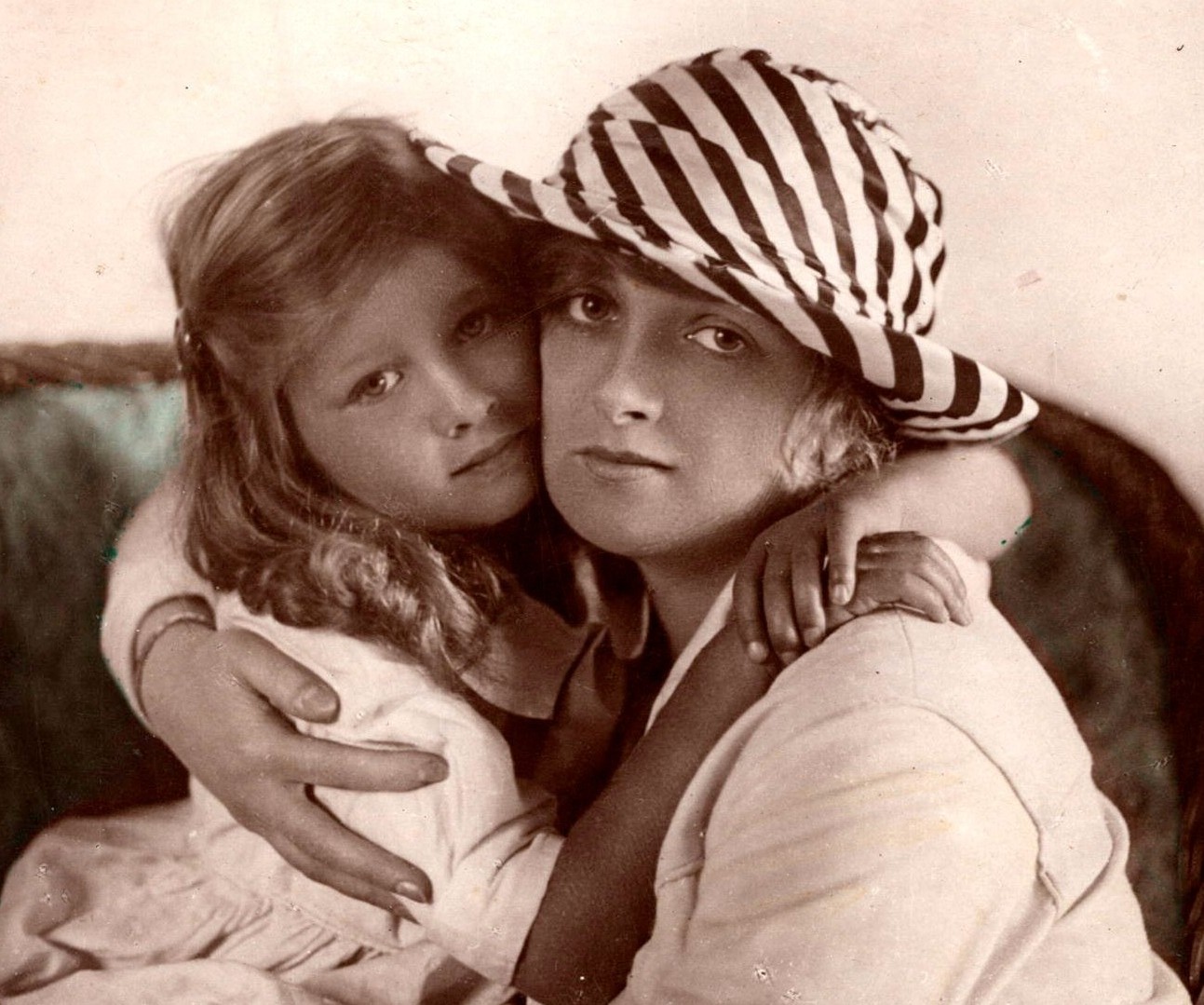
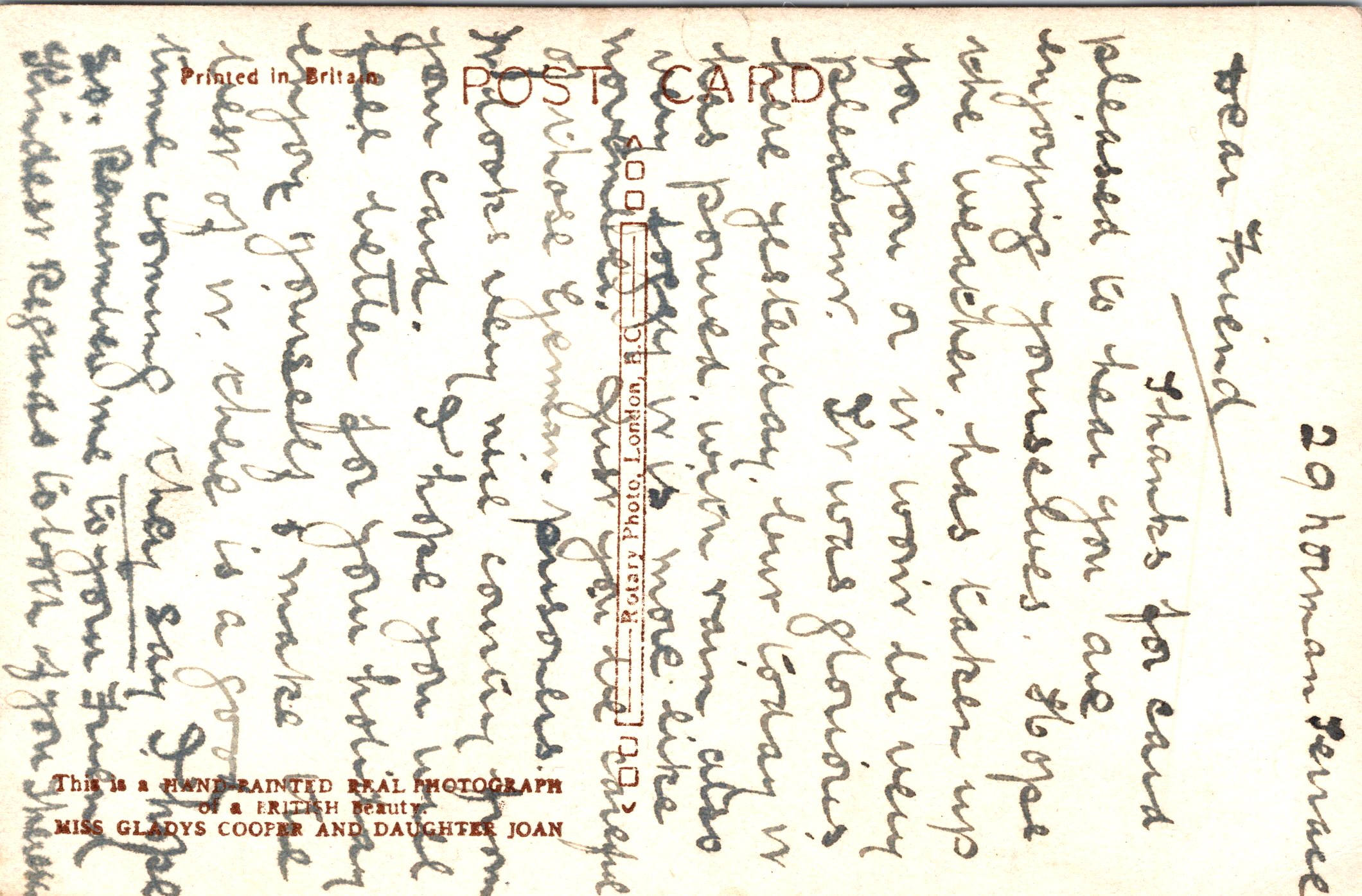
This rare vintage real photo hand-painted postcard features British actress, theatrical manager, and producer Gladys Cooper (1888-1971). Cooper’s career spanned over seven decades and she acted on stage, film, and television. She was a popular “pin-up” model for British troops during World War I. In 1967, she was awarded the coveted title of Dame of the Order of the British Empire. Cooper was known for both her talent and her beauty. In fact, she was considered by many to be the most beautiful actress in England. This is a real photo postcard featuring Gladys together with her daughter Joan. The postcard was published in Britain by Rotary Photo, this card is catalogued B.172-2. The postcard features Gladys seated in a wicker chair, dressed in a light coat and striking wide-brimmed hat with bold black and white stripes. Her expression is calm and direct, gazing steadily at the camera. Joan leans into her mother’s embrace, wearing a light dress, her long curls framing her face, and looking tenderly toward the viewer. The intimate pose conveys both warmth and strength. Cooper’s bold autograph facsimile appears at the bottom right. The reverse of the postcard is divided back and has a message. The following is an approximate transcription. “Dear Friend, Thanks for card, pleased to hear you are enjoying yourself. Jones’ leg is better I hope you have gone for good. Weather has taken up & it won’t be very long before you are more like yourself. Yesterday was glorious, but today is dull & very damp. Remember me to your mother. With kindest regards to you both.”(SOLD)
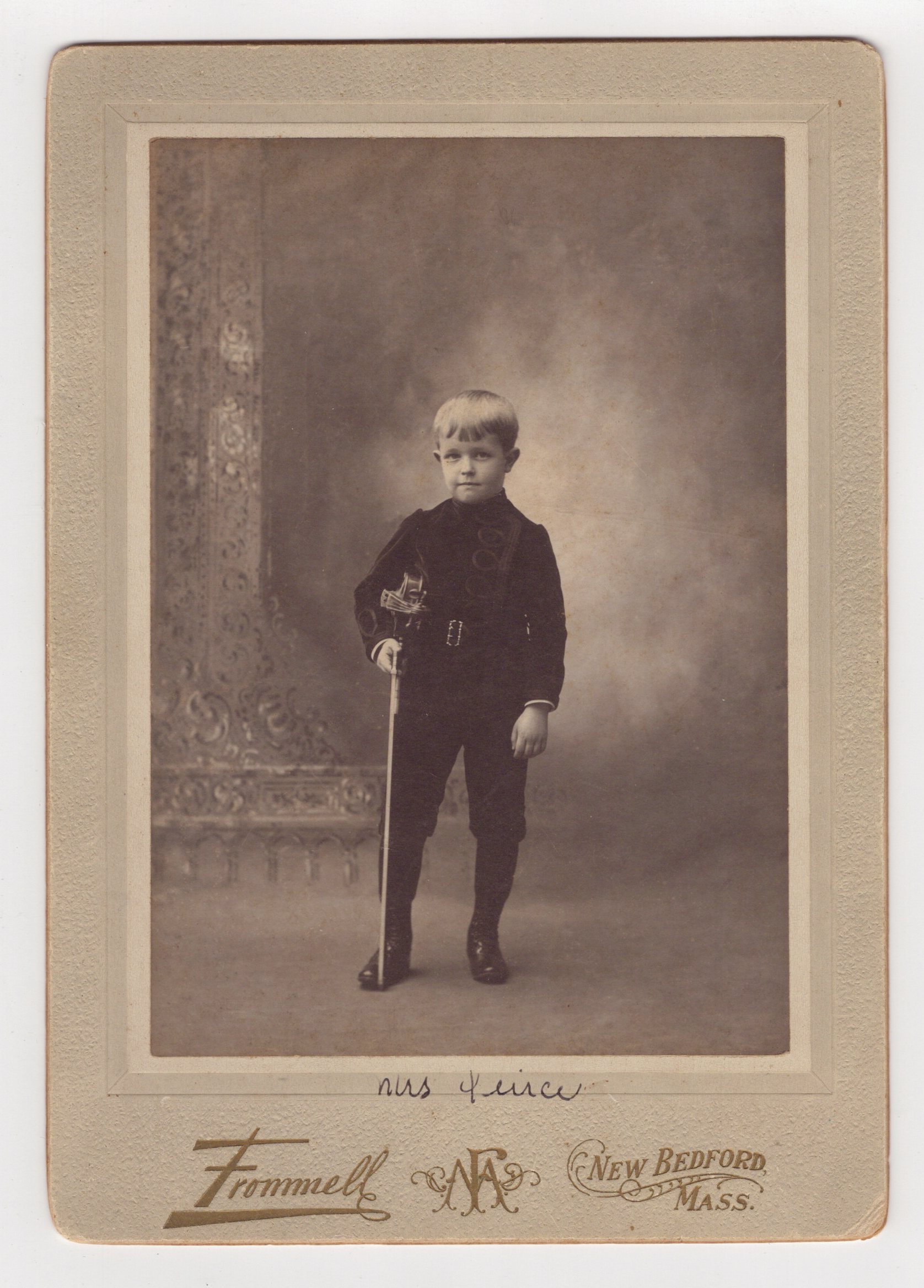
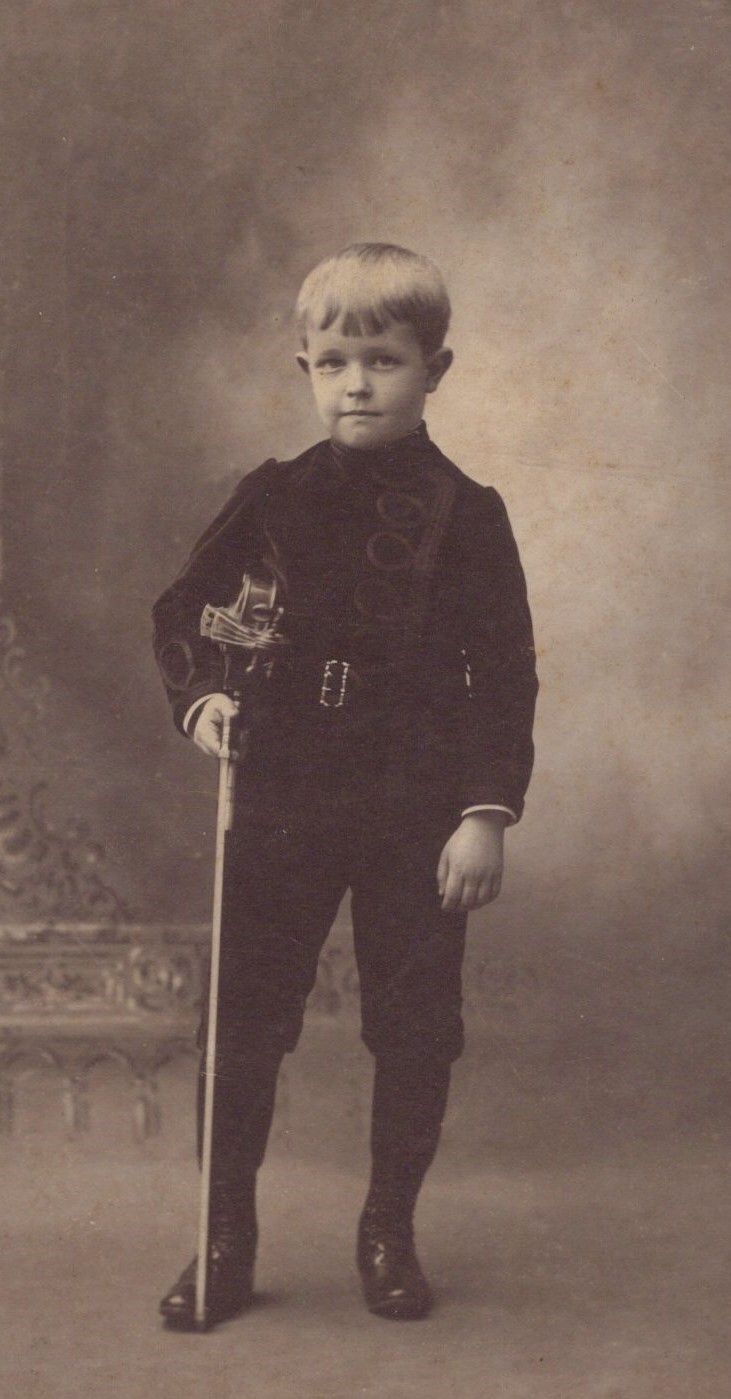
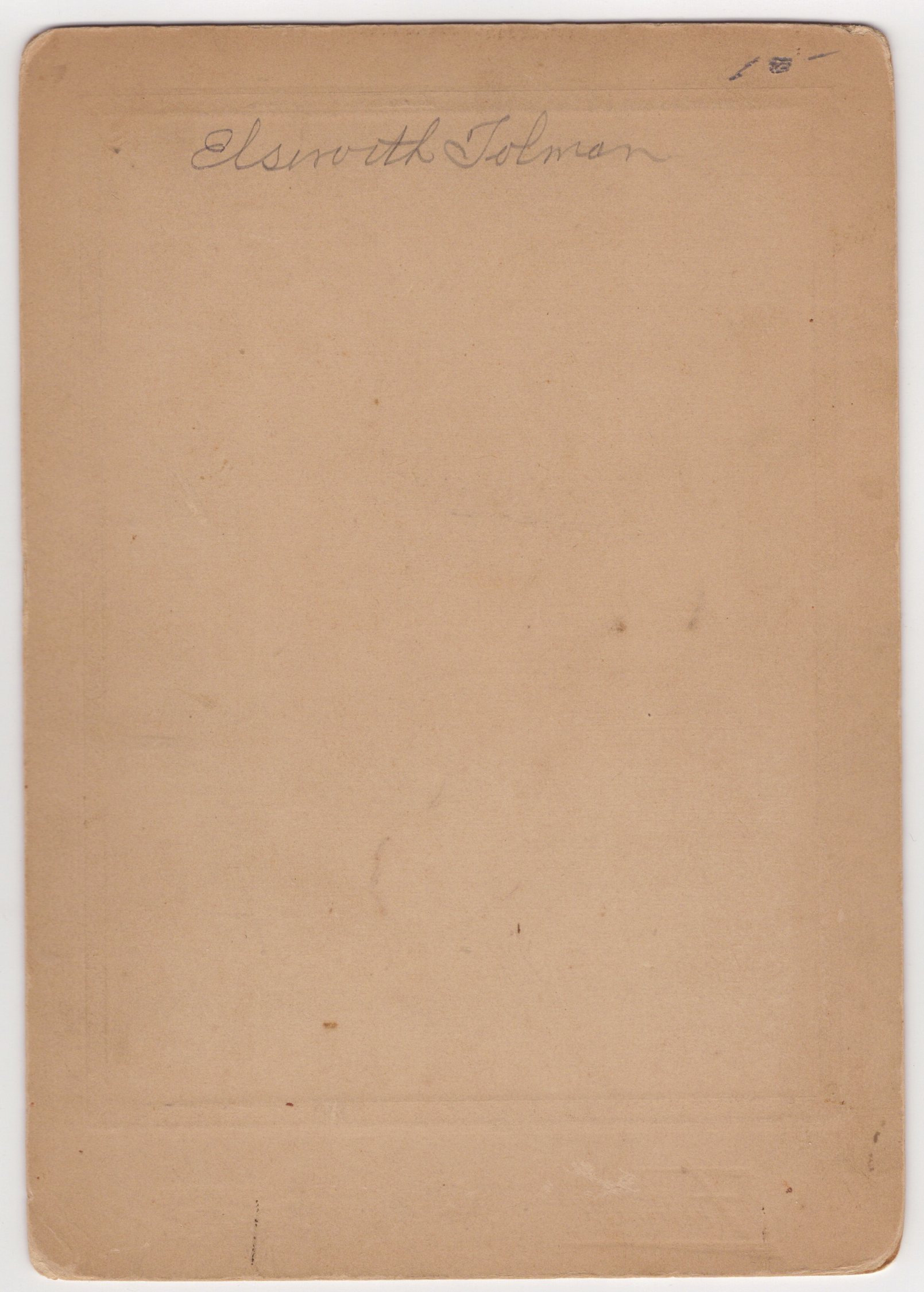
This vintage photograph features a handsome young boy dressed in dark clothing. He is holding a stick of some kind. Is it a toy? It almost looks like a sword. It has been pointed out to me by a Cabinet Card Gallery visitor that the boy actually has a violin under his arm. The “stick” is likely a bow. The child appears to be wearing a uniform (band?). The boy is identified on the reverse of the photograph. His name is Elsworth Baker Tolman and he lived most of his life in New Bedford, Massachusetts. He was born in 1891. His father and mother were named Elmer and Adrianna respectively. The boy’s father was a musician. The 1910 census shows that Elsworth was working as a dry goods salesman. Elsworth was in the Army during World War l. He was a Captain and was assigned to an Engineering unit. Records from the 1930’s reveal that he was working as an engineer and in 1939 he married Dorothy Tolman. In 1940, he was employed as a fire insurance Engineering Inspector. This photo was taken by Martin H. Frommell at his New Bedford, Massachusetts studio.
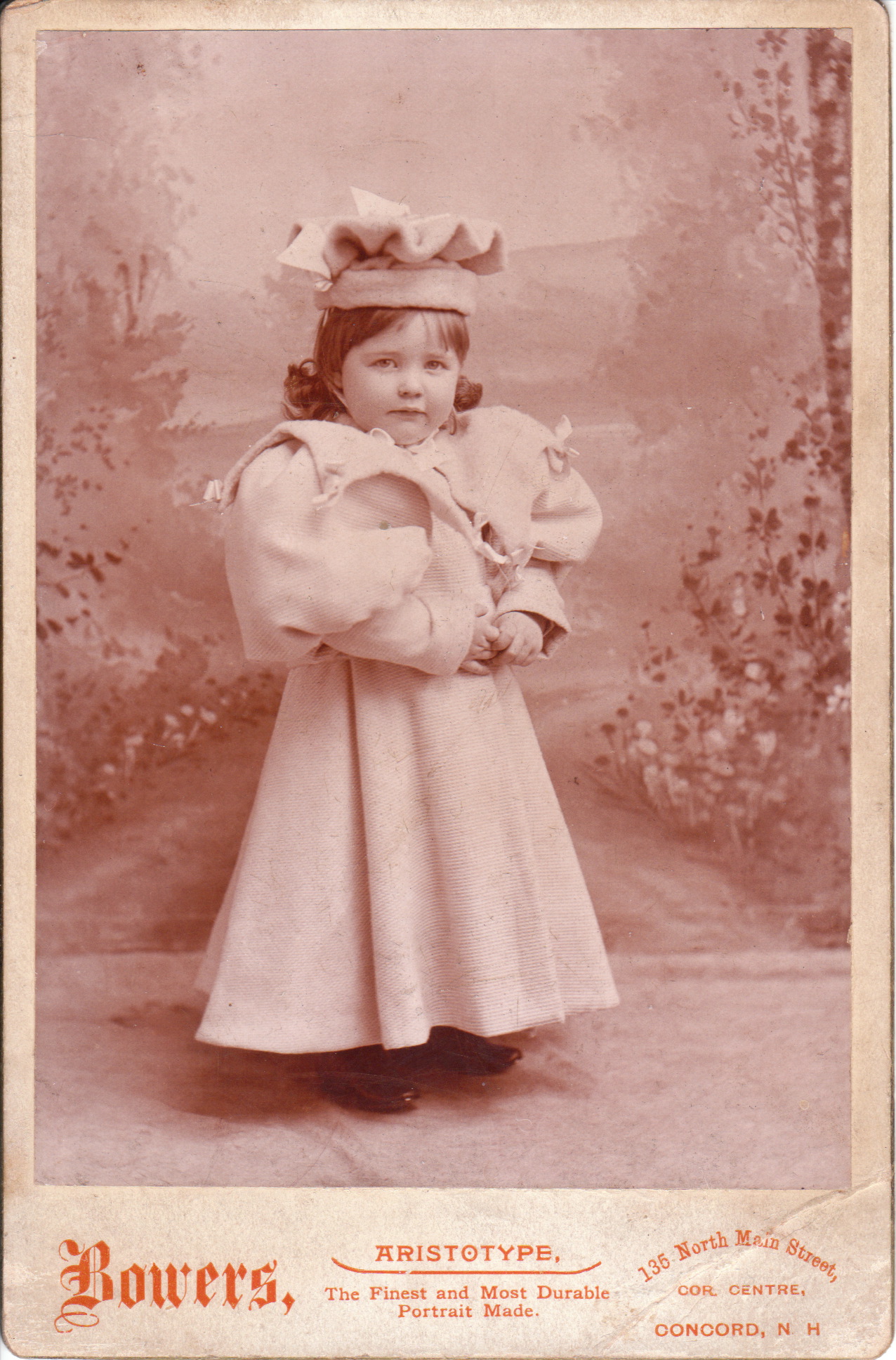
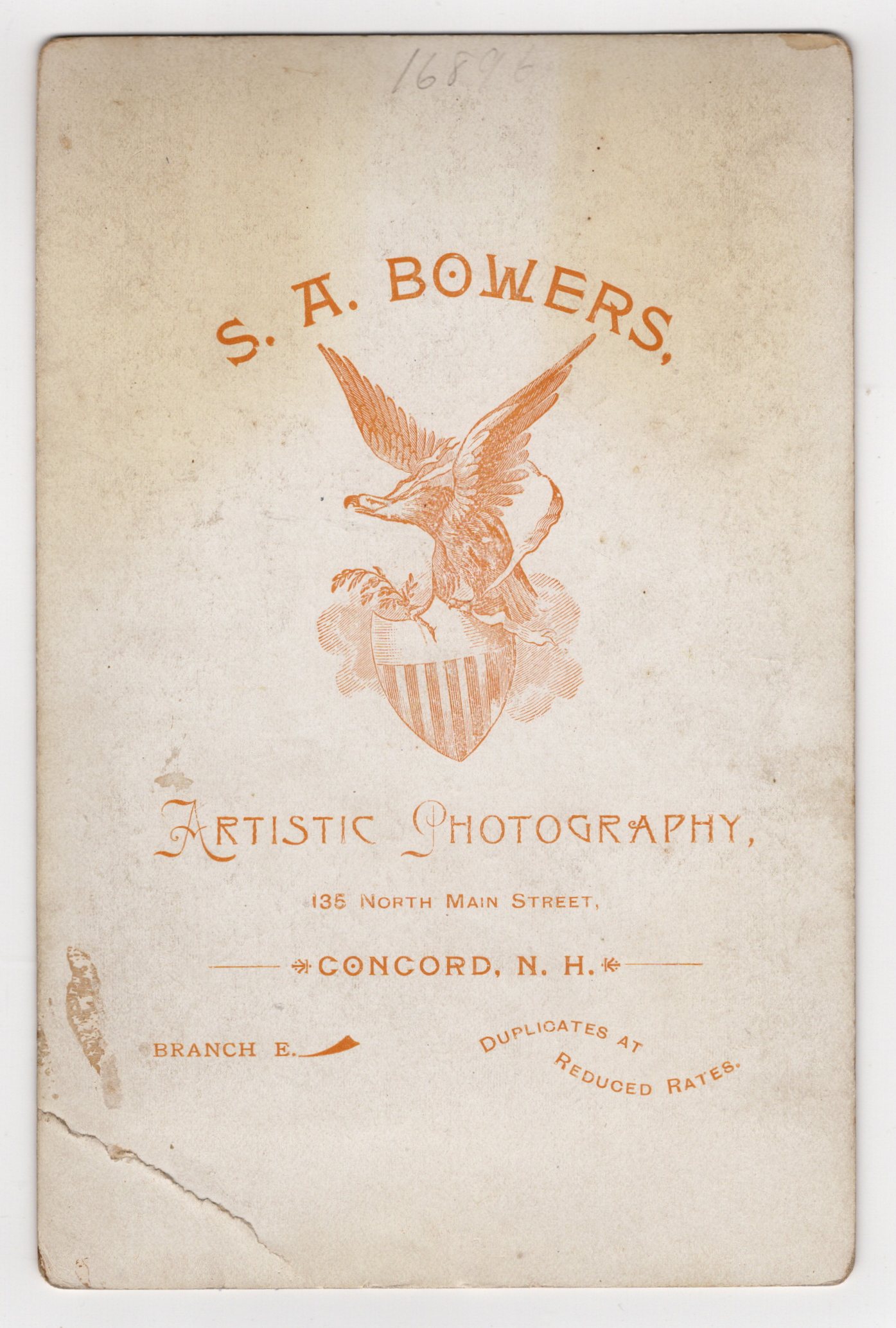
This cabinet card features an adorable little girl bundled up in her winter clothing. She is wearing quite the interesting hat. The photograph is by S. A. Bowers of Concord, New Hampshire. The front of the card announces that the Aristotype printing method was used in producing this image. This method employs collodion or gelatin chloride paper. SOLD
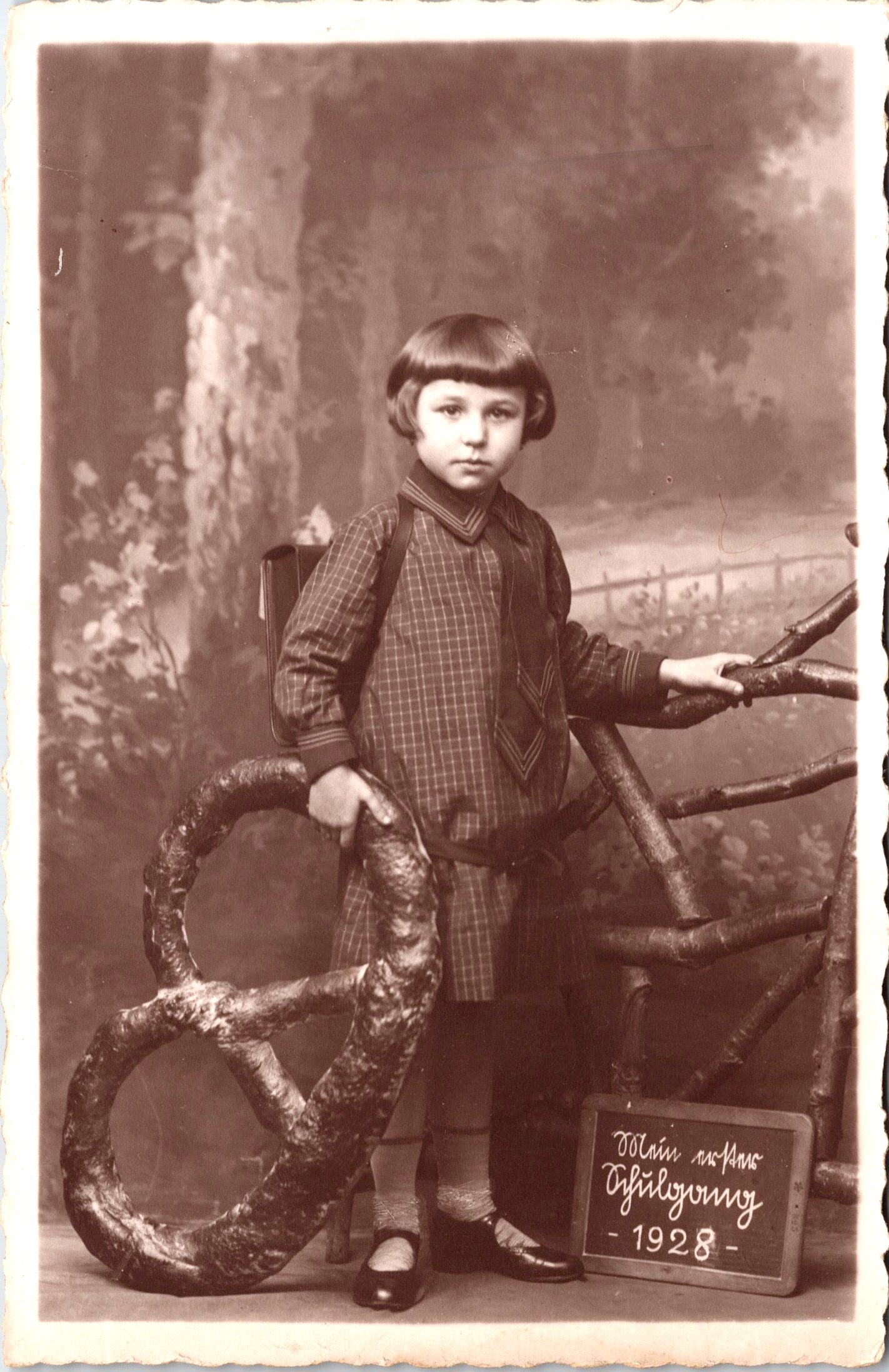
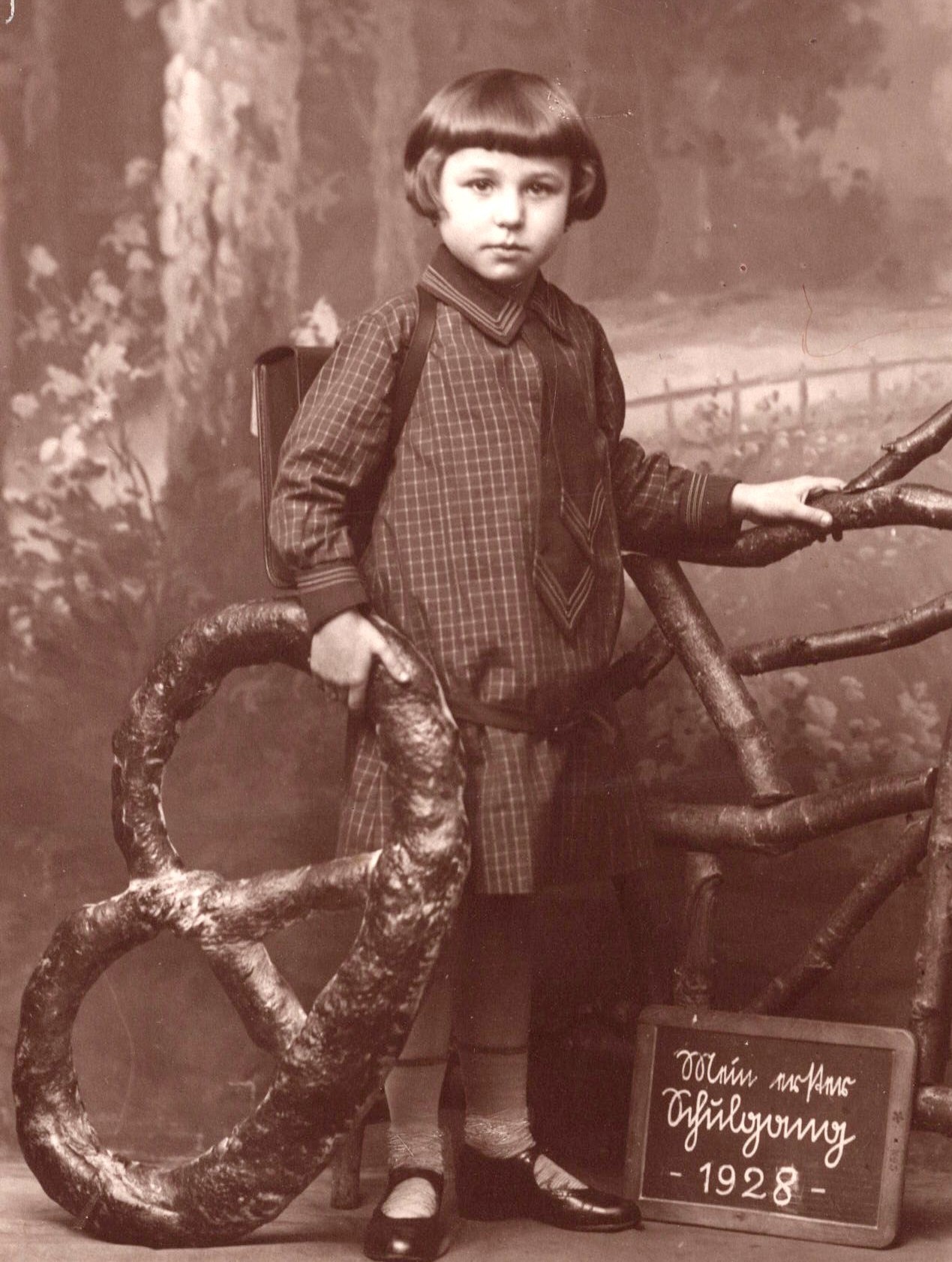
This evocative scalloped edge vintage real photo postcard captures a young school-aged child posed formally in a studio setting, dated 1928, during the late Weimar Republic period in Germany. The child stands confidently beside a sculptural studio prop resembling intertwined branches, resting one hand upon it while wearing a traditional school outfit of the era. Slung over the shoulders is a rigid school satchel (Schultasche), a detail that firmly anchors this image in everyday German childhood life of the 1920s. Most striking is the oversized pretzel-shaped prop placed prominently in the foreground. Far more than a whimsical accessory, the pretzel is a long-standing symbol in German culture, often associated with good fortune, nourishment, and childhood traditions. Its exaggerated size suggests a playful studio device meant to charm parents and relatives, blending symbolism with visual appeal.The painted studio backdrop—featuring a tree trunk and rustic fencing—adds a pastoral, storybook quality, contrasting gently with the child’s serious, composed expression. This blend of innocence and formality is characteristic of early 20th-century European studio portraiture. The sign beside the child translates as : “My First Day of School – 1928”. This inscription confirms the occasion and elevates the postcard from a simple portrait to a commemorative milestone image. Postcards like this were often produced to mark important life events—first school day, confirmations, or birthdays—and were commonly sent to extended family members. The clean, unused reverse suggests this example was preserved as a keepsake rather than mailed. The overall condition of this postcard is very good. The card has light, even age toning consistent with period silver gelatin postcards. There is minor surface wear at it’s corners. There are no creases. The image remains sharp with excellent contrast. Please review scans carefully for full condition details.
This cabinet card is available for purchase at The History Peddler for $36.00 or best offer
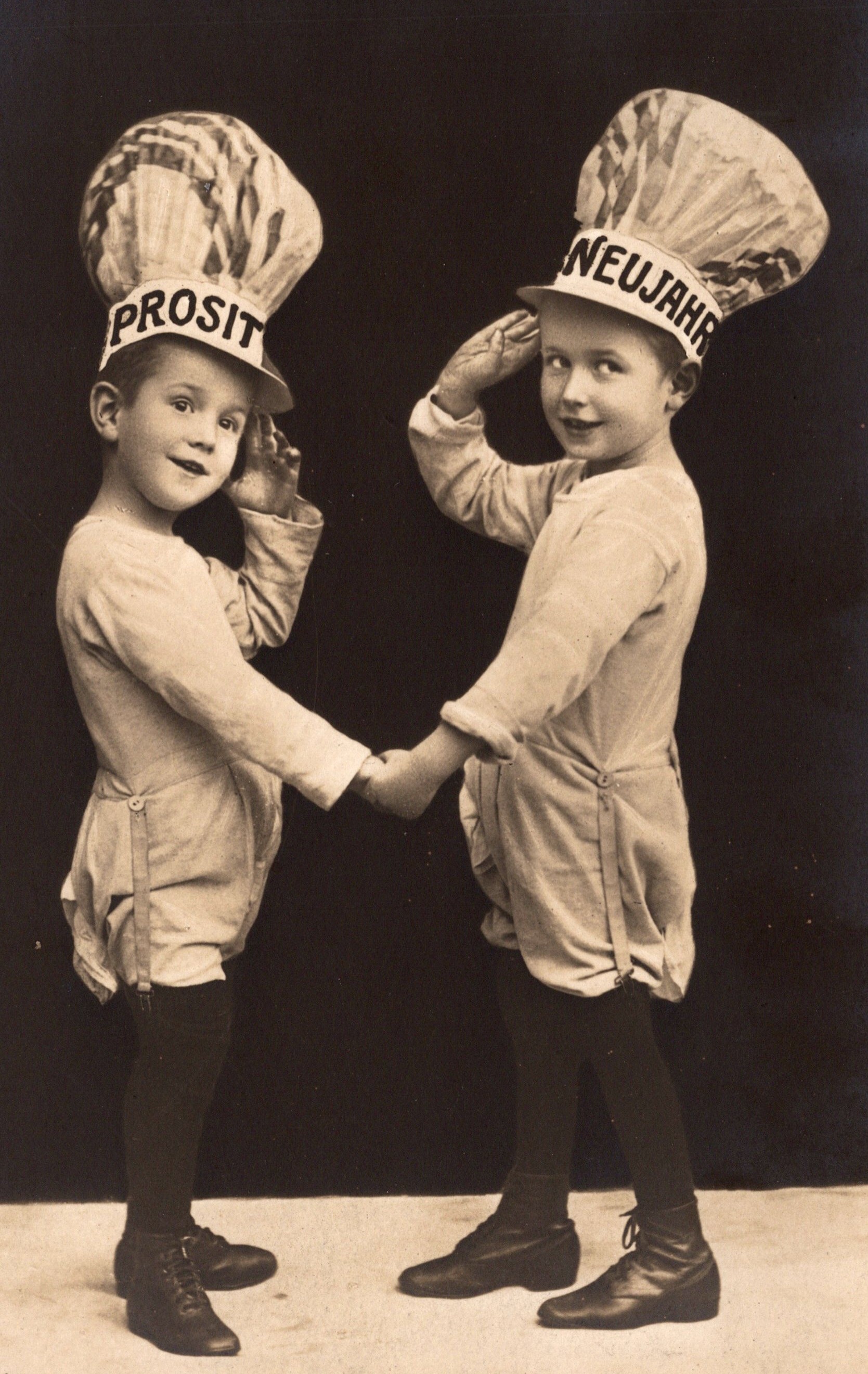
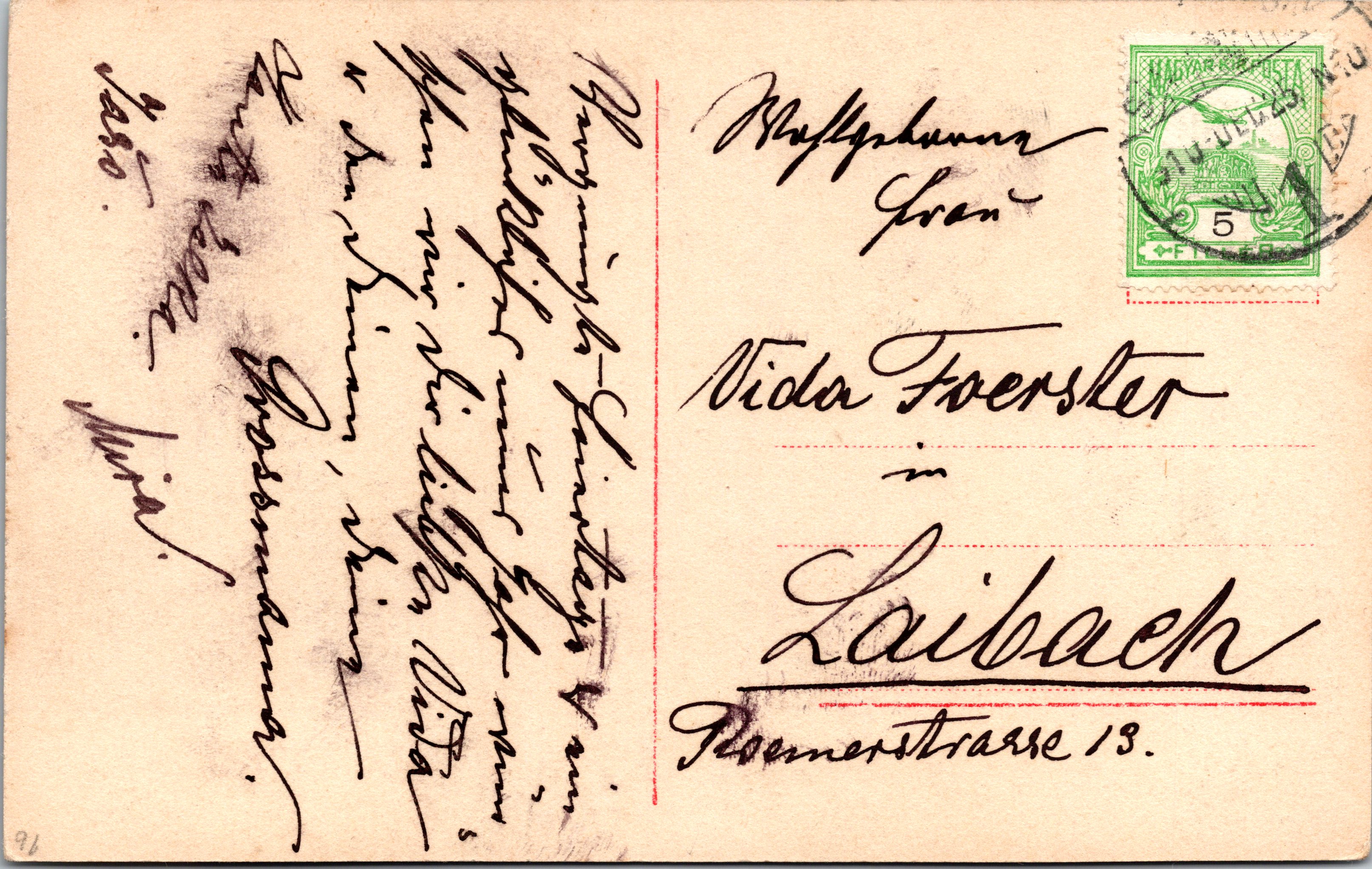
A wonderfully playful German New Year “Prosit Neujahr” real photo postcard published by RPH (Rotophot), Berlin—a major early 1900s European postcard producer best known for high-quality photographic subjects and big, numbered series. The image is pure studio charm: two children in oversized chef-style caps (party hats styled like tall cooks’ toques), posed hand-in-hand as if about to dance into the New Year. One cap reads “PROSIT” (a festive toast—“cheers!”) and the other reads “NEUJAHR” (“New Year”). Their little salute gestures and the crisp studio lighting give this card that classic pre-war holiday-photo look. At the lower left you’ll find the RPH monogram in a circle and the printed series number S.1281/3, identifying this as a Rotophot issue. Overall, this postcard presents nicely with minor edge/corner wear (see scans). The card was mailed to someone in in Laubach, Germany. The postcard has a green 5 (phennig) stamp from Germany. The message is difficult to clearly decipher but it is clear that it is a traditional New Year greeting. It appears to read “Heartfelt New Year’s greetings and a happy New Year …”. This card is likely from sometime around 1905 to 1907.
This cabinet card is available for purchase at my store, The History Peddler, for $22.00 or best offer.
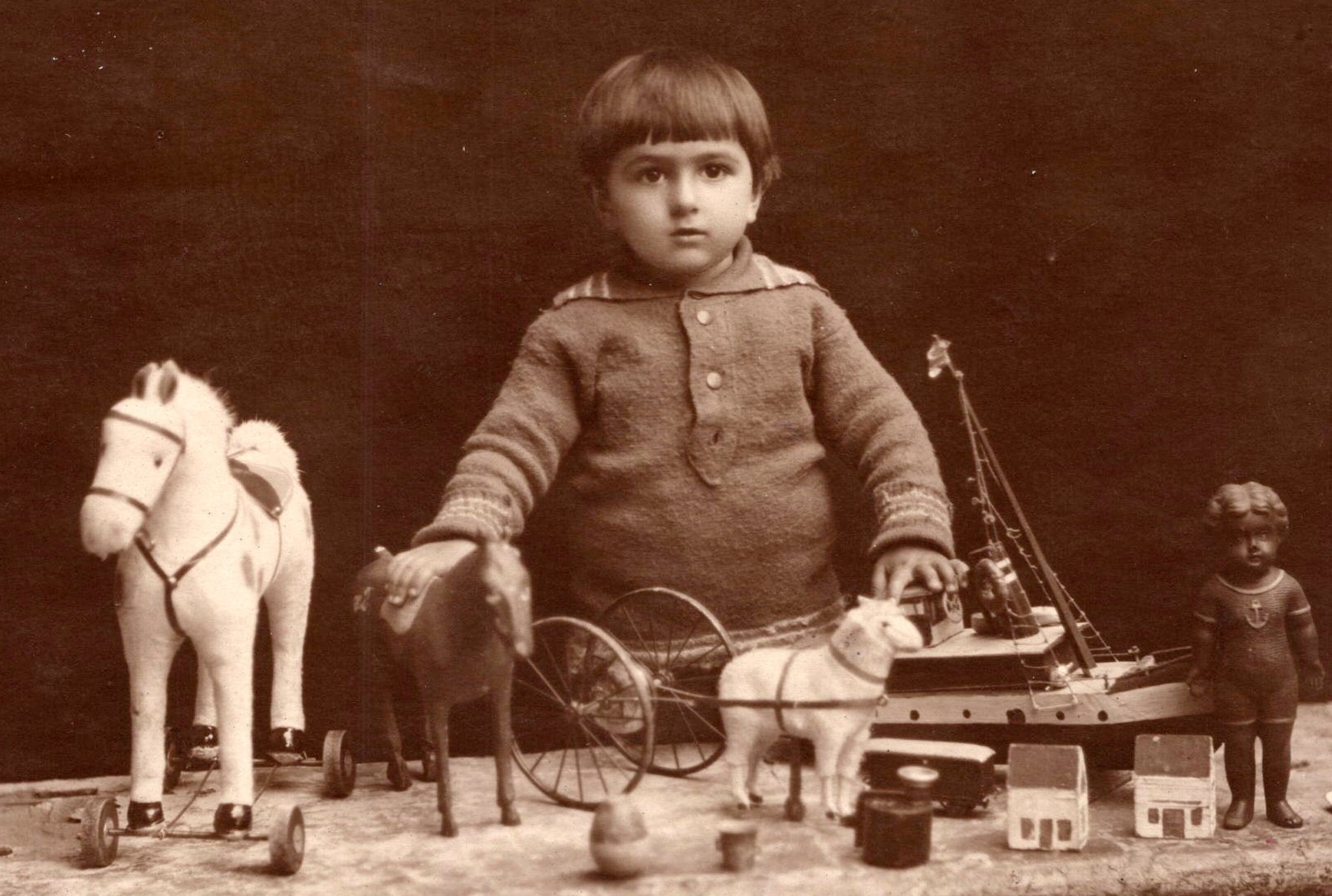
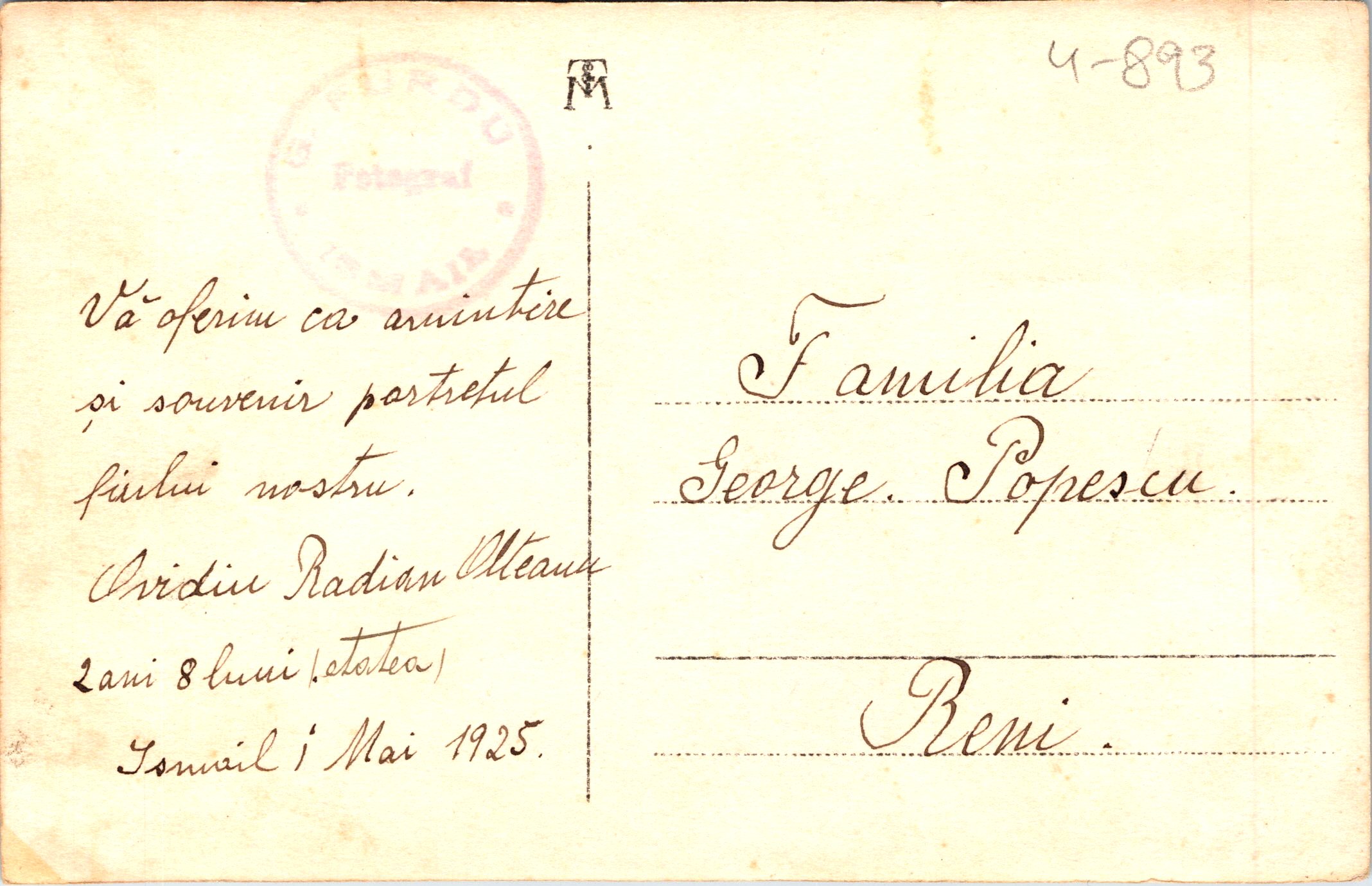
This evocative real photo postcard, written and dated 1925, presents a beautifully staged studio portrait of a very young child posed behind an elaborate miniature world of toys—an image that feels both intimate and faintly theatrical, as was common in European children’s portraiture of the interwar period. Spread carefully across the tabletop in front of the child is an impressive assortment of early 20th-century toys, each rendered with remarkable clarity. On the left stands a wooden pull horse on wheels, its form sturdy and utilitarian, likely hand-painted. Nearby is a small toy donkey or horse mounted on a simple wheeled frame. At center is a miniature cart with large spoked wheels, suggesting rural life and transport—imagery deeply familiar to Eastern European households of the era. To the right appears a toy goat or sheep, delicately harnessed, positioned near a detailed model boat complete with mast and rigging—an ambitious and unusual toy that adds narrative complexity to the scene. Also visible are tiny toy houses, a small lidded container or barrel, and a painted doll figure standing upright at the far right, dressed in what appears to be a sailor-style outfit. Collectively, these objects create a miniature village or imagined world, emphasizing themes of childhood, play, and aspiration. The child—identified in the message as two years and eight months old—stares directly at the camera with a solemn, almost uncanny composure, heightening the emotional impact of the image. The photograph is warm-toned and evenly exposed, suggesting professional studio work rather than a casual snapshot. This postcard is not only visually compelling but also richly documented, with a handwritten message on the reverse that firmly anchors it in time and place. The following is the English translation of the message on this postcard: “We offer you, as a keepsake and souvenir, the portrait of our son. Ovidiu Radian (Mleanu) 2 years and 8 months old Ismail, May 1, 1925.” The postcard is addressed to a family in Romania. The card originated from Ismail, a particularly important location historically. In 1925, Ismail was located in Basarabia, a region that at the time was part of Greater Romania (1918–1940). Today, Ismail is located in modern-day Ukraine. The postcard is in very good antique condition for a 1925 real photo postcard. The image remains strong with nice tonal depth. Light surface/handling wear consistent with age. The reverse shows expected age toning and a faint circular postal marking, along with the handwritten message. There is only minor corner/edge wear (see scans).
This cabinet card is available for purchase at The History Peddler for $68.00 or best offer





 THE CABINET CARD GALLERY