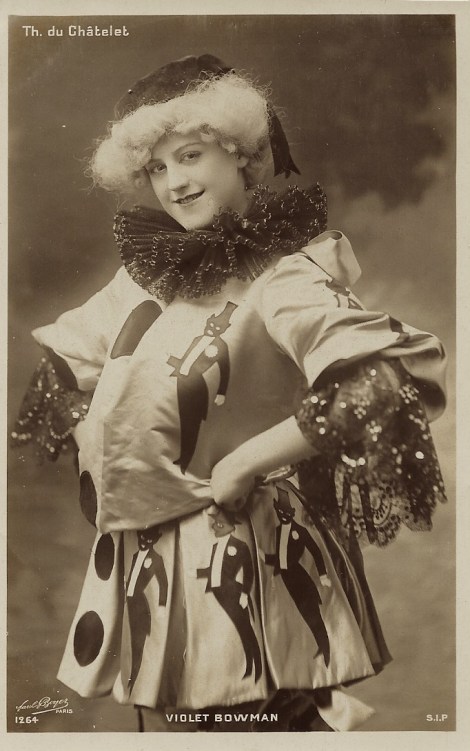
PORTRAIT OF GRACE BOWMAN, PERFORMER AT THEATRE DU CHATELET IN PARIS, FRANCE (BY PAUL BOYER)

stiff 3

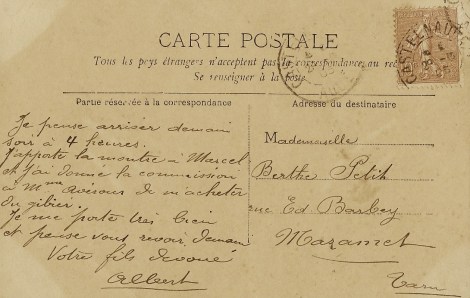
This vintage real photo postcard features a costumed stage actress named Violet Bowman. Her clownish costume’s pattern includes men in tuxedos and blackface. Preliminary research yielded little information about Miss Bowman but it appears from the postcard that she performed at the Theatre du Chatelet in Paris France. The theatre was designed by Gabriel Davioud after it was requested by Baron Haussmann between 1860 and 1862. Although it has been remodeled, the theatre is still in operation and currently seats 2,500 people. Violet Bowman is quite pretty in this portrait by celebrated Paris photographer, Paul Boyer (1861-1908). He photographed many famous people during his career. This postcard is published by Societe Industrielle de Photograpie (SIP) of Rueil, France and was part of a series (no. 1264). The postmark of this French stamped postcard is from Castelnaudary, France and is dated 1905. It is addressed to Mazamet, France.

stiff 4

ADORABLE LITTLE GIRL WEARING PIERROT COSTUME: SHE IS CUTE AS A BUTTON

pierrot

This vintage real photo postcard features an adorable little girl dressed in a Pierrot costume. Perhaps she is dressed for a party associated with the Carnival. Pierrot is a character introduced to Paris in the late seventeenth century. The character is still popular today in contemporary culture. Pierrot is often presented as a sad and naive clown. This postcard is from around the 1920’s.

pierrot 1

Published in: on February 13, 2016 at 12:00 pm  Comments (1)  
Tags: ,

PORTRAIT OF A WORLD WAR I ERA SOLDIER IN NANTES, FRANCE

SOLDIER

This vintage real photo postcard features a portrait of a smartly dressed young World War I era soldier. He looks quite handsome in his uniform and clearly has his “game face” on. The photographer of this image is Gustave Cade. He operated a studio at 8 Rue de la Barillerie in Nantes, France. Nantes is a city in western France, located on the Loire River.

SOLDIER 1

Published in: on February 11, 2016 at 12:00 pm  Comments (1)  
Tags: ,

WOUNDED WORLD WAR I FRENCH SOLDIER TREATED BY FELLOW COMBATANT WITH A BOTTLE OF ABSINTHE

wounded

This vintage real photo postcard features a wounded French soldier being treated by his fellow combatant. The soldier doing the nursing helps his buddy by pouring some absinthe into the cup that the wounded man is holding. The injured man seems to be very pleased as he awaits his medicinal drink. What is absinthe? It is a distilled highly alcoholic beverage. Absinthe became a highly popular drink in late 19th and early 20th century France. It is a drink that was later portrayed as dangerous and seen as a hallucinogen. By 1915, it was banned in the US and much of Europe (including France). Although the ban of absinthe and the start outbreak of World War I occurred close together in time, author Doris Lanier, in her book “Absinthe–The Cocaine of the Nineteenth Century……..” (1994), notes that soldiers continued to enjoy absinthe during the war. Back to the photograph. Note the storage holders on the shelf above the injured man’s bed. It appears that they were used to hold the hospitalized patient’s clothing and belongings. My description of this interesting photograph contains some conjecture. Perhaps you have a different interpretation of this image. If so, please share your ideas in the comment section.


Published in: on January 30, 2016 at 3:54 pm  Comments (13)  
Tags: ,

PRETTY WOMAN WEARING A BIRD NEST HAT

bird nest

This vintage real photo postcard features a pretty woman wearing a bird nest hat. At least it looks like a bird nest. This young woman has the beauty to wear this unusual hat and look terrific rather than silly. The postcard is of French origin and was published in Paris. The Publisher’s logo “LL” can be seen on the front of the postcard. The postcard is part of a series (#123). “LL” postcards were produced for France, England, United States, and other nations. For many years postcard collecting experts believed the logo stood for Louis Levy but there was no real supporting evidence and that belief died around 1991. Later research arrived at the conclusion that the initials “LL” stand for (Moyse) Leon and his son-in-law (Isaac) Levy. Leon and Levy began their career as assistants with the Parisian photographic studio Ferrier-Souilier. The pair began their own photographic studio in 1862. Leon and Levy’s studio won a gold medal at the 1867 Universal Exhibition. Leon left the partnership in 1872 and Levy kept the business going and continued to use the “LL” logo. The company was renamed Levy Fils et Cie. Levy died in 1913 and the company was later bought by the printer Emile Crete.


PORTRAIT OF A SERIOUS BEAUTY (VINTAGE REAL PHOTO POSTCARD)

serious beauty

This vintage real photo postcard features a portrait of a very attractive young woman. She is displaying a very serious expression as she looks directly at the camera. She is well adorned with pretty flowers. The postcard is addressed to, and postmarked at Tourcoing, France. Tourcoing is a city in northern France. The postcard has a French stamp.

serious beauty 1

Published in: on January 20, 2016 at 12:00 pm  Comments (2)  
Tags: ,

MYSTERY CHANTEUSE PHOTOGRAPHED BY NADAR

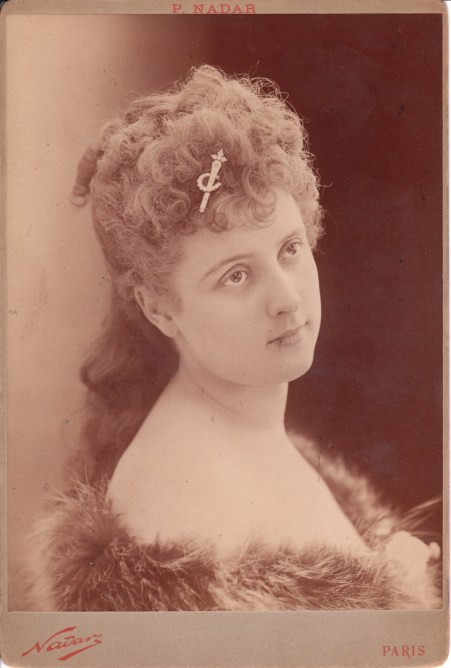
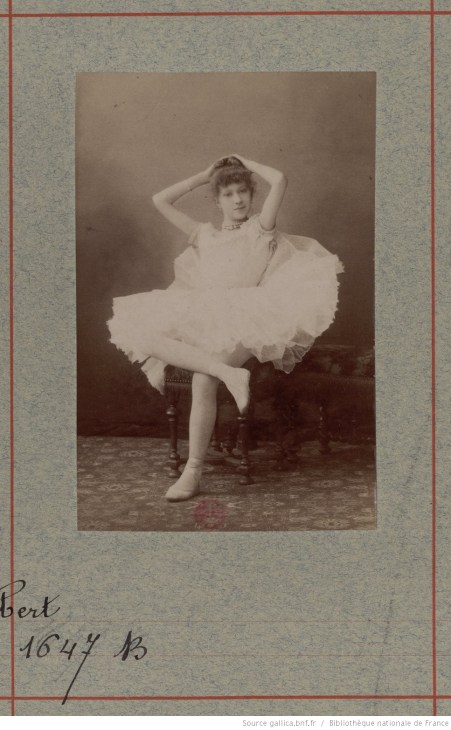
ILBERT_0002This Cabinet Card presents a bit of a mystery.  The photograph is by famed French photographer, P. Nadar of Paris. The subject of the photograph is a mystery. The reverse of the card has the name “Ilbert”  written in two places. In addition the word “Chanteuse” also appears. Is she an opera singer? Is she a nightclub singer? The woman is very stylish and is wearing a fur and interesting hair clip. Hopefully, a viewer will leave a comment with some identifying information.                                                    ADDENDUM: This photograph entered into the cabinet card gallery in 2009. Since then there have been a number of cabinet card gallery visitors that have left comments concerning the identity of the subject of this  image. There has been some disagreement, but at least two visitors have identified this performer as being Yvette Guilbert (1867-1944). To follow the discussion about identification, check out the comment section below. Now back to Mlle Guilbert. Born as Emma Laure Esther Guilbert, she began singing as a child but worked at a Paris department store model when she turned sixteen. She also took acting and voice lesson and in 1886 she began working as an actress. She debuted at the Variette Theatre in 1888. She was soon singing at a number of popular clubs before starring in Montmartre at the Moulin Rouge in 1890. Over time she began to sing a lot of  monologue “patter songs”. Often the lyrics were risque, even raunchy. Her song frequently featured tragedy and poverty. Guilbert was audacious and audiences ate it up. She was celebrated in France, England and the United States. She was a favorite subject of artist Henri de Toulouse-Lautrec, who made many portraits and caricatures of Guilbert. Later in her career, she appeared in silent movies, talkies and made recordings. She also wrote books about the Belle Epoque. It is interesting to note that Nadar, the photographer of the mystery chanteuse also photographed Yvette Guilbert. A Nadar photograph of Mlle Guilbert is part of the collection at the National Library of France. A copy of that image can be found below.
btv1b53092288b


Published in: on December 1, 2015 at 12:01 pm  Comments (7)  
Tags: , , , , , ,

THE MERCHANT OF THE MASKS (REAL PHOTO FRENCH POSTCARD BY ALBERT BERGERET)

masks

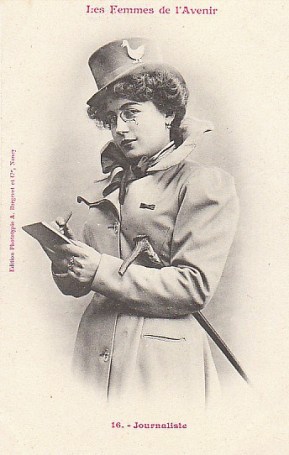
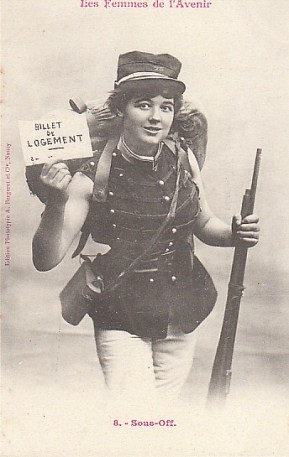
This spectacular vintage real photo postcard features a pretty young woman posed as a seller of theatrical masks.  Note the detail of the facial features of each mask. The masks are absolutely beautiful, as is their purveyor. This RPPC was produced by celebrated French artist Albert Bergeret (1859-1932) and published in Nancy, France. Included in Bergeret’s body of work is his series “Women of the Future”. In 1902 he designed a series of postcards depicting women at work in traditionally male professions. Seen below are some examples of these cards. We see a journalist and a soldier. Other cards included a physician, lawyer, and a military general. Bergeret was no feminist. In fact, many of his depictions in the series involved women in skimpy clothing. The pictures were more like pin-ups than a call for equal employment rights for women. Bergeret was a successful businessman. His studio became the leading postcard producer in France. In 1900 he produced 25 million cards and by 1903 he published 75 million postcards. He knew how to grow a business.

women-future3                                                                                                                                                        WOMEN OF THE FUTURE   femmes_avenir_08_sous_off                                                                                                                                                          WOMEN OF THE FUTURE

masks 1

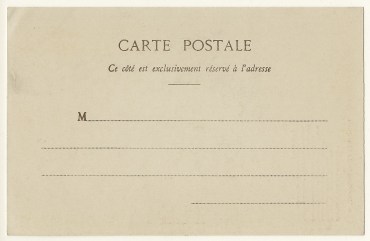
REVERSE OF THE MERCHANT OF THE MASKS POSTCARD

PORTRAIT OF A CUTE BABY IN PARIS, FRANCE (VINTAGE PHOTOGRAPH)

paris2

This post cabinet card era photograph features a very cute baby photographed by the Angelidis Studio in Paris, France. The photographer did an excellent job of posing this incredibly adorable child. The photograph measure 4″ x 5 1/2″.

Published in: on October 29, 2015 at 12:00 pm  Comments (2)  
Tags: , ,

TWO TEENAGE GYPSY GIRLS PREPARE FOR CARNIVAL IN CHALON SUR SAONE, FRANCE (VINTAGE REAL PHOTO POSTCARD)

gypsies

It appears that the two young women seen in this portrait are dressed and ready for the French Carnival. The festival occurs after the “Feast of Fools” and has been a tradition since the sixteenth century or earlier. The girls in the photograph of this vintage real photo postcard are dressed as gypsies and holding stereotypical tambourines. The girls are about in their teenage years. They were photographed by Monsieur Henry of Chalon-Sur-Saone, France. The city is located in the south of the Burgundy region of that nation. I wonder what the fascination is with gypsies? The obsession is apparent when one looks at postcards from around the turn of the century (1800’s to the 1900’s). An observer of these postcards will see gypsies here, there, and everywhere. Perhaps visitors to the cabinet card gallery would like to hypothesize about this cultural phenomenon. I would appreciate your input. Now, back to this postcard. The previous owner of this postcard translated the message as “Remember with affection your little girlfriend. A thousand kisses, Germaine”. My guess is that the shorter woman in this image is Mlle Germaine.  SOLD

gypsies1

Published in: on October 6, 2015 at 12:00 pm  Comments (1)  
Tags: , , , ,