 A very pretty and flamboyantly dressed woman poses for her photograph at the studio of E. Bieber. Bieber had two locations in Germany; Berlin and Hamburg. Emilie Bieber was a female German photographer who ran her Hamburg studio from 1852 through 1872 when she was joined by her nephew, Leonard Berlin-Bieber. Emilie Bieber died in 1884. The beautiful woman in this image is dressed to the hilt. Her dress and hat are covered with flowers and feathers. Perhaps she is an actress which judging by her expression, pose, and dress; is a likely possibility. This photograph is not a standard sized cabinet card but instead is known as a Boudoir Card. The card is 8 1/2 x 5 1/4 inches. To view other photographs by the Bieber studio, click on the category “Photgrapher: Bieber”.
BEAUTIFUL AND FLAMBOYANT GERMAN WOMAN: BOUDOIR CARD PHOTOGRAPH

ADORABLY DRESSED BOY WITH FUR HAT IN KARLSRUHE, GERMANY
 This cabinet card presents a young boy uncommonly dressed. He is photographed by Samson of Karlsruhe, Germany. Karlsruhe is in southwest Germany near the French-German border. The city is thought to be the model cityscape of Washington D.C.. The child is wearing a very interesting outfit. Does the outfit represent an ethnic or regional group? What is the story concerning the clothing item with the heart and other designs (are they suspenders or part of his shirt)? Is that a handkerchief barely tucked into the pocket of his jacket and why is the pocket near his elbow? The fur hat and the ties at the bottom of his pants also raise some interesting questions. Finally what is the lad holding in his right hand? It looks like a wand used to blow bubbles. Hopefully, a visitor to this site may share some enlightening information regarding this boys wardrobe.
FATHER AND MOTHER WITH THEIR FEET ON THE GROUND, BABY FLOATING IN MIDAIR IN RECKLINGHAUSEN, GERMANY
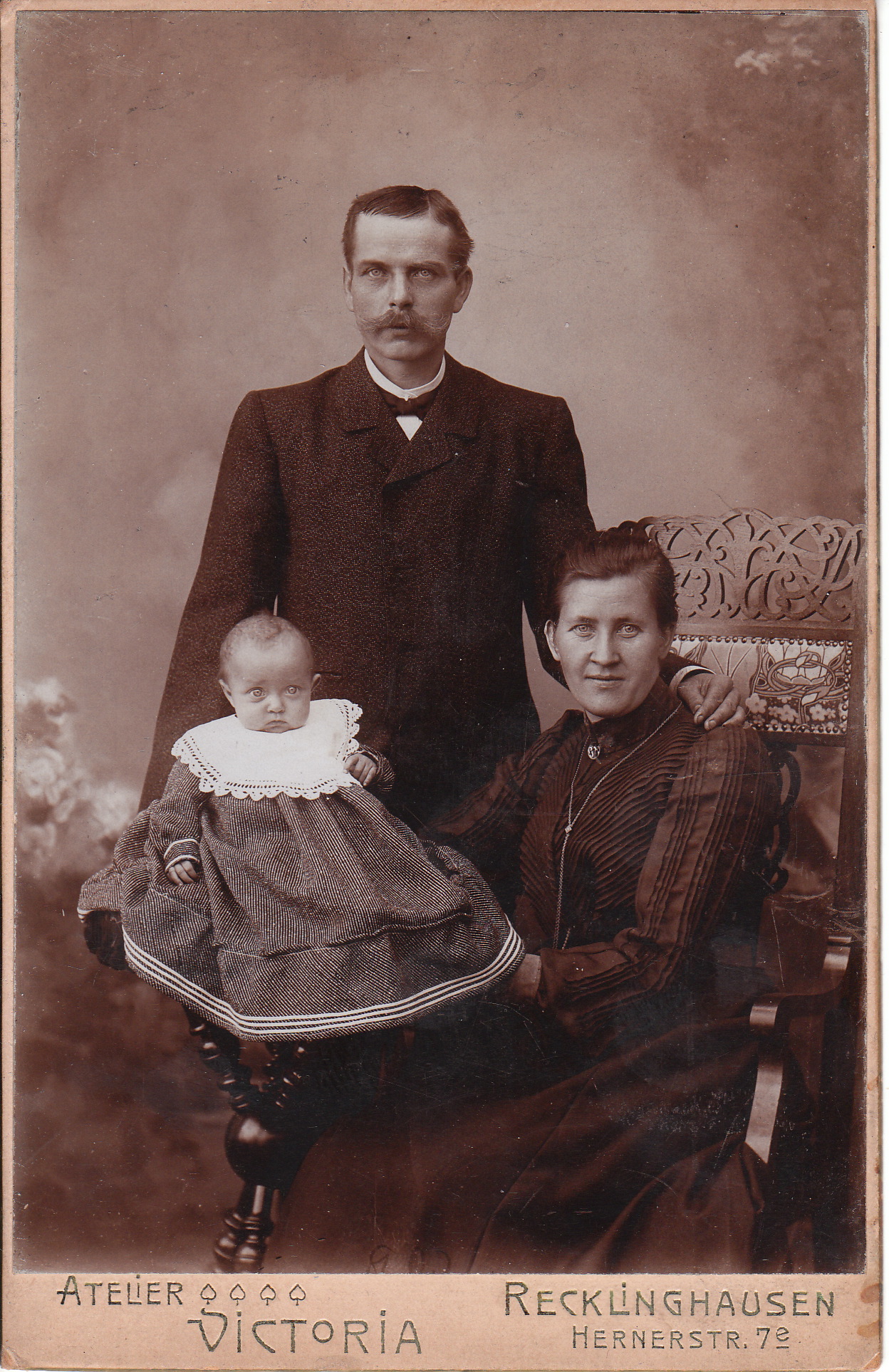 This Cabinet Card is a somewhat bizarre image. Dad and mom are posing with their infant who looks so small in her oversized dress. Mom is holding the baby in a position that makes the baby appear to be floating in midair. The infant is also in a position that makes the image appear as if the mother is a ventriloquist and the baby is her mannequin or puppet. The photograph was produced by Victoria, in Recklinghausen, Germany.
PRUSSIAN SOLDIER AND HIS FAMILY POSE IN FURSTENWALDE, GERMANY
 A Prussian soldier, his wife, and son pose for their portrait in the Schmidt studio in Furstenwalde, Germany. The photograph is dated 1898. The photograph shows a bit more intimacy than most during this time period. The soldiers son is holding his fathers hand and the soldiers wife appears to have her arm against her husbands shoulder. Note the soldiers moustache; it curves upward rather than the regularly seen downward. Perhaps a visitor to this entry can ascertain the soldiers rank and branch of service.
Two Cute Kids Posing in Gnesen, (Prussia?)
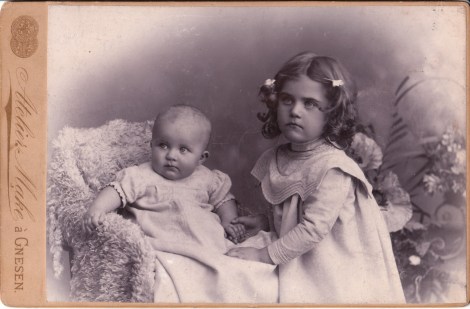 Two adorable kids (most likely siblings) pose in this Cabinet card photograph. The close-up of the baby is terrific and is an unusual pose for photographs of this era. Most babies I have seen in Cabinet cards are photographed from more of a distance. The photograper is Make of Gnesen. My research leaves me uncertain of whether Gnesen was part of Prussia or Germany at the time of this photograph. Please comment if you have information about what nation Gnesen was part of in the late 1800’s. Gnesen is currently part of Poland.
Adorable Siblings in Beuthen, Germany
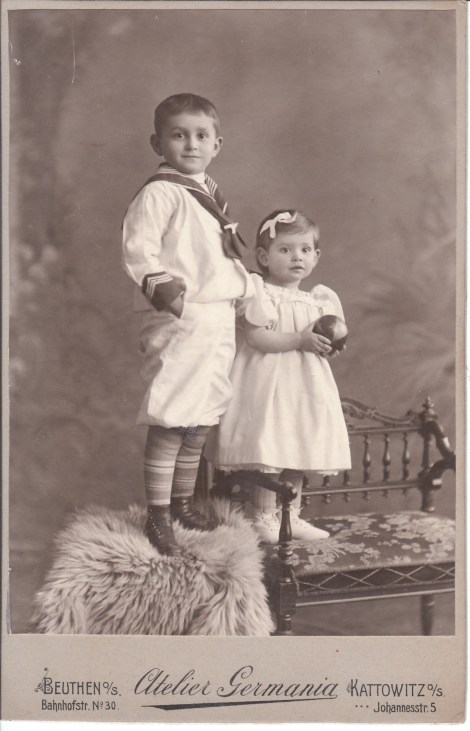
These two siblings are just adorable as they pose in the Germania Studio in Beuthen, Germany. Unlike many children seen in Cabinet Cards, these kids appear very relaxed and in good humor. The boy is cute in his sailor suit and the girl is holding a toy ball. The city of Beuthen is now called Bytom and is in southern Poland. Beuthen became part of Prussia in 1742 and part of the German empire in 1871. Beuthen was transferred to Poland in 1945.
Bernard Roelker: Esteemed Lawyer and Friend of Longfellow
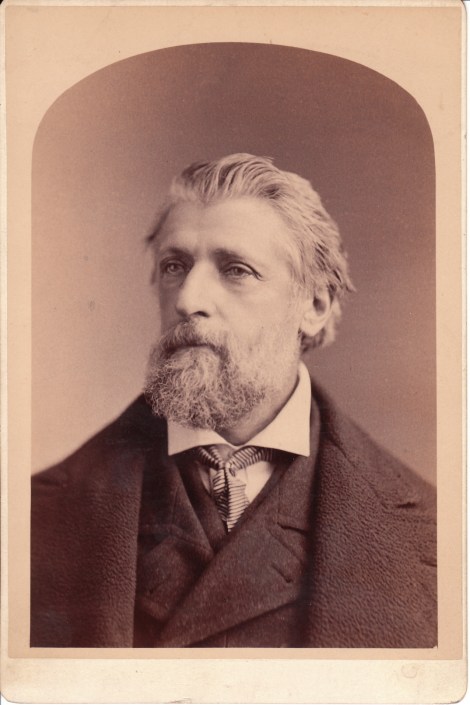
Bernard Roelker (1816-1888)) led an active life in Literature and Law. He attended the University of Bonn on the Rhine where he studied law. He came to the United States in the late 1830’s. He settled in Bridgeport, Connecticut and privately taught German and Music. He then went to Harvard and became friends with Henry Longfellow who was a professor there. Roelker became friends with a number of literary luminaries. He taught at Harvard and renewed his study of the law. He then practiced law in Boston and later moved to New York City where he started the law firm of Laur and Roelker. He built a large practice, especially among the Germans of the city. He was expert at wills and contracts. He argued an important case, Meyer vs Roosevelt, in front of the United States Supreme Court in 1863. It was the first legal tender case heard before the court and Roelker won the decision. Roelker and his friend Samuel Tilden organized the Prairie du Chien Railroad in Wisconsin. Tilden ran for President in 1876. Roelker never married. The photographer of this Cabinet card portrait is the famous photographer Sarony of New York City. The photograph is dated November, 1879.
Kaiser Wilhelm II: The Last German Emperor and King of Prussia
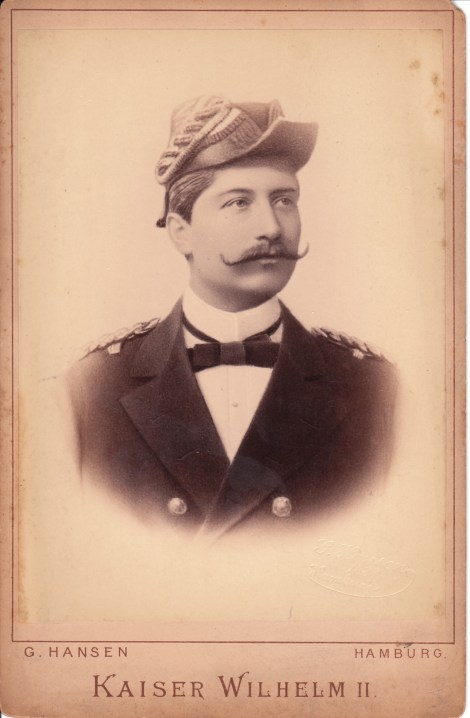
Wilhelm II (1859-1941) was the son of Crown Prince Frederick of Prussia and Victoria, daughter of Queen Victoria of England. He served a period of military service. In 1888 his father succeeded as Frederick III. He died shortly after and Wilhelm became Kaiser at age 29. Within two years he forced the resignation of Otto von Bismarck. He greatly increased the strength of the German armed forces. Following the assassination of Archduke Franz Ferdinand in Sarajevo in 1914, he greatly encouraged the Austrians against Serbia. This helped trigger World War I. When the war began he was excluded from military decisions by military commanders. In 1918 the German military collapsed. Kaiser Wilhem was forced to abdicate and went into exile in the Netherlands. This Cabinet Card portrait was photographed by G. Hansen of Hamburg, Germany.
Wounded Fencers from Jena, Germany
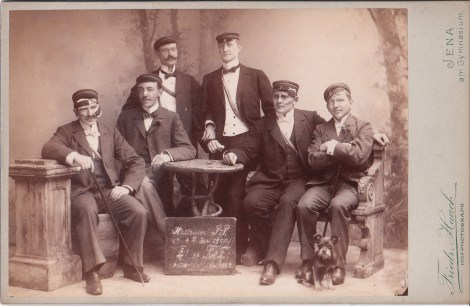
This Cabinet card image captures a fencing team after what must have been a tough match with another fencing club. Note the wounds and the little dog at the feet of the fencer furthest to the right of the photograph. Perhaps a reader of this blog can help identify the team and the words on the board in the center of the photo. The reverse of the card has German writing which I can not translate. It may list the two teams which competed. “Alleurarria contra Aruriscia” is the best interpretation I can make of the handwriting. Once again, I hope a fencing authority can comment and identify the competing teams. This is the second fencing Cabinet card that I have posted (look up the first under the category of sports). The photographer of both Cabinet cards is Friedr. Haack of Jena, Germany.
Three Fencers in Jena, Germany
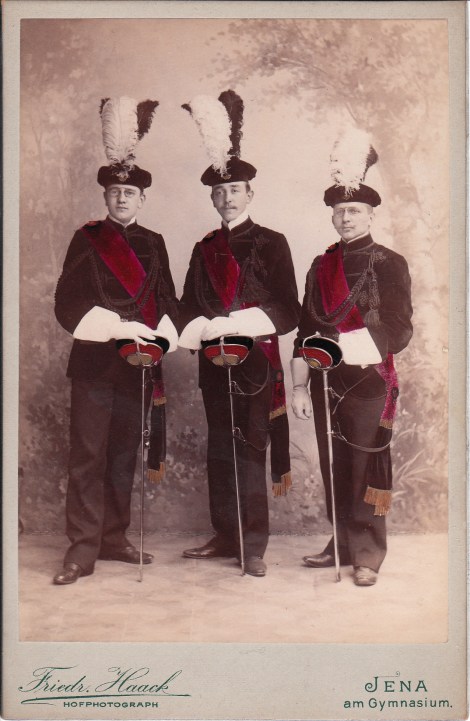
This Cabinet card is a terrific image of three fencers photographed by Friedr. Haack of Jena, Germany. Note the color which was added after the photograph was taken. Jena is a university city in central Germany. At the end of the 18th century Jena became a center for precision machinery, optics, and glass making. The subjects of this fencing Cabinet card probably were university students, as academic fencing was very popular during the time period this photograph was taken. I hope some knowledegable fencing aficionados can provide further information about the details concerning this image.


 THE CABINET CARD GALLERY