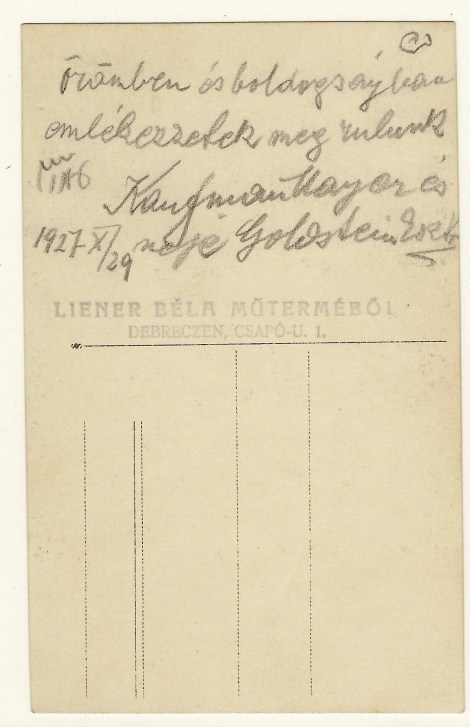
PORTRAIT OF A JEWISH COUPLE IN DOBRIESEN, HUNGARY (1927)

An older Jewish couple are featured in this vintage real photo postcard. An ink caption on the bottom front of the postcard states “Debreczen, Hungary, October, 1927).The couple are well dressed. The woman is wearing a double chained locket and the man is wearing a shirt with a wing tipped collar, a tie, and a yarmulke (kippah). A yarmulke is a jewish traditional head covering worn by most Jews in synagogue and worn by Orthodox Jews all the time. The photographer of this photo is Liener Bela, who operated a studio in Debreczen, the second largest city in Hungary (Budapest is the largest city). One can only hope that this Jewish couple left Europe before the Holocaust. In the first few decades of the 1900’s, Jews made up 5% of the Hungarian population. They had managed to achieve great commercial and professional success. In fact, their success was disproportionate to their numbers in the general population. Their accomplishments fostered resentment and the 1920’s were stained with much anti-semitism in Hungary. By 1920, Jewish enrollment in Hungarian universities were restricted by a quota.  Admiral Horthy, the Regent of Hungary, was a self-proclaimed “anti-Semite”. Repressive anti Jewish policies were adapted and fascist groups flourished. Hopefully, this lovely couple survived. This vintage postcard is in very good condition (see scans).

SOLD
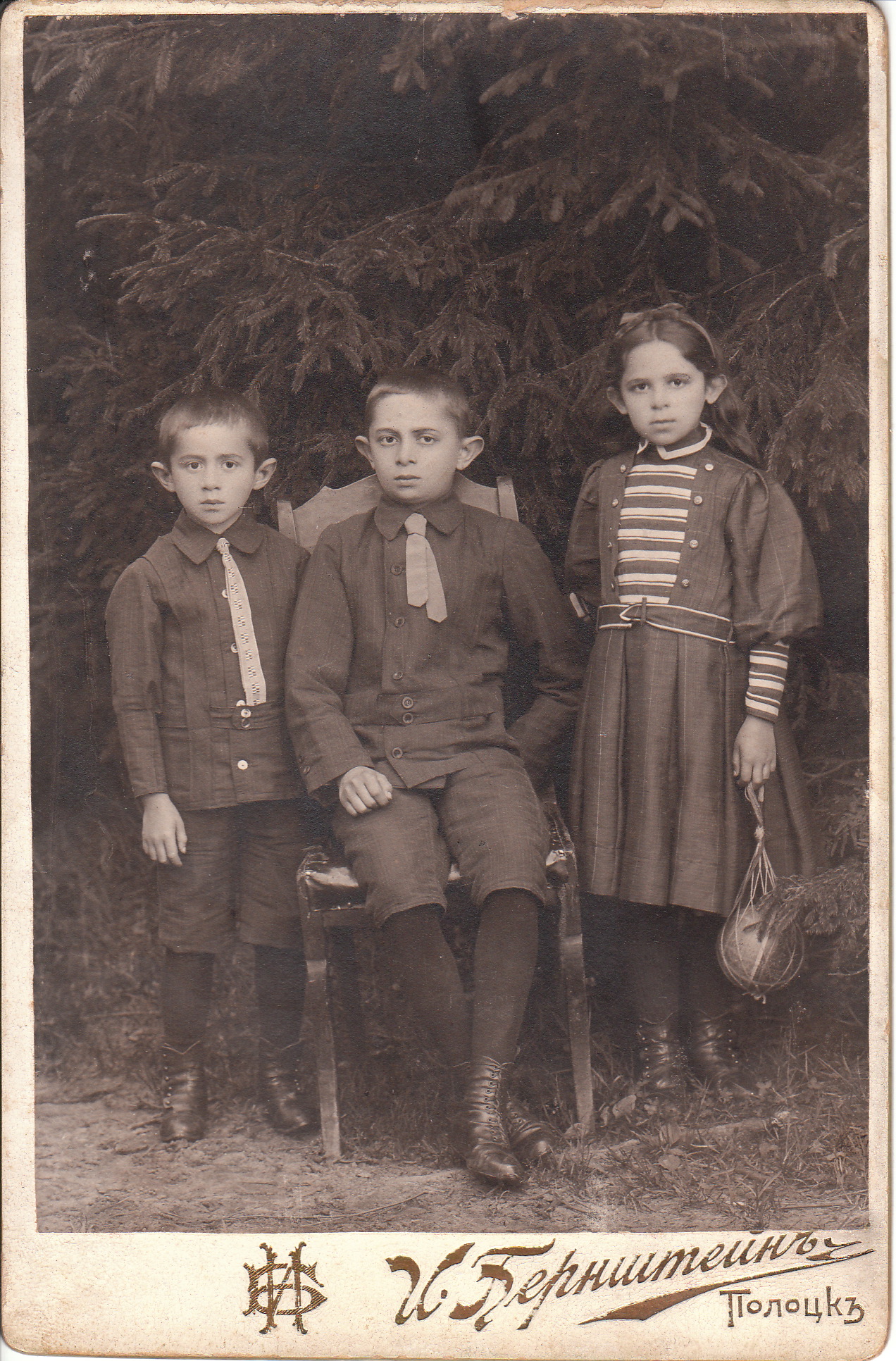
THREE YOUNG SIBLINGS (POSSIBLY SCOUTS) IN POLOTSK, BELARUS

This cabinet card features three children, likely siblings, posing for their portrait at a photographic gallery in Polotsk, Belarus. The young girl in the photograph is holding a ball held inside netting. Perhaps a visitor to the cabinet card gallery can provide more details about this toy. The previous owner of this cabinet card is from St. Petersburg, Russia. He has provided the photographers location, as well as the photographers name, Bernstein. He also contends that the way that the subjects are dressed in this image, indicates that they are scouts. In addition, the previous owner also asserts that the photographer of this image was Jewish. In fact, research reveals that the population of Polotsk in 1897 was over 20,000, and more than half of those residents were Jewish. There was a strong Orthodox Jewish community there.  The “Jewish Virtual Library” indicates that in the late nineteenth century, the city became embroiled in anti-Jewish agitation.

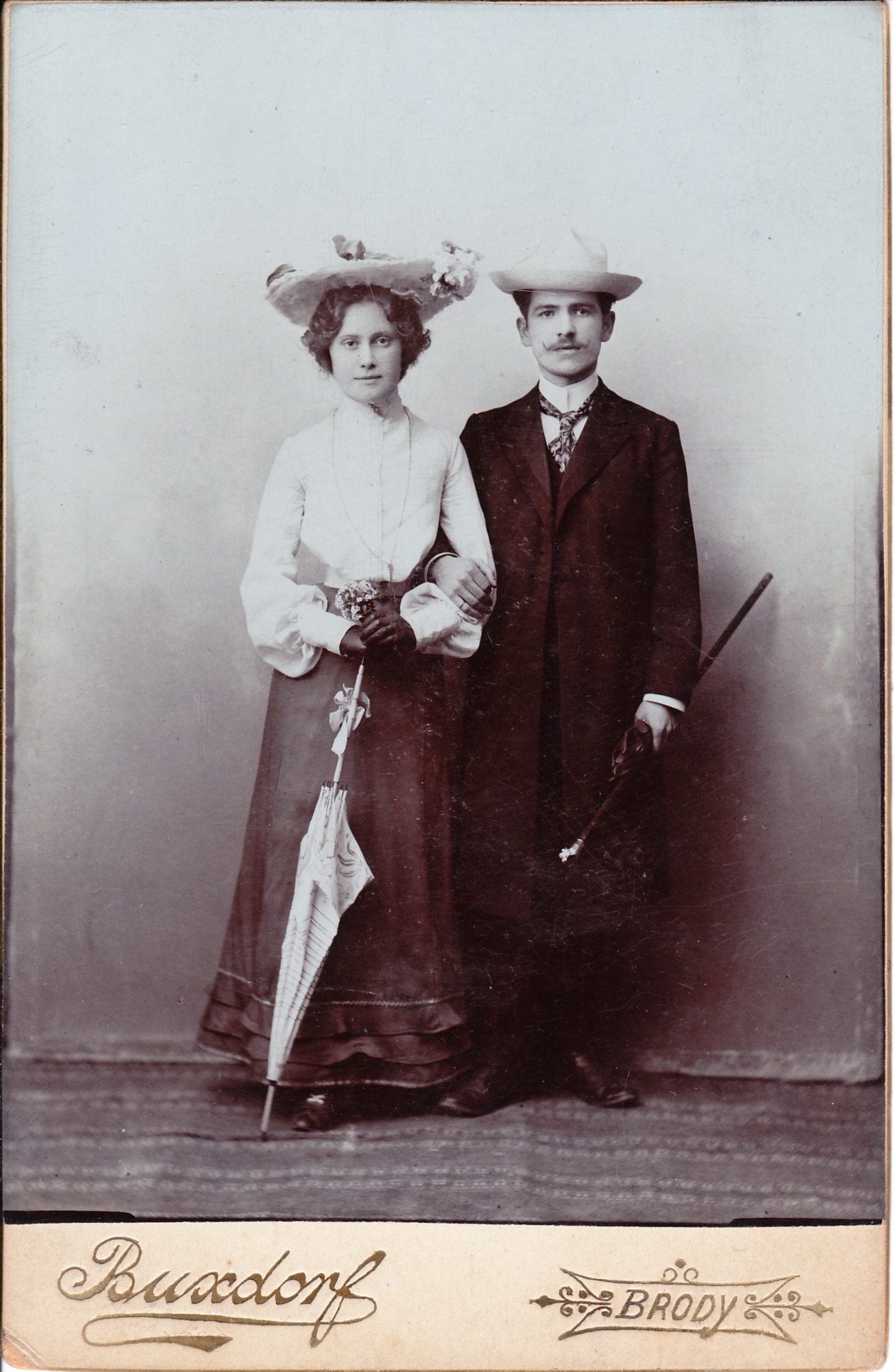
JEWISH COUPLE, REPORTEDLY BRODER SINGERS (YIDDISH) IN BRODY, UKRAINE

This Cabinet card featuring a well dressed couple, offers a bit of mystery. The last owner of this card states that this couple are “Brody Yiddish Singers”. So what does that mean? First of all, Brody is a city in Lviv Oblast (province) of western Ukraine. The city was a crossroads and jewish trade center in the 19th century. Brody is considered to be Shtetls,  Brodersanger, Purim, Jewish theater, CzarAlexander III, Berl Margulis, Berl Broder, one of the “shtetls”. The city was famous for the Brodersanger or Broder singers who were among the first Jews to publicly perform Yiddish songs outside of Purim (a holiday) and wedding celebrations. These performers were the precursors of jewish theater. Due to anti Jewish regulation enacted in 1882 by Czar Alexander III of Russia and the resulting exodus of Russian Jews; throughout 1881 hundreds of Jewish immigrants arrived in Brody daily. The most famous Broder singer was Berl Margulis also known as Berl Broder (1815  -1868). It is not certain that this cabinet card really depicts Broder singers and no evidence is available to support the claim , but it is not unusual for families to pass down such information over generations and  there is a reasonable chance that the history is correct and the story is worth telling. The photographer of this cabinet card is Buscdorf.