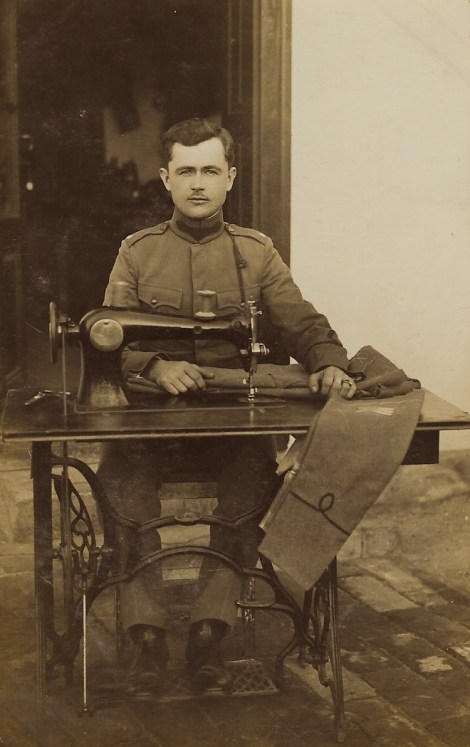
PORTRAIT OF AN ARMY TAILOR AND HIS SEWING MACHINE IN SERBIA (VINTAGE REAL PHOTO POSTCARD)

tailor

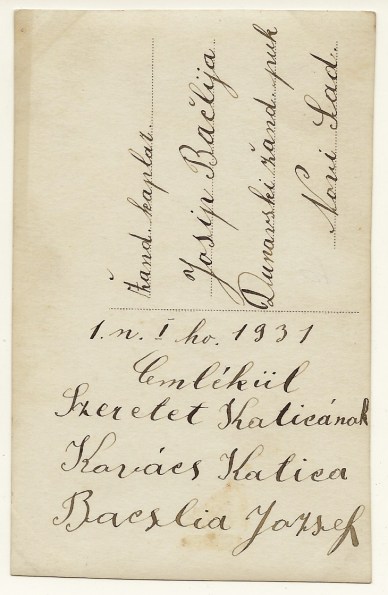
This vintage real photo postcard features a terrific portrait of an army tailor sitting at his sewing machine. The soldier is in uniform while he works on a pair of uniform pants. This photograph was taken in 1931, a period between World War I and World War II. The postcard is addressed to someone in Novi Sad, Serbia. Novi Sad is a city in Serbia on the banks of the Danube River. I am guessing that the soldier in this photograph was a member of the Serbian army. During 1931, Serbia was actually part of Yugoslavia.

tailor 1

Published in: on March 19, 2016 at 3:20 pm  Leave a Comment  
Tags: , , ,

A SOLDIER AND HIS RIFLE AND HIS PREY: A LARGE RABBIT

rabbit

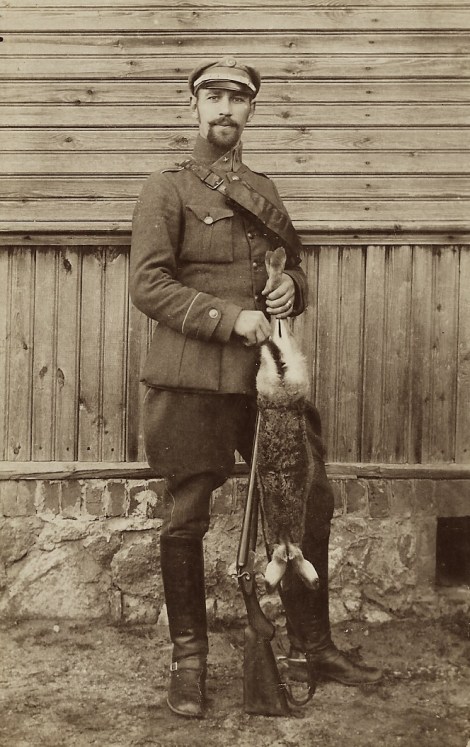
This vintage real photo postcard features a young soldier in uniform posing with his rifle and his lunch. The prize of the young man’s hunt is a large rabbit. Hopefully the soldier was able to avoid being “the hunted one” during his military service. This photograph appears to be from the early 1900’s and of European or Russian origin.

Published in: on February 15, 2016 at 12:00 pm  Leave a Comment  

PORTRAIT OF A WORLD WAR I ERA SOLDIER IN NANTES, FRANCE

SOLDIER

This vintage real photo postcard features a portrait of a smartly dressed young World War I era soldier. He looks quite handsome in his uniform and clearly has his “game face” on. The photographer of this image is Gustave Cade. He operated a studio at 8 Rue de la Barillerie in Nantes, France. Nantes is a city in western France, located on the Loire River.

SOLDIER 1

Published in: on February 11, 2016 at 12:00 pm  Comments (1)  
Tags: ,

WOUNDED WORLD WAR I FRENCH SOLDIER TREATED BY FELLOW COMBATANT WITH A BOTTLE OF ABSINTHE

wounded

This vintage real photo postcard features a wounded French soldier being treated by his fellow combatant. The soldier doing the nursing helps his buddy by pouring some absinthe into the cup that the wounded man is holding. The injured man seems to be very pleased as he awaits his medicinal drink. What is absinthe? It is a distilled highly alcoholic beverage. Absinthe became a highly popular drink in late 19th and early 20th century France. It is a drink that was later portrayed as dangerous and seen as a hallucinogen. By 1915, it was banned in the US and much of Europe (including France). Although the ban of absinthe and the start outbreak of World War I occurred close together in time, author Doris Lanier, in her book “Absinthe–The Cocaine of the Nineteenth Century……..” (1994), notes that soldiers continued to enjoy absinthe during the war. Back to the photograph. Note the storage holders on the shelf above the injured man’s bed. It appears that they were used to hold the hospitalized patient’s clothing and belongings. My description of this interesting photograph contains some conjecture. Perhaps you have a different interpretation of this image. If so, please share your ideas in the comment section.


Published in: on January 30, 2016 at 3:54 pm  Comments (13)  
Tags: ,

HANDSOME SAILOR POSES FOR HIS PORTRAIT IN ENGLAND (VINTAGE POSTCARD)

sailor

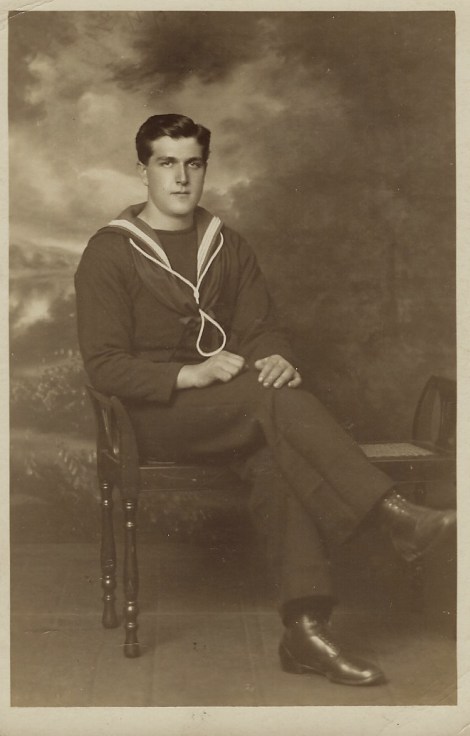
This item is a vintage real photo postcard featuring a portrait of a handsome young sailor. He looks quite dashing in his naval uniform. The young man was photographed by the J. S. Bullen studio which had two locations in England. The studio had branches in Grimsby and Louth. Bullen operated his studio in the 1910′s and 1920′s. He also may have worked as a  photographer in other decades.   SOLD

Published in: on January 27, 2016 at 11:56 am  Comments (2)  
Tags: , , ,

FOUR US SOLDIERS HAVING FUN WHILE ON LEAVE IN NEW YORK CITY (VINTAGE PHOTOGRAPH)

tank

The previous owner of this vintage photograph described it as featuring four US soldiers/cooks on KP (kitchen police) duty. I have my own interpretation of the photograph and perhaps you have your own view which I hope you will share. I believe that the young men are from a military base due to their clothing and their choice of having a backdrop which included a tank. If they are soldiers, they are clearly on leave. The fact that one man is wearing a white apron and another man is wearing a white jacket indicates that their military duties may include working in a kitchen. However, there is also a possibility that the afore mentioned white clothing and the two hats seen in the photo are just studio props. Note that two of the men are holding cigarettes while being photographed. Whatever the story really is, this is a terrific image that captures the aura of friendship between these young men. The photographer’s embossed logo is difficult to read but it is decipherable that his name was Thompson and his studio was located somewhere in New York City.

Published in: on January 1, 2016 at 1:07 pm  Comments (3)  
Tags: ,

IMAGE AND STORY: YOUNG SOLDIER COMES HOME FROM WORLD WAR I (VINTAGE REAL PHOTO POSTCARD)

african american man 2

On November 11th, 1918, World War I came to an end. It was a joyous time and soldiers and sailors from all the fighting nations were able to return home to their loved ones. This real photo postcard provides a visual image of that time in history. We see two ships speeding home on a a rough ocean. The postcard shows an American soldier who is portrayed as being on one of these ships. Note the American flag in the background as well as the flags on each ship. This was truly a patriotic time. On the reverse of the postcard is a most interesting message. On 12/13/18, about a month after the war’s end, Richard M. Daebelliehn (1889-1964) wrote a message to his wife. I will decipher it the best that I can as it is not totally legible. “Dear Wife, I will wire you just as soon as I hit USA and will have you meet me. You can be expecting a telegram from me”. He signed his name and followed it with an alphabet soup of letters, “HQ (headquarters) M.O.R.S. (?) A. E. F. (American Expeditionary Force) France. It also appears that the word “Cook” appears before his name. Daebelliehn sent this postcard to his wife who was living in Davenport, Iowa. Research reveals that his wife’s name was Grace Luttsia Anderson. The 1920 US census reports that the couple had two children, Dorothea (age 9), and Robert (age 7). The census, as well as many city directories, indicate that Richard was a butcher (meat cutter) for many years. In fact, he owned his own business. Knowing that Richard was a butcher before the war likely explains why he was a cook in the military. Richard and his family lived in Rock Island, Illinois at the time of the census. I wish I could say that after Richard was reunited with his family that they lived happily together for many years. However, Grace died in September of 1921 in Springfield, Illinois. Richard remarried (Margaret Daebelliehn) sometime before 1930. This postcard was produced by Furia, a French postcard company. The postcard certainly is a relic of history with an image on one side and a story on the other side.

african american man 3

FRENCH MILITARY MAN FROM THE 18TH BATTALION DE CHASSEURS (CARTE DE VISITE)

colonel

This carte de visite portrait features a French foot soldier from the 18th batallion de chasseurs. Chasseur is the French word for hunter. The term was used by the French and Belgian Army to denote light infantry or light cavalry. These troops were trained and utilized for rapid action.  The soldier in this image is holding a pair of white gloves. His facial expression exudes everything military. The photograph was taken by the Gabriel Studio.

SOLD

colonel 1

Published in: on October 5, 2015 at 12:00 pm  Leave a Comment  
Tags: , ,

FUNERAL OF A SOVIET PARTISAN COMMANDER (VINTAGE PHOTOGRAPH)

russian funeral

This vintage photograph features the funeral of a Soviet partisan commander. The previous owner of this image states that the photograph was taken in 1943 although this date is unconfirmed. There are many things to note in this photograph. We see the deceased lying in an open coffin surrounded by many members of his community and family. Some of the men are holding rifles. The top of the coffin is in the foreground of the image and laying on it are two crossed rifles, a garland of flowers, and the late officers military cap. A large portrait of the deceased can also be seen in the foreground. This image certainly gives the viewer a real glimpse into Russian history. The image measures 5 3/4 ” x 7″ and is not on card stock. ADDENDUM: The cabinet card gallery is fortunate to have informed visitors who generously leave comments and information about many of this  site’s photographs. Two such visitors have informed me (see comments) that the identity of the man in the large photograph in front of the coffin is not the deceased. Actually, the portrait is of Vladimir Lenin.

Published in: on August 24, 2015 at 11:59 am  Comments (9)  

ADORABLE LITTLE GIRL IN BUFFALO, NEW YORK

wunsch

This cabinet card portrait features a charming little girl wearing a long dark dress and a serious expression. The photographer of this image is William Wunsch (1846-1929). His obituary, which appeared in the Buffalo News, indicates that he was a war hero. As Wunsch requested, he was buried with three war medals (including the Gold Cross). Wunsch was a lieutenant in the Franco Prussian Wars and he was decorated for bravery. He came to the United States in 1871 and was granted citizenship in 1876. He was married to Sophia E. Steinmetz Wunsch (1878-1949). He resumed his Prussian career as a photographer after immigrating to the United States. He was very active in the German community of Buffalo, particularly with singing societies. Wunsch was still a photographer at the time of his death even though he was 83 years old. He is buried in Buffalo’s Forest Lawn Cemetery. Judging by the scalloped edges of this photograph, the image was produced sometime after 1886. Wunsch’s studio was located on Military Road at least between 1878 and 1927. It is interesting to note that this war hero photographer located his studio on a street called “Military Road” and used a military figure in his business logo which can be seen on the reverse of the cabinet card (see image below).  (SOLD)

wunsch 1