 A ten year-old boy named Horace H. Justice Jr. poses proudly in a sailor suit at the studio of Anderson & Hartshorn in Dayton, Ohio. Horace’s naval cap displays the name “Dewey” rather than the more typical ship name. Admiral George Dewey (1837-1917) was a US naval officer best known for his victory at the Battle of Manila Bay during the Spanish American War. He came home to the United States and was received as a conquering war hero. Young Horace is clearly paying tribute to Admiral Dewey. The Spanish American War era was a time marked by a escalation of patriotism in the United States and this image provides an illustration of this nationalistic fervor. It is also possible that Horace’s father may have served with Admiral Dewey and that Horace Jr. is emulating Horace Sr.. Initial research found a Horace J. Justice living in Dayton. The 1900 US census reveals that Justice was married to Mattie Justice 1885) and at the time of the census, they had a twelve year old son also named Horace. Horace Justice Sr. is mentioned in many Dayton city directories from 1871 through 1909. He worked many years as a travelling salesman. It could not be established that Horace Sr. was in the armed forces. It appears that Horace Jr was born in 1888 and died in 1948. Information was also found about the photographers. Photographer James Otto Hartshorn was a leading Dayton photographer. He was born in Ohio in 1869. A Dayton history book reveals that he was “deprived” of his parents when he was thirteen years-old and forced to live with various friends. He worked on a farm until he turned eighteen and and then moved to Dayton and for a short time worked in a cotton batting factory. In 1888 he became employed in a photography studio where he learned to become a very skilled photographer. In 1891 he married Ella M. Huesman of Dayton. In 1894 Hartshorn partnered with Charles F. Anderson and opened up the studio that produced the portrait of Horace Justice Jr..
“AMERICA FOREVER”: PATRIOTIC TEN YEAR OLD IN DAYTON, OHIO SUPPORTS AMERICAN SOLDIERS AND SAILORS DURING THE SPANISH AMERICAN WAR

AN OFFICER AND A GENTLEMAN IN ST. JOHNSBURY, VERMONT
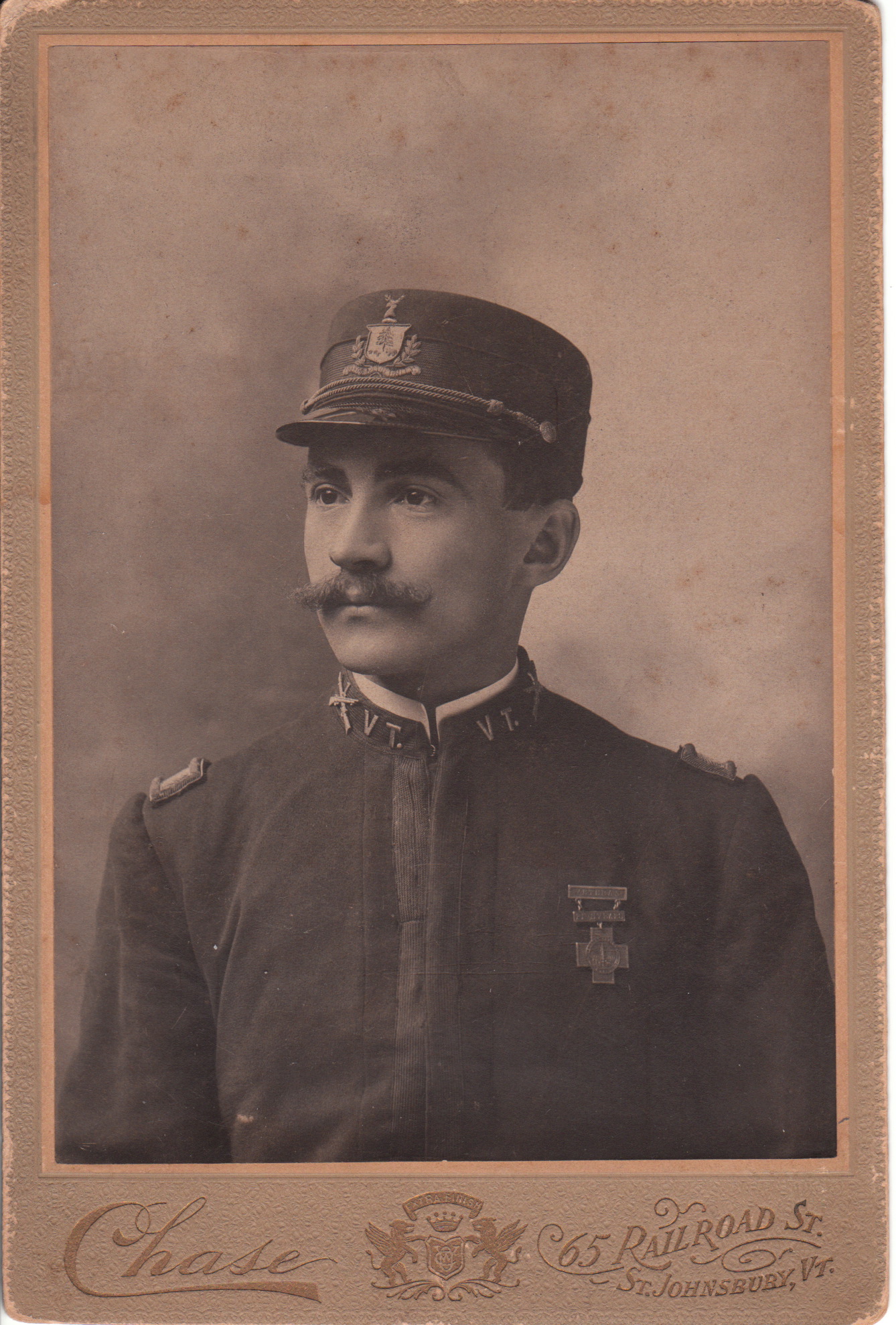 According to the previous owner of this photograph, the military officer pictured is a member of the St. Johnsbury Guard which was part of the 1st Vermont Infantry. The medal on his chest reveals that he is a 5 year veteran. The photographer of this image is Olin W. Chase who had studios at various times during his career at 32 Main Street and 47 Main Street in St. Johnsbury. The 1896 St. Johnsbury business directory reports that he was married to Mary J. Chase. He is listed in the 1901 directory as being in business in St. Johnsbury but the 1904 directory indicates that Chase had relocated to Greenfield, Massachusetts.
MYSTERY PHOTOGRAPH: POSSIBLY FRENCH CAVALRY SOLDIERS AND THEIR SWORDS AND HELMETS (HELP NEEDED FROM CABINET CARD GALLERY’S VAST AND UNPAID RESEARCH DEPARTMENT)
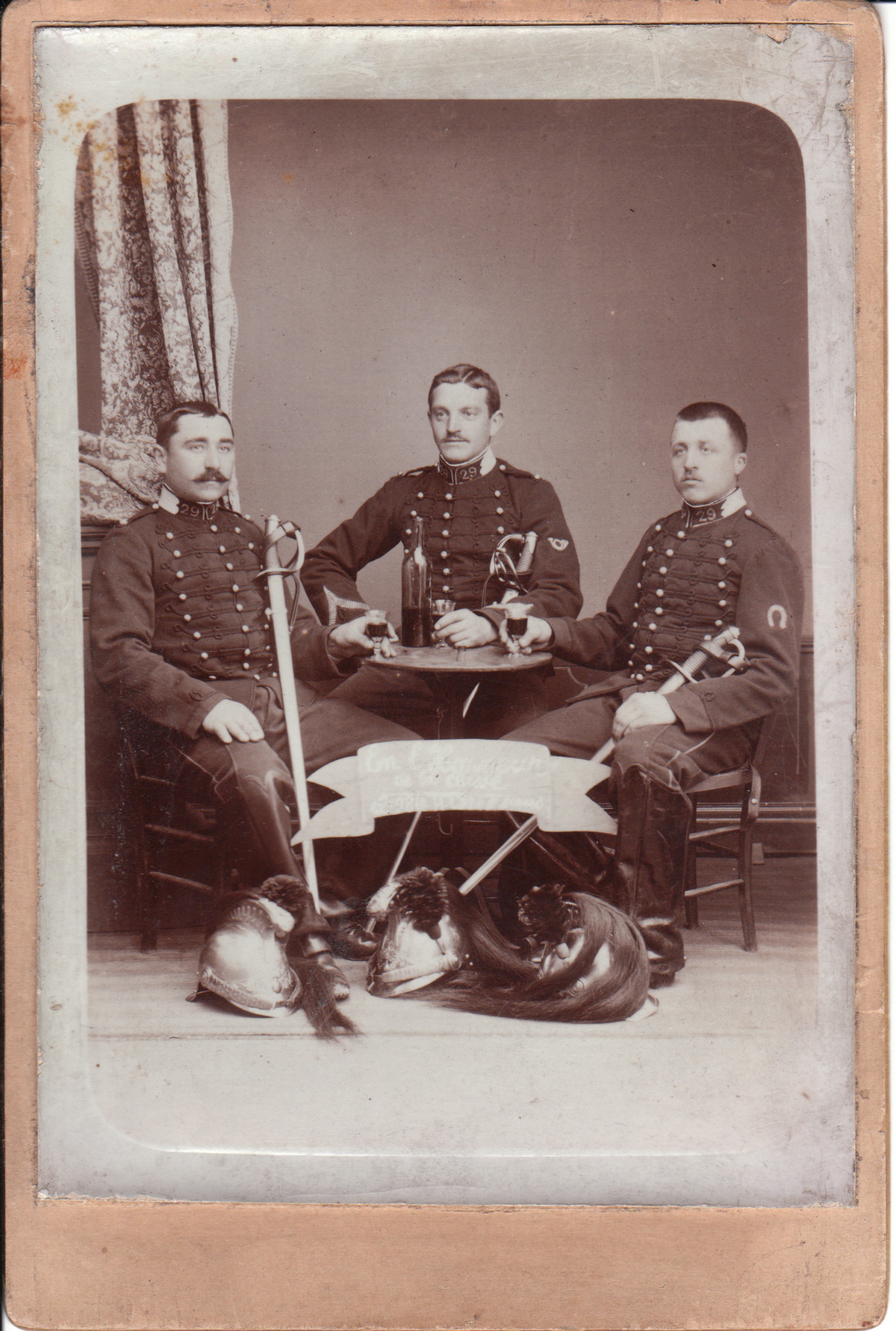 The previous owner of this photograph described the subjects in the image as World War I French Cavalry soldiers. The soldiers are wearing collar pins that identify their military unit as being the “29th”. They are drinking glasses of wine from a bottle on the table. The men have long swords and there are three helmets on the floor in front of the men. My uneducated guess is that these military men are part of a fencing team. There is a within the photograph which would provide more information but I can not decipher the script on the label. A stamp on the reverse of the photograph identifies the photographer as Moraux and the location of his studio as Provins, which is in north central France. Assistance is clearly needed from the cabinet card gallery’s vast and unpaid research department. The visitors to the cabinet card gallery have a history of contributing informed and thoughtful knowledge via their comments. Knowledge that helps us further our appreciation and understanding of the gallery’s images.
ARMED AND READY TO DEPLOY: SPANISH AMERICAN WAR SOLDIER IN MINNEAPOLIS, MINNESOTA
 This Spanish American War era soldier is dressed, armed and ready to deploy. Note his long rifle and the bayonet he is wearing on his side. He is wearing two medals, one which the previous owner of the photograph identified as signifying that he was the son of a Union civil war veteran. This photograph was taken at Dempsie Portraits which was located at 316 Nicollet Avenue in Minneapolis, Minnesota. George M. Dempsie began operating in Minneapolis in about 1887 and worked until at least 1910. He was at the Nicollet Avenue address between 1889 and 1910. He operated under the names of Dempsie’s New Photographic Rooms, Dempsie Portraits, and Dempsie & Andrews. At various times he employed his sons George R. Dempsie and Guy C. Dempsie.

UNITED STATES VOLUNTEER UNIFORMED SOLDIER AND HIS WIFE IN CHATTANOOGA, TENNESSEE
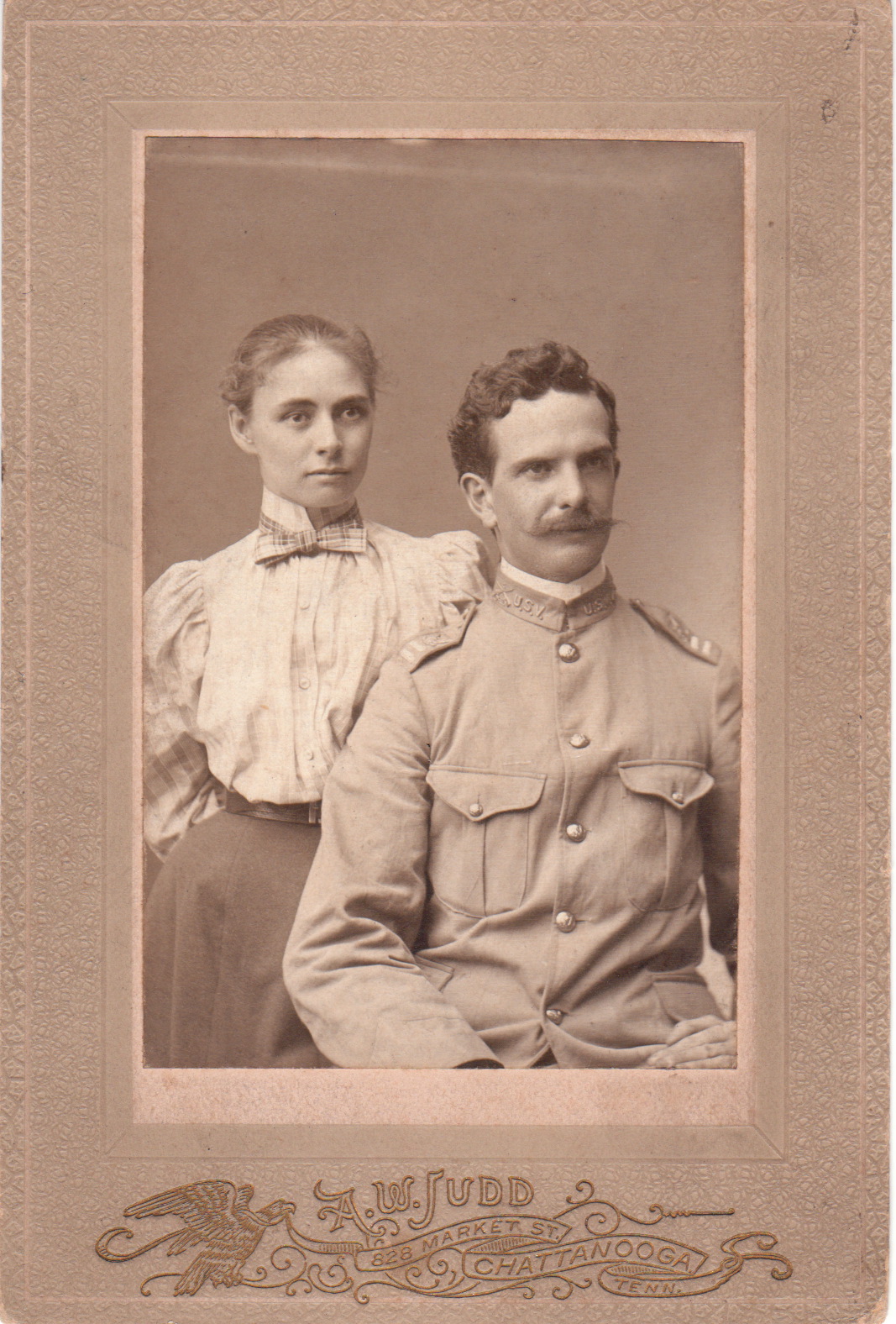
This photograph features a military man with a young woman who is likely his wife. The soldier is wearing collar pins that identify him as a member of the United States Volunteers. Members of the USV were enlisted in the army but were separate from units of the regular US Army. Although volunteer regiments existed during the civil war, the USV was not officially named until the Spanish American War in 1898. The volunteer army was a quick way to supplement the regular army during times of war and was unnecessary during times of peace. This portrait was likely taken during or just after the Spanish American War. The photograph is smaller than a cabinet card. It measures 3.5″ x 5.25″. Note that the woman is standing behind the man making him appear much more prominent. It almsost seems like that she was not even in the original pose and that she was superimposed onto his photographic portrait. The photographer is A. W. Judd of Chattanooga, Tennessee. Judd was born in 1846. The book “Chattanooga” (1996) reports that Amos Wilson Judd was a civil war veteran who began his photography business in 1877. His name and studio appears in Chattanooga’s business directories from 1890 through 1920. He died in 1929. He had two brothers who were photographers. His son succeeded him in running his studio. Judd had two portraits appear in Wilson’s Photographic Magazine (1900). The Photo Beacon (1906) states that Judd was the President of the Kentucky/Tennessee Photographers Association. Wilson’s Photographic Magazine (1908) indicates that he held a patent for a photography invention. A confederate soldier named Amos Judd was a member of the 2nd Battalion Georgia Infantry (State Guard), Company B. He mustered in as a private and left the service with the same rank.
EQUISITE PORTRAIT OF A BRITISH SOLDIER IN INDIA BY THE WELL RESPECTED STUDIO OF BOURNE AND SHEPERD

This cabinet card portrait features a uniformed British soldier in India. At least that is the opinion of the previous owner of this photograph. For all I know, this may be a photograph of a French soldier in France. Hopefully, one of Cabinet Cards Gallery’s visitors, knowledgeable about military history and uniforms, will be able to tell us with certainty which nation’s army this gentleman represents. The photographer of this crisp, clear, and riveting image is the Bourne & Sheperd studio. The Bourne & Sheperd studio was established in 1863. It is the oldest photographic studio still in operation. It was the most successful commercial firm in 19th and early 20th century India and it had outlets in Paris and London as well as a mail-order service. Samuel Bourne came to India in 1863 and partnered with an established Calcutta photographer. Charles Sheperd had partnered with a photographer in Agra in 1862. The two men joined forces in Shimla. Among his accomplishments, Bourne was known for his photographic expeditions to the Himalayans and Kashmir. He became celebrated as one of India’s best photographers. While Bourne was off making himself famous, Sheperd wasn’t just sitting home eating curried chicken and naan. Sheperd became known as a master printer. The partners opened a studio in Calcutta which became their flagship. They became the photographers of Indian Royalty and the British elite. In 1870 Bourne went back to England and opened a cotton mill and became a magistrate. In 1879 Sheperd returned to England. The partners continued to operate the Indian studios with continued success for a number of years. Since then, the studio has had multiple owners.
HENRY GOES TO WAR (PORTRAIT OF A SPANISH AMERICAN WAR ERA SOLDIER)
 A Spanish American War era soldier poses for his portrait at an unknown studio in an unknown place. Note the US pin and crossed rifles pin on each side of his collar. He also has pins on the front of his hat indicating he was a member of the 5th regiment, company E. The 5th Infantry Regiment was nicknamed the ‘”Bobcats” and is the third-oldest infantry regiment of the U.S. Army. It was established in 1808. The regiment arrived in the Philippines too late to participate in the war but did perform occupation duties and later saw action in the Philippines War of 1900. The photograph has an inscription on the reverse that identifies the soldier as “Henry”. It is not clear whether “Henry” is this young man’s first or last name. Other background information about this image was likely lost when a previous owner trimmed the photograph to fit it into a frame. Hopefully, a visitor to the cabinet card gallery can confirm that this is indeed a Spanish American War era soldier and not a World War I era soldier.
CAVALRY OFFICER WITHOUT A HORSE AND WITHOUT A COUNTRY
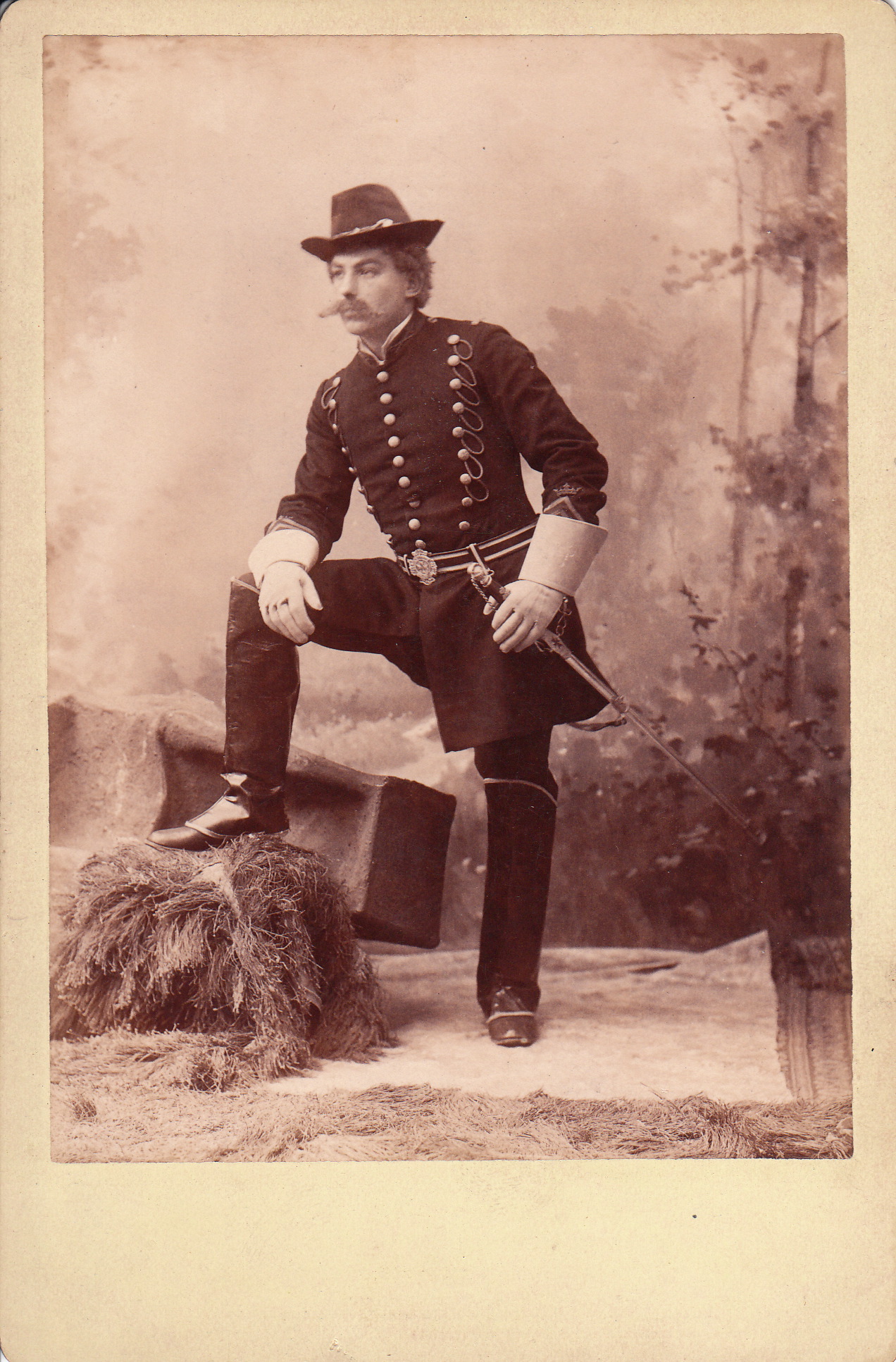
A cavalry officer poses for his portrait at an unknown studio in an unknown location. This handsome military man is wearing what appears to be riding gloves and a sword in a sheath on his belt. He also has a belt buckle which may provide some additional information. However, limited magnification availability has precluded uncovering further identifying information on the buckle. It is unlikely that the subject is a member of an American cavalry unit. There is an embroidered crown on his left sleeve which may indicate he served in a Canadian or British mounted brigade. Another possibility is that the subject is actually an actor wearing a theatrical costume. Hopefully, a cabinet card visitor will leave an enlightening comment concerning this man’s identity.
MEMORIAL PHOTOGRAPH OF BRITISH SAILOR IN MALTA
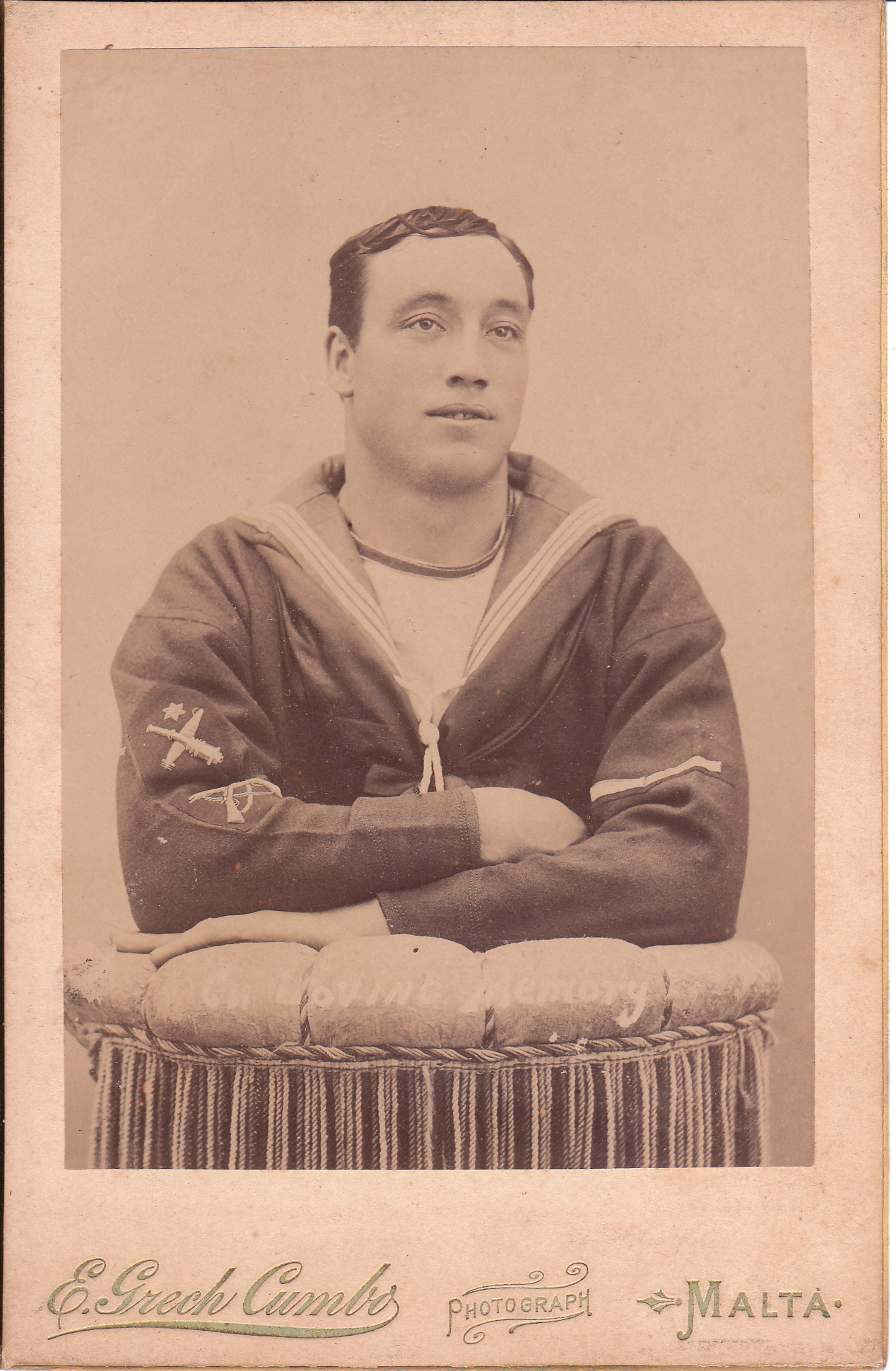 E. Grech Cumbo was a photographer on the island of Malta. His studio was located at 14 Strada Street in the city of Valleta. Cumbo produced this cabinet card of a British sailor (nationality needs to be confirmed). Stenciled on the photograph, above the cushion on which the sailor rests his arms, are the words, “In Loving Memory”. This photograph likely served as a memorial card for this young man’s crew mate friends. To view other examples of memorial photographs, click on the category “Memorial Card”.
ARMED SOLDIER POSES OUTDOORS IN BRISTOL, PENNSYLVANIA

A soldier, armed with a rifle, poses for his portrait in Bristol, Pennsylvania. He appears to be standing outside but it is possible that he actually is posed in front of an excellent backdrop of an outside scene. The young man is in uniform wearing a long coat, cape, and hat. He appears to have a bayonet at his side. The previous owner of this cabinet card stated that he was an Indian War era soldier but I am wondering if he may be more likely from the Spanish American War era. Perhaps a visitor to the cabinet card gallery will enlighten us about the time period that this soldier served. There are a number of knowledgeable military collectors that visit this site who always are happy to share their wealth of information. The photographer of this image has the last name of Schafer and his studio was located on Otter Street. Judging by the monogram below the photograph, his first initial appears to be “A”. No further information about the photographer was located.


 THE CABINET CARD GALLERY