FRANCIS WILSON: EARLY AMERICAN THEATRE STAR, PLAYWRIGHT, AND AUTHOR

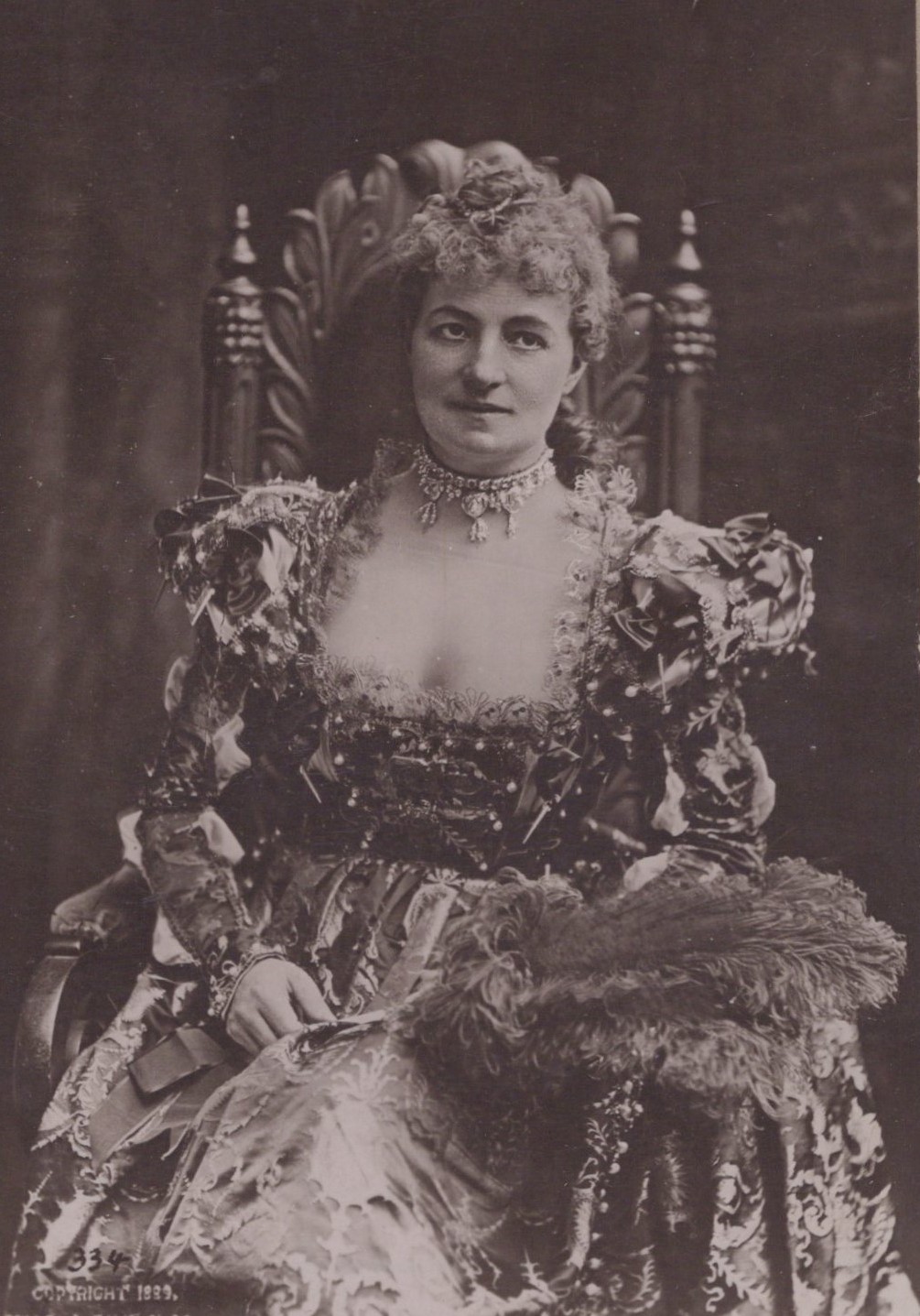
Francis Wilson (1854-1935) was an American actor born in Philadelphia, Pennsylvania. He began his career in minstrel shows but by the time he was 24 year-old he was playing in Philadelphia’s Chestnut Theatre. He worked several years in regular comedy and later took up opera, most successfully in “Eminie” (1886). He later starred in “The Oolah” (1889), The Lion Tamer (1891), The Little Corporal (1898), and then in a play that he authored, “The Bachelor’s Baby (1909). Wilson authored additional plays as well as books. He wrote  books about fellow actors Joseph Jefferson and John Wilkes Booth. He also penned an autobiography. The photographer of this cabinet card portrait of the handsome Wilson, is Falk, a photographer known for his celebrity portraits. This cabinet card has an extremely slight curl and is in overall good condition (see scans).

This cabinet card is available for purchase at The History Peddler for $48.00 or Best Offer.

Interested collectors may view the listing here:

https://www.ebay.com/itm/336018638873

JULIA MARLOWE: ESTEEMED AMERICAN STAGE ACTRESS

CABINET CARD 1

   CABINET CARD 2   (SOLD)

CABINET CARD 3  (SOLD)

CABINET CARD 4

CABINET CARD 5

CABINETCARD 6CABINET CARD 7   (SOLD)

CABINET CARD 8

CABINET CARD 9

MARLOW8

CABINET CARD 10

MARLOWE IN INGAMAR_0003
SPIN MARLOWE_0002

CABINET CARD 11

CABINET CARD 12

BRANSCOMBE

CABINET CARD 13

This image has an empty alt attribute; its file name is julia-marlowe-falk.jpg

CABINET CARD 14   (SOLD)

JULIA MARLOWE: ESTEEMED STAGE ACTRESS : SARONY : CABINET CARD PORTRAIT  c1890 - Picture 1 of 3

CABINET CARD 15 (SOLD)

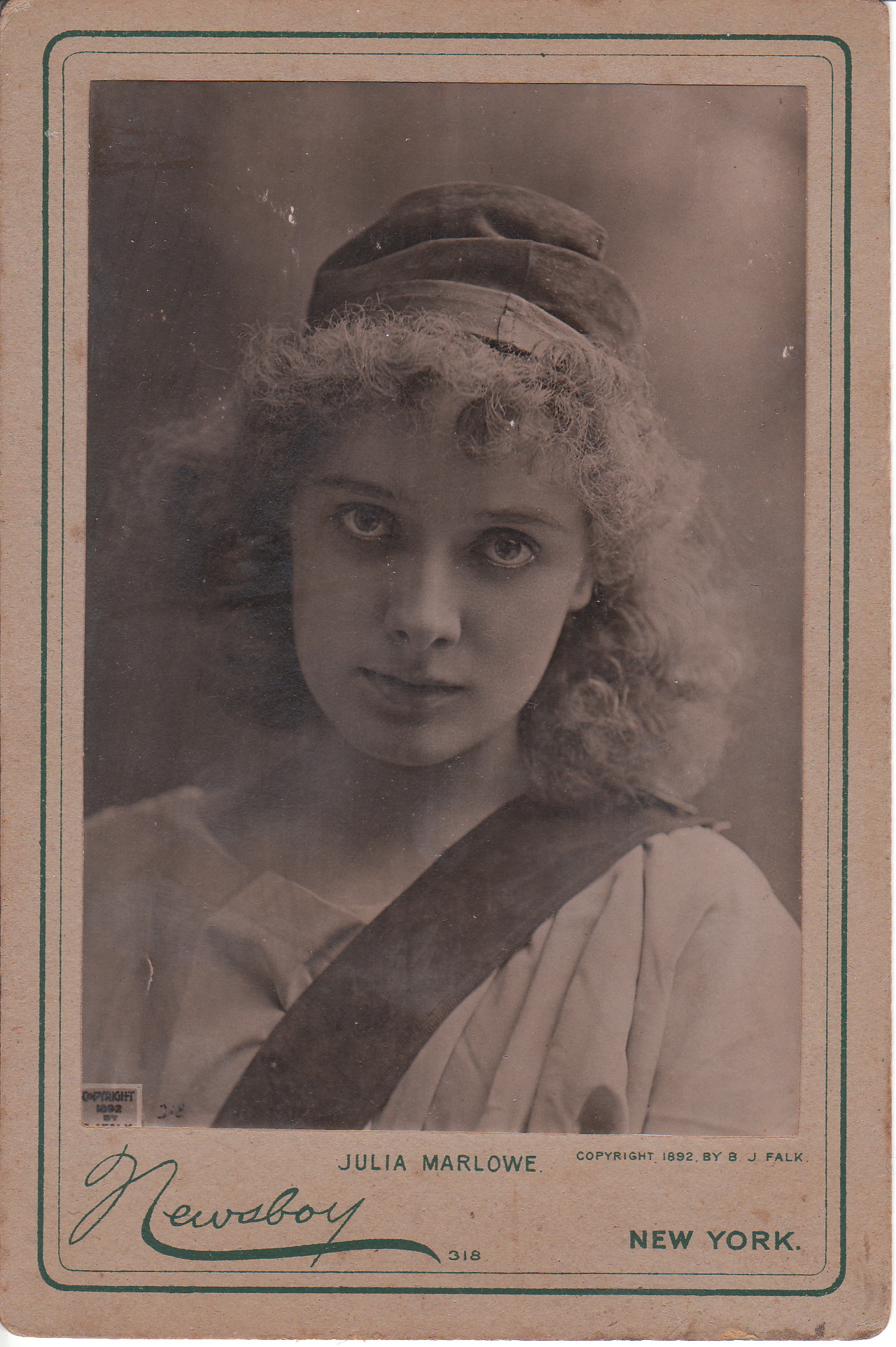
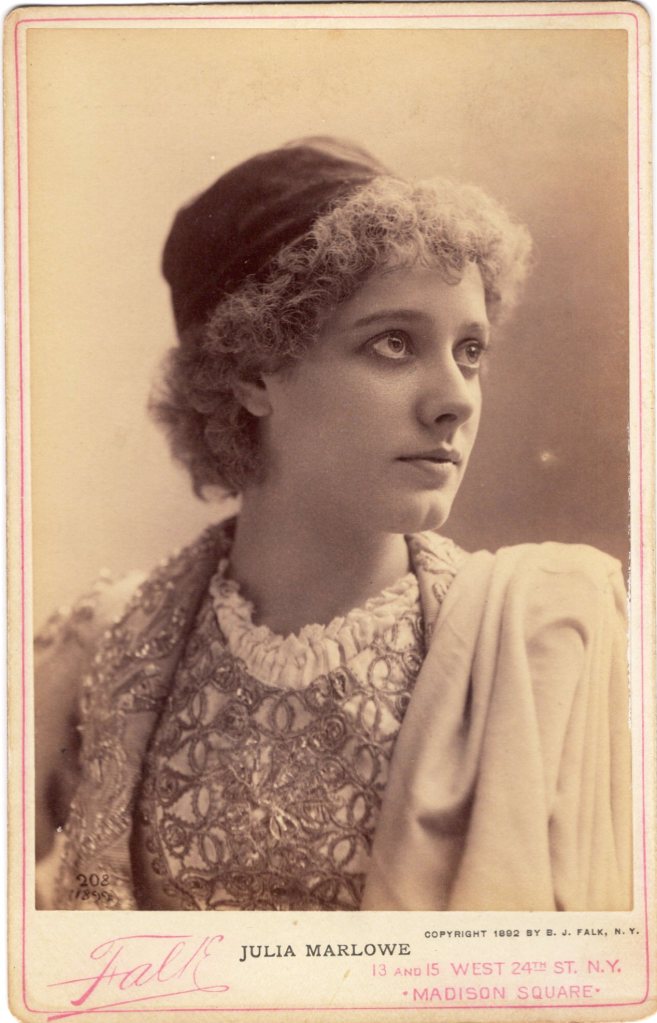
Julia Marlowe (1865-1950) was born in England and as a young child moved to the United States with her family. In her early teens she began her theatrical career with a juvenile opera company. She began playing Shakespeare in her home town of Cincinnati, Ohio. She made her Broadway debut in 1895 and by the end of her career, had appeared in more than 70 Broadway productions. Her first husband was actor, Robert Tabor. Their marriage lasted six years. In 1904 she appeared in “When Knighthood was in Flower”. Great success in this play brought her financial independence. Earlier, in 1903, she appeared in ‘The Cavalier” and “Ingomar”. The New York Sun wrote about her performance in “Ingomar”; “There is not a woman player in America or in England that is – attractively considered- fit to unlace her shoe”. In 1904 she began a partnership with actor E. H. Sothern. They toured the United States performing various plays of Shakespeare. They were managed by Charles Frohman and later, the Shubert brothers. They were considered to be among the major Shakespearian actors of the day. In 1906, Marlowe played in “Jeanne d’Arc” and also as Salome in “John the Baptist”. Later, Sothern and Marlowe played in London but were not terrific box office successes there. In 1911 Marlowe and Sothern married each other. In 1920 and 1921, they made eleven phonograph recordings for the Victor Company. The top Cabinet Card was produced by Newsboy as a premium for their tobacco products. The photographer was Falk and the image is from 1892.

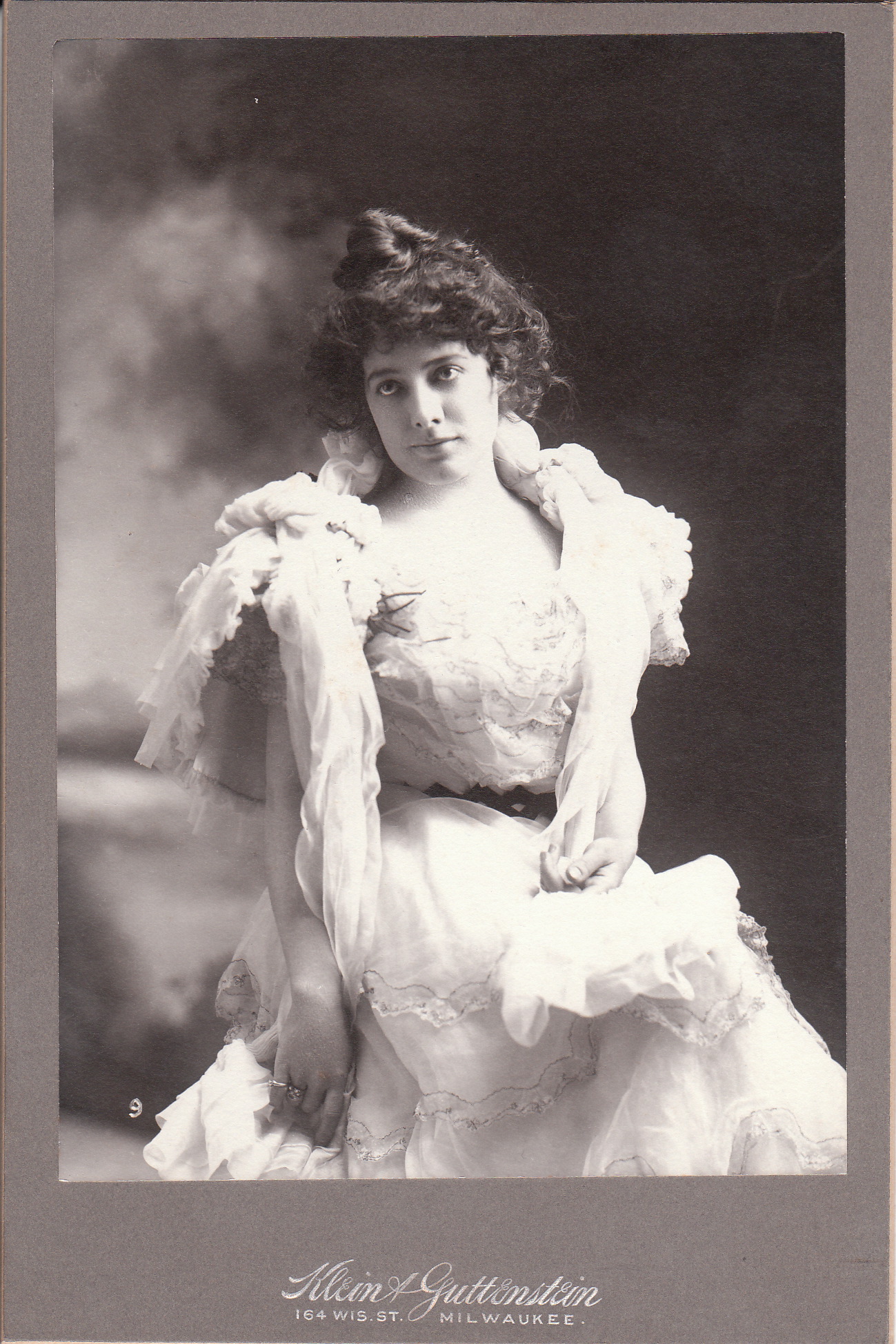
The second portrait of Julia Marlowe has a notation on the reverse of the card stating “Julia Marlowe Tabor”. Therefore, this photograph was likely taken during the time of her marriage to Tabor (1894-1900). The photographic studio that produced this portrait is  Klein & Guttenstein of 164 Wisconsin Street, in Milwaukee,  Wisconsin.  Klein and Guttenstein were leading photographers of their time. Wilson’s Photographic Magazine (1902) reveals that the two men  were very active in the Photographers Association of Wisconsin and other photography organizations. The photographers were considered part of a network of photographers skilled at producing publicity images of theatrical and vaudeville stars to be used in national magazines and other publications. The New York Public Library has a collection of portraits of actress Blanche Bates; produced by Klein & Guttenstein. The University of Pennsylvania Library has one of Klein & Guttenstein’s portraits of Julia Marlowe.  (SOLD)

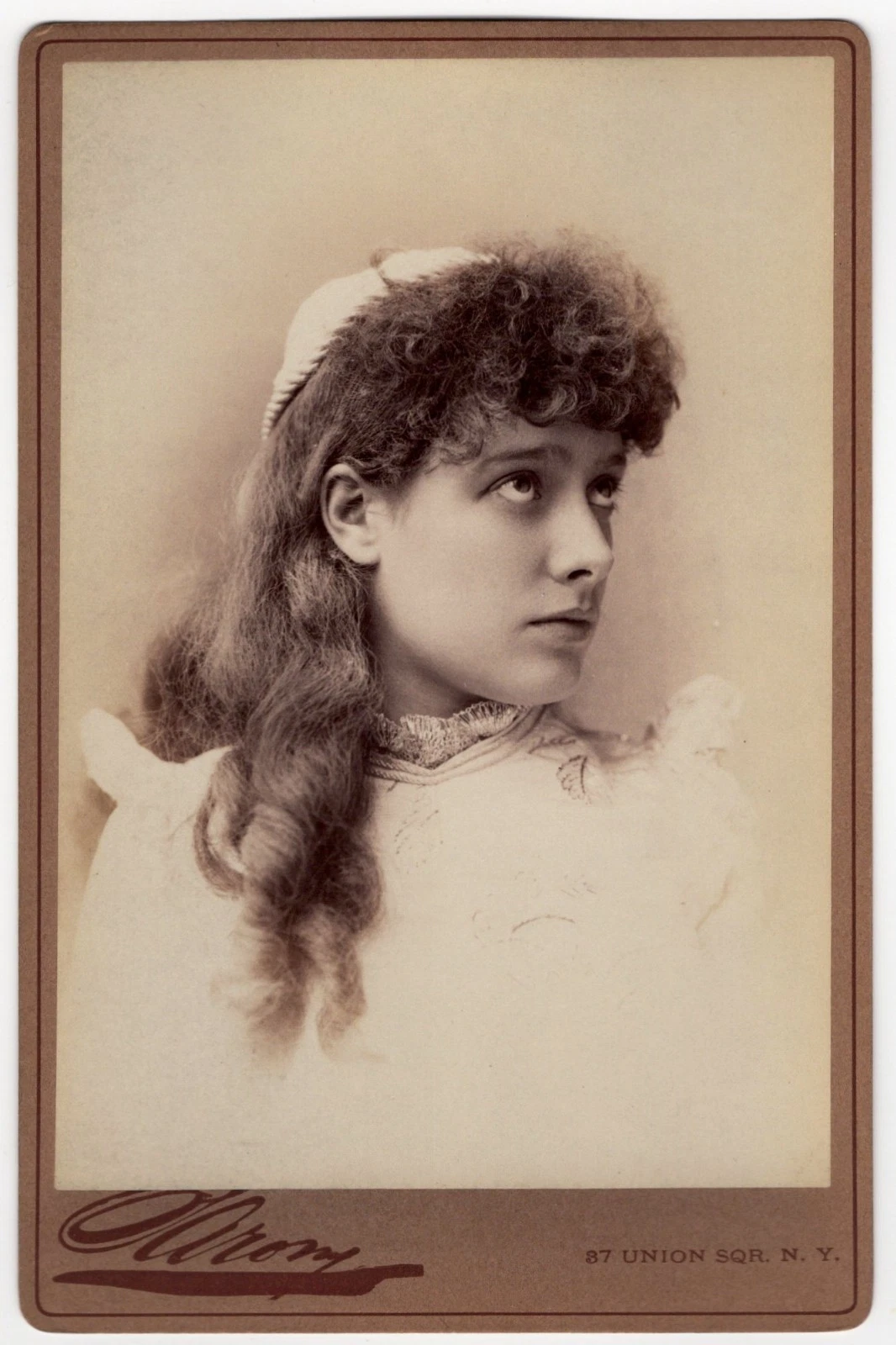
The third portrait of Julia Marlowe in the cabinet card gallery collection is photographed by Sarony, the famed celebrity photographer located in New York City.  This cabinet card is signed by the actress and dated 1890. Additonal photographs by Sarony can be viewed by clicking on the category “Photographers: Sarony”.  SOLD

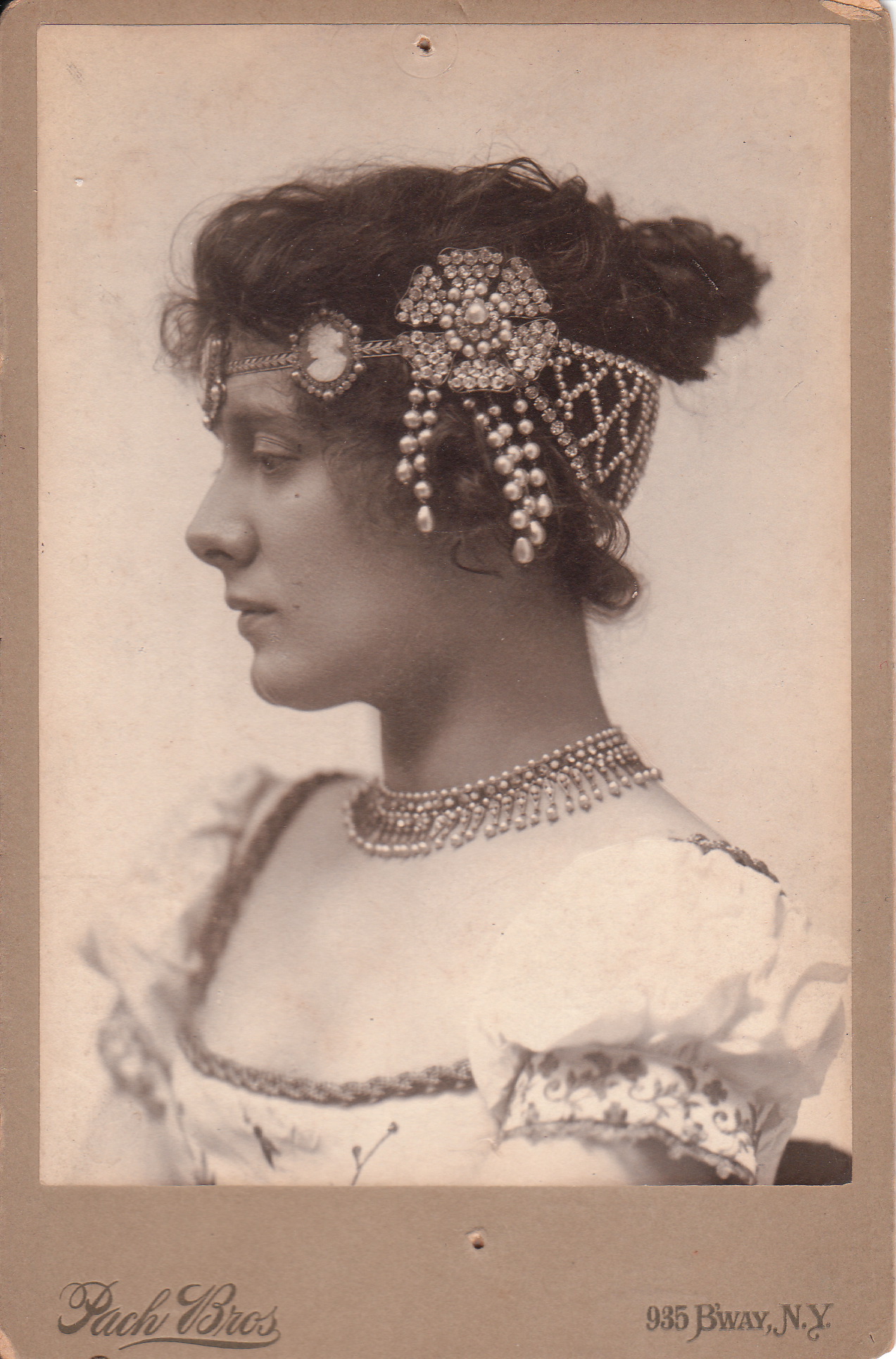
The fourth portrait of Miss Marlow features her in role in the production of “Countess Veleska”. The play was adapted for a German work, “The Tall Prussian”, by Rudolph Stratz. The play opened in New York in 1898 at the Knickerbocker Theatre. The review in the New York Times (1898) stated that the “drama was made wholly interesting by the personal charm and sincerity of Miss Marlowe”. In a sarcastic tone, the reviewer comments about Marlowe’s co star, Bassett Roe. The reviewer states that Roe has only two qualities of the man he was playing, “height and good looks”. The reviewer continues his scathing description of Roe; “The only time he actually warmed up was when he accidentally set his hair on fire. Even then he would have let it burn if Miss Marlowe had not gone to his rescue.” The photographic studio that produced the “Countess Veleska” cabinet card was Pach Brothers of New York City. Pach Brothers were photographers known for their photographs of celebrities of their era. To see additional photographs by the Pach Brothers, click on this site’s category of “Photographers: Pach Brothers”.

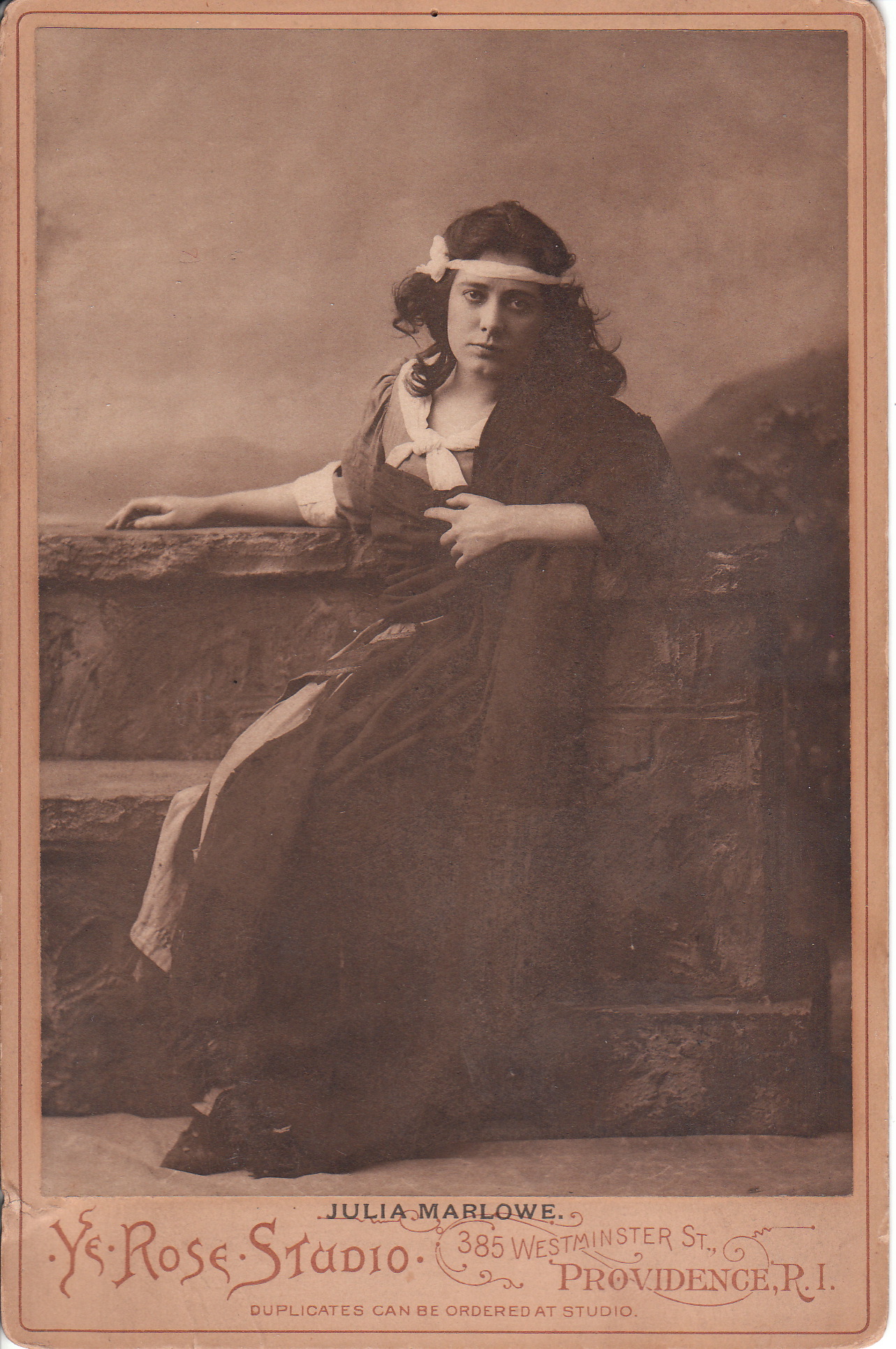
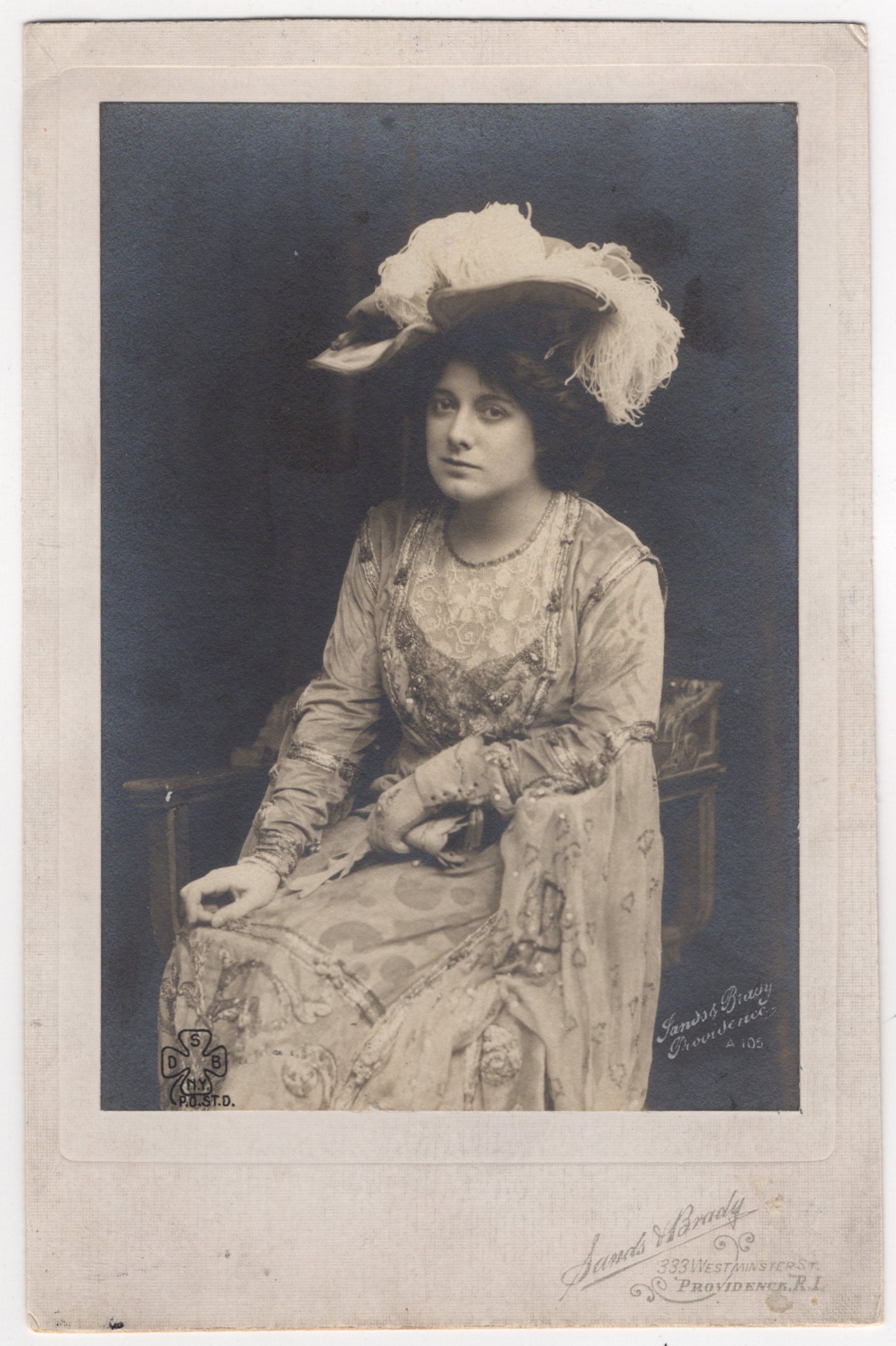
The fifth portrait of Julia Marlowe appears to be a photograph of the actress in costume for an unknown stage production. The image was photographed by Ye Rose Studio of Providence, Rhode Island. The reverse of the card indicated that the studio was opened in 1886. The studio was located in the Conrad building in downtown Providence. The building still exists. Other photographs by the Ye Rose Studio can be viewed by clicking on the category “Photographer: Ye Rose”.

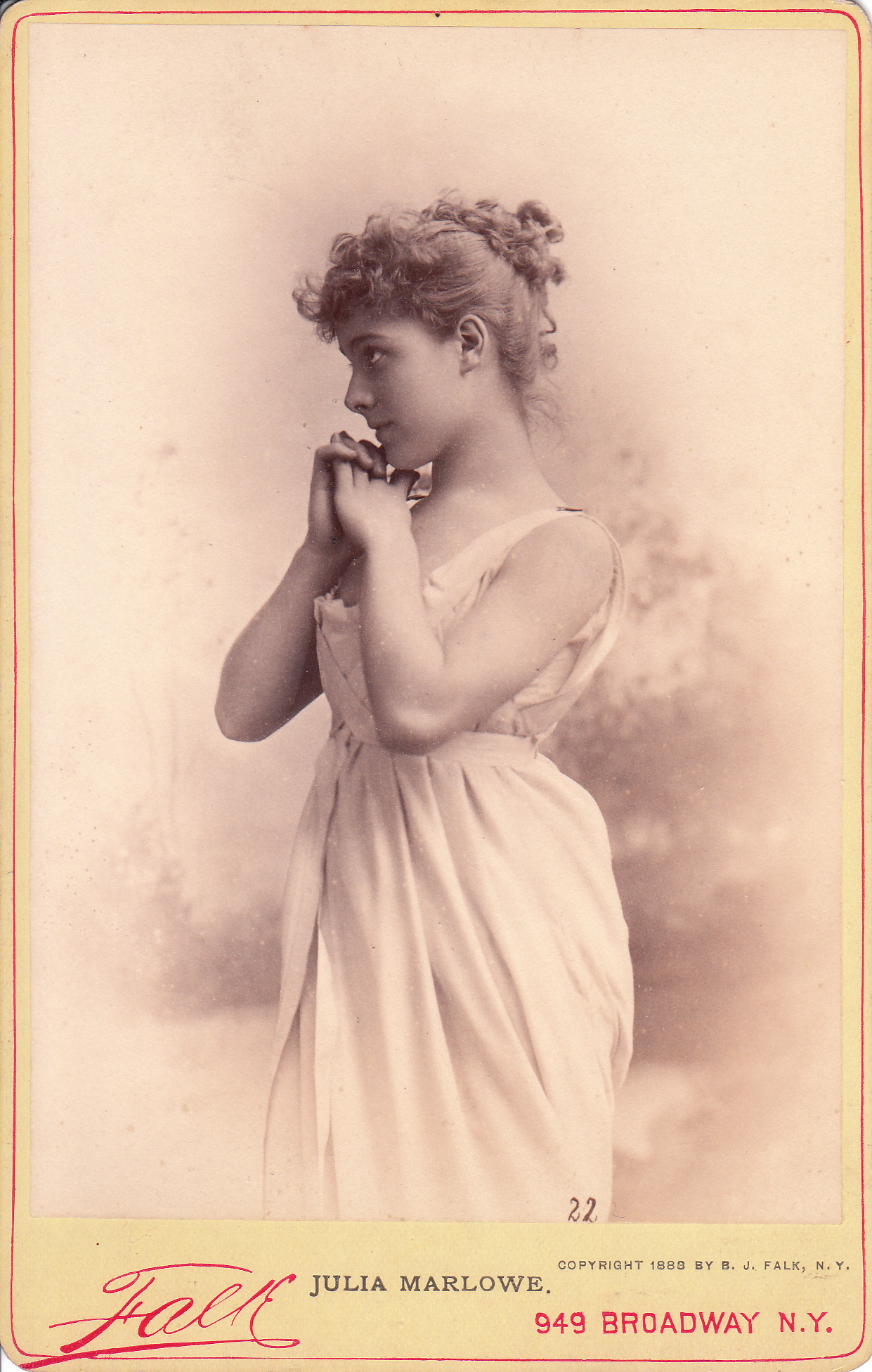
Portrait number six is an excellent example of the beauty of Julia Marlowe. This image, from 1888, captures Ms. Marlowe at the young age of twenty-three. The photographer of this portrait was B. J. Falk, a celebrity photographer located in New York City, New York. To view other photographs by Falk, click on the category “Photographer: Falk”.

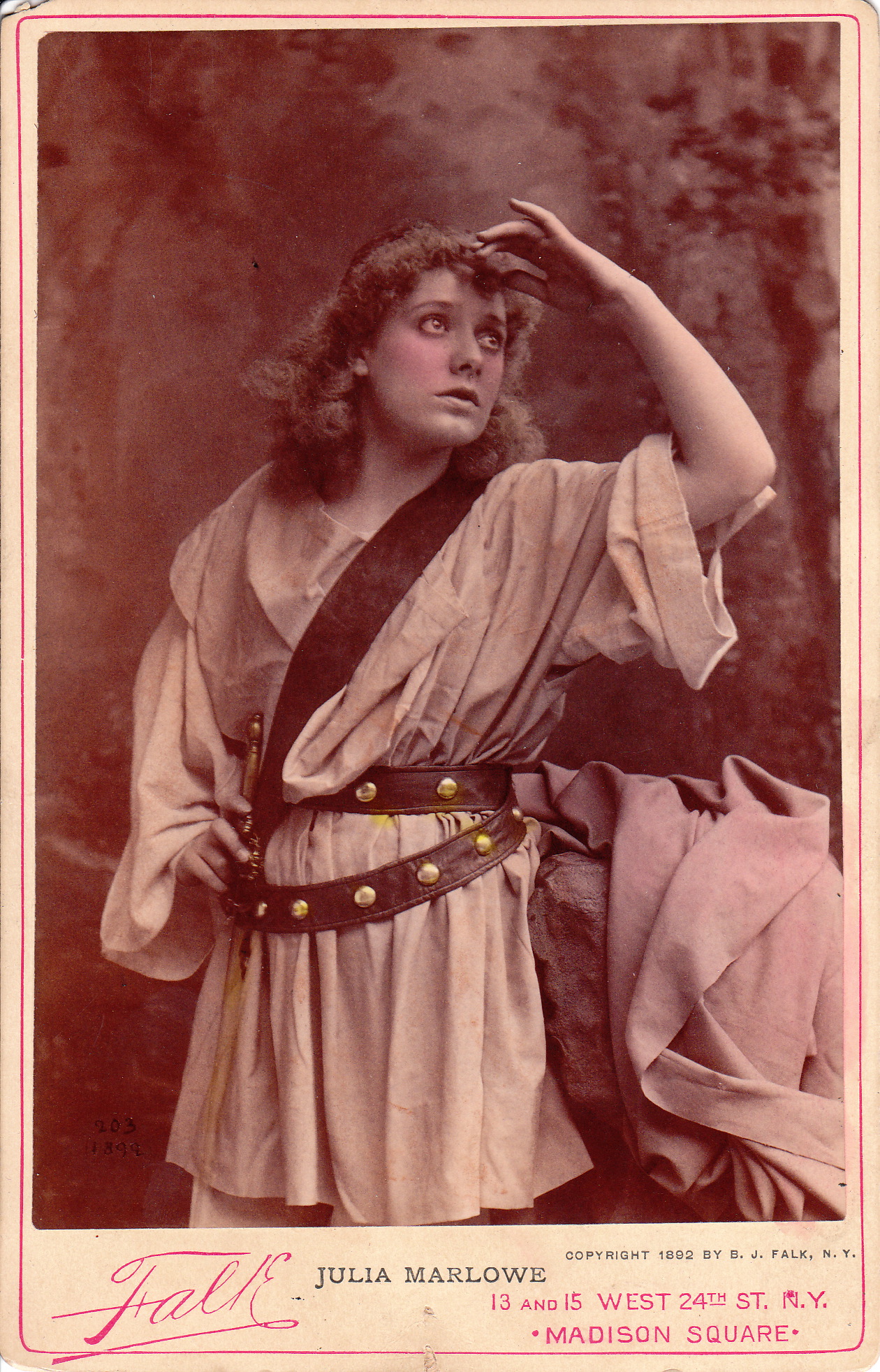
The seventh portrait is another example of a B. J. Falk image. The photograph features a costumed Julia Marlowe in the production of “Cymbeline“. Cymbeline is a play by William Shakespeare that was based on legends about the early Celtic British King,  Cunobelinus. The play deals with themes that include innocence and jealousy. Ms. Marlowe plays Imogen, the King’s daughter. Her expression in the photograph shows fear and concern as she looks at someone or something in the distance. Her left hand shades her eyes while her right hand clutches her belted dagger. A stamp on the reverse of  this cabinet card reveals that it was formerly owned by Culver Pictures of New York City, New York. Culver Pictures has been collecting photographs and illustrations from the 19th and first half of the 20th century, since 1926. These pictures are used in books, films, and other forms of media. At the time that this cabinet card was stamped by the company, Culver Pictures was located in New York City.  (SOLD)

Portrait number eight is a close-up photograph of Miss Marlowe. The photographer of this cabinet card is the studio of Rose & Sands whose gallery was located in Providence, Rhode Island. Note that photograph number five also came from the Rose studio, but at that time, the gallery was called, the Ye Rose studio. The Wilson’s Photographic Magazine (1899) reports that Rose and Sands were the proprietors of Ye Rose. A humorous headline in a photography magazine stated “Providence Provides for All, And Rose Provides for Providence”.  Print on the reverse of this cabinet card reveals that the Rose & Sands studio was opened in 1886 and that it specialized in “High Class Portraits from Cabinet to Life Size”. Also of interest, like photograph number seven, there is a stamp on the reverse of the photograph with the name “Culver Pictures Inc”.

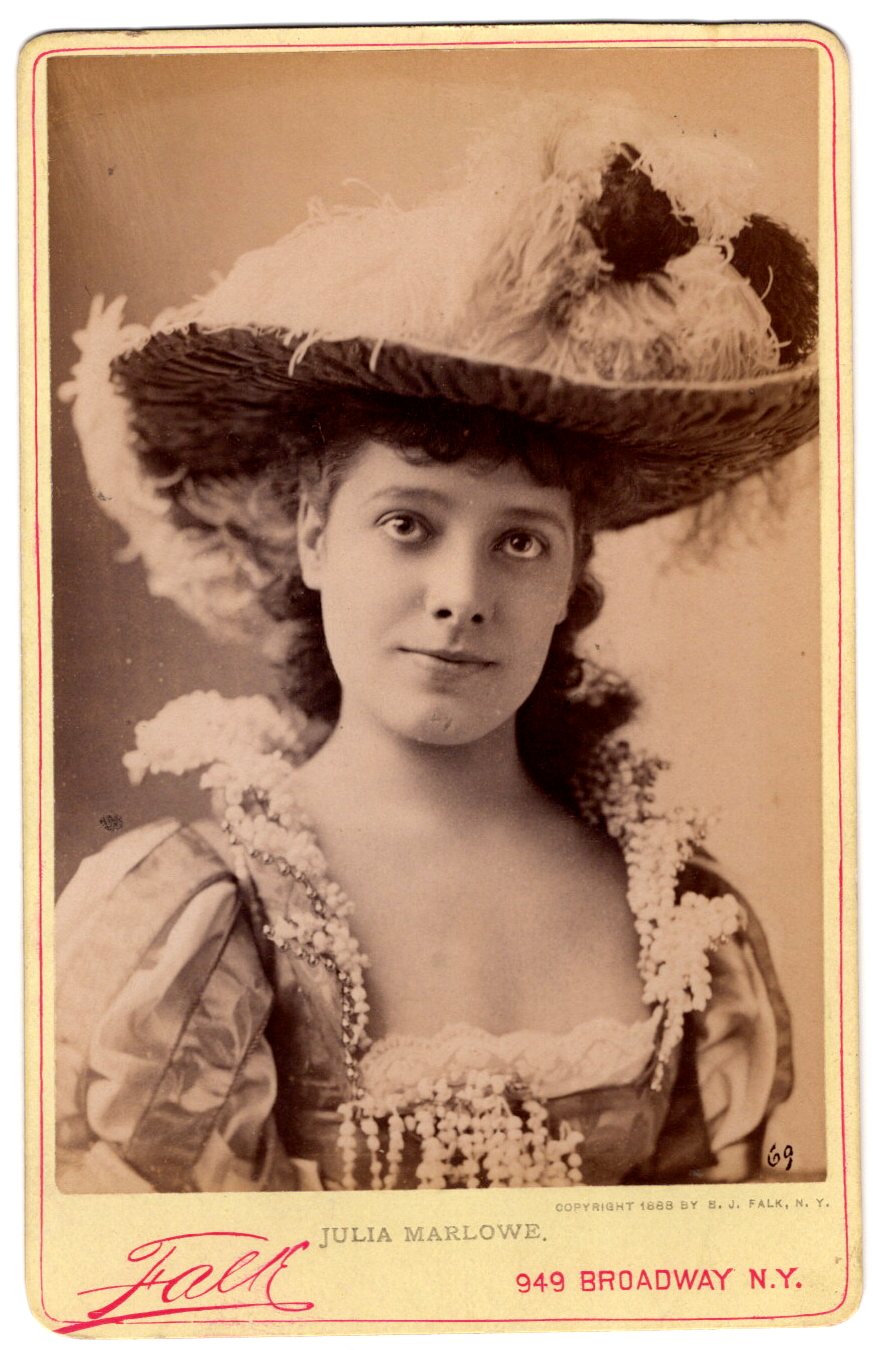
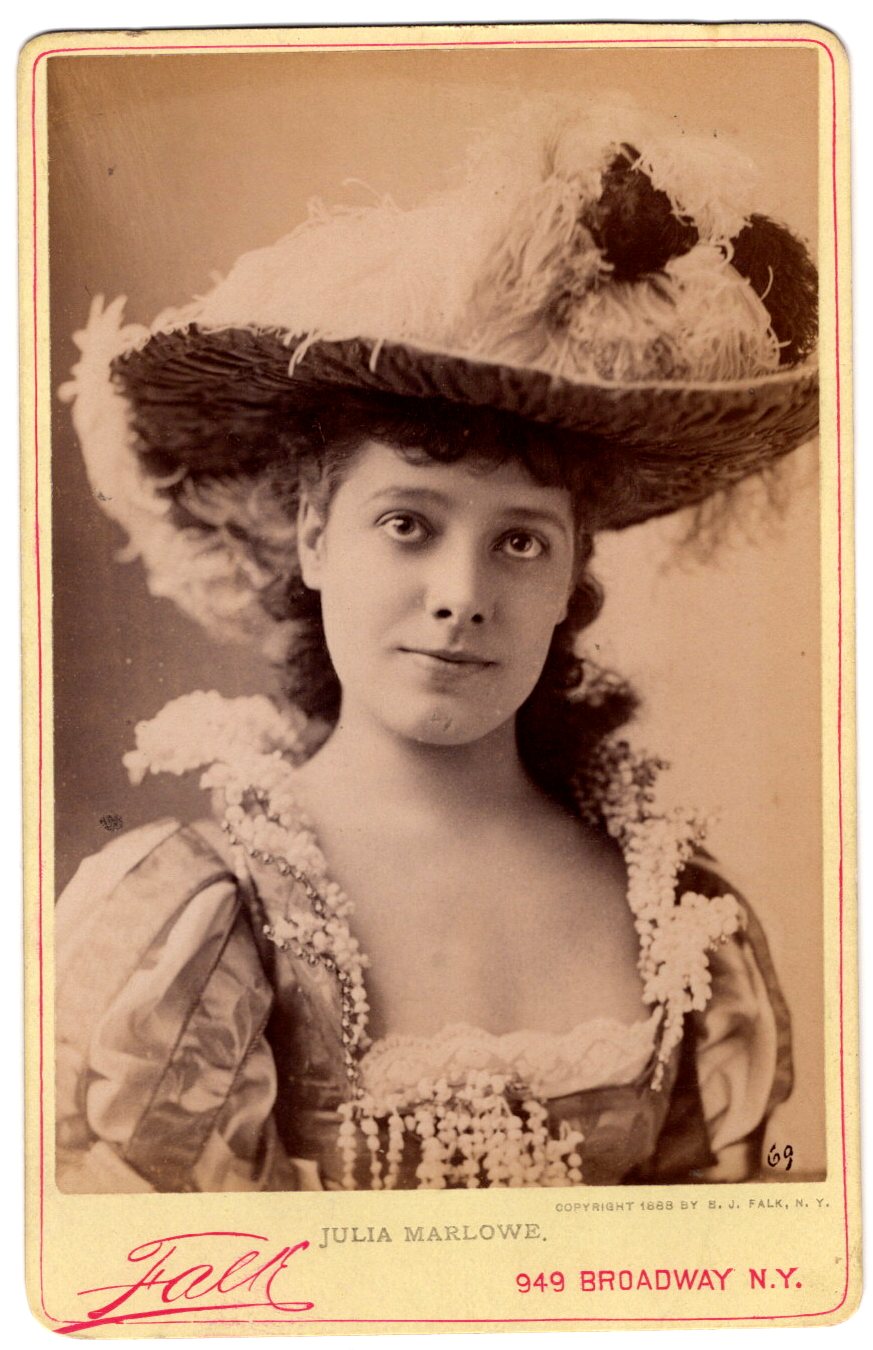
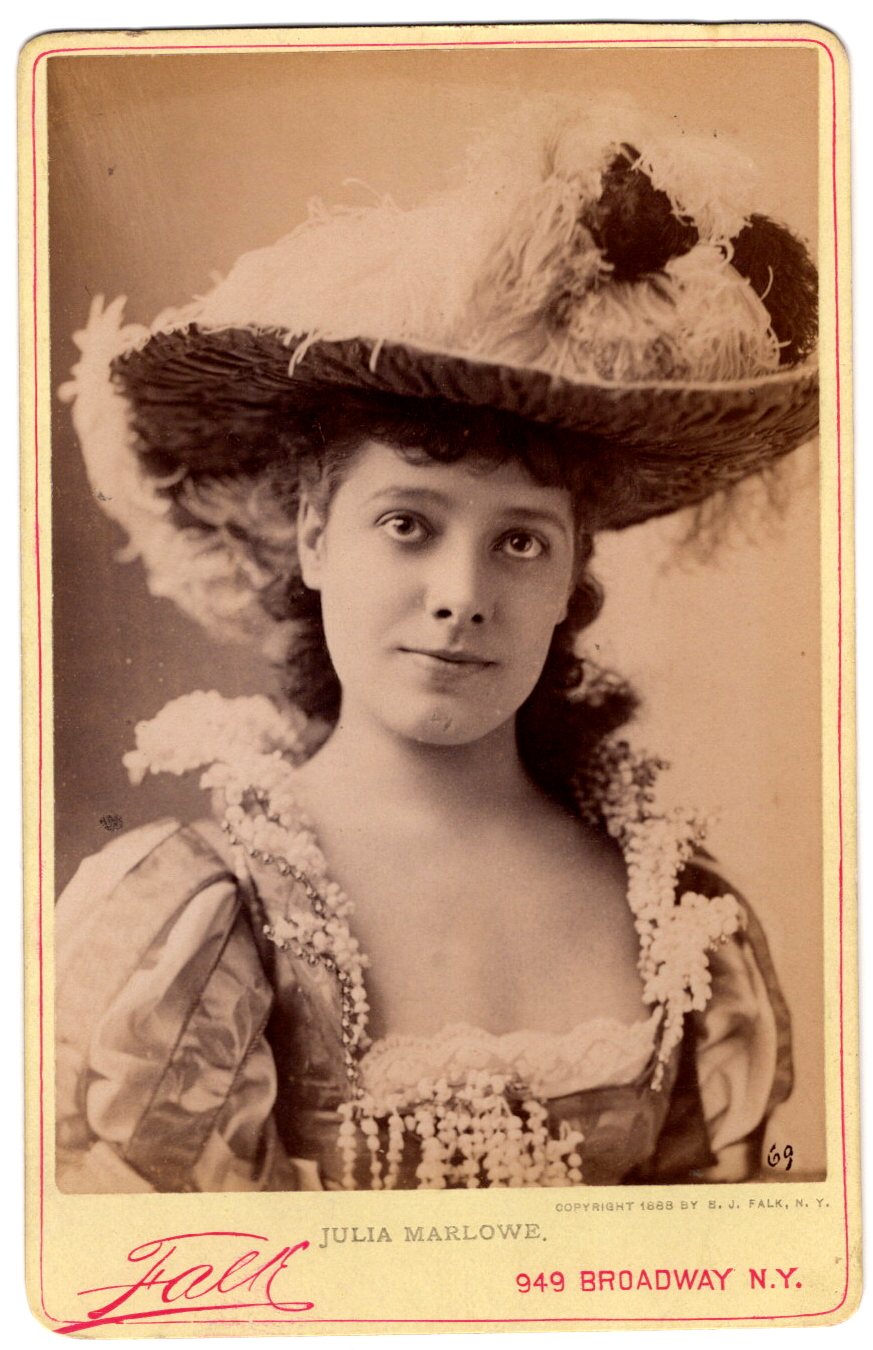
Photograph number nine features the beautiful Miss Marlowe displaying a mischievous smile. Note her engaging large eyes. She is wearing a somewhat revealing dress (for the cabinet card era) and has a wonderful hat atop her head. This cabinet card photograph was published in 1888 by Benjamin Falk of New York City.  The image is marked with the number sixty-nine.

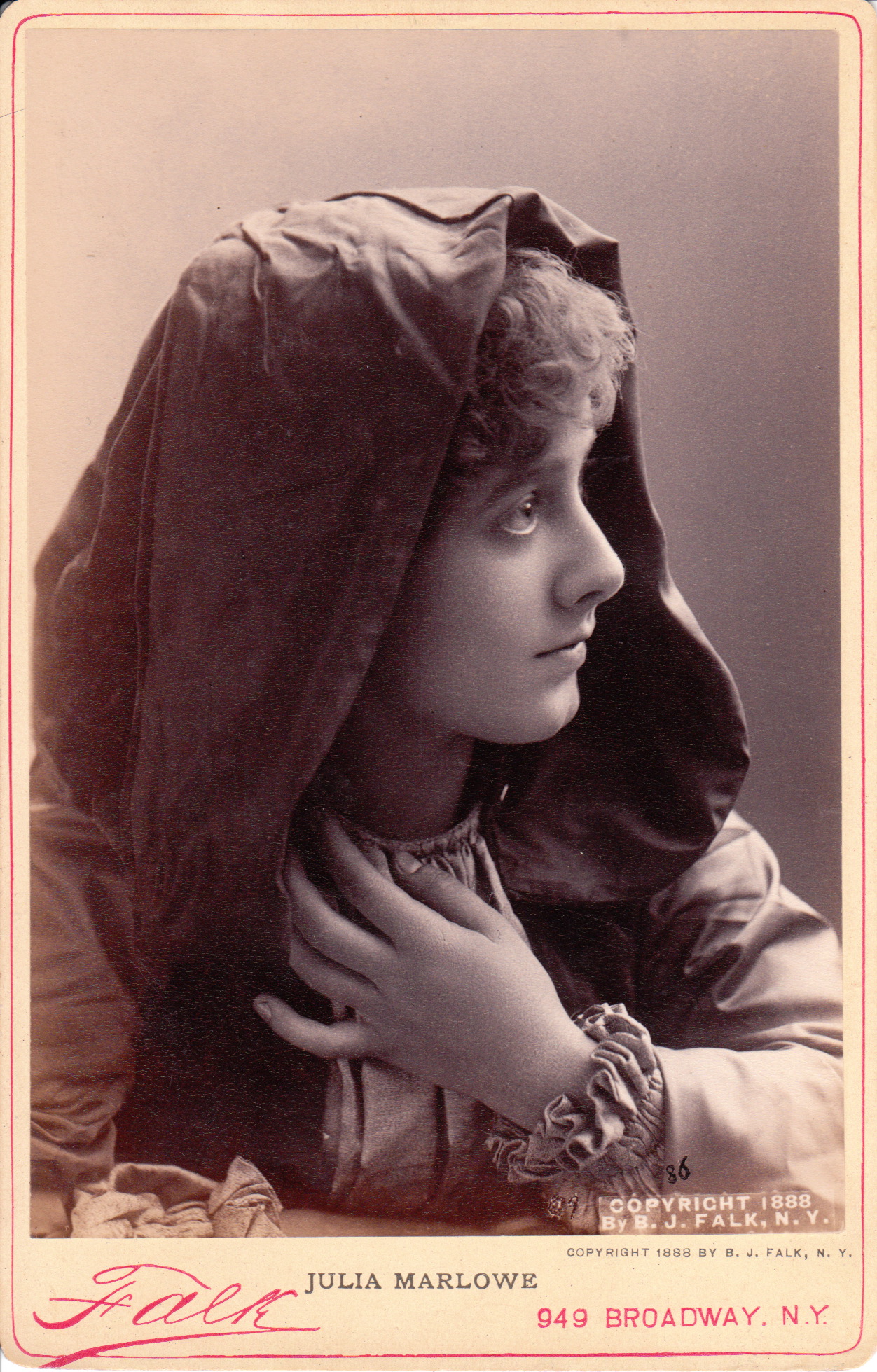
Portrait number ten is a closeup of Julia Marlowe with her head covered, but with her pretty face very visible. She is likely in costume for this photograph. The photograph is taken by B. J. Falk of New York City and has a copyright date of 1888. The cabinet card is marked number “86”.

The eleventh photograph captures Miss Marlowe staring hypnotically at a flower. Someone, has written below her name that the image features her in the role of Parthenia in the production of “Ingomar”.  The New York Times (1904) reviews the play and Miss Marlowe’s performance on opening night at the Empire Theater in New York City. The newspaper reports that Frederick Halm’s play was “impossibly romantic and deliciously sentimental piece of old-fashioned theatrics. Tyrone Power played Ingomar and he was described as “vigourous and picturesque” but the article added that his voice was “not at its best”. The review pointed out that Marlowe’s appearance in this play was to be her last appearance as an independent star before joining E. H. Sothern’s Shakespearean repertory. In regard to Marlowe’s acting in this play, it was written that she played a “dear little prig – adorably dear” (prig can be defined as smug or arrogant) and she presented “a masterpiece of harmonious, modulated, and sustained acting”. The 1904 performance of Julia Marlowe in “Ingomar” marked a return performance for this accomplished actress. The New York Times (1888) wrote a very positive review of the opening night performance in Washington D.C.. The appreciative audience included three Supreme Court Justices and a number of members of the Chinese Embassy. This cabinet card was produced by the previously mentioned Ye Rose Studio of Providence, Rhode Island and it likely dates back to her 1888 performance in the role.

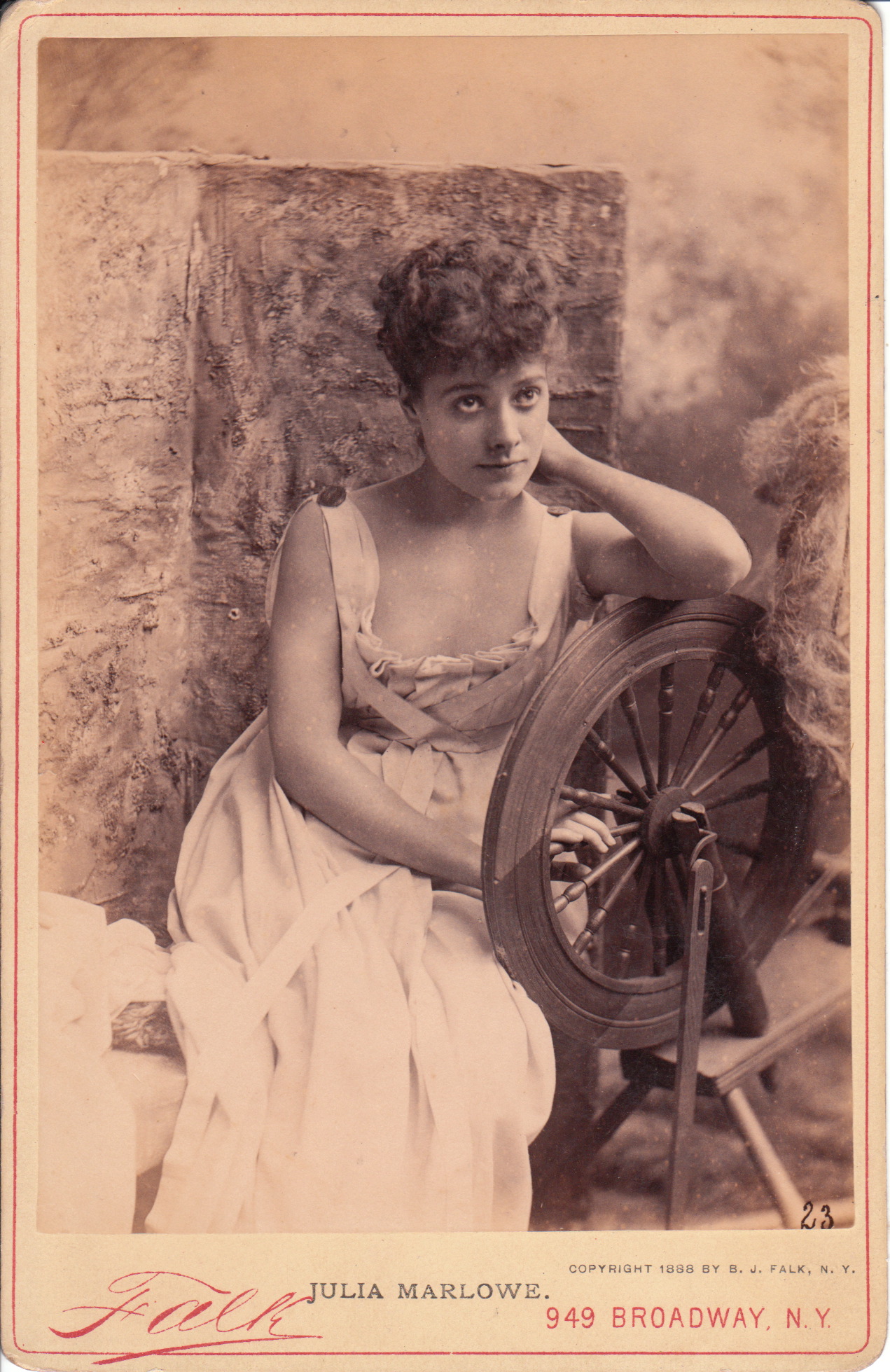
The twelfth cabinet card was produced by Benjamin Falk of New York City. He posed Miss Marlowe next to a spinning wheel. Her low cut dress makes this image a bit risque for the cabinet card era. If Falk or Miss Marlowe thought that looking up at the camera would create a “fetching appearance”, I would contend that their efforts failed. Rather than “fetching”, she appears dazed. The actress was a beautiful woman and provocativeness was not necessary to enhance her image. This photograph was produced in 1888 and was part of a series (#23).

Cabinet Card number thirteen is part of a series that includes Cabinet Card number ten. Both cards were photographed by Benjamin  Falk and have a copyright date of 1888. Both portraits are close-ups but this one is captures Marlowe looking at the camera while number ten offers a profile view. Falk really captured the actresses eyes. Her eyes are beautiful and they are haunting at the same time. This photograph is marked number number 83 of the series.

Cabinet Card fourteen features another beautiful portrait of Julia Marlowe. This photograph was taken by Benjamin Falk and was copyrighted in 1892. This cabinet card is uncommon, possibly rare.  (SOLD)

Cabinet Card 15 was photographed by Napoleon Sarony, the famed celebrity photographer located in New York City.  (SOLD)

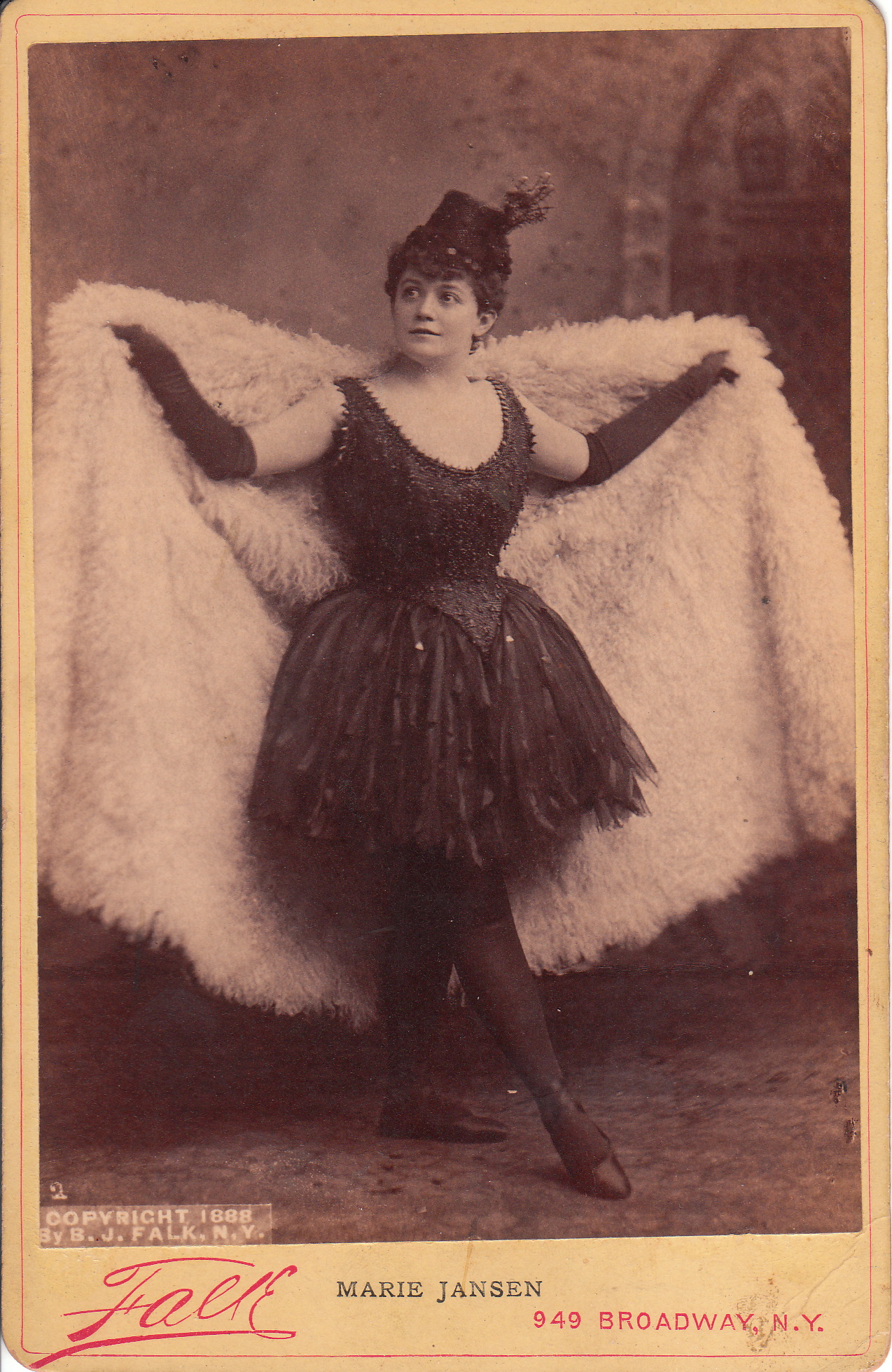
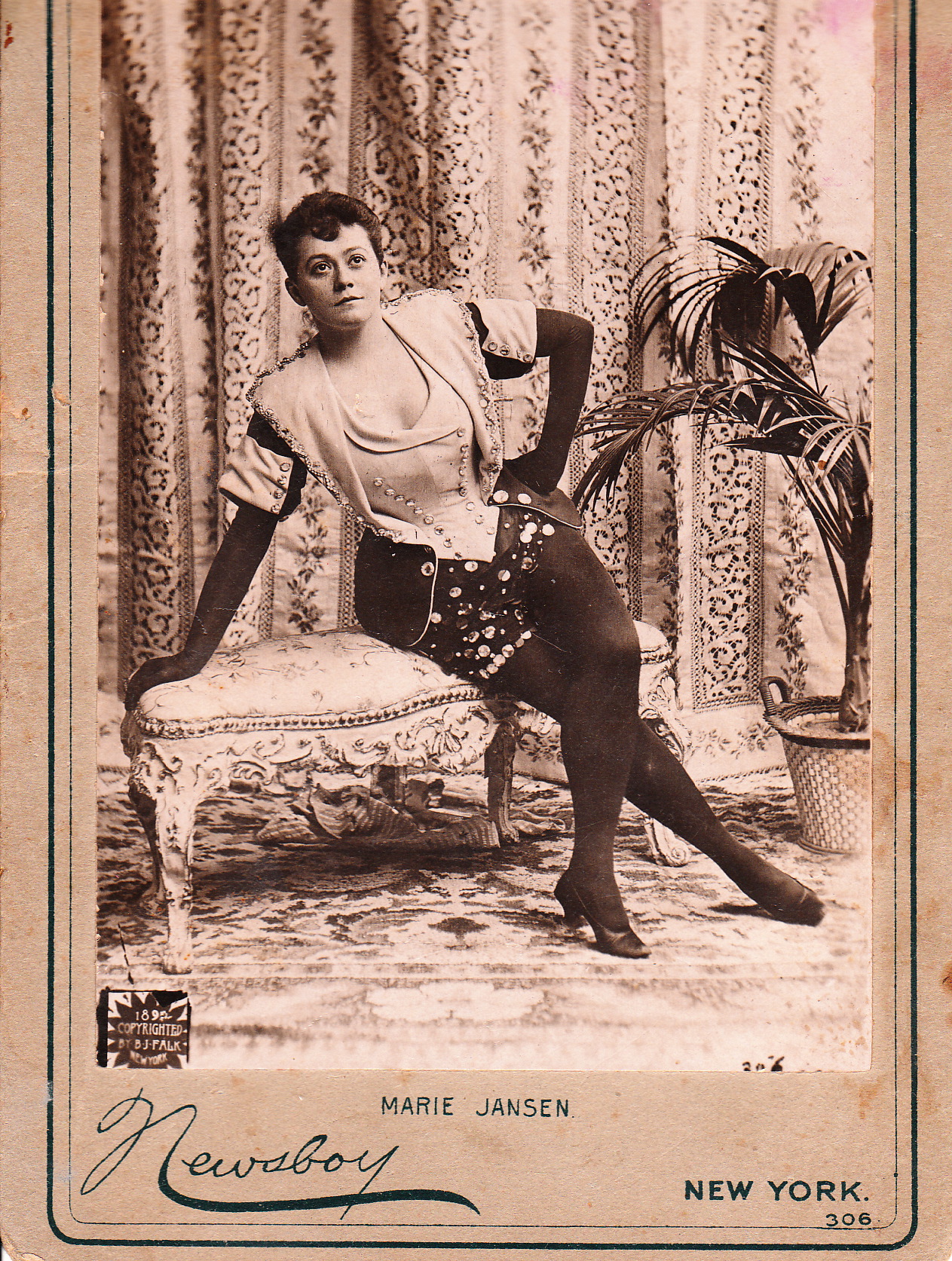
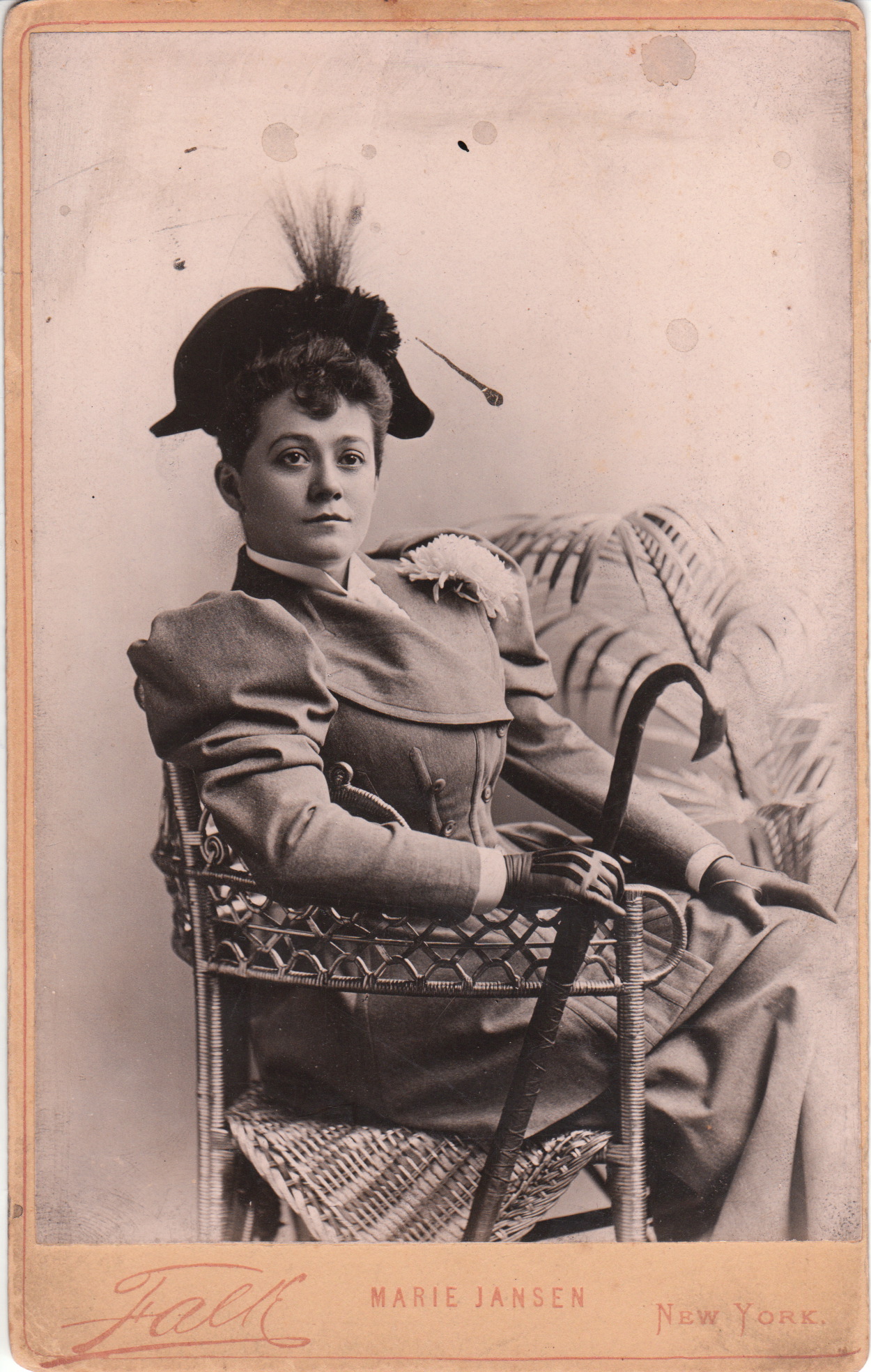
STAGE ACTRESS MARIE JANSEN IN FOUR IMAGES (1887,1888, AND 1892 PHOTOGRAPHS BY FALK)

CABINET CARD 1   SOLD

CABINETCARD2CABINET CARD 3

JANSEN4CABINET CARD 4

Marie Jansen (1857-1914) was an American actress and vocalist. She was a well known star of comic operas. She was born in Boston and her birth name was Hattie Johnson. Jansen made her theatrical debut in Boston at the Park Theatre in 1881. Her first major success occurred in 1883 with her appearance in “The Beggar Student”. In 1884 she was engaged by Charles Wyndham to create the title role in “Featherbrain” which ran in London, England. She then appeared  in the United States for several years as the leading woman in Francis Wilson’s comic opera company. In 1901, Jansen formed her own company that she took on tour. The top  image was photographed by famed celebrity photographer Falk of New York City. SOLD

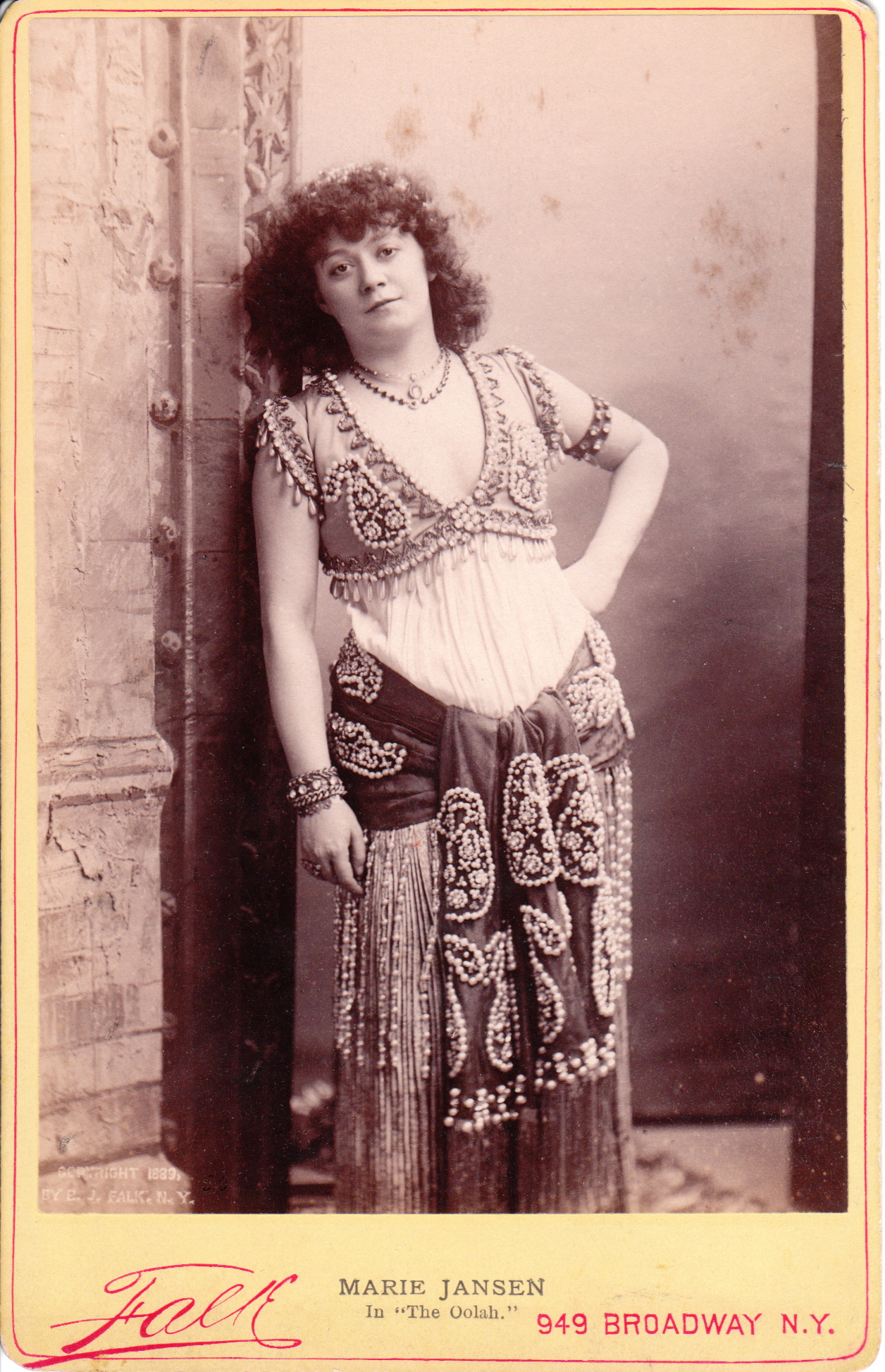
Postcard 2 shows Jansen in costume for the play, “The Oolah”. “The Oolah” was a comic opera produced by the Francis Wilson Company in 1887. The music was written by Charles Le Cocq and the libretto was written by Sydney Rosenfeld.

Postcard 3 was also photographed by Falk. This cabinet card is dated 1888 and is a bit risque for that time in history. The third image of Jansen also captures her in a bit risque costume. It was photographed by  Falk in 1892 and the cabinet card was used as a premium for Newsboy tobacco products.

Postcard 4 features Jansen in costume and sitting on a wicker chair. She is holding a cane and wearing gloves. This undated photograph is also by Falk. To view other photographs by Falk, click on the Cabinet Card Gallery category “Photographer: Falk”.

CORINNE: FAMOUS CHILD ACTRESS AND SUBJECT OF A SENSATIONAL CHILD ABUSE CASE

CORRINE_0003CABINET CARD 1

corinne_0002CABINET CARD 2

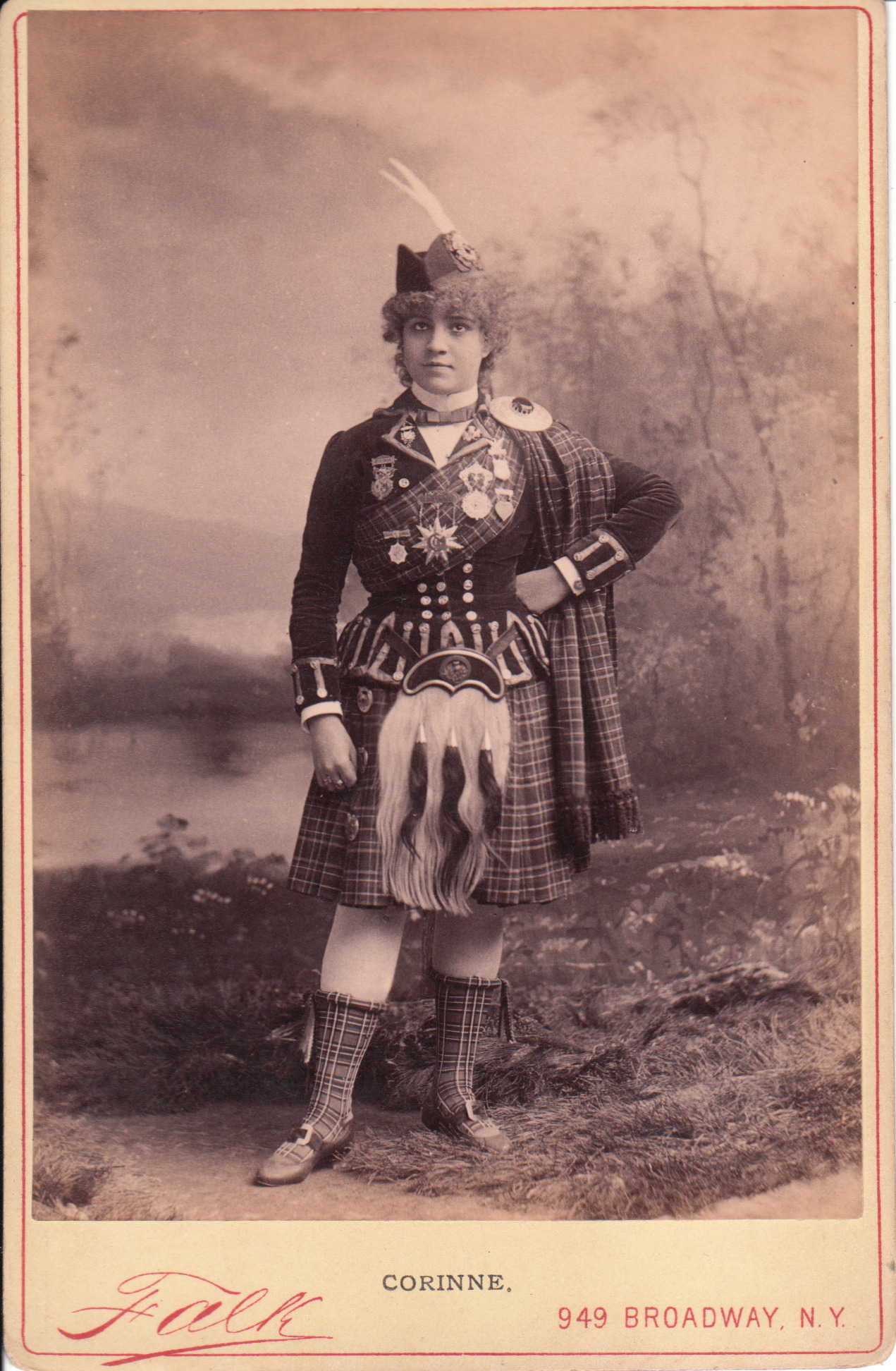
The actress pictured in Cabinet Card 1 is Corrine.  Corrine, like Elvis or Selena, was a performer that received national recognition and was known by just her first name. In the top portrait by celebrity photographer B. J. Falk, Corrine looks to be teenager or young adult. She is dressed in theatrical costume. Corinne was the daughter of actress Jennie Kimball. Kimball acted in the theater between 1865 and 1873. The year of her retirement, she became the mother of Corinne, who the New York Times (1896) labelled “the most famous of all the child actresses of this country”. It is not clear how Kimball and her husband came to raise Corinne, but is was speculated that she was adopted as an orphan. Kimball trained her young daughter for the stage. Corrine debuted in the theater at age two and a half.  At five years of age she played the part of  “Little Buttercup” in the Boston production of “Pinafore”. She played the role more than one hundred times. At fifteen years of age she was traveling as head of her own theater company. Jennie Kimball doubled as Corinne’s mother and manager. The New York Times (1896) reported that Corinne “was a goldmine” during her early days for Mrs. Kimball and remained a major money producer through the time the article was written. At the time the article appeared, Corinne was twenty-two years old.  Jennie Kimball’s successful management of her daughter’s career wasn’t appreciated by all observers. The New York Times (1881) asserted that the Society for the Prevention of Cruelty to Children objected to the way Corinne was being raised and successfully pursued custody of the child. During the custody hearing, eight year-old Corinne was put on the stand and interrogated by the society’s lawyer. He asked her how many times she was photographed and she didn’t know but said “she was never photographed in tights nor with her limbs and breast exposed”. The lawyer’s questioning revealed that the child had never attended school. However, Jennie Kimball did give her “lessons” each morning. The lawyer then gave Corinne an impromptu writing/spelling test during her testimony. The attorney also prompted the child to say she had never attended sunday school and didn’t know what a bible was nor had she ever been taught anything about Jesus Christ. The society lawyer was initially able to convince the judge to remove the child from the custody of Mrs Kimball because she was “unlawfully exhibited and employed” in dancing, singing and acting on the theatrical stage. Mrs. Kimball was allowed to take her daughter for a brief period to change her clothing but was assigned an escort to insure that the child would be brought to the society. Mrs Kimball was advised by George Hackett, the manager of a Providence opera house that if she took her daughter from New York to Jersey City, New Jersey; the girl would be out of the courts jurisdiction and she could keep her daughter. Mrs. Kimball followed his suggestion, and allowed a man to spirit the child out of state. As a result, Mrs. Kimball was charged with abduction and she ended up back in court. After a short time, the judge considered all the testimony that he heard and decided to return Corinne to her parents (he called them guardians). He believed that they were loving toward the child and responsible enough to continue raising her. Interestingly, he had something to say about the religious angle pursued by the society lawyer. The judge wrote that the the US constitution protected Corinne’s parents from being punished for not providing religious education to their daughter.  Corinne continued her acting career and eventually became involved in burlesque theater. The New York Times (1894) wrote “Corinne has grown up and proves a lively and entertaining performer. The article adds that “she has no large share of original talent, musical or dramatic, but she can sing and dance “well enough”.

Cabinet Card 2 pictures Miss Corinne and was published by Newsboy (#20 of a series). She is wearing jewelry galore and flowers in her hair. What is that contraption that she is wearing around her waist? Is it a pouch? If so, what is it meant to carry? SOLD


JULIA MARLOWE: ESTEEMED AMERICAN STAGE ACTRESS : CABINET CARD PORTRAIT 

This cabinet card features Julia Marlowe displaying a mischievous smile. Note her engaging large eyes. Miss Marlowe was a stage beauty. She is wearing a somewhat revealing dress (for the cabinet card era) and has a wonderful hat atop her head. Julia Marlowe (1865-1950) was born in England and as a young child moved to the United States with her family. In her early teens she began her theatrical career with a juvenile opera company. She began playing Shakespeare in her home town of Cincinnati, Ohio. She made her Broadway debut in 1895 and by the end of her career, had appeared in more than 70 Broadway productions. Her first husband was actor, Robert Tabor. Their marriage lasted six years. In 1904 she appeared in “When Knighthood was in Flower”. Great success in this play brought her financial independence. Earlier, in 1903, she appeared in ‘The Cavalier” and “Ingomar”. The New York Sun wrote about her performance in “Ingomar”; “There is not a woman player in America or in England that is – attractively considered- fit to unlace her shoe”. In 1904 she began a partnership with actor E. H. Sothern. They toured the United States performing various plays of Shakespeare. They were managed by Charles Frohman and later, the Shubert brothers. They were considered to be among the major Shakespearian actors of the day. In 1906, Marlowe played in “Jeanne d’Arc” and also as Salome in “John the Baptist”. Later, Sothern and Marlowe played in London but were not terrific box office successes there. In 1911 Marlowe and Sothern married each other. In 1920 and 1921, they made eleven phonograph recordings for the Victor Company. This cabinet card photograph was published in 1888 by the talented and popular Benjamin Falk of New York City. The image is marked with the number sixty-nine. This cabinet card has excellent clarity and is in very good condition (see scans).

6193

Buy this Cabinet Card Photograph (includes shipping within the US) #6193

To purchase this item, click on the Pay with Paypal button below

$72.00

6193

Buy this Vintage Original Cabinet Card (includes International shipping outside the US) #6193

To purchase this item, click on the Pay with Paypal button below

$82.00

HELENA MODJESKA : POLISH AND AMERICAN ACTRESS : SHAKESPEARE : CABINET CARD 1889

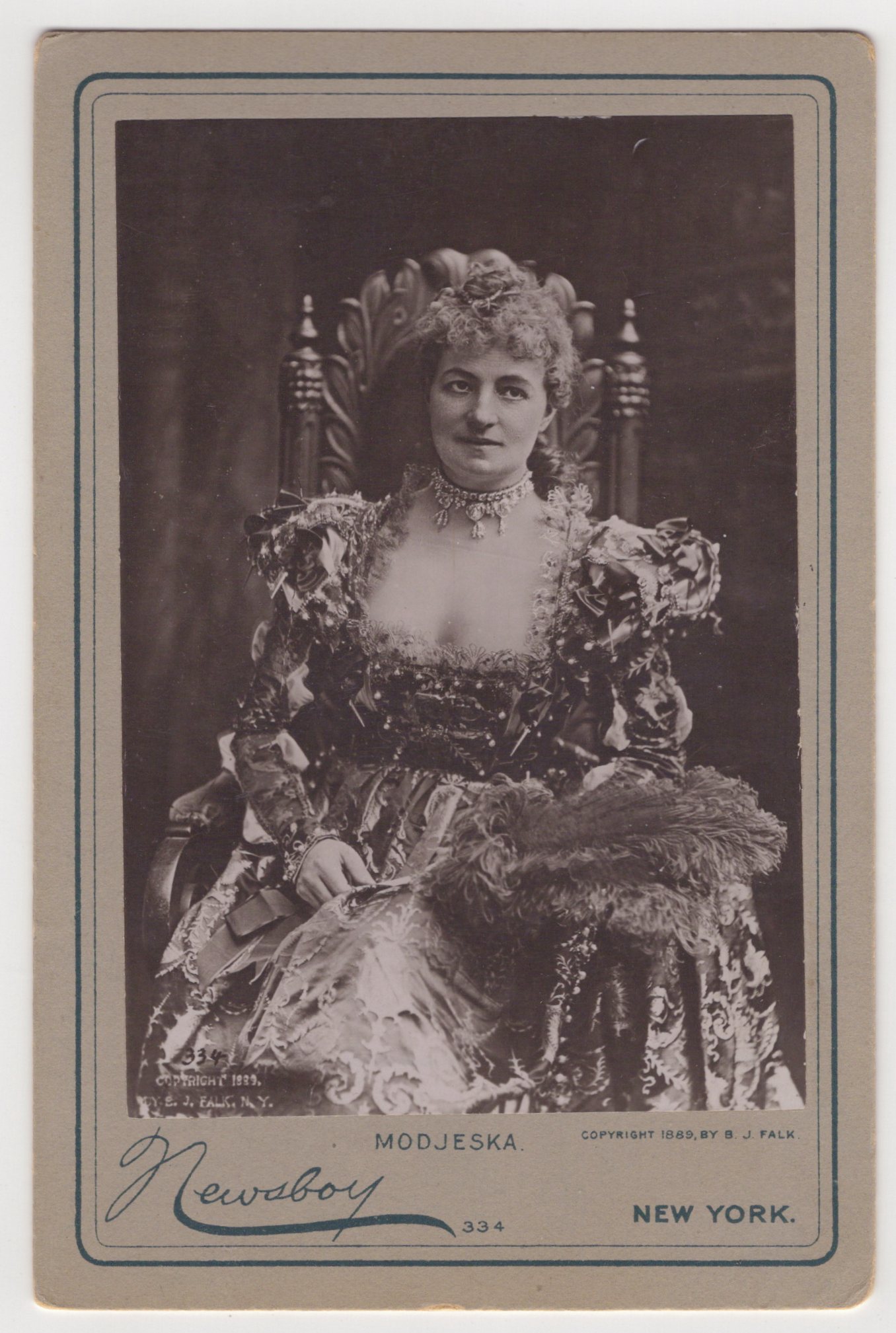
This cabinet card photograph features Polish actress, Helena Modjeska (1840-1909). She was known for her Shakespearean and tragic roles. She began her career on the Polish stage and after emigrating to the United States in 1876, she was successful on both the American and British stage. She is considered the greatest actress in the history of the Polish stage. After marrying Count Karol Bozenta Chłapowski, Modjeska emigrated with him to the United States in 1876. She initially attempted to establish a utopian agricultural community in California. However, the colony struggled, and she turned back to acting to support the venture financially. Modjeska achieved remarkable success on the American stage, learning English and debuting in San Francisco in Adrienne Lecouvreur. She quickly became known for her elegance, refined acting style, and powerful performances in Shakespeare’s plays, such as As You Like It and Othello, which she toured extensively across the U.S. and England. She played twelve Shakespearean parts in this country in addition to other classic and contemporary roles. In 1883 she appeared in America’s first professional appearance of Ibsen’s “A Doll’s House”. This cabinet card was published by Newsboy as a premium for their tobacco products. Miss Modjeska’s photograph was taken by esteemed celebrity photographer, Benjamin Falk in 1889. Some may consider this photo risque because of Modjeska’s low cut dress.  SOLD

MAXINE ELLIOTT : STAGE & FILM ACTRESS : BUSINESS WOMAN : CELEBRITY LOVERS : RPPC

POSTCARD 1

POSTCARD 2

POSTCARD 3 (SOLD)

POSTCARD 4 (SOLD)

POSTCARD 5 (SOLD)

POSTCARD 6 (SOLD)

POSTCARD 7 (SOLD)

POSTCARD 8 (SOLD)

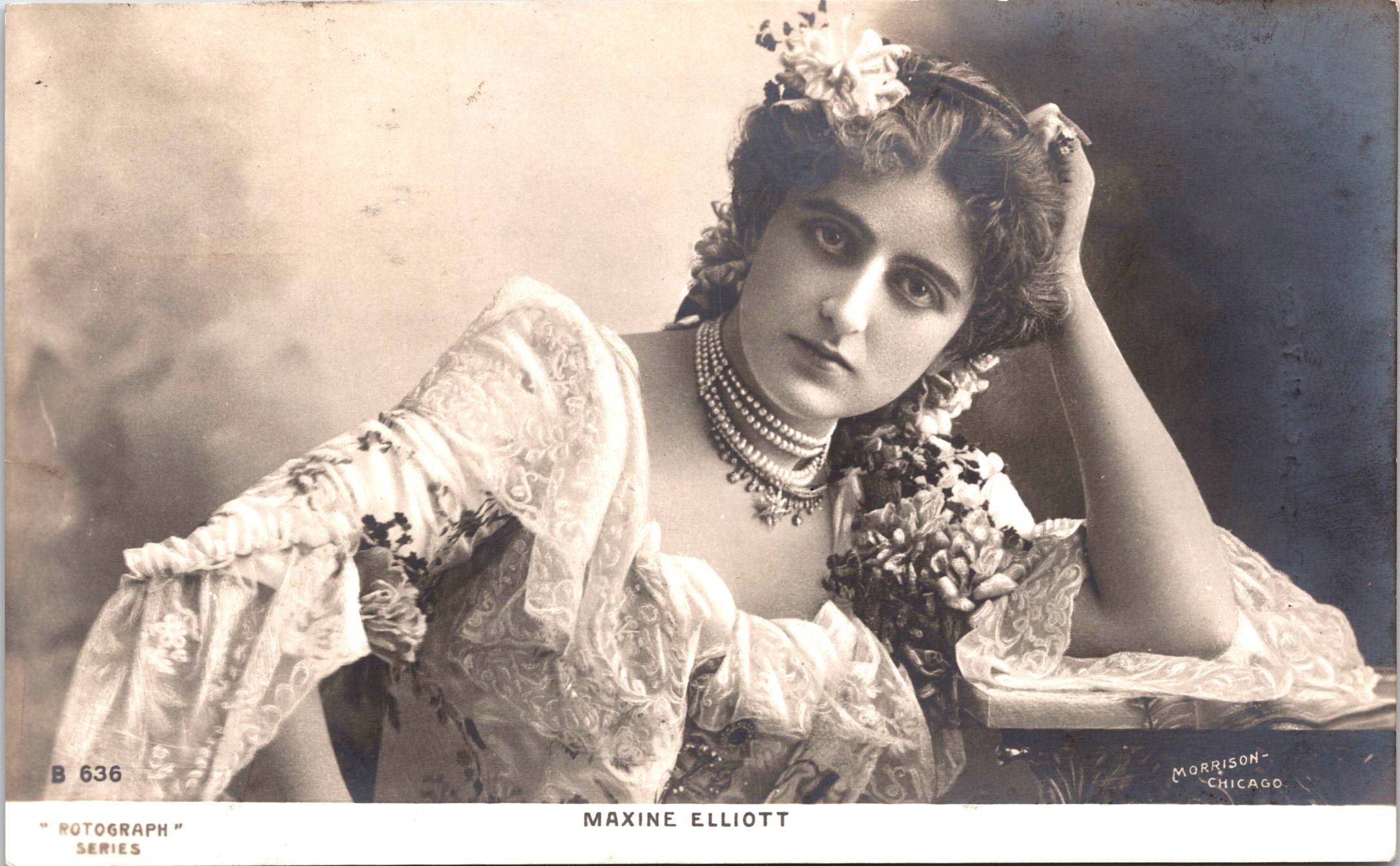
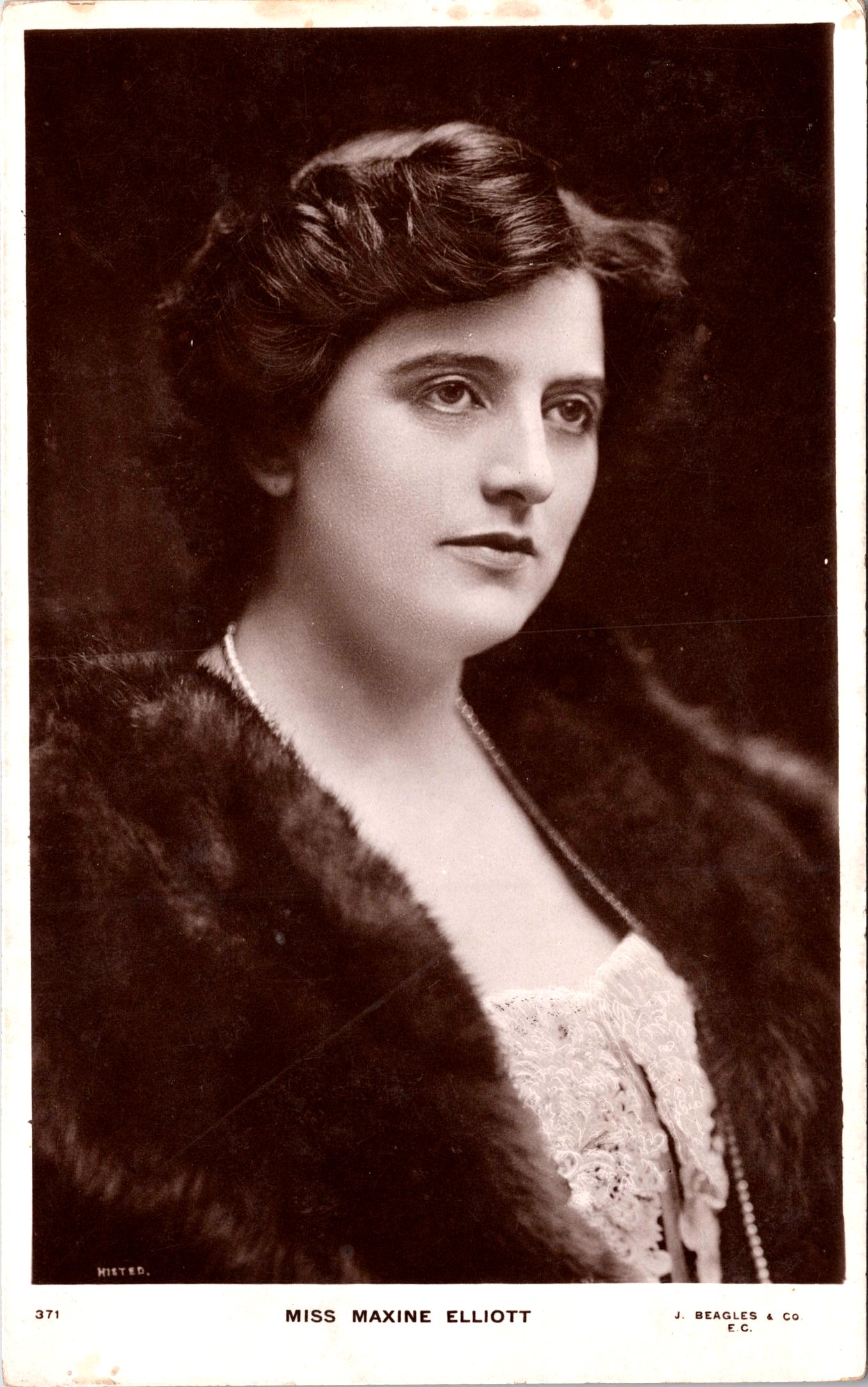
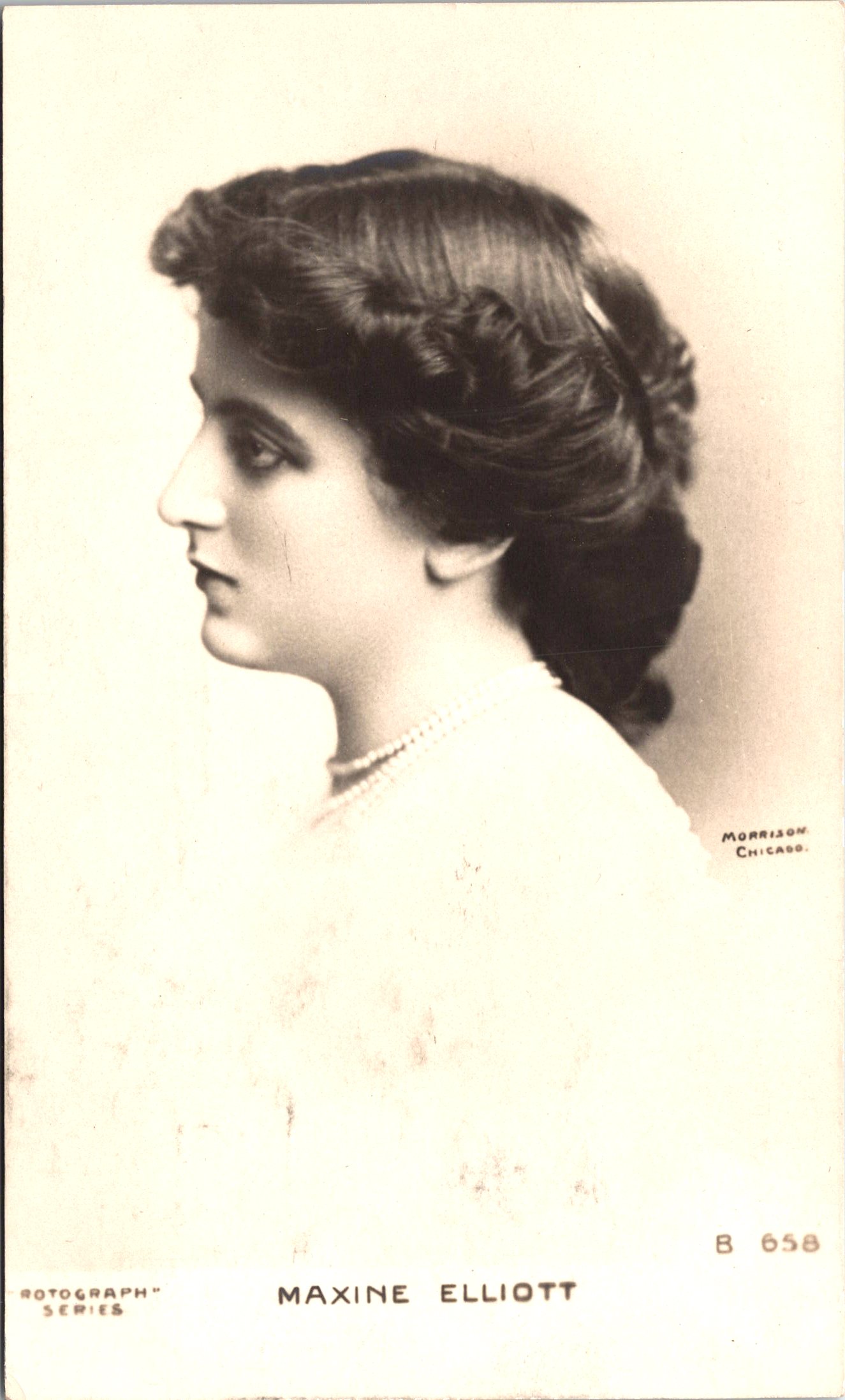
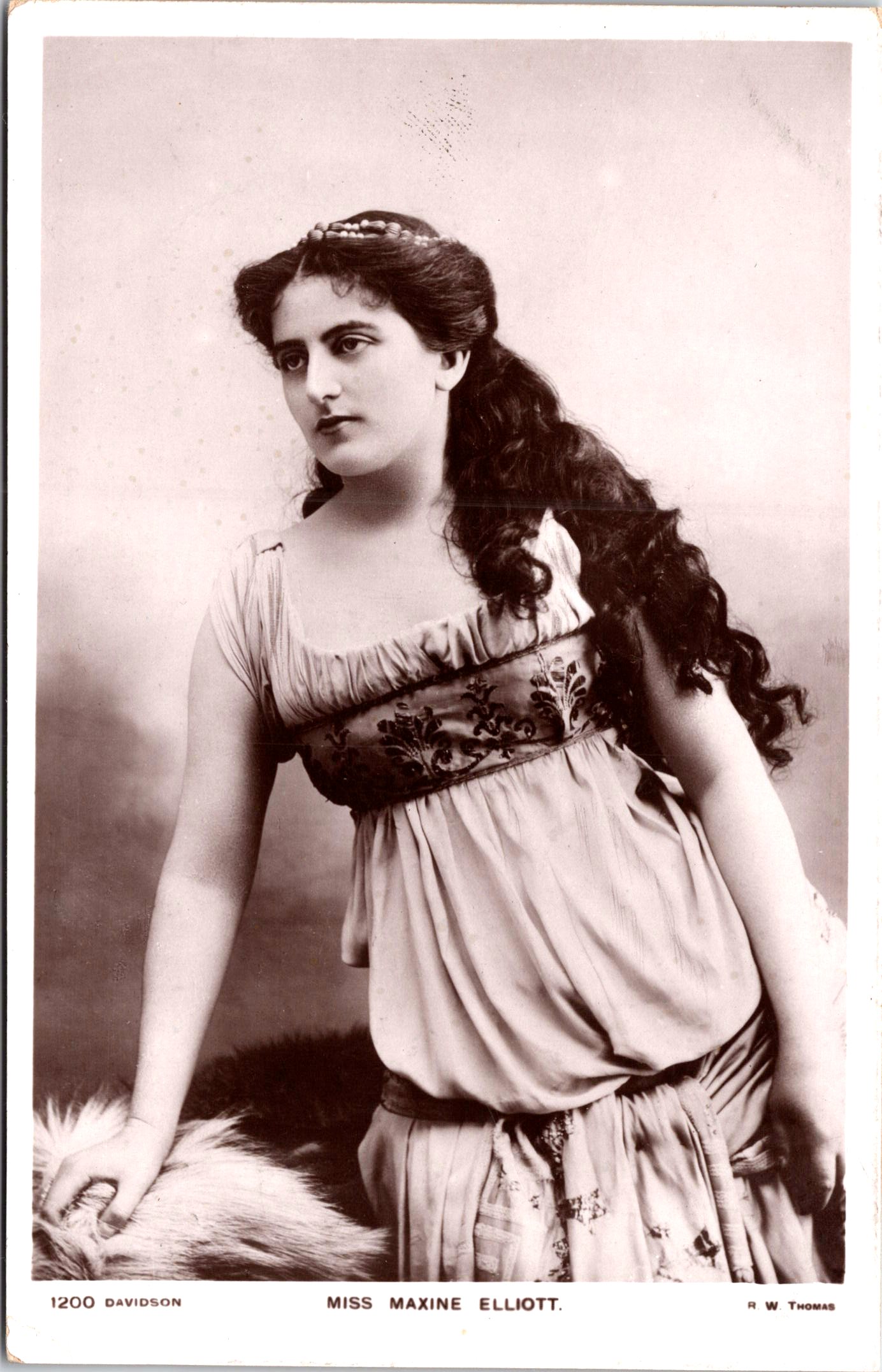
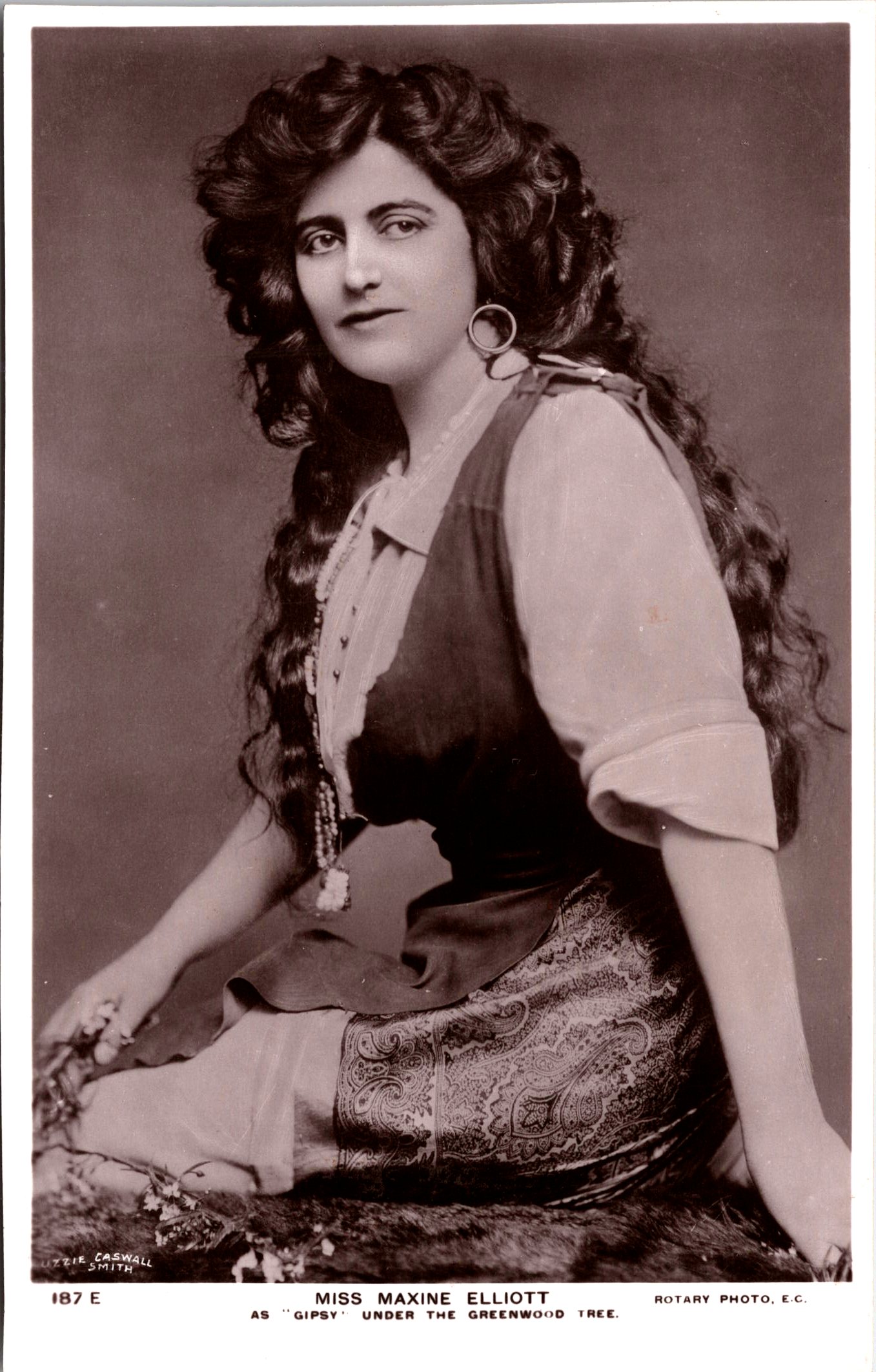
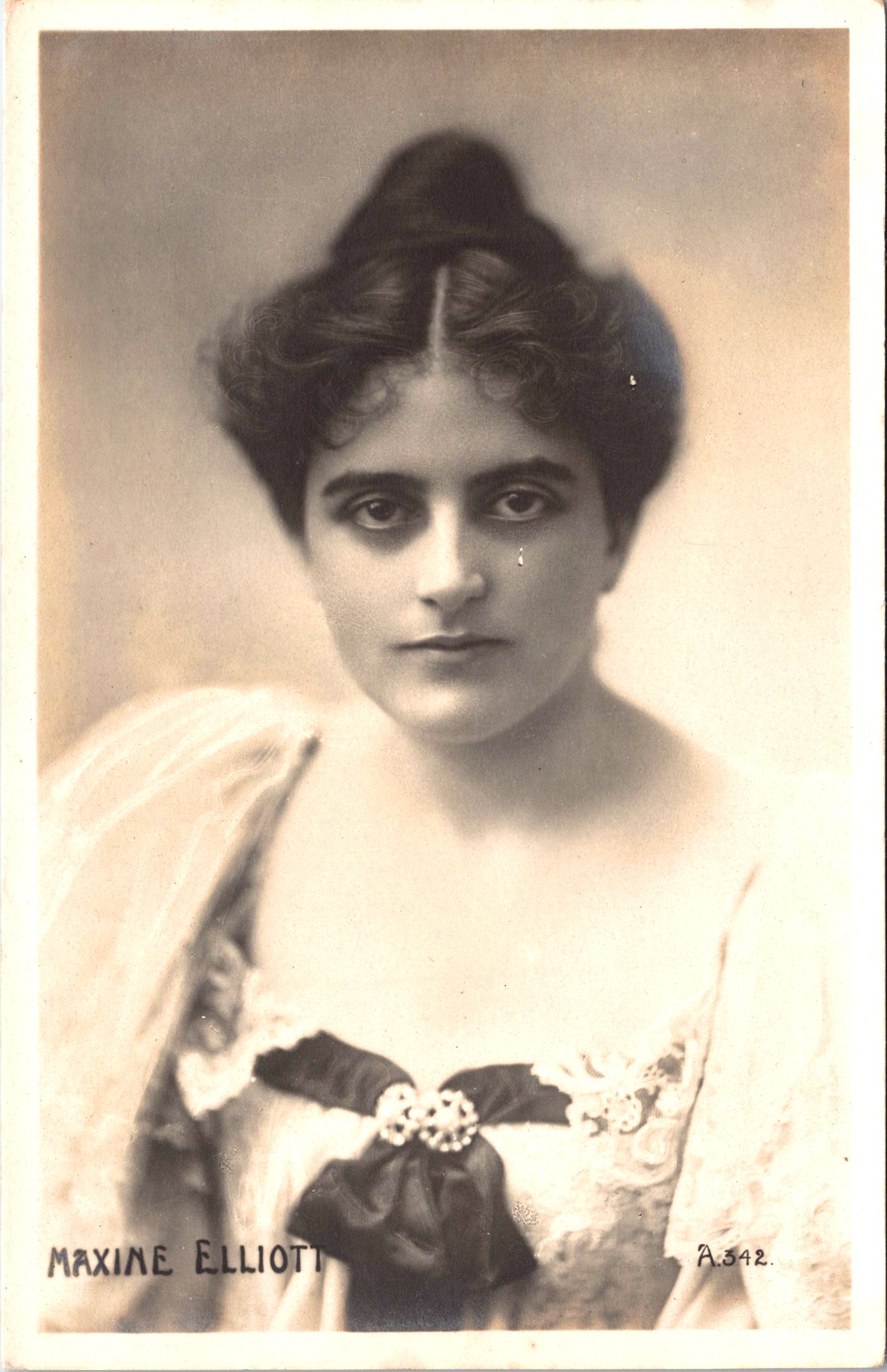
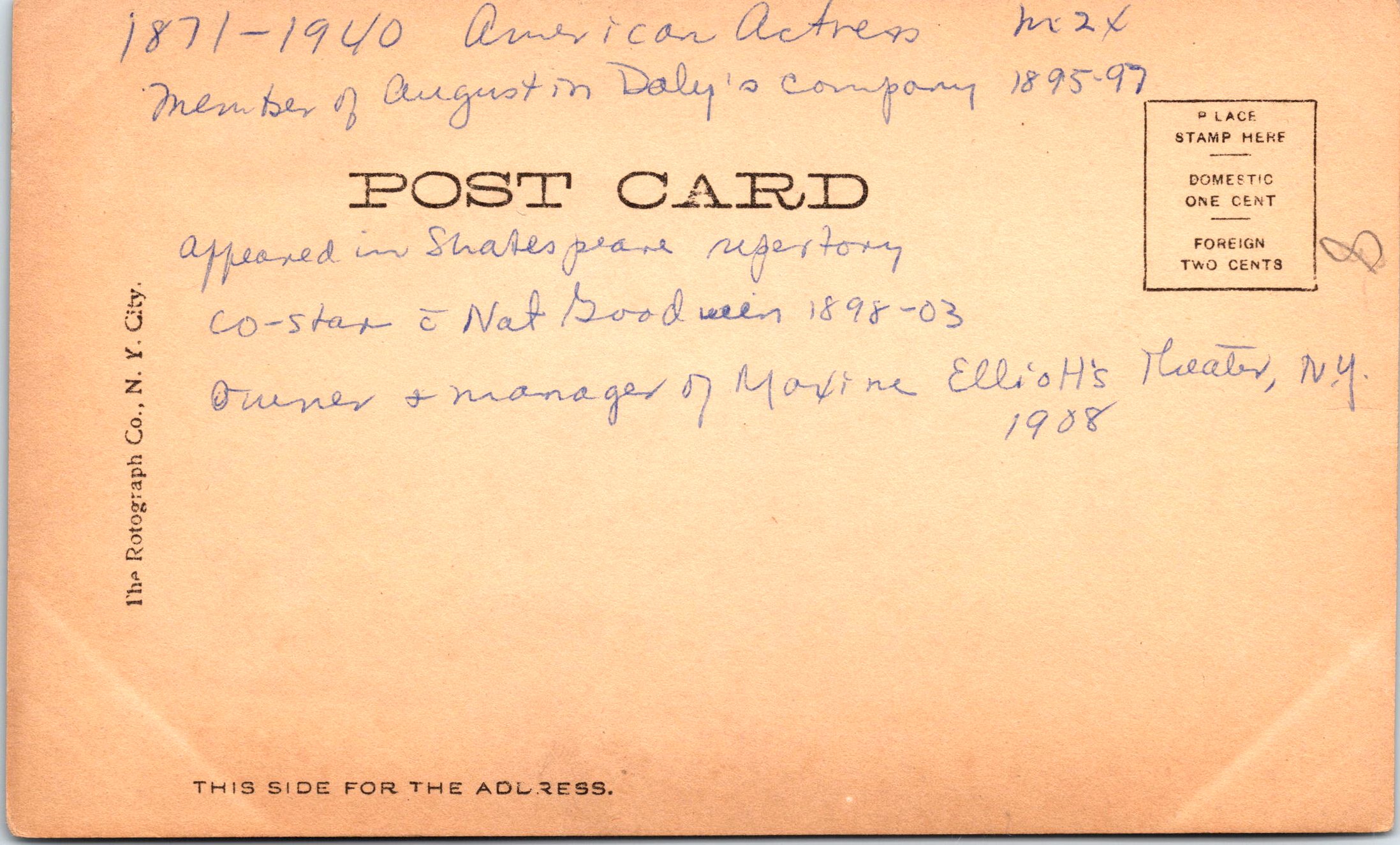
This vintage real photo postcard (Postcard 1) features a portrait of beautiful stage and film actress, and businesswoman, Maxine Elliott (1868-1940). Her photograph was taken by celebrity photographer Benjamin Falk at his New York City studio. Elliott was more than a stage actress. She managed her own theater and experimented with silent films in the 1910’s. Elliott was an extremely popular actress. Apparently she was popular with the men too. It is thought that she had affairs with famous people including King Edward VII and J. P. Morgan. It is also reported that she dated baseball hall of famer, John Montgomery Ward and heavyweight champion Gentleman James Corbett. During World War I she was very involved with the cause for Belgian relief. Elliott was born in Rockland, Maine. Her father was a sea captain. She had at least three siblings including her sister Gertrude Elliott, who also became a successful actress. When Maxine was 15, she was seduced and impregnated by a 25 year-old man. She may or may not have married the man but it is known that she lost the baby. In 1890 she made her first stage appearance. Her big break came in 1895 when she was hired by Augustin Daly to be the supporting actress for the highly acclaimed actress, Ada Rehan. In 1898, after divorcing husband number one, she married comedian Nat C. Goodwin. The two starred together in a number of productions including “Nathan Hale” and “The Cowboy and the Lady”. In 1903, Maxine appeared in the Broadway production of “Her Own Way” (1903). The play launched Maxine into stardom. In 1905, the play went to London where King Edward VII requested an introduction to the pretty actress. They met and then rumors started about the pair having an intimate relationship. In 1908, Goodwin obtained a divorce from Elliott. This is about the time she met 70 year-old J. P. Morgan. They became friends and rumors of their romantic involvement were never confirmed. Financial advice from Morgan helped her become a wealthy woman. The same year as her divorce, she opened her own theater, “The Maxine Elliott” in New York City. She was both the owner and the manager. In fact, she was the only woman in the US, at the time, managing her own theater. In regard to acting on Broadway, Elliott had an extensive resume. She appeared in 22 Broadway productions between 1894 and 1920. In 1913, she began acting in silent films. The IMDb reports that she was in five films including “From Dusk to Dawn” (1913), “Fighting Odds” (1917), and “The Eternal Magdalene” (1919). In 1913, Elliott went to England and started dating tennis star Anthony Wilding, fifteen years her junior. According to one source, the pair planned to marry, but he was killed in action in World War I. As a result, Elliott became obsessed with the war and moved to Belgium where she volunteered her money and time toward Belgian relief. It is reported that she also nursed wounded soldiers. Belgium recognized her by awarding her the Belgian Order of the Crown. Elliott retired from the stage in 1920. She stated that she “wished to grow middle-aged gracefully”. This postcard portrait features a young and beautiful Maxine Elliott. This image is a beautiful remnant of turn of the century theater history. This postcard was published by the Rotograph Company which was based in New York City. The postcard is part of a series (No.B888). SOLD

Postcard 2 features a photograph taken by female celebrity photographer, Lizzie Caswall Smith. Lizzie Caswall Smith (1870-1958) was a British photographer who operated in the early 1900’s. She specialized in photographing members of society and celebrities. Many of her photographs were used for postcards. She was involved in the Women’s Suffrage movement and photographed many of the leading suffragettes. She also photographed many actors including Billie Burke and Maude Fealy. She operated the Gainsborough Studio from 1907 through 1920 (309 Oxford Street) and moved to a new location (90 Great Russell Street) where she remained until she retired in 1930 at the age of 60 years-old. Her most famous photograph is a portrait of Florence Nightingale taken in 1910. It was auctioned in 1908 and sold for 5500 pounds which is an equivalent today of nearly 8,000 dollars. The National Portrait Gallery has 84 portraits associated with Lizzie Caswall Smith. This postcard was published by the Rotograph Company which was based in New York City. The postcard is part of a series (No.B636). SOLD

Postcard 3 features a nice portrait of Maxine Elliott. This image, taken by William Morrison (Chicago, Illinois) is a beautiful remnant of turn of the century theater history. This postcard was published by the Rotograph Company, which was based in New York City. The postcard is part of a series (No.B636).  (SOLD)

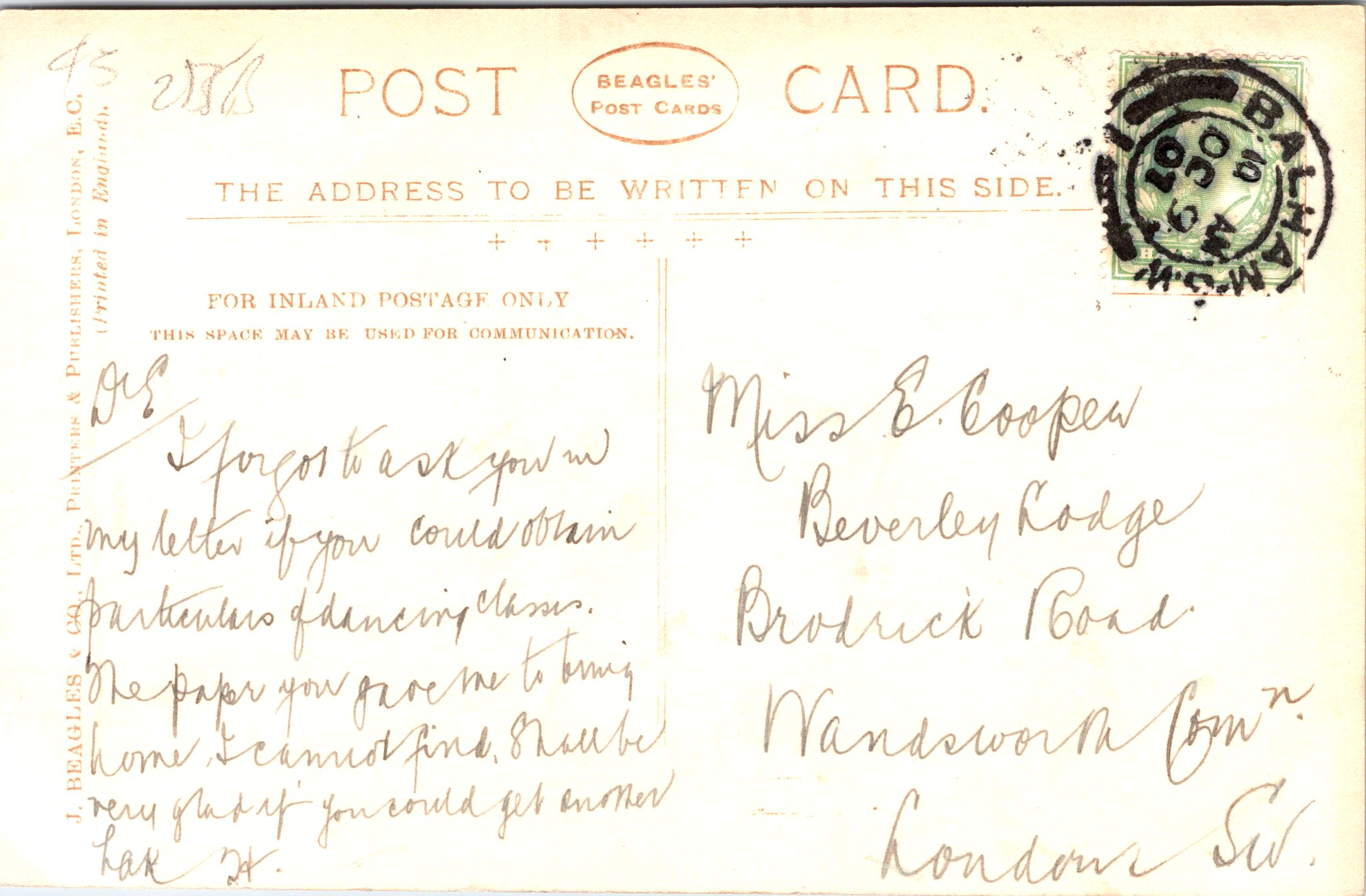
Postcard 4 features Miss Elliott’s portrait by Ernest Walter Histed (1862-1947). Histed was born in England but achieved his success as a photographer in Chicago, and later, in Pittsburgh. He then returned to England and opened a photography studio there. His subjects there included Clara Butt (Opera Star) Pope Pius X, and the Empress of Germany. Histed returned to the US and opened a studio on Fifth Avenue in New York City. He later moved to Palm Beach, Florida and continued his profession until 1934. The Museum of the City of New York has a large collection of his work. The National Portrait Gallery (England) has 32 of his photographs in their collection. This postcard was published by London’s J. Beagles & Co. as part of a series (No. G386).The company was started by John Beagles (1844-1909). The company produced a variety of postcards including an extensive catalog of celebrity (stage and screen) portrait postcards. After Beagle’s death, the business continued as J. Beagles & Co. until it closed in 1939.  (SOLD)

Postcard 5 comes from the studio of celebrity photographer, William McKenzie Morrison of Chicago, Illinois. Morrison’s studio was in the Haymarket  theater building. This postcard was published by the Rotograph Company which was based in New York City. The postcard is part of a series (No.B658).  (SOLD)

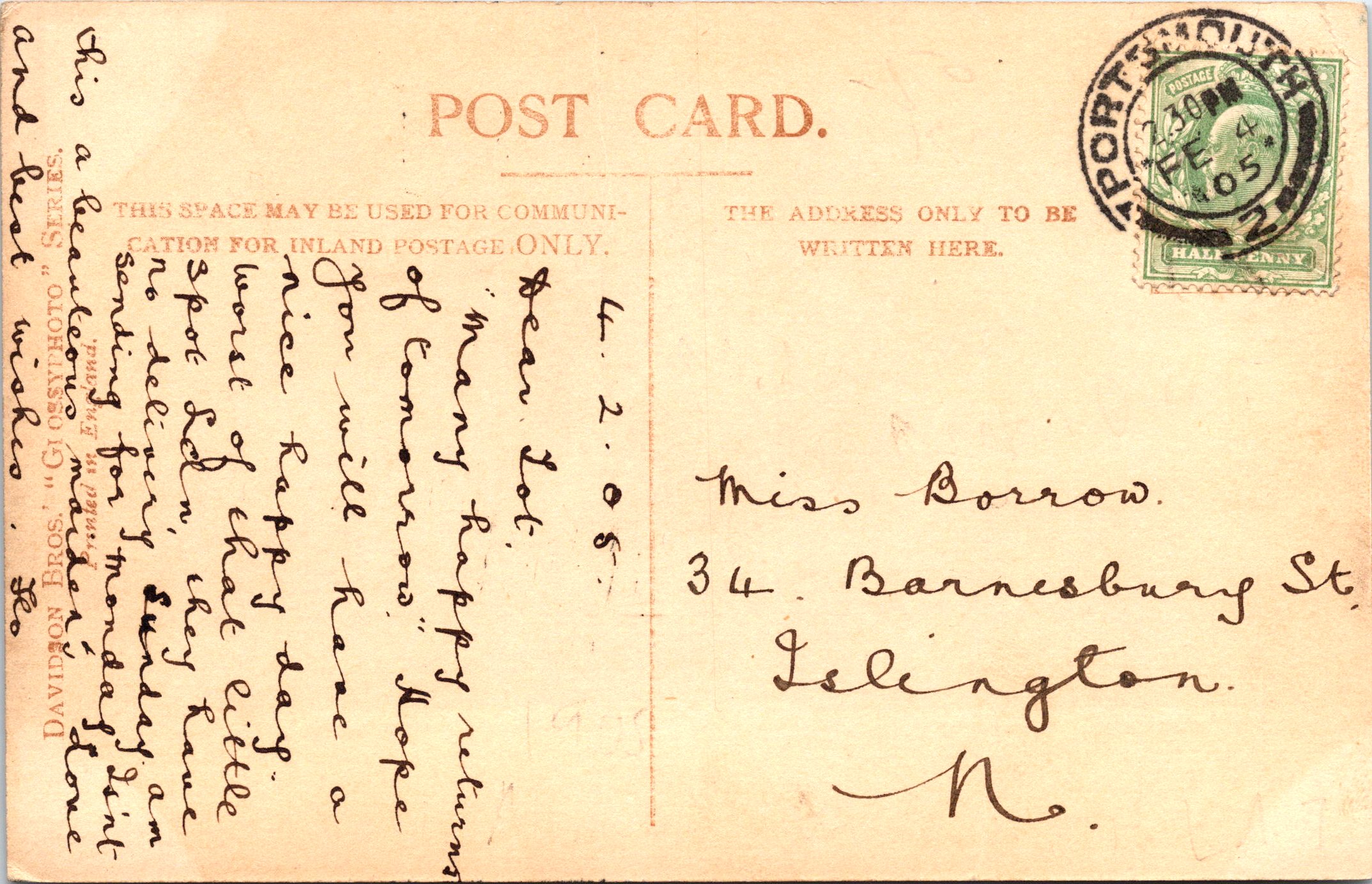
Postcard 6 features a pretty portrait of Miss Elliott taken by R. W. Thomas.  It is likely that he is the same man that authored “The Modern Practice of Photography” (1927).This postcard was published by London’s Davidson Bros. as part of a series (No.1200). The message from the sender of this card introduced me to a new word. The writer asks “Isn’t this a beauteous maiden?”. I looked up the word “beauteous” to see if it existed. I learned that the word exists and means “beautiful”. I also learned that “Beauteous” is a word that is customarily used in literature and not conversation. (SOLD)

Postcard 7 Elliott photrographed in costume for her role as Gipsy in “Under the Greenwood Tree”. Her photograph was taken by famed celebrity female photographer, Lizzie Caswall Smith. This image is a beautiful remnant of turn of the century theater history. This postcard was published by Rotary Photo as part of a series (No.187E).  (SOLD)

Postcard 8 was published by London’s Ralph Dunn & Co. as part of a series (No. A342). (SOLD)

POSTCARD 1 (SOLD)

POSTCARD 2 (SOLD)

POSTCARD 3 (SOLD)

POSTCARD 4 (SOLD)

POSTCARD 5 (SOLD)

POSTCARD 6 (SOLD)

POSTCARD 7 (SOLD)

POSTCARD 8 (SOLD)

VIRGINIA EARL : STAGE ACTRESS : PROLIFIC ON BROADWAY : VAUDEVILLE : PHOTO BY BENJAMIN FALK : CABINET CARD

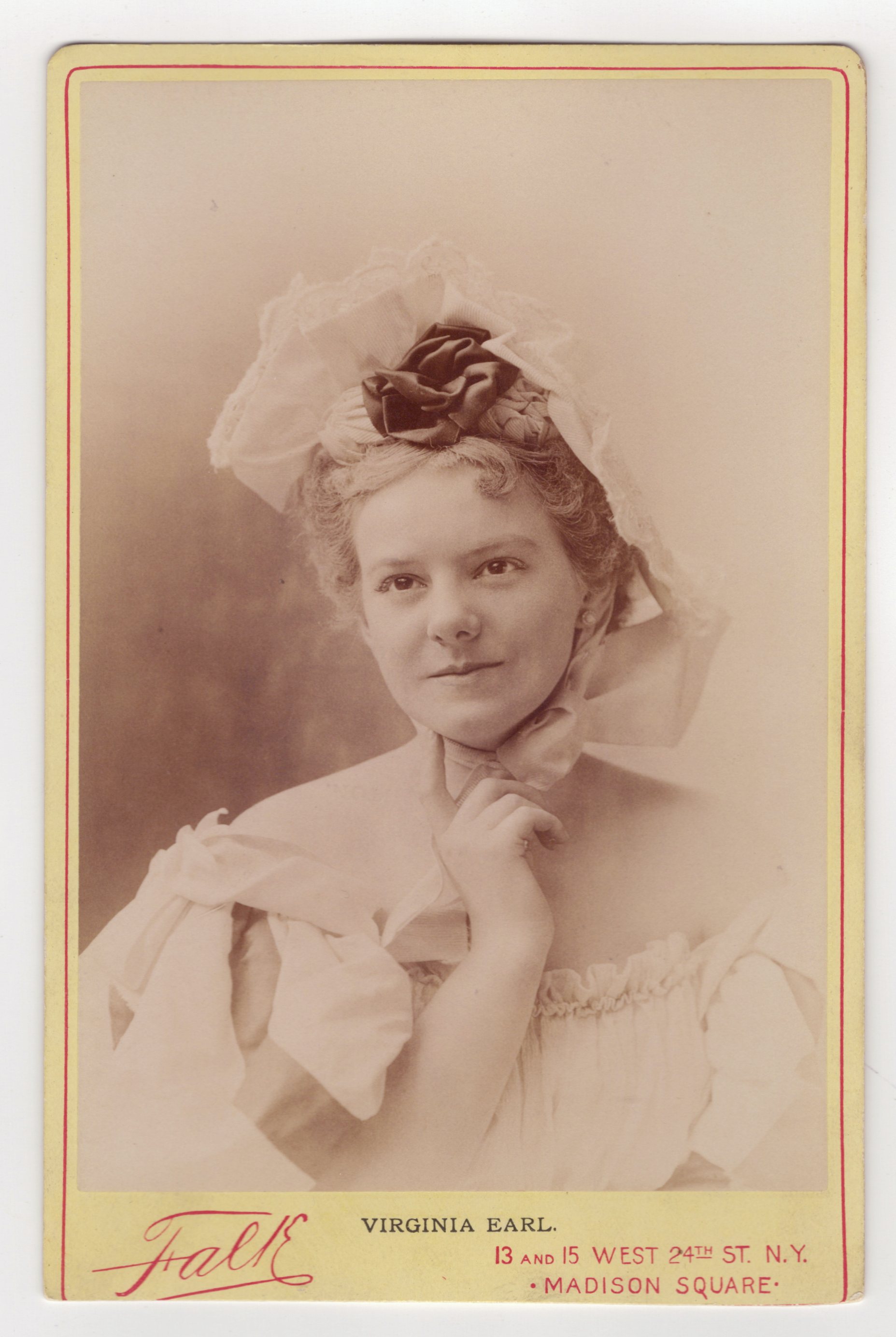
This cabinet card photograph features American stage actress, Virginia Earle (1873-1937). Much of her work was in light operas, musical comedies, and vaudeville. Earle was born in Cincinnati, Ohio. Her parents were Irish immigrants. She made her stage debut in 1887. She had a role in Gilbert and Sullivan’s “The Mikado” produced by the Juvenile Opera Company. She played in several of their productions. Earle then joined a touring company of the Pike Opera Company. When in San Francisco, she was hired by a vaudeville company where she performed for two seasons. She next went to Australia with a performing company. She was identified with Augustin Daly’s Edwardian musical comedies for many years. The musicals included “The Circus Girl” and “A Runaway Girl”.  Earle played in eleven Broadway production between 1899 and 1910. Earle was a “chronic” robbery victim. She captured one of the thieves. Earle was walking along Sixth Avenue (Manhattan) and saw a woman wearing one of the cloaks she wore in the production of “The Merry World”. Earle grabbed the woman and screamed for help. Eventually the woman was tried and acquitted. The woman’s husband claimed to have found the cloak and he was judged credible. In 1894, Earle married Frank Lawton, an actor and comedian. She divorced him in 1899. Earle’s photo portrait seen on this cabinet card, was taken by celebrity photographer, Benjamin Falk. Falk operated a studio in New York City. This photograph was likely taken in the late 1880’s or early 1890’s. The cabinet card has a slight curl and is in overall good condition. See Scans. 

6268

Buy this Cabinet Card Photograph (includes shipping within the US) #6268

To purchase this item, click on the Pay with PayPal button below

$39.95

6268

Buy this Vintage Original Cabinet Card (includes International shipping outside the US) #6268

To purchase this item, click on the Pay with PayPal button below

$49.95

MRS JAMES BROWN POTTER (SOCIALITE AND THEATRE ACTRESS)

CABINET CARD 1  (SOLD)

CABINET CARD CARD 2


BROWNPOTTER_0008CABINET CARD 3

In writing about Mrs James Brown Potter, an author stated “She was singularly beautiful with her pale delicate chiseled face, long dark eyes, and hair like burnished bronze with copper lights”. Mrs Brown Potter (1859-1936) was born Mary Cora Urquhart,  the daughter of a wealthy  New Orleans Colonel. She was one of the first American society women to join the stage. In 1877 she married a very wealth New York socialite, James Brown Potter. That same year she made her stage debut at Theatre Royal in Brighton, England. Soon thereafter, she partnered with actor Kyrle Bellew and they frequently performed together over a ten year period. She performed in the United States and in Europe. She retired from the stage in 1912. She was active in raising money for war charities during the Second Boer War. Mrs Brown Potter was considered a competent actress, but not an outstanding performer.

In the Cabinet Card 1 photograph, Mrs. Potter looks very beautiful as she peers through a curtained doorway. Her gown was likely made by the best dress makers of the time and was assuredly very expensive. Falk, the photographer of this cabinet card, was a famous celebrity photographer in New York City. To see other photographs by Falk, click on the category “Photographer: Falk”.  (SOLD)

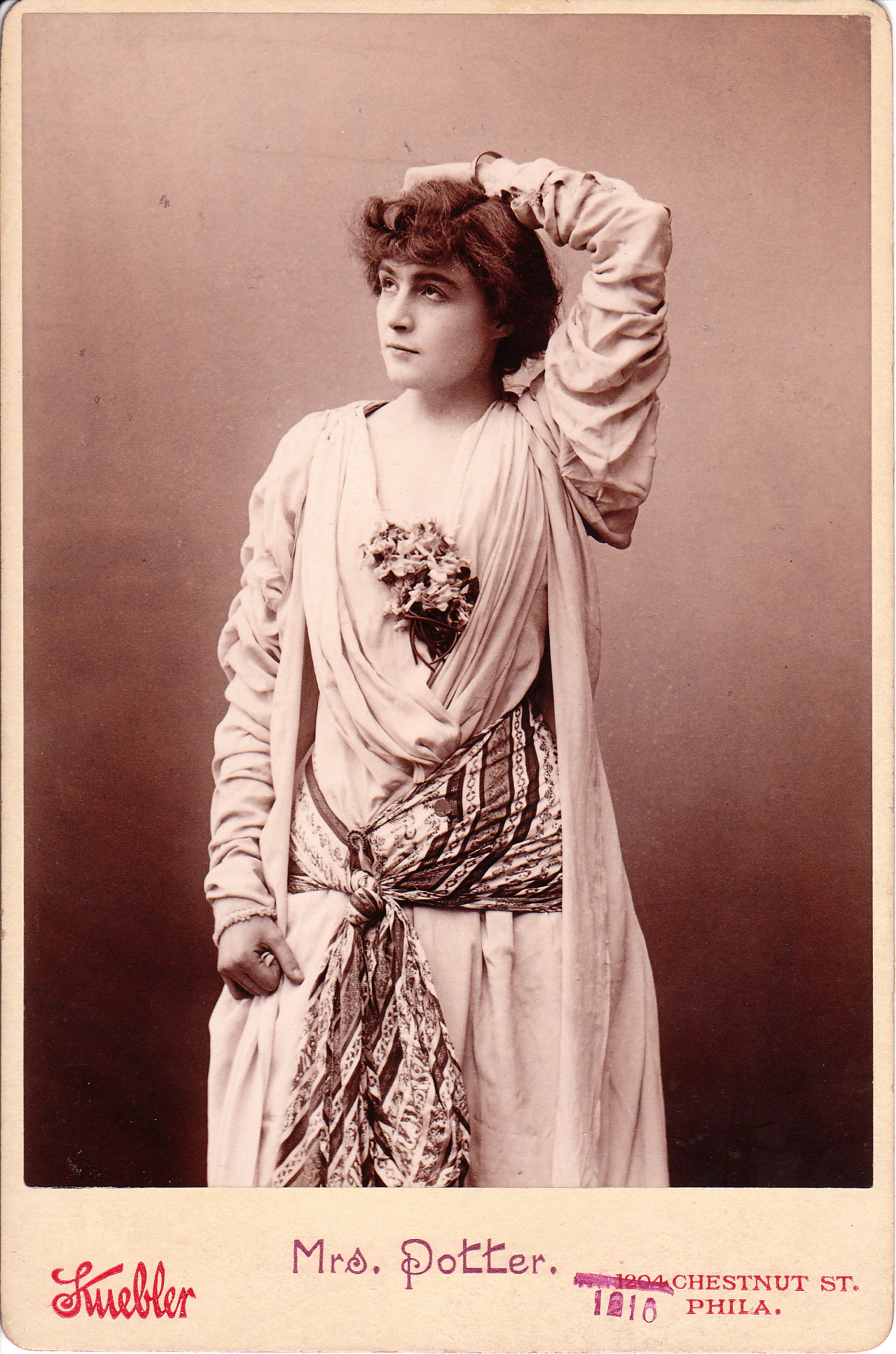
The Cabinet Card 2 photograph of Cora Potter was photographed by Kuebler of Philadelphia, Pennsylvania. She appears to be in costume and is clearly a beautiful woman with fetching eyes. To view other photographs by and to learn more about Kuebler, click on the category “Photographer: Kuebler”.

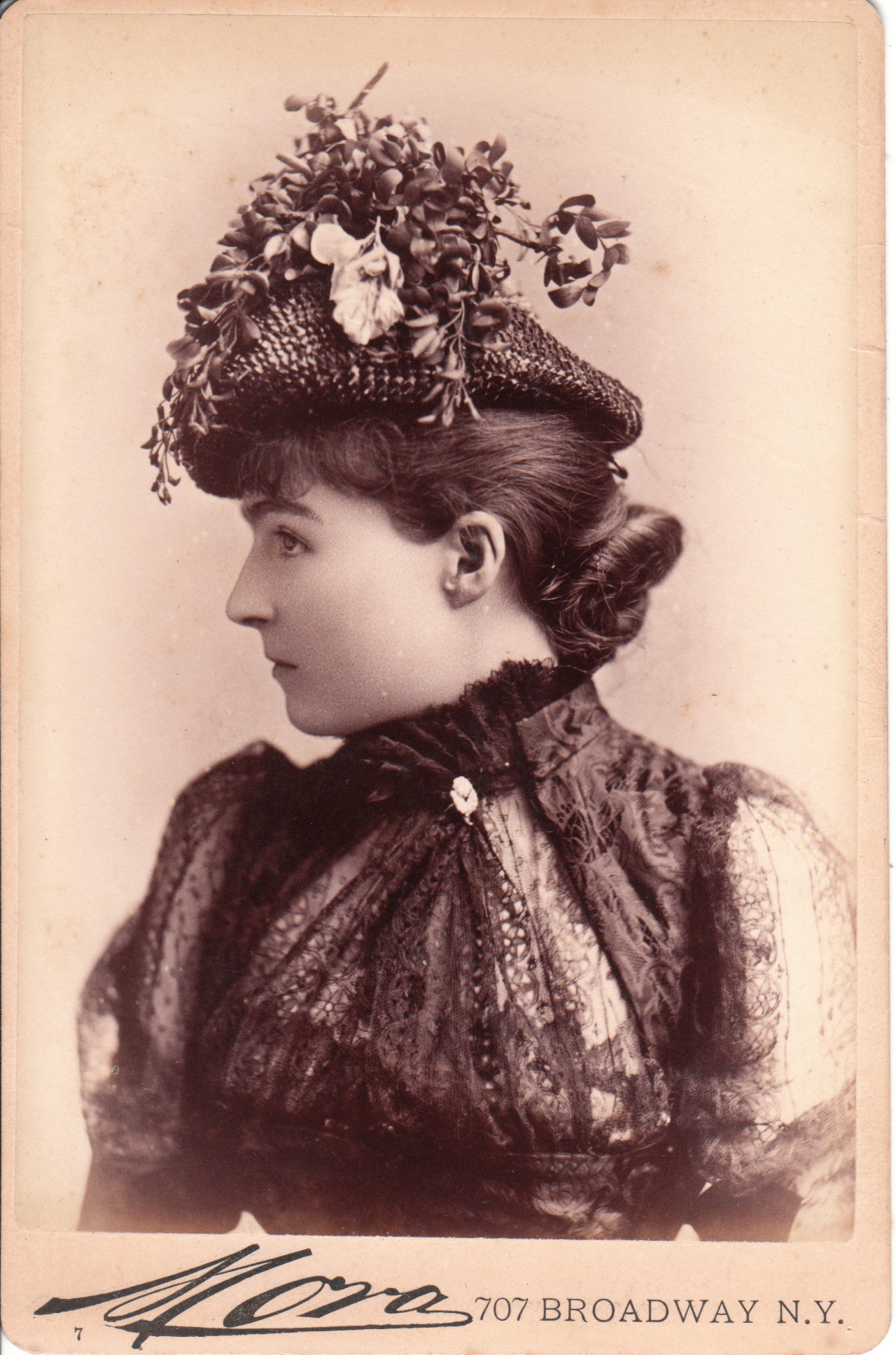
The Cabinet Card 3 photograph of Mrs Potter was produced by Jose Maria Mora, a celebrity photographer based in New York City. The image was part of a series (#7). To view other photographs by this photographer, click on the category “Photographer: Mora”. Mrs Potter looks quite elegant in this cabinet card portrait. Her hat can best be described as “floral”. The photograph is stamped on the reverse with the name of the gallery that originally sold it (“John Hoch Art Store, 118 Court Street, Boston”). Hoch’s obituary appears in the Bulletin of Photography and the article reports that he was the first among Boston’s photographers to sell photographs of celebrities. He had been engaged in the photography and picture frame business in Boston for more than fifty years. The obituary mentions that he was of German heritage and was 84 years old at the time of his death. His cause of death was cerebral hemorrhage.

FFOLLIOTT PAGET : ENGLISH STAGE ACTRESS : PHOTO BY BENJAMIN FALK : BROADWAY : RARE CABINET CARD

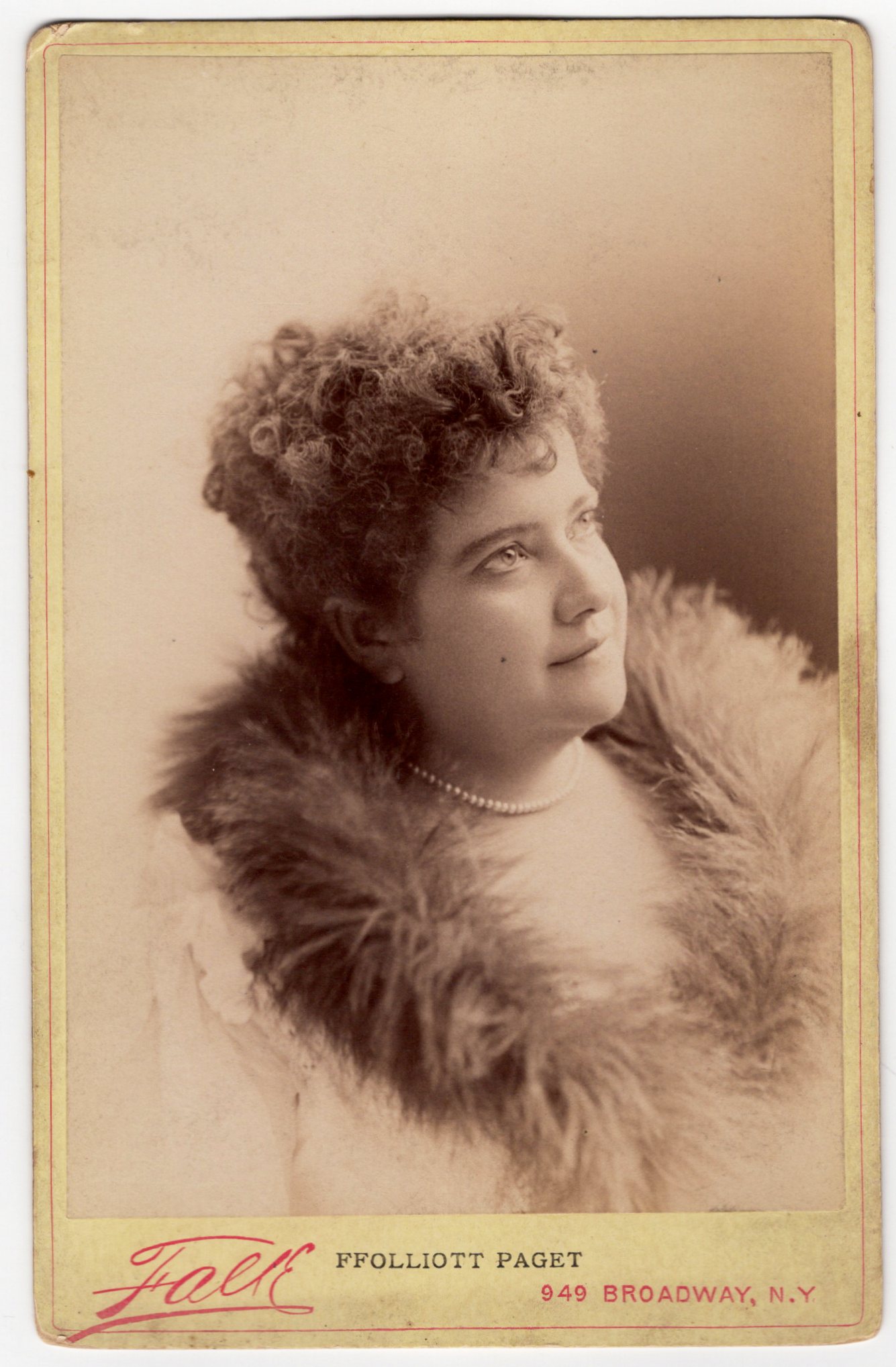
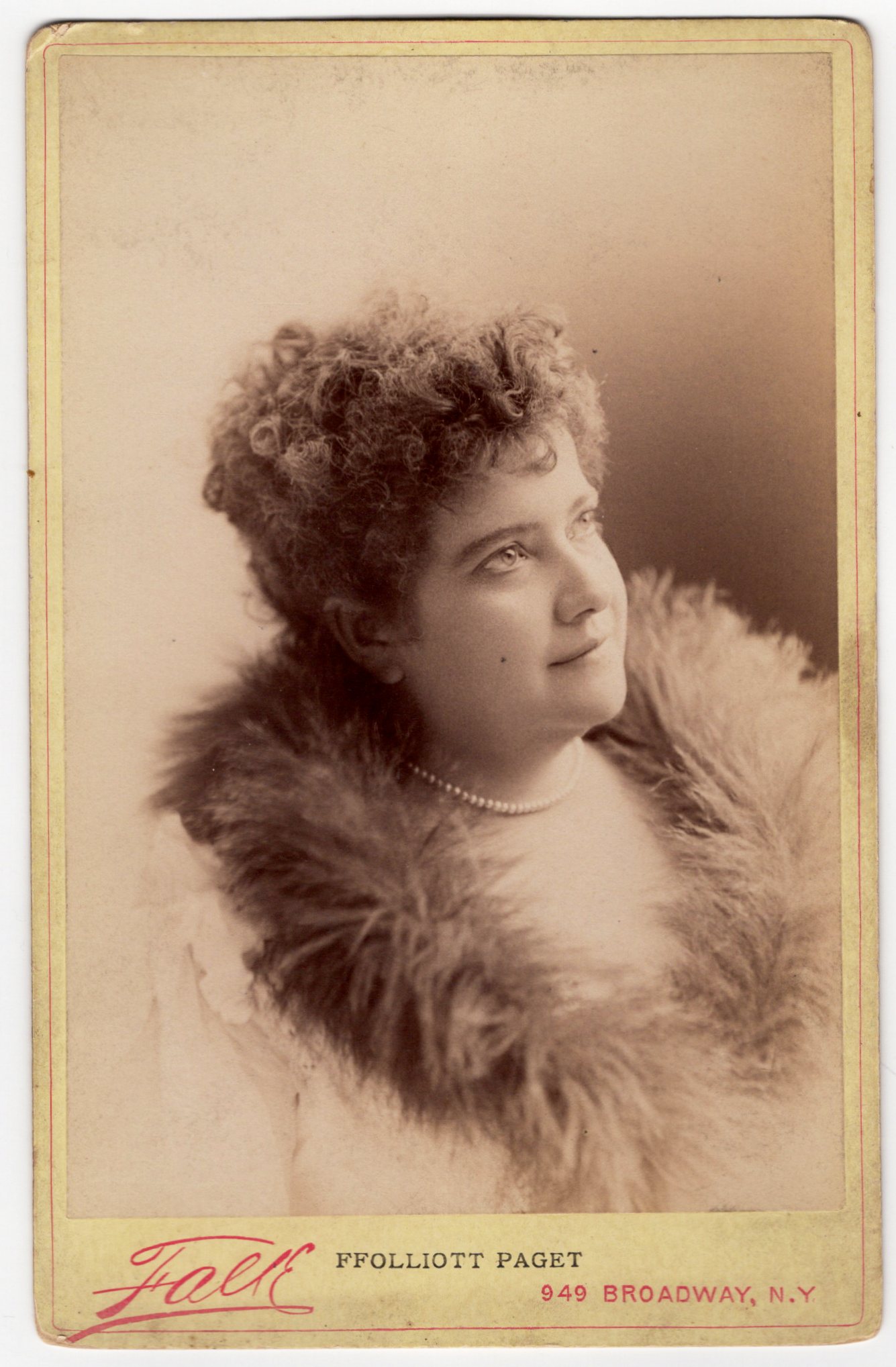
Benjamin J. Falk, New York City theatrical photographer, produced this cabinet card portrait of English actress FFolliott Paget. She is dressed to look her best; wearing pearls and a fur coat. Ms Paget appeared in fourteen Broadway plays including “What Every Woman Knows” ((1908-1909) and “The Rivals” (1912). This cabinet card has an extremely minor curl, corner wear (top left), and is in overall  good condition (see scans). Cabinet Card photographs of Ffolliott Paget are very uncommon. 

5896-1

Buy this Cabinet Card Photograph (includes shipping within the US) #5896

To purchase this item, click on the Pay with PayPal button below

$36.00

5896-3

Buy this Vintage Original Cabinet Card (includes International shipping outside the US) #5896

To purchase this item, click on the Pay with PayPal button below

$46.00

Published in: on January 26, 2024 at 12:00 pm  Comments (2)  
Tags: , ,