EDWIN BOOTH : RENOWNED STAGE ACTOR : BY GEORGE ROCKWOOD : UNCOMMON CABINET CARD

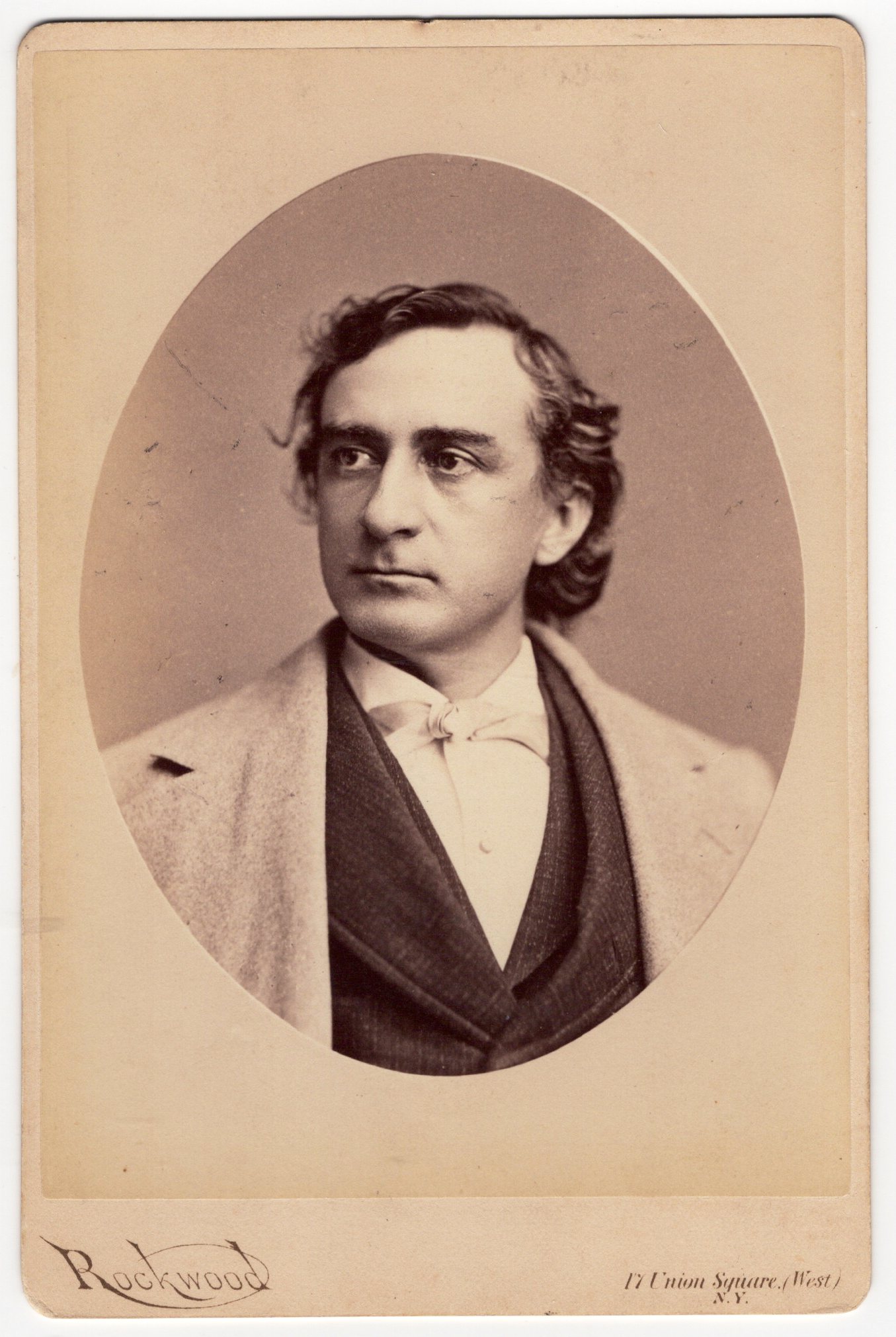
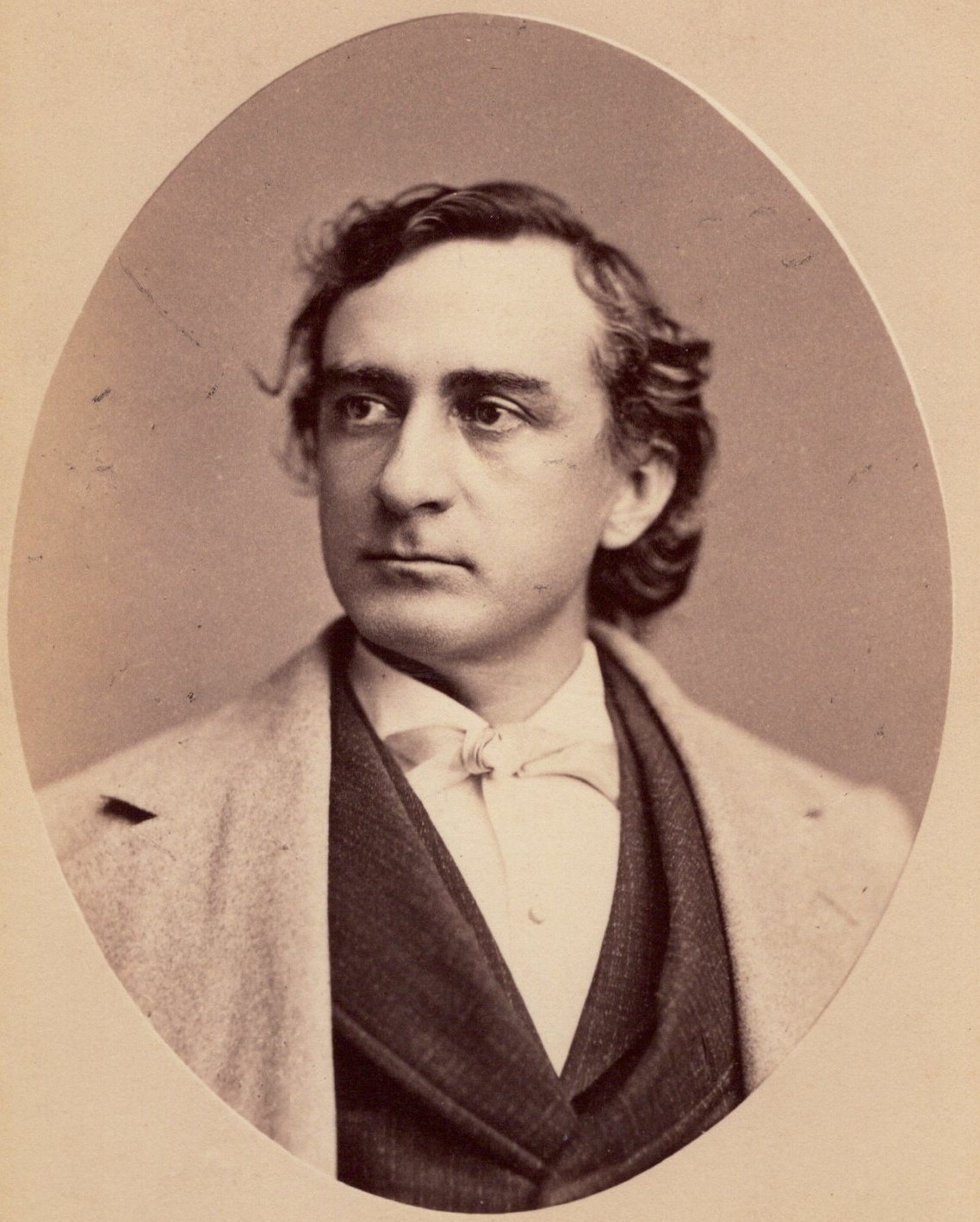
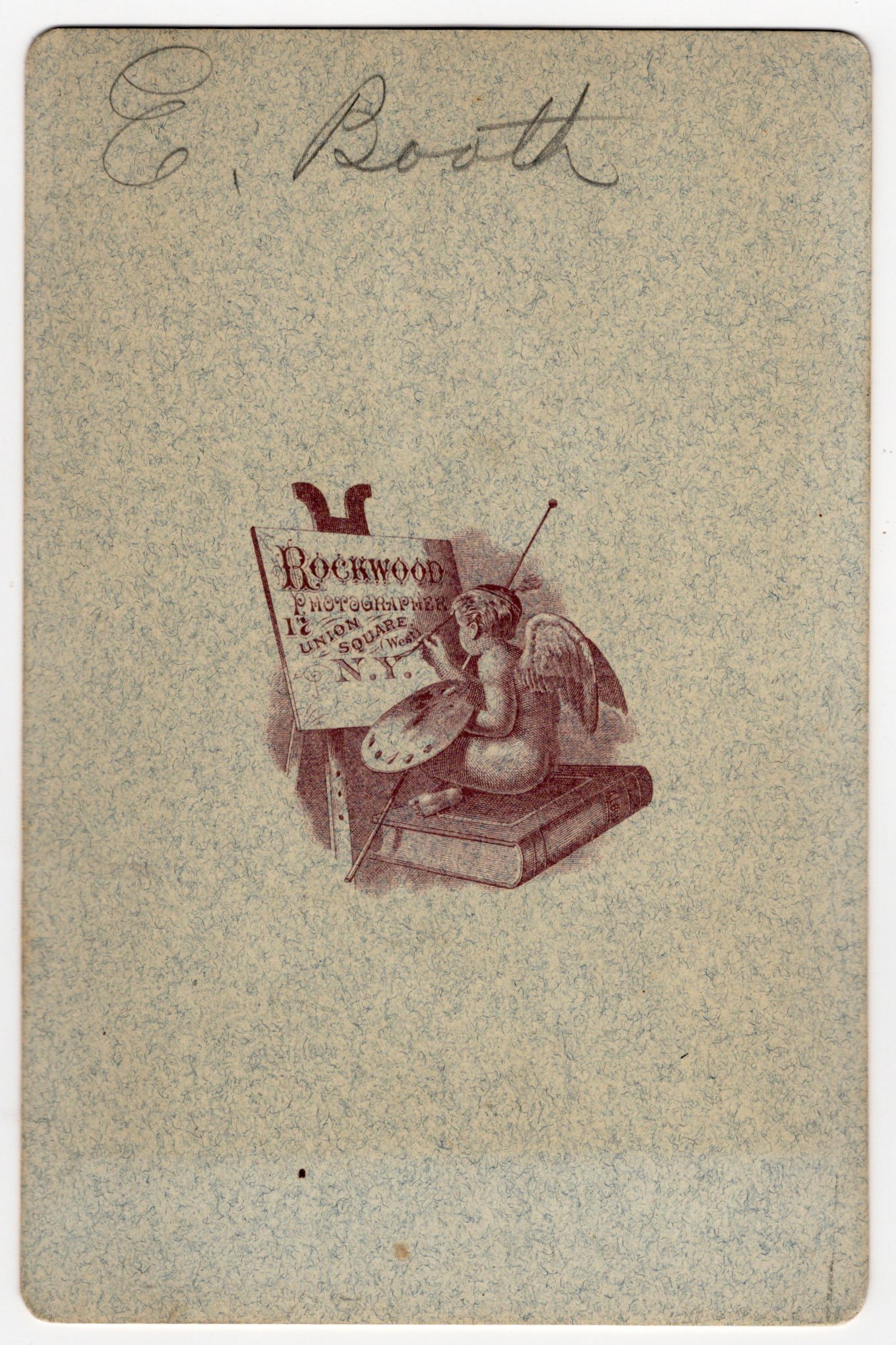
This stunning cabinet card portrait captures Edwin Booth, one of the most celebrated Shakespearean actors of the 19th century. Taken by renowned photographer George G. Rockwood of New York, the image boasts exceptional clarity and sharp detail, making it an outstanding example of 19th-century portrait photography. Booth is dressed in elegant period attire, featuring a high-collared white shirt with a neatly tied bow tie, a dark waistcoat, and a light-colored overcoat draped over his shoulders. His hair, swept back in soft curls, frames his distinguished face, exuding an air of quiet confidence and introspection. His gaze is directed slightly away from the camera, lending a dramatic and contemplative quality to the portrait—a fitting expression for a man known for his deep and emotional performances on stage. The cabinet card is in very good condition, with minimal signs of wear, and the sepia tones remain rich and well-preserved. The reverse of the card is equally impressive, featuring Rockwood’s distinctive studio imprint, which includes a charming illustration of a cherub holding a painter’s palette and brushes, next to an artist’s easel that advertises the Rockwood studio at 17 Union Square (West), New York. Additionally, there is an inscription at the top that reads: “E. Booth,” a reference to the legendary actor. Edwin Booth (1833–1893) was one of the greatest American actors of the 19th century, best known for his Shakespearean roles, particularly Hamlet, which he performed more than 100 times—an unprecedented feat at the time. His extraordinary talent and deep emotional connection to his roles earned him widespread acclaim in both America and Europe. Despite his artistic triumphs, Booth’s life was forever overshadowed by his brother’s infamous act—John Wilkes Booth’s assassination of President Abraham Lincoln in 1865. The tragedy devastated Edwin, who was a staunch Unionist and had publicly opposed his brother’s views. He briefly retired from the stage but later returned, determined to restore his family’s name through his craft. In 1888, he founded The Players Club in New York City, a private social club for actors, which still exists today. The Booth family was a dynasty of performers—Edwin’s father, Junius Brutus Booth, was an acclaimed English actor, and his brothers, John Wilkes Booth and Junius Brutus Booth Jr., also pursued theatrical careers. However, Edwin’s talent and legacy far outshone the rest of his family, cementing his place as one of America’s greatest classical actors. The photographer of Mr. Booth was George Rockwood (1832-1911). He was a renowned photographer whose studio was located in New York City. Rockwood was born in Troy, New York and graduated from college with a PhD, reportedly either from the University of Chicago, or Columbia University. At 21 years of age, he was a newspaper reporter for the Troy Daily Times and at age 23, he was managing editor of the Troy Daily Post. He began working as a photographer in St. Louis and in 1857 opened a studio with his brother Elihu in New York City. He has been credited with bringing CDV’s to America. His obituary in the Washington Post reports that Rockwood photographed  more than 350,000 people. SOLD
MAUD HARRISON : STAGE ACTRESS : BROADWAY : CABINET CARD

This cabinet card was photographed by George Rockwood (1882-1911) whose studio was located at 17 Union Square West in New York City. The reverse of the card identifies the subject of this portrait as Maud Harrison (c1856-1907). I have verified that this is indeed Maud Harrison. The corseted Miss Harrison is attractive and wearing a hat, a flower in her hair, and a cross. She is also wearing what appears to be wrist bands. The purpose of these bands beyond fashion, is unknown. Maud Harrison began her career at the Madison Square Theater. The IBDb reports that she appeared in five Broadway plays between 1877 and 1900. These productions include “Pink Dominos” (1877), “French Flats” (1880), and “Naughty Anthony” (1900).The New York Times reports Harrison’s death in 1907. She was found unconscious by a maid in her New York City hotel room. She died shortly after being discovered. Her cause of death was determined to be “Paralytic Stroke”. She had stopped acting in 1902 to care for her sick mother. She was in New York attempting to find a theatrical role to restart her career. For some reason, the Times reports that Miss Harrison was a Christian Scientist. This cabinet card’s photographer, George Rockwood was born in Troy, New York. He graduated from college with a PhD; reportedly either from the University of Chicago, or Columbia University. At 21 years of age, he was a newspaper reporter for the Troy Daily Times and at age 23, he was managing editor of the Troy Daily Post. He began working as a photographer in St. Louis and in 1857 opened a studio with his brother Elihu in New York City. He is credited for bringing CDV’s to America. His obituary in the Washington Post reports that Rockwood photographed more than 350,00 people. This cabinet card has foxing above Miss Harrison’s bust. SOLD

CLARA MORRIS: PRETTY AND BUSTY STAGE ACTRESS AND WRITER

clara

This cabinet card portrait features American stage actress Clara Morris (1849-1925). This photograph reveals that she was pretty and busty and appears to have enjoyed wearing gaudy jewelry. Note her earrings and collar pin. Clara Morris was born in Toronto, Canada and her real name was Morrison. She grew up in Cleveland, Ohio. She traveled to New York in 1870 as a member of Daly’s company. She was a sensation in L’Article 47 (1872) and acted in many other plays.  After 1885, she focused mostly on literary work. Her works included “A Silent Singer” (1899), “The LIfe of a Star” (1906), and “Dressing Room Receptions” (1911). In her book “Life on the Stage: My Personal Experiences and Recollections” (1911) she describes her meeting with John Wilkes Booth, the assassin of President Abraham Lincoln. This cabinet card was photographed by George Rockwood (1882-191) whose studio was located in New York City. Rockwood was born in Troy, New York and graduated from college with a PhD, reportedly either from the University of Chicago, or Columbia University. At 21 years of age, he was a newspaper reporter for the Troy Daily Times and at age 23, he was managing editor of the Troy Daily Post. He began working as a photographer in St. Louis and in 1857 opened a studio with his brother Elihu in New York City. He has been credited with bringing CDV’s to America. His obituary in the Washington Post reports that Rockwood photographed  more than 350,000 people. To view more photographs by Rockwood, click on the category “Photographer: Rockwood”.  SOLD

 
Published in: on October 26, 2014 at 8:22 am  Comments (2)  
Tags: ,

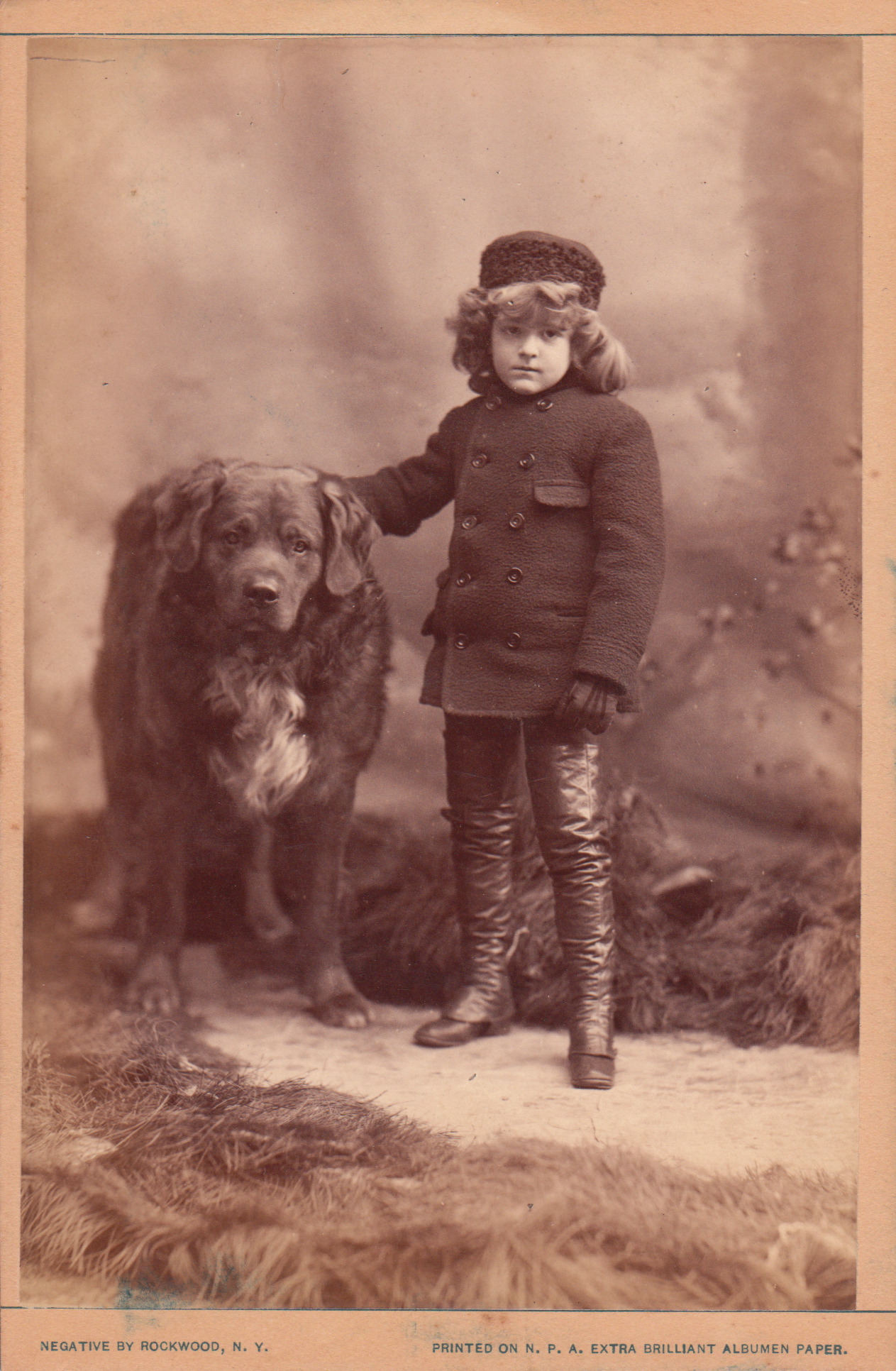
SMALL BOY AND HIS BIG DOG IN NEW YORK CITY, NEW YORK.

burmesedog_0005

A long haired and very well dressed young lad poses with his dog at the Rockwood studio in New York. The boy is wearing interesting leggings and a terrific hat. His dog appears to be a Burmese Mountain Dog but that is simply an uninformed guess. There is an unusual notation below the image; “Printed on N. P. S. extra brilliant albumen paper”. The photographer, George Rockwood of  New York City was a noted celebrity photographer. It is possible that the boy featured in this image may have been a child actor. To learn more about the photographer, click on the category “Photographer: Rockwood”.

Published in: on December 22, 2012 at 12:01 am  Leave a Comment  
Tags: , ,

ACTRESS MARY ANDERSON: BEAUTIFUL STAR OF THE AMERICAN AND ENGLISH STAGE


Cabinet Card 1  (SOLD)

These cabinet cards feature American stage actress, Mary Anderson (1859-1940). Interestingly, Anderson’s father was an Oxford educated New Yorker who after Mary was born, moved his family to Kentucky. He then joined the Confederate army and was killed in action when Mary was just three years old. Mary was not much of a student but loved to read Shakespeare. Her step father sent her to New York at age 14 to take ten professional acting lessons. In 1875, at age 16, Mary Anderson began her stage acting career in a Kentucky production of Romeo and Juliet. She continued acting in Kentucky and then appeared in a number of other cities, including New York. Her critical reviews tended to be mixed but she was well loved by the public. She then worked the New York and touring company stages for twelve years until she spent the next six years on the English stage (appearing in a lot of Shakespeare productions). She then returned to the United States, and at age 30, collapsed on  stage with a case of nervous exhaustion.   This experience, likely coupled with less than favorable reviews, caused her to retire from acting.

Cabinet Card 1 features Anderson in the role of  Galatea. A review of Mary Anderson’s performance in this role appeared in the New York Times in a September 1884 edition. She was appearing opposite British actor William Terriss, in the play “Pygmalion and Galatea”,  at the Lyceum Theatre in London. Many notables were in attendance, including Oscar Wilde. The review states ” Miss Anderson surpassed herself and that the performance was throughly artistic and finished”. The cabinet card was photographed by The Vanderweyde Light of London, England (182 Regent Street W.). Henry Van Der Weyde (1838-1924) was an artist and photographer. In 1877, he became the first photographer to install and take photographs by electric light.  (SOLD)

The second cabinet card was photographed by celebrity photographer, Sarony. The image reflects Mary Anderson’s great beauty. To view other photographs by Sarony, click on Cabinet Card Gallery’s category “Photographer: Sarony”.

The third cabinet card was photographed by “The Sparks Studio”. The studio was located in Philadelphia, Pennsylvania and the artist/manager was Elliott Houseworth. This cabinet card offers a profile portrait of the attractive Ms. Anderson. The 1880 census lists Elliott A. Houseworth as being born in 1855, residing in San Francisco, California, and working as a photographer. Houseworth also appears in the 1900 census as living in Norwood, Pennsylvania and working as a manager. These demographics fit the photographer of this image, since Houseworth managed Sparks Photography Studio and Norwood is only about eleven miles from Philadelphia.  To view other photographs of actresses by Sparks, click on the category “Photographer: Sparks Photo Publishing Co.”.

The  fourth cabinet card features a smartly dressed Mary Anderson and was photographed by George Rockwood, of New York City. To learn more about Rockwood and to view more of his photographs, click on the category “Photographer: Rockwood”.  A sticker on the reverse of the photograph indicates that the image was once part of the Kean Archives in Philadelphia, Pennsylvania. The Kean Archives was a company that served as a source of illustrations and photographs for various modes of media. They eventually were purchased by Getty Images.