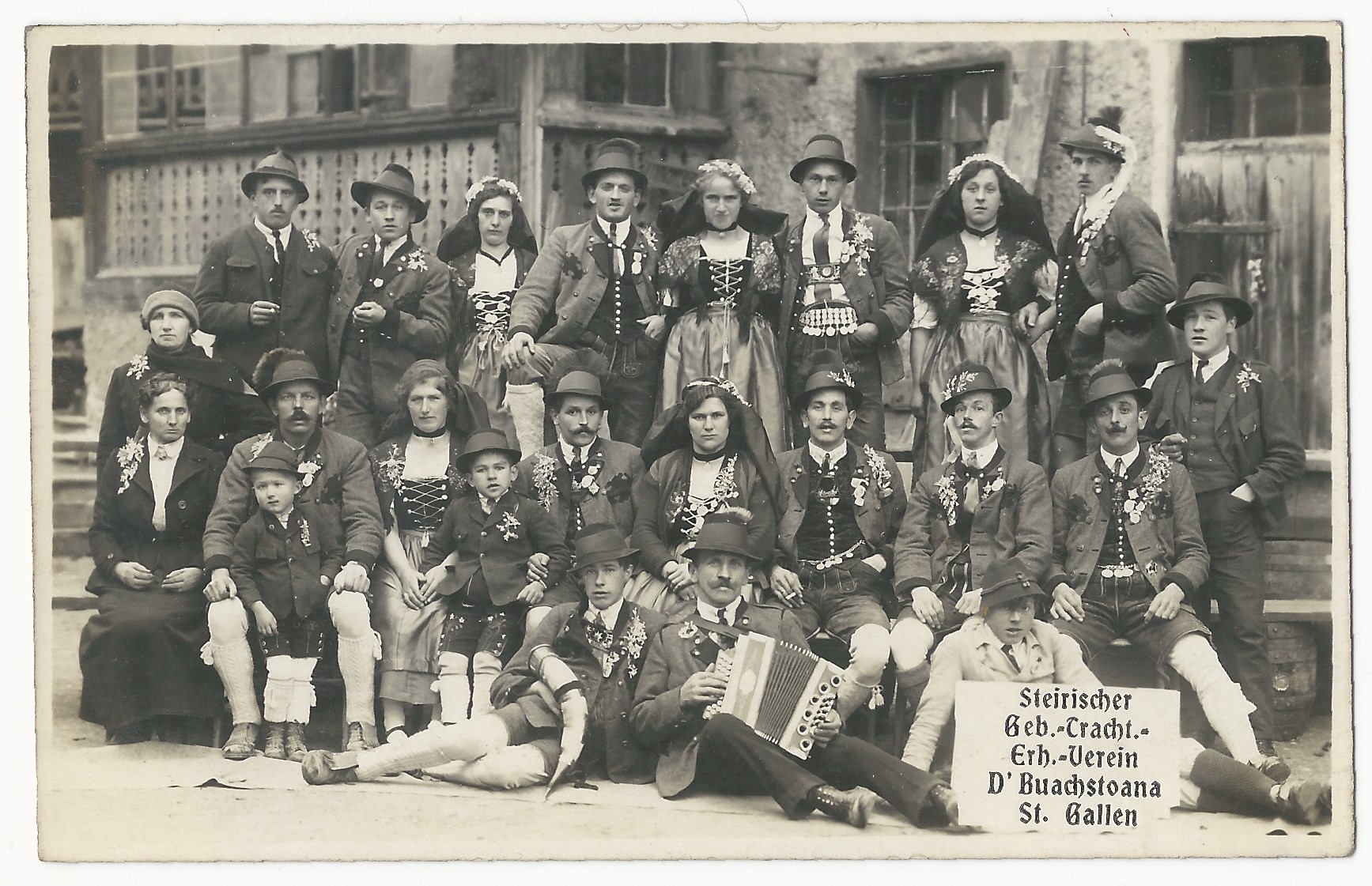
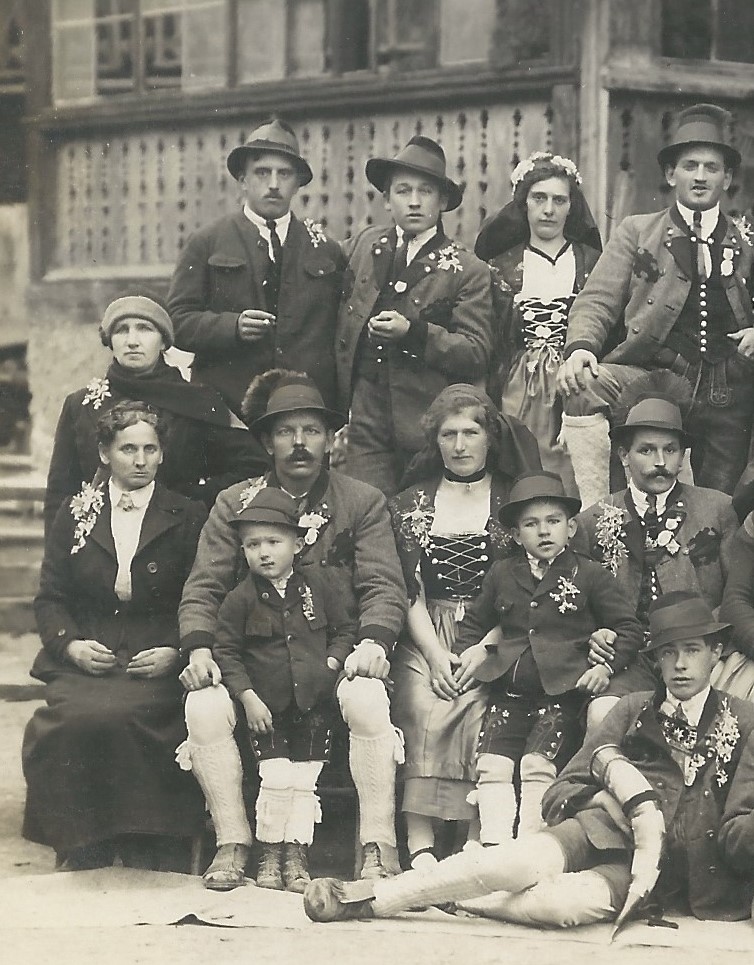
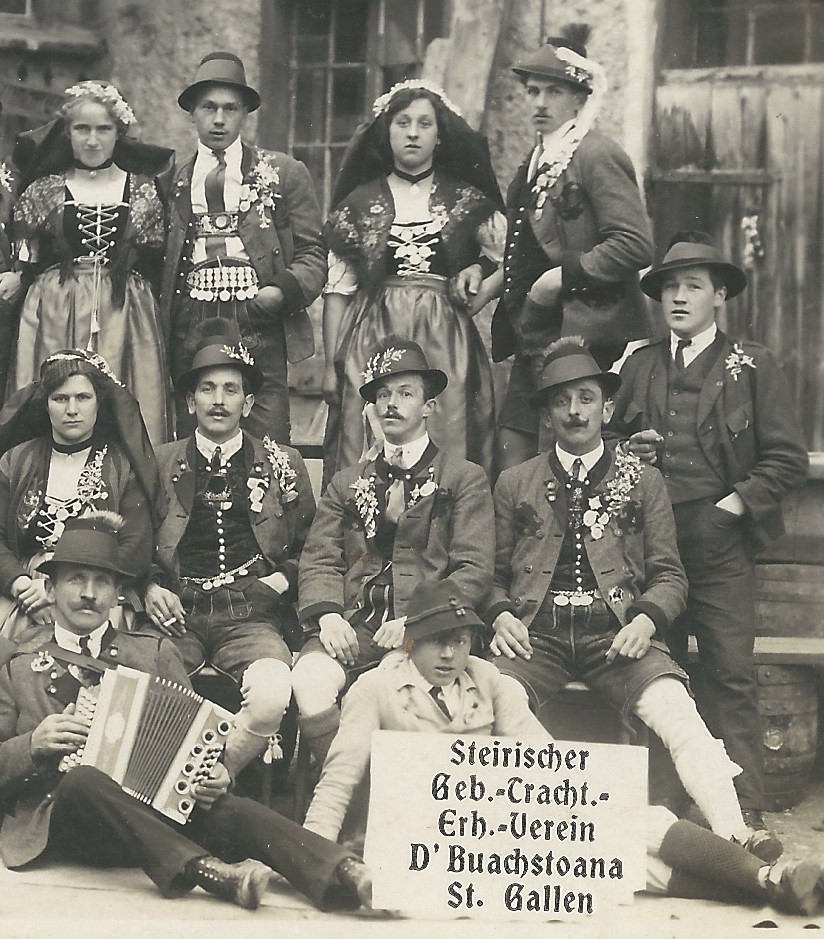
This vintage real photo postcard features a traditional Swiss folk music and dance group wearing traditional ethnic clothing. Note the accordion being held by the man in the center of the front row. The group was based in the town of St. Gallen. This real photo postcard is in good condition (see scans). There is a mar which can be seen on the man all the way on the right side of the top row. SOLD
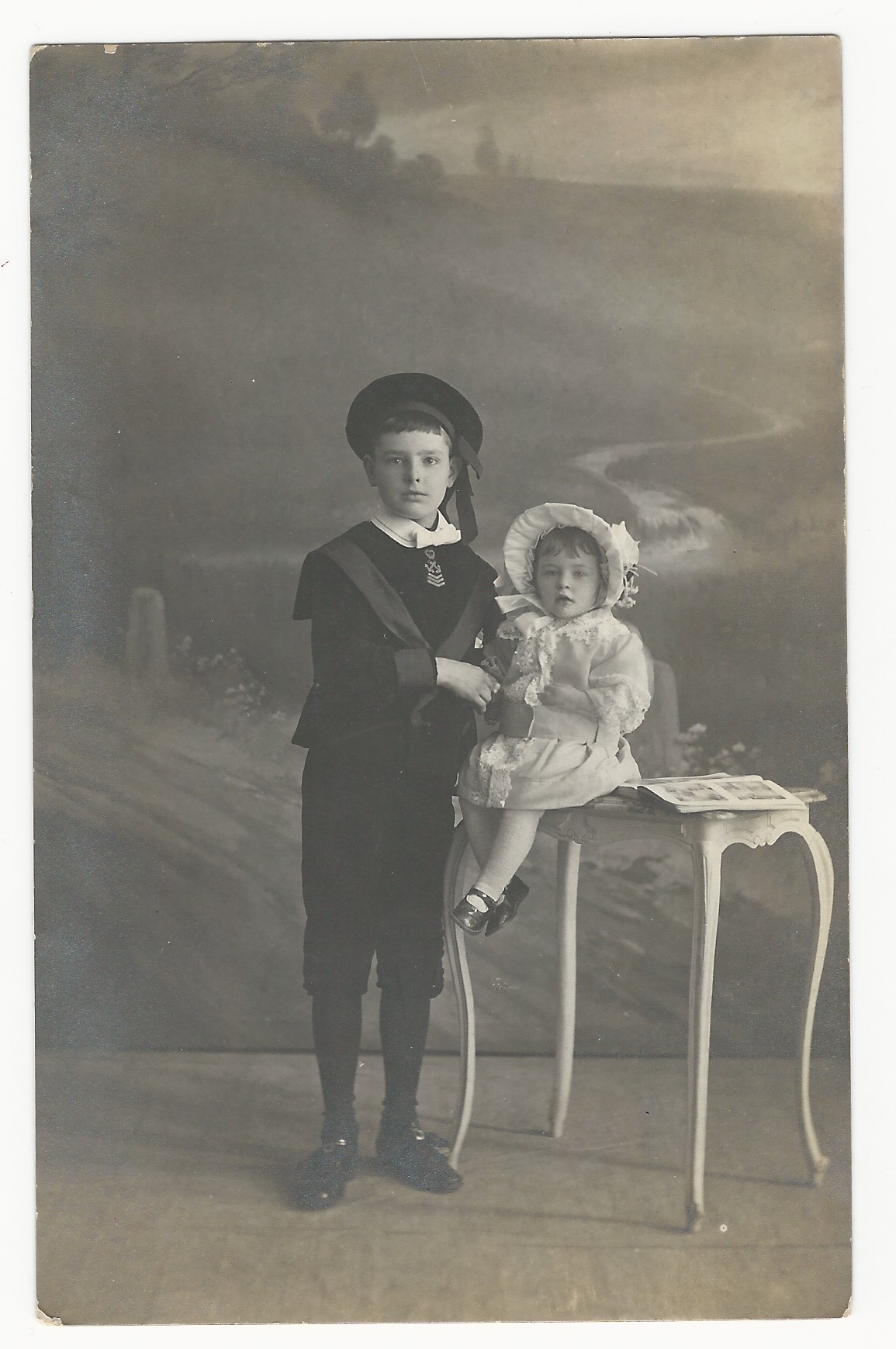
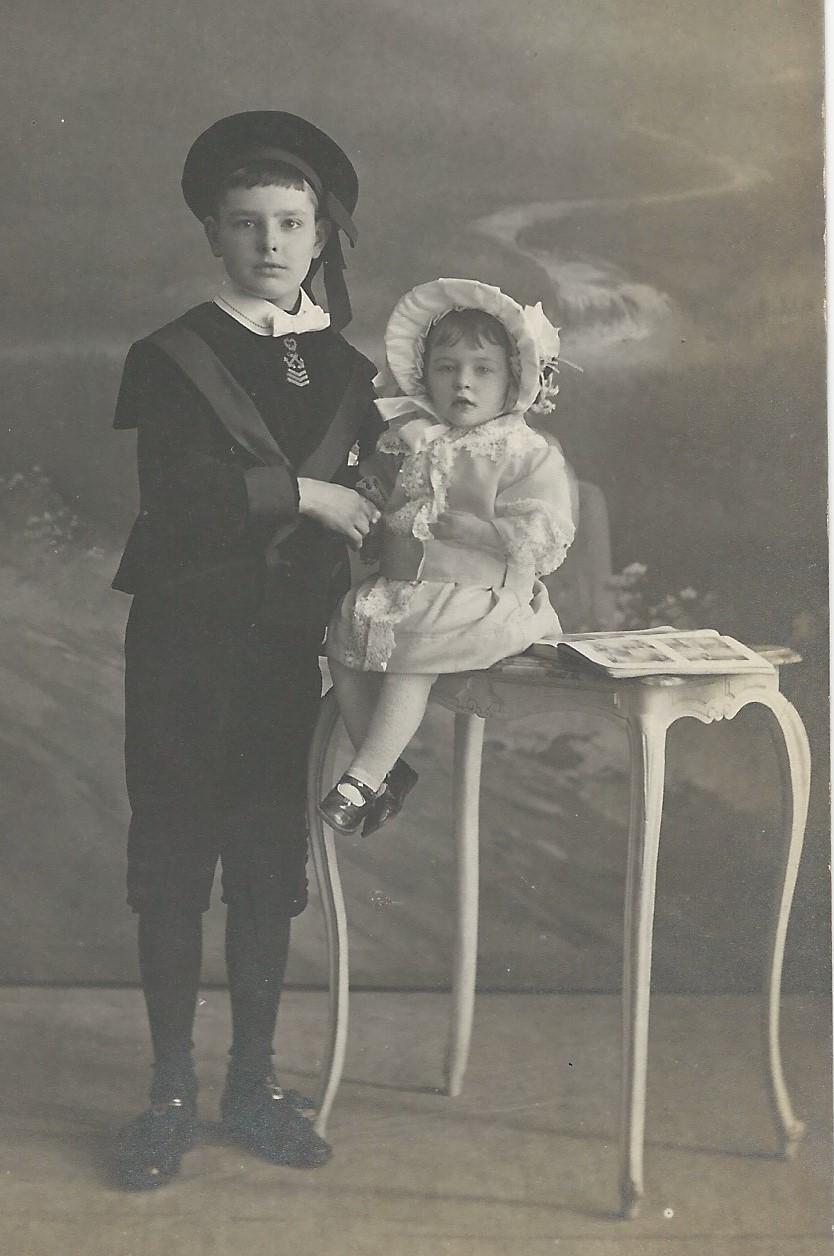
This vintage real photo postcard features a handsome young boy and his adorable toddler sister. The boy, clad in a sailor style outfit, protectively holds his sister. He is keeping her safe while she sits on the edge of a high small table. The little girl is dressed in fancy clothing which includes a cute bonnet. This photo postcard’s image was taken at an unidentified studio. The postcard is in very good condition (see scans).
Buy this original Vintage Real Photo Postcard (includes shipping within the US) #3370a
To purchase this item, click on the Pay with PayPal button below
$31.50
Buy this Vintage Real Photo Postcard (includes International shipping outside the US) 3370a
To purchase this item, click on the Pay with PayPal button below
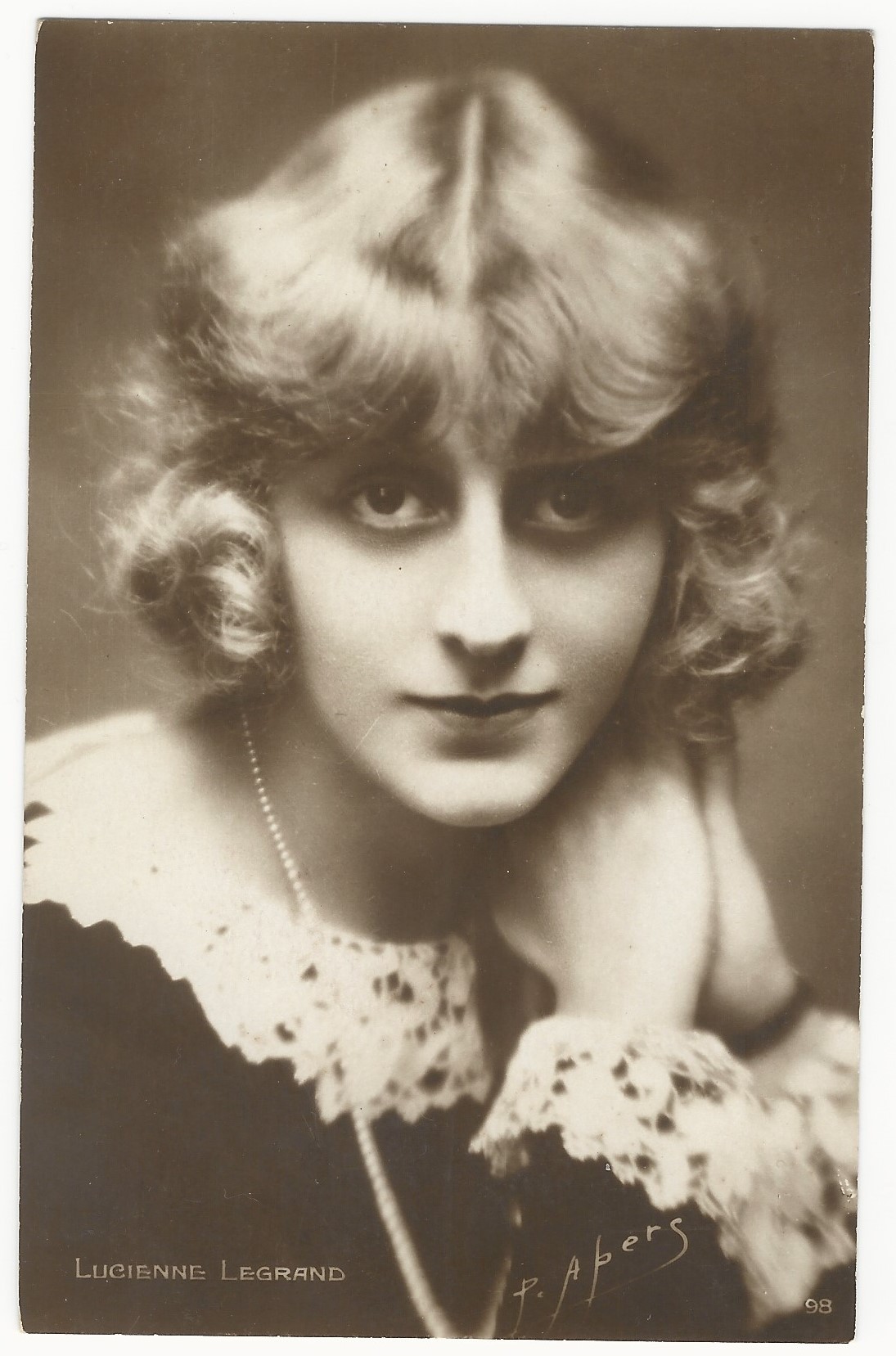
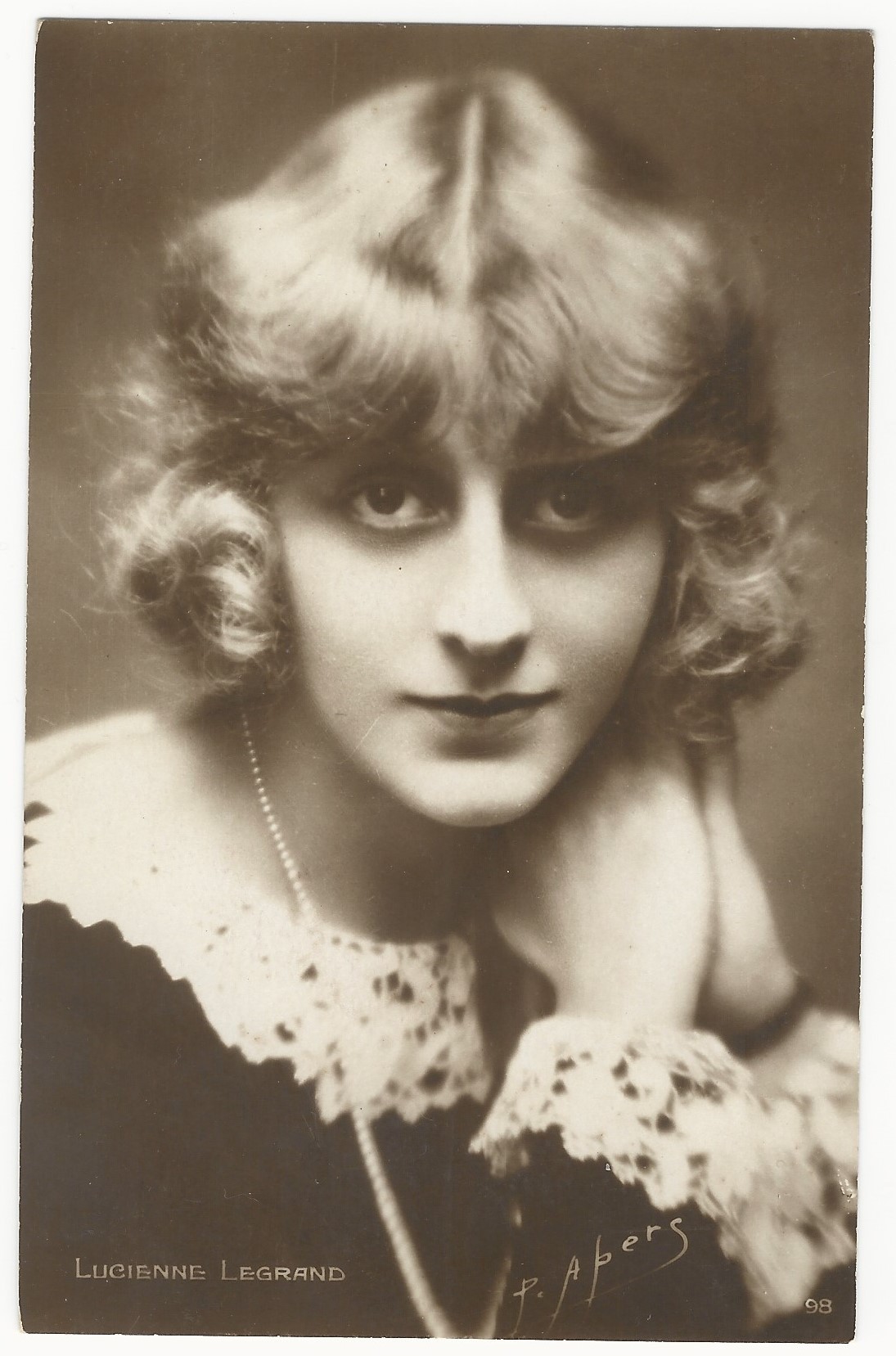
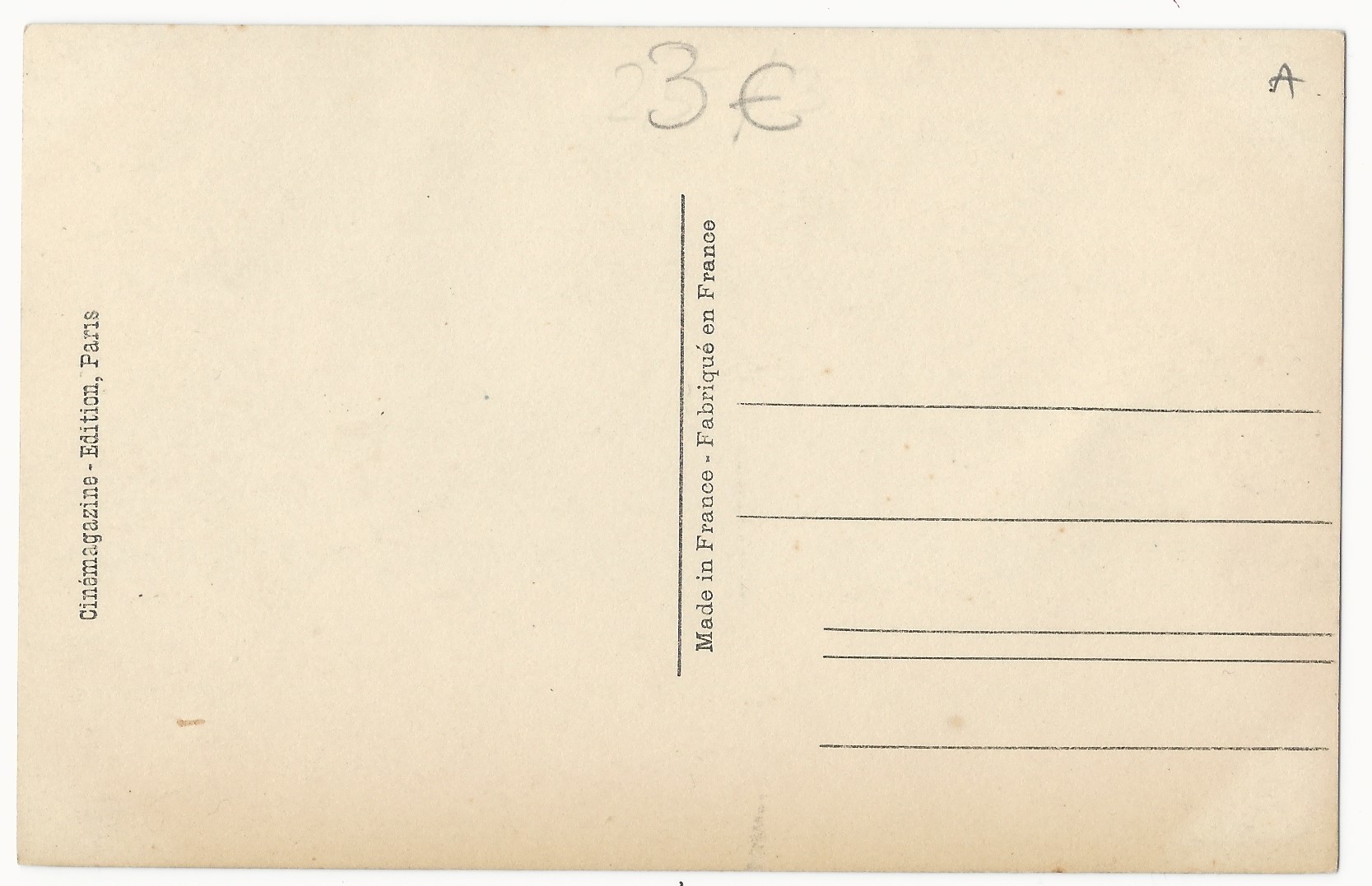
The pretty actress seen in this vintage real photo postcard is Lucienne Legrand (1900-1987). She was French and was active in film between 1921 and 1929. Her work was in silent film and she often worked alongside her actor/director husband, Emile-Bernard Donatien. For clarity sake, note that there was another actress named Lucienne Legrande; but this actress was born in 1920. Lucienne Legrand, pictured on this postcard, has eighteen film credits listed by IMDb. The site states that she is most well known for La chevauchee blanche (1924), Simone (1926), and Le martyre de Sainte-Maxence (1928). This photo postcard was published by Cinemagazine (Paris Edition) as part of a series (no.98). The photograph of Miss Legrand was taken by Pierre Apers. He was a talented French photographer active in the early twentieth century. His studio was in Paris and he specialized in portraiture. The cabinet card gallery is building a nice collection of his photographs. This vintage photo postcard is in very good condition (see scans).
Buy this original Vintage Real Photo Postcard (includes shipping within the US) #3360
To purchase this item, click on the Pay with PayPal button below
$15.50
Buy this Vintage Real Photo Postcard (includes International shipping outside the US) 3360
To purchase this item, click on the Pay with PayPal button below
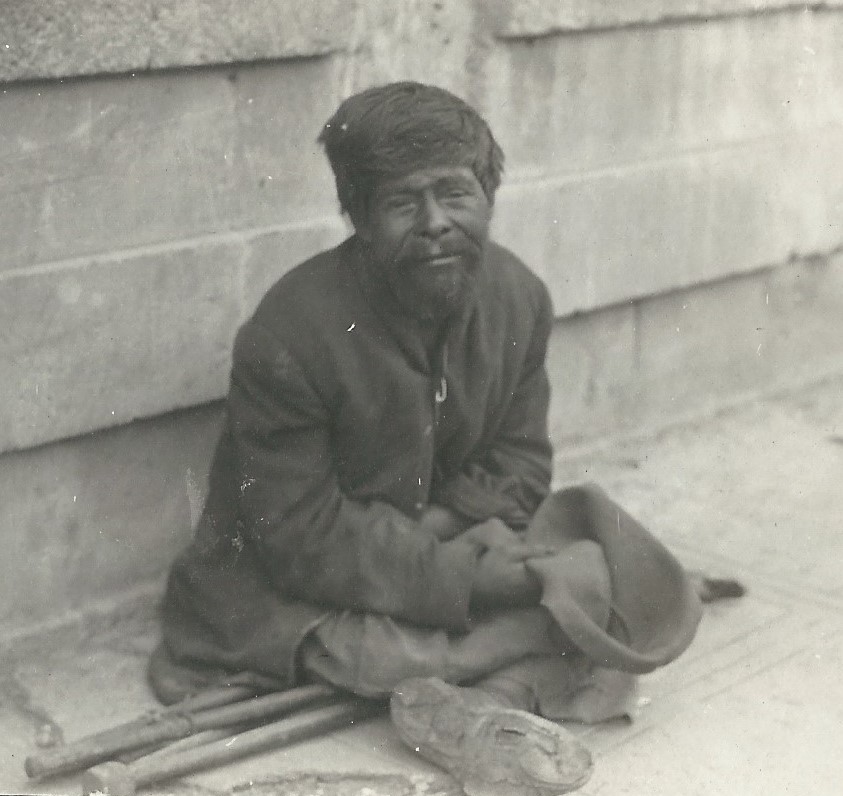
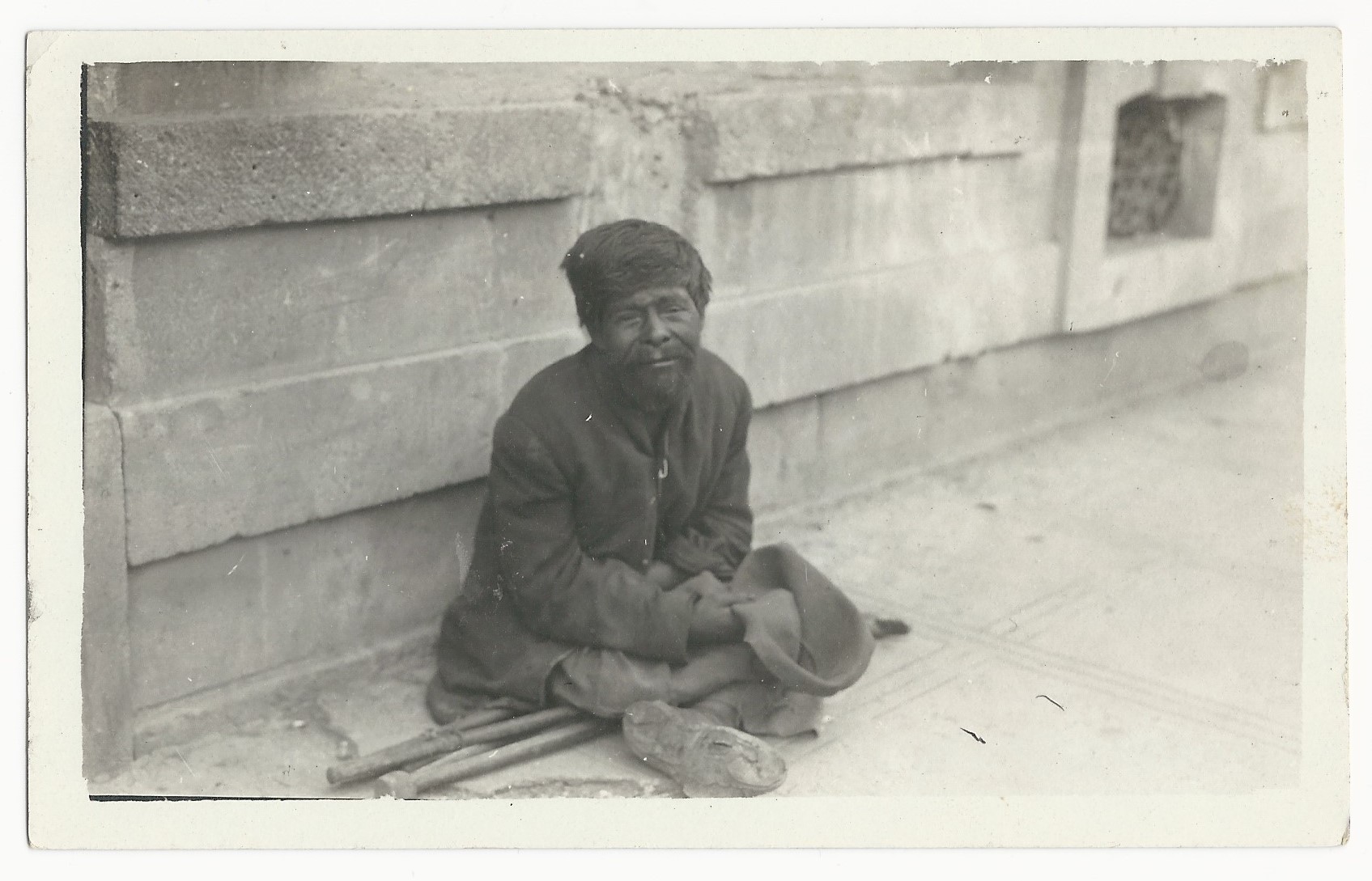
This vintage real photo postcard features a portrait of a beggar sitting on a sidewalk in Santiago, Chile. The poor soul has his hat extended hoping that a passerby will drop in some pesos. He is sitting on a pair of crutches. The poor soul’s facial expression reflects a life of pain and misery. This postcard’s Cyko stamp box indicates that the card dates back to between 1904 and the 1920’s. This vintage postcard is in good condition (see scans).
Buy this original Vintage Real Photo Postcard (includes shipping within the US) #3350
To purchase this item, click on the Pay with PayPal button below
$23.50
Buy this Vintage Real Photo Postcard (includes International shipping outside the US) 3350
To purchase this item, click on the Pay with PayPal button below
Bessie Love (1898-1986) is the subject of this vintage real photo postcard. She was beautiful and her postcard and photo images are very collectible. Bessie was an American-British actress who initially became popular by playing sweet, pure, and innocent young girls. She went on to play virtuous leading ladies in silent and early sound films. Her career had amazing longevity; she acted for more than eight decades. She worked in many areas of entertainment. In addition to her film work, she acted on the stage, and on radio and television. Bessie was born in Midland, Texas. Her father was a cowboy and a bartender. Her mother was a restaurant manager. She attended Midland schools until the eighth grade. She and her family moved to Arizona, New Mexico, and then Hollywood, California. Once in the Golden State, her father became a chiropractor and her mother worked in a clothing factory (Jantzen). Bessie attended Los Angeles High School and in 1915 she went to a film set to meet with Tom Mix who had promised to help her to “get into pictures”. Mix was unable to meet with her but film director D. W. Griffith was able to meet with her and he promptly put her under contract. Love dropped out of high school in order to pursue her film career. Impressively, she did complete her diploma in 1919. Bessie began with a small role in a Griffith movie, “Intolerance” (1916). Her first major role was in “The Flying Torpedo” (1916). That same year, she appeared in movies opposite William S. Hart and Douglas Fairbanks. Her first starring role was in “A Sister of Six” (1916). Love quickly became a popular performer. Early in her career, Bessie worked for “Fine Arts”, “Pathe” and then Vitagraph. In the 1920’s Love sought roles outside of the “sweet and innocent girl” parts. In two movies she played Asian women. She had the role of a drug addicted mother in “Human Wreckage” (1923) and in other films played an underworld flapper as well as a woman accused of murder. In the 1925 movie, “The King on Main Street”, Love became the first person to dance the Charleston in a movie (see the video below).. The dance became the rage of the era. Also in the 1920’s, Bessie appeared in a film based on Arthur Conan Doyle’s novel “The Lost World”. In addition, she appeared in a romantic comedy directed by Frank Capra. She signed with MGM in 1928. In 1929, Love exhibited her talent in musical comedy. She toured with a musical revue for sixteen weeks. It is thought that her singing and dancing performances in vaudeville helped prepare her for sound films. That same year, she made her debut in her first feature length sound film, the musical “The Broadway Melody”. Her performance led to her receiving a nomination for the Academy Award for Best Actress. MGM rewarded her with a five year contract and a three thousand dollars a week (equivalent to $45,000 a week in 2019). She continued to act in musicals and her success was reflected in her becoming “the screen’s first musical comedy star”. Between 1931 and 1943, Love entered semi-retirement. She had married in 1929 and during this break in her career, she began focusing on her personal life. Her husband was an agent, William Hawks. She had celebrity bridesmaids, including Carmel Myers, Norma Shearer, and Mary Astor. Love had a daughter in 1932, and in 1935, she moved to England. She obtained a divorce in 1936. During World War II, Love worked as a film script supervisor and also worked for the American Red Cross. After the war, Love resumed acting. Much of her work was in theater, television, and radio. She also played minor roles in British film. In 1958, she wrote and performed in a semiautobiographical play. Some of her later films included “The Barefoot Contessa” (1954), “On Her Majesty’s Secret Service” (1969 a James Bond Thriller), and “Sunday Bloody Sunday” (1971). Bessie Love had a long and successful acting career. The IMdB reports that she had 156 acting credits between 1915 and 1981. This vintage postcard was published by Cinemagazine (Paris Edition) as part of a series (no.163). The postcard has excellent clarity and is in very good condition (see scans). SOLD
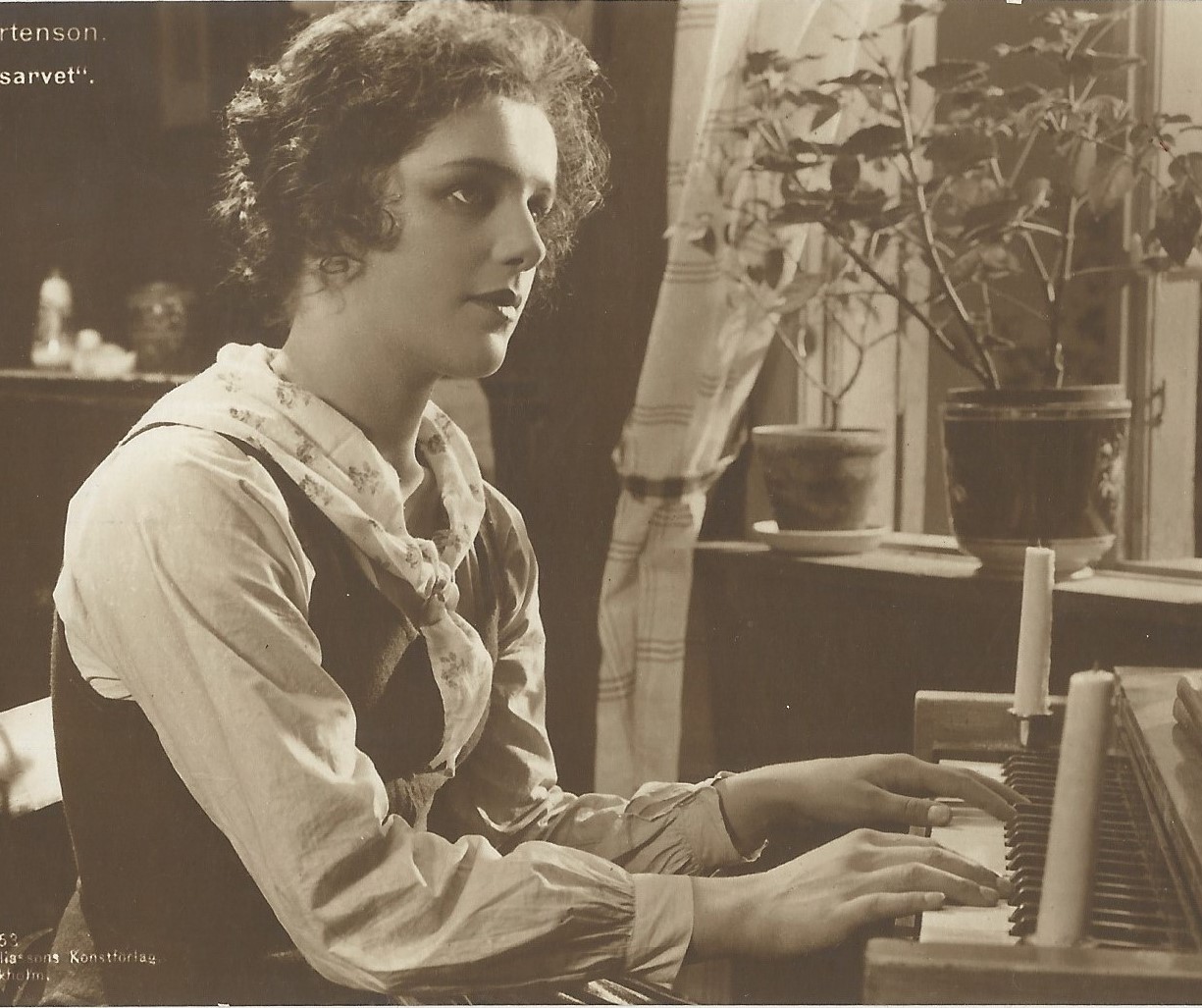
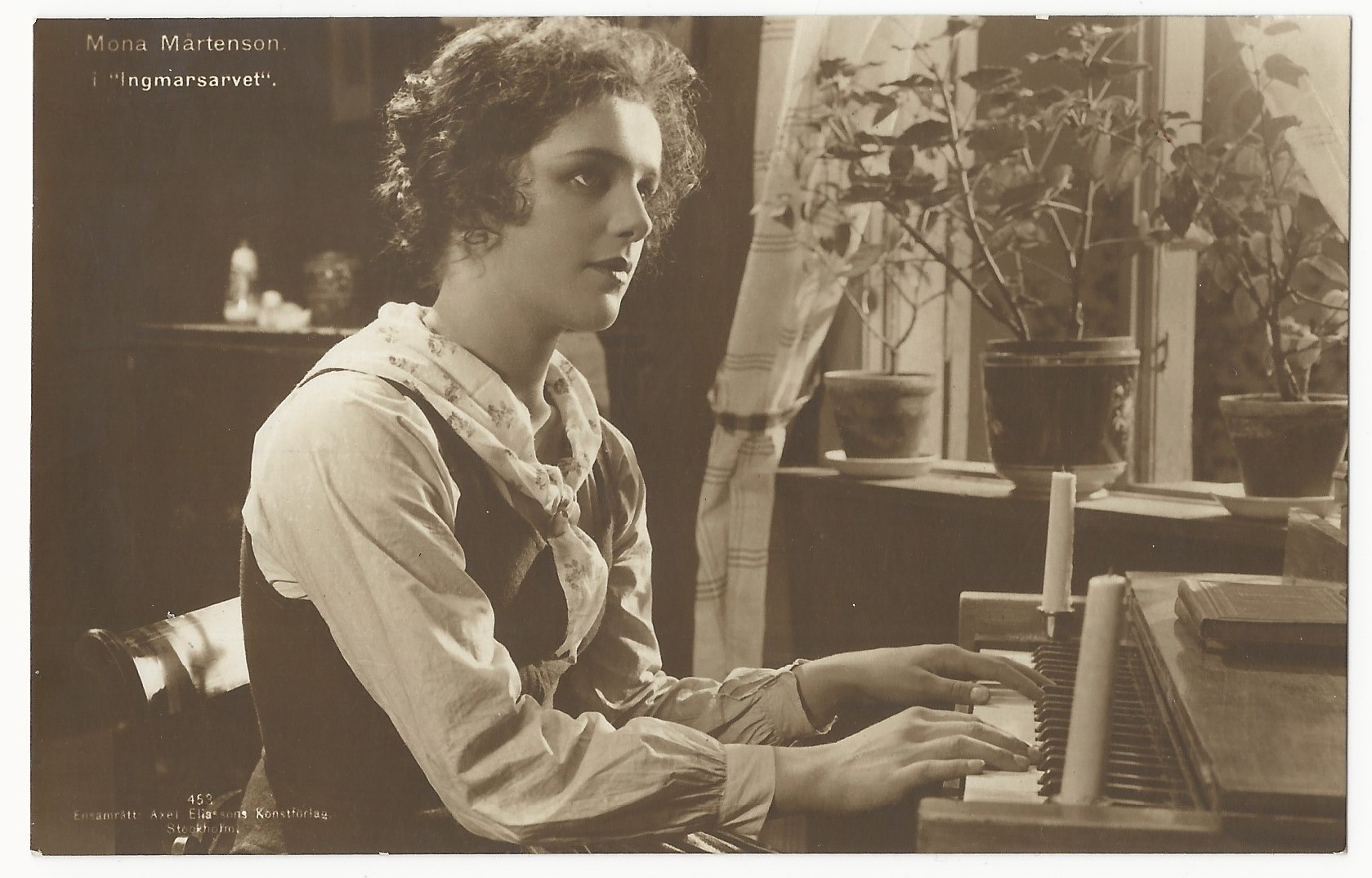
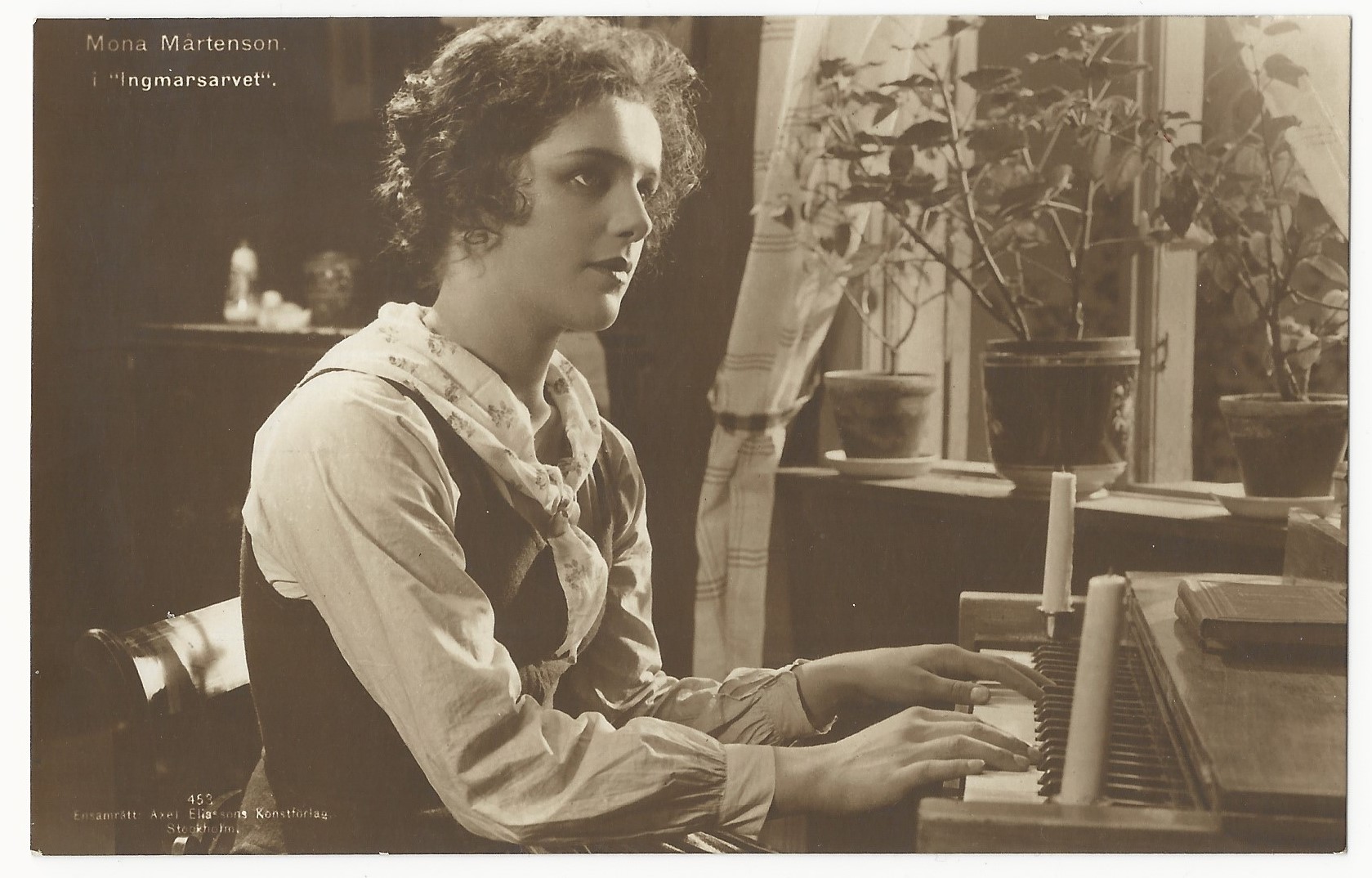
This vintage real photo postcard features pretty actress Mona Martenson (1902-1956) as she appears in the film, “Inmarsarvet” (1925). Translated into English, the film is titled “Ingmar’s Inheritance”. The movie is a Swedish silent drama film and was directed by Gustaf Molander and produced by Nord-Westi Film. Mona was 23 years-old when the postcard photo was taken. Martenson was an active performer from 1923 through 1949, appearing in 29 films. Mona was raised in Helsingborg and studied at the Royal Dramatic Theater Academy. She made her first film appearance in 1923. That same year, Mona and a classmate were selected by the school to audition for celebrated Swedish film director, Mauritz Stiller. Incidentally, you may be familiar with her classmate. Her name was Greta Garbo. Both Martenson and Garbo were cast in his upcoming film. The film was very successful and Mona and Greta were invited to Hollywood. Martenson was not interested in leaving Sweden, and turned down a contract offer from Louis B. Mayer. She remained in Stockholm and acted in theater and film. In 1929, Mona spread her wings and starred in a German film and in a Norwegian film. Mona was able to cross the “sound barrier” and appear in a number of “talkie” films. Her last film was “Pippi Longstocking” (1949). She played the supporting role of Pia. The photographer of Martenson’s portrait seen on this postcard was Axel Eliassons Konstforlag. He operated a studio, and then a postcard publishing company in Stockholm. The company was named “Axel Eliasson’s Art Publishers (AE) and began selling postcards in 1890. The company was Sweden’s leading producer of postcards during the first half of the twentieth century. In the middle of the 1890’s, Jenny Nystrom and Anna Palm were hired as illustrators. The company specialized in illustrated Christmas cards. Eliasson died in 1932. In 1941, the company was sold and underwent several name changes. The company still exists today, under the name “Axel Eliasson AB” and is located in Sagmyra, Sweden. It no longer publishes postcards. Instead it produces art publishing items (ie Christmas cards and gift items). This vintage postcard is in very good condition (see scans).
Buy this original Vintage Real Photo Postcard (includes shipping within the US) #3347
To purchase this item, click on the Pay with PayPal button below
$27.00
Buy this Vintage Real Photo Postcard (includes International shipping outside the US) 3347
To purchase this item, click on the Pay with PayPal button below
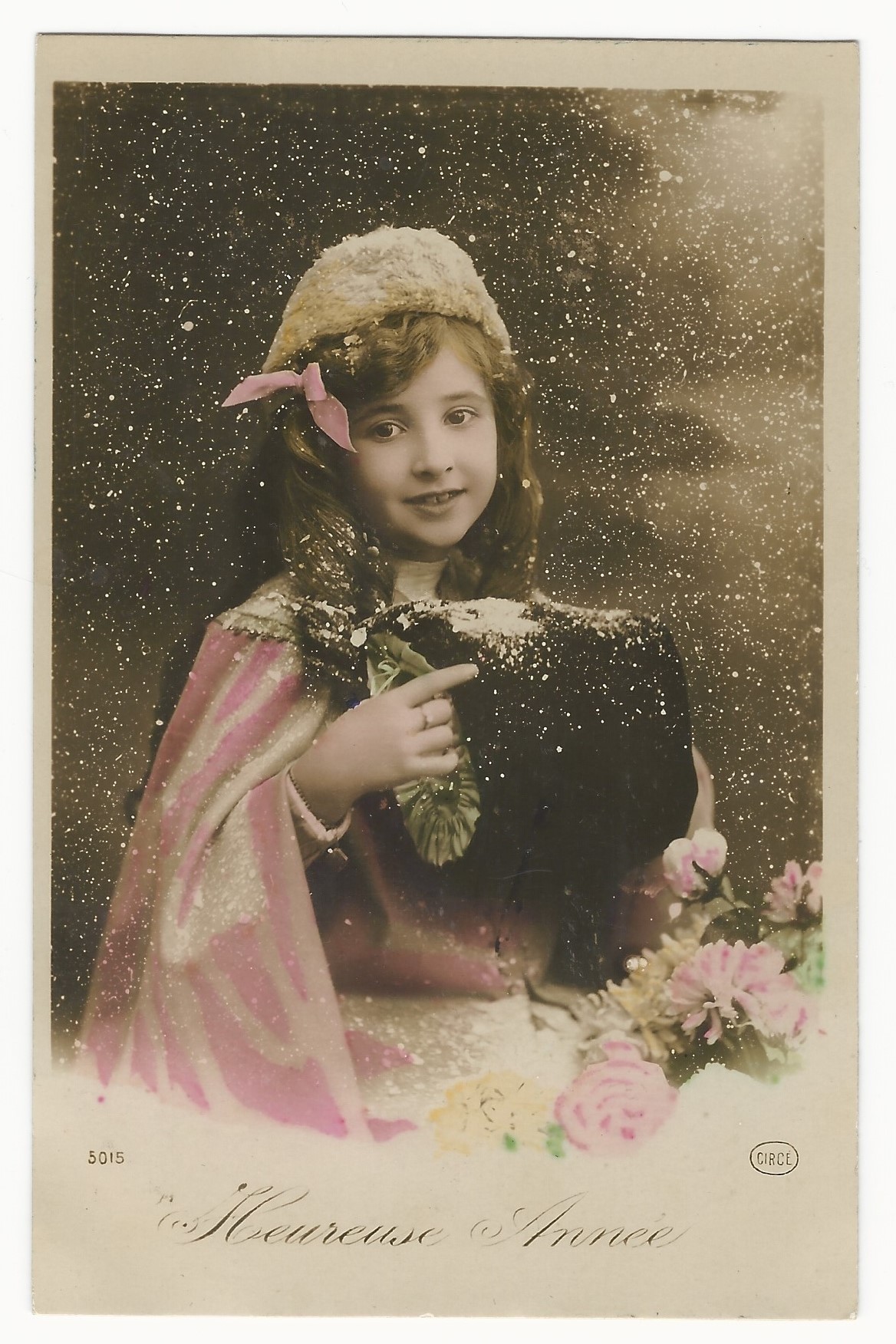
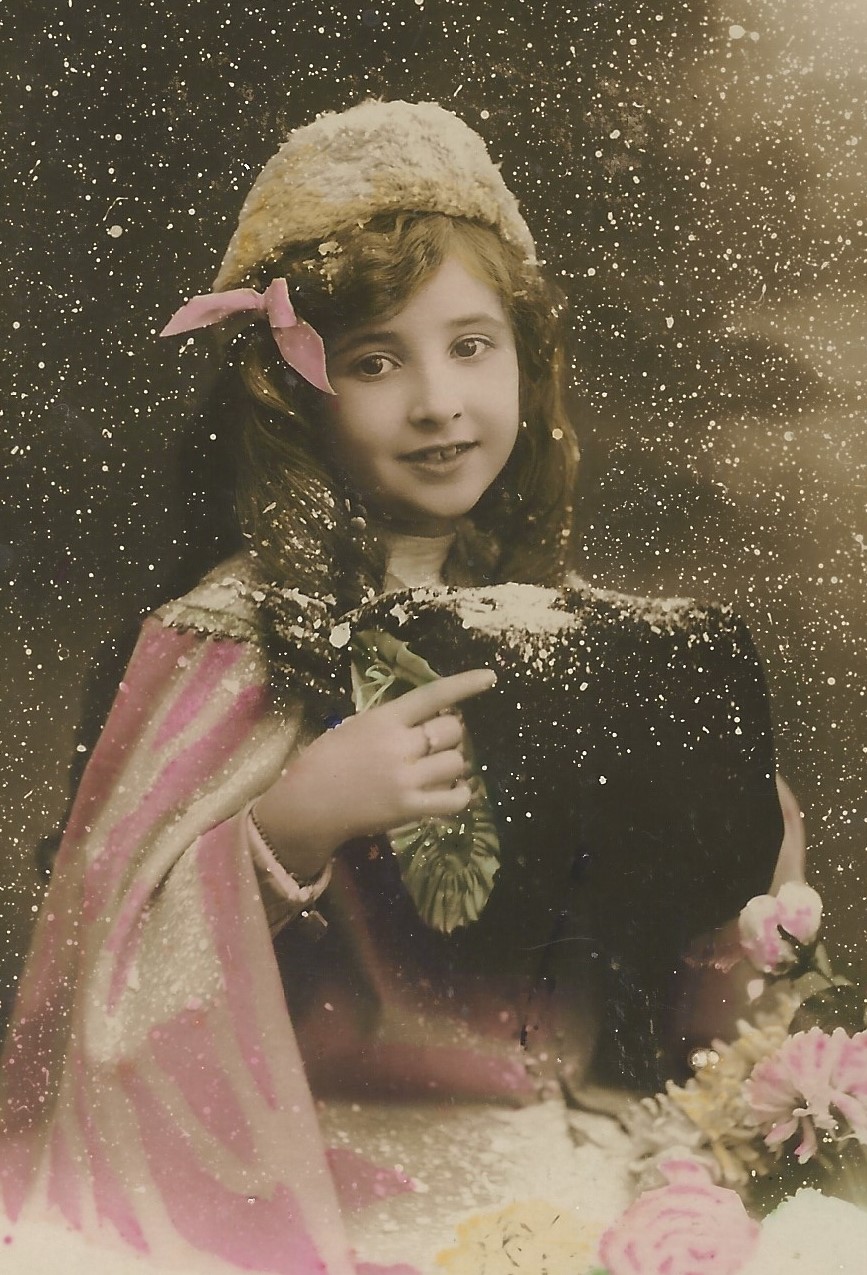
This vintage real photo postcard features an adorable little girl flashing a wonderful smile. Snow flakes fall around her. She is dressed for winter wearing a cape and winter hat. She is holding a muff to protect her hands. Note the pink ribbon in her hair and the flowers in the foreground. These must be hardy flowers to look so pretty in the wintertime. This “Happy New Year” card was published by Circe as part of a series (no.5015). SOLD
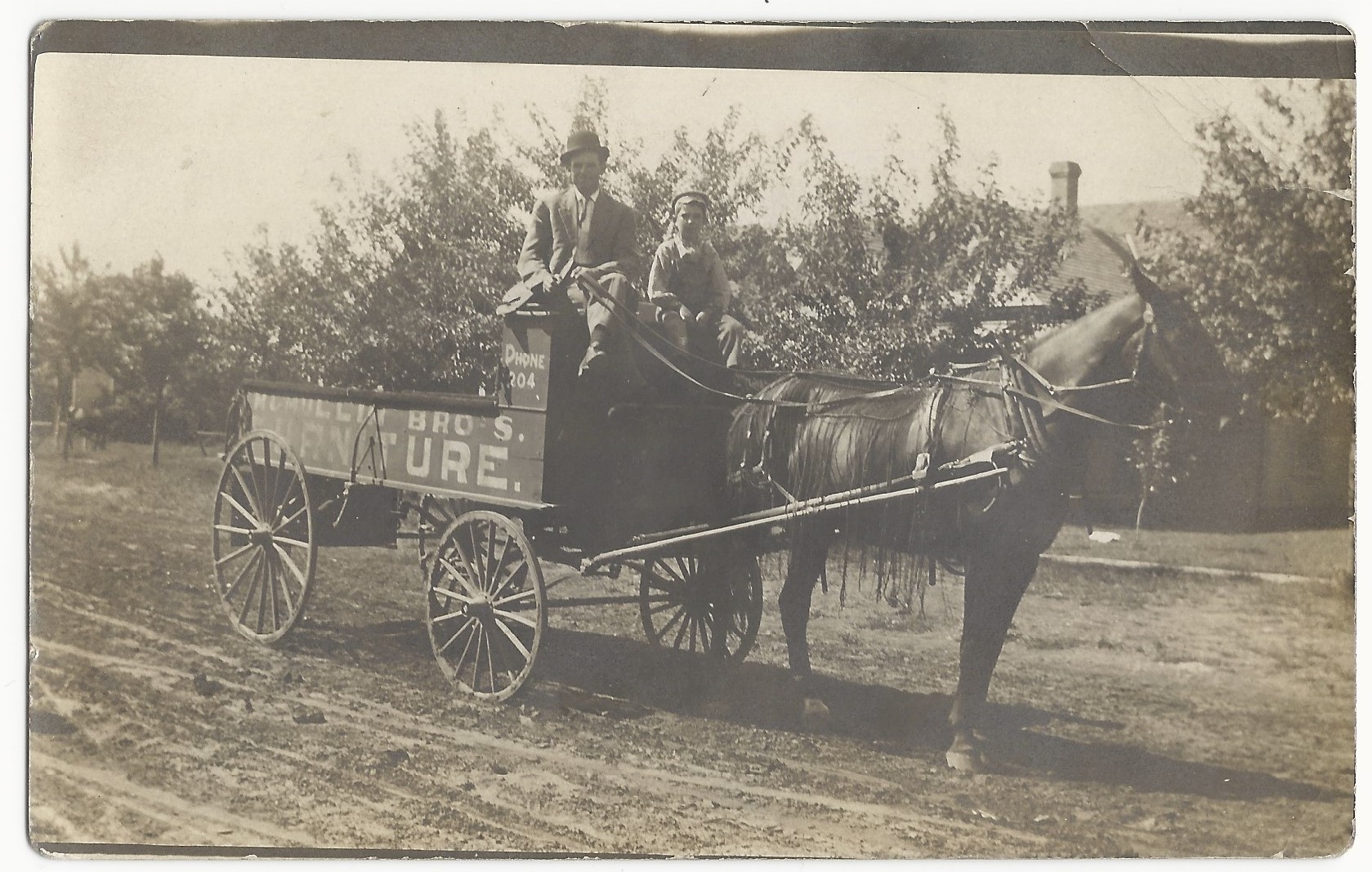
This vintage real photo postcard features a father and son on a horse drawn wagon. This is no ordinary wagon. Instead, as the painted sign on the side of the wagon states; it is the delivery wagon for the McMullin Brothers furniture store. The business was located in Anthony, Kansas. Research reveals that one of the McMullin brothers was Joseph Franklin McMullin (1857-1914). He can be found in the US Census of 1910 and his occupation is listed as the proprietor of a furniture store. Ten years earlier, the 1910 US Census reports that Joseph McMullin was working as a farmer, despite the fact that in 1909, the local newspaper, “The Anthony Republican”, ran an ad for McMullin Brothers furniture store. This photo postcard represents a piece of both Anthony and Kansas history. It is also a record of the workings of small business at the beginning of the twentieth century. Note that there is no furniture in the rear of the wagon. It is likely that the wagon and its driver and young assistant, presumably father and son, took the wagon out for the specific purpose of being photographed. The father is wearing nice clothing, not work clothes, which supports the theory that he was not photographed while on the job. This postcard’s AZO stamp box indicates that it dates back to between 1904 and 1918. SOLD
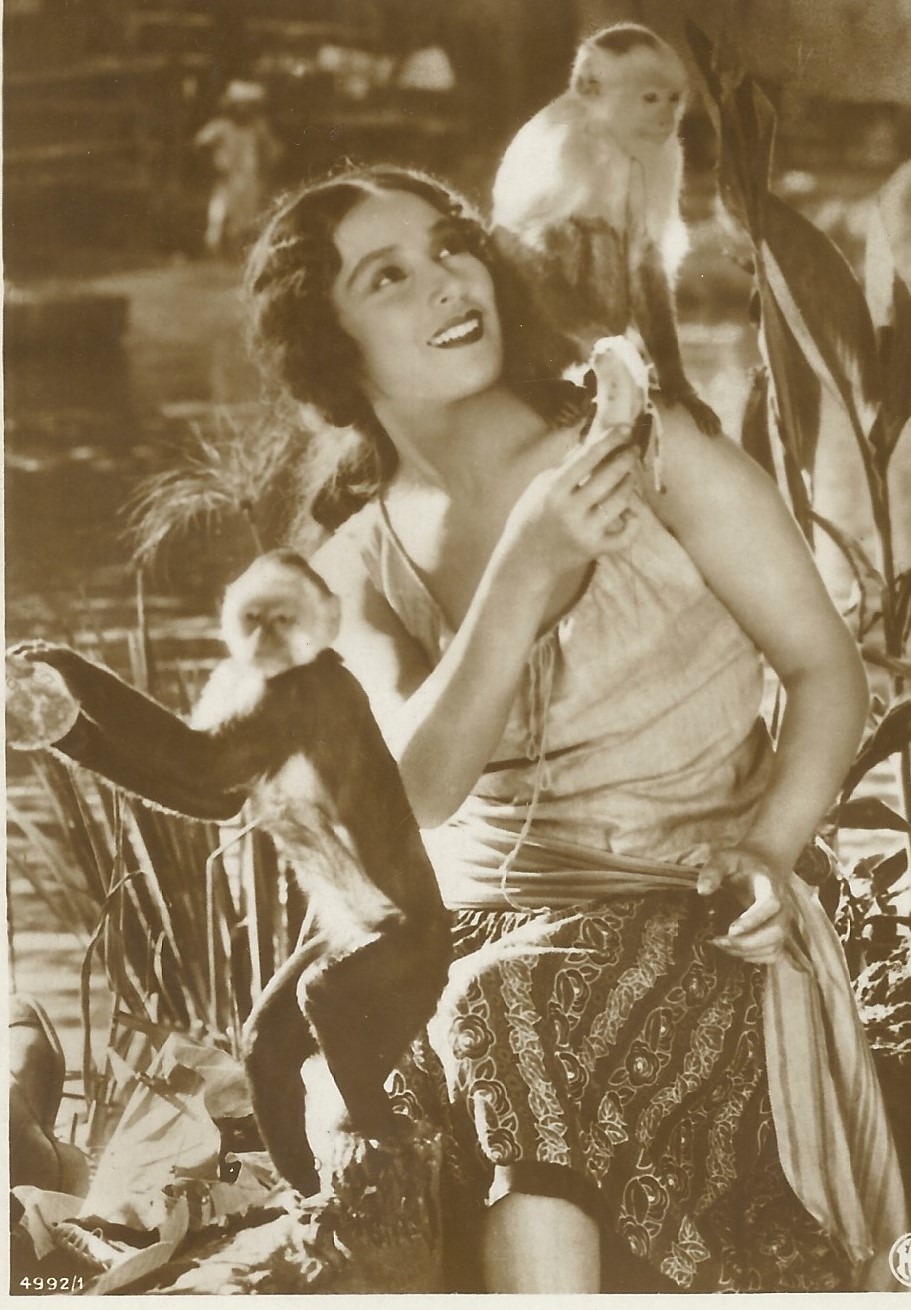
This vintage real photo postcard features Mexican actress, dancer, and singer; Dolores del Rio (1904-1983) and two unidentified capuchin monkeys. Del Rio’s performing career spanned more than half of a century. She was the first major Latin American actress to become an American film star (1920’s & 1930’s). Del Rio was also a major star in Mexican films. Dolores was known for her beauty as well as for her talent. She was discovered in Mexico and her Hollywood film career started in 1925. She began her career with a number of successful films, including “Ramona” (1928) and “Evangeline (1929). During the silent film era, she was considered the female version of “latin lover”, Rudolph Valentino. Del Rio was one of the fortunate actresses whose career was not destroyed by the advent of sound films. She acted in a wide range of film genres. “Bird of Paradise” (1932) and “Madame Du Barry” (1934) were among her successful films of the 1930’s. In the early 1940’s, her Hollywood career began to flounder sparking Del Rio to return to Mexico to become a major star of Mexican cinema. She continued acting in Mexican films through the 1950’s. Beginning 1960 she acted in both Mexican and Hollywood films. During the late 1950’s through the early 1970’s, Del Rio acted in theater and television. Dolores was born in Durango City, Mexico. Her parents were part of Mexican aristocracy whose lineage could be traced to Spain. Dolores was the cousin of actor Ramon Novarro (another silent film”latin lover”), and of Mexican cinema actress, Andrea Palma. During the Mexican Revolution (1910-1920), Dolores’s family lost its fortune. Her family felt threatened by Pancho Villa’s insurgence. It was time to “get out of town”. Her father fled to the United States while she and her mother escaped to Mexico City. Acting was an integral part of Dolores’s getaway. She and her mother felt compelled to dress as peasants to insure safe passage on the train to Mexico City. Her parents reunited there in 1912. Dolores attended a college in Mexico City operated by French nuns. After seeing Russian ballerina, Anna Pavlova perform; Dolores decided to become a dancer and took lessons from a well respected teacher. At age 17, Dolores married Jaime Martinez del Rio. He was from a wealthy family and was educated in England. The couple honeymooned in Europe for two years and Dolores formed close relationships with a number of members of European aristocracy. When the couple returned to Mexico, they settled in Mexico City. In 1925, Dolores met American filmmaker Edwin Carewe, and he was spellbound. He convinced Dolores and her husband to move to Hollywood where he promised to make Dolores a star. Her husband hoped to write screenplays there. When they arrived in Tinseltown, Carewe launched a public relations campaign to raise excitement about his beautiful find. He built up her aristocratic background by saying such gems as Dolores was “the first lady of high Mexican Society” and that she had come to Hollywood with a collection of shawls and combs valued at fifty thousand dollars. Dolores made her film debut in “Joanna” (1925), where she played a vamp of Spanish-Brazilian origin. Her first starring role was in the comedy “Pals First” (1926), directed by Carewe. That same year, Dolores appeared in the war film “What Price Glory?”. The movie was a huge financial success and helped Dolores become one of the “WAMPAS Baby Stars” of 1926. Other members of her “class” were Mary Astor, Joan Crawford, Janet Gaynor, and Fay Wray. By then, her film career was rocketing. Her role in Resurrection” (1927), a popular film based on a Tolstoy novel, further propelled her career. While her career was succeeding, her personal life was a “hot mess”. Her marriage to Del Rio ended in 1928. He had much difficulty being in the shadow of his famous and successful wife. Six months after Dolores filed for divorce, Del Rio died in Germany. While dealing with her grief, she had to deal with constant harassment from her discoverer, Edwin Carewe. He wanted to be more than her agent and her director since he had first launched her career. In 1929, Dolores announced to the press, that despite Carewe’s claims, the pair were just friends and business companions. She added that they had no plans for marriage. Soon thereafter, she cancelled her contract with him. The end result was a legal dispute that was settled out of court. Carewe’s anger did not end there. He disparaged her the press and refilmed “Resurrection” starring Lupe Velez, another popular Mexican film star. In 1930, Del Rio married MGM art director, Cedric Gibbons. They became one of Hollywood’s most followed couples of the early 1930’s. In 1932, the film, “Birds of Paradise”, was released to rave reviews. The film starred Del Rio and actor, Joel McCrea. The movie was a South Seas love story. A scandal arose from the film because of a scene featuring the pair swimming naked. Controversy continued in Del Rio’s appearance in “Flying Down to Rio” (1933). In this film, Del Rio was the first actress to wear a two piece bathing suit on screen. Fred Astaire and Ginger Rogers danced together for the first time on film, in this movie. Del Rio and Astaire also did an “intricate” dance number in the film. Del Rio found herself in political hot water when she and Ramona Novarro and Lupe Velez attended a special screening of a Mexican film which was accused of promoting Communism in California. Del Rio was accused of being a Communist for her attendance at the screening. In 1940, Del Rio began an affair with actor/filmmaker, Orson Welles. The dalliance resulted in Del Rio and Gibbons divorce. In 1954, Dolores was scheduled to co-star in a Spencer Tracy film, but the US government would not give her permission to work in the United States. The government believed she was sympathetic toward communism for attending the aforementioned film screening and for signing a petition supporting a world peace conference. After some time, she was able to remedy the problem by writing a persuasive letter to the US authorities. Later in life Del Rio did express some “political” beliefs. She stated that she wished she could play Mexican roles to show what life in Mexico was really like. She felt such an opportunity could help diminish the ugly stereotypes that existed about Mexicans in American society. She stated that it was her great wish to make fans realize the beauty, wonder, and greatness of Mexicans as a people. She asserted that the great majority of Americans view Mexicans as a “race of bandits, or laborers, dirty, unkempt, and uneducated”. Why do these false negative stereotypes sound so familiar? Del Rio wanted to show “the best that’s in my nation”. It has been pointed out by more than a few writers that Dolores del Rio was no “Latin bombshell”. Instead, she was noted for her elegance. The IMDb reports that Del Rio has 63 film credits ranging from 1925 through 1978. This vintage postcard was published by Ross Verlag as part of a series (no. 4992/1). The logo for Fox films can be seen in the lower right hand corner of the image. (SOLD)
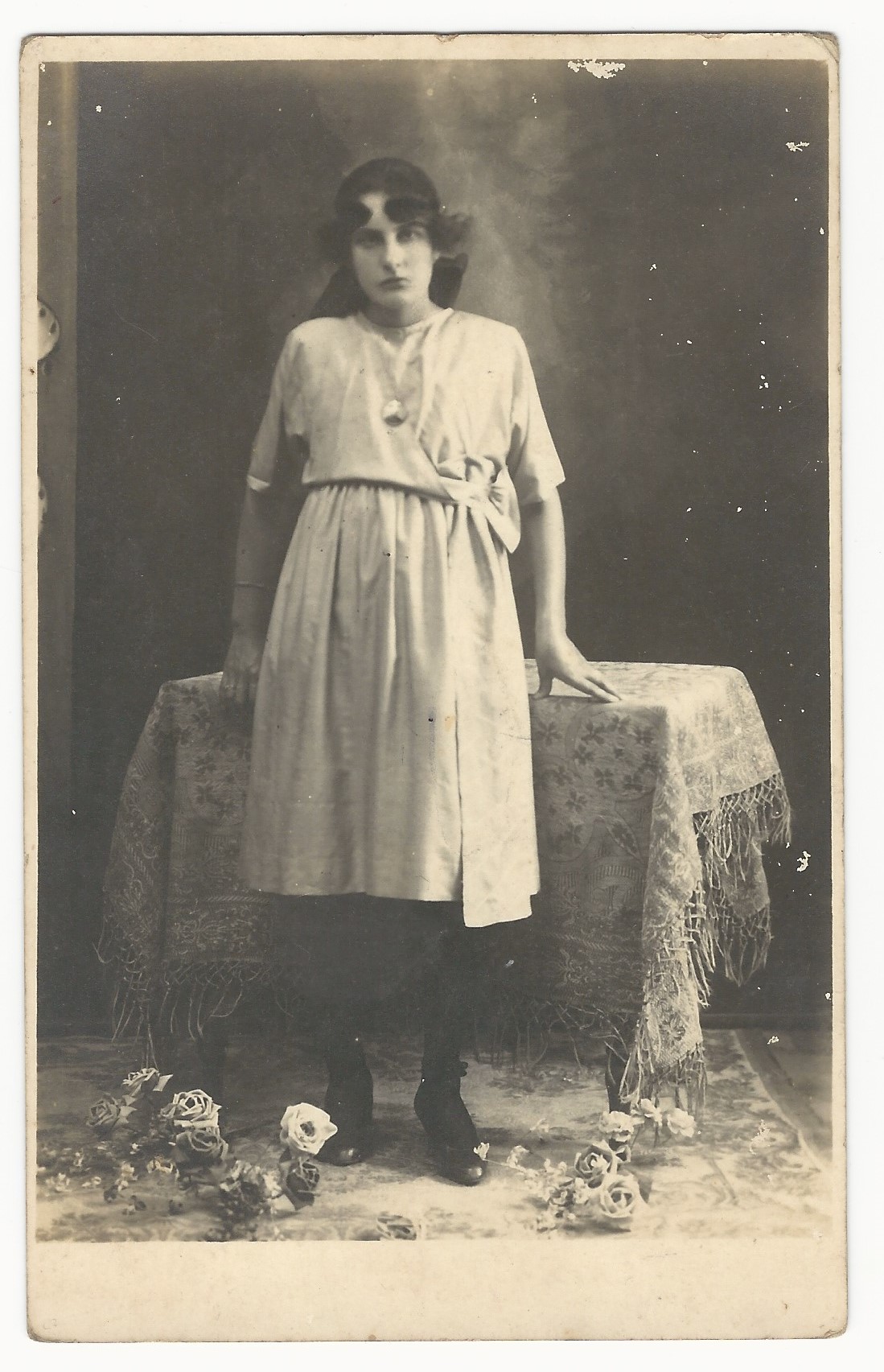
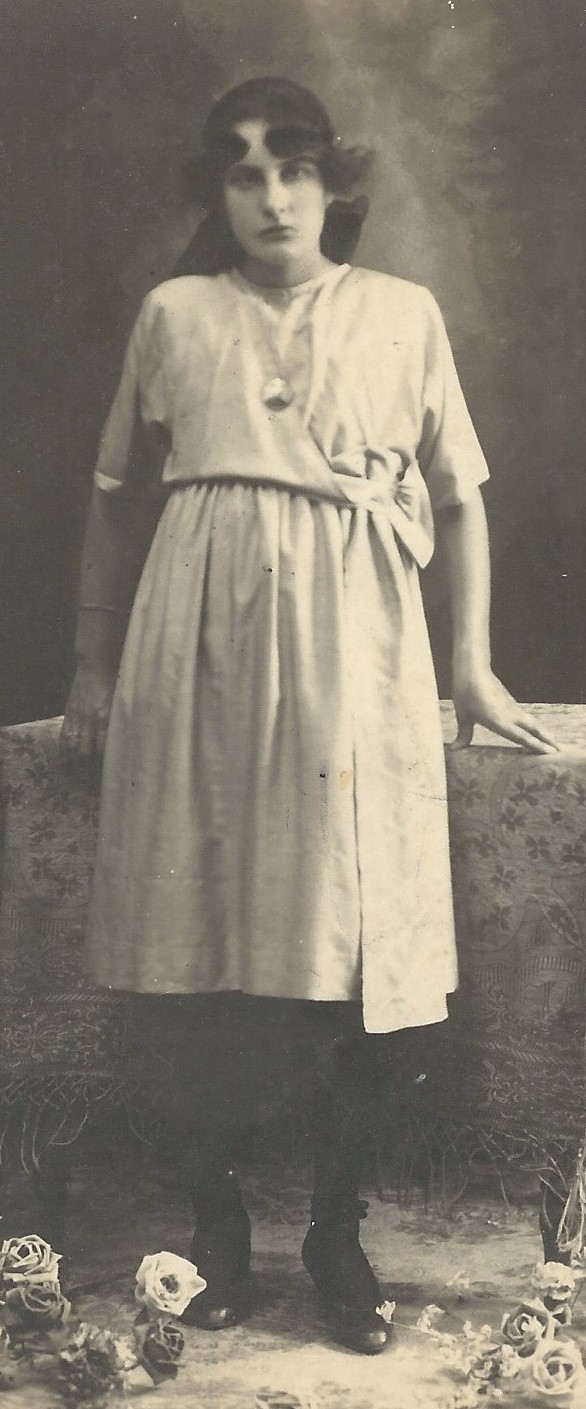
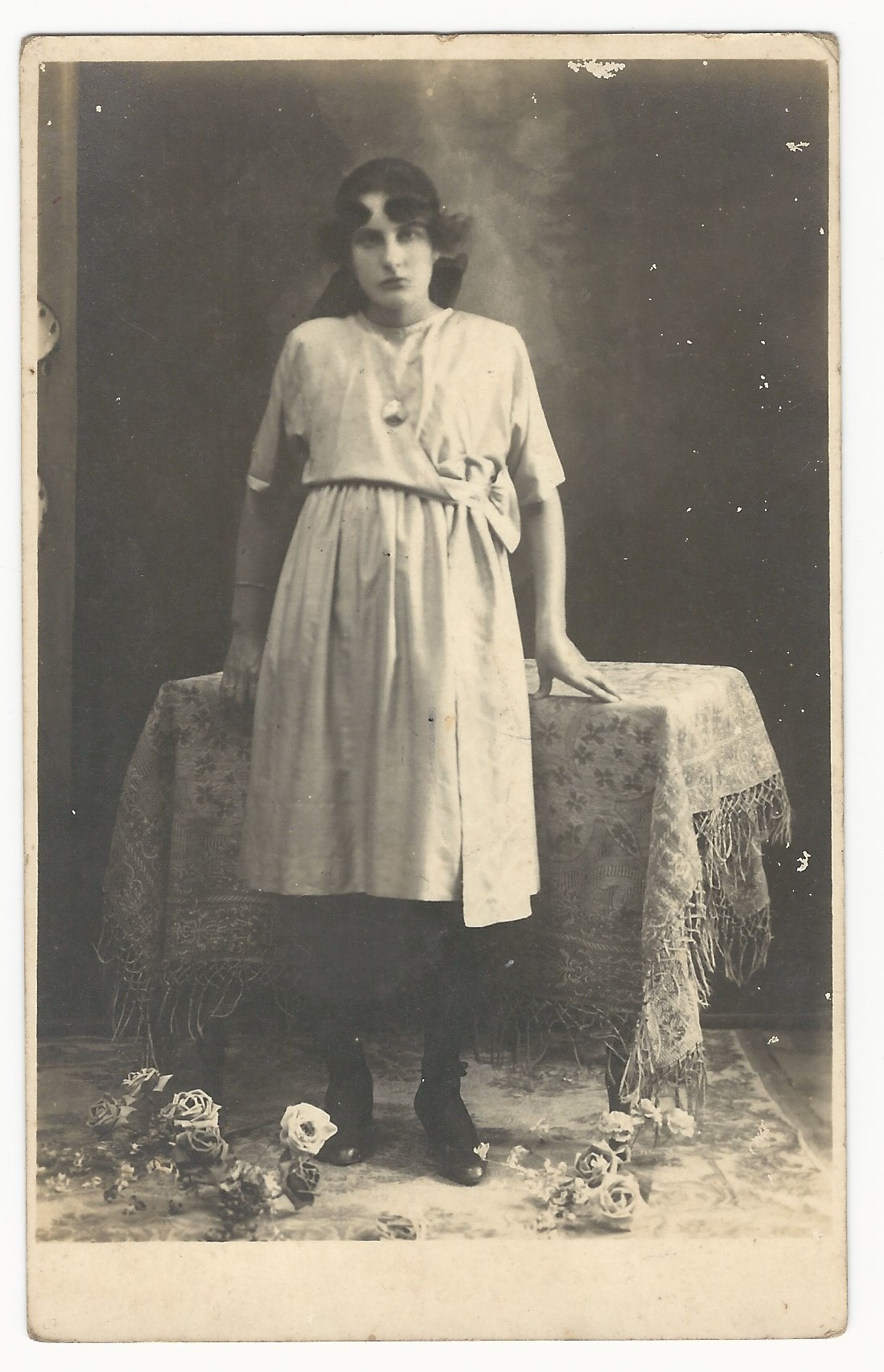
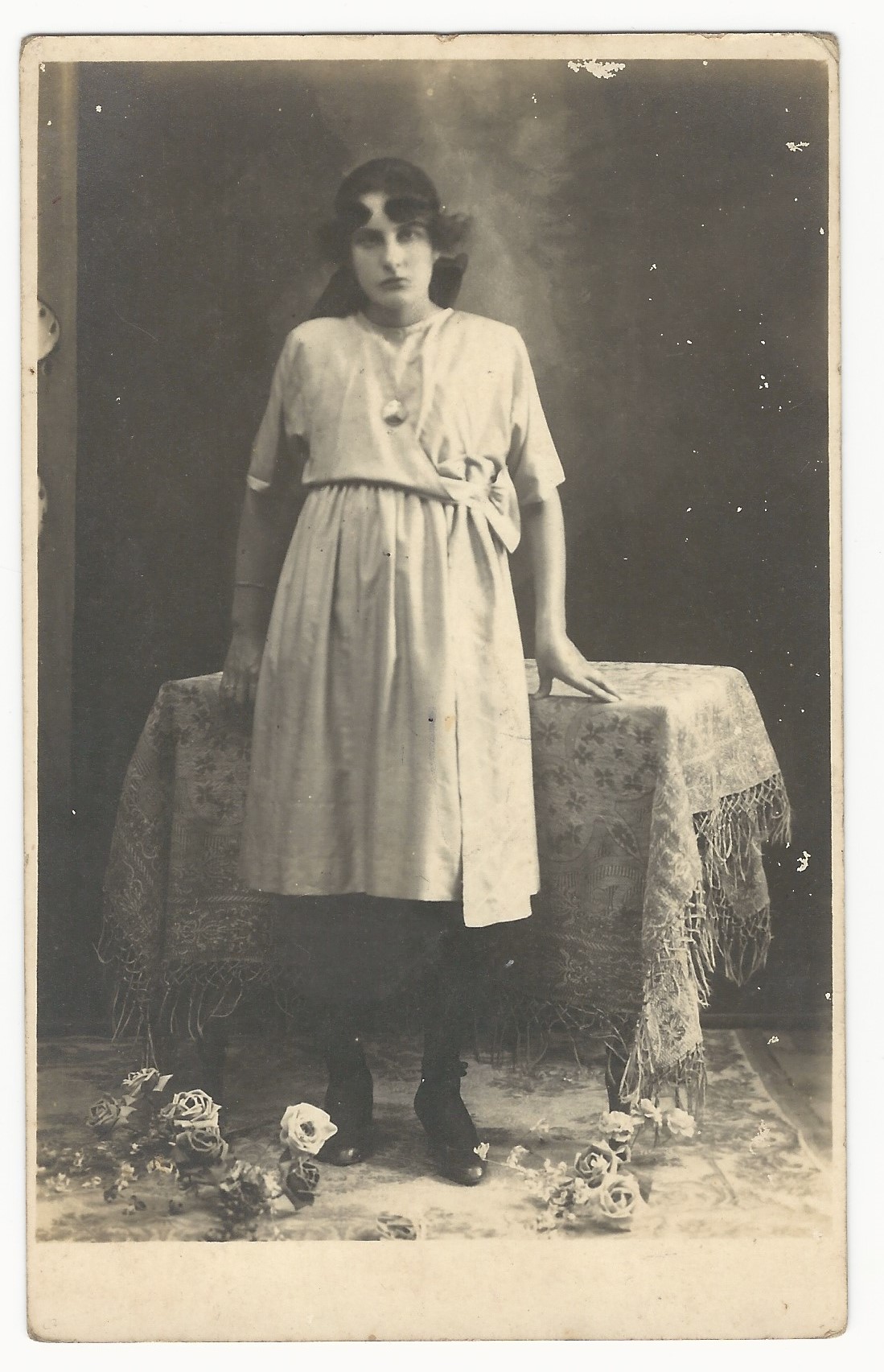
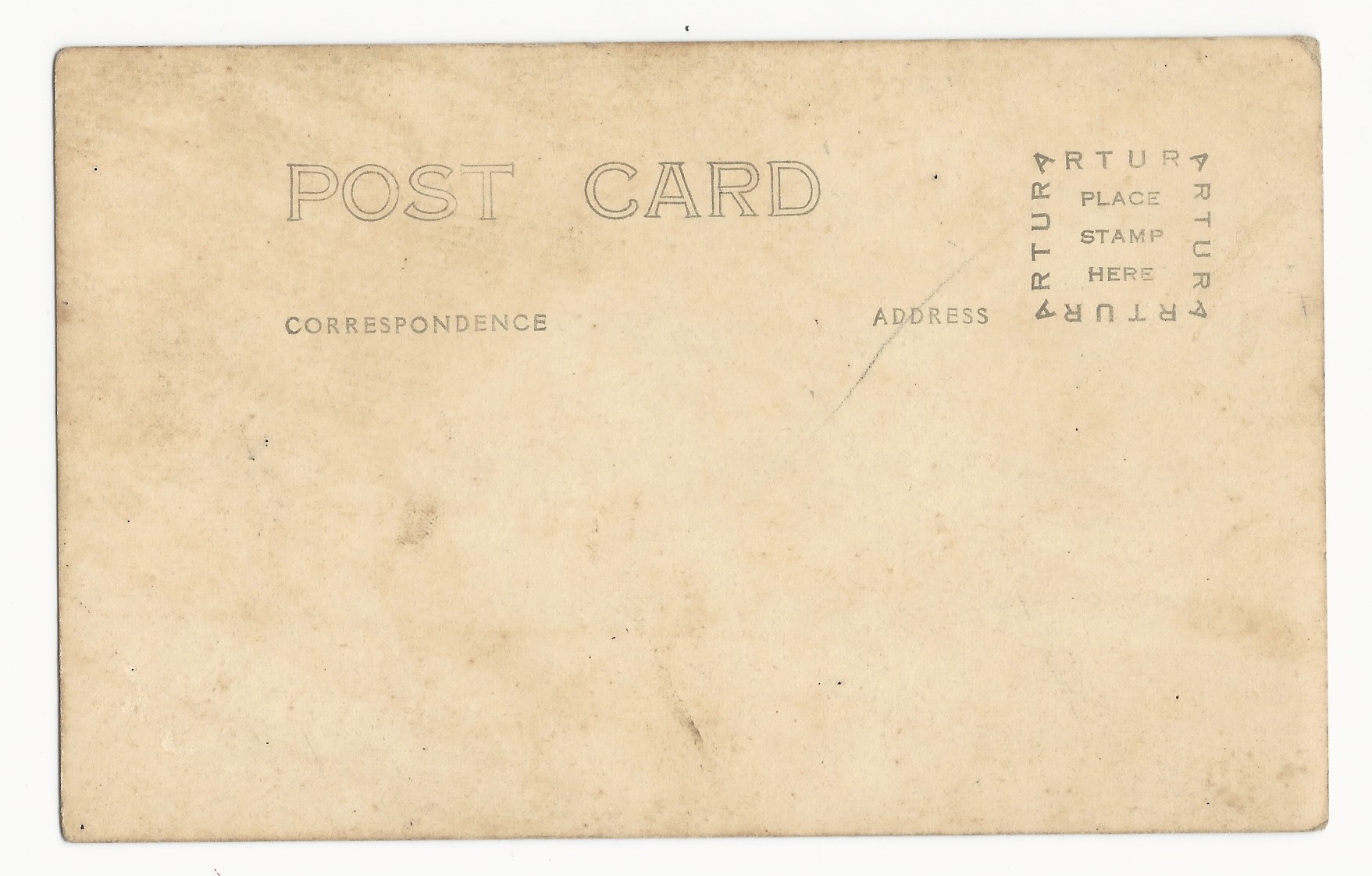
This vintage real photo postcard features a full view of a young woman leaning against a table positioned behind her. Is she showing a “baby bump”. I have seen few early photographs of pregnant woman. Were women reluctant to be photographed while pregnant? Did male photographers find pregnant women to appear unseemly? One should never ask a woman if she is pregnant, nor should one congratulate a woman before it is confirmed that she is pregnant. To ignore this “rule” creates the potential for a major faux pas. This portrait postcard has an Artura stamp box indicating it dates back to sometime between 1910 and 1924. The postcard is in good condition (see scans).
Buy this original Vintage Real Photo Postcard (includes shipping within the US) #3340
To purchase this item, click on the Pay with PayPal button below
$25.50
Buy this Vintage Real Photo Postcard (includes International shipping outside the US) 3340
To purchase this item, click on the Pay with PayPal button below













 THE CABINET CARD GALLERY