This vintage photo postcard documents a fascinating time in world history. In addition, the postcard is rare. An online search was unable to find a duplicate of this interesting postcard. The postcard features the SS Prinz Eitel Friedrich, a German passenger liner which also saw service in World War I. The ship served as an auxiliary cruiser of the Imperial German Navy. It was the second most successful of Germany’s first wave of auxiliary cruisers. Between August (1914) and March (1915), the Prinz Eitel Friedrich sank 11 ships. The ship was built in 1904 for a shipping company by the AG Vulcan shipyard in Stettin. Stettin is located near the Baltic Sea and the German border. The city is a major seaport. For the ten years prior to World War I, the Prinz Eitel Friedrich operated within Far East trade routes. Just before the war, the ship was converted into an auxiliary cruiser. Guns and gunboat crews were added to the ship and Max Therichens took command. In 1914, she joined the German East Asia Squadron. She was then detached and went to the coast of Australia. She operated in the Pacific and South Atlantic. The Prinz Eitel Friedrich sunk ships from Britain, France, Russia, and America (ship named William P Frye). The sinking of the William P. Frye was the first instance of a neutral American ship being sunk by the German Navy. By 1915, the ship was “played out” and sought haven in the United States, a neutral nation at that time. She sailed into Newport News harbor where she was interned. She had 342 prisoners onboard, taken from the ships, she had destroyed. It was reported that Therichens treated his prisoners kindly and had in fact become friends with the captured captain of the William P. Frye. This postcard documents the Prinz Eitel Friedrich after it arrived in Newport News. According to the photograph, it appears that many people came to the harbor to view the ship. The ship and it’s crew became media sensations with local and national newspapers. There were many accounts of the ship’s exploits and interviews with the captain. It was learned, remarkably, that in all of the ship’s exploits, not a single life was lost by the Germans nor their foes. In 1917. the United States declared war on Germany, and the Prinz Eitel Friedrich was transferred to the US Navy. She was refitted to become a troop transport and commissioned the USS DeKalb. The ship operated on the trans Atlantic route and survived the war. After the war, 1920 specifically, the ship became an immigrant ship for the United American Line of New York. It’s last voyage in that capacity was in 1925. She then was retired and finally scrapped in 1934. You probably just read more about the Prinz Eitel Friedrich than you wanted to know. However, I have more to add to complete the saga. Interestingly, the ship’s captain, Max Thierichens of the Imperial German Navy, was placed on trial in 1917. The trial occurred in Philadelphia and received much national attention. Thierichen had become a popular figure in the US during his two years prior to becoming a prisoner of war. He was considered a celebrity by many US citizens and a hero by German Americans. Apparently he had a number of amorous adventures in America. The result was felony charges of sex trafficking (white slavery). He was convicted and imprisoned. He received a fourteen month sentence. Facts of the trial are unclear but to be certain, the trial had political purposes. This rare and historic postcard is in very good condition. It’s AZO stamp box indicates that the postcard is from between 1904 and 1918. The card is marked with a copyright of 1915. (SOLD)


This vintage real photo postcard features two young children sitting on a garden wall. The boy and girl are adorably dressed and are very cute. The girl is holding a bouquet of pink flowers. Note the boy’s fantastic curls and terrific cap. The postcard’s message is dated 1902. This postcard was likely published by Felix Korn & Co. (F.K.) which was located in Stuttgart, Germany. I am unable to confirm the publishers name. This postcard lists F.K. as being located in Paris, not Stuttgart. Further complicating matters is that there also was another company that went by the F.K. initials (F. Kehrhan & Co of Bexley Heath, England). This card’s postage stamp is German and the postmark is from the city of Mulhausen. Mulhausen is a city located in eastern France, near the Swiss and German borders. However, at the time of the mailing of this postcard, Mulhausen belonged to the German Empire and was part of the Alsace-Lorraine territory. (SOLD)


This vintage real photo postcard features two young children sitting in a faux automobile. Most likely, the pair are siblings. The youngest of the two is behind the wheel. Judging by the facial expression of the driver, the roads must have been very treacherous that day. The little girl in the photo is flashing a wonderful smile. This studio photograph was taken by the Mage studio, located in Grand-Montrouge, France. Grand-Montrouge is a southern suburb of Paris. This vintage portrait postcard is probably from the 1910’s era. SOLD


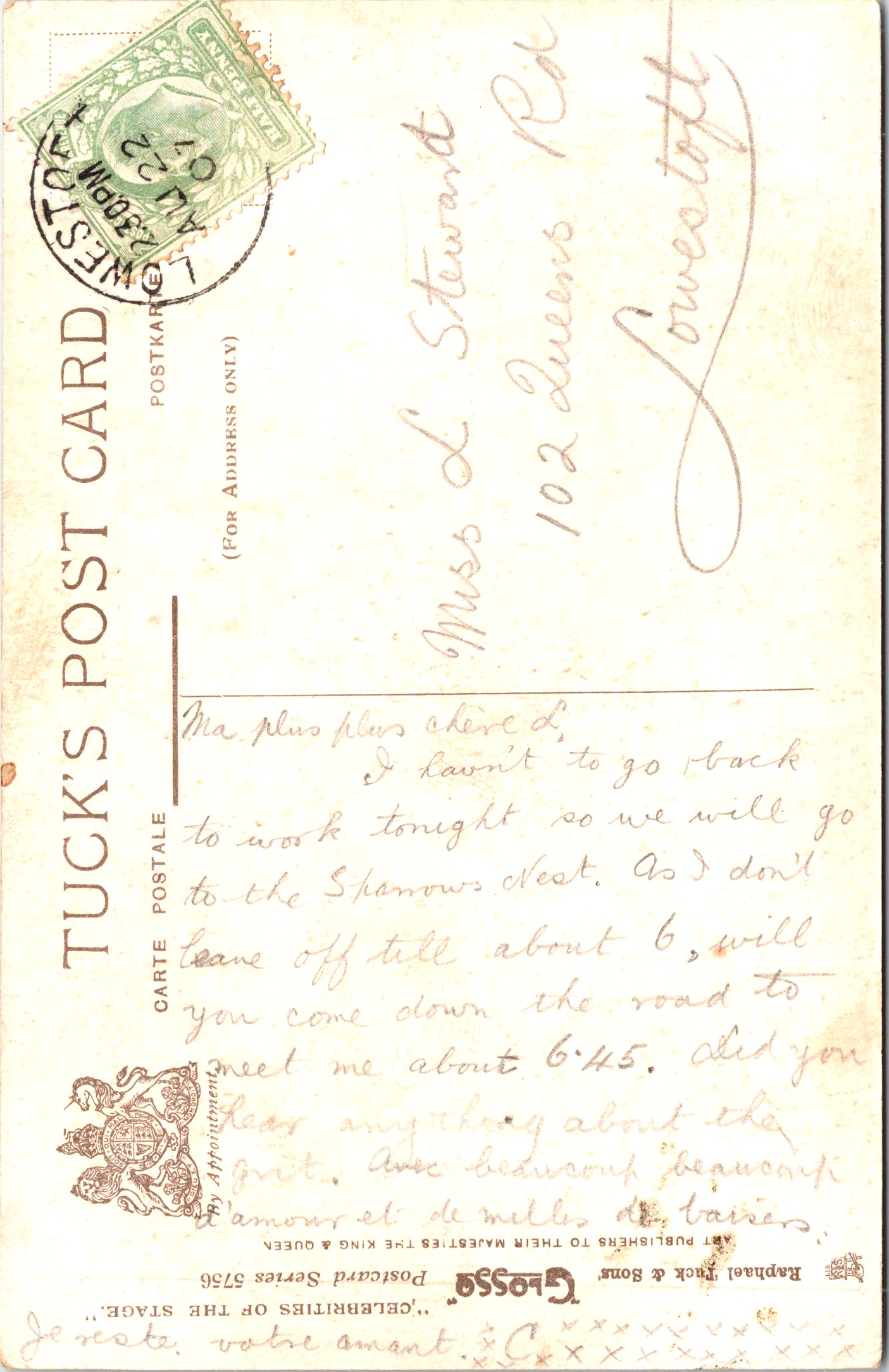
This vintage theater postcard features two actresses appearing in the play, “Resurrection”, by Henry Bataille. The play was adapted from a novel written by Leo Tolstoy. The novel was originally published in 1899. The play was performed at the “Theatre National de L’odeon. The actresses are Mll Sylvie (1883-1970) and Mme Bertha Bady (1872-1921). Here are brief biographical skethches of the actresses. Sylvie was born in Paris, France. Her original name was Louise Pauline Mainguene. Her father was a sailor and her mother was a teacher. She started her professional career in 1903. She appeared in a number of French silent films. She was both a stage and a screen actress. She graduated from the Paris Conservatoire. Her filmography, listed by IMDb, credits her as acting in 54 films between 1912 and 1968. Berthe Bady was born in Belgium but her nationality was French. Berthe Bady attended the Brussels Conservatory and was active on the stage between 1893 and 1913. She was a beautiful actress. Berthe was a companion to both Lugne-Poe and Felix-Henri Bataille. Lugne-Poe was a French actor, theatrical director, and scenic designer. He and Bady were involved in symbolist movement of the arts. Bataille was a French dramatist and poet. A brief explanation of symbolism seems to be merited. In theatre, symbolism is a way to bring a greater meaning to something than is apparent at face value. The use of color, characters, movement, props and costumes are all methods of presenting symbolism. In 1897 Bady was the subject of a portrait by Toulouse Lautrec and her death was the subject of a poem by a leading French poet, Louis Aragon. In addition, playwright Fernand Crommelynck dedicated a play to her. Wikipedia credits her with sixteen “notable” play appearances between 1893 and 1913. She appeared in Ibsen’s “The Master Builder” on an international tour. The tour took her to London, Brussels, Amsterdam, Milan, and additional cities. In 1918 she appeared in her one and only film, “Ecce Homo”. The photo of Berthe and Sylvie was taken by Emile Allevy, a Paris photographer. The postcard was published by A.J.C. (Arthur John Carter) of Eastbourne, England. This postcard was likely published around 1902 since that is when Bady played in the play at the Theatre National de L’odeon. This vintage postcard is in good condition (see scans).

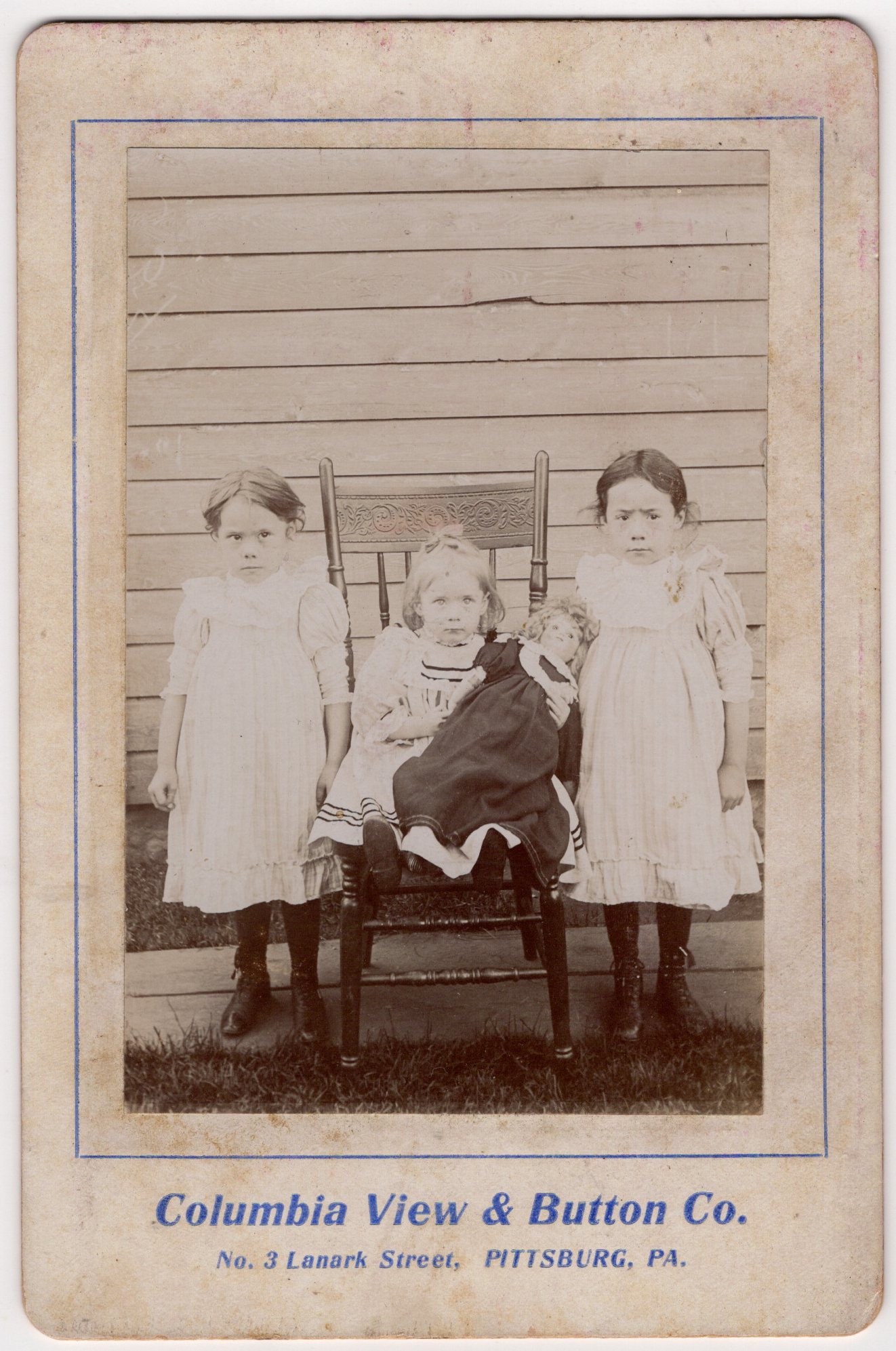
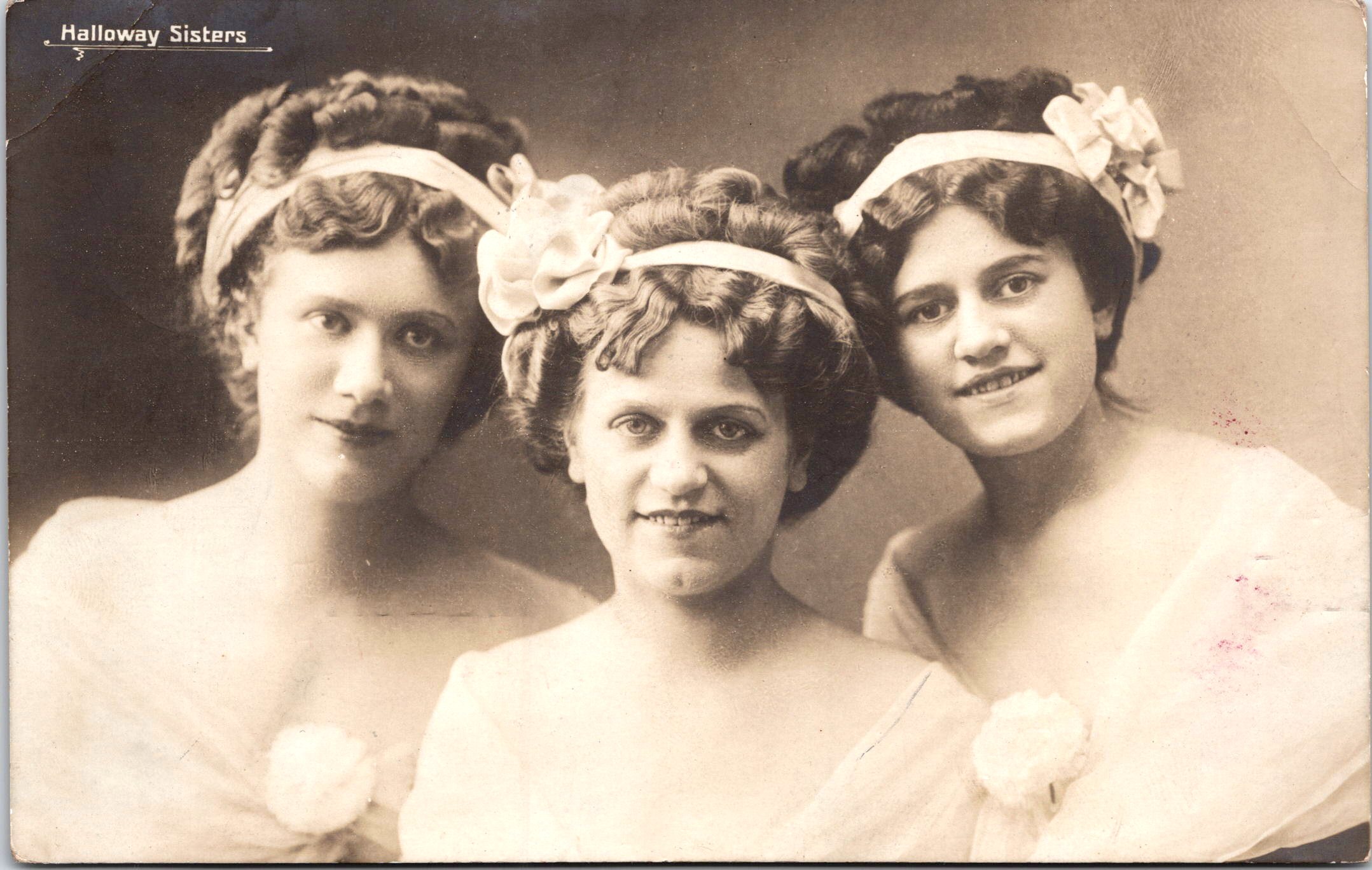
This vintage real photo postcard features three adorable little girls dressed in lacy colorful dresses and wearing flowers in their hair. The postcard was published by ABN and dates back to circa 1909. The postcard has a French stamp and a postmark from Ardeche, a department in southeast, France. The postcard in in very good condition (see scans).


This vintage real photo postcard features a well dressed father and presumably, his daughter. The child rests her hand on the shoulder of her father. Judging by her expression, physical contact with her father appears to have given her a sense of security and confidence. The young girl’s hat may indicate her nationality or ethnicity. The only clue that I have about that matter is that the card was purchased from a collector in Greece. This postcard is in very good condition (see scans).

This vintage postcard features a well armed soldier ready for battle. He is wearing an ammunition belt and at least a couple of hand grenades. He also has a rifle although only the barrel of the gun is visible. What nation is this warrior fighting for? Who is he fighting against? I wish I had answers. An inscription on the reverse of the photo indicates that the soldier is the Commandant (Commander) of his unit. The year that this photo was taken, according to the inscription is 1942. I believe, though not very confidently, that the language on the reverse of the photo is Greek. Perhaps this is a Greek or Turkish officer. This photograph was trimmed from a postcard. It measures about 2″ x 3″ and is in very good condition.