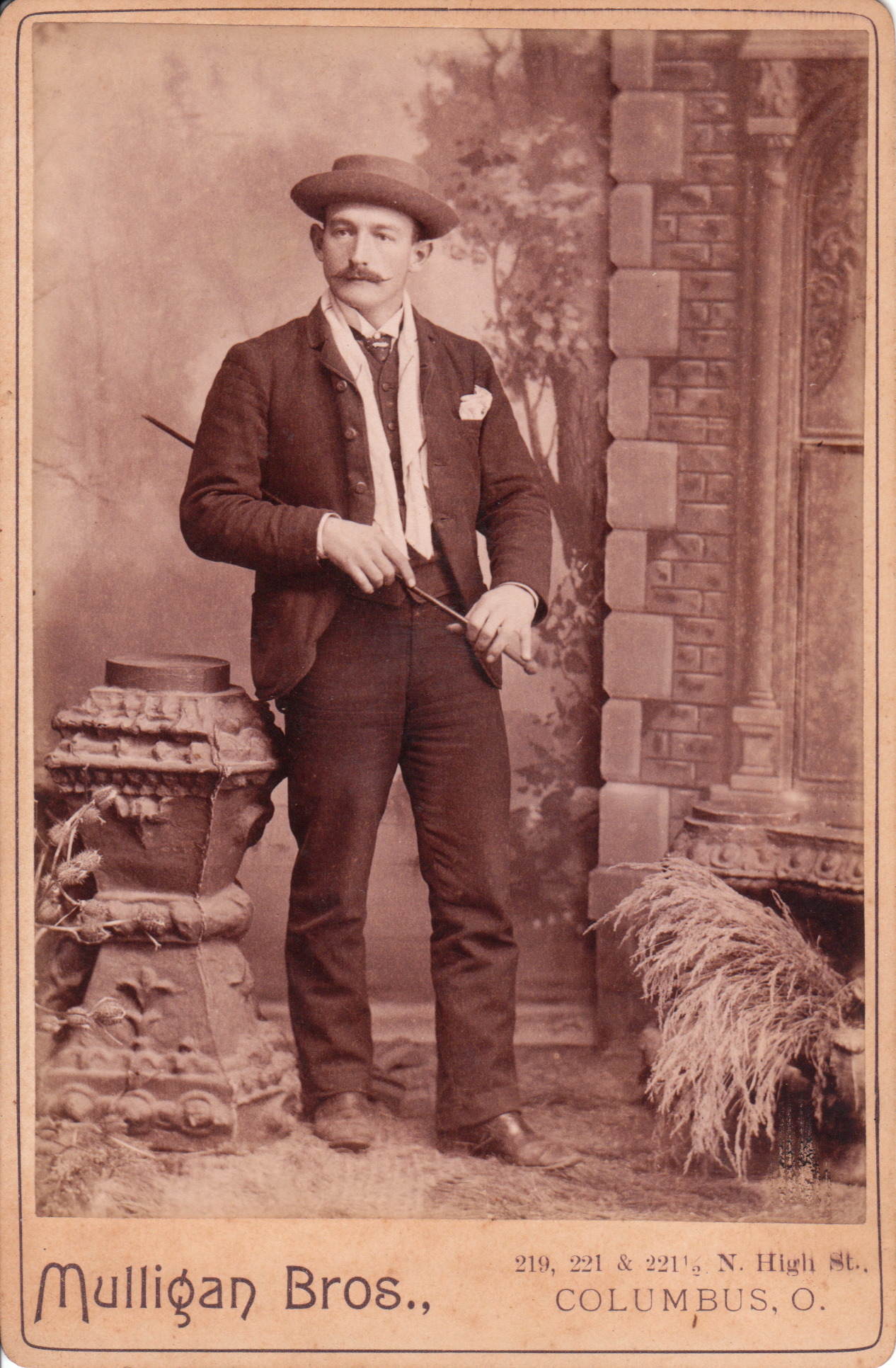
 The gentleman featured in this cabinet card portrait appears to be dashing off to conduct some business. He holds a walking stick and wears a scarf. He was photographed by the Mulligan Brothers studio in Columbus, Ohio.
DASHING MAN WITH PLACES TO GO AND PEOPLE TO SEE, POSES FOR HIS PORTRAIT IN COLUMBUS, OHIO

PRETTY YOUNG LADY IN SCHENECTADY, NEW YORK
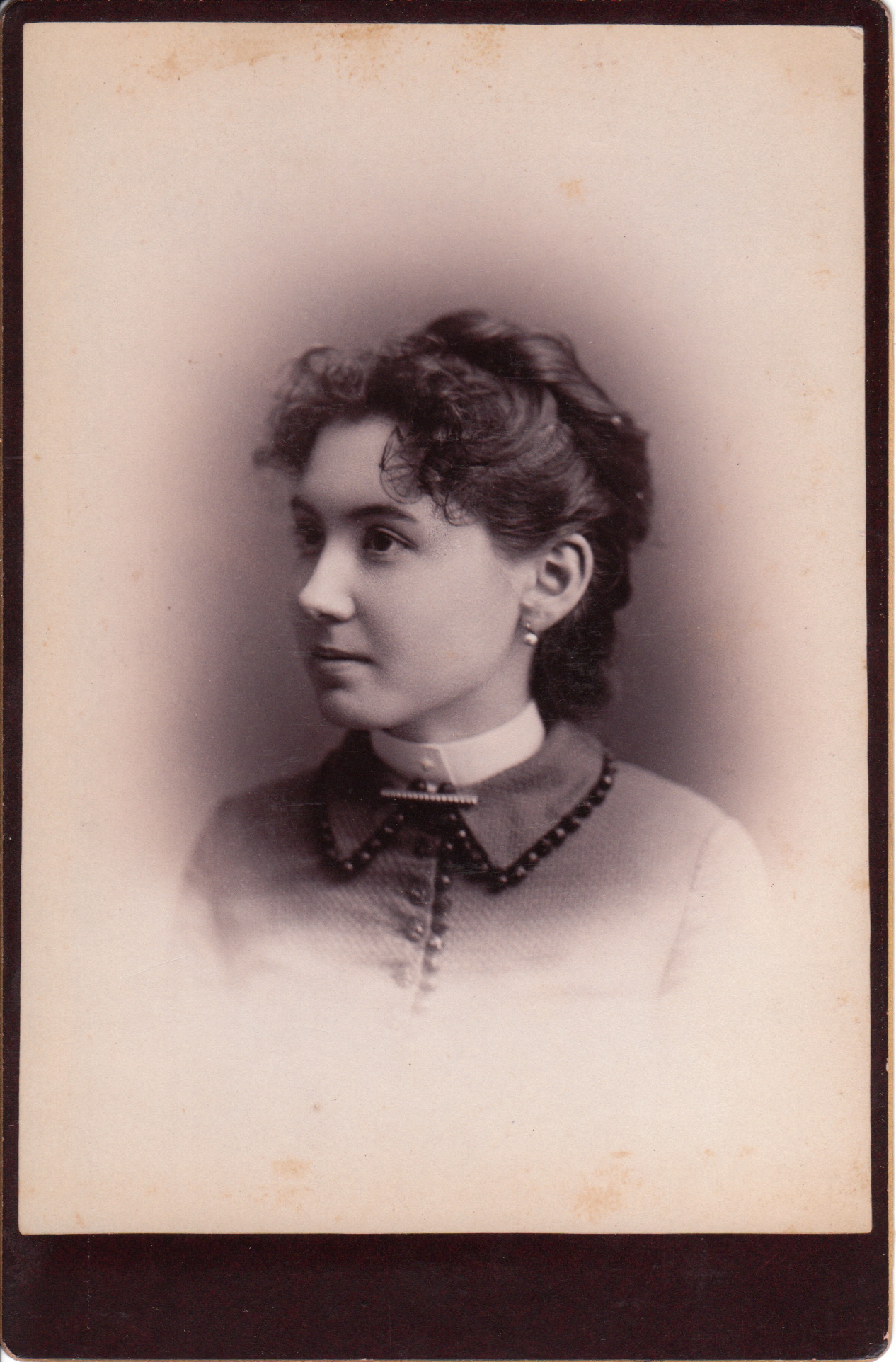 A pretty young lady poses for photographer R. E. Atkinson at his studio at 257 and 259 State Street in Schenectady, New York. The young woman in this image has a look that exudes an abundance of personality. Photographers took great pride in their work which is evident in Atkinson’s advertisement on the reverse of the photograph which states his occupation as “Artist and Photographer”. Atkinson worked as a photographer in Schenectady from at least 1885 through 1888 when he was succeeded by a firm called Smith and Talbott. In 1906 he shows up in the Schenectady business directory again but this time his profession is listed as “nursery stock”. Research reveals that during the 1870’s Atkinson worked as a photographer in Troy, New York.
HANDSOME AND WELL DRESSED YOUNG GENTLEMAN IN BANGOR, MAINE
 Chalmers studio in Bangor, Maine produced this photograph of a formally dressed and handsome young man. The reverse of the photograph has the subject’s name and a few more details listed. The fellows name is C. L. (possibly G. L.) Surall of the University of Maine, class of 1899. This image is likely a graduation picture.
KNIGHTS OF THE TEMPLAR MEMBER IN SAN FRANCISCO, CALIFORNIA
 The previous owner of this photograph asserted that the subject of this image is dressed in the uniform of the “Knights of the Templar”. Note the gentleman’s sword , gloves, belt, sash, and feathered hat. The Knights of the Templar was a fraternal group that originated shortly after the first crusade. To view other photographs of members of this organization, enter “templar” on this sites search box. This image was produced by Rieman & Company which was located in San Francisco. The photograph is larger than a cabinet card. It measures 5″x8″. Advertising on the reverse of the card includes the quote “Rieman’s Babies” and “When Others Fail, Try Rieman”. These boastful statements refer to Rieman’s general photographic prowess as well as his special talent for the difficult task of photographing babies. To view other photographs by Rieman and to learn more about him, click on cabinet card gallery’s category “Photographer: Rieman”.
STYLISH COUPLE IN BROOKLYN, NEW YORK
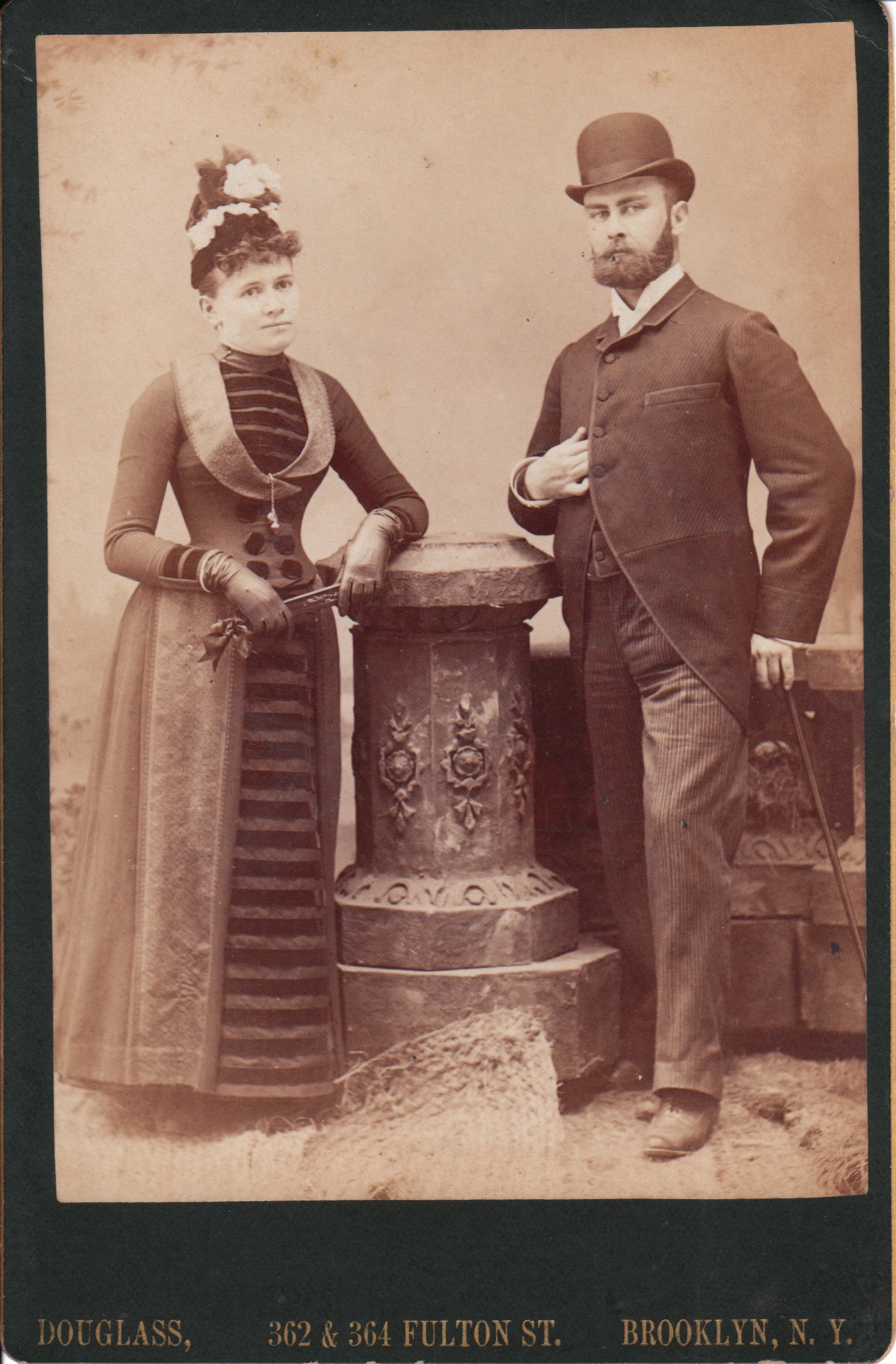 A stylish couple pose for their portrait at the Douglass studio in Brooklyn, New York. Both subjects are wearing wonderful hats. He is holding a walking stick. She appears to be holding a fan in her gloved hands.
UNITED STATES VOLUNTEER UNIFORMED SOLDIER AND HIS WIFE IN CHATTANOOGA, TENNESSEE
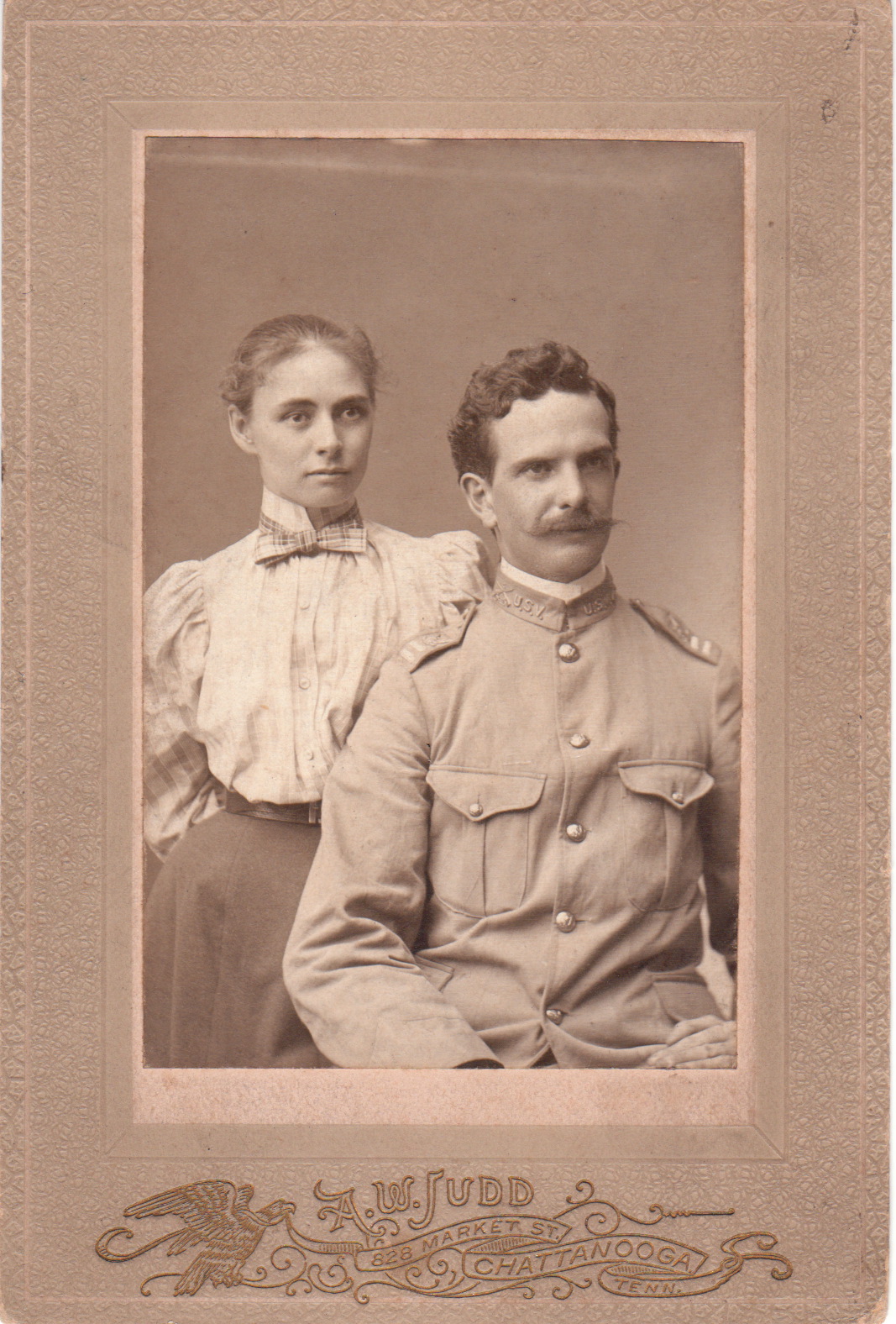
This photograph features a military man with a young woman who is likely his wife. The soldier is wearing collar pins that identify him as a member of the United States Volunteers. Members of the USV were enlisted in the army but were separate from units of the regular US Army. Although volunteer regiments existed during the civil war, the USV was not officially named until the Spanish American War in 1898. The volunteer army was a quick way to supplement the regular army during times of war and was unnecessary during times of peace. This portrait was likely taken during or just after the Spanish American War. The photograph is smaller than a cabinet card. It measures 3.5″ x 5.25″. Note that the woman is standing behind the man making him appear much more prominent. It almsost seems like that she was not even in the original pose and that she was superimposed onto his photographic portrait. The photographer is A. W. Judd of Chattanooga, Tennessee. Judd was born in 1846. The book “Chattanooga” (1996) reports that Amos Wilson Judd was a civil war veteran who began his photography business in 1877. His name and studio appears in Chattanooga’s business directories from 1890 through 1920. He died in 1929. He had two brothers who were photographers. His son succeeded him in running his studio. Judd had two portraits appear in Wilson’s Photographic Magazine (1900). The Photo Beacon (1906) states that Judd was the President of the Kentucky/Tennessee Photographers Association. Wilson’s Photographic Magazine (1908) indicates that he held a patent for a photography invention. A confederate soldier named Amos Judd was a member of the 2nd Battalion Georgia Infantry (State Guard), Company B. He mustered in as a private and left the service with the same rank.
TWO GIRLS PLAYING A BOARD GAME ON SEVEN SISTERS ROAD
 This cabinet card photograph captures two girls playing a board game. It would be nice to see the kids of today spending a little time playing board games instead of isolating themselves in front of their computer or video game system. Hopefully, a member of the “vast unpaid research department” of the cabinet card gallery will leave a comment identifying the game that these girls are playing. This photograph was produced by The Eclipse Photo Company which was located at 103 Seven Sisters Road. Where is Seven Sisters Road? Printing on the reverse of the photographs states “103 Seven Sisters Road N.” What is “N”? Perhaps “N” means North or the abbreviation for a City or Province. Research reveals that a “Seven Sisters Road” exists in London, England.
LADY LIBERTY AND HER TWO APATHETIC CHILDREN
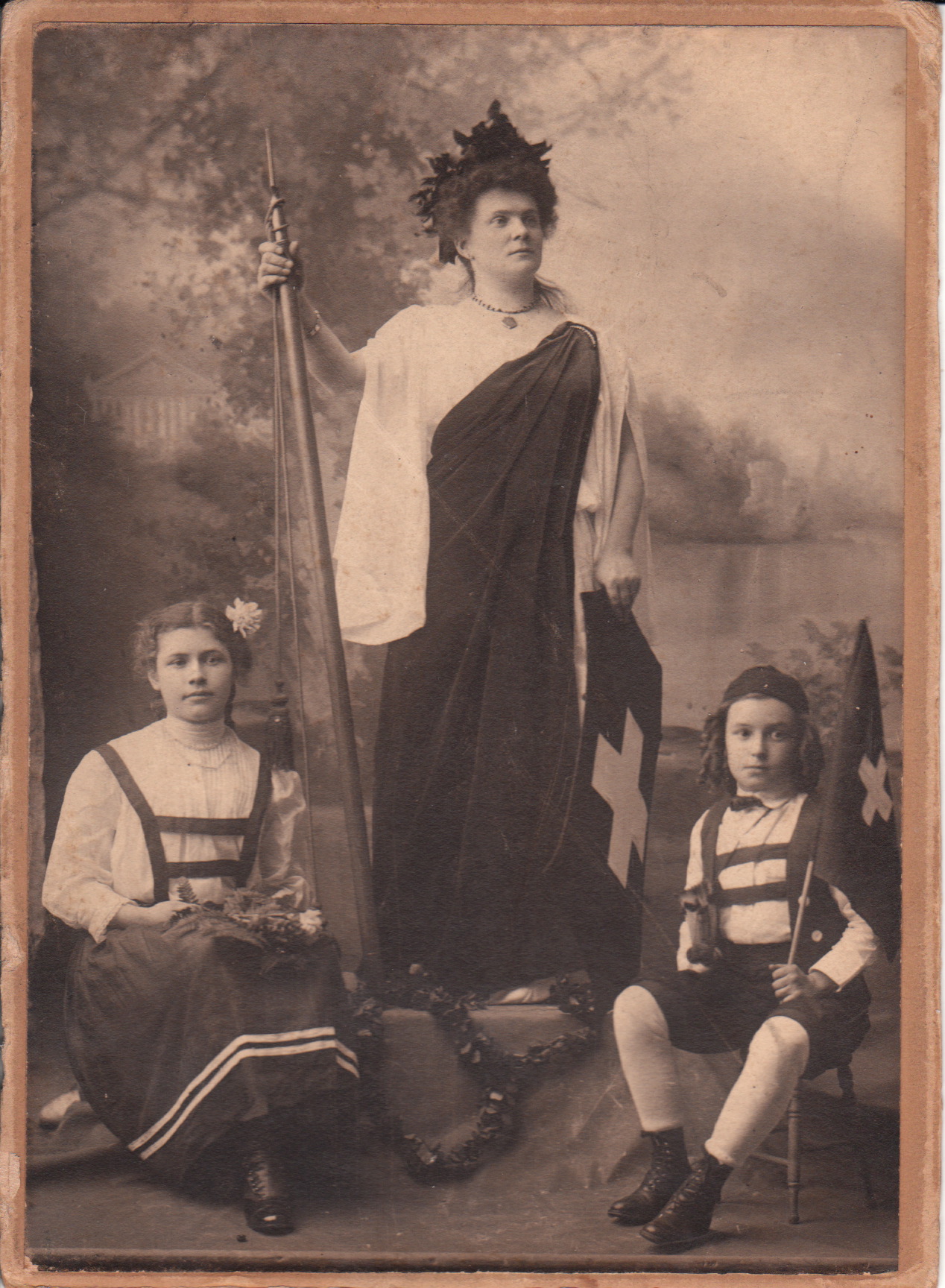 This photograph presents an interesting mystery. What exactly is going on in this image? It appears that this is a photograph of a theatrical presentation or possibly a costumed mother and her costumed children having fun and posing at a photographic gallery. Their clothing appears to be European. The mother is dressed in some sort of patriotic costume. She is holding a black flag with a white cross and a pole that may be a flag staff. The young boy is holding an identical flag to his mother. What is the origin of this flag? Some assistance from an informed cabinet card gallery visitor to answer this question would be greatly appreciated. A similar flag to the pictured flag is Saint Piran’s Flag. Saint Piran’s Flag is the flag of Cornwall. The people of Cornwall used the flag as a symbol of identity. Saint Piran is supposed to have created the flag from seeing the molten tin spilling out of the black ore in his fire. It is a white cross on a black background but the cross part covers the whole flag rather than float in the background like the crosses on the flags in this image. The woman in this image looks rather intense while the children appear uninterested. The subjects of this photograph are unidentified as is the photographer. The photograph has been trimmed to fit into a frame or album and it is likely that the name of the photographer and studio were removed in the process.
LOVING AFRICAN AMERICAN GRANDMOTHER AND HER TWO ADORABLE GRAND DAUGHTERS

This photograph is emotionally moving and it elicits a story that we tell ourselves. Most people will likely see it as a story about a grandmother and her grandchildren. Grandma has a tight loving grasp around the waist of her youngest granddaughter while the older granddaughter clings to grandma’s shoulder for security. This is a portrait of a tight knit family. The little girls are adorable. They are wearing bows in their hair; and both girls are wearing necklaces. It is difficult to tell for sure, but grandma seems to be containing a smile. The girls however, seem a bit bewildered by their experience of being photographed. Grandma was not living in easy times. At the time of this photograph, slavery had already ended but prejudice and discrimination was prevalent. There is dearth of early photographs of African American individuals and families. This image certainly serves a role in representing African American history. Unfortunately, the photographer and subjects of this image are unidentified.
ADORABLE LITTLE GIRL IN OXFORD, INDIANA
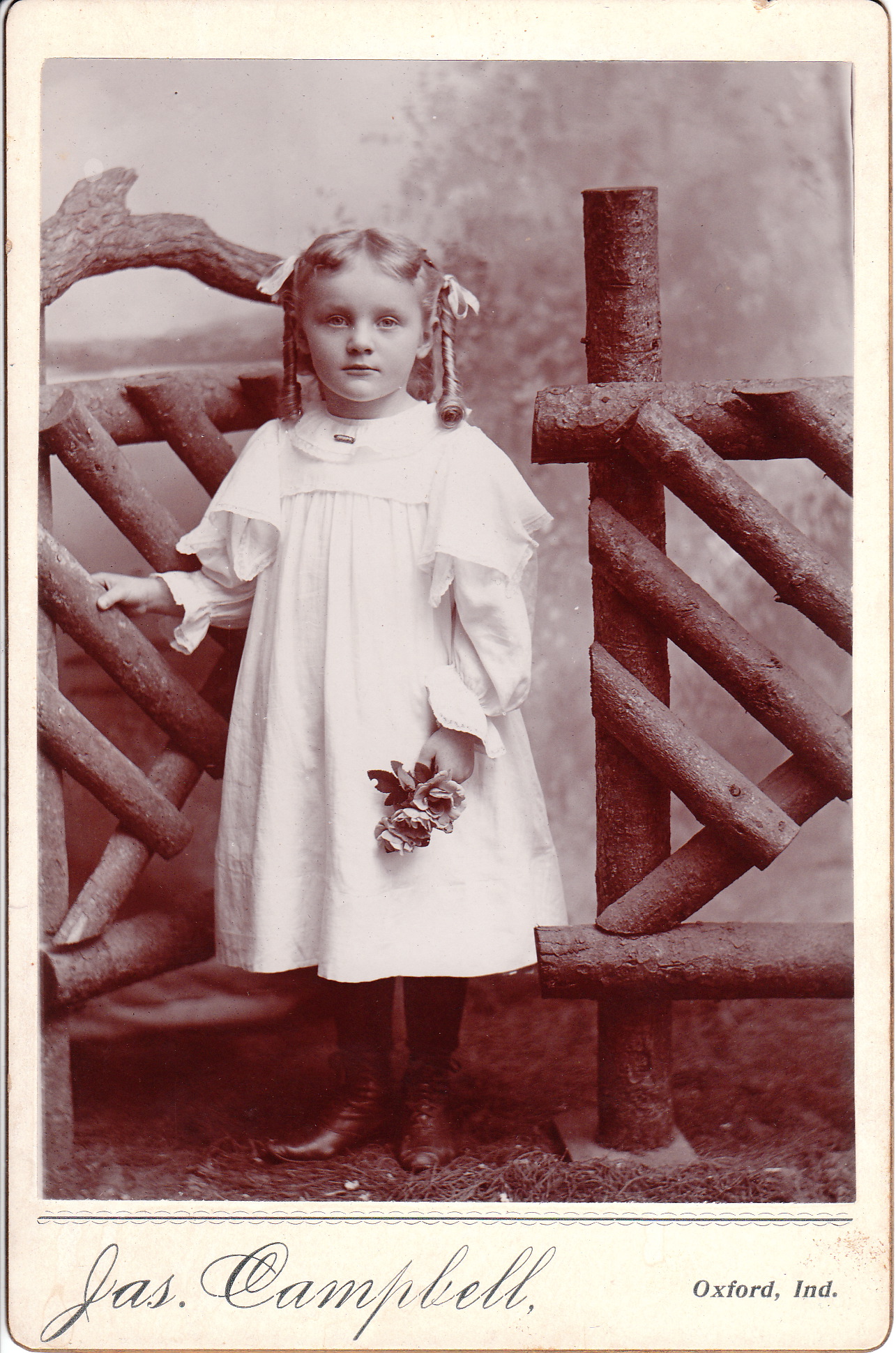 An adorable young girl poses by a wooden gate for photographer James Campbell in Oxford, Indiana. The little girl has terrific curls tied by bows and is holding flowers. The photographer of this cabinet card was a civil war veteran. The New History of the Ninety Ninth Indiana Infantry (1900) gives a brief biographical sketch of Campbell along with his photograph. James D. Campbell was born in 1845 in Fayette County, Indiana. He and his parents moved to Oxford in 1854. He was a well respected soldier in the civil war. He was a member of the 99th Indiana Infantry (Company C). He entered and left his regiment as a private. The book reports “He was one of those quiet faithful soldiers; always ready and always willing to do his duty”. His biography also describes him as married but having no children.


 THE CABINET CARD GALLERY