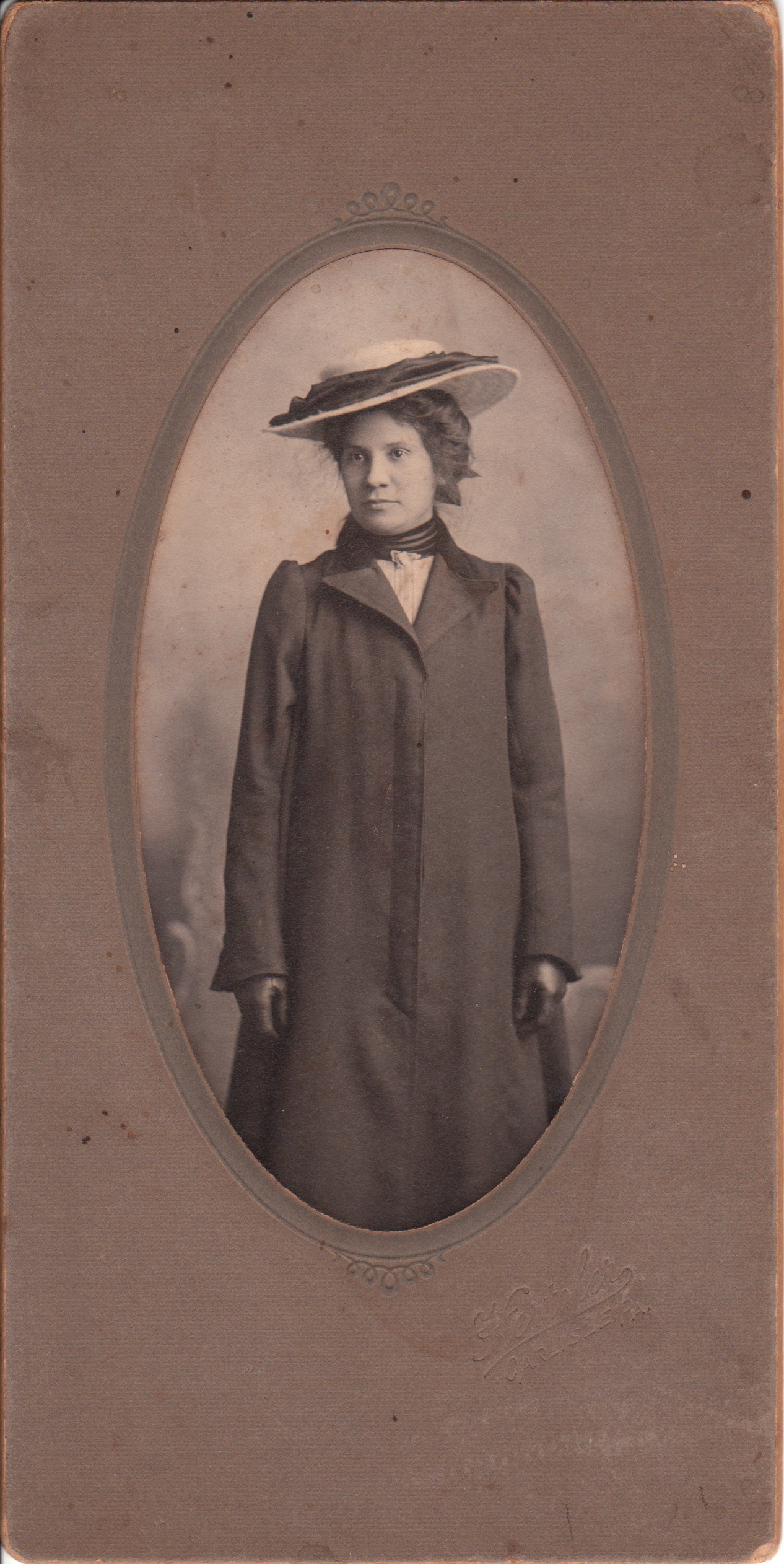
 The reverse of this photograph has an inscription and is signed by the subject. The young woman in this image is Amy Dalphus and the inscription states “to sister “Phillips” from sister “Beaver” Remember the day this was taken”. Miss Dalphus is well dressed and attractive in her coat, hat, and leather gloves. The photographer of this image was Hertsler whose studio was located in Carlisle. Research reveals that Amy E. Dalphus was from the Sioux tribe in South Dakota. She graduated from the Carlisle Indian Industrial School in 1903. She is cited in the book “A Biobibliography of Native American Writers, 1772-1924: A Supplement”by Littlefield and Parins (1985). Next to her name is the following: “Red Man and Helper, February 20-27, 1903”. Perhaps she wrote an article for this magazine or maybe her graduation is listed in the magazine’s pages. Research found little information about Miss Dalphus. Her name was listed on a number of annual “Indian Census” reports from the turn of the century. The “Indian Census” of 1896 reported her to be living in South Dakota with her step mother (Mrs. Moore) and three brothers and a sister. She lived under the auspices of the “Cheyenne River Agency”. The 1900 US census found her living in Carlisle as a student.The story of the Carlisle Indian school is an example of well meaning people committing terrible deeds in an effort to help others. It is important to realize that not everyone involved in this school, and others like it, were actually well intentioned. The Carlisle school operated from 1879 through 1918 as a boarding school founded by Captain Richard Henry Pratt. The school was part of the effort of the US government to assimilate children from 39 tribes into the majority culture. This was an effort to “civilize the Indian”. Pratt saw his task as similar to his experience with the “domestication of wild turkeys”. He believed his mission was the “annihilation of the Indian and his salvation as an American Citizen”. Pratt’s goal was to “kill the Indian in him, and save the man”. Many children were subject to this assimilation project. During some years, the school had as many as a thousand students a year. In addition, there were other schools engaged in the same endeavor. The students were forced to take English names to replace their given tribal names. This was very difficult for the students to accept because their tribal names had personal meanings that reflected their experiences or relationships. In the inscription on the reverse of this photograph, Amy Dalphus refers to herself as “Beaver” alongside her English name. Perhaps this is an effort by her to not surrender her tribal name. The Carlisle school became well known for its athletic programs. Coach Pop Warner and the talented athlete, Jim Thorpe, received national attention. More people are aware of Carlisle’s sports prowess than the actual abuse and racism that permeated the concept and operation of the school. SOLD
FEMALE NATIVE AMERICAN STUDENT AT THE CARLISLE INDIAN SCHOOL IN CARLISLE, PENNSYLVANIA

PRETTY WOMAN IN HENRY, ILLINOIS
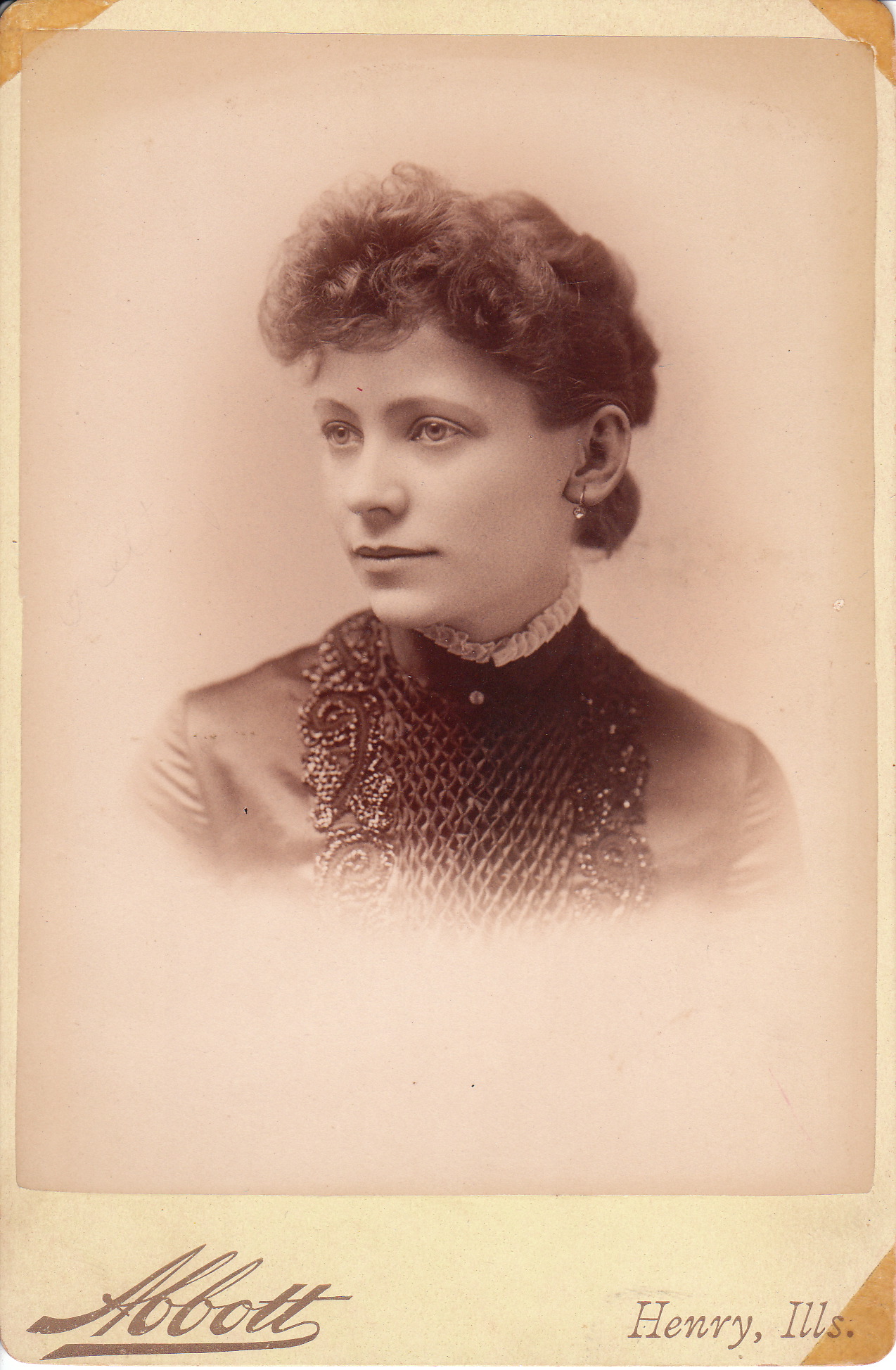
This cabinet card portrait features a pretty woman named Lizzie Smitz. She is identified on the reverse of the image. She is wearing earrings and what appears to be a beaded dress. Ms Smitz has great eyes. The photographer is Abbott, whose studio was located in Henry, Illinois. No biographical information about Lizzie Smitz could be found. The photographer, Charles Abbott is listed in the 1880 US census as an artist. He was 35 years old and lived with his wife, Louisa Abbott (age 32), and their son Harry (age 12). The family lived in a boarding house. The couple had married in 1867. Louisa Abbott was also listed in the census as an artist. The 1900 census finds the Abbots living as a couple in Henry, and Charles working as a photographer. Research also discovered that during the civil war, Charles was a Private in the 27th Maine Volunteer Infantry (Company K). SOLD
SWEET BEJEWELED LASS : AUCKLAND, NEW ZEALAND : FASHION : CABINET CARD

The F. W. Edwards studio produced this cabinet card portrait of a pretty Victorian woman. She is wearing a beautiful dress with a lace collar and lace sleeves. She is also wearing a lot of jewelry including a lovely necklace, ring and bracelet. Frederick William Edwards was well known in Auckland for more than his photographic skills. He was also a gifted athlete. According to the Observer (1888), Edwards was one of the best and most popular athletes in and around Auckland. he was “best known in aquatic and gymnastic circles” but he also had an impressive sports career in rowing. In addition, he was a noted rugby player. This vintage portrait cabinet card has cornerwear on it’s reverse top left corner. SOLD

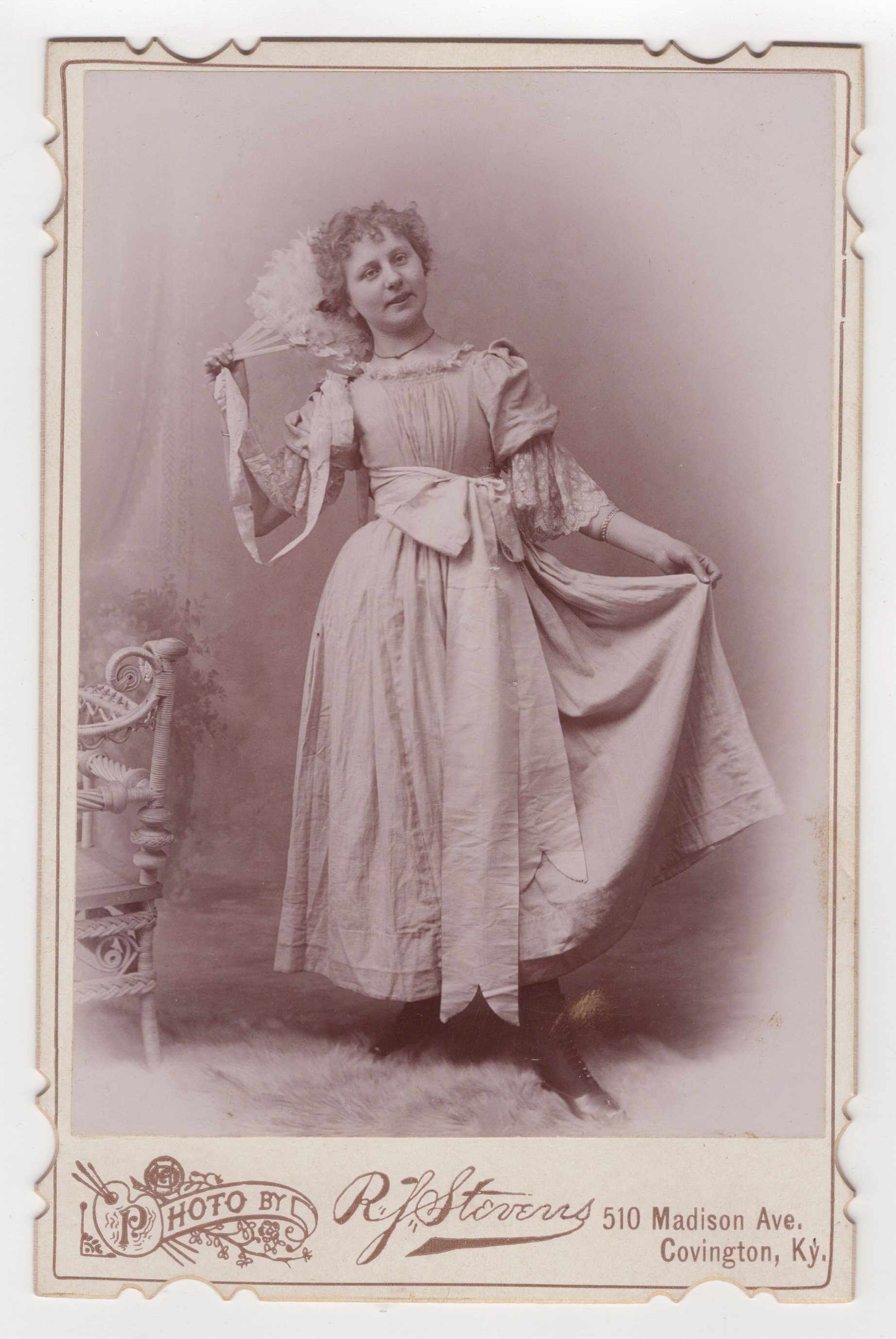
PRETTY YOUNG WOMAN WEARING LACY GOWN : FEATHER FAN : THEATRICAL POSE: CABINET CARD
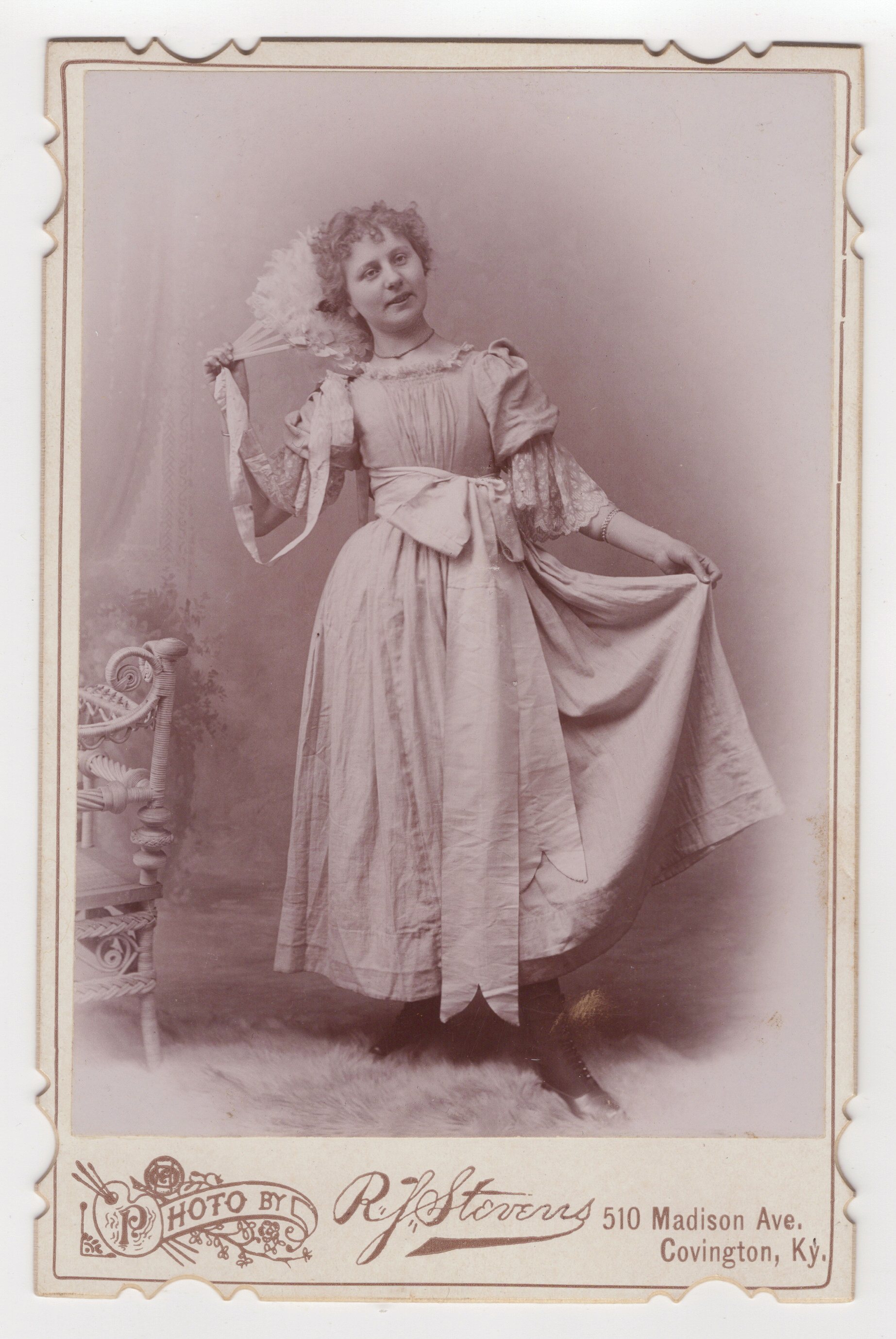
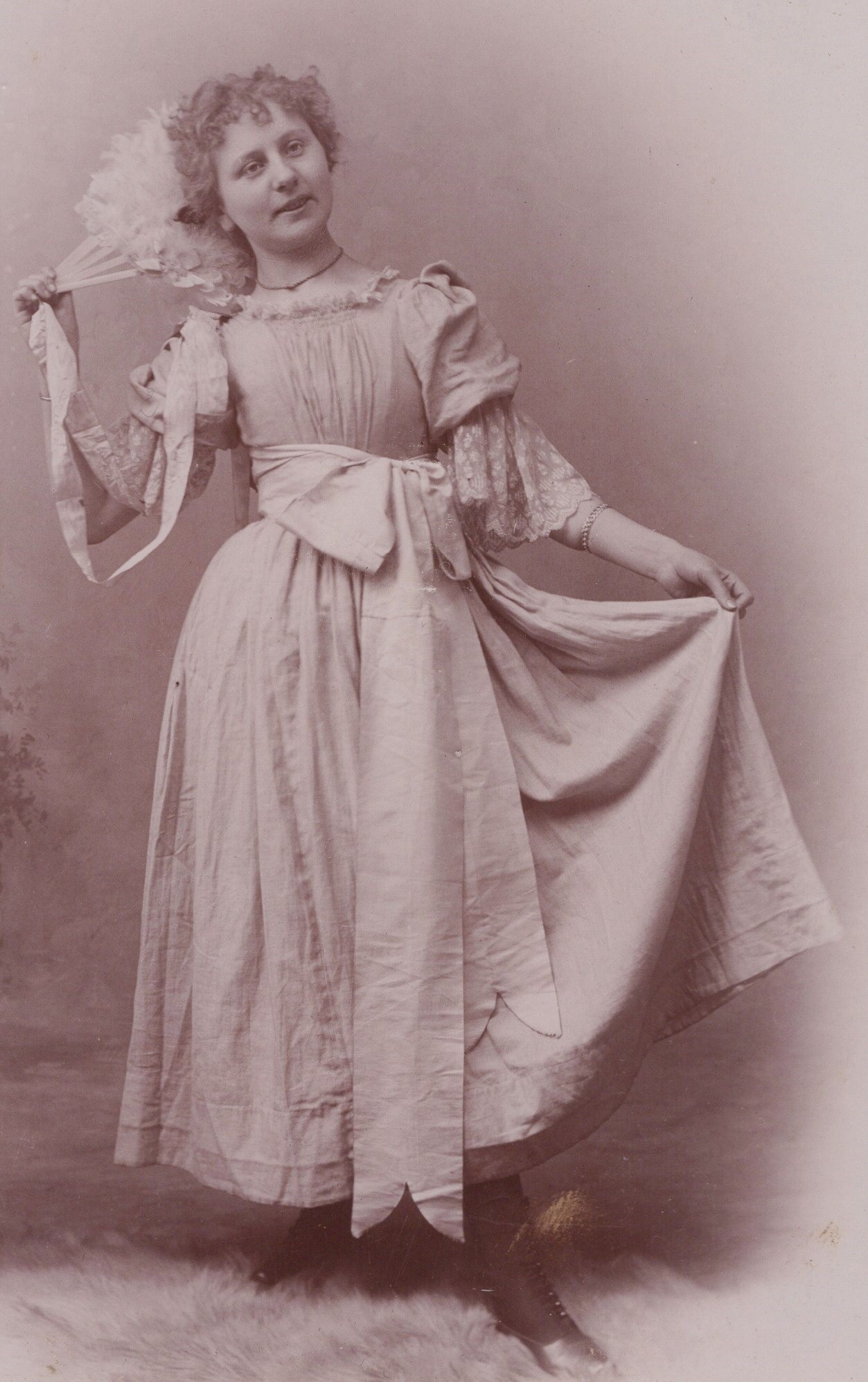
This cabinet card features a young woman wearing a lacy gown and holding a feather fan. She is striking a theatrical pose. The young lady is pretty and gives a floaty, light and airy appearance. This scallop edged cabinet card is from the Covington, Kentucky studio of Richard J Stevens. Stevens is listed as a photographer in the Covington / Newport Business Directory between 1888 and 1894. This cabinet card is in very good condition (see scans).
Buy this Cabinet Card Photograph (includes shipping within the US) #6379
To purchase this item, click on the Pay with Paypal button below
$28.00
Buy this Vintage Original Cabinet Card (includes International shipping outside the US) #6379
To purchase this item, click on the Pay with Paypal button below
$38.00
LUCKY LADY : HORSESHOE PIN : STEUBENVILLE, OHIO : CABINET CARD
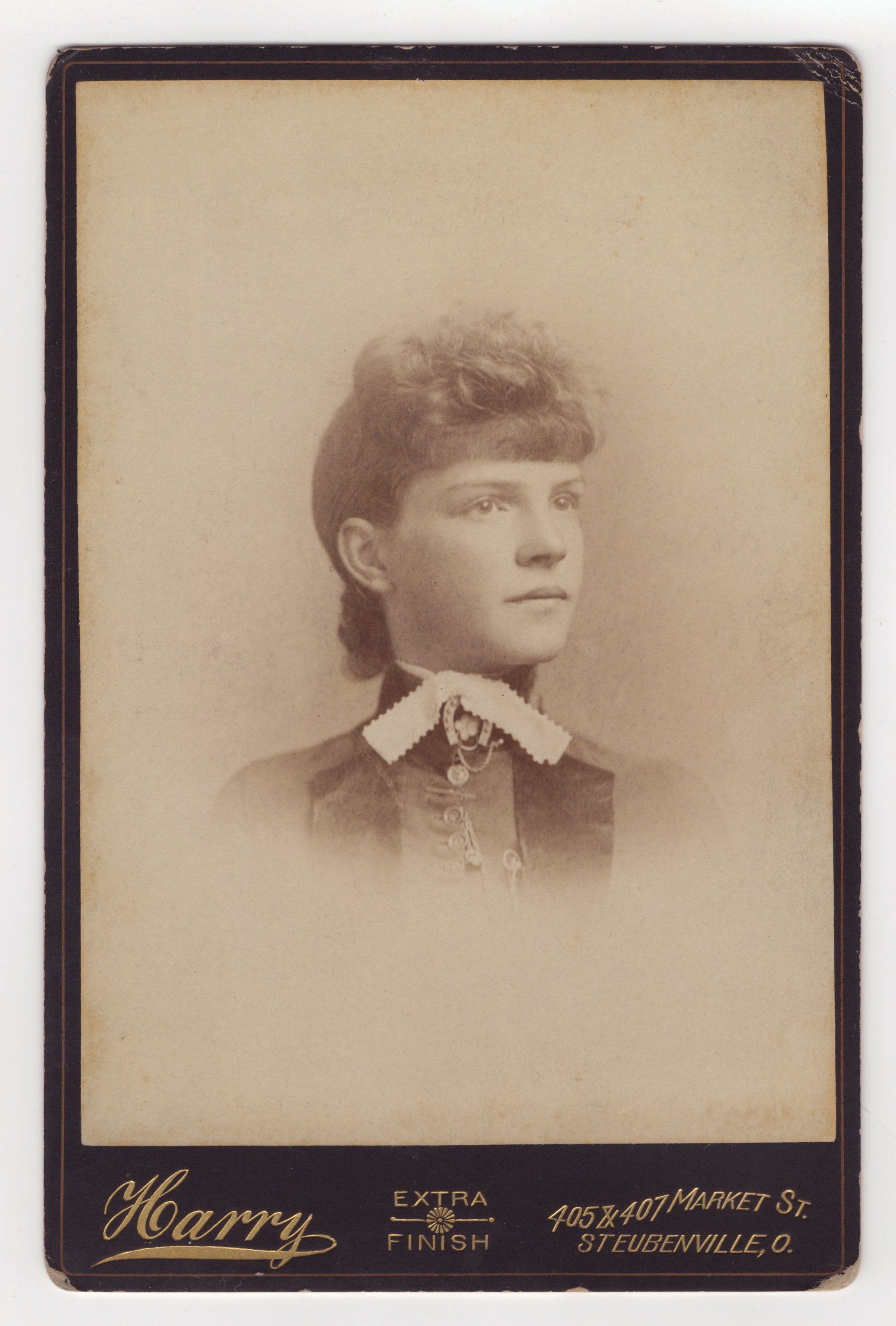
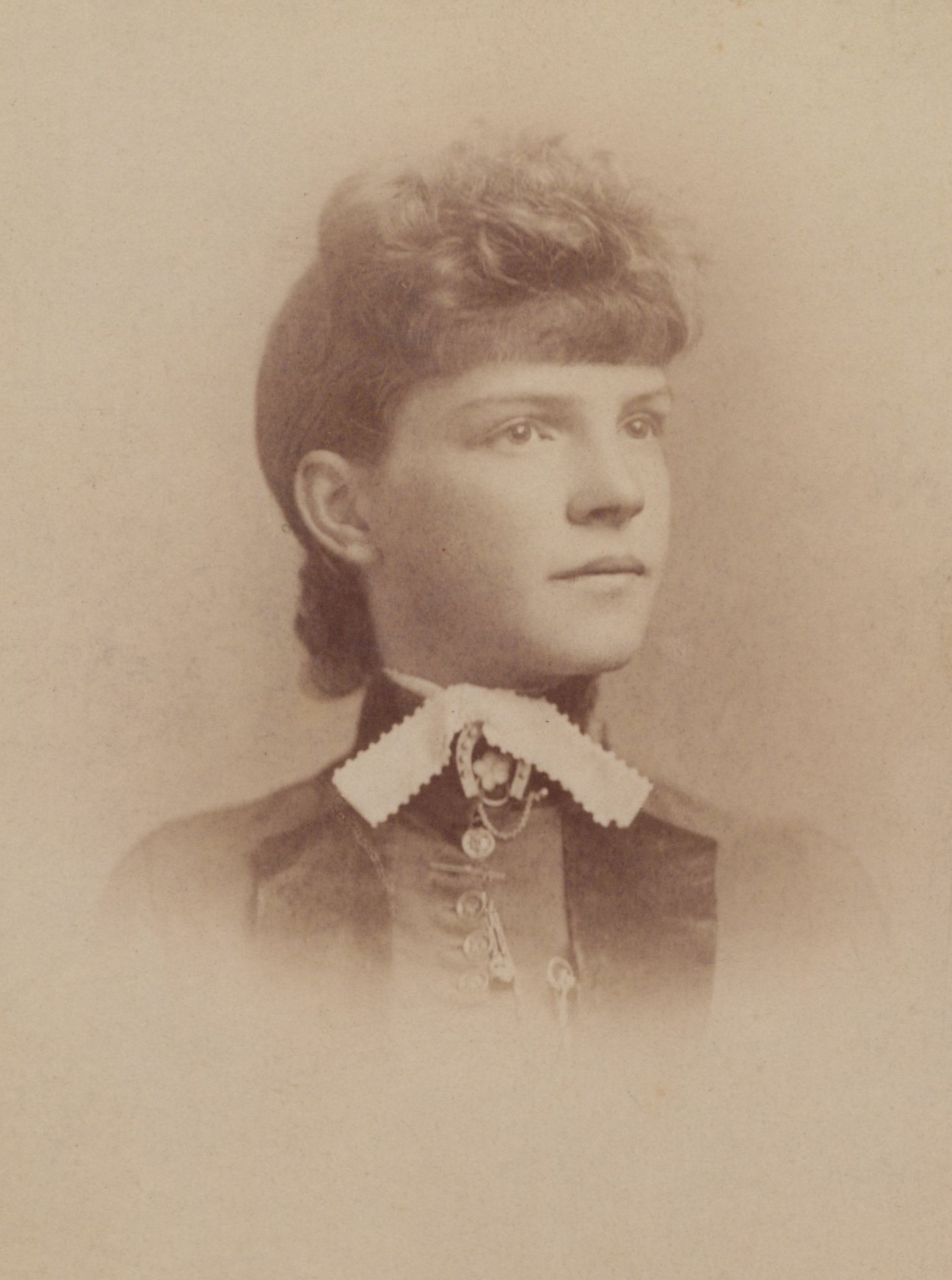
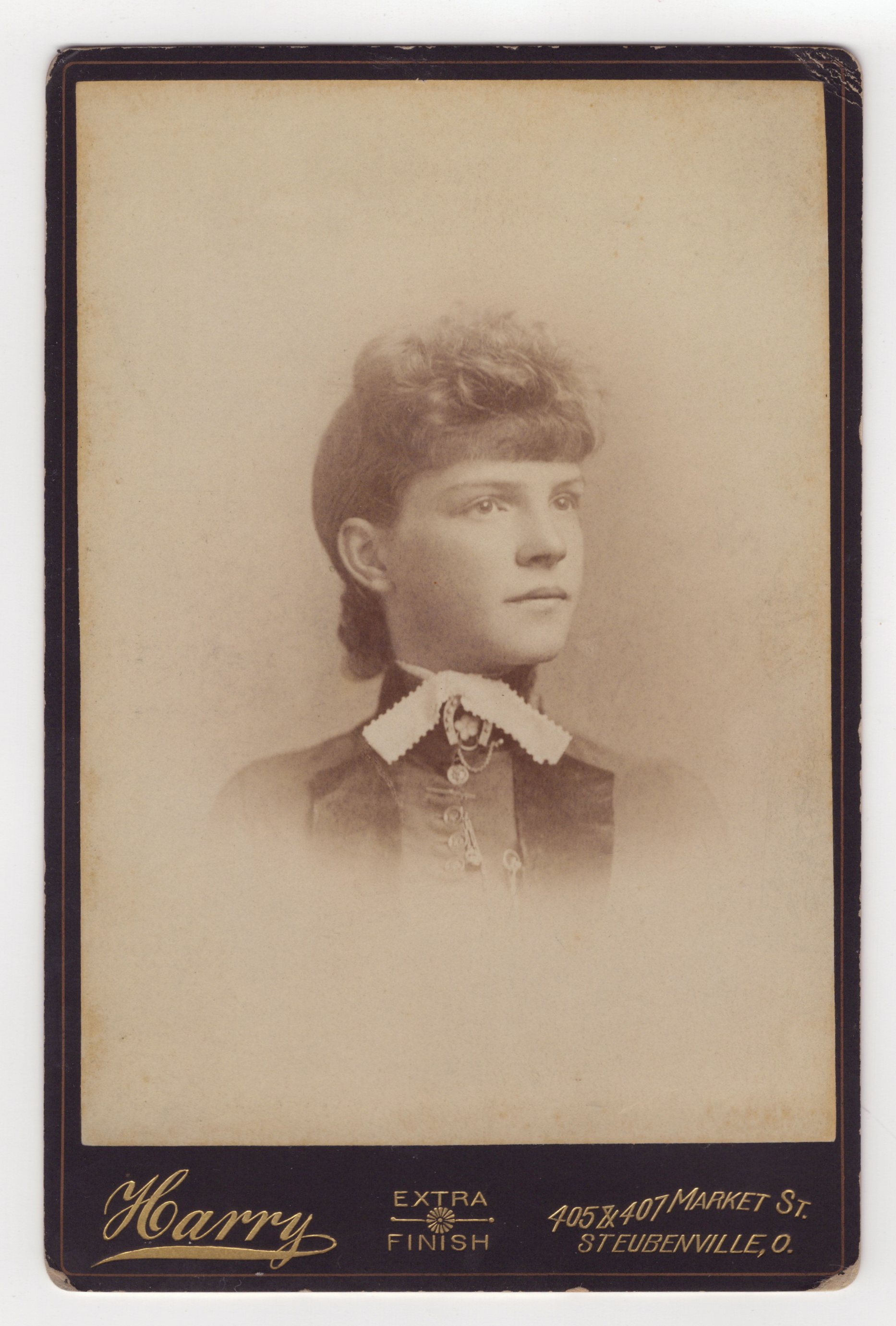
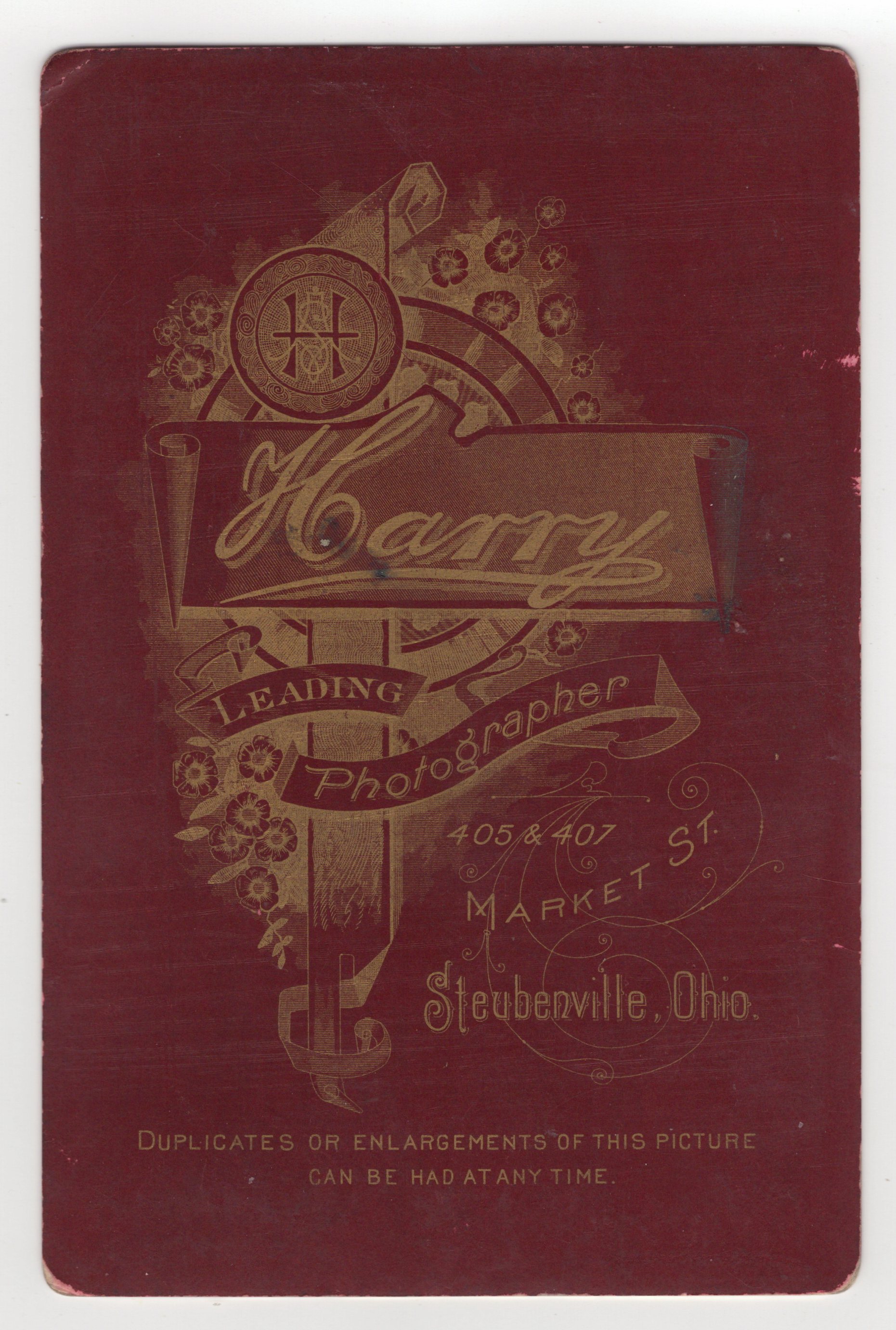
This cabinet card is a portrait of a young woman photographed by Harry, who advertised himself as the “leading photographer” of Steubenville, Ohio. The woman is wearing a ribbon around her collar as well as two pins. One pin is a horseshoe while the other appears to be some sort of clover. Perhaps these are good luck charms. Albert S. Harry (1848-1904) was born in Ohio and worked as a photographer in Wooster, Ohio through much of the 1870’s. In 1878, he settled in Steubenville and operated a studio until at least 1893. He later worked as a photographer in Brooklyn, New York. This cabinet card has corner wear and is in overall good condition (see scans).
Buy this Cabinet Card Photograph (includes shipping within the US) #6342
To purchase this item, click on the Pay with Paypal button below
$17.50
Buy this Vintage Original Cabinet Card (includes International shipping outside the US) #6342
To purchase this item, click on the Pay with Paypal button below
$27.50
PRETTY IN PLAID IN SIOUX CITY, IOWA (CABINET CARD)
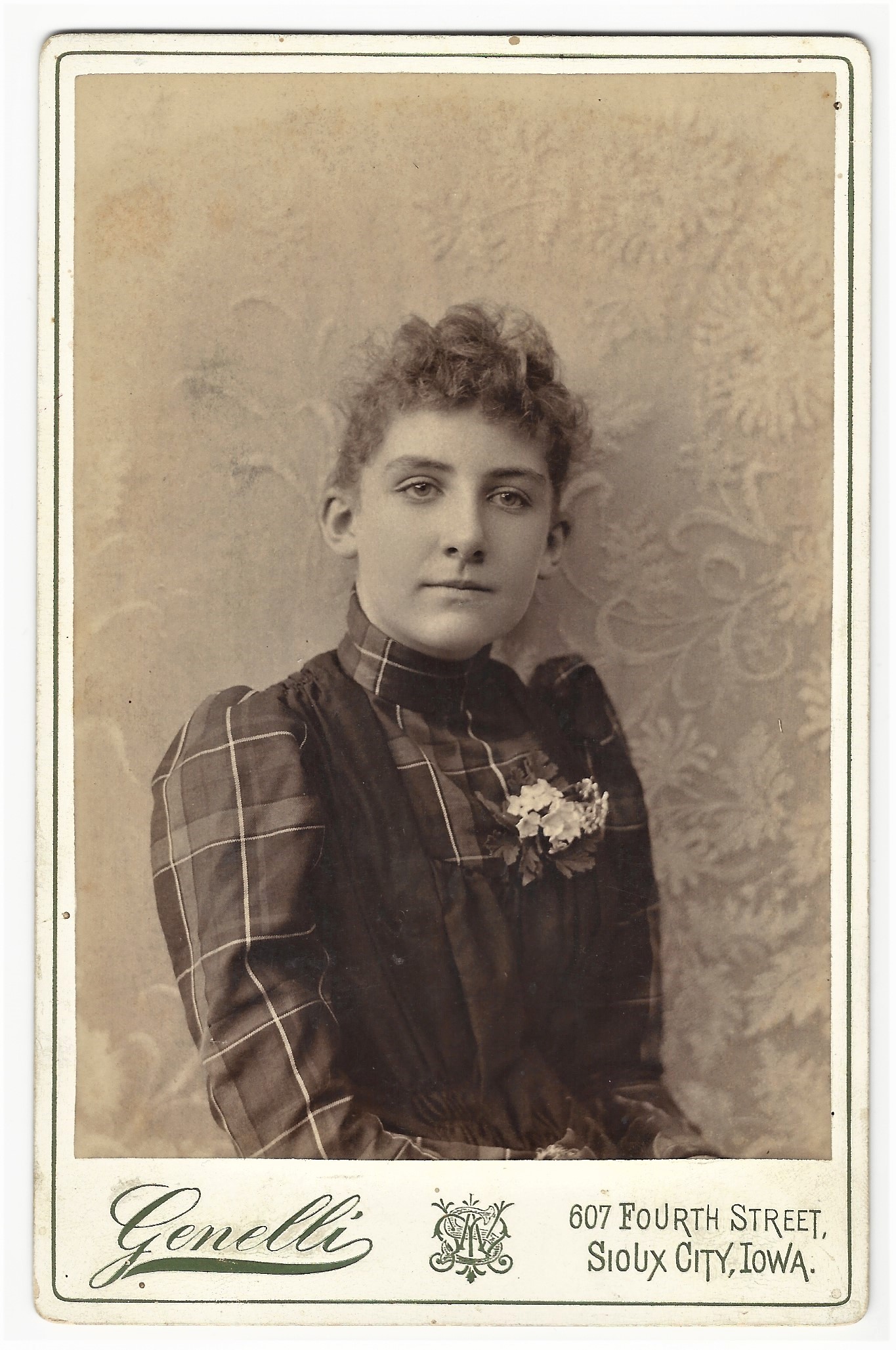
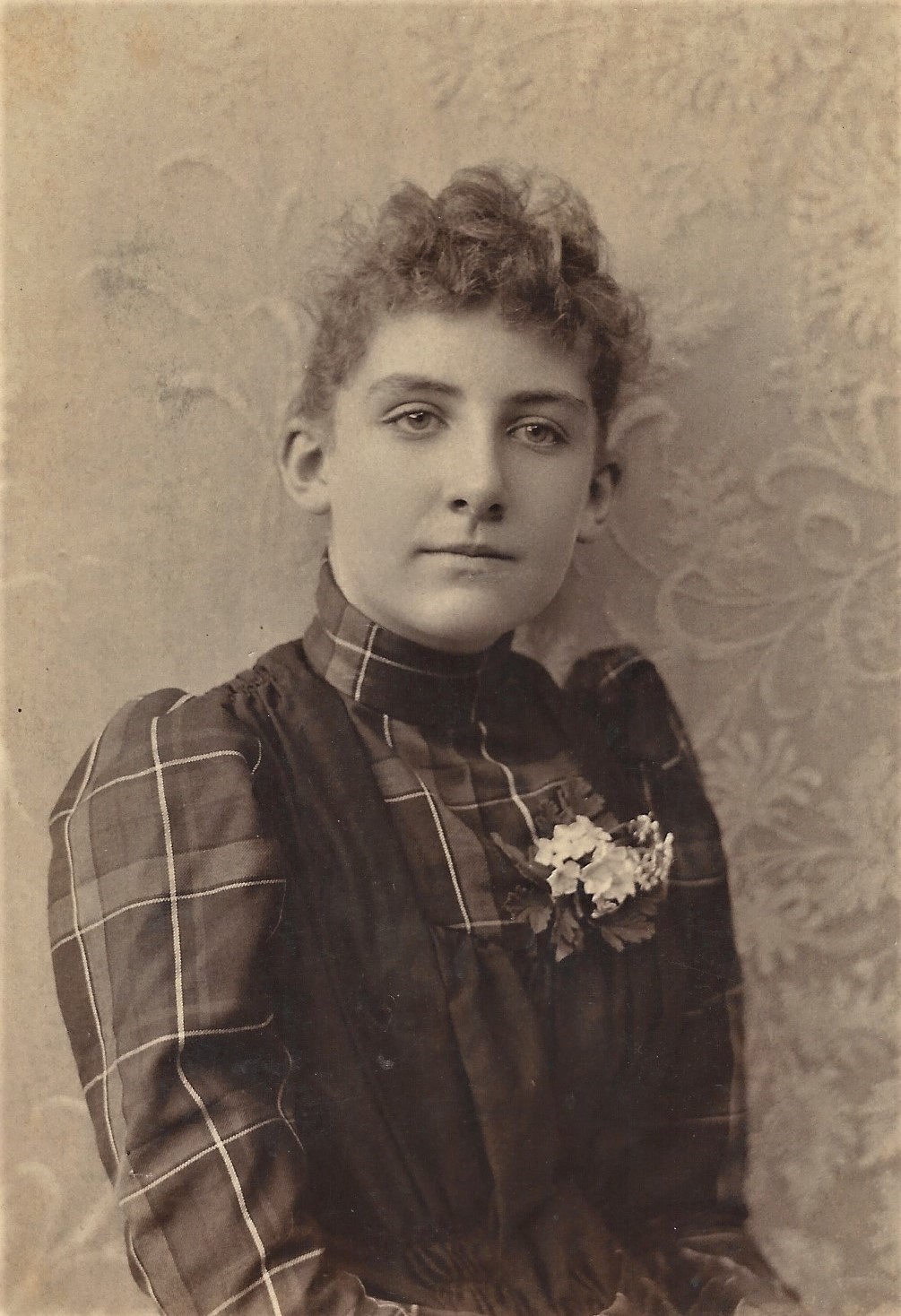
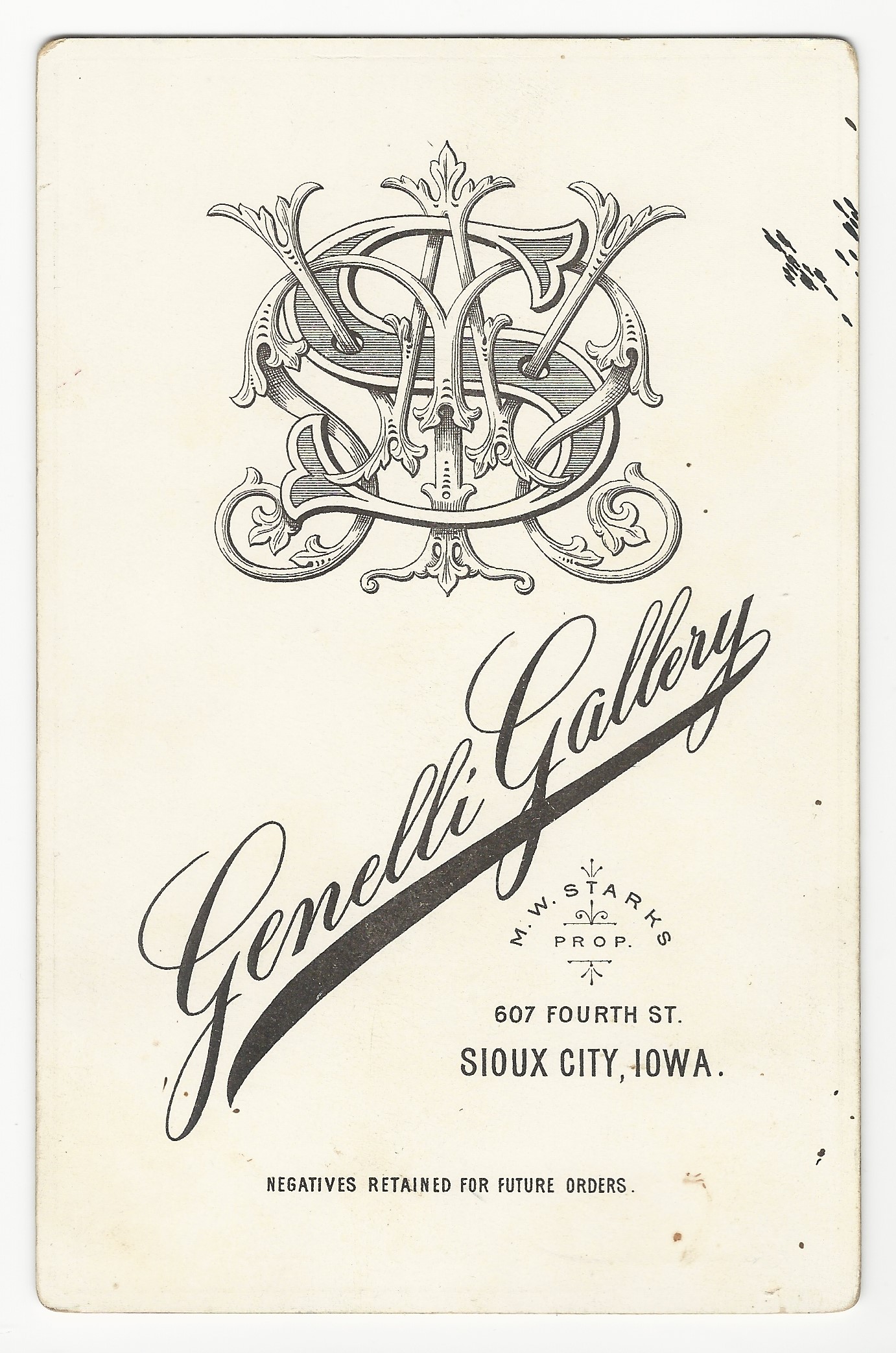
A pretty young woman appears in this portrait photograph from the Genelli studio in Sioux City, Iowa. She is wearing a lovely plaid dress with a corsage. The reverse of the cabinet card indicates that the proprietor of the studio was M. W. Starks. The book, History of the Counties of Woodbury and Plymouth Iowa (1890), reveals that M. W. Starks was born in Bradford, Illinois in 1851. In 1872 he began apprenticing as a photographer and soon entered a career in this field. In 1883 he came from St Louis, Missouri to Sioux City and established the Genelli gallery. In 1884 he married Miss Hattie L. Harvey. SOLD
PORTRAIT OF A YOUNG WOMAN : FASHIONABLE : BUFFALO, NEW YORK : CABINET CARD
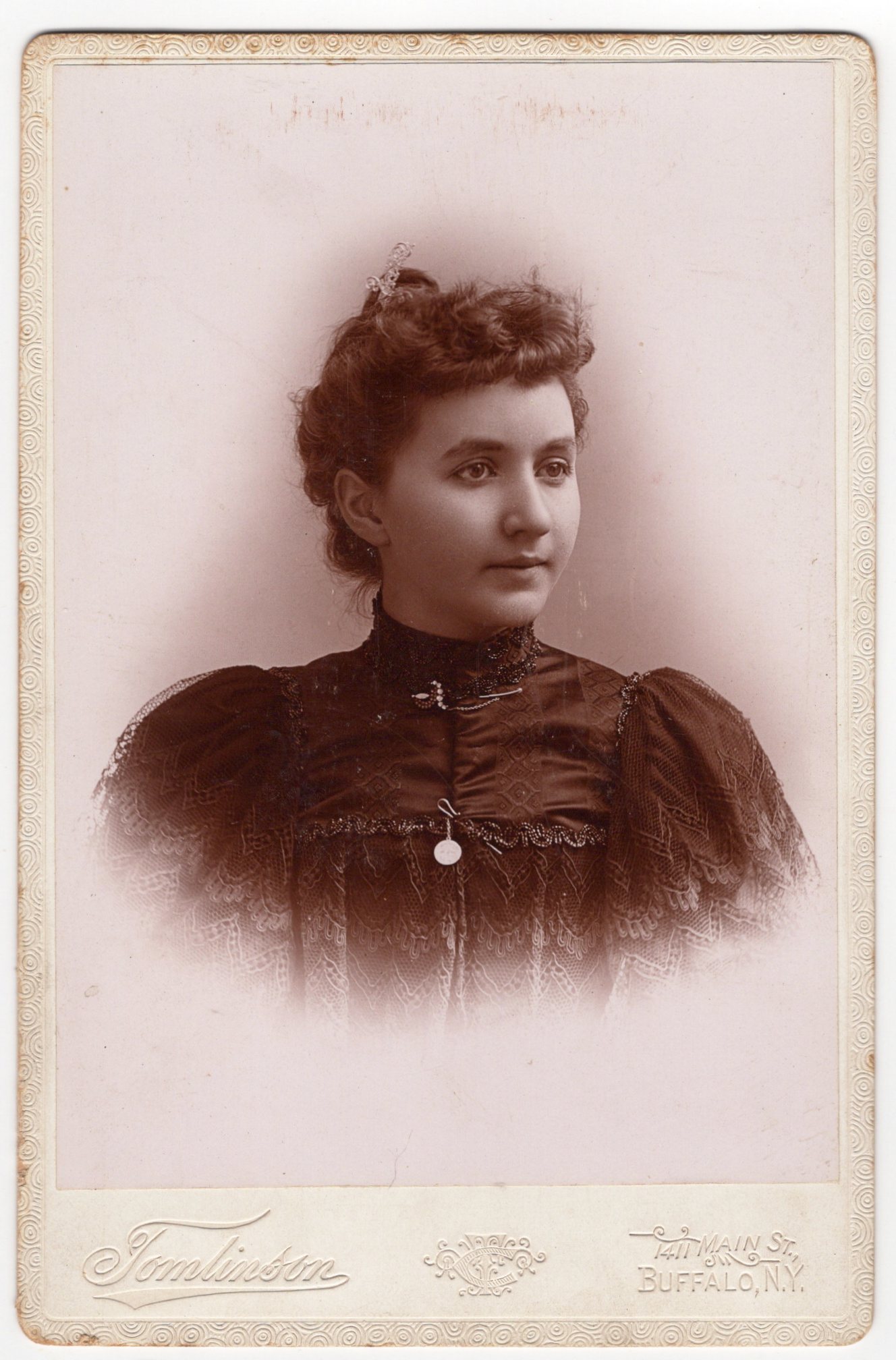

This cabinet card portrait features a pleasant looking young woman. She is fashionable in her lace blouse. She is displaying a half smile. Note her jewelry. She is wearing a collar pin and a locket. She also is wearing hair jewelry that appears to be a fillagree sword. This young woman’s photograph was taken by the Tomlinson studio in Buffalo, New York. The cabinet card is in good condition (see scans).
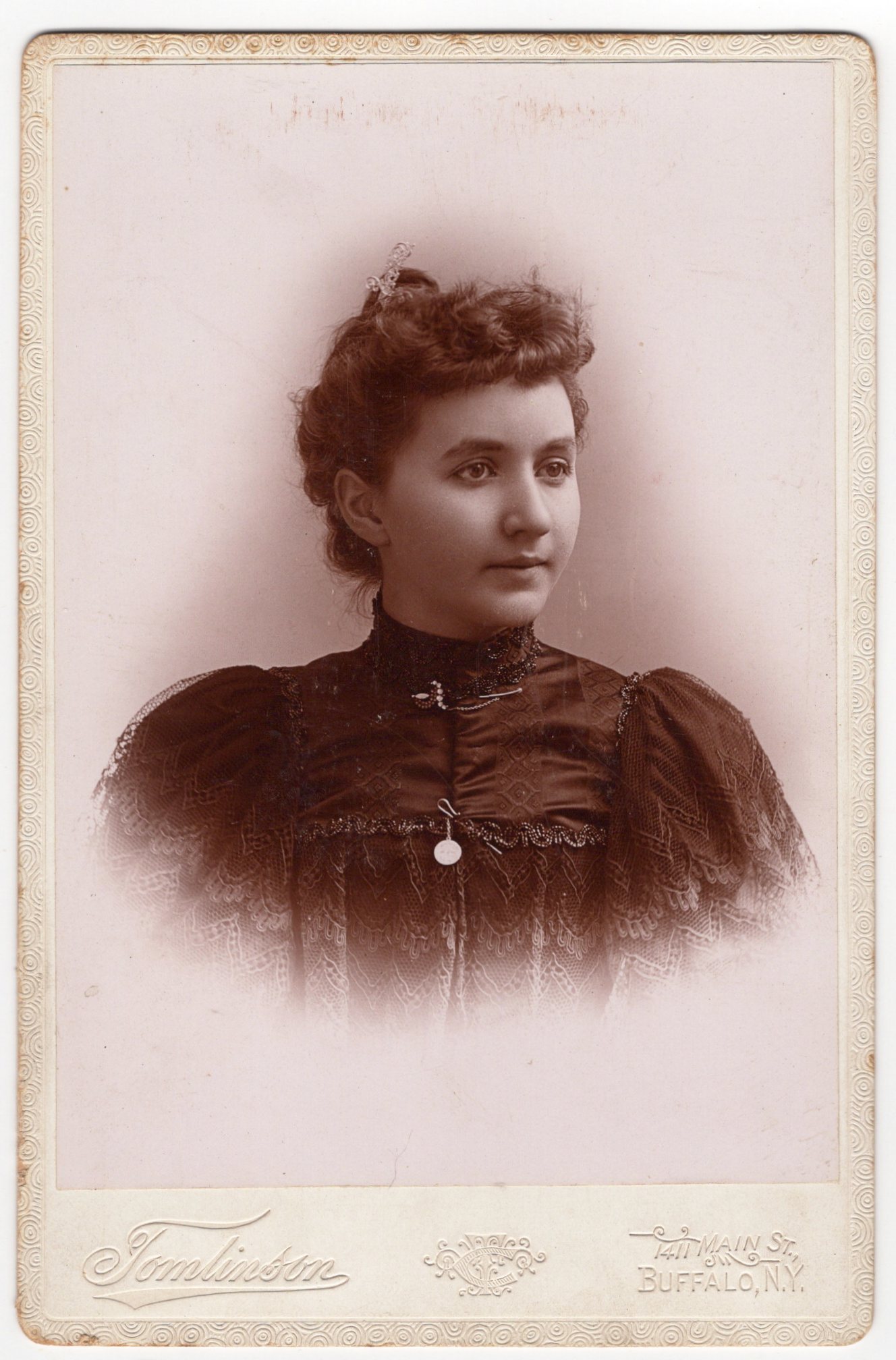
Buy this Cabinet Card Photograph (includes shipping within the US) #6254
To purchase this item, click on the Pay with PayPal button below
$22.50
Buy this Vintage Original Cabinet Card (includes International shipping outside the US) #6254
To purchase this item, click on the Pay with PayPal button below
$32.50

FASHIONABLE YOUNG WOMAN HOLDING A PARASOL AND A FLOWER : IN DARK CLOTHING : RPPC
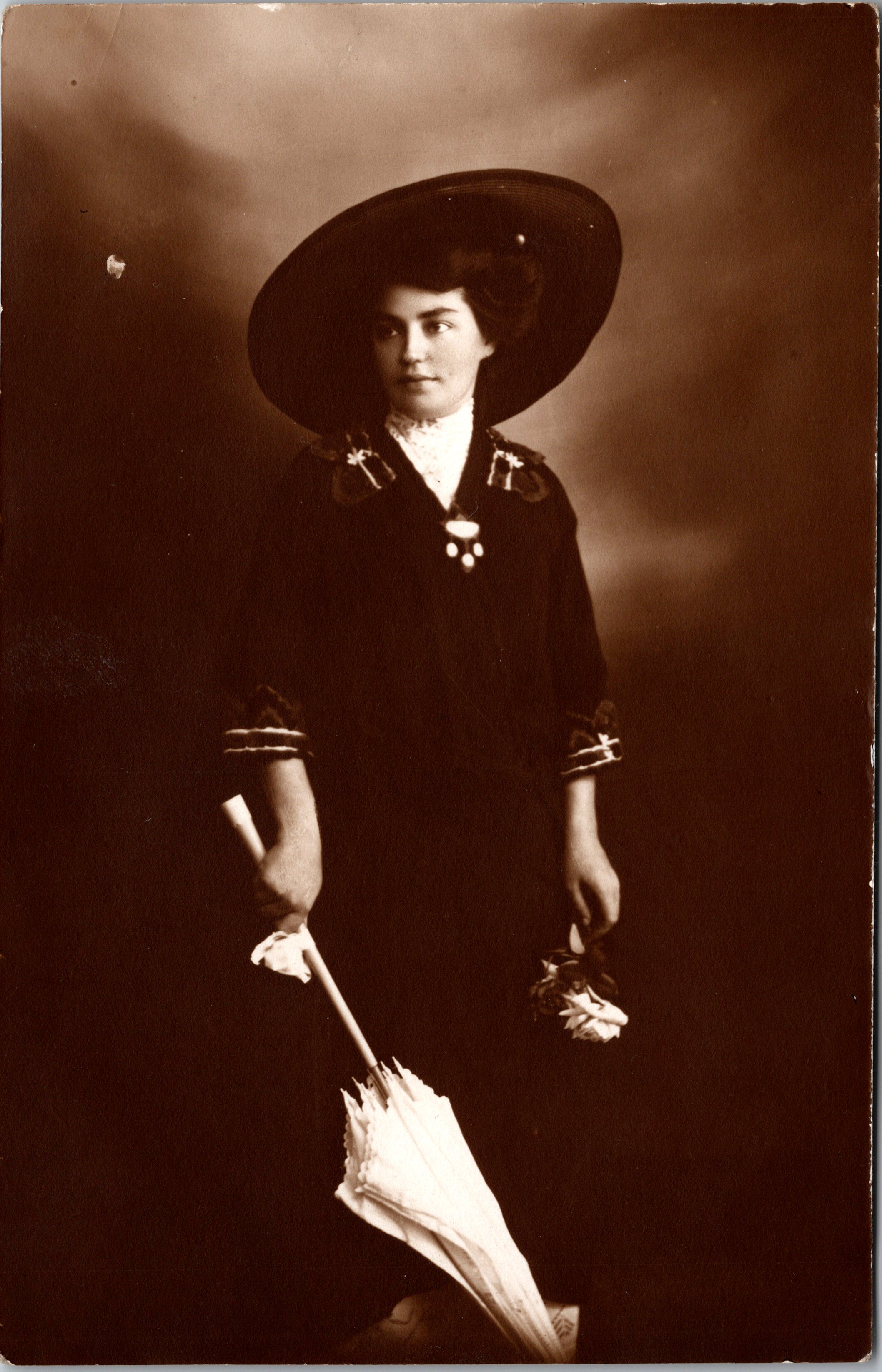
This vintage postcard features a pretty young woman wearing holding a parasol in one hand and a flower in the other hand. She is quite fashionable in her dark clothing. Note her wide brimmed hat. The woman has a nice smile.
The postcard is overall good condition (see scans).
FAMOUS CIVIL WAR PHOTOGRAPHER CAPTURES TWO WOMEN MAKING A FASHION STATEMENT IN SNOWY PAINESVILLE, OHIO
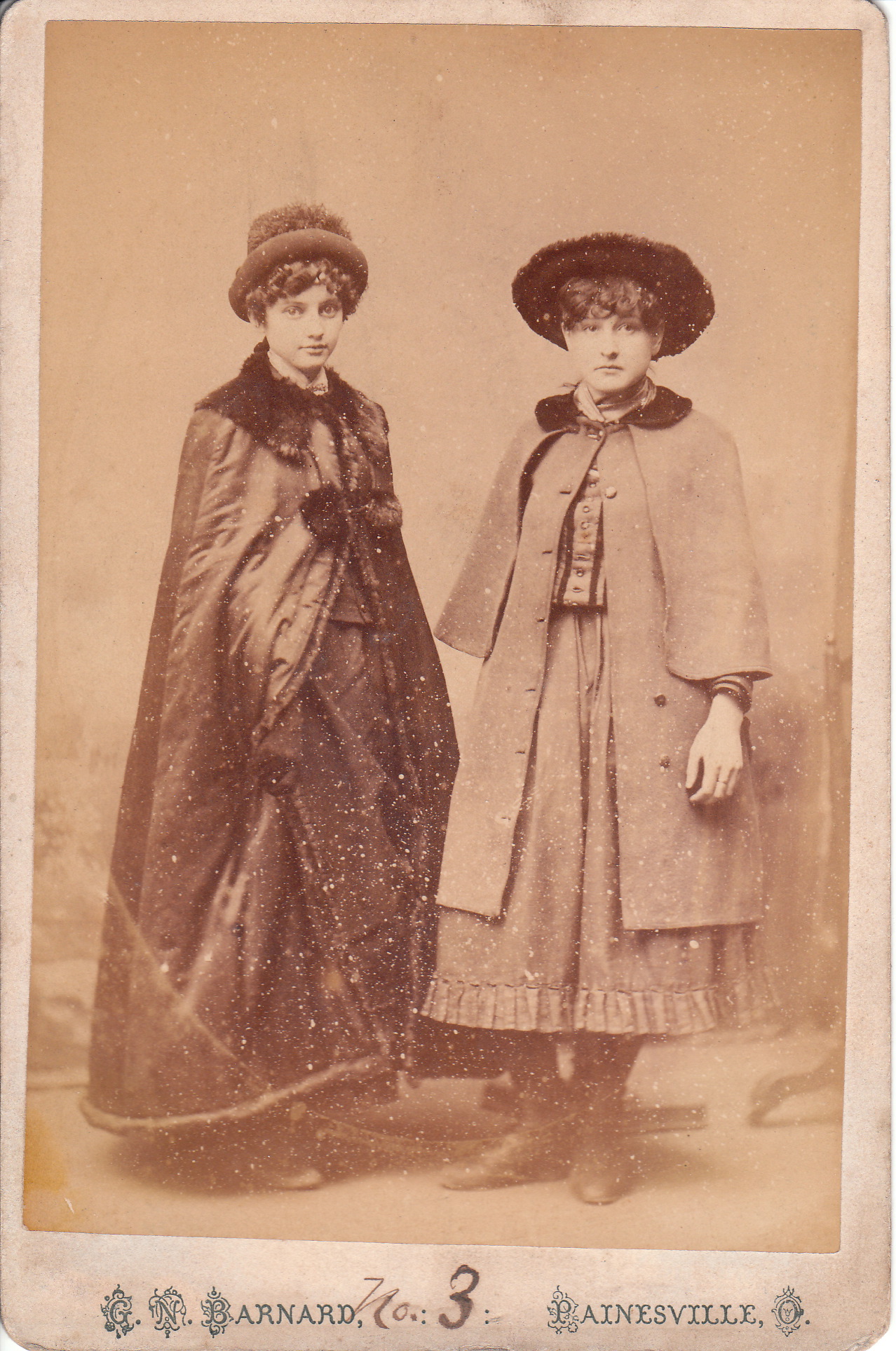
This cabinet card features two woman dressed in their winter cloaks and hats. They are in the studio of G. N. Barnard in Painesville, Ohio. The photograph has some special effects in the form of fake falling snow. The factor that makes this photograph most special, is the photographer’s life story. George N. Barnard (1819-1902), was a pioneer of nineteenth century photography. At age 23 he was producing daguerrotypes and four years later he opened his first studio in Oswego, New York. An 1853 grain elevator fire occurred in Oswego, and Barnard captured the fire with his camera. Some historians consider these photographs the first news photography in history. In 1854 he opened a short lived studio in Syracuse, New York. He then moved to New York City where he worked on stereoscopes for Edward Anthony’s Studio in 1859 .Soon, he was hired by Matthew Brady as a portrait photographer and Brady sent him to Washington D.C. to photograph Abraham Lincoln’s 1861 inauguration as President of the United States. He later became part of “Brady’s Photographic Corps” to photograph the Civil War. Barnard is best known for his work in the civil war (1861-1865). He was the official army photographer for the Military Division of the Mississippi, commanded by Union General William T Sherman. Barnard’s book “Photographic Views of Sherman’s Campaign” is a photographic record of Sherman’s destructive Atlanta Campaign and subsequent March to the Sea. After the war, Barnard opened a studio in Chicago in 1869. The studio was destroyed in the “Great Fire” of 1871. He proceeded to take photographs of the rebuilding of Chicago over the next few years; providing a terrific record of that process. In 1884, Barnard opened his Painesville, Ohio studio; which brings us back to the cabinet card image of the two ladies in the snow. (SOLD)
MADAM NAOMI: SIDE SHOW FAT LADY (562 POUNDS) OFFERS ESPECIALLY LARGE DOWRY TO PROCURE A HUSBAND
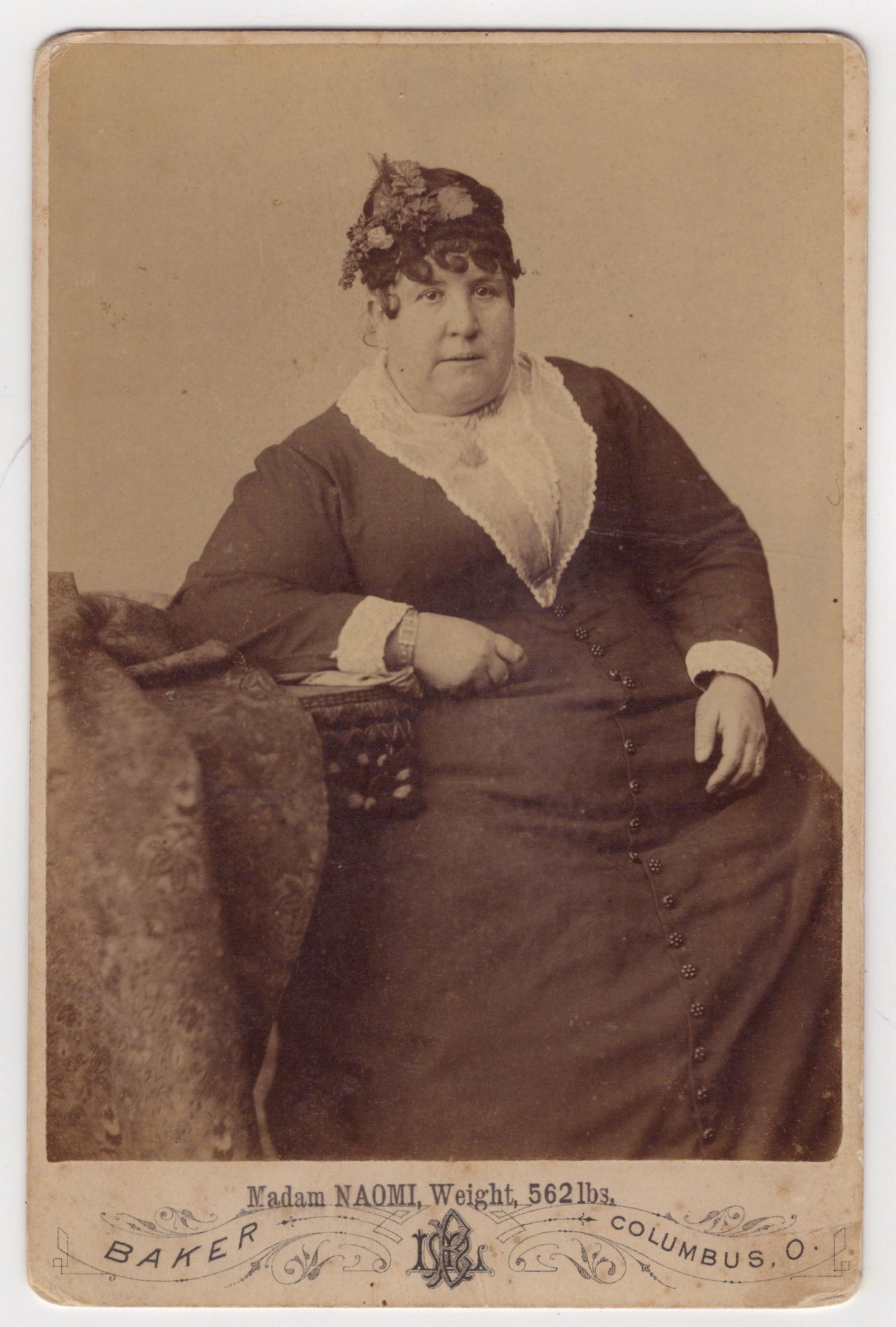
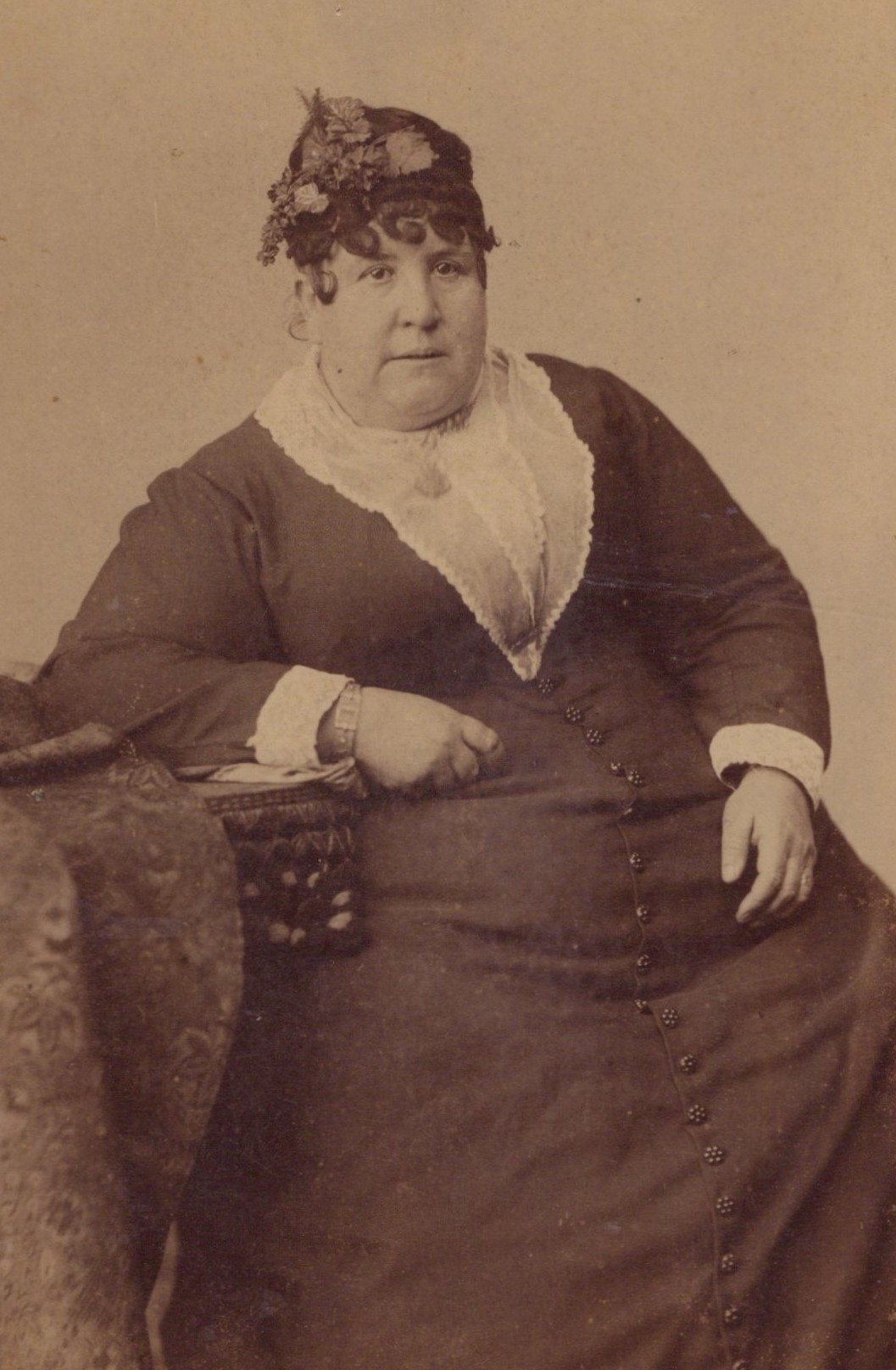
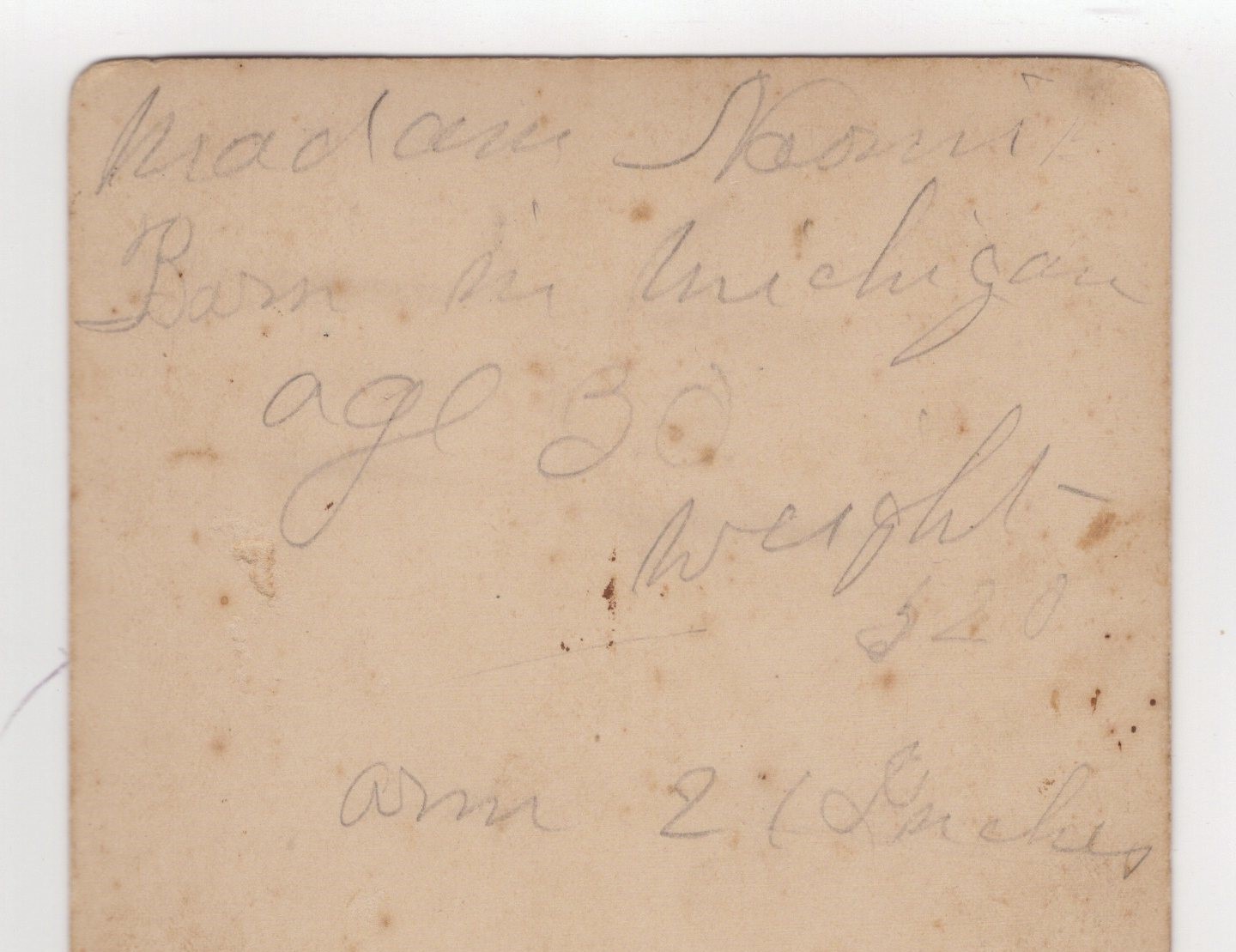
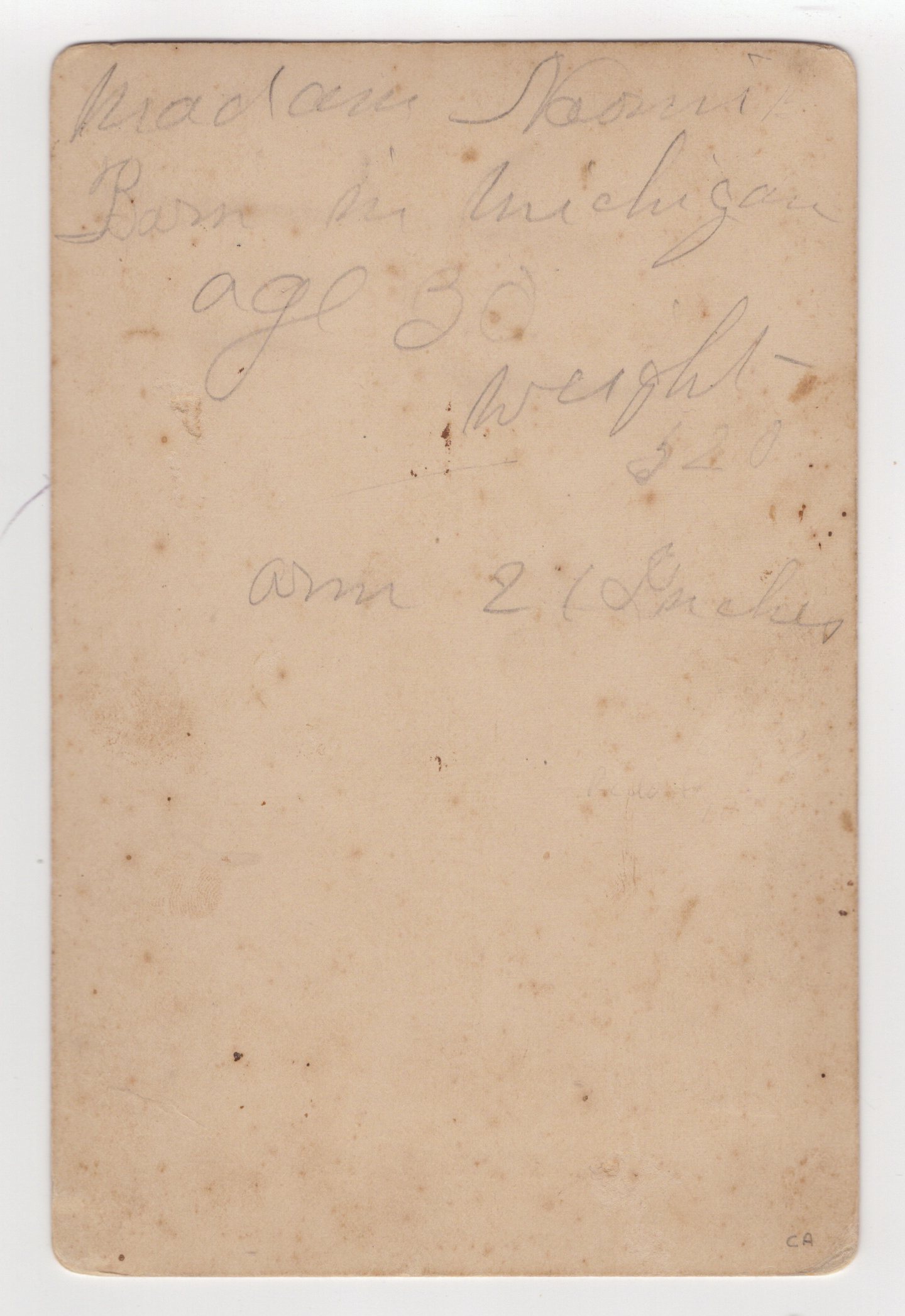
This cabinet card features Madam Naomi, who appears to have been a side show “fat lady”. The term “fat lady” is a despicable and derogatory way of describing someone overweight; yet the term found common use at circuses and fairs of the era of this photograph. Pencilled on the reverse of this image is the information that Madame Naomi was born in Michigan and at the time of the photograph, she was 30 years old. A further “fact” provided is that her arms had a circumference of 27 inches. Madam Naomi is not looking too comfortable in this portrait. She is wearing an interesting hat and one would guess that it would take her a long time to button all those buttons on the front of her dress. The newspaper The Weekly Statement (1890) has an article about a Madam Naomi appearance in Fort Wayne, Indiana. The article states that Naomi was advertised to appear in a museum and to “bestow her hand, heart, oleaginous sweetness, and a deed to a $5,000 farm to any young man who would marry her”. The offer was accepted by an insurance man from New York, Thomas J. Crowley; who came to Fort Bend and joined her on the museum stage to accept her hand in marriage. The photographer of this image is Baker, whose studio was located in Columbus, Ohio. There were many photographers named Baker operating out of Columbus when this photograph was taken. Many of the Bakers were relatives who operated the Baker Art Gallery. It is not clear which Baker or which studio is the source of this image. However, the initials below the photograph appear to be “LMB” which would indicate that the photographer was Lorenzo Marvin Baker (1834-1924).L. M. Baker was part of the Baker Art Gallery family. To view other photographs by the Baker Art Gallery, click on the category “Photographer: Baker Art Gallery”. (SOLD)


 THE CABINET CARD GALLERY