

This image is a post cabinet card era portrait of a sweet adorable little girl holding her doll. The child is well dressed and flashing a wonderful smile. This photograph was taken at the Hafer studio in Reading, Pennsylvania. The photo joins one of many images from Reading that can be found in the Cabinet Card Gallery. Edward Egleman Hafer (1843-1925) was a portrait painter in addition to being a photographer. He was born in Berks County, Pennsylvania and settled in Reading in his mid teens. He began his photographic career in Reading at the studio of Captain F. M. Yeager for whom he worked between 1872 and 1874. He then bought Yeager’s business and remained at the same address (433 1/2 Penn Street) until 1900. Hafer was married to Amanda Nagle Hafer (1853-1920). The 1920 US census indicates that he was still working as a photographer at a very advanced age. He eventually retired in 1920 and died in Mount Penn, Pa in the year 1925 at the age of 82. He is buried in Reading’s Charles Evans Cemetery. This photograph measures approximately 7″ x 5″.

This vintage real photo postcard features a wounded French soldier being treated by his fellow combatant. The soldier doing the nursing helps his buddy by pouring some absinthe into the cup that the wounded man is holding. The injured man seems to be very pleased as he awaits his medicinal drink. What is absinthe? It is a distilled highly alcoholic beverage. Absinthe became a highly popular drink in late 19th and early 20th century France. It is a drink that was later portrayed as dangerous and seen as a hallucinogen. By 1915, it was banned in the US and much of Europe (including France). Although the ban of absinthe and the start outbreak of World War I occurred close together in time, author Doris Lanier, in her book “Absinthe–The Cocaine of the Nineteenth Century……..” (1994), notes that soldiers continued to enjoy absinthe during the war. Back to the photograph. Note the storage holders on the shelf above the injured man’s bed. It appears that they were used to hold the hospitalized patient’s clothing and belongings. My description of this interesting photograph contains some conjecture. Perhaps you have a different interpretation of this image. If so, please share your ideas in the comment section.

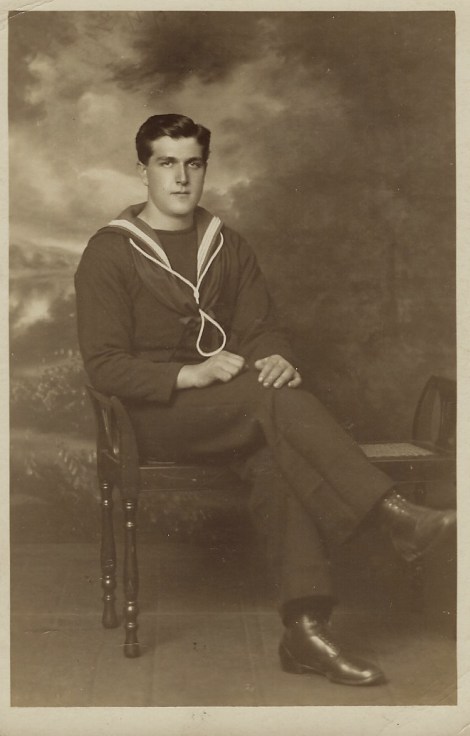
This item is a vintage real photo postcard featuring a portrait of a handsome young sailor. He looks quite dashing in his naval uniform. The young man was photographed by the J. S. Bullen studio which had two locations in England. The studio had branches in Grimsby and Louth. Bullen operated his studio in the 1910′s and 1920′s. He also may have worked as a photographer in other decades. SOLD

This vintage real photo postcard features a pretty woman wearing a bird nest hat. At least it looks like a bird nest. This young woman has the beauty to wear this unusual hat and look terrific rather than silly. The postcard is of French origin and was published in Paris. The Publisher’s logo “LL” can be seen on the front of the postcard. The postcard is part of a series (#123). “LL” postcards were produced for France, England, United States, and other nations. For many years postcard collecting experts believed the logo stood for Louis Levy but there was no real supporting evidence and that belief died around 1991. Later research arrived at the conclusion that the initials “LL” stand for (Moyse) Leon and his son-in-law (Isaac) Levy. Leon and Levy began their career as assistants with the Parisian photographic studio Ferrier-Souilier. The pair began their own photographic studio in 1862. Leon and Levy’s studio won a gold medal at the 1867 Universal Exhibition. Leon left the partnership in 1872 and Levy kept the business going and continued to use the “LL” logo. The company was renamed Levy Fils et Cie. Levy died in 1913 and the company was later bought by the printer Emile Crete.

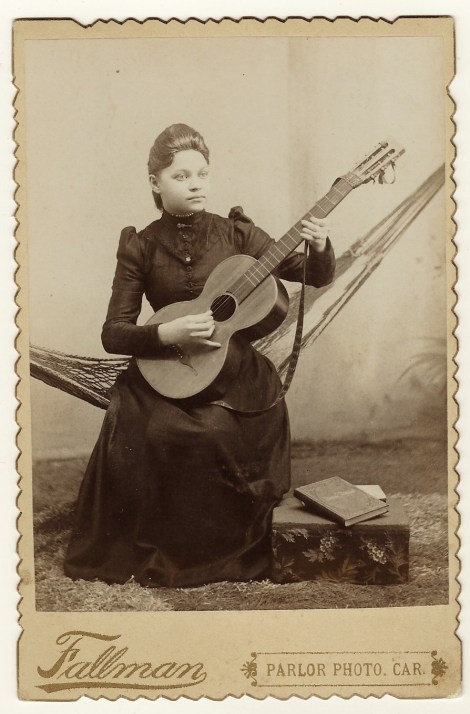
A young woman plays the guitar as she poses for her portrait by a railroad photographer. The Fallman studio was actually located on a train car. Printing on the front of the cabinet card notes that the photographer utilized a Parlor Photo Car. Some photographers, like Mr. Fallman, would rent or purchase a railroad car and travel from town to town. Sometimes the car would be disconnected from the train and the photographer would operate his studio until business conditions dictated that he move on to another locale. Fallman’s parlor car obviously contained backdrops and props. The woman in this photograph is sitting on a hammock next to a box topped with a couple of books. Preliminary research failed to uncover details about Mr. Fallman. However, the Cabinet Card Gallery possesses a vintage photograph of a cute little girl by Harry Fallman (1853-1907). His studio was located in Eureka, South Dakota. During his lifetime, Harry also lived and worked as a photographer in North Newberg and Portland, Oregon. It is unknown if Harry is the same Fallman who operated the rail car studio that produced the photograph above. To view Harry Fallman’s photograph and to learn more about him (and his celebrity son), click on the category “Photographer: Fallman”. SOLD
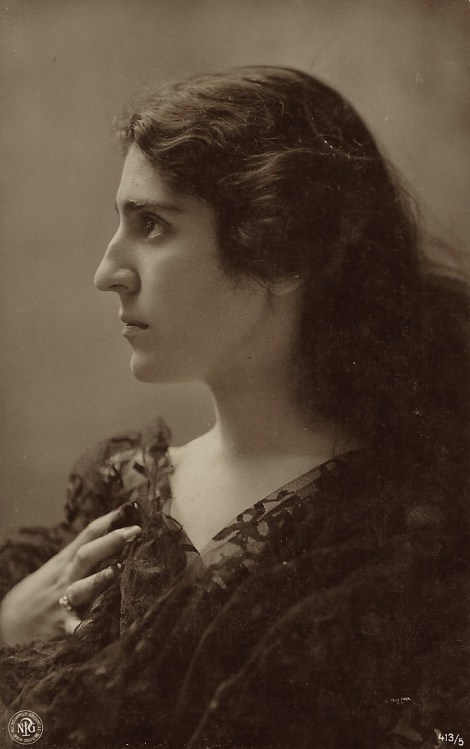
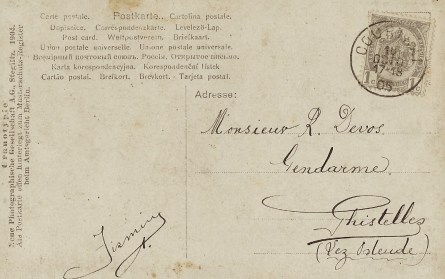
This vintage real photo postcard features a portrait of a very attractive young woman. She is displaying a very serious expression as she looks directly at the camera. She is well adorned with pretty flowers. The postcard is addressed to, and postmarked at Tourcoing, France. Tourcoing is a city in northern France. The postcard has a French stamp.


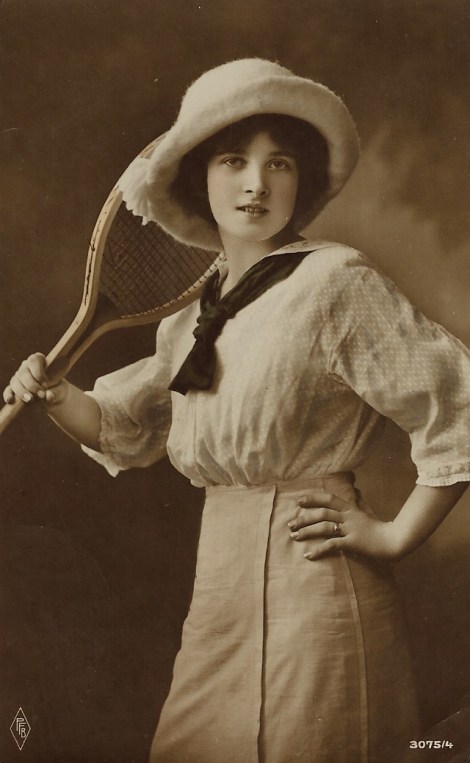
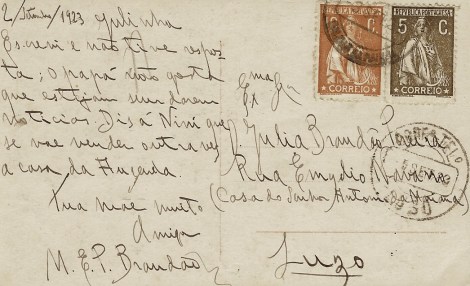
This vintage postcard features a very beautiful woman dressed for tennis and holding a tennis racquet. Her tennis clothing may appear to be a bit impractical for the demands of a tennis match, but this is the attire that women actually wore at the time this postcard was published. The postcard is postmarked 1923 and was mailed from Portugal. The card was published by PFB (Paul Finkenrath) of Berlin, Germany. It is part of a series. (no. 3075/4). The Paul Finkenroth company made quality photo postcards and the company was heavily oriented toward export. They were known to be responsive to printing postcards that they’re customers desired over time. They were quite profitable but closed in 1911 when protective tariffs interfered with their business. The company was established by Paul Finkenrath and Paul Grasnick in 1897. The partnership lasted about a year and then Grasnick left to start his own lithography studio. (See comments below concerning information about the publishing house that produced this postcard). SOLD

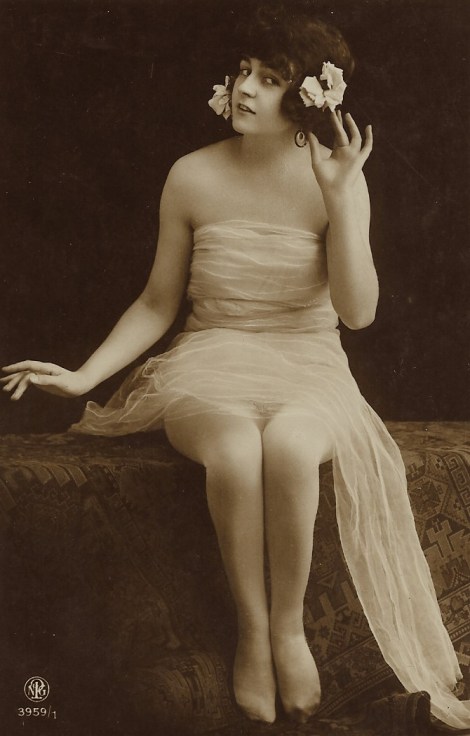
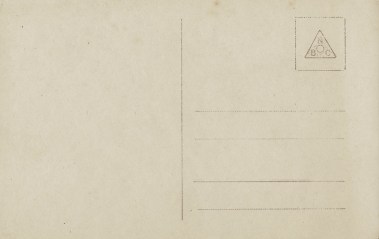
This vintage real photo postcard features a scantily clad sexy young woman wearing a “come hither” expression. There is little doubt that this postcard portrait was meant to be sexually inviting. This image supports the principle that “sex sells”. Sex sold products in the early 1900’s just as it does today. This postcard is of German origin. It was published by “NPG” (Neue Photographische Gesellschaft). The company was a leading bromide photo printing company for many years. The stamp box of this particular postcard has an interesting story. “NBC” (Neue Bromsilber Convention) was price cartel established in 1909 that continued until the 1930’s. The purpose of the cartel was to ensure that the minimum price charged for postcards was kept at a sufficiently profitable level. A number of postcard publishing companies joined the cartel in an effort to stave off the effect of competition on the pricing of postcards. (SOLD)