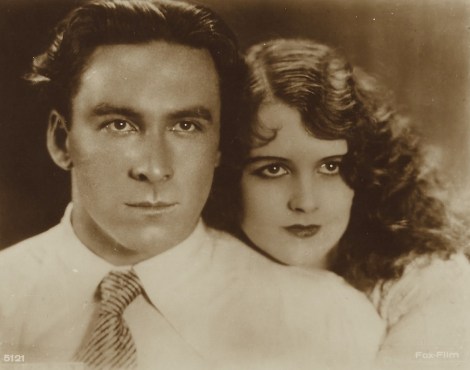
Can sexual chemistry be photographed? This fantastic vintage real photo postcard provides evidence that the answer is yes. This image captures early film stars George O’Brien and Virginia Valli in an emotionally charged scene in an unknown movie. The pair starred together in at least two silent movies produced by Fox. The films were “Paid to Love” (1927) and “Eastside Westside” (1927). Virginia Valli (1898-1968) was an American stage and film actress. Her early acting experience was with a Milwaukee based stage troupe. Her film career started in the silent film era and ended in the early stages of the talkies (1930’s). She has 65 credits on the IMDB web site. She began her film work with Essanay Studios in her hometown of Chicago in 1916. By the mid 1920’s, she was an established star at Universal Studios. She was the star of King Vidor’s “Wild Oranges” (1924). Most of her films were produced in the mid 1920’s and include Alfred Hitchcock’s first feature movie, “The Pleasure Garden” (1925). Her first sound picture was in 1929. She left the movie business in 1931 due to her high salary command and declining appeal to audiences. She moved to Palm Springs, California with her second husband, actor Charles Farrell. She was very much part of the social scene there. She died in Palm Springs at age seventy. George O’Brien (1899-1985) was an American actor popular during the silent film era as well as the early talkies era of the 1930’s. He is remembered most for his role in Murnau’s 1927 film “Sunrise: A Song of Two Humans”. He had an active film career which is evident by the fact that the IMDB web site gives him 85 credits. O’Brien was born in San Francisco and his father at one time, was the city’s chief of police. During World War I, O’Brien was in the US Navy and served on a submarine chaser. He worked as a stretcher bearer for wounded Marines and was decorated for his bravery. Following the war, O’Brien became the light-heavyweight champion of the Pacific Fleet. After completing is service, O’Brien was in his early twenties and he went to Hollywood to seek work as a cameraman. He did find employment in the field and helped film for Tom Mix and Buck Jones. He then entered acting by playing bit parts and by being a stuntman. His first starring role was in “The Man Who Came Back” (1927) where he played opposite Doroth Mackaill. He then appeared in “Iron Horse” by famed director John Ford in which his counterpart was Madge Bellamy. The film was a great success and the experience forged a colloborative relationship with Ford that resulted in O’Brien appearing in nine more of the directors films. He spent much of the 1920’s as a leading man in action and adventure type roles. During the 20’s he received the nickname “the torso” because of his excellent physique. With the arrival of sound, O’Brien appeared predominately in Westerns during the 1930’s and he was considered a major draw. With the arrival of World War II, O’Brien re-enlisted in the US Navy and served as a beachmaster in the Pacific theater. He was decorated several times and when he was discharged he had attained the rank of commander. He later joined the Naval Reserve where he served as a captain. O’Brien’s last leading role was in a film that included the Three Stooges. According to his obituary, O’Brien was buried at sea courtesy of the US Navy. This real photo postcard was published by Iris Verlag and made in Germany. The postcard is part of a series (no. 5121) and credits Fox Film.
ADDENDUM: After viewing this image, a visitor contacted me to claim that the beautiful woman in this photograph is not Virginia Valli, but instead, it is June Collyer (1906-1968). I was unable to locate information or relevant comparison images to definitively confirm that it is Collyer that is in the photograph, but I did find a film publicity photo identical to the postcard image above. The description of that photo indicates that the pictured woman is Collyer. Collyer was born in New York City and as a society girl was chosen by Allan Dwan (Director, Producer, Screen Writer) to her first starring role in “East Side, West Side. She did eleven silent films and made a successful transition to talkies. In 1928 she was he was one of the thirteen girls selected as “WAMPAS BABY STARS”. In 1930 she appeared in “The Three Sisters” and “Sweet Kitty Bellairs”. From 1930 through 1936 she starred in nineteen films. She took a sabbatical from acting in the 1940’s and did television acting during the 1950’s. June was the sister of radio actor/announcer Bud Collyer (1908-1969). He became a major game show star hosting such programs as “Beat the Clock” and “To Tell the Truth”. June Collyer was married to actor Stu Erwin. In conclusion, I am unsure whether the beautiful woman in this image is Miss Valli or Miss Collyer. It is an answerable question if someone is willing to do the requisite research.




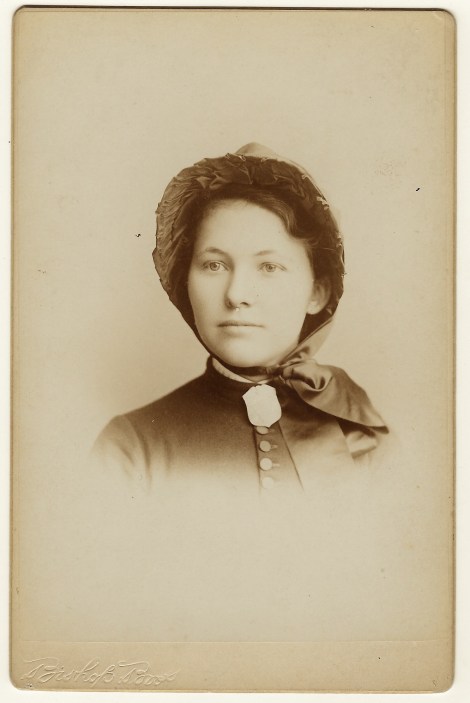
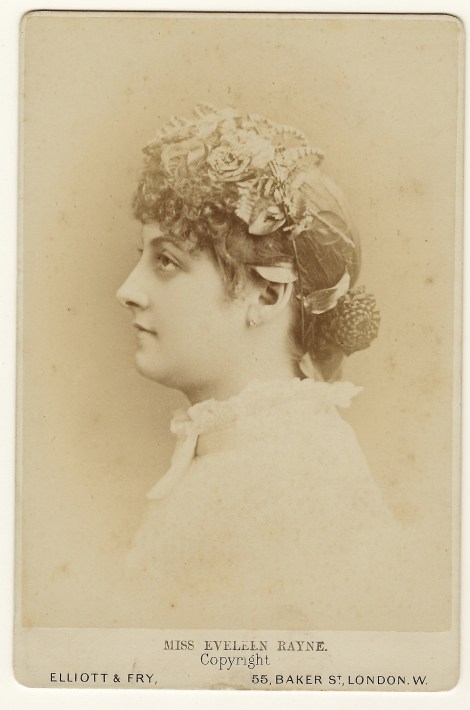 This cabinet card portrait features stage actress Eveleen (Evelyn) Rayne. She became titled when she married George Fitzwilliam in 1888. She died in 1925. The Elliott & Fry studio produced this image. This Victorian photographic studio and photographic film manufacturer was founded in 1863 by Joseph John Elliott and Clarence Edmund Fry. For an entire century the studio took and published images of leading Victorian luminaries from the fields of science, public service, art, politics as well as celebrities of the day. To view other photographs by this studio click on the category “Photographer: Elliott & Fry”.