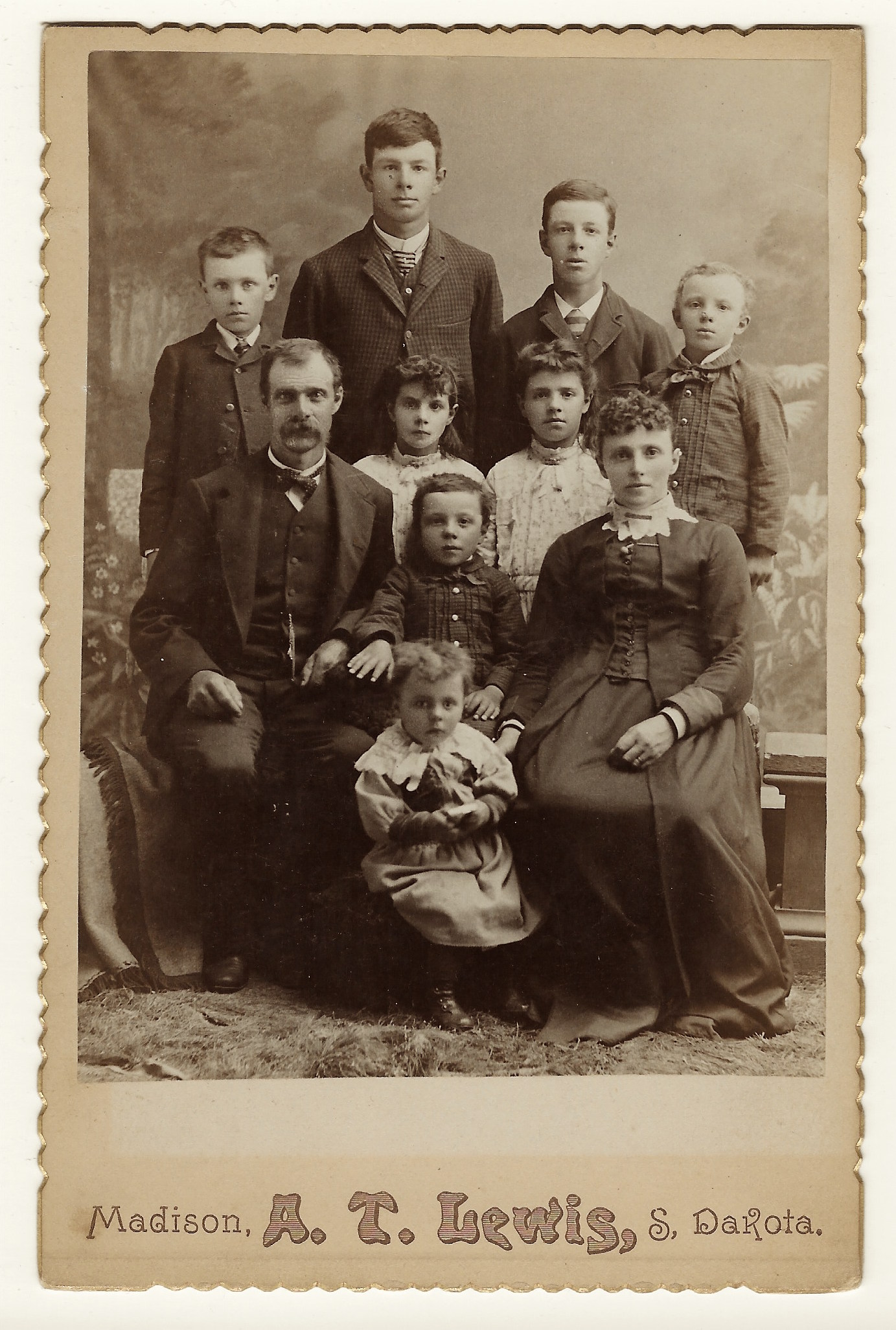
This cabinet card is a portrait of a large family taken at the studio of A. T. Lewis in Madison, South Dakota. This family is well dressed and likely well-to-do. South Dakota was part of the Dakota Territory until it became a state in 1889. This knowledge reveals that this photograph was taken in 1889 or later. The city of Madison was named after Madison, Wisconsin. Wikipedia reports that the city’s original name was Herman and that it was founded in 1880. Abrah T. Lewis, the photographer of this image was married to Miss Sarah J. Norcott in 1873. She was also a photographer and is actually the more likely of the two to have taken this photograph. Mrs. Lewis tended to do portraits while Mr. Lewis focused on scenic views. Abrah Lewis was born in Oneida, New York in 1853. He next lived with his family in Canada between 1855 and 1873. In 1873, Abrah and his bride moved to Michigan and eight years later he lost his house to a forest fire (1881). Mrs. Lewis’s grandmother perished in the fire and she nearly lost her mother. The couple left for a brief stay in Canada and then settled in South Dakota and worked as photographers in Sioux Falls. Three years later they moved to Madison and opened a photography studio there that was predominately operated by Mrs. Lewis while Mr. Lewis attended to branches of the studio at Brookings, Elkton, and Arlington (all in South Dakota). The pair resided in Madison (five years), Huron (two years) and Clark (two years). Like many photographer of the cabinet card era, this couple kept moving. Their next stop was various locations in Iowa where they continued to work as photographers. One of their locations was a town called Rock Rapids. To view photographs by other female photographers, click on the category “Female Photographers”.
BALDING MAN WITH MUTTON CHOPS IN OLEAN, NEW YORK
A well dressed balding man compensates for his hair deficit by wearing wonderful mutton chops and a handsome mustache. This wide eyed gentleman’s facial hair represents tonsorial genius. The photographer of this cabinet card photograph is the studio of Winsor & Whipple in Olean, New York. This photograph was taken in 1903 or before. “The Photographic Journal of America” (1903) reported the dissolution of the partnership between Winsor and Whipple. The article reported that H. C. Whipple needed to retire due to failing health and that he was planning to move to Colorado.
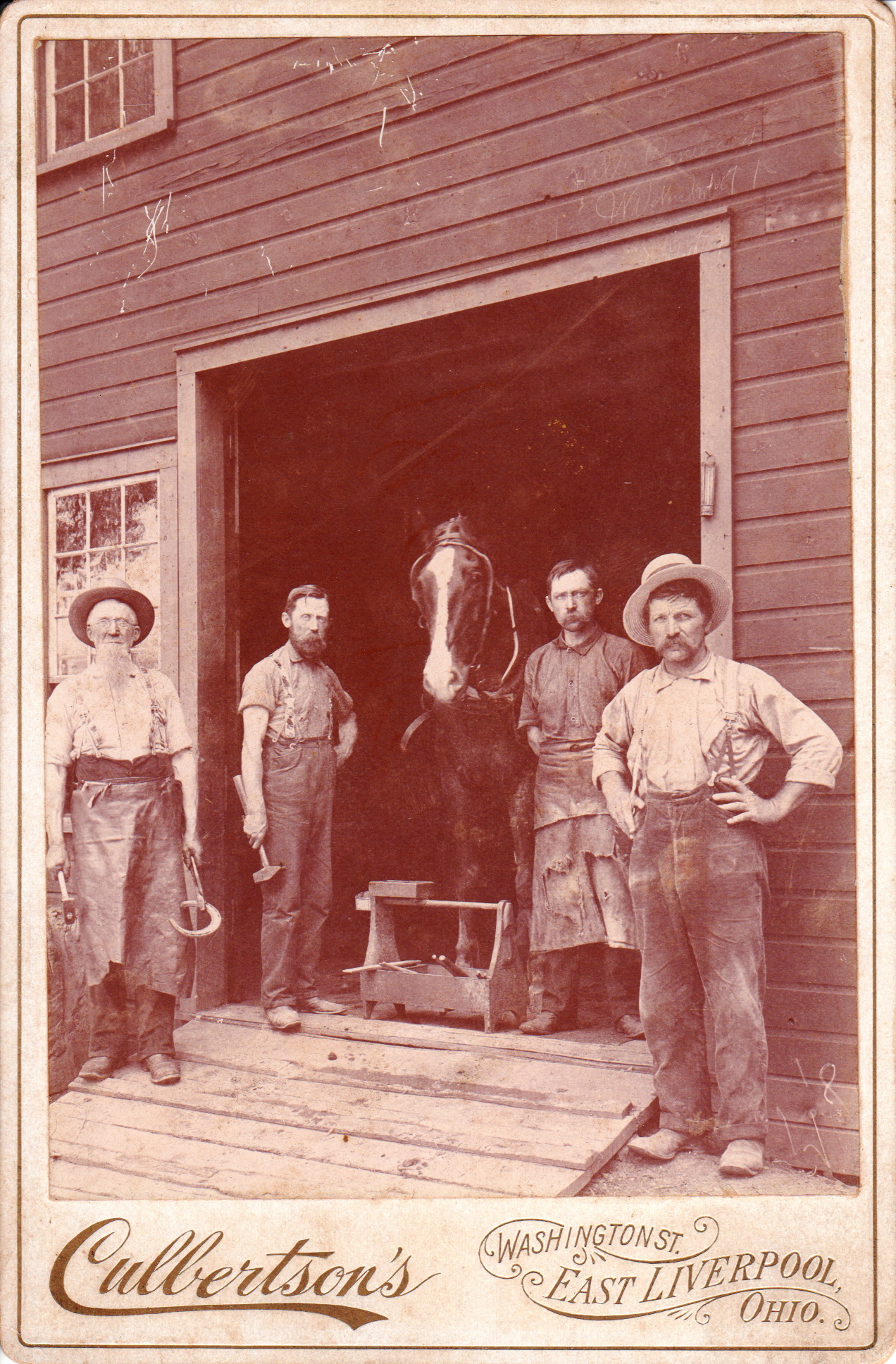
FOUR BLACKSMITHS, A HORSE, AND A PORNOGRAPHER IN EAST LIVERPOOL, OHIO
This cabinet photograph looks like a scene from a Clint Eastwood western feature film. It is as if the four men are looking into the street to watch Clint challenge four outlaws to a gunfight. More likely, this photograph captures a portrait of four men who work in an East Liverpool, Ohio blacksmith shop. Note that two of the men are holding tools of their trade and also take notice that there is a tool box in the center of the image. In additon, two of the men are wearing aprons and all four men are wearing what appears to be appropriate blacksmith garb. In the center of the photograph is a pretty horse. The photographer of this wonderful portrait is Culbertson’s Art Studio. The Culbertson studio is associated with the seamier side of photography and created quite a scandal in East Liverpool. Harry and Leon Culbertson were brothers and at one point were business partners in the Culbertson Brothers photography studio. On 5/10/1892, Harry was arrested on a charge of taking lewd and indecent photographs. His legal defense was that the photographs were “purely works of art”.The Lowell Daily Courier (Lowell, Massachusetts) reported the story on 5/13/1892. Culbertson claimed that two unknown young woman came to his studio and induced him to photograph them “undraped”. He left town shortly after his arrest.
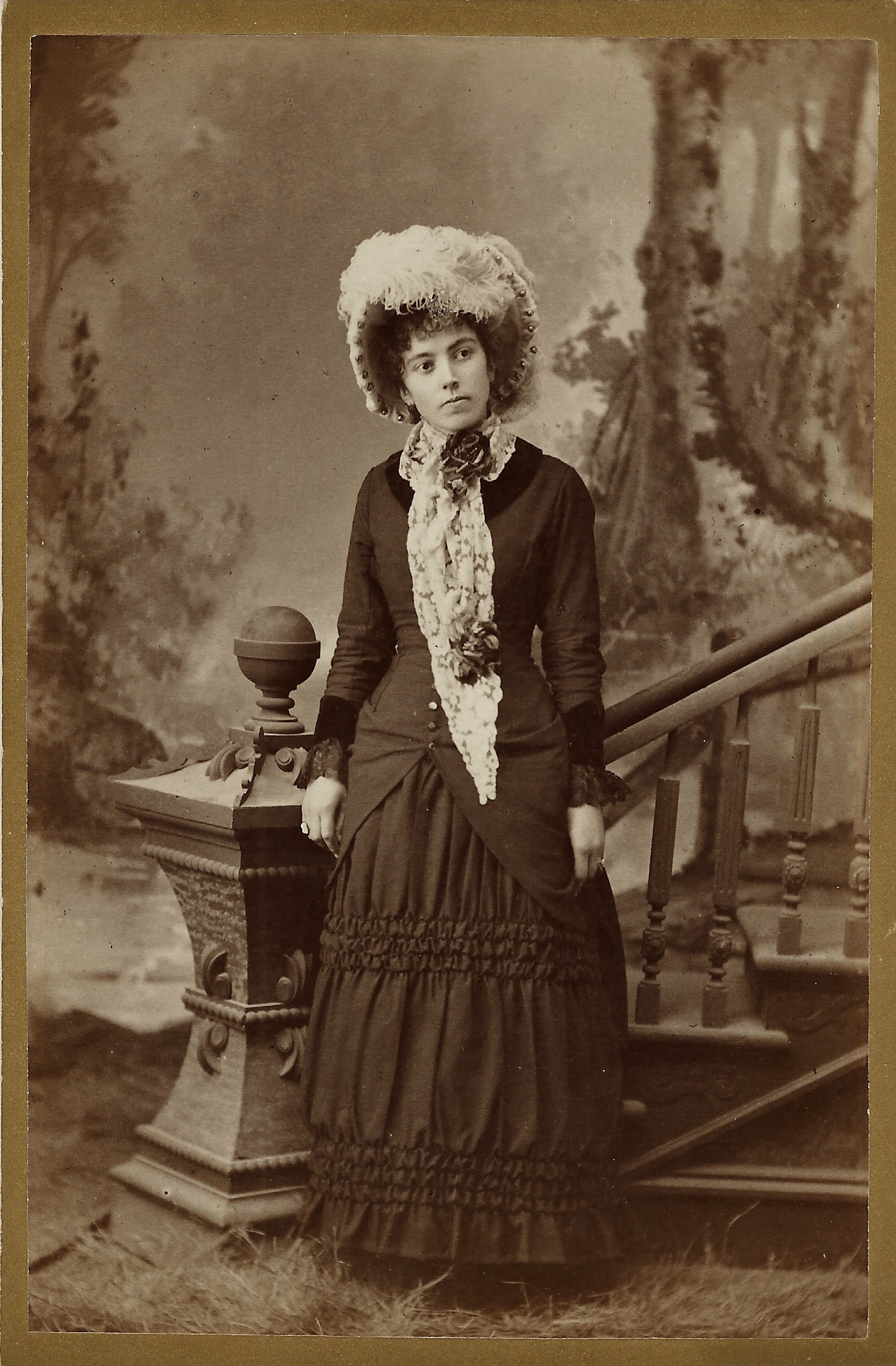
VERY PRETTY FASHIONISTA IN SPARTA, WISCONSIN
This cabinet card features a very pretty woman wearing a feathered hat. The feathers are likely ostrich feathers. She is wearing a beautiful dress and has flowers pinned to it in two places. She is wearing something that looks like a scarf wrapped around her neck and running down the dress’s front. Her hat is also beautiful. This woman would be considered a fashionista if she lived during the present era. She exudes stylishness. The woman has curly hair and an inquisitive expression. The Richardson Brothers photography firm produced this cabinet card and is mentioned in the Wisconsin Business Directory (1919).The brothers first names are cited as “Fred” and “Frank”. The “Commemorative Biographical Record of the Upper Wisconsin ……….” (1895) provides a different first name than Frank. It states that H. N. Richardson was born in 1854 in Sparta, Wisconsin. His father was a wagon maker turned farmer. H. N. was the youngest of five children.At age 21 he left the family farm and went to work in a Sparta marble works. At 23 years of age he moved to Sioux Falls, South Dakota and was employed for three years n a Marble Works there before returning to Sparta. He joined his brother Frank in a photography business named “Richardson Brothers”. The brothers operated the gallery together for four years. Then H. N. moved to Stevens Point, Wisconsin and established his own studio. He eventually developed branches in Plainfield, Scandinavia, and Hancock (all in Wisconsin). H. N. Richardson married Miss Jennie A. Linneman of Minnesota and they had four children. The “St. Louis and Canadian Photographer (1900) reported that Richardson Brothers Studio in Sparta was destroyed by fire. Research also revealed that at one time Fred Richardson was partners with Fred Foster in a studio in Sparta named “Richardson and Foster”. SOLD
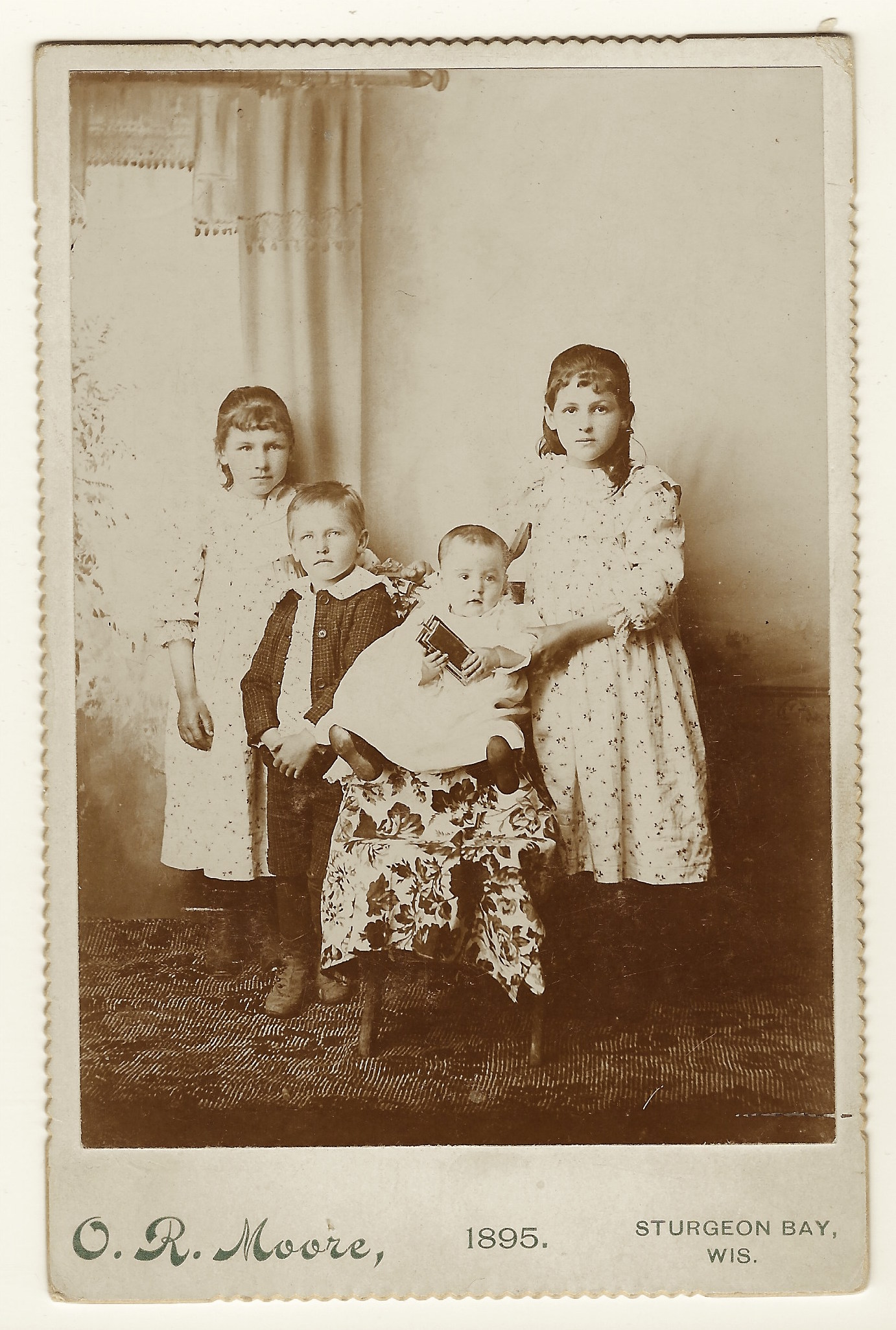
FOUR YOUNG SIBLINGS AND A HARMONICA IN STURGEON BAY, WISCONSIN
Four young children pose for their portrait at the O. R. Moore gallery in Sturgeon Bay, Wisconsin. It is close to certain that the children are siblings. The two oldest kids are girls and they appear to be wearing dresses made from the same fabric. It is not uncommon to see siblings wearing identical clothing in cabinet card photographs. One would guess that the reason for this practice was simply economics. The older girl is securely holding her youngest sibling securely on a chair. The baby has a harmonica in her/his hands. This image was taken in 1895. In 1891 Orville R. Moore worked as an operator for Sturgeon Bay photographer W. A. Drumb before opening his own studio. He opened his own studio by 1898. Some years later he sold his business and it became the Rieboldt Studio. Moore is mentioned in a number of photography journals. The “Photographic Times” (1898) cites him as competing in a photography competition sponsored by the Photography Association of Wisconsin. The “Bulletin of Photography” (1924) reports that Moore had returned to Sturgeon Bay after a fifteen year absence and opened a new photography studio. SOLD
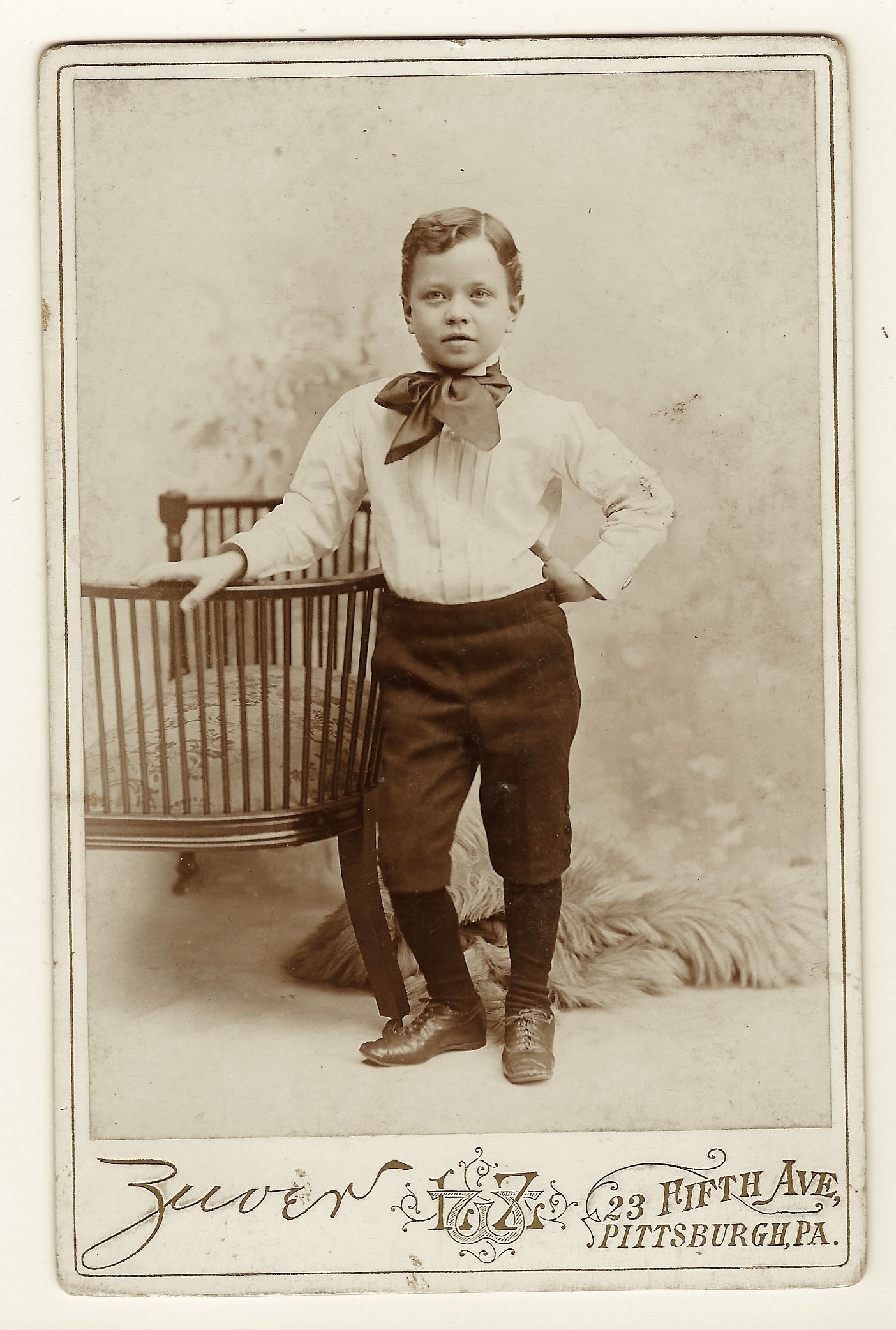
SASSY WELL DRESSED YOUNG BOY IN PITTSBURGH, PENNSYLVANIA
This cabinet card features a well dressed young boy with attitude. His expression and hand on his hip gives him a sassy appearance. Note his jumbo bow tie. This photograph was taken by Lewis W. Zuver (1854-1927). Zuver was a member of a family of photographers. His brother Leander L. Zuver (1861-1924) had a studio in Tionesta, Pennsylvania. His sister Mary M. Zuver was married to Jacob West and had a studio in Bradford, Pennsylvania. She was known for her portraits of women and children. Lewis, the photographer of this image was a guy who got around. He had studios in New York (Olean, Ellicottville, Salamonca), Ohio (Cleveland), and Pennsylvania (Pittsburgh). One source reports that he was in Pittsburgh at least from 1893-1900. He is listed in the Pittsburgh Directory (1895). At one point in his career he operated a studio on a steamboat that ran up and down the Alleghany between Olean, New York and Pittsburgh. A portrait of Henry J. Heinz (ketchup king) by Lewis Zuver can be found in “The Successful Americans” (1899). Zuver was clearly quite an entrepreneur and deducing from this image, he was a talented photographer. To view other photographs by this photographer, click on the category “Photographer: Zuver”.
COMPLIMENTS FROM MISS GERTRUDE FOSTER IN BOSTON, MASSACHUSETTS
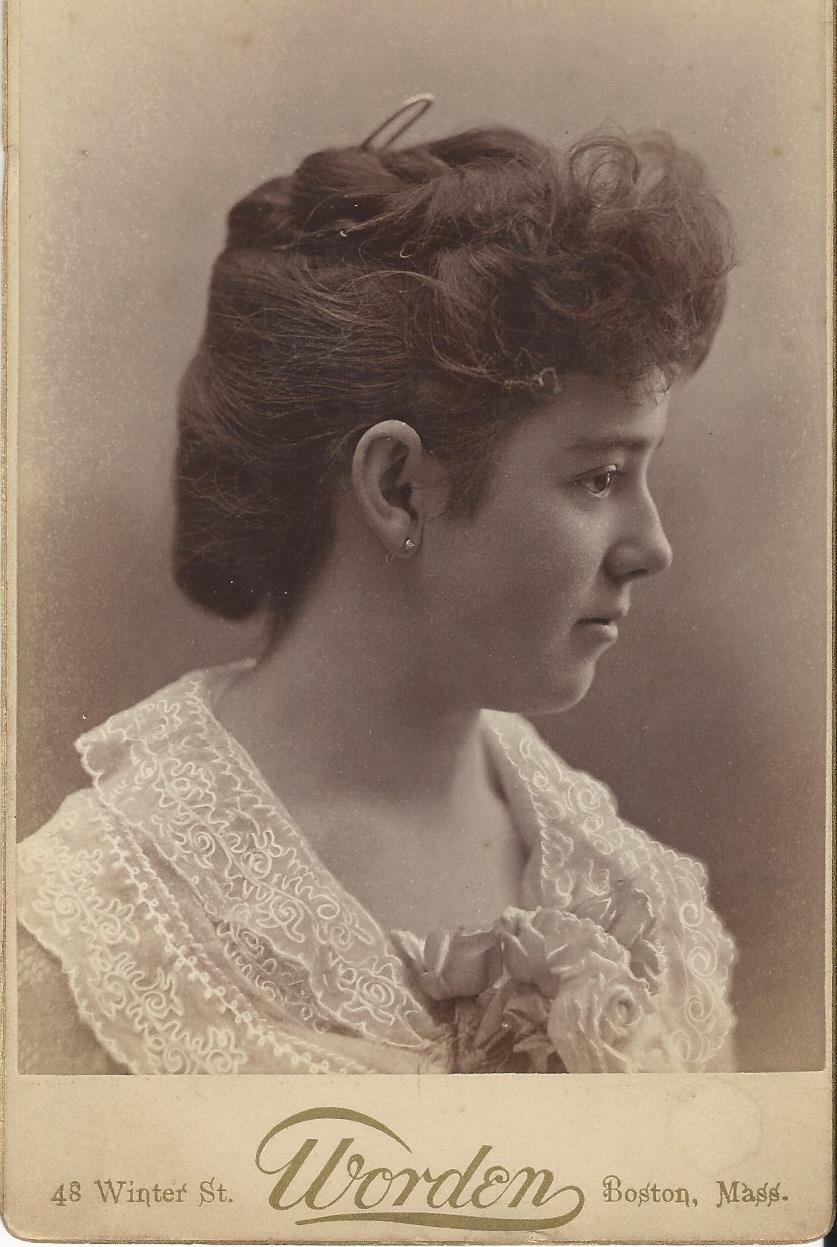
A pretty young woman poses for a cabinet card portrait at the Worden studio in Boston, Massachusetts. This profile portrait provides a nice view of her lacy dress and pinned flowers. The reverse of the photograph has an inscription that states “Compliments of Miss Gertrude Foster”. Research was unable to find an actress, dancer, or singer with the name of Gertrude Foster. It seems likely that the Gertrude Foster seen in this cabinet card was not a celebrity. Researching Miss Foster was unproductive because her name is too common in the Boston area. To view more photographs from the Worden studio, click on the category “Photographer: Worden”. ADDENDUM: I stumbled upon some biographical data about Miss Foster. It turns out that Gertrude Foster was a stage actress during the cabinet card era. The Capital (1898) reported that she was the “leading lady actress” at the Alcazar Theater in San Francisco before accepting a place in the touring Belasco & Thall Theater Company. Miss Foster is mentioned again in the San Francisco Call (1900). The newspaper reports her marriage to Edward W. Mansfield who was the manager of the Fisher Opera House in San Diego, California. Apparently Mansfield was smitten with her when they met professionally some years before. Mansfield reportedly waited to pursue her until she had an opportunity to garner some “fame”.
ROW ROW ROW YOUR BOAT GENTLY DOWN THE STREAM. MERRILY, MERRILY, MERRILY, MERRILY, LIFE IS BUT A DREAM (ESPECIALLY WHEN YOU HAVE TWO BEAUTIFUL WOMEN DOING THE ROWING)
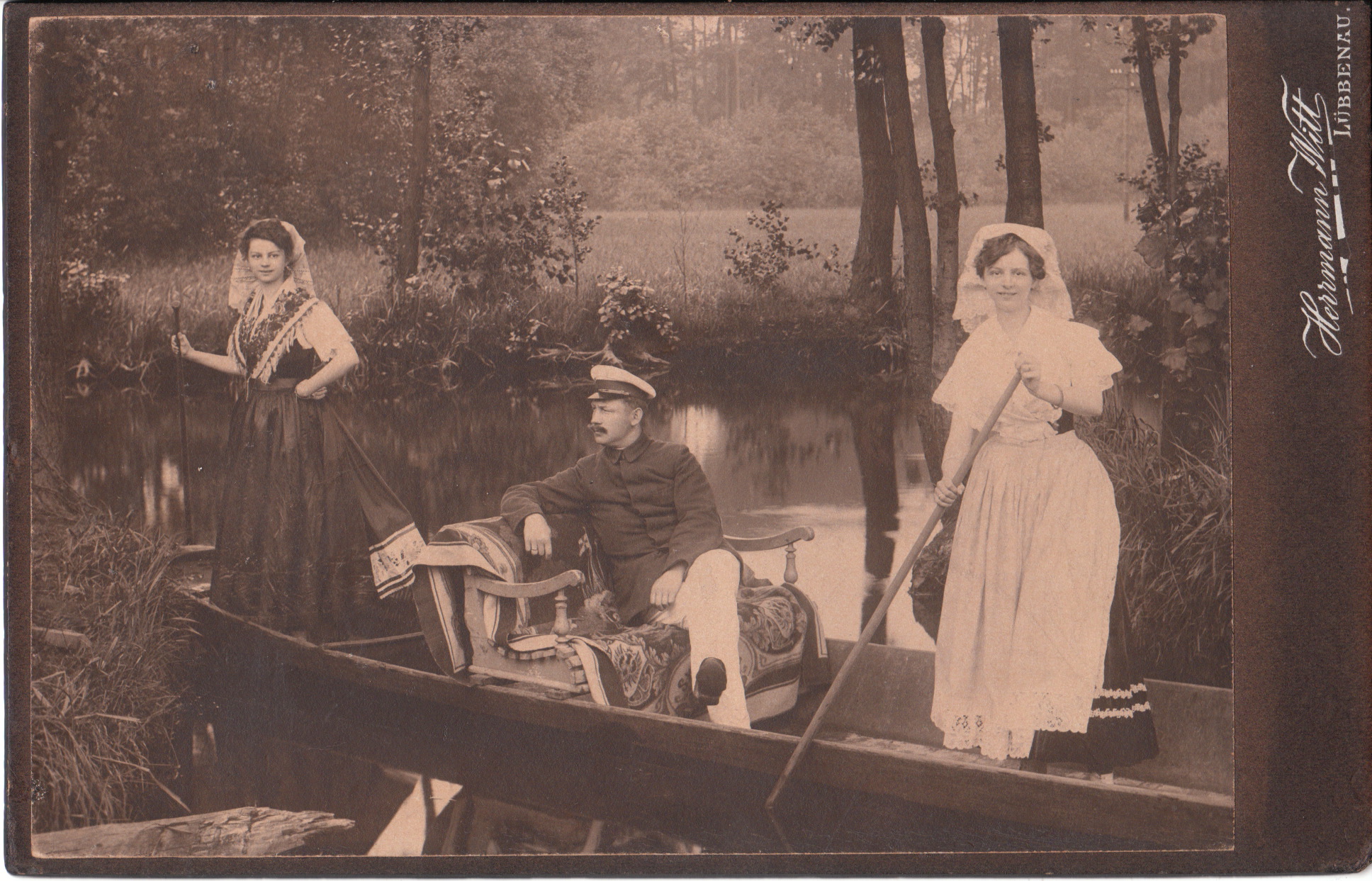
This cabinet card photograph features a fine gentleman wearing a ship captains cap and sitting between two beautiful finely dressed young women on a paddle boat. The women are holding the oars while the man rests on a blanket wrapped bench. I suppose this image has comical undertones. The boat on the lake looks like a real outdoor scene but it is most likely all taking place in a terrific well accessorized studio. The photographer of this unique image is Herrmann Witt and his studio was located in Lubbenau, Germany.
PORTRAIT OF A MENNONITE COUPLE IN ILLINOIS
This cabinet card features a portrait of a young Mennonite couple. Note the couples plain style of dress, the young man’s beard, and the woman’s bonnet. The reverse of the photograph has an inscription noting that the couple’s name is “Mr. and Mrs. D. T. Wagner”. An additional note on the verso states “return to Ida Buckingham, Oakley, Illinois”. Ida Buckingham (1886-1964) was likely a relative of the pictured couple and possessed the photograph during some period of her life. The photographer of this image is W. H. Farley. He operated photographic studios in Crete, Tampico, and Gibson, Illinois during the 1880’s. To view more of his photographs, click on the category “Photographer: Farley”. SOLD
A MAN WITH AN OUTSTANDING MUSTACHE IN PHILADELPHIA, PENNSYLVANIA
The gentleman is this cabinet card portrait has a wonderful mustache. It has been perfectly trimmed and maintained. He posed for this photograph at the studio of Oliver Boudnas De Morat which was located at the southwest corner of 8th and Market in Philadelphia, Pennsylvania. De Morat was a pioneer photographer. An article in “Photographic Mosaics” (1867) makes mention of his endorsing a certain photographic product. He is also cited in “The Philadelphia Photographer” (1870). He is considered to have been among the most prolific producers of cdv portraits. He was born in Montreal, Canada in 1836 and died in Philadelphia in 1902. To view photographs of unusual and interesting mustaches, click on cabinet card gallery’s category “Mustaches (Only the Best). SOLD