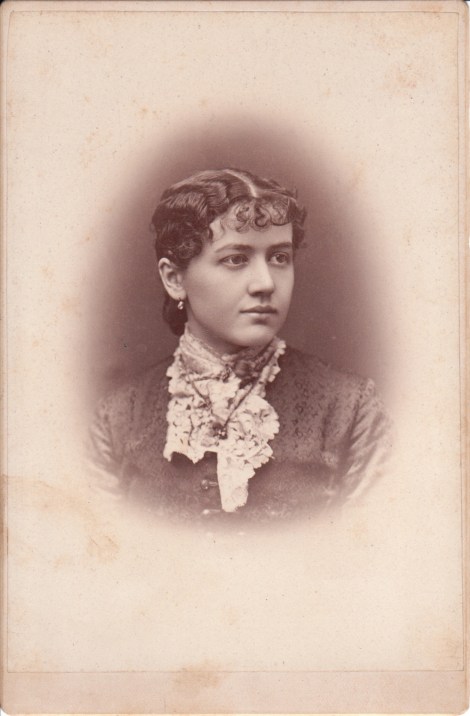
 This cabinet card features a portrait of a very lovely lady posing in the studio of Blakeslee & Moore in Ashtabula, Ohio. The town of Ashtabula was the site of a major train wreck in 1876 and one of the firemen who responded to the resulting blaze was Frederick W. Blakeslee. Besides being a firefighter, he was also a photographer and he used his camera to record the aftermath of the disaster. The image he made has become legendary in the history of disasters and the history of Ashtabula. He sold thousands of prints of the scene. Fred W. Blakeslee was in business in Ashtabula from 1870 to 1897. Blakeslee was born in Ohio in 1843. He was a lifelong resident of Ashtabula. At the end of the civil war he opened a photography studio in the town. Beginning the 1870’s he was joined by Frank C Moore (1851-1907). For a time, they operated a branch in Geneva, Ohio. Moore began his photography career as an apprentice in Ashtabula and then ran his own studio in Lima, Ohio between 1870 and 1875. Moore’s partnership with Blakeslee ended in 1894. Blakeslee’s son Frederick K Blakeslee (1880-?) also became a photographer in Ashtabula. The story of the “Ashtabula Train Disaster” is immensely tragic. The accident is thought to have been caused mainly by the collapse of a bridge owned by the Lake Shore and Michigan Railroad. The bridge was a joint creation by Charles Collins (engineer) and Amasa Stone (architect and designer). On a winter night in 1876, a train carrying 159 passengers and crew crossed over the bridge and when the first engine just passed the far side of the bridge, the bridge began to collapse and the rest of the train fell into the ravine. Ninety-two people were killed in the accident and most died from fires that were started from the train car’s oil lamps and stoves. The passengers were trapped in the burning crushed cars. The accident happened after a heavy snow storm and the rescuers were ill prepared and not equipped to help the poor victims of the train wreck. Charles Collins testified about the bridge design to an investigative jury and after finishing his tearful testimony, went home and shot himself in the head. Amasa Stone was held partially responsible for the accident, but he refused to accept blame. He theorized that the train jumped its tracks and destroyed the bridge. However, it is probable that he suffered severely from the incident, and about seven years later, he shot himself in the heart.
LOVELY LADY AND A TRAIN WRECK IN ASHTABULA, OHIO

WOMAN STANDS BY FENCE POST IN LEBANON, PENNSYLVANIA
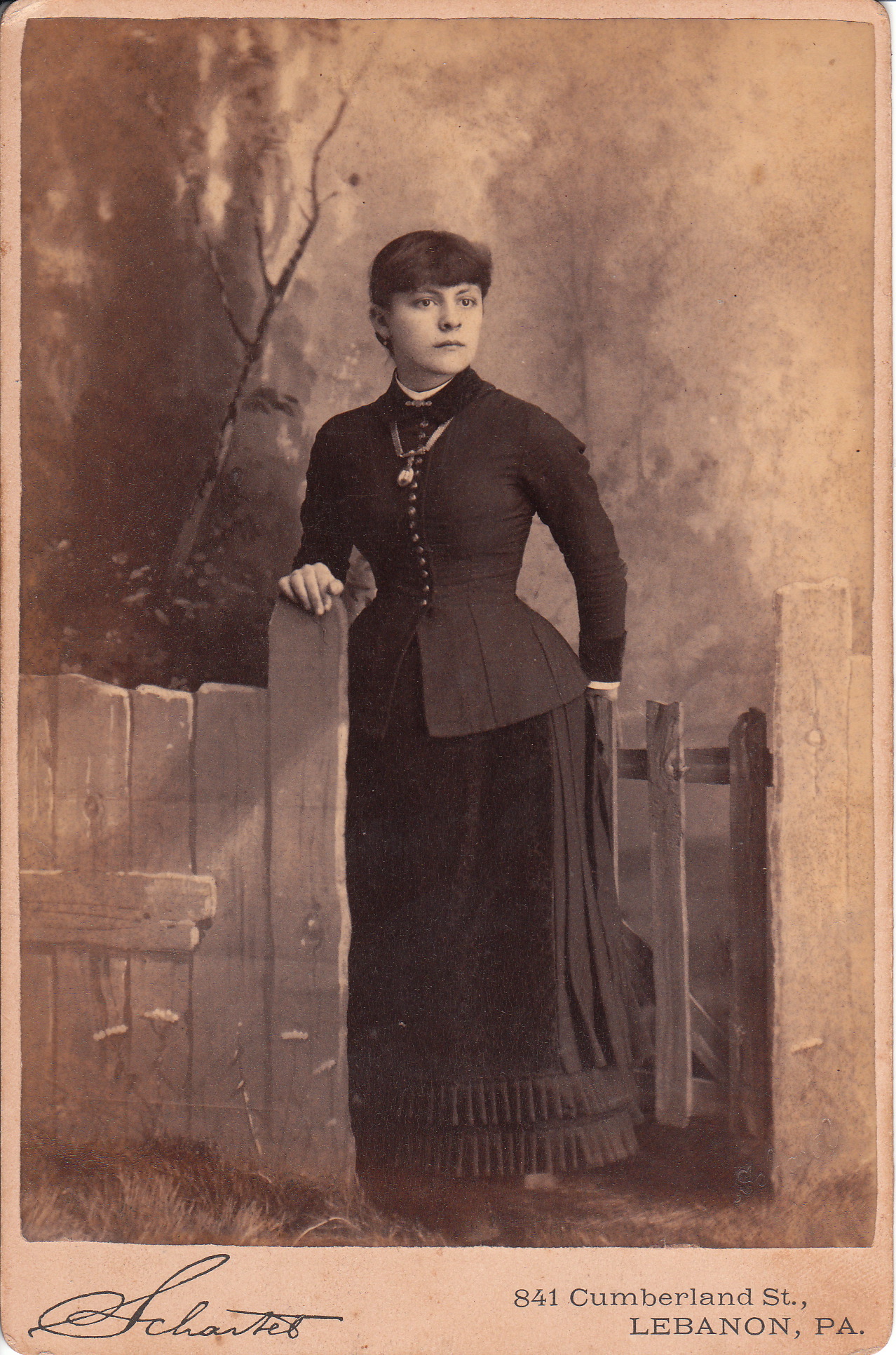 Elvin E. Schartel, a photographer from Lebanon, Pennsylvania, produced this image of an intense looking young woman standing at a gate. She is wearing a necklace with a locket. Schartel is listed in the 1889 Lebanon business directory as a photographer.
AUSTRIAN WOMAN HOLDING A PITCHER AND BASKET (PHOTOGRAPH BY RUDOLF KRZIWANEK)
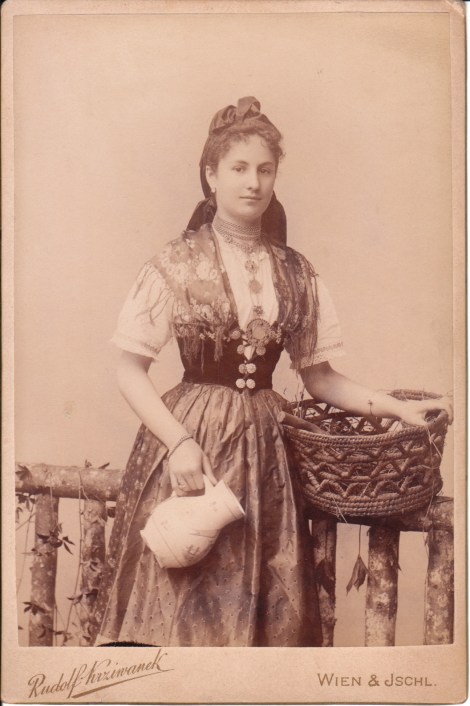
A pretty Austrian woman poses for her portrait at the studio of Rudolf Krziwanek. The woman is holding a pitcher in one hand and a basket with the other hand. The reverse of the photograph has an imprinted date which indicates that the image is from 1894. Krziwanek had studios in both Vienna and Ischl, Austria. Rudolf Krziwanek was a noted Austrian photographer in Vienna. He operated his studio there between 1870 until his death in 1905. He is well known for the many portraits he took of the Hapsburg Court.
TOOTHLESS OLD MAN WITH ODD BEARD IN HOWELL, MICHIGAN
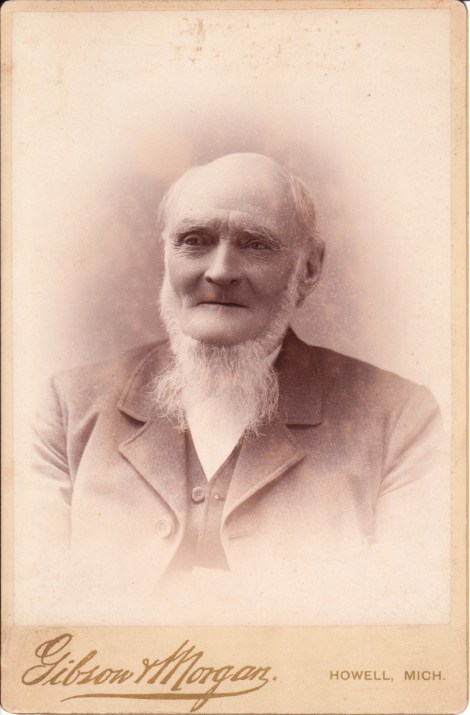
An elderly man poses for his portrait at the Gibson & Morgan studio in Howell, Michigan. The gray haired gentleman appears to be missing his teeth and is wearing an unusual beard that occupies much of his neck and little of his face. To view other interesting beards, click on the category “Beards (Only the Best)”.
TWO MEN IN UNIFORM IN KANSAS CITY, MISSOURI (FEMALE PHOTOGRAPHER)
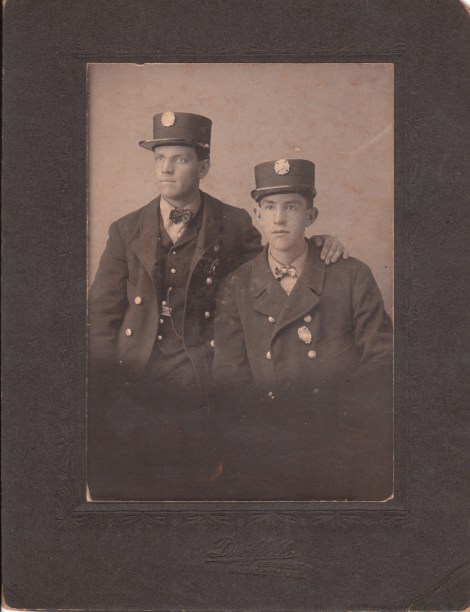
Two uniformed men strike an affectionate pose for a studio photographer in Kansas City, Missouri. Magnifying the photograph did not help definitively determine if the men were railroad conductors, firemen, police officers, or some other uniformed occupation. The photographer of this image is the Driffill studio. Mrs. Kittie Driffill operated a photography studio at 615 West 6th Street, in Kansas City. City business directories confirm that she had a studio in Kansas City between at least 1887 and 1910. According to the 1900 United States Census, Kittie worked the business with her son Edward Mack. In 1907 she worked with her husband Thomas Driffill.. Kittie Driffill also used the first name of Katherine.
SMALL BOY AND HIS BIG DOG IN NEW YORK CITY, NEW YORK.

A long haired and very well dressed young lad poses with his dog at the Rockwood studio in New York. The boy is wearing interesting leggings and a terrific hat. His dog appears to be a Burmese Mountain Dog but that is simply an uninformed guess. There is an unusual notation below the image; “Printed on N. P. S. extra brilliant albumen paper”. The photographer, George Rockwood of New York City was a noted celebrity photographer. It is possible that the boy featured in this image may have been a child actor. To learn more about the photographer, click on the category “Photographer: Rockwood”.
A BOY AND HIS DOG: BOY IDENTIFIED AS “ELDEN McFARLAND (I THINK)”
 A little curly haired boy in a rufflled shirt poses at the Twasaki studio along with his large white and black spotted dog. The boy is wearing a checkered bow tie. The dog appears to be resting comfortably as it sprawls on a rug in front of his young master. The boy has a sparkle in his eyes and his foot is resting lightly on the dog’s back.The reverse of the photograph has a handwritten inscription that identifies the child as “Elden McFarland (I think)”. The writer of the inscription was unusually honest about his lack of conviction in the identification. The dog pictured in this photograph is a St. Bernard (I think). If I am wrong, someone more informed than me about dog breeds will assuredly correct me via a comment.The photographer’s name on the bottom of this image is illegible. It appears to be Twasaki or Iwasaki but research was of no value in identifying the photographer or the location of his studio. The name Elden McFarland was too common to find biographical information about the subject. Knowing the location of the studio would have facilitated finding background information concerning young Master McFarland.
A PORTRAIT OF A BOY AND A CHAIR BY MISS LIBBY IN NORWAY, MAINE (NOTED FEMALE PHOTOGRAPHER)
 A young boy dressed in a double breasted jacket and wearing a tie poses for this portrait by Miss Libby of Norway, Maine. Minnie Libby (1863-1947) had a sixty year business career in Norway, Maine. She was a very able photographer and also an eccentric. She was the daughter of a Maine born blacksmith who was also a carriage maker and dealer. The 1880 census lists her at age sixteen as being an artist. She was sent to the Boston Museum of Fine Arts and developed an interest in photography. She worked as a studio photo retoucher while living in Boston. In 1882 she worked as a photo retoucher at the Anthony Crockett Picture Studio in Norway. In 1885 her father constructed a building to house her first studio. By the 1890’s Miss Libby was quite successful. In 1905 her father helped her buy a new studio which caused some controversy in the town of Norway. The seller of the building neglected to tell his tenant, a photographer, that the building was sold. The tenant photographer took ads out in the local paper denouncing the underhanded business practices of Miss Libby who ultimately occupied the building. Miss Libby’s response to the ads was to take out her own ads in which she said that she would use the advertising space to talk about her business, and not to make misleading statements about her competitors. In 1940, Life Magazine discovered Miss Libby. They did a feature on her life as a photographer, both past and present. Minnie Libby also produced oil paintings while working as a photographer. She was a talented artist and did many paintings of plants and flowers as well as landscapes. The Life Magazine article describes Miss Libby’s appearance. She most often wore knickers, men’s shirts, and a flowing bow tie. She was also described as a “first class photographer”. To view other photographs by Miss Libby, click on the category “Photographer: Libby”.
PORTRAIT OF BEAUTIFUL ACTRESS EVANGELINE IRVING (BY CELEBRITY PHOTOGRAPHER WILLIAM McKENZIE MORRISON OF CHICAGO, ILLINOIS)
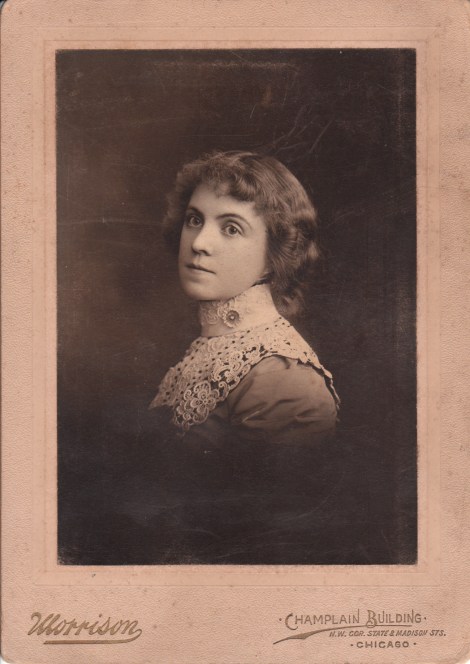
The previous owner of this photograph, reported the subject to be theatrical actress Evangeline Irving. Visual comparison to other portraits of Evangeline Irving support this identification. Evangeline Irving was an theater actress and the sister of a more successful theater actress named Isabel Irving. See Isabel’s portrait by searching for it in the Cabinet Card Gallery. This photograph was produced by William McKenzie Morrison, the Chicago, Illinois, based celebrity photographer. View other Morrison photographs by clicking on category “Photographer: Morrison”. The New York Times (1895) reported that Evangeline substituted for Isabel in a matinee performance of “The Case of Rebellious Susan”. Isabel was suffering from hoarseness. A number of New York Times (1895, 1896) articles describes a banking fiasco that Evangeline Irving was able to resolve. Her mother had gone to the Lincoln Safe Deposit Company to get twenty thousand dollars worth of bonds out of her box. When she could not find the bonds in the box, she ran out of the vault screaming that she had been robbed. She went home ill, and took to bed. She complained around town and soon her Senator contacted the bank demanding she be compensated with a check replacing her loss. The situation caused many people to run to their banks to see if their safety deposit box holdings had disappeared. Mrs. Irving caused a mini run on the city banks. It took awhile for Mrs. Irving’s daughters to get involved because both of the women were performing out west. Isabel was playing roles with the Lyceum Company and Evangeline was part of Stuart Robson’s Company. Soon, Evangeline came to the bank and after opening the safe deposit box found the bonds tied up in a bundle in the box. An apology was issued to the bank and made public.
MOTHER AND YOUNG DAUGHTER ENJOYING SOME MOMENTS IN BERLIN, GERMANY
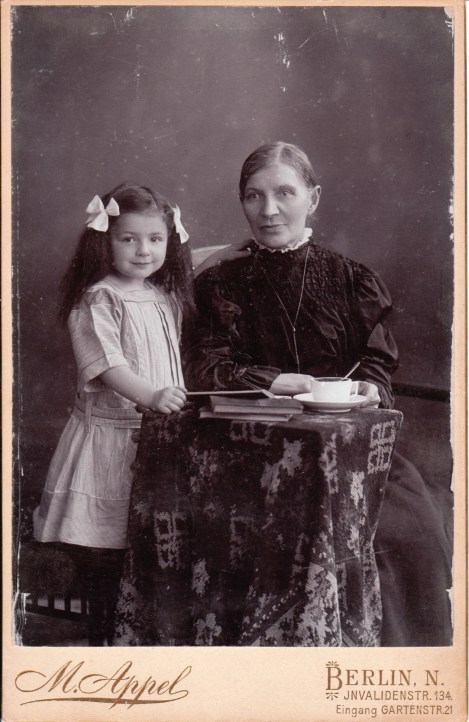
Photographer M. Appel does a masterful job in this photograph capturing a scene, albeit in a studio, that is nearly universal. This image shows a mother and daughter enjoying spending time together. Mother is reading with her adorable little girl while drinking a cup of tea or coffee. The daughter is wearing bows in her hair and a priceless expression. She affectionately rests her left arm on her mother’s shoulder. The reverse of the photograph has printing announcing that Mr. Appel had studios in three locations in Berlin, Germany.


 THE CABINET CARD GALLERY