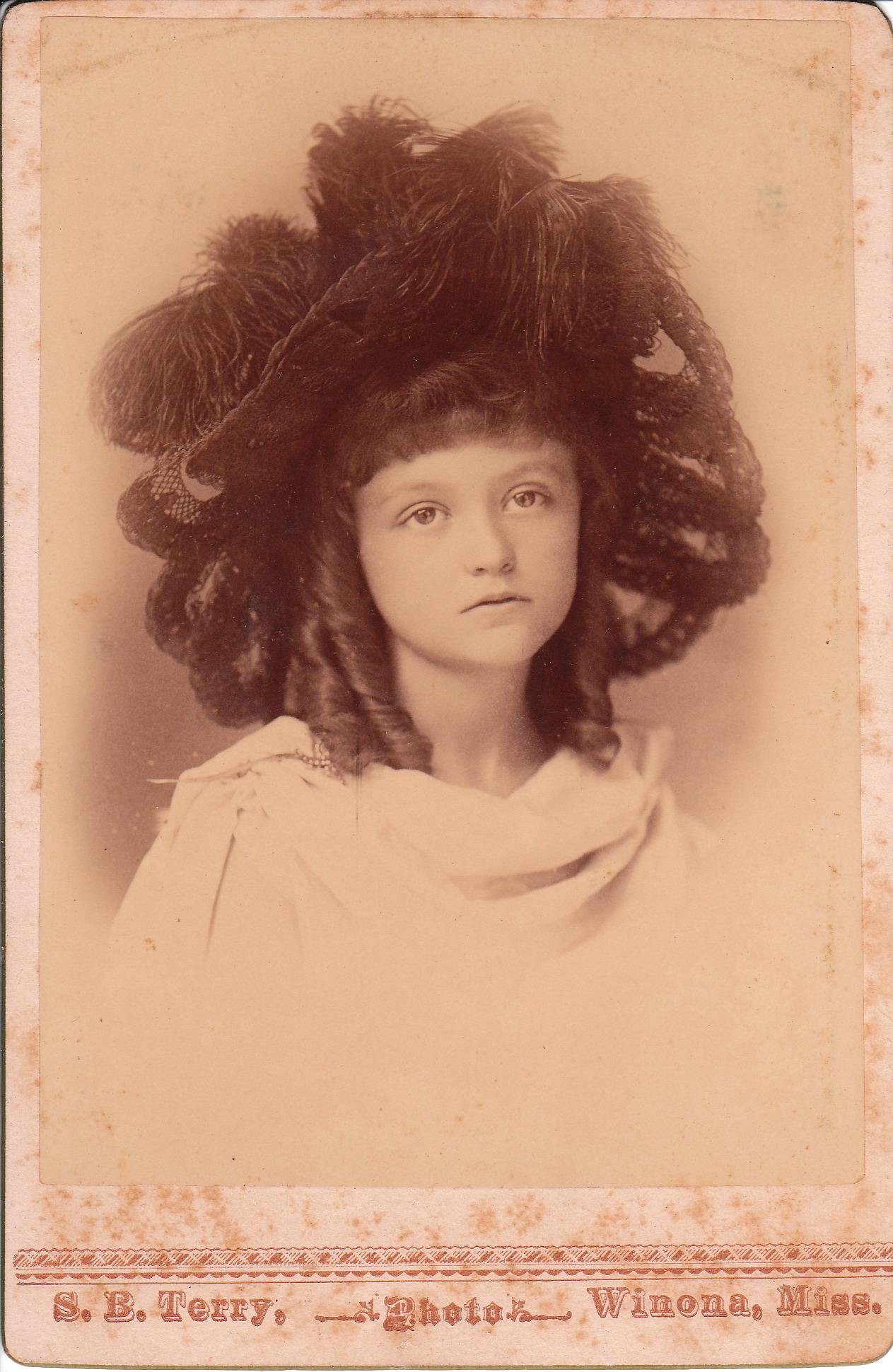
This cabinet card portrait is by S. B. Terry of Winona, Mississippi. His subject is a young girl with an angelic expression. She is wearing a fancy elaborate hat with ostrich plumes. Her hair is styled with sausage curls. She appears to be draped in white cloth. This portrait is very styled and atypical of many of the portraits of this era. The photographer, Sterling B. Terry was born in Mississippi circa 1862. He married his wife Anna in 1882. The 1900 census found him living in Winona with his wife (age 38), son William (age 15), and daughers Anne (age 11), Mary (age 10), and Clara (age 7). The 1900 and the 1910 census lists S. B. Terry’s occupation as “Photographer”. To view other photographs by this photographer, click on the category “Photographer: Terry”. (SOLD)
MAN WITH A GREAT BEARD IN LOUISVILLE, KENTUCKY
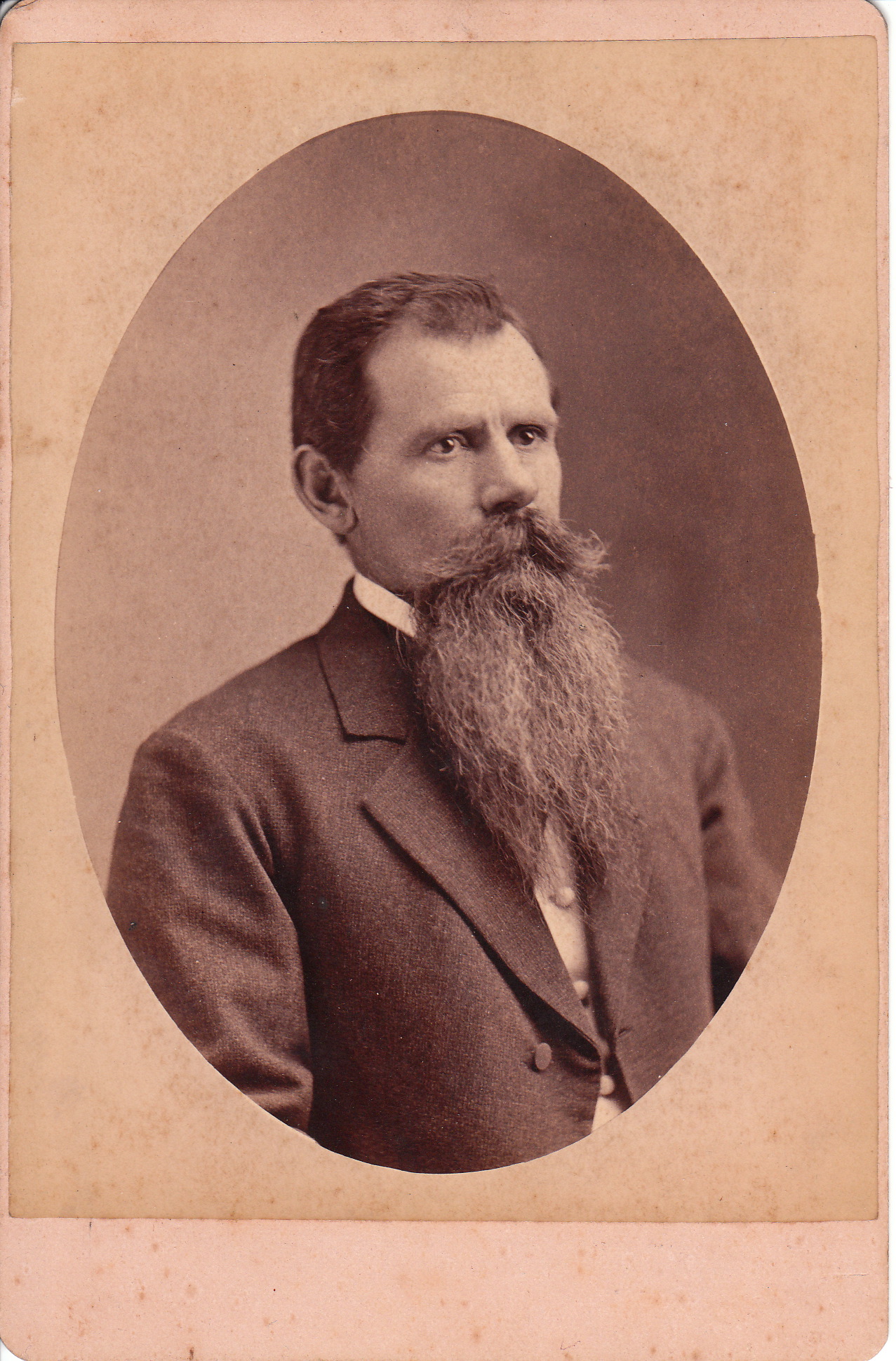
This cabinet card is a portrait of a middle aged man with a wonderful mustache and beard. The Cabinet Card Gallery has a collection of interesting facial hair cabinet cards which can be visited by clicking on the categories of “Beards (Only the Best)” and “Mustaches (Only the Best)”. The photographer of this image is Louis Bergman, whose studio was located at 56 & 58 Market Street, in Louisville, Kentucky. Perusal of Louisville business directories reveals that Bergman began business with a partner. Bergman & Flexner; the firm was listed in the 1868 and 1869 directories. He was reported to be the sole proprietor of a studio from 1872 until 1886. Bergman was listed at a number of different addresses over these years. Using these addresses, it appears that this particular photograph was taken between 1873 and 1881. From 1886 through 1894 the proprietor of the studio became Caroline Bergman. The Photographic Times and American Photographer (1883) reported that Bergman was Vice President of the Photographers Mutual Benefit Society of Louisville. Louis Bergman (c1838-?) was born in Hanover, Germany to Prussian parents. His wife, Carrie (!845-?) was born in Louisiana to German parents. The couple married in about 1865. The Bergman’s had a daughter, Lillie, who was 12 years-old at the time of the 1880 census. The census listed Louis as a photographer and Carrie as a homemaker. It is interesting to note that when the couples daughter reached 18 years of age, Carrie became the studio’s proprietor/photographer.
SOLD
PRESIDENT THEODORE ROOSEVELT AND MRS. ROOSEVELT (SOUVENIR OF VISIT- 1902)
This cabinet card features President Theodore Roosevelt (1858-1919) and first lady, Edith Roosevelt (1861-1948). Roosevelt was the 26th President of the United States and served between 1901 and 1909. He was truly a remarkable man. Among the titles that could describe him are; athlete, naturalist, explorer, hunter, author, cowboy, soldier, father, cowboy, and politician. He had a wide range of interests and achievements. As president, Roosevelt was a leader of the progressive movement, was a successful “trust-buster”, created an active government conservation effort, helped develop the Panama Canal, and negotiated a settlement to the Russo-Japanese War (won the Nobel Peace Prize). He was well known for his international relations policy characterized by the slogan, “speak softly and carry a big stick”. Roosevelt’s political career included holding positions as a New York State Assemblyman, member of the Civil Service Commission, New York City Police Commissioner, Assistant Secretary of the Navy, Governor of New York, and Vice President under William Mckinley. Upon Mckinley’s assassination, Roosevelt became the President of the United States. Roosevelt was a busy and productive man. Despite all the aforementioned activities, he also had a military career. He led a regiment of soldiers during the Spanish American War. He helped form a unit called “The Rough Riders”. The Rough Riders included an interesting combination of soldiers, including many cowboys, and many ivy leaguers. The unit was very successful and fought valiantly during the war. Pictured alongside Roosevelt on this cabinet card is his first lady, Edith Roosevelt. She was Roosevelt’s second wife; his first wife had died. Interestingly, Edith and Teddy were childhood friends and playmates. In fact they were next door neighbors while growing up in New York City. She was best friends with Roosevelt’s sister and even attended Roosevelt’s first wedding. Edith Kermit Carow and Theodore Roosevelt had five children. The caption on this cabinet card raises some interesting questions. This cabinet card was given out, or sold, as a souvenir. What event or place used the photograph as a memento? What is the significance of the year 1902? Perhaps a visitor to this site will have some knowledge they can share to address these questions. (SOLD)
HANDSOME WHITE HAIRED AND WHITE BEARDED GENTLEMAN IN PLAINWELL, MICHIGAN
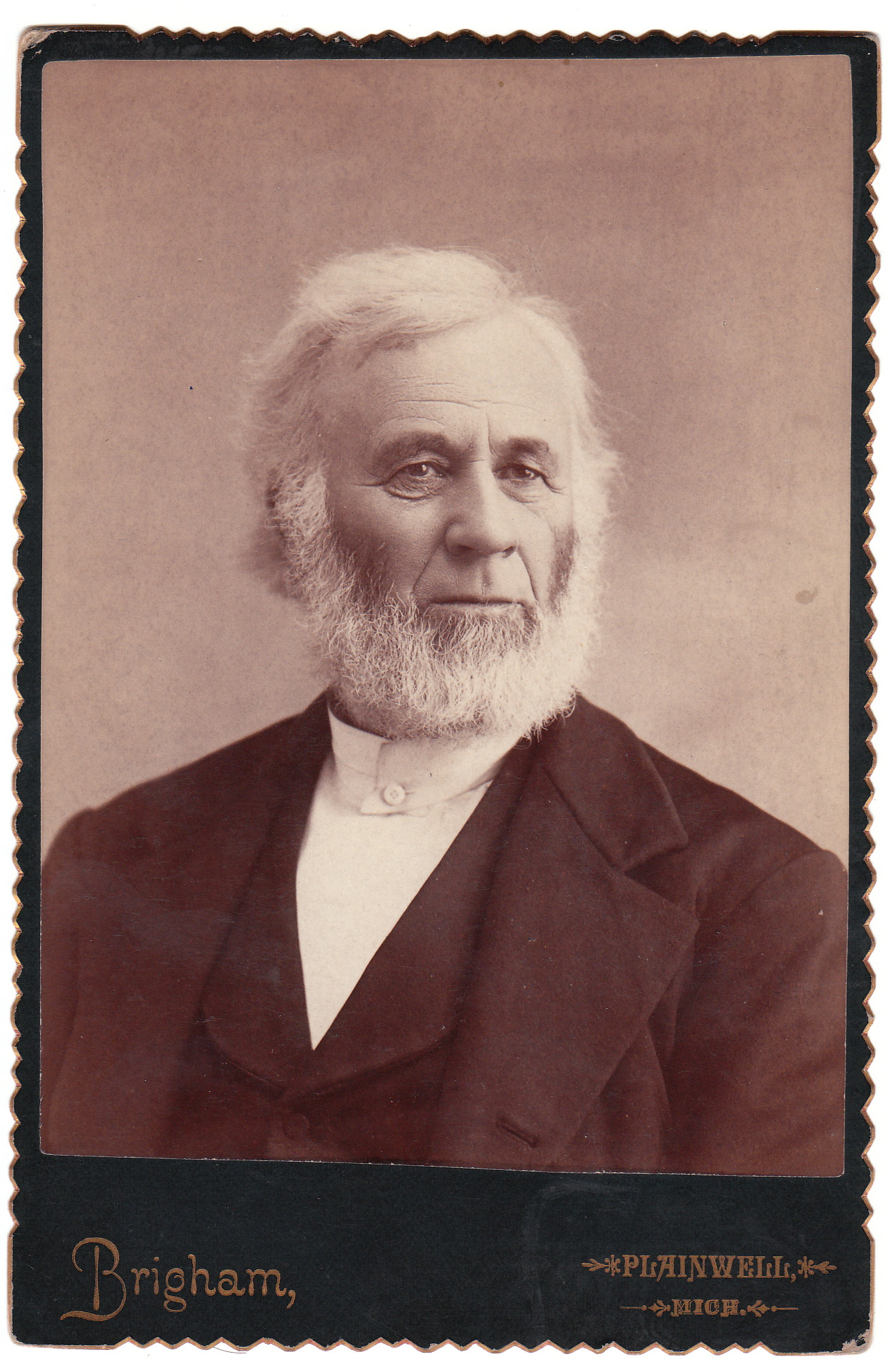
This handsome older gentleman with white hair and a white beard, is named Adrian Manley (1826-1906). The U.S. census of 1880 reveals that he was married to Elizabeth Manley and that he was employed as a clerk. He and his wife lived with their son Leny, a twenty nine year-old laborer. The 1900 census finds Mr Manley in his seventies living with his wife and two grandchildren, Wane (age 8), and Sylvia (age 6). Adrian Manley’s death certificate lists his occupation as a farmer which likely indicates that farming was his primary work for most of his life. The photographer who produced this photograph was John Morrison Brigham (1863-1933) whose studio was located in Plainwell, Michigan. Brigham attended Indiana Normal College at Valparaiso, Indiana. He studied photography in Plainwell and owned his first gallery there. In 1898 he moved to Battle Creek, Michigan where he opened a photography studio that became very successful. In 1885, Brigham married Ida M Potter of Mankato, Minnesota. Photo Beacon (1897) printed a review of some of Brigham’s work and it was not complimentary. The reviewer simply wrote, “lots of dead eyes”.
TWO YOUNG GENTLEMEN AND TWO YOUNG LADIES IN MACON, MISSOURI
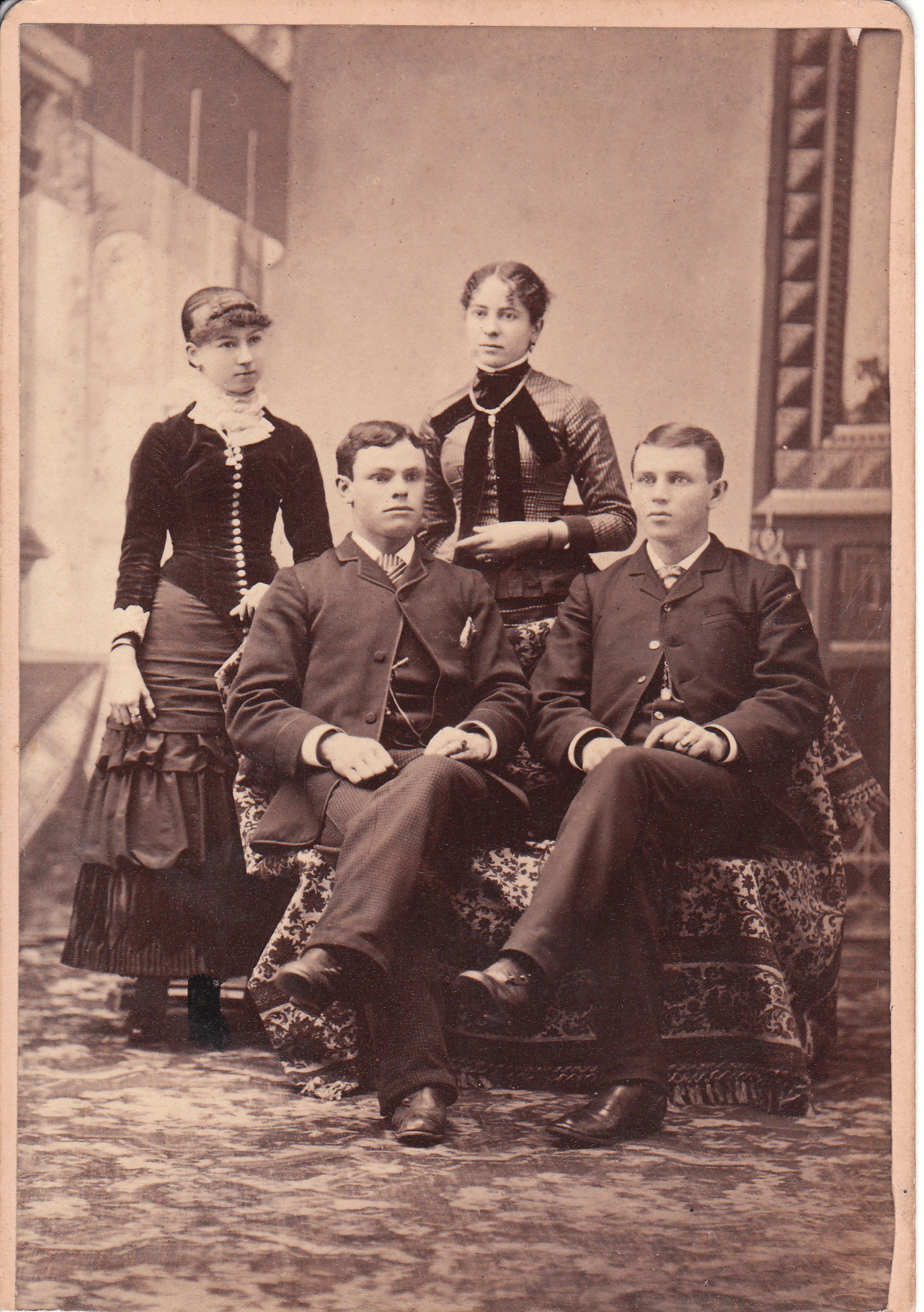
This cabinet card features two young gentlemen and two young ladies posing for their portrait at Roswall’s Art Studio, in Macon, Missouri. The exact address of the studio was 21 & 23 Rollins Street. The young adults in this photograph may be from the same family, or may be just friends. These four individuals are very well dressed, leading one to believe that they likely come from families of means. It is interesting to note that the girl on the left appears somewhat separated from the other three subjects. The separation my reflect how she felt psychologically about her place in the foursome. However, her position in the photograph may be simply the result of the photographer not wanting to leave too much space on the left side of the image. The photographer, Lars J. A. Roswall, was reported by the Photographic Times (1884) to be a part of a group that held a patent relating to an apparatus for cleaning photographs.
PORTRAITS OF GEORGE AND LIZZIE IN CHICAGO (STILL TOGETHER AFTER ALL THESE YEARS)
These two cabinet card portraits come from the same source and belong together. Writing on the reverse of one photograph indicates that the couple are named George and Lizzie. Perhaps the young man and woman are married to each other. If not married, the two subjects may be siblings. The photographer of both cards is Copelin whose studio was located on the Northwest corner of Madison and State Streets in Chicago, Illinois. The exact address was 75 Madison Street. Some biographical information concerning the Copelin studio is available, but it is very difficult to sort out. It seems that Copelin had a succession of photography businesses. Alexander J. W. Copeland (1851-c1923) and Melander bought out their boss to open a studio in Chicago sometime around 1870. Copelin & Son was established in 1871 and existed about ten years. The business has an interesting story associated with it. The gallery was established just six days before the Chicago Fire (1871) and the building was completely destroyed in the blaze. The building had been the first photographic gallery in Chicago but had housed many proprietors. A.J. Copelin rebuilt the business. In the early 1880’s, the Copelin Gallery was established. Copelin eventually left portrait photography and opened a successful commercial photography business. Copelin is also recognized as one of the founding fathers of the Photographers Association of America.
“LADIES AND GENTLEMEN, BOYS AND GIRLS, CHILDREN OF ALL AGES, LOOK AT THE GIRL ON THE FLYING TRAPEZE” …ROSE AUSTIN, AERIAL PERFORMING STAR
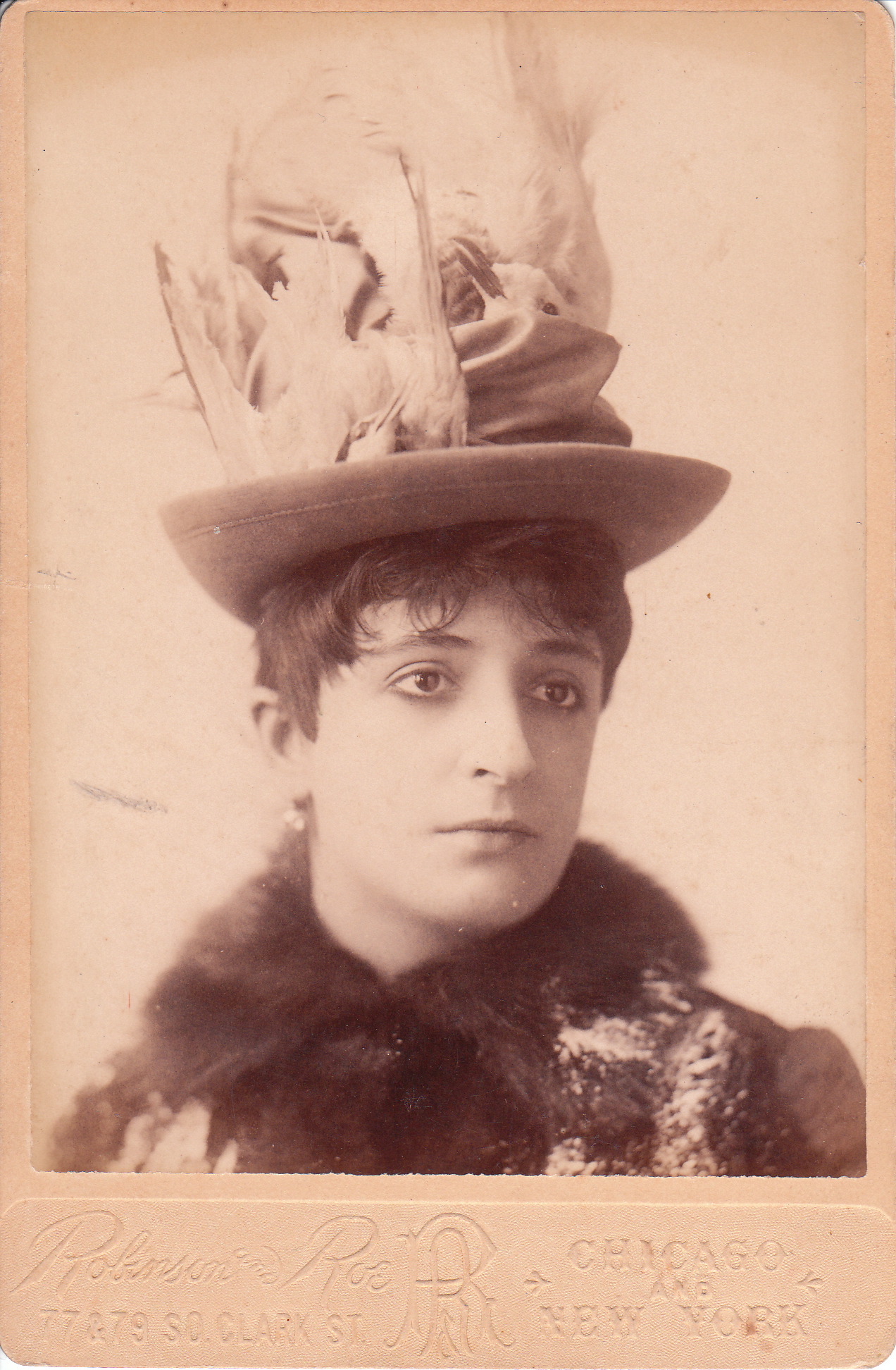
This cabinet card features a pretty, Rose Austin, of the Austin Sisters, who were well known trapeze artists. On the reverse of the photograph is a pencilled notation that states the performer’s name and “Bath Beach, Long Island, New York” (Bath Beach is in Brooklyn). The image was published by the Robinson & Roe studio which had galleries in both Chicago and New York City. The Circus Historical Society’s web site cites the “Austin Family”. Its members included R.G., Aimee (1870-1907), George E., and Rose. Among their venues were Orrin Brothers (1883-1884), W. W. Cole (1885), Coney Island (1892), and Bentley’s (1895). Aimee Austin, born in London, was an aerialist who was known as the “Human Fly” for her talent of “ceiling walking”. She began performing with Rose Austin, at nine years of age, as part of the Austin Sisters aerial act which played at the Circus Rentz, in Berlin, Germany. The act was managed by R. G. Austin. The aerialist performed with various European circuses before coming to the United States. Rose Austin was the subject of three articles in the New York Times. A 1892 article was entitled “Cannot Find Rose Austin”. The article reported that the disappearance of Ms. Austin from her home in Bath Beach. She was described as a well known trapeze performeer and leader of the “clever” Austin Sisters. It was also metioned that she was the wife of R. G. Austin; the manager of the Australian Theatrical Company. At the time of her disappearance, she and her sister were performing at Vaceas’s West End Casino in Coney Island, New York. She had been last seen boarding a ferry bound for New York City. The article points out that Ms. Austin had suffered from epilepsy for the previous four or five years and had experienced a severe attack about ten days earlier.(An acrobat with epilepsy? Doesn’t seem like a terrific career choice.). The article closes with a statement that both Rose Austin’s husband and her doctor, believed that she was either in a hospital, or had fallen off the ferry and drowned. A follow up article (1892) revealed that Ms. Austin had been found and was currently confined to bed as “she is wandering in her mind”. She couldn’t account for her whereabouts or activities during the time she was missing and last remembered falling ill on the ferry. A third article in the New York Times (1894) reports that Rose fell from a trapeze while performing with her brother George in Coney Island. She fell after fainting (one would imagine she had a epileptic seizure). She and her brother fell into a net together and knocked heads, rendering them both unconscious. George recovered quickly but Rose was brought home to Bensonhurst (Brooklyn) in a delirious condition. To view other photographs by Robinson and Roe, and to learn a little about them, click on the category “Photographer: Robinson & Roe”. SOLD
LITTLE GIRL AND HER RATTLE IN ROCHESTER, NEW YORK
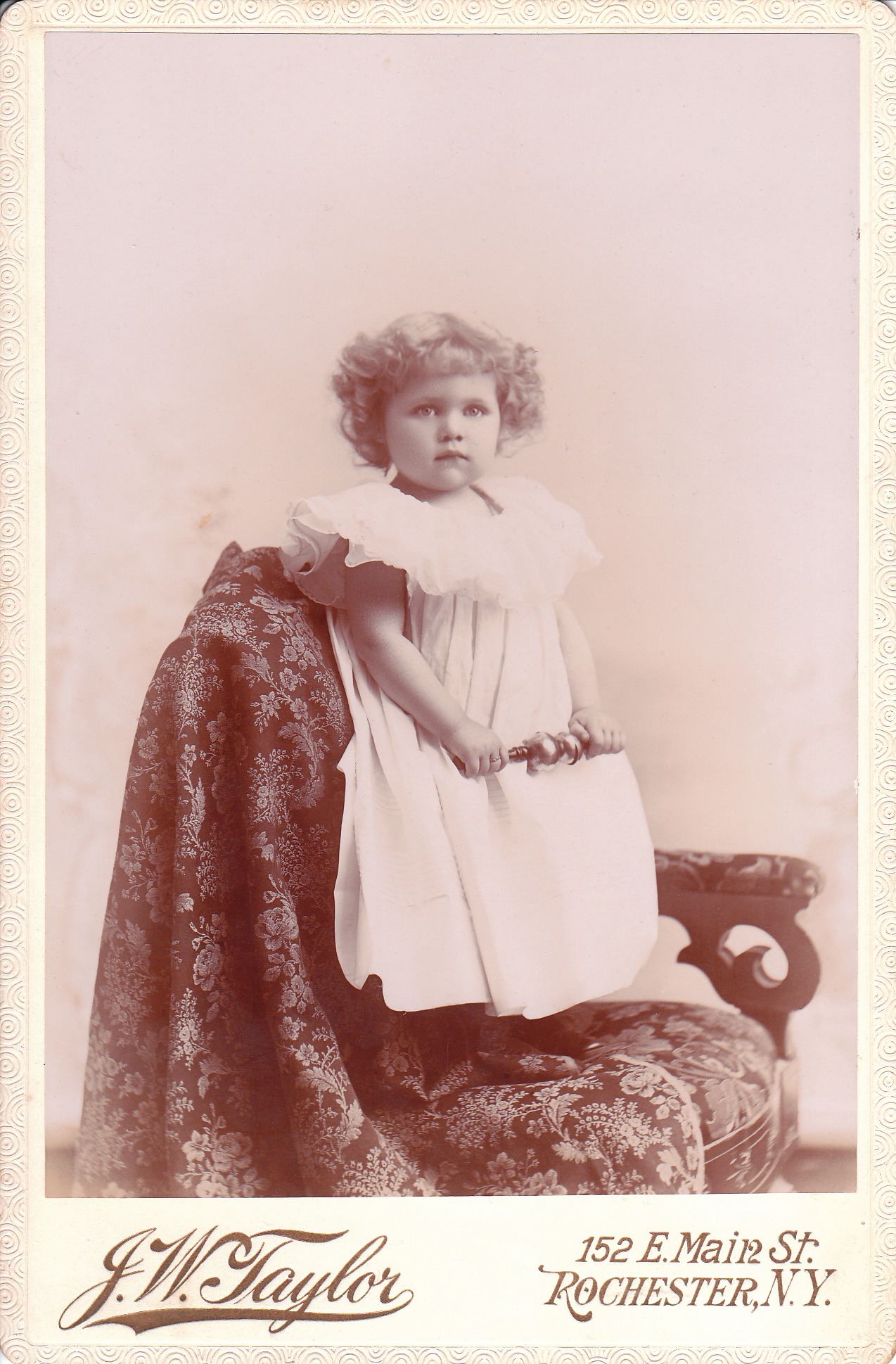
A cherubic, curly haired little girl stands on a blanket covered chair in the photographic studio of J. W. Taylor, in Rochester, New York. The girl is wearing a long gown and a very serious expression. She firmly holds a rattle with both hands. To view other photographs by Taylor, click on the category “Photographer: Taylor JW
A BOY AND HIS WOODEN TRICYCLE IN CLINTON, MASSACHUSETTS
This cabinet card features a well dressed young boy posing next to a wooden tricycle in the Jenness Studio, in Clinton, Massachusetts. The lad is wearing a suit, bow tie, and hat. Note the decorated wooden handlebars on the tricycle and the fancy seat. The first tricycle was invented in 1680 by a disabled German man who wanted to maintain his mobility. There were many versions invented over time until Starley developed the first rotary chain drive tricycle in 1877. After the introduction of this model, tricycle riding became very popular. Tricycles and bicycles can be found in many cabinet card photographs. To view examples of such images, click on the category of “Bicycle”.