HANDSOME GENTLEMAN : FAMOUS COLORADO PHOTOGRAPHER (J. COLLIER) : CABINET CARD

This cabinet card portrait features a handsome man with interesting styled side burns. He is dressed fashionably. The gentleman was photographed by a famous Colorado photographer, Joseph Collier (1836-1910), at his Denver studio. Collier was born in Scotland, where he began his career as a photographer. When he first came to Colorado, he produced stereographic images. He gained fame in the late 1800’s for his images of Colorado. His subjects included the downtowns of Telluride, Golden, and Denver. He also photographed the Garden of the Gods (Colorado Springs) and many mountain sites. After Collier immigrated to the United States, in 1871 he came to Central City Colorado. He was invited there by his cousin who owned the local newspaper. Collier opened his first studio in the backroom of the newspaper. He immediately began making photographic trips through the Rocky Mountains of Colorado. In 1873, Collier gave a set of his Colorado stereoviews to Julia Grant, the wife of President Ulysses Grant. In 1877, Collier moved to Denver opening a studio on Larimer Street. He practiced photograph there and retired by the turn of the century. In 1874, Collier provided the photographs for a book entitled “Summering in Colorado”. In addition, a book was published in 1983 focused on displaying Collier’s photos. The book was entitled “The Photography of Joseph Collier. Colorado. 1871-1910”. Some of Collier’s photos can be found at the Getty museum in Los Angeles, California. 

ADORABLE LITTLE GIRL : TEDDY BEAR : WATERING CAN : TOYS : SWITZERLAND : CDV

The little girl featured in this cartes de visite is adorable. She is nicely dressed in a navy style dress. She is standing on a chair and holding a watering can in one hand and a teddy bear in the other hand. She is posed next to a ball and other toys. Note the girl’s hair bows as well as the bows on her shoes. The photographer of the child’s portrait was Charles Guignet. He operated a studio in Lausanne, Switzerland. The city is located on the shores of Lake Geneva. There is a French town across the lake. Lausanne is about 38 miles northeast of Geneva. This CDV measures about 2.5x 4 inches. SOLD

PORTRAIT OF A HANDSOME MAN : CROOKSTON, MINNESOTA : CABINET CARD

This cabinet card photograph features a handsome man posing for his portrait at the Anderson studio in New York City. A caption under the image identifies him as “W. H. Pomeroy, the Pony Man”. The caption also indicates that Pomeroy was from San Antonio, Texas. During the late 1880’s, Pomeroy owned “Pomeroy’s Western World Troupe” and “Pomeroy’s Western World Show”. Both were Wild West shows. The show was composed of more than 100 people and 125 horses, ponies, donkeys, and mules. The show also included a ten piece band. In 1891, Pomeroy partnered with Max Samuels, from San Antonio, to found a circus. The circus was called “Pomeroy & Samuel’s Great International Railroad Shows”. Pomeroy is well dressed and sports a nicely trimmed mustache.  in this photograph. He is wearing a coarse wool coat and a matching waist coat. He is dressed in a crisp white shirt accentuated by a small silk bow tie. Atop his head is a flat crowned felt planter hat. There is something peeking out of his left jacket pocket. Mr. Pomeroy is posing in front of a backdrop. The photographer of this image was D. H. Anderson who operated a studio on Broadway in New York City. Anderson used the same photo studio formerly occupied by the famed photographer, Matthew Brady. Anderson had worked in various other American cities before moving to New York in 1881. He became known as a talented celebrity photographer. This photograph has an interesting aberration. If you look very closely in the sky next to the left side of his hat (slightly above the brim), you can see the words “Pony Man”. The words are very light and upside down. This developing error occurred more than one hundred years ago. SOLD

CORINNE: FAMOUS CHILD ACTRESS AND SUBJECT OF A SENSATIONAL CHILD ABUSE CASE

CORRINE_0003CABINET CARD 1

corinne_0002CABINET CARD 2

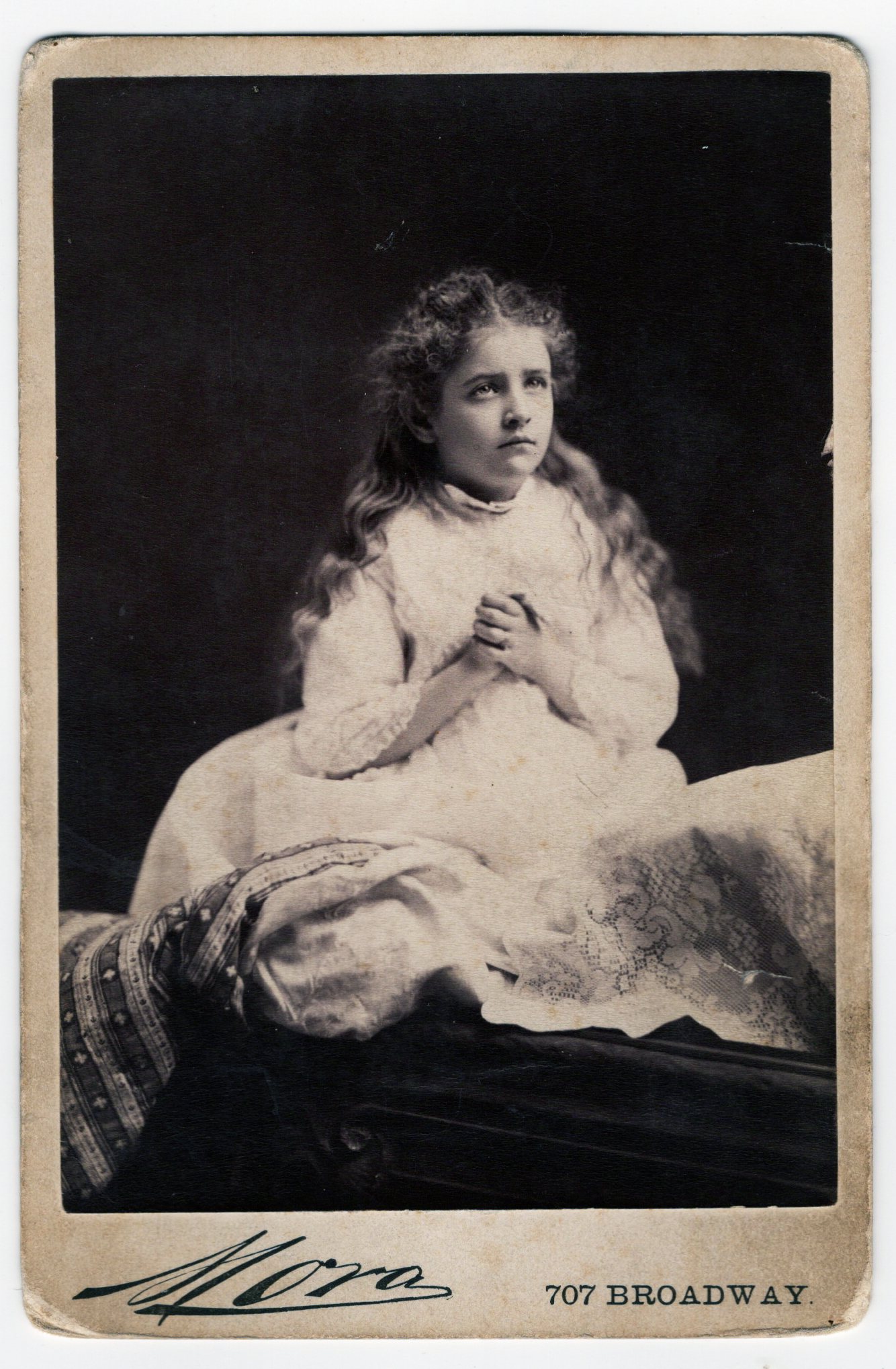
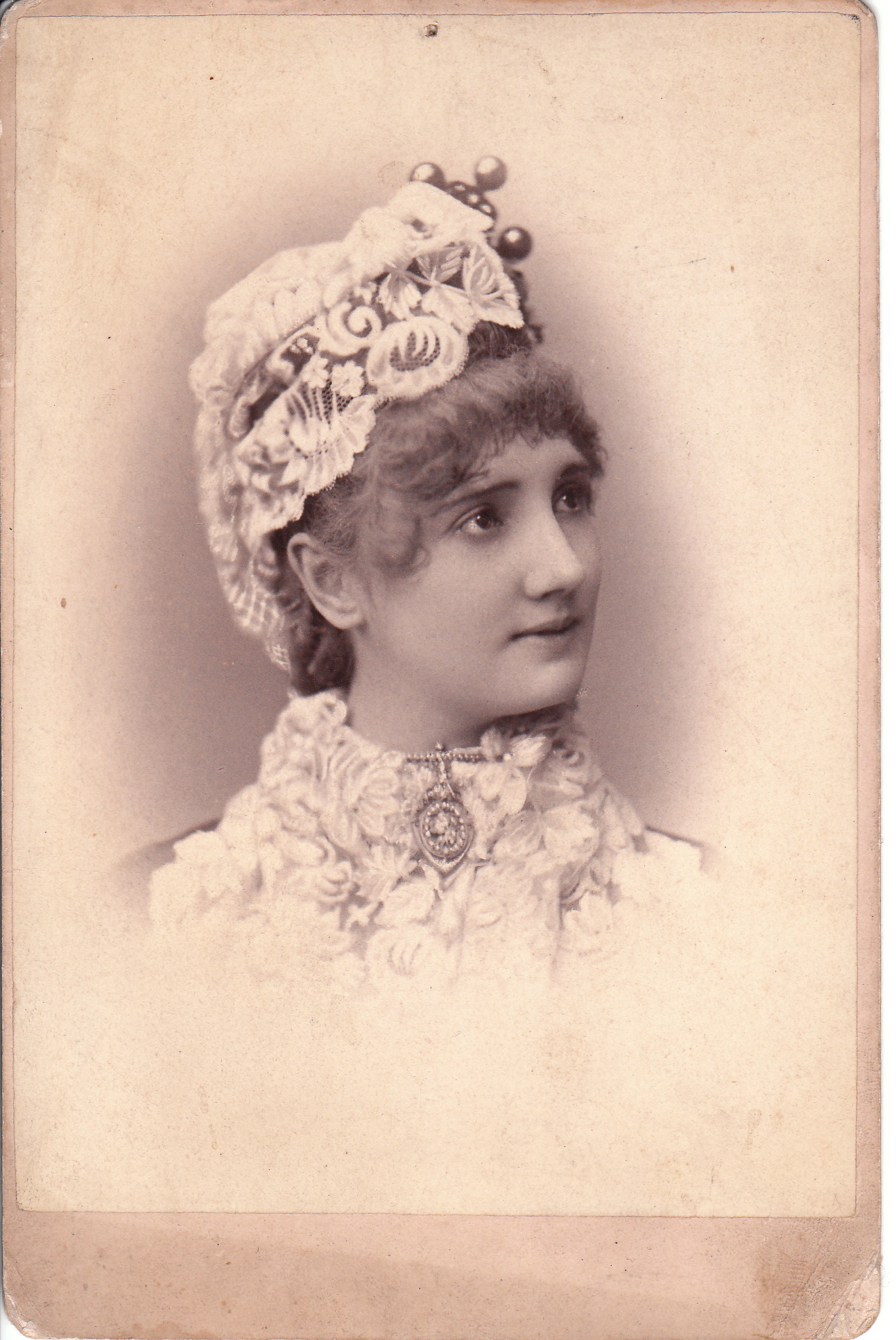
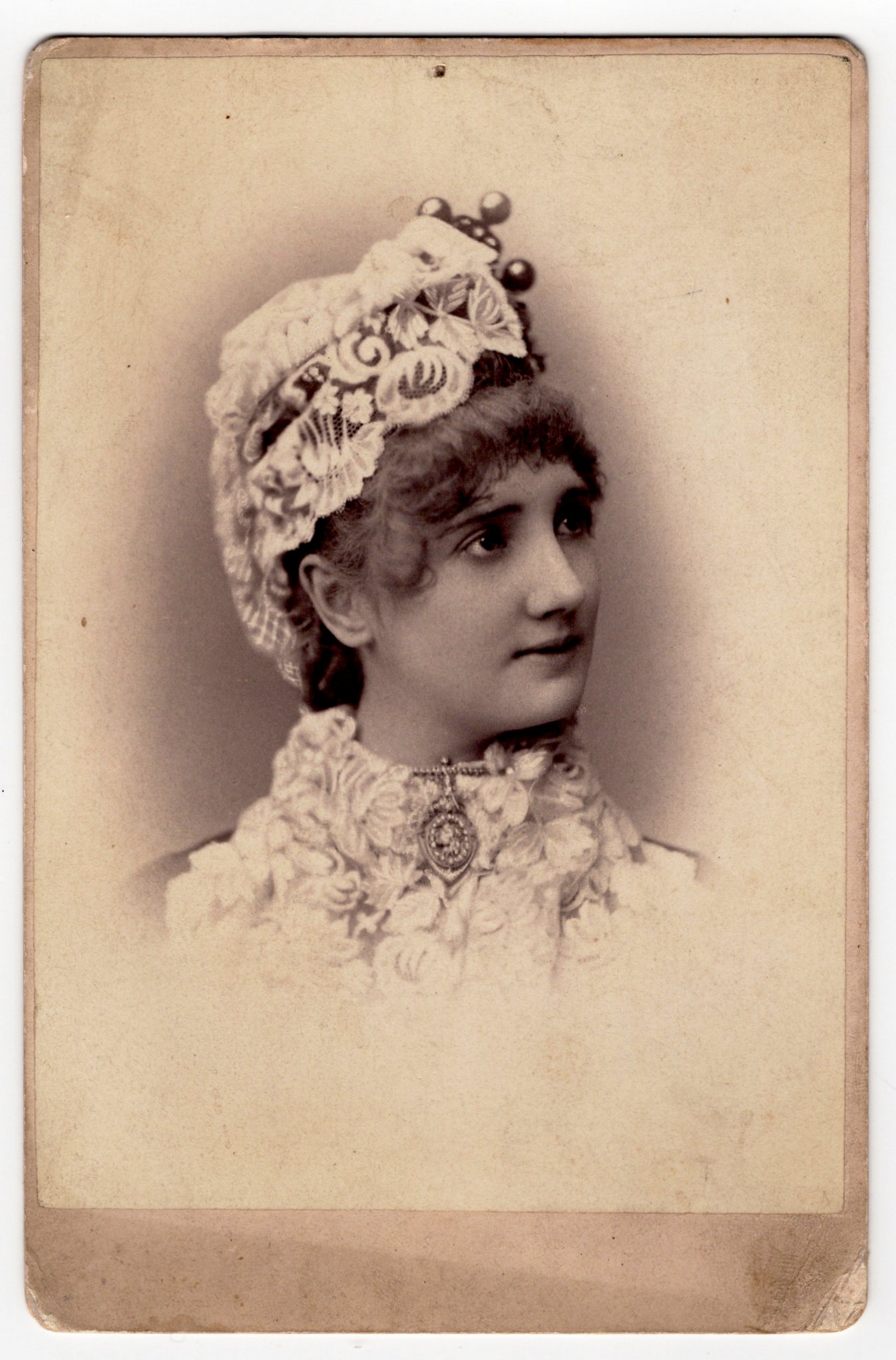
The actress pictured in Cabinet Card 1 is Corrine.  Corrine, like Elvis or Selena, was a performer that received national recognition and was known by just her first name. In the top portrait by celebrity photographer B. J. Falk, Corrine looks to be teenager or young adult. She is dressed in theatrical costume. Corinne was the daughter of actress Jennie Kimball. Kimball acted in the theater between 1865 and 1873. The year of her retirement, she became the mother of Corinne, who the New York Times (1896) labelled “the most famous of all the child actresses of this country”. It is not clear how Kimball and her husband came to raise Corinne, but is was speculated that she was adopted as an orphan. Kimball trained her young daughter for the stage. Corrine debuted in the theater at age two and a half.  At five years of age she played the part of  “Little Buttercup” in the Boston production of “Pinafore”. She played the role more than one hundred times. At fifteen years of age she was traveling as head of her own theater company. Jennie Kimball doubled as Corinne’s mother and manager. The New York Times (1896) reported that Corinne “was a goldmine” during her early days for Mrs. Kimball and remained a major money producer through the time the article was written. At the time the article appeared, Corinne was twenty-two years old.  Jennie Kimball’s successful management of her daughter’s career wasn’t appreciated by all observers. The New York Times (1881) asserted that the Society for the Prevention of Cruelty to Children objected to the way Corinne was being raised and successfully pursued custody of the child. During the custody hearing, eight year-old Corinne was put on the stand and interrogated by the society’s lawyer. He asked her how many times she was photographed and she didn’t know but said “she was never photographed in tights nor with her limbs and breast exposed”. The lawyer’s questioning revealed that the child had never attended school. However, Jennie Kimball did give her “lessons” each morning. The lawyer then gave Corinne an impromptu writing/spelling test during her testimony. The attorney also prompted the child to say she had never attended sunday school and didn’t know what a bible was nor had she ever been taught anything about Jesus Christ. The society lawyer was initially able to convince the judge to remove the child from the custody of Mrs Kimball because she was “unlawfully exhibited and employed” in dancing, singing and acting on the theatrical stage. Mrs. Kimball was allowed to take her daughter for a brief period to change her clothing but was assigned an escort to insure that the child would be brought to the society. Mrs Kimball was advised by George Hackett, the manager of a Providence opera house that if she took her daughter from New York to Jersey City, New Jersey; the girl would be out of the courts jurisdiction and she could keep her daughter. Mrs. Kimball followed his suggestion, and allowed a man to spirit the child out of state. As a result, Mrs. Kimball was charged with abduction and she ended up back in court. After a short time, the judge considered all the testimony that he heard and decided to return Corinne to her parents (he called them guardians). He believed that they were loving toward the child and responsible enough to continue raising her. Interestingly, he had something to say about the religious angle pursued by the society lawyer. The judge wrote that the the US constitution protected Corinne’s parents from being punished for not providing religious education to their daughter.  Corinne continued her acting career and eventually became involved in burlesque theater. The New York Times (1894) wrote “Corinne has grown up and proves a lively and entertaining performer. The article adds that “she has no large share of original talent, musical or dramatic, but she can sing and dance “well enough”.

Cabinet Card 2 pictures Miss Corinne and was published by Newsboy (#20 of a series). She is wearing jewelry galore and flowers in her hair. What is that contraption that she is wearing around her waist? Is it a pouch? If so, what is it meant to carry? SOLD


FINLEY, NORTH DAKOTA : MAIN STREET : OLD CARS & PICK-UP TRUCK : COCA COLA SIGN : RPPC

This vintage real photo postcard features a street view in Finley, North Dakota. The photograph shows Main Street. Note the old cars and the old pick-up truck. There is also interesting signage. Examples are signs advertising Coca Cola, REA Sheyenne Valley Electric Co-operative, and two cafe signs. The message on the card indicates that it was written by someone who recently moved into Finley. The writer mentions a new apartment and someone’s new job at a military base. The base is extremely likely to be the Finley Air Force Station which was a General Surveillance Radar Station just 1.5 miles from Finley. The base was opened in 1951 and closed in 1979.
 The postcard has a 1956 Finley postmark.  SOLD

MARY FULLER : SILENT FILM STAR & SCREEN WRITER : CHRONIC PSYCH PATIENT : RPPC

This vintage real photo postcard features American film actress Mary Fuller (1888-1973). She was born in Washington DC. Her father was an attorney. By 1906, she was working on stage. In 1907, signed with Vitagraph Studios to make films. In 1910, she signed with Edison Film Company. That same year, she appeared in the first film version of “Frankenstein”. By 1914, she was a major film star. After starting her career in theater, she made her film debut in 1908 when the industry was still in its infancy. Her work with the Edison Manufacturing Company helped establish her as a leading actress, and she quickly became one of the most recognized faces of silent film. One of her most famous roles was in “The Last of the Mohicans” (1911). In addition to her film work, Fuller was known for her appearances in short films and serials. Fuller was also a screenwriter. She penned eight films. When the film industry entered the sound era, Fuller’s popularity waned. After making a few sound films, she retired. In 1947, she suffered a nervous breakdown and spent the rest of her life (26 years) in a Washington DC psychiatric hospital. Her mental decompensation was precipitated by a failed affair with a married opera singer and later exacerbated by the death of her mother. The IMDb reports that Fuller appeared in 230 film roles between 1908 and 1917. This postcard was published by Photo-Play Advertising and Specialty Company. The firm was based in Pittsburg, Pennsylvania. SOLD

THE GIRL WITH THE UNUSUALLY LIFE-LIKE DOLL (VINTAGE RUSSIAN PHOTOGRAPH)

This vintage photograph features a cute little girl holding an unusual doll in her lap. The doll has a very life-like appearance. The child is sitting on an unusual carved wooden chair. She is wearing a checkered skirt and a hair bow. The photograph was purchased from a Russian collector and likely originates there. The photograph is on card stock that is slightly thinner than the paper board seen on most cabinet cards.  Speaking of unusual, note the chair that the girl is sitting on. The child’s clothing is adorable. She is wearing a large bow in her hair. The little girl, the photographer, and the location that the photo was taken, are all unidentified. The photograph is somewhat bowed and is in overall good condition (see scans).    

This cabinet card is available for purchase at The History Peddler for $32 or Best Offer.   

Interested collectors may view the listing here:

https://www.ebay.com/itm/236200681277

Published in: on January 1, 2025 at 12:00 pm  Comments (7)  
Tags: ,

ANNY ONDRA: BEAUTIFUL TALENTED ACTRESS : WIFE OF BOXING CHAMPION MAX SCHMELING : RPPC

This vintage real photo postcard features actress Anny Ondra. The postcard was published by Ross Verlag. The photograph is by Alexander Binder. The postcard is part of a series (no. 5873/1). Anny Ondra (1903-1987) was a Czech film actress. She was born in Tarnow, Galicia, Austria-Hungary (now Poland). She was active in the movie industry between 1914 and 1957. She acted in Czech, Austrian, and German films in the 1920’s. She appeared in some British dramas, most notably, Alfred Hitchcock’s “The Manxman” (1929) and “Blackmail” (1929). The IMDb credits Ondra with over 90 acting credits between 1914 and 1957. She appeared in more than 40 films in the sound era. However, her career in British films was hurt by her thick accent. Check out the youtube video below. In this “test film”, Hitchcock “interviews” Ondra and makes her visibly uncomfortable and embarrassed by asking her very personal questions. She was married to German boxing champion Max Schmeling between 1933 and 1987. Schmeling was the world champion between 1930 and 1932. He is  well known for his fights with African American fighter, Joe Lewis. Ondra’s father was a Czech, Austro-Hungarian military officer and she grew up in Tarnow, Pula, and Prague. At the early age of seventeen, she acted in the theater as well as in a film. When her family learned that she had acted in a film, they were extremely angry. In fact, she reported that she was given a beating by her father. Post World War I was a time, for many people, that being an actress was akin to being a prostitute. Ondra began to live with her boyfriend (her debut film’s director) but after some time, the relationship ended because she wanted a family and he wanted nothing to do with marriage. In 1933, after a three year romance, Anny married Max Schmeling. She had been in a film with the boxer (“Knock-Out”, 1935). It was a “happy” marriage and the couple remained together until her death in 1987. Ondra and Schmeling were hot names in Nazi Germany. German fascists tried to exploit them in order to popularize their movement. Schmeling was seen as a German superman while Ondra represented the blonde Aryan type. The two celebrities refused to collaborate. Schmeling turned down honors and even helped hide two Jewish children, saving their lives. However, because of Nazi propoganda, many believed that the couple had collaborated. As a result, Schmeling and Ondra suffered financially for their fictional cooperation with the Nazis. Ondra was portrayed in two modern day movies, “Ring of Passion” (1978) and Joe and Max (2002). Miss Ondra appears quite thin in this postcards’s photo. Note her fur collared jacket. SOLD

ORMI HAWLEY : AMERICAN SILENT FILM ACTRESS : OPULENT ORMI : REAL PHOTO POSTCARD

Ormi Hawley (1889-1942) was a pretty and popular American silent film actress. The IMDb reports that she has 129 film credits between 1911 and 1919. She must have garnered a significant amount of money because her nickname was “Opulent Ormi”. She also earned the nickname of “The Lillian Russell of the Pictures” because she frequently played society or aristocratic roles. Like many silent film actresses, she began her career as a teen on the stage. In 1911, she joined the Lubin Stock Company and over the next five years, she starred in dozens of short films. In 1918, she was the leading lady with opera legend Enrico Caruso. Later in her career, she managed the All-American Girls Symphony Orchestra. Upon marriage, she retired to her farm where she painted portraits and wrote children’s stories. This card was published by Kraus Manufacturing Company (New York) for the Lubin film company. Interestingly, the caption on the front of the card describes Hawley’s appearance. She is said to have blonde hair and gray eyes. (SOLD)

SWEET BEJEWELED LASS : AUCKLAND, NEW ZEALAND : FASHION : CABINET CARD

The F. W. Edwards studio produced this cabinet card portrait of a pretty Victorian woman. She is wearing a beautiful dress with a lace collar and lace sleeves. She is also wearing a lot of jewelry including a lovely necklace, ring and bracelet. Frederick William Edwards was well known in Auckland for more than his photographic skills. He was also a gifted athlete. According to the Observer (1888), Edwards was one of the best and most popular athletes in and around Auckland. he was “best known in aquatic and gymnastic circles” but he also had an impressive sports career in rowing. In addition, he was  a noted rugby player. This vintage portrait cabinet card has cornerwear on it’s reverse top left corner. SOLD

Published in: on December 29, 2024 at 12:00 pm  Leave a Comment  
Tags: , ,