Black Man in Chicago

black-man-in-chicago_0002

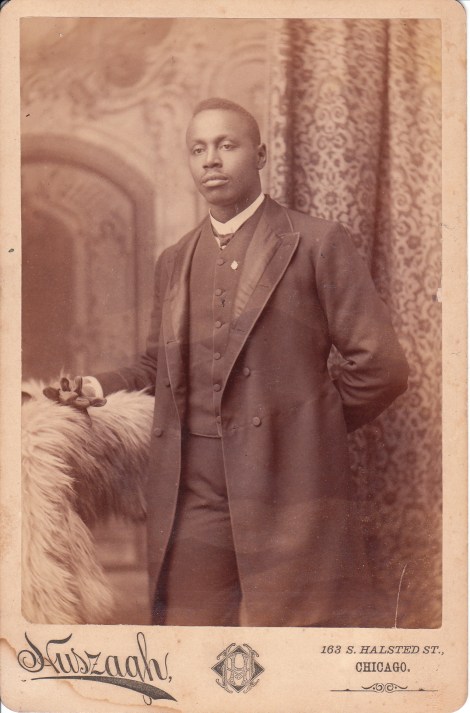
This distinguished looking black gentleman posed for this photograph at the studio of Huszagh in Chicago, Illinois. Check out the interesting backdrop and props. Note the pattern on the curtain and how his right hand is resting next to a pair of gloves on what seems to be a fur covered table. Do you think that this well dressed gentleman is wearing his best suit or, judging by his attire, do you think he may be a member of the clergy? Let me know your opinion.

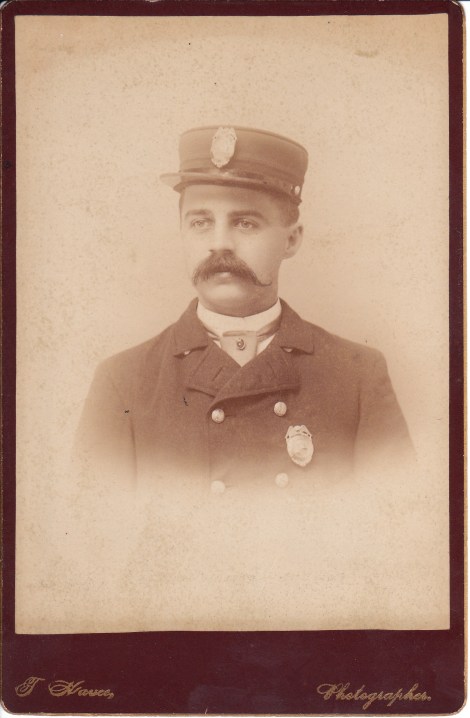
Policeman or Fireman in Stamford, Connecticut

fireman_00011


This Cabinet card is an image of a young policeman or fireman. The badges on his jacket and hat are not clear enough to read. Do you have an idea or some knowledge that would determine his actual occupation?  Please share your opinion. This uniformed fellow had his photograph taken by Havee of Stamford, Connecticut.

Published in: on December 9, 2008 at 2:06 am  Leave a Comment  
Tags: , ,

Black Woman in Saratoga, New York

blackwoman2

This is a terrific photograph of a young black woman taken by the studio of Record & Epler in Saratoga, New York.  Quality Cabinet card photographs of blacks are not easily found because there were not many produced at that time  in history. The Record & Epler studio is well known for their many stereographs and photographs of the grand hotels of Saratoga. It is also noted that the studio took a number of photographs of the Black employees of these hotels. To view other photographs from this studio, click on category “Photographer: Record & Epler”. This attractive woman is very nicely dressed and coiffed. Her face is very expressive. Judging by her facial expression, how do you think she is feeling as she sits for this wonderful photograph? Your comments are welcome.

ADORABLE GIRL IN COSTUME

girlcostume7

What is the story behind this interesting photograph? We see a very cute young girl posing for her portrait in an unusual costume? She is holding some sort of “stick” in her hand. Is it a riding crop? Is she wearing riding attire from her time period (turn of the century)? Please leave a comment with any ideas you may have about her clothing or the “stick” she is holding. The photographer is Perrtz of York, Pennsylvania. To view other photographs by Perrtz, click on the category “Photographer: Perrtz”.

Published in: on December 9, 2008 at 12:10 am  Comments (5)  
Tags: , , ,

Jose Maria Mora: Celebrity Photographer

Jose Maria Mora (1850?-1926) was born in Cuba. He was the son of a wealthy planter who sent Mora to europe to study art.  Mora decided he had other interests; mainly photography. The Cuban Revolution of 1868 prompted the Mora’s family to emigrate to the United States where Mora joined them. He studied under the very popular New York City photographer, Napoleon Sarony. In 1870 when he felt adequately prepared, Mora took over the studio of Gurney & Gurney on Broadway in New York City. In short time, Gurney became one of the most famous and financially successful celebrity photographers in New York City. Mora’s gallery stood out from others because of his creative use of many backgrounds and props in his photographs. 

In 1893, Jose Mora closed his studio and his reason for ending his photography career is unknown. In 1926, Mora was found unconscious in his hotel room. His bed had fallen on top of him. He had been living like a hermit for 15 years and relied on other guests to provide him with food. Surprisingly, he was found to have about $9000 in savings at the time of his death. It was reported that he had padlocks put on the door to his bath because he thought bathing would shorten his life. Mora recovered from his accident physically but mentally he was ruled incompetent and committed to a hospital. He died a month later.

Published in: on November 26, 2008 at 8:19 pm  Leave a Comment  
Tags: ,

William Cullen Bryant: American Poet and Journalist

American Poet and Journalist

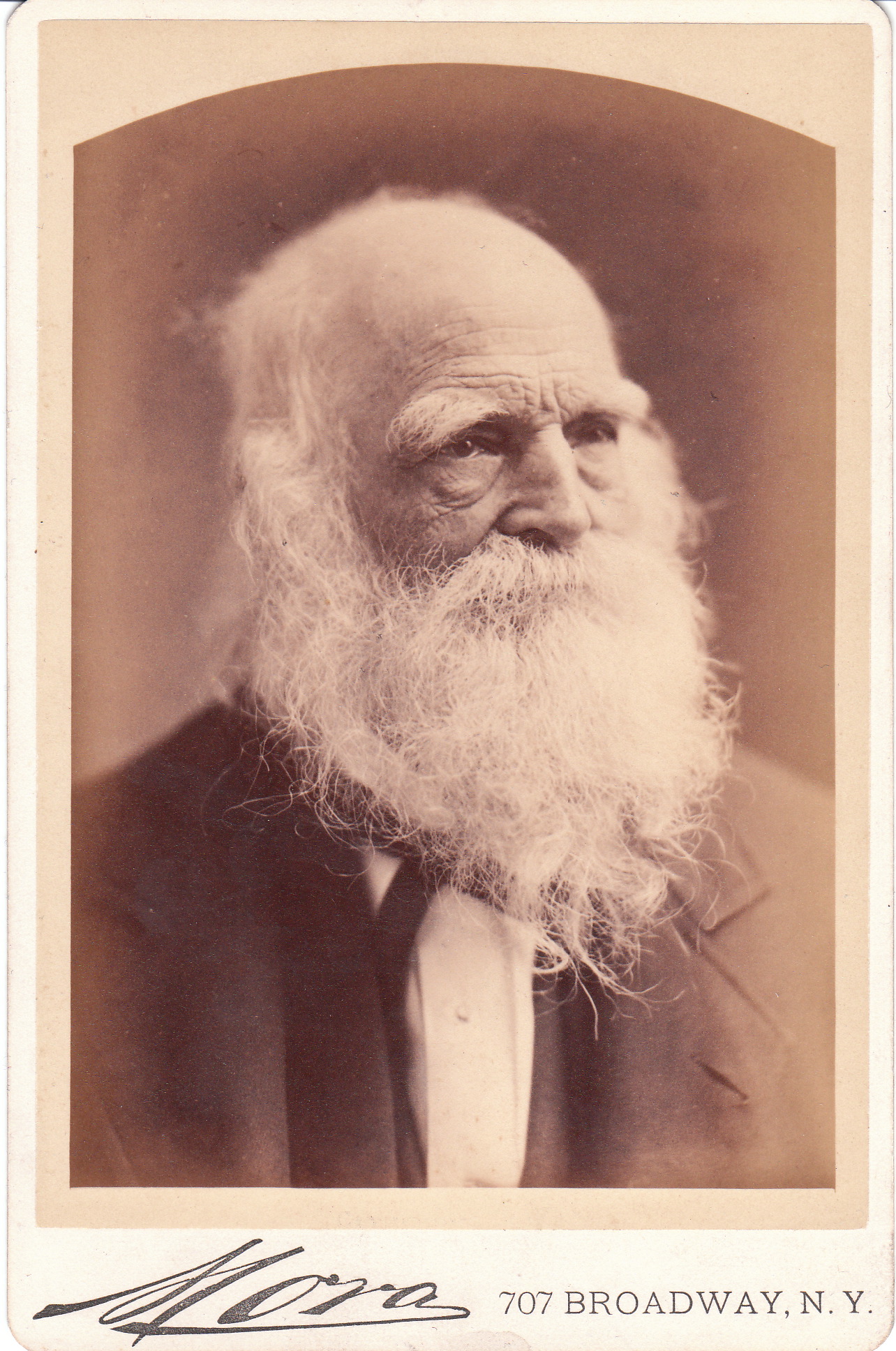
William Cullen Bryant (1794-1878) was a noted American poet and journalist. He also was a long-time editor of the New York Evening Post.  Bryant was born in Massachusetts. He attended Williams College and later studied law and was admitted to the bar in 1815. Bryant became interested in poetry in his early life. At about the age of 14, he published The Embargo, which was a critical attack against President Thomas Jefferson and the publication quickly sold out.  By the 1830’s he was considered America’s leading poet. Bryant supported his family with his law practice but became disheartened with the legal system. In 1825 he was hired as the editor of the New York Review and then of the United States Review and Literary Gazette. He then was hired by the New York Evening Post, a newspaper founded by Alexander Hamilton.  Within two years he was editor in chief and owner of the publication, a role he maintained for fifty years.  He made a fortune in this venture and also wielded a great deal of political clout on a local, state and national level. 

Bryant had progressive views and in time he joined the Free Soilers which later became the core of the new Republican Party. In 1856 he campaigned for John Fremont which made him a powerful figure in the Republican Party.  In 1860, he was one of the major Eastern supporters of Abraham Lincoln and was the person who introduced him at Linclolns famous address at Cooper Union which propelled Lincoln to the Presidential nomination and eventual election.

Toward the end of his life, Bryant worked on translating Homer’s the Iliad and the Odyssey.  He also became one of the leading authorities on homeopathy and as a hymnist for the Unitarian Church. He died in 1878 of complications after an accidental fall at  a Central Park ceremony which was honoring Italian patriot Giuseppe Mazzini.

This Cabinet card photograph of William Cullen Bryant was photographed by famed photographer Jose Maria Mora. Mora’s photographic studio was on Broadway in New York City.
Published in: on November 26, 2008 at 4:54 pm  Leave a Comment  
Tags: , ,

WHAT IS A CABINET CARD?

Welcome to the Cabinet Card Gallery. Cabinet card photographs were first introduced in 1866. They were initially employed for landscapes rather than portraitures. Cabinet cards replaced Carte de visite photographs as the popular mode of photography.  Cabinet cards became the standard for photographic portraits in 1870. Cabinet cards experienced their peak in popularity in the 1880’s.  Cabinet cards were still being produced in the United States until the early 1900’s and continued to be produced in Europe even longer. The best way to describe a cabinet card is that it is a thin photograph that is mounted on a card that measures 4 1/4″ by 6 1/2″. Cabinet cards frequently have artistic logos and information on the bottom or the reverse of the card which advertised the photographer or the photography studio’s services. Enjoy your visit.

Published in: on November 26, 2008 at 5:58 am  Comments (5)