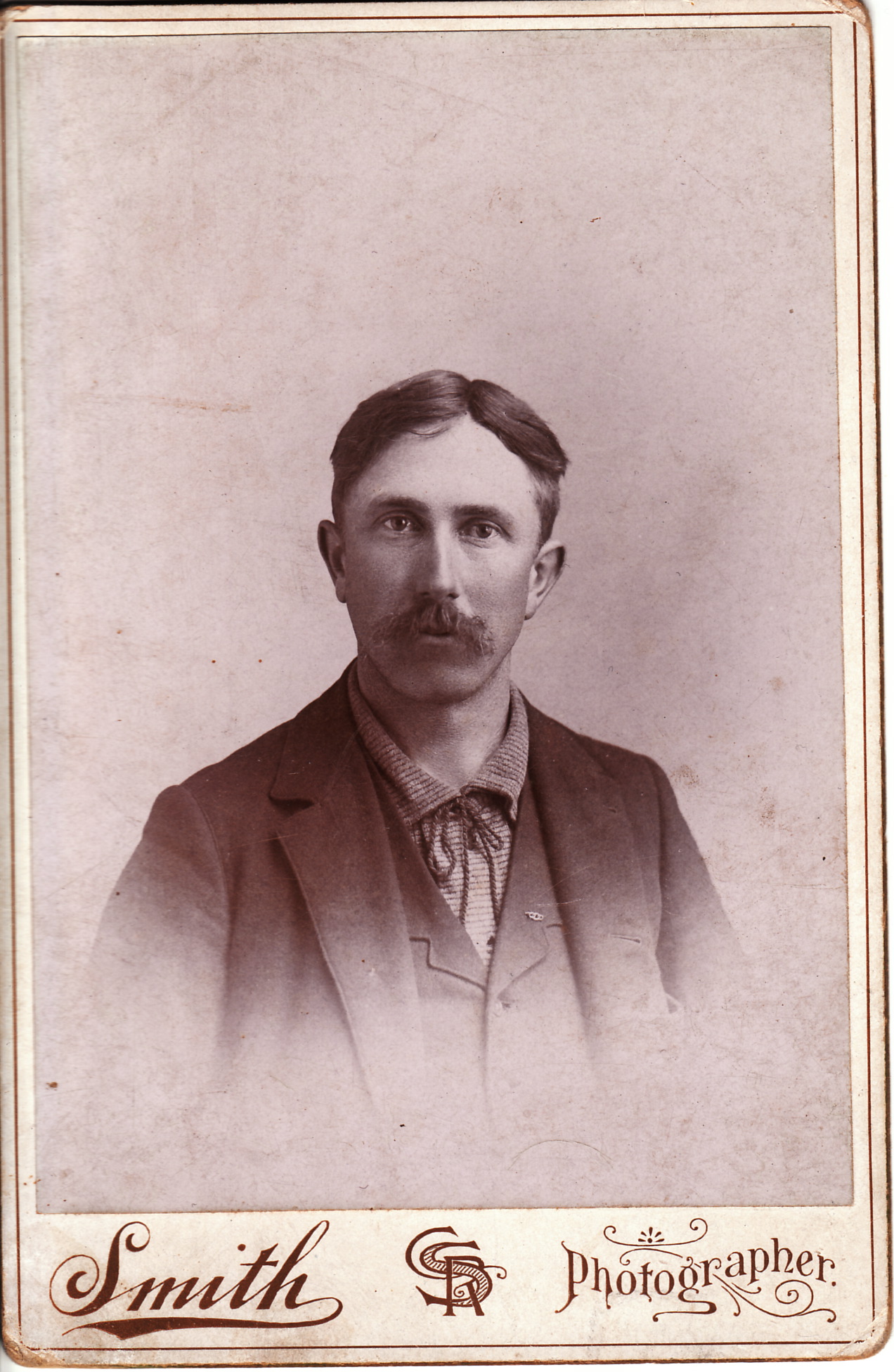
An inscription on the reverse of this cabinet card indicates that the man sitting for this portrait is Albert Strout. The photograph was recently purchased from an estate in Porter, Maine. Research discloses that there is an Albert Strout (1847-1925) buried in Cedar Crest Cemetery in Otisfield, Maine. Albert Strout was married to Ida M. Spurr Strout and records suggest that he may have been a carpenter. It is very possible that the biographical information discovered is accurate but it certainly may be incorrect. Albert Strout is a not an extremely rare name and the photographer who produced this image (Smith) does not list the location of his studio on the cabinet card. Perhaps this photograph followed Strout’s ancestors to Maine but originated in another part of the country. Note that Albert Strout is wearing a pin on his lapel and a string tie.
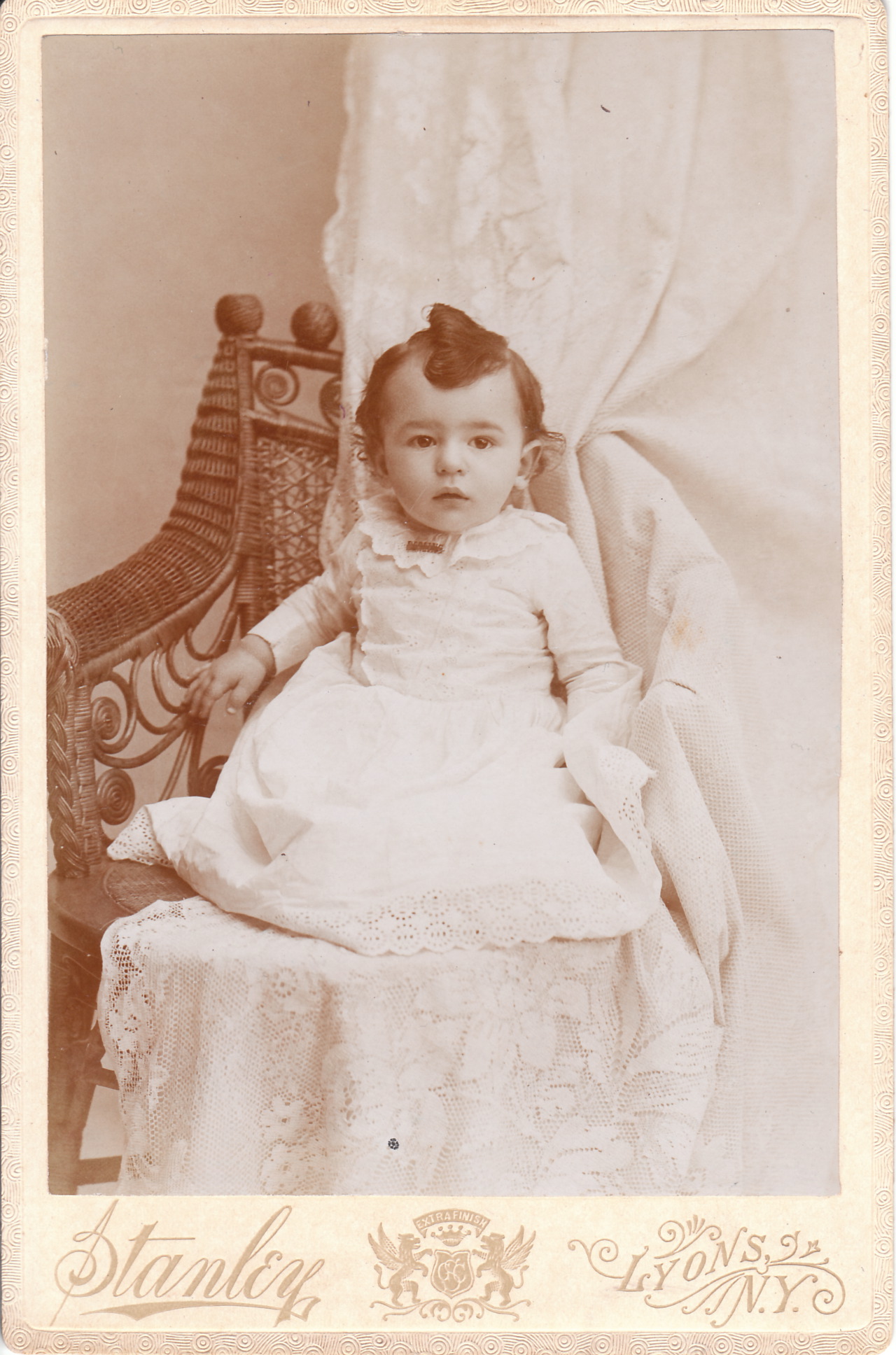
CUTE BABY POSES FOR PORTRAIT IN LYONS, NEW YORK (IS THAT A MOHAWK?)
An adorable wide-eyed baby poses for a cabinet card portrait at the photographic studio of Stanley, in Lyons, New York. The child is wearing a gown and a very interesting hair style which looks like a predecessor to the modern day mohawk. She is wearing a pin on her collar. The pin has lettering that may spell her name. The letters are unclear but it appears to say “Darlene”. Perhaps a visitor to this site can decipher the word on the pin and leave a comment with the correct information.
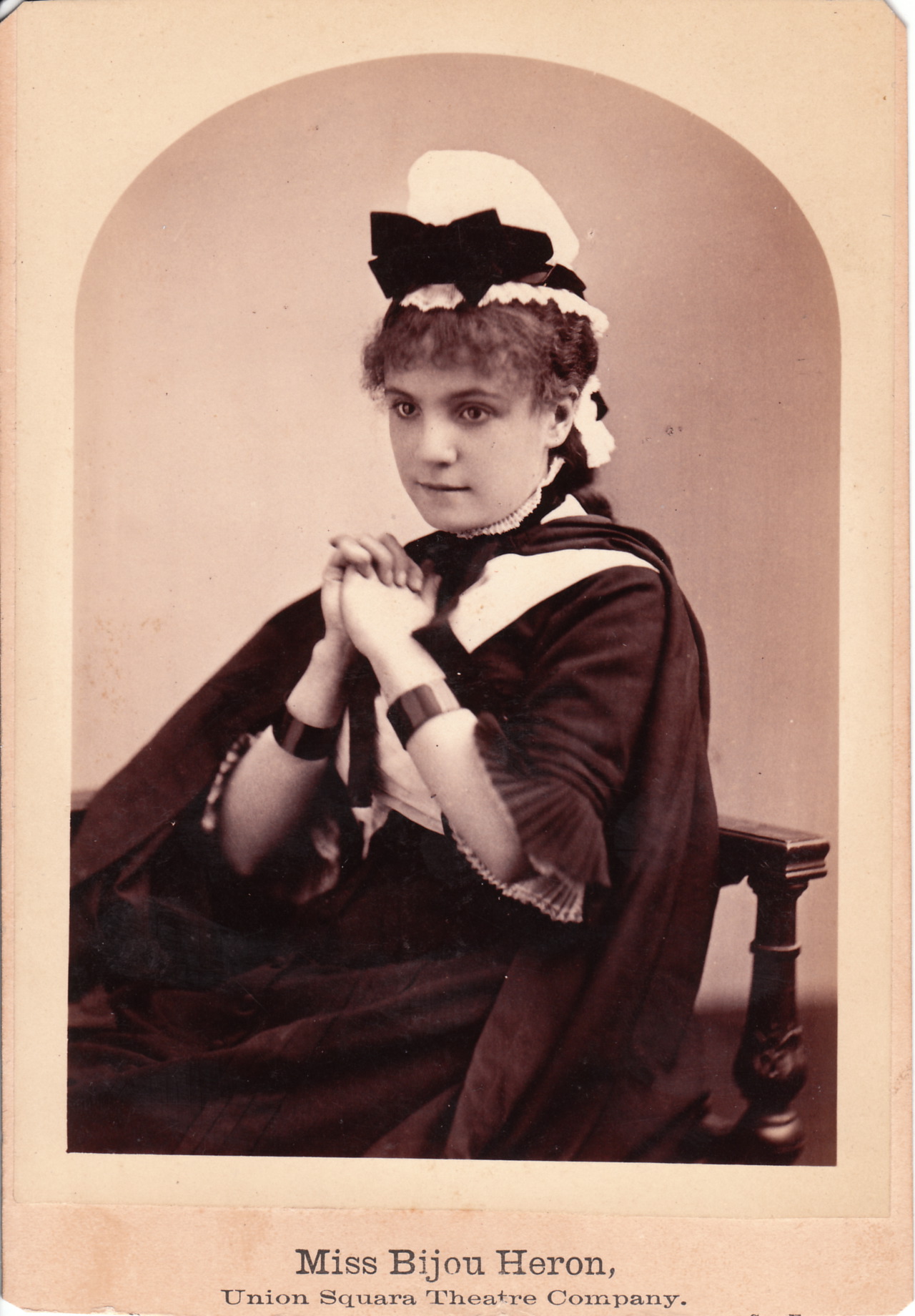
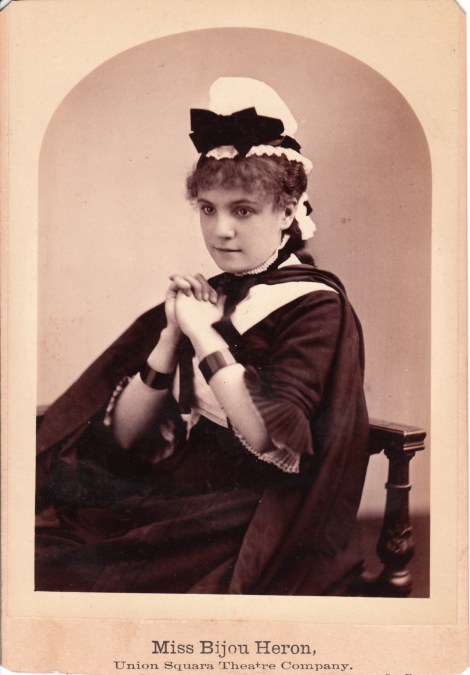
BIJOU HERON: BEAUTIFUL AMERICAN STAGE ACTRESS
This Cabinet Card presents the image of American stage actress Bijou Heron (1863-1937). She was the daughter of composer Robert August Stoepel and actress Matilda Heron. She began her career as a child. She married Broadway producer, writer, actor, and director, Henry Miller (1858-1926). Her son, Gilbert Miller became a very successful Broadway producer. The photograph was published for the Union Square Theatre Company. The photographic studio was Bradley & Rulofson in San Francisco, California. The reverse of the card indicates that the studio has the only “Elevator Photography” in the world. Perhaps a visitor to this site can explain the meaning of “Elevator Photography”. Research reveals that in 1872 the partners installed what they claimed to be the first hydraulic elevator ever to be associated with a photographic studio. The elevator cost them four thousand dollars. Henry William Bradley (1813-1891) and his partner William Rulofson (1826-1876) were partners in a photographic studio that photographed many notable Californians. Bradley was born in Wilmington, North Carolina, and grew up in New Orleans, Louisiana. He opened his San Francisco studio in 1850 and took in his partner in 1860. When he retired in 1878 his studio was considered the best on the west coast and won first prize at the Centennial Exposition at Philadelphia in 1876. Mr Rulofson had quite a controversial and interesting life and associated with many famous people including Ambrose Bierce. Rulofson died in a fall from the roof of his studio and was heard to say during the descent, “I am killed”. You can view a second cabinet card of an actress by these photographers by clicking on the category “Photographer: Bradley & Rulofson”. Ms. Heron is dressed in costume for this portrait. It is likely that she was appearing in San Francisco with a touring company from the Union Square Theatre. The costume that she is wearing is one that she wore in the play “The Two Orphans” in which she appeared with actress Maud Harrison circa 1880. This cabinet card indicates that Bijou Heron was a strikingly beautiful woman.
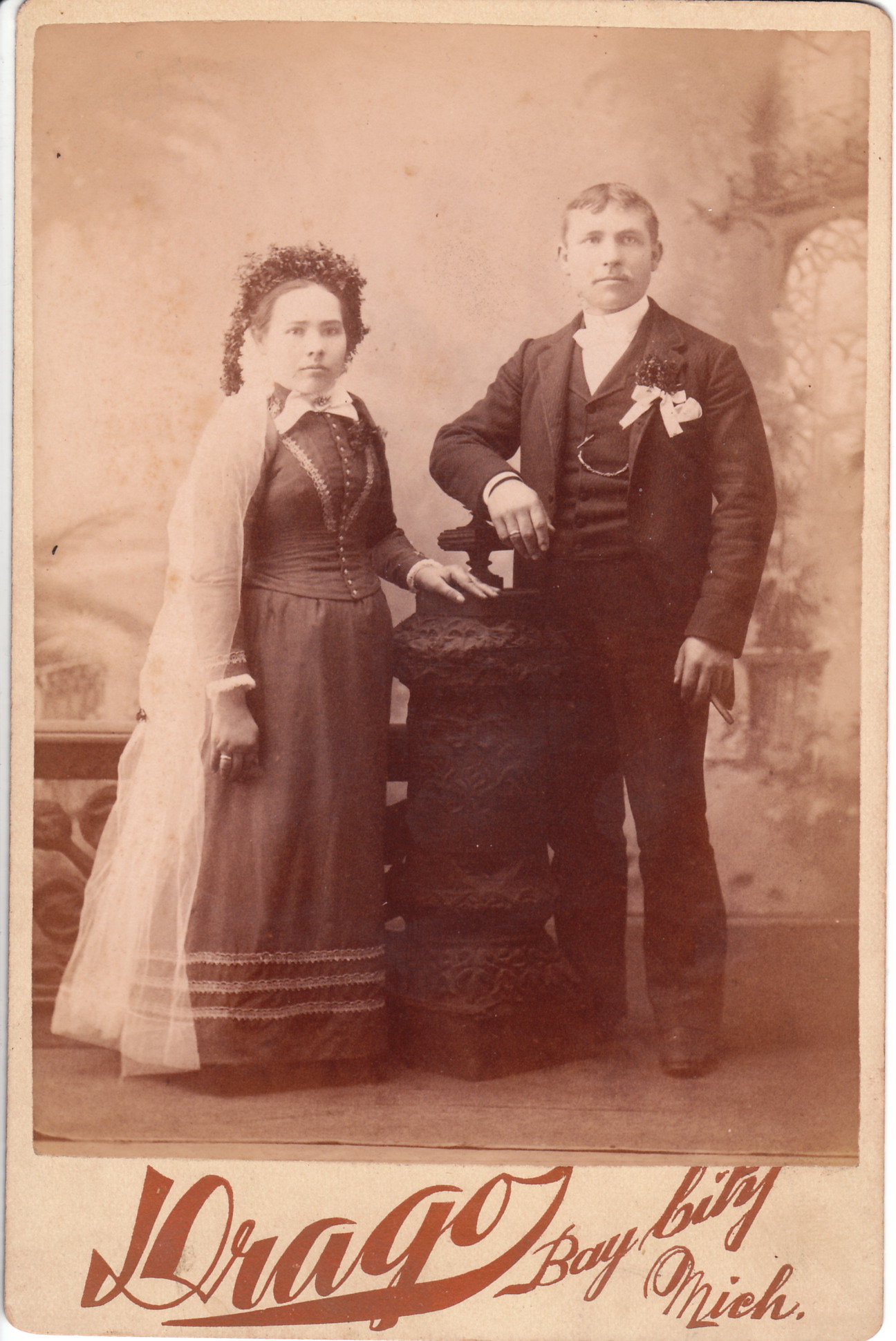
THE BRIDE WORE BLACK: WEDDING COUPLE IN BAY CITY, MICHIGAN
A bride and groom are posing for their wedding portrait in this Cabinet Card by Drago of Bay City, Michigan. The groom is wearing a three piece suit, flowers, and a pocket watch. The bride is wearing a dark wedding dress with a white veil. Check the “Wedding” category in the Cabinet Card Gallery to find some interesting comments about the history of dark wedding dresses. Research found little about the photographer except that his complete name was Albert Drago.
COOL LONG HAIRED MAN IN FARIBAULT, MINNESOTA (WILLIE NELSON TYPE)
This Cabinet Card photograph is an image of a very interesting looking man. His long hair and beard makes him look like Willie Nelson. This gentleman is from Faribault, Minnesota; or perhaps he was from elsewhere and just “on the road again”. The photographic studio was Peavey and Peterson of Faribault, Minnesota. Louis Peavey (c1832-1902) was a photographer active in Decorah, McGregor, and Ossion, Iowa (1864-1870). He opened a studio in Faribault, Minnesota in 1870 and partnered with Christian Peterson in about 1878 until near the end of the 1890’s.
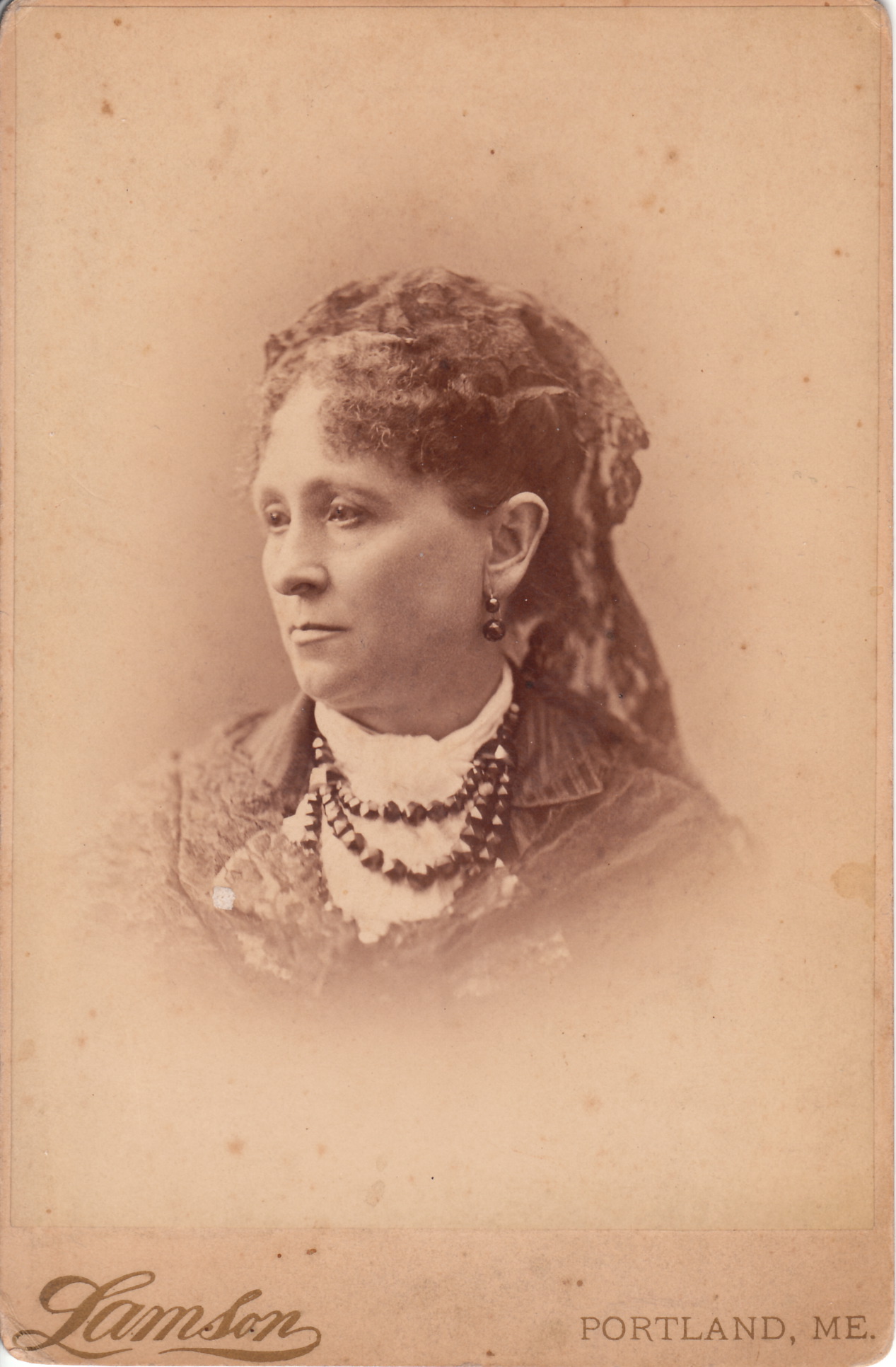
MOURNING IN PORTLAND, MAINE
This Cabinet Card may be a mourning card; a photograph of a woman in grief over the loss of a loved one. Sadness permeates this cabinet card and the woman’s expression. The photographer is Joseph Harrison Lamson (1840-1901) of Portland, Maine. The photographer’s father was a maker of daguerrotypes and his mother was an artist. He began his career in photography in Bangor, Maine and then worked in Cuba, the West Indies, and South America. He made a fortune and then bought a studio in Philadelphia, Pennsylvania. He then moved to Maine and operated a photographic studio in Portland. He photographed the poets Longfellow and Whittier. When he died, his two sons took over the studio.
DUTCH MAN IN DUTCH TOWN PHOTOGRAPHED BY DUTCH PHOTOGRAPHER IN ORANGE CITY, IOWA
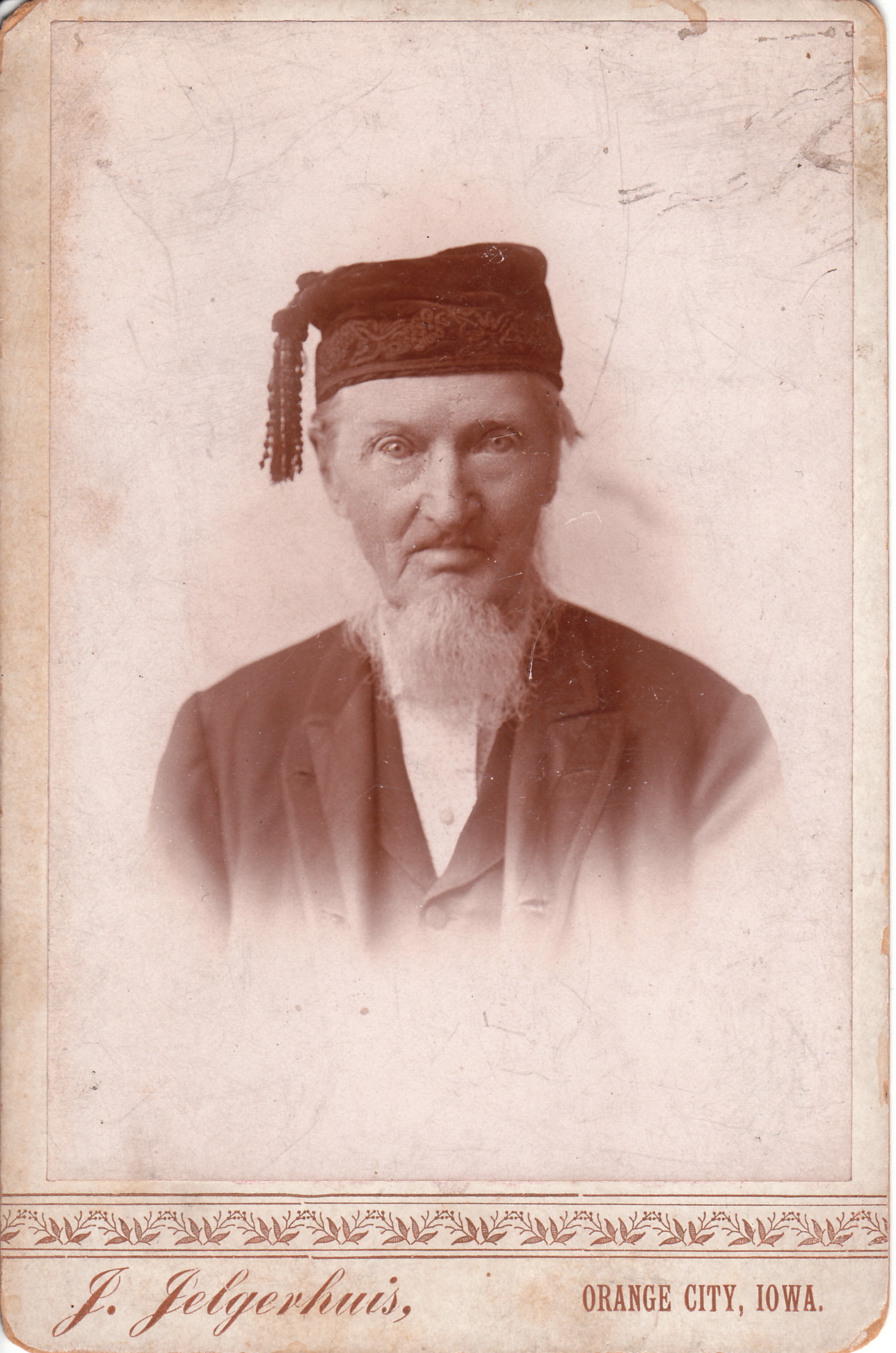
This Cabinet Card presents some interesting questions. Who is this man? What is his ethnicity? What is his story? The answers are lost to history but we can hazard some guesses. Perhaps the history of Orange City, Iowa can provide a little helpful information. Orange City was originally called Holland when it was founded in 1870 by settlers from Pella, Iowa who were looking for better and cheaper land. History books refer to Orange City as being known as the “Dutch Garden” or one of the “Dutch Colonies”. The photographer of this cabinet card is J. Jelgerhuis of Orange City, Iowa. The photographer’s last name indicates Dutch ethnicity. My hypothesis is that the subject of this photograph is a Dutch man, but I wouldn’t bet the farm on it. This is an especially good idea since I don’t have a farm. It sure would be terrific if a visitor to this site can identify historical details concerning this gentleman’s hat. I am quite sure that such information will illuminate the issue of his ethnic origin.
WOMAN IN FORT WAYNE, INDIANA: DRESSED FOR AN OCCASION
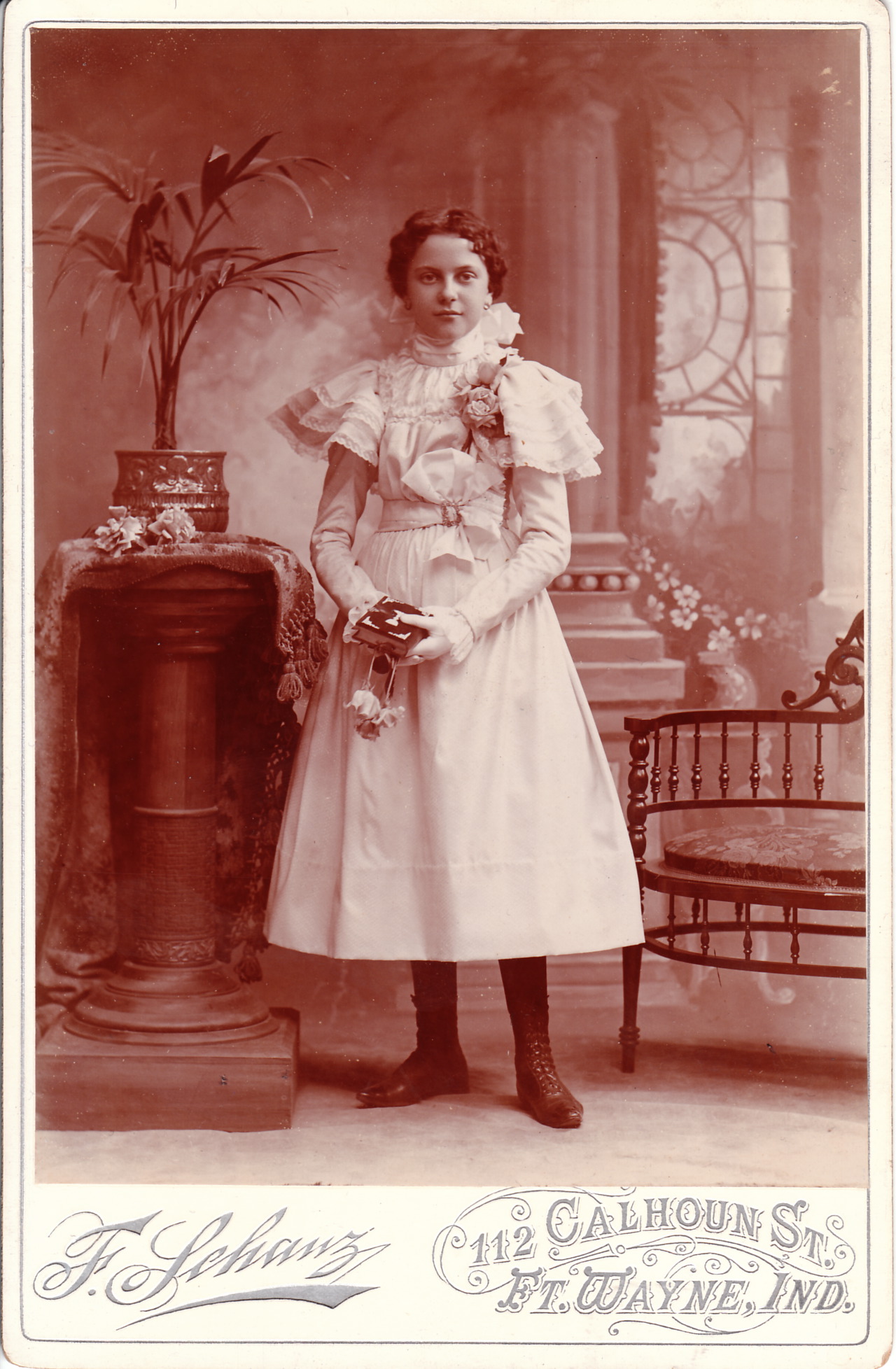
This Cabinet Card is an image of a teenager or young woman posing in a special dress for what is apparently a special day. She is holding a small book and flowers. She is wearing dress gloves and a corsage. Perhaps this is a portrait of her confirmation day. The props in the photograph are quite elaborate and that should not be a surprise once one learns about the photographer. The photographer is F. Schanz of Ft Wayne, Indiana. Research reveals that Felix Schanz (1861-?) was born in France and educated in Germany. He came to the United States at age 18 and worked as a photographer for three years in New York City. He arrived in Fort Wayne, Indiana in 1881. “The Pictorial History of Fort Wayne, Indiana” , published in 1917; states that Schanz was a well known and popular businessman who lived in Fort Wayne nearly 40 years. He had a number of successive studios but the one that he built in 1914 allowed drivers to drive into the building to obtain photographs of their car and the car’s occupants. Schanz also expanded his studio to work in the area of motion picture photography. He was an innovator and his studios were described as quite grand. to view other photographs by Schanz, click on the category “Photographer: Schanz”.
ANOTHER FIREMAN IN PORTSMOUTH, NEW HAMPSHIRE
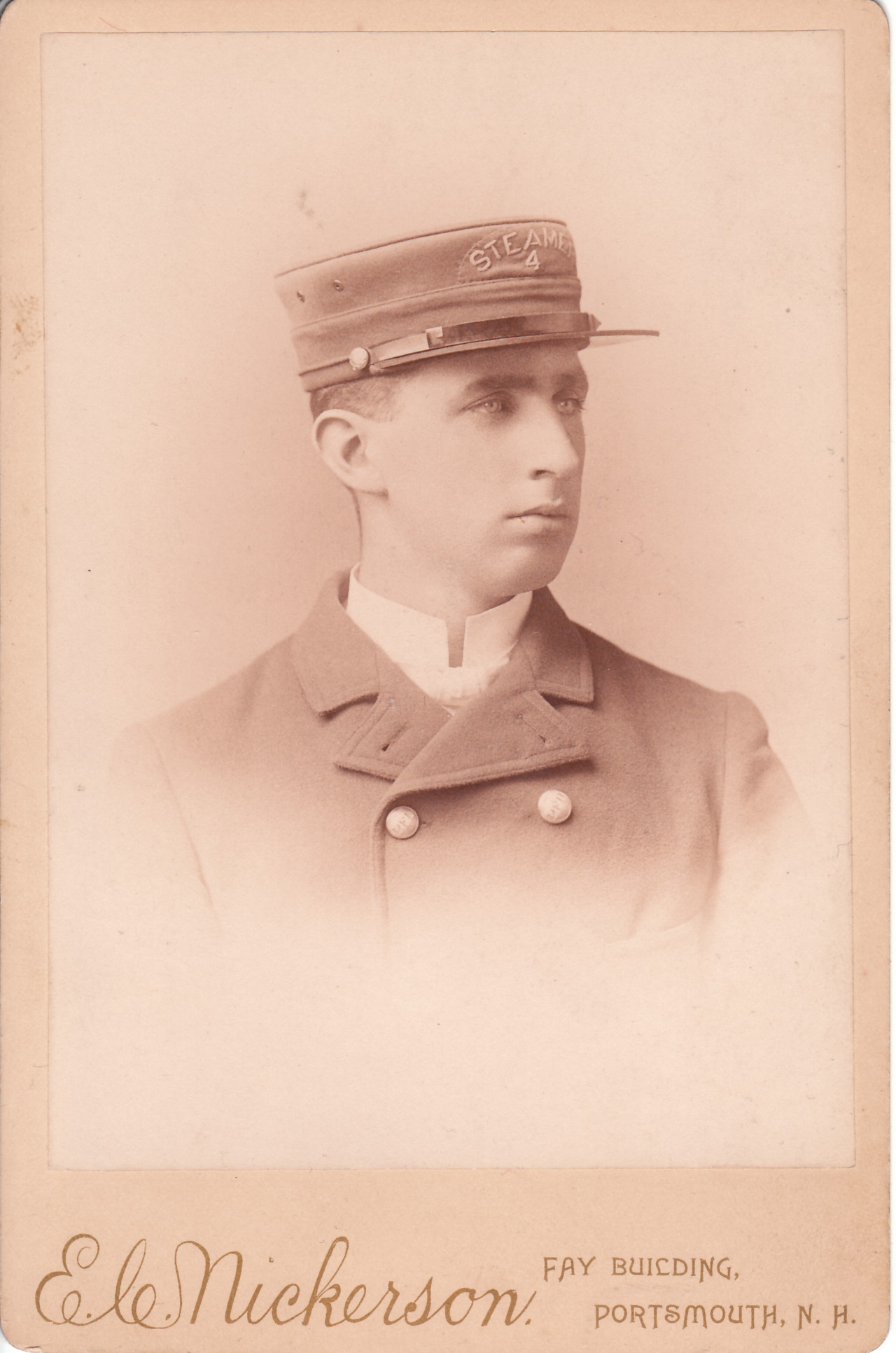
This Cabinet Card captures the image of a young fireman in Steamer Company #4 in Portsmouth, New Hampshire. He is wearing his dress uniform as he poses in the photographic studio of E. C. Nickerson located in Portsmouth, New Hampshire. The badge on his cap discloses that he is a member of steamer company #4. The first steam fire engine was built in England by Braithwaite and Ericsson in 1829. Captain Ericsson came to the United States where he produced the Civil War ironclad, the Monitor. In 1840, the first steam fire engine was produced in the United States. An improved and successful steamer in the United States was designed in 1852. The steamer fire engine could produce as many as six separate streams of water. The Cabinet Card Gallery’s category of “Firemen and Policemen” has a portrait of a second member of the Portsmouth Fire Department. Check it out. To view a another photograph by Nickerson, click on the category “Photographer: Nickerson”.
ADORABLE LITTLE GIRL IN WARREN, OHIO
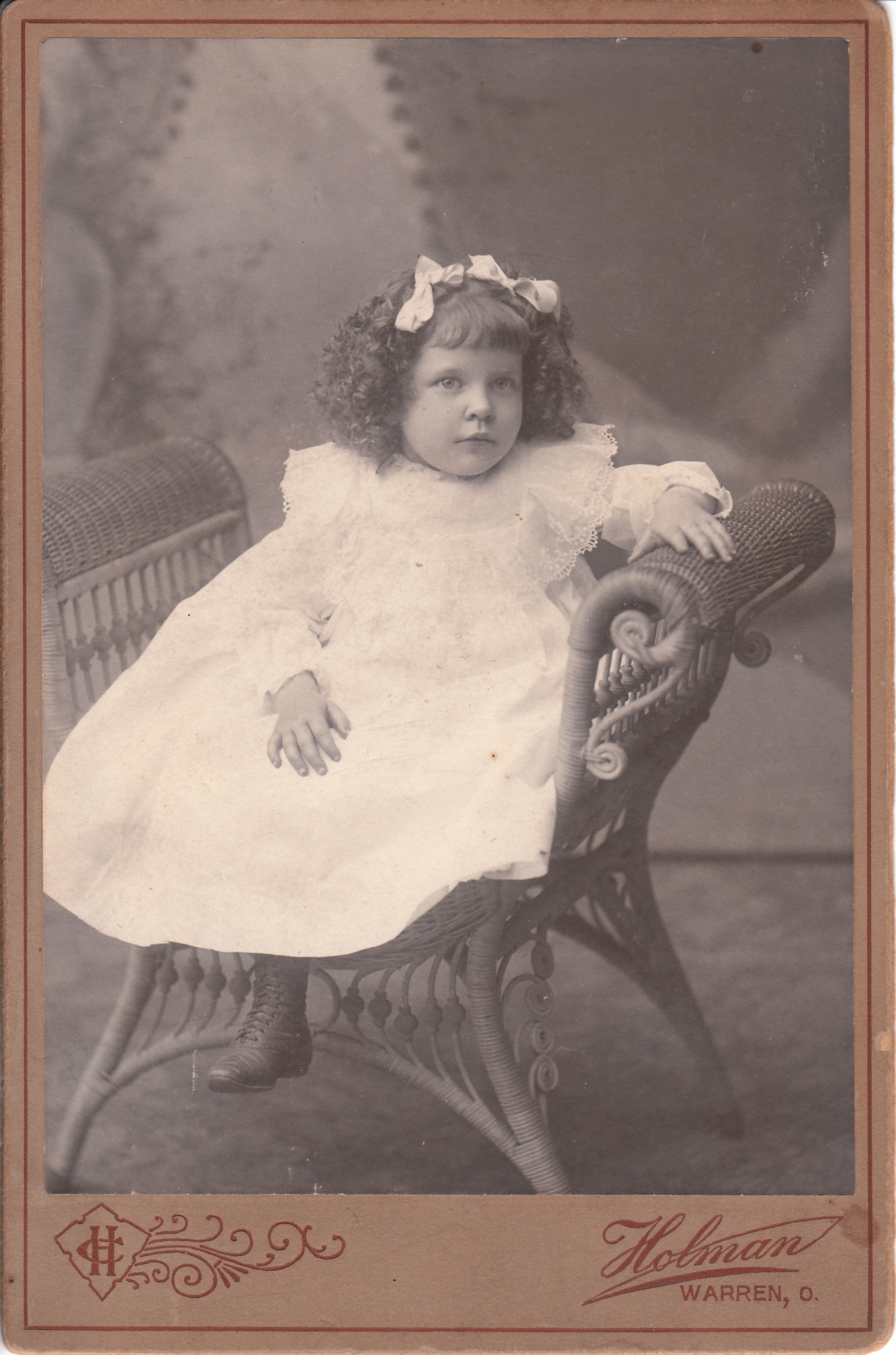
This cute little girl poses for her portrait in the studio of Holman, located in Warren, Ohio. She appears to be sitting on one of her feet as she peers into the camera with a dubious expression. She is wearing bows in her hair for her big day at the photographer. The reverse of the card indicates that the subjects name is Hazel Daugherty. Research indicates that the photographer is Charles E. Holman (1847-1915 or 1919). He was born in Massachusetts and shortly after the civil war, studied photography with his brother-in-law Luther M. Rice in Warren, Ohio. He moved to Utica, New York where he worked in a shoe factory until returning to Ohio and his employment with his brother-in-law in 1875. In1879, he bought the studio from Rice and ran the studio until about 1900.