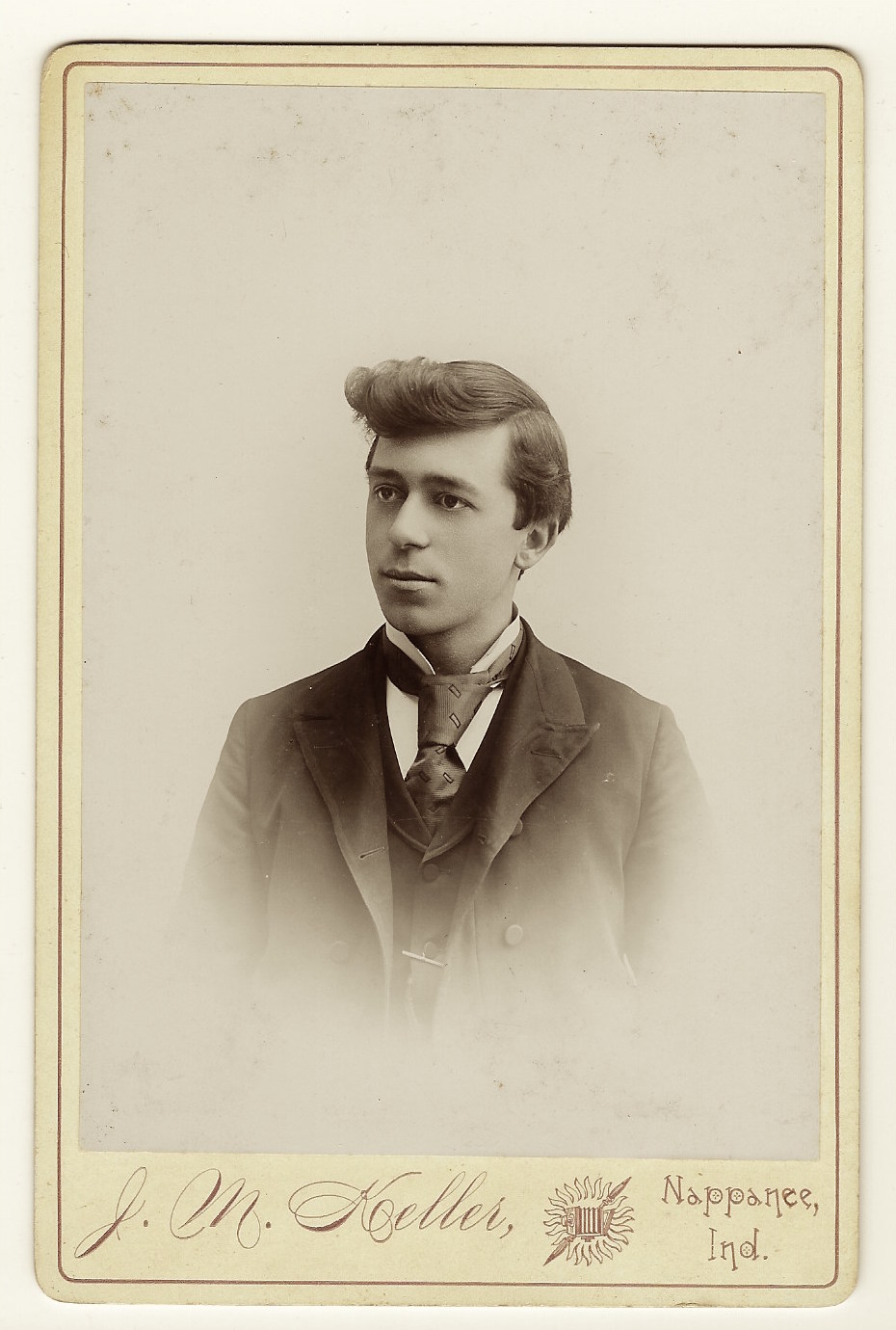
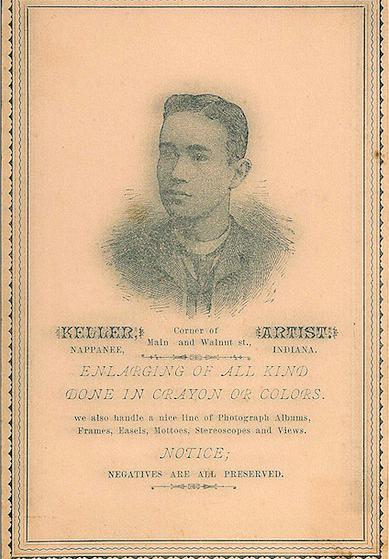
A young man, probably a teenager, poses for his portrait at the Keller studio in Nappanee, Indiana. The young gentleman is well dressed and well coiffed. Either he, or someone else, spent a good deal of time and work to properly arrange his hair. John M. Keller (1867-1943) opened his photography studio in Nappanee in 1897. An ad in the St. Louis and Canadian Photographer (1900) advertised the business as being for sale. The 1900 US census listed him as working as a bicycle dealer. Keller married Clara Burbach in 1891. The 1908 Elkhart (Indiana) business directory reported that he had a store selling bicycles and sundries, as well as repairing sporting goods. By the time of the 1910 US census, Keller had a new occupation. He was working as a garage manager. The Goshen Democrat Newspaper (1912) reported that while Keller was testing an automobile, the flywheel came off and struck him below the knee. The unfortunate accident broke his leg. Interestingly, the newspaper also stated that after injuring Keller, the flywheel continued it’s journey and actually went through the side of the building. The 1920 US census found Keller working as a “garage mechanic” in Frankfort City, Indiana while the 1930 US census lists him as unemployed and living in Rochester, Indiana. It turns out that Keller was a real entrepreneur. According to the Rochester Historical Society, In 1921 Keller built and operated the Keller Inn which was located near the edge of Lake Manitou. He also made lures for fishermen. Apparently Keller had a shady side. During prohibition he made and sold liquor and “locals reported he also ran prostitutes out to an island in Lake Manitou”. Keller died at age 75 from heart disease. Much of the information about J. M.Keller was found at an internet site (http://www.folkartfishingtackle.com/#!john-keller/cadr). The image below was also found there. The image is a back stamp from one of Keller’s cabinet cards. It seems likely that the young man pictured in the image is Keller himself. I can’t resist supplying an interesting fact about the town of Nappanee. It is the longest city name in the US which has each letter in it’s name appearing twice. (SOLD)
A VERY BEAUTIFUL BABY IN ELWOOD, INDIANA (MAY BE A POST MORTEM PHOTOGRAPH
This cabinet card features a very beautiful baby wearing a long gown. Her hair is styled beautifully and her eyes are wide open. This sweet baby looks like a doll. She is either wearing flowers on her gown or else someone has placed flowers on her. At first I thought this was a lovely portrait of a baby girl. However, the longer I have owned this image, the more I think that this is a post mortem portrait. The little girl’s expression and the size and placement of the flowers has led me to believe that her poor soul had departed before the photographer took this photograph. This photograph really tugs at my emotions. The image was taken by the Rodgers & Manson studio (Gem Gallery) in Elwood, Indiana.
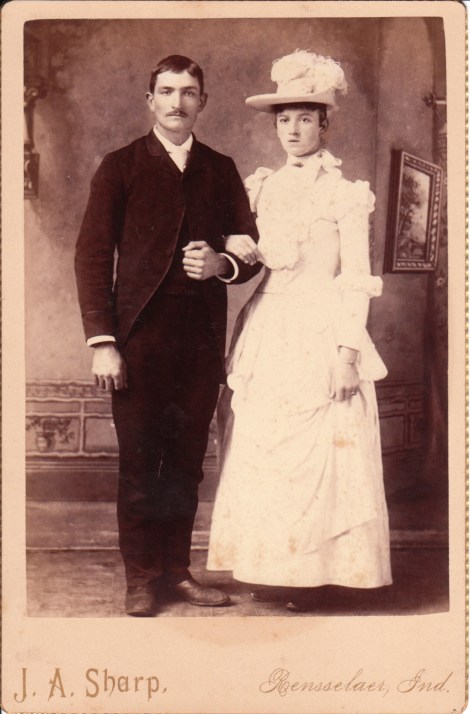
FASHIONABLE COUPLE IN RENSSELAER, INDIANA
A fashionable couple poses for their portrait at the Sharp studio in Rensselaer, Indiana. It is possible that this image is a wedding portrait. Joseph A. Sharp (1846-1903) was born in Frankfurt, Kentucky. He married Martha (Mattie) Stively (1849-1936) in 1874. Sharp’s obituary appears in the Semi Weekly Rensselaer Republican. The article states that Sharp began his photography career at age 21 while living in Ballfontaine, Ohio. He later lived in Kenton, Ohio and moved to Rensselaer in 1877. He worked about a year as a travelling photographer but the rest of his career he operated a studio in Rensselaer. The obituary asserts that one of the reasons he chose photography as a career was because at a young age he developed a hip disease which left him lame and unable to pursue a more active occupation. Sharp is buried in the Weston Cemetery in Rensselaer. Look below to see a photographic portrait of Joseph Sharp as well as an image of the tombstone he and his wife share.


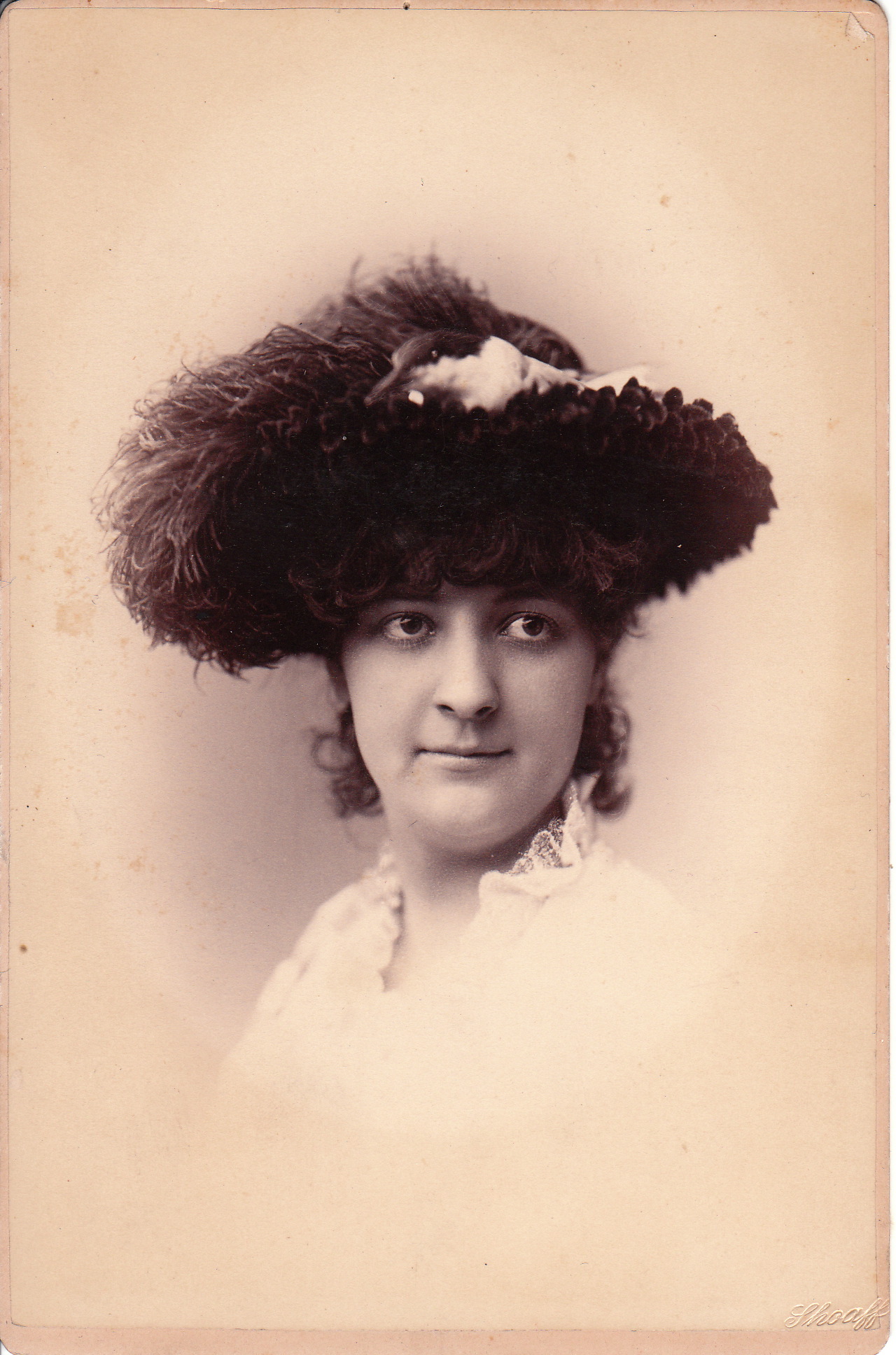
A WOMAN WITH INTENSE EYES AND AN INTENSE HAT IN FORT WAYNE, INDIANA
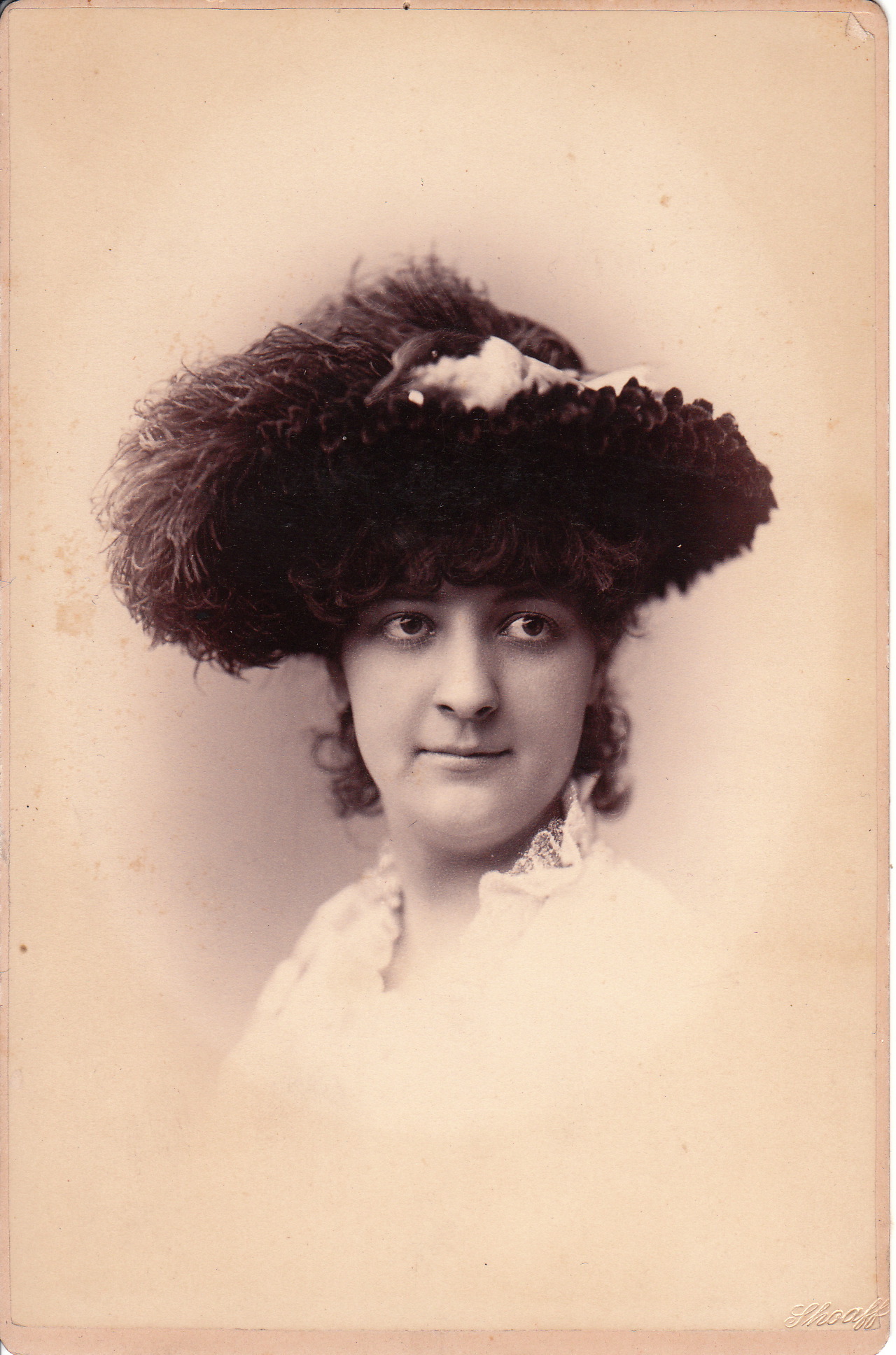
The woman in this cabinet card photograph is identified as “Hattie Sugle”. Her name appears in an inscription on the reverse of the photograph. Hattie has intense eyes and is wearing an interesting large hat. Research could not garner any further information about this individual. The photographer of this image is John A. Shoaff (1836-1921) who operated a photography studio in Fort Bend, Indiana. To learn more about this photographer and to view more of his photographs, click on the category “Photographer: Shoaff”. SOLD
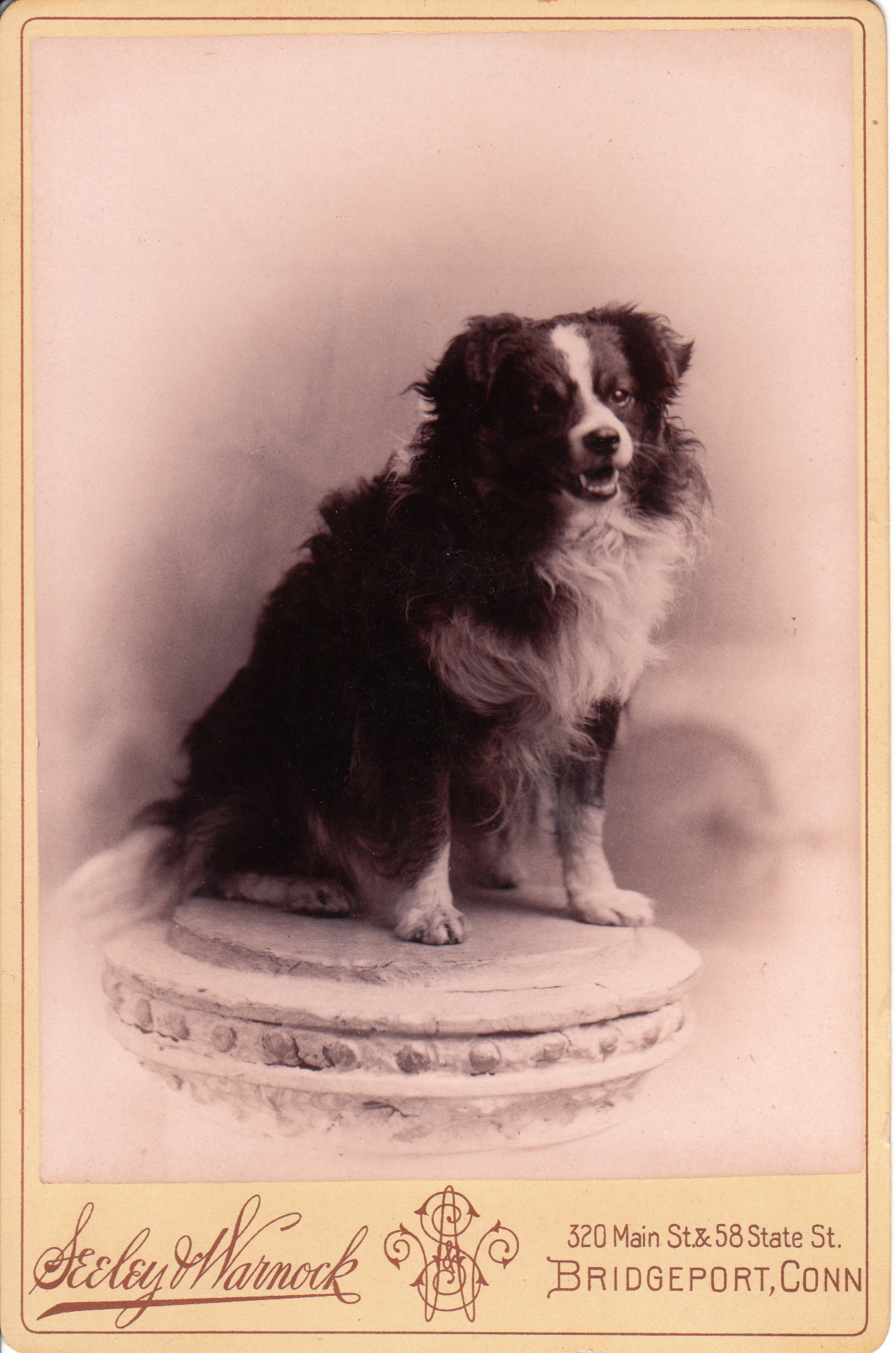
CUTEST DOG IN BRIDGEPORT, CONNECTICUT (1892)
Photographers Seeley & Warnock took this photograph of a cute dog posing in their studio in Bridgeport, Connecticut. What a pose? The photographers have captured this adorable canine exhibiting a smile (with his/her mouth open). The lighting utilized in this photograph could have been better, but lets remember that dogs are tough customers for a photographer. On the reverse of the cabinet card is advertising that states “Instantaneous Portraits of Children A Successful Specialty”. Note that photographing children is not only a “specialty” but it is a “successful specialty”. Additional printing on the reverse of the cabinet card indicates that it was produced in 1892. Preliminary research found no information about Mr. Warnock but there is an abundance of information about Mr. Seeley. Henry James Seeley was well known in Grand Army of the Republic circles. He was a department commander (Connecticut) and served in national offices of the organization. He was born in Jericho, Vermont in 1849. At the age of fifteen he enlisted in the 10th Indiana Battery, Light Artillery. After serving with the unit he was transferred to the gunboat Stone River which was operating on the Tennessee River. His next post was Fort Johnson in Huntsville, Indiana. Seeley entered and left the military as a private. After mustering out of the military in 1865, he taught school in Carbondale, Illinois. He then went to Vermont to further his education and then had teaching stints in Rome (NY), Worcester, Fall River and Bridgewater (MA). In 1872 he moved to Bridgeport where he studied photography and finally settled down. He opened a photography studio there in 1872 at 922 Main Street. He spent the next forty-five years or more working as a photographer.
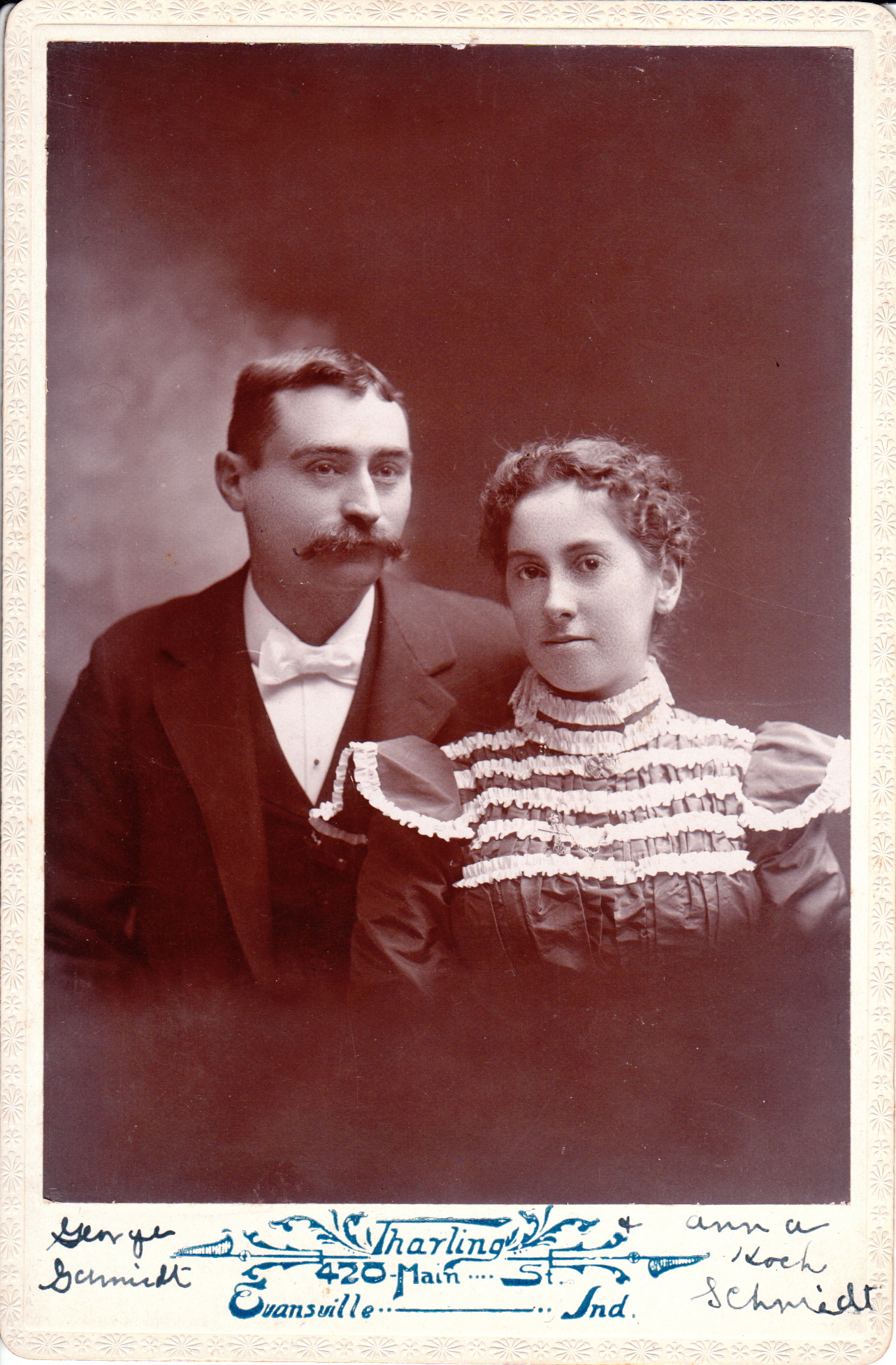
LOVELY COUPLE IN EVANSVILLE, INDIANA (GEORGE AND ANNA SCHMIDT)
A lovely formally dressed couple is featured in this cabinet card portrait by the John W. Tharling in Evansville, Indiana. The man and woman are identified as George Schmidt and Anna Hoch Schmidt. The 1900 census reveals that George and Anna were married in 1897. They made their home in Pigeon, Indiana. George worked as a stocker at the gas works. George was born in 1878 and was educated through the eighth grade. Anna was born in 1872. Both were natives of Indiana and were of German heritage. The 1910 US census finds the couple living in Knight, Indiana and George working as a farmer. The couple had two children, Hubert (age 9) and Idella (age 4). The couple also had a nineteen year-old live-in housekeeper. As a side note, Knight, Indiana was named in anticipation of the University of Indiana’s basketball program having great success under the leadership of coach Bobby Knight. He coached the Indiana Hoosiers between 1971 and 2000 and led the team to three NCAA championships. Sorry. I couldn’t resist telling the mythical origin of the naming of Knight, Indiana. The 1920 census discloses that the couple had added a third child, Miranda (age 3). They were living in Evansville. By the time the 1940 census was taken, Anna had died and George was living in Knight with his daughter Miranda (Grennan) and her family.
GENTLEMAN WITH PINCE NEZ EYEGLASSES IN SOUTH BEND, INDIANA
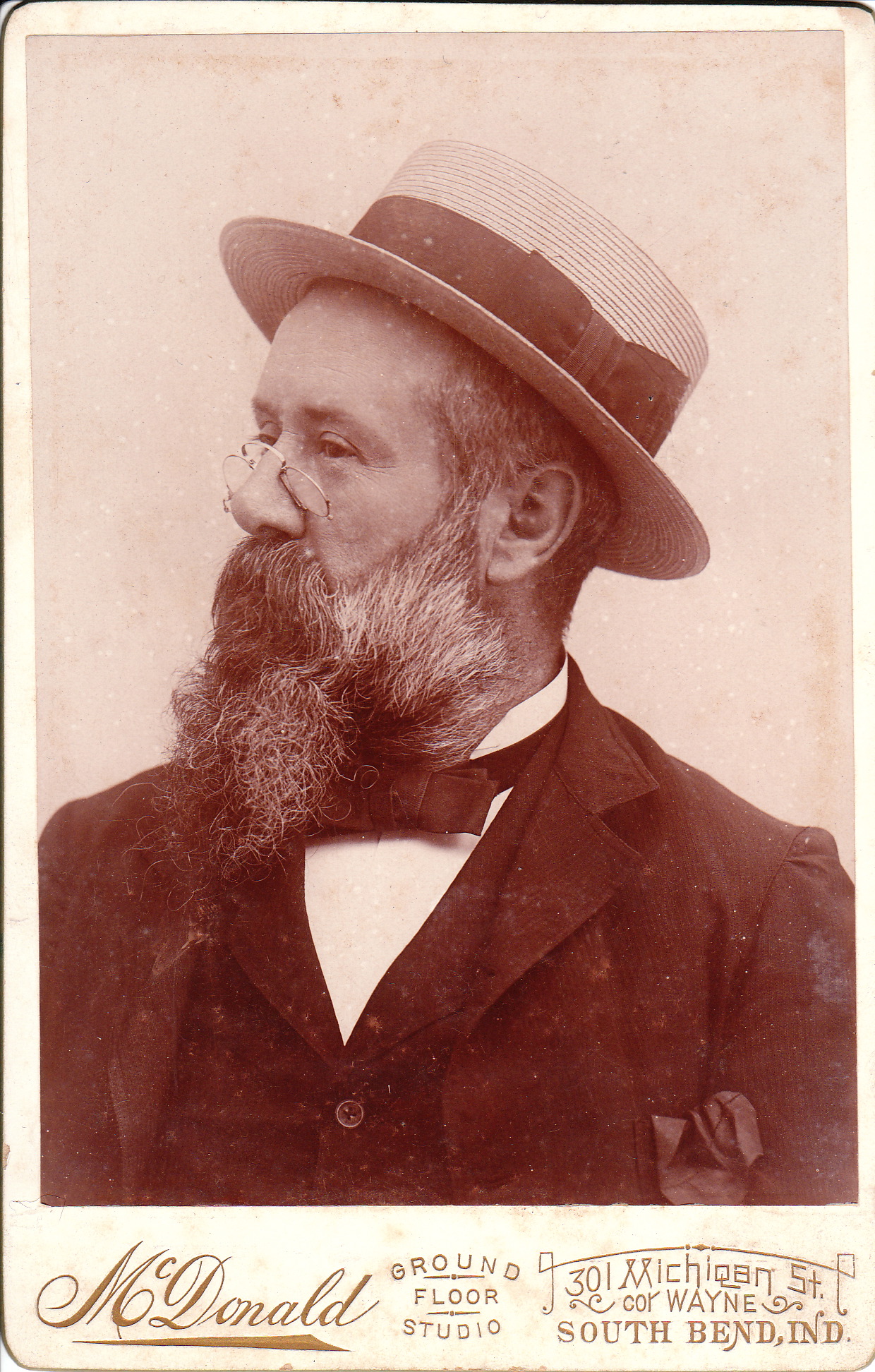
This cabinet card features a very interesting looking and nicely dressed gentleman. He is wearing a straw hat and pince nez glasses. He has the appearance of someone well educated. The subject of this portrait has a unique looking beard. To view other distinctive beards, click on the category “Beards (Only the Best). The photograph was produced by the McDonald Studio of South Bend, Indiana. The McDonald studio remains in business today. It is the oldest photography studio in the Michiana area. What is Michiana? Michiana is a region in northern Indiana and southwestern Michigan centered on the city of South Bend.. Albert J. McDonald founded the gallery in 1861. He operated the business for 41 years and was succeeded by his son. The Bulletin of Photography (1917) printed McDonald’s obituary. The article reports that he was born in Rochester, New York in 1841. His family moved to South Bend when he was nine years of age.
HANDSOME WHITE HAIRED AND WHITE BEARDED GENTLEMAN IN PLAINWELL, MICHIGAN
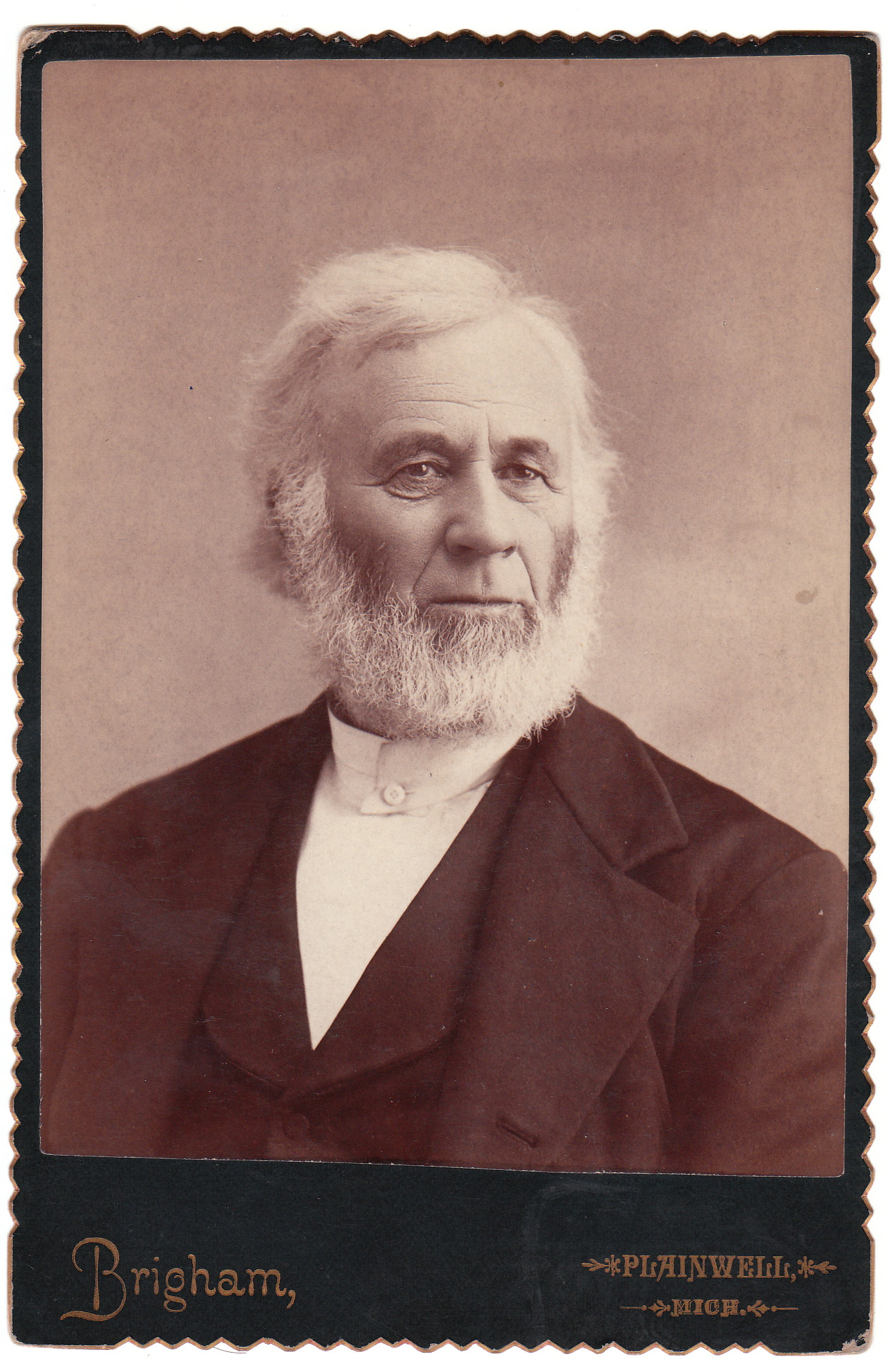
This handsome older gentleman with white hair and a white beard, is named Adrian Manley (1826-1906). The U.S. census of 1880 reveals that he was married to Elizabeth Manley and that he was employed as a clerk. He and his wife lived with their son Leny, a twenty nine year-old laborer. The 1900 census finds Mr Manley in his seventies living with his wife and two grandchildren, Wane (age 8), and Sylvia (age 6). Adrian Manley’s death certificate lists his occupation as a farmer which likely indicates that farming was his primary work for most of his life. The photographer who produced this photograph was John Morrison Brigham (1863-1933) whose studio was located in Plainwell, Michigan. Brigham attended Indiana Normal College at Valparaiso, Indiana. He studied photography in Plainwell and owned his first gallery there. In 1898 he moved to Battle Creek, Michigan where he opened a photography studio that became very successful. In 1885, Brigham married Ida M Potter of Mankato, Minnesota. Photo Beacon (1897) printed a review of some of Brigham’s work and it was not complimentary. The reviewer simply wrote, “lots of dead eyes”.