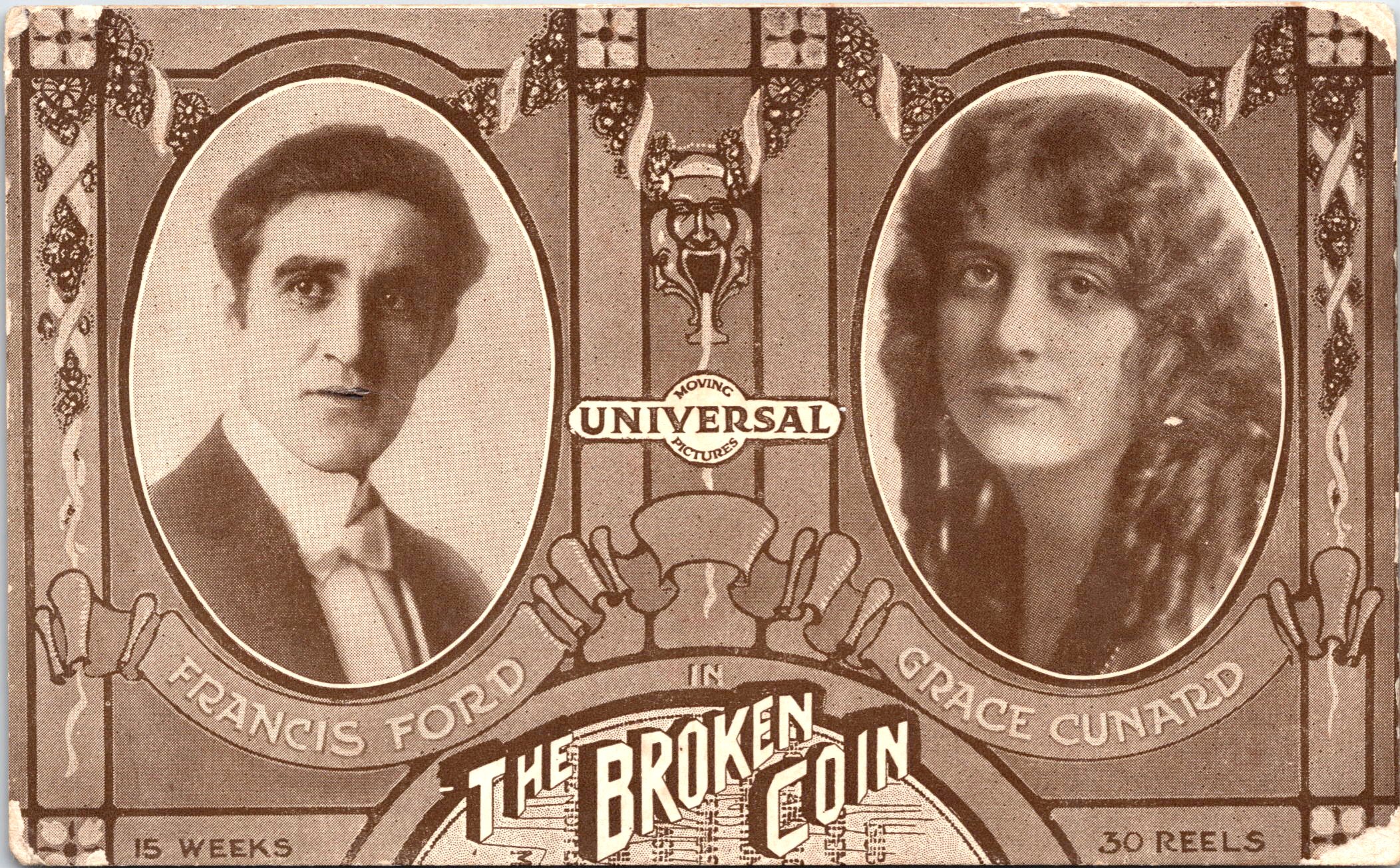
This vintage lithographic postcard advertises the American adventure-mystery silent film, “The Broken Coin”. The film was released by Universal Motion Pictures in 1915 and it was part of a 22 episode serial. The “Broken Coin” was the first chapter in the series which included thirty reels over 15 weeks. The film starred Francis Ford and Grace Cunard. The film was directed by Francis Ford and Grace Cunard was one of the two writers of the screenplay. Francis Ford (1881-1953) was an early American film actor, writer, and director. He was the older brother and mentor of film director John Ford. Francis Ford is reported by IMDb to have appeared in 495 acting roles, directed 180 films, and wrote 31 different screenplays. Grace Cunard (1893-1967) was an American actress, screenwriter and film director. She starred in over a hundred films during the silent film era. She cowrote at least 44 of these film and directed at least 8 of them. Cunard also edited many of her films. It is unfortunate to note that no copies of the “Broken Coin” series appear to have survived. This vintage postcard is an excellent purveyor of American silent film history.
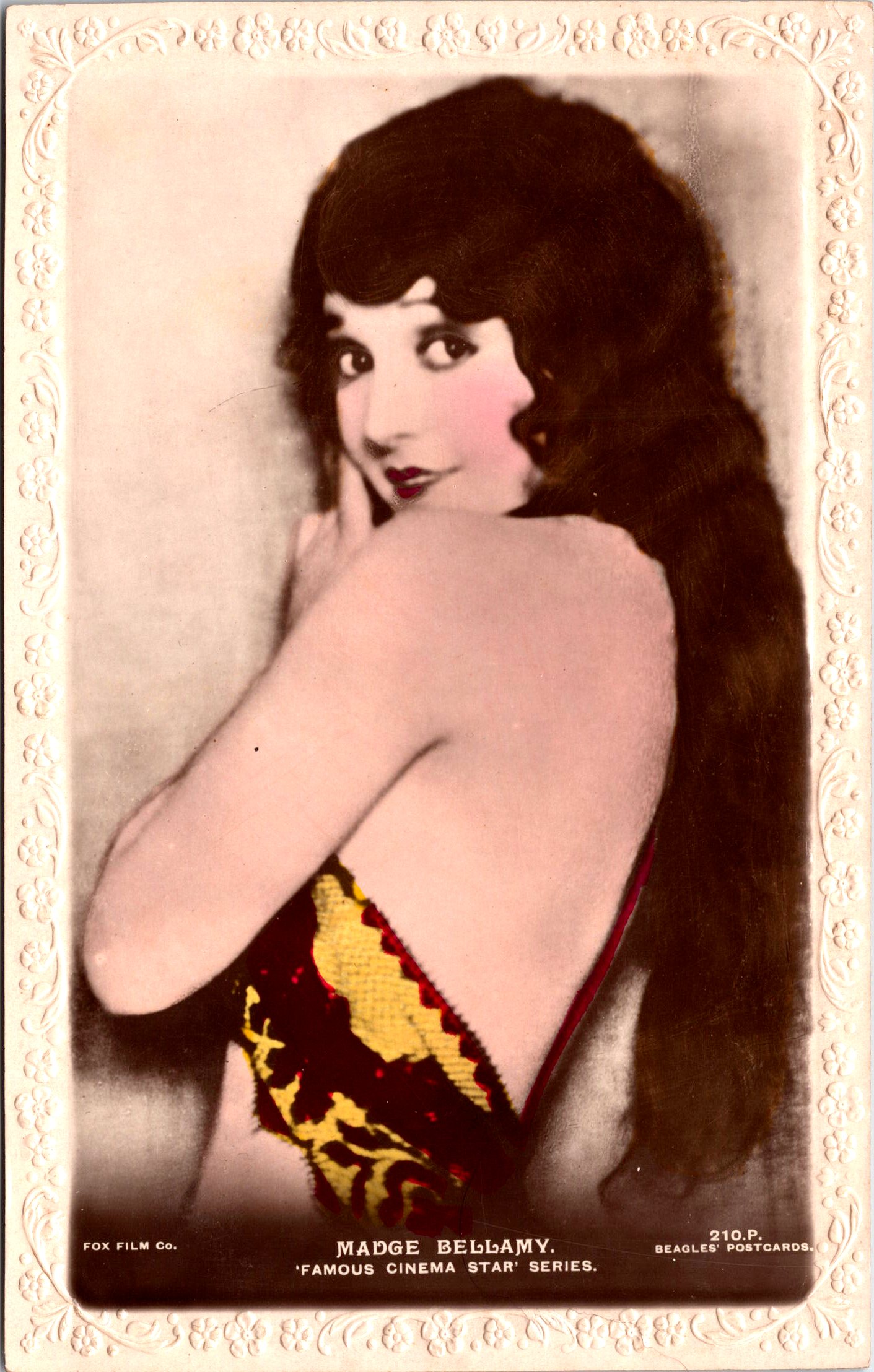
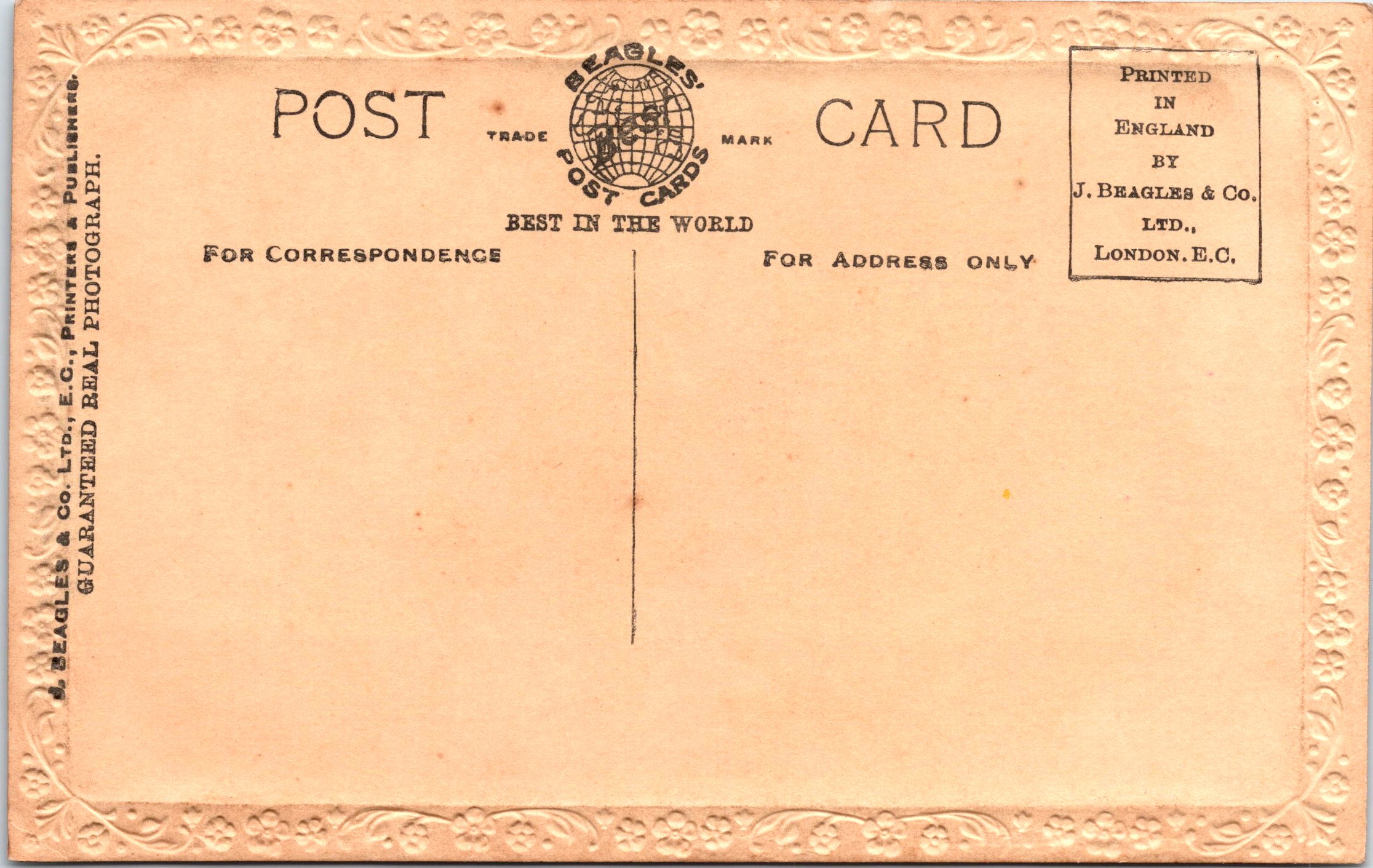
Postcard 1 is a hand tinted vintage real photo postcard that features Madge Bellamy (1899-1990), an American stage and film actress. She was a popular leading lady in films of the 1920’s and 1930’s. The sound era put the brakes on her career and a romantic scandal in the 1940’s brought it to a total stop. Madge was a Texan. She was born in Hillsboro and was raised in San Antonio and Brownwood. Her father was an English professor at Texas A&M University. As a young child she took dancing lessons but soon, she was interested in becoming an actress. At age 9, she made her stage debut in “Aida”. She and her family moved to Denver, Colorado. She met Carlos Bellamy there and the two married. When Madge decided to leave the state to pursue acting, her marriage ended. Madge went to New York City and worked on Broadway as a dancer. In 1919, she replaced Helen Hayes in Broadway’s “Dear Brutus”, opposite actor, William Gillette. Her career took off thereafter. In 1920, Madge appeared in her first film as a supporting actress to Geraldine Farrar. She then signed a contract with the Triangle Film Corporation. Her “breakout role” was as the title character in Lorna Doone (1922). In 1924 she signed a film contract with Fox Film Corporation. She stayed there five years and during that time she appeared in two films for film director, John Ford. In 1925, she began to have difficulties with fox executives. In 1928, she appeared in Fox’s first talking film, “Mother Knows Best”. In 1928, she married for a second time. The marriage lasted 3 days before she and her husband separated. By 1929, Bellamy’s career entered a tail-spin. She had made poor choices out of her unbridled anger. Fan magazines gave her the nickname of “Miss Firecracker” due to her temperament. In 1929, she also quit her contract with Fox, right after they bought the rights to make a film out of Broadway play. The vehicle was bought with a plan to have Madge be it’s star. Bellamy later admitted she quit over money and added “I got too big for my britches”. She didn’t work again until 1932. She accepted roles in “Poverty Row” (B-movies) films. One of these films was “White Zombie” (1932) in which she appeared opposite Bela Lugosi. Her performance received many poor reviews from film critics. By 1940, Madge basically had no film career. However, she wasn’t done with drama. She was arrested after firing three shots from a .32 caliber revolver at her former lover of five years. The incident was premeditated. She was angry at her intended victim because he married a model shortly after ending their affair. Fortunately, her aim was poor and she missed. The only casualty was her ex boyfriend’s car which took a couple of shots into it’s body. Bellamy pleaded guilty to a lesser charge (violating gun laws), and received a suspended six month sentence and probation. Madge Bellamy’s IMDb filmography reports 61 credits between 1920 and 1945. This vintage postcard is provocative. This postcard is risque for it’s era. She is showing a lot of bare skin. The postcard was published while Madge was under contract with Fox. Therefore, the postcard is from before 1929. The card was published by J. Beagles and is part of the “Famous Cinema Star Series” (No.210P). (SOLD)
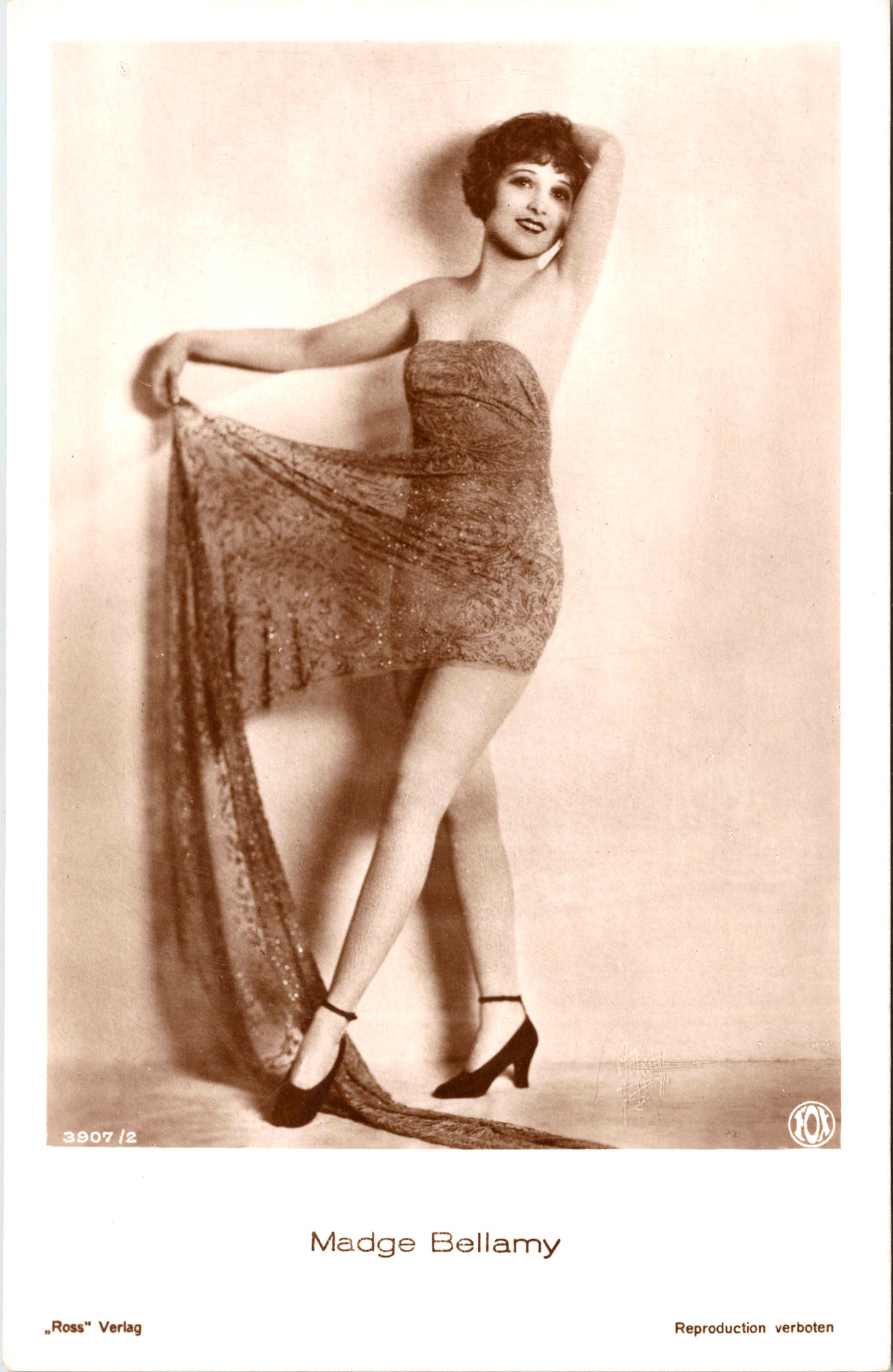
Postcard 2 offers another risque view of Madge Bellamy. Her alluring pose and short skirt qualifies this postcard to be considered provocative. This card was produced while Madge was under contract with Fox Films, sometime before 1929. This postcard was published by Ross Verlag as part of a series (No.3907/2). The postcard is in very good condition (see scans).
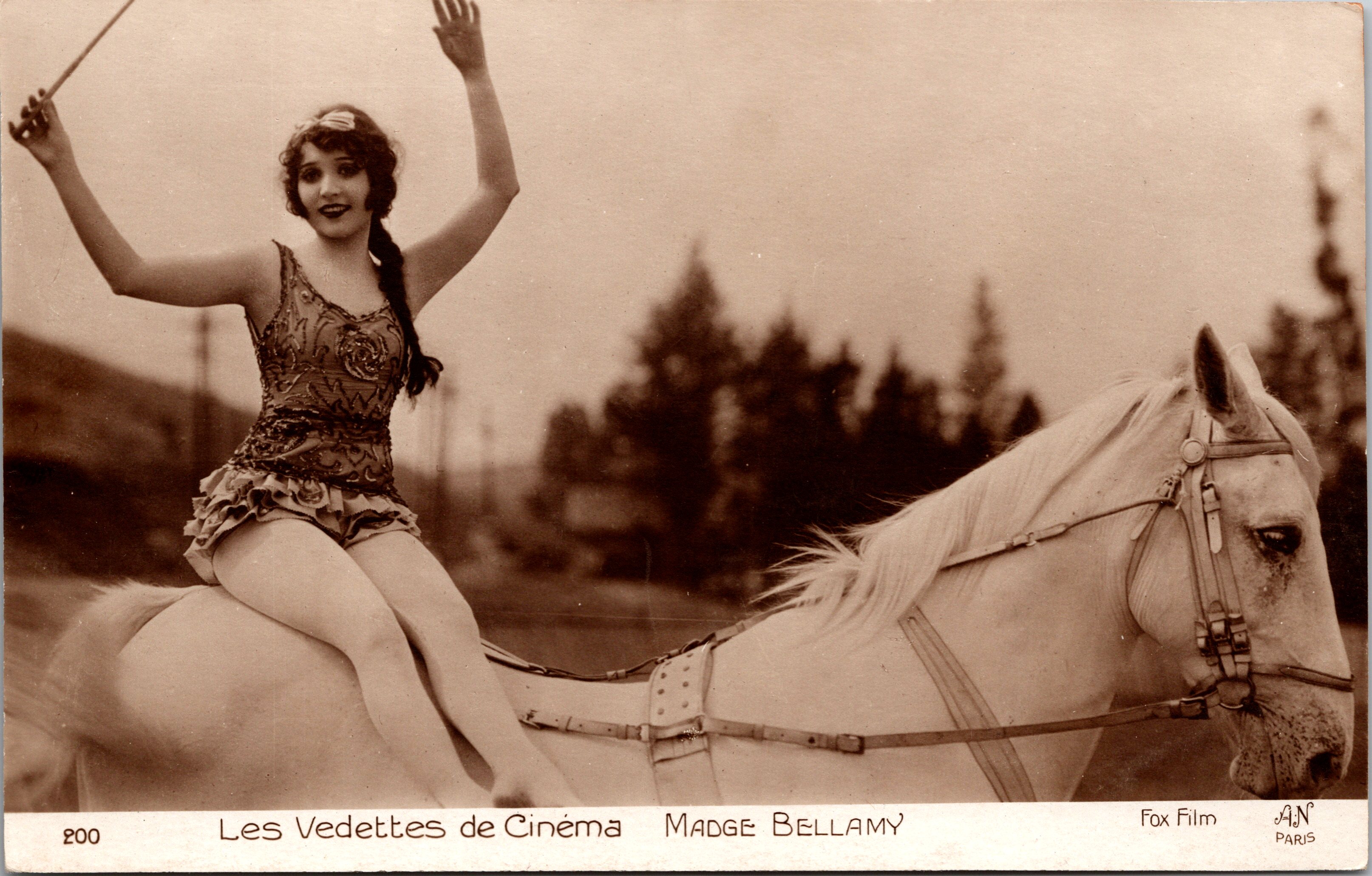
Postcard 3 is quite provocative. There are shades of Lady Godiva in this photograph. Miss Bellamy is pretty and scantily dressed. This postcard is risque for it’s era. The postcard was published while Madge was under contract with Fox. Therefore, the postcard is from before 1929. The card was published by Alfred Noyer and is part of the “Les Vedettes de Cinema” (The Stars of Film) series (No.200). This postcard is uncommon. (SOLD)
Buy this original Vintage Real Photo Postcard (includes shipping within the US) #7386
To purchase this item, click on the Pay with PayPal button below
$24.00
Buy this original Vintage Real Photo Postcard (includes International shipping outside the US) #7386
To purchase this item, click on the Pay with PayPal button below
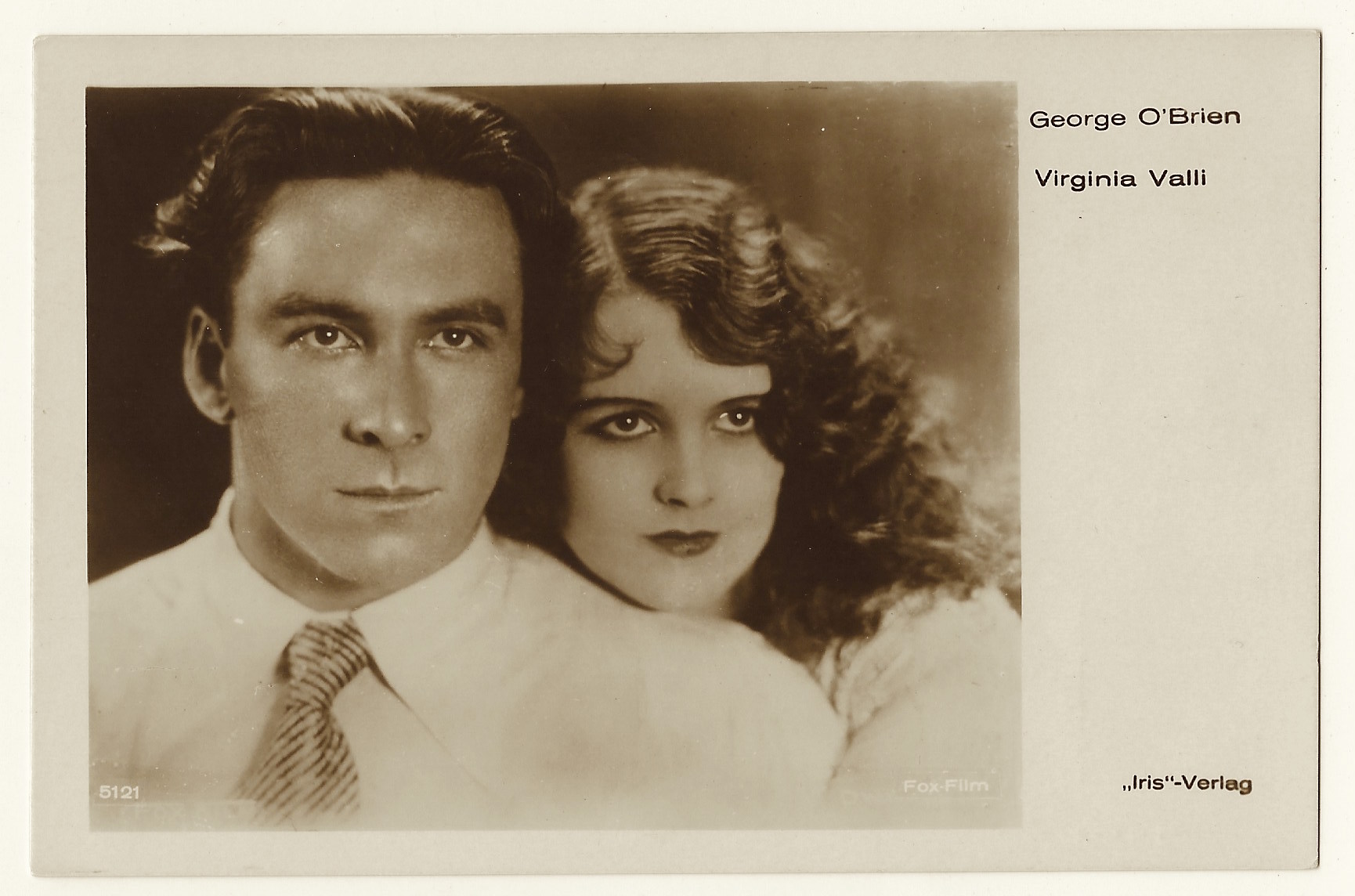
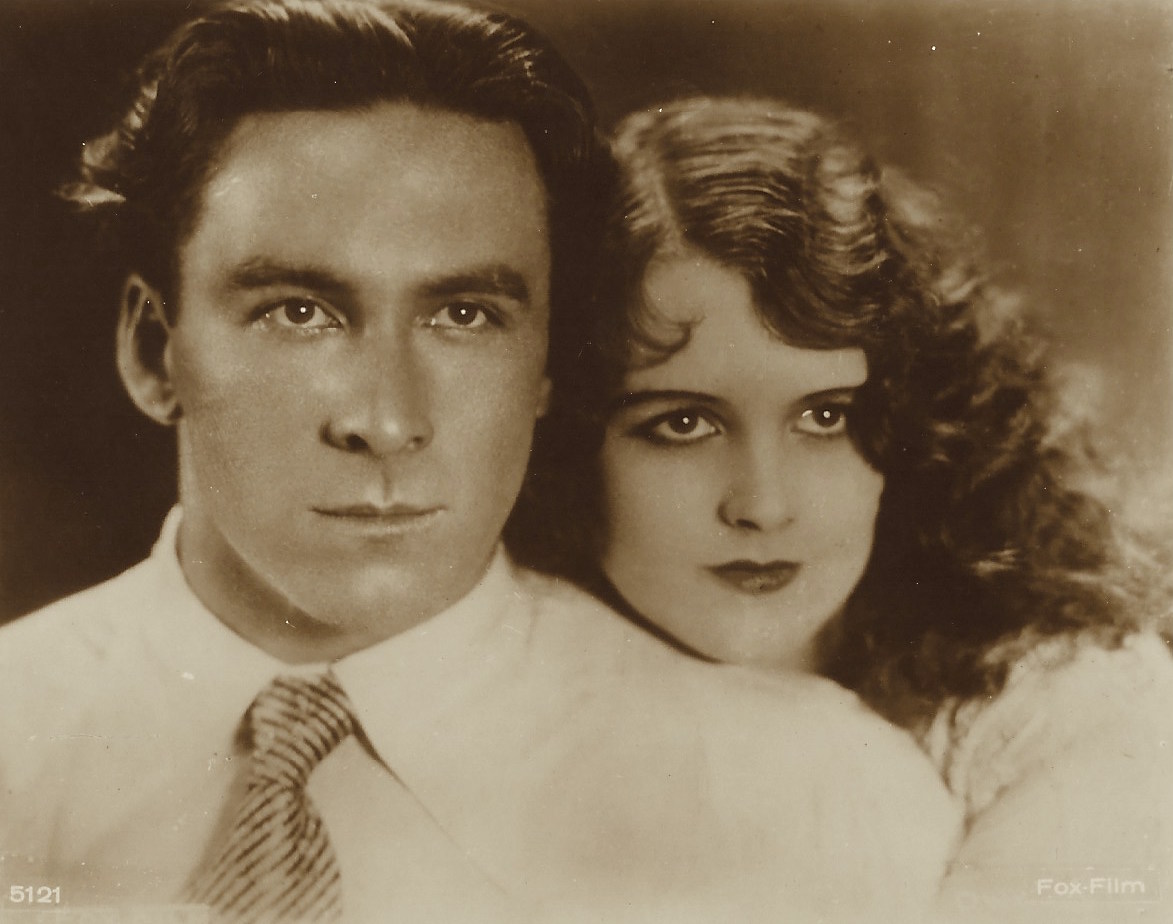
Can sexual chemistry be photographed? This fantastic vintage real photo postcard provides evidence that the answer is yes. This image captures early film stars George O’Brien and Virginia Valli in an emotionally charged scene in an unknown movie. The pair starred together in at least two silent movies produced by Fox. The films were “Paid to Love” (1927) and “Eastside Westside” (1927). Virginia Valli (1898-1968) was an American stage and film actress. Her early acting experience was with a Milwaukee based stage troupe. Her film career started in the silent film era and ended in the early stages of the talkies (1930’s). She has 65 credits on the IMDB web site. She began her film work with Essanay Studios in her hometown of Chicago in 1916. By the mid 1920’s, she was an established star at Universal Studios. She was the star of King Vidor’s “Wild Oranges” (1924). Most of her films were produced in the mid 1920’s and include Alfred Hitchcock’s first feature movie, “The Pleasure Garden” (1925). Her first sound picture was in 1929. She left the movie business in 1931 due to her high salary command and declining appeal to audiences. She moved to Palm Springs, California with her second husband, actor Charles Farrell. She was very much part of the social scene there. She died in Palm Springs at age seventy. George O’Brien (1899-1985) was an American actor popular during the silent film era as well as the early talkies era of the 1930’s. He is remembered most for his role in Murnau’s 1927 film “Sunrise: A Song of Two Humans”. He had an active film career which is evident by the fact that the IMDB web site gives him 85 credits. O’Brien was born in San Francisco and his father at one time, was the city’s chief of police. During World War I, O’Brien was in the US Navy and served on a submarine chaser. He worked as a stretcher bearer for wounded Marines and was decorated for his bravery. Following the war, O’Brien became the light-heavyweight champion of the Pacific Fleet. After completing is service, O’Brien was in his early twenties and he went to Hollywood to seek work as a cameraman. He did find employment in the field and helped film for Tom Mix and Buck Jones. He then entered acting by playing bit parts and by being a stuntman. His first starring role was in “The Man Who Came Back” (1927) where he played opposite Doroth Mackaill. He then appeared in “Iron Horse” by famed director John Ford in which his counterpart was Madge Bellamy. The film was a great success and the experience forged a colloborative relationship with Ford that resulted in O’Brien appearing in nine more of the directors films. He spent much of the 1920’s as a leading man in action and adventure type roles. During the 20’s he received the nickname “the torso” because of his excellent physique. With the arrival of sound, O’Brien appeared predominately in Westerns during the 1930’s and he was considered a major draw. With the arrival of World War II, O’Brien re-enlisted in the US Navy and served as a beachmaster in the Pacific theater. He was decorated several times and when he was discharged he had attained the rank of commander. He later joined the Naval Reserve where he served as a captain. O’Brien’s last leading role was in a film that included the Three Stooges. According to his obituary, O’Brien was buried at sea courtesy of the US Navy. This real photo postcard was published by Iris Verlag and made in Germany. The postcard is part of a series (no. 5121) and credits Fox Film.
ADDENDUM: After viewing this image, a visitor contacted me to claim that the beautiful woman in this photograph is not Virginia Valli, but instead, it is June Collyer (1906-1968). I was unable to locate information or relevant comparison images to definitively confirm that it is Collyer that is in the photograph, but I did find a film publicity photo identical to the postcard image above. The description of that photo indicates that the pictured woman is Collyer. Collyer was born in New York City and as a society girl was chosen by Allan Dwan (Director, Producer, Screen Writer) to her first starring role in “East Side, West Side. She did eleven silent films and made a successful transition to talkies. In 1928 she was he was one of the thirteen girls selected as “WAMPAS BABY STARS”. In 1930 she appeared in “The Three Sisters” and “Sweet Kitty Bellairs”. From 1930 through 1936 she starred in nineteen films. She took a sabbatical from acting in the 1940’s and did television acting during the 1950’s. June was the sister of radio actor/announcer Bud Collyer (1908-1969). He became a major game show star hosting such programs as “Beat the Clock” and “To Tell the Truth”. June Collyer was married to actor Stu Erwin. In conclusion, I am unsure whether the beautiful woman in this image is Miss Valli or Miss Collyer. It is an answerable question if someone is willing to do the requisite research.





 THE CABINET CARD GALLERY