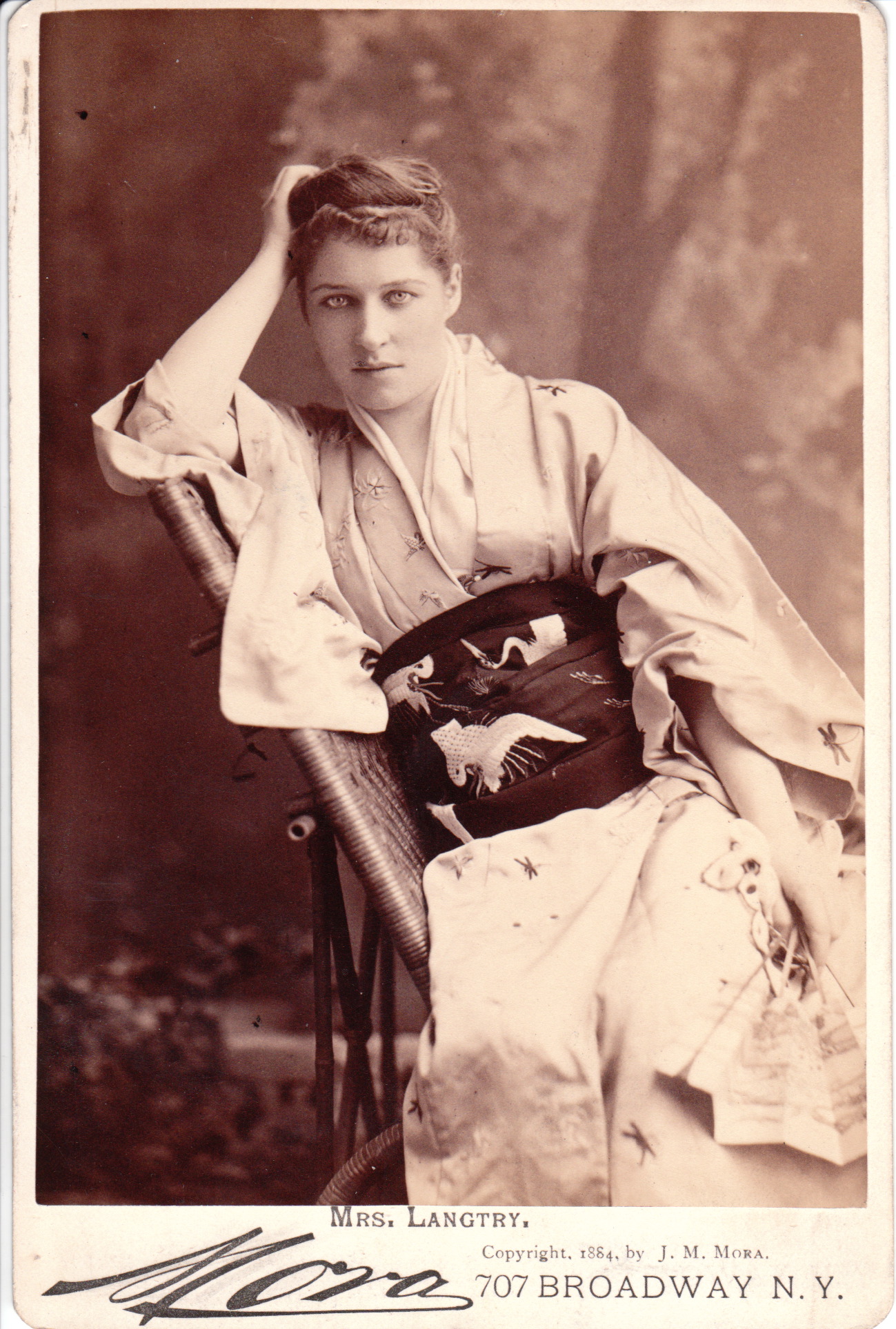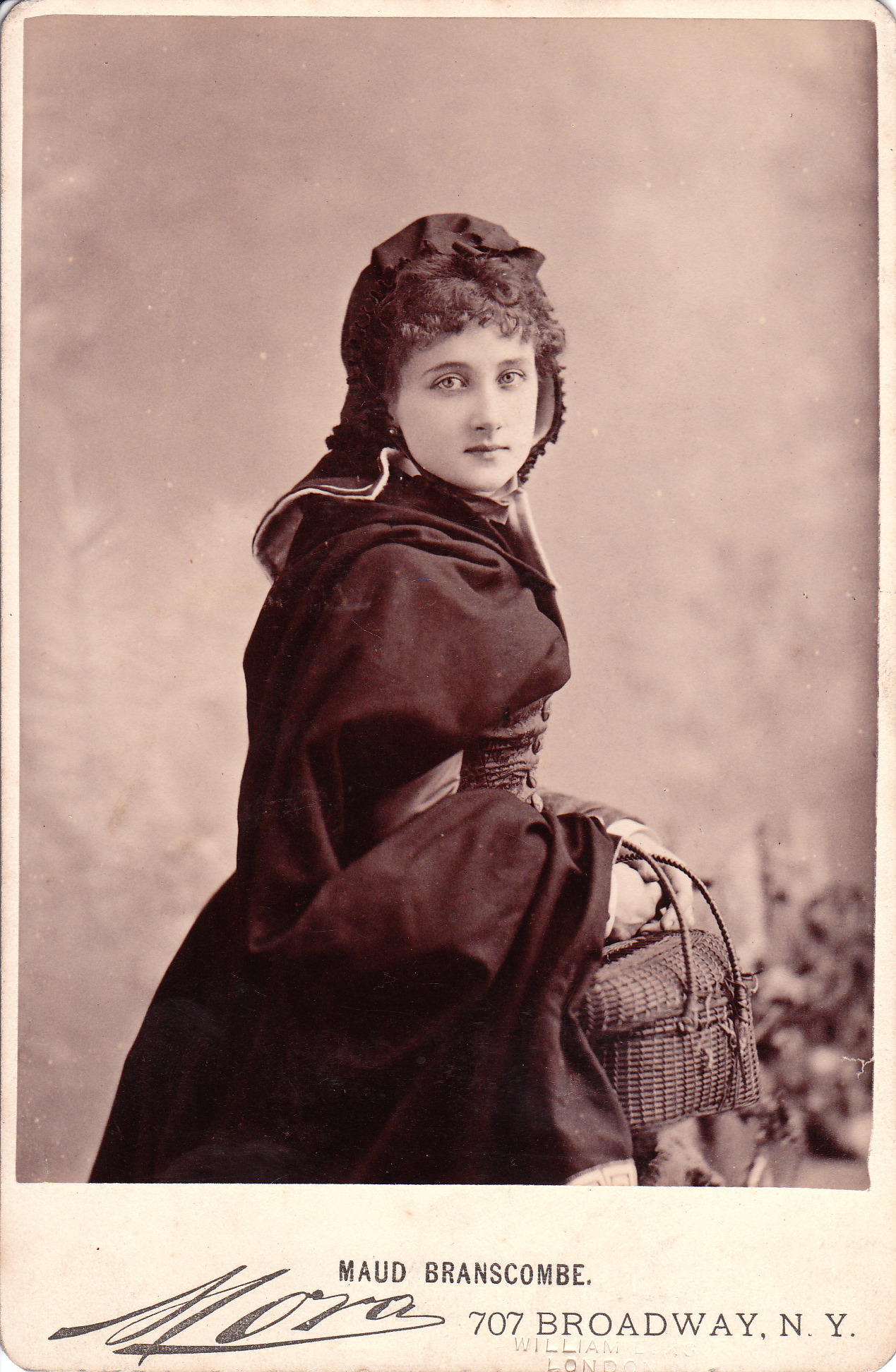
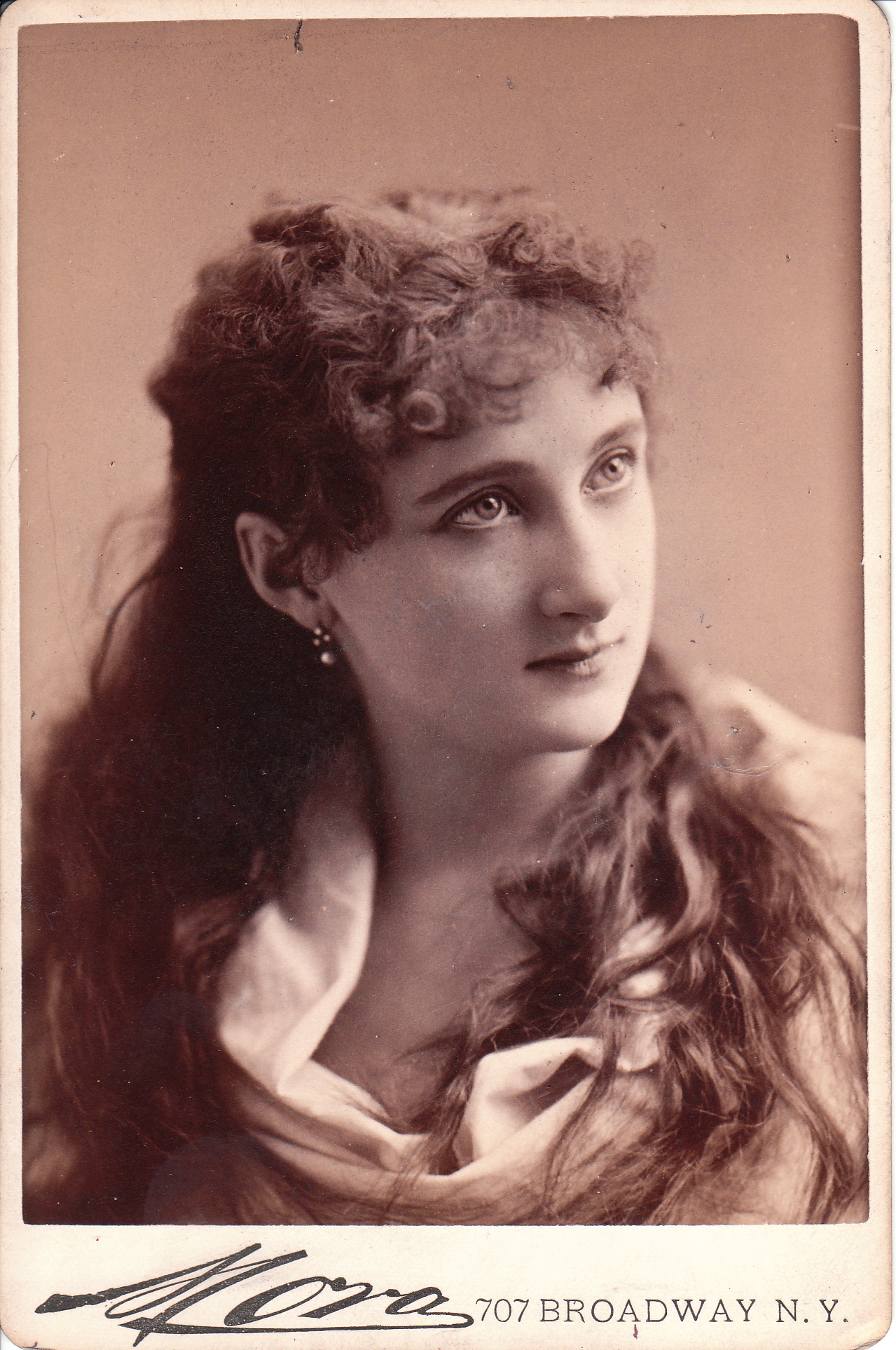
This cabinet card features British actress, Lillie Langtry (1853-1929). She was born on the island of Jersey, was known as the “Jersey Lily”, and was known for her beauty. She had many prominent lovers including the future King of England, Edward VII. At 20 years of age she married a wealthy Irish landowner, Edward Langtry and quickly became part of London’s high society. Due to her great beauty, she became a sought after model for a number of well known portrait painters. Beginning 1877, she had a three year affair with the Prince of Wales, Albert Edward. At the suggestion of close friend, Oscar Wilde, she began a stage career. She made her debut in “She Stoops to Conquer” (1881) at the Haymarket Theatre in London. She then embarked on the first of many United States theatre tours where she was a resounding success. She continued to have a number of affairs including a relationship with New York City millionaire, Frederic Gebhard with whom she became very involved in the sport of thoroughbred horse racing. In 1897 she became an American citizen. She is known as one of the early celebrities to make money endorsing commercial products. Among the products she advertised were cosmetics and soap. The photographer of this cabinet card is famed celebrity photographer, Mora, of New York City. The image was copyrighted in 1884. To see other images by Mora, click on this site’s category of “Photographer: Mora”. SOLD
ATTRACTIVE YOUNG WOMAN WITH HYPNOTIZING EYES IN DETROIT, MICHIGAN

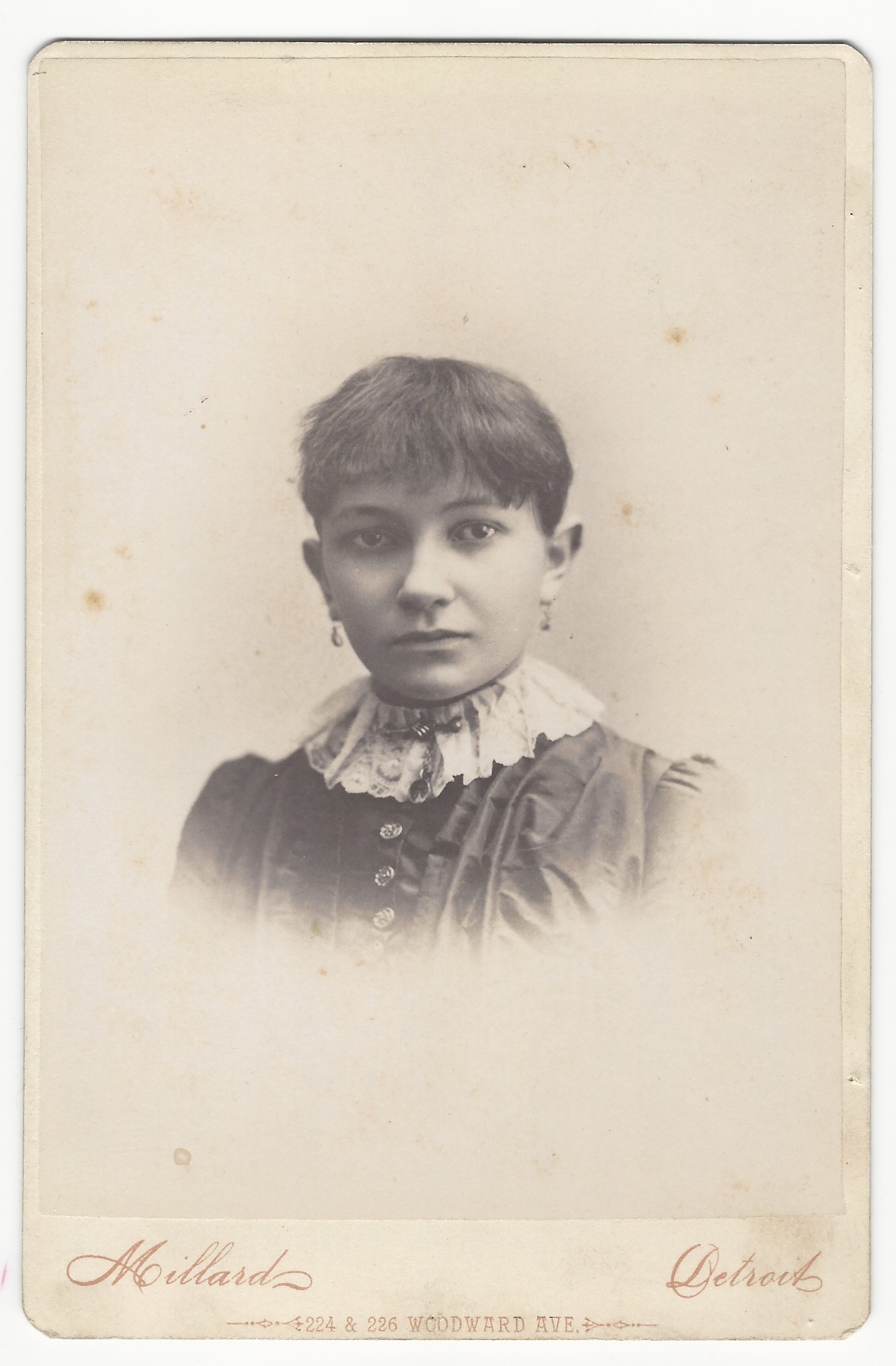
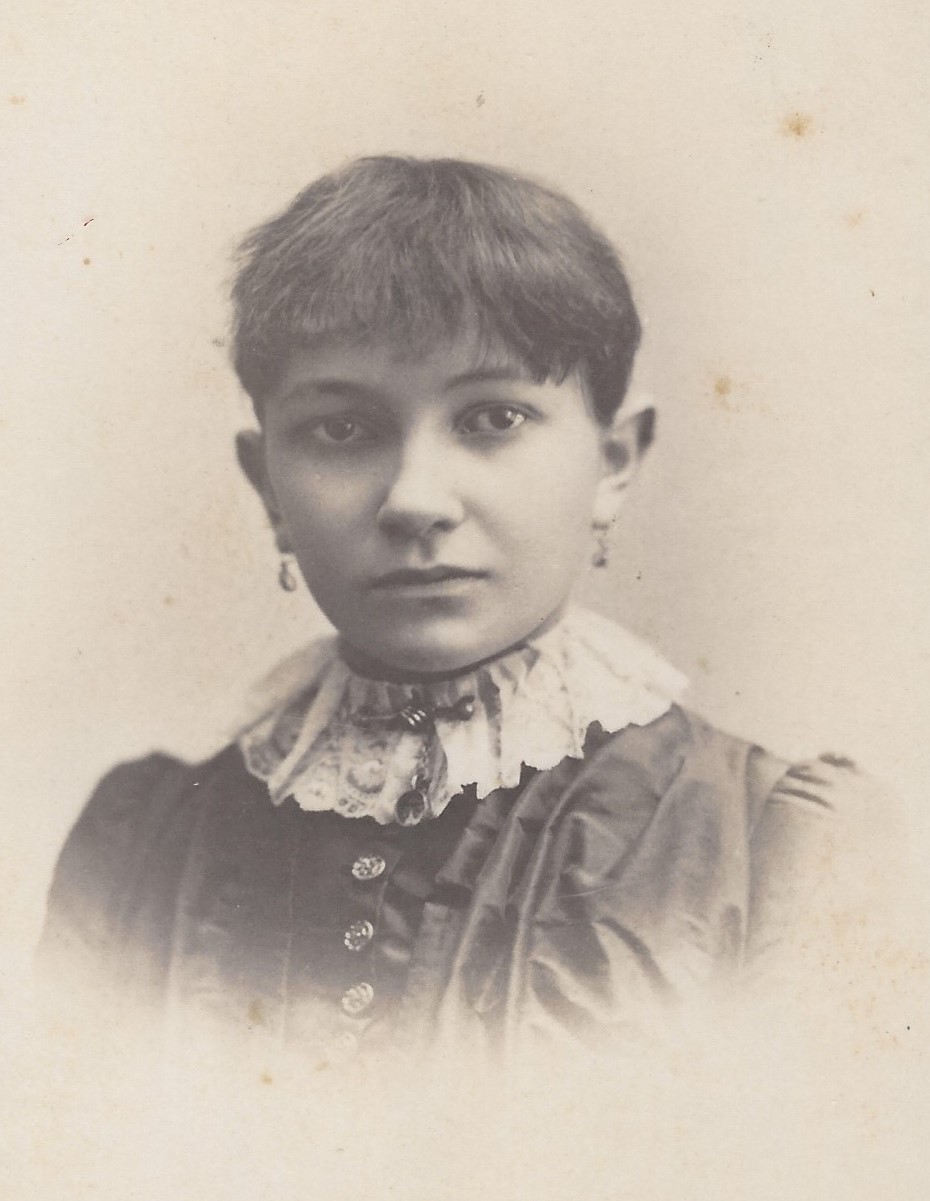
This bust portrait of an attractive short haired young woman is the product of the Millard studio in Detroit, Michigan. The woman is wearing a lace collared dress and earrings. She has magnificent deep hypnotizing eyes. C. A. Millard is mentioned in The Industries of Detroit (1887) as being the proprietor of the oldest photographic studio in Detroit. It is reported that he bought out a Mr. Powelson in 1879 and at the time of the books publication, Millard employed ten to fifteen artists in his studio. An interesting side note concerns Millard’s death in 1891. Frank Scott Clark (1865-1937), a noted backdrop painter, came to Detroit in 1892 to manage Millard’s studio for Millard’s estate. Among his accomplishments, Clark was an extremely talented photographic background specialist. In fact, during his career, he created, made, and set up backgrounds for both Napoleon Sarony and Jose Maria Mora. Not too shabby a resume for Mr Clark. (SOLD)
MAGGIE MITCHELL: CELEBRATED THEATRE ACTRESS WHO PERFORMED IN FRONT OF PRESIDENT ABRAHAM LINCOLN
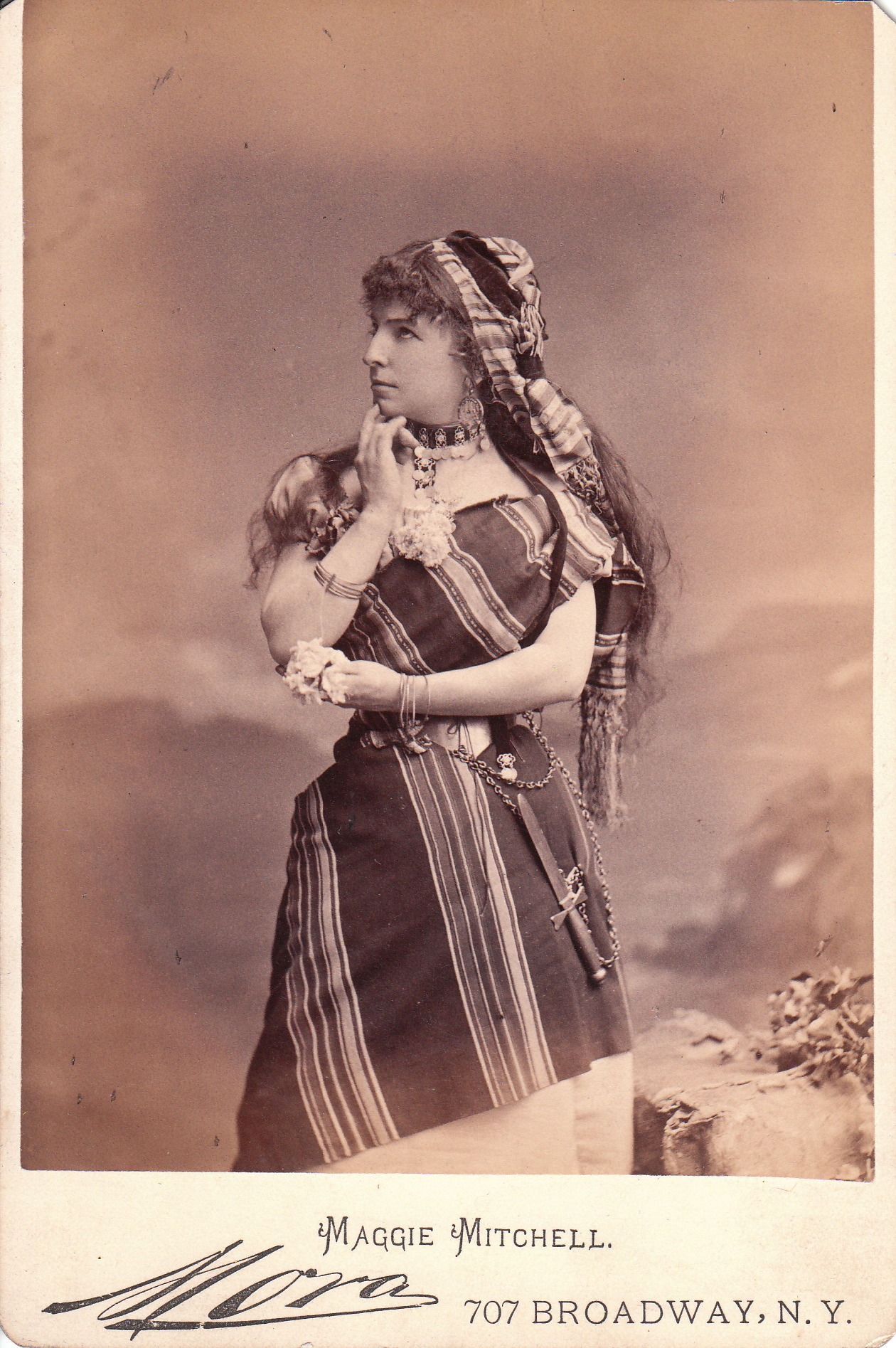
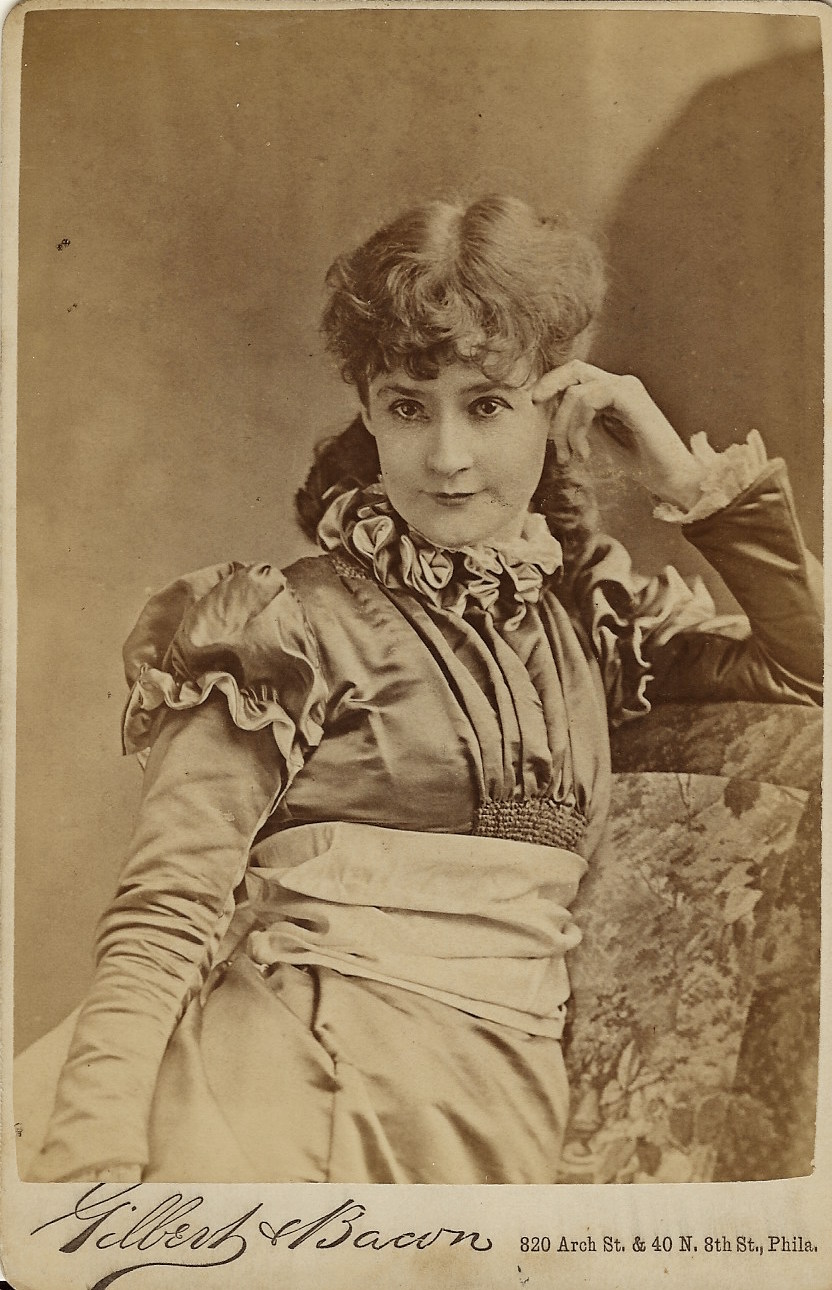
Maggie Mitchell (1832-1918) was a famous American actress, born in New York. Her first regular stage appearance was in “The Soldier’s Daughter” at the Chambers Street Theatre in 1851. Her first major success was as star of “Oliver Twist”. She has been described as small, agile and energetic, with a special talent for comedy. In 1860, she appeared in “Fanchon, The Cricket” which was adapted for her from a George Sand novel. She performed in this and other plays in front of President Abraham Lincoln. The photographer of the top image was celebrity photographer, Mora, of New York City. To view other photographs by Mora, click on Cabinet Card Gallery’s category, “Photographer: Mora”. The second portrait of Miss Mitchell was taken by the esteemed Philadelphia photographic studio, Gilbert & Bacon. This cabinet card image shows Maggie displaying a “come hither” expression. To view more photographs by this studio, click on the category “Photographer: Gilbert & Bacon”. ADDENDUM: A knowledgeable visitor to Cabinet Card pointed out that the second photo of Miss Mitchell is actually actress Lotta Crabtree (see comment below). A bit of research confirmed his astute observation. Lotta Crabtree, a woman who led a very interesting life, will receive her own entry in the cabinet card gallery in the next few days.
MLLE. RHEA: INTERNATIONAL STAGE ACTRESS

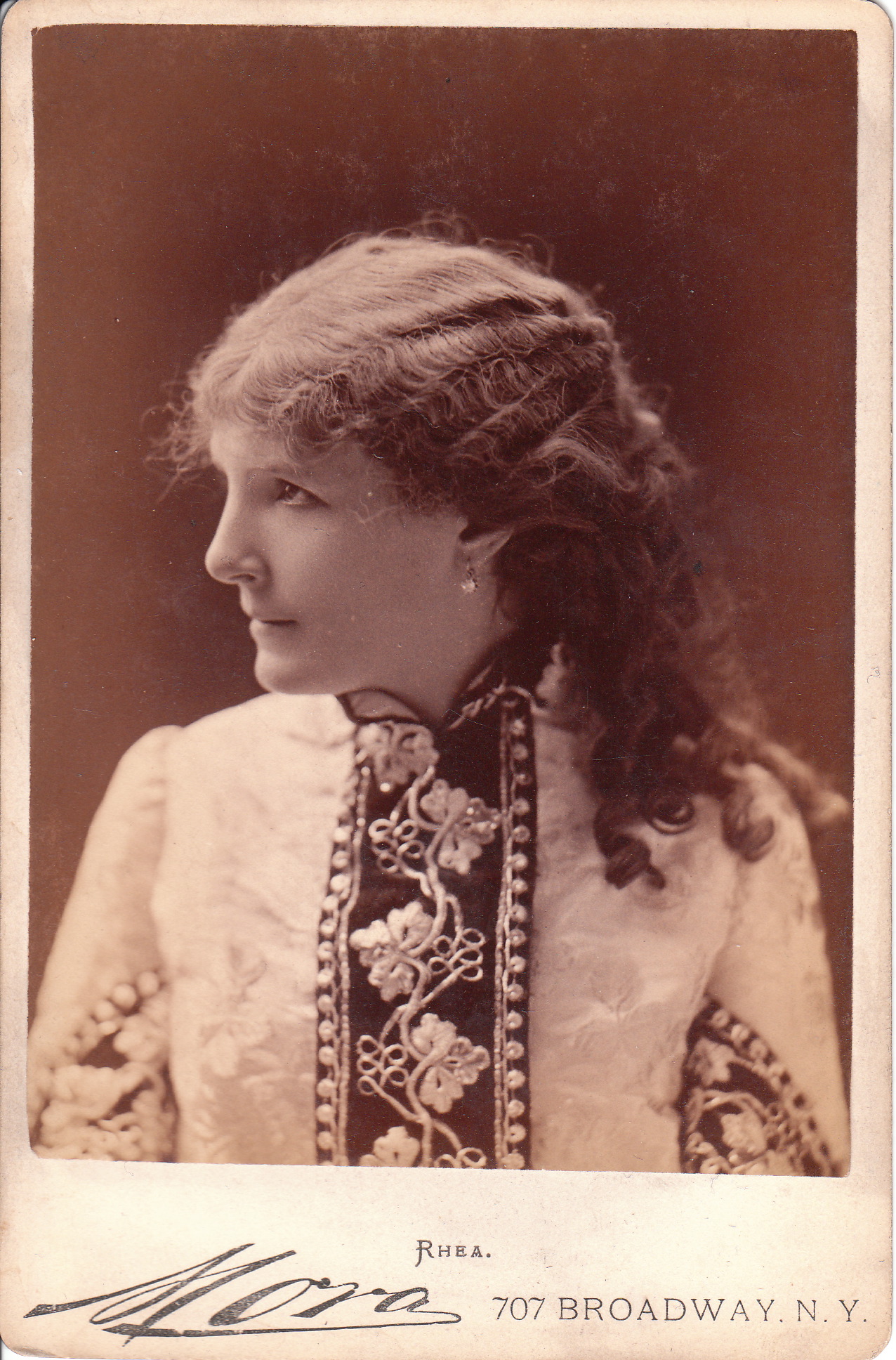
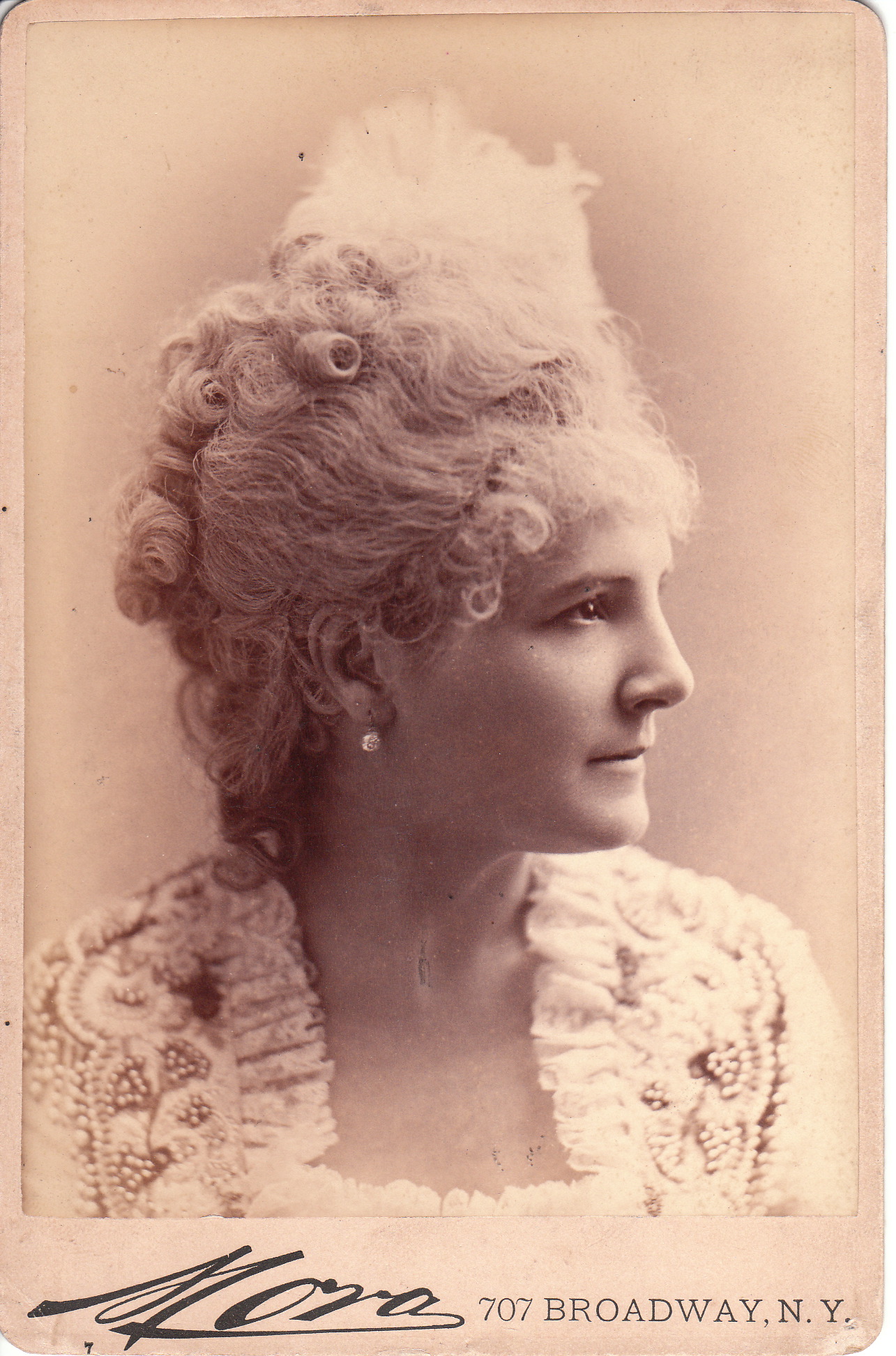
The top Cabinet card, by Jose Mora of New York, features actress Mlle. Rhea (1843-1899). Mlle Rhea was her stage name. She was actually Mlle Hortense-Berbe Loret and was born in Belgium to French parents. She began studying acting at age 20 upon the suggestion of an actor that she had met at a party. Her decision was also prompted by the death of her mother and financial reversals experienced by her father. She studied acting in Paris and in 1876 spent five years playing roles in Continental Europe. In 1881 she vacationed in England and decided to appear in British theater. She quickly learned English and in one months time, performed in Much Ado About Nothing in London. Shortly after, she travelled to America where she spent the majority of her remaining life. Her obituary in the New York Times indicates that her english was “somewhat incomplete” and he always performed with a pronounced french accent. She appeared frequently on the New York stage but was a fan favorite in the “provinces”. This very popular actress died in Montmorency, France in 1899. The second cabinet card is a portrait of Mlle. Rhea that was probably taken some years after the first cabinet card. The actress appears somewhat older than in the first image. The second cabinet card was also produced by Mora.
A LITTLE GIRL AND HER WAGON IN DETROIT, MICHIGAN
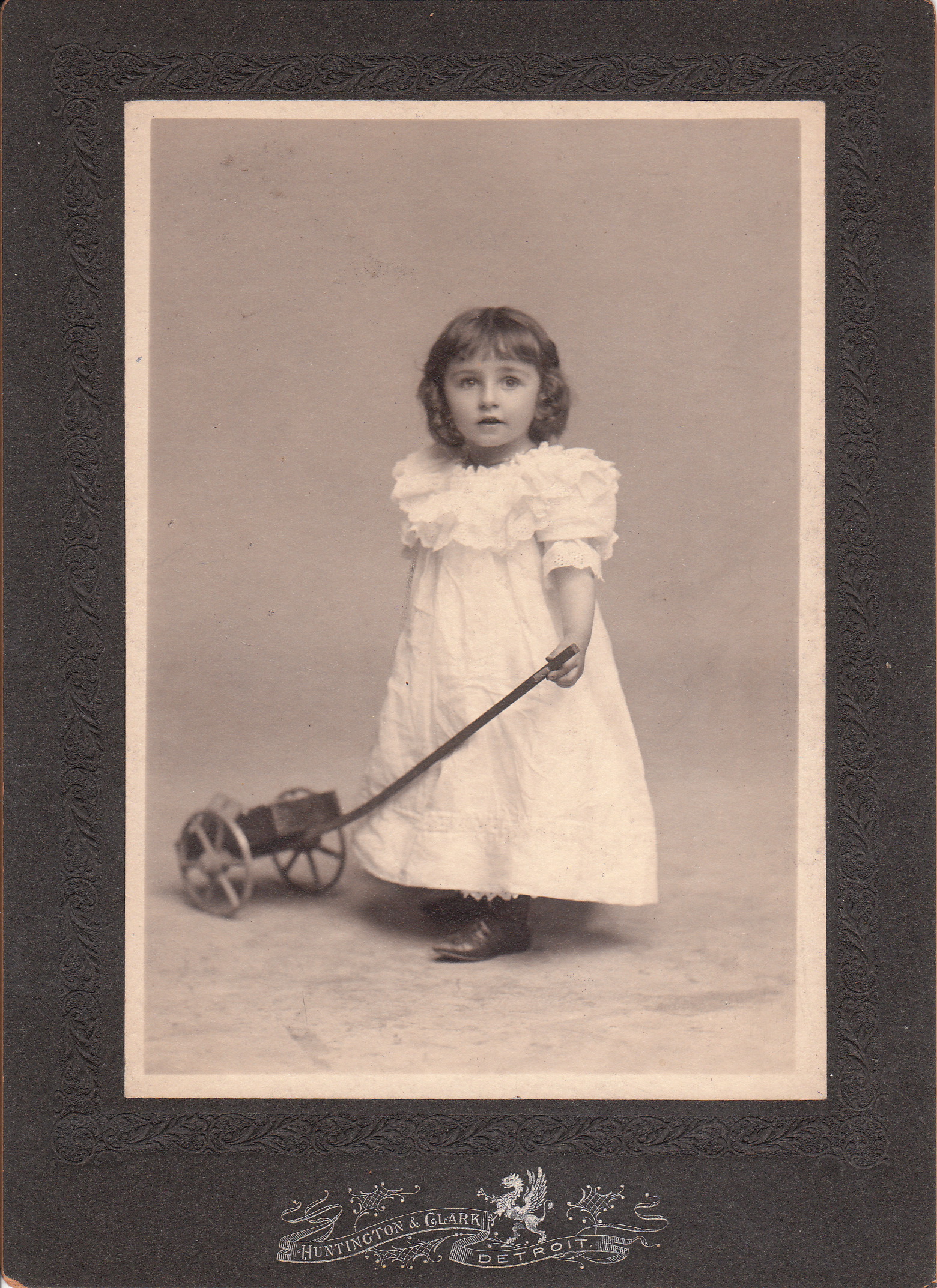
The Huntington & Clark studio of Detroit, Michigan, produced this wonderful photograph of an adorable little girl and her toy wooden wagon. The child’s hair is well styled and she is wearing a pretty frilly dress. Historical author, Thomas Yanul included Frank Scott Clark (1865-1937) in his series “Business & the Baroque: Six Portrait Photographers of America”. Clark was born in Peru, Indiana and claimed that his family lived in America during Revolutionary War times. Clark began his work career by working many different jobs in eastern United States and Canada. Around 1880 Clark was hired by prominent background painter, Lafayette W. Seavey. Seavey was very popular during the cabinet card era. Clark was then hired by a friend of Seavy who happened to be famed New York portrait photographer, Napoleon Sarony. Clark was involved with creating, making and setting up backgrounds for Sarony. He also worked as a camera operator. He worked several years with Sarony and also studied and was employed briefly with celebrated New York photographer, Jose Maria Mora. In the next phase of his career, he worked doing portraits, backgrounds, and theater scenery. In 1892, Clark moved to Detroit and managed the the Charles A. Millard studio estate. In 1894, Clark partnered with George Huntington and they worked together until 1903 when Clark began operating a studio on his own. The above portrait was taken during this partnership. Clark prospered and became very involved with Detroit’s upper crust. He not only served as their photographer but he also was active in their sport, social, literary and art circles. In his narrative, Yanul states that Clark “became a larger than life character of the Detroit scene”. He describes Clark as being a “slightly bohemian figure”. Yanul adds that Clark had a charismatic personality, dressed in an artistic fashion, and was quite intellectual.
THEATER ACTRESS LILLIAN CONWAY (PHOTOGRAPH BY JOSE MORA)
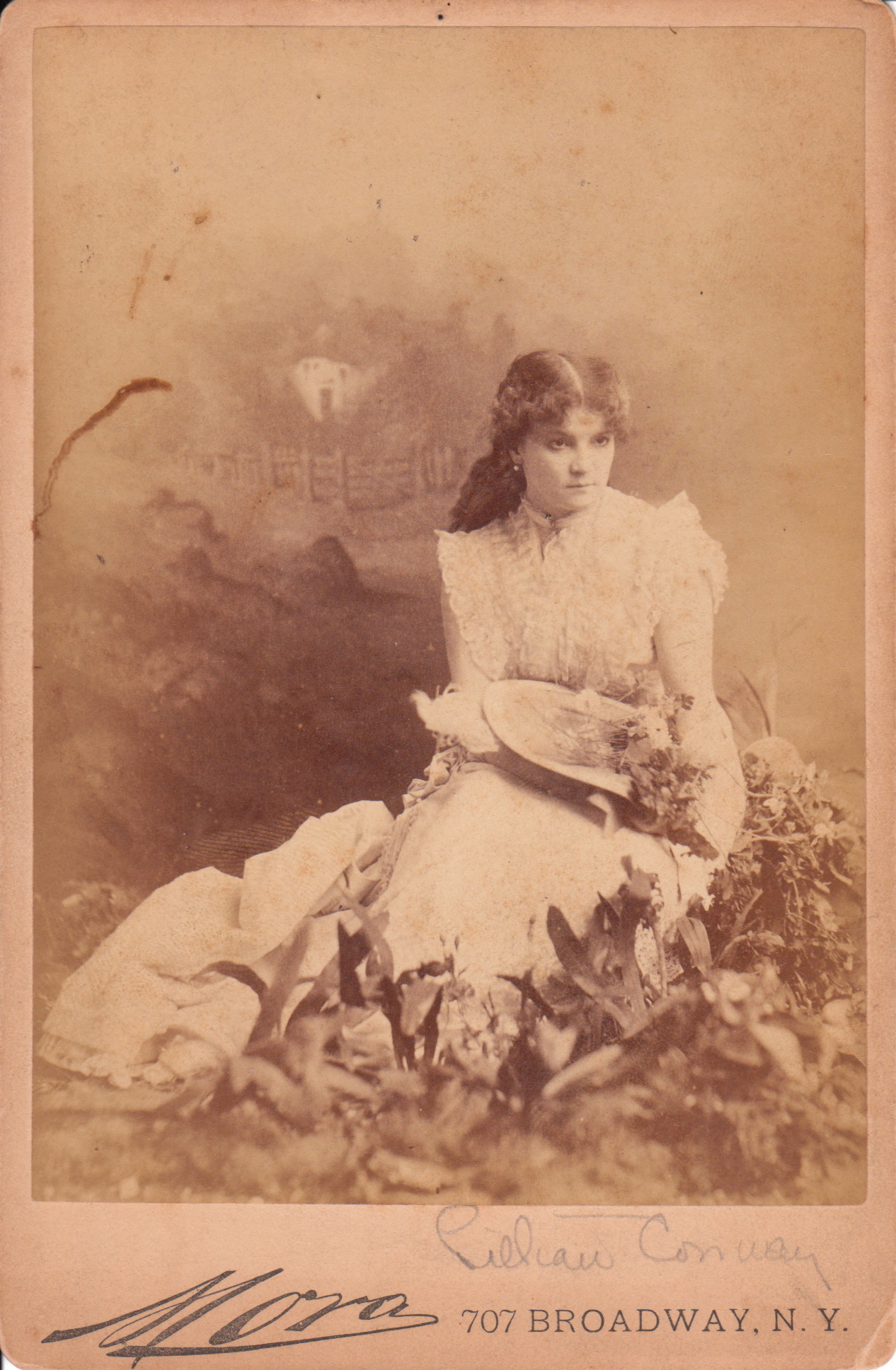
This cabinet card features a portrait of theater actress Lillian Conway. The image was produced by Jose Mora, the famous New York celebrity photographer. To view other images by Mora, click on the category “Photographer: Mora”. Lillian Conway was Brooklyn born and grew up in a theatrical family. Both her parents were appeared on the stage and her mother was also a theater manager. Lillian’s sister, Minnie, also was an actress. Lillian made her theater debut at the Brooklyn Theater playing a minor role in the burlesque “Evangeline”. She next appeared as the lead in “Virginius”. After her parents died, Lillian moved to Boston where she appeared in Globe Theater productions and next moved to Philadelphia to continue her theatrical career. While in Philadelphia, she met and married a local banker, left the stage, and had two children. The marriage had multiple problems including allegations that her husband was an alcoholic. She divorced her husband, who later died in 1887. Miss Conway returned to the stage and organized the Lillian Conway Opera Company. She took the “show on the road” but her theatrical group failed, partially due to scandal. It seems Lillian Conway was guilty of sharing a hotel room with the troupe’s unmarried business manager. Conway later fell ill, and with the help of the Actor’s Guild was able to finance a trip to London for treatment. Unfortunately, she died there in 1891 from rheumatic fever.
THEATER ACTOR H. J. MONTAGUE AND HIS CHECKERED TIE AND JACKET
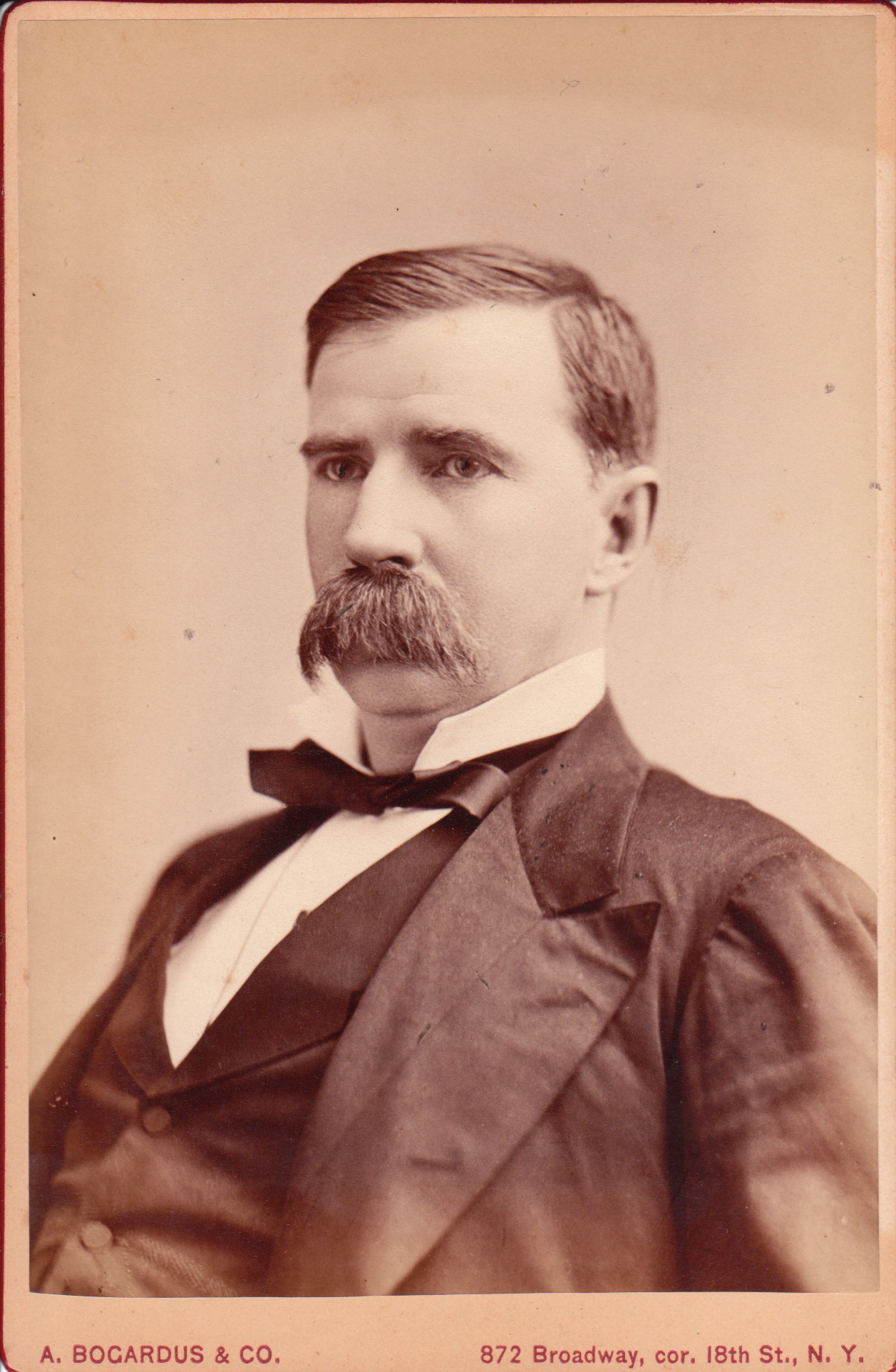
One wouldn’t think that a man could wear a checkered tie with a checkered jacket and still look dashing, but theater actor H. J. Montague is able to accomplish this feat. The photographer of this cabinet card portrait is theater specialist, Jose Mora. To view more of his celebrity photographs, click on category “Photographer: Mora”. The reverse of this image has an address and a return address as if it had been mailed. However, there is no stamp or postmark. The photograph is addressed to a “Jane Mure” in Philadelphia, Pennsylvania. The script is written in very ornate calligraphy. Surprisingly, both the return and sending addresses have Philadelphia zip codes. Since zip codes are from the twentieth century (1963), it appears that someone may have added the ornate script to give the card more character but wasn’t aware, or not thinking about, the relative recent introduction of the zip code system. Henry James Montague (1844-1878) was the stage name of Henry James Mann. He was an American actor born in England. He appeared in T W Robertson’s comedies in London and in 1870 was a founder of London’s Vaudeville Theater. He came to the United States in 1874 and made quite a splash. He became a matinee idol. George Odell wrote that Montague was “a perfect specimen of refined English Manhood”. He was said to have “made other leading men seem boorish, ill dressed and possibly a bit vulgar”. Montague died quite young, about 34 years old. According to the New York Times (1878) while playing a role in a San Francisco production, he fell extremely ill from a “hemorrhage of the lungs”. He required medical attention from some theater goers and was taken to a hotel to recuperate. He rallied only briefly. During a visit from friends he became acutely ill and his last words as he was dying were reported to be, “It’s no use, I am going boys; God bless you”. The New York Times covered his funeral. Attendees of his funeral include the “A” list of that era’s theater world. Mourners included Lester Wallack, Kate Claxton, Rose Coghlan, and Maud Granger. The afore mentioned three actresses all have portraits that can be viewed in the Cabinet Card Gallery by utilizing the search box.
MINNIE PALMER: SUCCESSFUL THEATRE ACTRESS NEARLY MURDERED BY HER POSSESSIVE HUSBAND
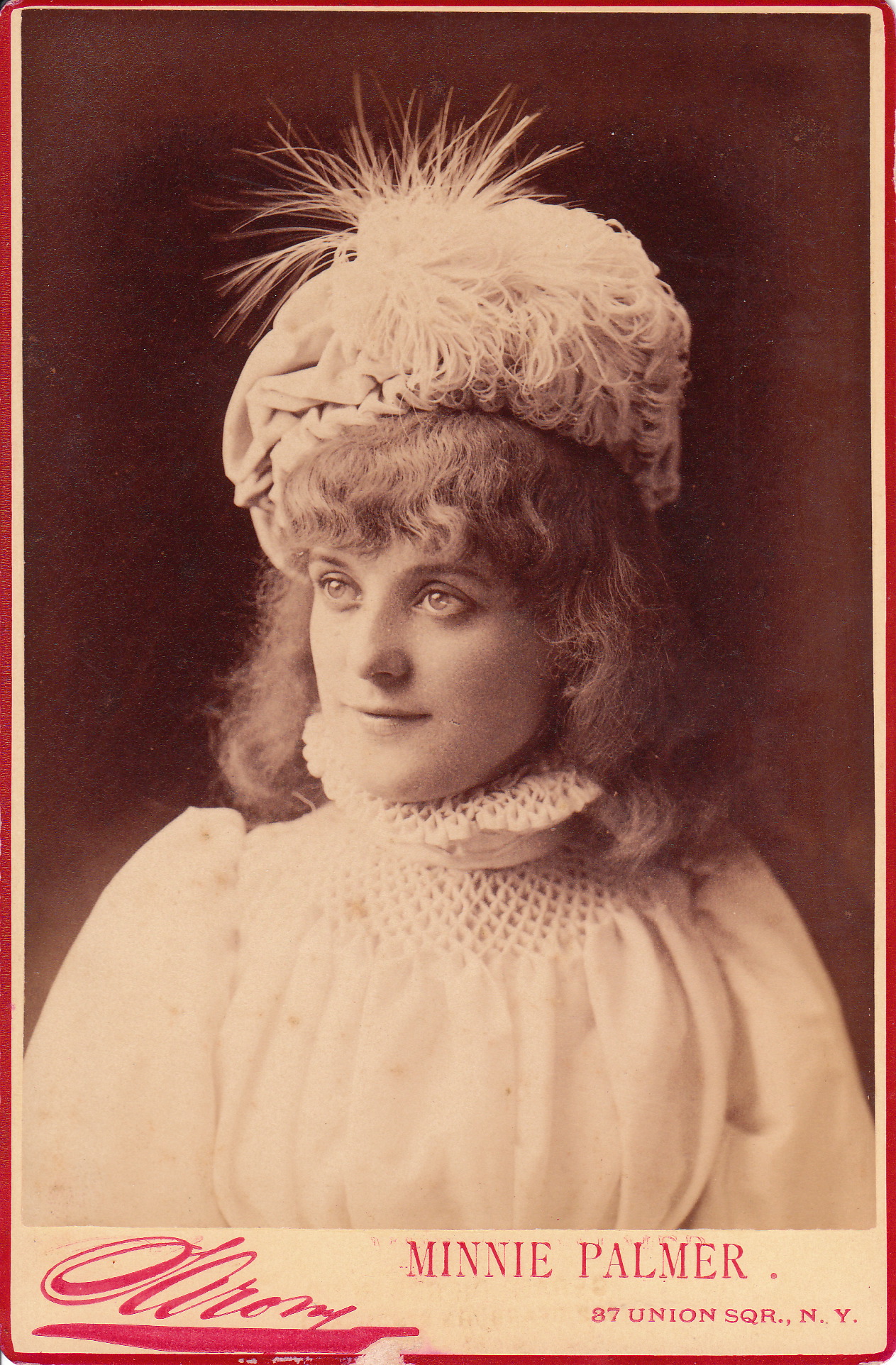
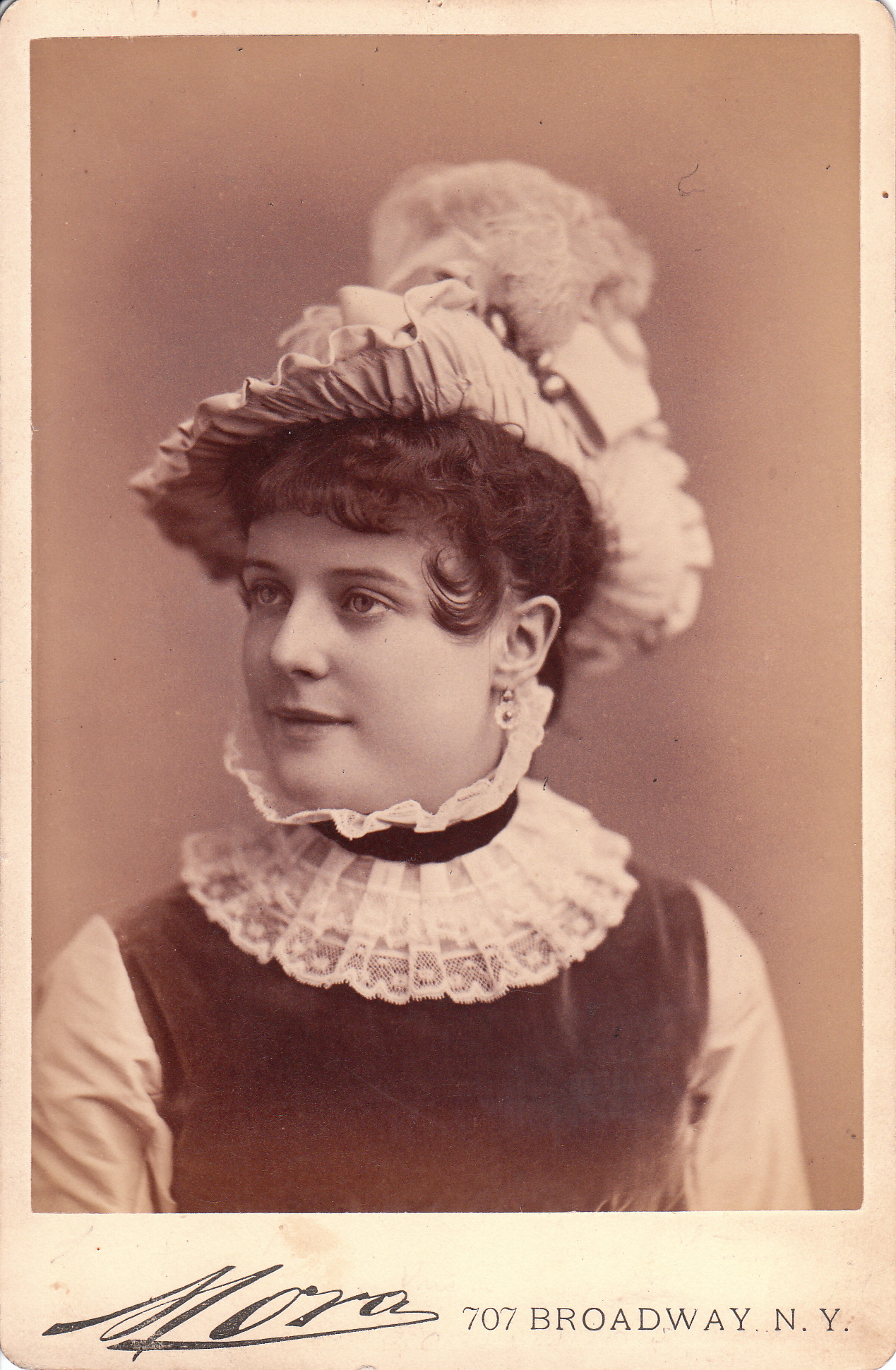
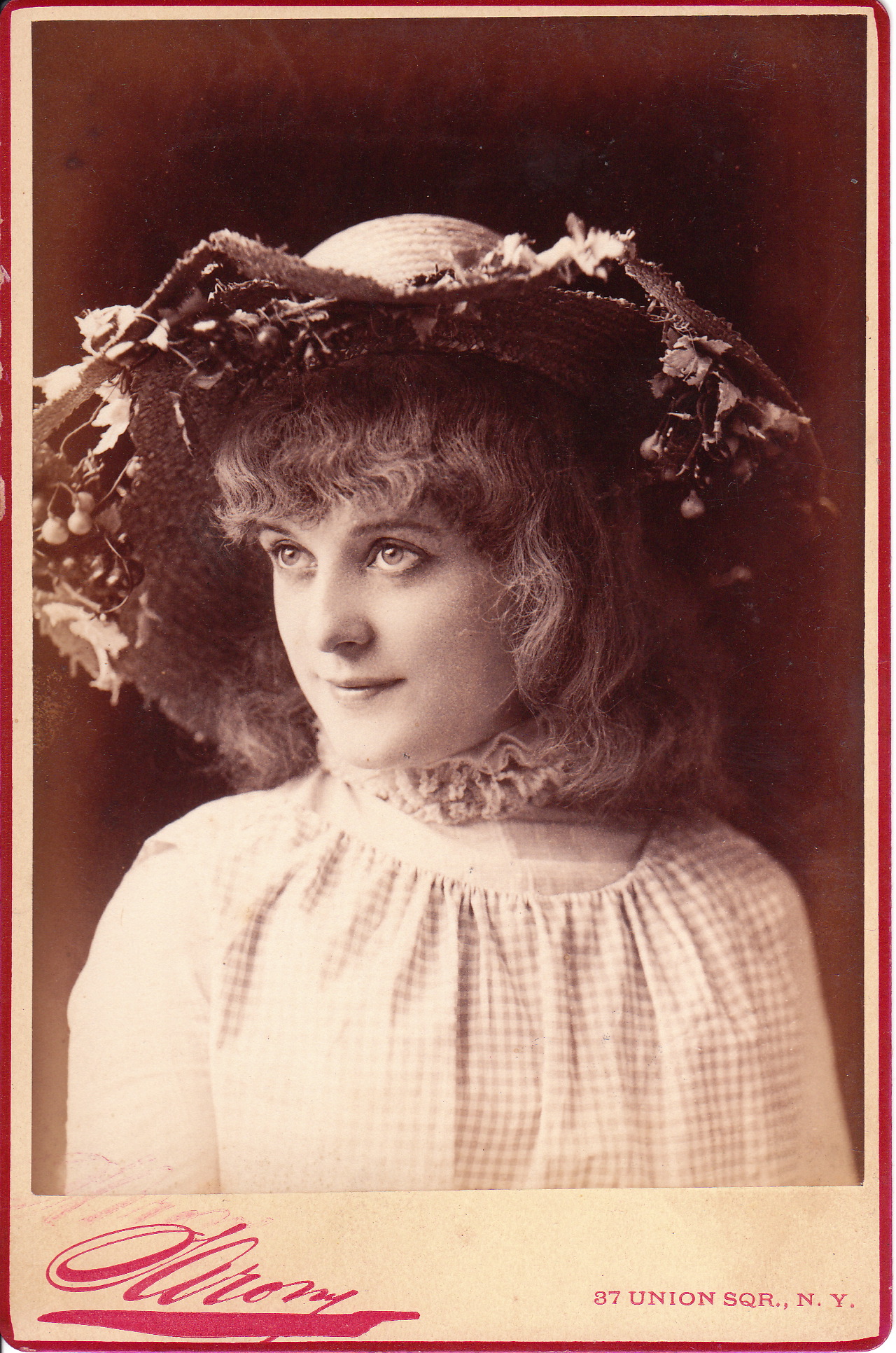
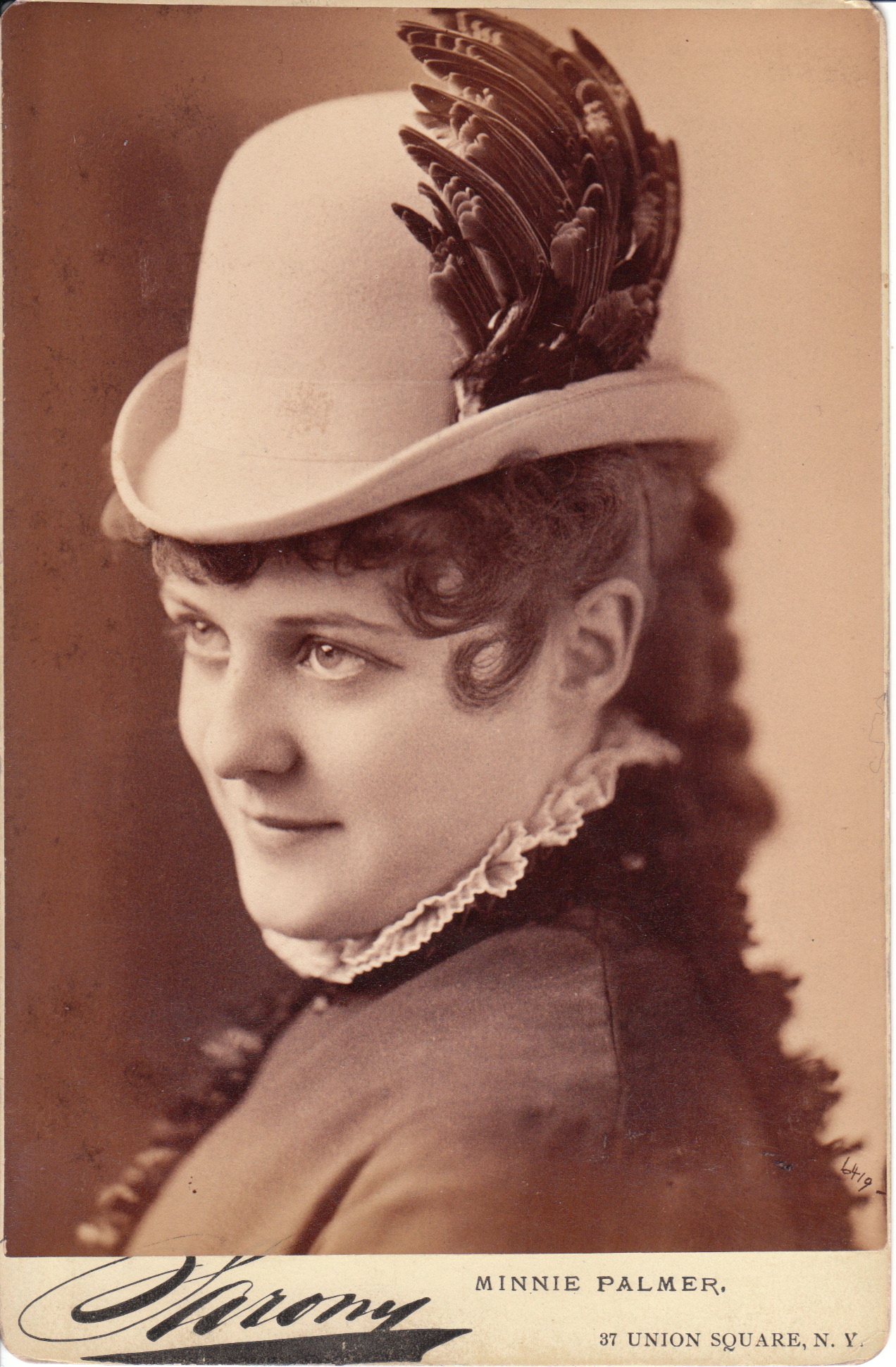
These cabinet cards feature a portrait of theatre actress, Minnie Palmer (1860-1936). Palmer was born in Philadelphia and spent her early childhood in a convent. At age eight, her family moved with her to Vienna where she was taught music and German. She then went to Paris where she learned dancing and French. At age eleven, in 1876, she went to Baltimore, Maryland, and made her first stage appearance. She then acted in Booth Theatre’s production of “Dan’l Druce”. This appearance was followed by roles in “Engaged“, “The Cricket on the Hearth” and other plays. She was very successful in “Two Orphans” and in the 1879-80 theatre season she had great notice in “The Boarding School” and “My Sweetheart“. Palmer also was successful at having aspects her personal life detailed in the newspaper. The New York Times (1890) reported her “narrow escape from death” when she was assaulted by her husband who brandished a huge carving knife. She received minor injuries to her face and her hand. Her husband, John Rogers, was also her manager. Rogers was angry because his wife had ignored his edict that she stay away from her mother. Apparently, upon her return from attending a horse show with her parents, Rogers attacked her. Rogers was a very possessive man; he had already written many insulting and abusive letters to Palmer’s friends in an effort to keep them away from her. Palmer was certainly not media shy. She gave the Times reporter a very detailed story about the violent incident and problems in her marriage which they were happy to print. The photographer of the top cabinet card is Sarony. The second cabinet card is a portrait by celebrity photographer, Mora. Both photographers were located in New York City. To see other photographs of these talented celebrity photographers, click on Cabinet Card Gallery’s category “Photographer: Sarony” and “Photographer: Mora”. The third cabinet card is by Sarony and it does a great job of capturing Minnie Palmer’s exceptional beauty. The fourth cabinet card, also by Sarony, is a close-up portrait of Miss Palmer wearing a feathered hat. Once again, Minnie Palmer is quite photogenic. She has sparkling beautiful eyes and a wonderful smile.