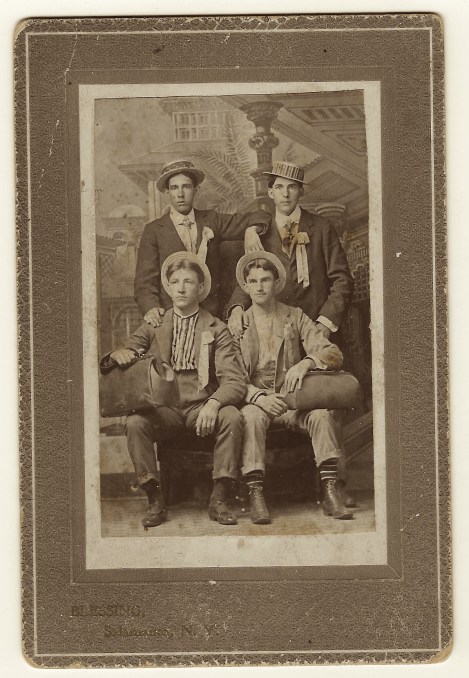
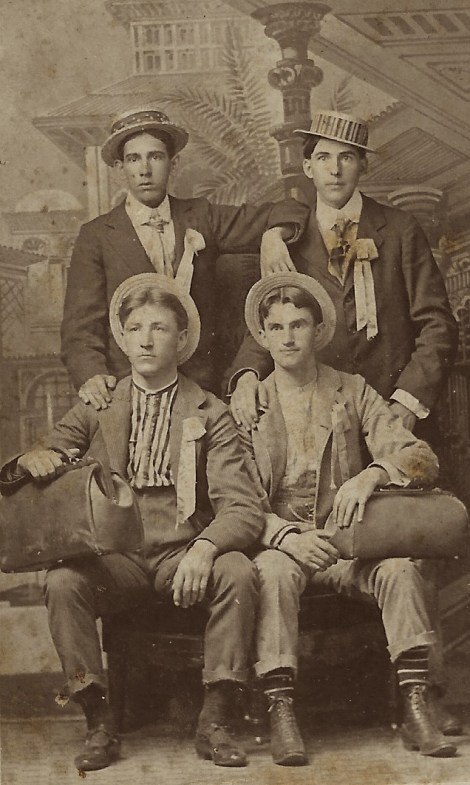
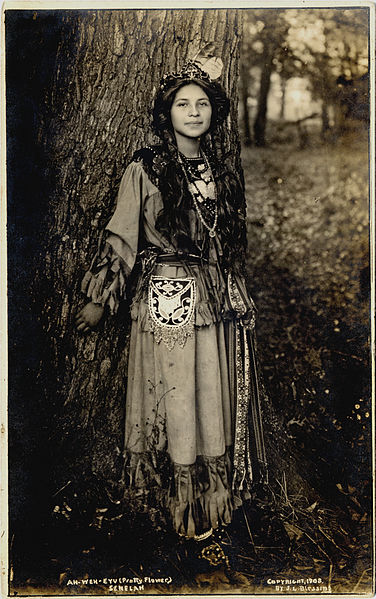
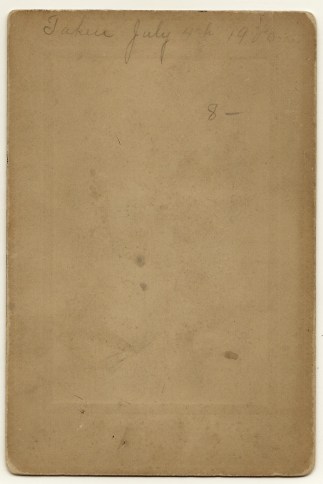
This vintage photograph captures four young men posing in their dress-up clothing and patriotic straw hats. An inscription on the reverse of the image states that the men were photographed on July fourth, 1900. The men are wearing prize ribbons on their lapels. They apparently won a contest of some sort. Its interesting to note that the two men in the front row are balancing luggage bags on their knees. The bags almost look like doctor bags. This photograph was taken by J. L. Blessing of Salamanca, New York. Blessing was no amateur as is apparent in his 1908 photograph of a Native American woman seen below. She is from the Seneca tribe and her name is Ah-Weh-Eyu (translation: Pretty Flower). Her English name was Goldie Jamison Conklin and she was from the Allegany Reservation in Western New York. She was born in Salamanca in 1892 and died in 1974. She was quite beautiful and worked as a model for the Cattarugus Cutlery Company of Little Valley, New York. She helped advertise the company’s line of “Indian Brand” knives. She was often photographed by Jesse Lynn Blessing who operated the Blessing Studio in Salamanca. His father was J. H. Blessing (1851-1920) who started the studio. According to an entry on geneology.com by J. L. Blessing’s grandaughter, Mr Blessing “was asked to work with Disney Studios by Walt Disney but decided to take over his father’s studio instead”. (SOLD)
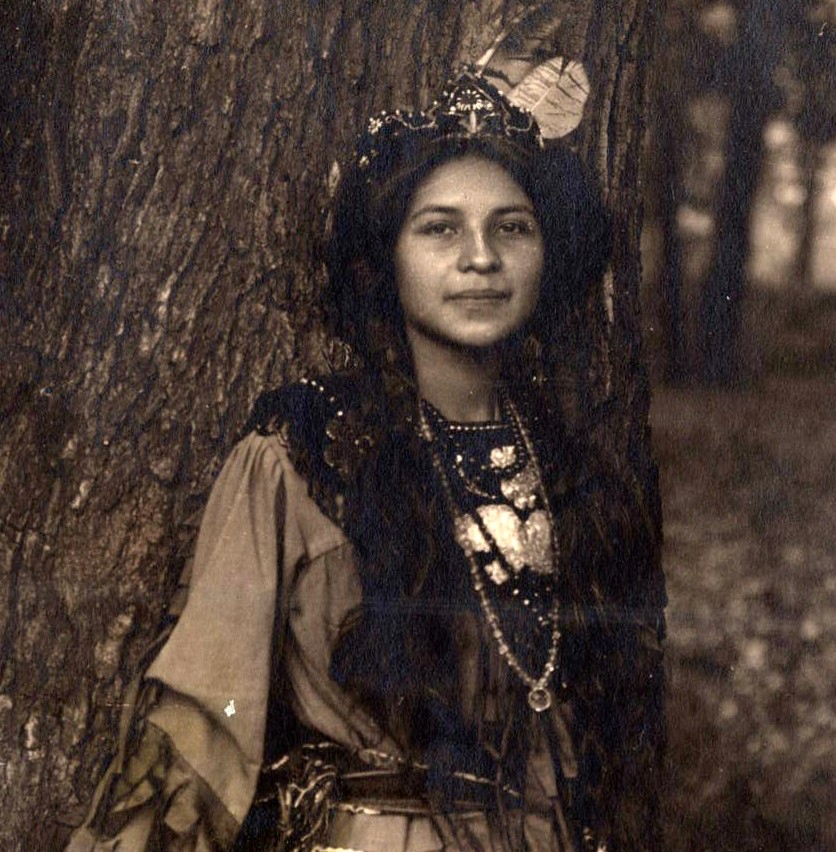
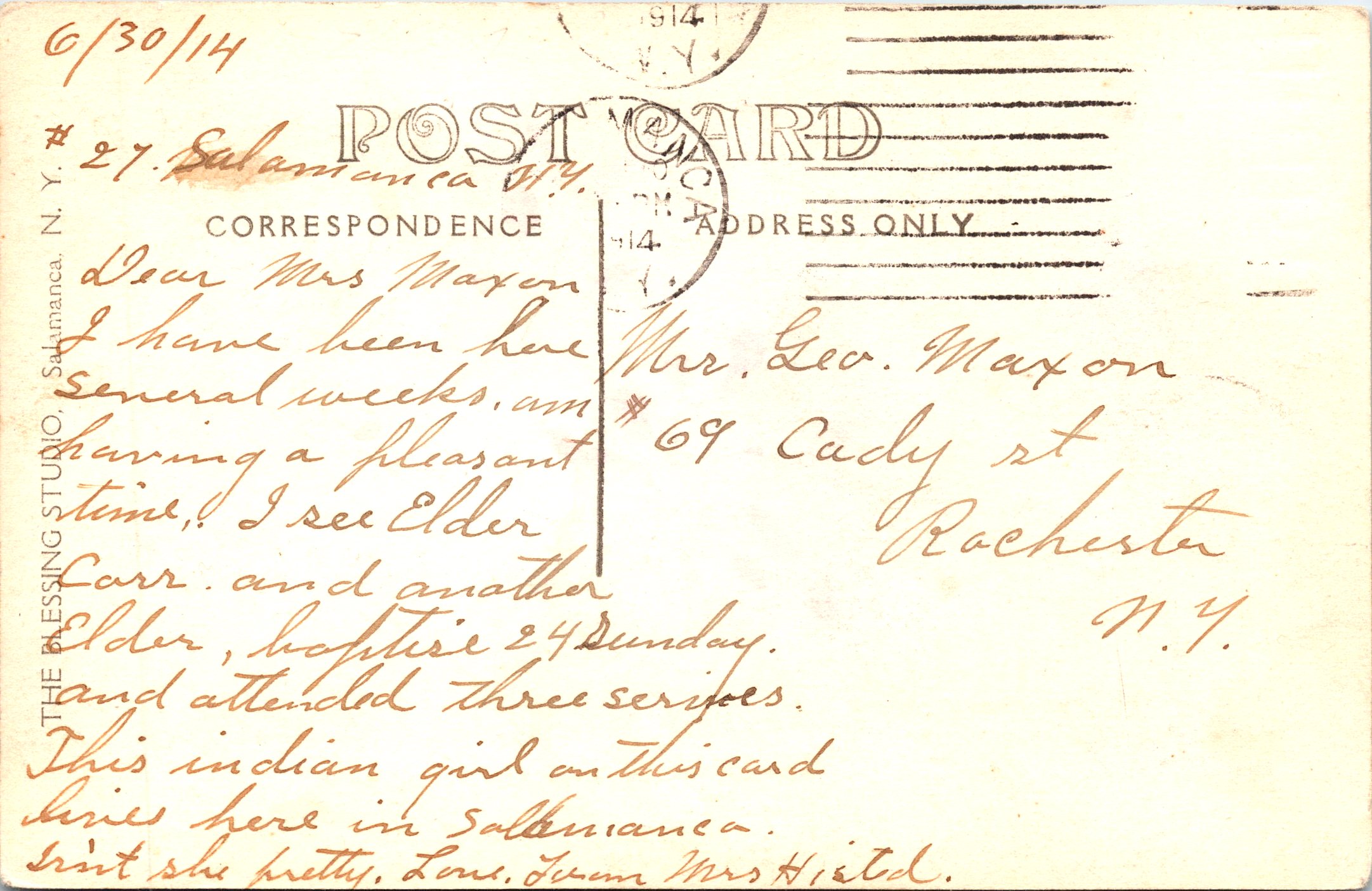
This vintage real photo postcard is striking. The photograph features a young attractive Native American woman. This photograph was taken by J. L. Blessing. His studio was located in Salamanca, New York. Blessing was no amateur, as is apparent in this 1908 photograph of the Native American woman seen below. She is from the Seneca tribe and her name is Ah-Weh-Eyu (translation: Pretty Flower). Her English name was Goldie Jamison Conklin and she was from the Allegany Reservation in Western New York. She was born in Salamanca in 1892 and died in 1974. She was quite beautiful and worked as a model for the Cattarugus Cutlery Company of Little Valley, New York. She helped advertise the company’s line of “Indian Brand” knives. She was often photographed by Jesse Lynn Blessing who operated the Blessing Studio in Salamanca. His father was J. H. Blessing (1851-1920) who started the studio. According to an entry on geneology.com by J. L. Blessing’s grandaughter, Mr Blessing “was asked to work with Disney Studios by Walt Disney but decided to take over his father’s studio instead”. The woman who wrote the message on this postcard could not help but comment about the Native American beauty appearing on this postcard. The writer states “The Indian girl on this card lives here in Salamanca. Isn’t she pretty?” SOLD
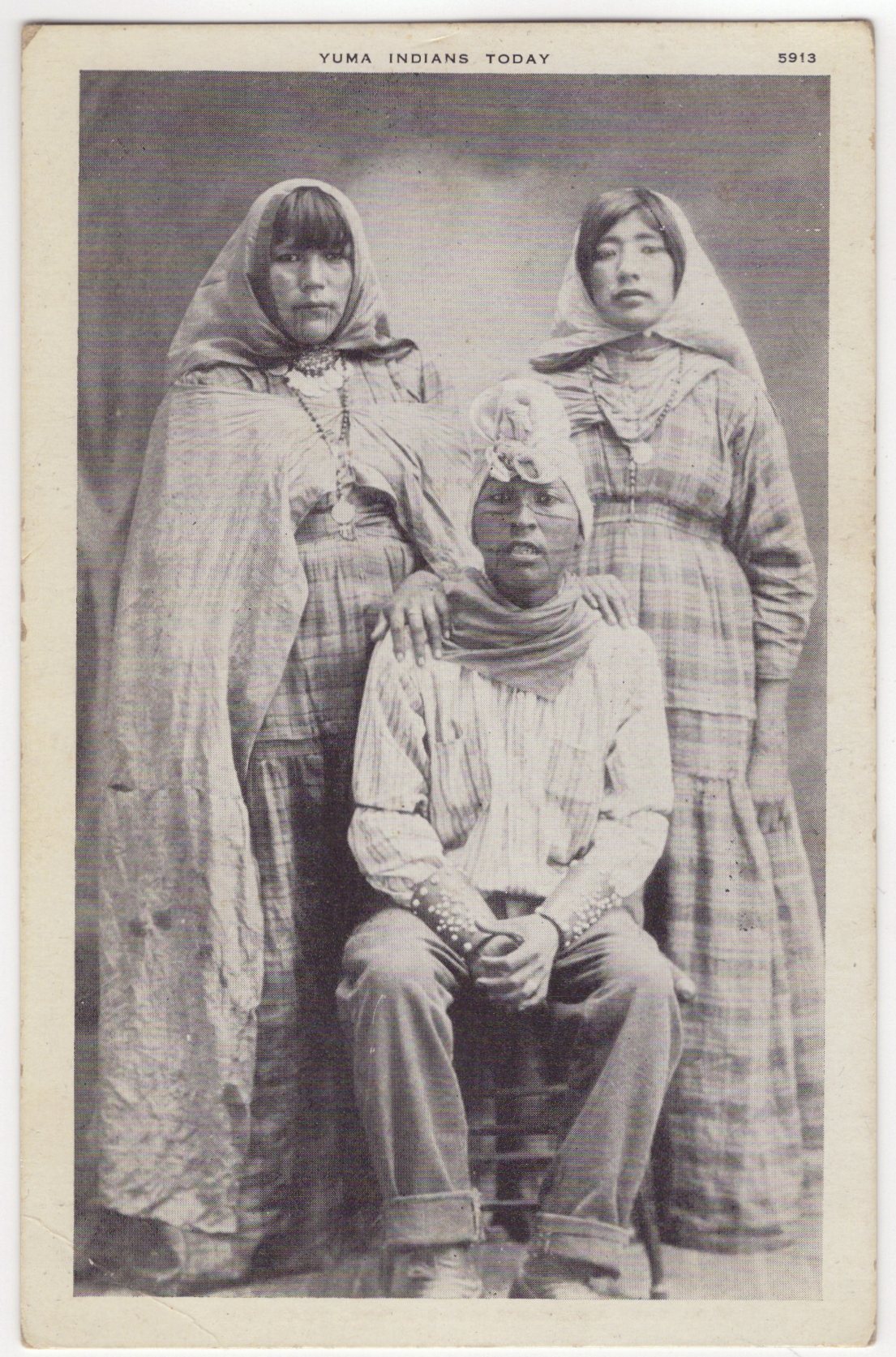
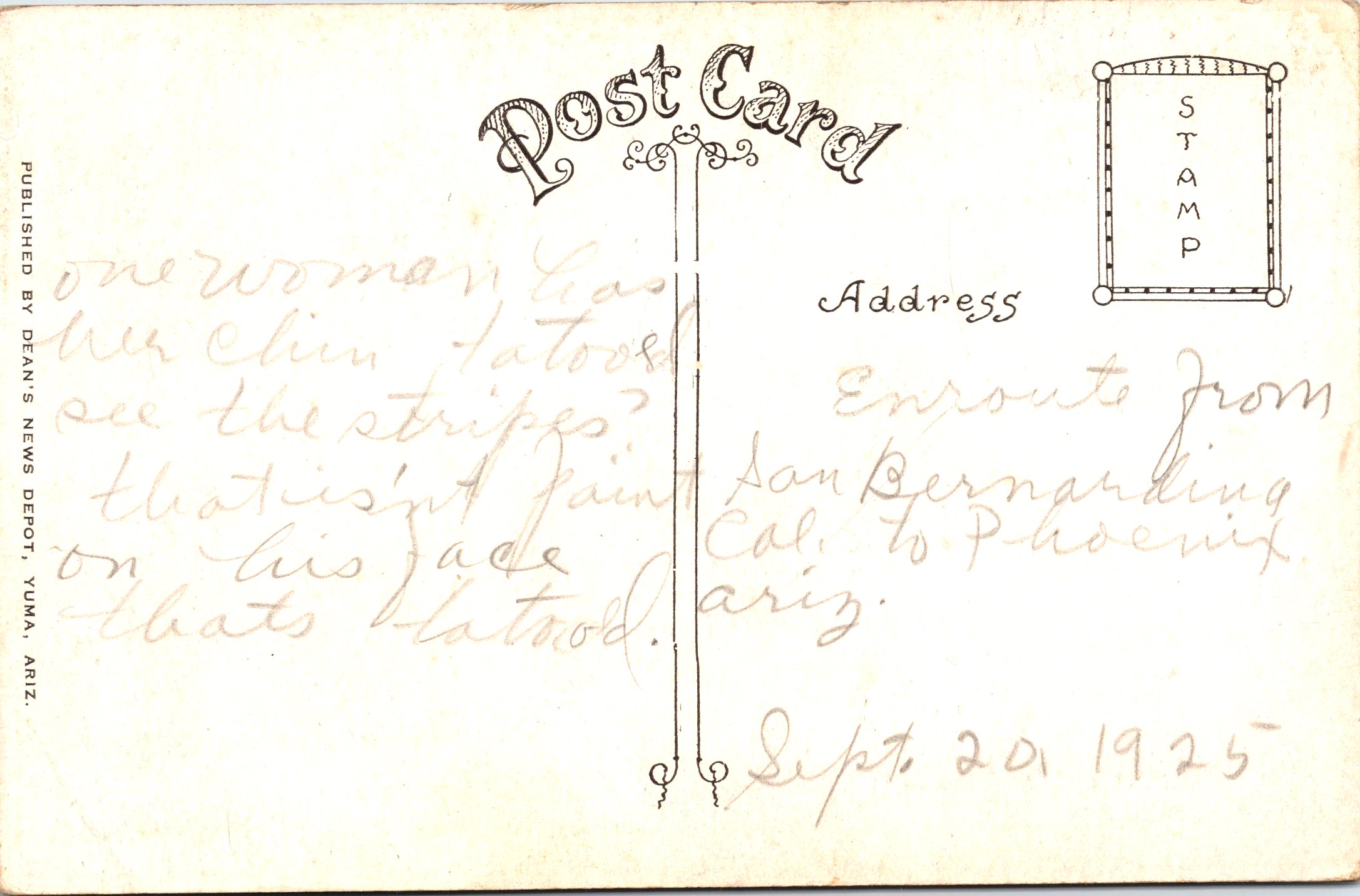
This vintage postcard features a portrait of three Yuma Indians. The Yuma are a Native American tribe that currently live on the Fort Yuma Indian Reservation. Their home is located on the lower Colorado River in Arizona and California. This lithographic postcard was mailed in 1925. The writer of the card was on route from San Bernadino, California to Phoenix, Arizona. The writer tells the recipient of the postcard that the lines on the seated man’s face, are not painted, but instead, they are tatoos. This postcard was published by Dean’s News Depot. The firm was located in Yuma, Arizona. (SOLD)
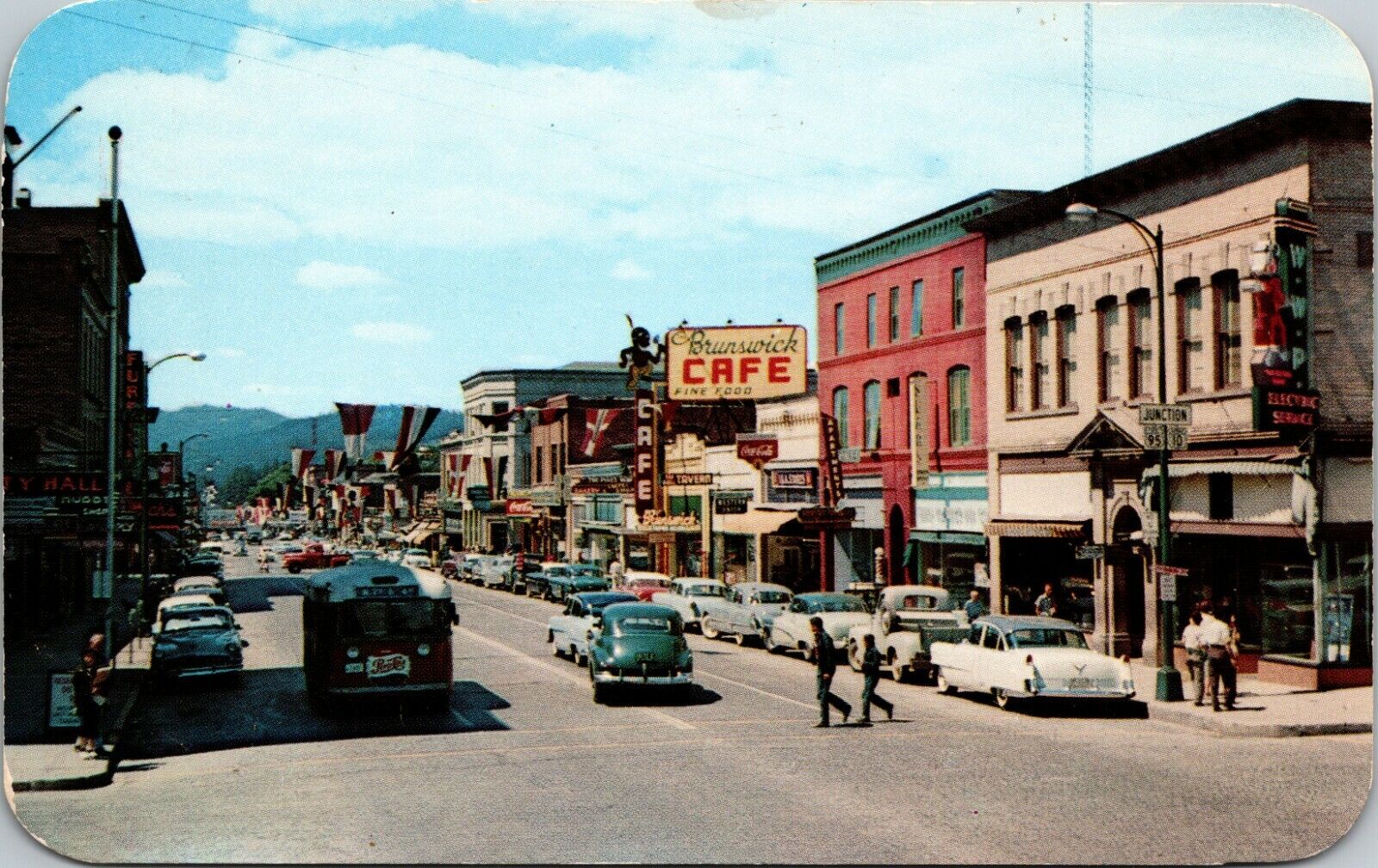
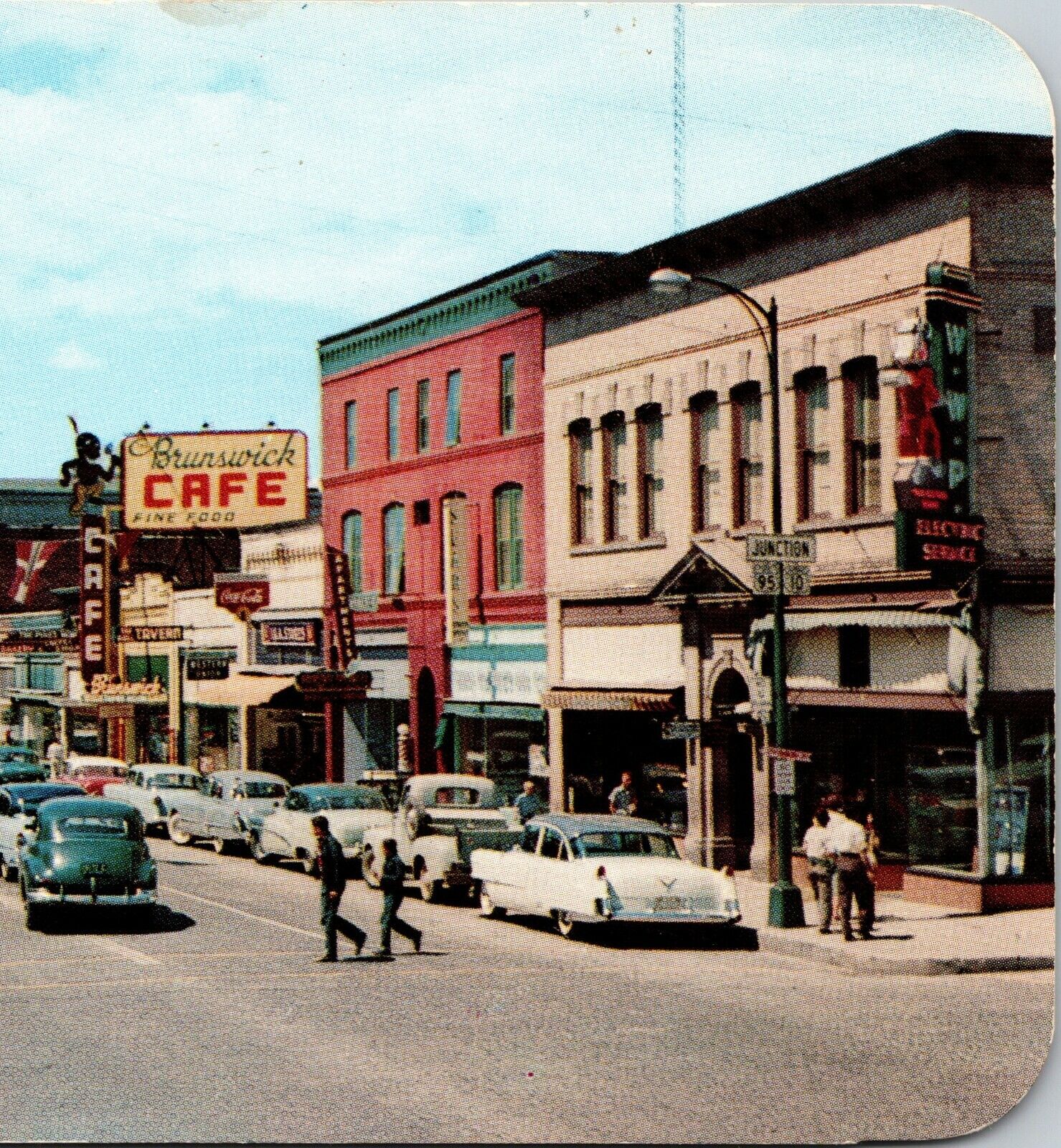
This vintage chrome postcard features a street scene in Coeur D’ Alene, Idaho. This card is an uncommon view of Coeur D’ Alene. The town has the look of the Old West. In addition, there are many decorative flags hanging over the street. The card shows Sherman Avenue and the street is a busy one. Note the signage. There are two Coca Cola signs and signs for the Brunswick Cafe, WWP Electric Service, some Apartments and a barbershop pole. There is also a junction sign for Route 95 and Route 10. The Brunswick Cafe sign is of a racist nature. The sign includes a cartoonish Native American holding a tomahawk. The cars on the street appear to be from the 1950’s. Check out the bus, as well as the red pick-up truck making a u turn further up the street. This postcard was published by Ross Hall Studios. The firm was located in Sandpoint, Idaho. SOLD
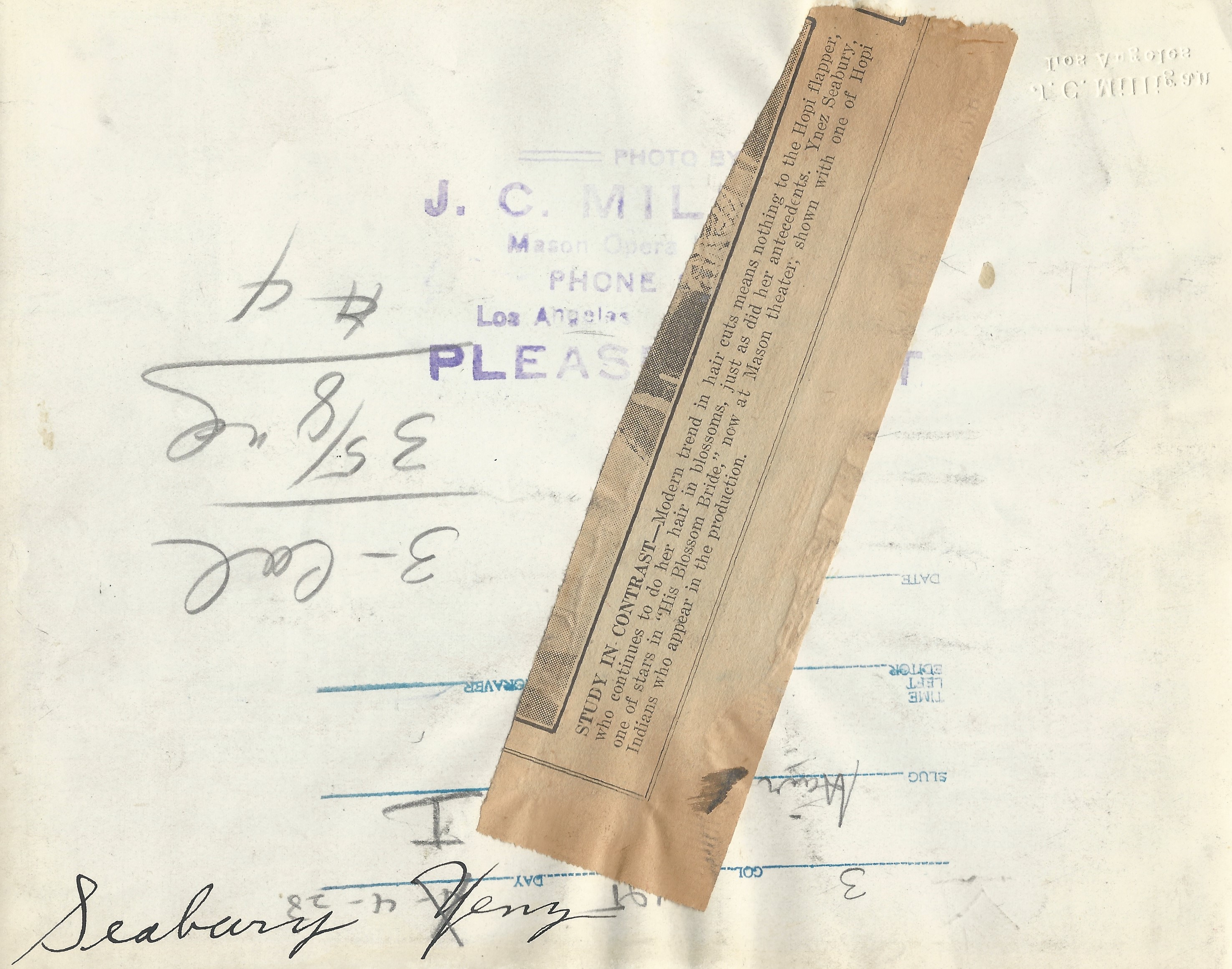
This vintage press photograph features a Native American woman and an actress named Ynez Seabury. The woman is wearing traditional clothing and a traditional hair style (in blossoms). The Native American woman is from the Hopi tribe. The pair were appearing in a play together. There were also other Hopi cast members. The play was called “His Blossom Bride”. Ynez Seabury (1907-1973) was an American actress who performed on the stage and in silent and early sound films. She was born in Oregon to parents who were both actors. She started her show business career as a child actor. She made her screen debut in D. W. Griffith’s, “The Miser’s Heart” (1911). The following year she appeared on Broadway. Many films followed. The IMDb reports that Seabury had 34 film credits. Her last feature film appearance was in a 1940 Cecil B. DeMille film.Seabury had dark features and as a result was often cast to play ethnic characters. A number of times she played Native American women. In 1928, she played a role in “His Blossom Bride”. This romantic drama premiered at the Mason Opera House in Los Angeles. Seabury played the Native American heroine but a number of Hopi tribesmen participated in the play. A popular online encyclopedia states that she was “revered” by the Hopis because she understood “their lives and ambitions”. The Hopi tribe lived primarily on the Hopi reservation located in Northeastern Arizona. This photograph was taken by J. C. Milligan. His name is embossed in the bottom right hand corner of the image.This photograph and caption appeared in at least one unidentified newspaper. (SOLD)
This vintage real postcard features a portrait of a Native American woman. She is carrying her young child on her back. She is dressed in Native American traditional clothing. Printing on the reverse of the card reveals that her name is Oue-ta-chu-hah and she is from the Maesquakie (Meskwaki) tribe. The tribe was located in Tam, Iowa. They are also known as the Fox tribe and are closely linked to the Sauk people. The message on this postcard is disturbing and racist. The writer tells the addressee that the Native Americans “take life easy, seldom working”. There is no mention of the impactful oppression and discrimination experienced by the tribes. This postcard was postmarked in 1909. (SOLD)
This vintage lithographic postcard features a group of Native Americans sitting (one is standing) in front of a teepee and making lacrosse sticks. Sitting in the group is a cute dog. Native Americans are credited with the development of the game of lacrosse. More specifically, the Iroquois Nation were originators of the game. The Iroqouis were in upstate New York and North of the US border into Canada. Lacrosse became Canada’s national sport. The netting on the Native American made sticks was made with wattup (roots) or deer sinew (connective tissue from deer). This postcard is rich in color and represents both Iroquois history and the history of Lacrosse. This card was published by Nerlich & Company (Toronto, Canada). Another version of this postcard has a caption reporting that the cards scene is located on Cornwall Island, Ontario, Canada. The postcard has a U.S. stamp and was mailed from Old Orchard Beach, Maine to Epping, New Hampshire in 1911. (SOLD)
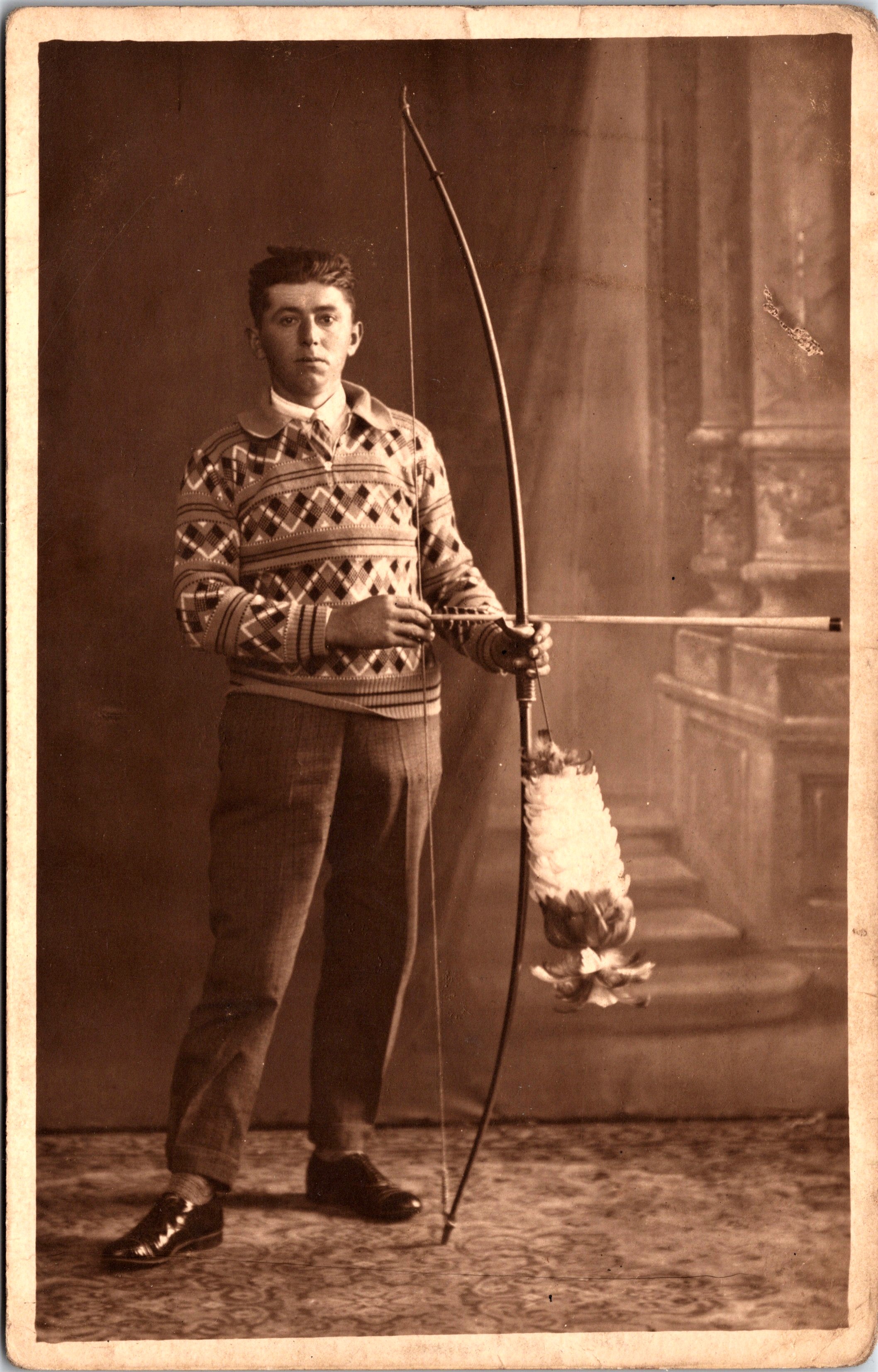
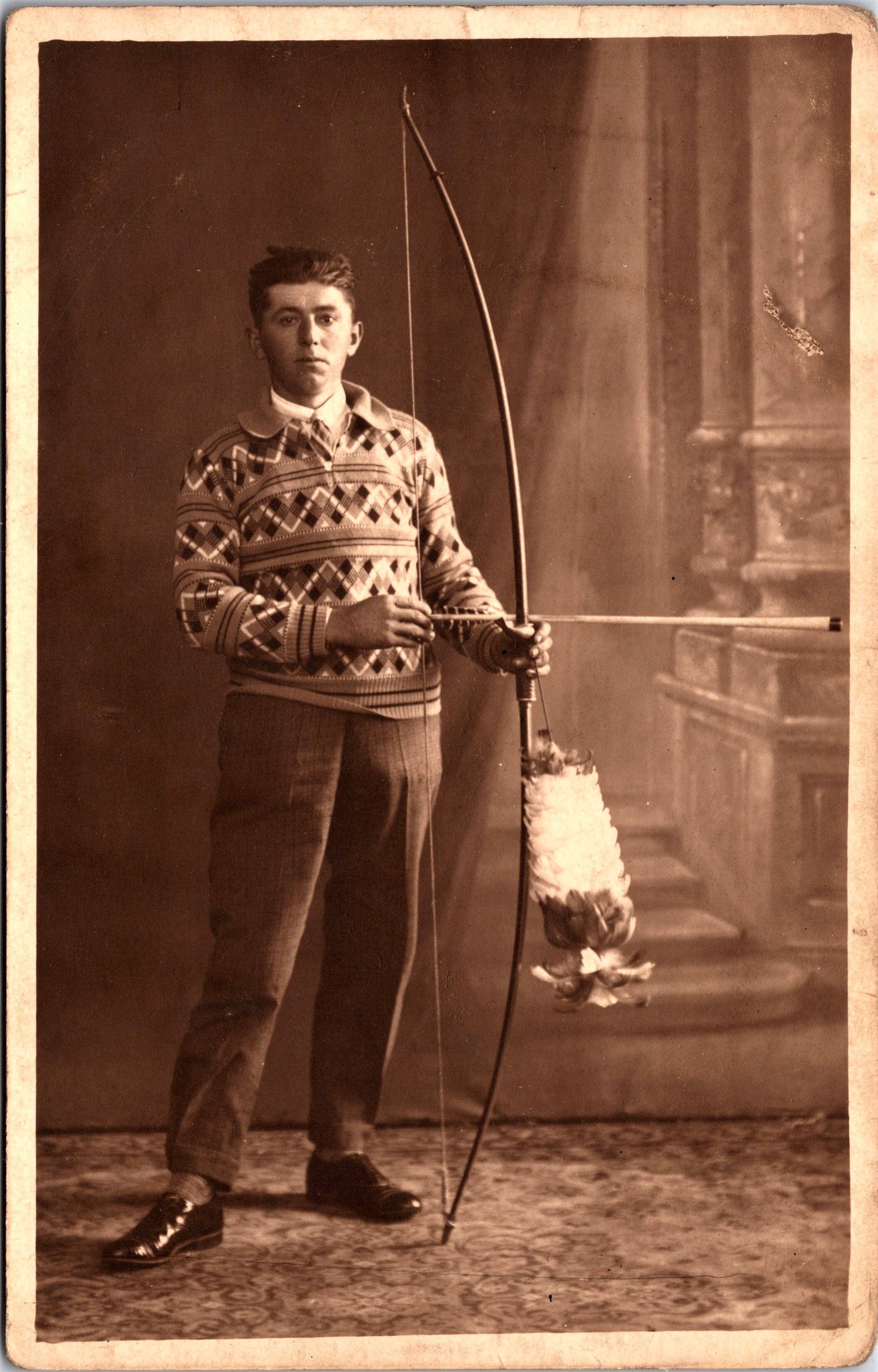
This vintage real photo postcard is a beauty. It features a young man holding a large bow and arrow. The size of the bow indicates to me that he knows how to handle it. The bow is not a toy. One has to wonder if this young man is Native American? The feather accessory hanging on this bow is most likely to be found on the bow of a Native American archer. The man’s complexion may also be a clue to his ethnicity. This vintage postcard is in very good condition (see scans).
Buy this Vintage Real Photo Postcard (includes shipping within the US) #3557
To purchase this item, click on the Pay with PayPal button below
$26.49
Buy this Vintage Real Photo Postcard (includes International shipping outside the US) 3557
To purchase this item, click on the Pay with PayPal button below
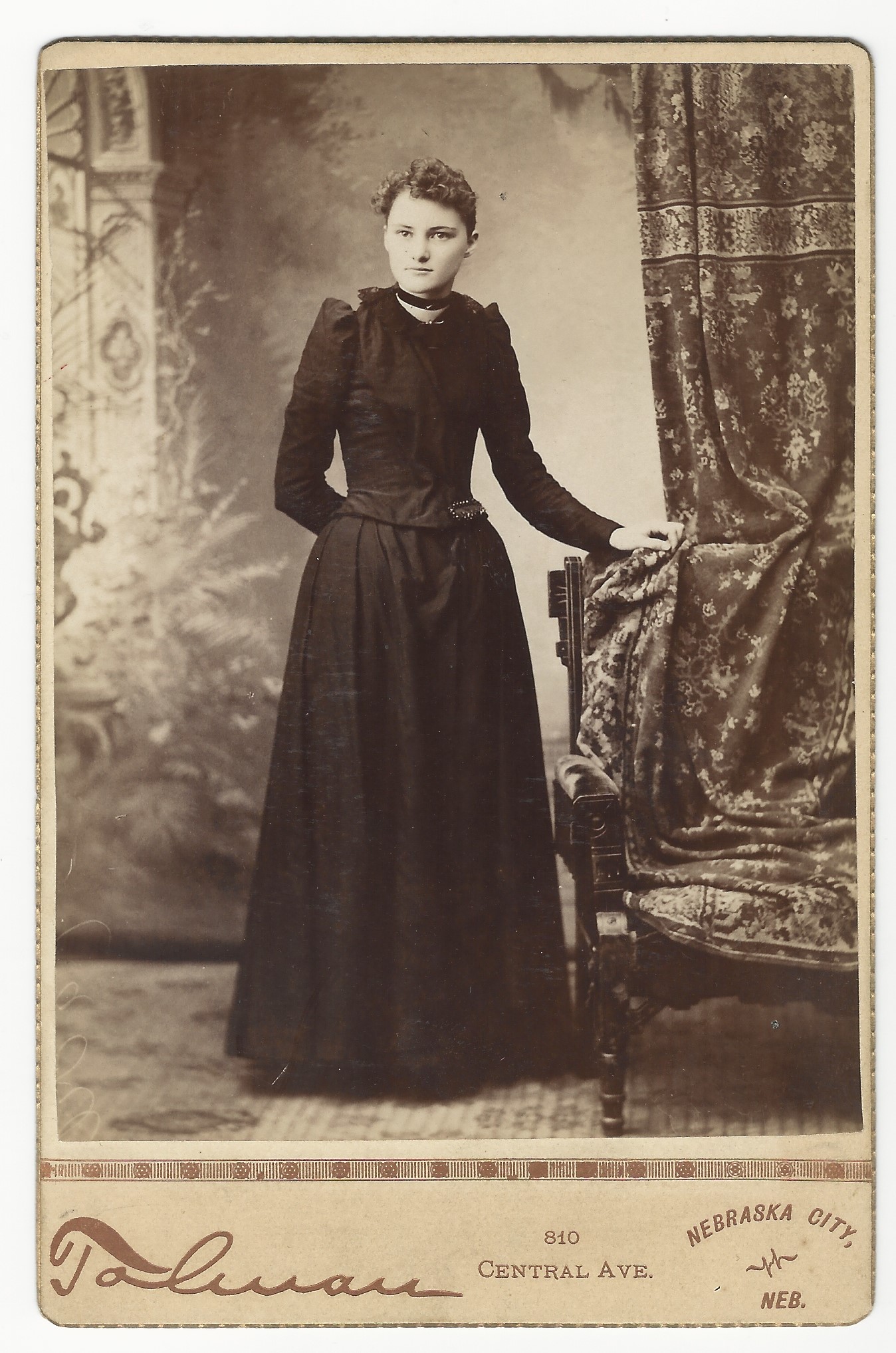
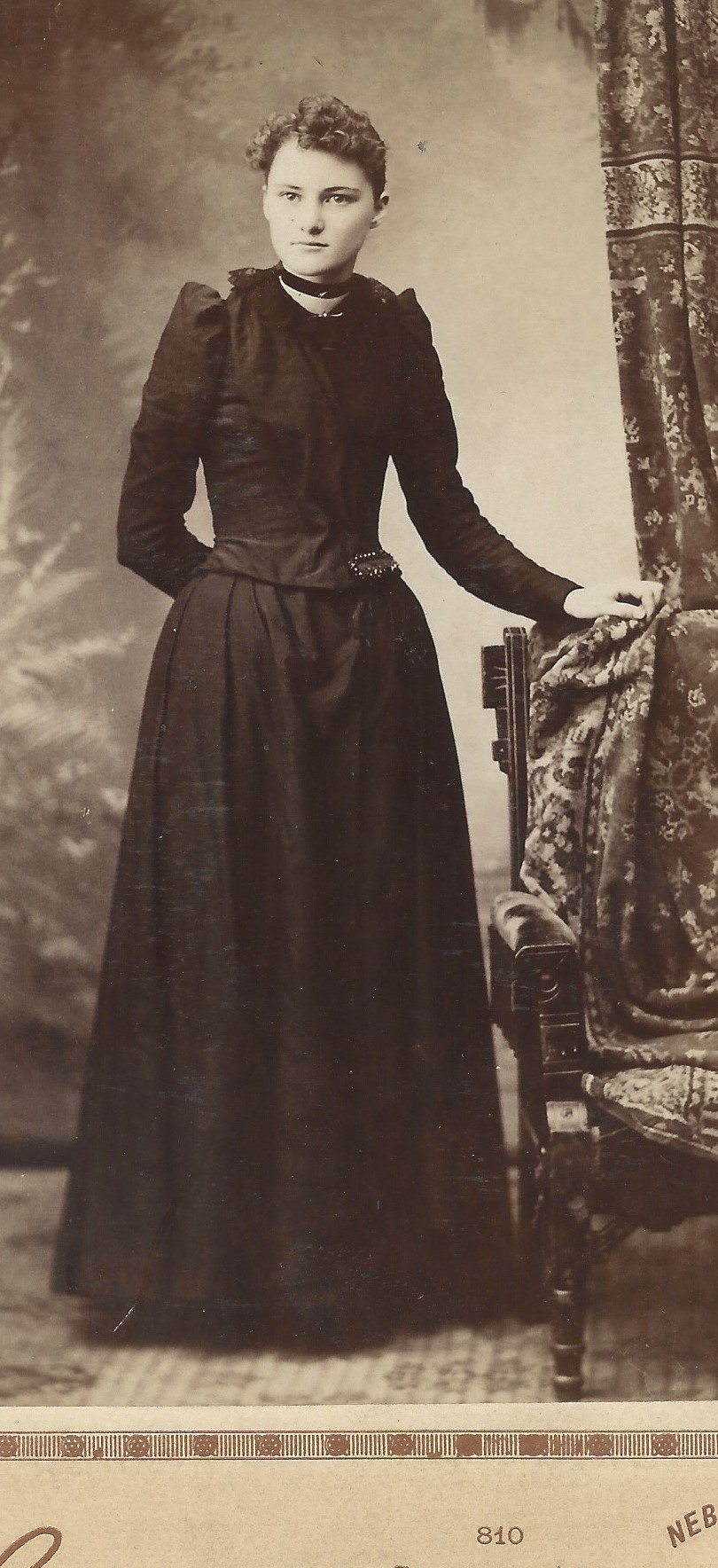
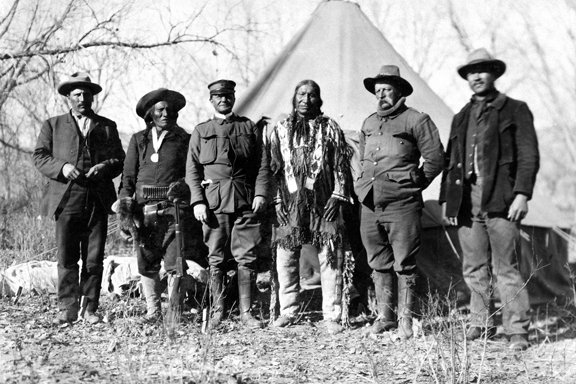
A young woman poses for her portrait at the Tolman studio in Nebraska City, Nebraska. She is likely in her teenage years. She is wearing a wide black band around her neck. Is the band jewelry? Is it part of her dress? Does the black collar band represent something (ie mourning)? I hope some of the visitors to the Cabinet Card Gallery will express their opinion about the band. The photographer of this image is Thomas W. Tolman. One source states that he was from Fort Dodge, Iowa and that he is listed in the 1882 Glenwood (Iowa) business directory (1882) as a photographer. Later, he was listed in the 1890 Nebraska City business directory. An article in the Gillette News Record (Wyoming) presents some interesting information about Mr. Tolman. He was hired by Collier’s Magazine to document a group of White River Utes migration from the Uintah reservation in Utah. They were heading north and their trip took them through Gillette. They were leaving the reservation because of a federal mandate that reclaimed some of the land on the reservation for homesteading and mining. A group of about 400 men, women, and children started the journey in 1906. Their destination was unclear. It was thought they may have been heading to Montana, or South Dakota. When they arrived near Gillette, they camped about 50 miles north of the city. This was the locale where they were photographed by Tolman. Along their travels, there were rumors of violence attributed to the this group of Native Americans. These rumors were unfounded. The New York Times condemned the journalists who reported the “fake news” about this group of Utes. Unfortunately, the complaints came from citizens who wanted the group rounded up and the US Cavalry was called to intercept them. Tolman photographed the group of Utes, both before and after the arrival of the US troops. A compromise was made and the migrating Native Americans agreed to go to Fort Meade, South Dakota with the cavalry escort. In exchange, the Utes were promised an opportunity to go to Washington D.C. to express their feelings about the Government’s “land grab”. In fact, Ute leaders did go to the nation’s capital where they met with President Theodore Roosevelt and hi head of the Bureau of Indian Affairs. The US did not change it’s policies. The Utes stayed at Fort Meade for about six months and than leased land from the Sioux for about a year. In 1908, the group returned to their reservation in Utah. The photos appeared in Collier’s Magazine. The article was headlined “The Unquiet Ute”. An example of one of the photographs in the series can be found below. It is not included in the sale of this cabinet card. It is impressive that Tolman was able to take well regarded photos without the comfort and resources of his studio. SOLD
A PHOTOGRAPH BY TOLMAN FROM “THE UNQUIET UTE COLLECTION”
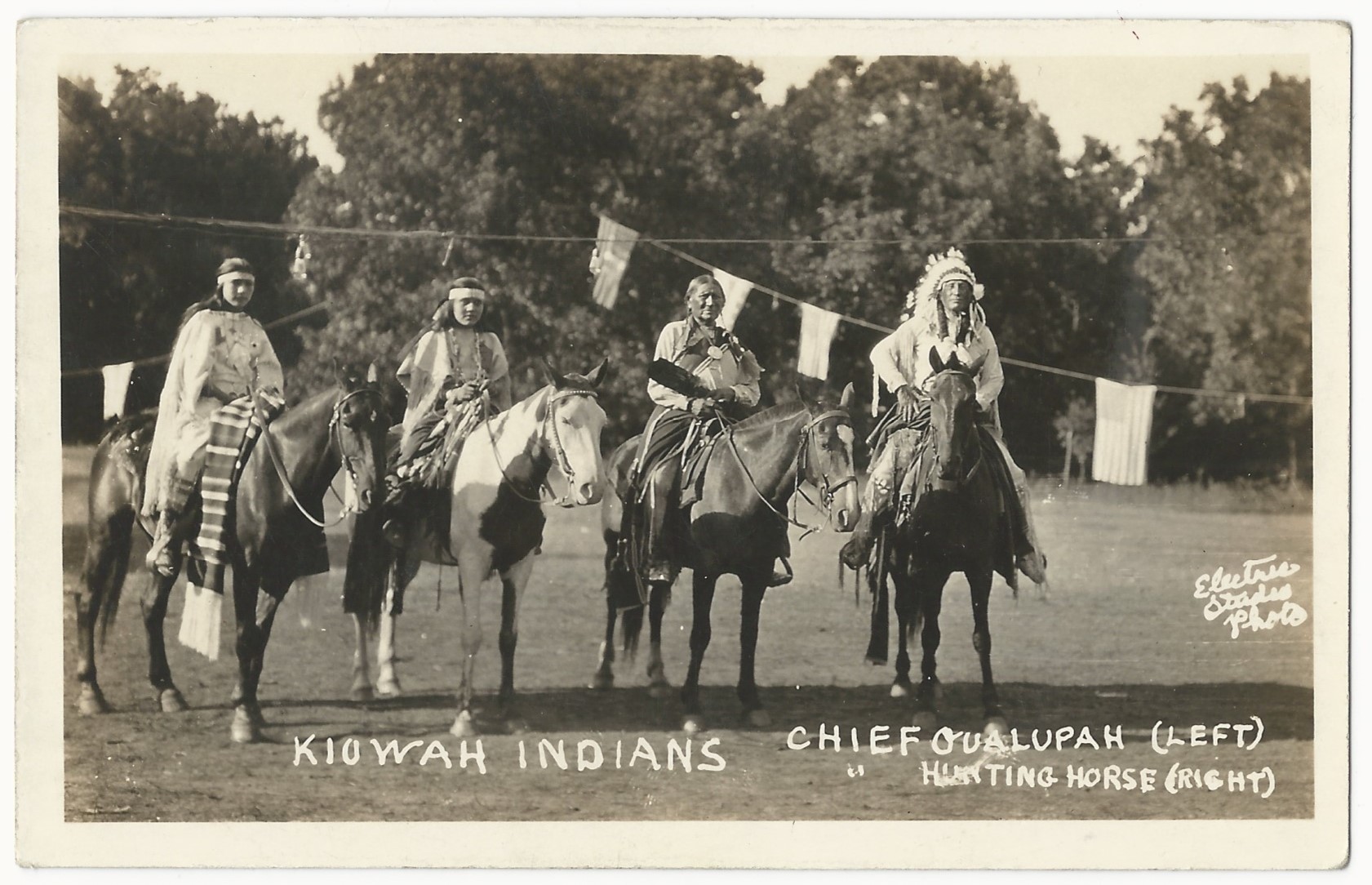
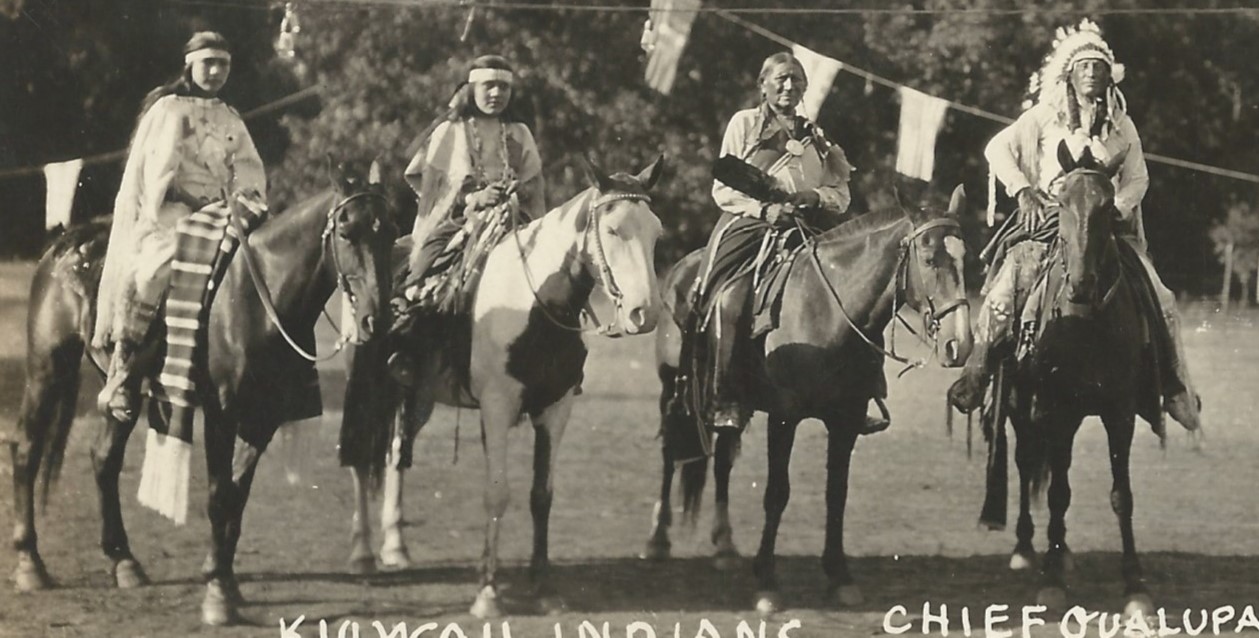
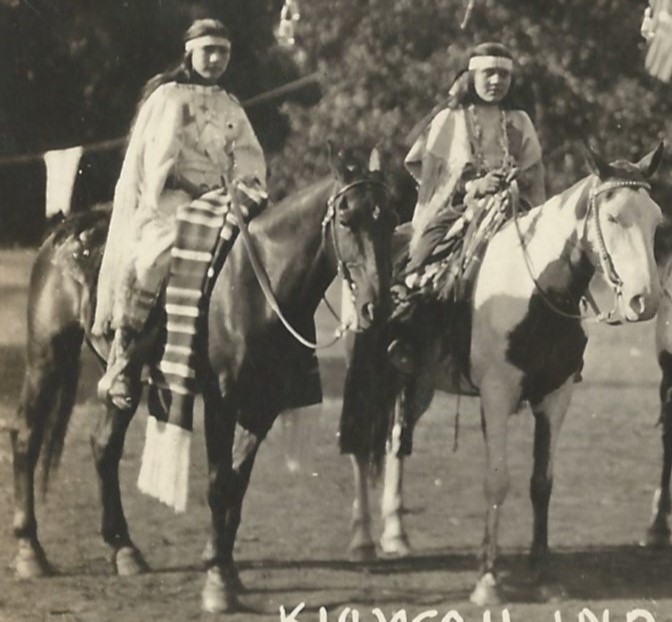
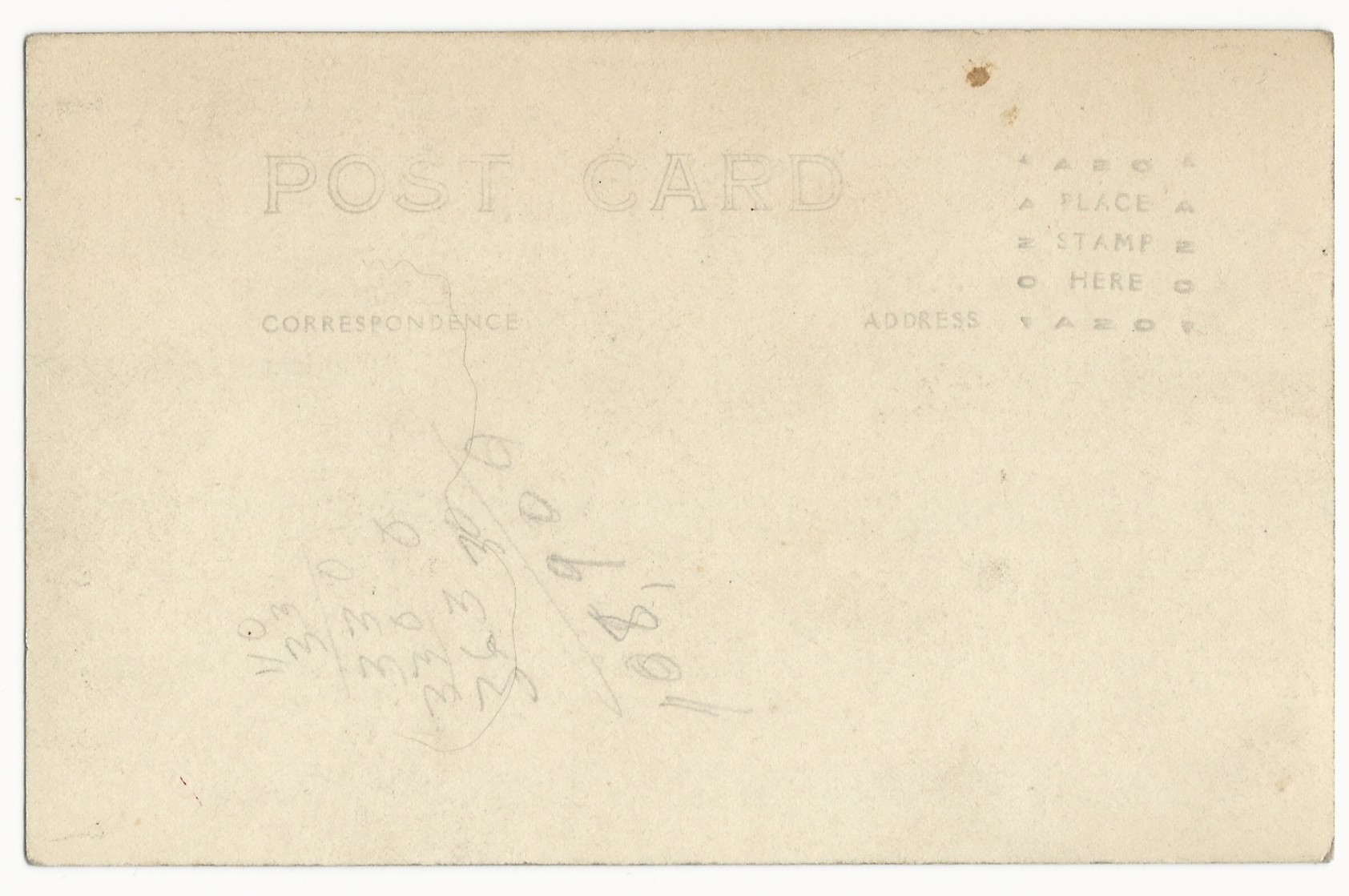
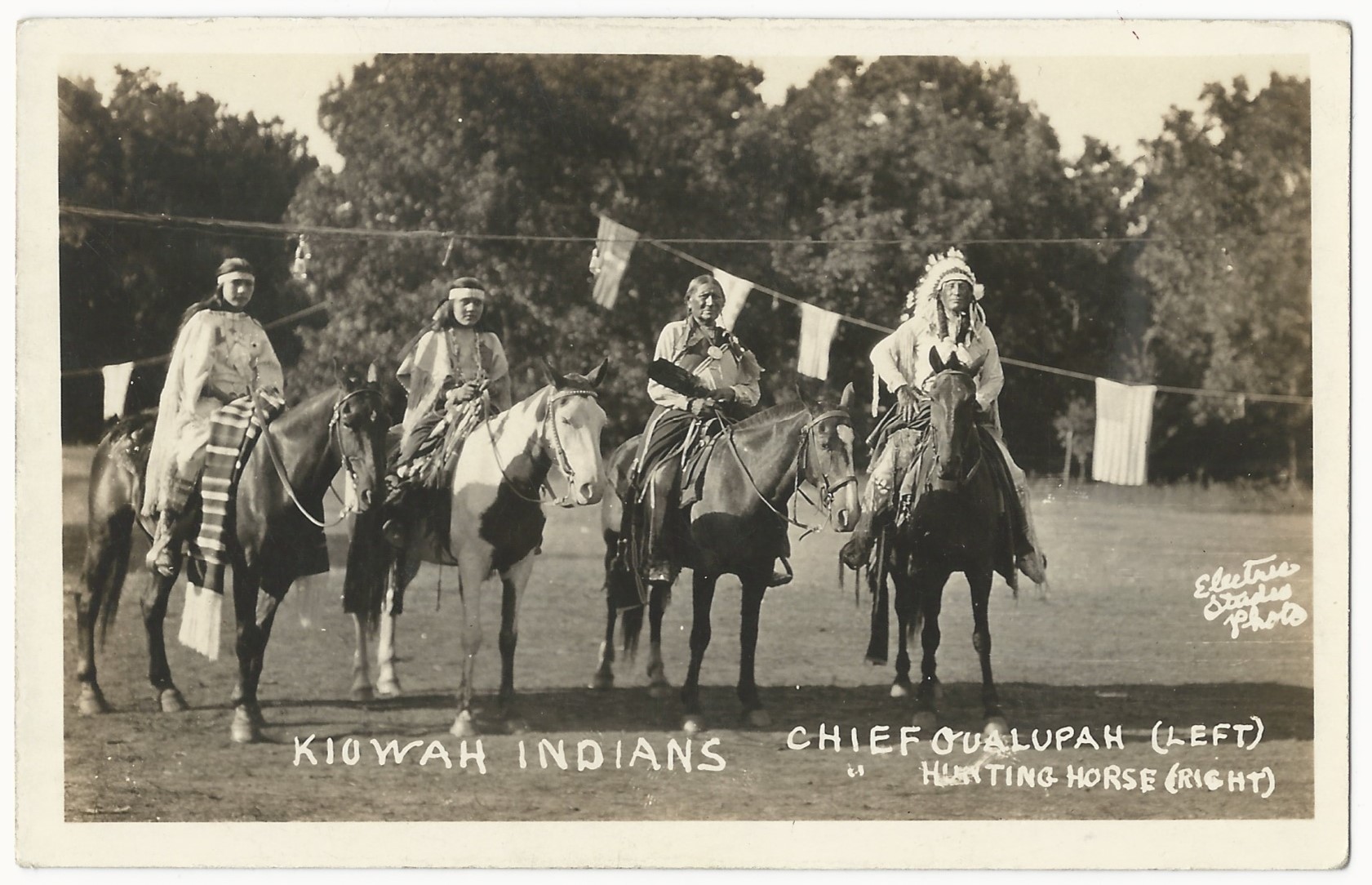
This vintage real photo postcard features a portrait of four Native Americans on horseback. The foursome are members of the Kiowah tribe. Among the group are Chief Qualupah and Chief Hunting Horse.The other two riders appear to be women. The four are dressed in Native American clothing. They are in a field which has lines of rope holding American flags. Perhaps they are invited guest to an Amrican patriotic holiday celebration. Researching Chief Qualupah was an exercise in frustration. I learned nothing about him. There were chiefs mentioned that had names close to “Qualupah”, leading me to believe that there are several different spellings of his name. Information about Chief Hunting Horse was plentiful. He was a well known scout during the Custer, Sheridan, and Sherman era. In 1871 he enlisted for a two year stint in the Seventh Cavalry commanded by Gerneral Custer. By the end of his legendary scouting career, his friends included Theodore Roosevelt and Geronimo. He was born in Medicine Lodge Kansas in 1846. He was the son of a Kiowa war chief and a Spanish woman who had been kidnapped in Mexico and raised by the Kiowas. Hunting horse came to “Indian Territory” (Oklahoma) at the age of fifteen. In 1917 he appeared in the silent Western film, “Daughter of the Dawn”. In the early 1900’s relatives began celebrating his birthday. These celebrations occurred every year until his death. Military and political figure were often among the attendees. Chief Hunting Horse died at the age of 107 and his funeral included full military honors. Who are the Kiowa? They were considered a nomadic tribe of the plains. It is thought that they originated in the northern basin of the Missouri River but migrated to the Black Hills around 1650. They lived peacefully there with the Crow Indians until they were invaded by the Cheyenne, Arapaho, and Sioux; resulting in the Kiowas moving further south. There they fought with the Comanche, but with the help of the Spanish, the two tribes formed an alliance and agreed to share their land. Joined by the Plains Apache, they hunted, traveled and fought war together.They raided settlements in Texas and New Mexico. They stole horses and mules which they used to trade with the Plains Indian tribes. In 1867, the Kiowa signed a treaty and agreed to settle on a reservation in Oklahoma. In 1901 their lands were open for settlement by whites and dissolving the contiguous reservation. Today, there are more than 12,000 Kiowa tribe members in Oklahoma and throughout the Southwest. The photograph taken for this postcard was taken by the Electric Studio. The postcard has an AZO stamp box indicating that the postcard dates back to sometime between 1910 and 1930. This postcard is in very good condition (see scans).
Buy this Vintage Real Photo Postcard (includes shipping within the US) #3205
To purchase this item, click on the Pay with PayPal button below
$35.50
Buy this Vintage Real Photo Postcard (includes International shipping outside the US) #3205
To purchase this item, click on the Pay with PayPal button below










 THE CABINET CARD GALLERY