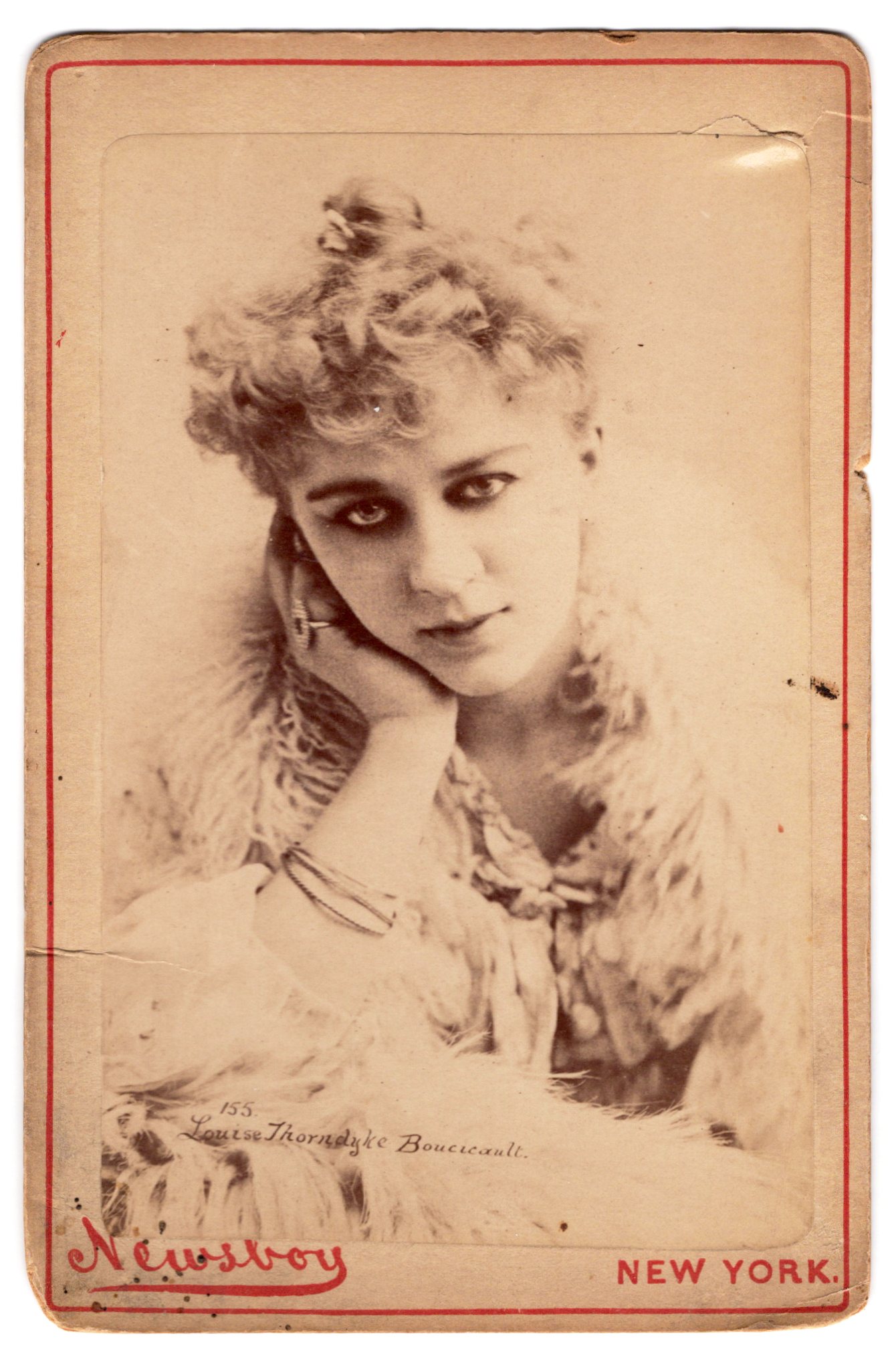
This captivating cabinet card portrait captures the actress Louise Thorndyke Boucicault (1864-1956), gazing directly into the camera with a contemplative, almost melancholy expression. Her eyes, heavily shadowed for dramatic effect, convey a depth of emotion that draws the viewer in. Her pose—head resting lightly on one hand—suggests a moment of introspection or elegant fatigue, a pose popular among 19th-century theatrical portraits intended to convey sophistication and emotional depth. Louise is adorned in a luxurious feather-trimmed garment that softly frames her face and shoulders, enhancing the ethereal, romantic atmosphere of the image. She wears multiple rings and a distinctive bracelet, suggesting a woman of style and theatrical flair. Her curly, light-colored hair is fashionably styled, with short bangs and loose curls swept back, a look typical of actresses of the 1880s and early 1890s. The image is labeled “155. Louise Thorndyke Boucicault” in the lower portion of the photograph, identifying her as the sitter. The card is mounted on cream cardstock with red border lines and bears the imprint “Newsboy, New York”—a well-known distributor of celebrity cabinet cards in the late 19th century. The reverse side of the card is blank, with the exception of a faint pencil inscription that appears to read “Jim”. Louise Thorndyke Boucicault was an English actress associated with the renowned Boucicault theatrical family. She was the wife of playwright Dion Boucicault Jr., himself the son of the famed Irish dramatist Dion Boucicault. Louise was active on stage during the Victorian and Edwardian periods and became known for her graceful presence and work in both dramatic and comedic roles. Her appearances were noted in both England and the United States. The Newsboy Cabinet Card Company, active in the 1890s, was known for producing mass-market cabinet cards featuring celebrities of the era—especially stage performers, opera singers, and vaudeville stars. These cards were distributed through tobacco products or sold directly as collectibles. (SOLD)
JULIA MARLOWE: ESTEEMED AMERICAN STAGE ACTRESS


CABINETCARD 6CABINET CARD 7 (SOLD)


CABINET CARD 12


CABINET CARD 14 (SOLD)

CABINET CARD 15 (SOLD)
VINTAGE PHOTOGRAPH 16 (SOLD)
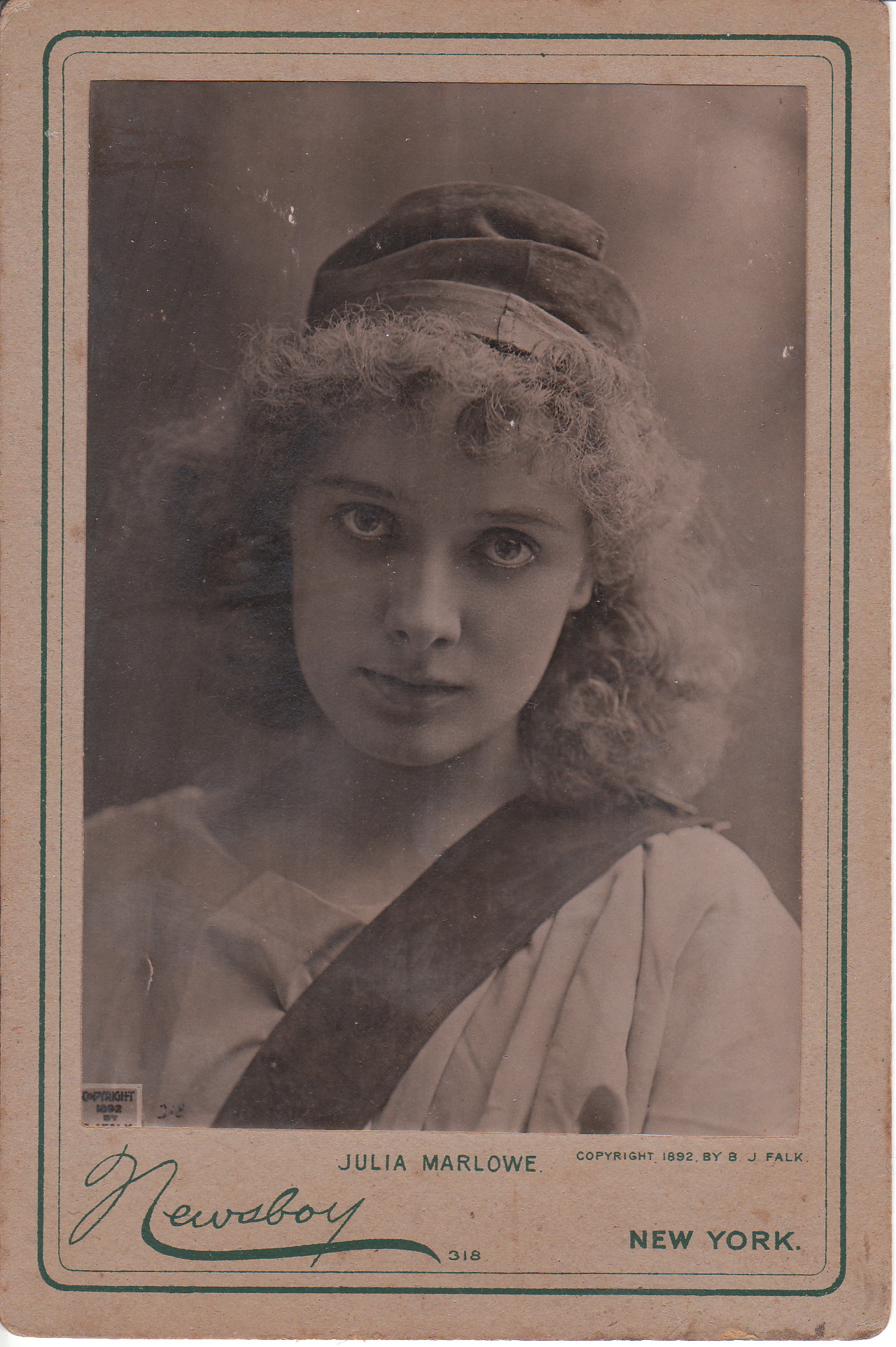
Julia Marlowe (1865-1950) was born in England and as a young child moved to the United States with her family. In her early teens she began her theatrical career with a juvenile opera company. She began playing Shakespeare in her home town of Cincinnati, Ohio. She made her Broadway debut in 1895 and by the end of her career, had appeared in more than 70 Broadway productions. Her first husband was actor, Robert Tabor. Their marriage lasted six years. In 1904 she appeared in “When Knighthood was in Flower”. Great success in this play brought her financial independence. Earlier, in 1903, she appeared in ‘The Cavalier” and “Ingomar”. The New York Sun wrote about her performance in “Ingomar”; “There is not a woman player in America or in England that is – attractively considered- fit to unlace her shoe”. In 1904 she began a partnership with actor E. H. Sothern. They toured the United States performing various plays of Shakespeare. They were managed by Charles Frohman and later, the Shubert brothers. They were considered to be among the major Shakespearian actors of the day. In 1906, Marlowe played in “Jeanne d’Arc” and also as Salome in “John the Baptist”. Later, Sothern and Marlowe played in London but were not terrific box office successes there. In 1911 Marlowe and Sothern married each other. In 1920 and 1921, they made eleven phonograph recordings for the Victor Company. The top Cabinet Card was produced by Newsboy as a premium for their tobacco products. The photographer was Falk and the image is from 1892.
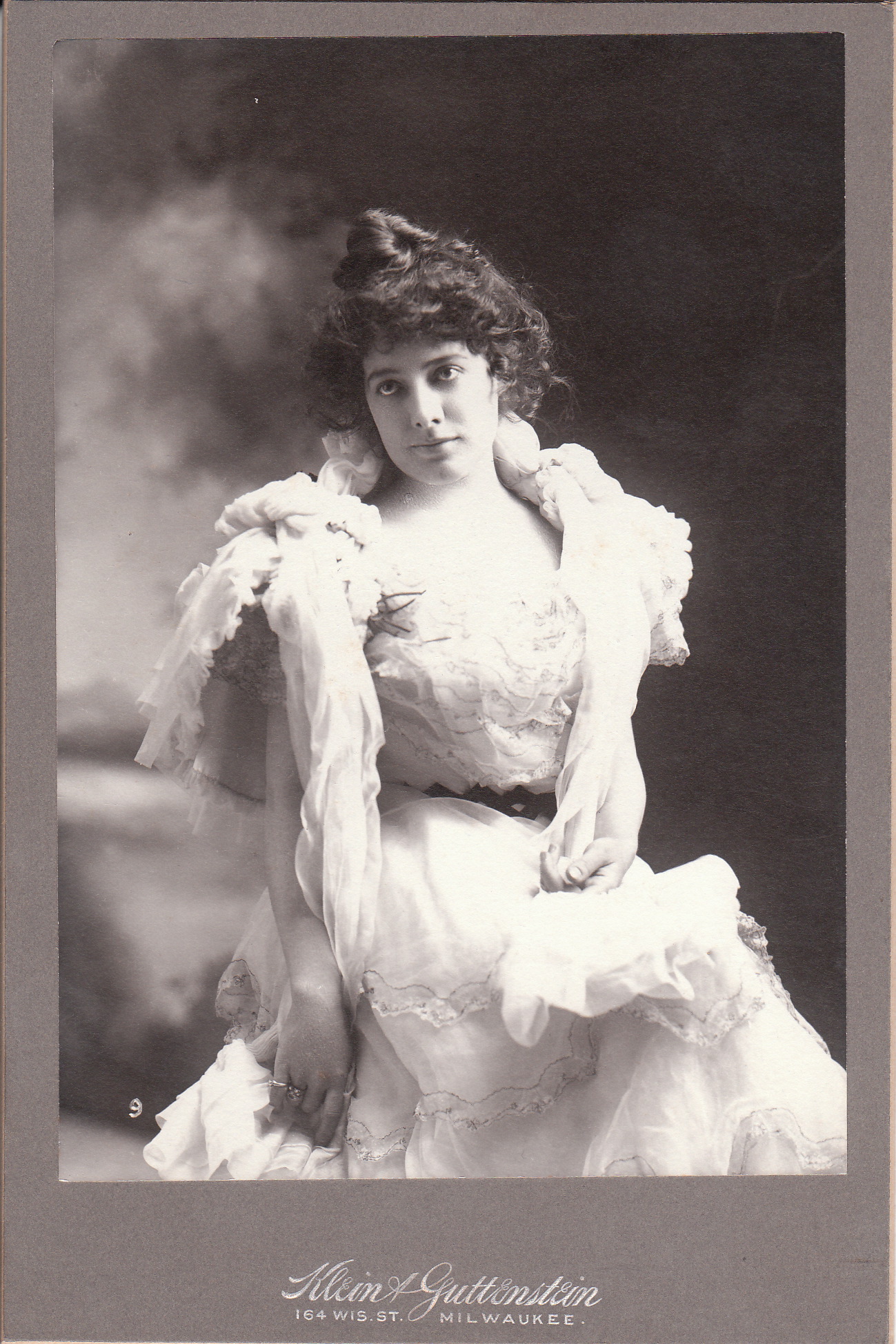
The second portrait of Julia Marlowe has a notation on the reverse of the card stating “Julia Marlowe Tabor”. Therefore, this photograph was likely taken during the time of her marriage to Tabor (1894-1900). The photographic studio that produced this portrait is Klein & Guttenstein of 164 Wisconsin Street, in Milwaukee, Wisconsin. Klein and Guttenstein were leading photographers of their time. Wilson’s Photographic Magazine (1902) reveals that the two men were very active in the Photographers Association of Wisconsin and other photography organizations. The photographers were considered part of a network of photographers skilled at producing publicity images of theatrical and vaudeville stars to be used in national magazines and other publications. The New York Public Library has a collection of portraits of actress Blanche Bates; produced by Klein & Guttenstein. The University of Pennsylvania Library has one of Klein & Guttenstein’s portraits of Julia Marlowe. (SOLD)
The third portrait of Julia Marlowe in the cabinet card gallery collection is photographed by Sarony, the famed celebrity photographer located in New York City. This cabinet card is signed by the actress and dated 1890. Additonal photographs by Sarony can be viewed by clicking on the category “Photographers: Sarony”. SOLD
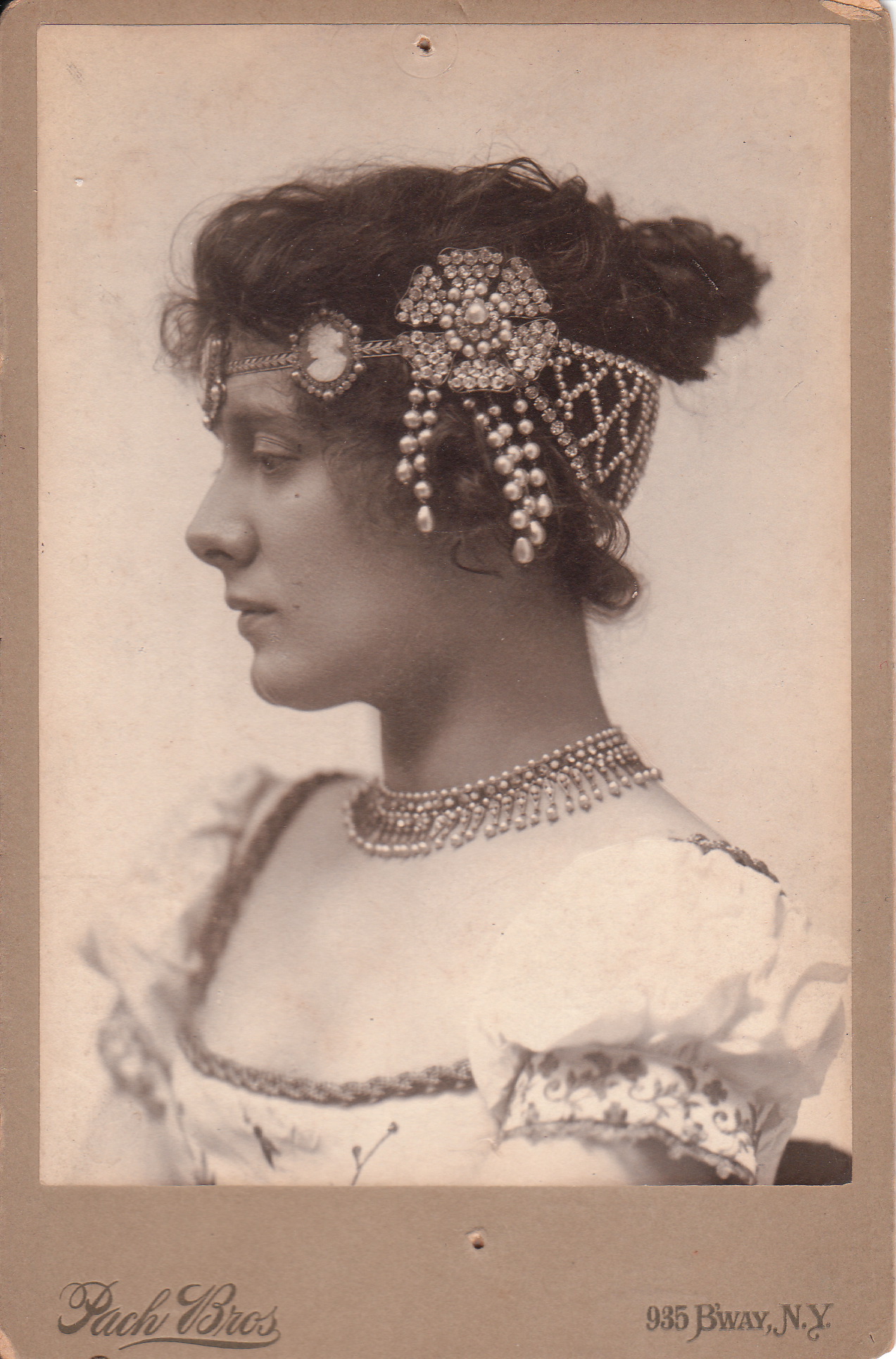
The fourth portrait of Miss Marlow features her in role in the production of “Countess Veleska”. The play was adapted for a German work, “The Tall Prussian”, by Rudolph Stratz. The play opened in New York in 1898 at the Knickerbocker Theatre. The review in the New York Times (1898) stated that the “drama was made wholly interesting by the personal charm and sincerity of Miss Marlowe”. In a sarcastic tone, the reviewer comments about Marlowe’s co star, Bassett Roe. The reviewer states that Roe has only two qualities of the man he was playing, “height and good looks”. The reviewer continues his scathing description of Roe; “The only time he actually warmed up was when he accidentally set his hair on fire. Even then he would have let it burn if Miss Marlowe had not gone to his rescue.” The photographic studio that produced the “Countess Veleska” cabinet card was Pach Brothers of New York City. Pach Brothers were photographers known for their photographs of celebrities of their era. To see additional photographs by the Pach Brothers, click on this site’s category of “Photographers: Pach Brothers”.
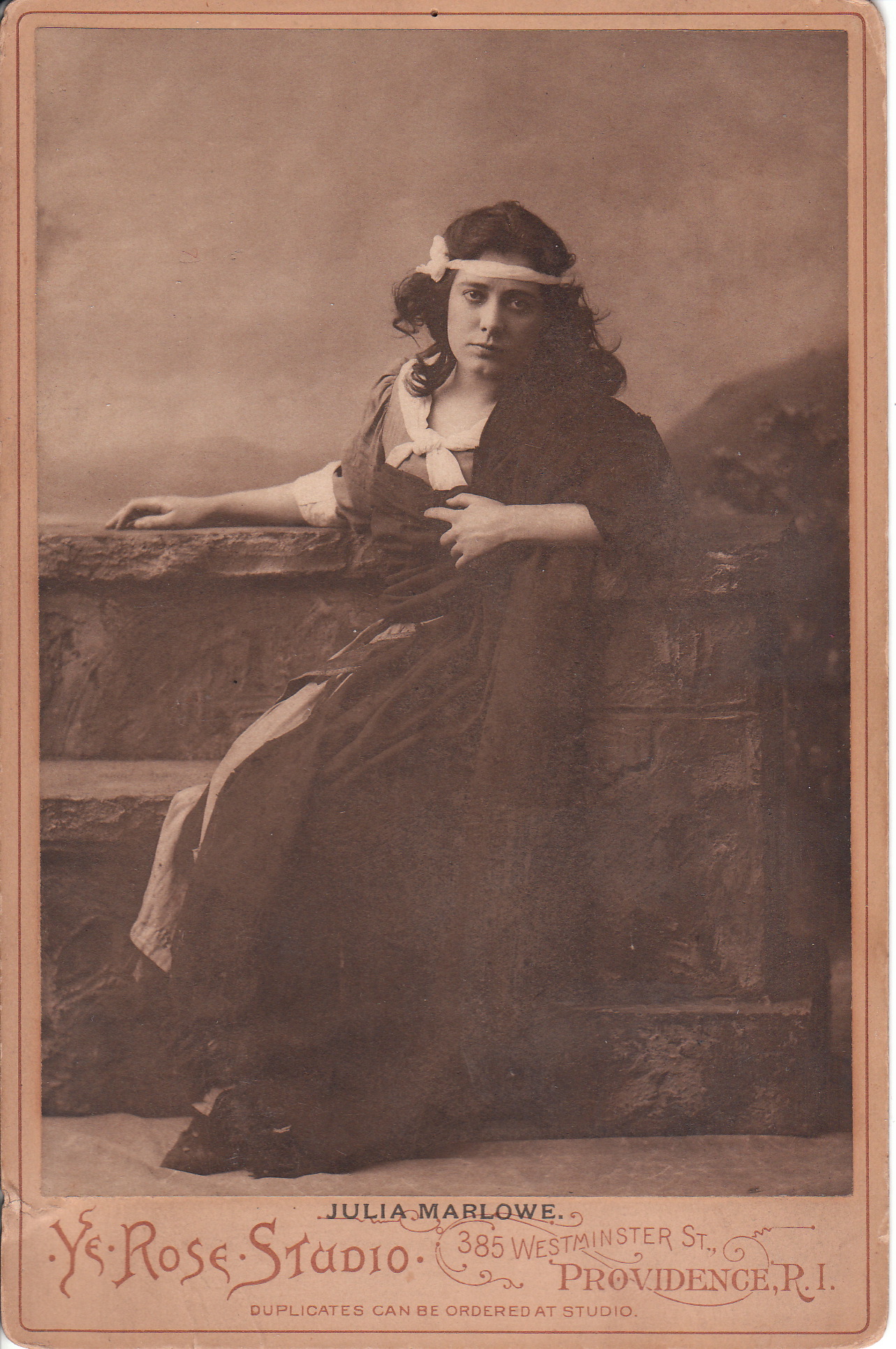
The fifth portrait of Julia Marlowe appears to be a photograph of the actress in costume for an unknown stage production. The image was photographed by Ye Rose Studio of Providence, Rhode Island. The reverse of the card indicated that the studio was opened in 1886. The studio was located in the Conrad building in downtown Providence. The building still exists. Other photographs by the Ye Rose Studio can be viewed by clicking on the category “Photographer: Ye Rose”.
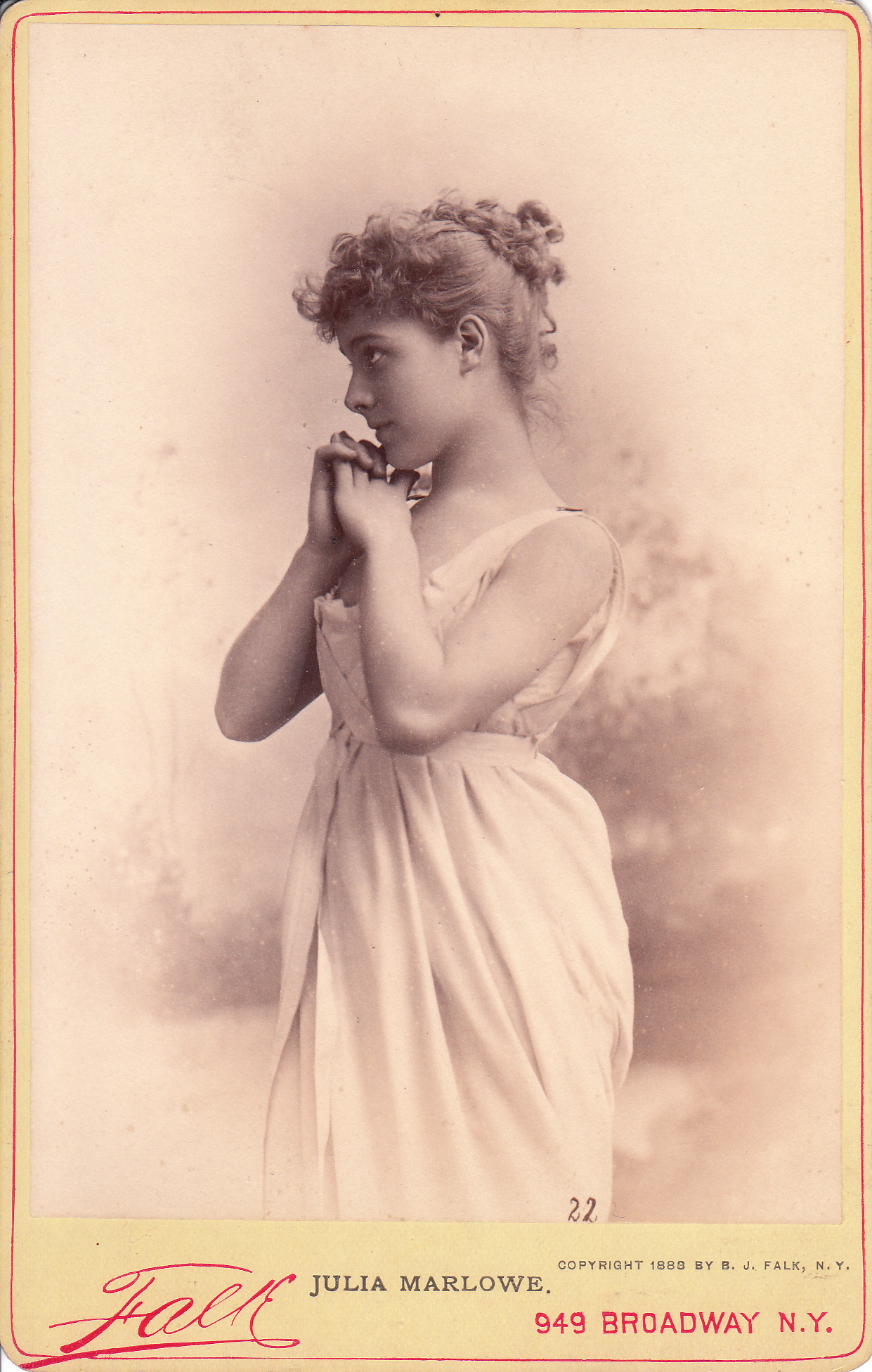
Portrait number six is an excellent example of the beauty of Julia Marlowe. This image, from 1888, captures Ms. Marlowe at the young age of twenty-three. The photographer of this portrait was B. J. Falk, a celebrity photographer located in New York City, New York. To view other photographs by Falk, click on the category “Photographer: Falk”.
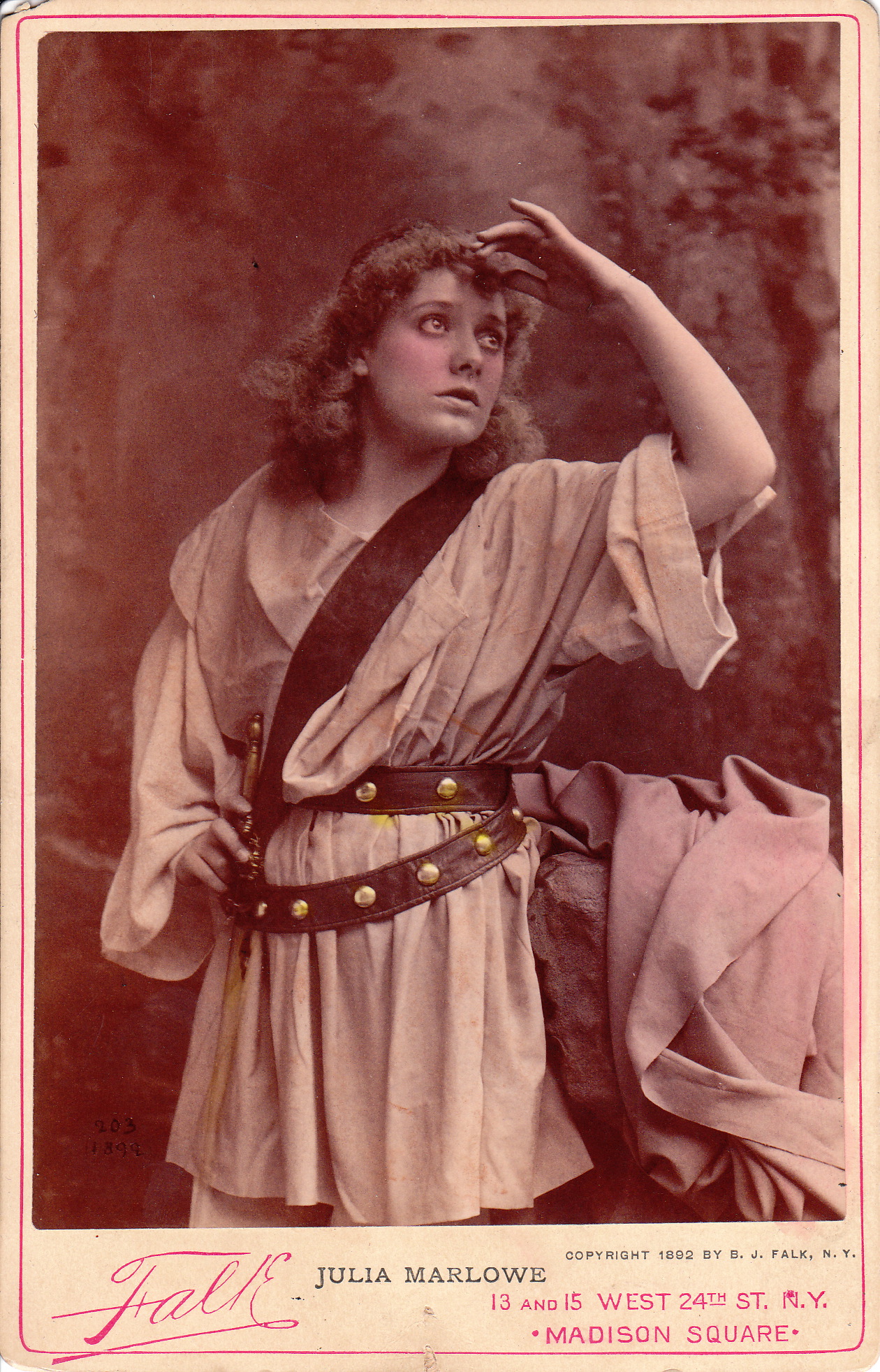
The seventh portrait is another example of a B. J. Falk image. The photograph features a costumed Julia Marlowe in the production of “Cymbeline“. Cymbeline is a play by William Shakespeare that was based on legends about the early Celtic British King, Cunobelinus. The play deals with themes that include innocence and jealousy. Ms. Marlowe plays Imogen, the King’s daughter. Her expression in the photograph shows fear and concern as she looks at someone or something in the distance. Her left hand shades her eyes while her right hand clutches her belted dagger. A stamp on the reverse of this cabinet card reveals that it was formerly owned by Culver Pictures of New York City, New York. Culver Pictures has been collecting photographs and illustrations from the 19th and first half of the 20th century, since 1926. These pictures are used in books, films, and other forms of media. At the time that this cabinet card was stamped by the company, Culver Pictures was located in New York City. (SOLD)
Portrait number eight is a close-up photograph of Miss Marlowe. The photographer of this cabinet card is the studio of Rose & Sands whose gallery was located in Providence, Rhode Island. Note that photograph number five also came from the Rose studio, but at that time, the gallery was called, the Ye Rose studio. The Wilson’s Photographic Magazine (1899) reports that Rose and Sands were the proprietors of Ye Rose. A humorous headline in a photography magazine stated “Providence Provides for All, And Rose Provides for Providence”. Print on the reverse of this cabinet card reveals that the Rose & Sands studio was opened in 1886 and that it specialized in “High Class Portraits from Cabinet to Life Size”. Also of interest, like photograph number seven, there is a stamp on the reverse of the photograph with the name “Culver Pictures Inc”.
Photograph number nine features the beautiful Miss Marlowe displaying a mischievous smile. Note her engaging large eyes. She is wearing a somewhat revealing dress (for the cabinet card era) and has a wonderful hat atop her head. This cabinet card photograph was published in 1888 by Benjamin Falk of New York City. The image is marked with the number sixty-nine.
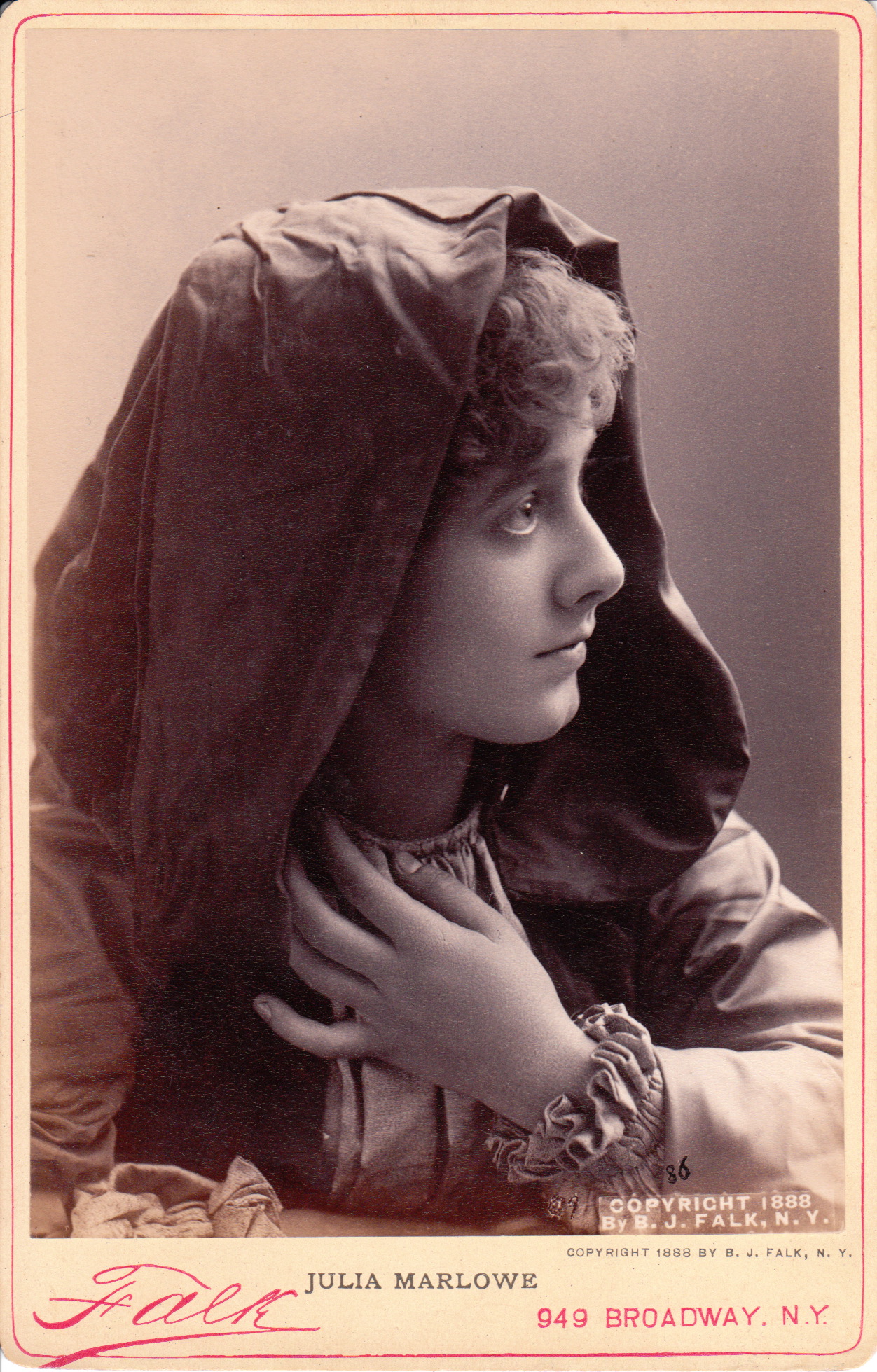
Portrait number ten is a closeup of Julia Marlowe with her head covered, but with her pretty face very visible. She is likely in costume for this photograph. The photograph is taken by B. J. Falk of New York City and has a copyright date of 1888. The cabinet card is marked number “86”.
The eleventh photograph captures Miss Marlowe staring hypnotically at a flower. Someone, has written below her name that the image features her in the role of Parthenia in the production of “Ingomar”. The New York Times (1904) reviews the play and Miss Marlowe’s performance on opening night at the Empire Theater in New York City. The newspaper reports that Frederick Halm’s play was “impossibly romantic and deliciously sentimental piece of old-fashioned theatrics. Tyrone Power played Ingomar and he was described as “vigourous and picturesque” but the article added that his voice was “not at its best”. The review pointed out that Marlowe’s appearance in this play was to be her last appearance as an independent star before joining E. H. Sothern’s Shakespearean repertory. In regard to Marlowe’s acting in this play, it was written that she played a “dear little prig – adorably dear” (prig can be defined as smug or arrogant) and she presented “a masterpiece of harmonious, modulated, and sustained acting”. The 1904 performance of Julia Marlowe in “Ingomar” marked a return performance for this accomplished actress. The New York Times (1888) wrote a very positive review of the opening night performance in Washington D.C.. The appreciative audience included three Supreme Court Justices and a number of members of the Chinese Embassy. This cabinet card was produced by the previously mentioned Ye Rose Studio of Providence, Rhode Island and it likely dates back to her 1888 performance in the role.
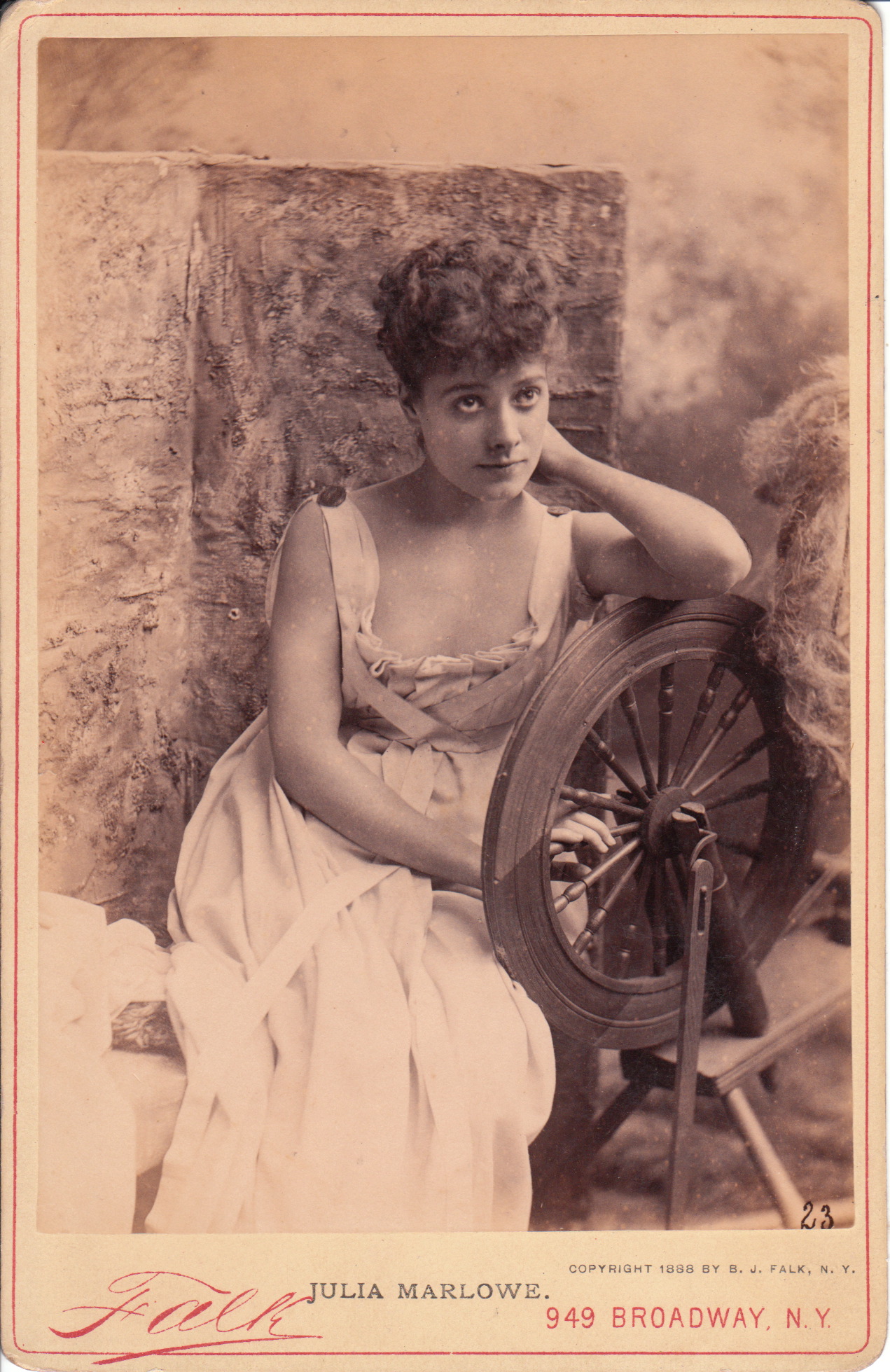
The twelfth cabinet card was produced by Benjamin Falk of New York City. He posed Miss Marlowe next to a spinning wheel. Her low cut dress makes this image a bit risque for the cabinet card era. If Falk or Miss Marlowe thought that looking up at the camera would create a “fetching appearance”, I would contend that their efforts failed. Rather than “fetching”, she appears dazed. The actress was a beautiful woman and provocativeness was not necessary to enhance her image. This photograph was produced in 1888 and was part of a series (#23).
Cabinet Card number thirteen is part of a series that includes Cabinet Card number ten. Both cards were photographed by Benjamin Falk and have a copyright date of 1888. Both portraits are close-ups but this one is captures Marlowe looking at the camera while number ten offers a profile view. Falk really captured the actresses eyes. Her eyes are beautiful and they are haunting at the same time. This photograph is marked number number 83 of the series.
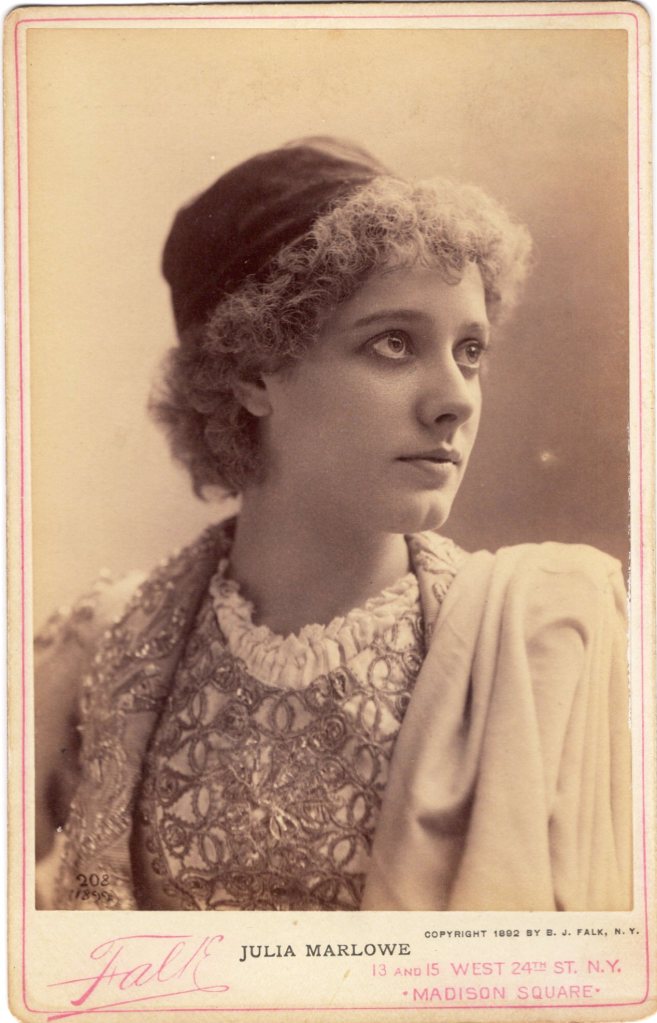
Cabinet Card fourteen features another beautiful portrait of Julia Marlowe. This photograph was taken by Benjamin Falk and was copyrighted in 1892. This cabinet card is uncommon, possibly rare. (SOLD)
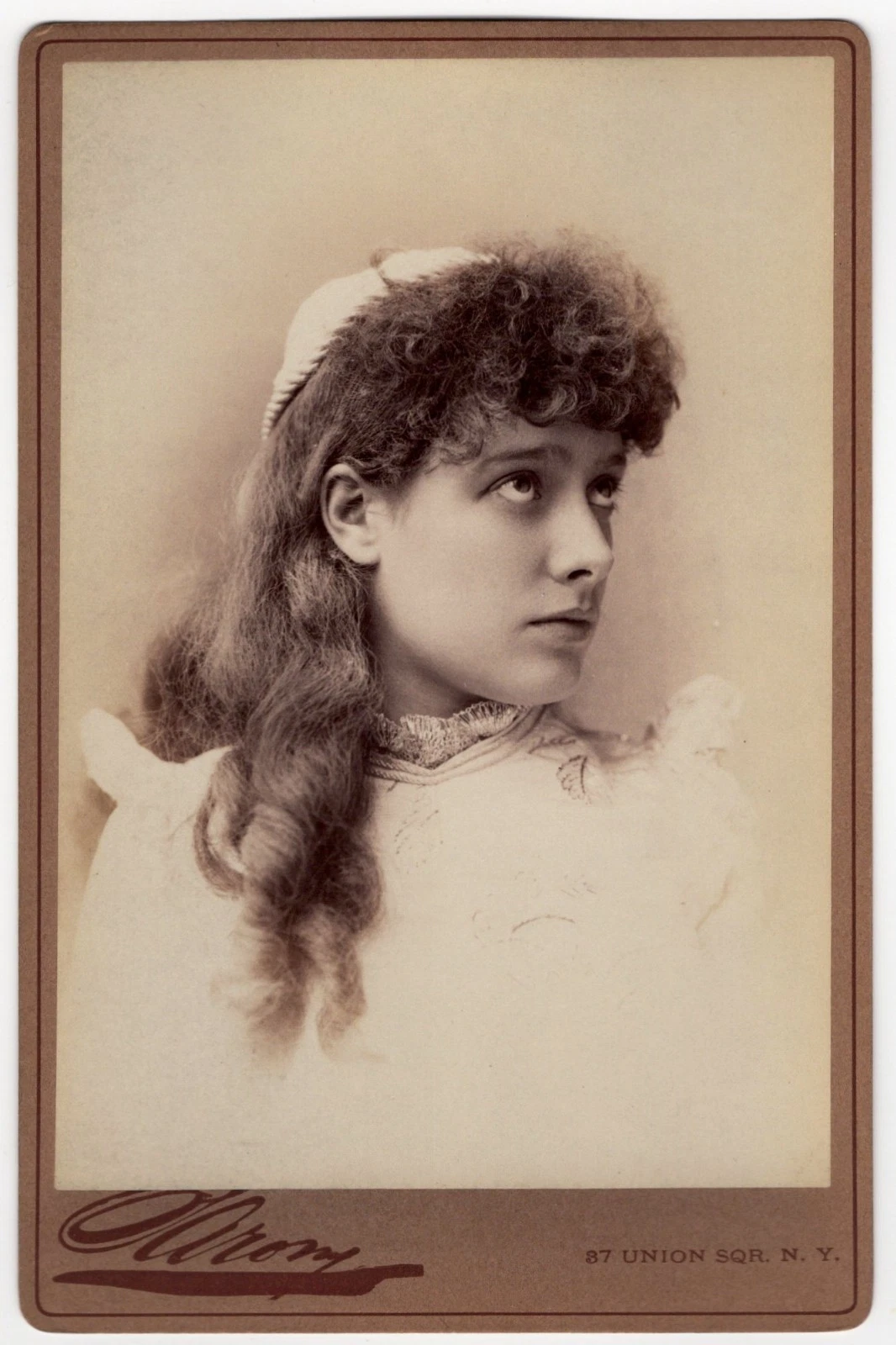
Cabinet Card 15 was photographed by Napoleon Sarony, the famed celebrity photographer located in New York City. (SOLD)
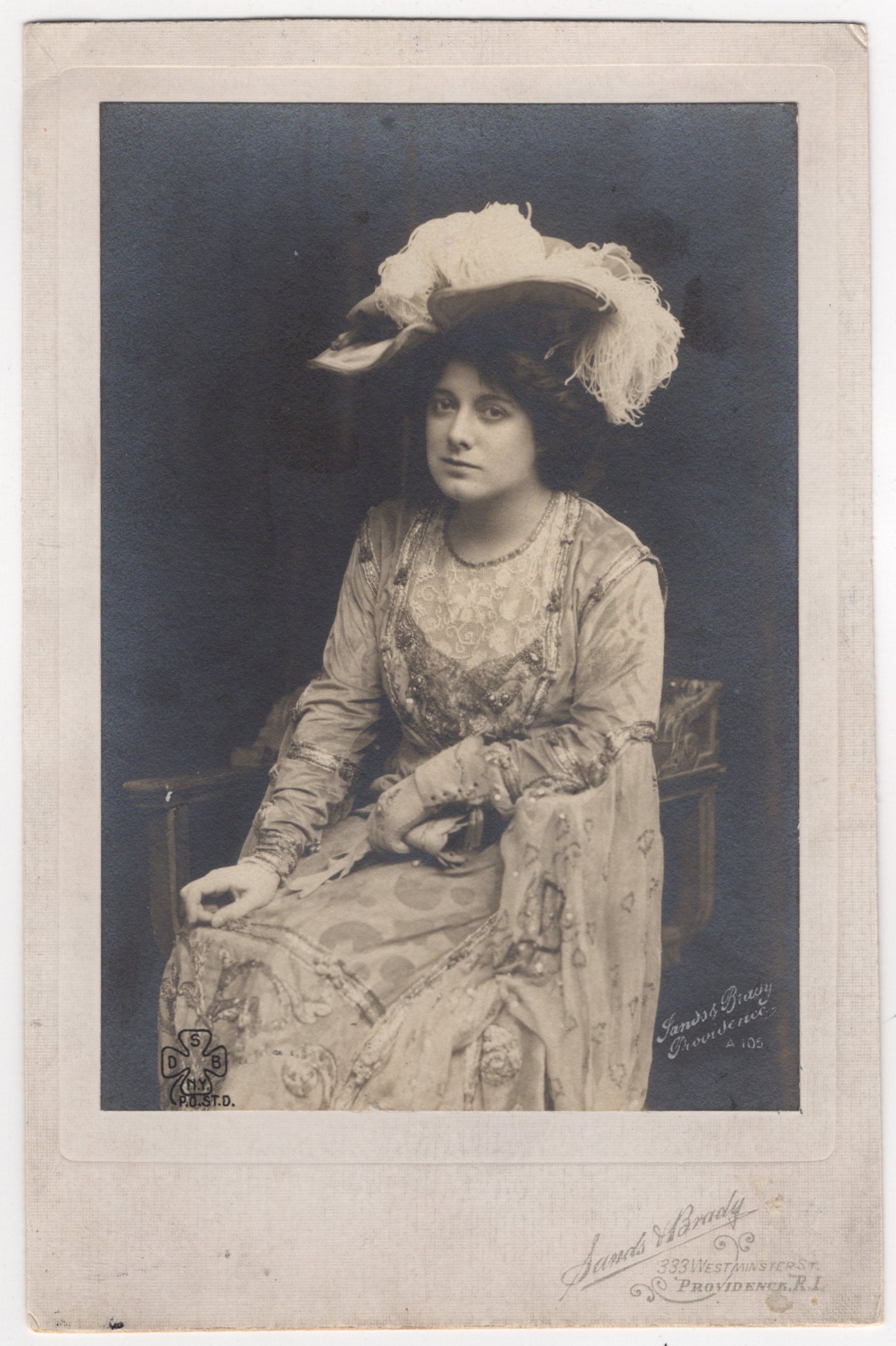
Vintage Photograph 16 shows a seated pretty young woman—Julia Marlowe—posing in a studio setting. This photograph is printed on a thin paper stock and then mounted to a heavier card. This was a common production method, and the piece appears exactly as manufactured. I have seen this same image as a postcard. Marlowe wears an elaborate Edwardian dress with ornate embroidery, beadwork, and lace detailing. Her gown has layered textures and patterns, and she rests one hand on her lap while the other lightly touches the chair. She wears a large, dramatic hat trimmed with tall, soft plumes that sweep upward and to the side. Her expression is calm and direct, looking slightly toward the camera with a composed, almost introspective gaze. The background is a simple dark studio backdrop that highlights her figure and outfit. The photographer is identified as the Sands & Brady studio in Providence, Rhode Island. In the lower left corner of the image is a distinct publisher’s mark: a four-leaf-clover-shaped logo with letters in each quadrant. The clover has three letters in it, S., D., and P.. The fourth quadrant indicates that the publisher was located in New York. (SOLD)
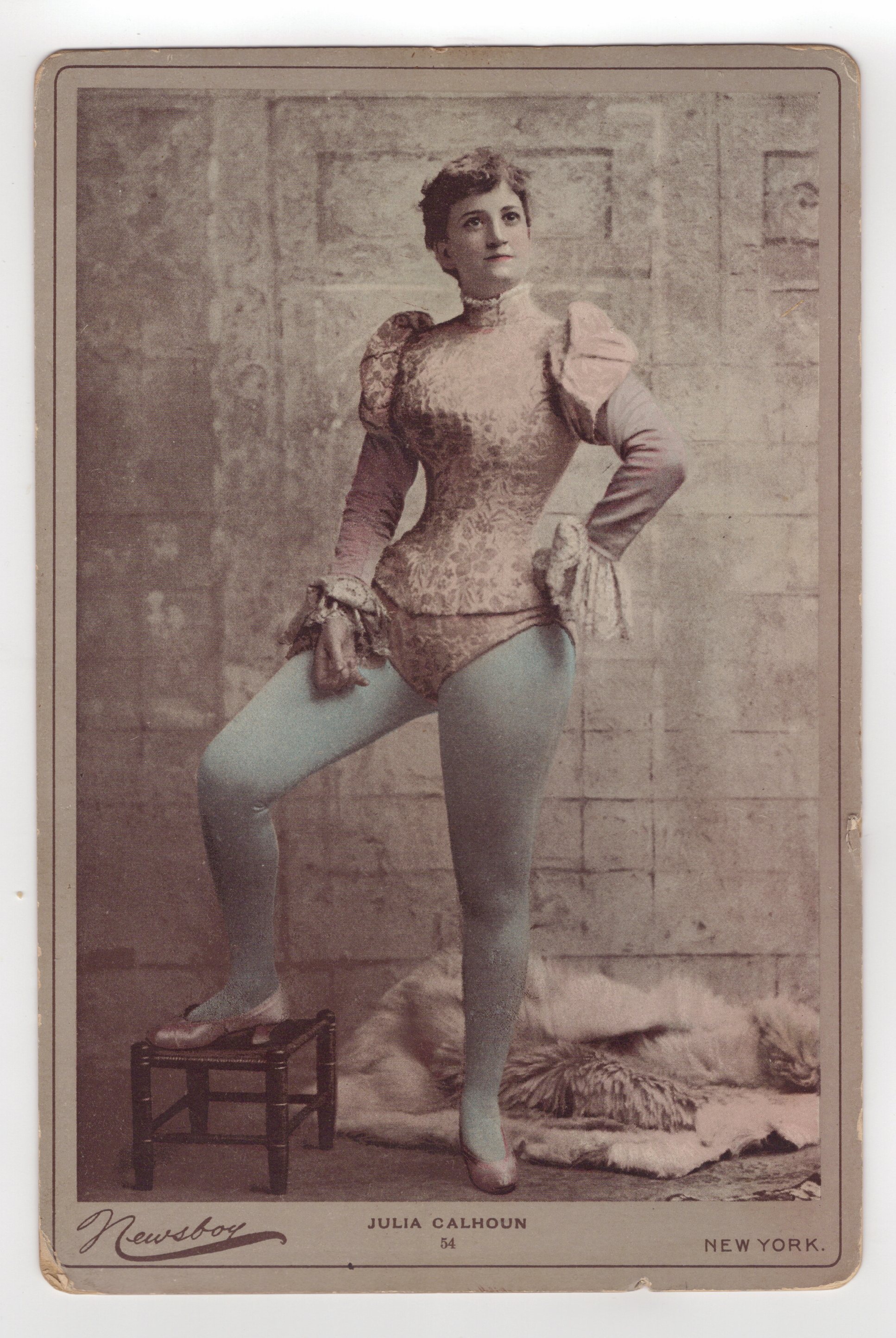
EXTRA LARGE CABINET CARD : JULIA CALHOUN : SILENT FILM ACTRESS : NEWSBOY : NEW YORK
This vintage large format cabinet card features American stage and silent film actress, Julia Calhoun (1870-?). She was adept at playing roles in comedy films including a number of roles opposite Oliver Hardy from about 1914 into the 1920’s. Her photograph appears in the Billy Rose Theater Collection at the New York Public Library. She was married to Kirkland Calhoun, also an actor. Julia Calhoun, according to the IMDb, appeared in 32 films between 1912 and 1923. Some of her more well known films include “The Human Orchid (1916)”, “The Man that Stayed at Home (1919)”, “The Match-Breaker (1921)” and “Just Like a Woman (1923)”. This cabinet card was published as part of the Newsboy tobacco advertising collection (No.54). This photograph measures about 6 x 9 inches. SOLD
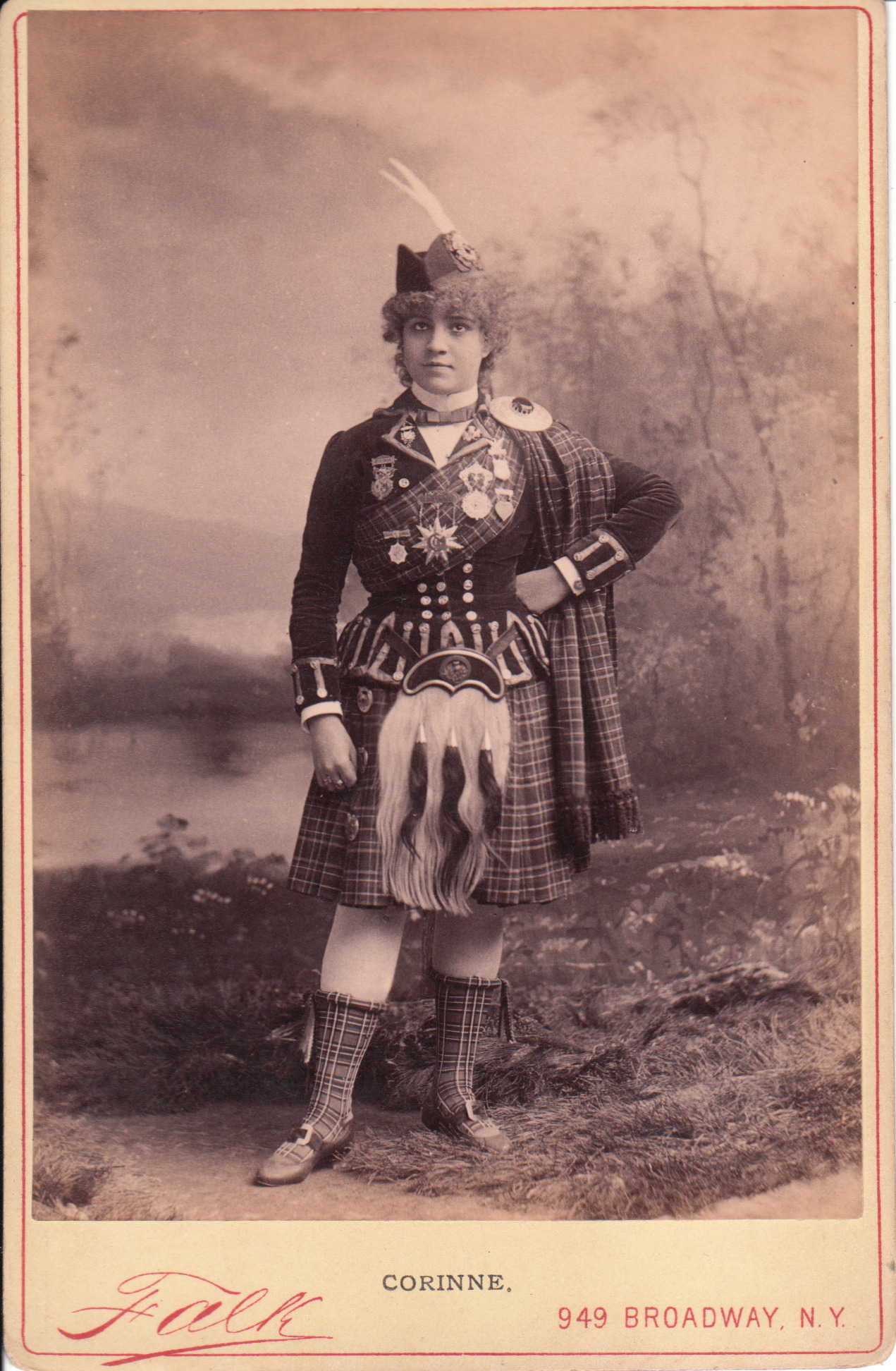
CORINNE: FAMOUS CHILD ACTRESS AND SUBJECT OF A SENSATIONAL CHILD ABUSE CASE
The actress pictured in Cabinet Card 1 is Corrine. Corrine, like Elvis or Selena, was a performer that received national recognition and was known by just her first name. In the top portrait by celebrity photographer B. J. Falk, Corrine looks to be teenager or young adult. She is dressed in theatrical costume. Corinne was the daughter of actress Jennie Kimball. Kimball acted in the theater between 1865 and 1873. The year of her retirement, she became the mother of Corinne, who the New York Times (1896) labelled “the most famous of all the child actresses of this country”. It is not clear how Kimball and her husband came to raise Corinne, but is was speculated that she was adopted as an orphan. Kimball trained her young daughter for the stage. Corrine debuted in the theater at age two and a half. At five years of age she played the part of “Little Buttercup” in the Boston production of “Pinafore”. She played the role more than one hundred times. At fifteen years of age she was traveling as head of her own theater company. Jennie Kimball doubled as Corinne’s mother and manager. The New York Times (1896) reported that Corinne “was a goldmine” during her early days for Mrs. Kimball and remained a major money producer through the time the article was written. At the time the article appeared, Corinne was twenty-two years old. Jennie Kimball’s successful management of her daughter’s career wasn’t appreciated by all observers. The New York Times (1881) asserted that the Society for the Prevention of Cruelty to Children objected to the way Corinne was being raised and successfully pursued custody of the child. During the custody hearing, eight year-old Corinne was put on the stand and interrogated by the society’s lawyer. He asked her how many times she was photographed and she didn’t know but said “she was never photographed in tights nor with her limbs and breast exposed”. The lawyer’s questioning revealed that the child had never attended school. However, Jennie Kimball did give her “lessons” each morning. The lawyer then gave Corinne an impromptu writing/spelling test during her testimony. The attorney also prompted the child to say she had never attended sunday school and didn’t know what a bible was nor had she ever been taught anything about Jesus Christ. The society lawyer was initially able to convince the judge to remove the child from the custody of Mrs Kimball because she was “unlawfully exhibited and employed” in dancing, singing and acting on the theatrical stage. Mrs. Kimball was allowed to take her daughter for a brief period to change her clothing but was assigned an escort to insure that the child would be brought to the society. Mrs Kimball was advised by George Hackett, the manager of a Providence opera house that if she took her daughter from New York to Jersey City, New Jersey; the girl would be out of the courts jurisdiction and she could keep her daughter. Mrs. Kimball followed his suggestion, and allowed a man to spirit the child out of state. As a result, Mrs. Kimball was charged with abduction and she ended up back in court. After a short time, the judge considered all the testimony that he heard and decided to return Corinne to her parents (he called them guardians). He believed that they were loving toward the child and responsible enough to continue raising her. Interestingly, he had something to say about the religious angle pursued by the society lawyer. The judge wrote that the the US constitution protected Corinne’s parents from being punished for not providing religious education to their daughter. Corinne continued her acting career and eventually became involved in burlesque theater. The New York Times (1894) wrote “Corinne has grown up and proves a lively and entertaining performer. The article adds that “she has no large share of original talent, musical or dramatic, but she can sing and dance “well enough”.
Cabinet Card 2 pictures Miss Corinne and was published by Newsboy (#20 of a series). She is wearing jewelry galore and flowers in her hair. What is that contraption that she is wearing around her waist? Is it a pouch? If so, what is it meant to carry? SOLD
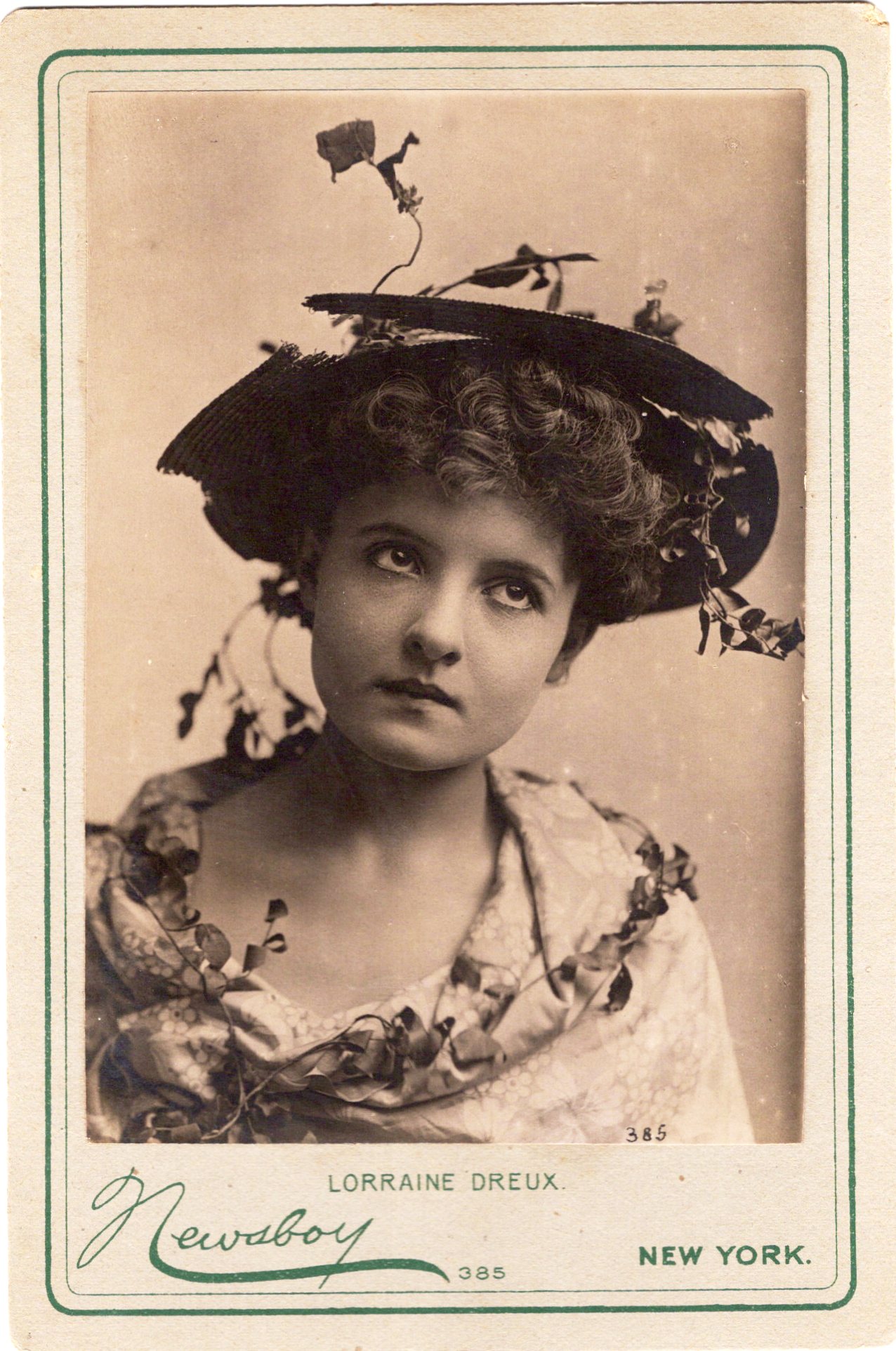
LORRAINE DREUX : PRETTY STAGE ACTRESS : DIES YOUNG AND TRAGICALLY : CABINET CARD
This cabinet card is a portrait of theatre actress, Lorraine Dreux. The image is part of the Newsboy Series (#385) and was published in New York City. The Newsboy series was used for advertising purposes by the Newsboy Tobacco Company. Celebrity photographs were given away as premiums upon the sale of tobacco products. Ms. Dreux looks like she ran through the woods in order to arrive at the photography studio in a timely fashion. She has twigs and leaves on her head and even is wearing a necklace of branches around her shoulders. It seems she is modeling “the natural” look. Her eyes are looking upward, as if to say, “Am I really wearing sticks and leaves?”. Who was Lorraine Dreux? The Illustrated America (1893) describes her as “young and pretty, with soft dark eyes, a tremulous little mouth, and a dazzling complexion”. She was born in Marquette, Michigan, of well to do parents. Her father did a great deal of business in the East and she spent much time on the banks of the Hudson River in New York. She was educated at home by a governess supervised by Dreux’s beautiful mother. She decided that she wanted to be an actress while in her early teens. Her parents reluctantly gave her permission and her first experience acting occurred while she was in London, England, with her mother. She was engaged by Mr Charles Wyndham to play comedy parts in London stage shows. She next joined the London Globe Theatre Stock Company playing sentimental roles. She then joined an English traveling theatre company. She soon returned to America and appeared in a number of plays, including “Ninety Days” with William Gillette. The article closes with the prediction that Dreux would be a successful actress in America because she possessed both beauty and talent. The New York Times (1894) reported on Dreaux’s appearance in “Lem Kettle” at the Bijou theatre. She also appeared in “Rush City” (1894) which was staged in Brooklyn (New York), and also in “Nance Oldfield” (1896) in New York. Dreux appeared in one Broadway production, “The Spectator” (1896). The New York Dramatic Mirror (1908) reported the tragic death of Lorraine Dreux. She was described as a well known and capable leading women of many stock companies outside of New York City. She died in New York’s Bellvue Hospital at age 35. The article reports that she “had fallen on evil days” and was “too proud to let her friends know of her plight”. She let an illness go till it turned into acute pneumonia which led to her death. Her last two engagements were in Worcester, Massachusetts and Rochester, New York. She received excellent reviews for her acting in both productions. However, her wardrobe was stolen and she was criticized for the way she dressed for her part in Rochester. She returned home “down hearted and discouraged” and sick, penniless and homeless. She met an old friend on the streets of New York who took her home to be fed and cared for but her condition worsened. A collection was made from other actors and actresses and the money was used to admit her to Bellvue Hospital where she died. Aid from the Actors Fund paid for her funeral and burial at Evergreen Cemetery. (SOLD)
KATHERINE FLORENCE : NEWSBOY PORTRAIT OF A POPULAR BROADWAY ACTRESS

This cabinet card photograph features actress Katherine Florence (1874-1952). She was born in Birmingham, England and died in Astoria, Queens, New York. She received her education from a convent in Peekskill, New York. She furthered her education by studying in Paris, and later, Montreal. Florence was a popular American stage actress who performed from the late 1880’s through the early twentieth century. Her mother was a famous actress named Katherine Rogers. Two of Katherine Florence’s sisters became successful stage actresses Their names are Violet Rand and Eleanor Moretti. She gained her early acting experience in her mother’s theatrical company. Her major debut took place in New York City, 1887 in the drama, “As In A Looking Glass”. Lily Langtry was also in the production. She appeared on the New York stage every year of her theatrical career except one. Florence was married to stage actor Fritz Williams in 1892 and their marriage ended with his death in 1930. Her resume includes acting in “The Lost Paradise (1892)”, “The King’s Musketeers (1898”), and “Letty (1905)”. During her career she played opposite excellent actors including Stuart Robson, E. H. Sothern, and William Gillette. The Interned Broadway Data Base credits Miss Florence with appearing in fourteen productions between 1893 and 1913. This cabinet card was produced by Newsboy, a tobacco company. The photograph was used as a premium to encourage customers to buy the tobacco products. SOLD
LORRAINE DREUX: PRETTY STAGE ACTRESS DIES YOUNG AND TRAGICALLY
CABINET CARD 1 (SOLD)

CABINET CARD 2 (SOLD)

CABINET CARD 2 (CLOSE-UP) (SOLD)
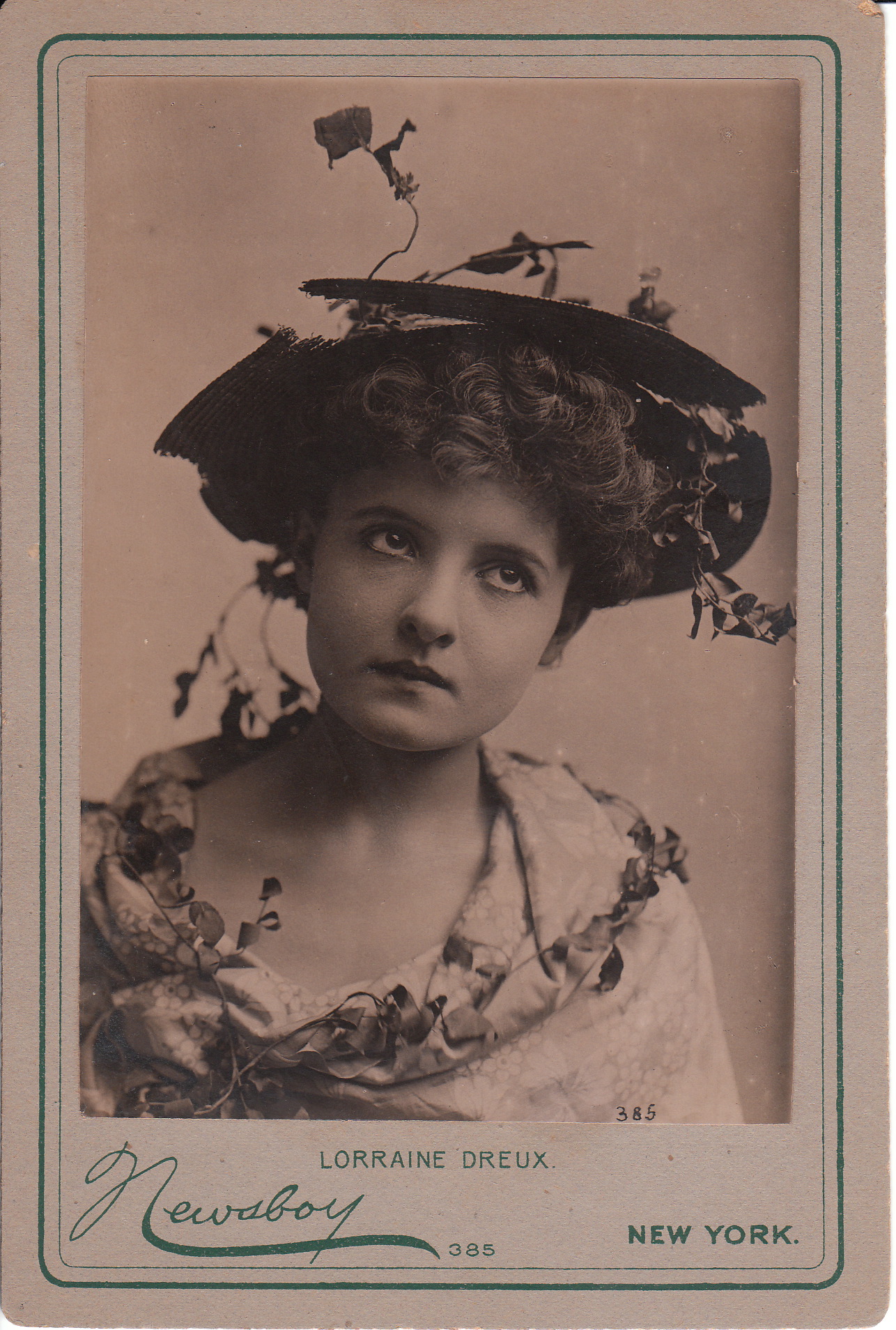
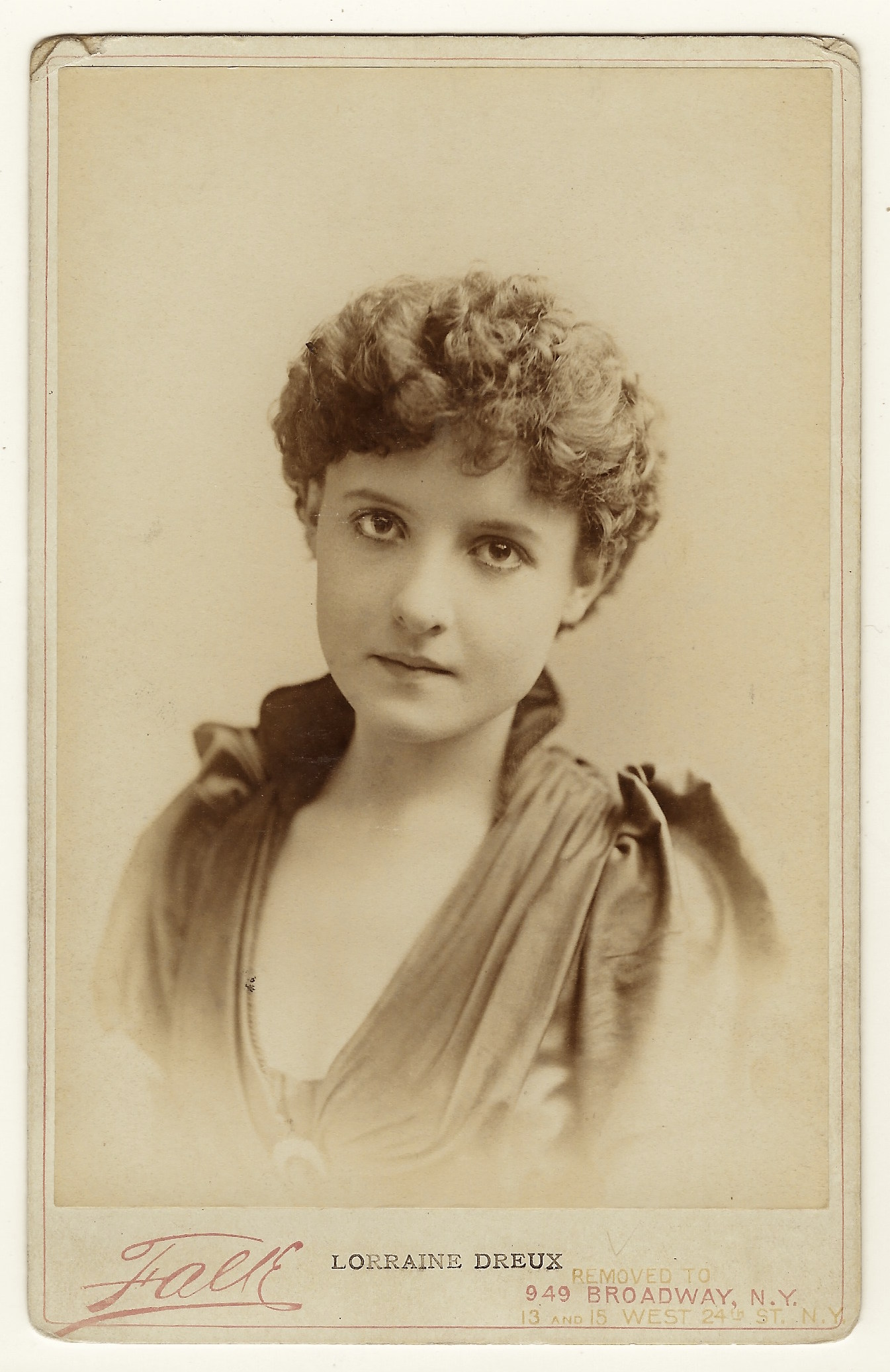
This cabinet card is a portrait of theatre actress, Lorraine Dreux. The image is part of the Newsboy Series (#385) and was published in New York City. The Newsboy series was used for advertising purposes by the Newsboy Tobacco Company. Celebrity photographs were given away as premiums upon the sale of tobacco products.To view other Newsboy photographs, click on the category “Newsboy”. Ms. Dreux looks like she ran through the woods in order to arrive at the photography studio in a timely fashion. She has twigs and leaves on her head and even is wearing a necklace of branches around her shoulders. It seems she is modeling “the natural” look. Her eyes are looking upward, as if to say, “Am I really wearing sticks and leaves?”. Who was Lorraine Dreux? The Illustrated America (1893) describes her as “young and pretty, with soft dark eyes, a tremulous little mouth, and a dazzling complexion”. She was born in Marquette, Michigan, of well to do parents. Her father did a great deal of business in the East and she spent much time on the banks of the Hudson River in New York. She was educated at home by a governess supervised by Dreux’s beautiful mother. She decided that she wanted to be an actress while in her early teens. Her parents reluctantly gave her permission and her first experience acting occurred while she was in London, England, with her mother. She was engaged by Mr Charles Wyndham to play comedy parts in London stage shows. She next joined the London Globe Theatre Stock Company playing sentimental roles. She then joined an English traveling theatre company. She soon returned to America and appeared in a number of plays, including “Ninety Days” with William Gillette. The article closes with the prediction that Dreux would be a successful actress in America because she possessed both beauty and talent. The New York Times (1894) reported on Dreaux’s appearance in “Lem Kettle” at the Bijou theatre. She also appeared in “Rush City” (1894) which was staged in Brooklyn (New York), and also in “Nance Oldfield” (1896) in New York. The latter show starred Rose Coghlan and her portrait can be seen in the Cabinet Card Gallery by placing her name in the “search box”. Dreux appeared in one Broadway production, “The Spectator” (1896). The New York Dramatic Mirror (1908) reported the tragic death of Lorraine Dreux. She was described as a well known and capable leading women of many stock companies outside of New York City. She died in New York’s Bellvue Hospital at age 35. The article reports that she “had fallen on evil days” and was “too proud to let her friends know of her plight”. She let an illness go till it turned into acute pneumonia which led to her death. Her last two engagements were in Worcester, Massachusetts and Rochester, New York. She received excellent reviews for her acting in both productions. However, her wardrobe was stolen and she was criticized for the way she dressed for her part in Rochester. She returned home “down hearted and discouraged” and sick, penniless and homeless. She met an old friend on the streets of New York who took her home to be fed and cared for but her condition worsened. A collection was made from other actors and actresses and the money was used to admit her to Bellvue Hospital where she died. Aid from the Actors Fund paid for her funeral and burial at Evergreen Cemetery. The second cabinet card portrait above, features Lorraine Dreux and her “Bette Davis eyes”. In this photograph, Miss Dreux has remarkable striking eyes. She is gazing directly at the camera. Many cabinet card portraits of actresses captures them with averted gaze. For example, the majority of cabinet card images of Sarah Bernhardt, that I have seen, has the celebrated actress staring away from the camera. Modern neuroscience has demonstrated that people find attractive faces with direct gaze are “more rewarding” than faces with averted gaze. This particular cabinet card is a bit risque as a result of Dreux’s relatively plunging neckline. This portrait was taken by Benjamin Falk, the celebrated New York celebrity photographer. (SOLD)

CABINET CARD 2
PORTRAIT OF A NEWSBOY

This cabinet card portrait features a young newsboy holding a stack of newspapers. Soon after the photograph was taken, he was probably delivering the newspapers or hawking them on the street. The young entrepreneur is displaying a serious business like expression. He is wearing an outer jacket, knee pants, long black stockings, and lace boots. Note his flat cap. The photographer’s name and location are unknown.
SOLD
MOLLIE FULLER: STAGE ACTRESS AND VAUDEVILLE PERFORMER

This cabinet card is a portrait of Mollie (Molly) Fuller (1868-1933), a Boston born stage and vaudeville performer. She appeared in two Broadway plays but is better known for her vaudeville career. She was the second wife of Frederick Hallen (1859-1920) and the couple were a popular team on the vaudeville stage for nearly twenty-five years. They were known for their short comedic plays. Mollie’s resume includes performances in “Adonis” and in “Evangeline”, both plays by Edward Rice. He biggest hit was her starring role in “The Twentieth Century Girl” (1895). When producer Edward Albee learned Mollie was near blind an impoverished in Chicago, he arranged to bring her to New York. He commissioned a theater piece to be written for her to perform in. She returned to the stage to perform in the resulting playlet “Twilight”. Mollie was the sister of Loie Fuller (1862-1928). Loie was a pioneer of modern dance and theatrical lighting techniques. Among Loie’s skills was her talent as a “skirt dancer”. She died in Hollywood, California, at the age of 68 in 1933. At the time of her death she was receiving assistance from “Troupers”, a national vaudeville players association. This cabinet card was issued by “Newsboy” which was a tobacco company that used cabinet cards as premiums to encourage sales of their tobacco products. This image is number forty-one of a series. SOLD
PAULINE HALL (1860-1919): BEAUTIFUL MUSICAL THEATRE STAR


CABINET CARD 2 (SOLD)

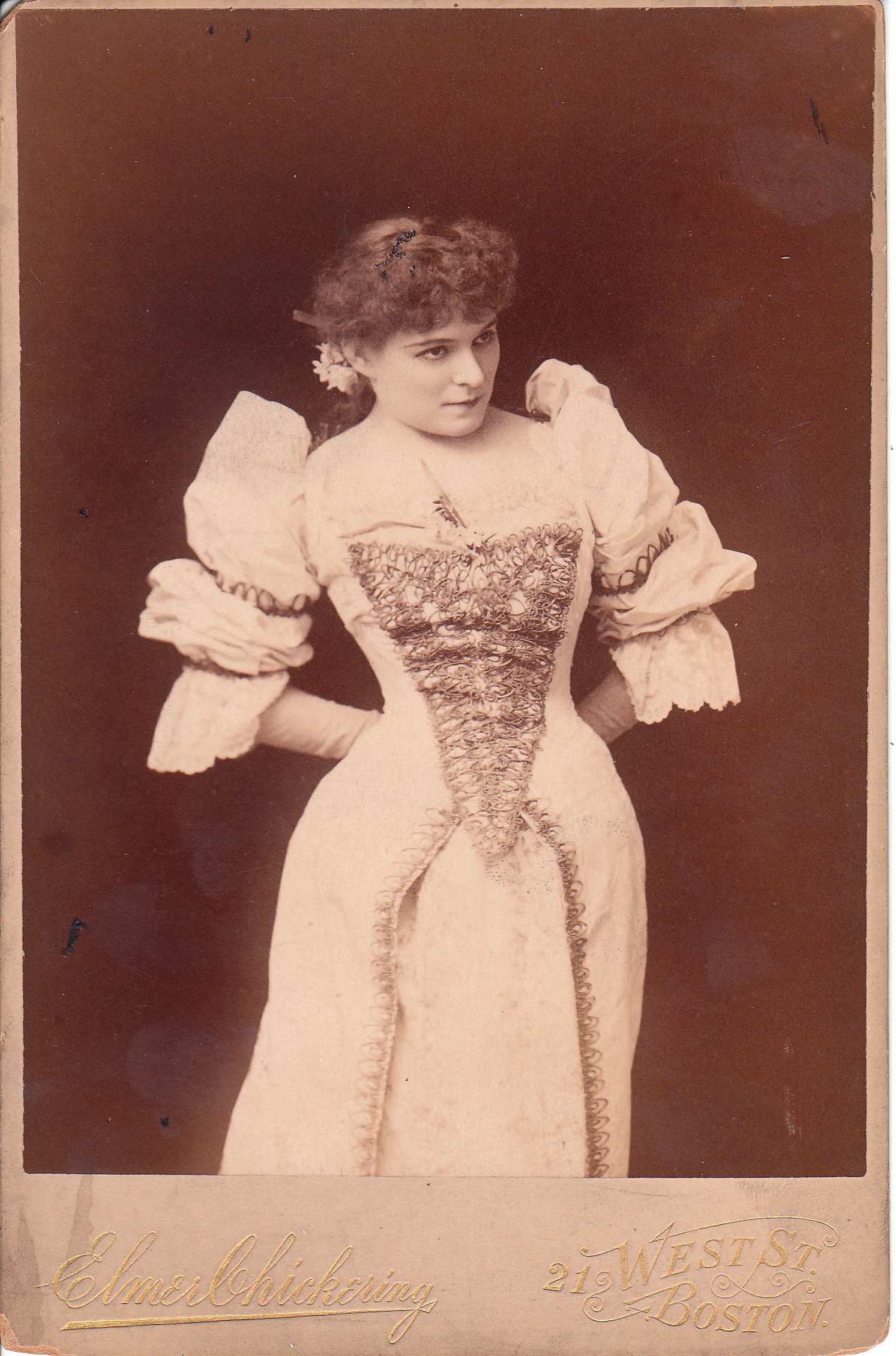
The top cabinet card features Pauline Hall (1860-1919), one of the most popular turn of the century prima donnas. She began her career as a dancer in Cincinnati, Ohio at age 15. She joined the Alice Oats Opera Company but left to tour in plays with famed actress Mary Anderson. By 1880, she worked for well known producer Edward Everett Rice in musical productions. Early in their association, he gave her a role in “Evangeline”. Her shapely figure allowed her to take male roles as she did in “Ixion” (1885). Her greatest success came in the title role of the first American production of “Erminie” (1886). She played in more than two dozen Broadway operettas. Her final role was in the “Gold Diggers” (1919). This photograph was taken by famed celebrity photographer, Elmer Chickering of Boston, Massachusetts. Other photographs by Chickering can be seen by clicking on Cabinet Card Gallery’s category of “Photographer: Chickering, E.”.
The second cabinet card, photographed by B. J. Falk, of New York City, captures Pauline Hall in stage costume. The photograph is #305 in a series from Newsboy. The tobacco company (Newsboy) gave away cabinet cards as a premium with the purchase of their products. This cabinet card shows a copyright date in the 1890’s. The exact date has become illegible over time. (SOLD)
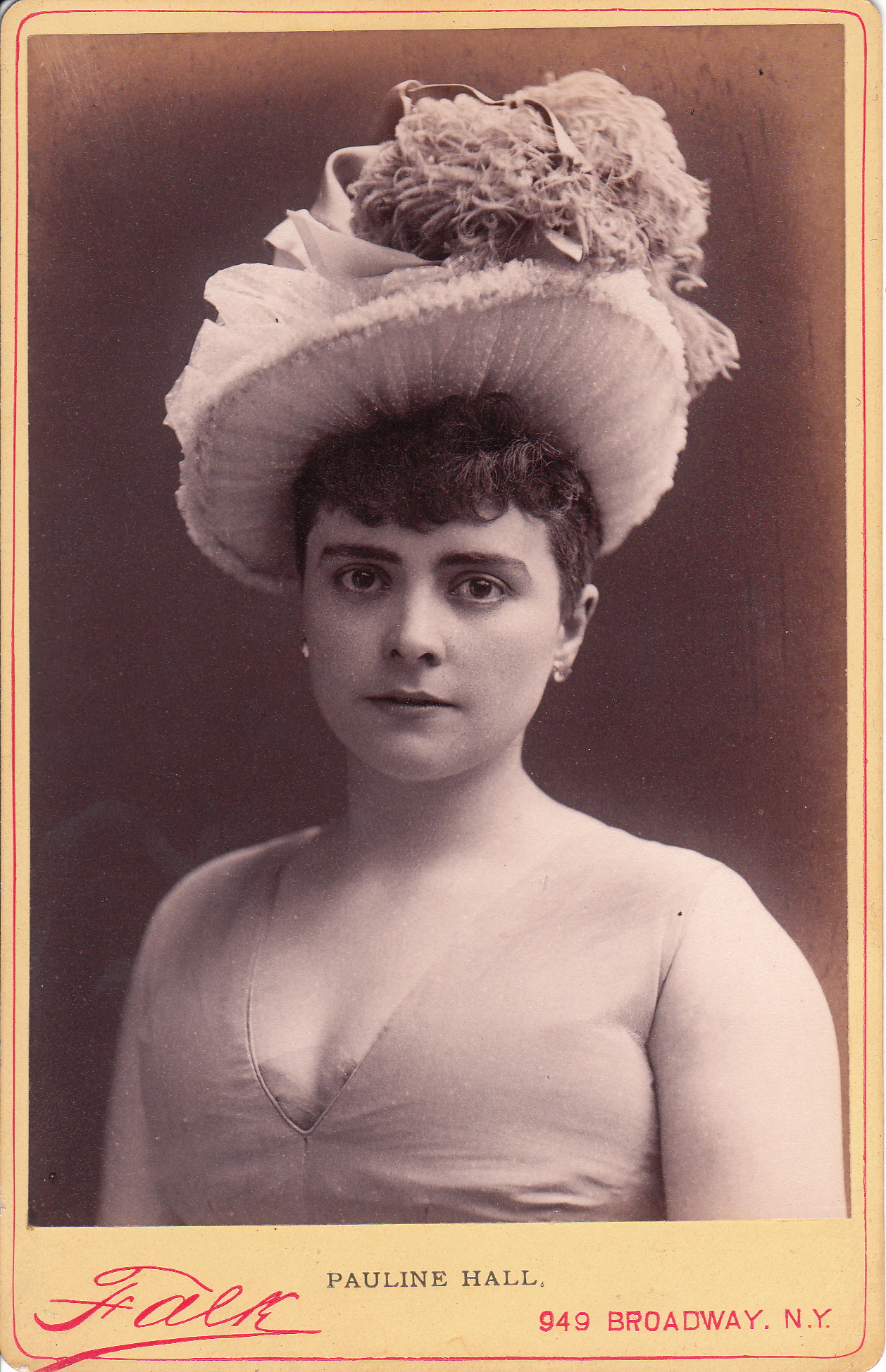
The third cabinet card portrait was also photographed by Falk. Ms. Hall looks quite beautiful in this image. She is wearing earrings and an interesting hat. The photograph is a bit risque. Much of her neck and shoulders are exposed. In addition, her dress accentuates and reveals significant cleavage. Is the material at the base of her scoop neckline part of her dress; or was it added in order to make the photograph less provocative? Perhaps a visitor to the cabinet card gallery will be able to provide an explanation. SOLD
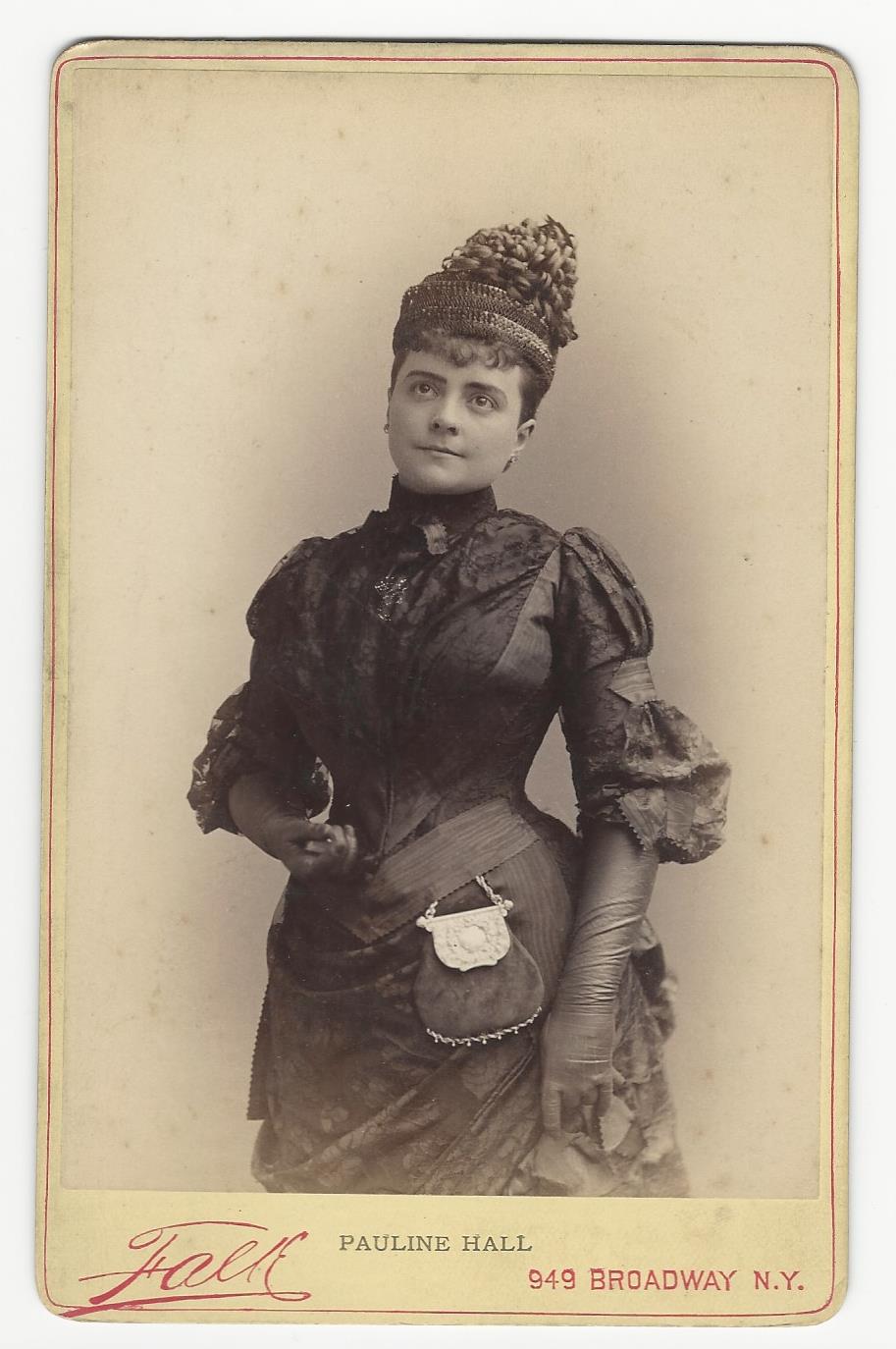
The fourth cabinet card image, once again photographed by B J Falk, features Miss Hall wearing a dark dress, long gloves, a lovely hat, and a purse. Pauline Hall certainly was a stage beauty as attested by this photograph. SOLD


CABINET CARD 1
CABINET CARD 2