JULIA MARLOWE: ESTEEMED AMERICAN STAGE ACTRESS

CABINET CARD 1

   CABINET CARD 2   (SOLD)

CABINET CARD 3  (SOLD)

CABINET CARD 4

CABINET CARD 5

CABINETCARD 6CABINET CARD 7   (SOLD)

CABINET CARD 8

CABINET CARD 9

MARLOW8

CABINET CARD 10

MARLOWE IN INGAMAR_0003
SPIN MARLOWE_0002

CABINET CARD 11

CABINET CARD 12

BRANSCOMBE

CABINET CARD 13

This image has an empty alt attribute; its file name is julia-marlowe-falk.jpg

CABINET CARD 14   (SOLD)

JULIA MARLOWE: ESTEEMED STAGE ACTRESS : SARONY : CABINET CARD PORTRAIT  c1890 - Picture 1 of 3

CABINET CARD 15 (SOLD)

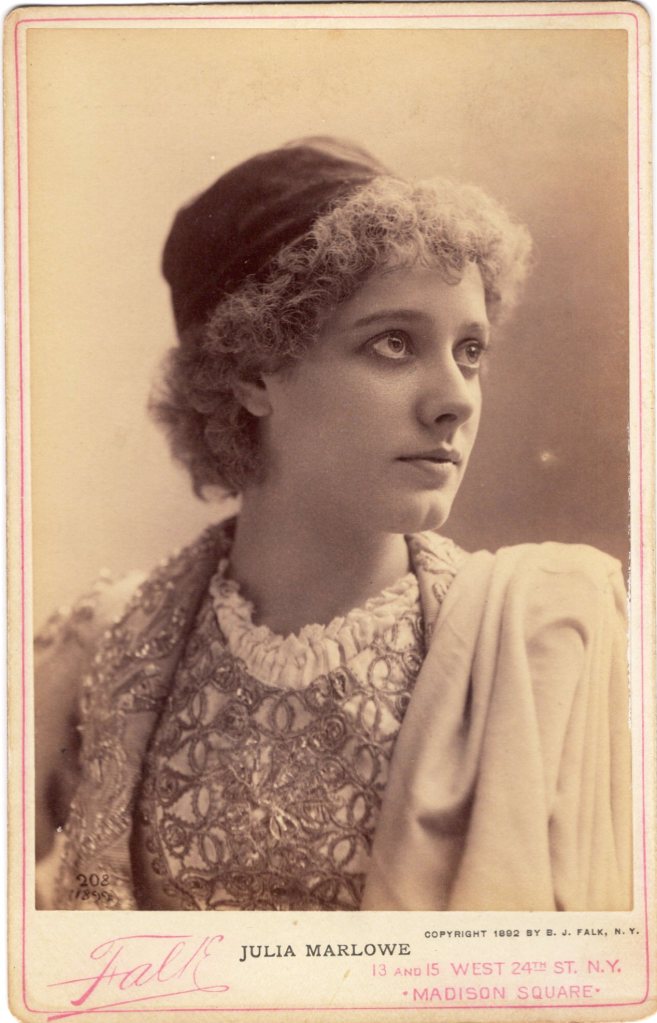
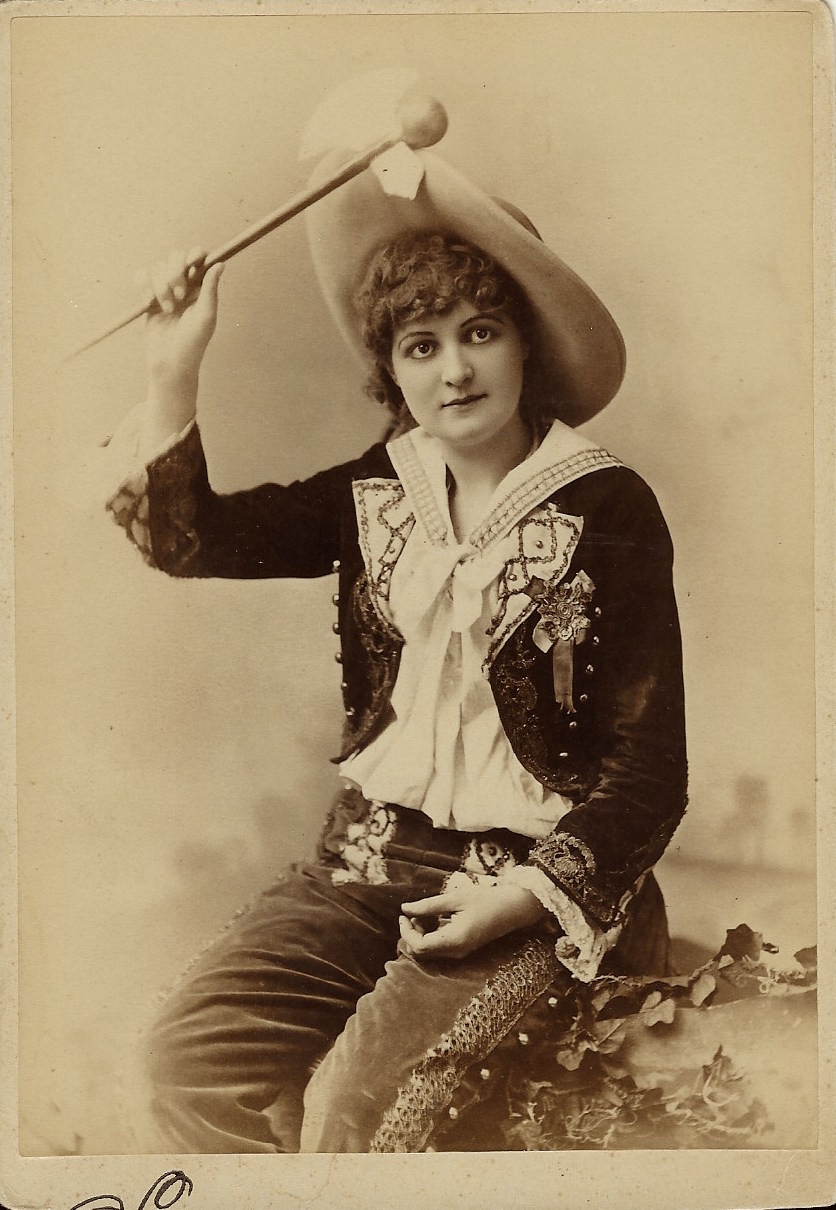
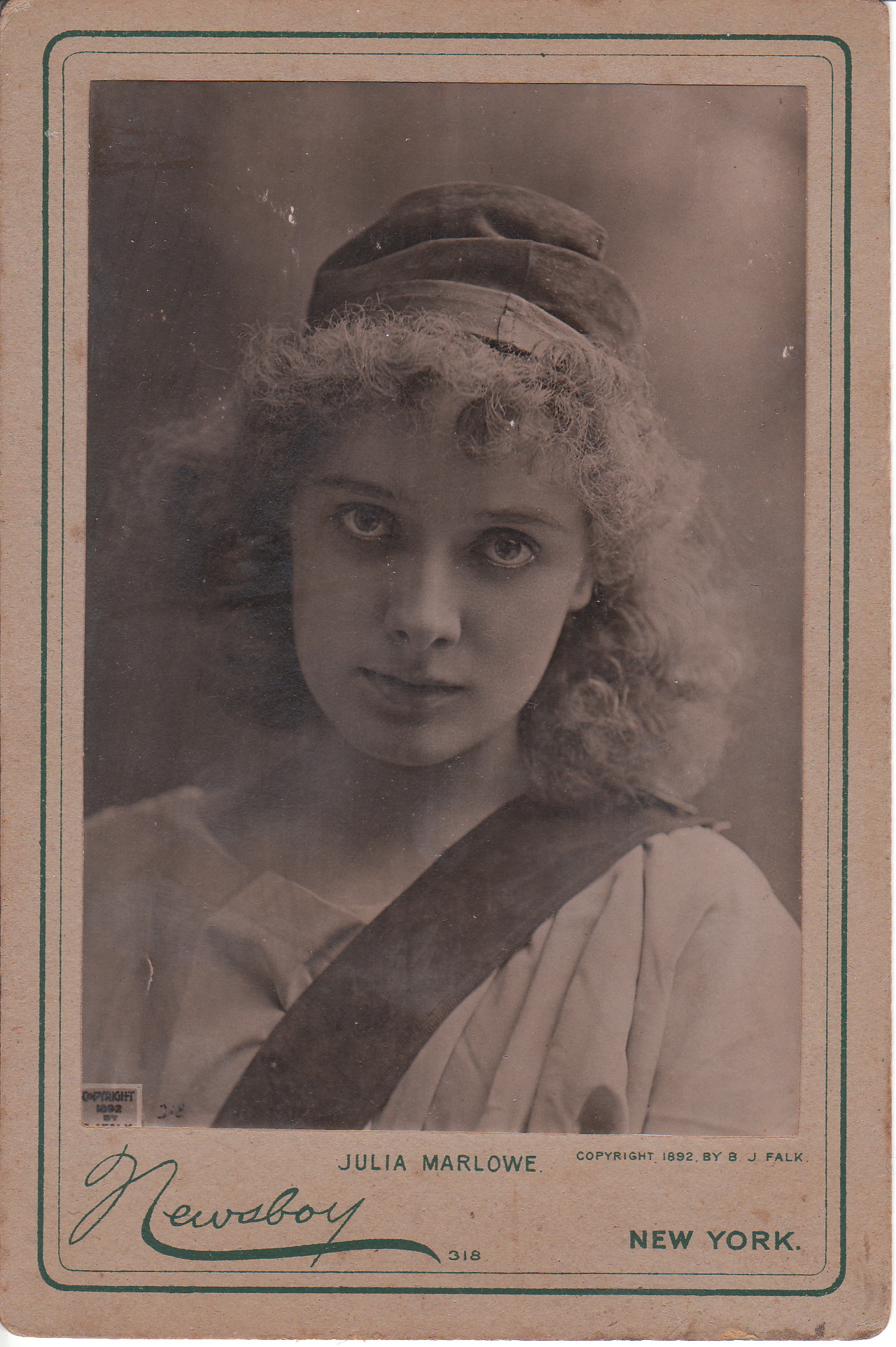
Julia Marlowe (1865-1950) was born in England and as a young child moved to the United States with her family. In her early teens she began her theatrical career with a juvenile opera company. She began playing Shakespeare in her home town of Cincinnati, Ohio. She made her Broadway debut in 1895 and by the end of her career, had appeared in more than 70 Broadway productions. Her first husband was actor, Robert Tabor. Their marriage lasted six years. In 1904 she appeared in “When Knighthood was in Flower”. Great success in this play brought her financial independence. Earlier, in 1903, she appeared in ‘The Cavalier” and “Ingomar”. The New York Sun wrote about her performance in “Ingomar”; “There is not a woman player in America or in England that is – attractively considered- fit to unlace her shoe”. In 1904 she began a partnership with actor E. H. Sothern. They toured the United States performing various plays of Shakespeare. They were managed by Charles Frohman and later, the Shubert brothers. They were considered to be among the major Shakespearian actors of the day. In 1906, Marlowe played in “Jeanne d’Arc” and also as Salome in “John the Baptist”. Later, Sothern and Marlowe played in London but were not terrific box office successes there. In 1911 Marlowe and Sothern married each other. In 1920 and 1921, they made eleven phonograph recordings for the Victor Company. The top Cabinet Card was produced by Newsboy as a premium for their tobacco products. The photographer was Falk and the image is from 1892.

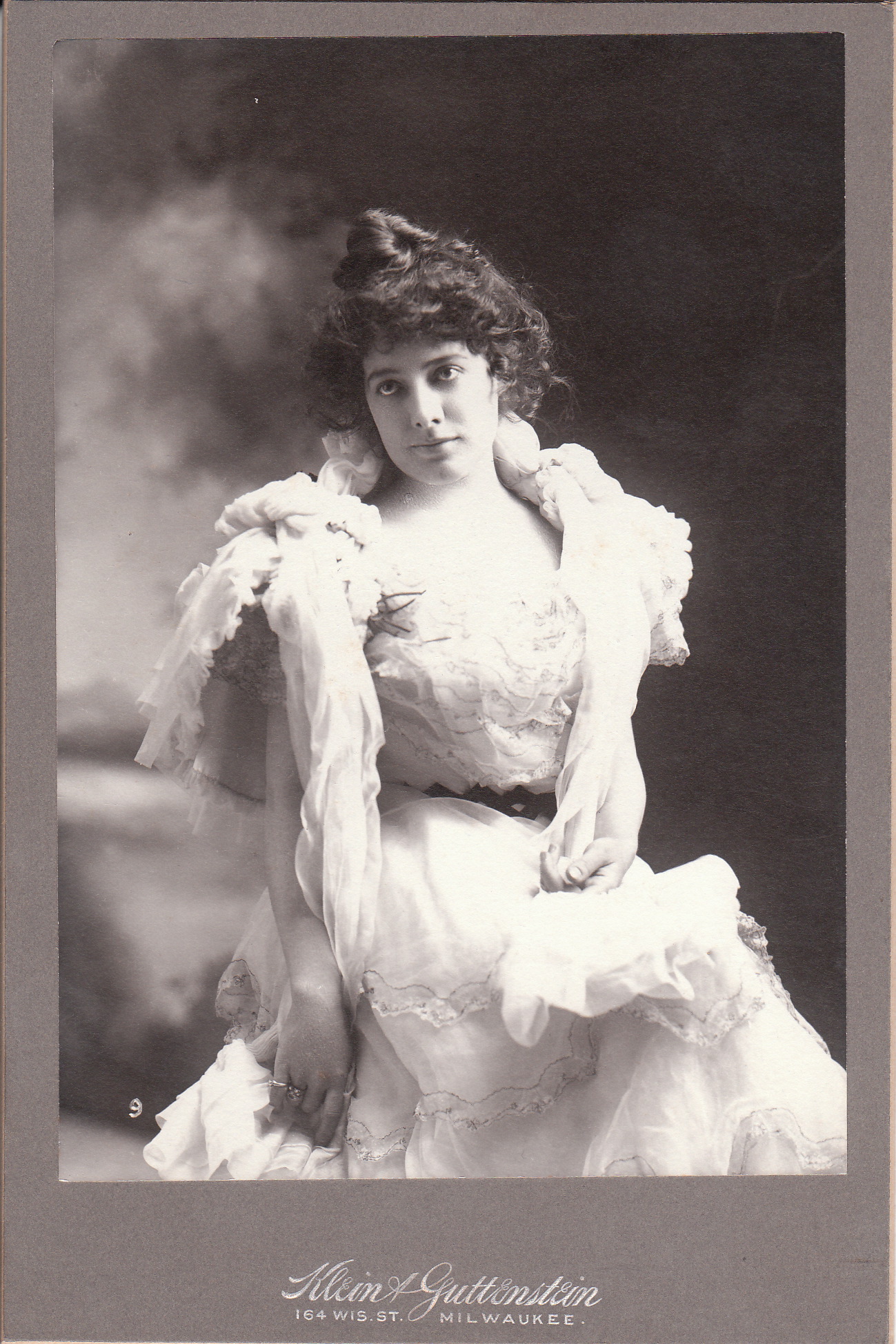
The second portrait of Julia Marlowe has a notation on the reverse of the card stating “Julia Marlowe Tabor”. Therefore, this photograph was likely taken during the time of her marriage to Tabor (1894-1900). The photographic studio that produced this portrait is  Klein & Guttenstein of 164 Wisconsin Street, in Milwaukee,  Wisconsin.  Klein and Guttenstein were leading photographers of their time. Wilson’s Photographic Magazine (1902) reveals that the two men  were very active in the Photographers Association of Wisconsin and other photography organizations. The photographers were considered part of a network of photographers skilled at producing publicity images of theatrical and vaudeville stars to be used in national magazines and other publications. The New York Public Library has a collection of portraits of actress Blanche Bates; produced by Klein & Guttenstein. The University of Pennsylvania Library has one of Klein & Guttenstein’s portraits of Julia Marlowe.  (SOLD)
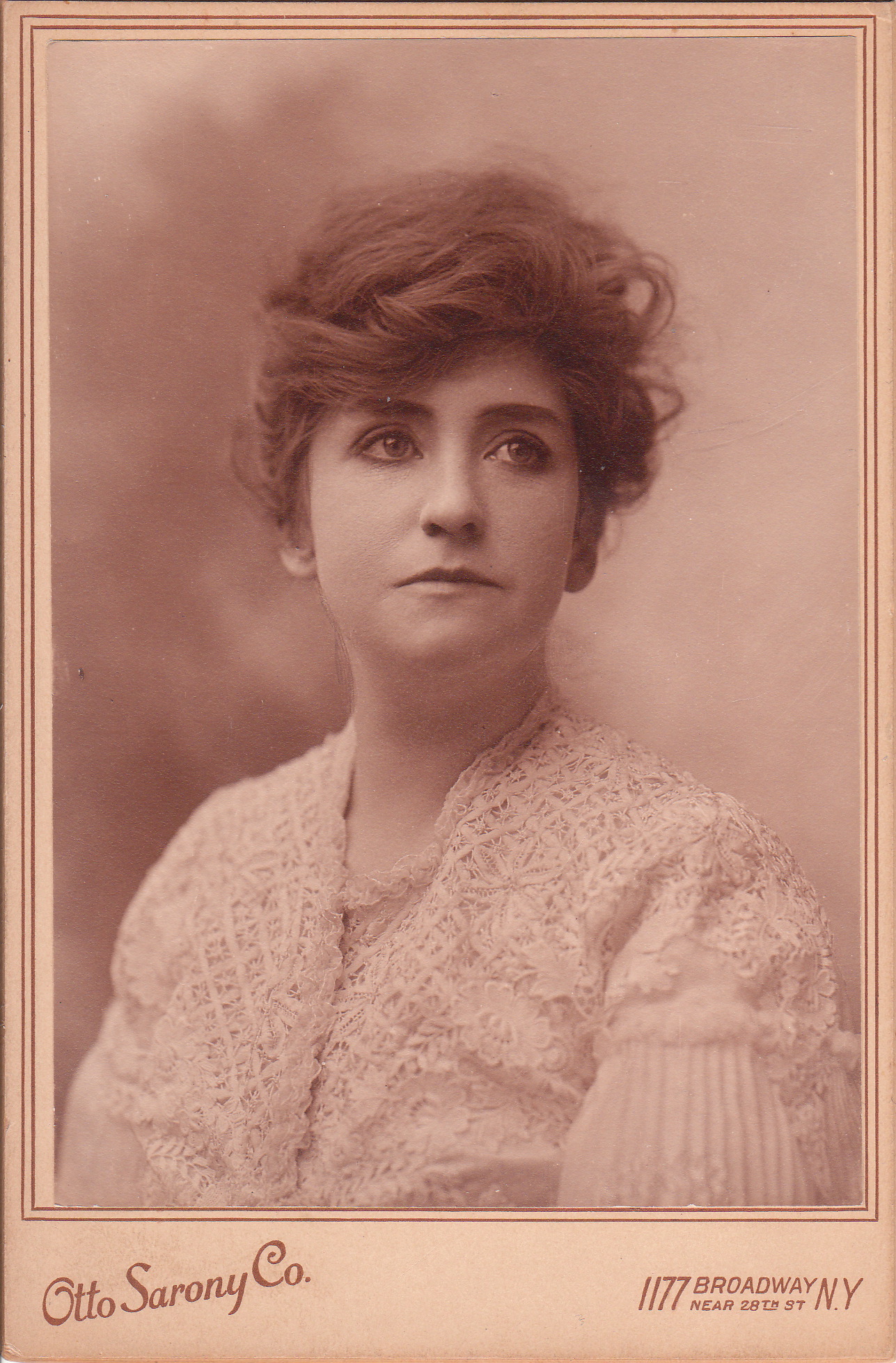
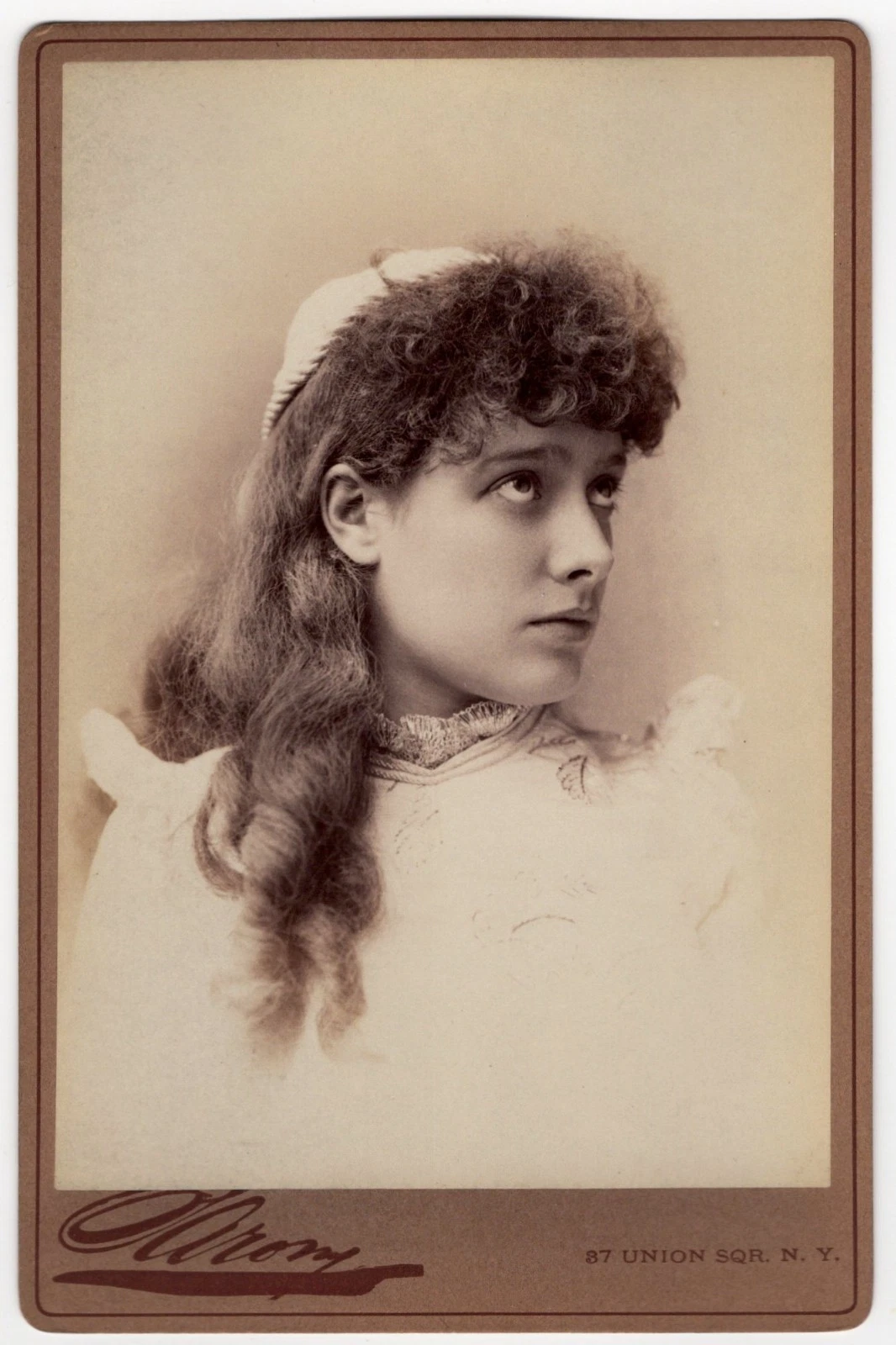
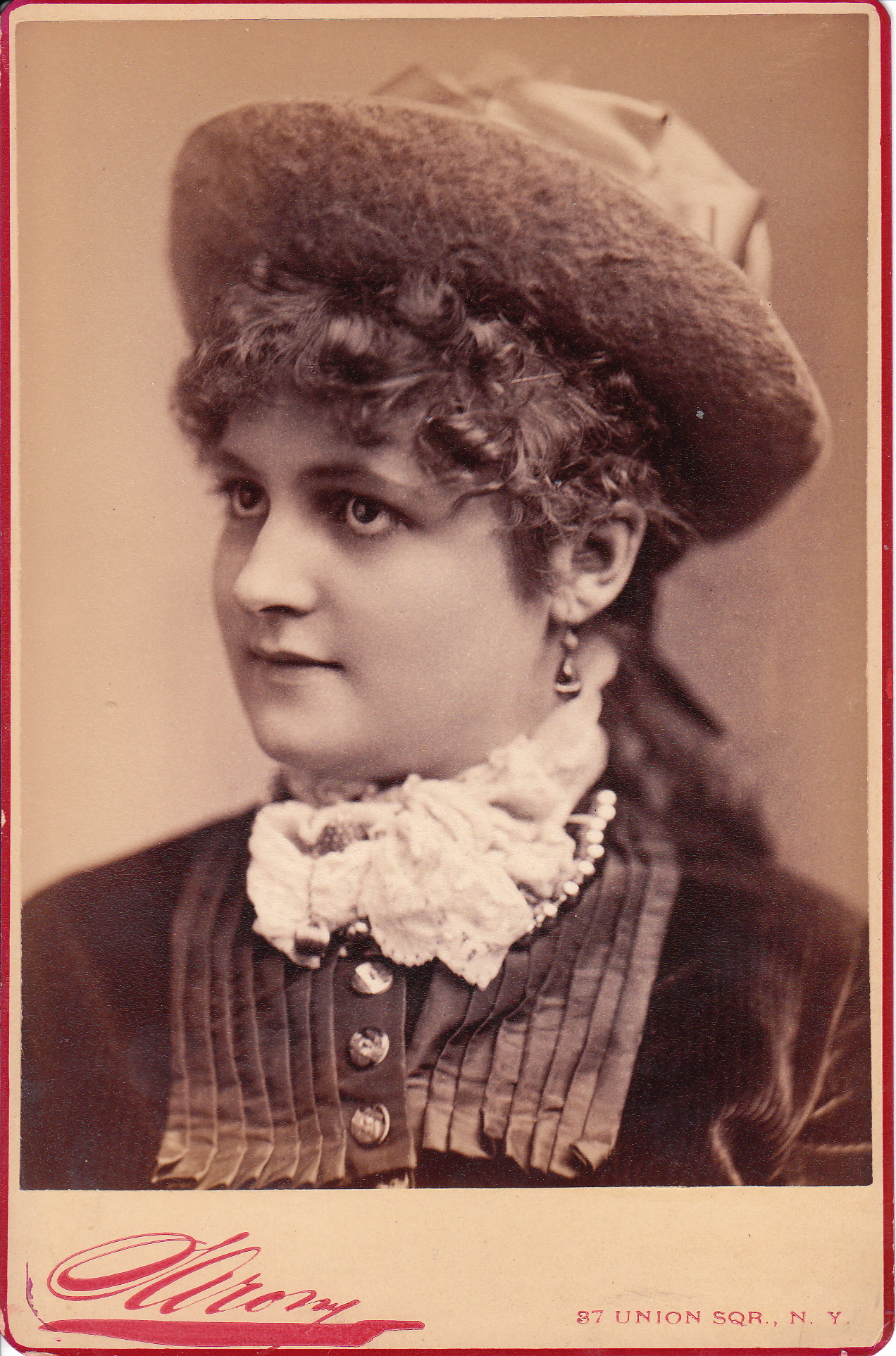
The third portrait of Julia Marlowe in the cabinet card gallery collection is photographed by Sarony, the famed celebrity photographer located in New York City.  This cabinet card is signed by the actress and dated 1890. Additonal photographs by Sarony can be viewed by clicking on the category “Photographers: Sarony”.  SOLD

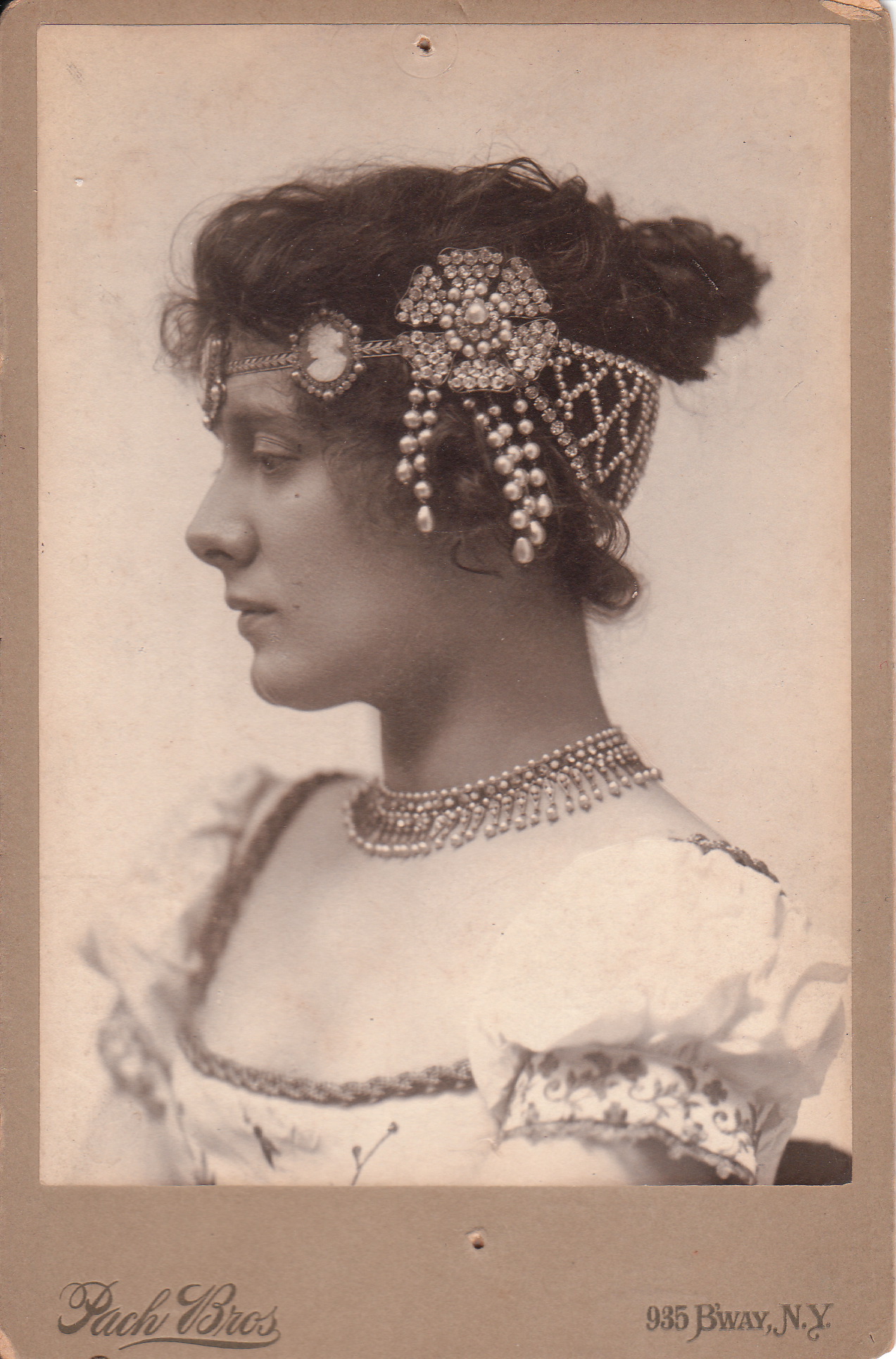
The fourth portrait of Miss Marlow features her in role in the production of “Countess Veleska”. The play was adapted for a German work, “The Tall Prussian”, by Rudolph Stratz. The play opened in New York in 1898 at the Knickerbocker Theatre. The review in the New York Times (1898) stated that the “drama was made wholly interesting by the personal charm and sincerity of Miss Marlowe”. In a sarcastic tone, the reviewer comments about Marlowe’s co star, Bassett Roe. The reviewer states that Roe has only two qualities of the man he was playing, “height and good looks”. The reviewer continues his scathing description of Roe; “The only time he actually warmed up was when he accidentally set his hair on fire. Even then he would have let it burn if Miss Marlowe had not gone to his rescue.” The photographic studio that produced the “Countess Veleska” cabinet card was Pach Brothers of New York City. Pach Brothers were photographers known for their photographs of celebrities of their era. To see additional photographs by the Pach Brothers, click on this site’s category of “Photographers: Pach Brothers”.

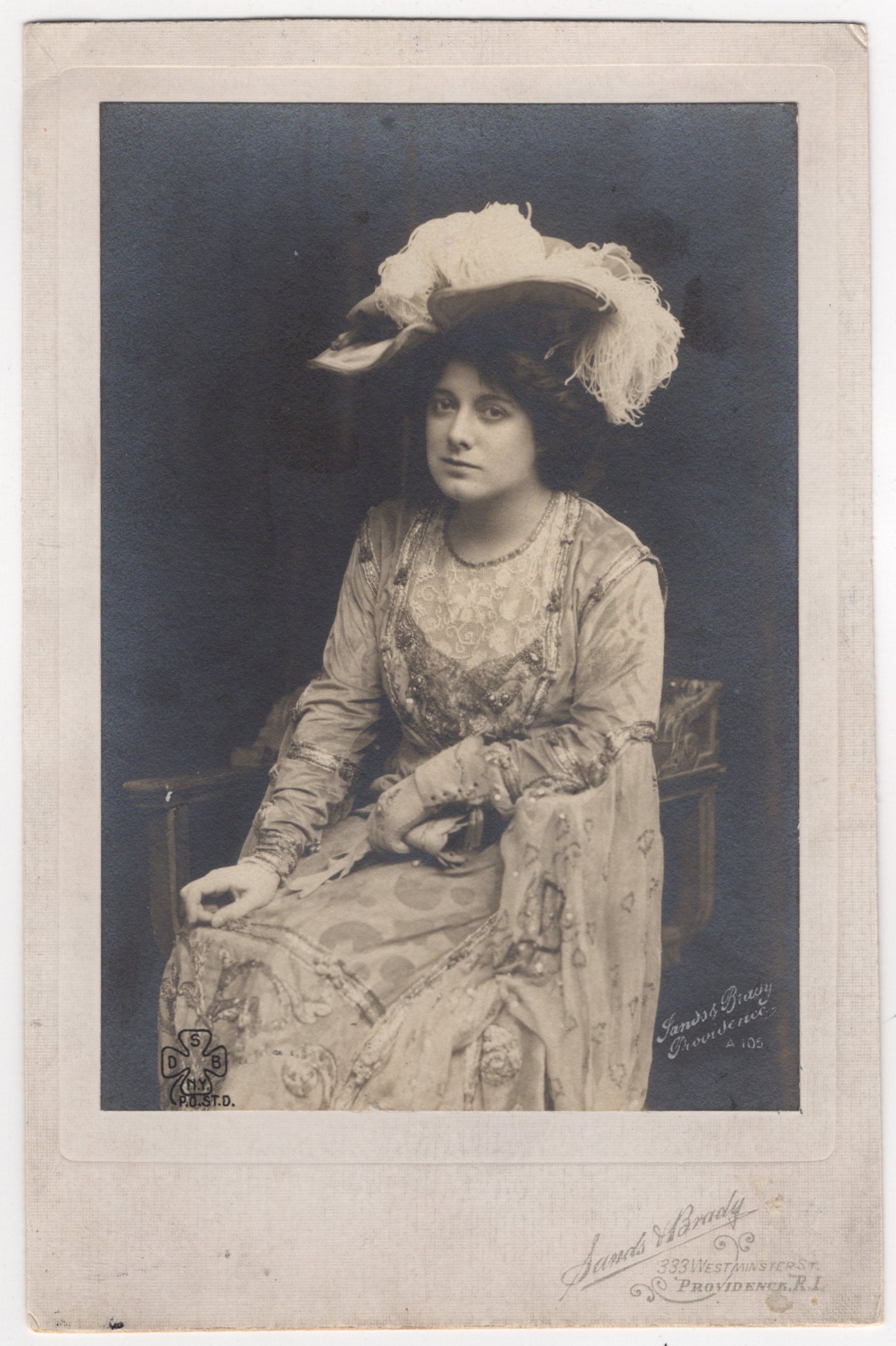
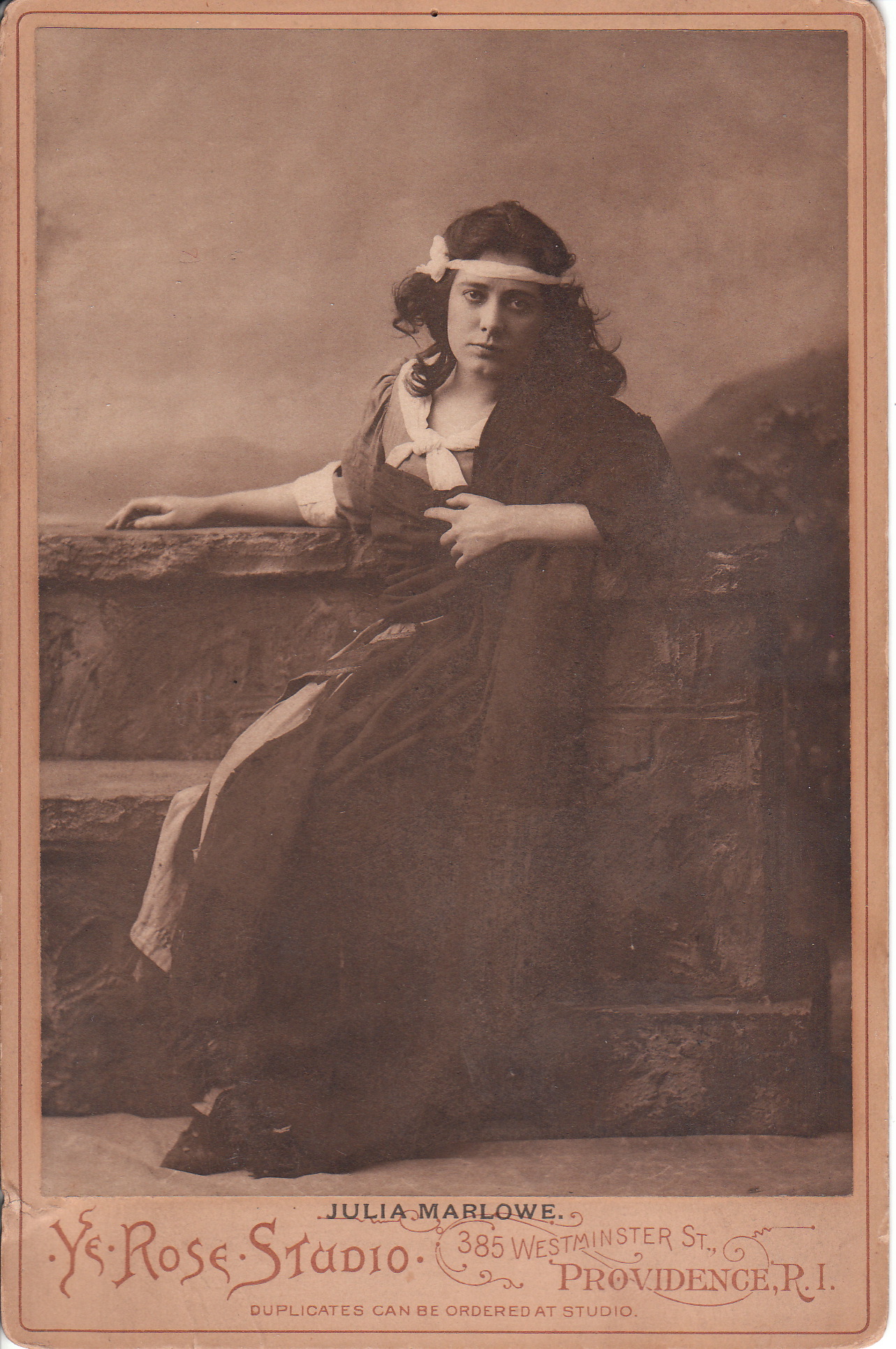
The fifth portrait of Julia Marlowe appears to be a photograph of the actress in costume for an unknown stage production. The image was photographed by Ye Rose Studio of Providence, Rhode Island. The reverse of the card indicated that the studio was opened in 1886. The studio was located in the Conrad building in downtown Providence. The building still exists. Other photographs by the Ye Rose Studio can be viewed by clicking on the category “Photographer: Ye Rose”.

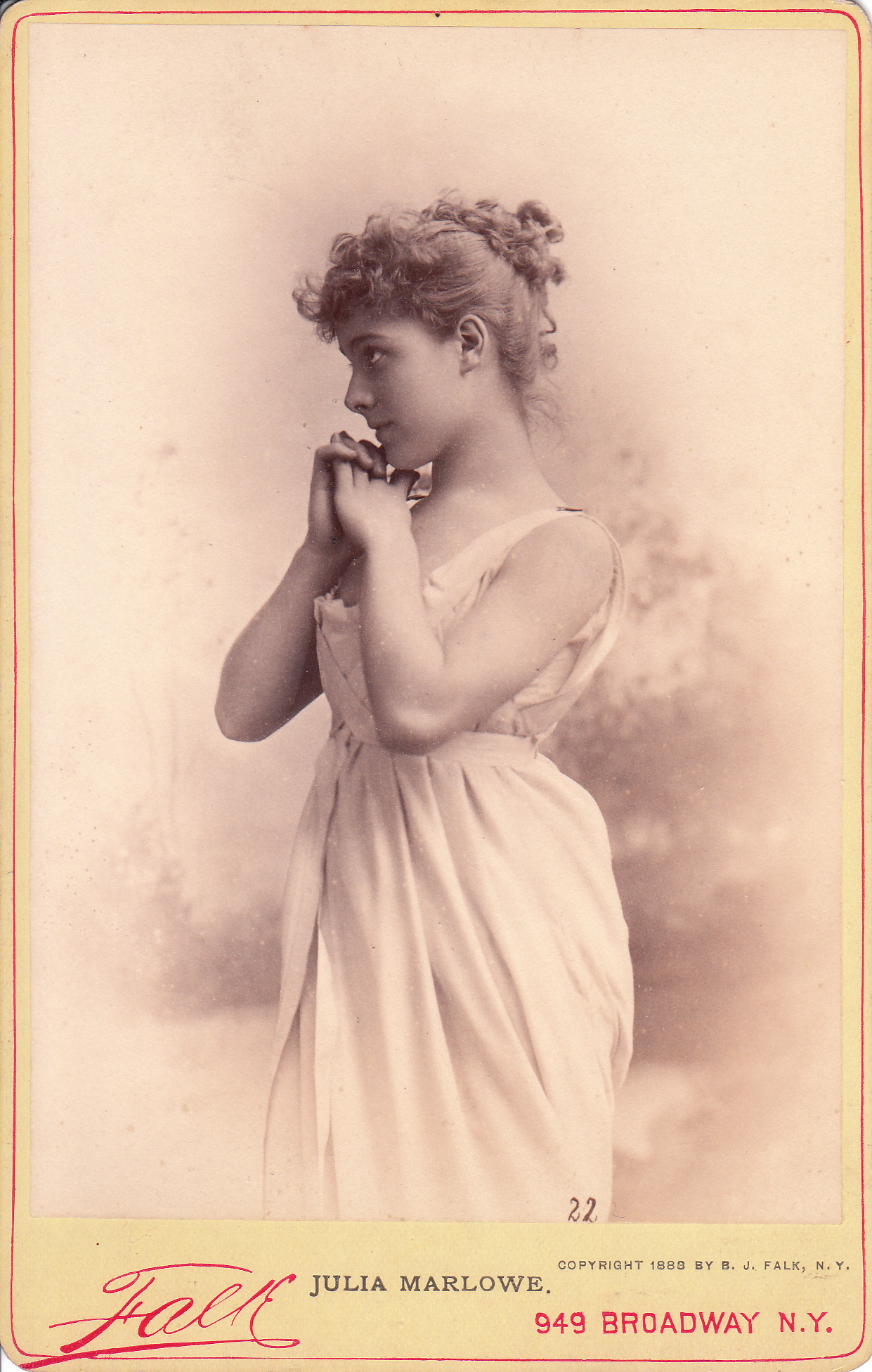
Portrait number six is an excellent example of the beauty of Julia Marlowe. This image, from 1888, captures Ms. Marlowe at the young age of twenty-three. The photographer of this portrait was B. J. Falk, a celebrity photographer located in New York City, New York. To view other photographs by Falk, click on the category “Photographer: Falk”.

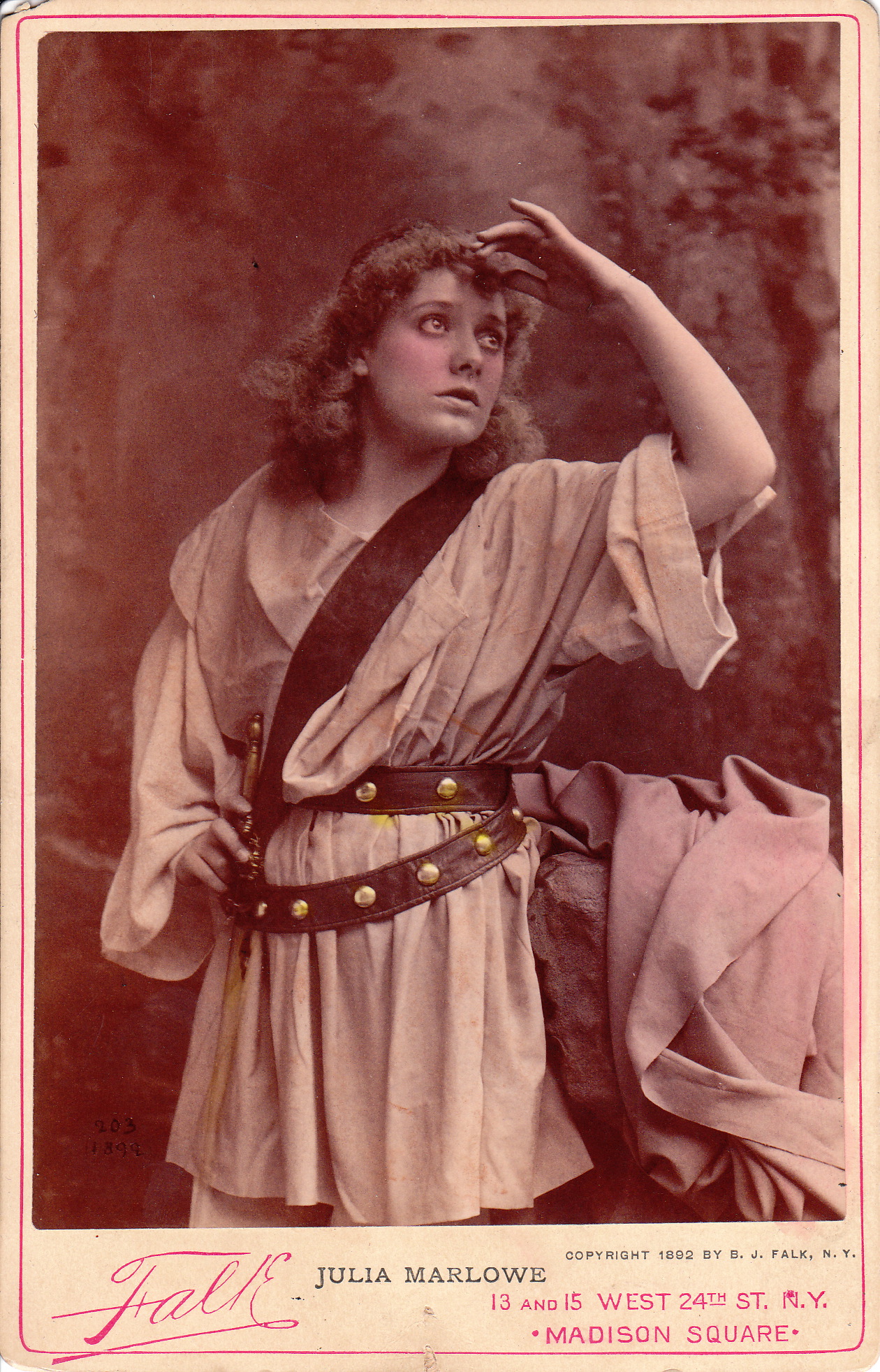
The seventh portrait is another example of a B. J. Falk image. The photograph features a costumed Julia Marlowe in the production of “Cymbeline“. Cymbeline is a play by William Shakespeare that was based on legends about the early Celtic British King,  Cunobelinus. The play deals with themes that include innocence and jealousy. Ms. Marlowe plays Imogen, the King’s daughter. Her expression in the photograph shows fear and concern as she looks at someone or something in the distance. Her left hand shades her eyes while her right hand clutches her belted dagger. A stamp on the reverse of  this cabinet card reveals that it was formerly owned by Culver Pictures of New York City, New York. Culver Pictures has been collecting photographs and illustrations from the 19th and first half of the 20th century, since 1926. These pictures are used in books, films, and other forms of media. At the time that this cabinet card was stamped by the company, Culver Pictures was located in New York City.  (SOLD)

Portrait number eight is a close-up photograph of Miss Marlowe. The photographer of this cabinet card is the studio of Rose & Sands whose gallery was located in Providence, Rhode Island. Note that photograph number five also came from the Rose studio, but at that time, the gallery was called, the Ye Rose studio. The Wilson’s Photographic Magazine (1899) reports that Rose and Sands were the proprietors of Ye Rose. A humorous headline in a photography magazine stated “Providence Provides for All, And Rose Provides for Providence”.  Print on the reverse of this cabinet card reveals that the Rose & Sands studio was opened in 1886 and that it specialized in “High Class Portraits from Cabinet to Life Size”. Also of interest, like photograph number seven, there is a stamp on the reverse of the photograph with the name “Culver Pictures Inc”.

Photograph number nine features the beautiful Miss Marlowe displaying a mischievous smile. Note her engaging large eyes. She is wearing a somewhat revealing dress (for the cabinet card era) and has a wonderful hat atop her head. This cabinet card photograph was published in 1888 by Benjamin Falk of New York City.  The image is marked with the number sixty-nine.

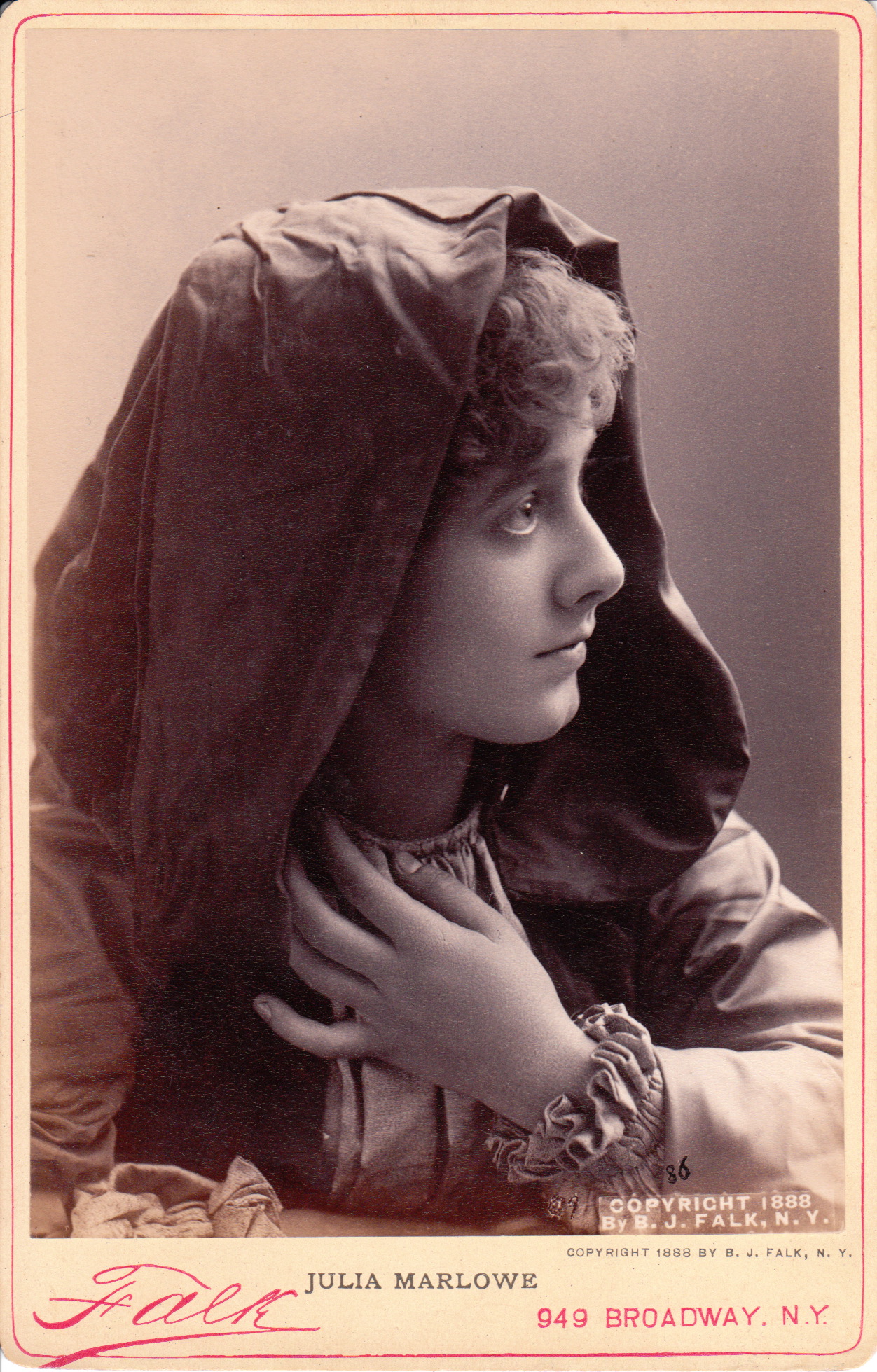
Portrait number ten is a closeup of Julia Marlowe with her head covered, but with her pretty face very visible. She is likely in costume for this photograph. The photograph is taken by B. J. Falk of New York City and has a copyright date of 1888. The cabinet card is marked number “86”.

The eleventh photograph captures Miss Marlowe staring hypnotically at a flower. Someone, has written below her name that the image features her in the role of Parthenia in the production of “Ingomar”.  The New York Times (1904) reviews the play and Miss Marlowe’s performance on opening night at the Empire Theater in New York City. The newspaper reports that Frederick Halm’s play was “impossibly romantic and deliciously sentimental piece of old-fashioned theatrics. Tyrone Power played Ingomar and he was described as “vigourous and picturesque” but the article added that his voice was “not at its best”. The review pointed out that Marlowe’s appearance in this play was to be her last appearance as an independent star before joining E. H. Sothern’s Shakespearean repertory. In regard to Marlowe’s acting in this play, it was written that she played a “dear little prig – adorably dear” (prig can be defined as smug or arrogant) and she presented “a masterpiece of harmonious, modulated, and sustained acting”. The 1904 performance of Julia Marlowe in “Ingomar” marked a return performance for this accomplished actress. The New York Times (1888) wrote a very positive review of the opening night performance in Washington D.C.. The appreciative audience included three Supreme Court Justices and a number of members of the Chinese Embassy. This cabinet card was produced by the previously mentioned Ye Rose Studio of Providence, Rhode Island and it likely dates back to her 1888 performance in the role.

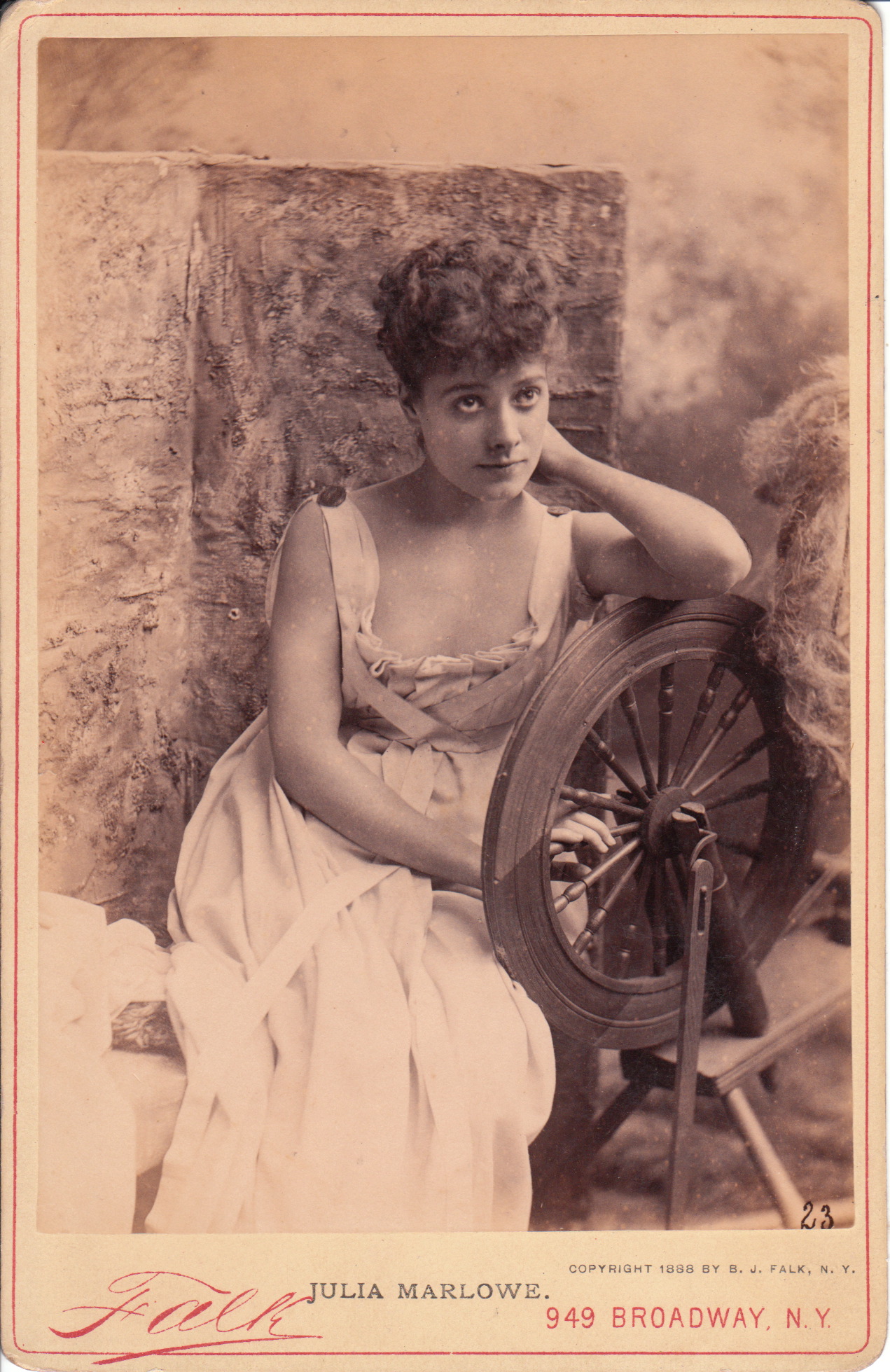
The twelfth cabinet card was produced by Benjamin Falk of New York City. He posed Miss Marlowe next to a spinning wheel. Her low cut dress makes this image a bit risque for the cabinet card era. If Falk or Miss Marlowe thought that looking up at the camera would create a “fetching appearance”, I would contend that their efforts failed. Rather than “fetching”, she appears dazed. The actress was a beautiful woman and provocativeness was not necessary to enhance her image. This photograph was produced in 1888 and was part of a series (#23).

Cabinet Card number thirteen is part of a series that includes Cabinet Card number ten. Both cards were photographed by Benjamin  Falk and have a copyright date of 1888. Both portraits are close-ups but this one is captures Marlowe looking at the camera while number ten offers a profile view. Falk really captured the actresses eyes. Her eyes are beautiful and they are haunting at the same time. This photograph is marked number number 83 of the series.

Cabinet Card fourteen features another beautiful portrait of Julia Marlowe. This photograph was taken by Benjamin Falk and was copyrighted in 1892. This cabinet card is uncommon, possibly rare.  (SOLD)
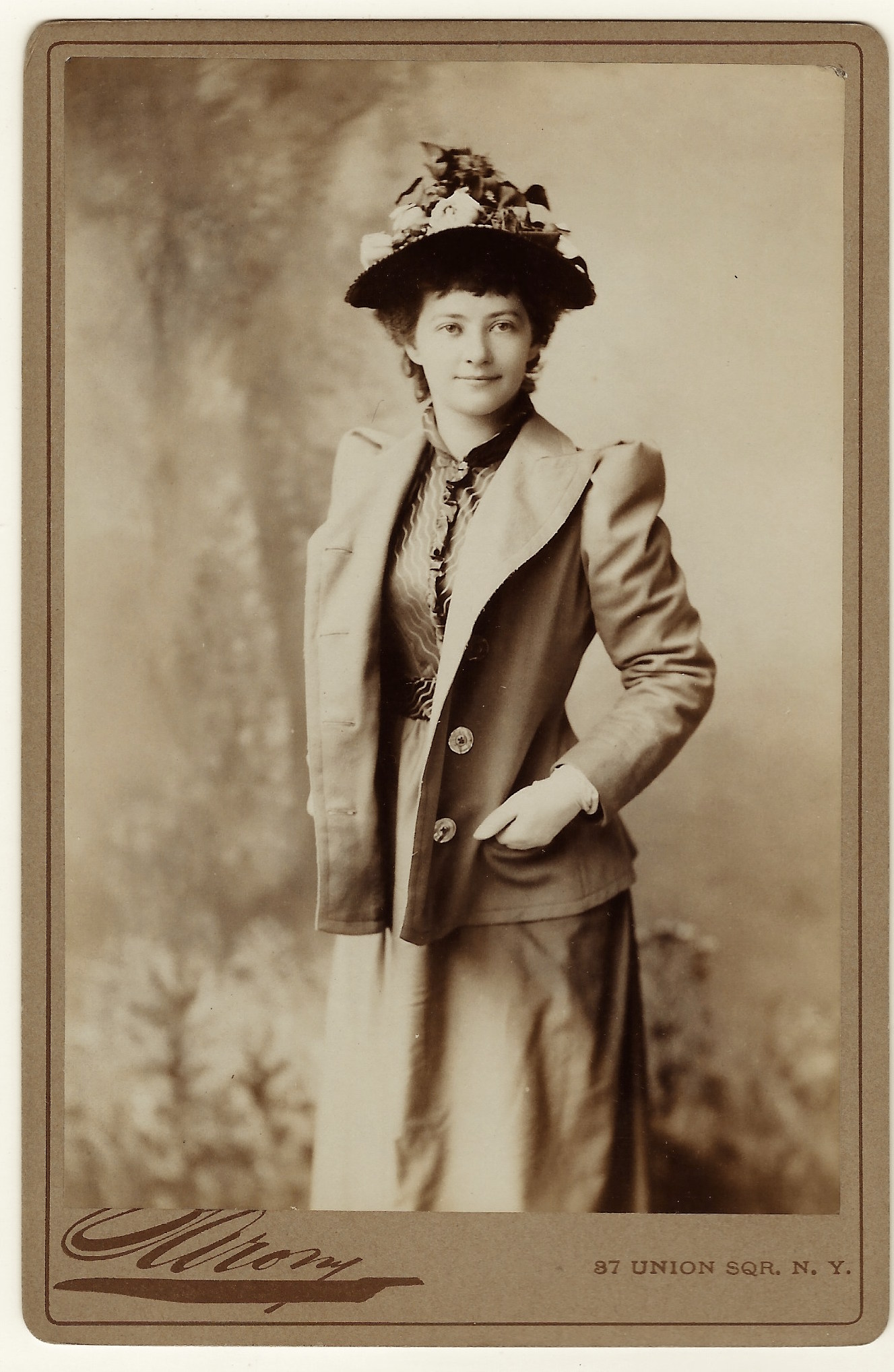
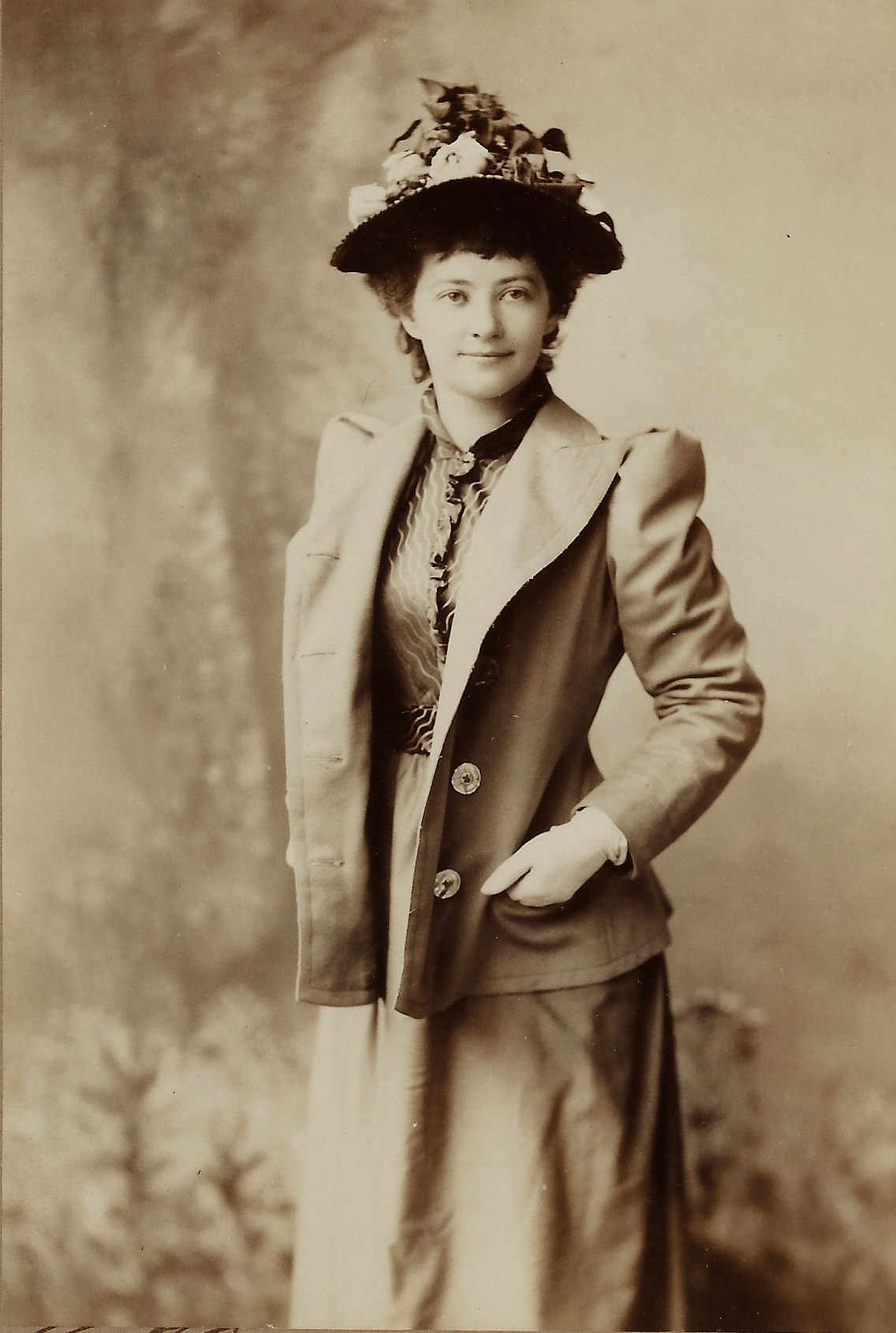
Cabinet Card 15 was photographed by Napoleon Sarony, the famed celebrity photographer located in New York City.  (SOLD)
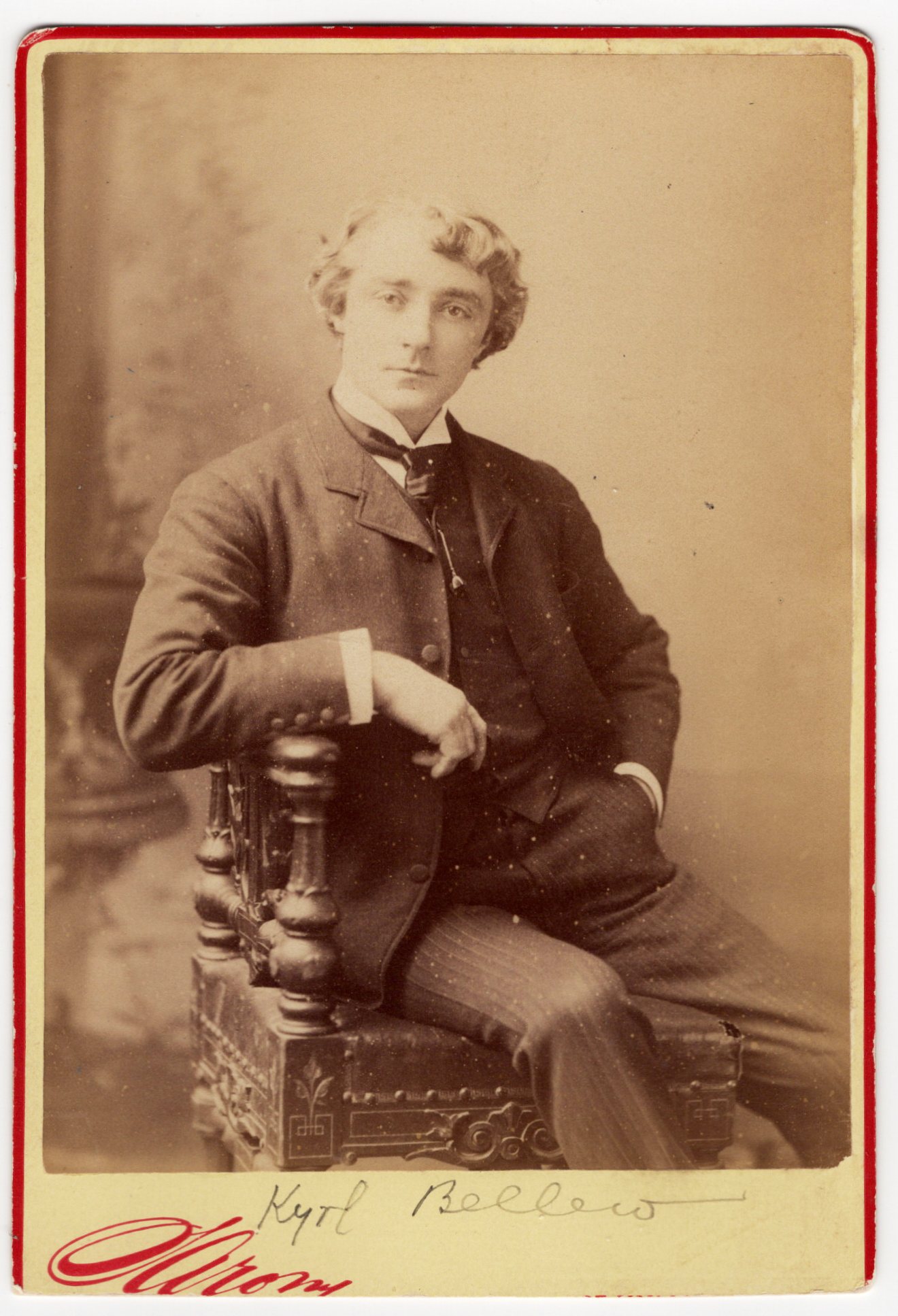
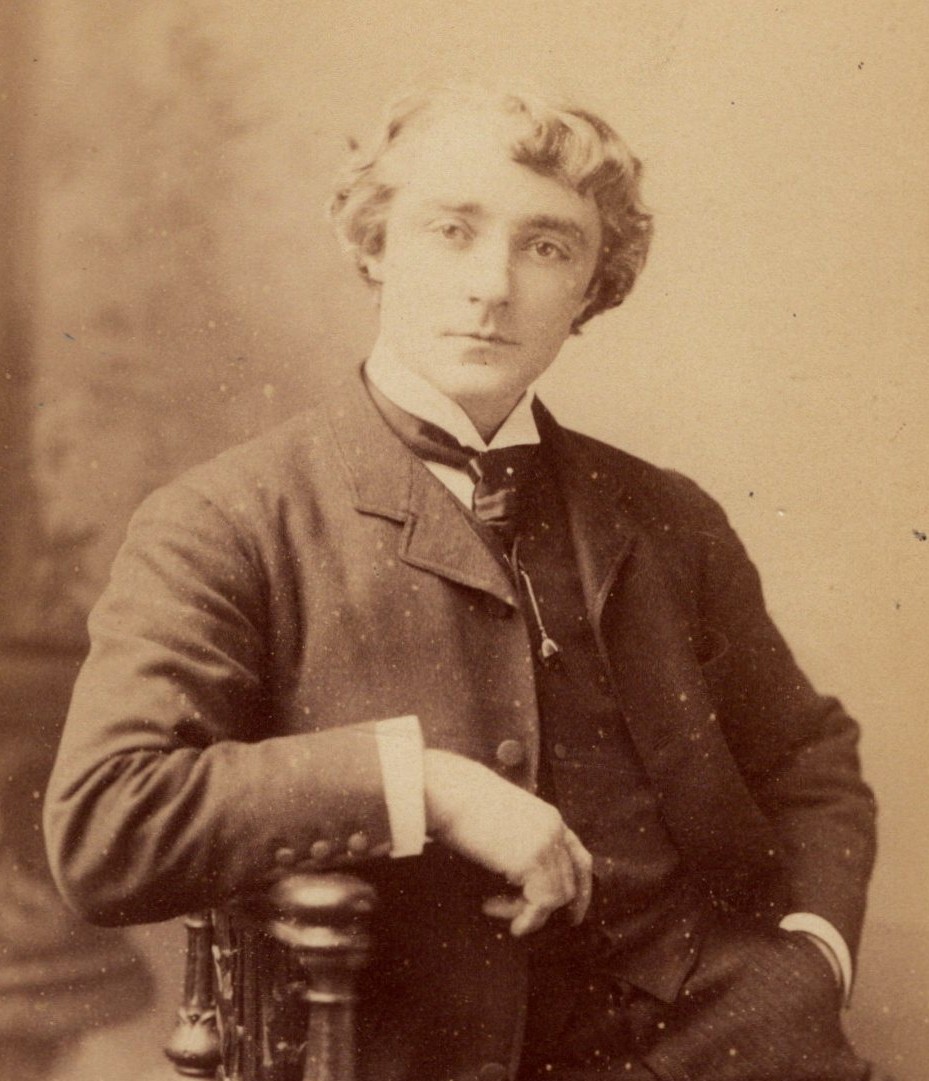
KYRLE BELLEW : STAGE ACTOR : BY NAPOLEON SARONY : NEW YORK CITY : CABINET CARD

This elegant cabinet card features the distinguished English actor Kyrle Bellew, captured in a poised seated portrait by renowned photographer Napoleon Sarony. Bellew is depicted in a formal dark suit with a high-buttoned waistcoat and a crisply starched white collar. His hair is neatly parted, and his mustache is meticulously groomed, reflecting the refined style of late 19th-century theatrical gentlemen. His expression is composed and introspective, with a subtle intensity in his gaze that hints at the dramatic roles he was known for. Bellew is seated in a carved wooden chair with a high back, its ornate design complementing the dignified atmosphere of the portrait. The studio backdrop is understated, ensuring that the focus remains on the subject’s commanding presence. The cabinet card is printed on slightly thinner stock than typically seen. Napoleon Sarony was located in New York City during the late 1800s. He was known for his finely composed theatrical portraits, capturing many prominent actors of the era with a distinctive clarity and elegance. His photography of celebrities went well beyond the theatrical world. He was a flamboyant man and many of his portraits reflected that trait.  Kyrle Bellew (1850-1911) was born in  England and was a celebrated stage actor renowned for his romantic leads and Shakespearean roles. He gained fame touring with actress Cora Brown-Potter in the 1880s and 1890s, performing in classic plays across the United States and Australia. Bellew’s career also included ventures into early silent films, notably starring in Adventures of Sherlock Holmes; or, Held for Ransom in 1905. He died in 1911, in Salt Lake City, Utah, while on tour with the play The Mollusc (SOLD)
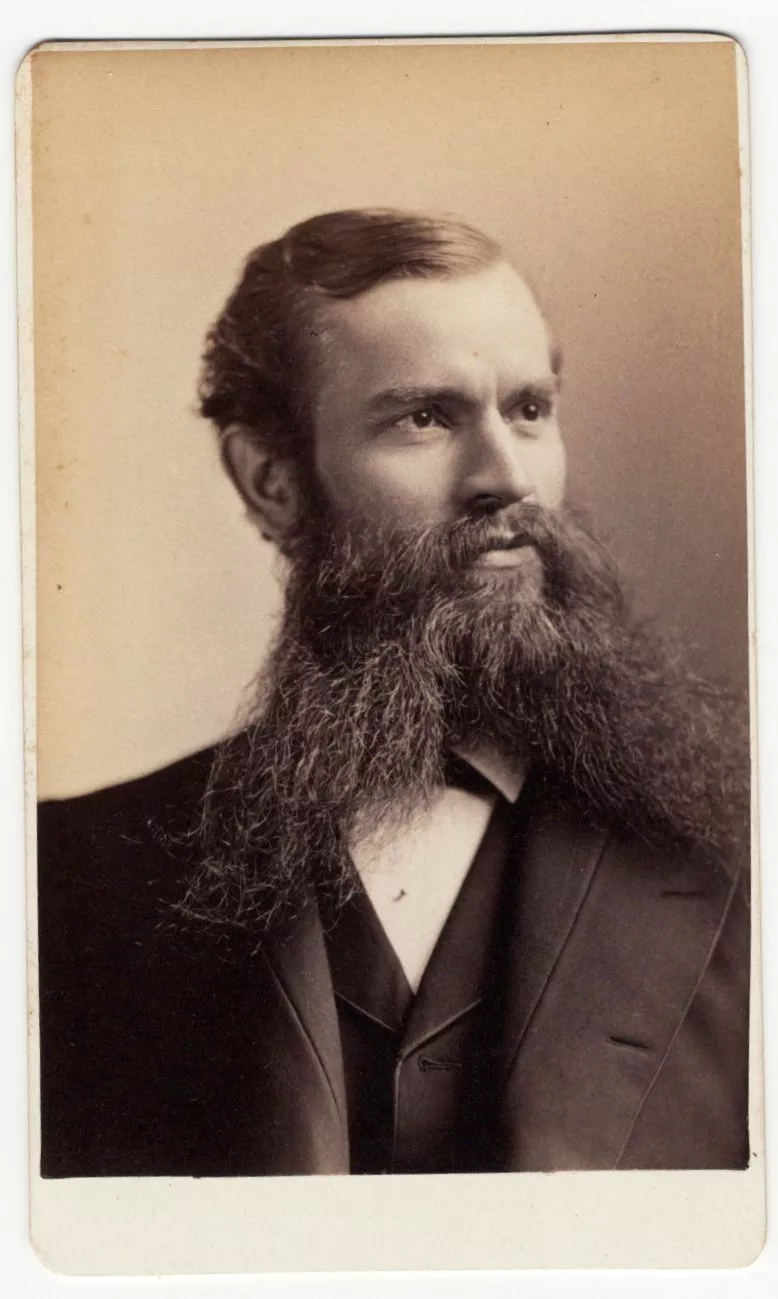
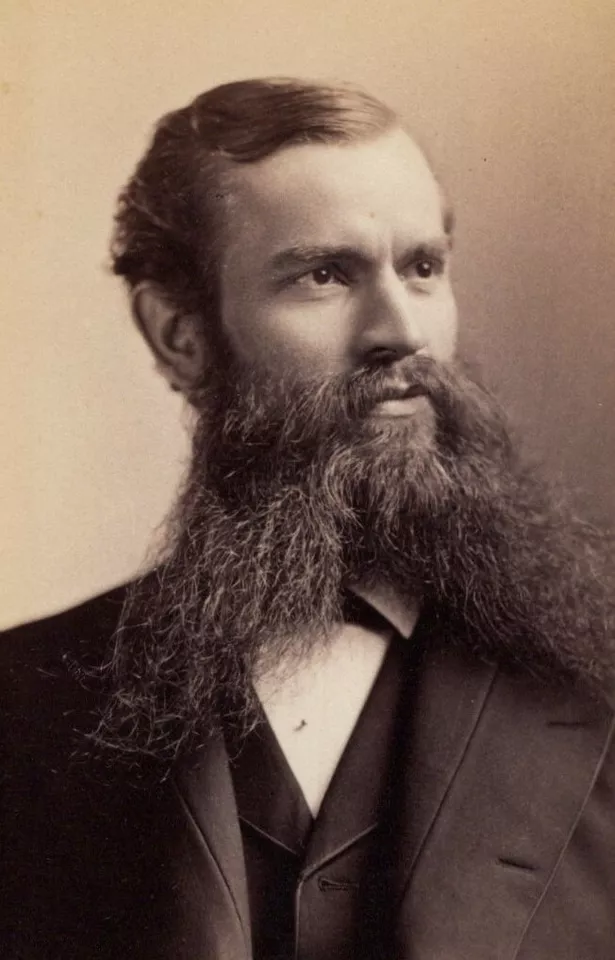
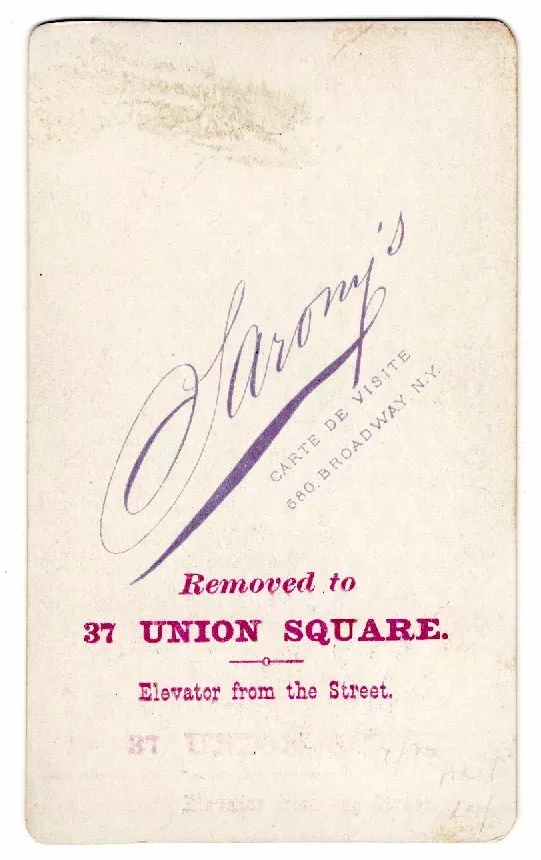
NAPOLEON SARONY CARTE de VISITE : HANDSOME MAN WITH GREAT BEARD & MUSTACHE : NYC

This carte de visite portrait features a handsome well dressed man with a wonderful beard and mustache. The cdv photograph was taken by celebrity photographer Napoleon Sarony. He operated a photo studio in the Union Square area of New York City. He was a famous photographer and was considered very talented and quite eccentric.  SOLD

ISABEL EVERSON: THEATRE ACTRESS WITH LITTLE BACKGROUND

CABINET CARD 1

everson

CABINET CARD 2

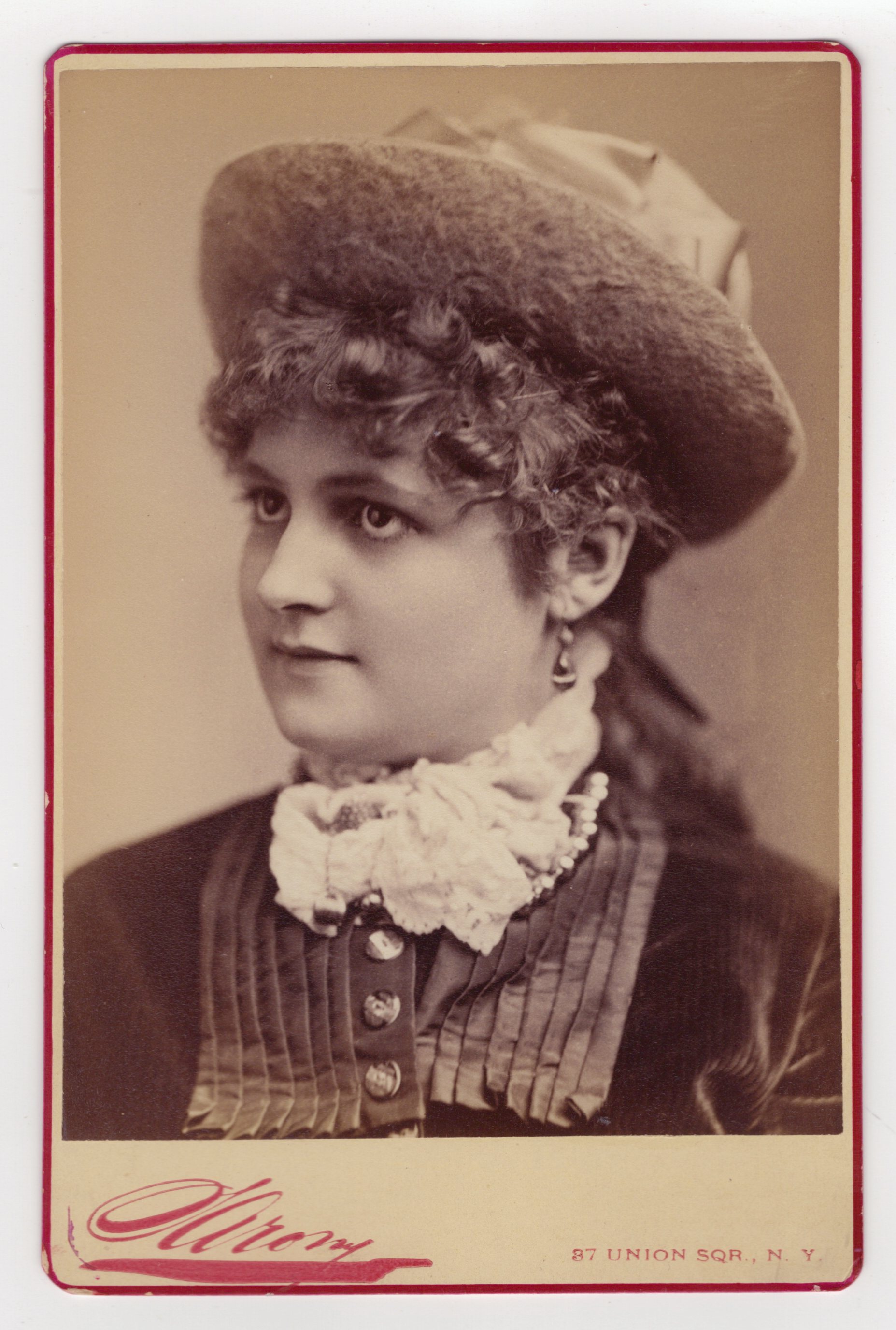
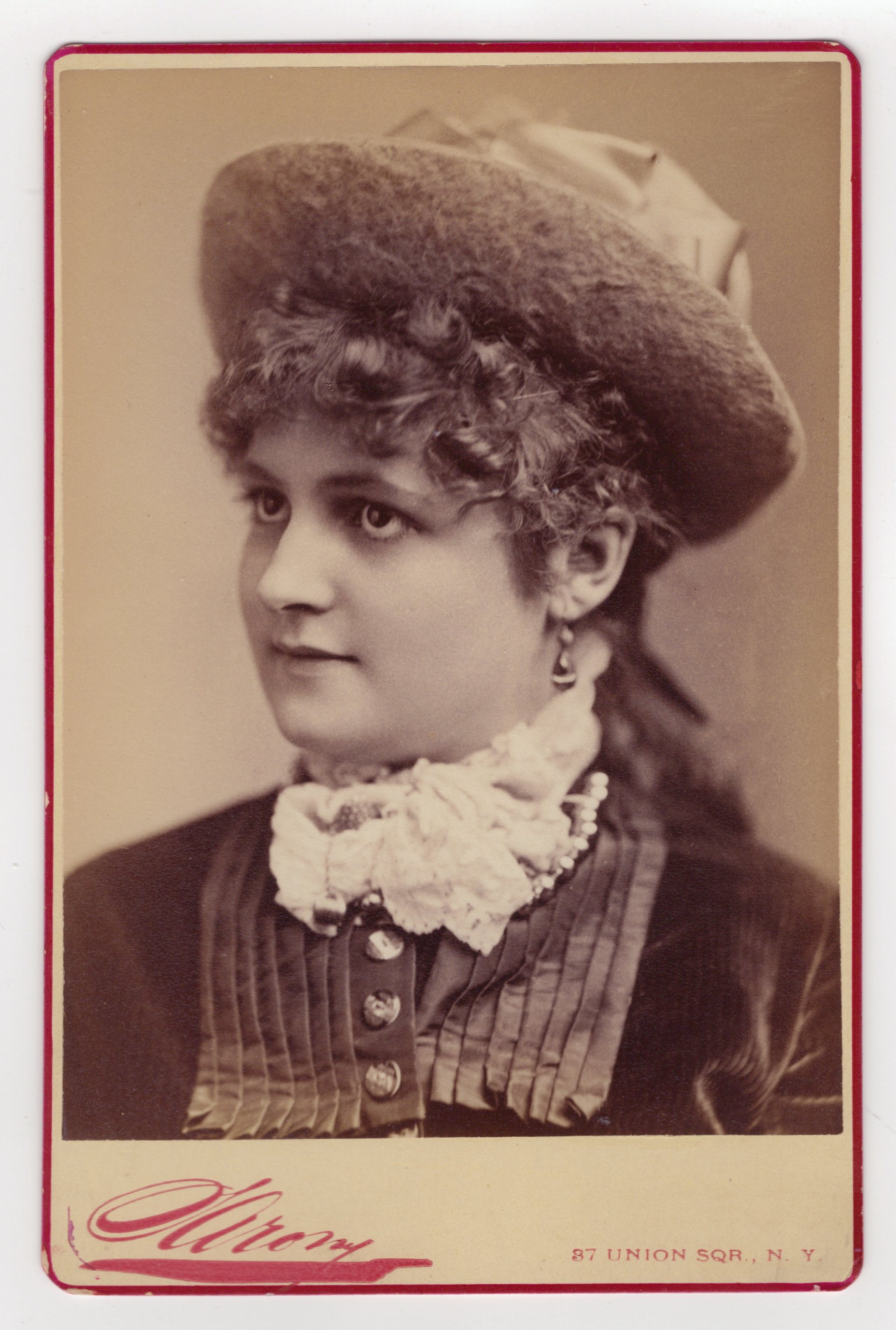
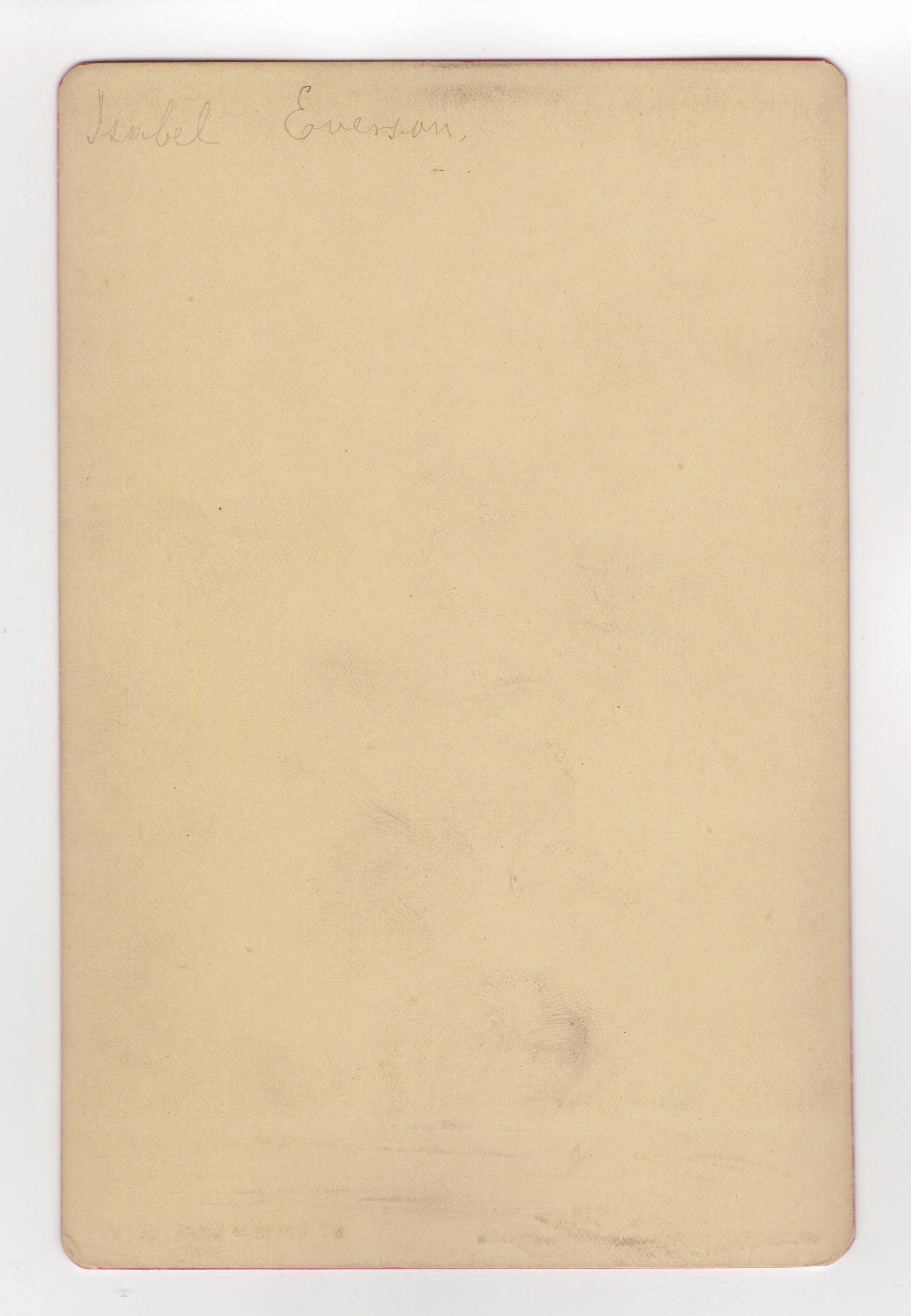
Penciled on the reverse of Cabinet Card 1 is the name Isabel Everson. Preliminary research reveals little information about this actress other than an existence of a tobacco card premium published by Sweet Caporal which has her portrait. In addition, some newspaper articles were found that announce her appearance in various theater production.  Further research is required. This cabinet card is by Sarony, famed celebrity photographer located in New York City. To see other examples of Sarony’s photographs; click on the Photographer: Sarony category on this site.

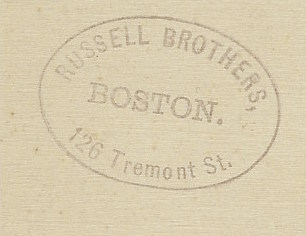
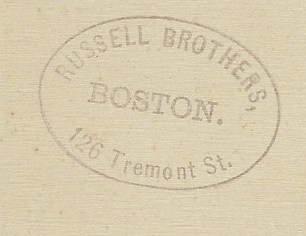
Cabinet Card 2 is a portrait of Everson by an unknown photographer. Unfortunately, the bottom of the cabinet card has been trimmed to fit into a frame or album, making it difficult but not impossible to identify the photographer. I attempted to identify the photographer by matching the script on the bottom of the photo with other photographer logos in the cabinet card collection. Unfortunately, I had no luck. Perhaps a cabinet card gallery visitor will be able to accomplish the detective work necessary to make the identification. Note the images found below that identifies Miss Everson as well as the image of the Russell Brothers stamp. Both the inscription and the stamp were located on the reverse of the cabinet card. Miss Everson is wearing a very interesting costume in this cabinet card photograph. It is probably something that she was wearing in a play in which she was appearing. I wonder what the object is that she is holding in her right hand. Does the object relate to her costume? I seem to have more questions than answers about this portrait of Isabel Everson. This cabinet card has an extremely slight curl. Extremely slight. The cabinet card has excerllent clarity and is in overall Very Good condition  (see scans). 

Buy this Cabinet Card Photograph (includes shipping within the US) #6400

To purchase this item, click on the Pay with Paypal button below

$64.00

Buy this Vintage Original Cabinet Card (includes International shipping outside the US) #6400

To purchase this item, click on the Pay with Paypal button below

$74.00

CABINET CARD 1

CABINET CARD 2

everson 3

CABINET CARD 2

Published in: on December 15, 2024 at 12:00 pm  Comments (6)  
Tags: , , ,

UNIDENTIFIED ACTRESS OR SOCIETY WOMAN IN NEW YORK CITY (PORTRAIT BY SARONY)

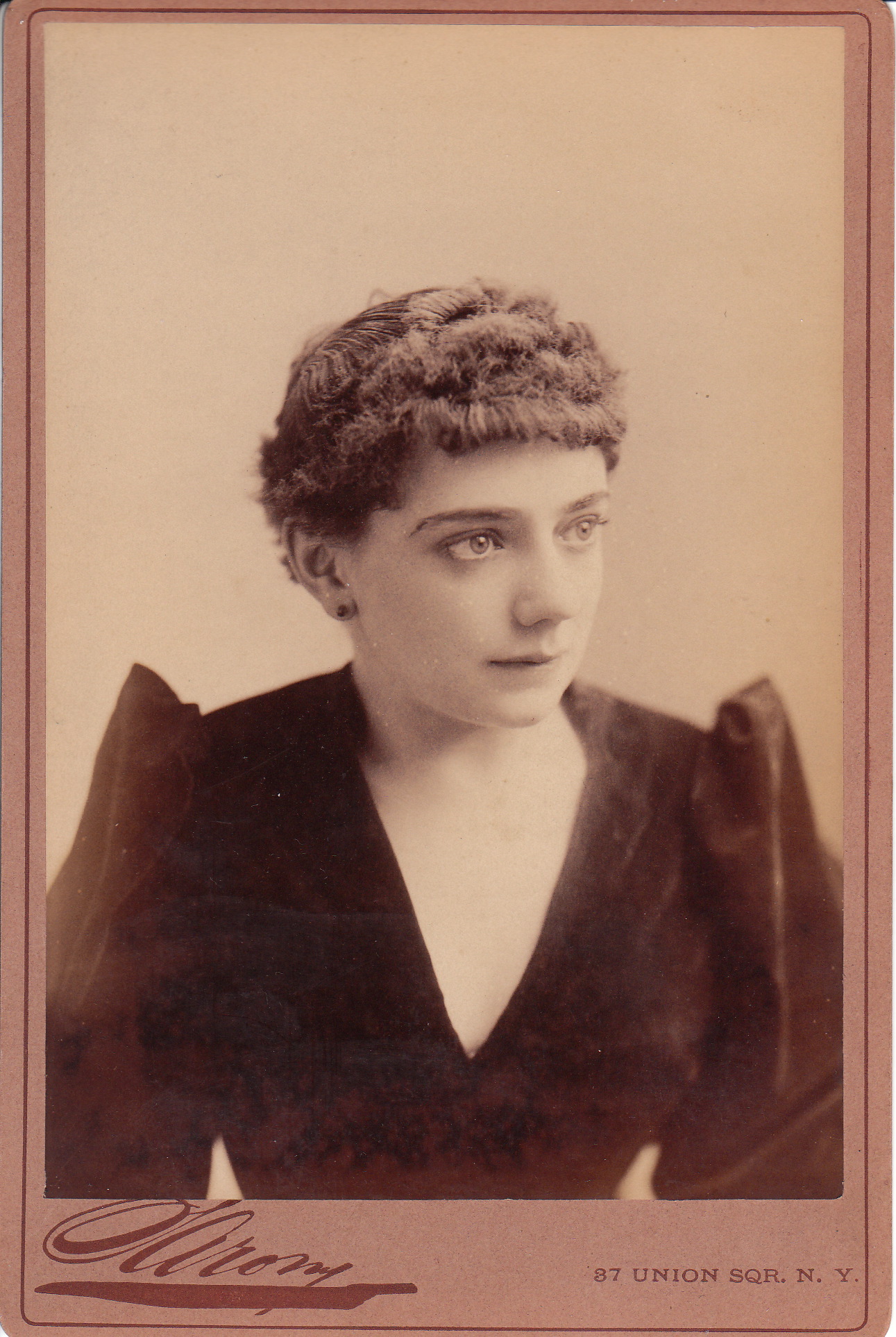
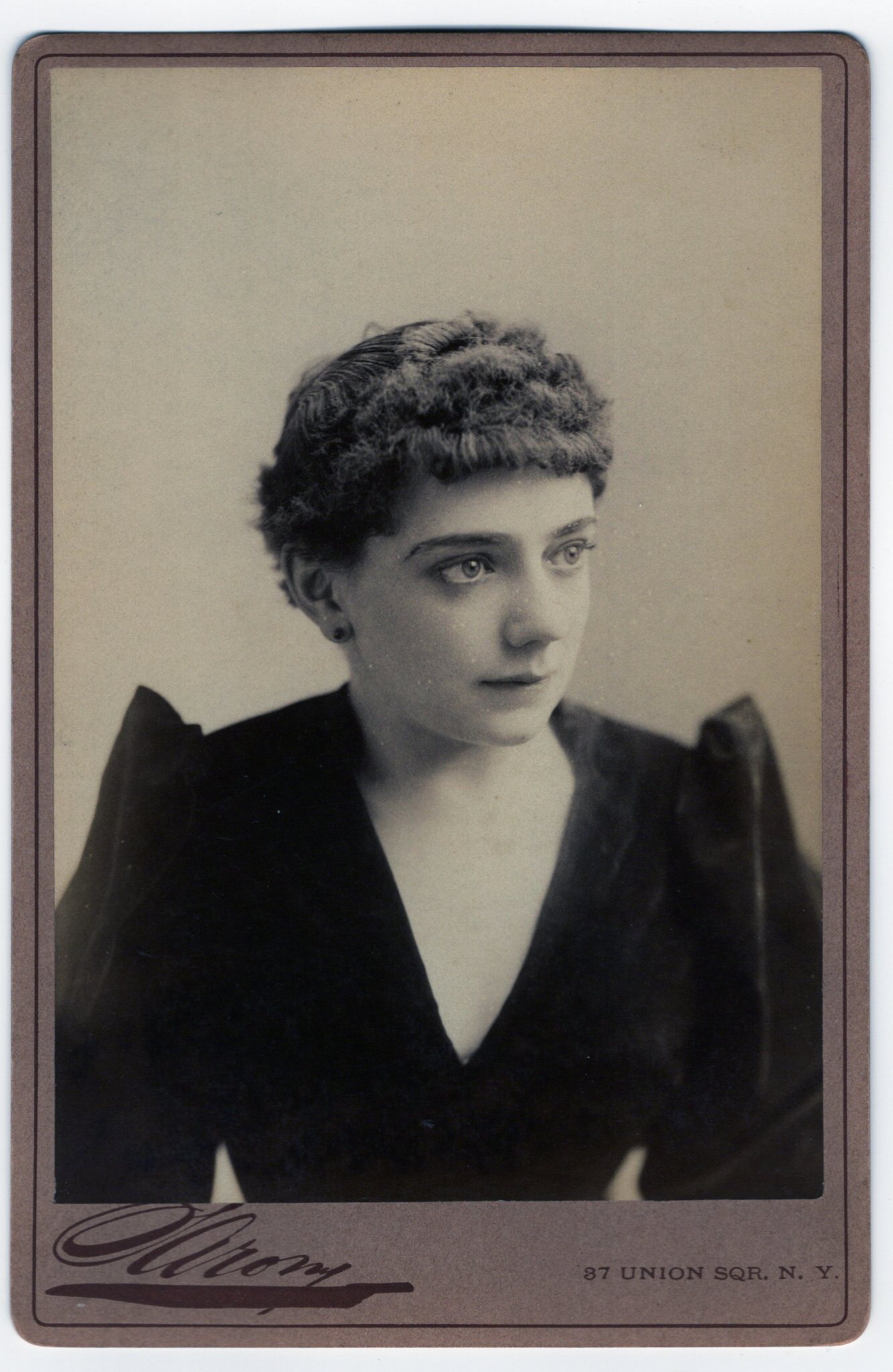
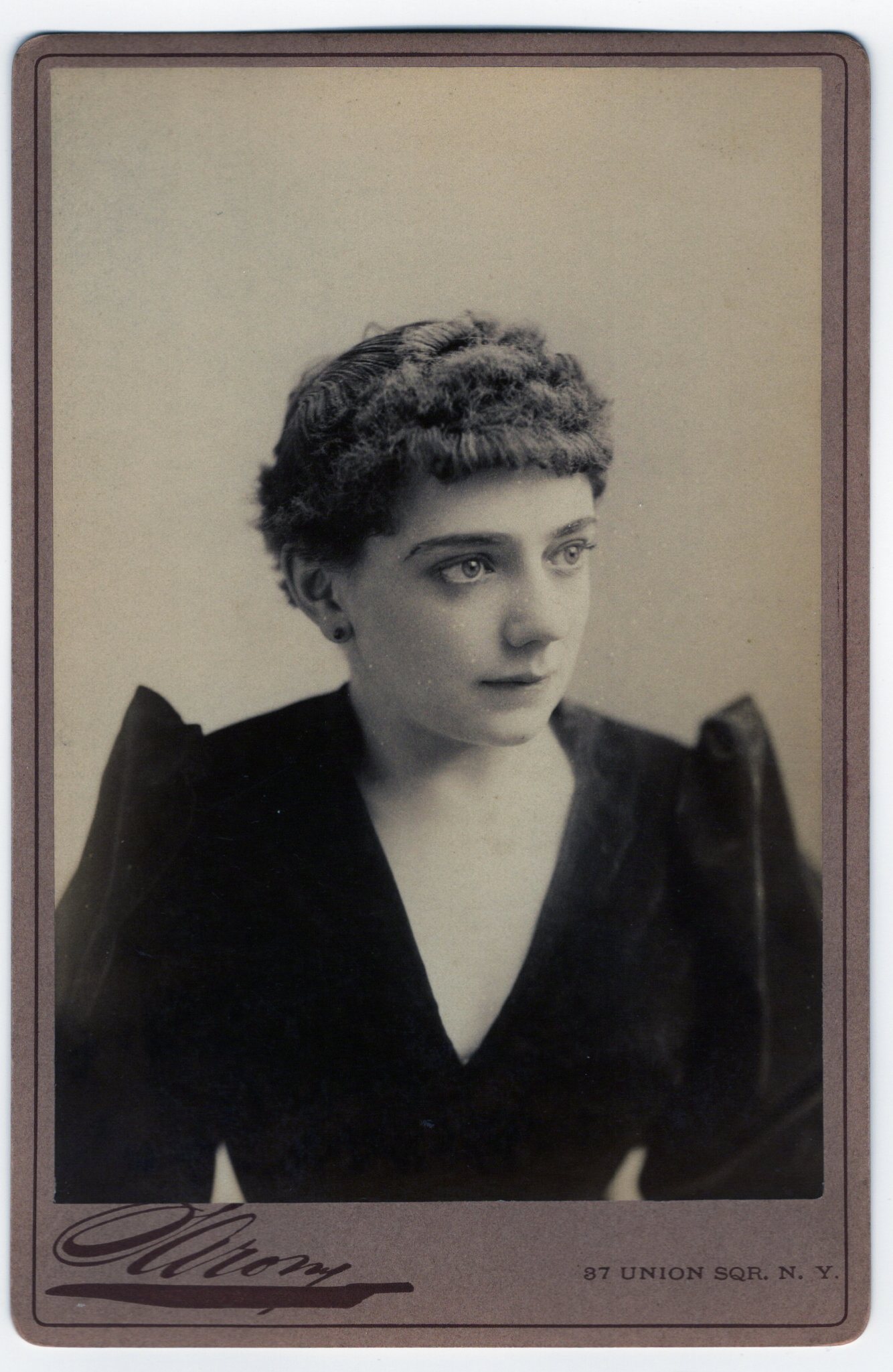
This cabinet card portrait, by celebrity New York City photographer Sarony, features an unidentified attractive young woman. She is likely an actress or a society woman. Her V-neck dress is very revealing for the era that the image was produced. In fact, this is somewhat of a risque mode of dressing. To view other photographs by Sarony, click on the category “Photographer: Sarony”. This cabinet card has an extremely mild curl and is in overall very good condition (see scans). 


6052

Buy this Cabinet Card (includes shipping within the US) #6052

To purchase this item, click on the Pay with PayPal button below

$49.95

6052-1

Buy this Cabinet Card Photograph (includes International shipping outside the US) 6052

To purchase this item, click on the Pay with PayPal button below

$59.95

Published in: on June 16, 2024 at 1:49 pm  Leave a Comment  
Tags: ,

ETHEL BARRYMORE: A STAGE BEAUTY

blog1CABINET CARD 1

CABINET CARD 2

                                                                                                                                      brrymore

                                                                 POSTCARD 1  (SOLD)
ethelPOSTCARD 2  (SOLD)
barrymorePOSTCARD 3

barrymore-againPOSTCARD 4   (SOLD)

BARRYMORE PCPOSTCARD 5  (SOLD)

ETHEL BARRYMORE: STAGE BEAUTY : BROADWAY : RPPC  (1906) - Picture 1 of 2POSTCARD 6 (SOLD)

Ethel Barrymore (1879-1959) was an outstanding American actress and a member of the famous theatrical Barrymore family. She was born Ethel Mae Blythe in Philadelphia, Pennsylvania. Her parents were actors and she was the sister of John and Lionel Barrymore.  She was the great aunt of modern day actress Drew Barrymore.

Ethel Barrymore was considered by many to be the greatest actress of her generation. She was a major Broadway performer and first appeared there in 1895. She had roles in A Dolls House by Ibsen (1905).  She was a strong supporter of the Actors’ Equity Association and played a major role in the 1919 strike. She played in Somerset Maugham’s comedy, The Constant Wife (1926). She also starred in motion pictures beginning her film career in 1914.  Notable films included None but the Lonely Heart (1944) and The Spiral Staircase (1946). Around 1900, Winston Churchill proposed marriage to Barrymore but she refused. She later married Russell Griswold Colt in 1909 and had three children. She died of cardiovascular disease in 1959 at her home in California. The Ethel Barrymore Theatre in New York City is named in her honor.

The cabinet card 1 portrait of Ethel Barrymore was photographed by Phillips Photographers of Philadelphia, Pennsylvania. To view other photographs by Phillips, click on the category “Photographer: Phillips”. The second image (cabinet card 2) of the actress was produced by Sarony, the famous celebrity photographer who’s studio was located in New York City. To see other Sarony photographs, click on the category “Photographer: Sarony”.

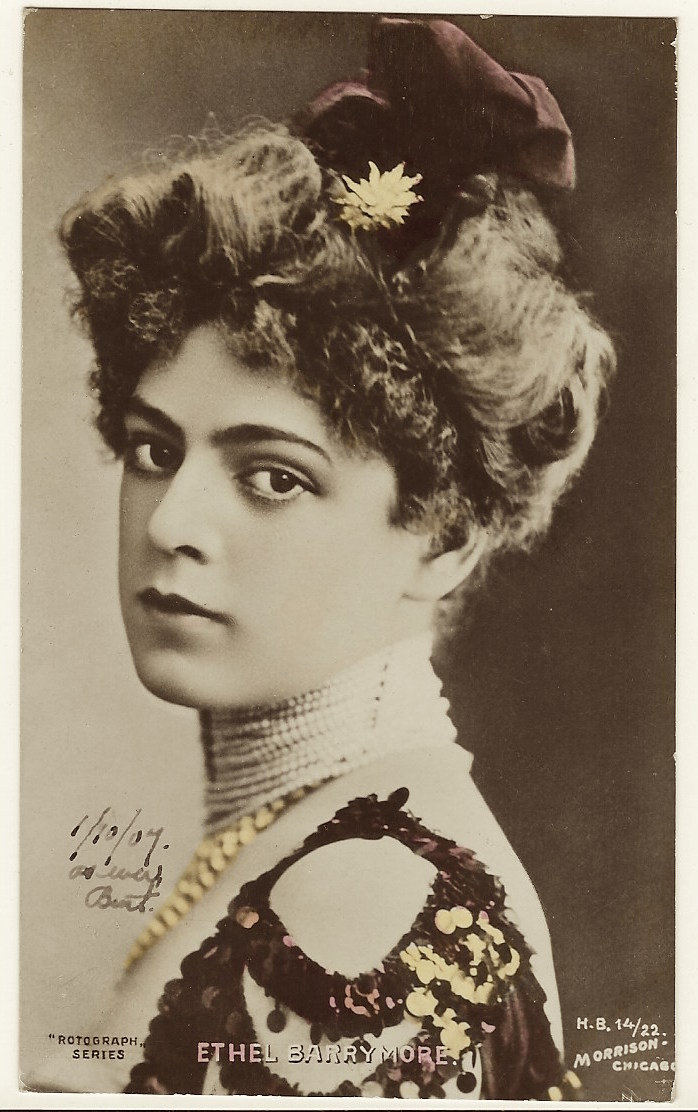
The third portrait of Miss Barrymore appears on postcard 1, published by the Rotograph Company who operated in  New York City and Germany. This postcard portrait was taken by famed Chicago photographer William Morrison. He is well known for his excellent portraits of theatrical stars. He produced both real photo postcards and cabinet cards. This postcard is number HB/1422 of the “Rotograph Series”. The image on this postcard is color tinted. This postcard has been mailed and postmarked (1907). The reverse of this postcard can be seen below.To view other photographs by Morrison, click on the category “Photographer: Morrison”.

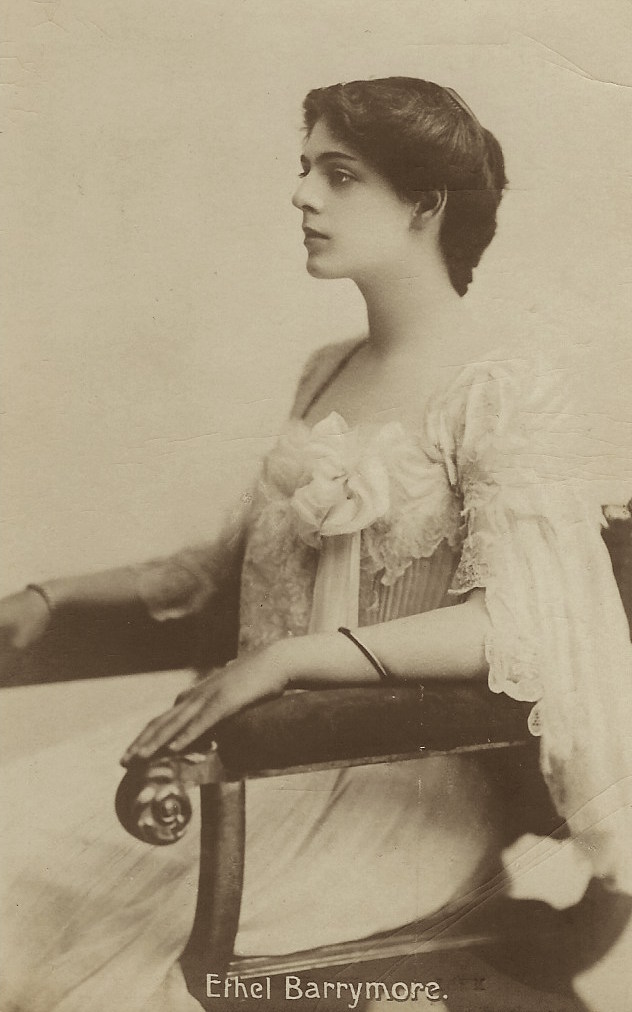
The fourth portrait of Ethel Barrymore is an uncommon one (postcard 2). The image provides a lovely profile view of this legendary actress. If you search for this exact postcard online, you likely won’t find it. This postcard was published by E. Frey & Company who operated in  New York City . Research reveals that postcards displaying the printed name of  “E. Frey” were actually published by the Souvenir Post Card Company which existed between 1905 and 1914. It was located at 268 Canal Street in New York City. The company was purchased by Valentine & Sons and the combined company became Valentine – Souvenir. This postcard was printed in Germany and is in good condition (see scan).

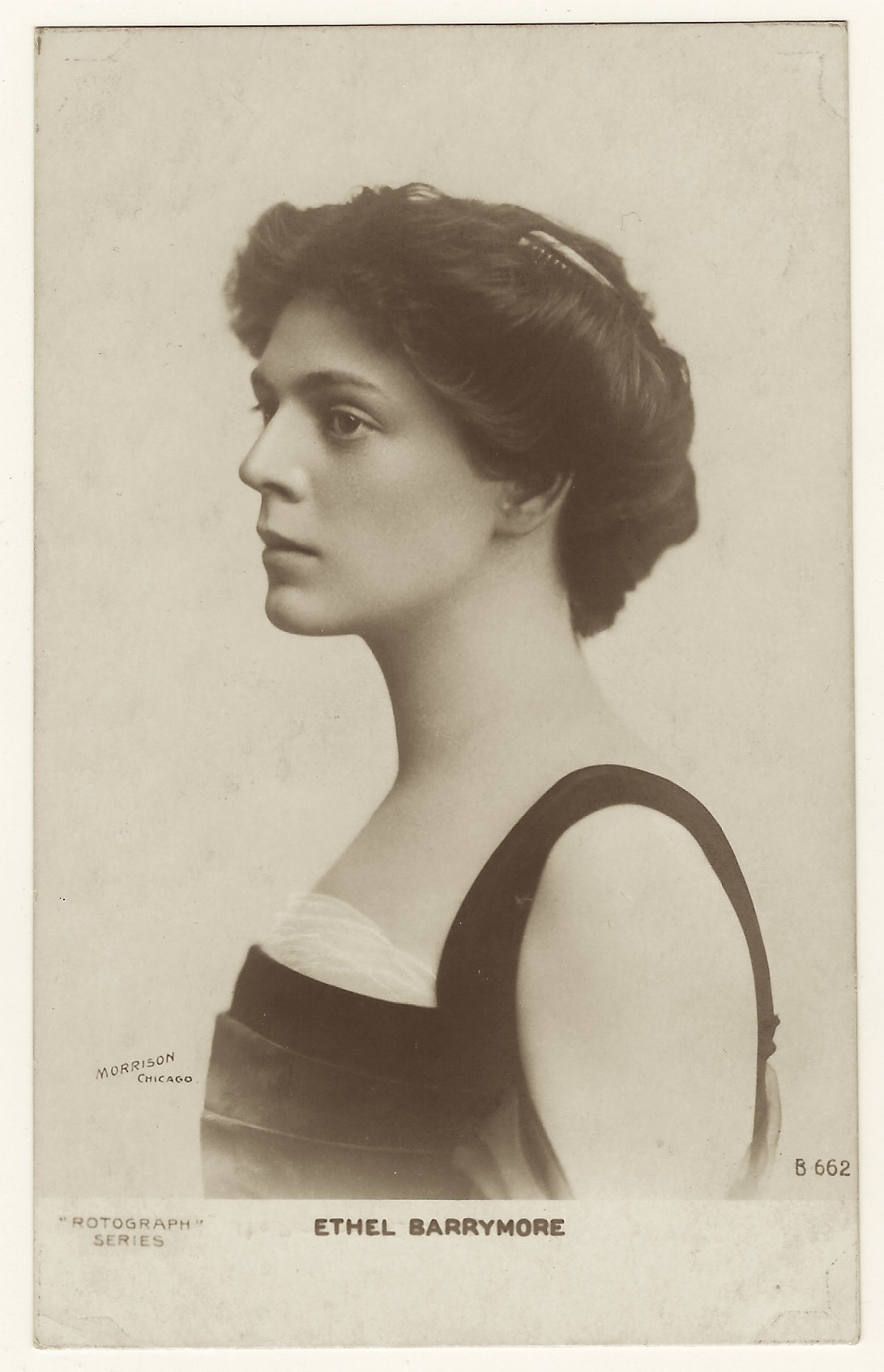
The fifth photograph (postcard 3) of Miss Barrymore was published by the Rotograph Company. This postcard portrait was taken by famed Chicago celebrity photographer William Morrison.This postcard is number B 662 of the “Rotograph Series”. The image has excellent clarity.

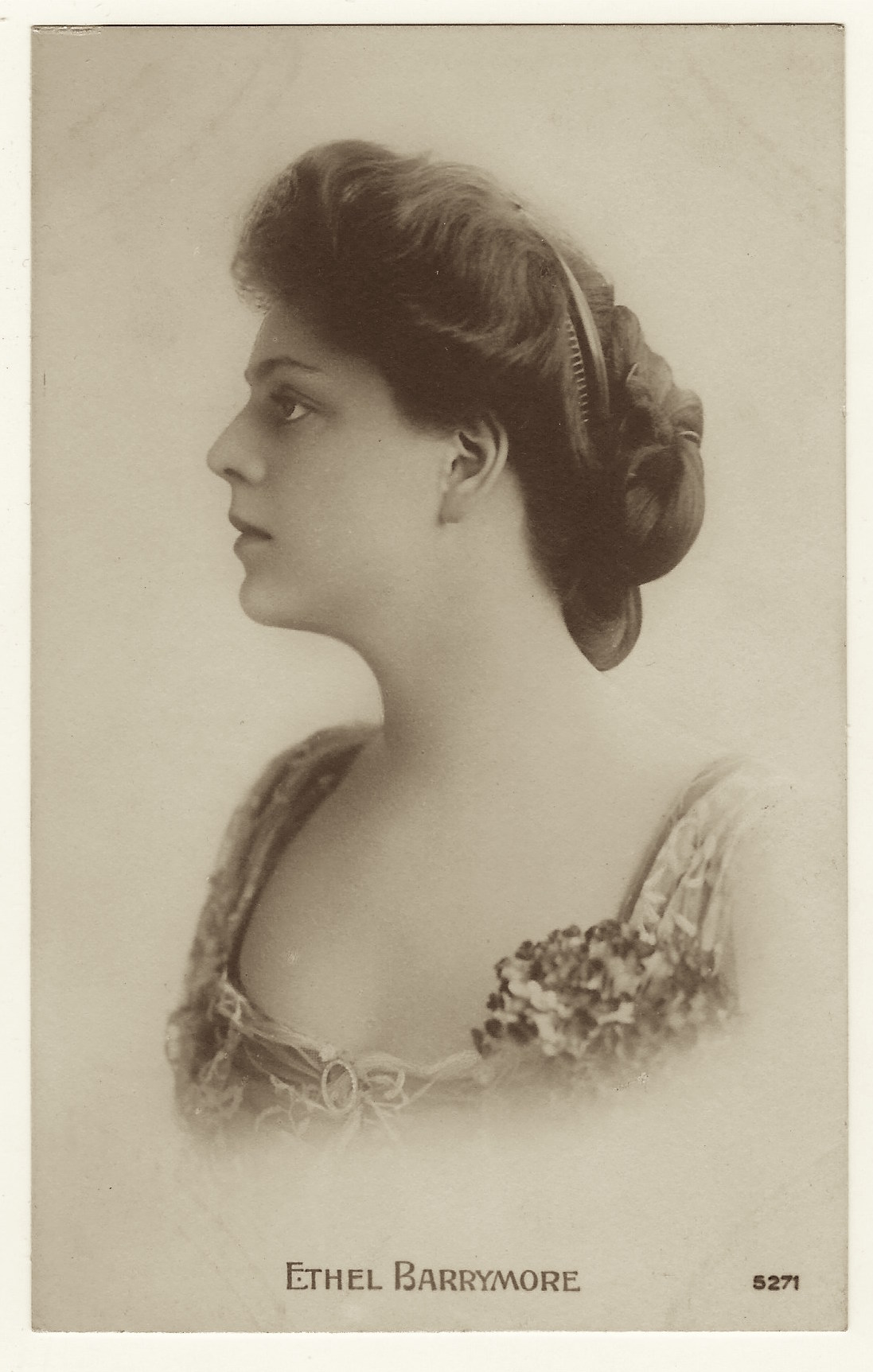
The sixth image (postcard 4) is a vintage real photo postcard portrait of Ethel Barrymore. The postcard was published by Albert Hahn who was based in New York City (200 Broadway) and Hamburg. Hahn operated his company between 1901 and 1919. The postcard was produced in Germany sometime in the decade of 1900-1910. The postcard is part of a series (no. 5271).  (SOLD)

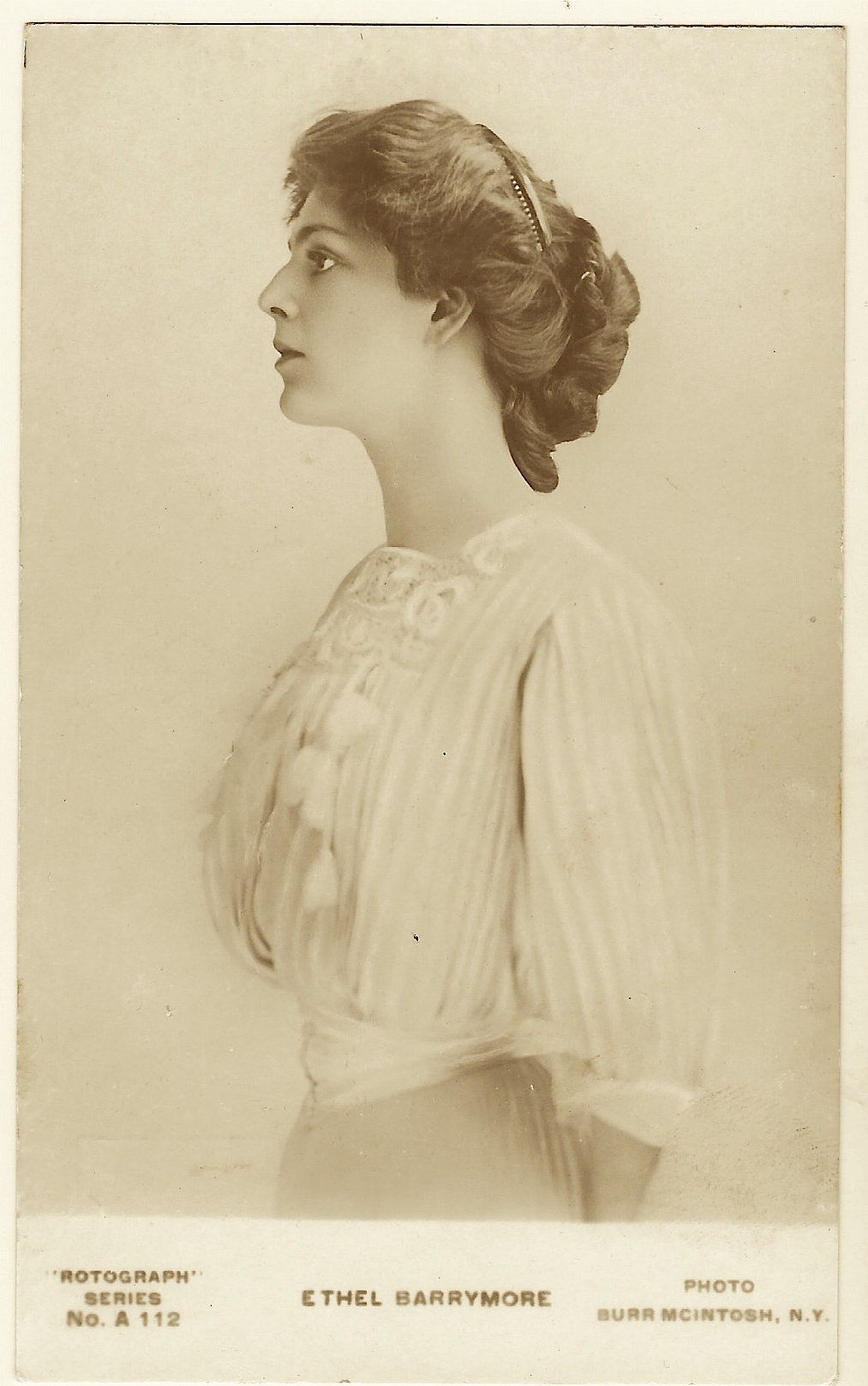
Postcard 5 offers a profile view of Miss Barrymore. The postcard was published by the Rotograph Company as part of the Rotograph Series (No. A 112). The photographer of this image is Burr McIntosh of New York City. William Burr McIntosh (1862-1942) lived an interesting life. Among his job titles listed by Wikipedia, are photographer, lecturer, film studio owner, silent film actor, publisher of the “Burr McIntosh Monthly”, reporter, and radio and early film pioneer. His sister was Nancy McIntosh, a noted operatic soprano. He was a graduate of Lafayette College in 1884. His most noted film role was his appearance in D. W. Griffith’s film, “Way Down East” (1920). Wikipedia notes that he appeared in 53 films between 1914 and 1934. This vintage postcard is in very good condition.

Postcard 6 is a portrait of Miss Barrymore that was postmarked in 1907.   (SOLD)

barrymore AGAIN 1

POSTCARD 4

studholme pc 3

        POSTCARD 5   

ETHEL BARRYMORE: STAGE BEAUTY : BROADWAY : RPPC  (1906) - Picture 2 of 2Postcard 6 (Sold)

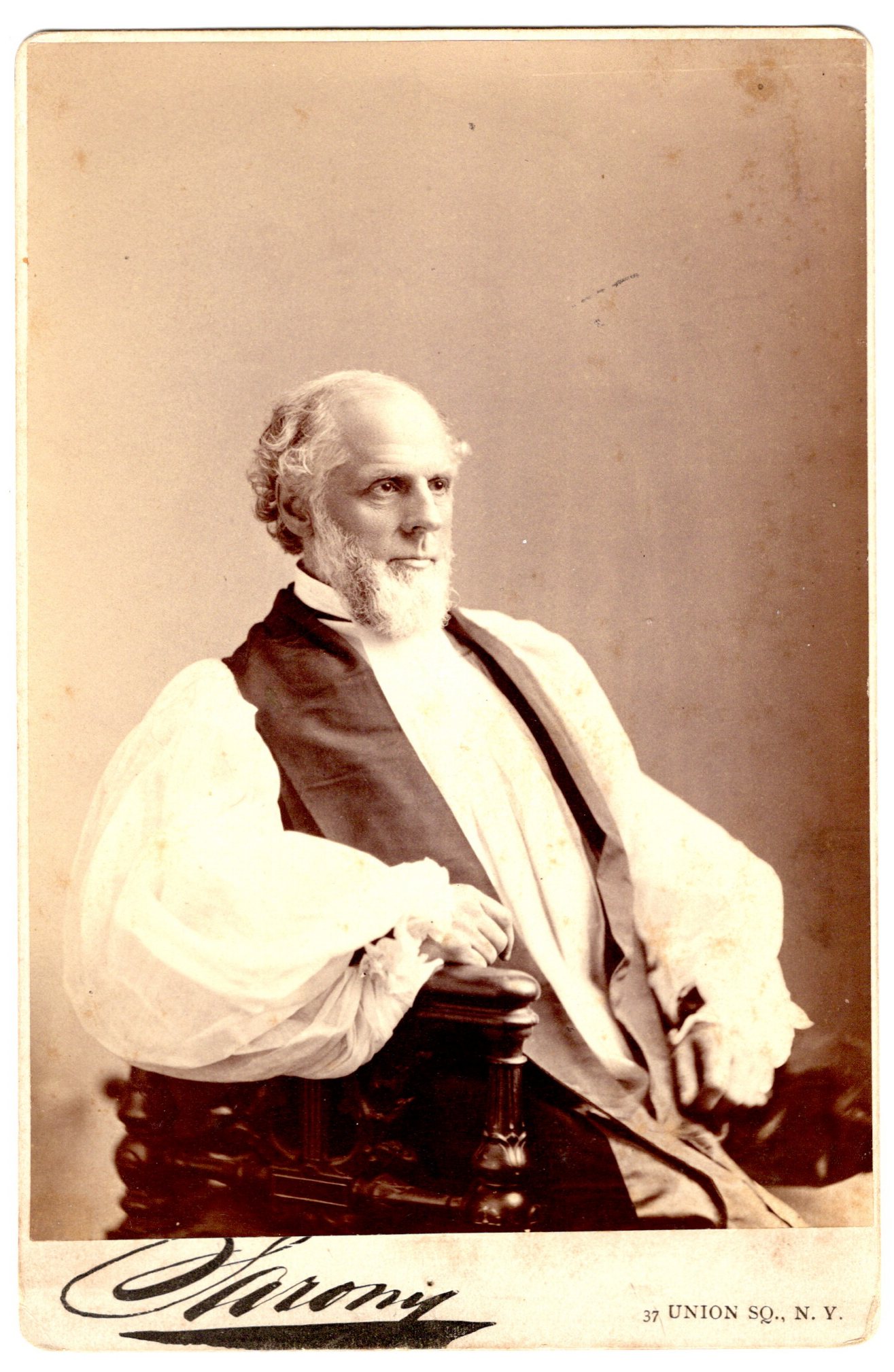
BISHOP HUNTINGTON : HARVARD : BY NAPOLEON SARONY : CABINET CARD

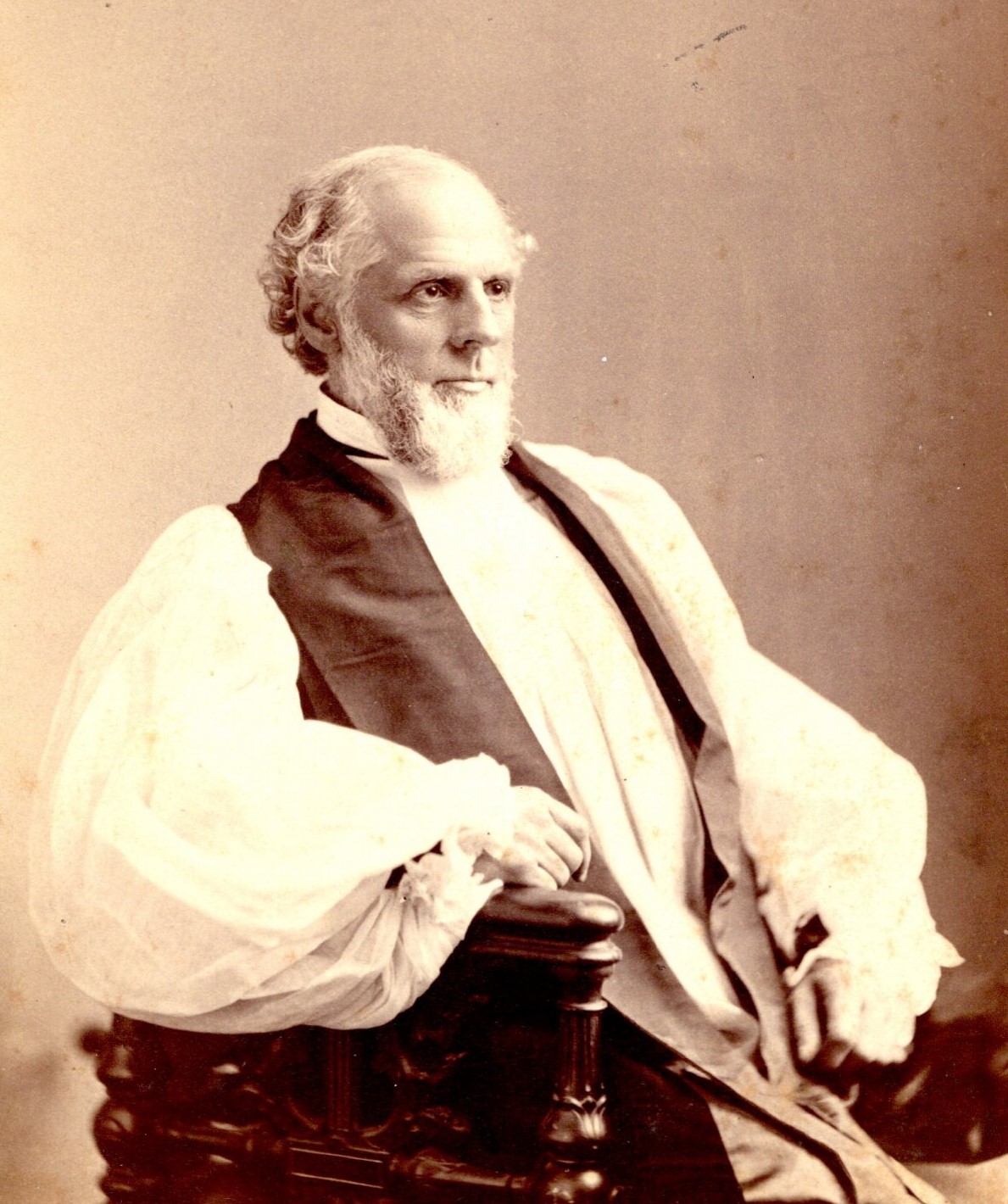
The distinguished gentleman is this photograph is Frederic Dan Huntington (1819-1904). He was an American clergyman and the first Protestant Episcopal bishop of the Episcopal Diocese of Central New York. He was born in Massachusetts and grew up on a farm. He was a graduate of Amherst College as well as Harvard Divinity School. He was the pastor of the South Congregational Church of Boston between 1842 and 1855. He then became a preacher to the University as well a a professor at Harvard. He next became the pastor of the newly established Emanuel Church in Boston. In 1869, he founded the St. John’s School in Manlius, New York. He served as president of the military school. Bishop Huntington was also known as the first president of the Church and for authoring several books. This photograph was taken by the renowned celebrity photographer, Napoleon Sarony. (SOLD)

MINNIE MADDEN FISKE: ACTRESS : PHOTO BY OTTO SARONY : NEW YORK CITY : CABINET CARD

otto_0001

This close-up cabinet card portrait features a pretty woman wearing a lace dress. She is posing at the Otto Sarony Company studio and it a good guess that she was an actress considering Sarony’s history of photographing stage personalities. Perhaps the cabinet card gallery’s vast unpaid research department (it’s amazingly informed and helpful visitors) will be able to identify the subject of this photograph. To view other photographs by the Sarony studio, click on the category (Photographer: Sarony). Otto Sarony was the son of celebrated photographer Napoleon Sarony. (SOLD)

Published in: on December 27, 2022 at 12:00 pm  Comments (6)  
Tags: ,

PORTRAIT OF AMERICAN STAGE ACTRESS MAUDE WHITE OR POSSIBLY A PORTRAIT OF AMERICAN STAGE ACTRESS MAUD WHITE

maude white 1

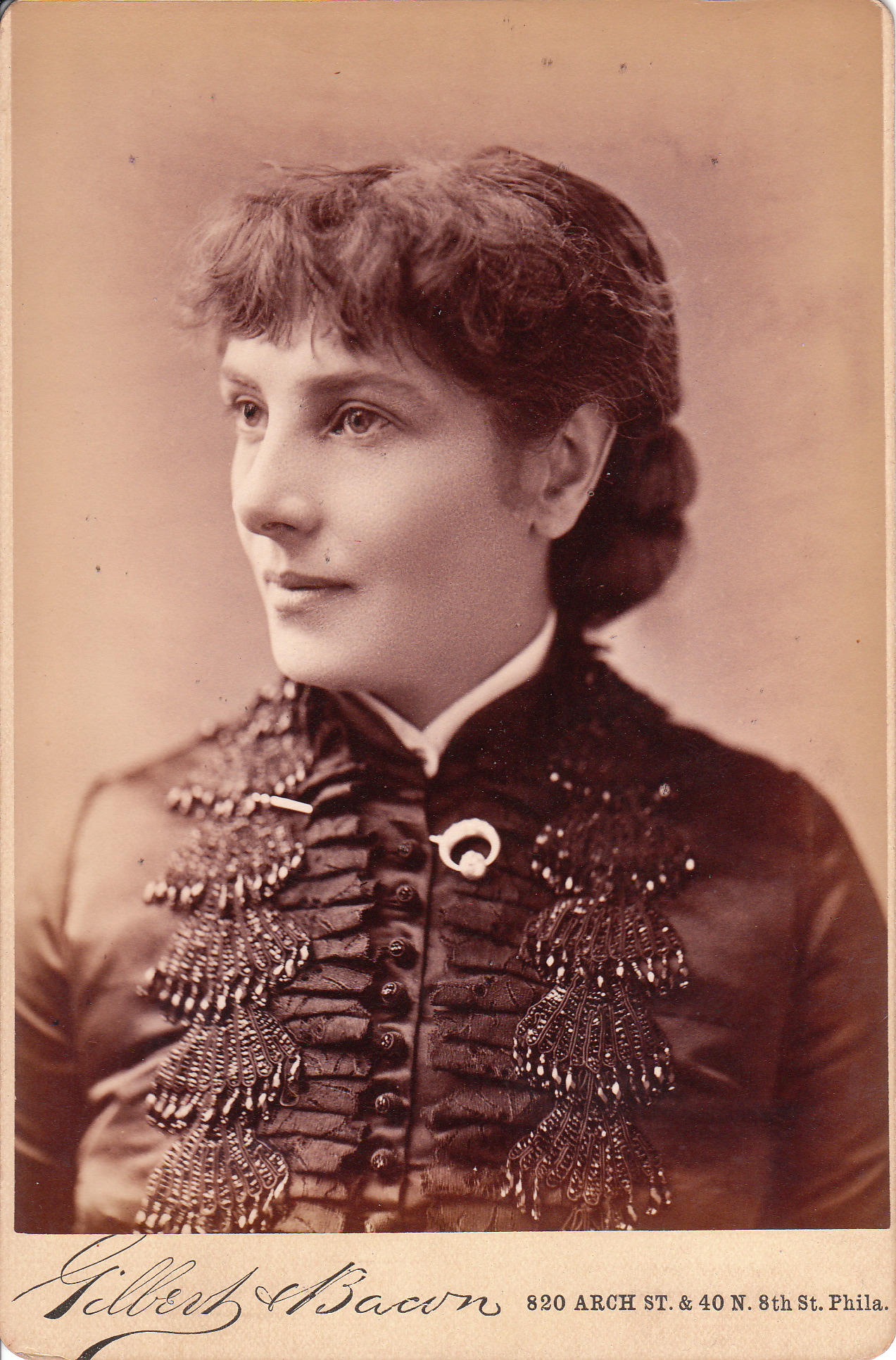
This is an unusual cabinet card portrait for two reasons. First, the pretty young woman who is the subject of this photograph is a New York city actress and certainly does not look the part. She is well dressed, but she is wearing conservative and “boring” attire. Overall, she looks more like the “woman next door” than a Broadway actress. She exudes a sweet and innocent disposition and she has a twinkle in her eyes. She doesn’t  give the appearance of a professional actress of that time. Where’s the histrionic flamboyance? Where’s the drama? Secondly, what’s wrong with the photographer, Napoleon Sarony. The fantastic celebrity photographer was not showing his usual bombastic flair when he posed and shot this photograph. Unlike many of his theatrical portraits, there is no fancy clothing or abundance of props in this portrait. The young lady in this image is named Maude White. Her name is written on the reverse of the photograph. However, there is a caveat worth mentioning. I encountered a problem while I was researching Maude White. I discovered that there was also an actress named Maud White who was performing during the same era. This became an issue because, despite the inscription on the back of the cabinet card, I could not be sure if the woman photographed was Maude White or Maud White. I attempted to find other photographs of both actresses but met no success. Due to the fogginess of the identification issue, I decided to research both Maude and Maud. The Internet Broadway Data Base reveals that Maude White appeared in one Broadway production, “The Ruling Power” (1904). However, Maud White made three appearances on Broadway (“Lost-24 Hours”(1895), “A Stranger in a Strange Land” (1899), and “There and Back” (1903). First, I will present some information gleaned from researching Maude. The New York Times (NYT) (1888) published an article about a soon to open play entitled “A Parisian Romance”. The star of the show was Mr Richard Mansfield and the supporting cast included Miss Maude White. The NYT (1888) later reviewed the play and made special mention of Maude. The review described her as “the danceuse (female ballet dancer) of the Opera” and reported that she played her role in a charming, pert, and clever manner. The NYT (1898) announced the soon to open comedy, “A Stranger in a Strange Land”, and that it would include both Mansfield and Maude. An article in the NYT (1900) stated that Maude would appear in Stuart Robson’s company that year. The NYT (1903) heralded the opening of a farcical comedy called “There and Back” and added that Maude would be a principal in the cast. An interesting story about Maude appeared in the NYT in 1905. The issue at hand was plagiarism. Maude had written a playlet called “Locked Out At Three AM” and she complained to the United States circuit court that the author of another play used some of her material. Maude had asked for an injunction and sued for damages. The NYT (1906) stated that Maude would be starring in the play “Nobody’s Fault”.  Now lets focus on Maud, rather than Maude.  In 1890, Maud was involved in some controversy and it was reported in the NYT. The title of the article was “Fritz Emmet Sobering Up”. Emmet was an established comedian who had a relationship with “John Barleycorn” that had produced many newspaper articles focussing on his drunken behavior. The article stated that there was  “a stormy sea” on the stage of the Hammerstein’s Harlem Opera House. Emmet had been drinking heavily for two weeks and creating much drama. His professional and personal life had become badly damaged. In his previous engagement in Philadelphia, Emmet had reached the point that he could no longer perform. The theater had to close the show, and fortunately for the theater, Emmet compensated them for their losses. Next stop was Harlem, but Emmet kept drinking excessively until the dramatic incident occurred on stage. At a Saturday night performance he “murdered his play”. While onstage he made many “Bacchanalian references” and exhibited other inappropriate words and actions.. Emmet’s adult son decided to put an end to his father’s out-of-control behavior. Just as the curtain went down on the last act of the play, Fritz’s son went on the stage where his father and Maud were standing. The son informed Maud that she would have to leave the theater company. Maud objected in a “vigorous manner” spurring the young Mr. Emmet to have her forcibly removed from the theater. Worse yet, he had her confined to a little storm house over the stage door. Basically, she was temporarily kidnapped. Maud cried and screamed “various better words” and even though Fritz tried to intervene, she was imprisoned until the police arrived. The police were called by the younger Mr Emmet and they promptly took Fritz to Manhattan Hospital where he was confined overnight. Maud was released and put in a carriage to go wherever she wanted to go. The story got worse for Fritz. Directly after this incident, his wife of 27 years, sued him for divorce on grounds of infidelity. They ultimately divorced and the settlement was costly for Fritz. Maud continued to perform and the NYT (1891) announced that Maud would be appearing in a play directed by Charles Frohman called “Mr. Wilkinson’s Widows”. That same year, she appeared in a Frohman production entitled “The Solicitor”. The NYT (1892) has an article reporting that Maud appeared in another Frohman production (“The Lost Paradise”). An 1895 NYT article states that maud was appearing with the Robert Hilliard Company in “Lost- 24 Hours” at the Hoyt Theater. The NYT (1897) has an article reporting her appearance in “The Wrong Mr Wright”. Maud received a complimentary review from the  NYT (1903) concerning her performance in the role of the “seductive Marie Antoinette” in the play “There and Back”.   (SOLD)

JENNIE WINSTON: INTERCONTINENTAL COMIC OPERA ACTRESS


CcCABINET CARD 1

  1. CABINET CARD 2  (SOLD)
  2. CABINET CARD 3    (SOLD)

gambier

CABINET CARD 4   (SOLD)

Cabinet Card 1 features early theatre actress, Jennie Winston. Unfortunately, biographical information concerning Ms. Winston appears to be sparse, and further research is necessary. An 1881 publication reveals that Jennie Winston was a native of Scotland and moved to Australia to join W. S. Lyster’s Italian Opera company. Her tenure with this company was seven years. She next went ot America under engagement to “Mr Maguire”, for whom she worked for one season’s duration. She then formed her own traveling opera company which journeyed to the western United States and British Columbia. The “Dramatic News” described Winston as “unsurpassed as a comic-opera artist by anyone in this country”. The photographer of this portrait was the studio belonging to Gilbert & Bacon. This studio was well known for their quality work as well as their work with local and visiting celebrities. To view other photographs by this studio, click on the category of “Photographer: Gilbert & Bacon”.

Cabinet Card 2 also by Gilbert & Bacon, captures a costumed Jennie Winston playing the mandolin. Note the backdrop  used in this photograph. The backdrop was an excellent choice for the photograph as it is compatible with Ms. Winston’s costume. It was also a good choice technically; the actress does realistically appear to be standing on a winding stone road.  (SOLD)

Cabinet Card 3 presents a portrait featuring a sultry looking Jennie Winston. The photograph is by celebrated photographer, Marc Gambier (1838-1900).  (SOLD)

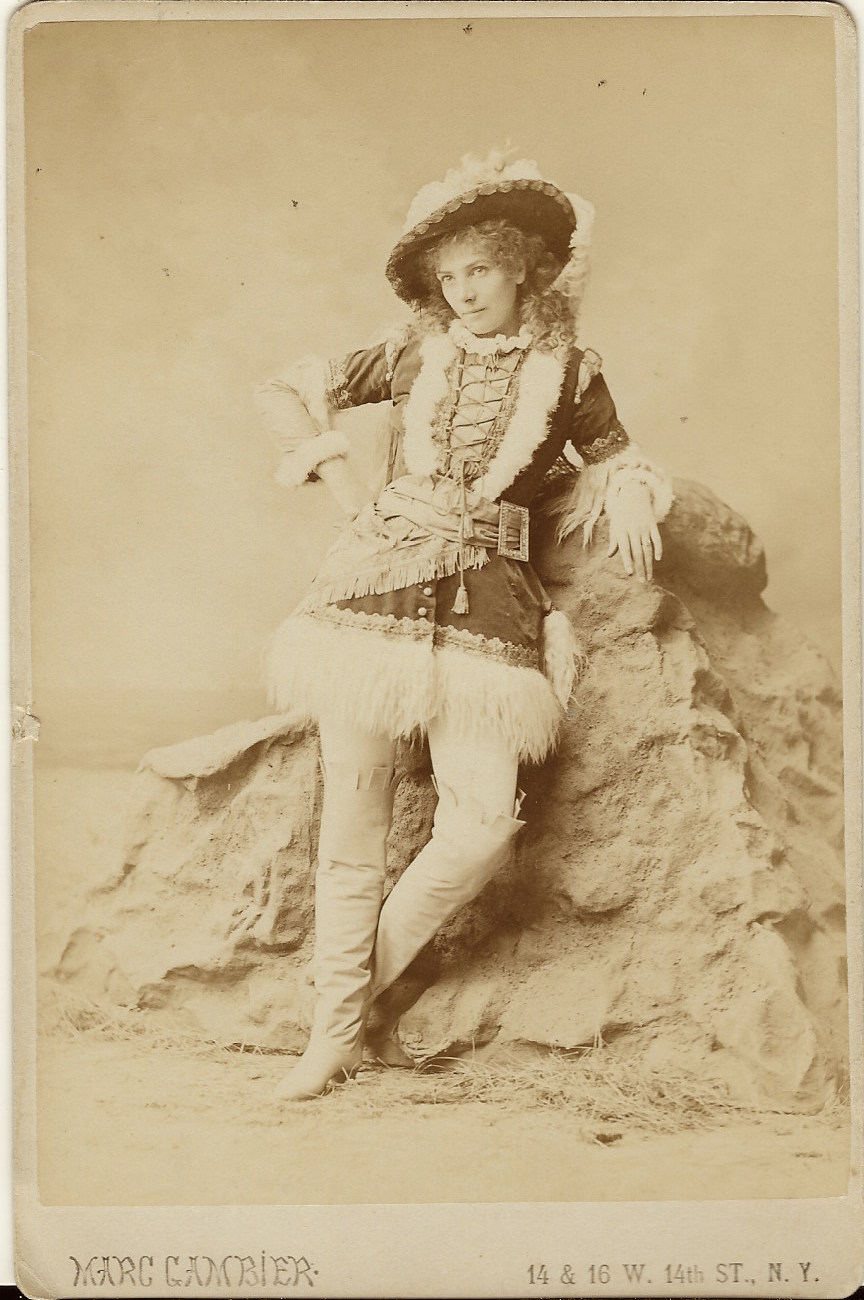
Cabinet Card 4 was also photographed by Gambier. Miss Winston is in costume for an unnamed theatrical performance. She is acting in the portrait. Note her provocative and coy appearance. Gambier was born and educated in Paris, France. At the age of 19, he came to America for a very short stint of time. He returned to France and became a student of the great painter, Le Creton. Subsequently, he became a student of another great painter, Camino. He then returned to America and for five years, studied and worked under esteemed photographer, Sarony (view Sarony’s photographs by clicking on the category “Photographer: Sarony”). He then launched his own photography business in New York City. He divided his time between his first love, painting, and his business of taking and selling photographs. Gambier was known as a great historical painter. He was a veteran of the French Army and while in the service, he sketched and painted several important battles. Research reveals that Gambier was listed in the 1880 US census. He was forty-one years old and living in New York City with his family. He is listed as living with his wife Emilie (age 28), daughters Louise (age 10) and Emilie (age 7), and son M. L. (age 2). Also in the residence was a young woman (age 25) who worked as a servant. Gambier was known for the many theatrical photographs he produced as well as for selling postage stamp sized portrait photographs, that people attached to their letters and postcards.   (SOLD)